Showing posts with label International trade. Show all posts

Monday, April 16, 2018

Syrian Conflict: Australia Could Run Out Of Fuel In 43 Days, Would Be ‘MAD MAX World’


Australia is at risk of running out of fuel in the next few weeks due to the ongoing conflict in Syria. The escalating situation in the war-torn country threatens to cripple the supply chains that keep Australia going.


While the International Energy Agency mandates that countries hold a stock reserve “equivalent to 90 days of net imports,” Australia only has 43 days worth of supply, the Australian reports. And that could be cut down even further if a global crisis threatens supply channels from places like the Middle East.


Low oil reserves and an over-dependence on imports is what’s driving Austrailia’s fuel concerns.  Defense Strategy and Capability at the Australian Strategic Policy Institute senior analyst Dr. Malcolm Davis says Australia’s fuel reserves would last “20 days at best” if supplies were cut off, News.com.au reports. “[Australia is] one of the few countries in the world that does not take our energy security seriously,” said Dr. Davis. “It would be a Mad Max world. Our society and our economy would begin to fall apart very quickly… [because] everything depends on fuel to make an economy run. It is very serious.”


The rather ominous forecast comes in the wake of major US-led strikes on the Syrian government. As tensions escalate and threaten to compromise international trade, this could prove dire for Australia: a nation that outsources its oil refining to such international locations as Singapore. “Instead of investing in refinement facilities here for refining fuel, the government has decided it’s cheaper to do it overseas,” said Dr. Davis. “The price they pay for that in a crisis is that China can interrupt flow to Australia [from Singapore] relatively easy and our economy falls apart.”


According to The Daily Mail UK, liberal Senator and former major general in the Australian Army Jim Molan agrees that “we [Australia] stand[s] in real trouble.” Speaking to 2GB on Monday Morning, Molan criticized the government’s passive approach to issues of fuel supply and energy security, calling it “a single point of failure for Australia.”


“The way that we seem to get around this is that we buy credits overseas which ignores the entire problem,” Nolan said. “Those credits say that if things go wrong we can buy from overseas, but hang on: our supply lines of communication by ship are likely to be either threatened or because of insurers nothing will come to us at all.”


Moreover, a chronic shortage of petrol, diesel, and aviation fuel could render the Australian military immobile, and in these times where rhetoric and tensions over a war are high, that could prove disastrous for the country.

Wednesday, December 27, 2017

Venezuelans Abandon Bolivar - Merchants Insist On Being Paid In Dollars

Venezuelans are struggling to carry out basic transactions like purchasing food as the value of their currency, the bolivar, has plunged against the dollar amid the country’s worsening economic collapse.


According to Reuters, over the past year, Venezuela’s currency weakened 97.5% against the greenback: Put another way, $1,000 of local currency purchased in early January would be worth just $25 now. The annual inflation rate in 2017 could reach $2,000. Though at least one other estimate puts the real rate of inflation closer to 2,800%.


Of course, President Maduro has blamed websites like DolarToday – which publishes the closest thing to an official black-market rate by surveying clandestine exchanges in Caracas and other cities – for the spread of black-market activity, part of a conspiracy organized by Washington and his local political opponents to force him from power.


One of the unintended consequences of the bolivar’s collapse has been a social experiment of sorts in the use of digital currencies: As we noted back in October, as many as 100,000 people are now mining digital currencies in Venezuela, defying a government crackdown that’s seen many of them thrown in prison.


But for those who can’t or haven’t resorted to transacting in bitcoin, an increasingly scarce supply of dollars is creating intractable problems for millions of Venezuelans, Reuters reported.


For many, simple purchases like a new tire for their car are simply out of reach.


There was no way Jose Ramon Garcia, a food transporter in Venezuela, could afford new tires for his van at $350 each.


Whether he opted to pay in U.S. currency or in the devalued local bolivar currency at the equivalent black market price, Garcia would have had to save up for years.


Though used to expensive repairs, this one was too much and put him out of business. "Repairs cost an arm and a leg in Venezuela," said the now-unemployed 42-year-old Garcia, who has a wife and two children to support in the southern city of Guayana.


"There’s no point keeping bolivars."


A practice that was initially adopted by shops catering to wealthy and middle-class Venezuelans is spreading to merchants selling everything from foodstuffs to medicine. Food sellers, dental and medical clinics, and others are starting to charge in dollars or their black-market equivalent - putting many basic goods and services out of reach for a growing number of Venezuelans.


"I can’t think in bolivars anymore, because you have to give a different price every hour,” said Yoselin Aguirre, 27, who makes and sells jewelry in the Paraguana peninsula and has recently pegged prices to the dollar. “To survive, you have to dollarize."


The socialist government of the late president Hugo Chavez in 2003 brought in the strict controls in order to curb capital flight, as the wealthy sought to move money out of Venezuela after a coup attempt and major oil strike the previous year.


Oil revenue was initially able to bolster artificial exchange rates, though the black market grew and now is becoming unmanageable for the government.


Still, President Nicolas Maduro has maintained his predecessor, the late Hugo Chavez’s policies on capital controls, even as the spread between the official rate - some 10 bolivars per dollar - and the black market rate - of around 110,000 per dollar - is now huge.


The trend is angering Venezuelans who don’t have access to dollars. As Reuters pointed out, it also dampened Christmas celebrations this year due to a shortage of pine trees, toys, meat, chicken, cornmeal…the list goes on.


While sellers see a shift to hard currency as necessary, buyers sometimes blame them for speculating.


Rafael Vetencourt, 55, a steel worker in Ciudad Guayana, needed a prostate operation priced at $250.


“We don’t earn in dollars. It’s abusive to charge in dollars!” said Vetencourt, who had to decimate his savings to pay for the surgery.


Most Venezuelans, earning just $5 a month at the black-market rate, are nowhere near being able to save hard currency.


"How do I do it? I earn in bolivars and have no way to buy foreign currency," said Cristina Centeno, a 31-year-old teacher who, like many, was seeking remote work online before Christmas in order to bring in some hard currency.


While many have begun mining bitcoin, purchasing the digital currency is also out of reach for many, since they would need to first convert their bolivars into dollars.


As the bolivar has continued to plummet, some communities have begun experimenting with alternative currencies that derive their value from a limited supply. In one Caracas neighborhood, several shops have started accepting the panal, one such alternative currency.


With the supply of dollars drying up since Maduro announced that the state-owned oil company would no longer settle payments for oil exports in greenbacks, it’s likely only a matter of time before more of these alternative paper currencies start springing up.


That is, unless the price of oil – which broke above $60 today – makes a surprising and altogether unlikely comeback.


Monday, December 25, 2017

Chinese Stocks Spooked By Apple iPhone X Forecast Cut, Nikkei Boosted By BOJ Hopes

With most global markets closed for Christmas, the only overnight action was in Asia, which saw Chinese equities fall with tech stocks and names linked to Apple the worst performers after a report that Apple cut forecast iPhone X sales forecasts, while property firms surged on speculation of coming consolidation. As a result, after opening higher, the Shanghai Composite Index closed 0.5% lower on the day, the blue-chip CSI 300 Index fell 0.3%, the Shenzhen Composite Index retreated 0.9%, while the ChiNext small-cap and tech Index dropped 1.3%. The PBOC"s refusal to conduct a reverse repo for the second day did not boost the market mood.


The biggest Asian losers were Apple suppliers after the Taipei-based Economic Daily News reported that Apple has cut its sales forecast for the iPhone X by 40% from 50 million in Q1 to only 30 million. The report also noted that Foxconn’s Zhengzhou plant stopped recruiting workers. Following the news, Apple supplier Lens Technology Co. dropped 8.4% to be among worst performers on the ChiNext measure; Shenzhen Sunway Communication Co. -2.2%, Luxshare Precision Industry and GoerTek both dropped at least 4%. As the table below shows, it was a sea of red for Apple suppliers.


Offsetting the drop in tech names was strength among property firms: Gemdale rose 6.3% as the best performer on CSI 300 measure after Citic Securities analysts said that the planned strict implementation of property curbs in 2018 would boost industry consolidation and benefit big companies. Unless, of course, it ends up crippling the business for everyone in which case today"s spike will promptly turn into a selloff.


Elsewhere in open Asian markets, Japan"s Nikkei erased early losses and scraped out gains on Monday as expectations that the Bank of Japan would buy more exchange-traded funds (ETFs) offset drops by financial stocks, Reuters reported. Movements in Japanese equities were confined to a narrow range with foreign investor presence lacking due to Monday"s closure of other major markets for Christmas; as a result, the Nikkei finished 0.16% higher at 22,939.18.


Of Tokyo"s 33 subsectors, 10 were in the red, led by securities T and banking after their U.S. financial peers lost steam on Friday following their recent strong performance. Denim clothing store operator Jeans Mate 7448.T soared 20.2 percent after reporting that December existing store sales increased 13.2 percent from a year earlier.  Furniture and interior goods seller Nitori Holdings 9843.T sank 6.4 percent after the company saw its operating profit for the nine months through to Nov. 20 rise a modest 0.3 percent to 70.4 billion yen ($621.58 million).


Cryptocurrency related shares slipped following recent wild swings in bitcoin. Internet provider GMO Internet which is engaged in the "mining" of bitcoin, fell 4.8%.  Remixpoint, an operator of virtual currency trading post services, dropped 4%.


In FX, it was a quiet session, with the only major mover once again out of China, where the yuan surged over 240bp to hit 6.5514 per USD at one point, the strongest since mid-September. Earlier in the day, the PBOC raised the yuan’s fixing by 138bp to 6.5683 per USD, the highest since Sept. 20. The dollar was little changed against other major currencies on Monday in holiday-thinned trading while the cost of swapping the yen for the dollar jumped as banks scrambled to raise dollars for the year-end period.


With most currency trading centers except for Tokyo shut on Monday for Christmas, trading volume was less than 20 percent of the average for major currency pairs including the euro/dollar and the dollar/yen. 


According to Reuters, the discount for buying the yen at future dates widened sharply as non-U.S. banks, which typically buy dollars now with sell-back contract at a future date, scrambled to procure greenbacks for the year-end.  The one-week forward discount starting from Wednesday jumped to 0.23 yen from around 0.04 yen in the middle of last week.


“Because foreign banks are away and few market players are eager to offer dollars, the forward market is very thin,” said a currency trader at a major Japanese bank. “The market is very volatile and there are hardly any trades beyond one week."


Wednesday, November 29, 2017

Is It Tuesday? Time For Another Banking Scandal...

Authored by Simon Black via SovereignMan.com,


Another day, another major banking scandal.


It’s getting to the point where you can practically set your watch to these things.


The latest involves our old friend Wells Fargo.


The Wall Street Journal reported last night that Wells has been screwing its customers on foreign currency exchange rates.


According to the Journal, Wells Fargo conducted an internal review of its fee arrangements and found that they had massively overcharged 88% of the sampled customers.


For example, the bank might have signed a contract with a customer to charge 0.15% on foreign currency transactions, but instead charged as much as 4%… about 26x higher than agreed.


It’s absurd to begin with that a bank would charge even a small percentage-based commission on foreign currency transactions (much less 4%), especially given that most of the transactions were to exchange euros and US dollars.


Sure, commissions are common in many industries.


When you list your house for sale, for example, your real estate agent receives a commission when s/he finds a buyer and closes the deal.


Real estate commissions often range between 2% to 6%. But agents earn this money because houses are big, illiquid assets. And it often takes a lot of time and work to close a sale.


But Wells Fargo has been charging huge commissions on buying and selling MONEY.


The foreign exchange (FX) market trades around $5.3 trillion each day (compare that to about $200 billion for US equities). That makes the US dollar / Euro trade literally one of THE most popular financial transactions in the world.


Billions upon billions of dollars and euros are exchanged every single business day of the week, around the clock, through electronic trading platforms.


It’s not like some currency trader at Wells Fargo ever had to lift a finger trying to find a buyer for his customer’s euros.


Anyone who has ever traded FX knows that it takes a fraction of a second to buy/sell major currencies.


There’s zero work involved on Wells Fargo’s end. Yet they charge a steep commission as if they have to put in all sorts of time and effort to buy and sell currency. It’s ridiculous.


But even worse, the bank formally agreed with its customers to charge a set fee. And then they totally violated those promises simply because it suited their interests.


How utterly, completely pathetic.


Bear in mind, this is the same bank that was caught creating fake accounts and charging fees to unsuspecting consumers without their consent, also because it suited their interests…


… and that this is an industry that has a track record of constantly violating their customers’ trust.


These banks have been caught red-handed illegally colluding to fix interest rates and exchange rates.


They have manipulated asset prices and knowingly sold their customers toxic assets.


They have invested their customers’ hard-earned savings in astonishingly stupid, no-money down loans to borrowers who had no hope of repaying the debt.


They use every accounting trick in the book to misstate their true financial condition, including the utter farce of carrying Volcker Rule assets on their books at 100 cents on the dollar… or mysteriously reclassifying their bond portfolios in a way to hide losses.


They reward themselves the most magnificent bonuses when times are good.


And when the house of cards begins to fall, they go to the public with hat in hand, claiming that they’re too big and important to lose any money.


Despite taking the public’s bailout money, these banks treat their customers with such contempt and suspicion. They make you feel like you’re committing a crime when you request a cash withdrawal of your own money.


It’s truly remarkable that this industry has any credibility left.


The good news is that it won’t last.


Banks no longer have a monopoly on finance. Technology already makes it possible to conduct just about any transaction you need outside the banking system.


You can deposit and withdraw funds, borrow money, exchange currency, invest your savings, pay bills, transfer funds, make online payments, etc. with cryptocurrencies, Peer-to-Peer platforms, and various blockchains.


And these technologies are often better, faster, and cheaper than the traditional banking system.


History tells us that technology almost invariably puts entrenched industries out of business.


E-commerce is obliterating traditional retail. Digital media is destroying print media.


And it’s only a matter of time before cryptofinance displaces the banking system.


Whether or not you think Bitcoin is a bubble at $10,000, it’s still worth understanding the enormous potential (and opportunities) of what these technologies can provide.


Because the alternative of dealing with Wells Fargo isn’t that attractive.


Friday, November 10, 2017

Putin, Trump Meet In Vietnam: This Handshake Followed

While officials cited "scheduling conflicts" that dashed hopes of a bilateral meeting between President Trump and President Putin on the sidelines of the APEC summit, the two "old friends" came face-to-face during the photo-op at the start of the conference... and the handshake took place...


The two were all smiles while shaking hands during the photo call...


Preparing for the traditional leaders’ photo at the Asia Pacific Economic Cooperation (APEC) summit – held this year in Da Nang, Vietnam – Putin had already taken his spot when Trump approached him, extending his hand. In the manner which has become famous, the US president then held onto Putin’s hand for several seconds, patting his counterpart on the back.


The leaders were dressed in Vietnamese national attire, in accordance with the informal APEC tradition. Both Putin and Trump put on blue shirts, while some of the other participants chose to wear white ones.


Notably the positioning of the leaders this year...right next to the Vietnamese leader and Putin...


Quite different from that of three years ago when President Obama appeared to be demoted to the old wives club...


Friday, October 6, 2017

Tariffs On Washing Machines Coming Up; Mish Rages "Let's Tax The Sun And The Rain Too"

Authored by Mike Shedlock via MishTalk.com,


Whirpool bitched to the Trump administration and the International Trade Commission about unfair pricing on Samsung and LG-brand washing machines.


The ITC panel ruled U.S. washing machine makers hurt by South Korean imports, so your price is guaranteed to go up.


The U.S. International Trade Commission on Thursday found that imports of large residential washing machines were harming domestic producers, in a major step the imposition of duties or quotas on foreign-made Samsung- and LG-brand washers.


The case, brought by U.S. appliance giant Whirlpool Corp, asked the ITC to recommend to President Donald Trump “global safeguard” restrictions on imported washing machines to stop South Korean rivals Samsung Electronics Co Ltd and LG Electronics Inc from flooding the U.S. market with cheap washers.


The commission, which voted 4-0 in finding that large residential washers were being imported in such quantities to create injury to domestic producers, will recommend remedies by Dec. 4 to Trump, who is expected to make a final decision by early next year.


Crony Capitalism


The ITC ruling will not save a single US job. But it will drive up costs on US consumers.


When corporations cannot compete, they bitch. They also pad the pockets of politicians so the politicians see things their way.


French economist Frédéric Bastiat wrote about this in 1845. I encourage everyone to read Bastiat’s famous Candlestick makers’ Petition.


The petition was a sarcastic proposal on behalf of candle makers and similar occupations to tax the sun for the unfair practice of providing free light.


Were it not for the sun, there would be more jobs for the manufacturers of Candles, Tapers, Lanterns, sticks, Street Lamps, Snuffers, and Extinguishers, and from Producers of Tallow, Oil, Resin, Alcohol, and Generally of Everything Connected with Lighting says Bastiat in his petition.


Let’s Tax the Sun and the Rain


Bastiat’s petition explains the folly of tariffs. Samsung is no more stealing jobs than is the sun.


Speaking of which, the US has massive sugar tariffs to protect the sugar lobby from “unfair competition” from countries that happen to have better-growing conditions for sugar cane because they get more sunlight and water.


Hmm. It seems we need to tax water for falling into Lake Superior and Lake Michigan instead of the desert where’s it’s badly needed.


Why should Illinois farmers get more rain than Arizona farmers? By tariff logic, we need to level out the playing field so that all corn farmers in Arizona and Greenland are not disadvantaged compared to Illinois.


Related Articles


  1. Reflections and Reader Comments on Free Trade: “China Doesn’t Play Fair!”

  2. Disputing Trump’s NAFTA “Catastrophe” with Pictures: What’s the True Source of Trade Imbalances?

  3. Trump Accuses Germany of “Currency Exploitation”: Merkel vs. Trump, Is Either Side Telling the Truth?

  4. Navarro Nonsense and the Folly of Trump’s Proposed Tariffs

All this talk of “fair trade” is complete nonsense. The only “fair trade” is free trade.


Those who wish to understand the true source of escalating trade imbalances need look no further than Hugo Salinas Price and Michael Pettis on the Trade Imbalance Dilemma; Gold’s Honest Discipline Revisited.

Wednesday, October 4, 2017

Switzerland Tops World's Most Competitive Countries Index (Yemen Least)

Something else "Murica is no longer #1 in...


A recently released World Economic Forum report has found that the global economy is recovering well nearly a decade on from the start of the global financial crisis with GDP growth hitting 3.5 percent in 2017. The eurozone in particular is regaining traction with 1.9 percent growth expected this year. As Statista"s Niall McCarthy points out, the improvement in Europe"s economic fortunes can be seen in the report and the following infographic which shows that six European economies are among the world"s ten most competitive.


Infographic: The World


You will find more statistics at Statista


The World Economic Forum defines national competitiveness as the set of institutions, policies and factors determining productivity levels


Switzerland grabbed top spot in the report with an index score of 5.86 out of 7, recording strong and balanced results across the most important determining factors such as health, primary education and a reliable macroeconomic environment.


The United States comes second for national competitiveness, though the report notes that it needs to improve its macroeconomic environment as well as health and education, both of which scored poorly.


Eight of the world"s ten worst countries for national competitiveness were in Africa.


Yemen has been devasted by war in recent years and it comes bottom with a score of 2.87. It was followed by Mozambique and Chad, both of which had a score of less than three. The only other non-African country in the bottom ten was Haiti which scored 3.22.

Friday, September 22, 2017

"You're Going To See A Rush For Gold" - Katusa Warns De-Dollarization Is Accelerating

Authored by Mac Slavo via SHTFplan.com,


Global strategist Marin Katusa is the New York Times best selling author of The Colder War, which details the geo-political power shift that threatens the global dominance of the United States. He’s also a well known resource hedge fund manager who legendary investor Doug Casey has called one of the best market analysts he’s ever worked with.


His prior forecasts noted that countries around the world would soon stop trading commodities like oil in the U.S. dollar, something we’re already seeing with China, Russia, Iran, and Venezuela, all of which are preparing non-dollar, gold-backed mechanisms of exchange.


This trend, according to Katusa in a must see interview with Future Money Trends, will only continue to weaken the U.S. dollar going forward and the result will be a massive capital flight to gold in coming years:


I think we’ll have a near term bounce on the U.S. dollar… then it’s going to be very weak… and then it’s going to go much, much lower… With China and Russia working together to de-dollarize the U.S. dollar starting with oil, which is the biggest market… and then all the other commodities.


You’re going to start seeing a massive unwind of these U.S. dollars in the emerging markets.


...


When that money comes back… which it will… and the world starts cluing in that the emerging markets need gold to convert the Yuan and the Ruble and all these different factors, you’re going to see a massive rush for gold.


Watch the full interview:


Katusa notes that he is preparing to “load up” on gold-based assets as the dollar strengthens and puts additional pressure on gold prices, but says that by next year major fund managers will start moving capital back into precious metals in response to dollar weakness, global de-dollarization and economic crisis:


Everybody wants to rush in when something’s exciting… but you take your position before the massive flow of money…


I think we have a near term dead cat bounce for the U.S. dollar… which will mean we’re going to have a little bit of weakness here in gold in the near term… the next six months is my time to load up.


…And when the funds flow come in… it’s going to be the equivalent of Niagra Falls coming through your garden hose.


The geo-political realignment taking place now stands to upend the financial and economic systems as we know them. This shift will not come without crisis and panic. The time to position yourself in gold-based assets is now.

Wednesday, September 20, 2017

US Sanctions Against Venezuela Will Hurt Americans


After fifty years of imposing embargoes and other sanctions, the United States never managed to topple Cuba"s communist regime.


After forty years of the same in Iran, the US met with similar amounts of success.


Ongoing sanctions against North Korea have not toppled to regime there. 


But, some people in Washington won"t let decades of failure dissuade them. 


Last week, Congressman Mike Coffman (R-Colo.) introduced new legislation to bar Americans from importing oil products from Venezuela. The Washington Examiner reports


[T]he Protecting Against Tyranny and Responsible Imports Act, or the PATRIA Act ... would target Venezuelan President Nicolas Maduro after he stripped the country"s democratically elected national assembly of its power and authority. According to the bill, the proposed ban on imports would last until the assembly"s power is fully restored.


"The goal is to change the conduct, the character of the Venezuelan government under Maduro. I think the window is closing," Coffman told the Washington Examiner. "They are dependent upon the export of oil really to fund their government, and without that, they can"t pay their security forces."


Experience suggests there is little reason to believe that sanctions will cause the regime to give up in Venezuela. If the regime has less oil money with which to pay the military, the regime can always steal more from the average citizen to make up the difference. In other words, ordinary Venezuelans will suffer more in response to US sanctions. 


oilprice.png


Source. 


Moreover, aggressive moves such as these against the Venezuelan regime have tended to only solidify support for the regime among its supporters. Both the current president Maduro, and his predecessor Hugo Chávez, were both successful in building support for themselves on a platform of opposing US meddling in Venezuelan political and economic institutions. 


When the US threatens to intervene in local politics, this only strengthens the resolve and support of the regime"s supporters. 


The US has already been acting in a reckless manner in this regard, as illustrated by President Donald Trump"s recent speculations about invading Venezuela to effect regime change. As noted by Daniel Politi at Slate, American threats directed at the Venezuelan regime do nothing to help the opposition


Throughout his power grab that has accompanied Venezuela’s descent into chaos, Maduro has long warned the United States was planning to invade the country. Trump’s words seemed to play straight into his narrative, recalling a time when Washington saw Latin America as its backyard where it could intimidate governments into doing its bidding.


“Maduro must be thrilled right now,” said Mark Feierstein, who was a senior aide on Venezuela to former president Barack Obama. “It"s hard to imagine a more damaging thing for Trump to say.”


Similarly, threatening Venezuela with more sanctions — something that may make the regime even more violent and desperate — do nothing to help the Venezuelan people in general, and only energize the regime"s base. 


Coffman claims the sanctions would be lifted if the Venezuelan regime were to restore the prerogatives and power of the national legislature, which has essentially been disbanded by Maduro. 


In recent months, the Venezuelan regime has rapidly become more dictatorial as forces loyal to Maduro have increasingly clamped down on opposition politicians and essentially ignored the results of recent elections that have brought many opposition leaders to power in the National Assembly. 


The working philosophy here, apparently, is that the imposition of sanctions will force the Venezuelan regime to democratize in response. One would be hard pressed to find examples of similar tactics actually working, however.


More astute observers might also ask why — if Coffman is so committed to democracy — he hasn"t called for similar embargoes of Saudi Arabian oil. The Saudi regime, of course, has been a dictatorship ever since its founding, sponsors international terrorism, and tolerates no religious freedom or freedom of speech. The Saudi regime, for instance, routinely arrests critics of the regime, and the regime"s spokesman has outright denied that elections should be allowed in Saudi Arabia. 


If human rights are of such pressing concern to the Congressman, its unclear why Venezuela is at the top of the sanctions list. 


As with all Trade Sanctions, Americans Suffer 


As with any discussion of sanctions, of course, we need not even consider the strategic futility of sanctions, or the morality of foreign regimes. 


Far from being a matter only of concern to foreigners, US sanctions are built on the cornerstone of limiting the freedoms of Americans.


As I noted earlier in regards to the Cuban embargo


[S]upporting an embargo means supporting the government when it fines, prosecutes, and jails peaceful citizens who attempt to engage in truly free trade. Support for an embargo also requires support for a customs bureaucracy that spies on merchants and consumers, and the whole panoply of enforcement programs necessary to punish those who run afoul of the government’s arbitrary pronouncements on what kind of trade is acceptable, and what kind is verboten. Naturally, this is all paid for by the taxpayers...


At their heart, embargoes are nothing but a specific type of prohibition. Sometimes, the government imposes prohibitions on transactions involving certain goods, such as cannabis. Other times, the prohibition extends to all transactions with people in a certain place. The fundamentals are the same, however, in that they prohibit peaceful exchange, with heavy penalties for violators.


In the case of a new embargo against Venezuela, the effect would be to place prohibitions on American importers, and thus drive up prices for oil and energy for all Americans. Government bureaucrats would be dispatched to monitor private industry to make sure they don"t violate the prohibitions. Government agents will impose fines, and make arrests if necessary. The American government will become more powerful at the expense of American consumers and American taxpayers. 


Indeed, this has already been going on with smaller-scale sanctions imposed by the Trump administration against Citgo oil refineries. Thanks to the sanctions, Citgo refineries in the US, which constitute four percent of American fuel capacity, and which employ American workers, are finding it more costly to obtain the oil they need for the refineries. Both domestic and foreign suppliers must scramble to work around the new regulations in order to avoid fines and lawsuits from government regulators who oversee trade. The effect of this will be to put pressure on more marginal employees and on more marginal operations, leading to layoffs and diminished refining capacity. Ultimately, it is Americans who will pay the price.

Tuesday, September 12, 2017

United Nations Unanimously Approves New Sanctions On North Korea

The UN Security Council has unanimously voted to step up sanctions on North Korea in retaliation for the country’s recent sixth and most powerful nuclear test. The 15-member Security Council passed the resolution unanimously, with both China and Russia siding with the US against North Korea, which however should not come as a surprise because as previewed this morning, the US drastically watered down its original sanctions proposal, which now excludes Trump"s prior demands for an oil import ban as well as international asset freeze on the government and leader Kim Jong Un, in order to win the support of Moscow and Beijing. This was the ninth sanctions resolution unanimously adopted by the 15-member council since 2006 over North Korea’s ballistic missile and nuclear programs.


Despite the compromises, U.S. Ambassador Nikki Haley said the resolution would cut North Korean exports by 90% and reduce the refined products available to North Korea by 44% and fuel by 30%. “Today we are saying the world will never accept a nuclear armed North Korea,” she said. “This will cut deep.”


Well, not really: the resolution slashes 55% of the country’s gas, diesel and heavy fuel imports, imposing a ban on condensates and natural gas liquids, a cap of 2 million barrels a year on refined petroleum products, and a cap on crude oil imports at current levels, in other words N.Korea"s oil flow remain untouched (as a reminder, China supplies most of North Korea’s crude). According to US officials quoted by Reutrs, North Korea imports some 4.5 million barrels of refined petroleum products annually and 4 million barrels of crude oil.


The new resolution also will impose an embargo on all textile trade and require inspections and monitoring of North Korea’s sea vessels by member states, but doesn’t provide for the use of military force to gain access to the ships.


According to the WSJ, a proposed ban on North Korean foreign workers, a source of an estimated $1 billion in annual revenue to the regime, also was reworded to allow countries to employ North Korean nationals if deemed vital for humanitarian reasons. It also doesn’t apply to workers who hold contracts taking effect before the adoption of the resolution.


Previously, China and Russia - veto-holders on the 15-member Security Council - had voiced opposition to harsher measures and threatened to block the vote if the ban on oil remained. China is reluctant to pressure the North Korean regime to the brink of collapse fearing instability at its border, a flow of refugees and a possible American military presence. Both Russia and China have said they favor direct talks and not sanctions.


Nikki Haley said that the sanctions will target $1.3 billion in North Korea revenue. The US ambassador to the UN added that the "strong relationship between Trump and Xi played a key role in negotiating the new UN sanctions", or translated: China imposed its terms on the US proposal so that China would note veto the mostly optical measure, to avoid making Trump look weak again in the UN. She also said that the US is "not looking for war" with North Korea, and added that North Korea has not yet "passed the point of no return." That said, by now it is completely unclear just what would entail passing said "point of no return."


After a week of intense negotiations, a unanimous Security Council vote against North Korea was viewed as politically more important than a strong U.S. stand that risked division, diplomats said. “Any perception of weakness on the side of the Security Council would only encourage the regime to continue its provocations and objectively create the risk of an increasingly extreme situation,” said France’s Ambassador François Delattre.


Of course, further provocations by the regime at this point remain all too likely. And so, now attention turns to Pyongyang and North Korea"s response: overnight, the state-run KCNA agency unleashed numerous warnings and threats toward the US should the sanctions pass.  “In case the U.S. eventually does rig up the illegal and unlawful ‘resolution’ on harsher sanctions, the DPRK [North Korea] shall make absolutely sure that the U.S. pays due price,” the spokesman of the country’s Foreign Ministry said in a statement.


However, it is unclear if these drastically watered down sanctions, which have China"s explicit blessing, will be sufficient to prompt another ICBM launch and/or nuclear test. In any case, keep an eye on those flashing red headlines.

Monday, September 11, 2017

Poverty, Prosperity, and Precious Metals

Written by Jeff Nielson, Sprott Money News


In the 20th century; by the end of the 1960’s, Western societies and especially Canada and the United States reached a level of prosperity never seen before – or since. Since the early 1970’s; the standard of living across the Western world has been in a relentless trajectory downward.


An article from April 2012 noted that the standard of living in the United States had already fallen by more than 50% since its zenith. Since that time, the standard of living in the U.S. (and across the West) has been devoured by 5 ½ years more “inflation” – the same “inflation” that the criminal bankers and corrupt politicians insist does not exist.


At the end of the 1960’s; a chocolate bar cost a dime. Today, a smaller version of that same chocolate bar costs close to a dollar. That 90% loss in purchasing power of the paper in our wallets is all inflation.


The beginning of the collapse in our standard of living in the early 1970’s wasn’t the only event of note at that time. The early 1970’s also marked the end of the gold standard.


Coincidence?


From the end of World War II until the end of the gold standard, the standard of living across the Western world went almost straight up. Since Paul Volcker assassinated the gold standard, our standard of living has gone straight down. Seventy-five years of “coincidence”?


Of course not. The Criminals themselves have already confessed to their crime.


In the absence of the gold standard, there is no way to protect savings[wealth] from confiscation [theft] through inflation.


- Alan Greenspan


The correct, economic definition of inflation is simple: an increase in the supply of money. Print and steal. The bankers print more of their funny-money, and that dilution causes the value of the sunny-money to decline.


Where does the wealth go? Where has the 90% loss in the purchasing power of our paper gone since the bankers assassinated the gold standard? Into the bankers’ vaults.


All of the new funny-money that is printed up is handed to the Big Banks. The Big Banks, and only the Big Banks (and their oligarch owners) are immune to the crime of print-and-steal. Everyone else loses.


For 1,000 years, this has been the bankers’ Game. That is why for 1,000 years, every one of their paper fiat currencies has gone to zero. Print-and-steal long enough and eventually you reach zero.


The affluence of the end of the 1960’s was obvious: two-car garages, with only one wage-earner. Virtually everyone who wanted to own their own home could afford to do so, with no more than a 20-year mortgage.


Today, with the typical family, it’s two wage-earners and a one-car garage – for the fortunate minority who can afford to live in their own home. For many of the Working Poor, it’s two wage-earners, an apartment, and no car. And they are still luckier than many: the Homeless People. No car. No roof.


This is what 45+ years of print-and-steal has produced. Readers have been previously alerted to this crime against humanity.


At first glance, this chart may be indecipherable to some, insignificant to others. Look closer.


We see that even though the West and India have nearly identical populations, the West has more than 20% more of the poorest-of-the-poor. When we compare the West with Africa, we see that the West (with a slightly greater population) hosts a slightly greater percentage of the poorest-of-the-poor. In proportionate terms; the West and Africa have roughly identical percentages of the poorest-of-the-poor.


Let me repeat this. When it comes to the poorest people on Earth, as percentages of our populations, there are now more of the poorest-of-the-poor in the West than in India, and a virtually identical percentage when compared to Africa.


To be clear, when considering starvation-level poverty, the plight is still worse in so-called Third World nations. However, when it comes to the lowest two deciles of wealth (the bottom 20%), in proportionate terms there are more of such people in the West than in India – and the same amount as in Africa.


Things aren’t much better for the 30% of the population right above that.


About half of Canadian workers living paycheque to paycheque: survey


Print and steal. From one wage earner and a two-car garage to “paycheque to paycheque”.


Print and steal. The bankers’ Crime can’t continue for another 45 years because print-and-steal does more than impoverish populations. It bankrupts entire societies.


Global Debt Hits 325% Of World GDP, Rises To Record $217 Trillion


Most of this debt has been created in the West: 10% of the world’s population, more than half of the world’s debts. Debt Jubilee is now inevitable in the West. For most of the Rest of the World it will be a matter of choice: not allowing only the West’s Deadbeat Debtors to walkaway from their debts.


Greece already tried for its own Debt Jubilee – after its economy was totally destroyed by the economic terrorism of the One Bank. The bankers said “no”, telling this bankrupt nation that it had to borrow more money. How perverse is that?


As the holder of all these (illegal and unenforceable) debts, the One Bank will try to delay Debt Jubilee as long as possible. Until then, it is just more print-and-steal. But we do not have to be victims.


Our corrupt governments refuse to protect us from print-and-steal by resurrecting the gold standard. So there is no protection available at the Systemic level. However, we can still protect ourselves as individuals.


Regular readers and astute investors know the antidote to print-and-steal: precious metals. The logic could not be more elementary.


The crime of print-and-steal is how the bankers loot the wealth from inside our paper. How do we protect ourselves? We don’t hold our wealth inside the bankers’ paper. We store our wealth in gold and silver. There it is safe from the One Bank.


Forget about the phony paper prices for gold and silver. Their only significance is a favorable exchange rate when we jettison more of the bankers’ paper.


With our wealth safely stored in gold and silver, all that the Criminals are capable of doing is to temporarily depress the paper exchange rate – they are the Rulers of all that (fraudulent) paper. They can do no more than that. And even here it is important to maintain perspective.


Two thousand years ago in ancient Rome; with a one-ounce gold coin a gentlemen could purchase a suit of the finest clothing, along with accessories – a hand-made toga, belt, and sandals.


Five hundred years ago; with a one-ounce gold coin a gentleman could purchase a tailor-made suit, along with accessories.


Today, despite decades of the One Bank attacking the price of gold, with a one-ounce gold coin we can still buy a suit and accessories. We just have to buy “off the rack”.


Compare that to the 90% loss in purchasing power with the bankers’ paper. There is no comparison. Safety, or financial rape.


Paper = poverty. Precious metals = prosperity. It is a simple equation.


For a small number, they can earn more wealth even faster than the bankers are stealing it. For everyone else, the bankers’ paper is a one-way ticket to poverty.


Ignore the paper prices. Remember the equation. It may be your only financial hope.


Questions or comments about this article? Leave your thoughts HERE.


Written by Jeff Nielson, Sprott Money News


Friday, August 4, 2017

What Will The Coming Gold Standard Look Like

I gave a talk at FreedomFest last month. Unfortunately, the video was not recorded (not even the projector worked). However, the topic is so important that I recorded the talk back in my office, to put a video to put on the Internet. My talk covers 6 areas:


  1. Two pseudo gold standards

  2. What do people need from a monetary system?

  3. What is the role of the banker?

  4. Why does gold circulate or not circulate?

  5. A working definition of the gold standard

  6. How do we get from here to there?

The video can be found on YouTube here or watch it below. For those interested in additional reading material, see my articles on why the world needs an Unadulterated Gold Standard, how interest rates are set in a gold standard and the need to remove capital gains tax on gold (and why that isn’t cronyism).


© 2017 Monetary Metals

Monday, July 24, 2017

Against Irredeemable Paper, Report 23 July 2017

Something needs to be said. We are against the existence of irredeemable paper currency, central banking and central planning, cronyism, socialized losses and privatized gains, counterfeit credit, wealth transfers and bailouts, and welfare both corporate and personal.


When we write to debunk the conspiracy theories that say manipulation is keeping gold from hitting $5,000 (one speaker here at FreedomFest claimed gold will go to $65,000), we are not trying to defend the Fed. When we discuss the flaws in predicting that kind of price, and the error in expecting to profit from it, we are not expressing a pro irredeemable dollar view.


We are saying there are good arguments against the regime of irredeemable paper currency—but this is not one of them. Irredeemable currency has two fatal flaws. One is the interest rate is unhinged. It can skyrocket as it did from the end of WWII through 1980, or collapse as it has been doing since then. Two is there is no extinguisher of debt. Debt grows—must necessarily grow—exponentially. As it has been doing for many decades.


The antidote to this poisonous system is the gold standard. However, it must be said that no gold price will cause the metal to circulate in the economy. It did not circulate when it was “cheap” 20 years ago. It did not circulate when it was “expensive” 6 years ago. It does not circulate now. It will not circulate even if it hits any of the gold bug price targets (if anything, a rapid price rise will be a powerful force keeping it out of circulation, as most people would have large taxable capital gains).


The one thing that can make gold circulate is interest.


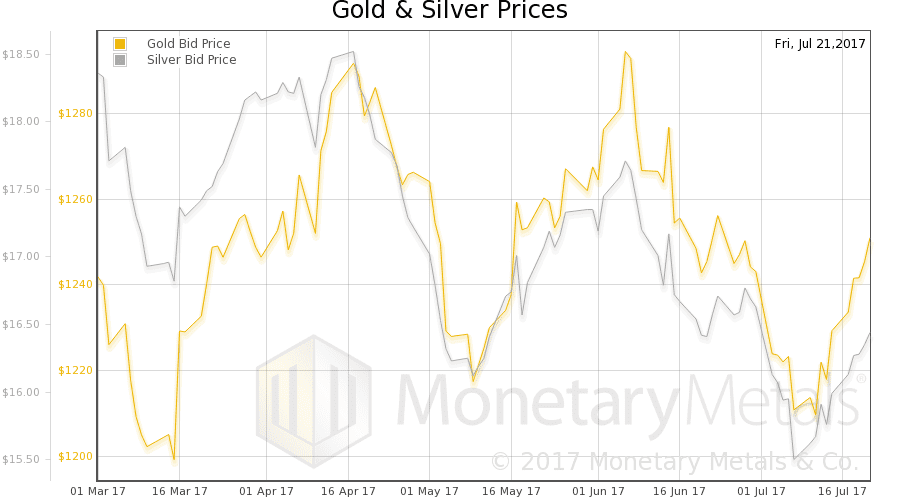
For two weeks, we have been talking about a potential capitulation. The gold price has risen about $40 since then, and that of silver 85 cents.


Will the bounce continue? Have the fundamentals firmed up?


We will show graphs of the true measure of the fundamentals. But first charts of their prices and the gold-silver ratio.


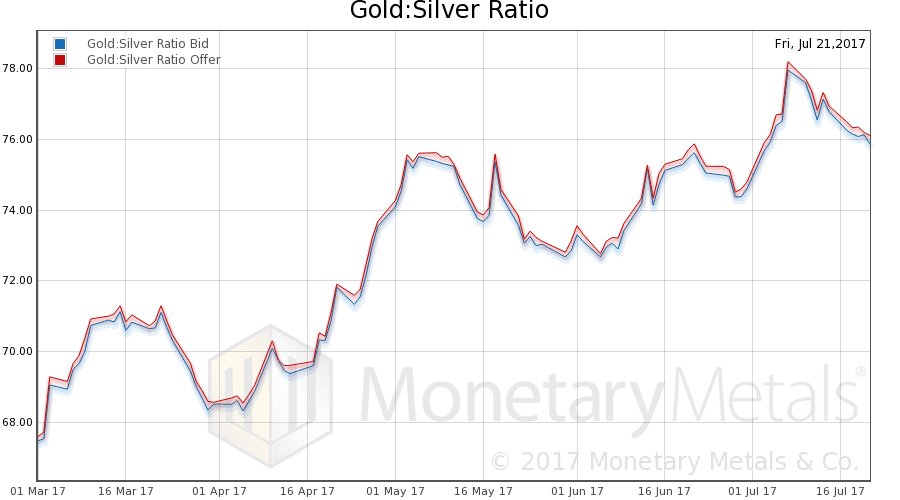
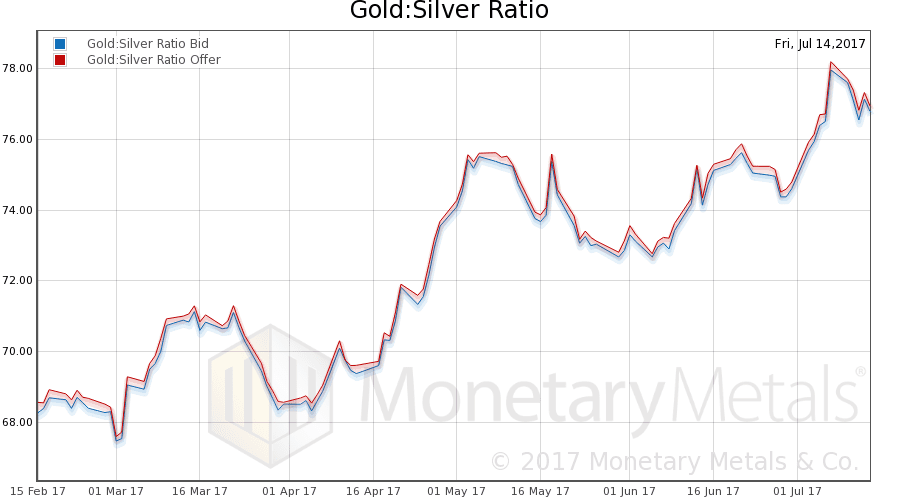
Next, this is a graph of the gold price measured in silver, otherwise known as the gold to silver ratio. The ratio moved down this week.


In this graph, we show both bid and offer prices for the gold-silver ratio. If you were to sell gold on the bid and buy silver at the ask, that is the lower bid price. Conversely, if you sold silver on the bid and bought gold at the offer, that is the higher offer price.


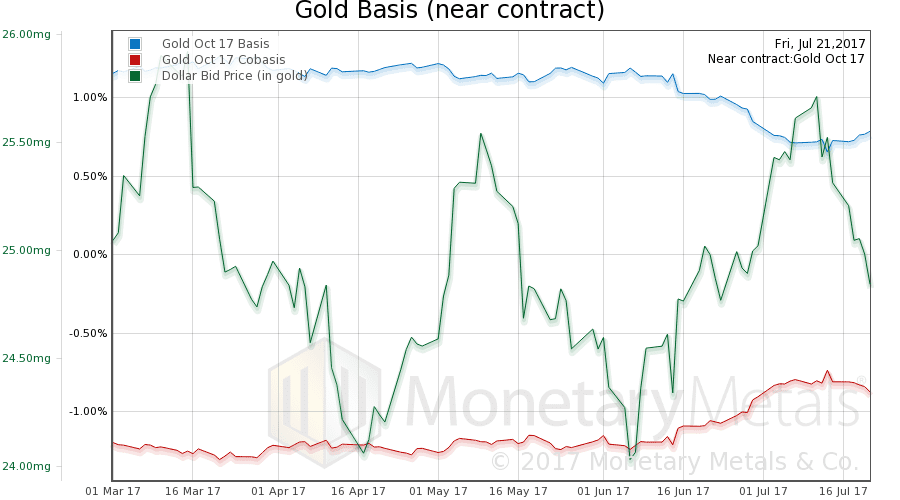
For each metal, we will look at a graph of the basis and cobasis overlaid with the price of the dollar in terms of the respective metal. It will make it easier to provide brief commentary. The dollar will be represented in green, the basis in blue and cobasis in red.


Here is the gold graph.


We have switched to the October contract, as the August is nearing expiry and under selling pressure.


The dollar fell this week (the mirror image of the rising price of gold). As the dollar fell, the cobasis fell—gold became less scarce.


Our calculated gold fundamental price fell a few bucks (chart here).


Now let’s look at silver.


As the dollar has dropped, the cobasis has come down (though still backwardated). Our calculated silver fundamental fell 25 cents to $17.59.


© 2017 Monetary Metals

Saturday, July 22, 2017

How The Elites Betrayed Working-Class America

Authored by Bill Bonner via InternationalMan.com,


Win-win deals get people more of what they want. Win-lose deals – usually imposed by government – bring them less. The few (the insiders) use government to exploit the many (the rest of us).


Win-lose deals also depress economic progress for everybody. Partly, this happens for an obvious reason.


Dropping the atom bomb on Hiroshima was a technical milestone, but not the kind of progress we’re talking about. Progress only makes sense if it means that people are able to get more of what they want.


By definition, when a person is forced into a bad deal, he gets less of what he wants.


Progress is also a learning process. You try something. You see what works and what doesn’t. As people experiment in this way, they learn… and the economy accumulates knowledge and wealth.


They learn to get to work in the morning, for example… to say please and thank you… to save their money… and to invest it wisely.


Win-lose deals interrupt the learning process. That’s why welfare programs fail: People get money without learning.


Temptation to Cheat


That is the real reason the Soviet Union failed, too.


Consumers were forced to buy whatever shoddy products were made available to them; producers had no way to learn how to make good ones.


Toward the end, products available for purchase in the Soviet Union were worth less than the raw materials and labor that went into them.


What do you need for win-win deals?


Three things:


1) People must be free to make choices with their time and money.


2) They must have money they can trust.


3) They must trust each other to respect their rights and property.


These things don’t happen smoothly and without interruption.


Progress is cyclical. Win-win deals add wealth and move society forward. But they depend on trust. And as trust increases, so does the temptation to cheat. When everyone leaves his liquor cabinet open, for example, who can resist having a drink?


Then trust declines. Barriers go up. Costs increase. Win-win gives way to win-lose. Progress goes into reverse.


Money You Could Trust


The invention of real money – based on gold – gave a boost to win-win deals… and to progress.


Why?


It was money you could trust.


If you are paid a gold coin for a day’s labor, you don’t have to trust the person who pays you. You don’t have to wonder if he has the money in his account to cover his check… or what will happen to his money in the future.


You don’t have to trust him; you put your trust in gold. This allows you to do transactions more freely – and speeds up economic progress.


Gold-backed dollars were trustworthy for nearly 200 years (setting aside Lincoln’s phony “greenbacks”).


People became so confident in the integrity of the dollar that they hardly noticed when the gold backing was removed (on March 19, 1968, when President Johnson signed a bill eliminating the “gold cover” for Federal Reserve notes).


But that’s the way it works: The more trusting people become, the easier it is to rip them off.


Set Up by the Elite


Of course, as trust expands and win-win deals proliferate, some people gain more than others.


The typical Chinese day laborer makes six times as much today as he did in 1999. The typical American day laborer has gained little.


And job competition from overseas made him feel like a loser. Now he wants walls – to keep out foreigners and foreign-made products. He wants win-lose deals that guarantee to make him a winner again.


He has no idea that he was set up by his own elite.


Former Fed chiefs Ben Bernanke and Alan Greenspan got their pictures on the cover of Time magazine. Most people think they are heroes, not rascals. Most people think they saved the economy from another Great Depression by dropping interest rates and injecting it with trillions of dollars in quantitative easing (QE) money.


Most people – even the POTUS – believe we need more fake money to “prime the pump” and get the economy rolling again.


Almost no one realizes it, but it was these stimulating, pump-priming, new credit-based dollars that fueled the trends that ruined America’s working-class wage earner.


Overseas, his competitors used cheap credit to gain market share and take away his job. At home, the elite imposed their crony boondoggles… their regulations… and their win-lose deals – all financed with fake money.


The average American’s medical care now costs him more than seven times more than it did in 1980. His household debt rose nearly 12 times since 1980.


Subtle “Bezzle”


He blamed the Chinese, the Mexicans, the liberals… the media… and the government.


He wanted change.


But who would have guessed that he had been ripped off by his own untrustworthy money?


After you account for inflation, the American worker has not had a significant raise in 40 years – almost since the new money system was put into place after 1971.


But the rich – as measured by the inflation-adjusted Dow – are 10 times richer.


Who would have imagined that after 3,000 years, the elite would have come up with money that betrayed his trust… a “bezzle” so subtle that he didn’t even notice?


*  *  *


Recently we’ve been wondering if it’s possible that America could be on the brink of a second civil war. We did some digging… and while the stuff we found may offend and shock you… We recommend you take a look anyway by clicking here.

Monday, July 17, 2017

Stockholm Syndrome Gold Report, 16 July 2017

Stockholm Syndrome is defined as “…a condition that causes hostages to develop a psychological alliance with their captors as a survival strategy during captivity.” While observers would expect kidnapping victims to fear and loathe the gang who imprison and threaten them, the reality is that some don’t.


There is a loose analogy between being held hostage and being an investor in a regime of irredeemable paper currency and zero interest rates. In both cases, the victim has little hope of escape and must seek to somehow survive under malevolent conditions.


Key behaviors in Stockholm Syndrome are positive feelings for their captors, a refusal to work with law enforcement afterwards, and even a belief in the terrorist’s humanity.


Key behaviors of investors today show eerie parallels: a desire to bid on dollars with their assets, a refusal to support the gold standard, and even a belief that the dollar is money. This last always shows when someone—even a gold bug—says gold is going up, or gold is the best performing currency, or gold has good returns.


These words up, performance, and returns indicate that the victim accepts the dollar as money, the dollar as the measure of value, the dollar as the unit of account. The victim seeks to view gold in terms of his captor’s paradigm. Much the way the kidnapping victim seeks to understand his capture and even geopolitics in terms of his captor’s world view.


Many victims are so thoroughly in thrall, that they scoff at the very idea of earning interest from a productive enterprise. They seek only the latest bubble, wherein they can make a profit: more dollars. Or, if not more dollars, at least more purchasing power. For years, they sought to do this in the gold and especially silver markets. Some gold bugs go even farther, and opposed a gold standard. Perhaps they don’t want sound money, they want gold to go up which means something external that gold can go up against.


We watched bemused, as a speaker at the Metal Writers Conference in Vancouver on May 29 told a standing-room-only crowd that bitcoin would hit $1 million (it went up after that, but is now down about 15% from that day). A 436X return would be nice, but of course the profits can only come from later speculators. There is an ugly little word for schemes in which profits come from those who buy in later. It is named for a gentleman who came from Italy, promoting his scheme in Boston.


We blame the game, not the player. It is important to emphasize this—don’t blame the players, blame the game—and we probably don’t do it enough. The fault lies not with those who bet on gold or bitcoin or anything else, nor even with those who regard betting as investing. The fault lies with the Fed and the other central banks who have the hubris to think they can centrally plan their way to prosperity. And the gun to force it on us, whether we agree or not. And the madness to cause the interest rate to fall for 36 years and counting (the Fed is not going to push the interest up much farther in this cycle, if they even dare one more hike). When freedom seems so remote as to be hopeless, it may be natural (we leave this to psychologists to say) to find a way to compromise, to get along to go along.


As to us, we will go on working towards that day of freedom, a big part of which is helping people see the monetary system for what it is: the current implementation of the fifth plank proposed by Karl Marx. Another part is to pay interest on gold…


Last week, we said:


“Peak hype, peak desperation, all selling in the streets with little buying… we are not technicians and do not focus on sentiment… but this description sounds like the definition of capitulation.


Also, we would add something important. Even if this is a capitulation low, that does not necessarily a mean a moonshot to $5,000 or even $2,000. We don’t expect that, and won’t expect it without evidence of a much more serious shift in the fundamentals. We would expect a normal trading bounce within the range and perhaps a few bucks over $1,300.”


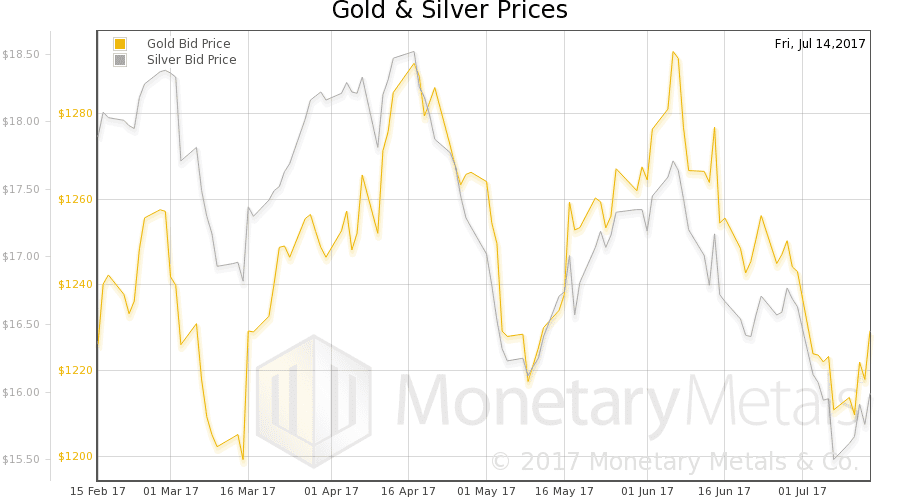
This week, the prices of the metals bounced somewhat, within the trading range. Gold closed last week at $1212, and this week at $1229. In silver, last week’s close was $15.56, and this’s week was $15.96.


Will the bounce continue? Have the fundamentals firmed up?


We will show graphs of the true measure of the fundamentals. But first charts of their prices and the gold-silver ratio.


Next, this is a graph of the gold price measured in silver, otherwise known as the gold to silver ratio. The ratio moved down this week.


In this graph, we show both bid and offer prices for the gold-silver ratio. If you were to sell gold on the bid and buy silver at the ask, that is the lower bid price. Conversely, if you sold silver on the bid and bought gold at the offer, that is the higher offer price.


For each metal, we will look at a graph of the basis and cobasis overlaid with the price of the dollar in terms of the respective metal. It will make it easier to provide brief commentary. The dollar will be represented in green, the basis in blue and cobasis in red.


Here is the gold graph.


The dollar fell a bit this week (the mirror image of the rising price of gold). Now it is the dollar hostages who use gold as their preferred hostage-bargaining chip to feel a bit better. One ounce of this commodity now fetches 17 more of the kidnapper’s paper scrip than it did a week ago.


As the dollar fell, the cobasis fell (especially in farther-out contracts). The August cobasis is still above zero (i.e. temporary backwardation).


Our calculated gold fundamental price is not much changed, still above the market price by a goodly margin (chart here).


Now let’s look at silver.


As the dollar has dropped (i.e. silver trades for more gang-scrip than last week), the cobasis has come down. But it’s still higher than gold’s cobasis, and this is the September contract, a month further from expiry than the August gold contract.


Our calculated silver fundamental is rising again, also a healthy margin above the market price.


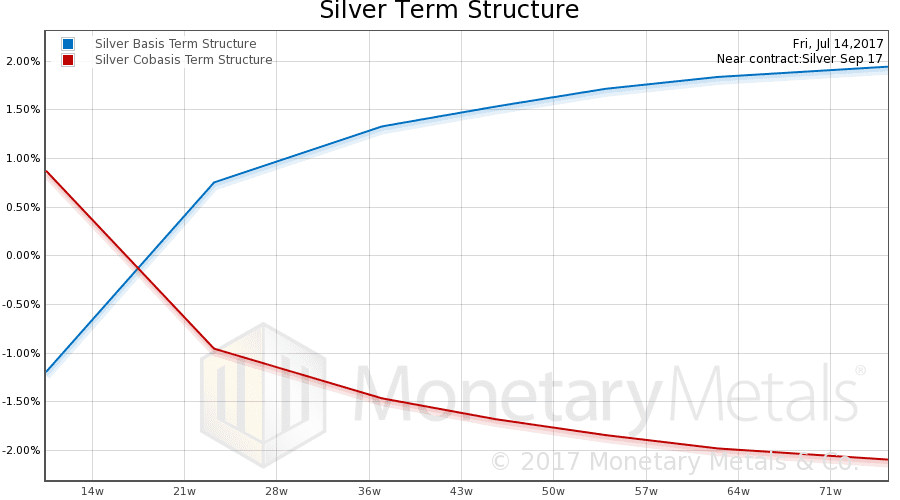
We thought it would be worth addressing the question: “is there a shortage in silver?” Let’s do it with a device that’s famously worth 1,000 words. This picture shows the term structure of the silver futures market.


What we see is what Sherlock Holmes observed that people heard in the night in the story Silver Blaze. There are no interesting features. Other than the temporary backwardation in the September contract, we see a rising basis and falling cobasis as we look out to December 2018. The rising basis looks a lot like the yield curve in the dollar, though slightly lower (6-month LIBOR is 1.5%).


If a real shortage developed in silver, the above curve would look quite different. And we would be publishing pictures of it.


Monetary Metals will be exhibiting at FreedomFest in Las Vegas in July. If you are an investor and would like a meeting there, please click here. Keith will be speaking, on the topic of what will the coming gold standard look like.


© 2017 Monetary Metals

Monday, July 10, 2017

38 Incredible Facts About The Modern U.S. Dollar

We’ve previously showed you 31 Fascinating Facts About the Dollar’s Early History, which highlighted the history of U.S. currency before the 20th century. This was a very interesting period in which we looked at the money used by the first colonists, the extreme bust of the Continental currency, the era of privately-issued bank notes, and Congress’ emergency issuance of the fiat “greenback” during the Civil War.


However, as The Money Project - an ongoing collaboration between Visual Capitalist and Texas Precious Metals that seeks to use intuitive visualizations to explore the origins, nature, and use of money - notes, the modern era of the U.S. dollar is just as interesting. We have it starting in 1913, when the Federal Reserve Act was passed by Woodrow Wilson. Not only did it establish a new central bank, but it also gave the Fed the authority to issue the Federal Reserve Note, which is (for now) the dominant form of U.S. currency both domestically and abroad.


A New Legal Tender


Leading up to the 20th century, there were four main forms of U.S. currency being used:


  • Gold and silver coins

  • Gold and silver certificates

  • Commercial bank notes, issued by private banks and backed by government bonds

  • “Greenbacks”, a fiat currency declared legal by Congress to help fund the Civil War

In 1913, however, the Federal Reserve Note was authorized as U.S. currency. The new notes were supposed to be backed by gold or other “lawful money”, based on the stipulations of the Federal Reserve Act of 1913.


However, this only lasted about 20 years. By the time of the Great Depression, the Fed considered itself to be in a tight spot. It simply did not have enough gold to back all Federal Reserve Notes and Gold Certificates in circulation, and at the same time wanted flexibility with monetary policy to fight deflation and unemployment.


In 1933, the Emergency Banking Act was passed by President Roosevelt, and Executive Order 6102 was also signed. The latter move famously criminalized monetary gold, and ended the gold standard.


After all, if gold can’t be legally owned, it can’t be legally redeemed.


Modern Paper Money


After a brief return to a pseudo gold standard after WWII, Nixon severed all remaining ties between gold and money in 1971. Since then, U.S. money has been purely fiat, and backed by the government rather than any physical commodity or precious metal.


Some facts on today’s paper money:


  • There is $1.54 trillion of U.S. currency in circulation, and 97% of that is Federal Reserve Notes

  • Over two-thirds of all $100 bills are held outside the U.S.

  • Dollar bills can be folded at least 8,000 times, which is 20x more than a normal sheet of paper

  • That’s because dollar bills are made of a special 75% cotton and 25% linen blend, patented by Crane & Co.

  • The U.S. Bureau of Engraving and Printing produces 38 million notes every day, worth $541 million

  • The two facilities, located in Washington, D.C. and Fort Worth, Texas use 9.7 tons of ink per day

  • For 2017, the Fed ordered 7.1 billion new notes, worth $209 billion

  • More than 70% of these notes are used to replace damaged ones

  • Notes with smaller denominations ($1, $5, $10) tend to last for shorter periods of time, due to more frequent usage

Coins


The coins used today are similar to U.S. Federal Reserve Notes in that their face values tend to greatly exceed their intrinsic values.


This is because cheaper metals such as copper, zinc, and nickel are used instead of gold or silver.


  • The average lifespan of a coin is 25 years, according to the U.S. Mint

  • It’s estimated that Americans throw away around $62 million of coins every year

  • In 2016, the U.S. Mint produced 16 trillion coins, valued at over $1.09 billion

  • The amount of copper in a penny has fluctuated over the years. It ranges from 0% (in WWII, pennies were made of steel so copper could be used for ammunition) to 95%.

  • Today’s pennies are 2.5% copper, with the remainder being 97.5% zinc

Just Remember, Nothing Last Forever...


Source: The Burning Platform

Wednesday, July 5, 2017

Chinese Manufacturers Are Scrambling To Replace Workers With Robots As Wages Soar

Tepid wage growth has been frustrating Americans for years. But if trends in China’s manufacturing sector have any bearing on the US, there’s an upside to stagnant pay: Workers get to keep their jobs – for now, at least.


In China – where real wages have doubled in the past decade – the opposite is true: Manufacturers, squeezed by rising labor costs and a paucity of skilled workers, are fueling an unprecedented boon in the adoption of automated technologies to cut down on the number of workers needed on factory floors, according to the latest findings of the China Employer-Employee Survey.


Ironically, the Communist Party’s willingness to support unprofitable businesses is compounding problems for Chinese workers, as many manufacturers are barely profitable to begin with.


As Bloomberg explains, China is no longer the cheap labor haven it once was.


“Monthly manufacturing wages reached 4,126 yuan at the end of 2015, equal to those in Brazil but much higher than Mexico, Thailand, Malaysia, Vietnam, and India.


At the same time, many firms are relying on government subsidies, while barely eking out profits or even losing money, according to the study released June 20. “Time is running out fast for Chinese manufacturers to adapt,” says Albert Park, head of the survey’s international committee and a labor economist at The Hong Kong University of Science and Technology.


The study canvassed more than 1,200 companies and 11,300 workers in Guangdong, China’s biggest manufacturing province, and Hubei, a major industrial base in central China. Some 26 percent of workers left their jobs annually in Guangdong and that turnover rate was even higher for younger workers, about 37 percent for employees below 28."


In a viral video published back in April, the People’s Daily provided a glimpse into the rapidly approaching future of China"s labor force: The video, also released by the SCMP, shows hundreds of round Hikvision robots, each roughly the size of a seat cushion, swiveling across the floor of the large warehouse in Hangzhou. A worker is seen feeding each robot with a package before the machines carry the parcels away to different areas around the sorting center. The robots sort more than 200,000 packages a day.


One factory owner explains to Bloomberg how he’s adding 40 robots to his workforce that will eventually allow him to reduce his human workforce by 25% or more.


As he marches through a gritty factory that makes baby strollers and wheels, Hu Chengpeng says finding workers is his number one challenge these days. Turnover at the facility in Hanchuan in Hubei province in central China is running at 20 percent, even while wages have been growing by double digits for his 400-plus workers every year. “Labor costs are getting just too high,” he said.


All of which explains why Hu, 34, is embracing China’s robotics revolution. He has added 40 new robots, each costing 40,000 yuan ($5,850), this year to replace dozens of workers tasked with cutting plastic molding. Eventually the factory will use a quarter fewer workers than today, without having to reduce annual production, he said. Hu also said he plans to shift more production away from making simple components and towards producing higher-margin branded strollers.”


Engineers are rushing to replicate even the most basic advantages that humans have over robots. In a video published by Bloomberg, employees at San Francisco-based Autodesk explain how they’re designing software to enable robots to “see” their surroundings. The engineers say it will ameliorate safety issues that have been a barrier to wider adoption. Soon, they say, robots and humans will be able to work in closer proximity.


Luckily, robots still have a ways to go before they can "think" like humans, too.

Friday, June 30, 2017

Factories May Be Coming Back To The U.S., But The Jobs Aren't: McKinsey

Trump effectively owes his election to the promise of bringing factories and manufacturing jobs back to the United States.  His relentless, targeted attacks against the "Big 3" U.S. auto manufacturers for outsourcing jobs to Mexico was undoubtedly a key reason that he was able to shock the world and win Michigan, Wisconsin, Ohio and Pennsylvania...an accomplishment which has eluded Republicans since Ronald Reagan.


Unfortunately, while factories may once again be making a comeback in the United States, after chasing low wages all around the globe for decades, they"re unlikely to bring the jobs with them.  As a new study from McKinsey highlights, if a new factory opens up in the United States you can bet it"s only because most of the jobs that used to be performed by humans have since been automated.  Per Bloomberg:


American manufacturing could be poised to rebound as technological disruption shakes up global production chains, but that will offer little relief to displaced factory workers, according to new research by the McKinsey Global Institute.


Now, McKinsey sees conditions changing in a way that could favor U.S. producers: automation is weakening the case for labor arbitrage as wages rise in emerging market economies and developing market residents are coalescing into a new consumer class, among other factors.


While the U.S. could seize on those manufacturing growth opportunities, especially if the government and companies invest to make production more competitive, there are catches. Importantly, production might bounce back without bringing a lot of jobs in tow.


“Even if we rebuild factories here and you build plants here, they’re just not going to employ thousands of people -- that just doesn’t happen,” said report co-author and McKinsey Global Institute Director James Manyika. “Find a factory anywhere in the world built in the last 5 years -- not many people work there.”


Not surprisingly, the biggest beneficiary of the decimation of the America"s manufacturing base has been China...which also means they have the most to lose as those jobs get automated.


Value Add


Looking at the likelihood of automation by industry, McKinsey finds that factory employment ranks near the top of the list -- behind accommodation and food services and just ahead of agriculture. Investment in re-training could help employees who are displaced, Manyika said, but it won’t happen overnight.


"It’s a bit of a heavy lift -- in the skilling, the investment in the right places, the right skills -- it’s not going to happen by itself."


Of course, this wouldn"t be the first time that economists had prematurely predicted the demise of labor markets due to technological advances:


"We are being afflicted with a new disease of which some readers may not have heard the name, but of which they will hear a great deal in the years to come—namely, technological unemployment" - Keynes, 1930


“Labor will become less and less important. . . More and more workers will be replaced by machines. I do not see that new industries can employ everybody who wants a job” - Leontief, 1952