Showing posts with label Foreign exchange market. Show all posts

Wednesday, December 27, 2017

Venezuelans Abandon Bolivar - Merchants Insist On Being Paid In Dollars

Venezuelans are struggling to carry out basic transactions like purchasing food as the value of their currency, the bolivar, has plunged against the dollar amid the country’s worsening economic collapse.


According to Reuters, over the past year, Venezuela’s currency weakened 97.5% against the greenback: Put another way, $1,000 of local currency purchased in early January would be worth just $25 now. The annual inflation rate in 2017 could reach $2,000. Though at least one other estimate puts the real rate of inflation closer to 2,800%.


Of course, President Maduro has blamed websites like DolarToday – which publishes the closest thing to an official black-market rate by surveying clandestine exchanges in Caracas and other cities – for the spread of black-market activity, part of a conspiracy organized by Washington and his local political opponents to force him from power.


One of the unintended consequences of the bolivar’s collapse has been a social experiment of sorts in the use of digital currencies: As we noted back in October, as many as 100,000 people are now mining digital currencies in Venezuela, defying a government crackdown that’s seen many of them thrown in prison.


But for those who can’t or haven’t resorted to transacting in bitcoin, an increasingly scarce supply of dollars is creating intractable problems for millions of Venezuelans, Reuters reported.


For many, simple purchases like a new tire for their car are simply out of reach.


There was no way Jose Ramon Garcia, a food transporter in Venezuela, could afford new tires for his van at $350 each.


Whether he opted to pay in U.S. currency or in the devalued local bolivar currency at the equivalent black market price, Garcia would have had to save up for years.


Though used to expensive repairs, this one was too much and put him out of business. "Repairs cost an arm and a leg in Venezuela," said the now-unemployed 42-year-old Garcia, who has a wife and two children to support in the southern city of Guayana.


"There’s no point keeping bolivars."


A practice that was initially adopted by shops catering to wealthy and middle-class Venezuelans is spreading to merchants selling everything from foodstuffs to medicine. Food sellers, dental and medical clinics, and others are starting to charge in dollars or their black-market equivalent - putting many basic goods and services out of reach for a growing number of Venezuelans.


"I can’t think in bolivars anymore, because you have to give a different price every hour,” said Yoselin Aguirre, 27, who makes and sells jewelry in the Paraguana peninsula and has recently pegged prices to the dollar. “To survive, you have to dollarize."


The socialist government of the late president Hugo Chavez in 2003 brought in the strict controls in order to curb capital flight, as the wealthy sought to move money out of Venezuela after a coup attempt and major oil strike the previous year.


Oil revenue was initially able to bolster artificial exchange rates, though the black market grew and now is becoming unmanageable for the government.


Still, President Nicolas Maduro has maintained his predecessor, the late Hugo Chavez’s policies on capital controls, even as the spread between the official rate - some 10 bolivars per dollar - and the black market rate - of around 110,000 per dollar - is now huge.


The trend is angering Venezuelans who don’t have access to dollars. As Reuters pointed out, it also dampened Christmas celebrations this year due to a shortage of pine trees, toys, meat, chicken, cornmeal…the list goes on.


While sellers see a shift to hard currency as necessary, buyers sometimes blame them for speculating.


Rafael Vetencourt, 55, a steel worker in Ciudad Guayana, needed a prostate operation priced at $250.


“We don’t earn in dollars. It’s abusive to charge in dollars!” said Vetencourt, who had to decimate his savings to pay for the surgery.


Most Venezuelans, earning just $5 a month at the black-market rate, are nowhere near being able to save hard currency.


"How do I do it? I earn in bolivars and have no way to buy foreign currency," said Cristina Centeno, a 31-year-old teacher who, like many, was seeking remote work online before Christmas in order to bring in some hard currency.


While many have begun mining bitcoin, purchasing the digital currency is also out of reach for many, since they would need to first convert their bolivars into dollars.


As the bolivar has continued to plummet, some communities have begun experimenting with alternative currencies that derive their value from a limited supply. In one Caracas neighborhood, several shops have started accepting the panal, one such alternative currency.


With the supply of dollars drying up since Maduro announced that the state-owned oil company would no longer settle payments for oil exports in greenbacks, it’s likely only a matter of time before more of these alternative paper currencies start springing up.


That is, unless the price of oil – which broke above $60 today – makes a surprising and altogether unlikely comeback.


Monday, December 25, 2017

Chinese Stocks Spooked By Apple iPhone X Forecast Cut, Nikkei Boosted By BOJ Hopes

With most global markets closed for Christmas, the only overnight action was in Asia, which saw Chinese equities fall with tech stocks and names linked to Apple the worst performers after a report that Apple cut forecast iPhone X sales forecasts, while property firms surged on speculation of coming consolidation. As a result, after opening higher, the Shanghai Composite Index closed 0.5% lower on the day, the blue-chip CSI 300 Index fell 0.3%, the Shenzhen Composite Index retreated 0.9%, while the ChiNext small-cap and tech Index dropped 1.3%. The PBOC"s refusal to conduct a reverse repo for the second day did not boost the market mood.


The biggest Asian losers were Apple suppliers after the Taipei-based Economic Daily News reported that Apple has cut its sales forecast for the iPhone X by 40% from 50 million in Q1 to only 30 million. The report also noted that Foxconn’s Zhengzhou plant stopped recruiting workers. Following the news, Apple supplier Lens Technology Co. dropped 8.4% to be among worst performers on the ChiNext measure; Shenzhen Sunway Communication Co. -2.2%, Luxshare Precision Industry and GoerTek both dropped at least 4%. As the table below shows, it was a sea of red for Apple suppliers.


Offsetting the drop in tech names was strength among property firms: Gemdale rose 6.3% as the best performer on CSI 300 measure after Citic Securities analysts said that the planned strict implementation of property curbs in 2018 would boost industry consolidation and benefit big companies. Unless, of course, it ends up crippling the business for everyone in which case today"s spike will promptly turn into a selloff.


Elsewhere in open Asian markets, Japan"s Nikkei erased early losses and scraped out gains on Monday as expectations that the Bank of Japan would buy more exchange-traded funds (ETFs) offset drops by financial stocks, Reuters reported. Movements in Japanese equities were confined to a narrow range with foreign investor presence lacking due to Monday"s closure of other major markets for Christmas; as a result, the Nikkei finished 0.16% higher at 22,939.18.


Of Tokyo"s 33 subsectors, 10 were in the red, led by securities T and banking after their U.S. financial peers lost steam on Friday following their recent strong performance. Denim clothing store operator Jeans Mate 7448.T soared 20.2 percent after reporting that December existing store sales increased 13.2 percent from a year earlier.  Furniture and interior goods seller Nitori Holdings 9843.T sank 6.4 percent after the company saw its operating profit for the nine months through to Nov. 20 rise a modest 0.3 percent to 70.4 billion yen ($621.58 million).


Cryptocurrency related shares slipped following recent wild swings in bitcoin. Internet provider GMO Internet which is engaged in the "mining" of bitcoin, fell 4.8%.  Remixpoint, an operator of virtual currency trading post services, dropped 4%.


In FX, it was a quiet session, with the only major mover once again out of China, where the yuan surged over 240bp to hit 6.5514 per USD at one point, the strongest since mid-September. Earlier in the day, the PBOC raised the yuan’s fixing by 138bp to 6.5683 per USD, the highest since Sept. 20. The dollar was little changed against other major currencies on Monday in holiday-thinned trading while the cost of swapping the yen for the dollar jumped as banks scrambled to raise dollars for the year-end period.


With most currency trading centers except for Tokyo shut on Monday for Christmas, trading volume was less than 20 percent of the average for major currency pairs including the euro/dollar and the dollar/yen. 


According to Reuters, the discount for buying the yen at future dates widened sharply as non-U.S. banks, which typically buy dollars now with sell-back contract at a future date, scrambled to procure greenbacks for the year-end.  The one-week forward discount starting from Wednesday jumped to 0.23 yen from around 0.04 yen in the middle of last week.


“Because foreign banks are away and few market players are eager to offer dollars, the forward market is very thin,” said a currency trader at a major Japanese bank. “The market is very volatile and there are hardly any trades beyond one week."


Sunday, December 24, 2017

US Tax Cut and Rate Hikes Threaten China Currency

Authored by Valentin Schmid via The Epoch Times,


Seven was the line in the sand.


But the Chinese yuan never crossed that line vis-à-vis the U.S. dollar. It only crept up to 6.96 yuan per dollar on Dec. 16, 2016, before starting an impressive comeback, down to 6.5 in the middle of this year.


Last year was a bad one for the Chinese economy. Growth was slow, and the world was worried China would finally land the hard way, as many have been predicting for years.


And more than GDP growth or any other metric, the Chinese currency was the barometer of whether China could keep things stable - stability is the mantra of the ruling communist regime - or suffer a crisis of debt deflation.


If it declined in value, it meant citizens and companies were moving money out of the country in droves because they didn’t believe in the Chinese dream anymore.


So another measure of how bad things had gotten in the second-largest economy of the world was capital outflows.


According to the Institute of International Finance (IIF), a record $725 billion left China in 2016, putting pressure on the currency and the Chinese interbank market.


All these factors have changed in favor of the dollar in the last quarter, and it’s going to be hard for China to compete.


Trying to stem the tide, the central bank sold record amounts of foreign currency. Chinese foreign exchange reserves, $4 trillion at the peak in 2014, went down to $3 trillion, and analysts started to question whether this was enough to finance the world’s largest trading economy.


Then, miraculously in time for the 2017 National Congress of the Communist Party, all of this stopped. The yuan never went above 7, the exchange reserves never went below 3, and capital outflows subsided thanks to draconian regulations making it harder for individuals and companies to move money out of the country.


Weak Dollar


But something else helped China to strengthen its currency to reduce capital outflows and to balance foreign exchange reserves: a weak dollar.


The dollar didn’t only decline against the yuan. It declined against virtually all of its major trading partners in 2017, dropping 12 percent from its Jan. 2 peak to its Sept. 4 trough.


A weak dollar takes pressure off the yuan and makes it less desirable for Chinese to invest in U.S. assets if they stand to lose money on the currency. A weak dollar makes Chinese foreign currency holdings in other currencies worth more.


But the weak dollar is bound to reverse in 2018, and for China, this means going back to the uncertainty of 2016.


Currencies move for a myriad of reasons, but this year’s drop in the dollar had three major pillars.


The first one was political. After the dollar spiked 8 percent in the wake of the election of President Donald Trump last November, it dropped when it became clear Trump could not quickly push through his “America first” agenda, which included tax cuts and getting tough on trade with China and Mexico.


The second pillar was the interest policy of the Federal Reserve. The Fed always lagged behind its announced rate hiking schedule for 2016 and 2017, thereby disappointing market expectations of higher interest rates and a higher yield for the U.S. dollar.


The third pillar was the economy. Relative to expectations, the United States underperformed against the emerging markets, including China and even Europe and Japan in the first half of the year.


Strong Dollar


All of these factors have changed in favor of the dollar in the last quarter, and it’s going to be hard for China to compete.


Trump managed to deliver on key campaign promises in the last inning of 2017. The tax bill is a boon for national and international corporations, making it more competitive to invest in the United States again. It also incentivizes companies to bring back trillions in offshore money. Although this money likely won’t come from China, it will boost the dollar and indirectly punish the yuan.


China, on the other hand, has become ever less competitive both regarding taxes (the corporate rate is 45 percent) as well as cheaper wages. Its main advantage nowadays is scale. So according to a report by The Wall Street Journal, China is already preparing a contingency plan to counter the Trump reforms by raising interest rates, tightening capital controls, and micromanaging the currency by intervening in the foreign exchange markets.


President Trump managed to deliver on key campaign promises in the last inning of 2017. The tax bill is a boon for national and international corporations, making it more competitive to invest in the United States again


Lower taxes for companies and individuals in the United States should also boost an already much-improved economy and therefore make U.S. assets like stocks and real estate more attractive for foreign buyers again.


But the United States is also threatening China on trade, whose $309 billion good trade surplus in 2017 provides powerful support for the yuan.


In late November, the United States filed a legal submission to the World Trade Organization (WTO) as a third party in a case China had brought against the European Union (EU) in late November. China is unhappy that, despite some WTO provisions, the EU has not granted it “market economy” status 15 years after joining. The United States rejects China’s arguments and sides with the EU.


On Dec. 18, Trump accused China of challenging American power and stealing intellectual property as he unveiled his national security strategy.


“The United States will no longer tolerate economic aggression or unfair trading practices,” his letter states, without mentioning China by name.


If the administration follows through with its tough talk and uses the investigation into Chinese intellectual property theft under Section 301 of the Trade Act of 1974 to impose sanctions on China, a smaller trade surplus will hurt Chinese exports and the currency at the same time. Although a trade war will be costly for both sides, China has more to lose here.


Independent of politics, the Fed is also starting to deliver on its interest rate hikes, making the dollar more attractive in international markets. It raised its benchmark policy rate 0.25 percent to 1.50 percent at its December meeting on Dec. 13.


The Chinese promptly followed suit, with the People’s Bank of China raising its benchmark rate by 0.05 percent to 3.25 percent. But research firm Capital Economics believes this won’t be a game changer and that financial conditions in China are still relatively loose.


“Despite this, we aren’t convinced by the narrative of policy tightening. A five basis point move in rates is too small to have a meaningful impact,” it writes in a note to clients.


However, if China doesn’t deliver on its reform schedule sooner than anticipated, it’s going to be 2016 all over again.


Monday, December 18, 2017

FX Weekly Preview: Dollar Squeeze A Growing Concern, But Longer Term Bears Likely To Temper It

Submitted by Shant Movsesian and Rajan Dhall MSTA

from fxdailyterminal.com


Over the past week, the argument that the tax reform aimed at corporates specifically could prompt a period of USD repatriation - much like an amnesty - has been growing in sentiment, and whether one believes in this, remains an upside risk we shouldn"t ignore.  Since the Fed"s much anticipated rate hike, we have seen a moderate hit on the USD reversed in full, but put in perspective, the overall ranges traded so far have been modest to say the least.  We also shouldn"t ignore the time of year, where liquidity is not at its best, though has been enough to send the major indices on Wall Street to new record highs.  There was a time this would have sent USD/JPY soaring, but it hasn"t, but times have changed and most of us can see that global growth reflected in the stock markets is a far cry from that seen through wage growth and inflation. 


There has also been some focus on cross currency basis, turning negative to further signal year end USD demand and into early 2018, which can be tied-in in part to the repatriation story above.  Some will attribute it to regulatory pressures in Europe (derivatives market) as well as Japan, and although immeasurable for the most part, is a risk worth noting given our focus for the week ahead. 


As such, we look for concurrent moves in EUR/USD and USD/JPY, with a move in the former through 1.1700 likely to correspond with a USD/JPY push for 113.50-114.00 again.  Once again, in light of the illiquid period ahead, these are merely risks we are highlighting, and given where the respective spot rates ended up on Friday night, it is noteworthy risk at this stage. 


Through 1.1700, EUR/USD will test the band of support seen in the 1.1650-1.1550 area, where the longer term interest based on the Euro zone recovery continues to carry favour.   Based on the rising PMIs in Germany and other leading states, notably France, few can argue that there is momentum here, but this is largely priced in for now as we can see in some of the relative performance in the cross rates.  Even a supported EUR/CHF rate is struggling at 1.1700. 


In the final week into Christmas, we should see the EU wide inflation reading for Nov confirmed at 1.5% while the German IFO survey will likely continue with a healthy business climate.  Italian industrial production and orders later in the week will give us some insight into whether the rest of Europe is keeping up pace, but all of the above - as we have already alluded to - will do little to materially better the EUR position for now.


USD/JPY in the meantime survived the short lived post FOMC sell off, in a move which was seemingly pre-empted as "dovish hike fade", but that lasted for all of a day at best.  We held 112.00 on the downside, with 111.50-60 the strong base lower down, and despite the longer term bias for USD weakness and a return through 110.00 at some stage, the consolidation phase looks set to continue with 114.00-115.00 yet to be retested in any substantial way. 


The BoJ meeting towards the end of the week will again maintain current policy stance aimed at getting inflation back to 2.0% target, so the only interesting potential is of any dissenters to the persistent asset purchasing and an eventual unwind.  Domestic data is improving, albeit slowly, but the central bank have their mandate - the markets have their own take, and it is one which looks likely to test the BoJ"s tolerance for JPY strength at some point down the line.  When rather than if!


In the UK, GBP looks capped now that the EU-UK passage to the round of talks on trade have been secured.  Once again, the agreements made to facilitate this are nothing more than a "statement of intent" - as David Davis put it - so we are now at the crux of the negotiation, and this should start to weigh on some of the (blind) optimism which has driven GBP to better levels across the board.  To temper this, we are not advocating a return to the doom and gloom scenario, rather some moderation which would put Cable back to levels closer to 1.3000-1.3100 rather than creating a platform for a move through 1.3500-1.3600 for 1.4000 as some have suggested.  It is all sentiment here for now.


EUR/GBP has found good support in the mid 0.8700"s, but we also see limited scope for an aggressive push through 0.9000 unless Brexit cordiality breaks down completely.  On the UK economy, notable was the lack of positive response to the bumper spending results seen for Nov.  Naturally there will be a discounting factor in pre Xmas buying incorporating the Back Friday sales, and next year"s numbers will make for a far better reading on consumer appetite and more importantly disposable income.  The final Q3 GDP print is the only notable data point next week including business investment numbers. 


We also saw some reprieve for the AUD and NZD last week, with both consistently getting hammered into their recent lows with very little breathing space.  NZD had recovered first, again, largely down to over-exhaustion and traders throwing the towel in, so suggestions that the market have eased up on their bearish sentiment on the new coalition government look a little premature, not to say "convenient" at this stage.   This is not to say that the recovery does not have a little more to run, and could be generated through the EUR and GBP crosses, with over-extensions here - much in the same way as we have seen in EUR/AUD and GBP/AUD - redressed into year end at least. 


Lots of data in NZ next week, with more business confidence surveys (ANZ), current account and trade all leading up to Friday"s Q3 GDP number. 


Little in the way of stats to consider in Australia, so markets will focus on the RBA minutes and what the central bank take is on the economy.  With bearish sentiment emanating on low wage growth, low inflation and high household debt, the AUD got a welcome boost from a 60k+ rise in jobs, which keeps hopes alive for the Phillips Curve kicking in.  Little evidence of that in the US, but hope is hope and the AUD has weakened enough for now, with 0.7500 proving a strong base.  AUD/NZD is now the one to watch, where we took out pre 1.0900 demand, but the late Sep lows ahead of 1.0800 remain intact as yet.


CAD traders have some hard data to feed on rather than hang on every speech and reported rhetoric from the BoC.  Accused of a hard turnaround from the post rate hike hawkishness, the market was once again wrong-footed on governor Poloz"s statements this week, who stated that he saw the need for less stimulus going forward.  The CAD push up was brief however, and found fresh buyers looking for an eventual push through 1.2900 based on the retrenchment in CAD rates.  The jobs report for Nov was strong however, and if CPI, retail sales and ultimately GBP can can improve on the moderate expectations (0.2% growth seen for Oct), then perhaps USD/CAD can survive a push on the heavily offered 1.2900-1.3000 area.  Fear of long(s) liquidation by some banks suggest this could facilitate a move through the above mentioned area, but this assumes intent, which again, is immeasurable.  We could also say this about strong positioning in the market for (long) EUR"s!


Thursday, December 7, 2017

The Latte Index: Using The Impartial Bean To Value Currencies

Like any other market, there are many opinions on what a currency ought to be worth relative to others.


With certain currencies, that spectrum of opinions is fairly narrow. As an example, for the world’s most traded currency – the U.S. dollar – the majority of opinions currently fall in a range from the dollar being 2% to 11% overvalued, according to organizations such as the Council of Foreign Relations, the Bank of International Settlements, the OECD, and the IMF.


For other currencies, the spectrum is much wider. The Swiss franc, which some have called the world’s most perplexing currency, has estimates from those same groups ranging from about 13% undervalued to 21% overvalued.


As VisualCapitalist"s Jeff Desjardins notes, such a variance in estimates makes it hard to come up with any conclusive consensus – so in today’s chart, we refer to a more caffeinated and fun measure that also approximates the relative value of currencies.


THE IMPARTIAL BEAN


The “Latte Index”, developed by The Wall Street Journal, uses purchasing-power parity (PPP) – comparing the cost of the same good in different countries – to estimate which currencies are overvalued and undervalued.


In this case, the WSJ tracked down the price of a tall Starbucks latte in dozens of cities around the world. These prices are then converted to U.S. dollars and compared to the benchmark price, which is a tall Starbucks latte in New York City (US$3.45).


Courtesy of: Visual Capitalist


The Latte Index is mostly for fun, but it’s also broadly in line with predictions made by the experts.


For example, the price of a latte in Toronto, Canada works out to US$2.94, which is about 14.8% under the benchmark NYC price. This suggests that relative to the USD, the Canadian dollar is undervalued. Interestingly, estimates from the aforementioned sources (BIS, OECD, CFR, IMF) have the Canadian dollar at being up to 10% undervalued – which puts the Latte Index not too far off.


Given the wild range of estimates that exist for currency values, using the relative cost of a cup of joe might be as good of a proxy as any.


Friday, December 1, 2017

Yes, Cash Is An Asset Class Again!

Authored by Steven Vannelli via Knowledge Leaders Capital blog,


In a US Dollar bull market with interest rates at zero, cash is rightfully dismissed as a non-asset class. But, when the US Dollar is in a bear cycle, things change, irrespective of what US interest rates are.


There are a handful of indicators we use to identify US Dollar bull and bear cycles.


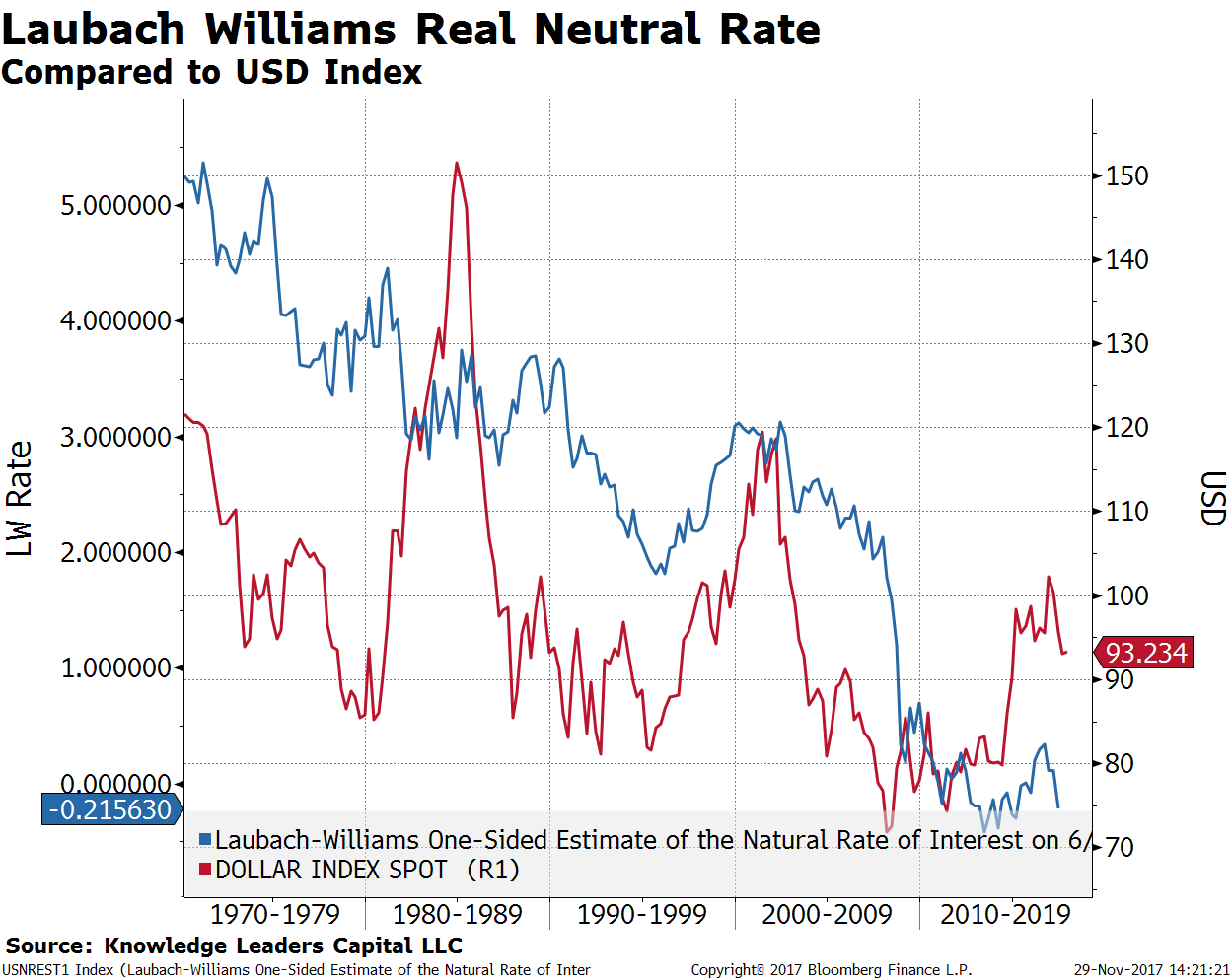
One indicator - the Laubauch-Williams (LW) Real Neutral Rate - has gained traction with the Fed and is often referred to as r-star. It is a measure of the real (after inflation) neutral interest rate that the US economy can handle without stimulating or restraining the economy. Over time, the LW Real Neutral Rate is one of the better signals for the US Dollar.


Every US Dollar bull market since 1970 has been marked by an increasing LW rate. In the chart below, I plot the LW Real Neutral Rate (blue line, left axis) against the US Dollar Index (red line, right axis). In the early 1980s the US Dollar bull market occurred with the LW rate rising from about 3% to about 4%. Similarly, the US Dollar bull run of the late 1990s occurred with the LW rate rising from just over 2% to just over 3%. The most recent US Dollar bull market has been no exception. While admittedly harder to see because the numbers are so small, the most recent US Dollar bull occurred with the LW rate rising from around -.5% to about +.3%.


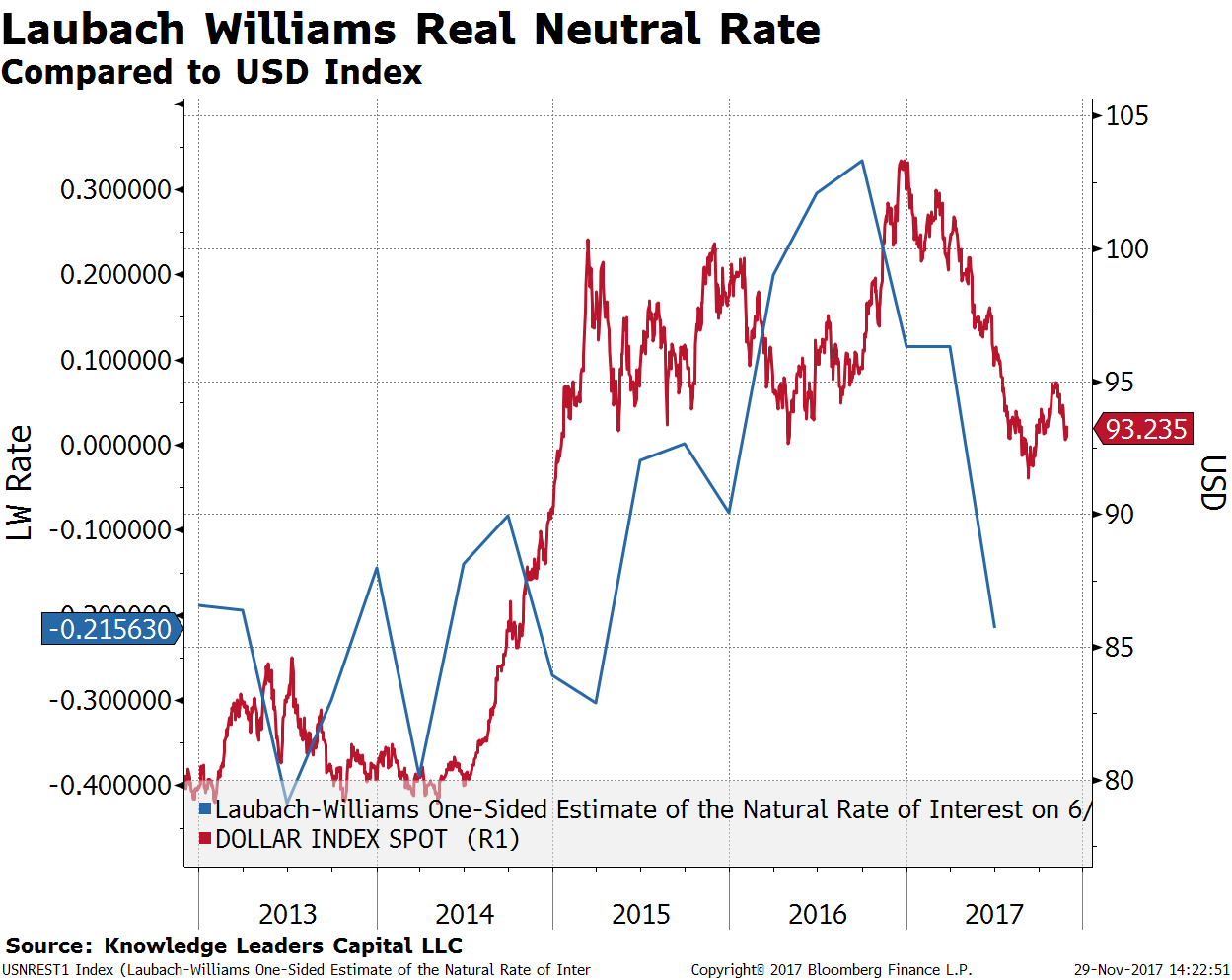
This relationship suggests the US Dollar bull run has come to a conclusion as the LW Real Neutral Rate has rolled over again. In the chart below, I focus on the last five years. Notice the US Dollar following the trend in the LW rate. The pop in the LW rate in the first quarter of 2014 led the 25% gain of the US Dollar from mid-2014 through early 2017. Notice also that the LW rate peaked in mid-2016, having fallen back by about 50bps in the last few quarters, leading the peak and decline in the US Dollar.


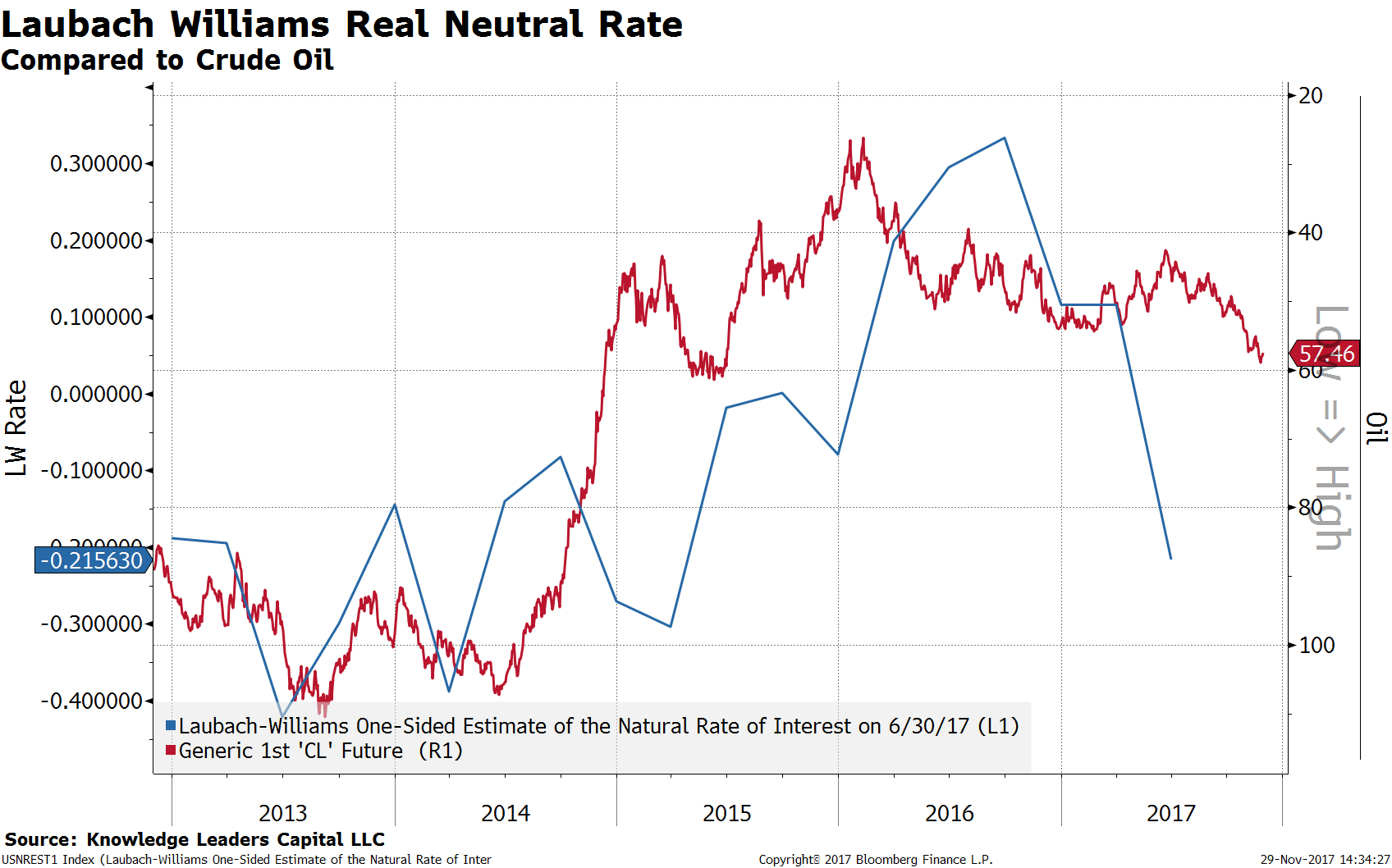
The fact that the LW rate has declined for three quarters in a row suggests this isn’t a temporary fluke. It is likely driven by the slow turnaround in oil prices. In the chart below, I plot the LW rate against oil prices. Simply, falling oil prices (red line, right scale, inverted) pull the LW rate (blue line, left axis) up. And, the reverse is true also that rising oil prices dampen the LW rate.


So, if we are now in a US Dollar bear market, driven by, among other factors, a falling LW rate and rising commodity prices, the good news is that cash is an asset class again.


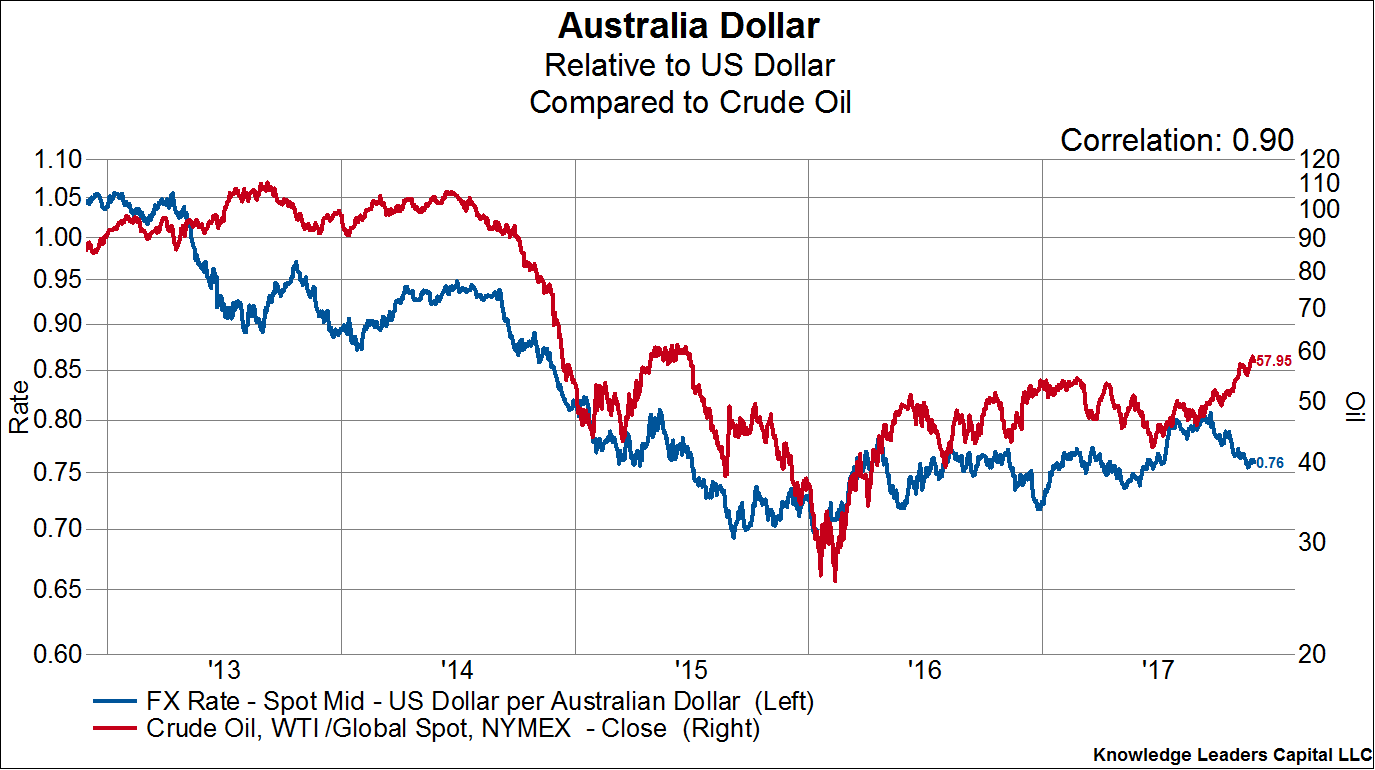
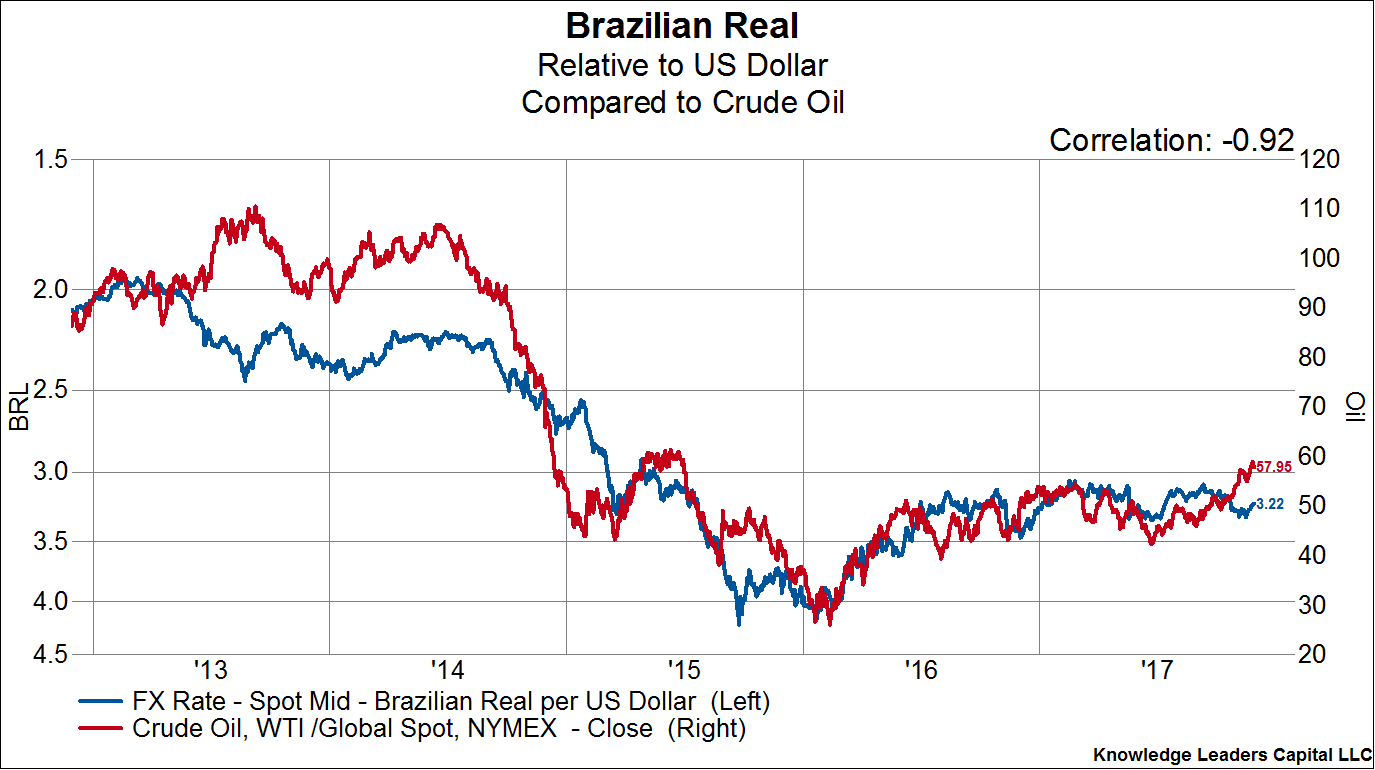
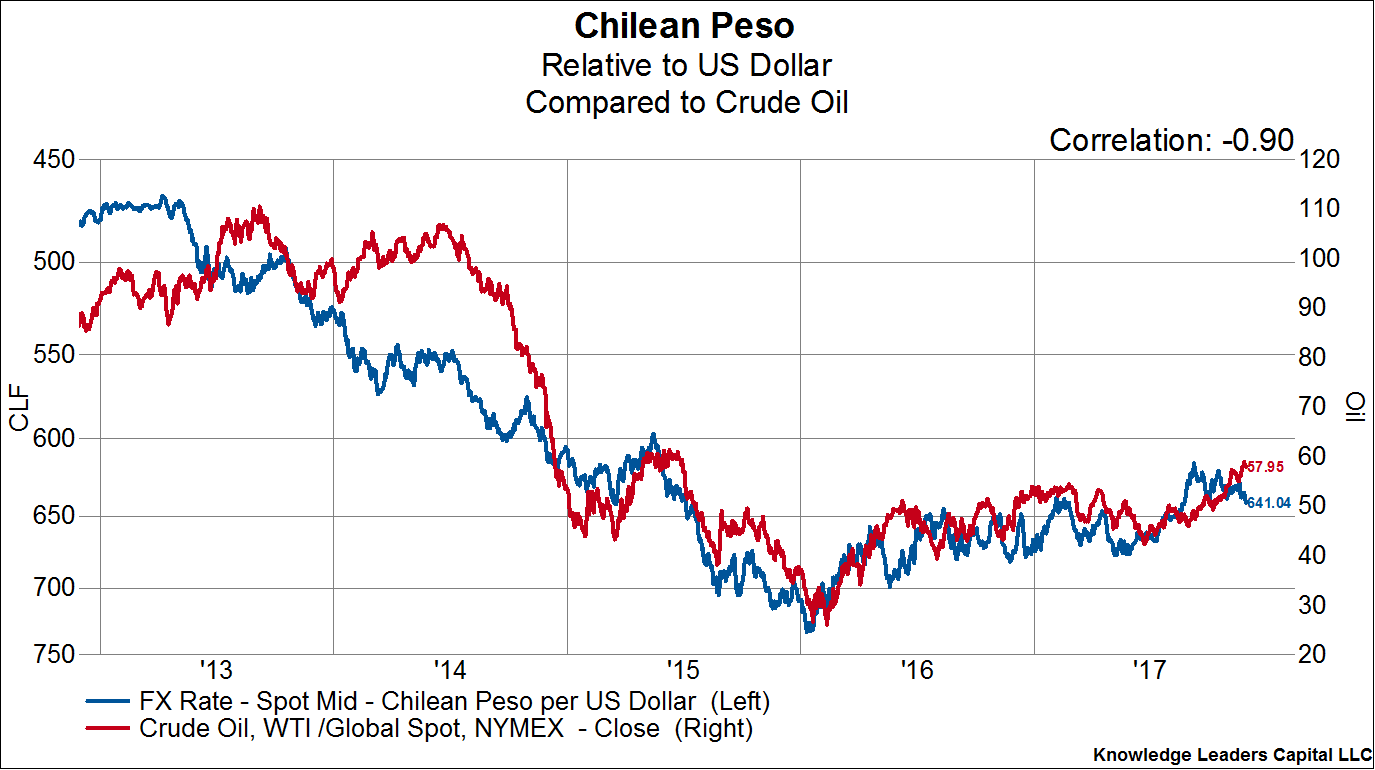
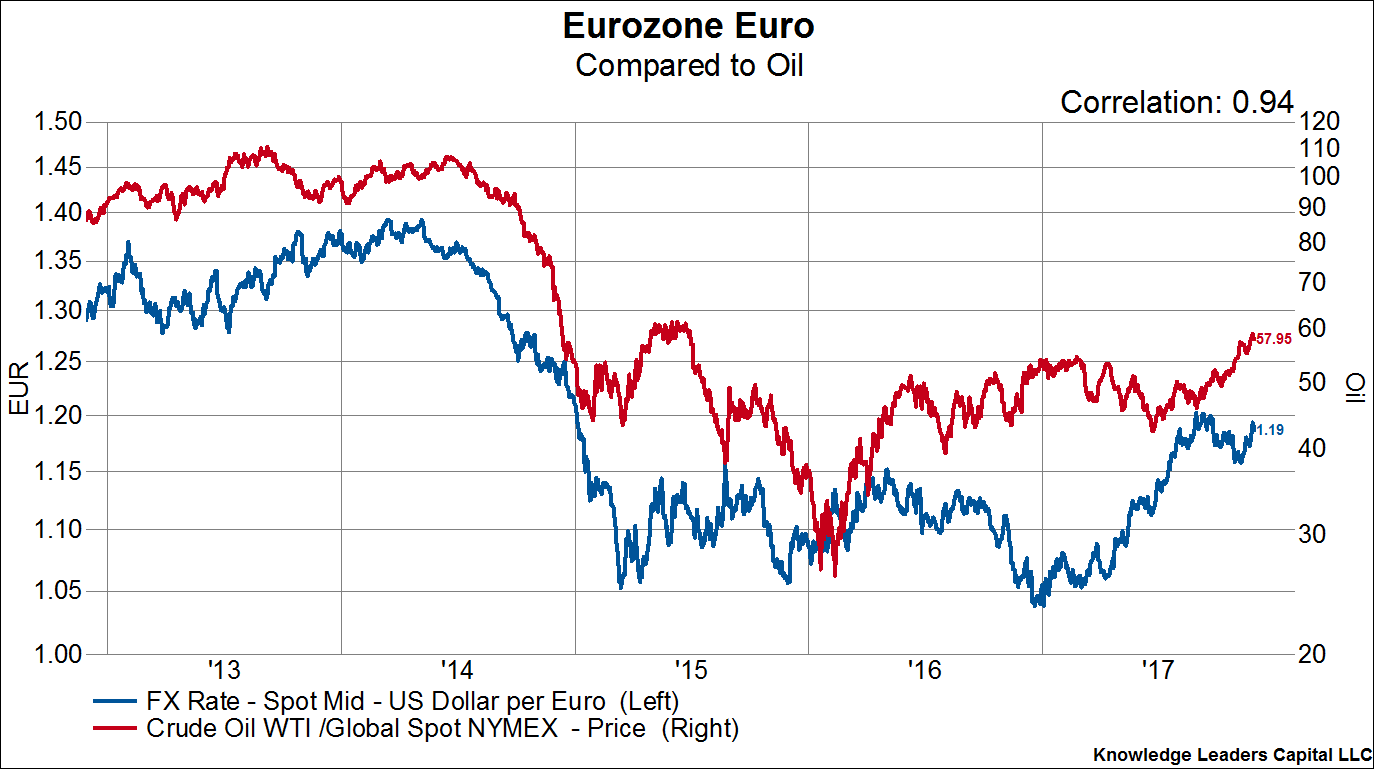
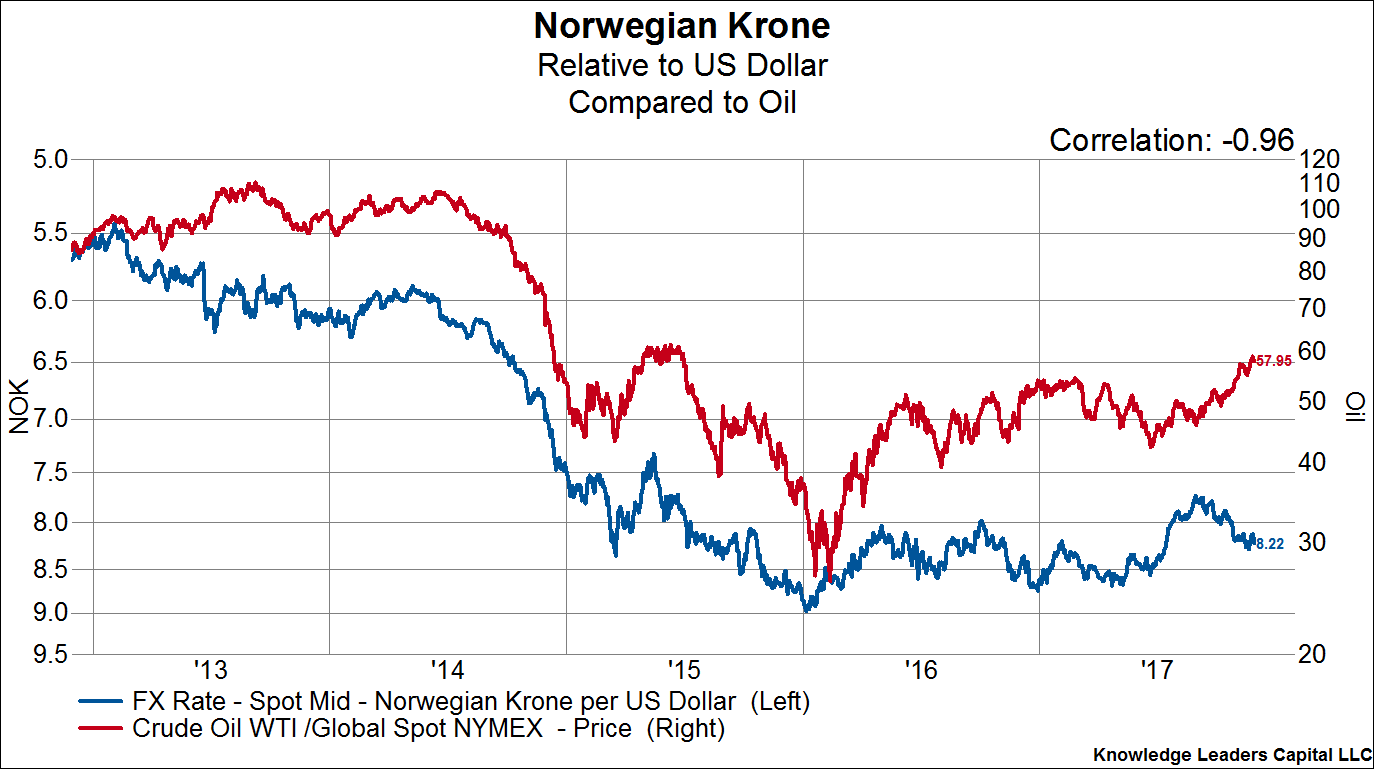
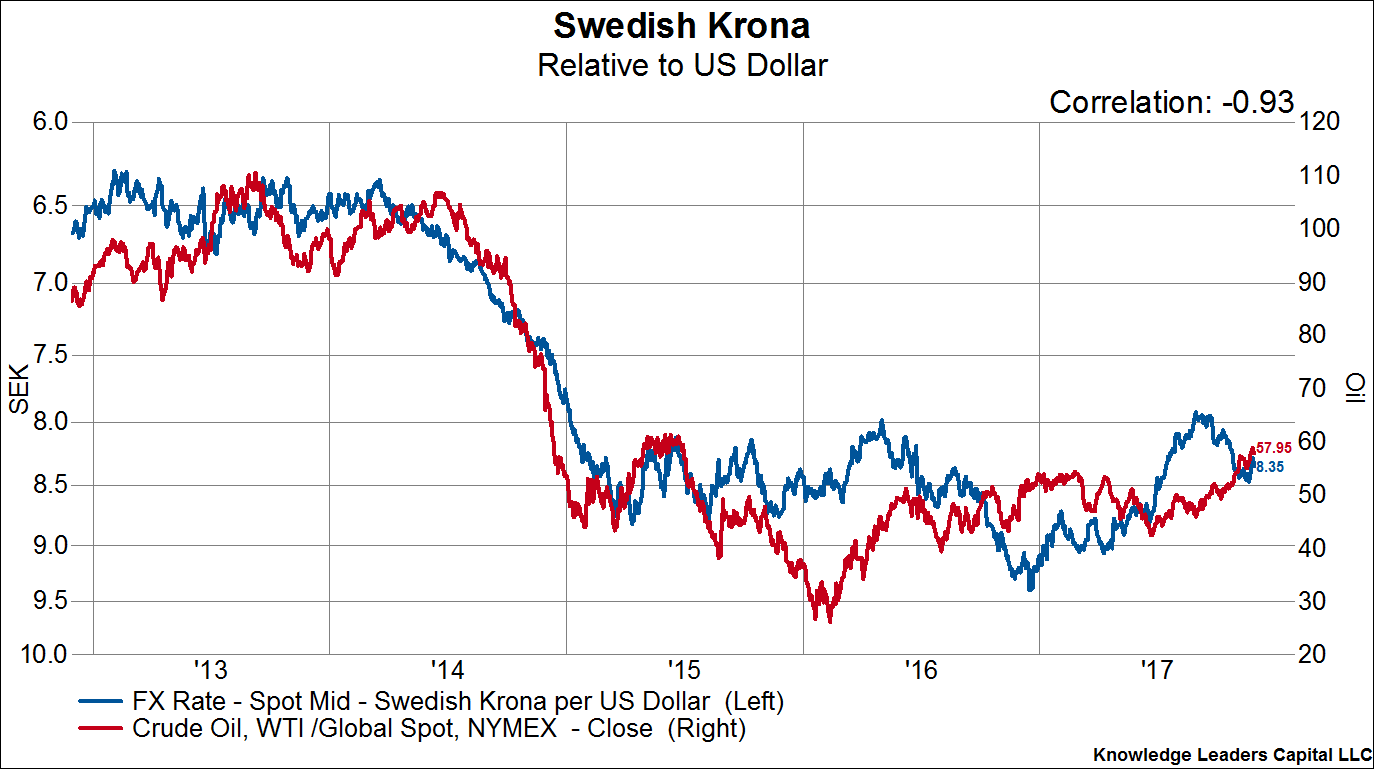
Which currencies should investors focus on? An easy place to start are those currencies with the tightest linkages to oil prices.


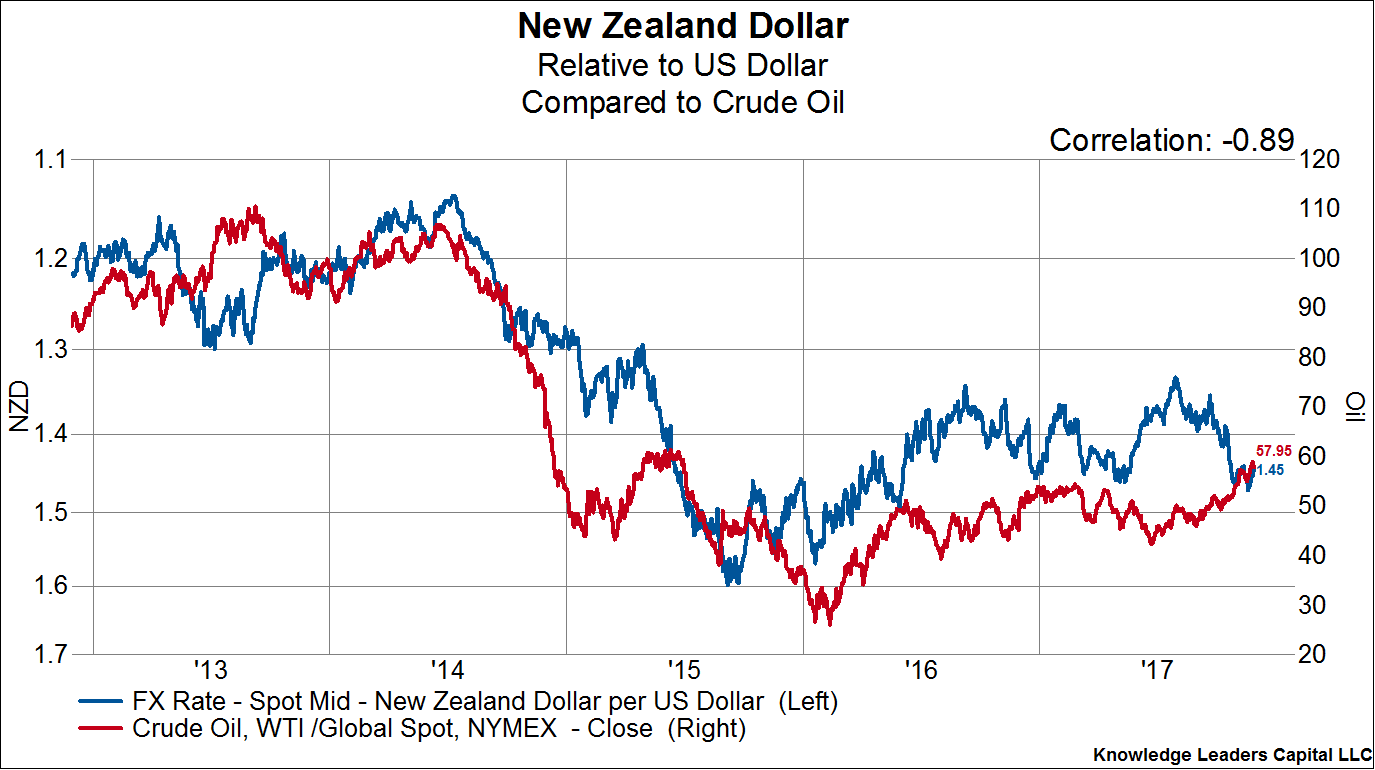
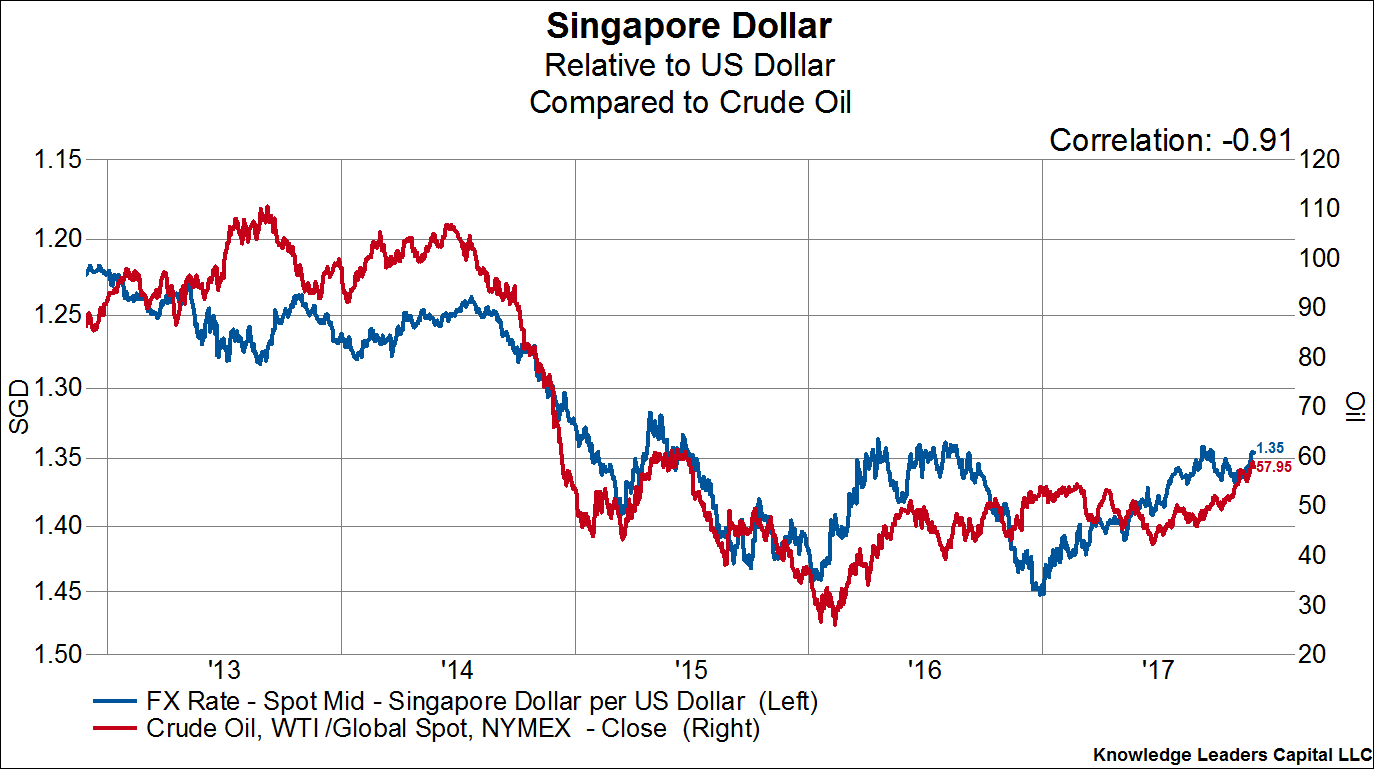
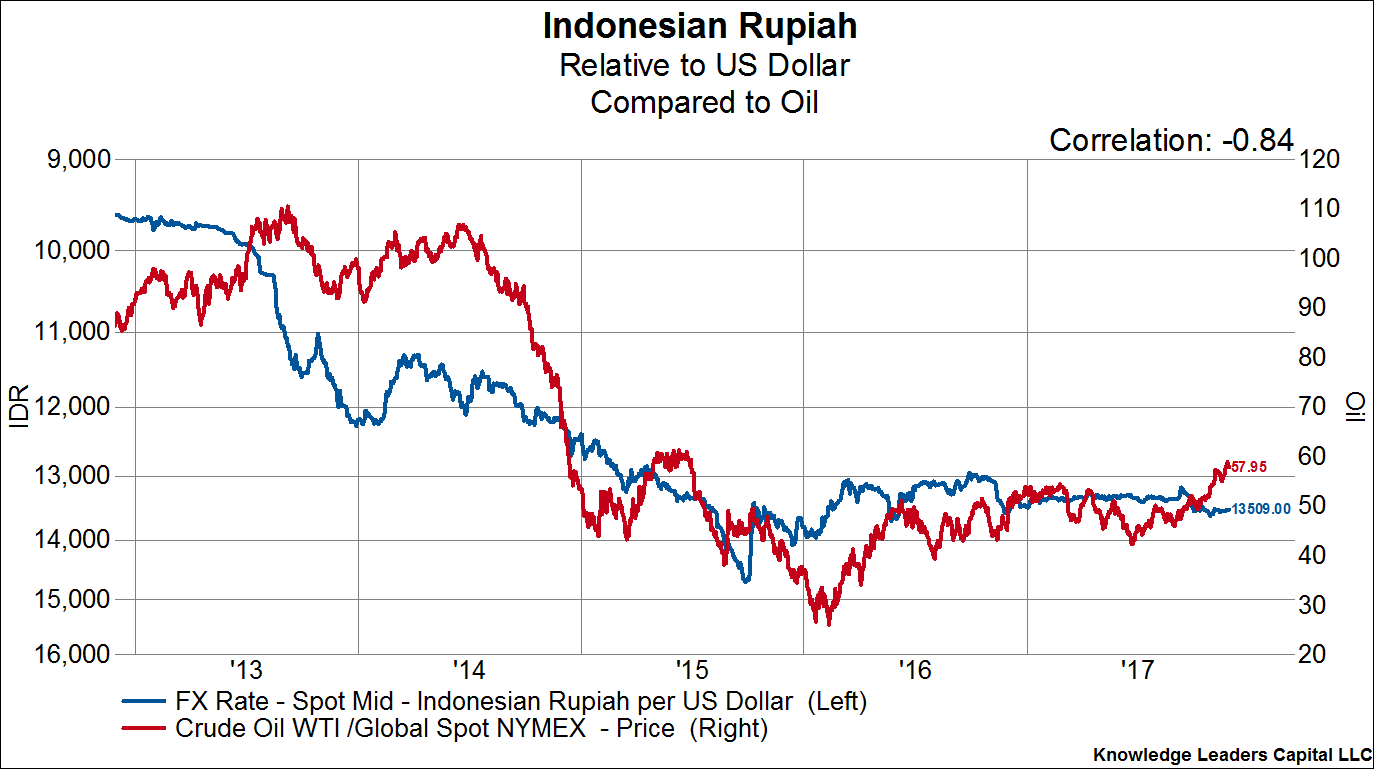
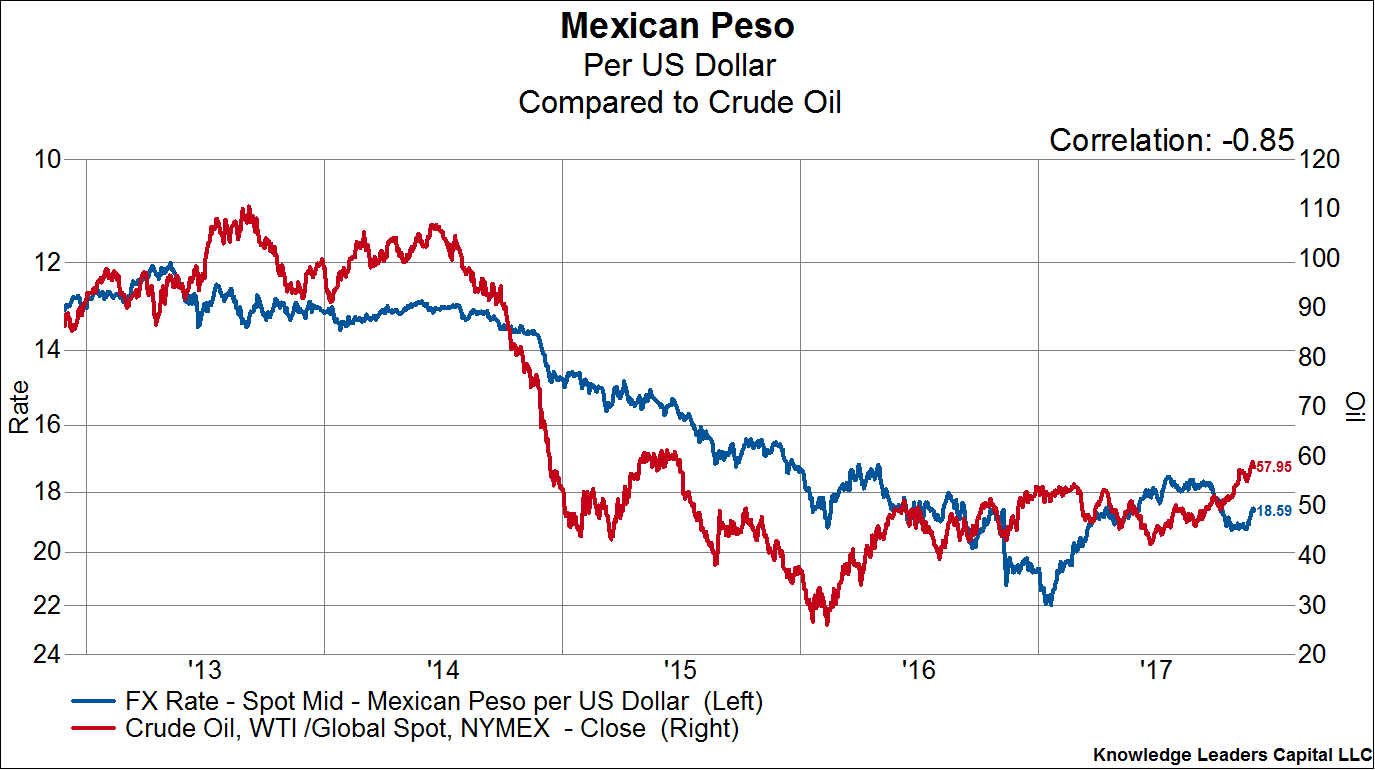
Let’s start in Asia. Among interesting developed market options for a cash allocation are the Australia Dollar, Singapore Dollar and New Zealand Dollar. In each chart below, I plot the US Dollar FX rate against oil prices, with the correlation shown in the upper right corner.


Among emerging market currencies in Asia, the most interesting are the Indonesian Rupiah and Thai Baht.


Moving to the Americas, the Canadian Dollar, Mexican Peso, Brazilian Real and Chilean Peso all look interesting.


Moving on to Europe, the most interesting currencies are Euro, Norwegian Krone and Swedish Krona.


While there are many asset allocation decisions that hinge on whether the US Dollar is in a bull or bear market cycle, one of the easier is currency allocation. An investor following an Anything but US Dollars policy has the chance to capitalize on the new US Dollar bear market. Cash is now an asset class again, and this creates new possibilities for alpha generation and risk management.


Paris - The Capital Of West & Central Africa

Via GEFIRA,


Once France was one of “the great powers”, dominating Europe and parts of the world in terms of culture and economy. The country’s demise started after the Second World War, though it still played a key role in the creation of the European Union and the euro, which was to prevent Germany from subjugating the rest of the continent.


However, this strategy has failed and Berlin has become Europe’s capital, with France’s importance ever dwindling.


France’s population is slowly being substituted for by people from Africa. Renaud Camus calls it the “grand replacement”. Paris, once a European, then a global is slowly turning into an African metropolis. If French elites, whose influence in Europe is fading, want to remain a world power, they can only opt for Africa. Qaddafi, the king of the kings, became a threat to France’s interests on the continent. It were not the Americans that pushed for Qaddafi’s replacement but the French elites.


Although the days of colonialism officially came to an end in the 1960s, Paris has not given up its position of a great power on the Dark Continent.


France controls most of the countries in West and sub-Saharan Africa politically, economically and through a strong military presence.


Gendarme without backbone


France’s current zone of influence in Africa is the result of the policies of President Charles de Gaulle, who was unable to come to terms with his defeats in Indochina (1954) and Algeria (1962) and therefore sought to achieve the dominance of France in his former colonies. After de Gaulle, however, other presidents did not refrain from using military force and violence in Africa to defend their interests, on the pretext of protecting human rights and democracy. The French often achieved the opposite, because they made the same mistakes in their military actions as Americans made elsewhere in the world: they supported people who later became their enemies or violated human rights.  For example, it was the regime of Juvenal Habyariman in Rwanda that was supported by Paris: the French supplied Hutu combat groups with weapons, thus contributing to the Tutsi massacre. Hollande, who in Paris and Europe was perceived as a weakling, showed the face of a warrior and sent heavy units and fighter planes to Mali in 2013. This would not have been necessary if French President Sarkozy and the USA had not overthrown Qaddafi. It was Sarkozy that initiated the NATO led airstrikes against Libya. The removal of Colonel Qaddafi gave rise to the creation of the Caliphate with the help of Tuaregs in the north of Niger and Mali. After a few years since the start of the mission in Mali one wonders: has it made Europe safer? Has the flow of migrants been stopped through Sahel countries? Are the Jihadists of African descent a lesser threat in Europe?


The cost of the military action in Mali in 2013 amounted to 650 million euros. Operation Barkhane (as it is called) continues to this day and costs the French budget €500 million per year. Of course, democracy in Mali is a top priority for most Europeans, right?


A total of 9,000 French soldiers are currently stationed in Chad, Niger, Mali, Burkina Faso, Senegal, Gabon, the Central African Republic and Djibouti. The growing military presence is intended to support the fight against terrorism and crime, in fact it is about the French elites extending their power to the south, reaching for cheap raw materials and outlet markets.


Common currency – Central African Republic sponsored by Mario Draghi


To preserve power, a sovereign needs not only to have an army but even more so issue a currency. Paris knows about this and uses a currency of its own to preserve its colonial power. It is beneficial for the government and large corporations that it represents: uranium from Niger and Gabon, cocoa from Ivory Coast, peanuts from Senegal, commercial orders for French companies in many different countries of West and Central Africa – some 1,000 French companies operating in francophone Africa generate annual profits of around €52 billion.Such profits would not be possible without the CFA franc. The CFA franc is the official currency in 14 African countries with a total population of 140 million.


Its history can be traced back to the Bretton Woods conference after the Second World War:as in all countries participating in the Bretton Woods system, there was considerable inflation in France. The introduction of a quasi-parallel currency should devalue the real franc and lower inflation in the African countries because the Africans cannot print money at will. Banque de France thus guaranteed the convertibility of the CFA franc into the real French franc for many decades and ensured its devaluation and a fixed exchange rate:


Since the introduction of the euro, the CFA franc has been linked to the common European zone. Still, it is the French treasury that is responsible for its stability and so it is the French tax payers who are held liable.


The monetary union thus transferred the cost of the CFA zone to the French taxpayer. Is it clear to an average French taxpayer that he is not only confronted with the cost of mass-migration and that, apart from the billions in development aid, which is usually wasted anyway, part of his tax goes to Africa? Part of it? Well, how much is that? Those responsible are happy to keep quiet about this. Try to get the information out, it’s like France’s state secret. The Maastricht Treaty provides proof of this: it says nothing about the CFA. Perhaps the French signed the treaty because the financial burden was too heavy for them?


Carrot for African elites, French conglomerates and… migrants


Let us take just one country as an example: Senegal, a popular destination for French presidents. Rolf Heimer wrote:”The devaluation (1994) of the CFA had two aspects: on the one hand, exports of its most important product, peanuts, actually rose in 1994/5, and thus the income of the plantation owners, who belonged to the elite; on the other hand, the majority of the population continued to impoverish, as the higher prices for the fertilizers and pesticides imported from abroad meant much lower income for most small farmers."


While devaluation against the franc or the euro makes imports from Europe more expensive, linking the CFA franc to the strong euro reduces the competitiveness of African CFA countries. It favours imports from countries with weaker currencies (e. g. China, Nigeria, India and Thailand). In addition, most of Africa’s exports are calculated in dollars, meaning that the loss is double, since any appreciation of the euro against the dollar worsens the total value of exports. It was particularly clear in the years 2000-2010: the appreciation of the euro put the CFA countries at a disadvantage. The African countries do not form an optimal currency area. It means that the group of countries can be hit by crises that are economically too much asymmetric: one of them can be worse off while others can be booming. There is no coordinated fiscal policy ensuring that capital is transferred from states that are doing well to those that are doing poorly. For example, rises in oil prices can cause immense damage to employment and production capacity in one country, as their central banks cannot cushion the negative effects of changes in nominal exchange rates, while another country may profit from the phenomenon. Even though the CFA guarantees its countries lower inflation and fiscal discipline imposed by the ECB, the question here is whether the cost of the single currency will not outweigh expected profits.


Who profits from it? It is certainly Africa’s upper classes and migrants. Thanks to CFA, the former can buy luxury goods at low prices in Europe and transfer French lifestyle to Africa, while the latter can rely on their homes in Ouagadougou or Dakar to retain their value.


Macron – a man who will change everything?


You must be joking. During his February visit to the former French colony of Algeria, he said:“Colonization is part of French history. It is a crime against humanity, a real barbarity. You have to face that part of the past and apologize for what has been done.” 


From a historical perspective it was a strange remark, because the French conquered Algeria while it was under the Ottoman rule to end Berber slave raids and piracy. Politically, his apologies make sense in that to rule the African continent, the Paris elites should win the hearts and minds of the black “French” peasants.


Thursday, November 30, 2017

Russia & China Use Logic When it Comes to Gold


Russia & China Use Logic When it Comes to Gold


Posted with permission and written by Rory Hall, The Daily Coin


Russia & China Use Logic When it Comes to Gold - Rory Hall


As we reported both here and here, gold is the answer going forward. How we the people will access physical gold or if we will be able to access physical gold is really the only remaining question. How high gold is going is the other important question. I hope it doesn’t get into the lofty heights that have been suggested in recent years - highs like $7,000, $9,000 and even $10,000 an ounce, as it would be much harder for people to use in everyday transactions. Unless, of course, it was on the blockchain or some other yet-to-be-developed type of fintech.


It is also no secret that Russia is looking for the exit door where the Federal Reserve Note (FRN), world reserve currency, US dollar is concerned. Russia has made it very clear they are making all the moves to stop using the FRN/US dollar as their primary currency to settle international trade. Gold will probably handle Russia’s trade settlement just fine.


Gold Is Russian Answer To U.S. Dollar Dominance – CPM Group


Russia’s increased purchases of gold is not a red flag, but a clear message of diversification away from the U.S. dollar and its “monetary hegemony,” according to Jeff Christian, the CPM Group managing director.


In October, Russia added another 21 metric tons of gold, which tripled the amount over the last decade and brought the overall total to 1,800 tons.


Russia has added, approximately 18 tons per month, every month, for the past 3 years. At their current pace Russia will move ahead of China into sixth largest gold hoard by late Q1 2018.


But, it’s “business as usual for Russia,” Christian told Kitco News at the Silver & Gold Summit in San Francisco. “[Russia is] finally able to execute on a long-term desire to rebuild their [gold] inventories and to diversify away from the dollar.”


Russia has witnessed most of its gold reserves sold off after the breakup of the Soviet Union, which it has been attempting to regain since about 1997, Christian pointed out.


“In 1997 to 2005 [Russia] didn’t have the foreign exchange and capital inflows needed to convert money to gold. But, as the oil, palladium, and nickel prices started rising in 2005, all of a sudden, Russia’s economy had a massive inflow of U.S. dollars.”


But, the Russian government quickly realized that it had a problem relying on the U.S. currency, said Christian.


“Russia had a massive inflow of U.S. dollars at a time when the U.S. government was increasingly hostile toward the Russian government,” he noted, adding that Russia decided to diversify away from the American currency.


Christian added that Russia is not alone in sending this kind of message of diversification, highlighting that China as well as many other countries are on the same page.


“China in Q1 2009 bought a lot of gold that was supposed to go to China Investment Corp, the sovereign wealth fund. And instead, the government decided to add it to monetary reserves to send a message to the U.S. Treasury that China can in fact diversify monetary reserves,” he said.


Change is in the air, according to Christian: “There is a great dissatisfaction with the monetary hegemony that the U.S. has exercised since WWII and [the world] will move towards some sort of post-Bretton Wood floating exchange rate program at some point in the future.”


You know there is a serious alliance between Russia and China when even Jeffrey Christian can’t discuss one without mentioning the other. These two countries are working hand-in-glove to displace the FRN from its world reserve currency status and move into a system that includes gold at the foundation. Neither country wishes to upset the warmongers in Washington DC as these two countries understand they are dealing with an unstable group who haven’t honored one treaty they have ever signed – not one treaty in all the history of Washington DC has ever been honored. Russia and China are just going about their business of conducting business and when all the major competent pieces are in place it will be too late for the US/Uk to retaliate.


Questions or comments about this article? Leave your thoughts HERE.


Russia & China Use Logic When it Comes to Gold


Posted with permission and written by Rory Hall, The Daily Coin


Check out these other articles by our contributors:


Dave Kranzler -  Bitcoin’s Inconvenient Truths: The Silence Is Deafening


Craig Hemke - Banks Again Defending Silver"s 200-Day Moving Average


Ask The Expert: Jim Willie

Wednesday, November 29, 2017

Is It Tuesday? Time For Another Banking Scandal...

Authored by Simon Black via SovereignMan.com,


Another day, another major banking scandal.


It’s getting to the point where you can practically set your watch to these things.


The latest involves our old friend Wells Fargo.


The Wall Street Journal reported last night that Wells has been screwing its customers on foreign currency exchange rates.


According to the Journal, Wells Fargo conducted an internal review of its fee arrangements and found that they had massively overcharged 88% of the sampled customers.


For example, the bank might have signed a contract with a customer to charge 0.15% on foreign currency transactions, but instead charged as much as 4%… about 26x higher than agreed.


It’s absurd to begin with that a bank would charge even a small percentage-based commission on foreign currency transactions (much less 4%), especially given that most of the transactions were to exchange euros and US dollars.


Sure, commissions are common in many industries.


When you list your house for sale, for example, your real estate agent receives a commission when s/he finds a buyer and closes the deal.


Real estate commissions often range between 2% to 6%. But agents earn this money because houses are big, illiquid assets. And it often takes a lot of time and work to close a sale.


But Wells Fargo has been charging huge commissions on buying and selling MONEY.


The foreign exchange (FX) market trades around $5.3 trillion each day (compare that to about $200 billion for US equities). That makes the US dollar / Euro trade literally one of THE most popular financial transactions in the world.


Billions upon billions of dollars and euros are exchanged every single business day of the week, around the clock, through electronic trading platforms.


It’s not like some currency trader at Wells Fargo ever had to lift a finger trying to find a buyer for his customer’s euros.


Anyone who has ever traded FX knows that it takes a fraction of a second to buy/sell major currencies.


There’s zero work involved on Wells Fargo’s end. Yet they charge a steep commission as if they have to put in all sorts of time and effort to buy and sell currency. It’s ridiculous.


But even worse, the bank formally agreed with its customers to charge a set fee. And then they totally violated those promises simply because it suited their interests.


How utterly, completely pathetic.


Bear in mind, this is the same bank that was caught creating fake accounts and charging fees to unsuspecting consumers without their consent, also because it suited their interests…


… and that this is an industry that has a track record of constantly violating their customers’ trust.


These banks have been caught red-handed illegally colluding to fix interest rates and exchange rates.


They have manipulated asset prices and knowingly sold their customers toxic assets.


They have invested their customers’ hard-earned savings in astonishingly stupid, no-money down loans to borrowers who had no hope of repaying the debt.


They use every accounting trick in the book to misstate their true financial condition, including the utter farce of carrying Volcker Rule assets on their books at 100 cents on the dollar… or mysteriously reclassifying their bond portfolios in a way to hide losses.


They reward themselves the most magnificent bonuses when times are good.


And when the house of cards begins to fall, they go to the public with hat in hand, claiming that they’re too big and important to lose any money.


Despite taking the public’s bailout money, these banks treat their customers with such contempt and suspicion. They make you feel like you’re committing a crime when you request a cash withdrawal of your own money.


It’s truly remarkable that this industry has any credibility left.


The good news is that it won’t last.


Banks no longer have a monopoly on finance. Technology already makes it possible to conduct just about any transaction you need outside the banking system.


You can deposit and withdraw funds, borrow money, exchange currency, invest your savings, pay bills, transfer funds, make online payments, etc. with cryptocurrencies, Peer-to-Peer platforms, and various blockchains.


And these technologies are often better, faster, and cheaper than the traditional banking system.


History tells us that technology almost invariably puts entrenched industries out of business.


E-commerce is obliterating traditional retail. Digital media is destroying print media.


And it’s only a matter of time before cryptofinance displaces the banking system.


Whether or not you think Bitcoin is a bubble at $10,000, it’s still worth understanding the enormous potential (and opportunities) of what these technologies can provide.


Because the alternative of dealing with Wells Fargo isn’t that attractive.


Saturday, November 25, 2017

A Golden Opportunity in 2018 Awaits as Distrust in Our Fiat Based System Accelerates

A Golden Opportunity in 2018 Awaits as Distrust in Our Fiat Based System Accelerates


Written by Nathan McDonald, Sprott Money News


A Golden Opportunity in 2018 Awaits as Distrust in Our Fiat Based System Accelerates - Nathan McDonald


Americans prepare to sit down, feast and give thanks this weekend for what they have, who they have and the good blessing that they have enjoyed over the past year.


This comes amidst a time period when their email boxes are being flooded with Black Friday specials for trinkets, bobbles and cosmetic goods that will provide a temporary reprieve from the more realistic situation that the vast majority are experiencing: growing debt levels and increased uncertainty.


The fact is, the stock market continues to tick higher, though not to the benefit of the mass majority of individuals who have simply not been able to partake in the "recovery" after the decimation they experienced via the 2008 crisis - a crisis that I contend has simply been papered over and one that will eventually once again rear its ugly head.


At the same time as new record highs in the stock market, we see that debt levels are also at all time highs, breaking new records and reaffirming my previously mentioned belief that the rot within our system continues to persist, silently behind the scenes. It appears that as a mass, we have learned nothing.


I am not trying to be pessimistic, but the fact is, people are rushing out to buy goods this weekend that they don"t need, can"t afford and ultimately that won"t make them any happier.


The only saving grace is the fact that a growing trend continues to manifest. This trend is one that cannot be ignored at this point and one that has central Banksters privately meeting and discussing what they are going to do about it.


This is the flood of fiat money that continues to flow out of the economy and into what people perceive is a more viable, safe place to park their funds. This can be witnessed via the monumental amount of money that continues to move into bitcoin and other alternative cryptocurrencies. This is a trend that has amazed many as the charts continue to go parabolic.


Perhaps these people are misguided, perhaps they are wrong and bitcoin will crash overnight; perhaps they are correct and we are going through a once in a lifetime change. Who knows - I certainty don"t.


What I do know however is that bitcoin is not alone in this trend. Art, collectibles, and other items that people perceive to have value continue to tick higher, setting new records as they reach new heights. The fact is, people can feel it in their bones - they know something is wrong with the system and they are attempting to park their money in items that cannot be simply printed out of thin air.


Yet, gold and silver continue to stagnate, floundering as money continues to be diverted away from this sector and into cryptocurrencies or whatever the latest, hottest trend is.


Still, I strongly believe that this is not going to last. I have followed the cryptocurrency community long before it was considered mainstream or trendy. The unknown truth is that there is a strong affinity for precious metals within that class of investors. They constantly compare bitcoin to gold and Litecoin to silver. They respect precious metals, dispute whether they believe it is better or worse than their cherished asset.


Any hiccup, any crash, any disturbance within the crypto space that causes this trend to reverse is going to cause a massive amount of funds to move back into the precious metals space, as people take a portion of their phenomenal gains and park it in an asset class that they believe to be a safe space, i.e. gold and silver.


Yet, cryptos do not need to crash for this to happen (although I

believe it would cause greater results) - not at all. People are finicky creatures and even though bitcoin is incredibly divisible, therefore making the current price irrelevant, this is simply not how people think.


Many will begin to believe that they have "missed the boat" or that the price is "simply too high now". This is exactly why stocks split when the nominal price becomes too high.


This leads to a golden scenario. I believe that the potential for gold and silver to sharply increase throughout 2018 is incredibly high. I believe that this will be remembered as a turning point within the precious metals markets and thus one of the greatest opportunities of our modern times.


Thursday, November 16, 2017

BoE Deputy Governor Gives Crazy Speech Warning Markets Have Underestimated Rate Rises

On 2 November 2017, the Bank of England raised rates for the first time in a decade and Sterling’s initial rise was promptly sold off by forex traders as we discussed.


The 7-2 vote by the Monetary Policy Committee was not the unanimous decision some had expected, while Cunliffe and Ramsden saw insufficient evidence that wage growth would pick up in line with the BoE’s projections from just over 2% to 3% in a year’s time. Ben Broadbent, MPC member, deputy governor and known to be a close confidant of Governor Carney, gave a speech today at the London School of Economics (LSE) in which he warned markets that Brexit issues didn’t necessarily mean that interest rates have to remain low.


Bloomberg reports that Broadbent stated that the Brexit impact on monetary policy depends on how it affects demand, supply and the exchange rate.


"There are feasible combinations of the three that might require looser policy, others that lead to tighter policy."


Which sounds alot like he doesn"t know, although he stuck to the central bankers trusty tool, reassuring LSE students the Phillips Curve "still seems to have a slope".


According to the FT.


The deputy governor of the Bank of England has warned that financial markets have underestimated the chance of further interest rate rises. In a speech at the London School of Economics on Wednesday, Ben Broadbent said markets had placed too much emphasis on the idea that interest rates needed to be kept low in the face of Brexit uncertainty. The deputy governor said it was “uncertain” and “complex” to anticipate how Brexit would affect inflation. But he rejected the assertion that Brexit “necessarily implies low interest rates”.


“Even as inflation rose, and the rate of unemployment fell further, interest-rate markets continued to under-weight the possibility that (the) bank rate might actually go up this year,” he said.


The BoE’s Monetary Policy Committee announced its first interest rate rise in more than a decade earlier this month. But the central bank has struggled to convince financial markets that it is likely to raise rates further.


BoE officials were taken aback when sterling sold off on the day it announced the rate rise, and two-year gilt yields remain below the BoE base rate, suggesting markets are sceptical that the MPC will raise rates further while there is still considerable uncertainty around the UK’s economic future outside of the EU.


Broadbent acknowledged that there is a risk that Brexit uncertainty could adversely impact UK demand. However, he sees the potential for other factors, a reduction in trade, for example, which could crimp UK capacity and necessitate a rise in rates. While Broadbent’s thinking is flawed, and his barley field example plainly ridiculous, the FT continues.


Brexit-related uncertainty could weigh on demand and motivate the MPC to keep interest rates low to support the economy, but other factors could push the central bank to raise rates.


For example, if Brexit reduced the UK’s openness to trade, the country’s output capacity could suffer, which would require the BoE to raise rates to temper inflation.


“Economists often presume that changes in an economy’s underlying productivity occur only slowly,” Mr Broadbent said. However, he added: “A sharp reduction in the degree of openness (to trade) could have a more immediate impact. “A field currently producing barley, sold into the European market, can’t easily or as fruitfully be replanted with olive trees”. He said the challenge for monetary policymakers was that “reductions in supply can add inflationary pressure even as they lower aggregate (gross domestic product)”.


So, let’s consider Broadbent’s example...


The UK suffers a drop in aggregate demand due to a contraction in trade, the BoE raises rates in an over-leveraged economy to stem the inflation and…undoubtedly makes the contraction in GDP much worse. That makes no sense and is the kind of one dimensional thinking that we’ve had to put up with from central bankers. What’s worse is that Broadbent has specific responsibility for monetary policy and a c.v. as long as your arm – Cambridge, Harvard PhD, Fulbright Scholar, Columbia University, Goldman Sachs and UK Treasury.


It’s no wonder we are in such a mess with people like this pulling the levers of policy in the central banks. Crazy ideas aside, Broadbent and his BoE colleagues might be unhappy with market projections for the future path of interest rates, but they can hardly blame investors for being sceptical.


Which way are rates going, Ben?