Showing posts with label Cronyism. Show all posts

Friday, December 1, 2017

Why Eliminating The State And Local Tax Deduction Is A Terrible Idea

Authored by Ryan McMaken via The Mises Institute,


The tax "reform" currently being discussed in Washington is mostly a political exercise for politicians who can use the process to extract more campaign contributions from supporters, and punish non-supporters. The actual tax burden imposed on Americans overall will change little.


The proposed elimination of the deduction for state and local taxes (SALT) is an excellent illustration of how the tax reform is really about playing political games. Forever in pursuit of "revenue neutral" tax reform, the GOP is simply turning to the elimination of the SALT deduction so it can raise federal revenues, and this allows for a tax cut for some other well-heeled special interest group. Using bizarre "logic," supporters of the deduction"s elimination claim that an increase in the federal tax burden will somehow lower state and local taxes — some day. Why? They imagine that if they raise federal taxes for people in states with high taxes (i.e., California, New York) then the majority of voters in those states will then be clamoring for a cut in state and local taxes. The GOP also relies on the tired claim that that a tax deduction (e.g., the home mortgage interest deduction) "subsidizes" those who claim the exemption. But only in the Orwellian world of Washington doublespeak is a tax break a "subsidy."  Moreover, given that states like California and New York are among the least reliant on federal funds, claiming that taxpayers there are "subsidized" by the rest of the country is an odd claim indeed.


There are several problems with this approach...


First of all, the SALT  deduction — like all federal tax increases —  will drive ever more tax revenues to the federal government, putting more power, both in relative terms and absolute terms, in the hands of the federal government. This is one reason federal tax increases are even worse than state and local tax increases. They skew political power in the US ever more toward the federal government. By increasing the federal government"s share of all tax revenues collected, the federal government will also then be in a better position to manipulate state governments and state policymakers with federal grants. The federal government does this today by using federal highway funds. As the old saying goes, "he who pays the piper calls the tune." 


An additional problem is that the elimination of the deduction is specifically aimed at increasing federal power at the expense of state and local power. There is no doubt that some conservatives and libertarians will cheer this. For many of them, the federal government and the county government are pretty much the same thing. In their minds, a Congress of out-of-touch millionaires 2,000 miles away is more or less the same thing as — or maybe even preferable to — a cash-strapped local government headed by middle-income part-time legislators.


This naive attitude is totally understandable for those who have never witnessed the very real differences between Washington politics and the politics of the local city council. But, there is a reason that subsidiarity and decentralization in politics have long been foundational elements of libertarian ideologies. Decentralization weakens political institutions, increases options for taxpayers, and contributes to a more vibrant private sector. 


The GOP"s efforts at eliminating the state and local tax deduction works in the opposite direction. The reform"s likely effect will be to further federalize the tax burden while making states more reliant on federal programs and federal grants. 


Americans Pay Most of their Taxes to the Federal Government 


At the core of the GOP"s drive to eliminate the SALT deduction is the assumption that state and local taxes are "too high" while federal taxes are apparently either just right, or even too low.  


But, it"s hard to see how anyone could come to the conclusion that the federal tax burden is the more harmless piece of the puzzle. The federal government already — by far — receives the largest share of the tax revenue pie.


revenues1.png


If we look at how much Americans pay to each level of government, we find that the federal government receives approximately two-thirds of all tax revenue, while only one third goes to state and local governments — combined.


In 2016, the federal government collected more than $3.4 trillion dollars in revenue via income taxes, customs duties, fees, and revenues from federally-owned lands. 


State governments, on the other hand, collected only $1.1 trillion in revenues. Local governments pulled in even less, with under $800 billion in revenues.


What the GOP is now telling us is that the federal government"s huge share of the pie is too small, and federal revenues ought to be increased further via elimination of the deduction. This, we"re then told, will lead to declines in state and local taxes. 


The GOP doesn"t mention, naturally, that state and local governments are already falling in their share of overall tax collections. 


During the current economic expansion, the share of local tax collections — as a percentage of all tax collections — dropped from 17 percent to 15 percent. State tax collections meanwhile dropped from 22 percent to 20 percent. The federal government"s share of the pie, however, increased from 60 percent to 64 percent. 


The federal government now controls nearly two-thirds of all revenues paid into governments in the United States, and if current trends continue, we may soon see the feds in control of 70 percent, or maybe even three-fourths of all tax revenue. 


If this is the GOP"s plan, this is a rather odd position to take for a political coalition that claims to be in favor of "local control" and decentralization and federalism. In reality, the outcome of this war on the SALT deduction is to make the American political system even more dominated by federal power. 


Federal Revenues vs. State Revenues 


Even in high-tax states, the federal government plays a disproportionately large role in tax collection.


If we compare state tax collections to IRS collections in each state, we find that taxpayers pay much more to the federal government than they pay to the state government. 


taxrev1_0.png


In California, for example, the federal government collects $405 billion from California taxpayers. The state government, meanwhile, collects $155 billion. Federal revenues in California are more than two-and-a-half times as large as state-level revenues. 


In many states, of course, the results are even more lopsided. 


In Minnesota, for example, federal revenues are more than four times the size of state revenues. In Colorado, federal revenues are more than three times the size of state revenues. 


We don"t have data on specific local revenues here, but given that local revenues make up only 15 percent of tax collections nationwide, its a safe bet that federal taxes are considerably larger than local revenues in most cases. 


And yet, to hear the GOP tell it, its state and local taxes that are imposing the real burden on Americans. Their solution? Pay more taxes to the federal government! 


Decentralize the Taxes 


None of this is to say that state and local taxes are a good thing. There is no shortage of waste, corruption, and cronyism at the state level — but compared to the federal government the dollar amounts are tiny in state-level boondoggles. 


Nevertheless, the diversity of tax regimes across states and localities has long been one of the good things about the relatively decentralized political system in the United States. 


As we"ve already been seeing, this reality has allowed countless productive Americans to vote with their feet and to move from high tax jurisdictions to low tax ones. This phenomenon thus imposes pressure on many jurisdiction to keep taxes low compared to other nearby jurisdictions. This is known as "tax competition" and it results only when states and localities have considerable autonomy over their tax rates.


Unfortunately, tax competition is restrained by the fact that tax revenues in the United States are primarily a federal matter. Taxpayers thus have far less power to change their tax fortunes by moving across state lines that would be the case in a truly decentralized system. 


The downside to local autonomy, of course, is that some states and localities will have especially high taxes. The solution to this, of course, is to avoid investing in those areas until tax competition is sufficient to force more restraint on tax rates. 


Raising federal revenues via eliminating the SALT deduction — as the GOP seeks to do — is hardly any sort of solution at all. Indeed, Congress should be moving in the opposite direction. Instead of eliminating the deduction, Congress should substitute a tax credit instead. Every dollar that state and local taxes increase would lead to an equal drop in federal taxes. Then, we might start to see some real diversity in tax burdens across the United States. 


In reality, we"re seeing quite the opposite. Our current situation is made worse as federal taxes make up a larger and larger share of the overall American tax burden. This leads to greater homogenization of tax rates across the United States, which makes it even harder to escape from especially bad tax policy. If the tax burden is ever "equalized" across all states, then taxation will all simply be equally bad nationwide, and moving across state lines will bring no relief.


Wednesday, November 15, 2017

Financial Tyranny: "We The People" Are The New Permanent Underclass In America

Authored by John Whitehead via The Rutherford Institute,


Americans can no longer afford to get sick and there’s a reason why.


That’s because a growing number of Americans are struggling to stretch their dollars far enough to pay their bills, get out of debt and ensure that if and when an illness arises, it doesn’t bankrupt them.


This is a reality that no amount of partisan political bickering can deny.


Many Americans can no longer afford health insurance, drug costs or hospital bills. They can’t afford to pay rising healthcare premiums, out-of-pocket deductibles and prescription drug bills.


They can’t afford to live, and now they can’t afford to get sick or die, either.


It’s a gamble any way you look at it, and the medical community is not helping.


Healthcare costs are rising, driven by a medical, insurance and pharmaceutical industry that are getting rich off the sick and dying.


Appallingly, Americans spend more than any developed country on healthcare and have less to show for it. While Obamacare (a.k.a. the Affordable Care Act) may have made health insurance more accessible to greater numbers of individuals, it has failed to make healthcare any more affordable.


Indeed, health care in America has become just another way of making corporations rich at consumer expense.


This is how the middle classes, who fuel the nation’s economy and fund the government’s programs, get screwed repeatedly.


We’re living a financial nightmare.


We have no real say in how the government runs, or how our taxpayer funds are used, but that doesn’t prevent the government from fleecing us at every turn and forcing us to pay for endless wars that do more to fund the military industrial complex than protect us, pork barrel projects that produce little to nothing, and a police state that serves only to imprison us within its walls.


If you have no choice, no voice, and no real options when it comes to the government’s claims on your property and your money, you’re not free.


Consider: The government can seize your home and your car (which you’ve bought and paid for) over nonpayment of taxes. Government agents can freeze and seize your bank accounts and other valuables if they merely “suspect” wrongdoing. And the IRS insists on getting the first cut of your salary to pay for government programs over which you have no say.


Unsurprisingly, the government has used its tax powers under the 16th Amendment to the Constitution to advance its own imperialistic agendas and the courts have repeatedly upheld the government’s power to penalize or jail those who refused to pay their taxes.


All the while the government continues to do whatever it likes—levy taxes, rack up debt, spend outrageously and irresponsibly—with little thought for the plight of its citizens.


If Americans managed their personal finances the way the government mismanages the nation’s finances, we’d all be in debtors’ prison by now.


Still, the government remains unrepentant, unfazed and undeterred in its money grabs.


While we’re struggling to get by, the police state is spending our hard-earned tax dollars to further entrench its powers and entrap its citizens.


For instance, American taxpayers have been forced to shell out $5.6 trillion since 9/11 for the military industrial complex’s costly, endless so-called “war on terrorism.” The 16-year war in Afghanistan, which now stands as the longest and one of the most expensive wars in U.S. history, is about to get even longer and more costly, thanks to President Trump’s promise to send more troops over.


In this way, the military industrial complex will get even richer, and the American taxpayer will be forced to shell out even more funds for programs that do little to enhance our lives, ensure our happiness and well-being, or secure our freedoms.


This is no way of life.


Yet it’s not just the government’s endless wars that are bleeding us dry.


We’re also being forced to shell out money for surveillance systems to track our movements, money to further militarize our already militarized police, money to allow the government to raid our homes and bank accounts, money to fund schools where our kids learn nothing about freedom and everything about how to comply, and on and on.


Are you getting the picture yet?


The government isn’t taking our money to make our lives better. Just take a look at the nation’s failing infrastructure, and you’ll see how little is being spent on programs that advance the common good.


We’re being robbed blind so the governmental elite can get richer.


This is nothing less than financial tyranny.


“We the people” have become the new, permanent underclass in America.


It’s tempting to say that there’s little we can do about it, except that’s not quite accurate.


There are a few things we can do (demand transparency, reject cronyism and graft, insist on fair pricing and honest accounting methods, call a halt to incentive-driven government programs that prioritize profits over people), but it will require that “we the people” stop playing politics and stand united against the politicians and corporate interests who have turned our government and economy into a pay-to-play exercise in fascism.


We’ve become so invested in identity politics that label us based on our political leanings that we’ve lost sight of the one label that unites us: we’re all Americans.


As I make clear in my book Battlefield America: The War on the American People, the powers-that-be want to pit us against one another. They want us to adopt an “us versus them” mindset that keeps us powerless and divided. Trust me, the only “us versus them” that matters anymore is “we the people” against the police state.


We’re all in the same boat, folks, and there’s only one real life preserver: that’s the Constitution and the Bill of Rights.


The Constitution starts with those three powerful words: “We the people.”


The message is this: there is power in our numbers.


That remains our greatest strength in the face of a governmental elite that continues to ride roughshod over the populace. It remains our greatest defense against a government that has claimed for itself unlimited power over the purse (taxpayer funds) and the sword (military might). As Patrick Henry declared in the last speech before his death, “United we stand, divided we fall.”


This holds true whether you’re talking about health care, war spending, or the American police state.


Sunday, October 22, 2017

Exit Polls Project Sweeping Victory, Supermajority For Japan"s Abe

As widely expected, Japan Prime Minister Abe"s ruling coalition is set for a sweeping victory in Sunday"s general election, and may retain the two-thirds parliamentary majority needed to revise Japan"s constitution, according to an NHK exit poll.


Shinzo Abe during an election campaign rally in Tokyo, on Oct. 21


Shortly after polls closed at 8pm, an NHK exit poll showed that Abe’s Liberal Democratic Party and coalition partner Komeito are set to win between 281 and 336 seats of the 465 total, boosting Abe"s chances of becoming Japan"s longest serving political leader: the Prime Minister needs 233 for a simple majority and 310 for a supermajority. Opposition parties are set to split the rest, with the left-leaning Constitutional Democratic Party projected to come in second. Actual results are now being counted.


NHK also projected the leftwing Constitutional Democratic party winning 44 to 67 seats, with upstart Tokyo governor Yuriko Koike’s Party of Hope taking 38 to 59 seats.


The exit polls are in line with the most recent media seat projections, shown below:


Source: Nikkei, Mainichi, Asahi, Kyodo, Goldman Sachs


The vote took place as a typhoon lashed Japan on Sunday, threatening to damp voter turnout for the election that was widely forecast to give Abe a fresh mandate to pursue economic revival and bolster the nation"s military.  Super Typhoon Lan is one of the strongest to hit Japan in years with heavy rain expected across much of the country. The Japan Meteorological Agency issued severe weather warnings for floods, wind damage and landslides. The typhoon is projected to make landfall near Tokyo on Sunday night.


A substantial win for Abe’s coalition would pave the way for more ultra-easy monetary policy and flexible fiscal stimulus that has allowed Japan - Asia’s second-biggest economy - to grow for 6 straight quarters, if only on paper. It would also give President Trump a stable partner in pushing a hardline stance against Kim Jong Un’s regime in North Korea. The LDP is due to hold a leadership election next September. If Abe runs and wins again, he could stay on as prime minister until 2021, according to Bloomberg.


Ever the opportunist, Abe called today"s election last month more than a year before parliament’s term expired, saying he wanted to test public opinion on a proposal to divert some revenue from a planned sales-tax hike to fund education and delay moves to rein in Japan’s swollen public debt. But the timing was really mostly influenced by a recent North-Korea driven uptick in his approval rating after a series of cronyism and corruption scandals hurt his popularity earlier in the year, sending his approval rating to a record low as recently as the summer.


As the FT notes, Japan’s election has been dominated by chaos among the opposition, which also helped Abe: the Constitutional Democratic Party was set up only about two weeks ago by former Chief Cabinet Secretary Yukio Edano after its predecessor split up. Other opposition lawmakers defected to populist Tokyo Governor Yuriko Koike’s upstart Party of Hope, which briefly jumped in opinion polls before fading. In his final election appearance on Saturday, Abe attacked the opposition for its time in government from 2009-12. “Just because they’ve changed their name, they can’t change that three years and three months. You can’t fool the public,” he said.


“It’s a very tough result,” Koike was quoted by Bloomberg immediately after the exit poll was released in a televised interview from Paris, where she is attending a conference on climate change. “We have to analyze the reasons properly, but I am sorry that I caused unpleasant feelings through my words and actions.”


In a sign of how little hope opposition parties had of defeating Abe, Koike left the country on Saturday night to attend a mayoral meeting in Paris on climate change. Even after the Democratic party had disbanded to support her, Ms Koike declined to run, leaving the opposition without a credible candidate for prime minister.


Meanwhile, almost five years into the job, Abe touted his economic record, with unemployment at less than 3 percent and the stock market at its highest level in more than two decades, both of which are largely and exclusively a function of the BOJ monetizing every piece of debt, not to mention ETF, if can find. The massive monetary easing has weakened the yen and bolstered exports while having less success at defeating deflation and boosting pay.


Abe also portrayed his party as best placed to defend Japan against the growing threat from North Korea’s missiles and nuclear bombs. His party is considering a proposal to allow Japan to have an offensive capability for the first time since World War II.


Set to become the latest Asian nation to turn to militarism, a two-thirds majority would make it easier for him to revise Japan’s pacifist constitution, a move he sees as necessary to strengthen the military. Any change would also need to pass a public referendum, and recent polls show the public divided over the issue. The ruling coalition currently controls 68% of seats in the lower house, including 288 for the LDP and 35 for its coalition partner Komeito, according to the parliamentary website.


What happens next?


According to Goldman analyst Naohiko Baba, "a big single-party majority for the LDP would afford the Abe administration stability, leaving the economic policy framework almost intact"


Baba adds that his biggest focus is whether the LDP can secure a majority on its own. If the ruling parties attain a majority but the LDP is unable to secure a single-party majority, Prime Minister Abe could come under pressure from within his party to step down in order to take responsibility, even if the LDP/Komeito coalition continued. How the election battle will unfold is anybody’s guess. However, based on exit polls, it appears the LDP is highly likely to secure far more than a majority of votes on its own.


Such a result would enhance Prime Minister Abe’s status within the LDP, highly likely enabling him to be reelected for a third term in the LDP presidential election in September 2018 and to maintain the reins of government for longer. It would also sharply reduce uncertainty surrounding economic policy as a whole since Prime Minister Abe is able to appoint the next BOJ Governor by himself when current Governor Kuroda"s term ends in April 2018.


With the election now concluded, the calendar below lists all the main political and economic events in Japan over the next four years.


Finally, here is a breakdown of the key party manifestos of Japan"s three main political parties: the LDP, the Party of Hope and the CDP:


Tuesday, October 17, 2017

Car-Bomb Kills "One-Woman WikiLeaks" Who Led The Panama Papers Revelations

Meet Daphne Caruana Galizia, the journalist who led the Panama Papers investigation into corruption in Malta.


A blogger whose posts often attracted more readers than the combined circulation of the country’s newspapers, Caruana Galizia was recently described by Politico as a “one-woman WikiLeaks”.


To John Dalli, a former European commissioner whom she helped bring down in a tobacco lobbying scandal, Galizia is “a terrorist.”


To opposition MPs, she’s a political force of nature, one who fortunately has her guns aimed at the other side of the aisle.


“She single-handedly brought the government to the verge of collapse,” says one MP. “The lady has balls,” says another.


Galizia’s mantra was simple: blog relentlessly about the “cronyism that is accepted as something normal here. I can’t bear to see people like that rewarded.”


Her blogs were a thorn in the side of both the establishment and underworld figures that hold sway in Europe’s smallest member state.


Well, sadly, all that is over now, as Galizia was killed today when her car, a Peugeot 108, was destroyed by a powerful explosive device which blew the car into several pieces and threw the debris into a nearby field.


As The Guardian reports, her most recent revelations pointed the finger at Malta’s prime minister, Joseph Muscat, and two of his closest aides, connecting offshore companies linked to the three men with the sale of Maltese passports and payments from the government of Azerbaijan.


No group or individual has come forward to claim responsibility for the attack.


Malta’s president, Marie-Louise Coleiro Preca, called for calm.


“In these moments, when the country is shocked by such a vicious attack, I call on everyone to measure their words, to not pass judgment and to show solidarity,” she said.


“Everyone knows Ms Caruana Galizia was a harsh critic of mine,” Muscat at a hastily convened press conference, “both politically and personally, but nobody can justify this barbaric act in any way”.


The Nationalist party leader, Adrian Delia – himself the subject of negative stories by Caruana Galizia – claimed the killing was linked to her reporting.


“A political murder took place today,” Delia said in a statement.


“What happened today is not an ordinary killing. It is a consequence of the total collapse of the rule of law which has been going on for the past four years.”


Responding to news of the attack, the German MEP Sven Giegold, a leading figure in the parliament’s Panama Papers inquiry, said he was “shocked and saddened”.


“It is too early to know the cause of the explosion but we expect to see a thorough investigation,” said Giegold.


“Such incidents bring to mind Putin’s Russia, not the European Union. There can be absolutely no tolerance for violence against the press and violations of the freedom of expression in the European Union.”


It doews make one wonder just what is happening in Europe, as Greece"s former finance minister tweeted...


Interesintgly, Muscat announced in parliament that FBI officers were on their way to Malta to assist with the investigation, following his request for outside help from the US government.


Caruana Galizia was 53 and leaves a husband and three sons.

Sunday, October 8, 2017

How Puerto Rico Can Rebuild And Become The Hong Kong Of The West

Authored by Benjamin Dierker via The Foundation for Economic Education,


The establishment of an Economic Freedom Zone, would set off an explosion of growth.


After a particularly devastating hurricane season, Puerto Rico has an uncertain future. Already mismanaged and saddled with debt, the island territory now faces the virtually insurmountable task of rebuilding its infrastructure and economy. But amidst the rubble and heartache lies one of the greatest opportunities in the modern era not just to rebuild, but to reimagine the possibilities for economic and political freedom.


Two simple but powerful steps taken by Congress could hasten recovery and redefine the trajectory of the island’s future.


First, the United States should assume all of Puerto Rico’s outstanding bond debt.


Second, in exchange for debt assumption, the federal government should establish the island as an Economic Freedom Zone.


Within a year, these reforms would help rebuild Puerto Rico; within a decade, they could rebuild our conception of the free market in the Western Hemisphere.


It is important to note that hurricane destruction has not created economic gain by boosting demand for construction. This broken-window view fundamentally misunderstands the nature of this potential. Nor should this plan come at the expense of traditional disaster relief. Before infrastructure can be rebuilt, urgent human needs must be met with outside aid.


But rather than pursue traditional recovery with an eye toward returning to business as usual, this proposal seeks to fundamentally remake Puerto Rico into a modern and dynamic economy built to match and surpass any on earth.


Puerto Rico"s Debt


The first step would wipe the slate clean to rebuild from a neutral position. The assumption of Puerto Rico’s debt would be both a relief effort aimed at freeing the local government’s limited resources and a signal to the world of our intentions to further the cause of freedom. Partly borne of mismanagement and partly of miscalculated federal policies, the territory’s debt can at least partially be attributed to the ambiguity of its relationship to the United States. Despite the political challenge of assuming the debt with a $20 trillion debt already on our books, absorbing the $74 billion debt would pay immediate dividends. Puerto Ricans, our fellow American citizens, would have immediate relief, and the freed cash flow would allow them to focus solely on rebuilding the island"s infrastructure.


The federal government’s assumption of a constituent government"s debt would follow historical precedent. As part of his First Report on the Public Credit, and later codified by the Funding Act of 1790, Alexander Hamilton proposed the assumption of state debts in order to both strengthen the financial position of the union and that of the individual states – allowing them each to lower their taxes and establish themselves on equal footing at the outset of our nationhood.


Our fledgling nation took on debt equal to 10 percent of our entire domestic product – a massive undertaking brought forth by visionary leaders. This set up the new federal government to be an instantly credible player on the world stage and made the phrase “backed by the full faith and credit of the United States” the closest thing to a guarantee as can be found in global finance more that 200 years later.


By comparison, assumption of Puerto Rico’s debt by the U.S. in 2017 would be a mere 0.4 percent of our more than $19 trillion economy, a greater political consideration than fiscal. As with the states in 18th century America, 21st century Puerto Rico would be in position to lower its taxes and the U.S. would strengthen its ability to back the reborn Puerto Rico.


Economic Freedom


The second step of the proposal is the establishment of an Economic Freedom Zone, which would set off an explosion of growth. The zone would flatten or suspend numerous taxes and regulations, prompting an immediate increase in productivity. The less restricted environment with more available resources would open the doors to investment and real estate development. Velocity of money would increase at the same time as new money is infused and invested into the economy, as relatively wealthier locals combining with aide workers, construction crews, and business investors spend on the island economy.


Suspending or streamlining environmental regulations would allow expedited construction on essential infrastructure projects, and needless economic hindrances like the Jones Act would finally be dissolved. Serving as a case study on microeconomics, the federal minimum wage would be suspended to allow private actors to negotiate their wages during the rebuilding effort. The government would no longer rob the worker of his bargaining power by mandating a price floor on labor.


Taking inspiration from Hong Kong and Singapore, governance from a lean, honest, and efficient local government, combined with openness to international investment and trade, will allow Puerto Rico to capture business that would be regulated away in the States – if they were allowed to get off the ground at all.


Proximity to the mainland provides access to wealth and high skill, while the separation and economic autonomy make it a distinctly productive business zone. The island is situated in the Caribbean Sea with access to multiple markets including developed and emerging economies and established trade routes. Starting from scratch, it could build a high tech integrated electrical grid and modernized ports, and with low taxes and regulations, attract highly skilled technical workers. At every level, innovation would dominate as free enterprise sets the agenda. Puerto Rico would essentially be liberated from the U.S. tax and regulatory burdens but protected by its legal system to secure property rights and thwart corruption, fraud, and cronyism.


With government taking a backseat, free markets would liberate the people of Puerto Rico, restoring dignity alongside material wealth. Allowing local government to make local decisions rather than being subject rules from Washington, D.C. would give control to those who know the island best. Favoring economic freedom to government regulation, resources would go to their highest valued use.


Political Support


This proposal would gather support from both sides of the aisle in Congress. To begin, there is a bipartisan desire to help our fellow citizens in Puerto Rico after the destruction of their economy and infrastructure. Democrats in Congress would rally around debt assumption as relief, while Republicans would be eager to tap the potential of free market reforms. Wrapped up as a hurricane recovery package, the timing is right.


On the mainland, we value the freedom of federalism, which allows different states to have wildly different policies and experiences. Just as states are the laboratories of democracy, Puerto Rico is poised to be a laboratory of both democracy and economic vitality. As the federal government has increasingly encroached on areas that were once the province of the states, much of the policy in America has become homogenized. Reestablishing the primacy of federalism to allow Puerto Rico to pursue low-regulation, fast-growth policies would provide a small-scale proving ground for the county to relearn what made America so successful.


In foreign policy terms, this would extend American exceptionalism and economics toward the Latin American world. With so much misguided focus on socialism and government control, the time has never been more critical to demonstrate the power of the free market and the value of freedom.


Rather than focusing on statehood or representation, this proposal frames Puerto Rico as an economic arena with the only priority being the prosperity of its people. In time, the politics that govern classification can be settled. The autonomy gained from the Economic Freedom Zone would simultaneously allow Puerto Ricans to forge a political identity and remain protected as U.S. citizens. The reforms will lift the citizens out of poverty, help reconcile pension obligations, provide a path for sustainable growth, and encourage local government stewardship that will render many of the statehood challenges moot.


Puerto Rico Could Be the Hong Kong of the West


Puerto Rico would become a magnet for investment with money pouring in from around the globe. As an Economic Freedom Zone, the local workforce would see a drastic rise in standard of living, while highly skilled and competitive human capital would expand economic potential. The unrestrained economic power of these reforms would bolster the political freedom of the island. Not only would Puerto Ricans be free from their current destitution, but they would get a taste of genuine political and economic freedom to truly engage with the world.


Having an economic power center so close to our shores would be a boon to our economy and would make theirs the envy of the world. Tourism, technology, luxury, and more would redefine Puerto Rico.


Puerto Rico is needlessly impoverished, and we have a unique opportunity to reverse course, improving the lives of its residents while also broadcasting the appeal of economic liberty to the world.


By restoring power to its people and unleashing the unbridled force of free market entrepreneurial capitalism, Puerto Rico will become a beacon of freedom and prosperity unparalleled in the Western Hemisphere. The invisible hand is knocking at the door. All it will take is for the federal government to open the door and get out of the way.

Saturday, September 30, 2017

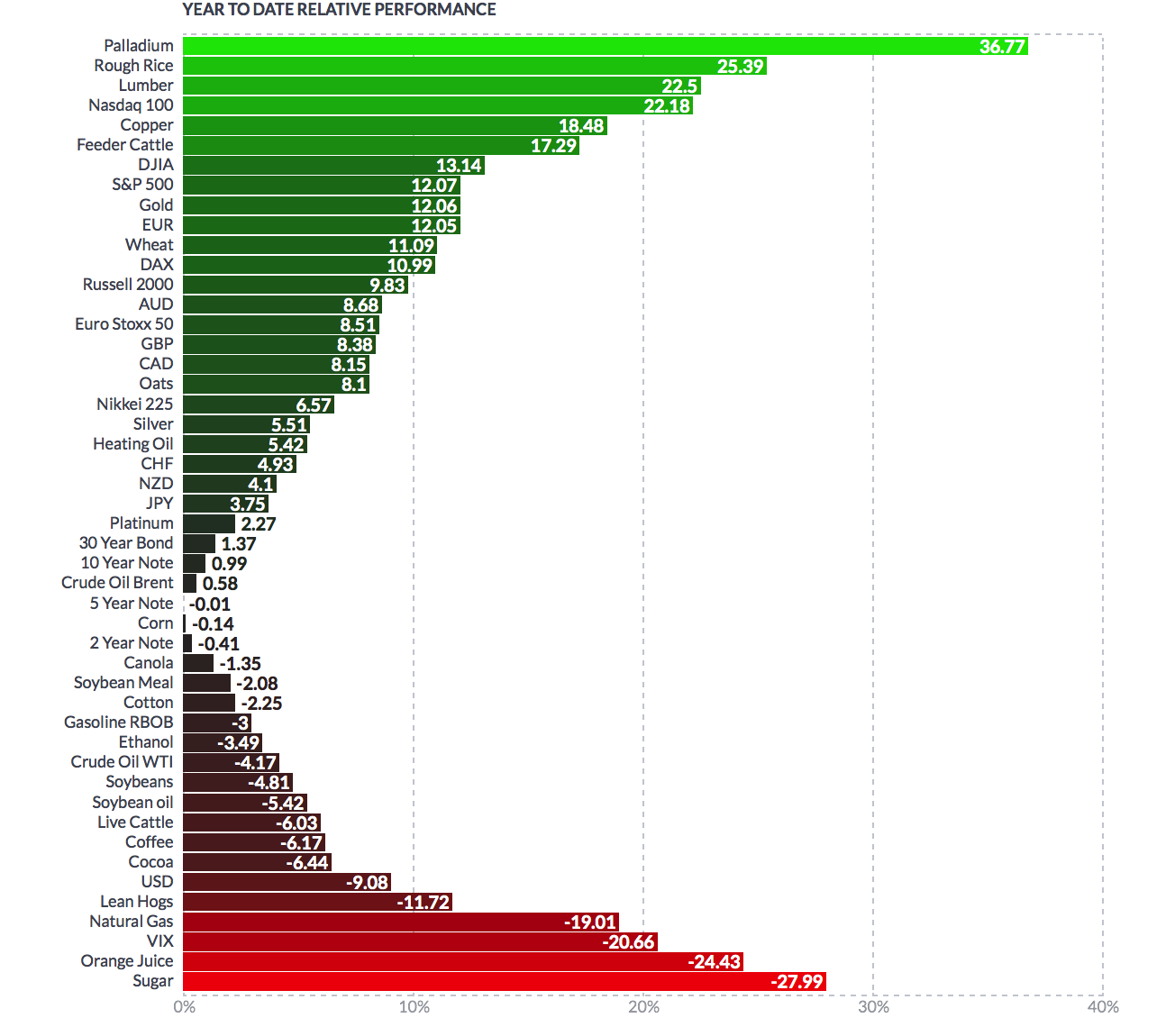
Gold Matches S&P 500 Performance In First 3 Quarters; Up 12% 2017 YTD

Editor Mark O"Byrne


- Gold climbs over 12% in YTD, matching S&P500 performance
- Palladium best performing market, surges 36% 2017 YTD
- Gold outperforms Nikkei 225, Euro Stoxx 50, FTSE and ISEQ
- Geo-political concerns including Trump and North Korea supporting gold
- Safe haven demand should push gold higher in Q4
- Owning physical gold not dependent on third party websites and technology remains essential


Click to enlarge. Source Finviz.com


In the year-to-date the gold price performance has matched the S&P 500, climbing over 12%.


Gold"s matching of the S&P 500 is particularly impressive when you consider the record-breaking performance of the benchmark stock market index in the last year. Yesterday it advanced 0.1% to 2510.06, a new all time record high price.


It is also impressive considering sentiment towards stocks is shall we say "irrationally exuberant", while sentiment towards gold remains muted despite gold eking out gains in 2016 and now again in 2017.


The precious metal has performed well predominantly due to rising uncertainties regarding North Korea, Trump and the political mess in the U.S. and other geopolitical tensions.


Its strong performance is despite noise from the US Federal Reserve regarding its alleged plans to tighten money supply and increase rates. Other major central banks have also provided similar indications.


Elsewhere, gold has outperformed both the Euro Stoxx 50 and Nikkei 225 which are 8.5% and 6.5% higher respectively. The UK"s FTSE and Ireland"s ISEQ are underperforming and have the hallmarks of markets that are topping out.


The FTSE and the ISEQ are 2.5% and 4.25% higher year to date.


Silver, platinum and palladium up 5.5%, 2% and 37%  YTD respectively


Gold wasn"t the only precious metal that performed well in the last three quarters. All four precious metals have climbed in price.


Palladium has been the headline grabbing asset in the last year. In the year-to-date the industrial precious metal is up by nearly 37%. Holdings in exchange-traded funds backed are close to the highest since the beginning of the year.


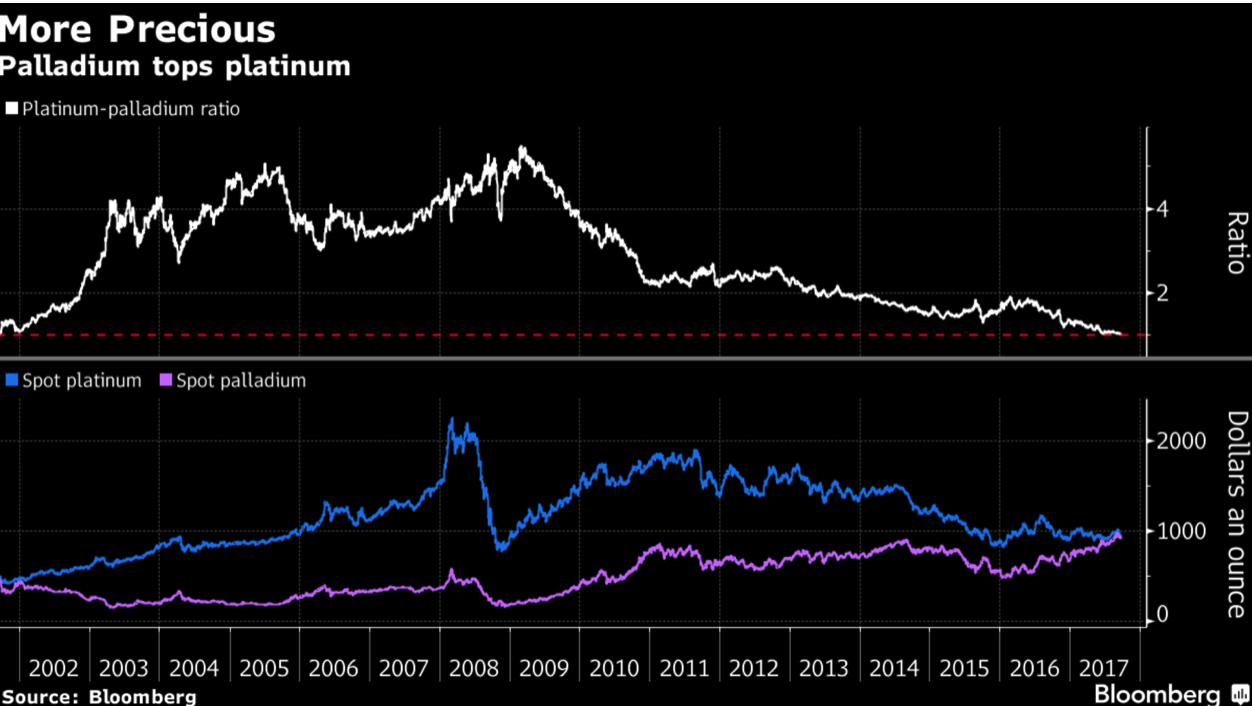
This week for the first time since 2001, palladium topped the platinum price. Palladium is predominantly used in pollution-control devices for gasoline-powered cars and trucks. In contrast platinum is used in diesel-powered engines.


Governments have been slowly clamping down on diesel due to concerns over its role in pollution and emissions scandals. Platinum is up by only 2% this year. Some believe the metal has been oversold in recent days and there is too much heat in the palladium market.palladium tops platinum
Meanwhile silver is refusing to go below $16/oz. Some investors may feel disappointed that it has failed to break above $19/oz this year, despite strength in gold.


Investors in silver must continue to take heart that silver does still stand to gain whenever the U.S. dollar loses strength or concerns about the stock market creates demands for assets to hedge risk with.


Geo-political concerns with North Korea and elsewhere fuel demand


In a recent Bank of America Merrill Lynch survey the biggest "tail risk" seen by investors was North Korea"s missile risk.


This was ahead of policy missteps in central banks of the US and China, and credit tightening in China.


However, worries over nuclear war are not the only concern fuelling the price of gold. Uncertainty regarding political haggling and stalemate in Washington are also providing key support.


Trump cronyism


Critics of President Trump are concerned that he and his team have achieved very little since his inauguration. Any plans that have been proposed are seemingly poorly devised and quickly shot-down.


This week the Republicans failed once again to defeat Obamacare, a key component of Trump"s election promises. Also the White House announced a plan for a lower corporate tax rate and to cut the highest individual income tax rate.


Critics argued however that the plan was awash with cronyism and helped the wealthy. There was also little indication given as to how the tax cuts would be funded amid risks that deepening U.S. deficits may further weaken the dollar.


Expect more safe haven demand next quarter 


As we all know, gold is a barometer for uncertainty. With a 12% climb in the last year and no sign of risks abating, there is little reason to not expect the price to continue to climb.


Should gold reach $1,400, then this will be a four-year high and a sure sign of a bullish breakout for the precious metal.


We shouldn"t invest in gold because of some ambulance-chasing punt on geopolitical disaster. Gold should play a key role in your investment portfolio as a tool for protecting against risk and hedging declines in stock and other markets and currency devaluations.


In truth, there is still a huge amount of uncertainty regarding the outlook for the global economy and global markets.


No one knows how central banks" attempts to unwind the last decade of monetary policy will play out, nor does anyone know how President Trump"s government will survive in an America that will continue to feel more pressure from the likes of Russia and China.


Investors need to stay focused on the medium and especially the long-term and the bigger picture.


Editors Conclusion


Sentiment in the gold market remains quite poor. Most of the public remains on the sidelines  and there is very little positive coverage of gold.


Nor is there an appreciation of the scale of economic, geo-political and monetary risks facing investors and savers today.


There remains a fundamental lack of knowledge of the still very strong supply and demand factors driving the physical gold market and a lack of understanding as to why gold remains a vitally important asset to own in a portfolio.


Many stock markets are at record highs. Many bond markets are at record highs. Many property markets are at record highs. This makes gold which is remains nearly 33% below its record high very attractive from a hedging and diversification perspective.


Real diversification through owning allocated and segregated gold not dependent on third party websites and technology remains essential.


The old Wall Street adage to always keep 10% of your wealth in gold and hope that it does not work remains prudent.


Lets hope for the best but be prepared for less benign financial scenarios...


Gold and Silver Bullion - News and Commentary


Gold steady, on track for first monthly loss in three (Reuters.com)


Dollar Pressured After Strong Week; Bonds Advance: Markets Wrap (Bloomberg)


India May Have a Spot Gold Exchange in 12 to 18 Months (Bloomberg)


Gold rebounds from 6-week low as dollar drops (Reuters.com)


U.S. trade deficit shrinks in August, but the gap has widened in 2017 (Marketwatch)


 Source: Zerohedge


Gold and cash reign as U.S. fund investors sell stocks: Lipper (Reuters)


Is This The Real Driver Of Gold"s Recent Weakness? (Zerohedge)


Here’s what this “old school” investor thinks of bitcoin… (Stansberry CH)


You"re Likely A Lot Less Prepared For Crisis Than You Realize (Peak Prosperity)


Rickards Warns "Cracks In The Dollar Are Getting Larger" (Zerohedge)


Gold Prices (LBMA AM)


29 Sep: USD 1,286.95, GBP 963.15 & EUR 1,090.82 per ounce
28 Sep: USD 1,284.30, GBP 961.04 & EUR 1,091.40 per ounce
27 Sep: USD 1,291.30, GBP 963.83 & EUR 1,099.54 per ounce
26 Sep: USD 1,306.90, GBP 969.59 & EUR 1,105.38 per ounce
25 Sep: USD 1,295.50, GBP 957.89 & EUR 1,089.26 per ounce
22 Sep: USD 1,297.00, GBP 956.15 & EUR 1,082.09 per ounce
21 Sep: USD 1,297.35, GBP 960.56 & EUR 1,089.00 per ounce


Silver Prices (LBMA)


29 Sep: USD 16.86, GBP 12.60 & EUR 14.27 per ounce
28 Sep: USD 16.82, GBP 12.53 & EUR 14.28 per ounce
27 Sep: USD 16.89, GBP 12.58 & EUR 14.38 per ounce
26 Sep: USD 17.01, GBP 12.67 & EUR 14.43 per ounce
25 Sep: USD 16.95, GBP 12.57 & EUR 14.27 per ounce
22 Sep: USD 16.97, GBP 12.52 & EUR 14.18 per ounce
21 Sep: USD 16.95, GBP 12.58 & EUR 14.24 per ounce


Recent Market Updates


- Gold Standard Resulted In “Fewer Catastrophes” – FT
- Financial Advice From Man Who Made $1+ Billion in 1929 – Importance Of Being Patient and “Sitting”
- “Gold prices to reach $1,400 before the end of the year” – GoldCore
- Commodities King Gartman Says Gold Soon Reach $1,400 As Drums of War Grow Louder
- Bitcoin “Is A Bubble” but Gold Is Money Says World’s Biggest Hedge Fund Manager
- Pensions and Debt Time Bomb In UK: £1 Trillion Crisis Looms
- Gold Investment “Compelling” As Fed May “Kill The Business Cycle”
- “This Is Where The Next Financial Crisis Will Come From” – Deutsche Bank
- Global Debt Bubble Understated By $13 Trillion Warn BIS
- Bitcoin Price Falls 40% In 3 Days Underlining Gold’s Safe Haven Credentials
- Gold Up, Markets Fatigued As War Talk Boils Over
- Oil Rich Venezuela Stops Accepting Dollars
- Massive Equifax Hack Shows Cyber Risk to Deposits and Investments Today

Tuesday, August 29, 2017

Capitalism - A New Idea

Authored by Jeff Thomas via InternationalMan.com,


Capitalism, whether praised or derided, is an economic system and ideology based on private ownership of the means of production and operation for profit.


Classical economics recognises capitalism as the most effective means by which an economy can thrive. Certainly, in 1776, Adam Smith made one of the best cases for capitalism in his book, An Inquiry Into the Nature and Causes of the Wealth of Nations (known more commonly as The Wealth of Nations). But the term “capitalism” actually was first used to deride the ideology, by Karl Marx and Friedrich Engels, in The Communist Manifesto, in 1848.


Of course, whether Mister Marx was correct in his criticisms or not, he lived in an age when capitalism and a free market were essentially one and the same. Today, this is not the case. The capitalist system has been under attack for roughly 100 years, particularly in North America and the EU.


A tenet of capitalism is that, if it’s left alone, it will sort itself out and will serve virtually everyone well. Conversely, every effort to make the free market less free diminishes the very existence of capitalism, making it less able to function.


Today, we’re continually reminded that we live under a capitalist system and that it hasn’t worked. The middle class is disappearing, and the cost of goods has become too high to be affordable. There are far more losers than winners, and the greed of big business is destroying the economy.


This is what we repeatedly hear from left-leaning people and, in fact, they are correct. They then go on to label these troubles as byproducts of capitalism and use this assumption to argue that capitalism should give way to socialism.


In this, however, they are decidedly wrong. These are the byproducts of an increasing level of collectivism and fascism in the economy. In actual fact, few, if any, of these people have ever lived in a capitalist (free-market) society, as it has been legislated out of existence in the former “free” world over the last century.


So, let’s have a look at those primary sore spots that are raised by suggesting that collectivism will correct the “evils” of capitalism.


Prices Are Driven From the Top Down


This is unquestionably the case in the aforementioned countries, however, it is not so under capitalism. Under capitalism, each producer tries to get as much as he can for his product, but, as others are also creating the same product, those with the lowest price are the ones who will succeed. Therefore, the consumers effectively set the prices, based upon what they’re willing to pay.


But in any country where cronyism exists between big business and government, regulations can squeeze out the competition, allowing a monopoly for a given product. The definition of this marriage between business and government is “fascism.” The government makes it increasingly difficult, through regulation, for the small producer to compete with the larger producer (who gives kickbacks to the government).


Capitalism Only Benefits Those at the Top


Capitalism benefits those who produce the most, but it also benefits all others, as they have a free choice to purchase whatever products they wish, at a price they’re prepared to pay. If the producer demands too high a price, consumers instead buy his competitor’s product, putting him out of business. The consumer is therefore in charge of the price of goods. A producer only rises to the top if he produces the most affordable product (as did Henry Ford, 100 years ago, with his Model T. Through the free market, he lowered his price repeatedly and, in so doing, put America on wheels).


Capitalism Impoverishes the Masses


The free market offers more goods to more people at lower prices, which enriches the lives of all consumers, no matter how rich or poor. In so doing, it raises up the masses over time, providing them with more and better goods, education, health care, etc., enabling them to rise out of poverty. By contrast, overregulation and entitlements enslave those same people to poverty.


Capitalism Can Only Work if It’s Heavily Regulated


The whole idea of the free market is that it’s free from interference by others—most importantly, governments. If left alone, the free market will produce the goods the public are most willing to pay for, which results in an ever-self-levelling of products and prices. As soon as regulation enters the picture, the free market is compromised. What exists today is not a free market, as Adam Smith would have recognised it, but a bloated, dysfunctional socialist/fascist/capitalist mongrel of a system. Of course it doesn’t work.


Fascism is capitalism in decay.


—Vladimir Lenin


Quite so. Regulation is a cancer that slowly eats capitalism until it morphs into fascism.


Do not their leaders deprive the rich of their estates and distribute them among the people; at the same time taking care to preserve the larger part for themselves?


—Socrates to Adeimantus


What was true ca. 400 BC in Athens is true today. Fascism (or corporatist cronyism) results in 99% of the population coming under the diktat of the 1%, which is made up of government leaders and corporate leaders, working in concert, to the exclusion of all others. This is, in fact, the opposite of a free market.


The creation of new wealth is the only functional weapon against poverty.


—Doug Casey


New wealth comes from the bottom up - it’s as simple as someone building a better mousetrap, or building the old one more cheaply. In such a market, both the producer and the consumer benefit.


In a fascist system, the wealth gravitates to the top, eventually choking out the middle class and expanding the poorer class, and that’s just what we’re witnessing today. The solution is not to go further in this direction, but rather to try something new… or at least new to anyone living under the fascist system. Although it still retains some capitalist overtones, it is unquestionably not capitalism.


A last word—capitalism does exist today, but it lives in select countries that have not yet given in to overregulation. In those countries, the average person thrives and has opportunities far beyond what’s allowed in the former “free” world. Should the reader conclude that his present country is unlikely to go in the direction of capitalism, he may choose to vote with his feet in order to prosper the way his ancestors did 100 years ago.


*  *  *


Today, Washington’s dangerous fascist policies have pushed the US economy to the tipping point. Years of overregulation, corporate bail outs, manic money printing, and artificially low interest rates, have bloated and warped the economy. Now it’s about to unravel… That’s why New York Times best-selling author Doug Casey and his team just released an urgent video. Click here to access it now.

Wednesday, August 23, 2017

The Chinese Economy's Fatal Flaws

Dr. Per Bylund’s recently published article poignantly states one of the core problems in the Chinese economy and its the state-manipulated Keynesian foundation. I do agree with his opinion. And if we dig deeper into the exact situation of Chinese economy, we will find that it’s a typical failing of the Keynesian, cronyist system.


By using the perspective of Austrian business cycle theory, lets take a look at China’s real estate industry, which is suffering more and more painfully from artificial credit issued by China’s central bank, the People’s Bank of China (PBC).


During the 2008 global economic crisis, China’s central government issued the famous RMB 4 Trillion Stimulus Package Plan (equaling to $586 billion).


Since 2009, the Chinese real estate economy has already suffered from three small economic cycles. As it is becoming more difficult for real estate companies to live on artificial prosperity, the duration of every business cycle has become shorter than the previous one. We also see more and more ghost cities because of the economic boom in every sub-economic cycle. There were at least 12 ghost cities founded in 2013, and the number of them jumped to at least 50 in 2017! Bankruptcy is happening more frequently among Chinese real estate enterprises. Since 2016, at least three real estate companies — with a combined debt of at least RMB 763 million — have gone bankrupt. The story of bankruptcy is continuing, with one of the biggest real-estate-driven enterprises, Wanda Group, facing financing problems. If Wanda no longer has access to cheap debt, it might not be able to refinance or roll over all its debt again. If Wanda has to face bankruptcy, it could possibly accelerate an end of the the current Chinese boom. 


The data from the Chinese local governments is also not optimistic; their debt levels have reached almost RMB 25 trillion (US$ 4 trillion) at the end of 2014. In 2015, even the PBC admitted in one of its annual reports saying that China’s financial system is facing higher instability and uncertainty.


The above evidence is not a surprise. All these are the consequence of artificial bank credit created by central banking and central planning.


In China, the loans are easy to get from the State Owned Enterprises (SOEs) or the businessmen who are the friends of the politicians in the Communist Party. China’s real estate industry is also the ally of the state and only the people who are friends of those in authority can participate in housing programs. 


Besides the SOE economic system, what we should worry more about is how the Keynesian and crony system hurts small and private businesses in China, who are driving the economy of this country. Compared with the SOEs, and the businessmen who are the close allies of some influential politicians, it is harder for ordinary entrepreneurs who are running small businesses to get loans. Moreover, the recent market squeeze makes it harder for Chinese small business to survive. These entrepreneurs are not only facing an unfriendly bank credit situation, but also the threat of having to bribe the government to circumvent the massive scale of governmental economic regulations.


Consider the story of a small business boss Li Lang, who is a typical Kirznerian alert businessman in China. Several years ago, he observed a shortage of moving companies in the Southwest Chinese town of Chengdu. He started his business to serve the local people. The business is not easy, not only because it requires hard work, but Li also must bribe and maintain good relations with the local politicians to let them “protect” his business and help him introduce some business opportunities. According to Li, if the local bigwigs in the crony system had already discovered the opportunity of earning a fortune by managing a moving company, it wouldn’t have been possible for him to enter the business. Though now that he has earned a lot of money, he still has to carefully maintain the relationship with the politicians to "protect" his business. His is not an isolated case. In China, the less connections you have with the cronyist system, the less business opportunity you have. And even if you become successful in your business, be careful, the state has eyes on your wealth.


Though we know that the private sector is driving the Chinese economy and has improved the living standard of many Chinese individuals despite state economic manipulation, we still have to emphasize that the nature of the Chinese economic model is dominated by Keynesianism and cronyism.


Otherwise, the false prosperity would make us misread what is happening in China.


*  *  *


In other words - don"t start believing.

Saturday, August 19, 2017

UK Opposition Leader Calls For "People's QE" - It's Venezuela With Tea & Cakes

Authored by Daniel Lacalle via The Mises Institute,


It is sad to see that, facing the evidence of the failure of demand-side policies and money printing, many commentators propose some of the most outdated and failed policies in modern economic history. In the UK, Mr. Jeremy Corbyn, the new leader of the Labour Party, believes that the government spends too little. With a current 44.4% of GDP public spending, saying the government spends “too little” is an insult to taxpayers and efficient public bodies alike.


But Mr. Corbyn wants to penalize the private sector creating the largest transfer of wealth from savers and taxpayers to government ever designed... The People"s QE (quantitative easing).


In Europe, we are already used to the follies of magic solutions from populist parties. Syriza, Podemos, and others always come up with “magic” and allegedly “simple” ideas to solve large and complex economic issues, and always fail when reality kicks in, but there are few that match the monumental nonsense of the wrongly-called “People´s QE”. It is the “Government´s QE”, rather.


Why Is this People’s QE a Bad Idea?


The analysis starts from the right premise. Quantitative Easing, as we know it, does not work, and creates massive imbalances. So what do they propose? Sound money? Erasing perverse incentives of printing money and unjustifiably low rates? No. Doing exactly the same, but passing the massive perverse incentive of currency debasement to politicians who, as we all know, have no perverse incentive whatsoever to overspend (note the irony).


The UK policy of increasing money supply in the past has always been based on two premises to avoid hyperinflation and currency destruction: the independence of the central bank as a central pillar of monetary policy, and the constant sterilization of asset purchases (ie, what it buys is also sold to monitor market real demand). The balance sheet of the Bank of England has remained stable since 2012, coinciding with the highest economic growth period, and is below 25% of GDP.


Corbyn´s People´s QE means that the central bank will lose its independence altogether and become a government agency that prints currency whenever the government wants, but the increase of money supply does not become part of the transmission mechanism that reaches job creators and citizens in the real economy. All the new money is for the government, with the Bank of England forced to buy all the debt issued by a “Public Investment Bank”.


The first problem is evident. The Bank of England would create money to be used indiscriminately for white elephants, a disastrous policy as seen in many EU countries, that only leaves overcapacity and a massive debt hole. By providing the public investment bank with unlimited funding, the risk of irresponsible spending is guaranteed. In a country where citizens are aware of wasteful public infrastructure, this is not a small risk. However, the monetary imbalances created by this policy would generate a massive “crowding-out” effect and incentivise cronyism, as the private sector would suffer the consequences of inflationary and tax pressures as well as unfair competition from government and its crony sectors.


The second problem is that rising public debt, even if “monetized” (hidden in the balance sheet of the investment bank), would still cripple the economy even with perennial QE. Printing money does not reduce the risk of rising imbalances as we are seeing all over the world. And the new bank´s potential losses would be covered with more taxes.


The idea of building lots of bridges and airports all over the place to “create” jobs would be mildly amusing if it hadn’t failed time and time again and forgets the cost of running those infrastructure projects once built, apart from the debt incurred. All paid by the taxpayer, who guarantees the capital of the Public Investment Bank.


The third problem is that inflation created by these projects is paid by the usual suspects, the private sector, and citizens, who do not benefit from this spending as the laws of diminishing returns and debt saturation show.


The Socialist idea that governments artificially creating money will not cause inflation — because the supply of money will rise in tandem with supply and demand of goods and services — is simply science fiction. The government does not have a better or more accurate understanding of the needs and demand for goods and services or the productive capacity of the economy. In fact it has all the incentives to overspend and transfer its inefficiencies to everyone else. As such, like any perverse incentive under the so-called “stimulate internal demand” fallacy, the government simply creates larger monetary imbalances to disguise the fiscal deficit created by spending and lending without real economic return: Creating massive inflation, economic stagnation as productivity collapses and impoverishing everyone… except itself.


These policies lead to tax increases, a higher cost of living and, above all, destroying a large part of the British private sector as the government monopolizes the major sectors of the economy and increases taxes for the rest.


These dangerous magic-solution policies have already been implemented in the past. They are nothing more than the Argentine model of Kirchner and Kiciloff disguised in Anglo-Saxon terms, a model that has only created stagflation. It is also the Venezuela model (Mr. Corbyn was a defender of Chavez and his economic policies). To think that the government can decide how much money is created and spend it on whatever it wants without thinking of the consequences for the economy.


The myth is that they say printing money will not cause inflation because it will increase productivity and the increase in money supply will come in tandem with more goods and services:


Inflation occurs when you have more money chasing the same or less amount of goods and services. If you have money creation that increases productivity, yes you have more money but you also have more goods and services…the supply of both increases in tandem, so you don’t necessarily have to have inflation.


It"s Been Tried Before 


The problem? It is simply a myth debunked by history. Every single attempt at this socialist myth of productivity, supply and demand moving in tandem because the government says so, fails. It never happens. The government does not have better or more detailed information than the private sector of what goods and services the economy needs, and even less knowledge of how to boost productivity because it does not have the incentive of profitability and efficiency, just of maximizing budget spending.


Productivity collapses as government overspends on white elephants and politically motivated investments with no real economic return. The supply of goods and services does not increase in tandem with money supply in an open economy dependent on imports like the UK’s. Basically, the theory sounds nice, it simply never happens.


At least, when private banks “create money”, they have an incentive to lend with a real economic return and to try to recover the principal, with an interest. They might fail, and therefore my defense of a minimum cash coefficient and sound money. However, the government has no such incentive, rather the opposite. To create money to spend on politically motivated items, and pass the imbalance through inflation and currency debasement to the productive sectors.


The lesson from Japan was clear: “Individual consumption only went up by around 0.1-0.2% of GDP and failed to increase long-run consumption. Overall, the program did not ignite inflation or help Japan out of its economic rut“. And the lessons from Chile with Allende, and Argentina with Kiciloff, are scary.


Corbyn forgets that the public sector cannot exist without private sector revenues. Printing money does not create prosperity, it dilutes it. Be it through current or other QEs.


The aristocrats of public spending always think that intervening on money creation and the economy is going to solve everything.


Do they know this will not work either? Yes, but the final objective is different. To make government control all aspects of the economy, whether it is in recession or in depression. For Corbyn, the government is infallible and any mistake it makes has to be blamed on an external enemy.


If Corbyn implements this “People’s QE”, it will be “Venezuela with tea and cakes”.


The People’s QE is the same as any other quantitative easing, a massive monetary imbalance today under the promise of solving it in the future. The current QEs will likely end with a financial crisis. The People’s QE would do the same. Except that the “alleged” beneficiaries, the “people”, will likely be drowned in inflation as the mirage of money supply and goods and services growing in tandem is proven as fake as it is in today’s QE programs. But without sterilization and transmission mechanisms, the inflation that is created today in financial assets would make prices soar due to devaluation.


Monetary imbalances always create inflation. Whether it is asset price inflation or goods, it is the symptom of aa larger problem. Because all monetary imbalances end with either a financial crisis, massive inflation or massive unemployment once the small and temporary effect of the monetary placebo ends.


The artificial creation of money without any support is always behind every crisis. The People’s QE has failed every time it has been implemented. This would not be different.

Wednesday, August 16, 2017

Ukrainian Lawmakers Disclose $45 Million In Bitcoin Holdings

As Ukraine"s crackdown on corruption continues, three lawmakers from Ukraine’s ruling party revealed this week that they own a combined $45 million in bitcoin, according to a report by RIA Novosti, a Russian foreign news service.


Their holdings came to light during mandatory financial disclosures by members of the Ukrainian parliament, part of an IMF-approved strategy to tamp down corruption in Ukraine. The country"s democratic institutions, which were never very robust to begin with, have been further destabilized by the civil war that"s seen pro-Russian separatists seize control of two regions in eastern Ukraine. Lawmakers must now disclose their assets and wealth in an online database.


Dmitry Golubov possesses the most bitcoin, with 8,752 BTC, an amount worth roughly $36 million at current prices, according to CoinDesk. Alexander Urbansky possesses 2,494 BTC, or $10.3 million, while Dmitry Belotserkovets owns 398 BTC, or $1.6 million.


Ukraine’s central bank plans to develop a regulatory framework for cryptocurrencies after discussing the legal implications of the virtual tokens at a meeting next month.  


“The disclosures come as Ukraine inches toward regulating the cryptocurrency.


As reported previously, the National Bank of Ukraine – the country"s central bank – revealed last week that the legal implications of cryptocurrencies will be discussed at the next meeting of the Financial Stability Board of Ukraine. That hearing, scheduled for the end of August, will bring together the nation"s financial authorities.


It"s unclear at this time exactly what steps the government will ultimately take. Local sources reported last week that a large cache of bitcoin mining machines were confiscated after authorities discovered them at a state-owned facility.”


Ukrainians have been exposed to the vast differences between the fortunes amassed by the country’s politicians and the more modest holdings of those they represent since an anti-corruption reform requiring senior Ukrainian officials to declare their wealth online was implemented late last year.


Some lawmakers have declared millions of dollars in cash. Others said they owned fleets of luxury cars, expensive Swiss watches, diamond jewelry and large tracts of land. These revelations have no doubt undermined public confidence in the country’s government, particularly the ruling party led by President Petro Poroshenko, whose family amassed a fortune in the confectionary business. By comparison, the average salary in Ukraine is just over $200 per month.


Poroshenko - a prominent fixture of the Panama Papers - retains control of a top TV channel and has failed to follow through on his promise to sell off his Roshen chocolate empire due to a lack of foreign interest and a dearth of rich-enough investors in Ukraine itself.


While the online declaration system has been intended to represent a show of good faith that officials are willing to open their finances up to public scrutiny, to be held accountable, and to move away from a culture that tacitly allowed bureaucrats to amass wealth through cronyism and graft, the public reaction has been one of shocked dismay at the extravagant lifestyles conjured up by many of the disclosures.


"We did not expect that this would be such a widespread phenomenon among state officials. I can"t imagine there is a European politician who invests money in a wine collection where one bottle costs over $10,000," said Vitaliy Shabunin, the head of the non-governmental Anti-Corruption Action Center.


Ukraine"s economy is on track to shrink by about 12 percent this year and only return to marginal growth should the eastern campaign end in 2016. Unrest in the country began back in 2014 when former President Viktor Yanukovich, who was perceived to be too close with Russian President Vladimir Putin, was forced to abdicate.
 

Meet Billionaire Kevin Plank: Maryland's Corporate Welfare King

Via StockBoardAsset.com,


A corporate cronyism scandal could be brewing out of Baltimore, Maryland this month involving Billionaire Kevin Plank (CEO of Under Armour). What is alleged per The Baltimore Post are Baltimore County Council members  supporting a ‘conditional grant in an amount up to  $ 2,000,000 to Under Armour, inc from the Maryland Department of Commerce pursuant to the Maryland Economic Development Assistance Fund’. The purpose of the grant is for the redevelopment of Tradepoint Atlantic (TPA) of Sparrows Point, where the 3,100 acre site use to be the home of the world’s largest steel producer called Bethlehem Steel.


In this case, Maryland’s economic development assistance fund is better known as ‘corporate welfare’. The article goes on to say,


someone please explain to me why Mr. Plank, who according to Forbes Magazine has a net worth around $1.74 billion, needs $2 million from us regular middle class taxpayers.  


After reading further into the article, it seems as Kevin Plank (CEO of Under Armour) has aligned himself with the so called ‘deep state’ of Maryland:


This debauchery not only involves Baltimore County, but also the state of Maryland and our local delegates who are deeply entrenched in TPA.  Several projects came up at the last meeting concerning the news in Annapolis and its impact on Baltimore County. What we heard from our delegation is more propaganda than reality. Once again, the issue of jobs (10,000 of them) was at the forefront of this gabfest. Blowing more hot air than facts, the delegation pontificated on the wind tunnel issue that TPA is pursuing.


Let’s take a closer look at that other Councilman’s checkered background. It is beyond me that Mr. Quirk, would even consider such taxpayer funded grants and loans with the current state of affairs with the county’s fiscal problems, which include decaying schools, lack of AC, and a wave of violence within that education system. Not to mention the crumbling roadways and a $200 million bond debt.  


Crossing into Baltimore City lines, Kevin Plank (CEO of Under Armour) has another real estate gamble valued at $5.5 billion called Port Covington located on 200 acres of Baltimore waterfront. The project is described as a ‘city with in a city’ for 10,000-15,000 new residents. This time around, the corporate welfare for the project is upwards of $660 million worth of tax incentives at the expense of the taxpayer.


So, where have we seen this story before? Yes, it’s Elon Musk whose companies, Tesla Inc. and Solar City Corp.  “hugely benefit from government grants, discounted loans, tax breaks, government incentives and the sale of environmental credits”.


This makes Elon Musk the Billionaire Welfare King of California and Kevin Plank the Billionaire Welfare King of Maryland.


Meanwhile, back in Baltimore, nearly 1/3 of black households have a zero net worth… The inner cities of Baltimore are an absolute mess after 50-years of democratic controlled leadership compounded with deindustrialization robbing the community of its wealth. There are nearly 46,800 vacant row homes in Baltimore City with a homicide rate that is doubled of Chicago’s and a homicide count higher than NYC.


In both Under Armour projects, Baltimore City and County Officials would rather provide a variant form of corporate welfare to Billionaire Kevin Plank (CEO of Under Armour), than spend it on the communities that need it the most. Something is wrong in America and it doesn’t smell right. We call this corporate cronyism and there is a scandal lingering….


In the video below, you’re about to hear an interview of two community leaders in Baltimore City, Maryland. The mainstream media is not allowed to share this with you, because it destroys the narrative that everything is awesome in Baltimore. This is a first hand account of what community leaders think about the corporate welfare of Under Armour in Baltimore and how they think public monies are being misallocated and are not reaching the communities that need it the most.