Showing posts with label LIBOR. Show all posts

Friday, December 15, 2017

Cryptocurrency Bank AriseBank To Acquire 100 Year Old FDIC Bank; Partner With BitShares.

Intro by Vince Lanci


via the Soren K. Group at Marketslant.com


The Next Revolution is already Happening


Over the past few weeks, I"ve had the pleasure of meeting the next revolutionaries in the democratization of money. This was while looking to understand better the guts of the blockchain tech and how it differed from crypto to crypto. I had the  pleasure of meeting with and  speaking to several people involved with Bitshares and those  involved  at the  periphery with Arisebank. During that time, by coincidence, Arisebank was in the process of doing the deal described in the headline. And I was able to look through the glass at this event where people were ,to my eye, looking to facilitate the transition from intellectual ideas to applications in reality. That is what Capitalism is in part about. Providing a service that fills a need and makes it easier which  gets you paid. Not making a dollar and being apathetic if the service actually helped someone. Free market capitalism allows for new ideas to make it (or not) on their own merits. That is what I saw. The potential  for self-clearing markets to  reassert themselves and for money to get to where it is needed most without incumbent toll booth operators throttling ideas fortheri own benefit.


I saw people who will make a bundle of money by adding value to a system in need of overhaul. i spoke wit ha few on a guarantee of anonymity. One key person said to me  in response ot me pointed question that blockchain is the beginning, Bitcoin may be the early pioneer, but like the Palm pilot, it was replaced by better tech. Why wed yourself to Blockchain?:


"Look, the tech is evolving, and we are already looking at how Quantum computing will make different types of tech more palatable than blockchain. I agree with you. In a few years at most, something better will come along. And that is a good thing. Because the goal here is to use these new tools to remove the friction in all things that prevents ideas from getting their chance to make it or not on their own merits. If you ( he was addressing me directly here) have an idea that will make a market more efficient and serve the greater good, I want to hear about it. Because now, I can help you get it into "production" much easier because  of what we can  do."


My response was: Sure, I feel intermediaries in general that do not add value need to be removed. Frankly, I feel Precious metals producers"  have been victims of their own ignorance for years. As a result they are captive clients to intermediaries who tell them when to hedge in order to maintain their credit line. Meanwhile those same firms that manage the producer"s banking, LOC, ISDAs, and production hedging are making money not just from those services, but on the prop-side of being able to benefit from the natural sell order flow captive producers provide. This is too much friction from production to user. It"s like a poorly connected pipeline slows waterflow"


His response was simple:


"Exactly. And we are already working with someone who is working on solving that problem right now. You should connect with them. "


And in 24 hours I was involved in a pressure cooker with a couple geniuses having conceptual discussions on how to use the available tech to make more precious metals distribution from producer to end user more efficient. The point is, the man quoted above was all about making  it happen. And it likely will if the people I"m now talking with and learning from get their wish. i hope to be sharing more on this topic soon. Moving on to the event at hand today.


Better Money Needs a Better Banking Model


If money is the life blood of capitalism, then banks are the valves that control the flow of that blood. In this way, traditional banks can sometimes make errors in allocation of investment capital, errors in custodial trust, and due to their centralized “gatekeeper” status have a Fed sponsored franchise that can be a deterrent to efficient, free markets. If you had the time to listen to my podcast yesterday on this topic you can see where I was coming from in light of today"s events.


This is actually why crypto currencies are vulnerable. They are not regarded as money officially, like Gold is not anymore either . They are also in the process of being regulated via futures listing and “crackdowns” to protect us so we are told; also what happened to precious metals. 


There are many of them, and this fragmentation itself has risk that comes with its promise of economic freedom. Many will not make it. And they exist outside the banking network. 


But what happens if a crypto (or all crypto currencies) gets access to the circulatory system itself? What happens when a cryptocurrency, due to Blockchain’s distributed ledger accounting tech, obviates the need for those custodial trustee valves that  exist like manned toll booths when ez pass exist? They unionize in a panic to protect their jobs. That is what happens. And that has begun. 


To digress a second, we actually pay to get access to our money now. Cash Remember the advent of the ATM? It was heralded as a cost reducer for banks and a convenience for the client. Now, it is a profit center where people frequently are charged to get their money. This is basically cash trading at a discount to digital cash. You are paying the bank money to use your money in private transactions . But Quick-Pay, in which they monitor all cash use and collect data from, is free; for now. 


Supply Side Scalability is No Longer a Viable Business Model in a World Without Scarcity. Demand Side"s Network Effect Model Is


Banking’s centralized method of  “service” which at one time was necessary for orderly and counter-party trustworthiness in markets, has either outlived itself or become easily abused in its use. The trust resided in the person who did the  custodial duties.  Their supply side-market structure based on scalability, key to the industrial revolution, is no longer the most efficient. Scarcity is not the problem anymore. Distribution is. And that means another business model applies more efficiently. It is the demand side market structure model based on the network effect. And  to implement that, we need  a better way of mitigating counterparty trust that removes the  human element and bottleneck that comes along with its centralized systems. 


Traditional brick and mortar centralized Banking, like every industry before it, is jeopardized by the most important concept behind the current disruptive technological movement: decentralization. The problem with decentralization for banking until the advent of Crypto and blockchain tech is: it was not compatible with mitigating counterparty risk.  Therefore a centralized authority was needed. Distributed ledger accounting tech removes the need for a central custodial trustee to protect you from counter-party risk. This is what tech geeks say when they refer to a "trustless" transaction. They mean; there is no need for a human to verify the authenticity of the deal. The trust is verified at its DNA level so to speak.


The Bank Teller"s Revenge


When they fired the tellers it was a good thing for everyone but the tellers. What happens when the credit officers are not needed in a few years? What happens when those technologies that banks use to lower costs actually replace their revenue streams like Letters of Credit, banking fees and other overpriced franchises? White collar people get fired, that"s what happens. Credit lawyers alongside operations managers. The corporation will triage every extremity it has to, to continue to perpetuate its own incumbent authority and existence. It could get very weird. Call it the Teller"s Revenge if it plays out as it could.


The replacement is not crypto per-se; it is Crypto , Gold, Fiat, or anything that people agree is money but in a decentralized system where perfect money (whatever that may be) can exist in a perfect banking system. One that does not need to violate privacy to ensure custodial trust anymore.


Centralized Clearing will be less needed like centralized execution was obviated before it by things like Globex.  Electronic trading platforms removed the need for Central Limit Order Books (CLOBberred Clients) in commodities. CLOBs were comprised of resting orders entrusted by clients and handled by their bankers who traded both principle and agency. This was how the Gold , Silver and LiBor Fixes were run, and we now know how that worked out.


Specifically, a decentralized crypto-exchange that operates network across the borders of nation states on combination with decentralized bank with FDIC approval? Globalism without centralization, organically better for all and a remover of walls for the flow of free capital would be possible. Enter Arisebank in partnership with Bitshares..


- Vince Lanci


contact Vince at vlanci@echobay.com


Cryptocurrency Bank AriseBank To Acquire FDIC-Insured Bank; Partners With BitShares.


Written by Michael Taggart at Huffington post


Arise Bank offers a myriad of services to consumers looking for a banking alternative. 


Dallas, TX —- AriseBank announced that they have reached an agreement with an FDIC insured bank, that has been operating in the United States for over a century, that they will acquire them before the end of the year. This comes on the heels of their record ICO launch, where AriseBank plans to raise one billion dollars, which would end up being a record in the ICO investment space. 


“We are very excited to be at the forefront of history today. We feel like this was going to happen eventually and wanted to get the process started for the industry as a whole. There are certain people who may disagree with this move but, it has to happen eventually. The bank we are acquiring has hundreds of banking partnerships across the world and many certifications and licenses that make sense when it comes to interacting with our decentralized cryptocurrency platform”, said Jared Rice Sr., a co-founder and current CEO of AriseBank. 


Arise Bank is the worlds first decentralized bank.


With this acquisition, AriseBank, the world’s first decentralized cryptocurrency bank, now has the full financial capabilities of traditional banking coupled with the power and platform of real-time crypto-banking including a global network of ATM’s, debit cards and an AI trading platform. 


“The world’s first federally compliant, decentralized bank invites visionary strategic partners from all countries”, said Eddy Taylor a BitShares partner and a current advisor to AriseBank. “Arise features will include quantum computer-safe operating systems, multi-crypto debit cards, cell to satellite global outreach and much more”, he said. 


Also included in the acquisition is a 25-year old investment bank that Arise plans on converting to a crypto-investment house for consumers around the world. “We plan on growing investor confidence outside of our decentralized platform, which will enable many other outside services in areas like real estate, among many others on a global scale. 


Bitshares DEX is the worlds first decentralized cryptocurrency exchange.


This acquisition is happening concurrently with the announcement of a strategic partnership with BitShares, the world’s busiest financial blockchain as seen on blocktivity.info. AriseBank, the first decentralized bank is teaming with BitShares, the first decentralized exchange to provide a comprehensive platform for real-time delivery of incorruptible financial products and services. 


BitShares (BTS), with a market cap of $680M, is also a smart coin factory with hundreds of innovative financial products and compliant ICO offerings. It currently holds the record for over one million blockchain transactions per day dwarfing the performance of Bitcoin and all other blockchain networks. BitShares has in turn, teamed with the United Precious Metals Association (UPMA) to bring real-time metal-backed digital currencies into the mainstream. 


Gold and Silver can be used as legal tender in many states in the US, and other countries around the world.


The combined strengths of a conventional bank + decentralized bank + decentralized exchange + smart coin factory + gold depository + enterprise integrator makes the first full service alternative financial system to offer honest money and a level the playing field for all mankind. 


For more information contact:


Eddy Taylor (310) 940-2404 or visit SovereignHero.com.


John 469-71-ARISE or visit AriseBank.com

Sunday, November 26, 2017

Citi"s Shocking Admission: "There Is A Growing Fear Among Central Bankers They"ve Lost Control"

Earlier we showed a variation on a VIX chart from Citi"s Hans Lorenzen which, if it doesn"t impress, or scare you, then nothing probably will.


However, leaving readers unimpressed - and unscared - will not satisfy Lorenzen, which is why the credit strategist who works together with the godfather of rational doom, Matt King, and has been warning for weeks that now is the time to sell credit, unloads in one of the more effusive missives of dripping negativity to hit during this holiday week when one after another equity sellside analyst has been desperate to outgun each other with their ridiculous 2018 year end S&P forecasts.


And while Lorenzen touches on many things, at its core, his warning is straight out of Shumpeter: the longer nothing changes, the greater the crash will ultimately be, a topic which DB"s Aleksandar Kocic dissected over the summer, even defining an entirely new term in the process: metastability.


So without further ado, here is Lorenzen explaining why "embellishing the status quo will be the market’s undoing.


Ultimately, extreme valuations, the lack of risk premia, and a lack of responsiveness to tail risks are merely symptoms. The real question is what the skewed incentive structure resulting from that backstop has done to the fabric of markets after so many years. To our minds the answer is that trades and strategies which explicitly or implicitly rely on the low-vol environment continuing, are becoming more and more ubiquitous.


Realised historic vol is de facto an exogenous input to much of the risk management framework that underpins modern finance. With lookbacks extending a few years, an extended period of market stability reduces VaR measures and improves Sharpe ratios. Both allow / encourage investors to take more risk – driving valuations higher and vol lower still, creating a self-reinforcing dynamic. Intuitively, returns should follow flows – money is deployed and the asset price goes up. But in the real world the causation works the other way.


What this means in real-world terms:


Long periods of one-way markets breed survivor biases. The fund manager with lots of beta outperforms, the cautious fund manager underperforms. Either the latter gets on the bandwagon or soon enough outflows from the fund will ensue. Over time, fewer and fewer “critics of the regime” are left standing.


In an asset class where the upside is constrained, like in credit, that dynamic is further reinforced by the fact that a fund manager has to take more and more beta relative to benchmark in order to sustain the level of excess carry that will merely cover costs. The lack of volatility and the super high correlations between credits and the index (Figure 24), leave precious little scope for alpha (Figure 25).


Here we can add another piece to the short vol conundrum, because the closer spreads get to the lower bound, the more explicitly being long credit in itself becomes a short-vol position. With less and less upside remaining, owning credit risk become a question of generating a small amount of carry (or premium) for taking future downside risk – essentially, akin to selling a put option.


Meanwhile, as spreads collapse, as dol implied and realized vol, we are all “happily” ignoring that more risk is being issued into the market than ever before (Figure 26) and that the credit quality of the market keeps slipping – for the first time ever the market cap of the BBBs is about to overtake the rest of the € IG index (Figure 27).


What happens next should be familiar from the last financial crisis: the infamous step up in risk:


When the conventional asset class of choice no longer offers a “decent” return potential, money looks to the next one on the quality spectrum for a pickup. IG funds holding BBs and AT1. DM funds buying EM debt. European and Asian funds holding more and more $ fixed income. Corporates moving their liquidity from money markets to short-dated IG credit funds. Mandate creep in the investment criteria. Even synthetic structured credit is making something of a comeback. The list of tourist trades goes on and on. Most of these too are predicated on the status quo - if volatility and risk premia were to rise, retrenchment back towards the original / natural asset allocation would be swift and uncompromising.


And then, one day, the market will finally discount that the central banks are no longer set to injection trillions in liquidity: that"s the moment the public finally begins to admit the emperor is not wearing any clothes.


You could rightly argue that many of these factors are generic to every bull market. The fact that volatility clusters is exactly because of these (and other) selfreinforcing dynamics. But the implicit ceiling on vol / cap on downside from the central bank backstops has, in our view, allowed them to run for much, much longer than would have been possible in a market operating on its own devices.


You could argue that there is nothing to worry about as long as fundamentals remain strong. But those looking at the economic data, corporate earnings or leverage trends to indicate the next turn in markets are looking in the wrong place, if you ask us. Over the last 50 years, only 2 out of 19 corrections in US credit were led by a recession. 12 had no overlap with a  recession at all. In half the corrections, there wasn’t even a discernible turn in the leading economic indicator beforehand. Plainly, there is a long history of market corrections being triggered by other factors than fundamentals – Black Monday in 1987 and the correlation crisis in 2005 are two obvious examples.


Still, judging by the current state of the market, Citi writes that traders "evidently don’t expect a sharp market correction to happen tomorrow."


While the probability of a next-day loss still feels quite low there is an obvious temptation to stay invested a little bit longer for professional investors, tasked not with delivering a return of money, but a return on money and with high frequency. The process of judging that near-term probability manifests itself in the frenzied search for “triggers”. Surely, if one could just get a slightly better call on the next trigger, then it’d be possible to get out just in time before everyone else jams the exit? We don’t dismiss the importance of triggers. Indeed,  when you look back at the last fifty years, nearly every major correction in credit can be associated with a triggering event (Figure 28). With hindsight everything is easy.


Here Citi has some advice: don"t look for triggers; instead focus on the big picture.


We are sceptical that hunting for the next trigger is worth the effort. If a trigger seems obvious, then it’s probably obvious to everyone and chances are it will be too late. Triggers are often latent – the long-term problem is obvious, but it is ignored until suddenly it explodes without much warning (think the Greek sovereign debt crisis). Multiple factors often have to  combine to create a triggering event – the GFC wasn’t just about sub-prime, it was about excessive leverage, inadequate regulation, unchecked financial innovation, misaligned rating methodologies, inadequate backstops and a host of other things. The last couple of years have seen several widely peddled “triggering events” crystallise with remarkably little shake out.


So what about the big picture? Here one can argue that in recent years the market simply wasn’t vulnerable with so much central bank money behind it. However, Lorenzen believes that "2018 is different." As we see it, it is now increasingly vulnerable to a mid-cycle, “technical” correction, based on what we have discussed above:


  • Central bank asset purchases are set to be the smallest in a decade (Figure 29). A $1tn of incremental demand versus 2017 is needed from private sources.

  • At least in the US, the opportunity cost of not being invested in credit (i.e. the yield differential to 3m LIBOR) is likely to be the smallest since 2007.

  • The perception of a backstop has facilitated a multitude of trades and strategies that are contingent on a low level of volatility in an increasingly crowded space. Now that backstop is moving “out the money”.

  • Vol is near historic lows and has been so for longer than ever before. More risk than ever before is being issued into a credit market where spreads, on a like-forlike basis, are close to the 2007 tights and where breakevens are wafer thin.


Lorenzen then branches into some chaos theory for good measure:


In the context of a self-reinforcing, herding market, the pivot point where the marginal investor is indifferent between putting more money back into risk assets and holding cash instead is fluid. But when the herd suddenly changes direction, the result is a sharp non-linear shift in asset prices. That is a problem not only for us  trying to call the market, but also for central bankers trying to remove policy accommodation at the right pace without setting off a chain reaction – especially because the longer current market dynamics run, the more energy will eventually be released.


And while not intended to be a conclusion, or even a punchline, the next line from the Citi strategist should scare the living daylights out of anyone: it is a direct admission that central bankers have now lost control.


That seems to be a growing fear among a number of central bankers that we have spoken to recently. In our experience, they too are somewhat baffled by the lack of volatility and concerned about the lack of response to negative headlines.... Our guess is that sooner or later in the process of retrenchment they

will end up going too far – though that will only be obvious with

hindsight.


Frankly, that"s about the scariest admission from one of the world"s biggest banks that we have read in a long time.


* * *


As for how this period of cataclysmic metastability ends, here is Lorenzen"s dire conclusion:


In a fairy tale, turning points come suddenly and unexpectedly. Everything that has long been taken for granted is suddenly in pieces. In that sense markets are not all that different. People have gotten used to the paradigm that has been built up since the Great Financial Crisis. It has been tested on several occasions – 2011, 2012 and 2015 – and on each occasion central banks have overcome the challenge, thus ultimately reinforcing the regime.


The emperor in Andersen’s story was only able to parade around naked because the social norms, customs, conventions and vested interests that had built up over time were so strong that even the blatantly obvious was better left unspoken.


Similarly, the low risk premia, the low level of volatility, the lack of responsiveness to tail risk and spillover of systemic events, the reluctance to sell etc. to us are all indications that the market now has an almost Pavlovian response to central bank liquidity. The mere thought of it is enough to still leave us salivating, even when it is patently in the process of being turned off. Yes, excess liquidity will remain in the system even after central bank net asset purchases fall to zero, but as we have argued, if that money has chosen to stay out of the securities  market now, then why should it seamlessly come flowing in at these valuations when the backstop is moving out the money?


While our conviction in the exact timing and magnitude of the paradigm shift is admittedly low – hence the deliberately very wide range in the scenario forecasts – it is unwavering  when it comes to the broader point that central bank asset purchases will remain the key driver of markets. Exactly because trades and strategies have been built up around an assumption of the status quo, we fear that the inflection point, if / when it comes will be anything but smooth and linear. Indeed, the longer we remain in the current paradigm, the greater the chance that it  ends up being both sharp and painful.


One of our favourite quotes pertains as much to markets as it does to economics:


“In economics, things take longer to happen than you think they will, and then they  happen faster than you thought they could.”


    ? Rudiger Dornbusch


Surely, that is a sentiment which the emperor who had his vanity and pride shattered so abruptly from the least likely angle would recognise all too well?


We end with one of our favorite pictures: the one we call Yellen"s moment of epiphany haw it all ends.


No wonder the Fed chair can"t wait to get the hell out...


Tuesday, October 31, 2017

BoE Expected To Vote 6-3 For Rate Increase And Signal Markets Underpricing Future Hikes

The last time the Bank of England raised rates was July 2007, when rates increased to 5.75%. Credit markets began to dislocate a month later (when LIBOR diverged from Fed Funds), equity markets peaked three months after the increase and things eventually got much worse.


So, the track record is not auspicious, but the alleged global macro narrative this time is one of synchronised global growth, notwithstanding Catalonia, North Korea and embryonic concerns about Chinese deleveraging. On the domestic front, UK inflation is a bit too warm, growth a bit too tepid and Brexit a bit too uncertain.


Nonetheless, the BoE is expected to vote 6-3 in favour of a rate hike from 0.25% to 0.50% on Thursday, as Bloomberg reports, not everyone at the Bank of England will be on board with raising interest rates.


While Nov. 2 may see the U.K.’s first rate increase in more than a decade, economists surveyed by Bloomberg say three out of nine officials on the Monetary Policy Committee will vote against the move. That’s based on the median estimate from 24 responses. Any divide within the BOE panel reflects the conflicting signals from the economy, which is seeing both a currency-driven inflation surge and weaker expansion. While for some officials, the economy may still be too fragile to endure a rate increase, Governor Mark Carney and others see Brexit reducing potential output, making the U.K. more vulnerable to overheating.


Two of the three likely dissenters are two of the three deputy governors no less, as Bloomberg notes...


Policy makers Dave Ramsden and Jon Cunliffe may be among those to dissent. Ramsden said this month he doesn’t yet see domestic inflationary pressures building, and Cunliffe said it’s an “open question” when the BOE should lift its benchmark rate from a record-low 0.25 percent.


Silvana Tenreyro, described as “neutral” on policy by Bloomberg Economics, has also hinted that she’ll proceed with caution. The overriding thinking on the committee, however, seems to be that above-target inflation and a shock to supply from leaving the European Union means a rate hike is warranted.


In the build-up to the decision on Thursday, some recent data may have emboldened the more hawkish policy makers. The economy expanded by 0.4 percent in the third quarter, more than economists expected, and inflation hit 3 percent last month, a full percentage point above the BOE’s target. The central bank will update its economic forecasts alongside the policy decision. Compared with August, economists see a chance of an increase in the bank’s inflation estimate for this year.


If a rate hike is forthcoming - and markets are pricing in an 88% probability of one - the more important question is the signal about future hikes. While many commentators believe that it will be a question of “one and done” (a “dovish” hike), Bloomberg believes that the “BOE may also say markets underestimating further hikes”, noting, even with a division on the MPC, economists forecast that the BOE will keep alive the prospect that further rate increases are on the cards. While another move may not come soon, more than half of those surveyed expect Carney to indicate that markets are still under-pricing the odds of future tightening.


Never mind further rate hikes, a substantial percentage of economists are against a rate increase this week. A Reuters poll published in the past week showed more than 70 percent of economists believe now is not the time to raise rates - though slightly more than that said it would happen anyway.


When Carney was appointed BoE Governor in 2012, then UK Chancellor of the Exchequer, George Osborne, described him as “the outstanding central banker of his generation.” While he might be outstandingly handsome (we’re told), the coming months will determine whether he lives up to that billing, or is seen as making a catastrophic policy error - like Jean Claude Trichet in 2008.


Monday, July 17, 2017

Stockholm Syndrome Gold Report, 16 July 2017

Stockholm Syndrome is defined as “…a condition that causes hostages to develop a psychological alliance with their captors as a survival strategy during captivity.” While observers would expect kidnapping victims to fear and loathe the gang who imprison and threaten them, the reality is that some don’t.


There is a loose analogy between being held hostage and being an investor in a regime of irredeemable paper currency and zero interest rates. In both cases, the victim has little hope of escape and must seek to somehow survive under malevolent conditions.


Key behaviors in Stockholm Syndrome are positive feelings for their captors, a refusal to work with law enforcement afterwards, and even a belief in the terrorist’s humanity.


Key behaviors of investors today show eerie parallels: a desire to bid on dollars with their assets, a refusal to support the gold standard, and even a belief that the dollar is money. This last always shows when someone—even a gold bug—says gold is going up, or gold is the best performing currency, or gold has good returns.


These words up, performance, and returns indicate that the victim accepts the dollar as money, the dollar as the measure of value, the dollar as the unit of account. The victim seeks to view gold in terms of his captor’s paradigm. Much the way the kidnapping victim seeks to understand his capture and even geopolitics in terms of his captor’s world view.


Many victims are so thoroughly in thrall, that they scoff at the very idea of earning interest from a productive enterprise. They seek only the latest bubble, wherein they can make a profit: more dollars. Or, if not more dollars, at least more purchasing power. For years, they sought to do this in the gold and especially silver markets. Some gold bugs go even farther, and opposed a gold standard. Perhaps they don’t want sound money, they want gold to go up which means something external that gold can go up against.


We watched bemused, as a speaker at the Metal Writers Conference in Vancouver on May 29 told a standing-room-only crowd that bitcoin would hit $1 million (it went up after that, but is now down about 15% from that day). A 436X return would be nice, but of course the profits can only come from later speculators. There is an ugly little word for schemes in which profits come from those who buy in later. It is named for a gentleman who came from Italy, promoting his scheme in Boston.


We blame the game, not the player. It is important to emphasize this—don’t blame the players, blame the game—and we probably don’t do it enough. The fault lies not with those who bet on gold or bitcoin or anything else, nor even with those who regard betting as investing. The fault lies with the Fed and the other central banks who have the hubris to think they can centrally plan their way to prosperity. And the gun to force it on us, whether we agree or not. And the madness to cause the interest rate to fall for 36 years and counting (the Fed is not going to push the interest up much farther in this cycle, if they even dare one more hike). When freedom seems so remote as to be hopeless, it may be natural (we leave this to psychologists to say) to find a way to compromise, to get along to go along.


As to us, we will go on working towards that day of freedom, a big part of which is helping people see the monetary system for what it is: the current implementation of the fifth plank proposed by Karl Marx. Another part is to pay interest on gold…


Last week, we said:


“Peak hype, peak desperation, all selling in the streets with little buying… we are not technicians and do not focus on sentiment… but this description sounds like the definition of capitulation.


…


Also, we would add something important. Even if this is a capitulation low, that does not necessarily a mean a moonshot to $5,000 or even $2,000. We don’t expect that, and won’t expect it without evidence of a much more serious shift in the fundamentals. We would expect a normal trading bounce within the range and perhaps a few bucks over $1,300.”


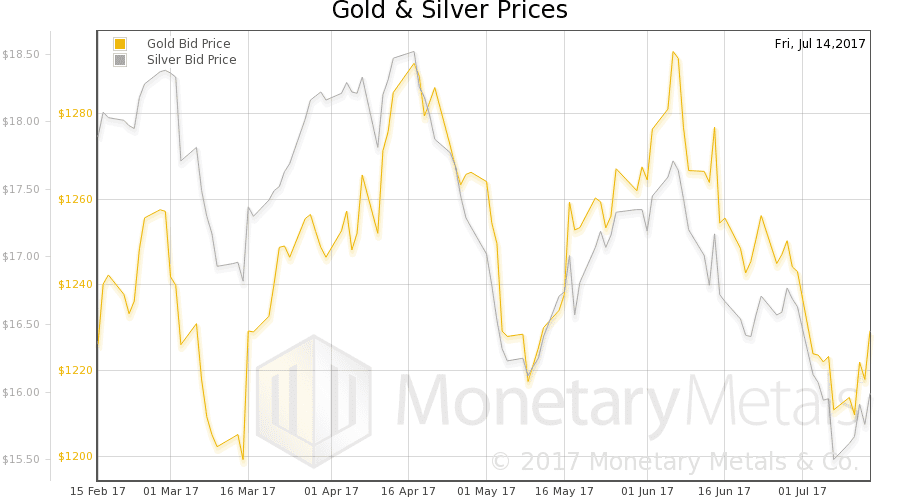
This week, the prices of the metals bounced somewhat, within the trading range. Gold closed last week at $1212, and this week at $1229. In silver, last week’s close was $15.56, and this’s week was $15.96.


Will the bounce continue? Have the fundamentals firmed up?


We will show graphs of the true measure of the fundamentals. But first charts of their prices and the gold-silver ratio.


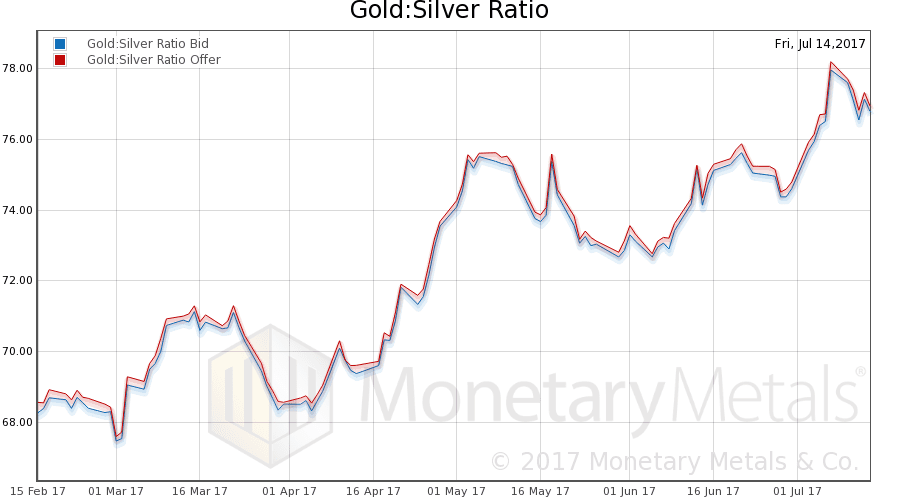
Next, this is a graph of the gold price measured in silver, otherwise known as the gold to silver ratio. The ratio moved down this week.


In this graph, we show both bid and offer prices for the gold-silver ratio. If you were to sell gold on the bid and buy silver at the ask, that is the lower bid price. Conversely, if you sold silver on the bid and bought gold at the offer, that is the higher offer price.


For each metal, we will look at a graph of the basis and cobasis overlaid with the price of the dollar in terms of the respective metal. It will make it easier to provide brief commentary. The dollar will be represented in green, the basis in blue and cobasis in red.


Here is the gold graph.


The dollar fell a bit this week (the mirror image of the rising price of gold). Now it is the dollar hostages who use gold as their preferred hostage-bargaining chip to feel a bit better. One ounce of this commodity now fetches 17 more of the kidnapper’s paper scrip than it did a week ago.


As the dollar fell, the cobasis fell (especially in farther-out contracts). The August cobasis is still above zero (i.e. temporary backwardation).


Our calculated gold fundamental price is not much changed, still above the market price by a goodly margin (chart here).


Now let’s look at silver.


As the dollar has dropped (i.e. silver trades for more gang-scrip than last week), the cobasis has come down. But it’s still higher than gold’s cobasis, and this is the September contract, a month further from expiry than the August gold contract.


Our calculated silver fundamental is rising again, also a healthy margin above the market price.


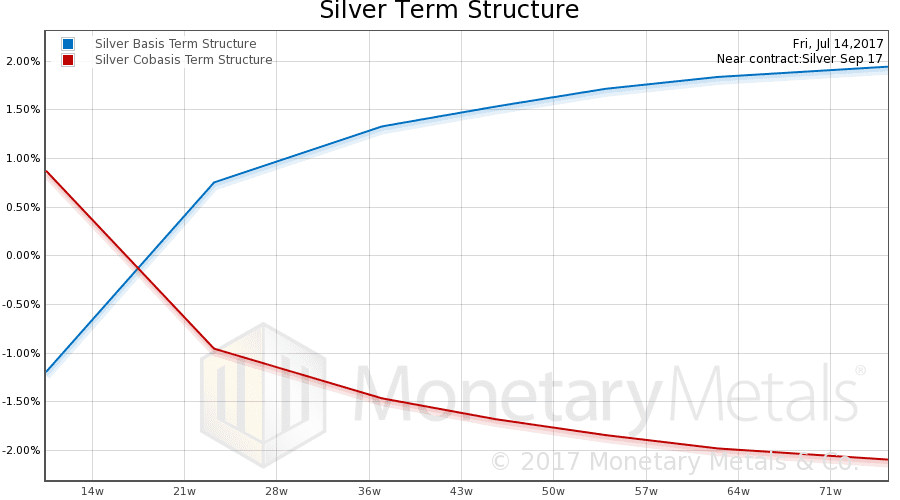
We thought it would be worth addressing the question: “is there a shortage in silver?” Let’s do it with a device that’s famously worth 1,000 words. This picture shows the term structure of the silver futures market.


What we see is what Sherlock Holmes observed that people heard in the night in the story Silver Blaze. There are no interesting features. Other than the temporary backwardation in the September contract, we see a rising basis and falling cobasis as we look out to December 2018. The rising basis looks a lot like the yield curve in the dollar, though slightly lower (6-month LIBOR is 1.5%).


If a real shortage developed in silver, the above curve would look quite different. And we would be publishing pictures of it.


Monetary Metals will be exhibiting at FreedomFest in Las Vegas in July. If you are an investor and would like a meeting there, please click here. Keith will be speaking, on the topic of what will the coming gold standard look like.


© 2017 Monetary Metals

Thursday, May 25, 2017

Another Rigged Market: Scientific Study Finds Systemic VIX Auction Manipulation

To the list of "rigged" markets (e.g. Libor, FX, Silver, Treasuries...) we can now add VIX (which explains a lot) as two University of Texas at Austin finance professors find "large transient deviations in VIX prices" around the morning auction, "consistent with market manipulation."


As Bloomberg reports, in addition to being an index that is much quoted in articles about market complacency, the VIX is used as a reference price for derivatives: If you want to bet that stock-market volatility will go up, or down, you can buy or sell futures or options on the VIX. These products are cash settled: The VIX is not a thing you can own, so if your option ends up in the money you just get paid cash for the value of the VIX at settlement.  


CBOE gets an official settlement level of the VIX based on a special monthly settlement auction of S&P 500 options. The auction runs from 7:30 a.m to 8:30 a.m., Chicago time. Traders submit bids and offers for S&P 500 options, the auction matches buyers and sellers to find clearing prices, and the prices of those S&P 500 options are used to compute the official settlement level of the VIX.


Guess what?


At the settlement time of the VIX Volatility Index, volume spikes on S&P 500 Index (SPX) options, but only in out-of-the-money options that are used to calculate the VIX, and more so for options with a higher and discontinuous influence on VIX.


We investigate alternative explanations of hedging and coordinated liquidity trading. Tests including those utilizing differences in put and call options, open interest around the settlement, and a similar volatility contract with an entirely different settlement procedure in Europe are inconsistent with these explanations but consistent with market manipulation.


That"s from this paper by John Griffin and Amin Shams of the University of Texas, who find a lot of trading in the S&P 500 options underlying the VIX during these settlement auctions, trading that pushes the settlement price of the VIX up or down. So for instance in months where the trading pushes the VIX up, the prevailing price of the VIX-influencing options will jump during the auction, peak at around 8:15 a.m. (the deadline for VIX-related bids in the auction), and then drop seconds after the auction ends when the options start trading normally:


The blue line there is a measure of the indicative prices of VIX-influencing options, spiking at 8:00 a.m. and peaking near 8:15. (If you ignore the numbers on the axis, you can almost think of it as being a chart of the VIX price.) The red dot is the trading price of those options about 25 seconds after the auction finishes.


The average effect is something like 0.31 VIX points, sometimes up and sometimes down, depending on the month.


 What is going on? Usually when you see patterns like this, the innocent explanation is hedging. But Griffin and Shams consider and reject that notion here, noting for instance that traders don"t seem to be closing out existing hedge positions but instead adding new ones. They argue that it"s more likely to be explained by attempts to move the VIX: If you are a dealer who is long (short) VIX futures, you can push up (down) the VIX at settlement by buying (selling) some deep-out-of-the-money S&P 500 options.


That is generically true in any derivatives market: If you are long a derivative, you can buy the underlying and push up the derivative price. But Griffin and Shams give a list of reasons why you"d almost expect the VIX to be manipulated:


First, the upper-level VIX market is large and liquid, enabling a trader to invest a sizeable position in VIX derivatives. In contrast, many of the lower-level SPX options, where the VIX values are derived from, are illiquid.


Griffin and Shams calculate that "the size of VIX futures with open interest at settlement is on average 5.7 times the size SPX options traded at settlement, and it is 7.3 times for VIX options that are in-the-money at settlement."


So if you are a trader who owns a lot of the market in VIX futures, you could push around a large dollar value of futures by trading a small dollar value in options. This is particularly true because the S&P option volume is divided among many strikes, and the illiquid deep out-of-the-money S&P 500 options have a big influence on the VIX: You can move the price of those options a lot with relatively small trades, and those price changes have a disproportionate effect on the VIX.


Second, the VIX derivatives are cash settled. Therefore, if the VIX settlement value deviates from its true value, the VIX position will automatically be cashed out at the deviated price.


If cattle are trading at the wrong price when your cattle futures settle, that doesn"t matter so much, because you just get the cattle. But you can"t just get the VIX: You get cash, so if the VIX is at the wrong price at settlement, that"s the price you get.


Third, the settlement occurs within a short period of time based on the SPX options pre-open auction.


You don"t have to intervene over some long period to keep options prices up; you can just submit bids in the pre-opening auction once a month and move the settlement price for that month.


There is a sort of hierarchy of manipulability in markets. At the top is Libor manipulation: Trillions of dollars of derivatives settled based on Libor, but Libor was calculated by essentially asking banks "what should Libor be?" The banks didn"t even have to do any trading in order to push the number around; manipulation was, in effect, costless. (Later, with the fines, it was costly.)


At the bottom is, like, manipulating the price of a stock by trading that stock. There are cases of it! It"s a thing. But it is a dumb thing; it really shouldn"t work. If you buy a stock, you will push the price up, sure. But to make any money you then have to sell the stock, which should push the price right back down.


But if you are going to manipulate a tradable market -- as opposed to a made-up one like Libor -- then VIX looks pretty tempting.


The product that you trade (S&P 500 options) is different from the product where you make your money (VIX futures and options), and the trading market is in the relevant sense smaller than the derivative market: You can move a lot of value in VIX products by trading a small amount of value, in a confined period of time, in the underlying market. So you can cheerfully lose money executing the manipulation -- trading the S&P options -- and make back more in the derivative.


If Griffin and Shams are right that there"s manipulation, there"s no particular pattern to it: Sometimes VIX gets anomalously pushed up during the settlement, sometimes down. That"s consistent with, for instance, a story of big dealers adding up their positions before each monthly settlement, realizing that they"re net long (short), and trying to push VIX up (down) to help out their positions. It would be like the kind of Libor manipulation that banks did to help out their trading books (which was up or down depending on their positions) -- not the kind of Libor manipulation that banks also did to disguise their funding costs (which moved Libor systematically down).


Finally, The Wall Street Journal notes that it is, of course, tough to rule out the possibility that something more benign is going on. For example, investors who had used the expiring derivatives to protect themselves could be seeking replacement protection when they participate in the auction, some say. Messrs. Griffin and Shams believe it’s not hedging activity due to the trading patterns they observed.


Full Study below:

Monday, May 15, 2017

What Do Rate Hikes Have To Do With Crashing Libor-OIS Spreads?

One of the more perplexing moves in recent weeks has been the rapid collapse in the Libor-OIS spread, traditionally a signal of bank credit risk, which has confused many rates traders due to contradictory signal it is sending in a world in which the Fed is supposedly tightening.


As we pointed out last Friday, one probable explanation for this is the gusher of bank funding availability that the world"s central banks (and even more so China) has unleashed. Nowhere is that more evident than in the total decoupling between "easing" financial conditions, and "tightening" monetary policy.


... something which Goldman itself pointed last week, when it remarked that its financial conditions index was the "easiest" it has been in 2 years.


Furthermore, another potential explanation for the plunge in the spread emerged two weeks ago, when DB"s rates strategists suggested that it could be a function of Japan"s sudden revulsion toward US paper, and especially hedged Treasury exposure, which Deutsche pointed out resulted in a sharp tightening in the JPY cross-currency basis, which in turn compressed Libor-OIS.


Now, in a follow up note, Deutsche picks up where it left off at the end of April, and highlights what we documented last week, namely that since peaking last September at 44bps, 3m Libor-OIS has collapsed each time the market got excited about higher rates. In fact, whenever the fed funds implied probability of a rate hike jumped just prior to an upcoming FOMC meeting, a drastic narrowing of Libor-OIS ensued.


So the question then is what do rate hikes have to do with Libor-OIS spreads?


According to Deutsche Bank, the simple answer is that all signs point to the problem being there is weak demand for short-term unsecured borrowing.


As short rates increase, banks have little reason to pay up for short-term funding when they can just term out their debt. The yield curve remains very flat, and demand for corporate debt seems ever insatiable. Although there is still plenty of activity in the commercial paper market, banks are issuing opportunistically only at rates favorable to them. This week, the rate on a 90-day AA financial CP was 1.06%, virtually unchanged since after the March hike.


At the same time, DB notes that cash has been trickling back into prime money market funds. The spread between prime institutional fund yields and government institutional fund yields, although smaller than at the beginning of the year, remains very attractive at 30 bps currently. Of note, six months after money market reforms and exactly zero funds (that we know of) had dropped below a $1 NAV, money market investors are venturing back into prime funds for better returns on their cash. In May, prime money funds saw total assets rise above $400bn for the first time since October.


With these dynamics in mind, a number of things would have to happen to reverse the tightening in Libor-OIS.


  • First, if the Fed slows its rate hikes in favor of letting its SOMA portfolio mature, longer rates should climb and the curve would steepen.

  • Second, if credit spreads widen, banks would also find it more expensive to issue term debt.

In both these scenarios, bank issuers might bring some of their funding back to the front end, which should drive up CP rates and consequently Libor. Another possibility is if bills cheapen, perhaps driven by an increase in net supply, government money funds could become attractive to investors again and some of their assets might come back from prime funds. This in turn reduces the pool of cash looking to invest in commercial paper, which also drives up their rates.


Thursday, May 11, 2017

Betting Against A June Rate Hike? Something's Going On

We noted yesterday that the recent trend of increased volumes into Eurodollar future out-months was "odd"...


But the sudden surge in interest in Eurodollar calls (vs puts) suggests more than just a few prop bets are being placed on the fact that The Fed does not hike rates in June.


As Bloomberg notes, preliminary futures open interest data for Wednesday shows steep increases in several Jun17 eurodollar call strikes, consistent with view that Fed won"t hike in June amid tightening FRA/OIS spread. However, these options bets have largely gone unnoticed as futures-market-implied odds (which the majority of investors are shown) of a June hike have been steady at around 80% for a week.


A second consecutive drop in 3-month dollar Libor setting Wednesday prompted a flurry of dovish Fed bets and waves of buying across Jun17 eurodollar futures.


And furthermore, the Fed Fund Futures curve has flattened dramatically - signalling lost faith in The Fed"s hiking trajectory...


And while these bets are being placed - against a June rate hike, the LIBOR-OIS spread - traditionally a signal of bank credit risk, has collapsed back to historic norms.


One probable explanation for this is the gusher of bank funding availability that the world"s central banks (and even more so China) has unleashed. Nowhere is that more evident than in the total decoupling between "easing" financial conditions, and "tightening" monetary policy...


Despite two rate hikes, Goldman"s financial conditions index has improived to its "easiest" in 8 months - thanks to the world"s policy-makers fungible money spigot to keep the dream of reflation alive (as evidenced in the chart above by the S&P 500).


This means, according to Bloomberg"s Mark Cudmore, that The Fed’s room to tighten is being underappreciated.


The market adjustment, when it comes, will be felt more in the front end than the long end of the U.S. rates curve.


Rates markets are only pricing one-and-a-half more hikes in 2017. That seems reasonable in the blinkered context that inflation shows little sign of accelerating out of control. However, monetary policy analysis needs to be updated.


Amid an excess of global liquidity, inflation is being dominated by macro factors. Commodity prices and technological innovations, rather than marginal short-term interest rate adjustments, are top-most in people’s minds.


The last two Fed rate hikes had no sustained tightening impact. In fact, financial conditions in the U.S. are the loosest they have been in almost three years, and approaching the extreme of the historical range going back 27 years.


This suggests that the Fed has plenty of room to tighten policy. Why wouldn’t they take steps to normalize while they can get away with it?


Ignoring the fact that this yet again argues for a rethink of inflation targeting and using short-term interest rates as the primary policy tool, it’s important investors don’t misinterpret the rationale and implications of any tightening.


The next Fed moves won’t be driven by accelerating growth or runaway inflation, so the yield curve shouldn’t steepen. But a subsequently flatter yield curve shouldn’t be read as signifying a policy misstep.


This is just the way of the future. There is extremely abundant liquidity globally due to the expansion of central bank balance sheets. While that’s the case, old economic analysis frameworks are outdated and inadequate.


Which confirms what Morgan Stanley wrote,


Along with record high stocks, credit spreads at the tights since 2014, the broad dollar index continuing to hold little changed about 3% below the high hit in December, and longer-end yields remaining slightly lower year to date, historically low volatility across asset classes adds to a picture of very easy broad financial conditions. So does all the money in the short end helping keep CP yields and LIBOR lower as fed funds rate expectations have been moving up.


So the capitulation in pricing of a future reversal in the persistent LIBOR-OIS tightening trend in the past few months accelerated and had a large impact on swap spreads on top of more swapped issuance of corporate bonds by banks. The spot LIBOR-OIS spread fell another 0 7 by to 14 bp, another low since before the first Fed rate hike in 2015 after a 20 by drop in the past two months. That"s not far now from the 9bp average from 2004 through the first half of 2007 (before getting as high as 364bp on October 10. 2008. maybe the single most extreme financial market price of the whole crisis). The forward LIBOR-OIS spread to June fell to 14.8bp. down from 15.8bp Tuesday and 19.4bp Friday mostly giving up on any near-term widening. The LIBOR part of that was reflected in the Jun 17 eurodollar futures contract rallying 2bp to 1.265%, down from 1.305% Friday, even as Jul 17 fed funds futures held steady at 1.11%. pricing an 83% chance of a June rate hike, up from 1.095% Friday. Never mind seeing a transmission from the fed funds rate to broad financial conditions in impacts on stocks, long-end yields, the dollar. et al., if higher fed funds rate expectations struggle to even get traction in raising short-term market interest rates.


Which translated into english implies The Fed has lost control of the transmission mechanism of its operations, just as we noted Goldman concerned about, which brings up another question:


If the Fed retains its ability to steer financial conditions, why have financial conditions eased recently despite ongoing hikes? The answer is that Fed policy—especially Fed policy communicated around FOMC meetings—only accounts for a relatively small part of the ups and downs of financial conditions. And other developments such as the sharp pickup in global growth have been helpful for US financial conditions by boosting risk assets while keeping the US dollar from appreciating sharply in response to higher short-term interest rates. While it is difficult to say whether future non-monetary policy shocks will be positive or negative for US financial conditions, our finding that the impact of Fed policy on financial conditions remains (at least) similar to the longer-term average suggests that Fed officials should be able to achieve their goals for financial conditions by moving the funds rate if they try hard enough.


Fed Policy Retains Sizable Impact


What Goldman really meant to say is that the Fed"s 50 bps in rate hikes since December have been drowned and offset by the trillions in new credit created out of China. That credit expansion is now ending however, and China"s credit impulse has tumbled into negative territory (but that"s a different topic).


Going back to Goldman, Hatzius adds that "we find that the sensitivity of financial conditions to monetary policy shocks has been quite high recently, at least when we identify these shocks using bond market moves around FOMC meetings. This suggests that the easing of financial conditions is due to other factors, most obviously the improved global environment, not reduced traction of monetary policy."


What form will this monetary tightening "shock" take place? "


Our best (though uncertain) answer is that the committee will need to deliver 50-75bp more hikes per year than priced in the forwards to stabilize the economy at full employment. This is roughly consistent with our current funds rate call that we will see an average of 3-4 hikes per year through the end of 2019, compared with market pricing of just over 1 hike."


Of course, if Goldman is wrong and the Fed has no intention of sending risk assets into a tailspin with a monetary policy "shock", then there is no saying just how much further the combined effort of China"s gargantuan, if cooling, credit expansion, coupled with the "dovishly" hiking Fed can take stocks. However, by now it is becoming clear to even the most resentful permabulls - and even Goldman  - that the longer the Fed delays the day of reckoning out of pure fear of the unknown, the greater the chaos and loss in asset values when the Fed no longer has the luxury of picking when to pull the switch.

6-Month Window & A Fiscal Fumble? Things That Don't Matter Could Matter Again...

Authored by Jason Leach via FusionPointCapital.com,


The first six to nine months of a presidential term are arguably the most important thanks in large part to staggered elections put in place by our forefathers. The Bush tax cuts, Clinton"s tax hikes, and the serious groundwork for Obamacare were accomplished during this time frame. President Trump and a balkanized Republican party have taken on ACA repeal/replace during this critical six month window, aiming to use fiscal year 2017 reconciliation (simple Senate majority but “nuclear” to cooperation) to get something passed before the Fall (the current House bill is dead on arrival in the Senate). Then, after this self-immolation, they aim to use the same reconciliation process to get something done on tax reform in fiscal year 2018 (they have a one-pager to work off as of now), and hope to tack on infrastructure and ongoing deregulation going into the 2018 midterm campaign season.


In the last four years, perhaps the least cohesive congress in history has passed the least legislation in over 200 years. After Obamacare passed (via reconciliation) and the subsequent killing of the use of earmark horse trading to corral votes (remember Nebraska?), the 2010 Tea Party insurgence became the “All Pros of No”, or the shutdown defense against anything serious getting done during Obama"s remaining years. Now, the six month window will probably close without real structural change to healthcare, tax reform will then likely be pushed into 2018/2019 (and be “tax relief” not reform), and infrastructure could well fall prey to pre-midterm stasis (Democrats not throwing a lifeline to “Reconciliation Republicans”).


Meanwhile, with a string of solid jobs numbers (despite anemic sub 3% growth in average hourly earnings instead of hoped for 3-5% to outpace inflation), the Fed is intent on making the “fiscal hand off”, with two rate hikes in the last six months (and unless rumors of Fed nervousness about the deteriorating credit situation are true) another hike in June (market is pricing in ~70%). Remember “Three Steps and a Stumble” from Pulling Awesome Forward? And, after seven years of feeding another asset pricing cycle (stocks, real estate) instead of productive “virtuous” cap ex cycle (outside the oil patch discussed in Crude Compression), the Fed plans to start reducing the size of the bloated $4.5 trillion balance sheet starting at the end of the year. Ben Bernanke expressed this past week that he is “calm about unwinding part of the balance sheet”, but he neglected to mention that no country has ever exited QE, so it may get rocky (if it happens at all as many view QE as a permanent part of central bank policy at this point).


After the election, consumer sentiment ("soft data") reached 17-year highs, and small business sentiment surged to 2004 levels, recording the biggest one month surge since 1980 in January. These “animal spirits” propelled markets to new highs just this past week, despite the Atlanta Fed"s GDPNow first quarter 2017 GDP forecast (that is, “hard data”, not sentiment) coming in at a severely revised down 0.2%. Consumer spending continues to lag sentiment with consumption at its lowest level in seven quarters. Business and consumers are sentimental but the virtuous cycle is not in gear. It"s just the annual first quarter blip right…


Let"s Talk About Credit…


It"s curious that the rise in LIBOR, affecting everyone with a credit card and an adjustable rate loan, is being overlooked by so many. The credit canary in the coal mine is wheezing a bit and with delinquencies on all loan bases rising - subprime mortgage, autos, and Capital One confirmed subprime credit cards are starting feel the pain (remember the Capital One turn in "06?).


That said, financial conditions and the overall market cycle has been a big focus at Fusion Point Capital. Chief Market Technician Arun S. Chopra CFA CMT has been keeping members in front of the cyclical process through a variety of longer term indicators. This is paramount at this stage of the cycle.


Some of the things Arun and I have been watching related to the overall macro story.


  • Libor and the dollar started rising in 2014, the end of QE expansion, the start of tightening conditions that crashed commodities (i.e., oil), led to a string of Yuan devaluations and roiled markets (LIBOR is up 5X from bottom and double from one year ago, and is the effective borrowing cost for dollars worldwide).

  • The dollar is now sitting on its rising 50 week moving average, an important overall trend level and signal (the Trump team has been talking down the greenback of late, we will see, but a move back up in the Indomintable Dollar is deflationary and oil could get hit again along with high yield, multi-national earnings, Emerging Market debt, etc.)

  • At the same time in 2014, we saw the yield curve peak (i.e., potential peak in economic expansion as flattening yield curve presages economic downturns)

  • There is still a 1% spread between the short and long end of the yield curve (before inversion), which can change quick depending on macro trends. 


Markets, Valuations, and Sentiment


Forward Street earnings are resurgent on “rebounding” oil (not so much anymore), anticipated tax cuts, infrastructure and deregulation – the reflationary “fiscal hand off” – all of which are looking like they are not occurring in 2017, and increasingly unlikely in anticipated form in the first half of 2018. Full year S&P 500 earnings for 2016 came in at $106. Current full year earnings estimates are $130 for 2017 and $147 for 2018, implying 23% earnings growth in 2017 and another 13% in 2018.


Citi estimated recently that every 1% of tax rate reduction adds roughly $1.75 of full year EPS to S&P 500. A significant amount of the 23% earnings growth anticipated above is based on the Trumponomics “reflation” and tax reform. Again, it does not look like it is coming soon, if at all in substantive form so take a hair cut to that S&P 2017 and 2018 earnings estimates of $130 and $147?


The much maligned non-timing tool of PE10 stands near its second highest level ever at ~30x and trailing P/E is ~25X. Remember, higher P/Es are justified by low rates and NPV (the TV says so). Additionally, and this is a point of emphasis, fully 96% of companies are now reporting non-GAAP earnings (removing “one-time” items), up from 70% in 2014, and less than 50% in 2009. That is, the one-time items boosted GAAP earnings for 2016 by 12%, to $106 from $95 – which is about the same level as 2013 when the S&P 500 traded 30% lower.


Right now, the market is easy peasie. It"s invincible - ostensibly due to overcoming every brief elevator down blip over the past 8 years of Fed asset price control. What happens when it becomes apparent there is a fiscal fumble? Things that don"t matter could possibly matter again…


Wednesday, May 10, 2017

Gold, FX Lawsuits May Have Less than 50% Chance of Winning- Vince Lanci

Writing from the road... 


Author Vince Lanci on marketslant.com


We have written many times about manipulation in this column. We seek justice and fairness in the markets that we continue to consider "free". First some thoughts on the trail of trader-speak I"ve been pouring over recently.


The takeaway is this: getting over the circumstantial evidentiary bar to be permitted to get to discovery was a big deal. Rosa Abrantes has done much to get these cases as far as she has. But now, forensic work at the operational level is needed. And it just is not easy to prove the cases. Now, even with chats and trade logs, the facts can almost never be known.


Within the constraints of our legal system, it is much harder to prove manipulation then the plaintiffs would have you think. This refers to the precious metals cases, the current FX cases, and the pending treasury cases.


We are now at the discovery level, thousands of documents with chats and messages back-and-forth between traders are available for the plaintiffs to review. This is great. But can the lawyers understand intent from written words?


He was just kidding! Can you prove otherwise?


PROVING INTENT IS NOT EASY


This is because the facts needed to prove "intent" are in the traders heads. And without intent you cannot win.


In the three legged stool that is the legal system, intent is hardest leg to establish. I think "means, and opportunity" are the other 2.


Trader conversations are not prose, to say the least. It is near impossible without inflection and confirmation in chats to determine, or differentiate sarcasm from sincerity. How can one divine intent from a chat where a trader alternately asserts he"s infallibly correct in an opinion, and then laughs at himself for having such an outrageous opinion? No, the burden of proof that the plaintiffs must satisfy is very difficult in this circumstance. 


Note my own spelling in these very articles that the Soren K group posts. My own trading messages were difficult to translate let alone divine my intent. Frequently brokers would object to my horrible typing. I would respond with


"My misspelling is protection against your execution error. If you mess up I can always blame you for not clarifying." I would then follow that with a LOL.


Was I joking? How can you tell? Frankly, I was truly sloppy and not detail oroented. But it also served to me as a hedge against what sometimes was poor service. I insisted on clarification. This was one way I got it.


PERSONAL EXPERIENCE SAYS TRUTH WITHOUT FACTS LOSES


In one instance I was subject to an eight hour deposition regarding a manipulation case in natural gas options. It Involved a major bank in Canada, a major energy exchange, a multibillion-dollar hedge fund, a new electronic trading platform, and traders who executed on that platform of which I was one.


I was a material witness and wasn"t a party to either side of the prosecution. But I ended up essentially being an expert witness because of the questions asked by one excellent attorney.


It was clear that they were not able to divine intent at the trading and forensic level of other participants in that scandal. They sought evidence of manipulation between the hedge fund and a bank employee. There was none to be found in the trades, or chats as damning as they may have been in appearance.


It was that day that I learned in the legal world, conditional probability and narrative do not hold up when there are no facts to back it up. TRADERS USE CONDITIONAL PROBABILITIES TO MAKE DECISIONS IN UNCERTAINTY. JUDGES RISK NOTHING. IT ALL COMES DOWN TO FACTS. WITHOUT FACTS, A CASE GETS SETTLED ON THE COURT STEPS. And the facts proving intent were in the peoples" heads. Short of a download of their brains the cases cannot be won easily.


It was made obvious to me later by my own attorney that the focus should"ve been on something entirely different then the line of questioning being asked.


His advice was meant to let me know that if something was going on it would"ve been impossible for them to divine it from trying to figure out what traders are doing and why they"re doing it.


The plaintiffs actually settled days later in part most likely because of the information given during my testimony. Ironically months before my deposition, one of the law firms" "expert consultants tried to hire me for their case. They actually called me seeking me as an expert witness.


My response was "I am qualified to do this, but if you check your list I"m a material witness in the case as I participated in the trades." Based on their discovery interview on me, I now know that case would have ended differently had they been able  to translate, correlate and corroborate trades to chats.


HFT IS EASIER TO PROVE


It is actually easier to prove intent in HFT cases. And that is because the programming used is essentially a trader"s intent in code. Programmers write down exactly what the trader wants to do!


But that won"t happen as long as it is run by bigger players. Mike Coscia was an impediment to other bigger form HFT rigging. Ask NANEX"s Eric Hunsader. Once you get a hold of a firm"s programmer, intent is easily proven. This is why you will increasinglyhear " The programmer is privy to proprietary secrets and cannot be deposed. Secrets as in INTENT TO SPOOF"?


CHATS DO NOT PROVE INTENT


Reviewing some of the Gold and FX conversations, even in context of the actions, is not such an easy proof of manipulation as the prosecutors would have you believe. It seems to me that the plaintiffs have a less than 50/50 chance of conviction and will settle on the court steps if they scare the defendants sufficiently.


Deutsche bank in our opinion was a fluke. A fluke because they had much bigger fish to fry with the DOJ. Why else would a bank walk away from its London precious metals vault only two years after opening?


LOST IN TRANSLATION


The Gold, Silver, Fx and now the Treasury manipulation cases are not easily proven using facts. And our legal system just does not burn witches without proof anymore. Having been a material and expert witness in these type things, the accusers are not usually prepared for the arcane speech traders use.


Just as when a lawyer says "res ipse loquitor", a trader can say, "it"s going down, I guarantee it! Lol." And no one an KNOW what he really intended. How can the plaintiff prove that the LOL is him not mocking himself?


Often times it is self recognition of his own failure, hubris, and ego. This, as opposed to him laughing at some unsuspecting victim. So, given this, how can the plaintiffs pretend to know what goes on in the traders mind? There is lexicon, trader sarcasm, wishful thinking as opposed to willful manipulation, and the old adage that "no one is bigger than the market."


FACTOIDS ARE NOT FACTS


Point here is that to win, all the defense has to do is make it clear that no one can know what the words written were intended to convey. In a legal system that needs facts, and where those facts are in the heads of the chat writers, it is not a slam dunk to get the evidence recognized as fact and not interpretation of what we feel a person may or may not have intended.


Lacking expert forensic preparation that links and correlates the chats with time stamped subsequent actions, all the plaintiffs will likely get is conjecture and muddied waters.  Facts will not be proven we bet. Not without narrative and contradictions found in discovery process. A ton of circumstantial material will not substitute for a real fact.


And unless litigators can prove contradiction of deposed traders on the stand between what they wrote, their actions, and what they say in discovery, the case is not easily won. Read what Matt Levine has to say on the topic below. 


Vince Lanci.


Vlanci@echobay.com


Twitter @vlancipictures


Marketslant Articles


Trader chats.


by Matt Levine.


My basic theory of post-crisis financial scandals is that the main illegal thing that traders do is send each other dumb emails and chat messages. So many of these scandals are hard to describe in objective terms.


The Libor scandal was about submitting fake numbers in Libor surveys, but even non-scandalous Libor submissions were pretty fake, so the only way to distinguish the bad fakes from the good ones was by finding chat messages saying things like "LOWER MATE LOWER !!" What was scandalous in the foreign-exchange-fixing scandal was that banks traded ahead of customer orders, but that was also legal; what was illegal was the dumb chats between those banks sharing customer information. The chats and emails are evidence of substantive illegality -- illegal collusion, manipulation, etc. -- but also display an attitude.


If they were written in dull legalese, they would have created much less of a reaction; regulators might not even have noticed the problem. But they weren"t; they were filled with obscenity, slang, misspelling, and promises of Champagne, all of which tend to enrage prosecutors and juries and the public.


Anyway I enjoyed this story about the irreducible atomic unit of dumb trader chat: A five-word message to a rival banker was enough to cost former Citigroup Inc. trader David Madaras his job as the bank fought to appease regulators probing the foreign-exchange scandal engulfing the industry.


Citigroup’s Timothy Gately disclosed the message on the first day of Madaras’s employment lawsuit in London Tuesday. The executive said the April 2011 chat constituted gross misconduct and firing Madaras was the only appropriate sanction. "he’s a seller/fking a," Madaras told a rival trader who had just disclosed the identity of a client, Gately said in a filing prepared ahead of the hearing.


That chatroom message "validated an external trader’s disclosure of a client name," Gately said in the filing. The first three words -- "he"s a seller" -- are substantive misconduct, disclosing a client"s order to a competitor, and enough to get you fired in an atmosphere of heavy scrutiny of that sort of thing.


The next two -- "fking a" -- are substantively superfluous, but you can"t have a scandalous trader chat without obscenity and misspelling. You can"t imagine a trader actually being fired for typing "he"s a seller," but of course one was fired for typing "he"s a seller/fking a." This is partly a matter of psychological makeup -- how could the traders resist cursing? -- but it might also be a matter of technology. What search, what flags, brought that chat to the executives" attention? Does compliance monitor every time traders type "he"s a seller"? (Presumably they type that a lot!) Or is there a search for "fking," and other variant spellings, that triggers review?


Read more by Soren K.Group

Monday, April 10, 2017

Secret Recording Implicates Bank of England In Libor Rigging

While it may seem like yesterday, it was nearly five years ago that the Libor scandal first broke, and with it brought scandalous suggestions that none other than the Bank of England was implicated.


As we first reported in July 2012, according to Barclays then CEO Bob Diamond, it was high level individuals at the BOE who may (or may not) have been aware that Libor had been "manipulated" and were (or were not) also active in the setting process:


  • BARCLAYS SAYS BANK OF ENGLAND CALLED ON OCT. 29, 2008 ON LIBOR

  • BARCLAYS SAYS DIAMOND MADE NOTE OF CALL; RECEIVED CALL FROM PAUL TUCKER

  • BARCLAYS SAYS TUCKER SAID `CERTAIN" BARCLAYS DIDN"T NEED ADVICE; SAID LIBOR DIDN"T ALWAYS NEED TO BE SO HIGH

And yet, concerned about how deep the rabbit hole would go if a central banker was implicated, Diamond tried to cover it up:


  • BARCLAYS SAYS DIAMOND DIDN"T BELIEVE HE HAD GOT INSTRUCTION

Even as:


  • BARCLAYS SAYS DEL MISSIER CONCLUDED INSTRUCTION HAD BEEN GIVEN; TOLD RATE SETTERS TO LOWER RATES

The note in question was represented below:


Needless to say, when it comes to the central bank nothing happened: a few BOE personnel were reassigned, some quietly lost their jobs, and nobody was prosecuted or charged. Certainly, nobody went to prison.


* * *


Fast forward nearly five years later, when the Libor scandal may have reemerged after a secret recording that implicates the Bank of England in Libor rigging has been uncovered by BBC Panorama.


According to the BBC, the 2008 recording adds to evidence the central bank repeatedly pressured commercial banks during the financial crisis to push their Libor rates down, just as suggested by Bob Diamond in 2012.


The recording calls into question evidence given in 2012 to the Treasury select committee by former Barclays boss Bob Diamond and Paul Tucker, the man who went on to become the deputy governor of the Bank of England. In the recording, a senior Barclays manager, Mark Dearlove, instructs Libor submitter Peter Johnson, to lower his Libor rates.


Dearlove tells him: "The bottom line is you"re going to absolutely hate this... but we"ve had some very serious pressure from the UK government and the Bank of England about pushing our Libors lower." To which Johnson objects, saying that this would mean breaking the rules for setting Libor, which required him to put in rates based only on the cost of borrowing cash.


Mr Johnson says: "So I"ll push them below a realistic level of where I think I can get money?"


His boss Mr Dearlove replies: "The fact of the matter is we"ve got the Bank of England, all sorts of people involved in the whole thing... I am as reluctant as you are... these guys have just turned around and said just do it."


The phone call between Mr Dearlove and Mr Johnson took place on 29 October 2008 the BBC notes, the same day that Tucker, who was at that time an executive director of the Bank of England, phoned Barclays boss Diamond. Barclays" Libor rate was discussed.


Diamond and Tucker were called to give evidence before the Treasury select committee in 2012. Both said that they had only recently become aware of lowballing, despite Diamond"s abovementioned tacit admission, which he then tried to cover up.


In its report, Panorama says it played the October 2008 recording to Chris Philp MP, who sits on the Treasury committee.


He told the programme: "It sounds to me like those people giving evidence, particularly Bob Diamond and Paul Tucker were misleading parliament, that is a contempt of parliament, it"s a very serious matter and I think we need to urgently summon those individuals back before parliament to explain why it is they appear to have misled MPs. It"s extremely serious."


Responding to the recording, Diamond told the BBC: "I never misled parliament and… I stand by everything I have said previously." Tucker did not respond to our questions. Peter Johnson, the Barclays Libor submitter, was jailed last summer after pleading guilty to accepting trader requests to manipulate Libor.


Two traders who made requests for Mr Johnson to move Libor up or down, Jay Merchant and Alex Pabon, were found guilty last June of conspiracy to defraud along with another submitter, Jonathan Mathew.


However, the jury could not reach a verdict on two other traders then on trial, Ryan Reich and Stelios Contogoulas. The Serious Fraud Office requested a retrial which concluded last week. Both Mr Reich and Mr Contogoulas were unanimously acquitted. Panorama also played Contogoulas the October 2008 recording. He said he believed that if it had been played during the criminal trials it might have affected the outcomes.


He said: "That"s the thing, you know in these trials that we went through they separated everything, separated trading requests and lowballing. So anything that has to do with this they don"t go in. So you"re asking me do I think that if all this was in would it make a difference? Probably, is the answer."


* * *


Another notable "criminal" to emerge from the Libor scandal was Tom Hayes, the UBS and Citi-based Libor manipulating protagonist of the recent book "The Spider Network", and who was arguably at the center of the prosection"s LIbor case. He has repeatedly claimed that the real culprits are not those - like him - who executed the Libor rigging, but the ones at the very top who have the instructions to do so.


Like, as the case may be, the Bank of England.


Yet while some junior people went to prison, nobody in the corner office, and certainly nobody at the BOE has faced any criminal consequences from their actions.


The BBC adds that the Serious Fraud Office, which brought the Barclays prosecutions told Panorama that evidence of lowballing, was provided to the recording. They also say they are still investigating lowballing and that they follow the evidence "as high as it goes and aim to charge the most senior people wherever there is a realistic prospect of conviction".


The Bank of England said: "Libor and other global benchmarks were not regulated in the UK or elsewhere during the period in question.... Nonetheless, the Bank of England has been assisting the SFO"s criminal investigations into Libor manipulation by employees at commercial banks and brokers by providing, on a voluntary basis, documents and records requested by the SFO."


Ironically, it is precisely that it was unregulated that may have given the Bank of England the green light to assume it can manipulate it with impunity.


It remains to be seen if, nearly a decade after the Libor manipulation took place, any central banker will go to prison over it.