Showing posts with label Natural Gas. Show all posts

Monday, January 8, 2018

Liberal Michael Moore Is So Angry About Destruction Of Environment, He Plans To Destroy The Environment In Protest

moore


The hypocrisy of wealthy liberals knows exactly zero bounds. Rich and whiny liberal, Michael Moore, is so upset about the destruction that’s been done to the environment, that’s he’s planning to destroy the environment to make a point.


And no, this is not a joke. According to Newsmax the infamous liberal filmmaker (who has gotten rich by exploiting other liberals) has threatened to begin fracking off the Florida coast.


His anger appears to be directed towards president Donald Trump, as Moore said the fracking will take place off the coast of Mar-a-Lago, which is Trump’s resort in Florida. Long opposed to everything Donald Trump has said and done, Moore took to Twitter to openly protest the administration’s decision to open nearly all U.S. offshore waters to drilling for oil and natural gas. Interior Secretary Ryan Zinke announced a plan Thursday, reversing protections in the Arctic, Atlantic, and Pacific.


The administration believes the proposed territory holds some 90 billion barrels of oil and 319 trillion cubic feet of natural gas, or reserves that are about 80 percent larger than is currently available. “Under President Trump, we are going to become the strongest energy superpower this world has ever known,” Interior Secretary Ryan Zinke told reporters.


This announcement angered Moore and his liberal hypocrisy quickly came to the surface. In other words, he’s going to protest the destruction of the environment by destroying the environment.


Moore is also all but saying he’s planning an oil spill, something that has disastrous effects on the environment. But Moore’s a liberal hypocrite, so in his mind, to protect the environment, he has to help destroy it.


Zinke said the draft National Outer Continental Shelf Oil and Gas Leasing Program for 2019 to 2024 would make over 90 percent of the outer continental shelf’s total acreage available for leasing, including areas put off-limits by the Obama White House.


However, there may already be a kink in Moore’s plan to frack of the coast of Florida. Florida Republican Governor Rick Scott immediately opposed Zinke’s plan, saying that he had asked to meet with the secretary to discuss “the crucial need to remove Florida from consideration.”

Tuesday, December 12, 2017

Huge Hub Explosion Sparks Surge In UK NatGas Prices

It has been a tough week already for those that heat their homes in Britain (and those that trade Natural Gas). Following extreme weather warnings and the forties pipeline crack shutdown, an explosion at one of the Europe’s biggest gas hubs further tightened supplies sending gas futures prices up by the most in 8 years.


As Bloomberg reports, gas futures rose the most in more than eight years in Britain, which already is struggling to absorb the impact of a crack that shut down a North Sea pipeline network. After snow fell for two days in London, cooler-than-normal temperatures spread from the Alps to Scandinavia, raising demand for heating fuels.


An explosion at around 9am at Austria’s main gas pipeline hub, left one person dead and 18 injured, according to police.


The facility about 50 kilometers (31 miles) northeast of Vienna transports the equivalent of a 10th of Europe’s gas demand.


Fire engines, ambulances and a rescue helicopter have reportedly been deployed to the area, and all work has been halted at the site.


"Eighteen people are injured and one is dead," police chief Markus Haindl said, as quoted by Sputnik.


He added that "technical problems" caused the explosion, and that there was "no indication of terrorism."


Several media outlets previously put the number of people injured at around 60.


”It is the worst possible time for a big gas hub to burn, since capacity is needed ahead of the winter and it changes the expectations of how much gas there will be available,” said Arne Bergvik, the chief analyst at Swedish utility Jamtkraft AB.


“If weather turns colder and capacity is unavailable, it will absolutely drive up power prices.”


Britain felt the threat most acutely, since it lacks the gas storage sites and web of interconnections that link markets across continental Europe. As Bloomberg concludes, U.K. is more vulnerable than normal this winter because Centrica Plc is closing the nation’s biggest storage site after more than 30 years. The Rough facility was able to meet as much as 10 percent of peak winter demand but that is now much reduced as it pumps out its last remaining fuel.


It takes about two weeks to bring LNG from Qatar, the U.K.’s biggest supplier of the super-chilled fuel. Only one tanker, the Bu Samra, is confirmed as arriving in the U.K. this month. The first tanker from Russia’s Arctic plant Yamal LNG may also head to Britain and would arrive in about five days, according to shipping website sea-distances.


“Gas demand is at above average levels because of the cold snap,” he said by email, estimating the shortfall of supply from the Forties outage at about 10 percent of average winter demand. “If outages persist, prices will remain high for some time.”


Friday, December 8, 2017

Bloomberg Has Identified Buffett"s Successor At Berkshire Hathaway (It Thinks)

There are some well-kept secrets in the financial world. For example, there’s the identity of the person or people who designed Bitcoin under the pseudonym, Satoshi Nakamoto. Then there’s the identity of the parties responsible for the frequent dumping of billions of dollars of gold futures contracts on to the market without regard for maximising price. Another one is Warren Buffett’s successor as Chief Executive Officer Berkshire Hathaway.


Besides his advancing years, he’s 87, there are other signs that curtain is coming down on the era of the world’s most successful investor. As we noted in August in “The Value Of Lunch With Warren Buffett Plunges 22%”.


The winning bidder in legendary investor Warren Buffett’s annual charity auction haspledged $2.68 million for the privilege of eating lunch with the billionaire investor…While the sum is far greater than the $25,000 paid in 2000 - the first year Buffett held the fundraiser - it’s about $800,000 shy of the record sum of $3,456,789 paid in 2012 and 2016.


By his own admission, Buffett has also found it increasingly challenging to find “value” in keeping with his investment style which he modelled on an earlier doyen of value investing, Benjamin Graham. That’s not Buffett’s fault, it merely reflects the longevity of the latest iteration of central bank bubbles.


Speaking to the usual throngs of shareholders as Berkshire’s AGM in May 2017, Buffett admitted that.


“If I die tonight, I think the stock would go up tomorrow.”


He wasn’t joking, the world’s greatest capital allocator was merely acknowledging that the market would likely price the parts of his very disparate conglomerate higher than the whole. “It would be a good Wall Street story”, he was reported to have said.


Bloomberg Businessweek has published an article on Buffett and Berkshire Hathaway arguing that the pressure to break up the company will mount after he steps down. Buffett’s successor will be critical if that is to be prevented…and Bloomberg thinks it knows his identity. For the time being, while Buffett remains in situ, nothing is going to change.


The glue is Buffett, who’s argued persuasively for decades that this hodgepodge makes sense. His market-beating returns have helped: $100 invested in Berkshire in 1964, when he began aggressively buying shares to take control, would be worth more than $2 million today.


Nothing of the sort is likely to happen while Buffett is there. He’s still the controlling shareholder, Berkshire is his life’s work, and he doesn’t want it torn apart by investment bankers or activist investors. To slow that process, Buffett assembled a board that backs his approach, and after his death he’ll leave his remaining shares to charities run by family and friends who know his wishes. But the pressure to dismantle his creation will mount—eventually.


The bulwark against that impulse will be Buffett’s successor as chief executive officer, whose identity is one of the business world’s best-kept secrets. In all his years of giving interviews and taking questions at the company’s marathon annual meeting, Buffett has acknowledged that the board has picked his replacement, but he’s never disclosed the name.


In a cheeky dig at Buffet’s ego, the Businessweek article suggests that by naming his successor, it might take the spotlight away from the man himself, “who loves the attention”. While we think there’s some truth to that, we also agree that Berkshire’s board is keen to give itself room to maneuver. Prior to his resignation from Berkshire, it was widely accepted that David Sokol, known as his “Mr Fix-It and major influence on acquisition targets, would succeed Buffett.


 Arguing that “These days, however, most arrows are pointing toward one man”, Bloomberg begins making its case by re-capping what Buffett has said about the qualifications for his job.  


Buffett, at least, has talked about the qualifications for the position. In a 2015 letter to shareholders, he said the board wants his successor to be drawn from the company’s ranks and “relatively young, so he or she can have a long run in the job.” He suggested future Berkshire CEOs should hold the post for more than a decade and that they should be “rational, calm, and decisive.” And, he noted, they should have upstanding character, be unmotivated by ego or a big paycheck, and be “all-in” at Berkshire.


As the article points out, Buffett neglected to mention stockpicking skills, although the next CEO will be able to call on the two former hedge fund managers hired by Buffett, Todd Combs and Ted Weschler. The two manage about $20 billion of Berkshire’s stock portfolio, but are unlikely to have the skills or the desire to oversee Berkshire string of operating businesses. The role of Chairman is expected to be given to eldest son, Howard Buffet who’s job will be to “guard the company’s culture—and force out any future CEO who messes with it”.


Bloomberg thinks that a major clue to the identity was dropped by Buffett’s partner, Charlie Munger.


Munger called two executives—Ajit Jain and Greg Abel—examples of the company’s “world-leading” managers who are in some ways better than their boss. While Buffett later denied that any executives were in a “horse race” to succeed him, the logical inference from Munger’s letter was that the board had already settled on one of these two—and probably wasn’t as seriously considering other internal candidates such as BNSF Executive Chairman Matt Rose or Tony Nicely, the CEO of Geico. Abel declined to comment, and Jain and Buffett didn’t respond to requests for comment.


Jain and Abel each fit many aspects of Buffett’s carefully tailored job description. They’re deeply committed to Berkshire’s culture, which prizes efficiency and long-term thinking. Neither has outward character flaws that would immediately be disqualifying. And each has built large businesses for Buffett.


Jain runs the insurance business, which remains the core of Berkshire, while Abel runs the energy/utility businesses. It’s tough to make a judgement between the two, but Bloomberg thinks that, in the end, Abel’s youth will sway it.


Jain runs the company’s namesake reinsurance operation, which for decades has provided Berkshire with billions of premium dollars for investments and acquisitions. Buffett has repeatedly said that Jain has probably made more money for shareholders than he has. In 2011 he said the board would make Jain CEO if he wanted the job.


Abel has steadily expanded a utility holding company in Iowa into a colossus in the energy industry. It runs several power companies throughout North America and the U.K., interstate natural gas pipelines, and giant wind and solar farms. It’s a big part of Berkshire that stands to get only bigger, Buffett said in May, adding that it’s “hard to imagine a better-run operation.”


A key distinction between the two executives is age: Jain is 66, Abel is 55. Buffett is proof that the CEO can do well by shareholders long past typical retirement age. Even so, Jain has been facing some health challenges that could eventually make working more difficult, according to people who’ve recently spent time with him. Analysts and some longtime investors don’t think he wants the job. He’s also spent his career in insurance, a business less essential to Berkshire than it once was.


Bloomberg notes that others are increasingly sharing the same view about Greg Abel, including Berkshire investors and analysts. If Abel is the man for the job, he will have to contend with Berkshire’s need to allocate around $400 billion of capital over the next decade, a larger sum than Buffett deployed during the last half century. The article argues that Abel is far from a bad allocator.


That’s a skill Abel has spent years honing. An accountant by training, he joined the business he now runs in 1992 when it was a small geothermal power producer in California. Its head at the time was Sokol, who spotted talent in the young executive and promoted him to bigger roles. In 2000, as investors chased the latest dot-com stocks, Berkshire bought a majority stake in the business.


Being part of Buffett’s empire created an opportunity. Abel’s company, then called MidAmerican Energy Holdings, was able to retain its earnings, a rarity in the utility industry, where the norm is to pay generous dividends..For a time, he ran a utility in the U.K. People who’ve worked for him say he’s steeped in the details of his operations. He often visits his far-flung utilities in person. “He’s made big bets,” says Jeff Matthews, an investor who’s written three books about Berkshire. “He’s as smart as they come.”


Ironically, if Abel is promoted to fill Buffet’s considerable boots, one scenario which would make his job considerably easier would be a market crash. Finding value would be much easier in deploying the company’s $100 billion cash mountain.


Monday, November 20, 2017

Nebraska Regulators Approve Keystone Pipeline Route Days After South Dakota Leak, Shutdown

TransCanada received its final required pipeline route approval, winning Nebraska’s permission to build its long-delayed Keystone XL crude oil pipeline across the state... just days after a 5,000 barrel spill in South Dakota shut the pipeline.


The decision will almost certainly be challenged in court.


Just a few short days after 210,000 gallons of crude oil spilled in South Dakota, Bloomberg reports that Nebraska"s Public Service Commission voted three to two Monday, removing one of the last hurdles to the Calgary-based company’s construction of the $8 billion, 1,179-mile conduit (1,897-kilometer), which has been on its drawing boards since 2008.


For those who aren"t familiar with the project, the pipeline links Canada’s Alberta oil sands to U.S. refineries.  While a portion of the pipeline has been operating, part of it had still not been approved by state regulators... until today"s decision by Nebraska.


However, as Bloomberg notes, the commission approved an alternative route.


Jane Kleeb, president of the environmental advocacy group Bold Alliance, said green-lighting an alternative route may have helped the commission reach a "middle ground solution.”


At the same time it opens new questions that she said her group would explore in federal court. She argued the secondary route wasn’t adequately vetted.


That view mirrored a dissenting opinion filed by Commissioner Crystal Rhoades. She wrote that TransCanada didn’t meet "the burden of proof” in proving that the pipeline is in the state’s public interest, and she said the alternative route needed more study on both the state and federal level. For example, she said, Nebraska’s Department of Environmental Quality didn’t analyze the alternative route at all in its 2013 report.


"It is clear” TransCanada “never intended it to be considered," Rhoades said.


In its post-hearing brief, TransCanada told the panel its "preferred route was the product of literally years of study, analysis and refinement by Keystone, federal agencies and Nebraska agencies," and that no alternate route, even one paralleling the Keystone mainline as the approved path does, was truly comparable.


TransCanada"s share price is up on the news...


Notably, with Nebraska’s go-ahead in hand, TransCanada still must formally decide whether to proceed with construction on the line, which would send crude from Hardisty, Alberta, through Montana and South Dakota to Nebraska, where it will connect to pipelines leading to U.S. Gulf Coast refineries. The company’s open season for gauging producers’ interest closed late last month, and TransCanada executives have indicated that they’ve secured enough shipping commitments to make the project commercially worthwhile.


Sunday, November 19, 2017

The U.S. Is Crushing Its Clean Energy Forecasts

Paris, schmarish...


In a February 2007 report, the United States Department of Energy made thirty-year predictions for the country"s energy usage and production. As Statista"s infographic below shows, using data from the non-profit international environmental pressure group Natural Resources Defense Council, these forecasts have so far been smashed.


Infographic: The U.S. Is Smashing Its Clean Energy Forecasts | Statista


You will find more statistics at Statista


Martin Armstrong details that actual CO2 emissions in 2016 have undercut the 2006 predictions by 24 percent.


In terms of the energy mix, power generated from coal was 45 percent beneath the forecast while clean(er) alternatives natural gas and wind/solar power saw overshoots of 79 and 383 percent, respectively.


Renewable energy infrastructure is also expanding at a much faster rate than was thought ten years ago. 2006"s prediction for installed solar was a massive 4,813 percent shy of the 2016 reality. The U.S now also has installed wind capacity of 82 gigawatts, 361 percent more than had been hoped for.


In fact, energy consumption in total was also 17 percent lower than expected... which is odd and perhaps a better indication of the recovery-less recovery"s reality?


Friday, November 17, 2017

Keystone XL Pipeline Shut Down After 5,000-Barrel Spill In South Dakota

Well this is awkward.  After months/years of protests targeting the Keystone XL pipeline from environmentalists worried about oil spills, TransCanada has now been forced to shut down the pipeline following...drum roll please...a 5,000 barrel oil spill in South Dakota.  According to The Hill, the pipeline was taken offline at 6am this morning following a leak that was discovered about 35 miles south of a pumping station in Marshall County, South Dakota.


Workers took the Keystone oil pipeline offline on Thursday after it spilled 5,000 barrels of oil in rural South Dakota, officials said.


A TransCanada crew shut down the pipeline at 6 a.m. Thursday morning after detecting an oil leak along the line, the company said. The leak was detected along a stretch of the pipeline about 35 miles south of a pumping station in Marshall County, South Dakota.


TransCanada estimates the pipeline leaked 5,000 barrels of oil, or about 210,000 gallons, before going offline. The company said it"s working with state regulators and the Pipelines and Hazardous Materials Safety Administration to assess the situation.


The South Dakota Department of Environment and Natural Resources heard about the leak at about 10:30 a.m. Thursday, ABC affiliate KSFY reported.


For those who aren"t familiar with the project, the 1,179 mile Keystone XL pipeline links Canada’s Alberta oil sands to U.S. refineries.  While a portion of the pipeline has been operating, part of it has still not been approved by state regulators.


Here is the statement on the incident posted by TransCanada earlier this morning:


At approximately 6 a.m. CST (5 a.m. MST) today, we safely shut down the Keystone pipeline after we detected a pressure drop in our operating system resulting from an oil leak that is under investigation.


The estimated volume of the leak is approximately 5,000 barrels. The section of pipe along a right-of-way approximately 35 miles (56 kilometres) south of the Ludden pump station in Marshall County, South Dakota was completely isolated within 15 minutes and emergency response procedures were activated.


The safety of the public and environment are our top priorities and we will continue to provide updates as they become available.


As you may recall, former President Barack Obama opposed the completion of the pipeline, but the Trump administration granted a permit for it in March. That said, Nebraska state regulators still need to approve the project in their state and a decision was expected from the Nebraska Public Service Commission next week....somehow we suspect that decision might be delayed.


The five members of the Nebraska Public Service Commission will vote on a proposed order for the Keystone XL pipeline on Nov. 20, the agency announced on Monday, though it didn’t detail what that decision might be.


Approval from the Nebraska commission is one of several tasks facing Keystone XL developer TransCanada, which hopes to build the pipeline and deliver oil from Alberta, Canada, to the Gulf of Mexico.


TransCanada reapplied for its Nebraska permit in February, putting the decision in the hands of the Public Service Commission. It applied to follow the same route bisecting Nebraska that the state’s governor approved in 2013, before President Obama rejected federal permits for the pipeline.


Ironically, Trump touted the Keystone XL pipeline as "the greatest technology known to man or woman" when he approved it back in March...oops.


Monday, November 13, 2017

Are Electric Cars As Clean As They Seem?

Authored by Zainab Calcuttawala via OilPrice.com,


Tesla’s unveiling of its mass market Model 3 sparked a global interest in making electric vehicles the next big thing in automobile manufacturing. But can the category’s green agenda keep up with its metal and recycling needs?


The concept of bunking the traditional engine for a non-gas guzzling counterpart has been here for decades, but creating an ecosystem for battery charging and bringing vehicle costs down was a challenge for decades.


The sheer force of Elon Musk’s vision is building the infrastructure needed to sustain millions of electric cars in the United States, Europe, and elsewhere. Most major manufacturers have joined the enthusiasm to ditch old-school engines to construct the international fleet of tomorrow.


But this new step doesn’t solve all of the world’s environmental pollution issues related to transportation. The extraction of rare earth minerals, the disposal of lithium-ion batteries, and the sourcing of the energy that powers charging stations are all issues that plague the future of the green argument for electric vehicles.


As Wired notes in an article from last year, electric vehicles are most efficient when they’re light. That way, they need minimal energy to transport their valuable cargo. In search for a light material to carry and conduct batteries, scientists discovered the power of lithium - a highly conductive metal that adds little burden to the vehicle’s frame.


Discovered in 1817, this key ingredient is mostly extracted from deposits in the United States, Chile, and Australia. The most cost-effective method for lithium processing involves pumping salt-rich waters into special evaporation ponds that eventually produce lithium chloride. Then, a special plant adds sodium carbonate to turn the former lithium chloride into lithium carbonate, a white powder.


The whole process requires power, which more often than not is sourced from fossil fuels, not renewables or nuclear energy. This is similar to the issue electric-car charging stations face when evaluating the efficiency of their establishments in eliminating pollution from the environment. In most parts of the U.S., if the stations source their electricity from the grid, they’re just increasing demand for fossil fuels since coal, oil, and natural gas power the majority of the country anyway. Some states, like California, are obvious exceptions because of their heavy investments in green energy, but for the most part, the pattern holds.


Moreover, lithium batteries need proper facilities in order to be recycled once they reach the end of their lifespan. Tesla’s Gigafactory, which promises to produce the electric car manufacturer’s batteries in an environmentally conscious way, says it will lead a program to recycle the hardware responsibly.


“The challenge that we have with recycling these rare metals is enormous,” author David Abraham, from The Elements of Power, says, “because the products that we have now use metals in such a small quantity that it’s not economic to recycle.”


But larger batteries should make a more convincing argument to start responsive recycling programs. Reusing the metal resources in these devices will lower the emissions and mining of rare minerals from the planet, paving the way for a healthier environmental report for future electric vehicles.


“The more batteries that are out there, in various devices, the more interest there is in figuring out how to recycle them or to recapture rare earth metals [from them],” electric car advocate Chelsea Sexton told Wired.


It truly has become a demand issue. As electric cars become increasingly popular, more services will be needed to deal with their production and disposal, accelerating the development of the vehicle category’s branding as the technology of tomorrow’s green Earth.


Sunday, October 15, 2017

The Death Of Petrodollars & The Coming Renaissance Of Macro Investing

Authored by John Curran via Barrons,


The petrodollar system is being undermined by exponential growth in technology and shifting geopolitics. What comes next is a paradigm shift...


In the summer of 1974, Treasury Secretary William Simon traveled to Saudi Arabia and secretly struck a momentous deal with the kingdom. The U.S. agreed to purchase oil from Saudi Arabia, provide weapons, and in essence guarantee the preservation of Saudi oil wells, the monarchy, and the sovereignty of the kingdom. In return, the kingdom agreed to invest the dollar proceeds of its oil sales in U.S. Treasuries, basically financing America’s future federal expenditures.


Soon, other members of the Organization of Petroleum Exporting Countries followed suit, and the U.S. dollar became the standard by which oil was to be traded internationally. For Saudi Arabia, the deal made perfect sense, not only by protecting the regime but also by providing a safe, liquid market in which to invest its enormous oil-sale proceeds, known as petrodollars. The U.S. benefited, as well, by neutralizing oil as an economic weapon. The agreement enabled the U.S. to print dollars with little adverse effect on interest rates, thereby facilitating consistent U.S. economic growth over the subsequent decades.


An important consequence was that oil-importing nations would be required to hold large amounts of U.S. dollars in reserve in order to purchase oil, underpinning dollar demand. This essentially guaranteed a strong dollar and low U.S. interest rates for a generation.


[ZH: Still, the underlying concept of how Petrodollar recycling, or as some call it, petrocurrency mercantilism works, leaves some confusion. So in order to alleviate that, here courtesy of Cult State, is a quick and simple primer that should hopefully answer all questions. From CultState:


So what is petrocurrency mercantilism?


It’s when a national bank and an energy producer collude to generate artificial demand for a currency at the expense of the purchasing power of other currencies.


The flowchart below shows how it all works.


Given this backdrop, one can better understand many subsequent U.S. foreign-policy moves involving the Middle East and other oil-producing regions.


Recent developments in technology and geopolitics, however, have already ignited a process to bring an end to the financial system predicated on petrodollars, which will have a profound impact on global financial markets. The 40-year equilibrium of this system is being dismantled by the exponential growth of technology, which will have a bearish impact on both supply and demand of petroleum. Moreover, the system no longer is in the best interest of key participants in the global oil trade. These developments have begun to exert influence on financial markets and will only grow over time. The upheaval of the petrodollar recycling system will trigger a resurgence of volatility and new price trends, which will lead to a renaissance in macro investing.


Let’s examine these developments in more detail.


First, TECHNOLOGY is affecting the energy markets dramatically, and this impact is growing exponentially. The pattern-seeking human mind is built for an observable linear universe, but has cognitive difficulty recognizing and understanding the impact of exponential growth.


Paralleling Moore’s Law, the current growth rate of new technologies roughly doubles every two years. In the transportation sector, the global penetration rate of electric vehicles, or EVs, was 1% at the end of 2016 and is now probably about 1.5%. However, a doubling every two years of this level of usage should lead to an automobile market that primarily consists of EVs in approximately 12 years, reducing gasoline demand and international oil revenue to a degree that today would seem unfathomable to the linear-thinking mind. Yes, the world is changing—rapidly.


Alternative energy sources (solar power, wind, and such) also are well into their exponential growth curves, and are even ahead of EVs in this regard. Based on growth curves of other recent technologies, and due to similar growth rates in battery technology and pricing, it is likely that solar power will supplant petroleum in a vast portion of nontransportation sectors in about a decade. Albert Einstein is rumored to have described compound interest (another form of exponential growth) as the most powerful force in the universe. This is real change.


The growth of U.S. oil production due to new technologies such as hydraulic fracturing and horizontal drilling has both reduced the U.S. need for foreign sources of oil and led to lower global oil prices. With the U.S. economy more self-reliant for its oil consumption, reduced purchases of foreign oil have led to a drop in the revenues of oil-producing nations and by extension, lower international demand for Treasuries and U.S. dollars.


ANOTHER MAJOR SECULAR CHANGE that is under way in the oil market comes from the geopolitical arena. China, now the world’s largest importer of oil, is no longer comfortable purchasing oil in a currency over which it has no control, and has taken the following steps that allow it to circumvent the use of the U.S. dollar:


  • China has agreed with Russia to purchase Russian oil and natural gas in yuan.

  • As an example of China’s newfound power to influence oil exporters, China has persuaded Angola (the world’s second-largest oil exporter to China) to accept the yuan as legal tender, evidence of efforts made by Beijing to speed up internationalization of the yuan. The incredible growth rates of the Chinese economy and its thirst for oil have endowed it with tremendous negotiating strength that has led, and will lead, other countries to cater to China’s needs at the expense of their historical client, the U.S.

  • China is set to launch an oil exchange by the end of the year that is to be settled in yuan. Note that in conjunction with the existing Shanghai Gold Exchange, also denominated in yuan, any country will now be able to trade and hedge oil, circumventing U.S. dollar transactions, with the flexibility to take payment in yuan or gold, or exchange gold into any global currency.

  • As China further forges relationships through its One Belt, One Road initiative, it will surely pull other exporters into its orbit to secure a reliable flow of supplies from multiple sources, while pressuring the terms of the trade to exclude the U.S. dollar.

The world’s second-largest oil exporter, Russia, is currently under sanctions imposed by the U.S. and European Union, and has made clear moves toward circumventing the dollar in oil and international trade. In addition to agreeing to sell oil and natural gas to China in exchange for yuan, Russia recently announced that all financial transactions conducted in Russian seaports will now be made in rubles, replacing dollars, according to Russian state news outlet RT. Clearly, there is a concerted effort from the East to reset the economic world order.


ALL OF THESE DEVELOPMENTS leave global financial markets vulnerable to a paradigm shift that has recently begun. In meetings with fund managers, asset allocators, and analysts, I have found a virtually universal view that macro investing—investing based on global macroeconomic and political, not security-specific trends—is dead, fueled by investor money exiting the space due to poor returns and historically high fees in relation to performance. This is what traders refer to as capitulation. It occurs when most market participants can’t take advantage of a promising opportunity due to losses, lack of dry powder, or a psychological inability to proceed because of recency bias.


A current generational low in volatility across a wide spectrum of asset classes is another indicator that the market doesn’t see a paradigm shift coming. This suggests that current volatility is expressing a full discounting of stale fundamental inputs and not adequately pricing in the potential of likely disruptive events.


THE FEDERAL RESERVE is now in the beginning stages of a shift toward “normalization,” which will lead to diminished support for the U.S. Treasury market. The Fed’s total assets stand at approximately $4.5 trillion, or five times what they were prior to the financial crisis of 2008-09. The goal of the Fed is to “unwind” this enormous balance sheet with minimal market disruption. This is a high-wire act a thousand feet in the air without a safety net or prior practice. Additionally, at some not-so-distant future date, the U.S. will need to finance enormous and growing entitlement programs, and our historical international sources for that financing will no longer be willing to support us in that endeavor.


The market participants with whom I met theoretically could have the ability to accept cognitively the points made in this article. But the accumulation of many small losses in a low-volatility and generally trendless market has robbed them of confidence and the psychological balance to embrace any new paradigm proactively. They are frozen with fear that the lower- return profile of recent years is permanent—ironic in an industry that is paid to capture price changes in a cyclical world.


One market legend with whom I spoke suggested he wouldn’t have had the success he enjoyed in his career had he begun in the past decade. Whether or not this might be true, it doesn’t mean that recent lower returns are to be extrapolated into the future, especially when these subpar returns occurred during the quantitative-easing era, a period that is an anomaly.


I have been fortunate to ride substantial bets on big trends, earning high risk-adjusted returns using time-tested techniques for exploiting these trends. Additionally, I have had the luxury of not participating actively full-time in macro investing during this difficult period. Both factors might give me perspective. I regard this as an extraordinarily opportune moment for those able to shed timeworn, archaic assumptions of market behavior and boldly return to the roots of macro investing.


The opportunity is reminiscent of the story told by Stanley Druckenmiller, who was promoted early in his investment career to head equity research at a time when his co-workers had vastly more experience than he did. His director of investments informed him that his promotion owed to the same reason they send 18-year-olds to war; they are too dumb to know not to charge. The “winners” under the paradigm now unfolding will be market participants able to disregard stale, anomalous concepts, and charge.


RELATEDLY, THERE IS a running debate as to whether trend-following is a dying strategy. There is plenty of anecdotal evidence that short-term and mean-reversion trading is more in vogue in today’s markets (think quant funds and “prop” shops). Additionally, the popularity of passive investing signals an unwillingness to invest in “idea generation,” or alpha. These developments represent a full capitulation of trend following and macro trading.


Ironically, many market players who wrongly anticipated a turn in recent years to a more positive environment for macro and trend-following are throwing in the towel. The key difference is that now there is a clear catalyst to trigger the start of the pendulum swinging back to a fertile macro/trend-following trading environment.


As my mentor, Bruce Kovner [the founder of Caxton Associates] used to say, “Nobody rings a bell at key turning points.” The ability to properly anticipate change is predicated upon detached analysis of fundamental information, applying that information to imagine a plausible world different from today’s, understanding how new data points fit (or don’t fit) into that world, and adjusting accordingly. Ideally, this process leads to an “aha!” moment, and the idea crystallizes into a clear vision. The thesis proposed here is one such vision.

Friday, October 13, 2017

Europe Braces For End Of Iran Nuclear Deal

Authored by Damir Kaletovic vias OilPrice.com,


Europe is scrambling to come up with a contingency plan in the face of a U.S. threat to end the nuclear deal with Iran - a move that lends a high level of uncertainty to European megadeals, including French Total SA’s $5-billion oil deal with Tehran.


At stake if Trump refuses to certify Tehran’s compliance with the nuclear accord on 15 October and sanctions are re-imposed are deals with European companies worth over $55 billion in total, according to figures from the Financial Times.


If Trump refuses certification on 15 October, Congress would then have 60 days to make a decision on new sanctions, giving Europe two months tome come up with a contingency plan. 


Right now, there isn’t one.


“People in Brussels are looking at whether blocking statutes need to be upgraded or updated,” David O’Sullivan, EU ambassador to the US, told the Financial Times on Thursday.


“There’s no definitive plan yet. But if the US were to do something which impinged on the ability of Europeans to do what we could consider legitimate business with Iran, this is something we would like to look at.”


Earlier in October, the French oil giant shrugged off the US sanctions threat, with Total CEO Patrick Pouyanne telling media,


“We knew when we signed that it will not be an easy road. But I prefer to have a problem to solve and to have the opportunity rather than having not signed [and] no opportunities.”


Total signed its deal with Iran in July, making recent history. This was the first deal Iran signed with a foreign energy company since sanctions were lifted in January 2016.


The $4.8-billion deal is to develop Iran’s prolific South Pars natural gas field—the largest gas field in the world, shared with Qatar. Total would lead the consortium.


Iran was the European Union’s top trading partner before sanctions were slapped on Tehran in 2010.


Since sanctions were lifted, trade has still been hampered due to some U.S. financial sanctions that make Western banking institutions still wary of doing business with Iran.


Europe’s options are limited as it seeks a contingency plan. According to analysts interviewed by the Financial Times, one option could be an effort to block legislation related to a new imposition of sanctions by the US, but this would be a complicated “by the international reach of U.S. laws on financial transactions”. 


Trump is expected to have a decision on the nuclear deal this afternoon.

Saturday, October 7, 2017

State Of Emergency Declared Across Southeastern US As Hurricane Nate Looms

Update (1 pm ET):  With Nate expected to strengthen into a category 2 storm by the time it makes landfall in southeastern Louisiana late Saturday, the NHC has expanded its storm warnings to include the part of the Florida panhandle east of the Okaloosa/Walton County Line to Indian Pass Florida, which is now under a tropical storm warning. Meanwhile, mandatory evacuations are set to begin in Port Fourchon, Louisiana at 12pm local time Saturday for remaining staff at the port, according to storm update by the Greater Lafourche Port Commission. This follows mandatory evacuation ordered by Lafourche Parish, La., President Jimmy Cantrelle for areas below floodgates in Golden Meadow, La. In addition, the US Coast Guard has suspended marine traffic activity as of 8 am local time for sector Mobile, which includes the ports of Gulfport and Pascagoula in Mississippi, Mobile, Ala., and Pensacola, Fla., in preparation for Hurricane Nate, according to an agency bulletin.


Staff at offshore oil rigs in the Gulf were ordered to evacuate, leaving nearly three-quarters of US Gulf of Mexico oil production was offline ahead of the storm. American Midstream Partners LP’s Destin gas pipeline and Enbridge Inc.’s Nautilus and Manta Ray lines are evacuating staff from Gulf platforms.


Thanks to Harvey, and now Nate, natural gas production in the Gulf of Mexico has plunged to the lowest level in three years. Gulf gas output may drop as much as 1.4 billion cubic feet a day, while 1.1 million barrels a day of offshore oil production and 3 million barrels of refining capacity are at risk, according to Shunondo Basu, an analyst at Bloomberg New Energy Finance.


* * *


After battering Honduras and Nicaragua with 80 mph winds and torrential rains that caused an estimated $250 million in damage, Hurricane Nate is rapidly advancing toward the US Gulf Coast and is expected to make landfall late Saturday in southeastern Louisiana, not far from where Hurricane Katrina landed in 2005. Experts expect that, once it"s course, the storm will have caused as much as $1 billion in damages across the US and Central America, far short of the tens of billions of dollars of destruction wrought by Irma and Harvey.


The storm, packing winds of 85 mph and moving at a speed of 22 mph, is expected to reach category 2 strength before it makes landfall – the third storm to hit the US mainland in six weeks.  As a category 2, it’s expected to be weaker than Katrina was when it made landfall as a category 3 in 2005. As of 8 am ET, the storm was 245 miles from the mouth of the Mississippi River, the National Hurricane Center said in its latest advisory. The quick-moving storm was expected to make landfall around Plaquemine Parish in Louisiana, southeast of New Orleans, just like Katrina did.


Fortunately for residents of New Orleans, Nate’s similarities to Katrina end there.  Nate is expected to cause only a fraction of the damage that Katrina wrought (though it wouldn’t be the first time this season that forecasters underestimated a Hurricane’s potential for devastation). Katrina brought a 24- to 28-foot (7.3- to 8.5-meter) storm surge with it that killed 1,800 people and flooded New Orleans. Nate’s surge is forecast to reach four to seven feet.


Like Irma and Harvey before it, meteorologists are amazed by Nate’s speed as it sprinted north-northwest away from Honduras at 22 mph, according to the NHC.


“I am amazed at how fast it is moving,” said Matt Rogers, president of the Commodity Weather Group LLC in Bethesda, Maryland. “It just lifted off Honduras and it is going to make landfall in New Orleans by tomorrow.”


Nate may dump as much as 6 inches of rain across U.S. Gulf Coast states, the eastern Tennessee Valley and southern Appalachians through the weekend, the hurricane center said. Some areas may get 10 inches, according to CNN.


With the memory of Katrina’s devastation still fresh in the minds of many residents, Louisiana has begun mandatory evacuations in areas near the levees in both New Orleans and Plaquemines Parish. President Trump on Friday declared an emergency in Louisiana ahead of Nate and ordered federal assistance to supplement state and local response efforts.


New Orleans leaders issued a citywide mandatory curfew beginning at 7 pm Saturday and continuing into Sunday morning until "the severe weather has passed."


As Nola.com reports, New Orleans Mayor Mitch Landrieu announced the curfew during a Friday news conference about the coming storm.


At a certain point, officials expect weather conditions to make travel impossible for first-responders, even in answer to emergency calls.


Beyond New Orleans, some 18 million Gulf Coast residents were under threat as Hurricane Nate powered toward the mainland early Saturday, bringing with it rain and storm surges to parts of Louisiana, Alabama and Florida.


A hurricane warning is in effect for portions of the northern Gulf Coast from Louisiana to Alabama, and preparations to protect life and property should be rushed to completion in these areas," the hurricane center said. "Life-threatening storm surge flooding is likely along portions of the northern Gulf Coast." A storm surge warning was in place from Morgan City, Louisiana to the Okaloosa-Walton county line in Florida.


Forecasters expect Nate’s winds will be particularly devastating. The storm"s reach will be wide, CNN meteorologist Chad Myers said, with strong winds affecting population centers from New Orleans to Panama City, Florida. Biloxi, Mississippi, could experience gusts of up to 100 mph as the storm tears down power lines. CNN says it could potentially leave one million people without power between eastern Louisiana and the Florida panhandle., according to Bloomberg.


The storm could also potentially drop 3 to 6 inches of rain, with 10 inches possible in some areas, from the central Gulf Coast north across the Deep South, the eastern Tennessee Valley and the southern Appalachians through Monday, the hurricane center said. Flash flooding like what was seen in Houston and Puerto Rico is a possibility.


The one upside of the storm’s aggressive pace is that it’s expected to pass quickly. Meteorologists expect it will be headed north across the Deep South, the eastern Tennessee Valley and the southern Appalachians.


"Once it hits land, it looks like it"s going to be very quick to move out of the area and then weaken," CNN meteorologist Jennifer Varian said.


Already, the storm’s impact on commodity markets is shaping up to be similar to the impact that Harvey and Irma had.


Orange-juice futures rallied on speculation that Nate may damage crops. Drillers including BP Plc and Chevron Corp. evacuated and shut oil and gas platforms in the Gulf. Phillips 66 was said to have reduced refining rates at the Alliance plant south of New Orleans, and the U.S. Coast Guard limited vessel traffic in the region.


Platforms in the Gulf of Mexico account for about 17 percent of U.S. oil output and 4% of gas production. Roughly 45 percent of petroleum refining capacity is on the coast. Gulf gas output may drop as much as 1.4 billion cubic feet a day, according to Shunondo Basu, an analyst at Bloomberg New Energy Finance.


Bracing for the storm, governors across the Southeast have declared states of emergency. Florida Governor Rick Scott (R) declared a state of emergency in 29 counties, and 7,000 members of the National Guard have been made available for deployment.


Alabama Governor Kay Ivey issued a state of emergency and advised residents to restock their emergency kits and make an evacuation plan, Russia Today reports.


“By Saturday noon you should be in your safe place,” Ivey told a news conference. “This is a fast-moving storm and we must begin preparing now."
 

Wednesday, September 27, 2017

Why Political Correctness Fails (When What We Know "For Sure" Is Wrong)

Authored by Gail Tverberg via Our Finite World blog,


Most of us are familiar with the Politically Correct (PC) World View. William Deresiewicz describes the view, which he calls the “religion of success,” as follows:


There is a right way to think and a right way to talk, and also a right set of things to think and talk about. Secularism is taken for granted. Environmentalism is a sacred cause. Issues of identity - principally the holy trinity of race, gender, and sexuality - occupy the center of concern.


There are other beliefs that go with this religion of success:


  • Wind and solar will save us.

  • Electric cars will make transportation possible indefinitely.

  • Our world leaders are all powerful.

  • Science has all of the answers.

To me, this story is pretty much equivalent to the article, “Earth Is Flat and Infinite, According to Paid Experts,” by Chris Hume in Funny Times. While the story is popular, it is just plain silly.


In this post, I explain why many popular understandings are just plain wrong. I cover many controversial topics, including environmentalism, peer-reviewed literature, climate change models, and religion. I expect that the analysis will surprise almost everyone.


Myth 1: If there is a problem with the lack of any resource, including oil, it will manifest itself with high prices.


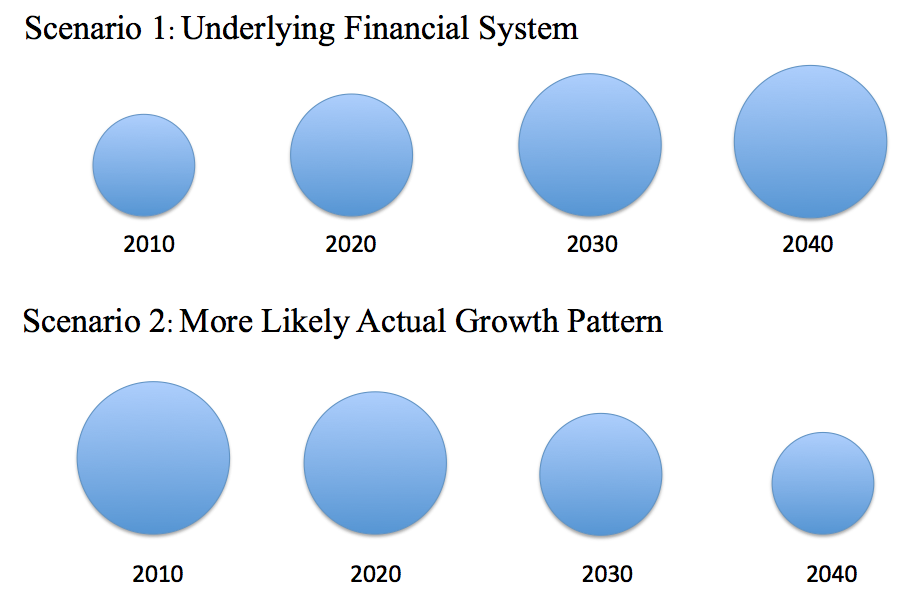
As we reach limits of oil or any finite resource, the problem we encounter is an allocation problem. 


What happens if economy stops growing

Figure 1. Two views of future economic growth. Created by author.


As long as the quantity of resources we can extract from the ground keeps rising faster than population, there is no problem with limits. The tiny wedge that each person might get from these growing resources represents more of that resource, on average. Citizens can reasonably expect that future pension promises will be paid from the growing resources. They can also expect that, in the future, the shares of stock and the bonds that they own can be redeemed for actual goods and services.


If the quantity of resources starts to shrink, the problem we have is almost a “musical chairs” type of problem.


Figure 2. Circle of chairs arranged for game of musical chairs. Source


In each round of a musical chairs game, one chair is removed from the circle. The players in the game must walk around the outside of the circle. When the music stops, all of the players scramble for the remaining chairs. Someone gets left out.


The players in today’s economic system include


  • High paid (or elite) workers

  • Low paid (or non-elite) workers

  • Businesses

  • Governments

  • Owners of assets (such as stocks, bonds, land, buildings) who want to sell them and exchange them for today’s goods and services

If there is a shortage of a resource, the standard belief is that prices will rise and either more of the resource will be found, or substitution will take place. Substitution only works in some cases: it is hard to think of a substitute for fresh water. It is often possible to substitute one energy product for another. Overall, however, there is no substitute for energy. If we want to heat a substance to produce a chemical reaction, we need energy. If we want to move an object from place to place, we need energy. If we want to desalinate water to produce more fresh water, this also takes energy.


The world economy is a self-organized networked system. The networked system includes businesses, governments, and workers, plus many types of energy, including human energy. Workers play a double role because they are also consumers. The way goods and services are allocated is determined by “market forces.” In fact, the way these market forces act is determined by the laws of physics. These market forces determine which of the players will get squeezed out if there is not enough to go around.


Non-elite workers play a pivotal role in this system because their number is so large. These people are the chief customers for goods, such as homes, food, clothing, and transportation services. They also play a major role in paying taxes, and in receiving government services.


History says that if there are not enough resources to go around, we can expect increasing wage and wealth disparity. This happens because increased use of technology and more specialization are workarounds for many kinds of problems. As an economy increasingly relies on technology, the owners and managers of the technology start receiving higher wages, leaving less for the workers without special skills. The owners and managers also tend to receive income from other sources, such as interest, dividends, capital gains, and rents.


When there are not enough resources to go around, the temptation is to use technology to replace workers, because this reduces costs. Of course, a robot does not need to buy food or a car. Such an approach tends to push commodity prices down, rather than up. This happens because fewer workers are employed; in total they can afford fewer goods. A similar downward push on commodity prices occurs if wages of non-elite workers stagnate or fall.


If wages of non-elite workers are lower, governments find themselves in increasing difficulty because they cannot collect enough taxes for all of the services that they are asked to provide. History shows that governments often collapse in such situations. Major defaults on debt are another likely outcome (Figure 3). Pension holders are another category of recipients who are likely to be “left out” when the game of musical chairs stops.


Figure 3 – Created by Author.


The laws of physics strongly suggest that if we are reaching limits of this type, the economy will collapse. We know that this happened to many early economies. More recently, we have witnessed partial collapses, such as the Depression of the 1930s. The Depression occurred when the price of food dropped because mechanization eliminated a significant share of human hand-labor. While this change reduced the price of food, it also had an adverse impact on the buying-power of those whose jobs were eliminated.


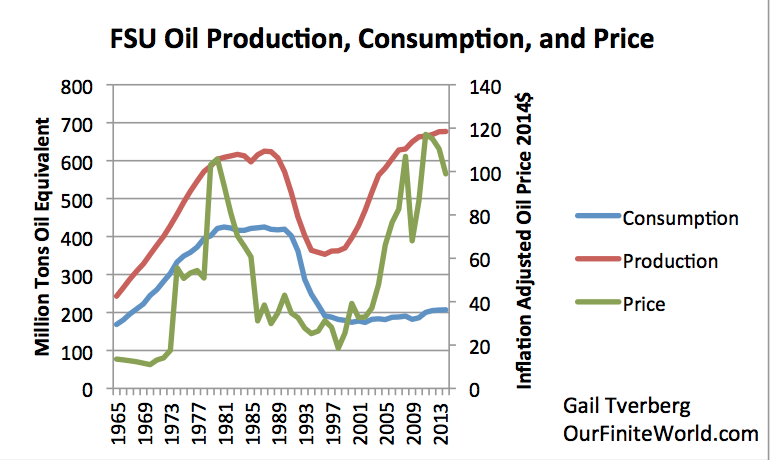
The collapse of the Soviet Union is another example of a partial collapse. This collapse occurred as a follow-on to the low oil prices of the 1980s. The Soviet Union was an oil exporter that was affected by low oil prices. It could continue to produce for a while, but eventually (1991) financial problems caught up with it, and the central government collapsed.


Figure 4. Oil consumption, production, and inflation-adjusted price, all from BP Statistical Review of World Energy, 2015.


Low prices are often a sign of lack of affordability. Today’s oil, coal, and natural gas prices tend to be too low for today’s producers. Low energy prices are deceptive because their initial impact on the economy seems to be favorable. The catch is that after a time, the shortfall in funds for reinvestment catches up, and production collapses. The resulting collapse of the economy may look like a financial collapse or a governmental collapse.


Oil prices have been low since late 2014. We do not know how long low prices can continue before collapse. The length of time since oil prices have collapsed is now three years; we should be concerned.


Myth 2. (Related to Myth 1) If we wait long enough, renewables will become affordable.


The fact that wage disparity grows as we approach limits means that prices can’t be expected to rise as we approach limits. Instead, prices tend to fall as an increasing number of would-be buyers are frozen out of the market. If in fact energy prices could rise much higher, there would be huge amounts of oil, coal and gas that could be extracted.


Figure 5. IEA Figure 1.4 from its World Energy Outlook 2015, showing how much oil can be produced at various price levels, according to IEA models.


There seems to be a maximum affordable price for any commodity. This maximum affordable price depends to a significant extent on the wages of non-elite workers. If the wages of non-elite workers fall (for example, because of mechanization or globalization), the maximum affordable price may even fall.


Myth 3. (Related to Myths 1 and 2) A glut of oil indicates that oil limits are far away. 


A glut of oil means that too many people around the world are being “frozen out” of buying goods and services that depend on oil, because of low wages or a lack of job. It is a physics problem, related to ice being formed when the temperature is too cold. We know that this kind of thing regularly happens in collapses and partial collapses. During the Depression of the 1930s, food was being destroyed for lack of buyers. It is not an indication that limits are far away; it is an indication that limits are close at hand. The system can no longer balance itself correctly.


Myth 4: Wind and solar can save us.


The amount of energy (other than direct food intake) that humans require is vastly higher than most people suppose. Other animals and plants can live on the food that they eat or the energy that they produce using sunlight and water. Humans deviated from this simple pattern long ago–over 1 million years ago.


Unfortunately, our bodies are now adapted to the use of supplemental energy in addition to food. The use of fire allowed humans to develop differently than other primates. Using fire to cook some of our food helped in many ways. It freed up time that would otherwise be spent chewing, providing time that could be used for tool making and other crafts. It allowed teeth, jaws and digestive systems to be smaller. The reduced energy needed for maintaining the digestive system allowed the brain to become bigger. It allowed humans to live in parts of the world where they are not physically adapted to living.


In fact, back at the time of hunter-gatherers, humans already seemed to need three times as much energy total as a correspondingly sized primate, if we count burned biomass in addition to direct food energy.


Figure 6 – Created by author.


“Watts per Capita” is a measure of the rate at which energy is consumed. Even back in hunter-gatherer days, humans behaved differently than similar-sized primates would be expected to behave. Without considering supplemental energy, an animal-like human is like an always-on 100-watt bulb. With the use of supplemental energy from burned biomass and other sources, even in hunter-gatherer times, the energy used was equivalent to that of an always-on 300-watt bulb.


How does the amount of energy produced by today’s wind turbines and solar panels compare to the energy used by hunter-gatherers? Let’s compare today’s wind and solar output to the 200 watts of supplemental energy needed to maintain our human existence back in hunter-gatherer times (difference between 300 watts per hour and 100 watts per hour). This assumes that if we were to go back to hunting and gathering, we could somehow collect food for everyone, to cover the first 100 watts per hour. All we would need to do is provide enough supplemental energy for cooking, heating, and other very basic needs, so we would not have to deforest the land.


Conveniently, BP gives the production of wind and solar in “terawatt hours.” If we take today’s world population of 7.5 billion, and multiply it by 24 hours a day, 365.25 days per year, and 200 watts, we come to needed energy of 13,149 terawatt hours per year. In 2016, the output of wind was 959.5 terawatt hours; the output of solar was 333.1 terawatt hours, or a total of 1,293 terawatt hours. Comparing the actual provided energy (1,293 tWh) to the required energy of 13,149 tWh, today’s wind and solar would provide only 9.8% of the supplemental energy needed to maintain a hunter-gatherer level of existence for today’s population. 


Of course, this is without considering how we would continue to create wind and solar electricity as hunter-gatherers, and how we would distribute such electricity. Needless to say, we would be nowhere near reproducing an agricultural level of existence for any large number of people, using only wind and solar. Even adding water power, the amount comes to only 40.4% of the added energy required for existence as hunter gatherers for today’s population.


Many people believe that wind and solar are ramping up rapidly. Starting from a base of zero, the annual percentage increases do appear to be large. But relative to the end point required to maintain any reasonable level of population, we are very far away. A recent lecture by Energy Professor Vaclav Smil is titled, “The Energy Revolution? More Like a Crawl.”


Myth 5. Evaluation methods such as “Energy Returned on Energy Invested” (EROI) and “Life Cycle Analyses (LCA)” indicate that wind and solar should be acceptable solutions. 


These approaches are concerned about how the energy used in creating a given device compares to the output of the device. The problem with these analyses is that, while we can measure “energy out” fairly well, we have a hard time determining total “energy in.” A large share of energy use comes from indirect sources, such as roads that are shared by many different users.


A particular problem occurs with intermittent resources, such as wind and solar. The EROI analyses available for wind and solar are based on analyses of these devices as stand-alone units (perhaps powering a desalination plant, on an intermittent basis). On this basis, they appear to be reasonably good choices as transition devices away from fossil fuels.


EROI analyses don’t handle the situation well when there is a need to add expensive infrastructure to compensate for the intermittency of wind and solar. This situation tends to happen when electricity is added to the grid in more than small quantities. One workaround for intermittency is adding batteries; another is overbuilding the intermittent devices, and using only the portion of intermittent electricity that comes at the time of day and time of year when it is needed. Another approach involves paying fossil fuel providers for maintaining extra capacity (needed both for rapid ramping and for the times of year when intermittent resources are inadequate).


Any of these workarounds is expensive and becomes more expensive, the larger the percentage of intermittent electricity that is added. Euan Mearns recently estimated that for a particular offshore wind farm, the cost would be six times as high, if battery backup sufficient to even out wind fluctuations in a single month were added. If the goal were to even out longer term fluctuations, the cost would no doubt be higher. It is difficult to model what workarounds would be needed for a truly 100% renewable system. The cost would no doubt be astronomical.


When an analysis such as EROI is prepared, there is a tendency to leave out any cost that varies with the application, because such a cost is difficult to estimate. My background is in actuarial work. In such a setting, the emphasis is always on completeness because after the fact, it will become very clear if the analyst left out any important insurance-related cost. In EROI and similar analyses, there is much less of a tieback to the real world, so an omission may never be noticed. In theory, EROIs are for multiple purposes, including ones where intermittency is not a problem. The EROI modeler is not expected to consider all cases.


Another way of viewing the issue is as a “quality” issue. EROI theory generally treats all types of energy as equivalent (including coal, oil, natural gas, intermittent electricity, and grid-quality electricity). From this perspective, there is no need to correct for differences in types of energy output. Thus, it makes perfect sense to publish EROI and LCA analyses that seem to indicate that wind and solar are great solutions, without any explanation regarding the likely high real-world cost associated with using them on the electric grid.


Myth 6. Peer reviewed articles give correct findings.


The real story is that peer reviewed articles need to be reviewed carefully by those who use them. There is a very significant chance that errors may have crept in. This can happen because of misinterpretation of prior peer reviewed articles, or because prior peer reviewed articles were based on “thinking of the day,” which was not quite correct, given what has been learned since the article was written. Or, as indicated by the example in Myth 5, the results of peer reviewed articles may be confusing to those who read them, in part because they are not written for any particular audience.


The way university research is divided up, researchers usually have a high level of specialized knowledge about one particular subject area. The real world situation with the world economy, as I mentioned in my discussion of Myth 1, is that the economy is a self-organized networked system. Everything affects everything else. The researcher, with his narrow background, doesn’t understand these interconnections. For example, energy researchers don’t generally understand economic feedback loops, so they tend to leave them out. Peer reviewers, who are looking for errors within the paper itself, are likely to miss important feedback loops as well.


To make matters worse, the publication process tends to favor results that suggest that there is no energy problem ahead. This bias can come through the peer review process. One author explained to me that he left out a certain point from a paper because he expected that some of his peer reviewers would come from the Green Community; he didn’t want to say anything that might offend such a reviewer.


This bias can also come directly from the publisher of academic books and articles. The publisher is in the business of selling books and journal articles; it does not want to upset potential buyers of its products. One publisher made it clear to me that its organization did not want any mention of problems that seem to be without a solution. The reader should be left with the impression that while there may be issues ahead, solutions are likely to be found.


In my opinion, any published research needs to be looked at very carefully. It is very difficult for an author to move much beyond the general level of understanding of his audience and of likely reviewers. There are financial incentives for authors to produce PC reports, and for publishers to publish them. In many cases, articles from blogs may be better resources than academic articles because blog authors are under less pressure to write PC reports.


Myth 7. Climate models give a good estimate of what we can expect in the future.


There is no doubt that climate is changing. But is all of the hysteria about climate change really the correct story?


Our economy, and in fact the Earth and all of its ecosystems, are self-organized networked systems. We are reaching limits in many areas at once, including energy, fresh water, the number of fish that can be extracted each year from oceans, and metal ore extraction. Physical limits are likely to lead to financial problems, as indicated in Figure 3. The climate change modelers have chosen to leave all of these issues out of their models, instead assuming that the economy can continue to grow as usual until 2100. Leaving out these other issues clearly can be expected to overstate the impact of climate change.


The International Energy Agency is very influential with respect to which energy issues are considered. Between 1998 and 2000, it did a major flip-flop in the importance of energy limits. The IEA’s 1998 World Energy Outlook devotes many pages to discussing the possibility of inadequate oil supplies in the future. In fact, near the beginning, the report says,


Our analysis of the current evidence suggests that world oil production from conventional sources could peak during the period 2010 to 2020.


The same report also mentions Climate Change considerations, but devotes many fewer pages to these concerns. The Kyoto Conference had taken place in 1997, and the topic was becoming more widely discussed.


In 1999, the IEA did not publish World Energy Outlook. When the IEA published the World Energy Outlook for 2000, the report suddenly focused only on Climate Change, with no mention of Peak Oil. The USGS World Petroleum Assessment 2000 had recently been published. It could be used to justify at least somewhat higher future oil production.


I will be the first to admit that the “Peak Oil” story is not really right. It is a halfway story, based on a partial understanding of the role physics plays in energy limits. Oil supply does not “run out.” Peak Oilers also did not understand that physics governs how markets work–whether prices rise or fall, or oscillate. If there is not enough to go around, some of the would-be buyers will be frozen out. But Climate Change, as our sole problem, or even as our major problem, is not the right story, either. It is another halfway story.


One point that both Peak Oilers and the IEA missed is that the world economy doesn’t really have the ability to cut back on the use of fossil fuels significantly, without the world economy collapsing. Thus, the IEA’s recommendations regarding moving away from fossil fuels cannot work. (Shifting energy use among countries is fairly easy, however, making individual country CO2 reductions appear more beneficial than they really are.) The IEA would be better off talking about non-fuel changes that might reduce CO2, such as eating vegetarian food, eliminating flooded rice paddies, and having smaller families. Of course, these are not really issues that the International Energy Association is concerned about.


The unfortunate truth is that on any difficult, interdisciplinary subject, we really don’t have a way of making a leap from lack of knowledge of a subject, to full knowledge of a subject, without a number of separate, partially wrong, steps. The IPCC climate studies and EROI analyses both fall in this category, as do Peak Oil reports.


The progress I have made on figuring out the energy limits story would not have been possible without the work of many other people, including those doing work on studying Peak Oil and those studying EROI. I have also received a lot of “tips” from readers of OurFiniteWorld.com regarding additional topics I should investigate. Even with all of this help, I am sure that my version of the truth is not quite right. We all keep learning as we go along.


There may indeed be details of this particular climate model that are not correct, although this is out of my area of expertise. For example, the historical temperatures used by researchers seem to need a lot of adjustment to be usable. Some people argue that the historical record has been adjusted to make the historical record fit the particular model used.


There is also the issue of truing up the indications to where we are now. I mentioned the problem earlier of EROI indications not having any real world tie; climate model indications are not quite as bad, but they also seem not to be well tied to what is actually happening.


Myth 8. We don’t need religion; our leaders are all knowing and all powerful.


We are fighting a battle against the laws of physics. Expecting our leaders to win in the battle against the laws of physics is expecting a huge amount. Some of the actions of our leaders seem extraordinarily stupid. For example, if falling interest rates have postponed peak oil, then proposing to raise interest rates, when we have not fixed the underlying oil depletion problem, seems very ill-advised.


Everything I have seen indicates that there is a literal Higher Power governing our world economy. It is the Laws of Physics that govern the world economy. The Laws of Physics affect the world economy in many ways. The economy is a dissipative structure. Energy inputs allow the economy to remain in an “out of equilibrium state” (that is, in a growing state), for a very long period.


Eventually the ability of any economy to grow must come to an end. The problem is that it requires increasing amounts of energy to fight the growing “entropy” (higher energy cost of extraction, need for growing debt, and rising pollution levels) of the system. The economy must come to an end, just as the lives of individual plants and animals (which are also dissipative structures) must come to an end.


People throughout the ages have been in awe of how this system that provides growth works. We get energy from the sun. This solar energy helps grow our food. It allows the physical growth of humans. It allows the growth of ecosystems and of economies. Humans, ecosystems, and economies seem permanent, but eventually they all must collapse. In physics terms, they are all dissipative structures.


Humans have been in awe of the self-organizing property permitted by flows of energy for as long as humans have had the ability to think abstract thoughts. These flows allow a newly created whole to be greater than the sum of their parts. For example, babies start from a small beginning and mature into adults. Musical notes go together to form recognizable melodies. Physical movements go together to form dances. Awe for this phenomenon seems to be one of the origins of religion.


Another reason for religions is a need for hierarchical structure within an economy. We know that animal groups very often have “pecking orders.” Adding a god provides a convenient way of adding a “top level” to the pecking order. Of course, if leaders can convince members of the group that they are all knowing and that science can provide all of the answers, then the top level provided by religion is not needed.


A third reason for religions is to help align the thoughts of members in a particular way. Most of us are aware of the power of magnetized materials.


Figure 7. Source.


To some extent, the same power exists when the belief systems of groups of people can be aligned in the same direction. For example, teachers find it much easier to teach large groups of students, if parents have emphasized the importance of school and the need for respect for teachers. A military leader can attack another country, if soldiers follow orders. A group of generally uncivilized people can learn the benefit of working with others, if proper instruction is given.


What has been astounding to me, as I have looked into the situation, is that the scientific evidence seems to point in the direction of a literal Higher Power governing our Universe. It is not clear whether this higher power is the Laws of Physics, or whether it is some outside “God” that created the Laws of Physics.


In the past, many researchers assumed that the Universe was a closed energy system, irreversibly headed toward a cold, dark end. Recent research indicates that the Universe is ever-expanding, and in fact, seems to be expanding at an accelerating rate. While individual dissipative structures are constantly encountering more and more entropy, the universe as a whole is perhaps expanding rapidly enough to “outrun” growing entropy. Thus, it can behave as an always-open system. This always-open energy system allows many types of objects to self-organize and grow, at least for a time. These objects behave as dissipative structures, each having a beginning and an end.


We really don’t know whether the Universe had a beginning. Some research suggests that it did not. Others believe it began with a Big Bang.


Within the Universe, the earth seems extremely unusual. In fact, it is not clear that there is any other planet that has exactly the right conditions for complex life. A recent American Scientist article discusses this issue. The book Rare Earth: Why Complex Life Is Uncommon in the Universe points out the huge number of coincidences that were necessary for complex life to form and flourish.


Within the Earth, and perhaps within the Universe as a whole, human economies are the most energy-dense form of structure found.


Figure 8. Image similar to ones shown in Eric Chaisson’s 2001 book, Cosmic Evolution: The Rise of Complexity in Nature.


Thus, in some sense, we humans and our economies may, in some sense, represent the current upper bound on development in the Universe.


We humans live on Earth. It is easy for us to think that our primary purpose in life is to care for and protect the Earth. Unfortunately, with our need for supplemental energy, this is not possible. Even at an early date, our need for resources exceeded what was sustainable. Joshua (in Joshua 17:14-18 relating to the period around 1400 BCE) instructs the tribes of Joseph to clear the trees from the hill country to have enough land for his tribe. This practice was clearly unsustainable; it would lead to erosion of the soil on hilltops. Even at that early date, high population and the need for resources to provide for this high population was conflicting with earth’s sustainability.


If our God is either the Laws of Physics, or some force giving rise to the Laws of Physics, then our God is really the God of the Universe. The limitations of the current Earth are no problem. God (or the Laws of Physics) could create a new Earth, or 1 million new Earths, if He chose to. Thus, from God’s point of view, it is not clear that there is any point to today’s environmentalism. There is a need not to poison ourselves, but “saving the earth” for other species after humans, or for a new set of humans who somehow will use much less energy, doesn’t make much sense. Humans can’t use much less energy; even if we could, our energy use would always be on an upward slope, headed to precisely where we are now.


There are many things that we can’t know for certain. Does this God want/expect us to worship him? Does this God plan an afterlife for some or all of the humans on Earth today? Obviously, if God (or the Laws of Physics) could create the Earth, God could also create other structures as well–possibly a “Heaven.” It is not clear to me that any one of today’s religions has a monopoly on insights regarding what is expected. A person might argue that we need not worry about religion at all, except for the fellowship it provides and the insights it offers regarding how early people coped with their difficulties.


Myth 9. The texts of religious groups around the world are literally true.


The texts of religious groups are true in the same sense that peer reviewed scientific literature is true. They represent, more or less, the best thinking of the day on a particular subject. This certainly does not mean that they are literally true.


We need to read religious texts in the context that they were written. In the earliest days, religious texts represented stories that people passed down from one generation to the next. These stories represented insights that these early people had gained. No one at that time was too concerned about authorship. If a story says, “God said,” it could also mean, “We think that this is something that God might have said.”


Literary styles were very different, back in an era before people pretended to have scientific knowledge. People created stories illustrating some aspect of a particular phenomenon. These stories were not supposed to fully describe what happened. This is why Genesis features two different creation stories.


The Bible makes liberal use of hyperbole and exaggeration. It is hard for people who are not familiar with the original language to understand how stories were intended to be interpreted. Is the concept of Hell added, primarily to provide a contrast to Heaven? In the Old Testament, the number of words in the ancient Hebrew language is much smaller than in today’s languages. This, by itself, makes direct translation difficult.


The earliest religious stories explained how God was perceived at that time. As people became more settled, their views changed. People were getting more “civilized.” Population densities were rising. The best beliefs in an early period may not have had relevance for a later period. This is why most religions have had reformers. Sometimes new writings are added. At other times, the way the writings are interpreted changes. This is why there seems to be a bizarre progression of stories from the Old Testament to the New Testament; new stories needed to be added to supplement and replace old ways of thinking.


Some of the things that early people discovered have not been understood by environmentalists. Genesis 1:28 says,


God blessed them and said to them, “Be fruitful and increase in number; fill the earth and subdue it. Rule over the fish in the sea and the birds in the sky and over every living creature that moves on the ground.”


The early people had figured out that humans were indeed different from other animals and plants. Their use of supplemental energy gave them power over other creatures. Their numbers could (and indeed, did) increase. Early authors were documenting how the world really worked. We later humans have been too blind to see the real situation. It is more pleasant for us to think that somehow we are just like other animals, except perhaps smarter and more in control. With our greater knowledge, we could somehow have avoided an increase in our numbers, if we had only planned better. The laws of physics say this cannot happen; our higher energy use dictates who will win the battle for resources.


The early religious stories were not too different from Peak Oil and Climate Change. They were sort of right. They gave partial insight. They were the best the authors could do at the time.


The ancient religious documents could not tell the whole story at once. New groups would gradually add more insights to the developing story, providing a better understanding of what was truly important for people living in a later period.


Conclusion


In practice, people need a religion or a religion-substitute. People need a basic set of beliefs with which to order their lives.


Our leaders today have proposed the Religion of Success, with its belief in Science, and the power of today’s leaders, as the new religion. This religion has appeal, because it denies the limits we are up against. Life will continue, as if we lived on a flat earth with unlimited resources. This story is pleasant, but unfortunately not true.


Donald Trump, with his version of conservatism, presents another religion. This religion seems to be focused on justifying the allocation of wealth away from the poor, toward the rich, through tax breaks for corporations and the wealthy. This is part of the process of “freezing out” the poor people of the world, when there are not enough resources to go around.


It is hard for me to support Trumpism, even though I recognize that in the animal world, the expected outcome when there are not enough resources to go around is “survival of the best-adapted.” If our concern is leaving energy resources in the ground for future generations, transferring buying power from the poor to the rich is a way of collapsing the economy quickly, while considerable resources remain in the ground. The fact that wealthy people are favored ensures that at least some people will survive.


China and Japan both have what are close to state religions, created by their leaders. School children learn stories regarding what is important, based on what state leaders tell them. In Japan, school children visit religious sites, and learn the proper religious observances. They also learn rules about what is expected of them–always be polite; respect those in charge; don’t eat food on the street; never leave any food wrappers on the ground. In many ways, these religions are probably not too different from today’s Religion of Success.


I personally am not in favor of religions that originate from political groups. I would prefer the “old fashioned” religions based on ancient documents from one or another of the world’s religions. We are clearly facing a difficult time ahead. Perhaps early people had insights regarding how to deal with troubled times. Admittedly, we don’t know for certain that heaven can be in our future. But when things look bleak, it is helpful to see the possibility of a reasonable outcome.
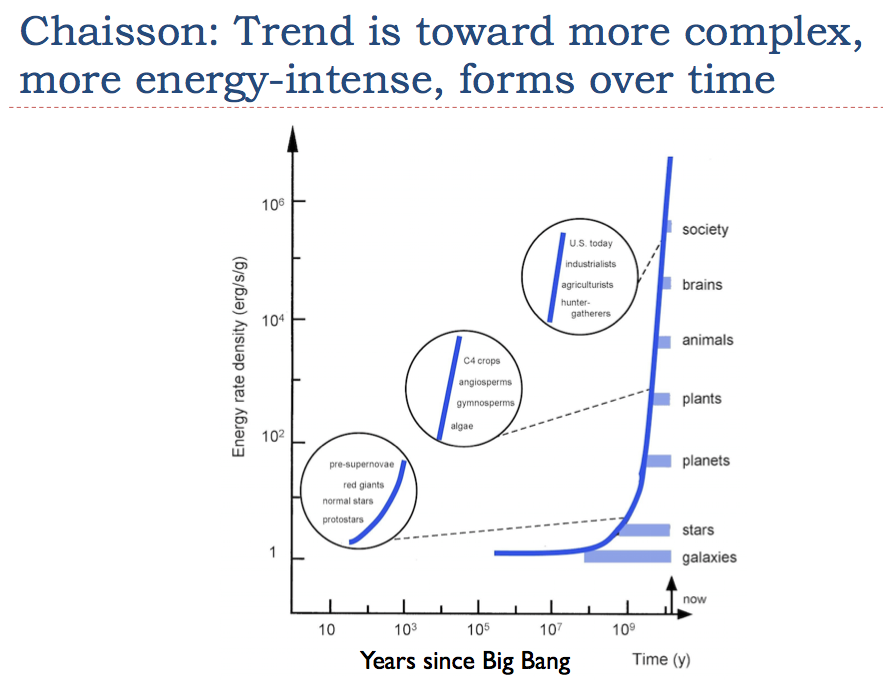

Furthermore, religious groups offer the possibility of finding a group of like-minded individuals to make friends with. We need all of the support we can get as we go through troubled times.