Showing posts with label GOLD. Show all posts

Tuesday, May 8, 2018

Gold Mining Supply IS Collapsing

By Rory Hall


Normally, I don’t step out and make such bold statements as gold mining supply IS collapsing; however, in this case it seems appropriate. We have reported on several occasions just in the past week, here, here and here how some of the largest mining companies in the world are seeing massive reductions in gold production. While funding continues to flow into mining companies, new discoveries, with few exceptions, are smaller and have much shorter production lifespans.


We recently interviewed (MUST LISTEN) the President/CEO of First Mining Gold, Jeff Swinoga, and his company is on the verge of bringing online one of the largest discoveries in some time. The Springpole project has an inferred 5 million ounces of gold in the ground. While 5 million ounces is a very impressive, and large, discovery the gold market needs about 10-15 more of these to keep pace with the current trend of gold acquisitions by central banks, the top government bullion mints and private bullion mints around the world. The gold discoveries are not manifesting.


While we have been saying capital inflows have been the problem, which we now can say we missed the mark, it has been the actual discoveries that have been the problem in more gold coming to market. Plenty of funding, serious lack of gold waiting to be found.


The demand for gold is increasing, yet new discoveries of the precious metal have not kept pace with the demand. Funds for exploration are historically high, $54.3 billion, up 60 percent over the past 18 years.


The increased spending, however, has not produced the equivalent in new gold discoveries. During the past decade, 41 discoveries have resulted in a mere 215.5 million ounces of the precious metal. Even counting recently discovered but unexplored mines, which may hold as-yet major discoveries, the total available amount of gold in these discoveries are not expected to surpass 363 million ounces over the next ten years.


Gold discoveries have followed a predictable pattern. 263 major gold discoveries have been made in the past 28 years, but half of those discoveries happened in the 1990s. This boom lasted until the turn of the century when the rate of discovery began to decline. Only 16 discoveries were reported from 2000 to 2002, which produced 108.3 ounces of gold. That amount was below the average finds of the 1990s. This decline has continued, with both new discoveries and the amount of gold mined decreasing steadily. By 2010, only 18.6 million ounces of gold was discovered, a severe drop from the 61.5 (million) ounces found in 2009.


Old sectors are being depleted, while active exploration for new discoveries has been slow. The amount of available gold has not met expectation and remains far below the 2009 high. Gold Telegraph


With the vast majority of mines discovered in the 1990s now either completely drained or on their last leg it is past time for them to be replaced. Mines have a finite “life span”  The problem is, the gold in the ground may be too deep, too expensive or too small a deposit to replace these older mines. I feel confident most of the mines around the world still have gold, silver and other metals awaiting to be processed, the problem is return-on-investment.


Continued gold exploration has become critical. In 2018, Colorado-based Newmont Mining Corp., one of the world largest gold explorers, has allocated $1.3 billion to expand its current projects, an increase of $300 million from the previous year.


Much of the available gold in Australia’s northern Goldfield has been depleted, and companies are drilling to unprecedented depths of 3 kilometers below the surface hoping for new discoveries as new finds are becoming rarer and more expensive to pursue. Gold Telegraph


This may be the best support for what we have been saying for the past year. Gold and silver are currently very inexpensive and in the coming handful of years this is going to change significantly. As we move into the 2020 decade those that possess precious metals today will be very happy to have made the commitment, while those sitting on the sidelines will be very disappointed. Get physical and get it now, 2020 will be here before you know what happened.


Rory Hall’s site is The Daily Coin, where this article first appeared. Beginning in 1987 Rory has written over 1,000 articles and produced more than 300 videos on topics ranging from the precious metals market, economic and monetary policies, preparedness as well as geopolitical events. His articles have been published by Zerohedge, SHTFPlan, Sprott Money, GoldSilver, Silver Doctors, SGTReport, and a great many more. Rory was a producer and daily contributor at SGTReport between 2012 and 2014. He has interviewed experts such as Dr. Paul Craig Roberts, Dr. Marc Faber, Eric Sprott, Gerald Celente and Peter Schiff, to name but a few. Don’t forget to visit The Daily Coin and Shadow of Truth YouTube channels to enjoy original videos and some of the best economic, precious metals, geopolitical and preparedness news from around the world.

Saturday, May 5, 2018

Kazakhstan Goes For The Gold, Again!

By Rory Hall


Another month passes and another hundred thousand ounces (3.11 tons) of physical gold get added to the Kazakhstan gold reserve vault. Each month this nation makes another deposit of physical gold and each month the vast majority of media completely ignores it. Not only has she been adding physical gold to her gold reserves for the past 66 straight months, the last two years have seen an increase in the overall volume of gold added.


In 2016 Kazakhstan added a total of 36 tons of gold and in 2017 she added an additional 40 tons of physical gold showing more than a 10% increase year-over-year volume. No, Kazakhstan is not breaking records or jumping past China and approaching France’s gold reserve status such as Russia is doing, but Kazakhstan is passing all her associates and will be moving into the top-ten gold holdings in short order.  If this trend continues into 2018 Kazakhstan will move into 16th position globally passing Saudi Arabia and approaching 15th position Portugal that holds 382.5 tons. Will anyone notice at that time?


The chart below, courtesy of Statista, shows reserves through February 2018.


Smaulgld produced the following the chart that includes March 2018 to drive home the idea even further.


Not only has this tiny country matched the gold reserves of the United Kingdom, their gold reserves now constitute 43% of their total reserves – WOW! This shows two things: 1) they’re serious about gold and 2) Kazakhstan has a small GDP footprint.  My guess is that as Kazakhstan acquires more gold their GDP will somehow take care of itself and grow along with the size of their physical gold vault. I’m willing to bet that five years from now we will see that exact scenario play out. I’m also willing to bet that IF Kazakhstan continues acquiring gold in the same manner she has for the past five years she will be approaching or surpassing the Netherlands, in 10th position globally, with 612.5 tons of gold reserves.


To me, this is one of the more important nations to continually add to their gold reserves for two very simple reasons – they were chosen by China to smelt gold for the Belt and Road Initiative; and they are members of the EAEU and SCO while they work very closely with the heads of both of these two economic alliances. Kazakhstan is, literally, the doorstep of both China and Russia. Kazakhstan makes up a measurable portion of the border between these two economic powerhouses.


chart – smaulgld – as of May 2, 2018 represents gold reserves of countries ranked 11-20


See video from Smaulgld HERE.


Rory Hall’s site is The Daily Coin, where this article first appeared. Beginning in 1987 Rory has written over 1,000 articles and produced more than 300 videos on topics ranging from the precious metals market, economic and monetary policies, preparedness as well as geopolitical events. His articles have been published by Zerohedge, SHTFPlan, Sprott Money, GoldSilver, Silver Doctors, SGTReport, and a great many more. Rory was a producer and daily contributor at SGTReport between 2012 and 2014. He has interviewed experts such as Dr. Paul Craig Roberts, Dr. Marc Faber, Eric Sprott, Gerald Celente and Peter Schiff, to name but a few. Don’t forget to visit The Daily Coin and Shadow of Truth YouTube channels to enjoy original videos and some of the best economic, precious metals, geopolitical and preparedness news from around the world.

Wednesday, May 2, 2018

Gold Eagle Sales Still Faltering While Mining Output Collapses – Perfect Storm

By Rory Hall


It appears we are seeing another sign of the frequency shift. Over the past few weeks we have been speaking more about this shift in terms of spirituality and community, but today we see it manifesting in a whole other area.


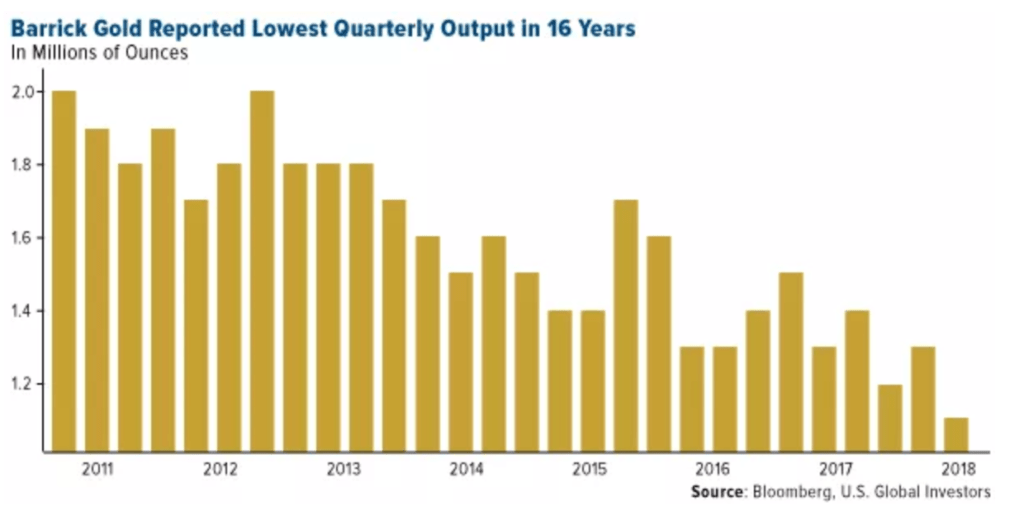
The decline in mining output by the “world’s largest gold miner,” Barrick Gold, seems to point towards undeniable reasons, as we have been saying for the past year, for gold to climb much, much higher. Gold, and silver, will break the chains of the bullion banks’ grip as the gold and silver traders begin to see more charts that look like the one below. This chart should get the attention of any gold bug – especially the trend that really began almost 7 years ago.


chart – Gold Core


It doesn’t take a genius to see a very serious decline in output beginning third quarter 2013 – five years ago. There is the one outlier in mid-2015 but it was completely washed out during the next two quarters. The downward trend seems to be intensifying – lower highs and much, much lower lows.


American Gold Eagle sales in March 2018 fell by 83% compared to March 2017, if that doesn’t constitute a frequency change not sure what does. As we reported last month


If we compare March 2017 to March 2018 we see a dramatic change


A mere 2,500 AGE one ounce coins were sold to the AP’s in March 2018 with an additional 10,000 one-tenth ounce coins (1,000 ounces) being sold as well for a total of 3,500 ounces and 12,500 total coins. Not a single half or quarter ounce AGE coin sold in March 2018. This is an 83% nosedive in sales in the all important year-over-year category in the total amount of gold ounces sold in March. If this were a normal business the doors would be closed, the inventory sold off and business shuttered.


We have been gathering up low mintage American Gold Eagles (AGEs) and Buffaloes and if anyone sees charts like the one below and can not see there may be an opportunity for higher premiums in the future, then it may require a second look.


chart – Gold Core


American Gold Eagles sales collapsed in 2017 and with the exception of three of the past sixteen months, going back to December 2016, sales have been absolutely abysmal. Any of the AGE coins – 1 ounce, 1/2 ounce, 1/4 ounce or 1/10 ounce – minted in 2017 or 2018 has the potential to command much higher premiums over the next few years. Remember, at the end of the day if the premiums collapse in the face of much higher gold values, will it really matter? If a person has the gold bullion that’s all that will matter. As Alasdair Macleod said – If you’ve got gold, you’ve got money. If you don’t have gold, you’ve got a problem – that’s a fact right there.


U.S. Mint American Eagle gold coin sales collapse to weakest April since 2007 giving contrarian value buyers another buy signal


Sales of U.S. Mint American Eagle gold coins dropped to their weakest April since 2007, while silver coin purchases for the month rose 10 percent higher than last year, U.S. government data showed on Monday.


The U.S. Mint sold 4,500 ounces of American Eagle gold coins in April, down 25 percent from the year prior. However, April sales were up 29 percent from March.


During April, spot gold prices rallied to a 2-1/2-month high of $1,365.23 per ounce as concerns over escalating tensions in Syria, U.S. Sanctions on Russia and the U.S.-China trade stand-off weighed on stock markets and helped to knock the dollar index to a two-week low against a basket of currencies. Gold Core


Two years ago during a July 2016 conversation with an independent market analyst, he suggested we had reached an inflection point. It seems he was spot on as the market has completely deteriorated from that time. Mining output has completely collapsed, Pan American silver mine recently shuttered operations and now we learn today the reality of Barrick Gold and their collapsing gold mining output. It is impossible to dig something out of the ground that either no longer exists, or the expense makes it impossible to retrieve. The inflection point Eric Dubin referenced is laid bare for all to see.


Rory Hall’s site is The Daily Coin, where this article first appeared. Beginning in 1987 Rory has written over 1,000 articles and produced more than 300 videos on topics ranging from the precious metals market, economic and monetary policies, preparedness as well as geopolitical events. His articles have been published by Zerohedge, SHTFPlan, Sprott Money, GoldSilver, Silver Doctors, SGTReport, and a great many more. Rory was a producer and daily contributor at SGTReport between 2012 and 2014. He has interviewed experts such as Dr. Paul Craig Roberts, Dr. Marc Faber, Eric Sprott, Gerald Celente and Peter Schiff, to name but a few. Don’t forget to visit The Daily Coin and Shadow of Truth YouTube channels to enjoy original videos and some of the best economic, precious metals, geopolitical and preparedness news from around the world.

Wednesday, April 25, 2018

House Monetary Policy Committee Member Questions Treasury and Fed about Their Gold Activities

By Activist Post


A Member of Congress posed some pointed questions to the Federal Reserve and the U.S. Treasury this week about their activities involving America’s gold reserves, including, apparently, efforts to “drive gold out of the world financial system in favor of the Federal Reserve Note or Special Drawing Rights issued by the International Monetary Fund.”


In a letter dated April 24, Representative Alex Mooney (R-WV) wrote to Jerome Powell, Chairman of the Federal Reserve, and Steven Mnuchin, Secretary of the U.S. Treasury, raising concerns about their formal policy to devalue the Federal Reserve Note (e.g. “inflation targeting”) and requesting information about the United States’ use of, and position on, gold.


“The purchasing power of our currency has fallen some 97% since Congress passed the Federal Reserve Act in 1913, with an acceleration in the rate of decline occurring since the early 1970s when the final link to gold was severed,” wrote Mooney while also pointing out there had been almost no inflation in the U.S. prior to the creation of the Federal Reserve System.


“This Fed policy of creating inflation has the effect of driving up the cost of virtually everything my West Virginia constituents consume, while simultaneously reducing the real value of their pensions, savings, and fixed income payments,” Mooney continued.


In his capacity as a member of the House Financial Services Committee and its Monetary Policy and Trade subcommittee, Mooney has asked the Fed and Treasury to answer the following questions in writing:


  1. Records in the archives of the historian of the U.S. State Department describe U.S. government policy in recent decades as aiming to drive gold out of the world financial system in favor of the Federal Reserve Note or Special Drawing Rights issued by the International Monetary Fund.


Is this still U.S. government policy toward gold? If not, what IS the U.S. government’s current policy toward gold?


  1. I have heard complains that the U.S. gold reserve has not been fully audited for many decades, particularly as there seems to have been no acknowledgement of – or account for – “swaps” and leases of gold or arrangements for such to which the U.S. government has been a party.


Does the U.S. government, through the Treasury Department, the Federal Reserve System, or any other agency or entity, transact in gold or gold derivatives either directly or through intermediaries? If so, what are those transactions and what are their objectives?


  1. Does the U.S. government undertake any transactions in gold or gold derivatives through the Bank for International Settlements, Bank of England, or other central banks or governments? If so, what are these transactions and their objectives?


Stefan Gleason, Executive Director of the Sound Money Defense League said,


In recent decades, government officials and central banks have almost entirely kicked gold out of the monetary system with disastrous effects, particularly for the average American.


A return to sound money, i.e. gold and silver, would usher in a new era of investment, savings, stable prices, and fiscal discipline.


We look forward to an explanation from Secretary Mnuchin and Chairman Powell regarding the government’s activities using America’s gold, including to what extent America’s gold reserves have been put at risk or used for what might be viewed as dubious purposes.


Congressman Mooney’s letter can be accessed here.


Image credit: Daily Coin

China Takes the Long View on Gold-Silver … and So Should You

By David Smith


A cursory look at Chinese history can convince you that China should not be underestimated when it sets its sights on a particular goal.


Even before Mao Zedong took over the reins in 1949, and the first Five Year Plan began in 1953, centuries of history demonstrated that long-term planning, while not always meeting expectations, is a core behavioral trait of the Chinese psyche.


And more often than not, it has enabled them to hit the mark.


Expect eventual success for the One Belt, One Road Initiative – the world’s largest construction project, estimated to cost $80 trillion dollars – linking the Asian mainland, (including Central Asia) with Europe via high speed rail, communications links and vibrant financial trading platforms.


And expect this project to be a major factor in bringing about what Doug Casey and others believe could become the greatest commodities bull-run that most of us now living are going to see.


The petro-yuan. A game-changer?


And oh, by the way, China recently officially launched a petro-yuan contract at the Shanghai International Energy Exchange. It marks the first time overseas investors have been able to access a Chinese commodity market – an oil futures contract – that can be settled, not only with U.S. dollars, but also Chinese Yuan, eventually a basket of currencies… and gold.


Asian Analyst, Pepe Escobar, sees clearly where this is heading, saying:


As the yuan progressively reaches full consolidation in trade settlement, the petro-yuan threat to the US dollar, inscribed in a complex, long-term process, will disseminate the Holy Grail: crude oil futures contracts priced in yuan fully convertible into gold…


That means China’s vast array of trade partners will be able to convert yuan into gold without having to keep funds in Chinese assets or turn them into US dollars… Still, the whole petrodollar edifice lies on OPEC – and the House of Saud– pricing oil in US dollars; as everyone needs greenbacks to buy oil, everyone needs to buy (spiraling) US debt. Beijing is set to break the system – as long as it takes.


Meanwhile, gold will continue rising to a level where, at some point, Beijing decides to set a conversion rate. When this “golden moment” arrives, the effects on global oil trade – and U.S. continued supremacy in this arena – will be profound. Mining Analyst, Byron King doesn’t mince any words about it. Says he,


China’s vast array of trade partners will be able to convert yuan into gold without having to keep funds in Chinese assets or turn them into U.S. dollars. It’s a straight-up way to bypass the buck. And what if Saudi Arabia – among China’s largest oil suppliers – agrees to accept yuan instead of dollars? It’ll be a bomb-down-the-funnel for U.S. dollar hegemony in the world.


Gold-for-Oil is just one element which will take precious metals to new all-time highs.


For the last several years, we’ve discussed many of these factors, about which readers can fully test their understanding by perusing scores of reports and essays archived here at https://www.moneymetals.com/news You can also find a steady stream of informative, relevant, actionable information on “The Silver Guru” David Morgan’s Blog.


Once this trend fully gets under way – sooner than most expect – the price you’re looking at for physical gold (and silver with its 90% directional gold-correlation price movement) will quickly recede in the rear-view mirror.


Here are just a few recent commentaries that should give you a sense of the structural changes in these markets, making them increasingly subject to explosive moves on the upside – without sending you an invitation to board the train beforehand.


The bottom line is gold is nearing a major bull breakout above $1365. That will turn psychology bullish and bring traders back in droves. Gold is rallying ever closer to new bull-market highs as evidenced by its massive multi-year ascending-triangle chart pattern now nearing a bullish climax. Today gold is only a couple percent below that decisive breakout, which will finally blast it back onto the radars of investors. – Adam Hamilton, Zeal Speculation and Investment


We see a massive base building in gold. Massive. It’s a four-year, five-year base in gold. If we break above this resistance line, one can expect gold to go up by, like, a $1,000. . . Doubleline CEO, Jeff Gundlach, the “Bond King”


With the growth of high-end consumption and the development in second and third-tier cities, the Chinese market will show its substantial demand, mostly unexplored, for physical gold, as more and more people start to realize gold’s stored and retaining values in the long term. – Song Xin, China Gold Association, April 18, 2018.


So how should you consider handling this situation?


Yes, we’ve been waiting “quite awhile” for this trend to get underway, creating fireworks for metals’ holders. And yes, a few people have become impatient, and actually sold back their metal – which may have taken years to accumulate. But just remember, it’s less a question of if, rather than when this all comes together.


Successful metals’ owners who have prospered since the beginning of the bull run in 2000, got there – and stayed onboard – by following a few sensible rules.


Does this look like an established trend? (Courtesy goldchartsrus.com)


They listen to the “experts” and pay attention to big changes, like the Chinese yuan-for-oil event we’re discussing here.


In addition, they look at what the charts tell them – that Asia continues to suck up gold and silver from the West like a proverbial vacuum cleaner. The Silk Road Gold Total Reserves Plus Demand chart nearby confirms this in spades. They touch base with risk tolerance, taking stock of their financial capability to participate. And acquire metal on a regular basis (without going ‘all in’ at any particular price point), regardless of that the price is doing that month.


They understand that profoundly positive things come to those who are patient, have a plan… and who then act on it. So, ask yourself today, “Am I willing – like the Chinese – to persevere for ‘as long as it takes"”?


David Smith is Senior Analyst for TheMorganReport.com and a regular contributor to MoneyMetals.com. For the past 15 years he has investigated precious metals’ mines and exploration sites in Argentina, Chile, Peru, Mexico, Bolivia, China, Canada, and the U.S. He shares his resource sector observations with readers, the media, and North American investment conference attendees.

Friday, April 20, 2018

In an Attempt to Ditch the Dollar, Turkey Will Take Back All Its Gold From the US

gold(ZHE) After Venezuela, Germany, Austria and the Netherlands prudently repatriated a substantial portion (if not all) of their physical gold held at the NY Fed or other western central banks in recent years, this morning Turkey also announced that it has decided to repatriate all its gold stored in the US Federal Reserve and deliver it to the Istanbul Stock Exchange, according to reports […]

Peter Schiff Economy Warning : ‘Enjoy The Calm Before The Storm’


Financial analyst Peter Schiff is warning to “enjoy the calm before the storm.” Schiff, who predicted the 2008 recession says that inflation and interest rates are about to go up much more than expected.


In his most recent podcast, Schiff basically said to enjoy things now, because the storm will eventually hit. With the United States missile strike in Syria, rumblings of a trade war and a generally weak dollar, gold briefly flirted with $1,365 last week. But the anticipation of Federal Reserve rate hikes continues to create strong headwinds against the yellow metal. Many people now think the Fed will nudge interest rates up again in June, leaving six months to get in the much-anticipated third hike of the year, and possibly even get in a fourth.


The Fed is not going to be able to deliver the rate hikes the Fed is expecting, and again, it’s the expectation of more rate hikes that is what is keeping the lid on the price of gold. But it’s only a matter of time before the market blows the lid off and the price of gold goes up. –Peter Schiff


Peter said gold is basically trading sideways right now, in advance of a breakout. Meanwhile, the dollar is doing the same thing in the other direction. The greenback is weak but not breaking down. On the other hand, it isn’t recovering any of its losses. Peter thinks it’s treading water right now before it heads lower again, according to Seeking Alpha. 


Of course, the economic growth was supposed to help “pay for” the tax cuts and the massive amounts of deficit spending. If the economic growth doesn’t materialize, the deficits will be even bigger and they are already going sky-high. On top of that, rising interest rates are going to increase the annual payments on the debt.


So, these deficits are blowing through the roof and this is going to be the driving force in moving the dollar substantially lower and moving gold substantially higher.


We are in the perfect storm, I think, of massive explosion in deficits, not just the budget deficit but the trade deficit, these tariffs or a trade war is only going to compound the problem. We’ve got the economy weakening. We’ve got the dollar teetering on the brink of collapse. We’ve got gold about to break out and the bond market is in the same thing.


Right now, everything seems pretty calm on the horizon, but we are in the calm before the storm.


The three major markets – bonds, gold, and the dollar – are all moving sideways, getting ready to continue their most recent moves, which for gold is up, for the dollar is down, and for bonds are down, which means interest rates are up – and it’s one, two, three strikes and you’re out.

Thursday, April 19, 2018

Enormous National Debt Will Double Again In 10 Years Or Less

Will it really be possible for our kids to pay all this back?


America’s national debt will increase to almost twice its current sizethanks to legislation Congress passed over the last year. Also,the federal deficitwill expand to over $1 trillion for the first time in 2022 because of the same laws.


The national debt, which was $14.70 trillion in 2017, will grow to $28.70 trillion by 2028, Seeking Alpha Contributor Elliott R. Morss revealed. Morss based his predictions on a report from the Congressional Budget Office.


The federal government’s deficit will grow from $630 billion in 2017 to $1.08 trillion in 2022, andit will rise to $1.14 trillion in 2028 because of the same legislation. The national debt is the amount of money the government owes to creditors. The deficit is the amount by which federal spending exceeds tax revenue.


The debt and deficit will soar because of three laws passed by Congress: last year’s tax reform, the Bipartisan Budget Act, and the Consolidated Appropriations Act. If those laws remain on the books for the nexttenyears, Morss predicts they will cut federal revenues by 4% or $1.7 trillion and increase federal spending by $1 trillion or 2%.


National Debt Will Be 96.20% Of GDP By 2028


Morss has predicted that by 2028, the national debt will be almost as massiveas the gross domestic product (GDP), which consists of all the money generated by America’s economy.


The debt amounted to 76.5% of the GDP in 2017, and by 2028, the debtwill consume 96.2% of the GDP, as a chart made by Morss indicates. That means the debtmight be higherthan the GDP as soon as 2029 – just 11 years from now.


Disturbingly, Morss might be optimistic with his percentages. His chart estimated the U.S. GDP might be $22.33 trillion in 2028, while the national debt would be $28.7 trillion.


U.S. Treasury Floods Markets With Debt To Raise Cash


Uncle Sam already hasa hard time finding enough moneyto pay the bills. The U.S. Treasury flooded the securities markets with a record $179 billion in debt in a few hours on February 20.


That was only part of $258 billion in debt the Treasury sold during the week of February 20, 2018, Bloomberg Marketsreported. That sale was the most significantauction of debt since the financial meltdown during 2008. The debt takes the form of Treasury bonds and other securities.


The Danger from Debt: Hyperinflation


The most considerabledangers from debt and deficit spending are inflation and hyperinflation. Unsustainable levels of debt can destroy a nation’s currency.


That has already happened in Venezuela where the government accumulated around $60 billion in debt it cannot pay. As a result, Venezuela is suffering from hyperinflation; prices in the country rose by 6,147% between February 2017 and February 2018.


People can prepare for more massivenational debts and higher federal deficitsby moving their money out of U.S. dollars. Investments worth considering includeprecious metals like gold and silver, real estate, U.S. stocks, foreign stocks, cryptocurrencies, and foreign currencies.


Getting out of the dollar would be a smart move because it is unlikely that Congress will cut spending or increase taxes in the foreseeable future. Frankly, I see it as an impossibility.


The truth is, when so many families are already facing serious financial issues, does anyone their right mind think this will end with a whimper instead of a nightmarish financial bang?


Since we’ve already destroyed the foundations which kept us free, we should begin immediately to rebuild our economy on a rock solid Christian foundation.


Wednesday, March 28, 2018

Now is the time to buy gold, major commodities team suggests

(INTELLIHUB) — A Goldman Sachs commodities team suggests that gold may “outperform” in the coming months amid growing fears of an upcoming stock market bobble.


A man by the name of Eugene King leads a team of Goldman Sachs analysts who believe now is the time to invest in gold.


“Last week, the Federal Reserve approved the widely anticipated quarter-point rate hike to put the new benchmark funds rate at 1.75 percent. Central bankers, led by Jerome Powell in his first meeting as chairman, also hinted the path of rate hikes could be more aggressive,” as CNBC reports.


Historically speaking, when the stock market has fallen from rate hikes gold typically climbs which is what makes the tangible metal such an appealing investment.


“Based on empirical data for the past six tightening cycles, gold has outperformed post rate hikes four times,” one analyst explained.


©2018. INTELLIHUB.COM. All Rights Reserved.

The post Now is the time to buy gold, major commodities team suggests appeared first on Intellihub.

Tuesday, March 27, 2018

Physical Gold Production May Be Peaking, But There Is No Shortage In Paper Gold

By Clint Siegner


Gold production numbers for 2017 are still being compiled but estimates call for the first annual decline in mine output since 2008.


The gold price fell dramatically in the months following the 2011 peak in prices. It has languished at, or near, the cost of production for years. Low gold prices are having a predictable effect on mine output.


Many projects with marginal ore deposits were rendered uneconomic. High cost operators went out of business. Exploration budgets got slashed dramatically. And all of these factors compound a larger underlying issue. It is increasingly difficult to find gold deposits that make sense to mine. New discoveries are less than a fifth of what they were in 2006.


Much higher gold prices will drive more exploration and should boost discoveries. Some projects which have been mothballed due to higher costs will become feasible once again. But the trend seems clear – the drought in discoveries, which began more than a decade ago, looks likely to persist regardless of the gold price. And the struggle to find economic deposits will translate to a serious decline in production in the years ahead.


Some forecasters believe 2016 represented peak gold production. To the extent that physical supply is a determinant in the price, gold investors have something to look forward to. However, and unfortunately, price discovery happens in the broken and rigged futures markets.


When it comes to trading in gold futures, the physical supply and demand for the metal is barely a consideration.


Practically no one trading contracts cares about getting delivery.


During periods of high speculative demand in the futures markets, the bullion banks stand ready to sell a virtually unlimited number of fresh new contracts. Physical gold may be scarce, but available paper gold has been limitless.


Someday the confidence in gold (and silver) futures is likely to collapse.


Some event will prompt traders to look at the shocking amount of leverage built into the contracts. They will suddenly be uncomfortable with how little physical metal there is supporting the enormous paper trade. When too many begin standing for delivery of bars, they will be handed cash instead, provided their counterparties are solvent.


The markets will wake up and find all of the paper which was supposed to represent gold actually does nothing of the kind. The peak in paper gold will have passed.


Diminishing mine output will definitely have ramifications for the gold price, but the metal won’t find fair market value until people stop demanding paper and start demanding the real thing. Gold investors should be encouraged by prospects of a peak in physical gold, but the real celebration will have to wait until the peak in paper gold is behind us.


Clint Siegner is a Director at Money Metals Exchange, the national precious metals company named 2015 “Dealer of the Year” in the United States by an independent global ratings group. A graduate of Linfield College in Oregon, Siegner puts his experience in business management along with his passion for personal liberty, limited government, and honest money into the development of Money Metals‘ brand and reach. This includes writing extensively on the bullion markets and their intersection with policy and world affairs.

China Moves To Destroy US Dollar As They Launch The Gold-backed Petro-Yuan

By Matt Agorist


In a massive move against the global dominance of the U.S. dollar, China’s highly anticipated Petro-Yuan has been launched in Shanghai. With China being the world’s largest consumer of oil, this new currency is an international game-changer that was a predicted move by China to directly compete—and subsequently devalue—the US dollar.


Analysts call the plan, announced by Beijing in September, a huge move against the dollar’s global dominance – and reserve currency status.


The Chinese government reportedly plans to allow the crude oil futures contract priced in yuan to be fully convertible into gold.


As TFTP reported at the time, in addition to serving as a hedging tool for Chinese companies, the contract will allow for increased use of the yuan in trade settlement.


These contracts will thus enable China’s trading partners to pay with gold or to convert yuan into gold without the necessity to keep money in Chinese assets or turn it into US dollars, according to Bloomberg.


Essentially, the new benchmark will allow exporters, such as Russia, Iran or Venezuela to avoid US sanctions by trading oil in yuan that is convertible to gold – thereby negating the hegemony of the petrodollar.


On Monday, trading of the new oil futures contracts for September settlement started on the Shanghai International Energy Exchange at 440.20 yuan ($69.70) per barrel, reports Chinese daily the South China Morning Post. Some 18,540 lots have reportedly been sold and purchased so far.


As Bloomberg reports, the Petro-Yuan is a direct challenge to the dollar’s dominance. However, whether or not it will have an immediate effect remains to be seen.


Shady Shaher, head of macro strategy at Dubai-based lender Emirates NBD PJSC, says it makes sense in the long run to look at transactions in yuan because China is a key market, but it will take years. Bloomberg Gadfly columnist David Fickling argues that China doesn’t have “nearly the influence in the oil market needed to carry out such a coup.” On the other hand, paying in yuan for oil could become part of President Xi Jinping’s “One Belt, One Road” initiative to develop ties across Eurasia, including the Middle East. Chinese participation in Saudi Aramco’s planned initial public offering could help sway Saudi opinion toward accepting yuan, which is used in only about 2 percent of global payments.


Leading economist, Carl Weinberg, managing director at High Frequency Economics, goes even further, predicting a major paradigm shift. Weinberg told CNBC last year that China will likely “compel” Saudi Arabia to abandon the petrodollar, and instead, begin trading oil in yuan—a move he says is likely to precipitate the rest of the oil market following suit and abandoning the U.S. dollar as the global reserve currency.


At the BRICs summit last year, Russian President Vladimir Putin expressed Russia’s support for the Petro-Yuan to specifically challenge the “unfairness” of the US dollar’s global dominance.


Russia shares the BRICS countries’ concerns over the unfairness of the global financial and economic architecture, which does not give due regard to the growing weight of the emerging economies. We are ready to work together with our partners to promote international financial regulation reforms and to overcome the excessive domination of the limited number of reserve currencies.


As the respected journalist/geopolitical analyst Pepe Escobar explains: ‘to overcome the excessive domination of the limited number of reserve currencies’ is the politest way of stating what the BRICS have been discussing for years now; how to bypass the US dollar, as well as the petrodollar.


“It is more of a game changer for the US. As soon as other nations have a real credible alternative to the US dollar, they can dump dollars and switch to the yuan which can spark a dollar crisis. If that happens, not only will there be inflation from the tariffs, but also from the flood of dollars,” Ann Lee, Adjunct Professor of Economics and Finance at New York University and author of the book What the US Can Learn From China, said.


Matt Agorist is an honorably discharged veteran of the USMC and former intelligence operator directly tasked by the NSA. This prior experience gives him unique insight into the world of government corruption and the American police state. Agorist has been an independent journalist for over a decade and has been featured on mainstream networks around the world. Agorist is also the Editor at Large at the Free Thought Project, where this article first appeared. Follow @MattAgorist on Twitter, Steemit, and now on Facebook.

Saturday, March 24, 2018

Gold and Silver Possession Is a Constitutional Right – and a Practical Imperative

By David Smith


It’s a safe bet that most readers of this column who hold physical precious metals – gold, silver, platinum and palladium – do so because they view them as a store of value. Gold and silver especially, have served in the role of honest money for at least five millennia.


With a melting point 700 degrees higher than gold, the Spaniards weren’t able to determine how to utilize platinum, but they still considered it to be valuable, calling it platina – “little silver.” It would be tossed it back into a stream so that it might be able to “grow up”!


Gold, silver, and copper were monetary metals – not chosen because some authority decreed it, but through trial, error, and successful application in everyday life. (Under certain situations, as when India briefly banned gold importation, platinum and silver demand as substitutes, spiked.)


Today, cautious “stackers” don’t widely advertise what they hold, not because they are doing something nefarious, but as a practical matter to avoid the possibility of being robbed!


And more fundamentally, because like many other things in our personal lives, it’s really no one else’s business, unless we decide to make it so.


Historically this has more than once become an intensely practical matter, as when Jews fleeing Nazi oppression in the 1930s secreted gold out of Germany, disguised as box hinges and belt buckles painted black. In the case of fleeing Vietnamese in the 1970s (or more recently, Middle Eastern families) it has served as an exchange for life-saving transportation to a different continent and a new life.


Closer to home, Americans felt the sting of government intrusion in 1933 when they were ordered by Federal decree – not long after the President had stated publicly that he would not do so – under penalty of fine or imprisonment, to “turn in your gold.”


Banks were closed for four days “in order to prevent the export, hoarding, or earmarking of gold or silver coin or bullion or currency.” (So much for storing precious metals in safety deposit boxes!)


Soon thereafter, the official gold price was raised 70%, enabling the government to print money and continue financing record expenditures while keeping the currency backed by the required 40% gold minimum.


All of us are (or should) be aware by now that our privacy across the board has been, if not completely destroyed, then eroded to a point close to it.


The old canard that “If you have done nothing wrong, you don’t have anything to fear” is not only outdated and naive, it’s simply an invitation to unfettered expansion of authoritarian policies on the part of “the government” at all levels – local, regional and national.


An important inspiration for this month’s essay was sparked by a reading of and reflection on a lengthy post at bitcoin.com by Wendy McElroy, titled “Privacy Is the Virtue That Sparked the American Revolution.” In a powerful statement, she ties together the concept that even in – perhaps especially because of – the age of digital revolution, privacy is as important today as it has ever been. She says:


Government wants people to believe that privacy is the antechamber of crime, a refuge for miscreants, and a danger to the innocent. The opposite is true. Privacy is a virtue upon which due process, freedom, and personal lives are built. Privacy is at the core of what it means to be human, because the essence of privacy is the individual mind as it assesses and experiences life.


The surest protection of privacy is to do exactly what government fears. Assert it; celebrate it; understand its pivotal importance to freedom. Do not respond to the spine-chilling demand — “Your papers!”


Those who would like to read this column in its entirety, and perhaps study other aspects of McElroy’s new book, The Satoshi Revolution: A Revolution of Rising Expectations – which she is “live publishing” – can access it here.


What happens to U.S. holders if gold rises to $8,000-$10,000… or more?


In interviews here at Money Metals, Jim Rickards has stated his belief that at some point in the future, the price of gold will be revalued in an effort to back a significant portion of the Federal debt. He thinks this will be done in one or more steps, to the level of $10,000 per ounce.


Pegging the price at anything close to this level would of course institute a sea-change in the price of all precious metals, as well as the shares of the miners who produce them. It might also introduce a serious inflationary wave into the economy.


Over the next few years, given its ongoing supply/demand matrix, gold has the potential to reach these levels even without the event Rickards describes.


So is another gold confiscation in the cards? I believe that what is much more likely is the imposition of a “windfall profit tax” supported by government entities seeking to fill their own coffers, as well as by envious citizens who did not have the foresight to acquire their own gold and silver ahead of time.


Even so, under such a scenario, would you rather be envious with nothing to show for your inaction, or a bit upset because you had to pay a portion of your newly found largess in taxes?


An alarming new proposal – tracking physical cash.


A recent nominee to the Federal Reserve Board of Governors, the ironically named Marvin Goodfriend, has proposed placing a metal strip in U.S. paper money, in order to track it. Each time it was returned to a bank, the money would be taxed at a pre-determined rate.


In his proposal he stated, “The magnetic strip could visibly record when a bill was last withdrawn from the banking system. A carry tax could be deducted from each bill upon deposit according to how long the bill was in circulation.”


Should this alarming idea become reality, it will only serve to widen the gulf of distrust between the government and the governed. And it might cause even the most shallow thinker to consider that, “Gee, maybe I should get some hold-in-my-hand gold and silver!”


David Smith is Senior Analyst for TheMorganReport.com and a regular contributor to MoneyMetals.com. For the past 15 years he has investigated precious metals’ mines and exploration sites in Argentina, Chile, Peru, Mexico, Bolivia, China, Canada, and the U.S. He shares his resource sector observations with readers, the media, and North American investment conference attendees.


Thursday, March 22, 2018

Arizona Law Takes Another Step to Support Sound Money

By Michael Maharrey


Last week, Arizona Gov. Doug Ducey signed a bill into law that takes another step toward establishing gold and silver as money. The new law supplements Federal Reserve notes with honest money that has stable, constitutionally protected value.


Rep. Mark Finchem (R-Tucson) introduced House Bill 2013 (HB2013) on Jan. 9. The new law recognizes silver and gold as liquid capital for trust companies.


Practically speaking, the bill does two things.


  1. Modifies the definition of “liquid capital” to include legal tender for trust company certification. (Sec. 1)

  2. Defines legal tender as a medium of exchange, including specie, that is authorized by the U.S. Constitution or Congress for the payments of debts, public charges, taxes and dues. (Sec. 1) Specie is defined as coins having precious metal content.


Trust businesses act as “fiduciaries.” A fiduciary is a person who holds a legal or ethical relationship of trust. Typically, a fiduciary handles money or other assets for another party. A trust company in Arizona must maintain $500,000 of liquid capital reserves in order to operate. The bill would allow trust companies to count gold and silver specie as part of their liquid capital.


Under the current law, liquid capital is defined as capital in the form of certificates of deposit issued by banks, savings banks or savings and loan associations that do business in Arizona. These certificates of deposit are insured by the FDIC. HB2013 expands the definition to include gold and silver. Finchem explained the impact of the bill.


This would fortify the capital asset reserve of trust companies in Arizona. Since the FDIC only insures up to $250,000 of personal deposits in an FDIC insured bank, and they can take up to 99 years to pay a claim under federal law, this move permits investors in trust companies to place hard assets on deposit as ready, liquid capital reserve without converting the real money to fiat currency and then digital currency as in a deposit in the ACH system.


From a broader perspective, the passage of HB2013 recognizes hard money as a legitimate risk reducer. It also expands the role of gold and silver as money in Arizona, and further undermine the Federal Reserve’s monopoly on money.


Last month, the House passed HB2013 by a 33-24 vote. On March 14, the Senate approved the measure 17-13. Gov. Ducey signed the bill into law Friday. It will go into effect 90 days after the legislature adjourns sine die.


Wednesday, March 21, 2018

China Is One Signature Away From Dealing The Dollar A Death Blow

This report was originally published by Brandon Smith at Alt-Market.com


If you leave your sliding glass door open, you might let in a stray cat, raccoon, or bugs without knowing it.


Some intruders are worse than others. All can be annoying. But let in a thief, who robs your home… and it only takes that one time to change your life forever.


The U.S. has essentially left their “sliding glass door” open, and on March 26 China is set to become the intruder that may very well deal a death blow to the dollar.


China Prepares Death Blow to the Dollar


On March 26 China will finally launch a yuan-dominated oil futures contract. Over the last decade there have been a number of “false-starts,” but this time the contract has gotten approval from China’s State Council.


With that approval, the “petroyuan” will become real and China will set out to challenge the “petrodollar” for dominance. Adam Levinson, managing partner and chief investment officer at hedge fund manager Graticule Asset Management Asia (GAMA), already warned last year that China launching a yuan-denominated oil futures contract will shock those investors who have not been paying attention.


This could be a death blow for an already weakening U.S. dollar, and the rise of the yuan as the dominant world currency.


But this isn’t just some slow, news day “fad” that will fizzle in a few days.


A Warning for Investors Since 2015


Back in 2015, the first of a number of strikes against the petrodollar was dealt by China. Gazprom Neft, the third-largest oil producer in Russia, decided to move away from the dollar and towards the yuan and other Asian currencies.


Iran followed suit the same year, using the yuan with a host of other foreign currencies in trade, including Iranian oil.


During the same year China also developed its Silk Road, while the yuan was beginning to establish more dominance in the European markets.


But the U.S. petrodollar still had a fighting chance in 2015 because China’s oil imports were all over the place. Back then, Nick Cunningham of OilPrice.com wrote…


Despite accounting for much of the world’s growth in demand in the 21st Century, China’s oil imports have been all over the map in recent months. In April, China imported 7.4 million barrels per day, a record high and enough to make it the world’s largest oil importer. But a month later, imports plummeted to just 5.5 million barrels per day.


That problem has since gone away, signaling China’s rise to oil dominance…


The Slippery Slope to the Petroyuan Begins Here


The petrodollar is backed by Treasuries, so it can help fuel U.S. deficit spending. Take that away, and the U.S. is in trouble.


It looks like that time has come…


A death blow that began in 2015 hit again in 2017 when China became the world’s largest consumer of imported crude…


Petroyuan graph


Now that China is the world’s leading consumer of oil, Beijing can exert some real leverage over Saudi Arabia to pay for crude in yuan. It’s suspected that this is what’s motivating Chinese officials to make a full-fledged effort to renegotiate their trade deal.


So fast-forward to now, and the final blow to the petrodollar could happen starting on March 26. We hinted at this possibility back in September 2017…


With major oil exporters finally having a viable way to circumvent the petrodollar system, the U.S. economy could soon encounter severely troubled waters.


First of all, the dollar’s value depends massively on its use as an oil trade vehicle. When that goes away, we will likely see a strong and steady decline in the dollar’s value.


Once the oil markets are upended, the yuan has an opportunity to become the dominant world currency overall. This will further weaken the dollar.


The Petrodollar’s Downfall Could be a Lift for Gold


Amongst all the trouble ahead for the dollar, there are some good news too. The U.S. might have ditched the gold standard in the 1970’s, but with gold making a return to world headlines… we could see a resurgence.


For the first time since our nation abandoned the gold standard decades ago, physical gold is being reintroduced to the global monetary system in a major way. That alone is incredibly good news for gold owners.


A reintroduction of gold to the global economy could result in a notable rise in gold prices. It’s safe to assume exporters are more likely to choose a gold-backed financial instrument over one created out of thin air any day of the week.


Soon after, we could see more and more nations jump on the bandwagon, resulting in a substantial rise in gold prices.


After 8 long years of ultra-loose monetary policy from the Federal Reserve, it’s no secret that inflation is primed to soar. If your IRA or 401(k) is exposed to this threat, it’s critical to act now! That’s why thousands of Americans are moving their retirement into a Gold IRA. Learn how you can too with a free info kit on gold from Birch Gold Group. It reveals the little-known IRS Tax Law to move your IRA or 401(k) into gold. Click here to get your free Info Kit on Gold.

Thursday, March 15, 2018

Russian Plane Loses 3 Tons Of Gold On Takeoff

This article was originally published by Tyler Durden at Zero Hedge


In the west there is “helicopter money.” In Russia, they do “airplane gold.”


Gems, precious metals and diamonds worth hundreds of millions rained over Russia’s coldest region when a Russian plane with ten tons of gold, platinum and diamonds lost a significant part of its cargo upon taking off from an airport in the Russian region of Yakutsk, famous for its rich natural resources and diamond deposits.


The precious rain then continued as the aircraft gained height.


The Nimbus Airlines AN-12 cargo plane hit problems during takeoff, resulting in a breach in the hull that allowed its precious cargo to fall all over the runway.


Local media reports that the glittering metal bars seen in the photos are indeed gold, platinum and gems. TASS cited officials from the Interior Ministry as saying that some 172 gold bars weighing about 3.4 tons were recovered.


Yakutsk Airport insisted that the plane was operational and was ready for the flight. After leaving its cargo on the runway, the plane made a successful landing in the nearby Magan Airport, some 26km north-west of Yakutsk.


According to the Siberian Times, police sealed off the runway and a vast search is underway.


The monetarist dream plane was en route to Krasnoyarsk and further to the Kupol Dome mine.


The plane was carrying more than 9 tons of “concentrate containing precious metal” that belonged to the Mining and Geological Company in the neighboring Chukotka region, the committee said. The ill-fated hatch fell on the local auto market, causing no injuries. The Chukotka Mining and Geological company is 75% owned by Canada’s Kinross Gold.


Meanwhile, the technical engineers at the Yakutsk airport who prepared the plane for takeoff have been detained.


The value of the load was put at 21 billion rubles, or $370 million.

Wednesday, March 14, 2018

Gold Expert: ‘If Deep State Is pushed In A Corner Much Further, They Can Pull The Plug


Gold and silver expert David Morgan recently appeared in an interview with USA Watchdog‘s Greg Hunter.  Morgan said point blank that “if the Deep State gets pushed into a corner much further, they can basically pull the plug,” and may just crash our economy.


Morgan explains why he thinks it is a great idea to have some physical gold and silver in your portfolio.  “That means the stock market could come tumbling down, and then they [the deep state] could blame the Trump Administration,” said Morgan.


“If you are losing the chess game, you just get up and turn the table over and the pieces go flying everywhere. That is a metaphor for a war. That’s a metaphor for crashing the stock market. That’s a metaphor for crashing the bond market, and it’s a metaphor for it happening on its own. I am concerned that if you win, you lose. This is why the unraveling is being done extremely carefully,” he continued.


“I am not saying it is going to happen. I am saying it could happen. These people are so used to winning a rigged game, if they start being caught, and they have been caught, then they are going to do things that are not necessarily predictable. They are not going to act in a rational manner. They are going to do anything possible to protect themselves. You cannot rule out the possibility that they will turn the table over and that’s it.”


Morgan explains that the problem with the market is its manipulation by the deep state. Once they begin to lose their grip on those they feel are underneath them, they could just “end the chess game” by “flipping the table.”


A good portion of the interview shows Morgan discussing the importance of silver.


There is some free information on TheMorganReport.com regarding precious metals. You can also become a subscriber to The Morgan report and get much more timely and detailed analysis of the financial markets.  If you want to find out more about the “cryptographic silver monetary system” mentioned by Morgan in the interview, click here to go to Ag.Lode.One.

Breakthrough Sound Money Bill Becomes Law Today – Ends ALL TAXATION of Gold and Silver

Sound money activists rejoiced as the Wyoming Legal Tender Act became law today. The bill restores constitutional, sound money in Wyoming.


Backed by the Sound Money Defense League, Campaign for Liberty, Money Metals Exchange, and in-state grassroots activists, HB 103 removes all forms of state taxation on gold and silver coins and bullion and reaffirms their status as money in Wyoming, in keeping with Article 1, Section 10 of the U.S. Constitution.


Introduced by Representative Roy Edwards (R-Gillette), HB 103 received a 55-5 favorable vote on final passage in the Wyoming House last week following Senate approval by a vote of 25-5. Gov. Matt Mead let HB 103 become law today without his signature.


The most immediate impact of the new law, which formally takes effect on July 1, is to eliminate all Wyoming sales taxes when purchasing gold or silver.


While Wyoming does not currently have an income tax, the bill stipulates “the purchase, sale or exchange of any type or form of specie or specie legal tender shall not give rise to any tax liability of any kind.” That means no income tax, property tax, sales tax or any other Wyoming tax can be assessed against the monetary metals.


Lead sponsor Roy Edwards said, “Imagine going to the grocery store and asking the clerk for change for a $20 bill and being charged $1.00 in tax. That’s what we’re doing in Wyoming by charging sales taxes on precious metals and we’re taking steps to change that.”


With the adoption of HB 103, Wyoming joins all its bordering states (South Dakota, Idaho, Utah, Colorado, Nebraska) and more than 30 other states that do not assess a sales tax against precious metals.


Some states have specifically eliminated income taxation on gold and silver (Arizona and Utah) or have established precious metals depositories to store the state’s own physical gold and help citizens save and transact in gold and silver bullion (Texas).


Sound Money Defense League’s Jp Cortez testified during both the Wyoming House and Senate hearings, noting “taxation on precious metal ownership harms those most negatively impacted by currency debasement – wage earners, savers, and those on a fixed income. But it also punishes local business owners who lose business to out-of-state precious metals dealers.”


“With the abuses of the Federal Reserve’s paper money system becoming increasingly obvious, we’re seeing more legislators across America advance sound money legislation. We believe the Wyoming victory will encourage states like Kansas, Idaho, Tennessee, and Minnesota act on proposals to reduce or eliminate the taxes levied on money in their own states,” said Stefan Gleason, president of Money Metals Exchange, a national precious metals dealer with more than 100,000 customers.


“In reality, Federal Reserve Notes are ‘fake money’ because they have counterparty risk. Restoring gold and silver as money will solve many of the problems we are seeing with inflation and runaway debt,” continued Gleason.


Rep. Roy Edwards concluded, “If it hadn’t been for all the calls and emails to legislators and our governor from so many friends and allies, this victory would not have been possible. I also want to thank Sen. Larry Hicks for his invaluable help in the Senate.”


For more information on state laws dealing with gold and silver, click here.


The Sound Money Defense League is an Idaho-based public policy group working nationally to bring back gold and silver as America’s constitutional money.