Showing posts with label Monetary Policy. Show all posts

Wednesday, January 10, 2018

Party While You Can – Central Bank Ready To Pop The ‘Everything’ Bubble

This article was originally published by Brandon Smith at Alt-Market.com


bubblepop1


Many people do not realize that America is not only entering a new year, but within the next month we will also be entering a new economic era. In early February, Janet Yellen is set to leave the Federal Reserve and be replaced by the new Fed chair nominee, Jerome Powell. Now, to be clear, the Fed chair along with the bank governors do not set central bank policy. Policy for most central banks around the world is dictated in Switzerland by the Bank for International Settlements. Fed chairmen like Janet Yellen are mere mascots implementing policy initiatives as ordered. This is why we are now seeing supposedly separate central banking institutions around the world acting in unison, first with stimulus, then with fiscal tightening.


However, it is important to note that each new Fed chair does tend to signal a new shift in action for the central bank. For example, Alan Greenspan oversaw the low interest rate easy money phase of the Fed, which created the conditions for the derivatives and credit bubble and subsequent crash in 2008. Ben Bernanke oversaw the stimulus and bailout phase, flooding the markets with massive amounts of fiat and engineering an even larger bubble in stocks, bonds and just about every other asset except perhaps some select commodities. Janet Yellen managed the tapering phase, in which stimulus has been carefully and systematically diminished while still maintaining delusional stock market euphoria.


Now comes the era of Jerome Powell, who will oversee the last stages of fiscal tightening, the reduction of the Fed balance sheet, faster rate increases and the final implosion of the ‘everything’ bubble.


As I warned before Trump won the election in 2016, a Trump presidency would inevitably be followed by economic crisis, and this would be facilitated by the Federal Reserve pulling the plug on fiat life support measures which kept the illusion of recovery going for the past several years. It is important to note that the mainstream media is consistently referring to Jerome Powell as “Trump’s candidate” for the Fed, or “Trump’s pick” (as if the president really has much of a choice in the roster of candidates for the Fed chair). The public is being subtly conditioned to view Powell as if he is an extension of the Trump administration.


This could not be further from the truth. Powell and the Fed are autonomous from government. As Alan Greenspan openly admitted years ago, the Fed does not answer to the government and can act independently without oversight. So, why is the media insisting on misrepresenting Powell as some kind of Trump agent? Because Trump, and by extension all the conservatives that support him, are meant to take the blame when the ‘everything’ bubble vaporizes our financial structure. Jerome Powell is “Trump’s guy” at the Fed; so any actions Powell takes to crush the recovery narrative will also be blamed on the Trump administration.


But, is it a certainty that Powell will put the final nail in the coffin of “economic recovery?” Yes. Last Friday the Fed finally released the transcripts of its monetary policy meetings in 2012, and in those transcripts are some interesting admissions from Powell himself. After reading these transcripts I am fully convinced that Powell is the man who will stand as the figurehead of the central bank during the final phase of U.S. decline.


Here are some of the most astonishing quotes by Powell from those transcripts along with my commentary. These quotes are yet another piece of evidence that vindicates my position on the Fed as an economic saboteur and my position on the historic market bubble the bank has created:


Powell: “I have concerns about more purchases. As others have pointed out, the dealer community is now assuming close to a $4 trillion balance sheet and purchases through the first quarter of 2014. I admit that is a much stronger reaction than I anticipated, and I am uncomfortable with it for a couple of reasons.


First, the question, why stop at $4 trillion? The market in most cases will cheer us for doing more. It will never be enough for the market. Our models will always tell us that we are helping the economy, and I will probably always feel that those benefits are overestimated. And we will be able to tell ourselves that market function is not impaired and that inflation expectations are under control. What is to stop us, other than much faster economic growth, which it is probably not in our power to produce?”


Assessment: By all indications the Fed did do more, MUCH more. Including QE3, various stimulus packages and incessantly low interest rates for years, the Fed has essentially stepped in every time stock markets in particular were about to crash back to their natural state of decline. Powell is being rather honest in his estimation here that these stopgaps are in fact temporary and that the Fed cannot produce true economic growth to support the market optimism they have created through their interventions. He is stating openly that markets will only remain optimistic so long as they are assured that the Fed will continue to intervene.


This is probably why it took almost six years before these transcripts were released.


Powell: “When it is time for us to sell, or even to stop buying, the response could be quite strong; there is every reason to expect a strong response. So there are a couple of ways to look at it. It is about $1.2 trillion in sales; you take 60 months, you get about $20 billion a month. That is a very doable thing, it sounds like, in a market where the norm by the middle of next year is $80 billion a month. Another way to look at it, though, is that it’s not so much the sale, the duration; it’s also unloading our short volatility position.”


Assessment: And here we have Powell’s shocking admission, clarifying his previous point — the “strong response” that Powell is referring to is a market reversal, or bubble implosion. He even admits the existence of the Fed’s “short position on volatility.” This explains the strange behavior of the VIX index, which has plunged to record lows as “someone” continually shorts VIX stocks in order to interfere with any decline in markets.


This interference in the VIX has conjured an aberration, a market calm and investor confidence that is artificial. Such overconfidence, when optimism turns into mania, has happened before. In fact, the end of the Greenspan era was awash in such exuberance. And this delusion always ends the same way — with crisis.


I would also like to mention here that I have seen some disinformation being planted on Powell’s statements in 2012, asserting that he was “not talking about stock markets” specifically. Obviously he is, as you will see in other parts of his statement, but to reinforce the point, here is a quote from another Fed member who spilled the beans, Richard Fisher:


“What the Fed did — and I was part of that group — is we front-loaded a tremendous market rally, starting in 2009.


It’s sort of what I call the “reverse Whimpy factor” — give me two hamburgers today for one tomorrow.”


Fisher went on to hint at his very reserved view of the impending danger:


“I was warning my colleagues, Don’t go wobbly if we have a 10 to 20 percent correction at some point… Everybody you talk to… has been warning that these markets are heavily priced.” [In reference to interest rate hikes]


So, what happens when the Fed stops shorting volatility and ends the easy money being pumped into markets? Well, again, I think Powell and Fisher have just told you what will happen, but let’s continue.


Powell: “My third concern — and others have touched on it as well — is the problems of exiting from a near $4 trillion balance sheet. We’ve got a set of principles from June 2011 and have done some work since then, but it just seems to me that we seem to be way too confident that exit can be managed smoothly. Markets can be much more dynamic than we appear to think.


When you turn and say to the market, “I’ve got $1.2 trillion of these things,” it’s not just $20 billion a month — it’s the sight of the whole thing coming. And I think there is a pretty good chance that you could have quite a dynamic response in the market.”


Assessment: The Fed balance sheet is being reduced NOW, and Powell as chairman will only continue the process if not expedite it. Some people may argue that Powell is displaying an attitude that would suggest he is not on board with tightening policies. I disagree. I believe Powell will make the argument that the band-aid must be ripped off and that stock markets need some “tough love”.


In fact, Fed members including Yellen and former member Alan Greenspan (is there such a thing as a “former” member of the Fed?) have already been fielding the notion that stock markets are suffering from “irrational exuberance” and that something must be done to “temper inflation.”


Powell is also acknowledging the mass-psychological aspect of investors, now trained like Pavlovian dogs to salivate over stock tickers instead of thinking critically on the implications of equities that “can’t lose”.  When they finally begin to realize that equities can indeed lose, and that the Fed is going to let them lose, what will the result be, I wonder?


Powell: “I think we are actually at a point of encouraging risk-taking, and that should give us pause. Investors really do understand now that we will be there to prevent serious losses. It is not that it is easy for them to make money but that they have every incentive to take more risk, and they are doing so. Meanwhile, we look like we are blowing a fixed-income duration bubble right across the credit spectrum that will result in big losses when rates come up down the road. You can almost say that that is our strategy.”


Assessment: Wow! And there you have it. The new Fed chair’s own prognostications. He even used the dreaded “B” word  bubble. Yes, as I have been arguing for quite some time, the Fed will continue to raise rates and cut off the low cost money supply to banks and corporations that has helped boost stock markets as well as numerous other asset classes.  And now we discover after six years a Fed official, soon to be the Fed chairman, telling you EXACTLY what is about to happen within American markets, reinforcing my long held position.


Powell even mentions that “this is their strategy.” Now, that could be interpreted a few ways, but I continue to hold that the Fed plans to deliberately crash markets and that this will be a controlled demolition of the U.S. economy.


Trump may actually clash with Powell over these measures in the near future, considering Trump has thoroughly taken credit for the insane stock market rally that has dominated since his election. But, this will only add to the fake drama. Imagine, the very man Trump “picked” as the new head of the Federal Reserve undermining the market bubble which Trump boasts about on his Twitter account. The Kabuki theater will be phenomenal.


All the while, the true culprits behind the bubble and the crash, the international financiers and banks, will escape almost all scrutiny as the public mindlessly follows the political soap opera played out in the mainstream media.


***


If you would like to support the publishing of articles like the one you have just read, visit our donations page here. We greatly appreciate your patronage.


You can contact Brandon Smith at: brandon@alt-market.com


With global tensions spiking, thousands of Americans are moving their IRA or 401(k) into an IRA backed by physical gold. Now, thanks to a little-known IRS Tax Law, you can too. Learn how with a free info kit on gold from Birch Gold Group. It reveals how physical precious metals can protect your savings, and how to open a Gold IRA. Click here to get your free Info Kit on Gold.

Monday, December 18, 2017

Three Charts That SCREAM "Inflation" In 2018

The financial system is preparing for an inflationary shock.


The single best means of measuring inflation vs deflationary forces in the US financial system is the TIP to Long-Treasury (TLT) ratio. When this ratio rallies the system is predicting inflation. When it falls, the system is fearing deflation.


Running back to 2010, we’ve been in a long-term deflationary downtrend on this ratio.


This deflationary pull has dragged down the entire commodity complex over the same time period.


But this is about to end. In the short- term, the TIP:TLT ratio has MASSIVE support at current levels. And given the clear descending wedge pattern it’s formed, the odds are favoring a sharp breakout to the upside sometime in early 2018.


This is going to ignite a HUGE rally in commodities and other inflation hedges. Our big theme for 2018 is INFLATION. And we"re already producing numerous winners from this trend.


We just published a Special Investment Report concerning FIVE secret investments you can use to make inflation pay you as it rips through the financial system in the months ahead


The report is titled Survive the Inflationary Storm


We are making just 100 copies available to the public.


To pick up yours, swing by:


https://www.phoenixcapitalmarketing.com/inflationstorm.html


Best Regards


Graham Summers


Chief Market Strategist


Phoenix Capital Research

Thursday, December 14, 2017

Jamie Dimon Says Corporations Will Fund Buybacks With Tax Cuts And That"s "Not A Bad Thing"

For at least half a decade now (How The Fed"s Visible Hand Is Forcing Corporate Cash Mismanagement) we have warned about how the Fed’s flawed approach to monetary policy incentivizes corporations to fund share buybacks with massive amounts of debt...


…While the corporate sector has spent record sums on share buybacks...


Capex has experienced an unprecedented decline...


Of course, some Democrats have argued that the Trump tax plan will perpetuate essentially the same incentives as corporate tax rates are slashed and money brought back from overseas is spent on still more buybacks, instead of creating jobs and capital expenditures, like the Republicans argue it will be.


The flimsiness of the GOP’s argument was exposed a few weeks ago during a memorable gaffe involving NEC Chief (and former No. 2 at Goldman Sachs) Gary Cohn, one of two officials managing the tax bill on behalf of the White House – the other being Treasury Secretary Steven Mnuchin, also a former Goldmanite.


During an event for the Wall Street Journal"s CEO Council, an editor at The Wall Street Journal asked the room: "If the tax reform bill goes through, do you plan to increase investment - your company"s investment, capital investment?"


He asked for a show of hands.


Alas, as the camera revealed, virtually nobody raised their hand.


Responding to this "unexpected" lack of enthusiasm to invest in growth, Cohn had one question: "Why aren"t the other hands up?


While Cohn’s dismay at the lack of enthusiasm for his tax plan was obvious and embarrassing (the clip was in heavy rotation on CNBC for much of the next day), the fact that corporations will spend the windfall created by the tax bill isn’t necessarily a bad thing, according to JP Morgan Chase CEO Jamie Dimon.


Of course it wouldn’t be “a bad thing” – for Jamie.


When it comes to the rest of us…well…maybe not so much.


Dimon, who was speaking at a conference in Ann Arbor, Michigan hosted by Axios, according to CNBC.


According to Dimon’s logic, repatriations enabled by the tax plan could swiftly lead to more than $1 trillion being brought back from overseas. It doesn’t matter where that money goes, the point is there will be more capital sloshing around the domestic economy…and that will eventually manifest itself in the form of capex, job creation and higher wages…


"You need a competitive tax system ... companies will retain more capital and start to use it over time," Dimon said Wednesday in response to a moderator question at the Axios Smarter Faster Revolution event in Ann Arbor, Michigan.


"Some will raise wages. Some will buy companies. Some may do dividends and buybacks. Don"t act like that is a bad thing. That is their money. Think of it as a QE4. That money gets recirculated in the American system."


Dimon said tax reform "simply needs to be done," and should have happened 15 years ago. And while the benefits aren’t “going to be immediate”, they will accelerate growth “cumulatively over time."


JPMorgan"s Jamie Dimon: Tax reform bill will result in more jobs from CNBC.


After the bill passes "probably a trillion dollars will come back from overseas," he added. "Cumulatively over time that will accelerate growth in the American economy." That effect will resemble something like QE4, though we’re not sure that’s the best comparison...


The real question is: Will the tax bill somehow prevent the Federal Reserve from needing to launch QE4 before the end of Trump’s first term. If you believe a recent Treasury Department analysis of the Senate tax plan released earlier this week.


That plan calcuated that the tax cuts would bolster US economic growth to an average rate of 2.9% real growth over the next 10 years...


...which would make the current economic expansion the longest in modern history...


...But then again, if you believe that, then we have some condos for you to buy.


Tuesday, December 12, 2017

How Will The Market Absorb Trillions Of US Treasury Bonds to Replace The Feds Balance Sheet Wind Down?

First, the facts:


At Powell"s Nov 28th 2017 testimony to Congress, Powell said that as the Fed allows its 4 trillion dollar balance sheet to wind down, the US Treasury would issue new bonds to the market to replace them (so, technically, US notional debt will neither increase nor decrease as a result of QE).


Recall that QE is a sterile operation (this is why we don"t have hyper-inflation).  What does that mean?  Sterile means that the US public debt will neither increase or decrease as a result of QE, and neither will the money supply.  Another way to say this is that QE is a cash neutral operation.  Where cash is pushed into the system at one point, it must be drained someplace else (in our case, the Fed offers interest to banks to store their cash at the Fed...mostly with IOER - interest on excess reserves..and all the banks have indeed been doing this).  This is also why banks are not over-excited to lend you money...they get risk free money to deposit their cash at the Fed.  QE simply took US debt off the markets balance sheet, and placed onto the Fed"s (yes, the Fed printed digital fiat currency to make this happen...but the unwind will reverse  this "money" creation).  So, the Fed bought 10yr notes with funny money..will hold them to maturity...and then when those 10yr notes mature, the US Treasury will auction new bonds into the market to repay the Fed, making the funny money disapear like magic.  This whole process together "sterilizes" the Feds money printing...but in the meatime, the market pushed that money into other assets (mostly stocks).


Here is the simplified flow of money:
Fed QE --> bond market --> stock market --> bank accounts --> Fed accounts(IOER)


Such that total dollars in circulation didn"t change much...they ended up back at the Fed (with a nice uptick in asset prices as an inbetween step).
There was a nice side effect to this...while the Fed holds a large balance sheet...the US Treasury doesn"t have to pay interest on its debt (because the Fed remits all its profits back to the Treasury...and interest income is considered profit).  When the Fed winds down its balance sheet, the Treasury will have to start paying interest on that debt again.


The interesting question is thus:  When the US Treasury tries to sell 1-2 Trillion dollars of long term debt back into the market...what happens to interest rates and the stock market?  Recall #1 that after the Trump election, 10 year interest rates moved from 1.80% to now 2.40% (expectation of Trump borrowing lots of long term money to finance his infrastructure and deregulation projects).  But that hasn"t even happend yet (analysis of the Republican tax plan cost estimates an additional 1 Trillion US long term debt).  Recall #2 that the Fed is currently holding a lot of that debt...which minimized the need to liquidate bad long positions in the post Trump bond market selloff.  US Treasury debt is "high quality" and so the market will buy it...but at what price?  This is the big question.  Will the market sell stocks to make room to buy up all this new debt (reverse QE)?  Does this cause the next stock market crash?  (hint hint - probably)


The piper must be paid eventualy.  However, just like in Cyprus...the banks will have a heads up...and their assets will be safe.  What will happen to yours?

Sunday, December 10, 2017

What You"re Not Being Told About The Real Economy

Authored by Jeffrey Snider via Alhambra Investment Partners,


The year 2000 was a transition year in a lot of ways. Though Y2K amounted to mild mass hysteria, people did have to get used to writing the date with 20 in front of the year rather than 19. It was a new millennium (depending on your view of Year 0) that seemed to have started off under the best possible terms.


Not only were stocks on fire at the outset, the economy was, too. The idea of this “new economy” leading toward a permanent new plateau of low inflation growth, driven by the breathtaking productivity gains in telecommunications and computing, seemed quite real on the surface. US GDP advanced by more than 3% in 15 straight quarters from Q2 1996 through Q4 1999, averaging a sizzling 4.7% in those nearly four years of dot-com supremacy.


The labor market was clearly robust, too. In March 2000, the BLS estimates (current benchmarks) that total payrolls (Establishment Survey) rose by 468k from that February. That brought the 6-month average up to +303k, a record of expansion that also mystified economists for its lack of inflationary wage pressures. In any case, the late nineties had roared up to the doorstep of the 21st century.


We all know what happened in April 2000, as investors suddenly got cold feet about first the high flying NASDAQ. It wasn’t just stock prices and IPOs, of course, as it really meant one of the major economic themes of that age was in danger being undermined, if not thoroughly debunked. The new economy of the 21st century might not have been grounded so solidly in true economics (small “e”) as everyone thought (especially those running the Fed).


The labor market of 2000 was a study in contrasts, starting out as good as it did, but by that June, there was a shocking minus for the monthly headline payroll number. It wasn’t just a one-time problem, either, as despite all assurances in all the usual places payrolls would contract again in August and also in October. To end the year 2000, the 6-month average for the Establishment Survey had fallen to just +109k.


It was, again, a year of transition, beginning as the “sky is the limit” dot-com era and ending in almost a tailspin just two months shy of official recession. In many ways, the economy has never recovered from it, the labor market (the eurodollar’s giant sucking sound) most prominently.


Because of this and really the length of time involved between then and now, we have forgotten what a good economy actually looks like. There have been, of course, brief moments when we get the sense that something just isn’t right, such as the “jobless recovery” of 2002 and 2003, as well as the whole aftermath of the Great “Recession” up until 2014. By and large, however, the economy and the labor market are described in terms that just don’t apply if almost by default (it’s less bad today, so mustn’t it be good?).


The current payroll report for November 2017 suggests a gain of 228k. It is characterized as everything from “solid” to “robust.” Is it? How would we really know?


The best way to confirm that suspicion is to compare the current labor statistics to those in the past, calibrating the most recent numbers by those before that were recorded during what were inarguably the best of times; such as the late nineties.


Using monthly payroll gains, though, can be misleading simply because of geometric progression. A gain of 228k in November is not equivalent to the 228k gain in November 2000. The latter is actually a better single month result starting as it did from a smaller base.


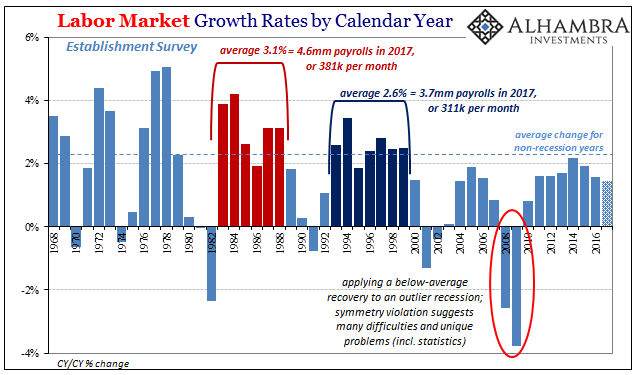
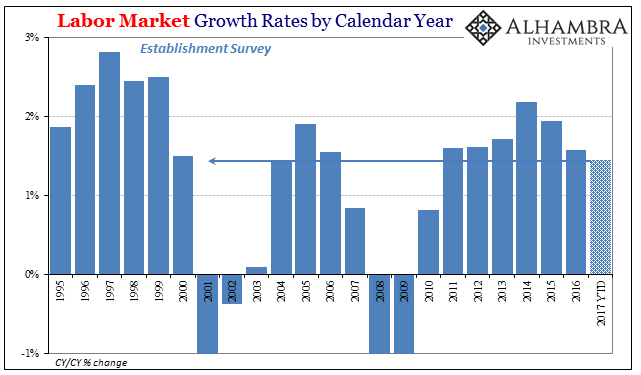
From 1993 through 1999, the labor market gained, on average, 2.6% per year according to the Establishment Survey. Since that time period is universally accepted as one featuring a strong economy, that is our standard for measurement. We can also go back to the eighties for what might amount to as an upper limit of sorts, the economy and labor market at that time being whatever is better than strong and robust – truly awesome.


Translating those average gains into the 2016 base equals an expectation of 3.7mm payrolls gained for 2017 to be as good as the nineties, and 4.6mm, which would signal a splendid economic year consistent with the eighties. Through 11 months so far up to November, the Establishment Survey gives us just 1.9mm for 2017. Assuming December turns out equal or better than November’s “good” number, the year should end with a total payroll expansion around 2.1mm, maybe 2.2mm.


That’s less than two-thirds of the way to the nineties, and significantly less than half of the eighties. This year, no matter how many months at 200k plus, has not been a good one. In fact, payroll gains in the eleven months so far tallied by the BLS’s Establishment Survey are less than those presented in that transitional year of 2000.


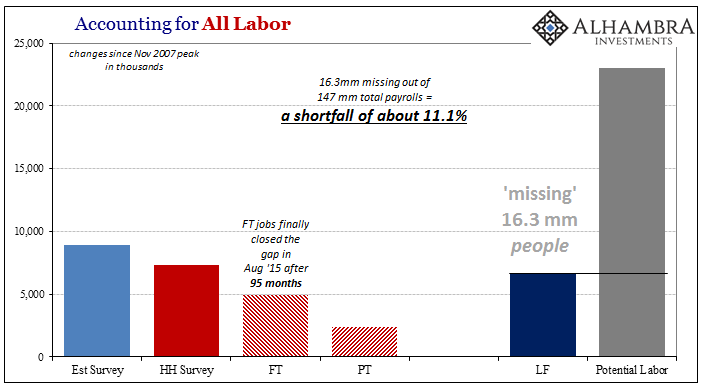
This is how you get the newest generation of American adults yearning in greater numbers for something vastly different, a radical political change if for no other reason than the establishment here continuing to say that everything is good when by every reasonable standard it isn’t even close! The “robust” labor market even of the past few years isn’t nearly enough to draw in those still sitting on the sidelines struggling, however, they do (parents’ basements) to just get along, leaving the economy instead it’s “missing” 16.3 million; a number that in a truly robust economy would be falling not rising.


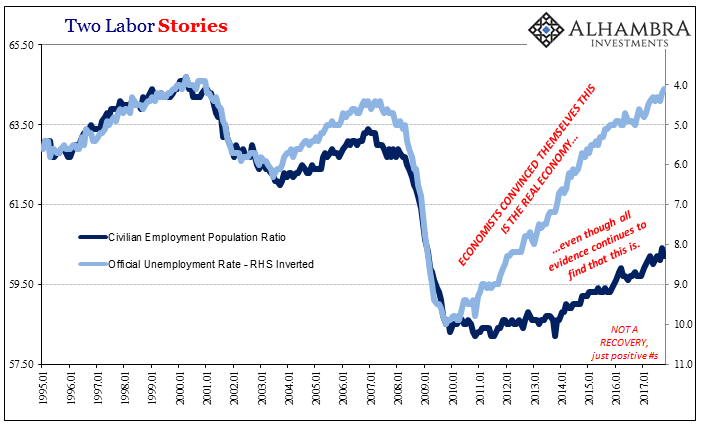
The issue clearly cannot be labor supply (Baby Boomer retirements, heroin, and fentanyl abuse in the Rust Belt) but shrunken labor demand; permanently shrunken economic demand. Therefore, there really should be no expectation for accuracy in the unemployment rate and what that means all around (inflation, baseline growth, monetary policy).


Once again in yet another month where the unemployment rate registers a ridiculous low, wages, and payroll earnings remain stuck at visibly low levels. The average weekly earnings of production and non-supervisory employees rose by just 2.6% year over year in November, after gaining 2.2% in October, 2.6% in September, and 2.7% in August. That’s nothing like in the past when the unemployment rate was where it is now. There is nothing like acceleration in earnings, not even solid growth.


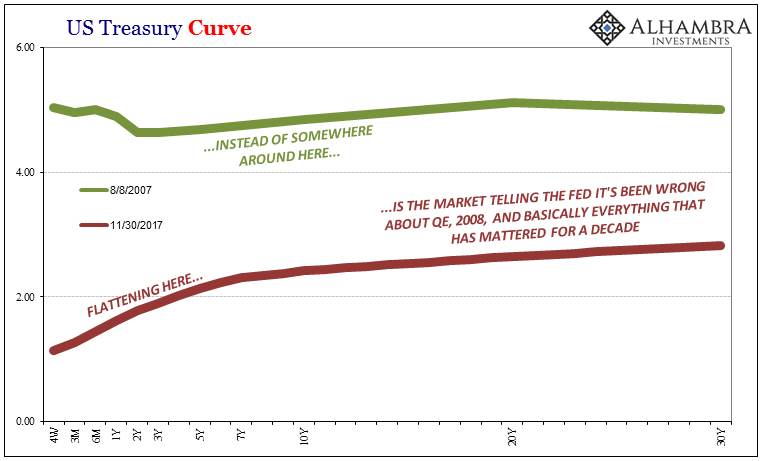
I don’t mean to make all this about the bond market every time (actually it’s appropriate), but the idea that treasuries at the long end have to be wrong has no basis other than misconception or intentional misdirection.


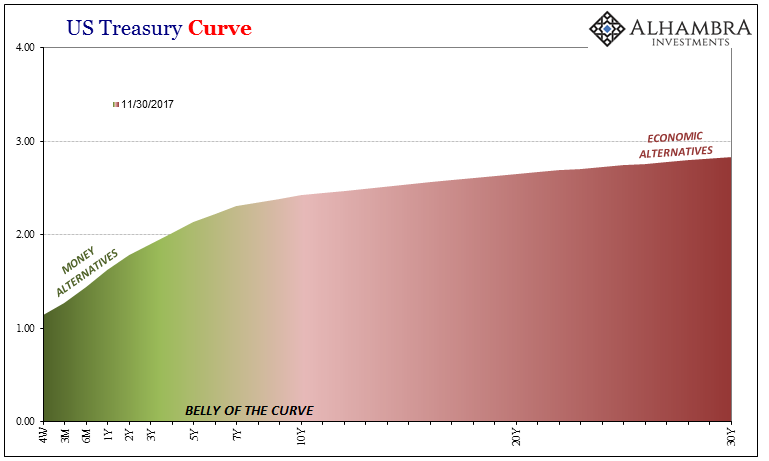
The data, including the BLS data, remains firmly on the side of flattening, and like the Establishment Survey’s paltry 1.9mm in 2017, it’s not even close.


Is Bitcoin Just A Brilliant Wealth Redistribution Scheme?

Authored by Valentin Schmid via The Epoch Times,


Many older, wealthy people are losing out, while younger risk takers are getting rich...


Normally, the concept of wealth redistribution involves government using force to take from some people and give to others. But the bitcoin revolution is redistributing wealth differently.


For the sake of simplicity, and to avoid confusion, we will talk about only the original bitcoin in this article and avoid the likes of cryptocurrency products such as ethereum and initial coin offerings, as well as recent duplicates of the original protocol.


On the one hand, at a price of $15,500 and a market capitalization of $277 billion at the time of writing, bitcoin has made many people rich. Most of the early bitcoin adopters who made the real money are young and entrepreneurial, and they have been put at a disadvantage by the status quo of the current financial system of fiat and bank money.


On the other hand, we have the representatives of the old money system, the Jamie Dimons and Joseph Stiglitzs of the world, who have made a fortune using the old system (Dimon) or gained prestige and recognition talking and writing about it (Stiglitz). At this moment, they are losing out. The value of their assets is getting crushed in bitcoin terms, and more people are becoming interested in the 8-year-old cryptocurrency.


People holding bitcoin become richer not only relative to U.S. dollars, or euros, or yen, but also relative to the stock market and gold.


The price of one share of JPMorgan stock was worth 0.084 bitcoin on Jan. 3, the first trading day of the year. On Dec. 1, it’s worth only 0.0096, a decline of 89 percent. We can calculate similar numbers for the S&P 500, the 10-year Treasury, and even bitcoin’s competitor for sound money, good old gold.


Bitcoin is often compared with penny stocks, but only the best can compete with bitcoin’s 1,500 percent price rise this year and with a valuation of $277 billion, bitcoin is pushing into the sphere of the heavyweights of finance. But that’s still a far cry from the $8 trillion valuation of global gold, the $20.5 trillion U.S. government debt market, or the $80 trillion of global stocks.


Sophisticated Wealth Redistribution


So what will happen if the price of bitcoin keeps going up, to $50,000, to $100,000, or even to $1 million, a value at which its market cap ($16.7 trillion) would be roughly equal to the combined balance sheets of the Fed, the European Central Bank, and the Bank of Japan (totaling $14.5 trillion)?


It’s not that the $15,500 you spend to buy one bitcoin now is sucked up by the bitcoin blockchain and disappears out of existence.


It is transferred to the person who sold you the bitcoin, and he or she can spend it on other assets or goods and services.


If the price of bitcoin keeps going higher, the relative value of it and other assets will change, similar to the example of JPMorgan stock, which became almost 90 percent cheaper in bitcoin terms this year.


Not only will the dollars in your pocket become worth less in the process (down 92 percent in bitcoin terms this year), but also any other asset that doesn’t keep pace with the rise of bitcoin will drop. People holding bitcoin become richer not only relative to U.S. dollars, or euros, or yen, but also relative to the stock market and gold.


And all this happens without a single government rule or regulation.


However, there are other mechanisms preventing people from getting into bitcoin and participating in the upside, although none of them includes the use of force.


Intellectual Hard Work


The first such barrier is how well you understand bitcoin.


In order to “buy into” bitcoin, you have to believe in the story. Bitcoin’s main value proposition is that it is digital sound money that is not centrally controlled by a government or private party, is censorship-resistant, and is outside of the banking system.


However, though the corruption of the hybrid system of fiat government money and private bank money has been thoroughly exposed, many people still do not perceive the status quo to be a problem, nor do they see the record risks baked into the booming stock market.


It takes another college course’s worth of research to understand the technology behind bitcoin and why, despite its risks, it could provide a new monetary solution and system for the digital age and digital economy.


So for them, bitcoin doesn’t solve a problem, and therefore they won’t have a reason to expose themselves to the gut-wrenching volatility as well as the technological risk still inherent to the system.


A similar argument applies to the status-quo elite, who have greatly benefited from the corrupt system and see bitcoin as a risk to that system. This group includes almost all government officials—especially central bankers—and politicians, as well as the private banking elite. They are incentivized to defend the old system at all costs, but would be smart to hedge their exposure. Some may be doing so in secret.


So these are the first intellectual hurdles to overcome: understanding that our current money system is severely flawed, and that to prosper and make progress, humanity needs an alternative.


To fully understand this, many people spend a few years researching history and economics away from mainstream educational propaganda.


The Gold Trap


Then, there is a second trap. As most of the history of sound money is rightly focused on gold and the gold standard period of the late 1900s, some people who understand the problems of the monetary system are too beholden to their golden beliefs to wrap their heads around bitcoin.


This group of people believes—and they may well be right—that gold will reset the debt-based financial system, as it has always done in history. They are also not participating in the bitcoin upside.


It takes another college course’s worth of research to understand the technology behind bitcoin and why, despite its risks, it could provide a new monetary solution and system for the digital age and digital economy.


It then requires a more nuanced and probability-based investment approach to see that while bitcoin is far riskier than gold and has some disadvantages compared to the yellow metal, it also provides far higher upside. The gold market is relatively expensive, at $8 trillion, while bitcoin is relatively cheap, at $277 billion. Bitcoin also has some striking advantages over gold, which warrant a rise in price.


Once you understand the value proposition and are ready to buy in, you need to jump through some hoops to register with an exchange and safely store your bitcoin, which is another hurdle many people who do not fully understand bitcoin cannot clear.


Winners and Losers


So, by and large, and of course with the usual exceptions and caveats, the old guard of both the political and financial systems and the old guard of sound-money people are not participating in the upside of bitcoin.


This is not because they don’t have any money to invest or because the government prohibits them from doing so. It is their own intellectual inflexibility, lack of curiosity, and risk-aversion that bars them from entry.


As bitcoin becomes ever more secure and ever more mainstream, more people from these groups will hop on the gravy train, but they will be able to afford fewer bitcoin with their assets than they would have now or five years ago.


As these people bid up the price to the stratosphere, the early movers will be richly rewarded and their purchasing power will increase relative to goods and services—and relative to the very assets the old guard now owns that were previously out of reach.


So who are the people who are gaining on the status quo with their crazy cyberpunk cryptocurrency?


They are the pioneers and innovators who built the bitcoin ecosystem and keep working tirelessly to make it more secure and ever more consumer friendly.


It is the former finance professional who learned about sound money on YouTube and spent months educating himself on how bitcoin works.


It is the software developer who first looked at the bitcoin protocol out of technological interest and then learned everything about money and monetary history.


It is the sophisticated investor who understands that a zero interest policy boosts his stock holdings in the short term but exposes them to massive downside when rates start rising again. He knows that diversifying his portfolio with assets outside of the banking system actually increases his risk-adjusted return. He does not think he needs to make an either-or choice between bitcoin and gold.


It is the prudent saver who understands that spending less on frivolous consumption is worth it when he can save in a currency with a sound monetary policy.


Of course, every technology and every sector in finance has its bad apples, scammers, and speculators who have no idea about the underlying value proposition. Bitcoin does, too, but they don’t seem to go beyond the scope and proportion we have seen in banking and government.


In spite of this usual caveat, bitcoin favors risk takers, innovators, savers, and people who are curious and persistent enough to learn new technology as well as history. It favors the little people who are willing to take some risks, over the old elite fighting to maintain their privilege. By rewarding these positive qualities, the voluntary bitcoin wealth redistribution creates a positive incentive cycle, much different than the old model based on bureaucratic force.


The Zealous Pursuit Of State-Sponsored Collapse

Authored by EconomicPrism"s MN Gordon via Acting-Man.com,


When Bakers Go Fishing


Government intervention into a nation’s economy is as foolish as attempting to control the sun’s rise and fall by law or force.  But that doesn’t mean governments don’t meddle each and every day with the best – and worst – of intentions.  The United States government is no exception.


From the “When the government helps the economy” collection: Breaking a few eggs while baking the bridge to nowhere omelet. [PT]


Over the years, layers and layers of interference by various federal, state, and local agencies have built up like grime on a kitchen window.  The grease shines and smells of something fierce.  The layers of government grime also drip and ooze into every crack and crevice of the economy.


These days, for example, it is impossible to carry out a simple private transaction with your barber or barista without some form of government interference.  Has your barber obtained the required license and paid the obligatory fees to be able to legally taper your neck line?  Has your barista’s espresso bean grinder passed city health inspection?


Is the hot Cup of Joe served in a paper cup of appropriate recycled material composition?  Did the hot beverage exceed the legally accepted temperature standard?  Did state and local governments receive their tax exaction upon payment?


The licensing racket – left panel: the basic definition of the racket; middle panel: how long it takes and what it costs to obtain licenses for assorted jobs in the US; right panel: the inexorable growth of rules and regulations. One shouldn’t be surprised that the pace of real economic growth has steadily declined since peaking in the late 19th century (or if one wants to focus on the modern era, since it peaked not too long after WW2). From money supply inflation to regulatory inflation, Leviathan has undermined the economy at every turn by inflating all the stuff we definitely don’t need more of. The pretense is that this is needed to “protect” us (for instance, last year the police courageously protected the citizens of Georgia from the dangers of an unlicensed lemonade stand by arresting its 14-year old female proprietor). Let us be clear: No-one will be allowed to terrorize the community by running an unlicensed lemonade stand or engaging in the high crimes of dispensing unlicensed manicures and haircuts. [PT] – click to enlarge.


When it comes to more complicated matters, where real money’s on the line, government interference is an absolute disgrace.  Did you know that it costs 10 times more to have an appendectomy in the United States than in Mexico?  Is the procedure 10 times better?


Obviously, this is nothing new.  Governments have been regulating and impressing their fingerprints all over commerce since society first granted its leaders the opportunity.  People are so accustomed to it that they accept government intervention as necessary to better their lives.


When it comes to price fixing, wage controls, and dictating oil production, things quickly go haywire.  This is because prices, wages, and resources have their own independent relationships beyond what can be legislated.


When the price of a certain good or commodity is artificially fixed below its natural equilibrium, scarcity and shortages follow.  In short, when the price of bread is decreed below the cost of the wheat that goes into it, bakers go fishing.


The scourge of occupational licensing [PT]


Credit Market Intervention


Perhaps the most nefarious of all government intervention, is that which directly affects a nation’s money stock.  Many people don’t recognize its occurrence.  But they do misdiagnose its effects.


Wage stagnation, for instance, is often blamed on greedy executives off-shoring their production.  In reality, this is merely a consequence of a forced monetary regime that inhibits genuine capital formation and earned savings in favor of asset price inflation. Of course, only a complete killjoy would bother scratching below the surface to uncover such minutiae.


Without question, the last decade has brought forth some of the craziest monetary policy experiments in human history.  If you recall, the Federal Reserve dropped the federal funds rate to near zero in December 2008, and kept it there until December 2015 – exactly seven years.


Since then, the Fed has hiked the federal funds rate four times – 0.25 percent each time – bringing the federal funds rate up to 1.25 percent. The Federal Open Market Committee (FOMC) meets on December 12 and 13, and will likely raise the federal funds rate another 0.25 percent.


It is also anticipated that the Fed will raise rates three times in 2018, assuming financial markets and the economy don’t break down before they can accomplish this.


Broad true money supply TMS-2 and the federal funds rate – a mountain of money was created, and it is an apodictic certainty that is has not made us one iota more prosperous – quite the contrary. [PT] – click to enlarge.


Concurrent with the Fed’s interest rate raising efforts, they’ve also begun to reduce their balance sheet.  They’re selling some of the roughly $3.6 trillion in Treasury and mortgage-backed securities purchased as part of their Quantitative Easing program. This reversal of the Federal Reserve’s Quantitative Easing program reduces the pool of available credit in the financial system.


It doesn’t take much imagination to visualize the effect this will have on an economy and financial markets that are wholly addicted to cheap and abundant credit.  So where does the GOP’s tax bill fall within this landscape?


The Zealous Pursuit of State-Sponsored Collapse


Here we turn to David Stockman, former Director of the Office of Management and Budget under President Reagan.  Stockman’s more than four decades of in-the-trenches experience, study, and contemplation of taxes, budgets, and deficits, and how these all influence and affect the economy, is unrivaled. As he explains:


“All tax cuts are not created equal.  Their impact for good or ill depends on: (1) which taxes are cut; (2) how the revenue loss is financed; (3) when they occur in the business cycle; and (4) how they impact that nation’s underlying fiscal posture.


“Our point today is that the GOP gets an “F” on all four components of the test.  That’s because a deficit-financed tax cut is never a good idea, but is especially counter-productive if done late in the business cycle in the face of a structural deficit that is high and rising (owing to inexorable demographic pressures on entitlement spending); and in the teeth of an unprecedented cycle of monetary contraction, which is exactly what the Fed’s interest rate normalization and balance sheet shrinkage (QT or quantitative tightening) amounts to.”


David Stockman, former budget director in the Reagan administration – which he quit when it ignored his admonishments on its massive spending. [PT]


To clarify, if you’ve been out of school for a while, “F” stands for fail.  Most notably, financing tax cuts with money borrowed from the future is doomed to fail.  Hence, the great GOP tax cuts represent but another fail milestone in the zealous pursuit of state-sponsored collapse.


As an aside, since last week, when we declared buying bitcoin above $11,000 to be an action for idiots, bitcoin has spiked up above $19,000.  That represents more than a 70 percent increase in just one week.  Nonetheless, we stand behind our claim.  We also stand behind our claim that sometimes idiots get rich – click to enlarge.


We should point out that the spike to $19,000+ in BTC was confined to the Coinbase exchange, where a huge premium developed during the trading day. It was not replicated at any of the other exchanges, where BTC peaked just below $16,000. This is mainly a sign of inefficiencies at said exchange (BTC routinely trades at a premium there, but it is usually much smaller). It took a while for arbitrageurs to bring the premium back down, but they succeeded eventually. [PT]


Friday, December 8, 2017

Mugabe Out, Mnangagwa In, Inflation Down - Current Annual Rate 32%

Authored by Steve H. Hanke of the Johns Hopkins University. Follow him on Twitter @Steve_Hanke.


Robert Mugabe’s 27-year reign of lawlessness, corruption, and incompetence came to an end late November 2017, after a “soft coup” engineered by Emmerson Mnangagwa (aka “the Crocodile”) successfully unseated the aged dictator. Since then, inflation expectations in Zimbabwe have fallen sharply. In consequence, inflation has fallen like a stone. Indeed, before Mugabe’s resignation, Zimbabwe’s implied annual inflation soared to peak rate of 356% (10/26/17). But, following Mnangagwa’s assumption of power, the implied annual inflation rate has fallen to today’s rate of 32%.  


In 2008, Zimbabwe suffered the second most severe episode of hyperinflation in recorded history. The annual inflation rate peaked in November 2008, reaching 89.7 sextillion (10^23) percent (see table below).


At the peak of Zimbabwe’s hyperinflation episode in November 2008, Zimbabweans refused to use the Zimbabwe dollar. With that, the economy was spontaneously, and unofficially, dollarized. Eventually, the government faced this fait accompli in early 2009, when they dollarized the economy by accepting the dollar as the unit of account for government finances.


This year, Zimbabwe once again experienced a bout of hyperinflation, not due to dollarization, but because the Zimbabwean government is issuing, in effect, a new currency that is circulating parallel to the U.S. dollar. Currently (12/8/17), the annual inflation rate is at 32% (see chart below).


During Zimbabwe’s hyperinflation episode from 2007-2008, the Reserve Bank of Zimbabwe failed to report an accurate measure of inflation rates. When episodes of hyperinflation occur, the only feasible and reliable way to measure the inflation rate is via the application of Purchasing Power Parity (PPP). To do so, data on the exchange rate between the domestic currency and a stable international currency are required. This was not feasible in Zimbabwe. The Zimbabwe dollar was not traded on an organized exchange that reported exchange rates, and the use of black-market exchange rates was not feasible either.


However, the organized stock market in Harare did provide prices that allowed for the calculation of implied Zimbabwe dollar exchange rates. One stock, Old Mutual, was, and still is, listed on both the London Stock Exchange and the Zimbabwe Stock Exchange. Each share of Old Mutual commands the same claim on the company’s earnings and assets, irrespective of the market it is traded on. Therefore, given arbitrage and PPP, the ratio of the Old Mutual share price in Harare to that in London equaled the Zimbabwe dollar/sterling exchange rate.


To convert the resulting Zimbabwe dollar/sterling exchange rate to a Zimbabwe dollar/U.S. dollar rate, I multiplied the Zimbabwe dollar/sterling rate by the sterling/U.S. dollar rate, creating what is known as the Old Mutual Implied Rate (OMIR). By using the OMIR as an exchange rate between Zimbabwe dollars and USD, PPP was then applied as the final link necessary for calculating inflation rates.


When President Robert Mugabe’s party, ZANU-PF, regained control in Zimbabwe in 2013, government spending and public debt surged, resulting in economic instability. To finance its deficits, the government created a “New Zim dollar.” The New Zim dollar is issued at par to the U.S. dollar, but trades at a significant discount to the U.S. dollar. As a result of the issuance of the New Zim dollar, the money supply has exploded in Zimbabwe, and so has inflation.


Employing the same theory and method of measurement that was used to calculate Zimbabwe’s 2007-2008 hyperinflation episode, I was once again able to measure an accurate inflation rate, explained here in a detailed study. After doing so, I found that Zimbabwe experienced hyperinflation for the second time in less than ten years between September 2017 and early November 2017. 


Hyperinflation occurs when the monthly inflation rate reaches 50% per month and remains above that rate for at least 30 consecutive days. This initial threshold was breached on September 14, 2017, and the monthly inflation rate stayed above this rate until November 2, 2017. Currently, the monthly rate of inflation is -68% (see chart below).


In Defense Of Bitcoin Hoarding

Authored by Jeffrey Tucker via The Foundation of Economic Education,


In Internet slang, they are called the HODLers, the people who are clinging to their Bitcoin and refusing to spend it. Instead, they just refresh their wallet apps, feeling richer by day while deferring consumption. Many of these burgeoning millionaires live like paupers. I’ve met many of them: all over the U.S., in Israel, in Brazil. They believe that every dollar they spend today is two dollars they won’t make in a few months. Probably they are right.


Bitcoin is undergoing a historic deflation, which simply means that its value is growing relative to the goods and services it can purchase.


This is in contrast to inflation, in which the value of the currency falls relative to its purchasing power. Inflation inspires spending – better to get rid of the money while it is more valuable. Deflation inspires saving – better to keep it so that your wealth rises over time.


So there is nothing selfish, strange, or weird about holding an asset that is rising in value. It would be irrational to do otherwise. And there is nothing odd about spending like mad in an inflation either. Our expectations of the future determine what we do today in every life and especially in monetary economics.


Some Money! 


This tendency to hold rather than spend is giving rise to a new claim. Bitcoin isn’t really a viable medium exchange, they say. You can’t buy a sandwich with it. Few people are paid in it. Adoption in the retail sector is slow. The total market capitalization is $219 billion and yet the trade volume nowhere near reflects that.


And it is true that most of the big money people are just holding it. James Mackintosh, writing in the Wall Street Journal, summarizes the conclusion: “It has become a vehicle for hoarding by libertarians for gambling by hordes of speculators attracted to its wild price swings.”


I’m looking now at the total market capitalization of the entire sector of cryptoassets: it approaches $400 billion. That is larger than the market cap of JP Morgan, by the way. That valuation is in private hands, growing in value at incredible rates. It’s risen 1,000% in 2017, and many people are predicting much higher growth in 2018.


The Implications


Under old-style Keynesian theory, economic growth is driven by consumer spending, not saving, so anyone who is hoarding money under the mattress is holding back progress. Hoarders are the enemy. “Every such attempt to save more by reducing consumption will so affect incomes,” wrote J.M Keynes, “that the attempt necessarily defeats itself.” He popularized what became known as the “Paradox of Thrift.”


It’s supposed to be counterintuitive. You think that saving up for the future is a good thing. Whoops, you are hurting others and, in the long run, hurting yourself. You should be spending, even going into debt to spend.


But sometimes “counterintuitive” is just wrong. That is the case here. There is no paradox. The intuition is right. Thrift is a good thing, on the individual level or for the whole society. Deferring consumption is the necessary precondition to permit saving. Saving is never wasteful. It’s true that infinite saving is pointless but that’s not how this works.


You are always saving for something. The end of saving is eventual consumption in some form. More importantly for economic growth, saving is the precondition for investment. Investment is what extends the complexity of the structure of production. This leads to employment, expansion of the division of labor, and the eventual rise of wealth.


 Consider the classic case of Crusoe on the island. Every day he is out catching fish to eat. He doesn’t have time to weave a net because he is always fishing with a pole. But at some point, he realizes that he could catch more with a net. In order to gain time, he has to stop fishing. So he saves up a few days of fish so he can eat without fishing, during which time he weaves a net. That net allows him to multiply his catch by 10 times. The deferring of today’s consumption for great overall wealth later is what makes progress possible.


The Policy of Pillage


Once the wrong (Keynesian) theory took hold in the 1930s, it became national policy to incentivize consumption over spending. Gold was confiscated from people. Government spending, it was believed, would goose the economy to make up for the ability or willingness of people to spend. The gold standard itself was destroyed in order to build a monetary system that could be inflationary – so that the money would be worth less in the future than it is today, thereby motivating the desire to spend.


This whole policy became a disaster for economic growth. After World War II, the US underwent a huge expansion as a result of the hoarding that occurred throughout the Depression and the War, and this was despite (and not because of) federal policy.


After the initial boost in economic growth, the Federal Reserve began its inflationary path. The personal savings rate peaked at 15% but then savers were blindsided by a wicked hyperinflation that hit in the late seventies, pillaging the savings that had been built up for the last two decades. No surprise: personal saving fell and fell, incomes flattened, and economic growth became ever more of an uphill climb. In our own times, inflation has been fixed but now we deal with near-zero interest rates, which harms saving as well.


As you can see in the chart, the economic crisis of 2008 traumatized a generation to the point that people began to save at much greater rates. No more would be trust the system to take care of them. It was exactly at this point that Bitcoin came into being, and created something that is really the opposite of the dollar: a currency designed to rise in value over time.


Many of the metaphors surrounding Bitcoin were drawn from the old-world gold standard. We speak of mining, for example, and proof of work (think of miners wearing jeans, panning gold from stream or banging picks into mountains). As with gold, there is a limit on the amount that can be created. And there are multiple levels of standards to determine authenticity and truth in accounting. In some ways, Bitcoin was invented to be the ultimate anti-Keynesian monetary praxis.


Up with Thrift


Now we see the results. Bitcoiners are HODLers. They save. They hoard. They have turned against consumption in favor of saving. I see it myself all around me. Young people who are invested in Bitcoin turn down luxury consumption. They don’t own cars. They bike and walk. They don’t spend big on dinners. They live off cheap groceries. They know that everything they consume today eats into their capacity for consumption, investment, and building wealth for the future.


So much for the Paradox of Thrift. Bitcoin is about the Virtue of Thrift. The pundits can decry it all day. Bitcoin doesn’t care. What’s more, you don’t need economic theory to understand this. You only have to follow the money.


If you ever despair of the future, just consider how much capital is currently being built up in the crypto sector. There will come a time, maybe in five to 15 years, when all this deferred consumption is going to be unleashed on the world economy in the form of real capital to build wealth and prosperity. And consider too: this is not about one economy, not about one nation. It’s about the whole world, capital and prosperity without borders.


The pundits can fulminate all they want. Technology doesn’t care.


Thursday, December 7, 2017

Worhsipping At The Altar Of FOMO

Authored by Sven Henrich via NorthmanTrader.com,


Retail investors are worshipping at the altar of FOMO (fear of missing out). It may prove to be a painful experience.


Never before has retail gotten this aggressively exposed to stocks.


Just in time when central banks and buybacks are pulling back. I talked a bit about this in the recent The Carrot Top, but I want to expand a bit on this to issue a general warning for retail: The boat is fully loaded in one direction. Be aware.


Wall Street will not warn retail, they’ll keep pushing the envelope until the very bitter end. It’s actually quite easy to be a bull. Keep raising targets, always be optimistic, and when something breaks shrug your shoulders and say: Hey what are you gonna do? Stuff happens. The Fed will come to the rescue.


And the cycle begins anew.


You know the drill:


Remember the primary job of Wall Street is to get retail to invest, and to be fair, they are doing a fabulous job.


And so every December we see the same annual ritual. Here’s the message sent to retail, we can only go higher. $SPX targets for 2018:


Here’s a visual from BAML:


The primary argument: Wall Street is not yet euphoric:


Really? What’s this:


Not euphoric? Let’s dig in a bit deeper into the data.


You may have seen my Rydex chart indicating record bullish allocations in The Carrot Top:


Last night Jesse Felder sent me some more data points confirming the same:


More data:


The American Association of Individual Investors’ asset-allocation poll shows members’ exposure to stocks are as heavy as it was near the 2000 peak. Cash allocations fell 1.2 percentage points to 13.9%. Cash allocations were last lower in December 1999 (12.0%).


Also:


TD Ameritrade’s Investor Movement Index of retail activity “saw its largest single-month increase ever in November, increasing over 15% to hit an all-time high of 8.53. TD Ameritrade clients were net buyers for the tenth consecutive month.”


Combine it with sentiment:


Via Reuters:


“52 percent said they believed the stock market could sustain continued growth for five years without a downturn of 10 percent or more.”


Confident much?


It’s actually the perfectly logical conclusion of what central bank interventions have wrought:


The BOJ balance sheet is now at 121% of GDP the ECB’s at 41% of GDP.


The result of course is we haven’t corrected at all. We are now in the longest market period without even a 5% correction. Ever:


We haven’t had a single down month in 2017 which historically has never happened either:


And the rush into long equity funds has been unprecedented:


Get us into stocks. We can’t go down, we can only go up. FOMO.


So when I say central banks have created a monster I really mean it.


And so it’s no surprise that central bank policy is viewed by some as the greatest risk to asset prices in 2018:


Mohammed El-Erian:


“The biggest risk to asset prices and the global economy would be if the biggest institutions reduce their monetary stimulus at the same time. Rather than reflecting the prospects of individual institutions, the greatest monetary policy uncertainty facing the global economy is what would happen if all these central banks, along with the People’s Bank of China, were to decide to reduce their monetary stimulus at the same time. When it comes to central banks, this is the biggest source of risk to asset prices and the global economy, and it would call for high-frequency policy monitoring and close international consultations.”


Asset prices are a central bank planned construct that has resulted in retail being completely long and fully exposed to equities.


And I have not even addressed the trillions of dollars exposure all being long short $VIX products:


BAML has a phrase for this: “Yield starvation forces selling volatility for yield”. “Forces” being the operative word:


Note the center piece: “Unprecedented central bank policy & low growth recovery”.


By the way I’m not picking on BAML here, not at all.


But I’m highlighting that 2017 has seen an unprecedented rush by retail into the most highly valued stock market since 1900 according to Goldman, a market that remains entirely uncorrected.


But nobody is issuing any risk warnings here. Keep going long my friends we can only go higher and if there’s a dip buy it. And no doubt this strategy has worked.


My perspective remains a variant one: This singularly oriented market construct is at extreme high risk that some trigger will pop all of this.


In a world where nothing has mattered and corrections have disappeared altogether it may be a fair question to ask what such a trigger may be. I’ll leave that for a future post, but I will say this: Triggers are often the excuse to assign cause after the fact. But it is the construct itself that seeds the depth of the ultimate unwind.


Worshippers at the altar of FOMO have come accustomed to no dip ever lasting. Will they find themselves slow to react when one does?