Showing posts with label KIM. Show all posts

Thursday, December 28, 2017

North Korean Defectors Show Signs Of Radiation Exposure

South Korean scientists and doctors who have been examining North Korean defectors have stumbled upon yet another horrifying discovery: At least four of the defectors have shown signs of radiation exposure, the South Korean government said on Wednesday - although researchers could not confirm if the radiation was related to Pyongyang’s nuclear weapons program.


Earlier today, we noted that one of the defectors had also tested positive for Anthrax antibodies, suggesting that North Korean leader Kim Jong Un has continued his chemical weapons program despite signing an international chemical weapons treaty. Of course, the North Korean government has denied that chemical weapons are being used.


All four men are former residents of Kilju county, an area in North Korea that includes the nuclear test site Punggye-ri. According to Reuters, they were likely exposed to radiation between May 2009 and January 2013. All of the men defected to the South before the most recent test, according to a researcher at the Korea Atomic Energy Research Institute.


The researcher cautioned that people can be exposed to radiation in many ways, and that none of the defectors who had lived in Punggye-ri itself showed specific symptoms.


Fears that North Korea could unintentionally trigger a nuclear disaster via its nuclear tests have escalated since the North’s Sept. 3 nuclear test, prompting China to increase monitoring of radioactive activity along its border with its restive neighbor. Seismic activity detected in the aftermath of the test suggests the test site is suffering from "Tired Mountain Syndrome" – a condition detected at former Soviet nuclear testing sites. The destabilizing impact of the tests was made evident when a tunnel at Punggye-ri collapsed, killing 200 North Korean workers.


Still, the North has pushed ahead with building new tunnels at the test site, suggesting that – instead of abandoning Punggye-ri altogether, as their Chinese peers have advised, they intend to move the tests to a different part of the mountain.


Ultimately, scientists worry that the mountain could implode, releasing a plume of toxic radioactive dust into the atmosphere that could wreak untold havoc on the health of people across the region.


Tuesday, December 26, 2017

Balloons & Flash Drives: How A Private Organization Is Trying To Incite Rebellion In North Korea

Authored by Anders Hagstrom via The Daily Caller,


The U.S.-based Human Rights Foundation (HSF) has worked with North Korean defectors to smuggle flash drives and other tools into their dictatorial homeland to counter the regime’s propaganda throughout 2017.


HSF director Alex Gladstein claims that his organization has successfully smuggled up to 10,000 flash drives into the country containing documentaries countering state narratives, according to The Telegraph.


The organization also uses massive hydrogen balloons plastered with news bulletins to float across the border into North Korea in hopes that citizens will realize their true situation and bring the country down from within.


“This is to liberate minds,” Gladstein told the paper.


“We’re creating little windows to the outside world so that the North Korean people can make decisions for themselves about what they want to do with their lives.”


HSF’s “Flash Drives for Freedom” campaign sees volunteers go to great risk smuggling USB sticks through black markets on the China-North Korea border. The majority of North Koreans have devices that can read the flash drives, and since the program began, HSF has smuggled in 2 million hours of footage and 48 million hours of reading material, reaching an estimated 1.1 million North Koreans. According to HSF’s website, the flash drives contain ebooks as well as an offline version of Korean wikipedia.


HSF began the program in 2013 by simply filling hydrogen balloons with DVDs and leaflets and floating them across the border. High level North Korean defectors have said that causing the general population to question their living conditions is one of the most effective ways to attack Kim Jong Un’s regime.


“Given the history of Eastern Europe, I hope that people can think about the potential of information rather than reckless conflict and provocation and totally failed diplomacy,” Gladstein said.


“There is nothing the government can do with information, they can’t manipulate it. It’s a very powerful thing.”


Thae Yong-ho, who was once second in command at North Korea’s U.K. embassy before defecting in 2016, calls the general population of North Korea Un’s “Achilles heel.”


“We cannot change the policy of terror of the Kim Jong-un regime,” he said. “But we can educate the North Korean population to stand up by disseminating outside information.”


Russia"s Military Is Leaner, But Meaner

Authore by Leonid Brershidky via Bloomberg.com,


During Russian President Vladimir Putin"s annual press conference on Thursday, a friendly journalist asked Putin whether the escalating tension in relations with the U.S. and the crumbling of arms control treaties would draw Russia into an unsustainable arms race. "We will ensure our security without engaging in an arms race," the president replied, citing widely diverging dollar numbers for the U.S. and Russian defense budgets. 


That"s a simplistic answer from a politician starting an election campaign (of sorts: Putin is headed for re-election in March without giving anyone else a chance). The more pointed question that should be asked is this: How, with a relatively small and decreasing military budget -- 2.77 trillion rubles ($42.3 billion) for 2018, down from some 3.05 trillion rubles this year -- is Russia is still a formidable military rival to the U.S., with its enormous and increasing budget of almost $692.1 billion in 2018, up from $583 billion this year? 


The equalizing value of the two countries" well-balanced nuclear deterrents is enough of a reason to avoid direct confrontation. But leaving that aside, Putin may well understand the nature of modern military challenges better than U.S. President Donald Trump and U.S. legislators -- and Russia"s authoritarian system may be more efficient when it comes to military allocations. Note that Russia is now almost an equal to the U.S. as a power broker in the Middle East, where the Russian military has just helped Syrian President Bashar Al-Assad effectively win a civil war -- in which the U.S. was helping the other side. At the same time, Russian defense spending numbers are deceptive. The country is far more militarized than its defense spending suggests. That level of security spending is only sustainable at the expense of Russia"s future.


Trump"s military spending hike, which makes it necessary to remove the existing cap on defense expenditure, is a dubious and likely outdated response to decreased global security.


Quite aside from the cost of maintaining the world"s most powerful military, the U.S., according to the Washington think tank Center for Strategic and International Studies, has spent at least $2 trillion on its wars since 2001. But, considering the less transparent costs, such as those of caring for veterans, war-related increases to the Department of Defense base budget and interest on the debt taken on to cover defense spending, it"s closer to $4 trillion at the very least. The Afghan conflict has cost the U.S. at least $840 billion -- more than four times Afghanistan"s cumulative GDP since 2001. Since the 2018 U.S. defense budget contains additional funds for sending 3,500 more troops to Afghanistan, the results of the massive outlay over the years are clearly suboptimal.


Today"s wars aren"t fought with fat wads of money. The adversaries are mostly small, agile forces that aren"t as well-resourced as nation states. Fighting them requires a combination of local knowledge, brute force applied only at important points in a conflict and ability to shift risks onto the shoulders of irregular fighters. Russia kept cutting its defense budget all through its participation in the Syrian war. Yabloko, an opposition party, earlier this year put the cost of the Syrian operation for Russia at about 140.4 billion rubles ($2.4 billion at the current exchange rate) since September, 2015; that"s some 4 percent of what the U.S. allocated to overseas contingency operations in 2017 alone -- and the outcome is as good as Russia could have expected.


The U.S. is pumping money into comparatively inefficient warfighting -- and into preparing for the kind of large-scale war that"s not likely to take place because of existing nuclear arsenals and unauthorized nuclear proliferation. Even North Korea, with its unknown but probably small nuclear capability, is dangerous enough to deter the U.S. from attacking. At his press conference, Putin made the point that the U.S. couldn"t know for sure where to strike in North Korea -- and if the Kim regime managed to get a single long-range, nuclear-armed missile in the air, the results could be catastrophic.


U.S. defense budgets, of course, feed a large, powerful domestic industry; even the indirect U.S. involvement in a conflict lifts the stock prices of major defense contractors, research has shown. In Russia, the biggest contractors are state-controlled; they have far less lobbying clout, and the technocratic Russian government has kept them on a short leash, though some of the military"s purchasing decisions have served regional development rather than defense purposes. Such an arrangement, which would have been inefficient in most other industries, probably reduces wasteful spending in the budget-dependent military-industrial complex.


That said, in relative terms, Russia is spending more on force-related functions than the U.S. does. Trump"s budget proposal allocated $71.8 billion to the Department of Homeland Security and the Justice Department. Add that up with the defense spending, and the total security budget will stand at $764 billion, less than 19 percent of total federal spending. Russia will spend a combined 29 percent of its federal budget -- some 4.8 trillion rubles -- on defense and domestic security. That"s probably not all of the security-related outlay either, as Mark Galeotti pointed out earlier this year: Even some of the education and development spending in Russia goes toward military goals.


In the U.S., federal law enforcement outlay is a fraction of defense spending. In Russia, the two areas of government expenditure are almost equal. That"s the difference between a country with a relatively liberal domestic order and a near-dictatorship, which relies heavily on the suppression of dissent and must keep large law enforcement agencies under centralized control.


Russia could show the world how to spend efficiently on more than adequate defense -- but instead it is engaged in an arms race against its own development. For years, it has been underfunding areas such as education and health, undermining what Putin told the press conference was his vision of the country"s future -- flexible, technology-driven, highly productive. Judging by Putin"s answers to reporters on Thursday, he still prefers not to notice that.


Monday, December 25, 2017

Ben Garrison"s 12 Days Of Trumpmas

Authored by Ben Garrison via GrrrrGraphics.com,


‘Twas the night before Christmas, and in the White House
Trump’s words were stirring; Obama felt like a mouse.


A populist president with a broom that swept clean,
Trump accomplished much in 2017.


Yet out past the lawn there arose such a clatter,
Pussy Hatters were yelling along with Black Lives Matter.


The Deep State pushed back—the Swamp became bitter,
They always get triggered when Trump is on Twitter.


Fake News Media compared Trump with Nixon,
“Impeach him!” said Maddow, Mika and Wolf Blitzen.


Rich kneelers were kneeling and sitting on hands,
Stadiums were emptied, they angered their fans.


Rocket Man’s missiles were threatening Seoul,
Kim Jong-Un’s stocking was soon stuffed with coal.


Respect, fame and fortune many women were hoping,
Instead they were molested–the gropers were groping!


Crooked Hillary lied about Trump’s Russian collusion,
The evidence showed it was just an illusion.


The Ass Clowns were angry and showing no poise,
They were loud and obnoxious–empty barrels of noise.


Trump’s eyes twinkled with MAGA delight. He yelled,
“MERRY CHRISTMAS TO ALL, AND TO ALL A GOOD NIGHT!”


–Merry Christmas from Ben and Tina Garrison


Friday, December 22, 2017

Retired Green Beret Rages "We Are Long Past The Tipping Point"

Authored by Jeremiah Johnson (nom de plume of a retired Green Beret of the United States Army Special Forces) via SHTFplan.com,


So, let’s cite a few passages from President Trump’s National Security Speech:


“Throughout our history, the American people have always been the true source of American greatness. Our people have promoted our culture and promoted our values. Americans have fought and sacrificed on the battlefields all over the world. We have liberated captive nations, transformed former enemies into the best of friends, and lifted entire regions of the planet from poverty to prosperity. Because of our people, America has been among the greatest forces for peace and justice in the history of the world. The American people are generous. You are determined, you are brave, you are strong, and you are wise.”


Determined, brave, strong, and wise. Certainly, the President wasn’t referring to most of the population? Maybe he was in Wal-Mart, looking at these determined, brave, strong, and wise citizens:


walmart-shopper


walmart-shoppers


But the generosity? Here is the “generosity” in a nutshell, for those can see it for what it is, just after that section:


“Fourth and finally, our strategy is to advance American influence in the world, but this begins with building up our wealth and power at home. America will lead again. We do not seek to impose our way of life on anyone, but we will champion the values without apology. We want strong alliances and partnerships based on cooperation and reciprocity. We will make new partnerships with those who share our goals, and make common interests into a common cause.”


Here’s some more generosity, of the “Black Friday” type…with the determined, brave, strong, and wise, once more:


shoppers


Yes, it sounds very similar to the imperial hubris we have heard parroted for the past half a century and more.  Look at this oxymoronic sentence:


“We will not allow inflexible ideology to become an obsolete and obstacle to peace.”


Not allow inflexible ideology? And if our government is the unbiased “factor” to determine what ideology is inflexible, perhaps it should examine itself, first, as we are the ones not to compromise. Just the statement “we will not allow inflexible ideology,” is an inflexible statement; ergo, perhaps the government should fold.


We are at a very important juncture right now. The President made this speech to galvanize public opinion and support with ratings at about 60% disapproval. There is no clearly defined (let alone productive) foreign policy, with gross inconsistencies throughout this first year of the President’s term. Praising Russia for cooperation and sharing of intelligence to thwart a terrorist attack, just months after we expelled all Russian diplomats from the Russian embassy in California, as well as forcing them to vacate properties…in under a week.


Granted, all embassies (American and foreign nations) are full of spies, however, such a forced eviction has not improved relations with the Russians. The North Korean situation takes center stage:  as mentioned before, North Korea only has two options. They can either relinquish their nuclear weapons and submit to western hegemony as another IMF and World Bank vassal, or they can continue in their present course.


The punch line: they possess nuclear missiles with the capabilities of delivering an EMP (Electromagnetic Pulse) attack, or a nuclear strike against American cities. The President of the United States just stated (as printed above) “America will lead again.” What better leadership example than to do a 180-degree turn, and try…make the attempt…to extend full diplomatic courtesy to North Korean leader Kim Jong Un? What better strategy than to roll out the red carpet, and treat him with the courtesy of a leader of another nation…one with nuclear missiles…and show yourself to extend the hand of diplomacy?


The President owes that much: owes a legitimate attempt to help to protect the 320 million people of this country, who do not have a Mt. Weather or a Cheyenne Mountain to retreat to. He owes it to 320 million American people who are in the crossfire. And if Un is unresponsive? Then the attempt was made. Lead by example and take the first step, for the welfare of the millions…ours, and yes, theirs.


Any who may be smirking will lose such skepticism if the city their family lives in suddenly becomes a dust cloud spiraling into the upper stratosphere.


There was much the President said that was worthwhile, but he said most of it in the present tense…as if we are “there” already, and not that we have a long way to go. To credit him, the Obama years almost destroyed this country. We are now as the hollowed-out exoskeleton of a cicada…clinging to the Tree of Liberty, but emptied, with barely a pulse.


Determined, brave, strong, and wise? The teleprompter told him that: he certainly wasn’t looking out of the window and viewing actual people. Our people have promoted our culture and our values? And just what would those be?  Reality T.V. shows and professional football players who take a knee in a foreign country, and refuse to stand for the anthem of the United States, but will stand for Britain’s anthem?


Yes, there is our value system: not even pride or loyalty to respect the U.S. when in a foreign land… a nation that we fought two wars against, then saved in World War II.


Their right to “take a knee” exercised their right to freedom of speech, while they also exercised the freedom to make complete jackasses out of themselves. Such freedom was earned for them and is maintained for them by their betters


Pat Tillman was one of those betters: standing for something he believed in, and remembering that he was an American…something he held higher in importance than being a professional football player in the NFL. We can learn much from the example that he set.


It’s from the ground up that we need to return to our basics, and give all of Washington D.C. and Congress an “enema” to drain the true polluting substance from the “swamp” of D.C.  We are long past the tipping point, and possibly past the point of no return, but we still must try. From the President of the United States down to the rest of us…all of us…We the People. Hopefully we’ll have one more example to go by. Lead from the front, Mr. President, and be a Statesman…and act as the Commander-in-Chief as a last resort.


You have the power, Mr. President, to destroy many nations and enter a war, but do you have the strength to not do this? Remains to be seen. If you care about the American people and the United States as much as you say you do, then the choice is simple, even though the execution of it will be tough.


Thursday, December 21, 2017

America Preparing "Bloody Nose" Military Attack On North Korea: Telegraph

While North Korea managed to once again drop off the list of immediate geopolitical concerns having kept relative quiet in recent weeks, without any notable provocations or ICBM launches, this may be changing soon, because according to the Telegraph, America is drawing up plans for a “bloody nose” military attack on North Korea to stop its nuclear weapons program. The UK newspaper"s sources claim that the White House has “dramatically” stepped up preparation for a military solution in recent months amid fears diplomacy is not working. As a result, one option currently under consideration is destroying a launch site before it is used by the regime for a new missile test. Stockpiles of weapons could also be targeted.


The explanation for what would be an act of war, is amusing: "The hope is that military force would show Kim Jong-un that America is “serious” about stopping further nuclear development and trigger negotiations." Well, yes: launching an offensive war does tend to confirm that one is indeed serious. The question is what will China, Russia and the rest of the all too serious world do in response.


“The Pentagon is trying to find options that would allow them to punch the North Koreans in the nose, get their attention and show that we’re serious", said one former US security official briefed on policy.


Some further details:


Donald Trump’s decision to bomb a Syrian government airfield earlier this year to defend America’s “red line” on chemical weapons use is seen as a blueprint.  Details have emerged after this newspaper talked to around a dozen current and former officials in America and Britain about policy towards North Korea.


The conversations show that the Trump administration is more willing to consider military options to end the conflict than widely assumed. 


And while it will hardly come as a major surprise, the Telegraph notes that it can be revealed that senior British diplomats fear America has already begun a “step by step” military build-up in the region that could escalate.


Alastair Morgan, the UK ambassador to North Korea, visited Washington DC for behind-closed-doors talks about forcing the regime to the negotiating table last month.  The UK is also urging Southeast Asian and African countries to expel some North Korean diplomats amid fears they are secretly financing the regime.


Meanwhile, in a continuation of a previous US demand, the Trump administration wants North Korean ships to be stopped and searched amid fears they are being used to get round UN sanctions.


The urgency behind the plan, and the pressure to act comes from the drop in estimated time it will take for North Korea to develop a missile that could hit America with nuclear weapons.


Just a few years ago it was believed the regime was a decade away from that point, but now the figure has dropped to as little as 18 months - though estimates vary.  Senior figures in the Trump administration have made clear in public that it would be unacceptable for North Korea to reach that position.  While Mr Trump has always said a “military option” is on the table, the administration"s focus has been on building economic and diplomatic pressure. 


But Mr Kim’s refusal to negotiate has left senior White House figures disillusioned with diplomacy and increasingly considering military avenues.  One British source who recently attended a briefing with H.R. McMaster, Mr Trump’s national security adviser, and other officials left feeling alarmed. 


“The Americans said deterrence doesn’t work against North Korea and negotiation doesn’t work,” the source said. 


“Those who heard them left with the impression that military action is very much an option they were considering seriously.”


Kori Schake, a former director of defense strategy at the White House’s National Security Council who served under George W Bush, said military action is a real possibility. "The White House very strongly believes that either North Korea will agree to give up its nuclear weapons or we will launch a preventative attack to destroy them,” she said.  "I would put the odds of them actually carrying that out at three in 10. Other policy experts say it is four in ten."


Still, war is not a guaranteed outcome. On one hand, British officials are continuing to urge their US counterparts to focus on diplomatic solutions and are looking to increase pressure on North Korea.


Separately, while the Trump administration is considering military options, the Telegraph concedes that "it is not a foregone conclusion that the US president will choose to go down that path.  There are major uncertainties about how Mr Kim would react if provoked and the regime already has missiles that could strike nearby countries including Japan and South Korea. "


Ultimately, and as we have said since early in 2017, the decision to attack North Korea will ultimately come down to whether the generals in Trump"s circle of confidence can and will overpower the diplomats:


Experts also say there is a split in the US administration with Mr Trump and Mr McMaster more willing to consider military action than Rex Tillerson, the secretary of state, and Jim Mattis, the defence secretary. 


The good news is that - for now at least - Trump no longer needs a major foreign diversion, especially after his biggest political victory of the year, with the passage of the GOP Tax Cut, which tangentially, may have also bought Kim Jong-Un a few additional quarters reprieve.


Monday, December 18, 2017

Meet The Team Building North Korea"s Nuclear Missiles

In recent years, North Korea has frustrated the US intelligence community, which has struggled to determine exactly how Kim Jong Un and his regime have managed to make so much progress, so quickly in their quest to develop a nuclear weapon capable of striking the Continental US.


The international community has authorized one round of sanctions after another, and yet they appear to have little impact on the country’s economy. If anything, these efforts have only served to strengthen the Kim’s grip on power by feeding the narrative - taught to every North Korean child - that the US is an evil, imperialist antagonist bent on subjugating the North.


While the exact means by which the North has managed to survive such immense international pressure remain a mystery, the New York Times has a theory: North Korean leader Kim Jong Un has cultivated an aura of reverence and celebrity around the country’s nuclear scientists.


These celebrity scientists are known by nicknames like the “nuclear duo” and the “missile quartet”.


They also occupy a unique place in the North Korea power structure: While Kim, 33, has executed scores of senior officials - including his own uncle - he has turned the scientists into public heros. So far, not one nuclear scientist has been punished by the regime.


“We have never heard of him killing scientists,” said Choi Hyun-kyoo, a senior researcher in South Korea who runs NK Tech, a database of North Korean scientific publications. “He is someone who understands that trial and error are part of doing science."


As a result of this, each of the six nuclear tests conducted since 2006 has been more powerful than the last, an incredible feat of engineering, considering the restraints.


Kim has elevated science as an ideal in the regime’s propaganda and put his fondness for scientists and engineers on prominent display across North Korea.


One of the carrots Kim has offered his prized scientists is a street called “Future Scientists Street”. Opened four years after Kim assumed power in 2011, the street is reportedly filled with gleaming towers for scientists, engineers and their families.


Kim also opened a sprawling complex shaped like an atom that showcases the nation’s achievements in nuclear science, and where decadent galas are held to celebrate the nuclear program’s progress.


There is little doubt what is behind Mr. Kim’s passion for science. In ubiquitous propaganda posters, North Korean rockets soar into space and crash into the United States Capitol.


After successful tests, scientists and engineers are honored with huge outdoor rallies.


While international sanctions prohibit the teaching of science with potential military applications to North Korean students, the regime has hit upon several clever strategies to import nuclear research from the outside world.


Also, the country still manages to send talented students abroad to study science in places like China, India and even Germany.


Kim wasn’t the first North Korean leader to adopt these special privileges for scientists. Indeed, his grandfather, Kim Il-sung, embraced science as he struggled to rebuild North Korea from the ruins of the Korean War. He embraced those trained in Japan when Korea was a Japanese colony and later sent hundreds of students to the Soviet Union, East Germany and other socialist states.


One of them was So Sang-guk, a nuclear scientist who emerged as a key figure in the nation’s nuclear program but seems to have retired.


However, since taking power, Kim Jong-un appears to have overseen a generational shift at the top of the weapons program, elevating a group of scientists and officials about whom little is known.


But now, analysts have identified six figures who have repeatedly appeared alongside Mr. Kim at key moments - four tied to missile development and two associated with nuclear tests.


Two members of the “missile quartet” are scientists, according to state media. Jang Chang-ha is 53 and president of the Academy of National Defense Science, and Jon Il-ho, 61, is commonly described as an “official in the field of scientific research.”


Ri Pyong-chol appears to be the quartet’s highest-ranking member. A former air force commander, he serves as first deputy director of the ruling Workers’ Party’s munitions industry department.


Kim Jong-sik, 49, first began appearing with Kim Jong-un in February 2016 and has an engineering background. His rise has coincided with an acceleration of test launches, but he and Ri did not attend last month’s launch.


Ri Hong-sop is the director of North Korea’s Nuclear Weapons Institute. He appears to be a key figure in the nuclear program.  


Hong Sung-mu, the other member of the “nuclear duo,” is a former chief engineer at the Yongbyon nuclear complex, the birthplace of the North’s nuclear weapons program.


But in perhaps one of the most significant trappings of the scientists’ status in North Korean society is the picture below, where several scientists can be seen sharing a cigarette with Kim - a major privilege considering Kim is revered like a God in North Korea.


After successful tests, sometimes Kim will even embrace his scientists, some of whom can be seen weeping. In another stunning image, Kim can be seen carrying one of the scientists on his back - a play on an old Korean tradition.


North Korea carried out its most powerful nuclear test yet back in September when it detonated what was estimated to be a 300 kiloton bomb. Despite indications that the North’s longtime test site at Punggye-ri is suffering from “tired mountain syndrome”, satellite imaging recently showed the North’s military is hard at work on a new tunnel located in a remote area of the test site...


...Suggesting that the North is already preparing to carry out what would be its seventh nuclear test.


Sunday, December 17, 2017

Debunking The Myths About An Attack On North Korea

Submitted by The Saker,


First, the bragging dummies


Trump and Haley are still at it.  They want to force China to take action against the DPRK by threatening to take North Korea “into their hands” if China refuses to comply.  Haley said, “But to be clear, China can do more, (…) and we’re putting as much pressure on them as we can. The last time they completely cut off the oil, North Korea came to the table. And so we’ve told China they’ve got to do more. If they don’t do more, we’re going to take it into our own hands and then we’ll start to deal with secondary sanctions.”


First, let’s reset this scene in a kindergarten and replay it.


Kid A has a fight with Kid B.  Kid A threatens to beat up Kid B.  Kid B then tells Kid A to go screw himself.  Kid A does nothing, but issues more threats.  Kid B keeps laughing.  And then Kid A comes up with a brilliant plan: he threatens Kid C (who is much much bigger than Kid B and much much stronger too!) by telling him "if you don’t make Kid B comply with my demands, I will take the issue in my own hands!".  The entire schoolyard erupts in hysterical laughter.


Question: how would you the gauge the intelligence of Kid A? Anyway...


This would all be really funny if this was a comedy show.  But what this all is in reality is a slow but steady progression towards war.  What makes this even worse is the media’s obsession with the range of North Korean missiles and whether they can reach Guam or even the USA.  With all due respect for the imperial “only we matter” (and nevermind the "gooks"), there are ways “we”, i.e. the American people can suffer terrible consequences from a war in the Korean Peninsula which have nothing to do with missile strikes on Guam or the USA.


Image via The Saker


The lucrative target: Japan


This summer I mentioned one of the most overlooked potential consequences of a war with the DPRK and I want to revisit this issue again.  First, the relevant excerpt from the past article:


While I personally believe that Kim Jong-un is not insane and that the main objective of the North Korean leadership is to avoid a war at all costs, what if I am wrong?  What if those who say that the North Korean leaders are totally insane are right? Or, which I think is much more likely, what if Kim Jong-un and the North Korean leaders came to the conclusion that they have nothing to lose, that the Americans are going to kill them all, along with their families and friends?  What could they, in theory, do if truly desperate?  Well, let me tell you: forget about Guam; think Tokyo!  Indeed, while the DPRK could devastate Seoul with old fashioned artillery systems, DPRK missiles are probably capable of striking Tokyo or the Keihanshin region encompassing Kyoto, Osaka and Kobe including the key industries of the Hanshin Industrial Region.  The Greater Tokyo area (Kanto region) and the Keihanshin region are very densely populated (37 and 20 million people respectively) and contain an immense number of industries, many of which would produce an ecological disaster of immense proportions if hit by missiles.  Not only that, but a strike on the key economic and financial nodes of Japan would probably result in a 9-11 kind of international economic collapse.  So if the North Koreans wanted to really, really hurt the Americans what they could do is strike Seoul, and key cities in Japan resulting in a huge political crisis for the entire planet.  During the Cold War we used to study the consequences of a Soviet strike against Japan and the conclusion was always the same: Japan cannot afford a war of any kind.  The Japanese landmass is too small, too densely populated, to rich in lucrative targets and a war would lay waste to the entire country. This is still true today, only more so.  And just imagine the reaction in South Korea and Japan if some crazy US strike on the DPRK results in Seoul and Tokyo being hit by missiles!  The South Koreans have already made their position unambiguously clear, by the way. As for the Japanese, they are officially placing their hopes in missiles (as if technology could mitigate the consequences of insanity!).  So yeah, the DPRK is plenty dangerous and pushing them into their last resort is totally irresponsible indeed, nukes or no nukes.


Yet, for some reason, the western media rarely mentions Japan or the possible global economic consequences on a strike against Japan.  Very few people know for sure whether the North Koreans truly have developed a usable nuclear weapon (warhead and missile) or whether the North Korean ballistic missile truly can reach Guam or the USA.  But I don’t think that there is any doubt whatsoever that North Korean missile can easily cover the roughly 1000km (600 miles) to reach the heart of Japan.  In fact, the DPRK has already lobbed missiles over Japan in the past.  Some red blooded US Americans will, no doubt, explain to use that the US THAAD system can, and will, protect South Korea and Japan from such missile strikes.  Others, however, will disagree.  We won’t know until we find out, but judging by the absolutely dismal performance of the vaunted US Patriot system in the Gulf War,  I sure would not place my trust in any US made ABM system.  Last, but not least, the North Koreans could place a nuclear device (not even a real nuclear warhead) on a regular commercial ship or even a submarine, bring it to the coast of Japan and detonate it.  The subsequent panic and chaos might end up costing even more lives and money than the explosion itself.


Then there is Seoul, of course.  US analyst Anthony Cordesman put is very simply “A battle near the DMZ, directed at a target like Seoul, could rapidly escalate to the point at which it threatened the ROK’s entire economyeven if no major invasion took place."


[Sidebar: Cordesman being Cordesman, he proceeds to hallucinate about the effects of a DPRK invasion of the ROK and comes up with sentences such as “Problems drive any assessment of the outcome of a major DPRK invasion of the ROK, even if one only focuses on DPRK- ROK forces. The DPRK has far larger ground forces, but the outcome of what would today be an air – land battle driven heavily by the overall mobility of DPRK land forces and their ability to concentrate along given lines of advance relative to the attrition technically superior ROK land and air forces could inflict is impossible to calculate with any confidence, as is the actual mix of forces both sides could deploy in a given area and scenario“.  Yup, the man is seriously discussing AirLand battle concepts in the context of a DPRK invasion of the South!  He might as well be discussing the use of Follow-on-Forces Attack concept in the context of a Martian invasion of earth (or an equally likely Russian invasion of the Baltic statelets!).  It is funny and pathetic how a country with a totally offensive national strategy, military doctrine and force posture still feels the need to hallucinate some defensive scenarios to deal with the cognitive dissonance resulting from clearly being the bad guy.]


Why does Cordesman say that?  Because according to a South Korean specialist “DPRK artillery pieces of calibers 170mm and 240mm “could fire 10,000 rounds per minute to Seoul and its environs.”   During the war in Bosnia the western press spoke of “massive Serbian artillery strikes on Sarajevo” when the actual rate of fire was about 1 artillery shell per minute.  It just makes me wonder what they would call 10,000 rounds per minute.


The bottom line is this: you cannot expect your enemy to act in a way which suits you; in fact you should very much assume that he is going to do what you do not expect and what is the worst possible for you.  And, in this context, the DPRK has many more options than shooting an ICBM at Guam or the USA.  The nutcases in the Administration might not want to mention it, but an attack on the DPRK risks bringing down both the South Korean and the Japanese economies with immediate and global consequences: considering that rather shaky and vulnerable nature of the international financial and economic system, I very much doubt that a major crisis in Asia would not result in the collapse of the US economy (which is fragile anyway).


We should also consider the political consequences of a war on the Korean Peninsula, especially if, as is most likely, South Korea and Japan suffer catastrophic damage.  This situation could well result in such an explosion of anti-US feelings that the US would have to pack and leave from the region entirely.


How do you think the PRC feels about such a prospect?  Exactly.  And might this not explain why the Chinese are more than happy to let the USA deal with the North Korean problem knowing full well that one way or another the USA will lose without the Chinese having to fire a single shot?


The terrain


Next I want to re-visit a threat which is discussed much more often: North Korean artillery and special forces.  But first, I ask you to take a close look at the following three maps of North Korea:


These full-size maps can be downloaded from here.


What I want you to see is that the terrain in North Korea is what the military call “mixed terrain”.  The topography of North Korea article in Wikipedia actually explains this very well:


The terrain consists mostly of hills and mountains separated by deep, narrow valleys. The coastal plains are wide in the west and discontinuous in the east.  Early European visitors to Korea remarked that the country resembled “a sea in a heavy gale” because of the many successive mountain ranges that crisscross the peninsula. Some 80 percent of North Korea’s land area is composed of mountains and uplands, with all of the peninsula’s mountains with elevations of 2,000 metres (6,600 ft) or more located in North Korea. The great majority of the population lives in the plains and lowlands.


Being from Switzerland I know this kind of terrain very well (it’s what you would see in the Alpine foothills called “Oberland” or “Préalpes”) and I want to add the following: dense vegetation, forests, rivers and creek with steep banks and rapid currents.  Small villages and *a lot* of deep, underground tunnels. There are also flat areas in North Korea, of course, but, unlike Switzerland, they are composed mostly of rice fields and marshes.  In military terms this all translates into one simple and absolutely terrifying word: infantry.


Why should the word infantry scare so much? Because infantry means on foot (or horses) with very little airpower (AA and MANPADS), satellites (can’t see much), armor (can’t move around), gunships, submarines or cruise missiles can do.  Because infantry means “no lucrative targets” but small, dispersed and very well hidden forces.  Company and even platoon-level warfare.  Because infantry in mixed terrains means the kind of warfare the US Americans fear most.


The adversary


And with that in mind, let’s repeat that besides its huge regular armed forces (about a million soldiers plus another 5 million plus in paramilitary organizations) the DPRK also has 200,000 special forces.   Let’s assume that the Western propaganda is, for once, saying the truth and that the regular armed forces are poorly equipped, poorly trained, poorly commanded and even hungry and demotivated (I am not at all sure that this is a fair assumption, but bear with me).  But spreading that amount of soldiers all over the combat area would still represent a huge headache, even for “the best and most powerful armed forces in history” especially if you add 200,000 well-trained and highly motivated special forces to the mix (I hope that we can all agree that assuming that special forces are also demotivated would be rather irresponsible).  How would you go about finding out who is who and where the biggest threat comes from? And consider this: it would extremely naive to expect the North Korean special forces to show up in some clearly marked DPRK uniforms.  I bet you that a lot of them will show up in South Korean uniforms, and others in civilians clothes.  Can you imagine the chaos of trying to fight them?


You might say that the North Koreans have 1950"s era weapons.  So what?  That is exactly what you need to fight the kind of warfare we are talking about: infantry in mixed terrains.  Even WWII gear would do just fine.  Now is time to bring in the North Korean artillery.  We are talking about 8,600 artillery guns, and over 4,800 multiple rocket launchers (source).  Anthony Cordesman estimates that there are 20,000 pieces in the “surrounding areas” of Seoul.  That way is more than the US has worldwide (5,312 according to the 2017 “Military Balance”, including mortars).  And keep in mind that we are not talking about batteries nicely arranged in a flat desert, but thousands of simple but very effective artillery pieces spread all over the “mixed terrain” filled with millions of roaming men in arms, including 200,000 special forces.  And a lot of that artillery can reach Seoul, plenty enough to create a mass panic and exodus.


Think total, abject and bloody chaos


So when you think of a war against North Korea, don’t think “Hunt for Red October” or “Top Gun”.  Think total, abject and bloody chaos.  Think instant full-scale FUBAR.  And that is just for the first couple of days, then things will get worse, much worse.  Why?


Because by that time I expect the North Korean Navy and Air Force to have been completely wiped-off, waves after waves of cruise missiles will have hit an X number of facilities (with no way whatsoever to evaluate the impact of these strikes, but nevermind that) and the US military commanders will be looking at the President with no follow-up plan to offer.  As for the North Koreans, by then they will just be settling in for some serious warfare, infantry-style.


There is a better than average that a good part of the DPRK elites will be dead.   What is sure is that the command and control of the General Staff Department over many of its forces will be if not lost, then severely compromised.  But everybody will know that they have been attacked and by whom.  You don’t need much command and control when you are in a defensive posture in the kind of terrain were movement is hard to begin with.  In fact, this is the kind of warfare where “high command” usually means a captain or a major, not some faraway general.


You might ask about logistics?  What logistics I ask you? The ammo is stored nearby in ammo dumps, food you can always get yourself and, besides, its your home turf, the civilians will help.


Again, no maneuver warfare, no advanced communications, no heavy logistical train – we are talking about a kind of war which is much closer to WWII or even WWI than Desert Storm.


[Sidebar: as somebody who did a lot of interesting stuff with the Swiss military, let me add this: this kind of terrain is a battlefield were a single company can stop and hold an entire regiment; this is the kind of terrain where trying to accurately triangulate the position of an enemy radio is extremely hard; this is the kind of terrain where only horses and donkeys can carry heavy gear over narrow, zig-zagging, steep paths;  entire hospitals can be hidden underground with their entrance hidden by a barn or a shed; artillery guns are dug in underground and fire when a thick reinforced concrete hatch is moved to the side, then they hide; counter-battery radar hardly works due to bouncing signals; radio signals have a short range due to vegetation and terrain; weapon caches and even company size forces camps can only be detected by literally stepping on them; underground bunkers have numerous exits; air-assault operations are hindered by the very high risk of anti-aircraft gunfire or shoulder-fired missiles which can be hidden and come from any direction.  I could go on and on but I will just say this: if you want to defeat your adversary in such a terrain there is only one technique which works: you do what the Russians did in the mountains in southern Chechnia during the second Chechen war – you send in your special forces, small units on foot, and you fight the enemy on his own turf.  That is an extremely brutal, dangerous and difficult kind of warfare which I really don’t see the Americans doing.  The South Koreans, yes, maybe. But here is where the number game also kicks in: in Chechnia the Russians Spetsnaz operated in a relatively small combat zone and they had the numbers.  Now look at a map of North Korea and the number of North Korean special forces and tell me – do the South Koreans have the manpower for that kind of offensive operations?  One more thing: the typical US American reaction to such arguments would be “so what, we will just nuke them!".  Wrong.  Nuke them you can, but nukes are not very effective in that kind of terrain, finding a target is hard to begin with, enemy forces will be mostly hidden underground and, finally, you are going to use nukes to deal with company or platoon size units?!  Won’t work.]


If you think that I am trying to scare you, you are absolutely correct. I am.  You ought to be scared.  And notice that I did not even mention nukes.  No, not nuclear warheads in missiles.  Basic nuclear devices driven around in common army trucks.  Driven down near the DMZ in peacetime amongst thousands of other army trucks and then buried somewhere, ready to explode at the right time.  Can you imagine what the effect of a “no-warning” “where did it come from?” nuke might be on advancing US or South Korean forces?  Can you imagine how urgent the question “are there any more?” will become?  And, again, for that the North Koreans don’t even need a real nuclear weapon.  A primitive nuclear device will be plenty.


I can already hear the die-hard “rah-rah-rah we are number 1!” flag-wavers dismissing it all saying “ha! and you don’t think that the CIA already knows all that?”.  Maybe they do and maybe they don’t – but the problem is that the CIA, and the rest of the US intelligence community, has been so hopelessly politicized that it can do nothing against perceived political imperatives.  And, frankly, when I see that the US is trying to scare the North Koreans with B-1B and F-22s I wonder if anybody at the Pentagon, or at Langely, is still in touch with reality.  Besides, there is intelligence and then there is actionable intelligence. And in this case knowing what the Koreans could do does not at all mean know what to do about it.


Speaking of chaos – do you know what the Chinese specifically said about it?


Can you guess?


That they will “not allow chaos and war on the peninsula."


Enter the Chinese


Let’s talk about the Chinese now.  They made their position very clear: “If North Korea launches an attack that threatens the United States then China should stay neutral, but if the United States attacks first and tries to overthrow North Korea’s government China will stop them."  Since there is no chance at all of a unprovoked North Korean attack on the South or the USA, especially with this threat by the Chinese to remain neutral if the DPRK attacks first, let’s focus on the 2nd part of the warning.


What could the Chinese do if the US decides to attack North Korea?  There basic options depend on the nature of the attack:


  1. If the US limits itself to a combination of missile and airstrikes and the DPRK retaliates (or not), then the Chinese can simply provide technical, economic and humanitarian aid to the DPRK and denounce the US on a political level.

  2. If the USA follow up with a land invasion of some kind or if the DPRK decides to retaliate in a manner which would force the USA into a land invasion of some kind, then the Chinese could not only offer directly military aid, including military personnel, but they could also wait for the chaos to get total in Korea before opening a 2nd front against US forces (including, possibly, Taiwan).

That second scenario would create a dangerous situation for China, of course, but it would be even far more dangerous for US forces in Asia who would find themselves stretched very thin over a very large area with no good means to force either adversary to yield or stop.  Finally, just as China cannot allow the USA to crush North Korea, Russia cannot allow the USA to crush China.  Does that dynamic sound familiar?  It should as it is similar to what we have been observing in the Middle-East recently:


  1. Russia->Iran->Hezbollah->Syria

  2. Russia->China->DPRK

This is a very flexible and effective force posture where the smallest element is at the forefront of the line-up and the most powerful one most removed and at the back because it forces the other side to primarily focus on that frontline adversary while maximizing the risks of any possibly success because that success is likely to draw in the next, bigger and more powerful adversary.


Conclusion: preparing for genocide


The US has exactly a zero chance of disarming or, even less so, regime changing the DPRK by only missile and airstrikes.  To seriously and meaningfully take the DPRK “in their hands” the US leaders would need to approve of a land invasion.  However, even if that is not the plan, if the DPRK decides to use its immense, if relatively antiquated, firepower to strike at Seoul, the US will have no choice to move in ground forces across the DMZ.  If that happens about 500,000 ROK troops backed by 30,000 US military personnel will face about 1 million North Korea soldiers backed by 5 million paramilitaries and 200,000 special forces on a mix terrain battlefield which will require an infantry-heavy almost WWII kind of military operations.  By definition, if the USA attacks the DPRK to try to destroy its nuclear program such an attack will begin by missile and air strikes on DPRK facilities meaning that the USA will immediately strike at the most valuable targets (from the point of view of the North Koreans of course).  This means that following such an attack the US will have little or no dissuasive capabilities left and that means that following such an attack the DPRK will have no incentive left to show any kind of restraint.  In sharp contrast, even if the DPRK decides to begin with an artillery barrage across the DMZ, including the Seoul metropolitan area, they will still have the ability to further escalate by either attacking Japan or by setting off a nuclear device.  Should that happen there is an extremely high probability that the USA will either have to “declare victory and leave” (a time-honored US military tradition) or begin using numerous tactical nuclear strikes.  Tactical nuclear strikes, by the way, have a very limited effectiveness on prepared defensive position in mixed terrain, especially narrow valleys.  Besides, targets for such strikes are hard to find.  At the end of the day, the last and only option left to the USA is what they always eventually resort to would be to directly and deliberately engage in the mass murder of civilians to “break the enemy’s will to fight” and destroy the “regime support infrastructure” of the enemy’s forces (another time-honored US military tradition stretching back to the Indian wars and which was used during the Korean war and, more recently, in Yugoslavia).  Here I want to quote an article by Darien Cavanaugh in War is Boring:


On a per-capita basis, the Korean War was one of the deadliest wars in modern history, especially for the civilian population of North Korea. The scale of the devastation shocked and disgusted the American military personnel who witnessed it, including some who had fought in the most horrific battles of World War II (…).  These are staggering numbers, and the death rate during the Korean War was comparable to what occurred in the hardest hit countries of World War II. (…)  In fact, by the end of the war, the United States and its allies had dropped more bombs on the Korean Peninsula, the overwhelming majority of them on North Korea, than they had in the entire Pacific Theater of World War II.


“The physical destruction and loss of life on both sides was almost beyond comprehension, but the North suffered the greater damage, due to American saturation bombing and the scorched-earth policy of the retreating U.N. forces,” historian Charles K. Armstrong wrote in an essay for the Asia-Pacific Journal.  “The U.S. Air Force estimated that North Korea’s destruction was proportionately greater than that of Japan in the Second World War, where the U.S. had turned 64 major cities to rubble and used the atomic bomb to destroy two others. American planes dropped 635,000 tons of bombs on Korea—that is, essentially on North Korea—including 32,557 tons of napalm, compared to 503,000 tons of bombs dropped in the entire Pacific theatre of World War II.”  As Armstrong explains, this resulted in almost unparalleled devastation.  “The number of Korean dead, injured or missing by war’s end approached three million, ten percent of the overall population. The majority of those killed were in the North, which had half of the population of the South; although the DPRK does not have official figures, possibly twelve to fifteen percent of the population was killed in the war, a figure close to or surpassing the proportion of Soviet citizens killed in World War II.”


Twelve to fifteen percent of the entire population was murdered by US forces in Korea during the last war (compare these figures to the so-called ‘genocide’ of Srebrenica!).  That is what Nikki Haley and the psychopaths in Washington DC are really threatening to do when they speak of taking the situation “in their own hands” or, even better, when Trump threatens to “totally destroy” North Korea.  What Trump and his generals forget is that we are not in the 1950"s but in 2017 and that while the Korean War and a negligible economic impact on the rest of the planet, a war the middle of Far East Asia today would have huge economic consequences.  Furthermore, in the 1950"s the total US control over the mass media, at least in the so-called “free world” made it relatively easy to hide out the murderous rampage by US-lead forces, something completely impossible nowadays.  The modern reality is that irrespective of the actual military outcome on the ground, any US attack on the DPRK would result is such a massive loss of face for the USA that it would probably mark the end of the US presence in Asia and a massive international financial shock probably resulting in a crash of the currently already fragile US economy.  In contrast, China would come out as the big winner and the uncontested Asian superpower.


All the threats coming out of US politicians are nothing more than delusional hot air.  A country which has not won a single meaningful war since the war in the Pacific and whose Army is gradually being filled with semi-literate, gender-fluid and often conviction or unemployment avoiding soldiers is in no condition whatsoever to threaten a country with the wide choice of retaliatory options North Korea has.  The current barrage of US threats to engage in yet another genocidal war are both illegal under international law and politically counter-productive.  The fact is that the USA is unlikely to be able to politically survive a war against the DPRK and that it now has no other option than to either sit down and seriously negotiate with the North Koreans or accept that the DPRK has become an official nuclear power.


Wednesday, December 13, 2017

After Shocking Tillerson Reversal, North Korea Agrees "It Is Important To Avoid War"

Just two weeks after North Korea once again put the world on nuclear war alert by launching its most advanced Intercontinental Ballistic Missile (ICBM) to date - which experts believe could reach New York or D.C. with a nuclear payload - Secretary of State Rex Tillerson in surprising statements Tuesday indicated that the US would be willing to hold talks with North Korea without any preconditions. 


And it appears the North may have already responded to the overture: according to comments from UN political affairs chief Feltman crossing the Reuters wire on Tuesday evening:


  • N.Korea agrees "it is important to avoid war. "

  • We have left the door open for negotiations. 

  • N.Korea did not offer any type of commitment to talks. 


In remarks given to the Atlantic Council think tank in Washington, Tillerson said, “We’re ready to talk anytime North Korea would like to talk and we’re ready to have the first meeting without preconditions." He stated his belief that it was "unrealistic" for North Korea to give up its nuclear weapons program before even coming to the table as they already have "too much invested in it." And it appears the statements are representative of a potential new course for the White House, as Tillerson added that President Trump "is very realistic about that as well."


"We are ready to talk anytime North Korea would like to talk. We are ready to have the first meeting without preconditions," Tillerson said. “Let’s just meet. We can talk about the weather if you want. We can talk about whether it’s going to be a square table or a round table if that’s what you’re excited about.” He added further, “And then we can begin to lay out a road map."


Earlier in the day the secretary of state said the administration was pleased with the "progress" so far in ramping up the "extreme" sanctions and diplomatic pressure on the isolated Communist nation, which has involved heightened UN sanctions and greater pressure from China as well. As evidence of the multi-national nature and effectiveness of the sanctions, Tiller said that over 22 countries have recalled their diplomats from Pyongyang, among them even nations like Mexico and Peru. 


He had also earlier referenced pressure through a regimen of US-South Korea military exercises in the region which the North sees as a threat, saying that, an “important part of our diplomatic success is that we have a strong military presence standing behind us so that if North Korea makes bad choices, we’re prepared.”


The timing of Tillerson"s potential overture is interesting: not only does it come two weeks after a missile launch that experts confirmed could reach much of the North American continent, but at a time when South Korea is feverishly preparing to host the upcoming Winter Olympic games in February 2018. 


Especially worrisome was Pyongyang"s recent November 28th ICBM launch was reported to have flown for 50 minutes on a very high trajectory reaching 4,500 km above the earth (more than ten times higher than the orbit of Nasa’s International Space Station) before coming down nearly 1,000 km from the launch site off the west coast of Japan. The test prompted the US Ambassador to China, Terry Branstad, to reiterate that Kim Jong Un"s provocative actions constitute “the biggest threat to humankind right now.”


Predictably, the US response has been to hold increased military exercises in the region with allies like Japan - as were conducted throughout Tuesday - though other world powers, Russia foremost among them, urged caution and restraint regarding heightened exercises which North Korea sees as saber rattling. However, even South Korea is now requesting that the US dial down its drills, as it worries its northern neighbor could maneuver to stir up trouble preceding or even during the Winter Olympics, set to be hosted in Pyeongchang County from February 9th through Feb 25th, followed by the Paralympic Winter Games. 


The site of the games is a mere 50 miles south of the heavily militarized border, making potential for a major incident as the global spotlight shines on the games an alarming possibility. According to reports, thousands of South Korean military and police personnel are conducting intense security drills preparing for scenarios ranging from bombings, to chemical weapons attacks, to hostage-taking situations. Some 5,000 military personnel are expected to be deployed to the games once they begin as Prime Minuster Lee Nak-yon vowed that the massive security show of force would ensure there are no “security loopholes.”


Meanwhile the South Korean government is reportedly urging the US to hold off on further regional military exercises and shows of force until after the games.


Furthermore, as we reported last night, the security drills come amid new reports that South Korea is asking the U.S. to put off staging two major military exercises until after the end of the Winter Paralympics in March. Those exercises infuriate the Pyongyang regime, which brands them a “rehearsal for war.”  No word yet whether the Pentagon will agree.


This comes amidst talk of what"s being called a "freeze-for-freeze" deal in which the North would agree to halt all missile launches and nuclear tests and in return the US would suspend all military exercises in the area. This is something both Moscow and Beijing are currently pushing hard for, and Tillerson"s remarks before the Atlantic Council today could signal that the White House is seriously considering the plan. 


At the very least, Tillerson"s statements open up a door at an opportune time in which all major powers invested in the region desire to see tensions relaxed, especially the South. His seemingly easygoing remarks, such as “Let’s just meet, we can talk about the weather if you want... so it is really about how do you begin the process of engagement" - appear to have provided just such an opening.


Sunday, December 10, 2017

These 8 Places Around The World Are Actively Preparing For Nuclear War

Authored by Daisy Luther via The Organic Prepper blog,


Everywhere, it seems like officials are actively preparing for the possibility of nuclear war.


Tensions are high in practically every corner of the world but somehow, despite the proliferation of imminent threats, many people are still blithely unaware of the hell that could be unleashed.


Due to tensions between the US and North Korea, the world is frantically preparing for the possibility of a nuclear attack. The US, China, Russia, North Korea, and South Korea have all shown force with bombers and destroyers, and it seems that it will only be a matter of time before one incident sparks a cascading explosion.


The governments of these 8 places are making preparations, but they’ll be to little avail if people don’t participate and just expect to be rescued.


1) South Korea


In South Korea, their government has urged citizens to get prepared for war, and prepping is becoming mainstream for North Korea’s nearest neighbor and sworn enemy.


The government of South Korea is making every effort to turn its citizens into a country of survivalists. With the ever-increasing threats from the North, South Korean preppers are becoming mainstream, instead of a quirky fringe element…


The South Korean President isn’t taking this lying down. In case North Korea undertakes provocations against us or our ally, we have the power to destroy (the North) beyond recovery.” This threat most likely will not please the Dear Leader of North Korea, so it’s probably safe to predict even greater hostilities on the horizon.


The South Korean Ministry of Public Administration and Security has issued guidelines for a variety of attacks to their citizens due to the ever-increasing risk of an attack by North Korea…


…An article published in the South Korean Times states, “The number of doomsday pessimists is rapidly growing here, as is shown from the number of relevant YouTube videos and their views.”


The article goes on to describe a video by a popular female comedian that teaches watchers how to create a bug-out bag. But that’s not all. South Korean preppers are becoming mainstream. (source)


2) China


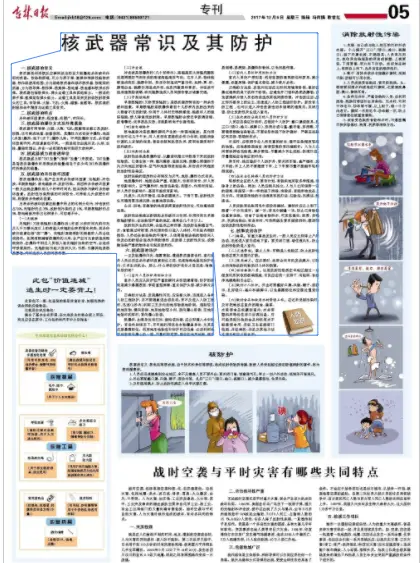
A Chinese newspaper from an area that shares a border with North Korea published a series of articles advising people how to prepare for a strike.


Bloomberg summarized the advice:


The Jilin Daily — the government newspaper of Jilin province on North Korea’s northeastern border — published articles on page 5 explaining how nuclear weapons work and the damage they cause. The paper used cartoons to offer advice on what residents can do about radiation exposure and provided instructions on how to respond during an attack.


One article listed essential items for emergency kits, including fire extinguishers and breathing masks. Another warned that air raids could mean nuclear, chemical and biological attacks, and used the 1945 atomic bombing of Hiroshima as an example.


The cartoon images illustrated how residents should clean their bodies, boots, and coats after being exposed to radiation. They suggested taking iodine tablets if there is radiation nearby. (source)

3) Japan


Millions of people in Japan have taken part in (or soon will) nuclear attack evacuation drills, and the Prime Minister is urging local authorities to designate the best sturdy, underground sites to be used as potential shelters.


…Tokyo isn’t the first city to conduct these types of large-scale drills: Towns facing the Korean Peninsula have conducted similar drills in recent months. 


The national and city governments are to carry out a series of exercises between January and March to prepare for a potential attack on Tokyo, the Sankei Shimbun newspaper reported, the first time that a major Japanese city will have carried out responses to a simulated attack.


Towns facing the Korean Peninsula have in recent months conducted similar drills, with residents instructed to seek shelter in response to sirens warning of an imminent missile strike.


Prime Minister Shinzo Abe has called on local governments throughout the country to identify underground facilities or buildings that are sufficiently sturdy to withstand a missile attack and to designate those facilities as shelters. source()


But it isn’t just Asia that is preparing for the possibility of a nuclear strike.


4) Australia


Australia recently received a warning from North Korea, calling the country a “vassal” of the United States.


A spokesman for the North Korean Foreign Ministry told the country’s state-run Korean Central News Agency (KCNA) [said] that Australia’s support for the United States in opposing North Korea was a “suicidal act.”


“Australia will be unable to avoid a disaster if it keeps toeing the US line of military, economic and diplomatic pressure upon the DPRK despite its repeated warnings,” the Foreign Ministry spokesman was quoted as saying.


“It should be prudent in speech and conduct with its own principle, instead of blindly following the US’ policy of aggression, and realize that working to develop friendly relations with other countries is the best way to its security.” (source)

The minister for defense personnel, Dan Tehan, said that they “will not be cowed” by North Korea’s threats.

5) Hawaii


Hawaii recently tested their nuclear sirens that have not been used since the 1980s. The island is the closest American state to Hawaii, which makes it geographically vulnerable.


But here’s the bummer about the siren test. They were going for 20 whole minutes and hardly anyone even noticed them.


It’s hoped that the 385 sirens dotted around Hawaii will give residents and tourists a 20-minute warning if North Korean nuclear missiles are inbound.


But the sirens, which have been silent since the Cold War, were barely heard in the busy tourist areas of Waikiki, where most people obliviously went about their day.


…Disturbed by the underwhelming results of the tests, officials are now investigating whether the sirens were operating as they are supposed to. (source)


One of my dearest friends lives in Hawaii and has attended the nuclear preparedness meetings that have been held on Maui. According to her, hardly anyone shows up. No one is interested.


With that in mind, one must wonder if the issue with the lack of response to the nuke siren is one of decibels or one of cognitive dissonance.


6) Guam


As a US territory and the closest to North Korea, Guam could find itself in the crosshairs. Officials have issued guidelines to all its residents to prepare them for the possibility of a nuclear strike. (Here’s a link to the fact sheet.)


There’s some excellent advice, such as:


  • “Make a list of potential concrete shelters near your home, workplace or school.”

  • “Do not look at the flash or fireball — It can blind you.”

  • “Lie flat on the ground and cover your head. If the explosion is some distance away, it could take 30 seconds or more for the blast wave to hit.”

  • “When possible, take a shower with lots of soap and water…do not scrub or scratch the skin.”

  • “Do not use conditioner in your hair because it will bind radioactive material to your hair.”


7) The US Mainland


Here on the mainland, California is making preparations, but one notable factor is that residents should not expect help from the government any time soon should such a catastrophe occur. (This, of course, is something that preppers have known for a long time and is clearly evidenced in the slow response to Puerto Rico.)


It also warns of the difficulties government authorities would likely encounter in dealing with the aftermath of a blast. The public will need to evacuate, the report says, but with “limited understanding of radiation risks, they will experience high anxiety and may be non-compliant…”


“…The consequences of a nuclear attack in Southern California would be catastrophic,” the report says. “Nonetheless, government entities and first responders are expected to remain operational to preserve human life, maintain order, and aid in the recovery process.”


The report, which is largely directed at local, state, and federal agencies and first responders located in the Los Angeles region, notes that the federal government will likely be of limited help immediately after a nuclear blast.


“[T]here will be no significant federal assistance at the scene for 24-72 hours following the attack,” the bulletin says. (source)


The Pentagon is planning missile defense bases along the coast.


Congressman Mike Rogers, who sits on the House Armed Services Committee and chairs the Strategic Forces Subcommittee which oversees missile defence, said the Missile Defense Agency (MDA) was aiming to install extra defences at West Coast sites.


“It’s just a matter of the location, and the MDA making a recommendation as to which site meets their criteria,” the Alabama Congressman and Republican said.


When asked about the plan, MDA Deputy Director Rear Admiral Jon Hill said in a statement: “The Missile Defense Agency has received no tasking to site the Terminal High Altitude Air Defense System on the West Coast.”


The MDA is a unit of the US Defense Department. Congressman Rogers did not reveal the exact locations the agency is considering but said several sites are “competing” for the missile defense installations. source()


The goal, of course, is to shoot down the missiles before they can land in the United States and cause untold damage and death tolls. It may not be that easy though. Alarmingly, several experts have raised concerns about our ability to shoot down nukes before they hit.


8) Russia


Russia has been preparing for nuclear possibilities for quite a while now. Last year, it was reported that Russia was building fallout shelters all over the country and that 40 million citizens participated in a defense drill shortly before the US election, when tensions were running high over Syria.


But it didn’t end with the election because now Russia is up to its eyeballs trying to defuse the US/North Korea situation. Russian president Vladimir Putin recently received a letter from Kim Jong Un that stated they could launch an attack on the US “at any day” and could reach the mainland.


As well, Russia has voiced concerns about the animosity with NATO and recently drilled for the possibilities of nuclear or biological attacks. Russia has alleged that the US and Europe are developing nuclear weapons use procedures at their borders.


Preparing for a scenario in which Russia was attacked by “weapons of mass destruction by a hypothetical enemy,” soldiers were deployed in hazmat suits and gas masks.


Units specializing in chemical weapons were deployed in the Krasnodar and Stavropol regions, while at least 100 personnel in the neighboring Rostov region launched a parallel decontamination drill on Monday. It followed similar exercises held by Russian overseas troops in nearby Armenia over the weekend.


Also deployed were mobile laboratories and radioactive- and chemical-tracing reconnaissance vehicles capable of quarantining, assessing and potentially eliminating a chemical or nuclear threat. 


In recent weeks, Russia’s nuclear-capable forces practiced missile launches and flyovers in apparent offensive measures for a conflict scenario. (source)


Here is what would happen if a 10 kiloton nuclear strike occurred.


As I have written numerous times, if you aren’t at Ground Zero, a nuclear strike is very survivable. It isn’t one of those situations like The Road, where the whole world is a nuclear wasteland and people start eating each other to survive.


(This is an excerpt from my article, How to Prepare for a Nuclear Attack.)


Contrary to popular belief, a nuke won’t kill everyone within hundreds of miles. If you aren’t in the immediate blast radius, a nuclear strike is absolutely survivable.


The one-mile radius around the blast will be virtually unsurvivable. Within two miles, people will suffer 3rd-degree burns from the intense wave of heat.


If you are within two miles of the blast, the winds will be coming at about 600 miles per hour. This will take down buildings and cause a tremendous amount of pressure. Some experts recommend that you keep your mouth open to try and reduce the pressure on your eardrums. Looking at the blast could cause permanent blindness.


According to the DHS (source), 10 kilotons is the approximate size of nuclear weapon we could expect.


  • Nearly everyone within a half-mile radius of the point of impact would die and most of the buildings would be demolished. This would be considered Ground Zero.

  • The area within the next half mile would suffer extensive damage, fires, and serious injuries.

  • Areas within three miles could see minor injuries to people and slight damage to their homes.

  • The fallout would kill even more people. According to the DHS:

  • Within 10 to 20 miles of the explosion, radioactive exposure would cause nausea and vomiting within hours and death without medical treatment.

  • But for those near enough to the blast, experiencing more than 800R of radiation, not seeking shelter immediately would cause deaths with or without medical treatment, the study found.

  • People would not be able to evacuate this area as fallout would arrive within just 10 minutes.

People upwind of the strike and outside the 20-mile radius would be unlikely to suffer any effects. People downwind would need to take shelter. Deaths from cancer that is related to the fallout could occur for many years after.


With all of these governments spending oodles of money trying to prepare their citizens for the unthinkable, it would be extremely wise to get ready, just in case.


You’ll need to plan to hunker down for 14-21 days. That means you’ll need food, a way to cook it, water, sanitation supplies, and other essentials to last for that amount of time. You should invest in a potassium iodide supplement to stave off the possibility of thyroid cancer. (Learn how to use them in this article with a printable version.)


*  *  *


In times like this, it’s more essential than ever to keep well-informed. (Sign up here for my daily emails and follow my website, Preppers Daily News.) Most importantly, go to this article to learn in-depth what you should do to prepare for the possibility of a nuclear attack. If the missiles are in the air, it’s far too late.