Showing posts with label Exchange rate. Show all posts

Monday, December 25, 2017

Chinese Stocks Spooked By Apple iPhone X Forecast Cut, Nikkei Boosted By BOJ Hopes

With most global markets closed for Christmas, the only overnight action was in Asia, which saw Chinese equities fall with tech stocks and names linked to Apple the worst performers after a report that Apple cut forecast iPhone X sales forecasts, while property firms surged on speculation of coming consolidation. As a result, after opening higher, the Shanghai Composite Index closed 0.5% lower on the day, the blue-chip CSI 300 Index fell 0.3%, the Shenzhen Composite Index retreated 0.9%, while the ChiNext small-cap and tech Index dropped 1.3%. The PBOC"s refusal to conduct a reverse repo for the second day did not boost the market mood.


The biggest Asian losers were Apple suppliers after the Taipei-based Economic Daily News reported that Apple has cut its sales forecast for the iPhone X by 40% from 50 million in Q1 to only 30 million. The report also noted that Foxconn’s Zhengzhou plant stopped recruiting workers. Following the news, Apple supplier Lens Technology Co. dropped 8.4% to be among worst performers on the ChiNext measure; Shenzhen Sunway Communication Co. -2.2%, Luxshare Precision Industry and GoerTek both dropped at least 4%. As the table below shows, it was a sea of red for Apple suppliers.


Offsetting the drop in tech names was strength among property firms: Gemdale rose 6.3% as the best performer on CSI 300 measure after Citic Securities analysts said that the planned strict implementation of property curbs in 2018 would boost industry consolidation and benefit big companies. Unless, of course, it ends up crippling the business for everyone in which case today"s spike will promptly turn into a selloff.


Elsewhere in open Asian markets, Japan"s Nikkei erased early losses and scraped out gains on Monday as expectations that the Bank of Japan would buy more exchange-traded funds (ETFs) offset drops by financial stocks, Reuters reported. Movements in Japanese equities were confined to a narrow range with foreign investor presence lacking due to Monday"s closure of other major markets for Christmas; as a result, the Nikkei finished 0.16% higher at 22,939.18.


Of Tokyo"s 33 subsectors, 10 were in the red, led by securities T and banking after their U.S. financial peers lost steam on Friday following their recent strong performance. Denim clothing store operator Jeans Mate 7448.T soared 20.2 percent after reporting that December existing store sales increased 13.2 percent from a year earlier.  Furniture and interior goods seller Nitori Holdings 9843.T sank 6.4 percent after the company saw its operating profit for the nine months through to Nov. 20 rise a modest 0.3 percent to 70.4 billion yen ($621.58 million).


Cryptocurrency related shares slipped following recent wild swings in bitcoin. Internet provider GMO Internet which is engaged in the "mining" of bitcoin, fell 4.8%.  Remixpoint, an operator of virtual currency trading post services, dropped 4%.


In FX, it was a quiet session, with the only major mover once again out of China, where the yuan surged over 240bp to hit 6.5514 per USD at one point, the strongest since mid-September. Earlier in the day, the PBOC raised the yuan’s fixing by 138bp to 6.5683 per USD, the highest since Sept. 20. The dollar was little changed against other major currencies on Monday in holiday-thinned trading while the cost of swapping the yen for the dollar jumped as banks scrambled to raise dollars for the year-end period.


With most currency trading centers except for Tokyo shut on Monday for Christmas, trading volume was less than 20 percent of the average for major currency pairs including the euro/dollar and the dollar/yen. 


According to Reuters, the discount for buying the yen at future dates widened sharply as non-U.S. banks, which typically buy dollars now with sell-back contract at a future date, scrambled to procure greenbacks for the year-end.  The one-week forward discount starting from Wednesday jumped to 0.23 yen from around 0.04 yen in the middle of last week.


“Because foreign banks are away and few market players are eager to offer dollars, the forward market is very thin,” said a currency trader at a major Japanese bank. “The market is very volatile and there are hardly any trades beyond one week."


Thursday, December 21, 2017

Venezuela"s Grim Reaper: A Current Inflation Measurement - Current Annual Rate 4651%

Authored by Steve H. Hanke of the Johns Hopkins University. Follow him on Twitter @Steve_Hanke.


The Grim Reaper has taken his scythe to the Venezuelan bolivar. The death of the bolivar is depicted in the following chart. A bolivar is worth less, and with its collapse, Venezuela is witnessing today the world’s worst inflation. 


As the bolivar collapsed and inflation accelerated, the Banco Central de Venezuela (BCV) became an unreliable source of inflation data. Indeed, from December 2014 until January 2016, the BCV did not report inflation statistics. Then, the BCV pulled a rabbit out of its hat in January 2016 and reported a phony annual inflation rate for the third quarter of 2015. So, the last official inflation data reported by the BCV is almost two years old. To remedy this problem, the Johns Hopkins – Cato Institute Troubled Currencies Project, which I direct, began to measure Venezuela’s inflation in 2013. We measure the monthly and annual inflation rates on a daily basis. We measure. We do not forecast. 


The most important price in an economy is the exchange rate between the local currency and the world’s reserve currency — the U.S. dollar. As long as there is an active black market (read: free market) for currency and the black market data are available, changes in the black market exchange rate can be reliably transformed into accurate estimates of countrywide inflation rates. The economic principle of Purchasing Power Parity (PPP) allows for this transformation.


We compute the implied annual inflation rate on a daily basis by using PPP to translate changes in the VEF/USD exchange rate into an annual inflation rate. The chart below shows the course of that annual rate. Today, a new high of 4651%/yr has been reached (see the chart below).


Friday, December 1, 2017

Yes, Cash Is An Asset Class Again!

Authored by Steven Vannelli via Knowledge Leaders Capital blog,


In a US Dollar bull market with interest rates at zero, cash is rightfully dismissed as a non-asset class. But, when the US Dollar is in a bear cycle, things change, irrespective of what US interest rates are.


There are a handful of indicators we use to identify US Dollar bull and bear cycles.


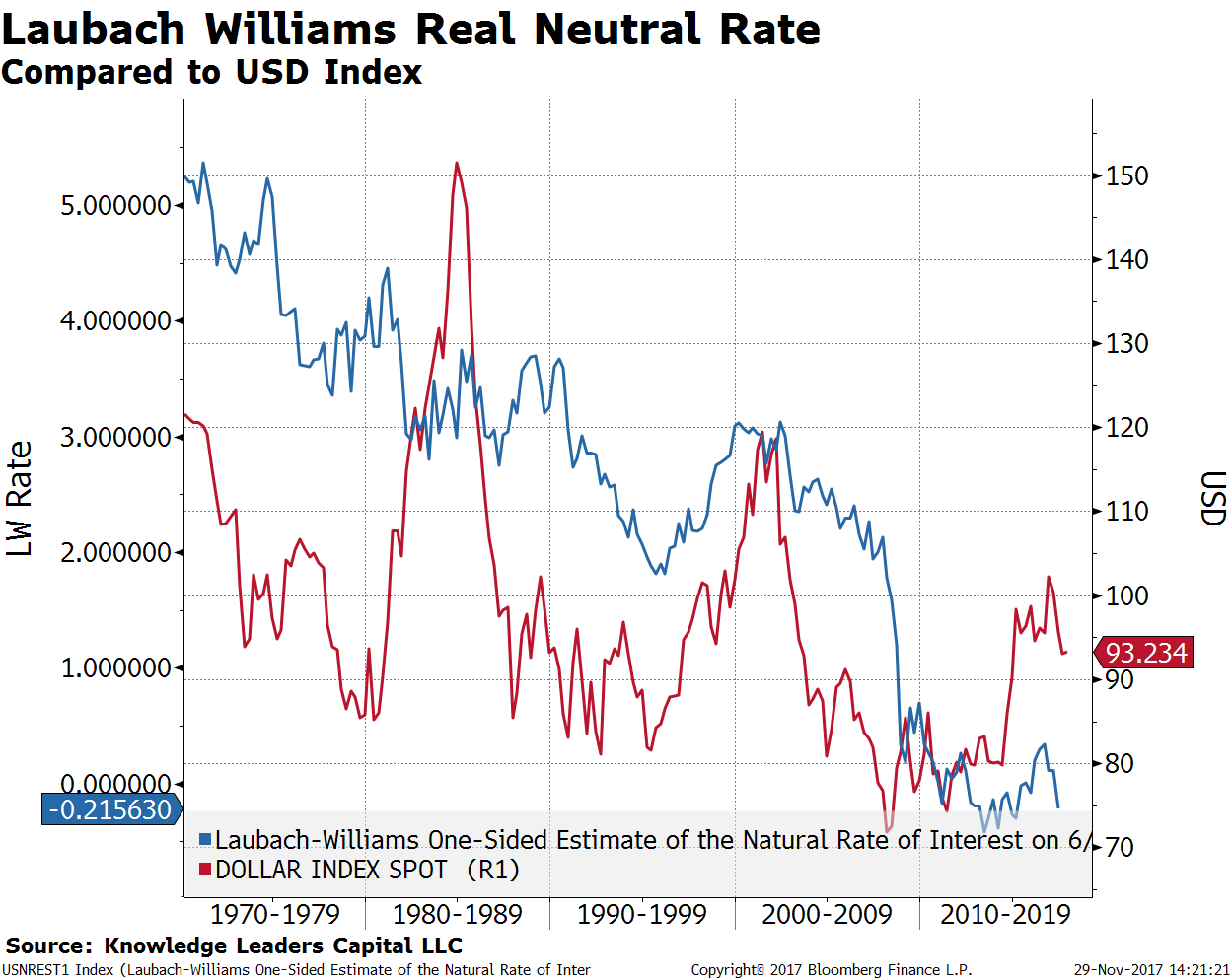
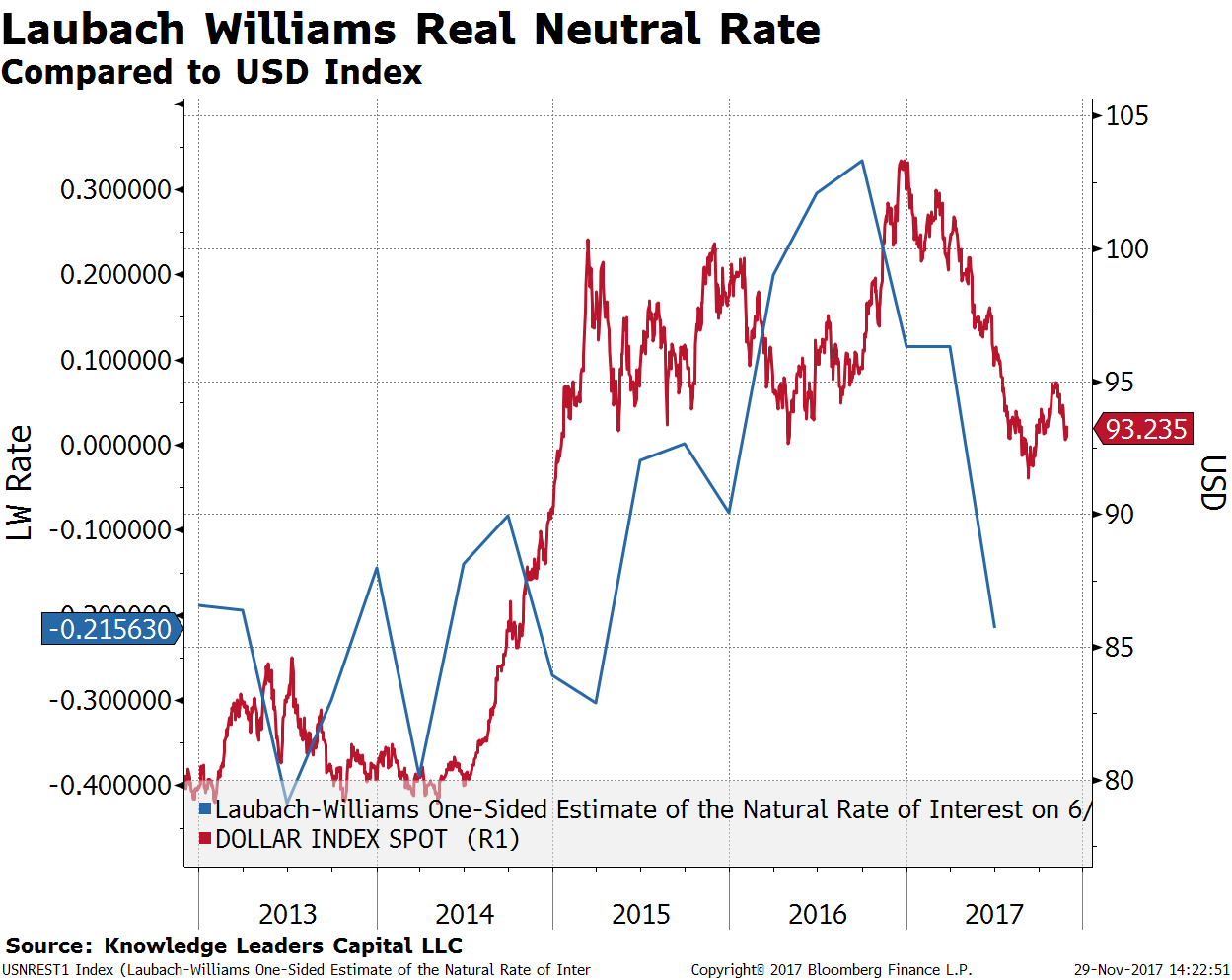
One indicator - the Laubauch-Williams (LW) Real Neutral Rate - has gained traction with the Fed and is often referred to as r-star. It is a measure of the real (after inflation) neutral interest rate that the US economy can handle without stimulating or restraining the economy. Over time, the LW Real Neutral Rate is one of the better signals for the US Dollar.


Every US Dollar bull market since 1970 has been marked by an increasing LW rate. In the chart below, I plot the LW Real Neutral Rate (blue line, left axis) against the US Dollar Index (red line, right axis). In the early 1980s the US Dollar bull market occurred with the LW rate rising from about 3% to about 4%. Similarly, the US Dollar bull run of the late 1990s occurred with the LW rate rising from just over 2% to just over 3%. The most recent US Dollar bull market has been no exception. While admittedly harder to see because the numbers are so small, the most recent US Dollar bull occurred with the LW rate rising from around -.5% to about +.3%.


This relationship suggests the US Dollar bull run has come to a conclusion as the LW Real Neutral Rate has rolled over again. In the chart below, I focus on the last five years. Notice the US Dollar following the trend in the LW rate. The pop in the LW rate in the first quarter of 2014 led the 25% gain of the US Dollar from mid-2014 through early 2017. Notice also that the LW rate peaked in mid-2016, having fallen back by about 50bps in the last few quarters, leading the peak and decline in the US Dollar.


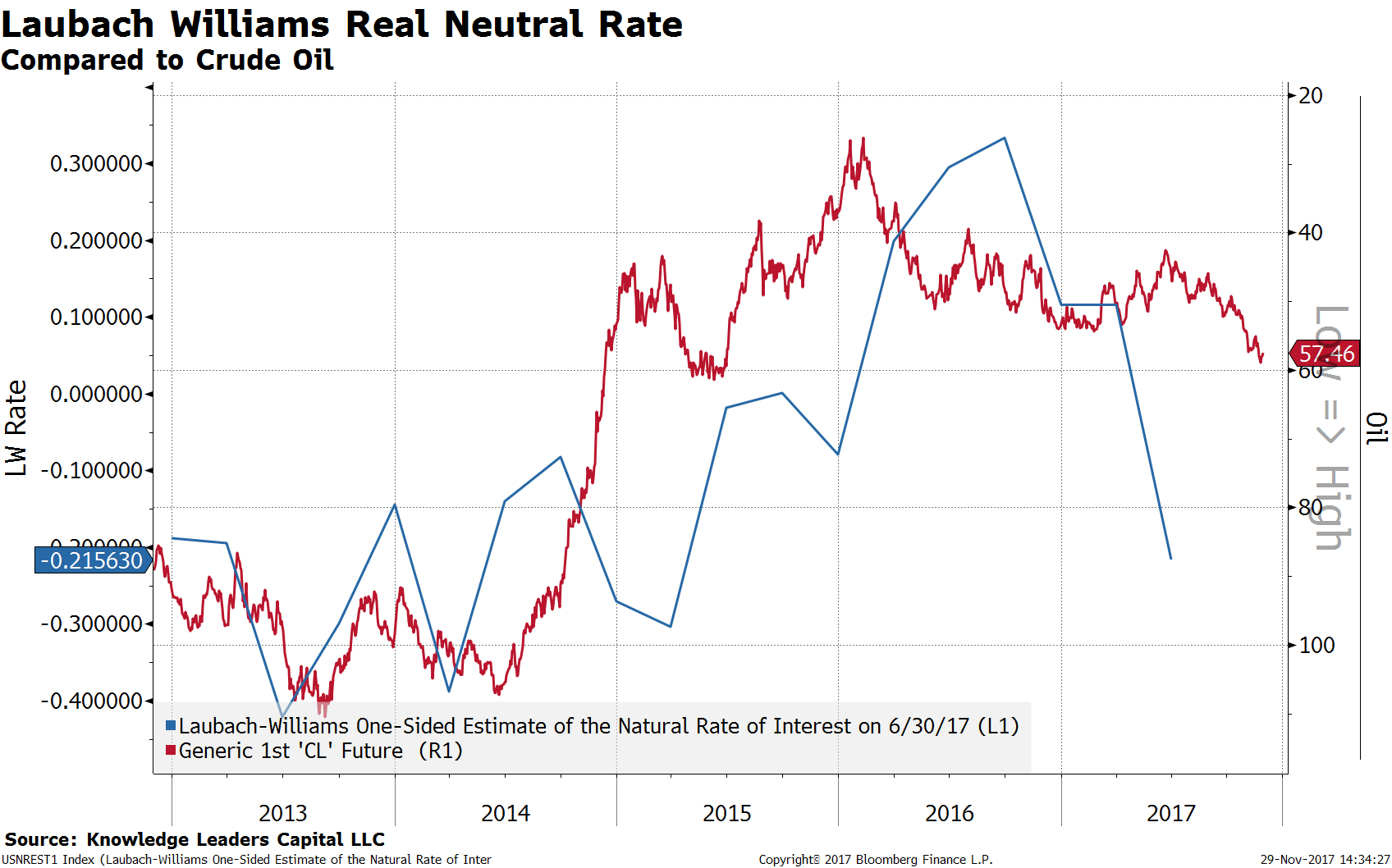
The fact that the LW rate has declined for three quarters in a row suggests this isn’t a temporary fluke. It is likely driven by the slow turnaround in oil prices. In the chart below, I plot the LW rate against oil prices. Simply, falling oil prices (red line, right scale, inverted) pull the LW rate (blue line, left axis) up. And, the reverse is true also that rising oil prices dampen the LW rate.


So, if we are now in a US Dollar bear market, driven by, among other factors, a falling LW rate and rising commodity prices, the good news is that cash is an asset class again.


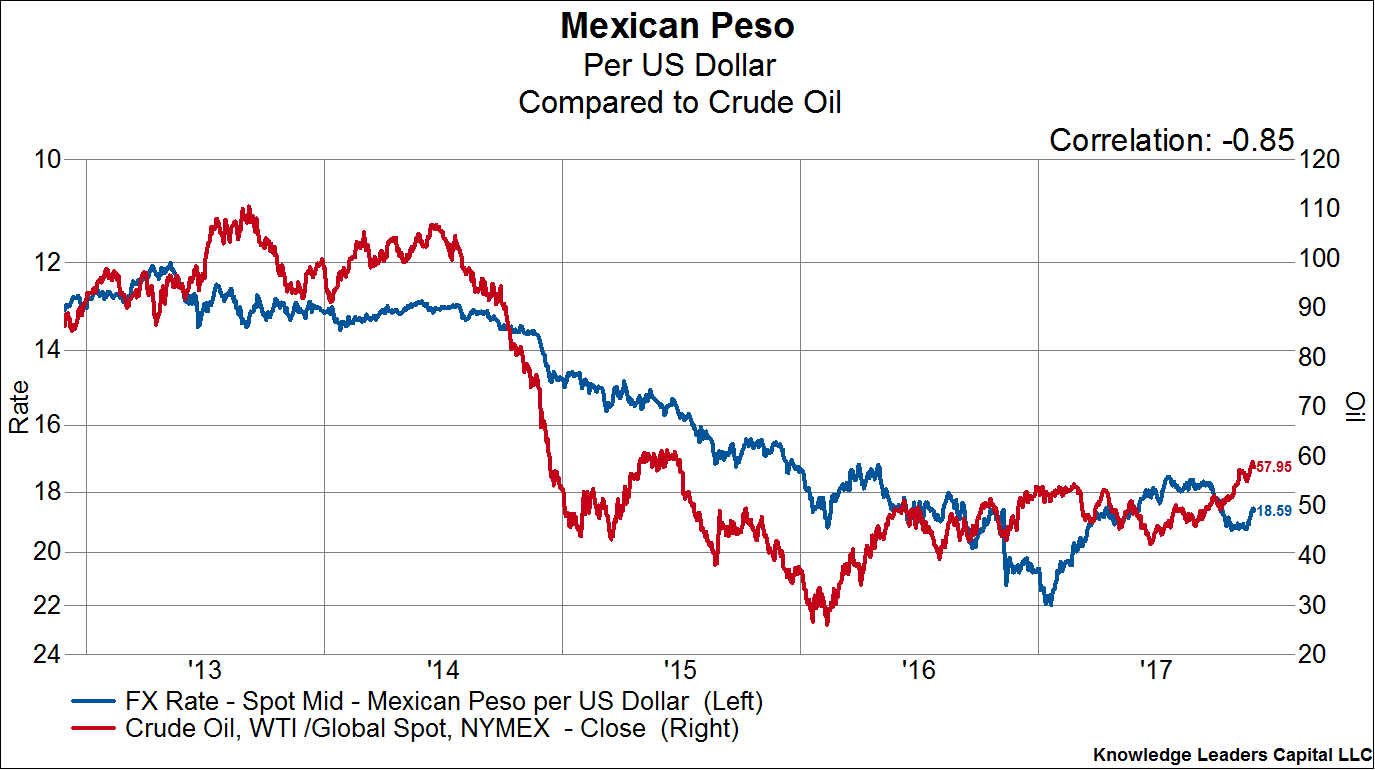
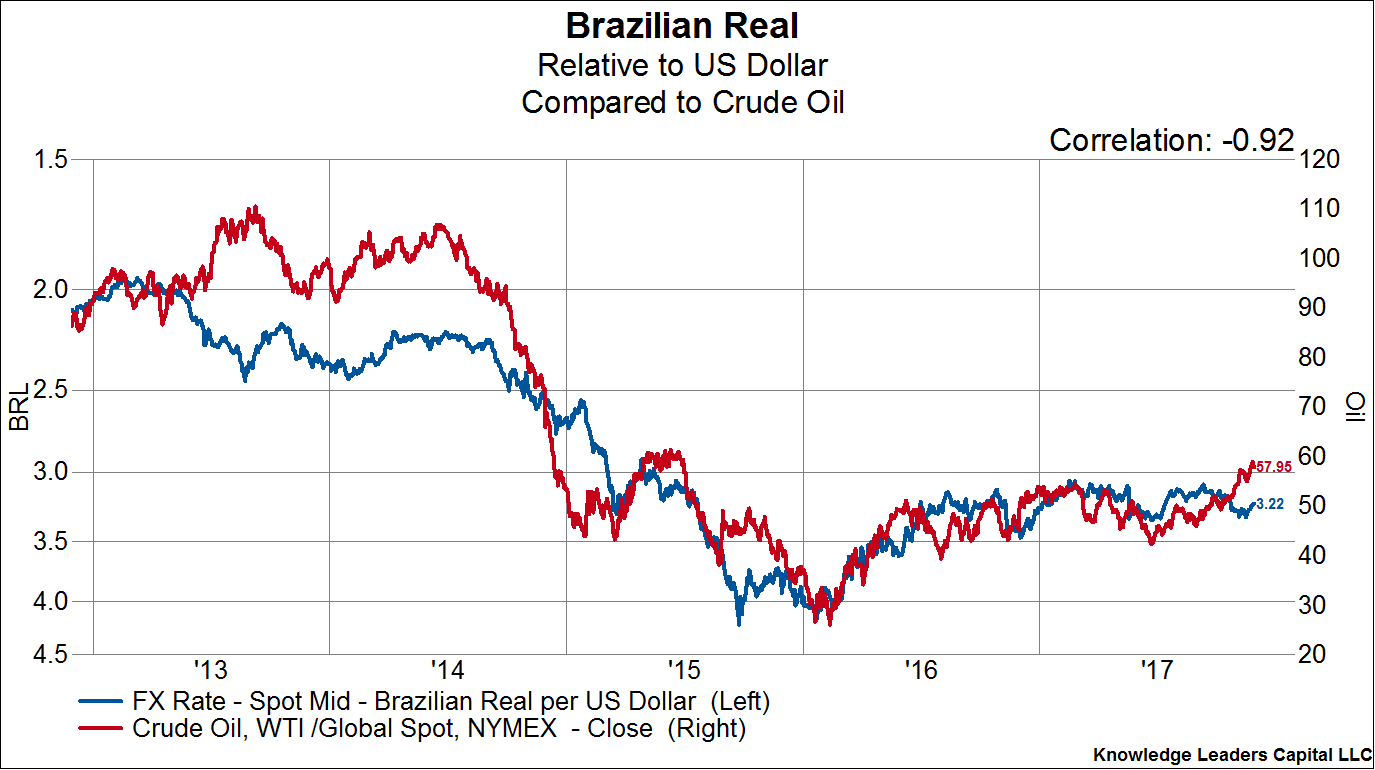
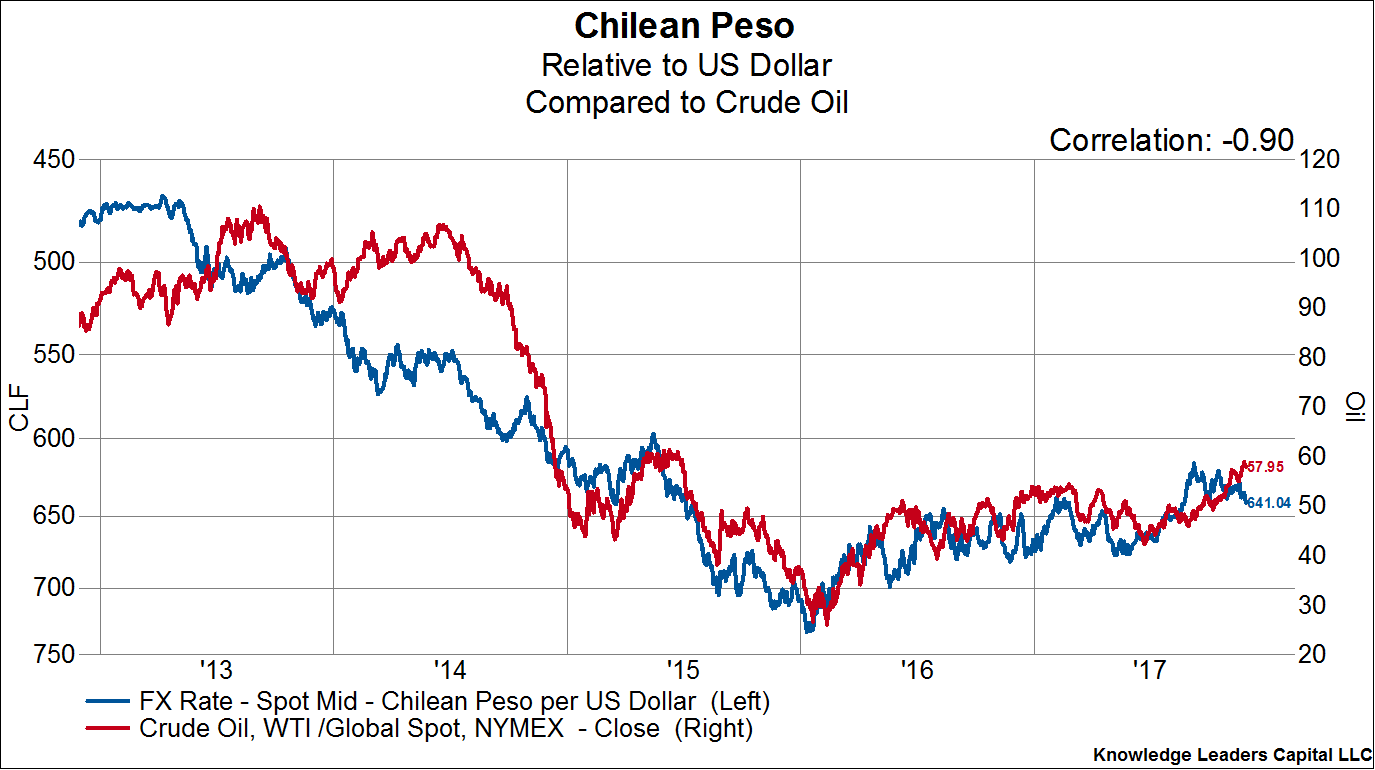
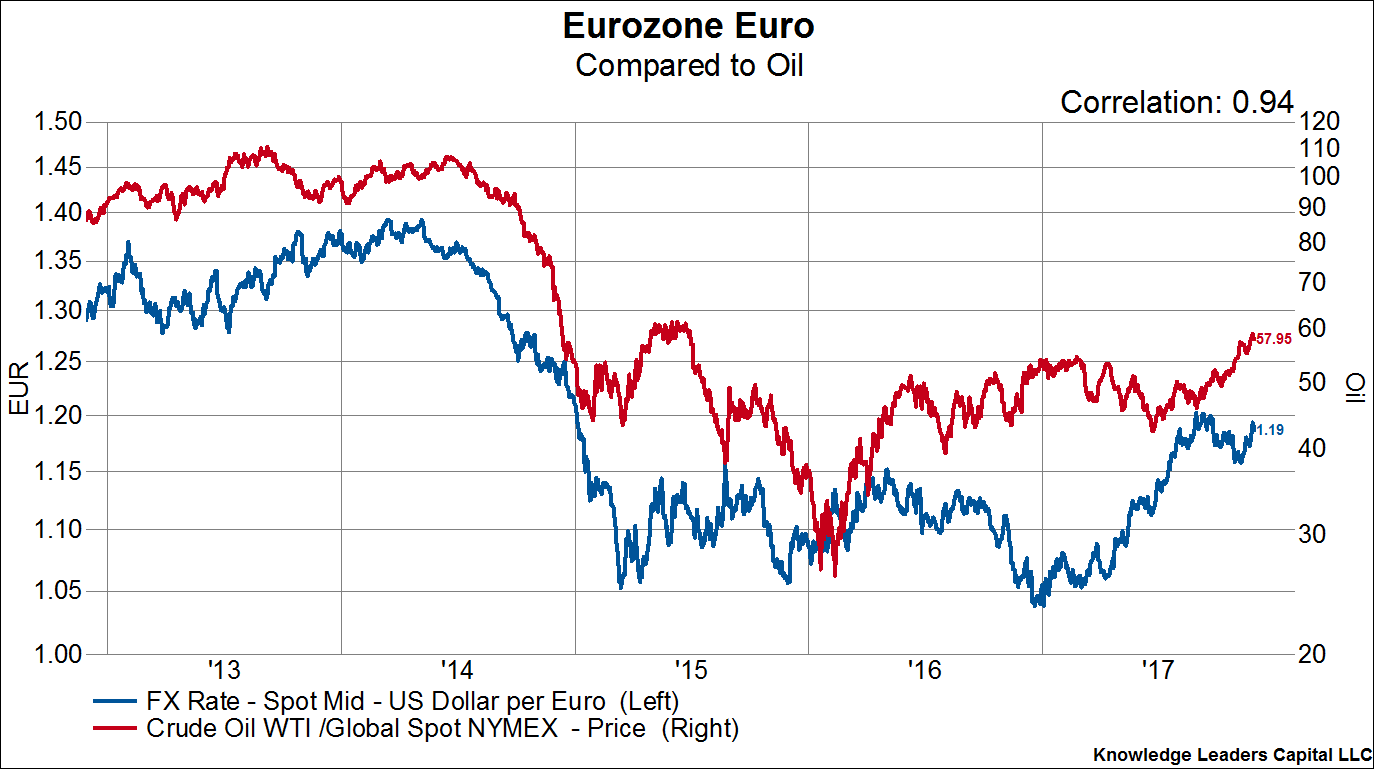
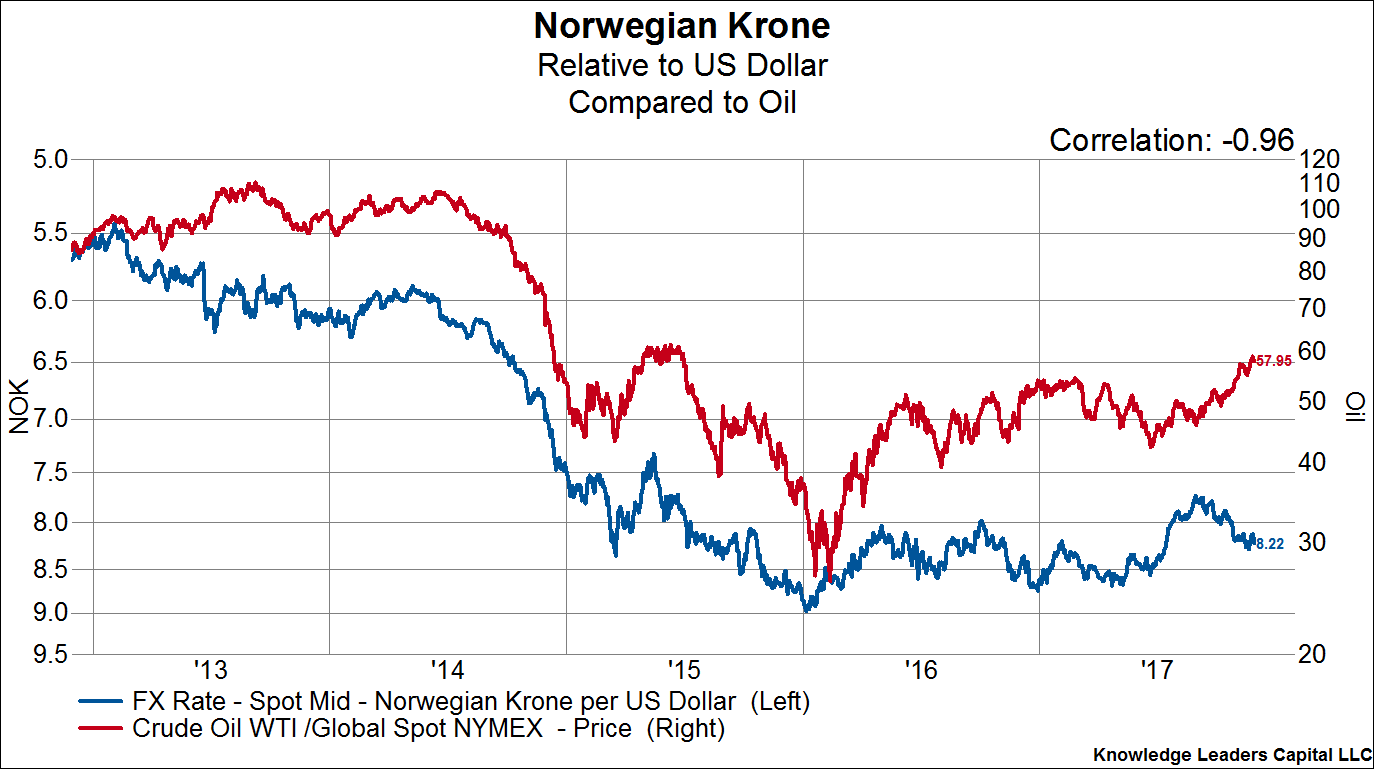
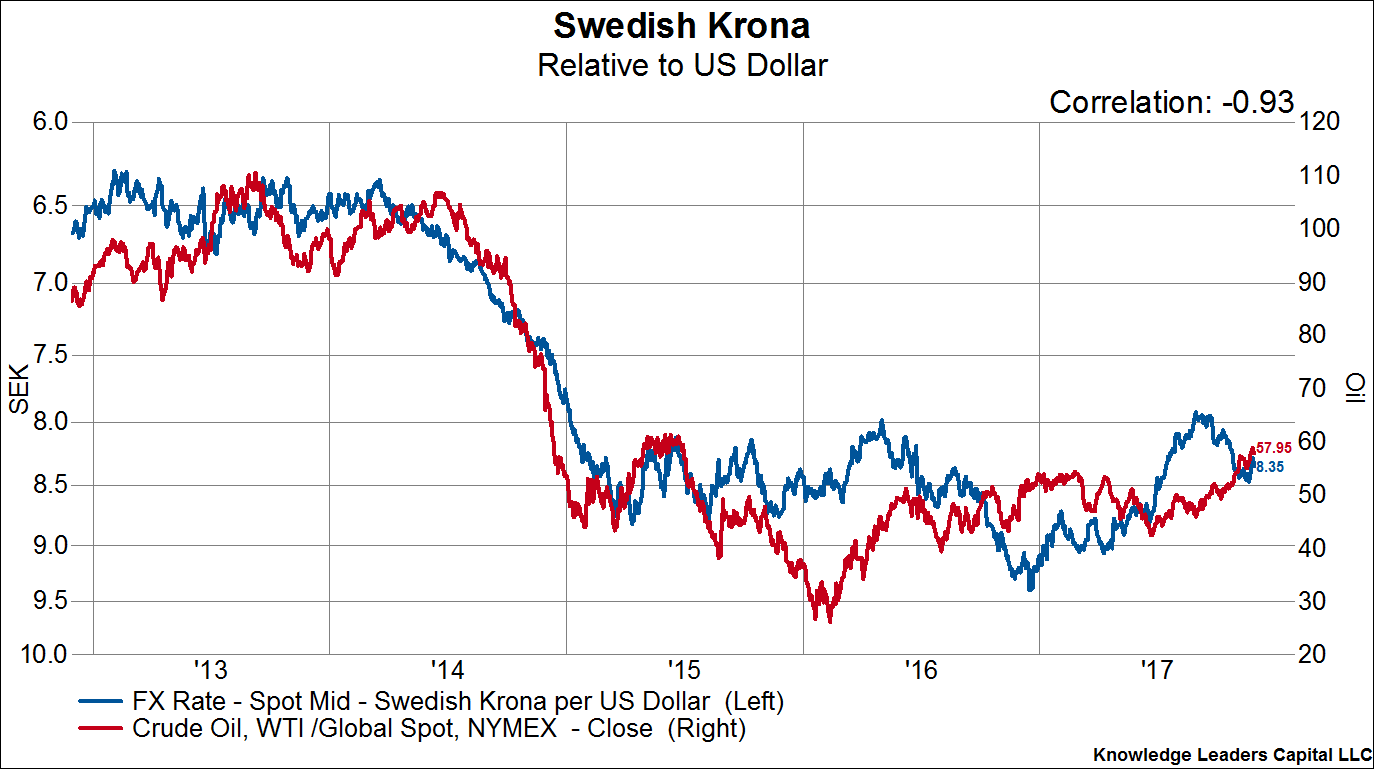
Which currencies should investors focus on? An easy place to start are those currencies with the tightest linkages to oil prices.


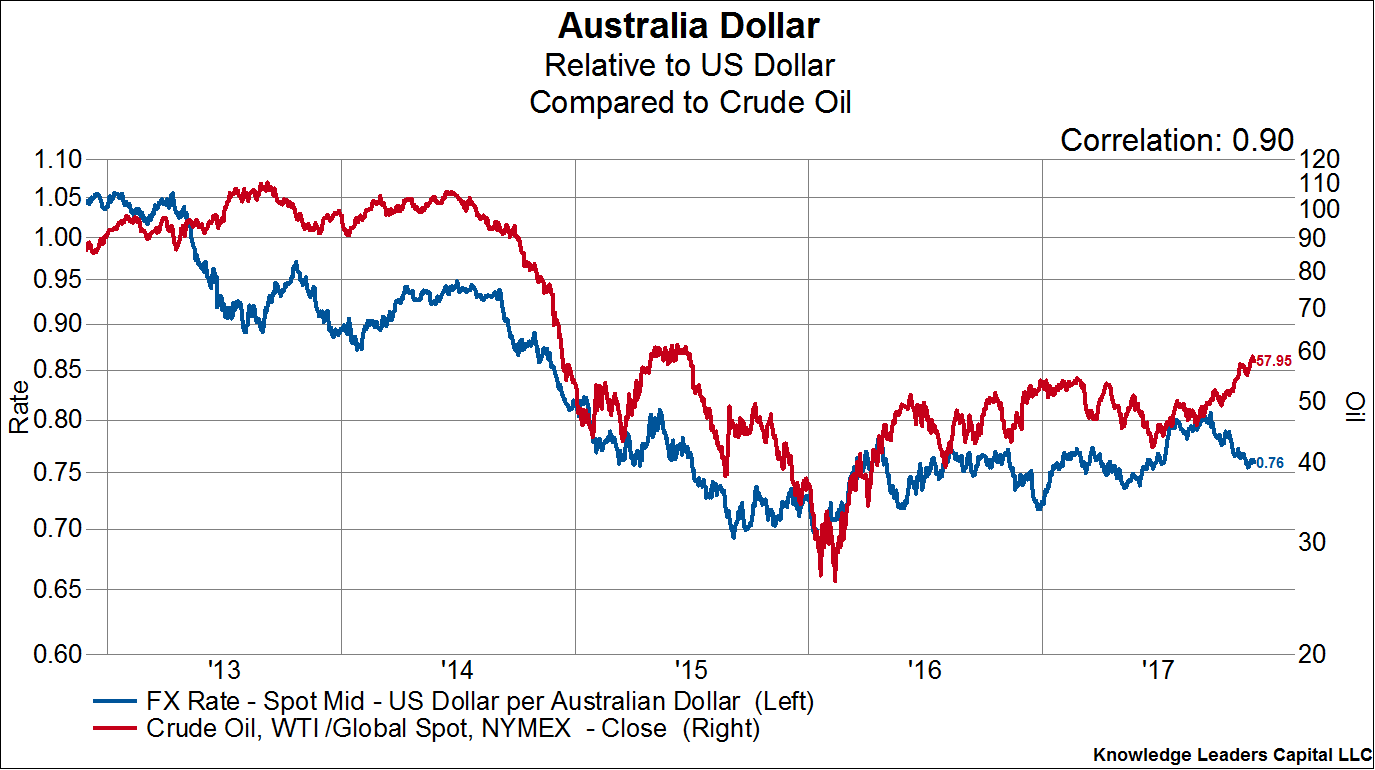
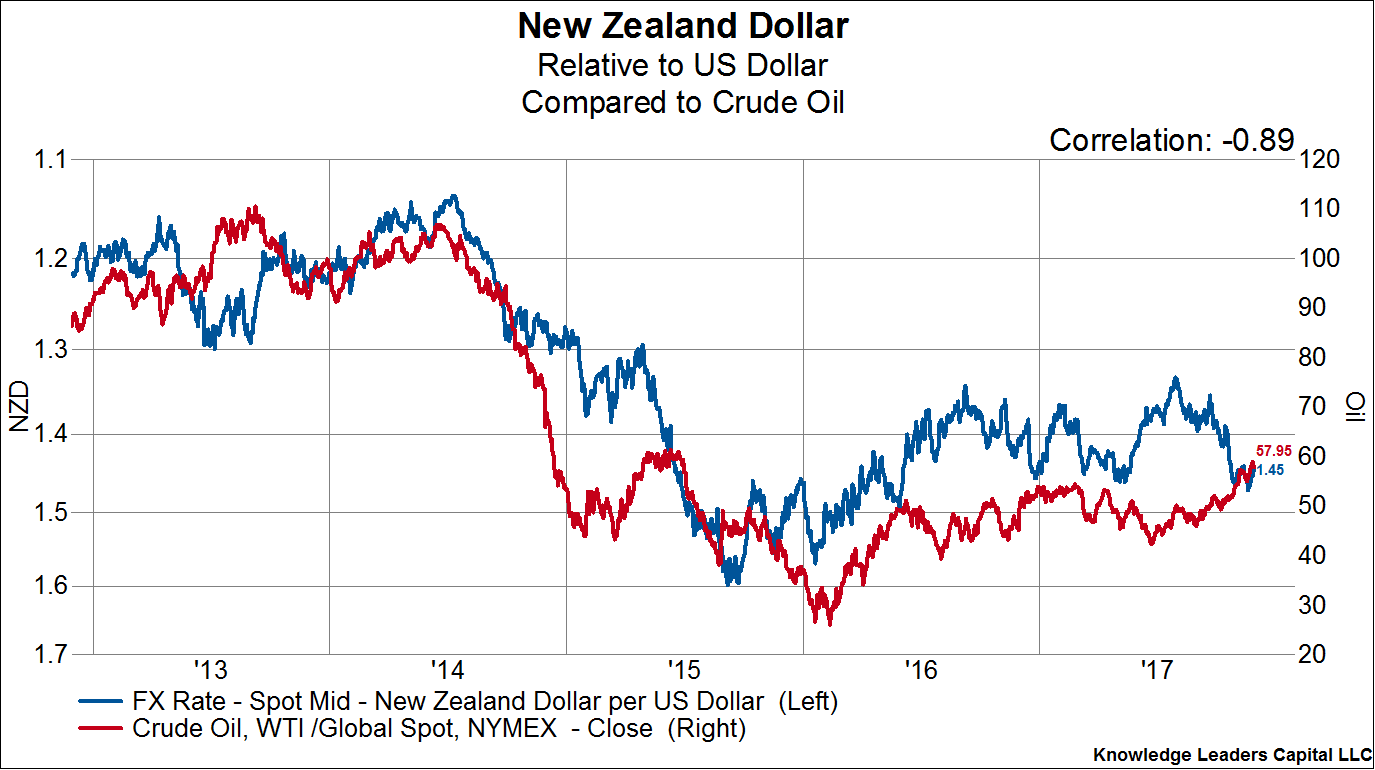
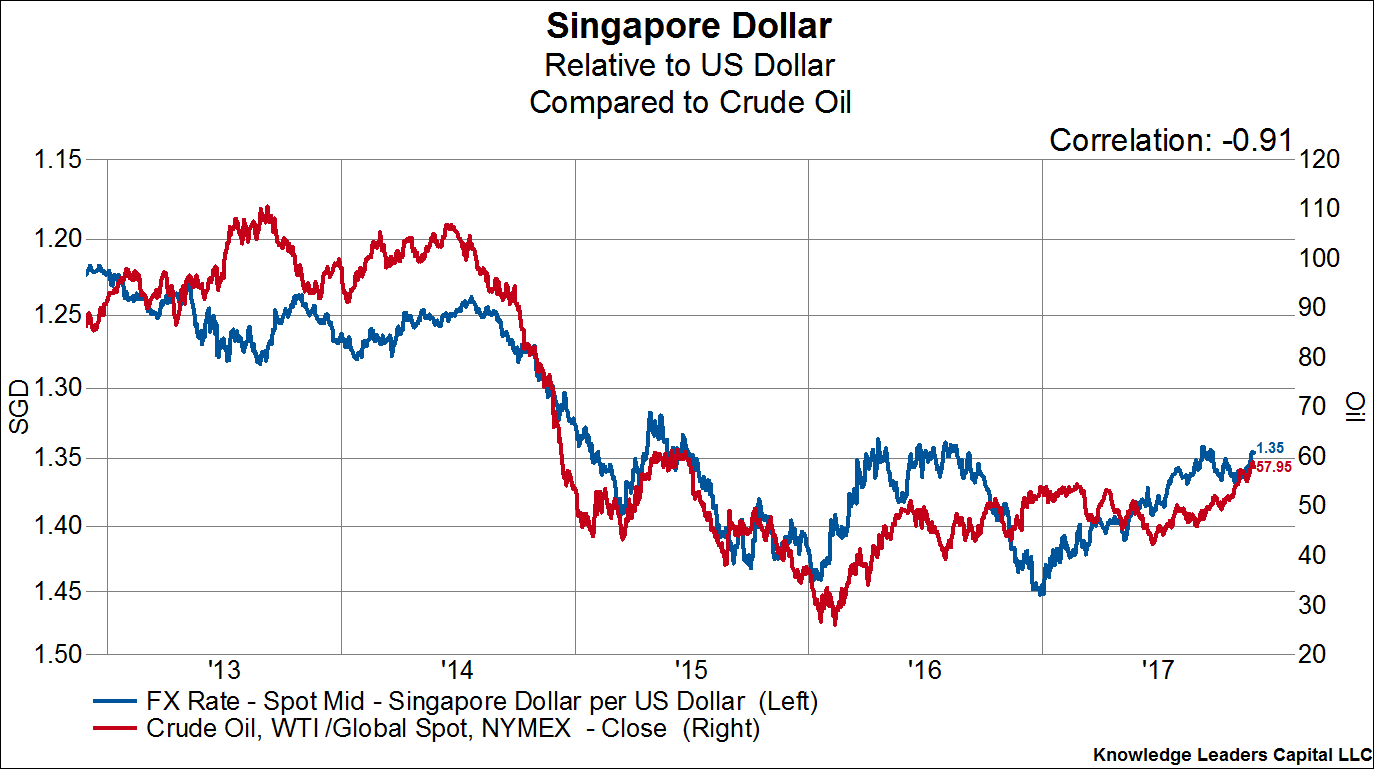
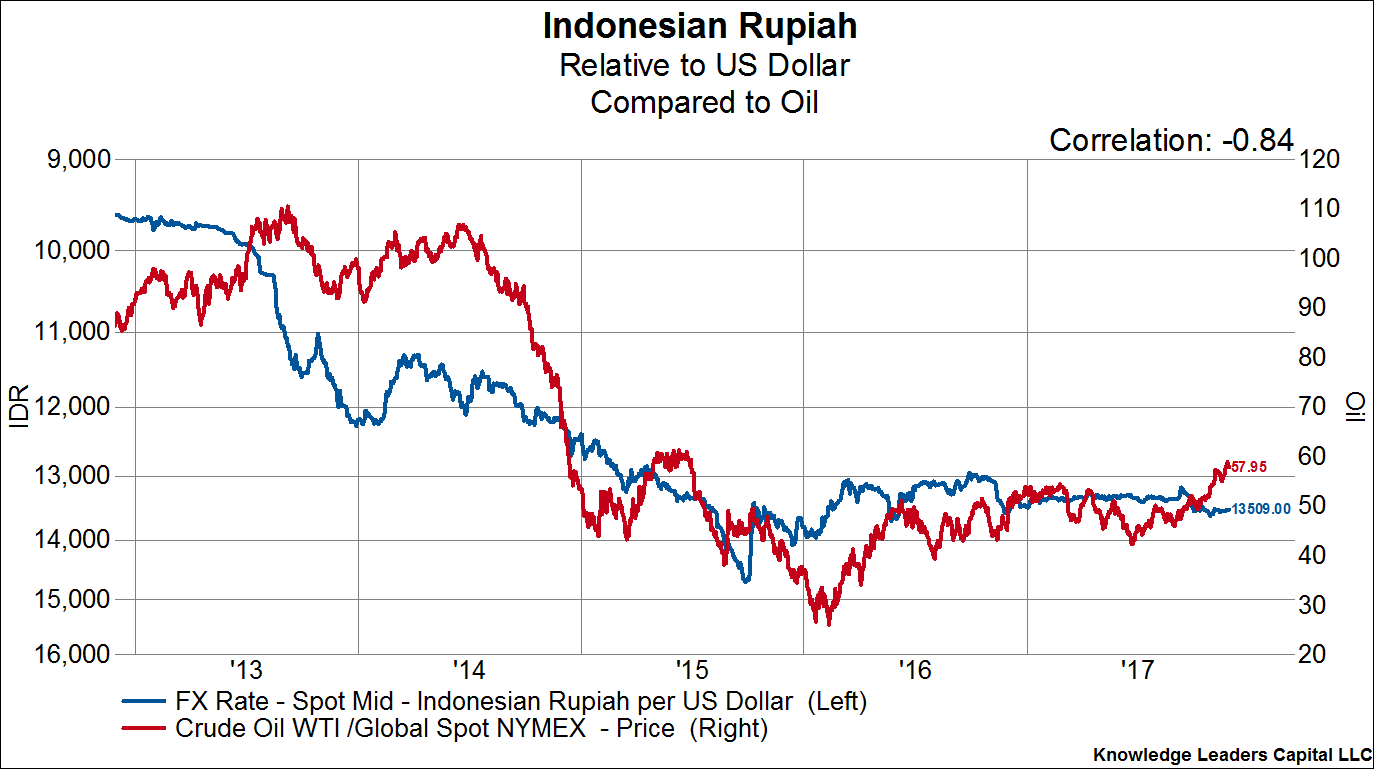
Let’s start in Asia. Among interesting developed market options for a cash allocation are the Australia Dollar, Singapore Dollar and New Zealand Dollar. In each chart below, I plot the US Dollar FX rate against oil prices, with the correlation shown in the upper right corner.


Among emerging market currencies in Asia, the most interesting are the Indonesian Rupiah and Thai Baht.


Moving to the Americas, the Canadian Dollar, Mexican Peso, Brazilian Real and Chilean Peso all look interesting.


Moving on to Europe, the most interesting currencies are Euro, Norwegian Krone and Swedish Krona.


While there are many asset allocation decisions that hinge on whether the US Dollar is in a bull or bear market cycle, one of the easier is currency allocation. An investor following an Anything but US Dollars policy has the chance to capitalize on the new US Dollar bear market. Cash is now an asset class again, and this creates new possibilities for alpha generation and risk management.


Wednesday, November 29, 2017

Is It Tuesday? Time For Another Banking Scandal...

Authored by Simon Black via SovereignMan.com,


Another day, another major banking scandal.


It’s getting to the point where you can practically set your watch to these things.


The latest involves our old friend Wells Fargo.


The Wall Street Journal reported last night that Wells has been screwing its customers on foreign currency exchange rates.


According to the Journal, Wells Fargo conducted an internal review of its fee arrangements and found that they had massively overcharged 88% of the sampled customers.


For example, the bank might have signed a contract with a customer to charge 0.15% on foreign currency transactions, but instead charged as much as 4%… about 26x higher than agreed.


It’s absurd to begin with that a bank would charge even a small percentage-based commission on foreign currency transactions (much less 4%), especially given that most of the transactions were to exchange euros and US dollars.


Sure, commissions are common in many industries.


When you list your house for sale, for example, your real estate agent receives a commission when s/he finds a buyer and closes the deal.


Real estate commissions often range between 2% to 6%. But agents earn this money because houses are big, illiquid assets. And it often takes a lot of time and work to close a sale.


But Wells Fargo has been charging huge commissions on buying and selling MONEY.


The foreign exchange (FX) market trades around $5.3 trillion each day (compare that to about $200 billion for US equities). That makes the US dollar / Euro trade literally one of THE most popular financial transactions in the world.


Billions upon billions of dollars and euros are exchanged every single business day of the week, around the clock, through electronic trading platforms.


It’s not like some currency trader at Wells Fargo ever had to lift a finger trying to find a buyer for his customer’s euros.


Anyone who has ever traded FX knows that it takes a fraction of a second to buy/sell major currencies.


There’s zero work involved on Wells Fargo’s end. Yet they charge a steep commission as if they have to put in all sorts of time and effort to buy and sell currency. It’s ridiculous.


But even worse, the bank formally agreed with its customers to charge a set fee. And then they totally violated those promises simply because it suited their interests.


How utterly, completely pathetic.


Bear in mind, this is the same bank that was caught creating fake accounts and charging fees to unsuspecting consumers without their consent, also because it suited their interests…


… and that this is an industry that has a track record of constantly violating their customers’ trust.


These banks have been caught red-handed illegally colluding to fix interest rates and exchange rates.


They have manipulated asset prices and knowingly sold their customers toxic assets.


They have invested their customers’ hard-earned savings in astonishingly stupid, no-money down loans to borrowers who had no hope of repaying the debt.


They use every accounting trick in the book to misstate their true financial condition, including the utter farce of carrying Volcker Rule assets on their books at 100 cents on the dollar… or mysteriously reclassifying their bond portfolios in a way to hide losses.


They reward themselves the most magnificent bonuses when times are good.


And when the house of cards begins to fall, they go to the public with hat in hand, claiming that they’re too big and important to lose any money.


Despite taking the public’s bailout money, these banks treat their customers with such contempt and suspicion. They make you feel like you’re committing a crime when you request a cash withdrawal of your own money.


It’s truly remarkable that this industry has any credibility left.


The good news is that it won’t last.


Banks no longer have a monopoly on finance. Technology already makes it possible to conduct just about any transaction you need outside the banking system.


You can deposit and withdraw funds, borrow money, exchange currency, invest your savings, pay bills, transfer funds, make online payments, etc. with cryptocurrencies, Peer-to-Peer platforms, and various blockchains.


And these technologies are often better, faster, and cheaper than the traditional banking system.


History tells us that technology almost invariably puts entrenched industries out of business.


E-commerce is obliterating traditional retail. Digital media is destroying print media.


And it’s only a matter of time before cryptofinance displaces the banking system.


Whether or not you think Bitcoin is a bubble at $10,000, it’s still worth understanding the enormous potential (and opportunities) of what these technologies can provide.


Because the alternative of dealing with Wells Fargo isn’t that attractive.


Saturday, October 28, 2017

The World"s New Reserve Currency? Everything You Need To Know About PetroYuan

Earlier this week, we pointed out that the "PetroYuan" is on the verge of becoming reality with Graticule"s Adam Levinson noting that the birth of a yuan-denominated oil contract will be a “huge story” in the fourth quarter, and will be a “wake up call” for investors who haven’t paid attention to the plans.


As a reminder, nothing lasts forever...


Judging by the interest in the topic, investors are less informed than many believed and so the different teams within Société Générale Cross Asset Research examine what this contract would mean for the global oil markets and for the internationalisation of the yuan - if it gets off the ground.


Part 1 The proposed yuan-denominated crude oil futures contract


  • Why is a yuan-denominated Chinese crude futures contract interesting to think about?  Why is it potentially significant?

  • Would yuan-denominated Chinese crude futures affect the physical markets?

  • Has China actually proposed changing its crude buying from USD to yuan?

  • What about the crude producers and exporters?

  • How much non-USD crude trade currently exists?

  • If small volumes don’t change how the oil market operates, how big would the volumes have to be to make a difference?

  • Is there another commodity that trades in multiple currencies at different exchanges that we can learn lessons from?

Part 2 Another step towards currency internationalisation?


  • Why does China want to introduce a yuan-denominated crude oil futures contract? 

  • How can the yuan succeed in becoming a reserve currency?

  • What does the status of an international currency mean for the yuan?

  • What will an internationalised yuan mean to China’s FX reserves?

*  *  *


Part 1: The proposed yuan-denominated crude oil futures contract


In November 2013, the Shanghai International Energy Exchange (INE) was established. Fully owned by the Shanghai Futures Exchange, the INE began efforts to offer an alternative crude oil futures contract to the global oil markets. After four years, these efforts are continuing. The proposed contract is for medium sour crude oil, is physically deliverable, and – most significantly – would be denominated in yuan.


We begin with the oil markets.


Why is a yuan-denominated Chinese crude futures contract interesting to think about? Why is it potentially significant?


Such a contract would be a tool that would make it possible for crude exporters selling to Chinese refiners to hedge their sales in yuan. This could help any future effort by China to import crude using yuan; on the other side of the coin, it could also help any future effort by various crude exporters to sell crude in a currency other than USD. 


In the abstract, the potential volumes are large, which is why this is worth thinking about.  China is the world’s biggest crude importer, with net imports in January-July 2017 of 8.4 Mb/d (and trending higher); the second biggest crude importer is the US, with net imports of 7.2 Mb/d in January-July 2017 (and trending lower). 


To put this into context, according to the IEA, in 4Q17, global product demand will be 98.5 Mb/d and global crude demand will be 82.2 Mb/d (including refinery runs and direct burn).  Crude trade is much less, at 42.4 Mb/d in 2016, according to the BP Statistical Review; this excludes crude that is produced and consumed in the same country. In other words, Chinese net crude imports account for over 10% of the global crude market and almost 20% of global crude trade. 


Would yuan-denominated Chinese crude futures affect the physical markets?


No, not at all. That’s not what this is about – there would be no impact on physical supply (like the example of natural gas – see below). In theory, if this were to happen, it would purely be about pricing. The global oil markets are denominated almost entirely in USD, so it is interesting to think about that landscape changing.


Has China actually proposed changing its crude buying from USD to yuan?


No. In recent years, there has been occasional general talk from China of moving away from the USD for purchases of crude oil and other commodities; however, we are not aware of any serious or concrete proposal on the table to start buying crude in yuan any time soon. That said, it is worth acknowledging that most Chinese crude buying is done by three large stateowned oil companies. Therefore, if it so chooses, the Chinese government certainly has the ability to push such an agenda; similarly, the government has the ability to push the use of INE crude futures for hedging crude in yuan.


What about the crude producers and exporters?


This is an important question to ask because it’s not just about what the Chinese want. As with any commercial transaction, both the buyer and the seller need to agree. In the case of crude oil, they need to agree on the volume, price, type and quality of crude as well as the delivery date and delivery location, among other things. However, the currency is almost always the USD – that is not a point of negotiation.


Over the years, including 2017, major crude producers such as Iran, Russia and Venezuela have talked about selling and exporting crude in non-dollar currencies. The reasons have been general geopolitical tensions with the US and Europe, and more specifically, oil-related sanctions; the use of non-dollar currencies may offer a way to circumvent oil-related sanctions, at least partially.  


Hypothetically, if China were to have serious talks with Iran, Russia and Venezuela about importing crude and paying in yuan, that would be important because it would add another dimension to the geopolitical analysis. If sanctioned countries could simply side-step the measures by selling crude in yuan or other non-dollar currencies, it would mean that the risk of supply disruptions and potential upside risk for oil prices would be reduced.


How much non-USD crude trade currently exists?


It is very difficult to make an accurate and confident estimate. Again, depending on the political context, talk of non-dollar crude trade from the countries mentioned above comes and goes, and sometimes some deals are done more for political and public relations purposes than for anything else. 


Our “guesstimate” is that such volumes probably amount to no more than 300-350 kb/d out of the 82.2 Mb/d global crude market noted above. For reference, to put that in terms of physical crude trade, 5 VLCC-size tankers each month carrying 2 Mb each would equal 333 kb/d. We would consider that, or its equivalent in smaller vessels, to be a generous estimate. We would consider 10 VLCCs or equivalent each month, or 666 kb/d, to be an extreme upside estimate but highly unlikely. This excludes barter arrangements and loans-for-crude deals. China lent Russia large sums of money after the global financial crisis in 2008-2009 in exchange for longterm crude supply deals; more recently, China had such an arrangement with Venezuela.


The bottom line, in our view, is that actual crude trade paid in cash but not using USD has never amounted to more than a few token cargoes. Importantly, when this does happen, the entire transaction and negotiation of the price is done in USD as usual, with pricing done the normal way; for example, both Urals and Dubai, which are key marker crudes in their own right, are priced as differentials to Brent. The only difference when a non-USD currency is used is that a last step is added, where the amount for the invoice is converted from USD into a different currency.


If small volumes don’t change how the oil market operates, how big would the volumes have to be to make a difference?


The question is really: what is the tipping point? How much non-USD crude trade does there need to be for the entire negotiation to take place in yuan, or rubles, or euros?  In other words, what does it take for price discovery and price formation to take place not in USD but in another currency?


The short answer is that we don’t know. But something on the order of 7-8 Mb/d of crude trade seems to be a sensitive level from a practical standpoint. How do we come up with this?  It’s simple: we are thinking about Saudi Arabia. Saudi crude exports have averaged 7 Mb/d through the first eight months of this year; in 2016, before the current OPEC cuts took effect, they averaged 7.6 Mb/d. The 7-8 Mb/d range works out to 16-19% of the 42.4 Mb/d global traded crude volumes.


Our view is that physical efforts to shift global crude trade away from US dollars seem doomed to failure unless the Saudis fully participate. Usually in matters of pricing, the other Middle East exporters follow the lead of the Saudis, so there is a “double whammy” effect and the volumes could start to increase quickly.


In this context, the warming relationship between Saudi Arabia and Russia becomes more interesting, too. Could the two countries cooperate on this in the same way they’ve cooperated on cutting production this year, in order to stabilise prices? Perhaps. That would add even more volumes because Russia is the second-biggest crude exporter in the world.  According to the BP Statistical Review, Russian crude exports averaged 5.5 Mb/d in 2016.


However, the geopolitics of oil quickly gets complicated. Why would the Saudis want to do something (like encourage non-USD crude trade) that would benefit Iran? This is always true, but is even more true now at a time when US-Iran tensions are ramping up and the US is threatening to re-impose oil sanctions on Iran. Also, why would the Saudis want to do something that would diminish the value of their currency, which is pegged to the USD, their huge USD reserves, and other USD-denominated assets?


If it would take the Saudis to make a real fundamental change in moving the oil markets away from a sole reliance on the USD to a multiple currency market, from a Saudi perspective, the arguments “against” are at least as strong as the arguments “in favour”. In short, we are sceptical of Saudi support for such a move.


Rather than support from Saudi Arabia or a cooperative effort between Saudi Arabia and Russia, a more realistic and higher-probability scenario would be a move to non-USD crude exports led by Russia on its own or perhaps a cooperative effort between Russia and Iran – with China being the key crude buyer, using yuan, in all the scenarios. Without the inclusion of Saudi Arabia and other Middle East exporters such as the UAE, Kuwait and Iraq, the volumes involved with Russia and Iran would be much less; this would make a fundamental change in oil price formation away from USD slower and more difficult but not impossible.


Is there another commodity that trades in multiple currencies at different exchanges that we can learn lessons from?


The answer to this question is yes and the best example is natural gas. The point of making this comparison is that ultimately different denominated prices in the same underlying commodity do not affect the physical balances but do influence trade flows, arbitrage and market analysis.


The US natural gas market is the largest regional market in the world (IEA estimates it alone represented 21% of total global gas demand) and is almost entirely priced in USD (AECO, Canada’s most liquid supply point, prices in CAD/GJ). The US LNG market (imports and exports) are also denominated in USD.


The global LNG market is heavily indexed to USD as well, but that is due to the dominance of oil indexation in long-term LNG sales agreements; the USD dominance of the global LNG market thus reflects the dominance of USD in oil prices.


In Europe (which represents 13% of total global gas demand according to IEA estimates), there are two main natural gas price points. In the UK, the National Balancing Point (NBP) – the hub of UK gas trading – is denominated in GB pounds and pence/therm. In the Netherlands, the hub of natural gas trading is known as Title Transfer Facility (TTF), and this contract is in euros and euro cents per MWh. Recently, there has been an observed shift in the dominance of these price points regionally; critically, this is a function of the physical characteristics of the market rather than the currency used or the exchange rate.


Historically, NBP was the most liquid point and also the price structure included in European LNG sales contracts, making it the dominant global representation of the European market. Recently, however, TTF has seen an increase in liquidity (increased open interest) and has become increasingly reflective of the physical continental European market. Factors such as the higher carbon price in the UK, which has an impact on gas competitiveness/pricing within the regional power generation stack, the declining trend of the UK production profile, and the region’s increased dependence (seasonal switching) on the Interconnector pipeline between the UK and continental Europe have all contributed to the reduced ability of NBP to reflect the wider European market; hence the rise of TTF. Importantly, it is the changes in the physical market that have changed the competitive landscape among TTF and NBP, and it has little to nothing to do with the different exchange rates (although Brexit may have decreased NBP’s popularity).


The existence of varying price structures in the global natural gas market is a critical comparison to make for oil, which has the potential to see a rise in pricing in currencies other than the USD. It is important to emphasise that even with multiple price structures, global natural gas trading behaviour is dominated by physical market conditions. At the same time, there is sometimes an influence from fluctuations in exchange rates, making analysis of flows, arbitrage, and trading somewhat more complicated; however, supply and demand dynamics are not fundamentally affected.


Part 2: Another step towards currency internationalisation? 


Why does China want to introduce a yuan-denominated crude oil futures contract? 


The Chinese government wants the yuan to become an international currency. This means that it wants the yuan to be used widely in international transactions (a settlement currency), to be adopted as a pricing currency for goods and services in global markets (an invoicing currency), and to be considered as a store of value by international investors (an investing currency). The goal of internationalisation also goes hand in hand with the profile objective for the yuan to obtain a reserve currency status since these two are highly correlated. While it is currently unclear (or too early to discern) whether China is aiming for the yuan to become the reserve currency – dethroning the dollar – Chinese policymakers are certainly eyeing the yuan as one of the major reserve currencies.


China has been working much harder on this project since 2009. The process has moved at varying speeds depending on capital account pressures, domestic asset prices and growth considerations, but much progress has been made (see the timeline on the next page). A quarter of China’s exports and imports are settled in yuan, although most of them are still invoiced in other hard currencies.


The proposed yuan-denominated crude oil futures contract to be listed on the Shanghai International Energy Exchange (INE), fully owned by the Shanghai Futures Exchange, is another step on the road to promote internationalisation and erode the USD hegemony in the global financial system. While over the years, there have been some relatively small volumes of oil traded in non-USD currencies, including the yuan (as discussed in the oil section above), the value of oil is still priced in dollars. One of the main impacts of the proposed new crude futures contract, and presumably one of the intentions behind the proposal, is that by providing a yuandenominated financial hedging tool for crude oil, this will likely help to promote the appeal of the yuan as a pricing currency in global oil trade.


From the Chinese policymakers’ perspective, China should arguably have a bigger say in the pricing of commodities since it has become the biggest consumer of many of them. Also, the petro-dollar system seems to be a successful model to imitate: first, the yuan would be more widely accepted by natural resource exporters, and in turn, these exporters could invest their yuan revenues (as FX reserves) into yuan-denominated financial assets.


How can the yuan succeed in becoming a reserve currency?


To improve the yuan’s chances of becoming an international and reserve currency, the main areas of development would be strengthening the institutional framework, fully opening the capital account to foreign residents, allowing market forces to play a greater role and establishing and managing a policy framework that alleviates the risk of crisis over an extended period.


China technically joined the reserve currency club when the IMF added it to the SDR basket in September 2016. The narrow definition of a reserve currency is for currencies used for international trade and willing to be held by other central banks as part of their reserves. On these narrow criteria, China has achieved what few currencies have been able to do.


Realising “true” reserve status and supplanting or even meaningfully competing with the USD in the global financial system is a very high hurdle that will take time (maybe 10-20 years) and require further enhancements in various areas. A broader set of criterion (listed below) of a reserve currency highlights the enormous challenges that China faces:


Medium of exchange. Entities outside China would need to widely adopt the RMB for transactional purposes (i.e. trade settlement). The yuan trade/investment settlement, the offshore yuan market and the Belt & Road Initiative (BRI) would need to be promoted. China is making steady strides in this area, with now 25% of China’s cross-border transactions settled by yuan. According to the SWIFT, however, the yuan share in international payments has not been able to advance and has hovered around 2% since late 2014.


Store of value. Individuals, companies and central banks would need to have faith in the currency as able to preserve wealth. About 60 central banks now hold some RMB assets in their portfolios, but this amount only represented 1% of total global reserves at the end of 2016.


Liquidity and market access. To become widely accepted, a currency would need to have high liquidity with foreigners having unencumbered access to local financial markets. China has created numerous schemes for global investors to access its equity and bond markets, but it is only a start, with foreign investors’ share in onshore capital markets at merely 2%. Further liberalising the capital account for foreign residents would be a necessary condition.


Institutional framework. Ultimately, confidence in the legal, regulatory and policy framework would need to be paramount for foreigners to hold large quantities of the currency. The current (USD) and previous (GBP) dominant global reserve currencies already had these qualities before attaining their status.


In many ways, China is working in reverse order – pushing internationalisation before the others condition are in place. Critically, policy priorities would need to be reoriented. It will be a challenge for China to meaningfully challenge the USD’s dominance, but it is not insurmountable over the next 10-20 years provided China takes steps in opening up (full capital account convertibility), giving up control of markets and strengthening and improving transparency in its legal, regulatory and policymaking framework.


What does the status of an international currency mean for the yuan?


Before the reserve currency status can support the yuan, the yuan may have to continuously prove itself as a stable currency to boost its status as a reserve currency. We think that the fundamental factors of economic growth, debt risk and interest rate differentials will continue to play dominant roles in the yuan’s FX trends over the medium term.  
A quick check of the history of the four major currencies – the dollar, euro, yen and sterling – since the 2000s suggests a visible and positive correlation between a currency’s traded weighted performance and its share in global FX reserves. However, correlation does not necessarily mean causality, and the causality can go both ways.


For instance, in the case of the yen and sterling, however, changes in their valuations look to have led their changing popularity among global reserve managers. The strength of the yen between 2009 and 2013 did not attract significantly more reserve inflows right away, probably because of the lacklustre economic development at the time. Sterling only started to gain a share in global reserves in 2003 despite its persistent strength since late 1990s.


For the yuan, we observe that the pace of yuan internationalisation was faster during the phase of currency appreciation or stability and slower when the yuan depreciated. This came despite the continuous policy efforts.


For the past seven years, USD/CNY has moved surprisingly closely with US-China yield differentials, and in the past three years the correlation of CNY to broad dollar moves has increased. Contrary to popular belief, the CNY shows few idiosyncratic tendencies and rather behaves in a similar manner to other EM/G10 currencies.


No matter what happens, the correlation between the CNY and the USD could remain high. The simple fact is that the correlation across most currencies is high over the cycle given that many top-down macro factors tend to drive FX over the medium term. 


The CNY may, however, play an increasing role in leading currency cycles, just as the USD does now. This would mean an increasing importance of Chinese data, monetary and fiscal policy in affecting global currency trends.


What will an internationalised yuan mean to China’s FX reserves?


The project of yuan internationalisation comprises currency liberalisation, capital account open-up and domestic capital market deepening. Liberalising the currency implies that the central bank will intervene less and less in the currency market, and a relatively stable level of FX reserves is therefore most consistent with the goal of making the yuan an international currency. 


Indeed, Chinese policymakers have repeatedly expressed their commitment to making the yuan a more flexible currency, freer from direct currency interventions by the central bank. However, it is also a stated goal for the yuan to maintain relatively stability against a basket of China’s major trade partners’ currencies. These two goals are only compatible when there is no major depreciation (or appreciation) pressure on the yuan resulting from major outflow (or inflow) pressure. 


China’s FX reserves can recover this year after the $1tn drop over the previous 2.5 years because the yuan has managed to stabilise against the dollar and a basket of currencies. The yuan’s stability should be a function of 1) dollar weakness, 2) capital controls and 3) China’s stable growth this year. These three factors will likely be the main drivers of the trend in China’s FX reserves over the next few years. While there remains much uncertainty around the dollar, it seems that Chinese policymakers have honed the skill of capital controls. This ought to reduce the risk of sharp declines in FX reserves going forward.


In the meantime, we think the chance of China persistently increasing its FX reserves is also limited unless the weak dollar trend continues and accelerates. The relationship with the US is one factor, and domestically there will likely remain strong demand from Chinese households and corporates for investment diversification if China continues to rely on rapid debt growth and money creation to sustain its economic model (see Anatomy of China"s outflows). As the developments in 2015 and 2016 proved, such capital outflow pressure could outweigh the support from a decent current account surplus for the yuan.


What will the yuan’s internationalisation mean to global FX reserves?


China’s share of global reserve portfolios should increase over time. Depending on whether it achieves true reserve currency status in the eyes of foreign participants, that share will be either low (5%), high (25%) or very high (25%+). 


Emerging market central banks still need a significant amount of dollars to undertake intervention assuming their currency regimes are not fully flexible, and a precautionary stockpile is desired to manage balance of payments shocks. Against all EM currencies, except most notably the CEE euro bloc, the dollar is by far the most widely traded and liquid FX cross. Virtually all intervention is done in USD crosses, and one prerequisite for central banks to shift their anchor currency to the RMB would be CNY crosses that are tradable without underlying dollar transactions being required. For instance, while EUR/CNY is quoted and traded onshore through the CFETS, it requires dealers to facilitate the trade through two separate transactions (USD/CNY and EUR/USD). The sheer size of the Chinese economy, growing global financial linkages and increasing RMB trade settlement will see a shift in this direction over time, but it will be a very long and slow process. Products such as the proposed yuan-denominated crude oil futures contract will help to marginally speed up the progression. 


Reserves can be divided into two broad categories: precautionary and excess. The precautionary portion needs to be in liquid assets to meet demand for foreign currency/dollars on short notice and mitigate balance of payments stress. Currently, these are mostly held in US government bonds or deposits, followed by European bonds, then UK, Japan, Canada and Australia down the list. China is below these. Gold is liquid but somewhat lower on the scale compared to deposits or government bonds, so there are natural limitations to how much central banks would hold. 


The excess portion of reserves can be invested in anything, and central banks have an excess globally. Central banks have undertaken various diversification efforts over the past few decades, with the share of euros in global reserve portfolios for example having increased from 20% in 2002 to 27% in 2008 before falling back to 20% in 2016. Central banks have been more active in holding commodity currencies (CAD and AUD) over the past five years.  
Russia has been buying a lot of gold. To do this, it either sells existing USD or other currency holdings, or when it intervenes and accumulates dollars it then diverts the currency to gold instead of treasuries. If central banks have excess reserves or do not want to accumulate more dollars, they could hold gold instead. 


The proposed yuan-denominated crude oil futures contract reduces the need to use dollars for the transaction, but it does not change the outcome or address the fundamental question: do central banks want/need USD or yuan? They could have bought yuan previously. The proposed yuan-denominated crude oil futures contract does not make it an easier process. But for those countries subject to sanctions, it might be attractive. According to the 4Q16 IMF COFER report (link), foreign central banks held USD85bn in allocated reserves in the CNY (or 1% of global reserves). Total foreign holdings of Chinese bonds amounted to USD135bn, according to ChinaBond, suggesting the vast majority of holdings are from central banks.


If reserve manager allocations to the RMB doubled over the next five years, and if those inflows were spread out evenly over the period, they would amount to roughly USD6bn per quarter (or another USD100bn). While not insignificant, that is still a drop in the ocean compared to other balance of payments components. However, if reserve manager allocations reached the weighting of the JPY in allocated global reserves (4%), the inflows could be closer to USD500bn over five years. An allocation equivalent to the euro (around 20% of global) reserves could see nearly USD1.5trn in inflows.


It could be challenging for the CNY to reach a high weight if global reserves are not rising. In 2002-2008, when central banks were diversifying into euros, global FX reserves were rising sharply and a significant portion of the growth in reserves was due to China. During this period, central banks were buying dollars through intervention (in an attempt to keep their currencies weaker than otherwise) and with some of those newly acquired dollars they decided to diversify their holdings and buy euros. However, in the absence of a strong increase in global FX reserves going forward, it would present a significantly higher hurdle for reserve managers to diversify into the CNY. It would require active diversification out of other currency holdings (i.e. sell existing dollar assets) to acquire the CNY.


Friday, October 13, 2017

China Launches Yuan-Ruble Payment System

The monetary regimes of China and Russia, two of the world"s most resource-rich nations, are drawing closer with every passing day.


In the latest push for convergence, China has established a payment versus payment (PVP) system for Chinese yuan and Russian ruble transactions in a move to reduce risks and improve the efficiency of its foreign exchange transactions. The PVP system for yuan and ruble transactions, designed to streamline commerce and curency transactions between the two nations, was launched on Monday after receiving approval from China’s central bank, according to a statement by the country’s foreign exchange trading system.


It marks the first time a PVP system has been established for trading the yuan and foreign currencies, said the statement, which was posted on Wednesday on the website of the China Foreign Exchange Trade System (CFETS). PVP systems allow simultaneous settlement of transactions in two different currencies.


According to CFETS, the system would reduce settlement risk as well as the risk of transactions taking place in different time zones, and improve foreign exchange market efficiency. Of course, if the two countries had a blockchain-based settlement system, they would already have all this and much more.


CFETS said it plans to introduce PVP systems for yuan transactions with other currencies based on China’s Belt and Road initiative, and complying with the process of renminbi internationalization. Russia, however, is a top priority: the world"s biggest oil producer recently became the largest source of oil for China, the world’s top energy consumer.


To be sure, the monetary convergence between Beijing and Moscow is hardly new. The most notable recent development took place in April, when the Russian central bank opened its first overseas office in Beijing on March 14, marking a step forward in forging a Beijing-Moscow alliance to bypass the US dollar in the global monetary system, and to phase-in a gold-backed standard of trade. As the South China Morning Post reported at the time, the new office was part of agreements made between the two neighbours "to seek stronger economic ties" since the West brought in sanctions against Russia over the Ukraine crisis and the oil-price slump hit the Russian economy.


At the time, Vladimir Shapovalov, a senior official at the Russian central bank, said the two central banks were drafting a memorandum of understanding to solve technical issues around China’s gold imports from Russia, and that details would be released soon, to which we said that If Russia - the world"s fourth largest gold producer after China, Japan and the US - is indeed set to become a major supplier of gold to China, the probability of a scenario hinted by many over the years, namely that Beijing is preparing to eventually unroll a gold-backed currency, increases by orders of magnitude.


Furthermore, also around the same time, as the Russian central bank was getting closer to China, China was responding in kind with the establishment of a clearing bank in Moscow for handling transactions in Chinese yuan. The Industrial and Commercial Bank of China (ICBC) officially started operating as a Chinese renminbi clearing bank in Russia on Wednesday this past Wednesday


"The financial regulatory authorities of China and Russia have signed a series of major agreements, which marks a new level of financial cooperation," Dmitry Skobelkin, the abovementioned deputy head of the Russian Central Bank, said. "The launching of renminbi clearing services in Russia will further expand local settlement business and promote financial cooperation between the two countries," he added according to.


Irina Rogova, a Russian financial analyst told the Russian magazine Expert that the clearing center could become a large financial hub for countries in the Eurasian Economic Union.


* * *


The creation of the clearing center, and the launch of PVP systems enables the two countries to further increase bilateral trade and investment while decreasing their dependence on the US dollar. It will create a pool of yuan liquidity in Russia that enables transactions for trade and financial operations to run smoothly. In expanding the use of national currencies for transactions, it could also potentially reduce the volatility of yuan and ruble exchange rates. The clearing center is one of a range of measures the People"s Bank of China and the Russian Central Bank have been looking at to deepen their co-operation, Sputnik reported.


But one of the most significant measures under consideration is the previously reported push for joint organization of trade in gold.


In recent years, China and Russia have been the world"s most active buyers of the precious metal. On a visit to China last year, the deputy head of the Russian Central Bank Sergey Shvetsov said that the two countries want to facilitate more transactions in gold between the two countries.


"We discussed the question of trade in gold. BRICS countries are large economies with large reserves of gold and an impressive volume of production and consumption of this precious metal. In China, the gold trade is conducted in Shanghai, in Russia it is in Moscow. Our idea is to create a link between the two cities in order to increase trade between the two markets," First Deputy Governor of the Russian Central Bank Sergey Shvetsov told Russia"s TASS news agency.


In other words, China and Russia are continuing to shift away from dollar-based trade, to commerce which will eventually be backstopped by gold, or what is gradually emerging as an Eastern gold standard, one shared between Russia and China, and which may day backstop their respective currencies.


Meanwhile, the price of gold continues to reflect none of these potentially tectonic strategic shifts, just as China - which has been the biggest accumulator of gold in recent years - likes it.

"Game Changer"

Authored by Paul Brodsky via Macro-Allocation.com,


Investors understand that asset markets are experiencing dynamic change (think ETFs), but have not yet broadly recognized that the fundamental nature of wealth itself is changing too. Before the decline of active asset management runs its course there will be an imperative to focus on active currency management. Wealth maintenance and creation demands a clear understanding of this transformation. 


Debt Tokens 


The majority of us are not as rich as we think. Our wealth is held in debt tokens or assets denominated in them with increasingly dubious prospects. Some accounting identities are in order.


Classically, an asset is something with intrinsic value that transcends time and money. It has some value no matter how or when one measures it. Only two people – a potential buyer and seller – need to value something for it to be an asset.


A currency, meanwhile, is a unit of account that provides users with a means of measuring and exchanging value. In a hypothetical barter economy, production itself is would be currency. Currencies representing saved wealth are necessary because we need to value goods, services and assets relative to each other.


Modern currencies are widely misunderstood. They are actually the product of bank system double-entry accounting – ultimately un-reserved, 100 percent faith-based obligations of centralized entities (governments, central banks or currency boards) to manufacture enough actual base money in the future (i.e., inflate) to settle all claims for money that was already created by private banks through the lending process. It is important to note that credit and credit-currencies are claims on money, not claims on assets. Depending upon how one counts, there is either 3 times (M2), 5 times (bank assets), 12 times (total credit market debt), or 25 times (total unfunded liabilities) the amount of claims on US dollars than the amount of actual US dollars in existence (base money). There are no plans to remedy this overwhelming leverage. In fact, this month the Fed is beginning to increase currency leverage again by reducing the size of its own balance sheet, which will effectively re-leverage banks by reducing bank reserves.


This state of monetary affairs is a big deal for financial asset investors. As it stands today, investors could not hypothetically exchange all assets (or liabilities) for base money, or even for credit currencies (M2), at or near current prices. To do so, banking systems would have to first create new liabilities, which in turn would dilute and diminish the purchasing power value of currencies in which assets are denominated.


To be good money, a currency must also be a store of value, meaning it also has to be an asset or be backed by an asset. In the current regime, there are no assets with quantifiable value directly associated with fiat currencies…other than the ability to tax.


The ability to tax is indeed an asset of governments, but one with greatly diminished value. In the US, fiscal year 2016 tax revenues were $3.3 trillion.1 Meanwhile, baseline government spending was about $3.4 trillion, including $1.06 trillion for Medicare and Medicaid; $910 billion for Social Security; $600 billion for non-defense discretionary spending to fund federal departments and agencies; $585 billion for the Defense Department; and $240 billion for interest on federal debt.2 These expenditures are rising faster than tax revenues and do not include truly discretionary government spending. (It seems legislators only have true discretion over how they deficit-spend.) 


While the incalculable value of assets of the United States government (including its strong military and hegemonic control over shipping lanes and bilateral trade) may exceed its currency obligations, such assets cannot be transferred to creditors (i.e., dollar holders) to satisfy obligations. Thus, from both stock (leverage) and flow (budget deficit) perspectives, the US dollar is a very poor credit in real terms. Indeed, other fiat currencies may be worse and all of them are effectively unreserved debt tokens.


The quantity of systemic liabilities – including debt-based credit and credit-currencies – has come to vastly exceed the forward real value of unencumbered assets (adjusted for necessary currency devaluation). It is not possible to net all assets against all liabilities without dramatically reducing the real purchasing power value (PPV) of assets. What does this imply for assets denominated in credit-currencies? Today’s wealth has been borrowed to such an extent that it cannot be broadly recognized in the currencies in which assets are currently denominated. Looking forward, we think the most influential input into wealth creation will be getting the underlying currency right.


If today’s currencies are, in realty, unreserved debt tokens, and assets are denominated and measured in them, then how does one value assets in real terms? Here’s three-step logic we think makes sense:


1. Take the nominal value of an asset priced in a certain currency


2. Adjust the nominal value by the implicit leverage embedded in that currency


3. Present Value the future nominal cash flows of the asset against future currency dilution


Applying this metric makes clear that assets – equity, debt, plant, equipment, labor, goodwill, whatever – priced in certain currencies may hold significantly more or less value today than similar assets priced in other currencies with similar nominal asset valuation metrics (i.e., P/Es, Price to Book, Cap Rates, etc.).


Not surprisingly, assets have taken on many of the qualities of currencies, which makes sense given that both are effectively unfunded obligations. Neither assets nor currencies can have intrinsic value. Currencies may only be valued against other currencies and assets may only be valued against other assets. Is it any wonder that financial asset markets have become places to “save” and that low-cost passive investment vehicles like ETFs are becoming the vehicles of choice? It was inevitable that today’s government-sponsored, bank-executed monetary system would eventually be disintermediated, and the shift to “saving” through passive investing in asset markets is a step in that process.


Value Exchange


What happens when value begins to be exchanged directly on the internet itself, rather than through centralized portals that sit atop it like toll booths? Block chain technology is effectively an open source triple-entry accounting system that includes all participants in the value transfer process. The combination of the technology, its applications, and its accessibility are genuinely transformative.


What will happen to the value of highly-leveraged credit-currencies relative to less leveraged or zero leveraged stores of value that arise from this transformation? What will happen to Foreign Exchange (FX) cross rates in a peer-to-peer world where nothing is foreign? What about the real value of assets?


Looking forward, a growing portion of value, regardless of what form it takes, will be exchanged peer-to-peer, and any value leftover will be stored in whichever form counterparties agree – fiat currencies, cryptocurrencies, commodity-backed currencies, maybe even direct claims for commodities, goods, services or equity.


Value Exchange (VX) rates could look something like the hypothetical table below:


Table 1: Hypothetical Value Exchange Rate (VX) Table - 2027


We should expect value to flow directly between producers and consumers of that production, rather than through public and private sector intermediaries charging them rent. Rentiers and sovereign authorities will formally embrace this brave new world – not out of a sense of altruism, but because the technology is already here and human incentives cannot be denied.
 

Wednesday, September 13, 2017

Draghi's Dilemma - Why Is the Euro Still Gaining Against the Dollar?

Authored by Daniel Lacalle via The Mises Institute,


The primary purposes of the incorrectly named “unconventional monetary policies” are to debase the currency, stoke inflation, and make exports more competitive. Printing money aims to solve structural imbalances by making currencies weaker.


In this race to zero in global currency wars, central banks today are “printing” more than $200 billion per month despite that the financial crisis passed a long time ago.


Currency wars are those that no one admits to waging, but everyone wants to fight in secret. The goal is to promote exports at the expense of trading partners.


Reality shows currency wars do not work, as imports become more expensive and other open economies become more competitive through technology. But central banks still like weak currencies —they help to avoid hard reform choices and create a transfer of wealth from savers to debtors.


The Euro Rallies


So how must the bureaucrats at the European Central Bank (ECB) feel when they see the euro rise against the U.S. dollar and all its main trading currencies by more than 12 percent in a year, despite all the talk about more easing? The ECB will keep buying 60 billion euro a month in bonds, maintain its zero interest-rate policy, and keep this “stimulus” as long as it takes, until inflation growth and GDP growth are stable.


Contrary to the wishes of the ECB, however, a strong euro is justified for several reasons.


The European Union’s trade surplus is at record highs, and, 75 percent of Eurozone trade happens between Eurozone countries. Higher exports and the continued recovery of internal demand in European member countries strengthen the euro.


The perception of weakness of the U.S. government and its inability to push through key reforms. This has weakened the dollar and by definition strengthened the other two large trading currencies, the euro and the Japanese yen.


And another important factor is the relief rally after the French and Dutch elections. The fears of a Euro breakup have been eliminated, or at least delayed, as pro-EU political parties won.


The Problems With a Strong Euro


However, a strong euro has very significant implications for the EU economy and the ECB’s policy.


The strong euro puts exports to its main outside trading partners - the United States (20.8 percent of exports in 2016) and China (9.7 percent) - at risk. Despite the ECB’s extreme monetary policy and a euro trading almost at parity with the dollar, exports to non-EU countries have stalled since 2013. GDP growth estimates for 2018 are falling due to a lower contribution of net exports.


The currency also has a high impact on tax revenues in Europe. The correlation between the euro–dollar exchange rate and the earnings estimates of the largest multinationals represented in the Stoxx Europe 600 Index is very high.


According to our estimates, a 10 percent rise of the euro against the dollar is equivalent to an 8 percent drop in earnings and leads to lower corporate tax revenues. From an investment perspective, as earnings drop, the European stock market goes from being relatively cheaper to becoming more expensive.


Investors and economists need to pay attention to these factors. If the euro continues to strengthen, the EU economic recovery is at risk. So the Eurozone is stuck between a rock and a hard place. It cannot stop the stimulus because deficit spending governments cannot live with higher financing costs, and increasing the stimulus to weaken the currency simply doesn’t work anymore.


The only way out is structural reforms, but most governments are afraid of them even in good times, let alone when the going gets tough.

Sunday, September 10, 2017

Eric Peters:"From Here Do You Want To Remain Long Crap? And Short Quality?"

It is Sunday which means Eric Peters, the CIO of One River Asset Management, has published his latest weekly assortment of anecdotes and vignettes selected from the life of a hedge fund manager (always in the 3rd person), which today focuses on the quandary facing the Fed (hiking rates hurts Wall Street, but does it help Main Street?), portfolio positioning (does mean-reversion spell the end of the two best trades of the year, long EM and equities), trapped central banks and the Stockholm Syndrome (the inability by Sweden and ECB to tighten even as they forecast economic growth) and China"s ongoing nationalization of its financial system. In a subsequent post we will also present his 4 anecdotes on the life of a CIO from the perspective of everyday events.


So without further ado, here is Eric Peters with his latest weekend notes.


Real Wealth:


“The irony is that the people who are least sensitive to interest rates are the most affected by low interest rates,” said the CIO. “In most cycles, the collapse in interest rates would have sparked a massive real estate cycle, driven particularly by those who need loans.” But not this time.


“The real activity has been in places like NYC where people are least in need of mortgages.” But their wealth has exploded indirectly through low rates via the rise in asset prices. “I wouldn’t bank on that lasting for much longer, though I’m not sure what’s next.” 


“The real economy hasn’t gotten over-leveraged as a result of low rates,” continued the same CIO. “But the financial economy sure has.” Corporate debt issuance, share buybacks, financial engineering of all stripes. “But what is the Fed going to do? Hike rates to hurt rich people?” he asked.


“Maybe that helps restore a sense of social fairness over a 20yr timeframe, but I’m not sure that it helps anyone in the near-term.” He fired up his Ferrari, heading to the Hamptons. “High rates hurt Wall Street, but how do they help Main Street?”


Old Dogs:


“Examine portfolios that have worked,” said the CIO. “And then mean-revert them to see how they make you feel.” Dogs of the Dow was a well-known example of a mean-reversion system. “Long emerging markets and long equities are the portfolios that have worked this year.” Short bonds and long dollars are the 2017 losers. “So do you still want to be long EM and equities from here? And do you want to be short bonds and long dollars?” Sometimes it’s helpful to look at the world simply. “From here, do you want to remain long crap? And short quality?” 


Stockholm Syndrome:


Sweden’s central bankers left overnight rates at -0.50% and forecast no hikes until Q3 2018. They did, however, lift 2017 GDP forecasts +1.0 to +3.2% and 2018 GDP +0.3 to +2.7%. Industrial production is surging +5.3% annually, and services output is rising +4.1%. Inflation is right on target at 2%. The economy is booming. Real rates are deeply negative, in desperate need of normalization.


But you see, European central bankers have set overnight rates at -0.40%. And the Swedes are hostage to fears of a strong krona.


Big Brother:


“China completely renationalized its financial system,” said the CIO. “They turned their backs on markets.” For a time, the PBOC had come to accept the West’s belief in the wisdom of free markets. No more. “They closed their capital account and have no plans to even reconsider the decision until 2020.” Perhaps much later.


“Allowing markets to determine exchange rates and interest rates is not part of Chinese culture.” No nation in Asia really believes in free floating financial markets.


“They can continue running this game until they open up.”


Friday, September 8, 2017

China Capitulation: Corriente Advisors' Mark Hart Ends 7-Year Bet On A "Massive Yuan Devaluation"

China bears like Kyle Bass claimed victory last year after bets that the Chinese yuan would weaken paid off handsomely – particularly if they were supercharged by leverage. Hopefully, for their sake, yuan decided to lock in those gains early this year. Because since January, China’s currency has whipsawed higher, reversing most of its 2016 depreciation as the US dollar has endured a period of broad weakness, and Chinese policy makers have turned their attention to managing the currency’s valuation against a basket of currencies.


But Mark Hart, who, like Bass is a Texas-based fund manager, and who built his bear case against China on the theory that the PBOC would opt for a series of one-off devaluations in the yuan, instead of allowing it to gradually depreciate, which would be tantamount to a policy error.


Here’s more from a post on Hart’s outlook that we published last year:


“Hart believes that the Chinese crawling devaluation is an error as it carries with its the latent threat of much more devaluation in the future, thus encouraging even more outflows, which in turn forces China to sell even more reserves, which destabilizes the economy even further, forcing even more devaluation and so on.


Instead, a one-off devaluation would allow policy makers to “draw a line in the sand” at a more appropriate level for the yuan, easing pressure on China’s foreign-exchange reserves and removing an incentive for capital outflows, according to Hart, who’s been betting against the currency since at least 2011. He adds that China should devalue before its $3.3 trillion hoard of reserves shrinks much further, he said, because the country can still convince markets it’s acting from a position of strength.”


According to Hart, while a devaluation this year would be “jarring” and may initially accelerate capital outflows, it would ultimately put China in a stronger position. He said the country could explain the move by saying it would put the yuan at a level more reflective of market forces and allow the currency to catch up with declines in international peers.


However, the 50% devaluation that Hart had been anticipating never materialized. So, after seven years, Bloomberg is reporting that Hart has (pun intended ) had a change of heart after spending $240 million on his losing bet against the currency, which nearly cost him his sanity.


Hart is now taking the other side of the trade, joining the ranks of Bridgewater Capital’s Ray Dalio and other yuan bulls:


“Mark Hart spent seven years and $240 million waiting on a crash in China’s currency.


He lost sleep. He lost clients. He damn near lost his sanity.


And now he’s lost his conviction: Hart, who called for a more than 50 percent yuan devaluation last year, has turned bullish on China and its currency.”


According to Bloomberg, Hart’s dedication to his short-yuan position left employees demoralized at his Fort Worth, Texas fund. Hart claims that his investing thesis was sound. His biggest mistake? Hart says he was “too early” in putting on the trade.


“His reversal hasn’t come easily. From his base in Fort Worth, Texas, the hedge fund manager spent countless nights on the line to Hong Kong, parsing market news and exchange rates. At times, the stress took a toll on Hart personally and left his employees demoralized.


‘I always thought we had a good risk-reward trade on, but we made a number of mistakes, including being way too early,’ Hart, who started the yuan bet after predicting both the U.S. subprime mortgage bust and the European debt crisis, said in a telephone interview. ‘And now the world has changed.’”


Hart now believes that G-20 leaders tacitly conspired to a “Plaza Accord”-type agreement to stanch the dollar’s appreciation while putting a floor under the yuan last February during a G-20 summit in Shanghai.


“In cool hindsight, the 45-year-old founder of Corriente Advisors sees last year’s Group of 20 summit in Shanghai as a key turning point. Like many investors, Hart suspects the meeting resulted in a tacit agreement among world leaders to prevent the yuan from tumbling. He calls it China’s “whatever it takes” moment - when policy makers resolved to prop up the currency at any cost.”


The agreement has tremendously benefited China, Hart says.


“‘China now has the breathing room it needs to either temporarily stave off a slowdown with fiscal and monetary stimulus, or reform, grow and upgrade itself into the world’s largest developed economy,’ Hart said.”


Regardless of whether Hart’s “conspiracy theory” is accurate, China has clearly succeeded in stabilizing the exchange rate. The yuan ended a three-year slide in late December and has rallied almost 7 percent in 2017. China’s central bank strengthens its daily reference rate for onshore yuan for a ninth day on Thursday, the longest run of increases since January 2011. The PBOC raised the yuan reference rate by 0.06% to 6.5269 per dollar, extending the strengthening streak since Aug. 28 to 2%. Meanwhile, the offshore yuan surged, sending the USDCNH below 6.50 for the first time since May 3, 2016.


Even at its weakest point, the yuan never weakened enough for the options that Hart originally purchased in 2009 to pay off. His dedicated China funds, which had fixed lifespans, bought options that were designed to deliver one of two outcomes. According to Bloomberg, a massive payoff in the event of a currency crash, or a near total wipeout if a major devaluation failed to occur.

Tuesday, September 5, 2017

RBA Preview: No Change, But Statement Likely To Be On The Positive Side

By Rajan Dhall of FXDaily.co.uk


Since the last RBA Statement, we have seen some positive factors feeding into what should be another cautiously optimistic outlook on both the global and domestic economy.  With much reference to the near term revival in Chinese demand for raw materials, we have seen a strong rise in industrial metals, where Copper in particular has caught the eye, but with the recent wave of construction, there may be some references to a temporary pass through affect.  Australia recognises the challenging economic shift in China, and has and will continue to maintain expectations for slower growth, and therefore demand next year.  


Closer to home, the labour market has been healthier, and whilst most central banks are wary of slow wage growth, steady gains in jobs are expected to see some pick up eventually.  On the broader theme of inflation, core rates have dipped a little,  but are expected to pick, and are likely to continue with this outlook as capacity utilisation picks up.  


More recently, the components for Q2 have been very strong, and all point to good number on Wednesday, with over 9% growth in construction work, as well as CapEx very likely to see consensus forecasts of 0.8% rise met - if not, exceeded. Despite these positive factors, the RBA will are more than likely to remain on hold, but governor Lowe has said in recent weeks that the next move is more likely to be up, and with other central banks also reining in loose policy, the board may set out to further highlight this shift in sentiment, but with as measured communication.  


It will not have gone unnoticed that the EUR has taken off in anticipation of an ECB move, so given concerns over currency appreciation, we expect a balanced statement with the familiar caveats of household debt levels restraining consumption, already hampered by sluggish earnings pick.  Indeed, housing credit growth has outpaced income growth, so as long as this remains the case, the RBA will err on the side of caution.  


Rhetoric on the AUD per se should again be confined to further appreciation from current levels generating a slower pick up in activity along with inflation, which is pretty much par for the course.  The Board will also again highlight USD weakness impacting on AUD exchange rates, and this has helped support the spot rate to some degree, which looks unlikely to see any major volatility in the aftermath of the announcement - if anything, a modest skew to the upside.


Monday, August 21, 2017

FX Week Ahead: Jackson Hole, And A Chance For Yellen To Fend Off Some USD Bashing

By Shant Movsesian and Rajan Dhall MSTA


Coming off a mixed week for the USD, traders focus their attention on the Jackson Hole symposium which starts on Thursday, running through to Saturday.  Within this, Friday"s address by the Fed chair will take centre stage, and for all the "will she, won"t she" talk about monetary policy, the market will be hanging on Janet Yellen"s words, as the third rate hike for 2017 remains in the balance.  As it stands, ECB sources (always an interesting one that) report that president Draghi will refrain from covering policy matters when he takes to the stand, and we saw this hit the EUR, helping to stabilise the USD index in the process. 


Since then, political shenanigans at the White House have again undermined the greenback, with the past week see the manufacturing council disbanded by Donald Trump after a series of resignations prompted by his public address in response to the Charlottesville attack.  We then saw rumours hitting social media that Gary Cohn had resigned, but despite being dismissed, cast doubt over the chief economic adviser"s advocacy of the current administration. 


Ending the week we saw chief strategist Stephen Bannon removed (in whatever manner this entailed), and through all the above, risk sentiment wobbled (at best) again, and the funding currencies and safe havens led by the JPY and CHF regaining ground.  Gold also pushed above $1300, but failed to maintain this key level into the weekend. 


Consequently, there will be little focus on the data this week, and to that end we see little on the schedule of note anyway.  Markit release their version of manufacturing and services PMIs (Wednesday) which have been at odds with the ISM data lately, and the Jul readings for existing home sales are released on Thursday.  Friday"s volatile Durable goods orders will naturally be overshadowed by Yellen"s address, but through the week, economic activity indices from Chicago, Richmond and Kansas are also out.  


In Europe, we get the national and composite PMI numbers midweek.  On Monday, the German ZEW release their survey results, for comparison with the IFO institute who report on Friday along with the Q2 German GDP data early on in the European session.  In all cases, the data will have to be pretty underwhelming to dent the bullish sentiment in the EUR. We saw 1.1700 giving way when the ECB minutes divulged the governing council"s concern over the FX overshoot, and while this may have been addressed vs the CHF and JPY, both the spot and GBP rates continue to find strong demand on dips.  


EUR/USD managed to push down to 1.1660, but was swiftly back above 1.1700 again. Liquidity in the summer markets overemphasise the larger orders, with more buying interest noted here down to 1.1610.  For EUR/CHF, 1.1225 is the first major support point to note, with much of the latest weakness down to broader risk factors which have naturally pulled USD/CHF back to 0.9600 (and lower) again.  0.9770-75 still the level to overcome for those looking for a more meaningful correction and/or recovery in the USD.  


We saw EUR/JPY also giving back early week gains, which saw the 128.00 handle briefly surrendered, but as noted above, the JPY is quick to react to negative risk factors these days, and this is down to the net short positioning in the market.  According to the representative CFTC data however, this has been trimmed by some 20% this past week.  EUR longs have also contracted, but as above, there are plenty waiting to get back in at lower levels, and impulsively so.  


USD/JPY remains well placed to push lower again and retest the new August base at 108.60, through which lie the 2017 lows around 108.15.  Fresh demand seen all the way into the low 107.00"s if we do break lower, with the constant stream of surprises coming out of Capital Hill more than capable of seeing this achieved.  This should be a broader JPY move however, with the likes of GBP/JPY also showing signs that the upturn has run its course.  The commodity Dollars also looked to have topped out vs JPY, with the weekly charts on AUD, NZD and CAD near identical.  


Out of Japan, we get the latest CPI stats out on Thursday, and a continuation of a slow pick up will add to some of the more encouraging domestic growth signals we have been receiving of late.  Manufacturing PMIs here are out on Tuesday.  


The China data slate is empty next week, as is that of Australia, so the AUD will be at the mercy of external factors which are split between the USD and general risk appetite.  Hitting the low 0.7800"s this week, we expect the market will be looking for a deeper retrace based on the technical breach of 0.7835-50, but closing well above here on the weekly charts puts this in the balance for now.  


Trade data in NZ offers a chance of some differentiation among the "Antipodeans", with NZD tracking the AUD spot for the most part, and keeping AUD/NZD inside a 1.0650-1.0850 range; the upside does look more likely to give way. The recent NZ numbers have not been great, namely jobs growth in Q2.  The fiscal clout from the budget surpluses has faded into the background also, though many anticipated this as much of this was fed back into social investment more than business.  Gains above 0.7300 look tenuous for now, but demand ahead of 0.7200 sets up a near term stalemate.  


One of the more positive developments this week was the cordial start to the NAFTA talks, and although this may sound naive, did give the CAD some relief - as it did the MXN, which both ended the week up on both the USD and the JPY.   As noted before, the greater risks lie at Mexico"s door, but for the US, a positive outcome - for all - would temper some of the negative factors hitting USD sentiment at the moment.  Nb, Mexican Q2 GDP on Tuesday for those who monitor levels in the current tri party accord. 


Canadian inflation on Friday drew an odd response from the CAD as yoy CPI up from 1.0% to 1.2% is little cause for excitement.  Given pricing for another BoC rate hike this year is up around 80%, we see the risk to the downside on this basis alone, with some of the more recent domestic readings (trade and manufacturing sales) perhaps reflective of the aggressive CAD appreciation seen in the last few months.  We still look for an eventual test of 1.2200-1.2000 lower down, but not "all in one go"!  1.2750-1.2800 as expected has contained the upside, and next week will see whether the support just under 1.2600 will hold up for a more significant correction.   Wholesale sales, retail sales (both for Jun) and corporate profits due for consideration next week.


GDP for Q2 is the major event in the UK ahead; this released on Thursday along with the business investment levels as the CBI distributive trades survey.  Last week, the focus was on the jobs report where we saw wage growth improving, but with the bears gaining the upper hand, GBP relief was short lived, with a deeper probe into the numbers showing real earnings down - as you would expect given the exchange rate fed rise in inflation.  Jul PSNB and CBI industrial trends orders are out on the Tuesday.


It took the BoE"s highlighting of their concerns over the Brexit process ahead to curtail Cable strength towards the 1.3300 level, and now the market has been "directed" towards this key and ever-present (!) factor, rebounds see the market jumping in to sell quickly and 1.2900+ being given short shrift.  There is no disputing the fact that we tread cautiously from here, and especially so given the EU talks have stalled, with the UK keen to press ahead with transitional agreements, but Europe equally keen to resolve withdrawal terms first.  


The low 1.2800"s are providing some strong support in the meantime, but we should all now be familiar with current market persistence in maintaining well established themes. We still expect GBP to push lower, and it is now all about how much breathing space we get between down-legs.  Expect very little of this against the EUR as we continue to grind up towards the resistance zone in the 0.9150-0.9250 area.  


We also get Q2 growth in Norway on the Thursday, which is the stand out release in Scandinavia.  Just as we see in AUD/NZD, there is little to differentiate between the NOK and SEK at the present time, with steadfast parameters in NOK/SEK at 1.0120 and 1.0360 having noticeably contained trade in the past 5 weeks.  Parity was momentarily breached at the start of Jul, but strong GDP numbers in Sweden could not generate a fresh move to test these levels. NOK - and CAD - correlations with Oil price have faded at these generally more comfortable levels.