Showing posts with label Economy. Show all posts

Wednesday, May 9, 2018

Nomi Prins: Collusion! How Central Bankers Rigged the World

This article was originally published by Adam Taggart at PeakProsperity.com


Nomi Prins, Wall Street veteran turned financial industry reformist returns to the podcast this week to explain the findings within her new book Collusion: How Central Bankers Rigged The World.


Nomi has put together a timeline of exactly when and how the central banks have plundered the wealth of the masses since 2008, either directly or indirectly through the loss of purchasing power of the currencies they control:


The relationship between the Central Banks, the major ones — the Fed, Europe Central Bank, Bank of Japan — all the larger Central Banks in the world and their private banks was effectively, and is effectively, kept secret. The relationships they have with each other, a lot of it is secret; so you have to really dig in to it to find out what’s really going on.


What I did was dig into the documents that I could find and create a timeline. That’s why each chapter in each region starts in 2008. It works with Mexico, Brazil, Japan, China and Europe and juxtaposes that with what the Fed was doing at that time to see how that collusive behavior wound up happening. The secret-ness is in the relationships of the banks, where that money that was fabricated by these institutions actually went, and when — or if — it’s coming back.


The ‘cheat and deceiving’ part of that definition is also apparent: people have been cheated out of their futures from the standpoint of the central banks’ strategies. So when the Feds creates cheap money, companies and banks and countries borrow more from the future because it is so cheap and easy. This deceives many people into thinking that the economy is somehow therefore being helped by this strategy, which is in acutality an emergency strategy. It’s an emergency that’s gone on now for ten years.


Yes there have been some tweaks here and there — interest rates have gone up a little bit in the United States — but all in all, rates are still pretty much 0% on average globally and quantitative easing still exists. The books of the major Central Banks are as big as they were at their heights through this last ten-year period…and they’re still growing. Just look at Europe and Japan.


Look at the stock market. The stock market is really high right now in a lot of different places. Why is it so high? Because a lot of this money went into debt which was borrowed to buy corporate stock, to buy the stock of banks, or to buy the banks themselves. That’s a major form of manipulation and deception as well.


Why is JP Morgan’s stock going up? Is it just because JP Morgan is such a great bank and so helping? Well, no. It’s because it received a lot of help from the Federal Reserve. It funneled that help into its own shares, and it has continued to pay settlements and be fined on egregious activity against its own clients, which are many because it’s the largest bank in the United States among the largest banks in the world.


There are multiple points of cheating and deception that have been enabled or that occur because of Central Banks policies. Some of those policies are secret; but a lot of them are public. You just have to piece the documents and the timelines together.


Click the play button below to listen to Chris’ interview with Nomi Prins (41m:38s).


Tuesday, May 8, 2018

Gold Mining Supply IS Collapsing

By Rory Hall


Normally, I don’t step out and make such bold statements as gold mining supply IS collapsing; however, in this case it seems appropriate. We have reported on several occasions just in the past week, here, here and here how some of the largest mining companies in the world are seeing massive reductions in gold production. While funding continues to flow into mining companies, new discoveries, with few exceptions, are smaller and have much shorter production lifespans.


We recently interviewed (MUST LISTEN) the President/CEO of First Mining Gold, Jeff Swinoga, and his company is on the verge of bringing online one of the largest discoveries in some time. The Springpole project has an inferred 5 million ounces of gold in the ground. While 5 million ounces is a very impressive, and large, discovery the gold market needs about 10-15 more of these to keep pace with the current trend of gold acquisitions by central banks, the top government bullion mints and private bullion mints around the world. The gold discoveries are not manifesting.


While we have been saying capital inflows have been the problem, which we now can say we missed the mark, it has been the actual discoveries that have been the problem in more gold coming to market. Plenty of funding, serious lack of gold waiting to be found.


The demand for gold is increasing, yet new discoveries of the precious metal have not kept pace with the demand. Funds for exploration are historically high, $54.3 billion, up 60 percent over the past 18 years.


The increased spending, however, has not produced the equivalent in new gold discoveries. During the past decade, 41 discoveries have resulted in a mere 215.5 million ounces of the precious metal. Even counting recently discovered but unexplored mines, which may hold as-yet major discoveries, the total available amount of gold in these discoveries are not expected to surpass 363 million ounces over the next ten years.


Gold discoveries have followed a predictable pattern. 263 major gold discoveries have been made in the past 28 years, but half of those discoveries happened in the 1990s. This boom lasted until the turn of the century when the rate of discovery began to decline. Only 16 discoveries were reported from 2000 to 2002, which produced 108.3 ounces of gold. That amount was below the average finds of the 1990s. This decline has continued, with both new discoveries and the amount of gold mined decreasing steadily. By 2010, only 18.6 million ounces of gold was discovered, a severe drop from the 61.5 (million) ounces found in 2009.


Old sectors are being depleted, while active exploration for new discoveries has been slow. The amount of available gold has not met expectation and remains far below the 2009 high. Gold Telegraph


With the vast majority of mines discovered in the 1990s now either completely drained or on their last leg it is past time for them to be replaced. Mines have a finite “life span”  The problem is, the gold in the ground may be too deep, too expensive or too small a deposit to replace these older mines. I feel confident most of the mines around the world still have gold, silver and other metals awaiting to be processed, the problem is return-on-investment.


Continued gold exploration has become critical. In 2018, Colorado-based Newmont Mining Corp., one of the world largest gold explorers, has allocated $1.3 billion to expand its current projects, an increase of $300 million from the previous year.


Much of the available gold in Australia’s northern Goldfield has been depleted, and companies are drilling to unprecedented depths of 3 kilometers below the surface hoping for new discoveries as new finds are becoming rarer and more expensive to pursue. Gold Telegraph


This may be the best support for what we have been saying for the past year. Gold and silver are currently very inexpensive and in the coming handful of years this is going to change significantly. As we move into the 2020 decade those that possess precious metals today will be very happy to have made the commitment, while those sitting on the sidelines will be very disappointed. Get physical and get it now, 2020 will be here before you know what happened.


Rory Hall’s site is The Daily Coin, where this article first appeared. Beginning in 1987 Rory has written over 1,000 articles and produced more than 300 videos on topics ranging from the precious metals market, economic and monetary policies, preparedness as well as geopolitical events. His articles have been published by Zerohedge, SHTFPlan, Sprott Money, GoldSilver, Silver Doctors, SGTReport, and a great many more. Rory was a producer and daily contributor at SGTReport between 2012 and 2014. He has interviewed experts such as Dr. Paul Craig Roberts, Dr. Marc Faber, Eric Sprott, Gerald Celente and Peter Schiff, to name but a few. Don’t forget to visit The Daily Coin and Shadow of Truth YouTube channels to enjoy original videos and some of the best economic, precious metals, geopolitical and preparedness news from around the world.

Monday, May 7, 2018

Kafka’s Nightmare Emerges: China’s “Social Credit Score”

By Charles Hugh Smith


China is creating Kafka’s nightmare world as the perfection of centralized control of its citizenry.


China is rapidly building out a Total Surveillance State on a scale that far surpasses any government surveillance program in the West. The scope of this surveillance is so broad and pervasive that it borders on science fiction:


It’s well known that the intelligence agencies in America seek what’s known as Total Information Awareness, the goal being to identify and disrupt terrorists before they can strike.


This level of surveillance has run partly aground on civil liberties concerns, which still have a fragile hold on the American psyche and culture.


The implicit goal of China’s Total Surveillance State is to control the citizenry and root out any dissent before it threatens The Communist Party’s hold on power, but the explicit goal is a behavioral psychologist’s dream: to reward “positive social behaviors” and punish “negative social behaviors” via a “Social Credit Score.”


There is something breathtakingly appealing to anyone in a position of power about this goal: imagine being able to catch miscreants who smoke in no-smoking zones, who jaywalk, who cheat people online, and of course, who say something negative about those in power.


But let’s ask a simple question of China’s vast surveillance system: what happens when it’s wrong? What if one of those thousands of cameras mis-identifies a citizen breaking some minor social code, and over time, does so enough times to trigger negative consequences for the innocent citizen?


What recourse does the citizen have? It appears the answer is none, as the process is not strictly speaking judicial; the system appears to be largely automated.


Here’s a second question: is the scoring system truly transparent, or can insiders place their thumbs on the scale, so to speak, to exact revenge on personal enemies?


Question #3: Who have the power to change the weightings within the automated software? Will criticizing the government online generate 1 negative point this month but 10 points next month? How can citizens with a handful of negative points, some perhaps incorrect mis-identifications, avoid crossing the dreaded threshold if they don’t know how the system is truly ranking various violations?


This aligns perfectly with the world envisioned by Kafka in his novels The Trial and The Castle.


Kafka’s fictional accounts of power manifesting through an impenetrable bureaucracy describe a world with two primary features:


  1. The rules guiding the system are opaque to those enmeshed in the system

  2. There is no recourse for those unjustly persecuted or convicted by the system


What is it like to inhabit such a world? I’ve assembled some insightful comments on Kafka’s works from online resources.


Critic Michiko Kakutani: “(his novels share)…the same paranoid awareness of shifting balances of power; the same atmosphere of emotional suffocation.”


The Trial is “the story of a man arrested and prosecuted by a remote, inaccessible authority, with the nature of his crime revealed neither to him nor to the reader.”


“The law in Kafka’s works, rather than being representative of any particular legal or political entity, is usually interpreted to represent a collection of anonymous, incomprehensible forces. These are hidden from the individual but control the lives of the people, who are innocent victims of systems beyond their control.”


“For Kafka, law ‘has no meaning outside its fact of being a pure force of domination and determination."”


Kafka’s novel The Castle explores “the motif of an oppressive and intangible system” and “the seemingly endless frustrations of man’s attempts to stand against the system.”


China is creating Kafka’s nightmare world as the perfection of centralized control of its citizenry. The question is: will the Chinese people tolerate this as long as the current artificial financialized “prosperity” reigns? What will happen to their perception and tolerance when the debt-fueled “prosperity” blows away like the sands of the Taklimakan Desert?


Gordon Long and I discuss the conceptual framework and implementation of Social Control in a two-part video series:


Part 1:


Part 2:


My new book Money and Work Unchained is $9.95 for the Kindle ebook and $20 for the print edition.


Read the first section for free in PDF format.


If you found value in this content, please join me in seeking solutions by becoming a $1/month patron of my work via patreon.com.


You can read more from Charles Hugh Smith at his blog Of Two Minds, where this article first appeared.


Also Read: China Accused of Using Biometric Surveillance to Send Thousands to Political Detention Camps

Another Step Towards Collapse of the Petrodollar

By Rory Hall


Ken Schortgen, Jr., The Daily Economist, recently penned an article about Nigeria approving a currency swap agreement with China, stating,


It has been a little more than a month since China officially began offering oil futures contracts denominated in the Yuan currency, but early results continue to be positive for this contract to over time take more and more market share from the West and the Petrodollar.  And with Iran, Qatar, and even Venezuela having already agreed to buy and sell their oil in currencies other than the dollar, a new currency swap agreement signed on May 3 between Nigeria and China could mean that a fourth OPEC nation could also soon be leaving the Petrodollar.


The Central Bank of Nigeria (CBN) has signed a currency swap deal worth about $2.5 billion with the People’s Bank of China to provide adequate local currency liquidity for transactions between national businesses, The Punch newspaper reported on Thursday, citing a high-ranking official from the Central Bank of Nigeria (CBN). Sputnik News


The Daily Economist


For the past year and a half, a major topic throughout the alternative press has been the new Chinese oil futures contract settled/priced in yuan. The fact that China is directly challenging the Federal Reserve Note, U.S. dollar, is quiet a significant change. For those who have been paying attention, this new futures oil contract is nothing more than the next step in China moving completely away from the Federal Reserve Note, and the “world reserve currency” system and towards a multi-polar world with several currencies being used for international trade.


While China pursued currency swaps as far back as 1997, during the “Asian financial crisis,” none of the agreements were ever activated. That all changed with the global financial meltdown in 2008. China began actively pursuing, and instituting, direct currency swaps and even went so far as to open “Renminbi Clearing Centers” around the world including Canada, the backyard of the U.S.


Beyond the moderate progress in Asian regional financial cooperation, China has signed swap agreements with approximately 30 countries since 2008 (see Table 1). The People’s Bank of China (PBOC) stated that those swap agreements were intended not only to “stabilize the international financial market,” but also to “facilitate bilateral trade and investment.”


Table 1: China’s swap agreements and its counterparties


#CountriesSigning DateSwap Amount (RMB billion)Trade volume (RMB billion)RMB Clearing CenterRQFII
1BelarusMay 201578.94
2MalaysiaApr 2015180652.66
3South AfricaApr 201530401.25
4AustraliaApr 2015200839.84
5ArmeniaMar 201511.19
6SurinameMar 201511.24
7PakistanDec 20141087.46
8ThailandDec 201470438.29
9KazakhstanDec 20147175.93
10Hong KongNov 20144002,465.25
11CanadaNov 2014200335.01
12QatarNov 20143562.60
13RussiaOct 2014150549.15
14South KoreaOct 20143601,687.19
15Sri LankaSep 20141022.27
16MongoliaAug 20141536.66
17SwitzerlandJuly 2014150367.42
18ArgentinaJuly 20147091.28
19New ZealandApr 20142576.20
20EUOct 2013350N.A.
21IcelandSep 20133.51.37
22AlbaniaSep 201323.44
23HungarySep 20131051.72
24UKJun 2013200430.79
25BrazilJun 2013190554.90
26SingaporeMar 2013300466.94
27UkraineJun 20121568.43
28TurkeyFeb 201210136.79
29UAEJan 201235284.45
30UzbekistanApr 20110.728.00
31IndonesiaMar 2009100420.54
Total3,137.210,747.2

CogitAsia


The chart above, from CogitAsia, was produced in 2015 and does include Japan, Nigeria or France — all of which are conducting direct currency swaps with China. All three nations bring something unique, economically speaking, to the table that will prove beneficial for both sides of the trade.


China now has direct currency swaps with more than 30 nations, including some of the largest economies in the world, like Japan, France, Australia to name but a few. This is all part and parcel to circumventing the world reserve currency system which punishes other nations, while at the same time strengthens the U.S. economy. What’s terrible for the rest of the world is awesome for the U.S.


China, along with a great many other nations, are ready for this system to change and balance the economic scale. When you announce to the world that your currency is someone else’s problem, the people who have the problem usually find a way to mend the problem and eliminate the situation creating the problem.


Even the gloomiest pessimists accept that a steep dollar depreciation would inflict more suffering on China and other Asian economies than on the United States. John Snow’s counterpart in the Nixon administration once told his European counterparts that “the dollar is our currency, but your problem.” Snow could say the same to Asians today. If the dollar fell by a third against the renminbi, according to Nouriel Roubini, an economist at New York University, the People’s Bank of China could suffer a capital loss equivalent to 10 percent of China’s gross domestic product. For that reason alone, the P.B.O.C. has every reason to carry on printing renminbi in order to buy dollars. NY Times


This is exactly where we stand today. China, along with Russia, understand this scenario all too well. These two nations, along with 30+ other nations, are making moves to be rid of the problem known as the Federal Reserve Note, U.S. dollar. Once this “problem” is corrected the U.S. economy will change dramatically. Inflation, and according to some economist like John Williams of ShadowStats, hyperinflation will rain down on the U.S. economy like the world has never seen or experienced before. At this juncture we can only hope cooler heads prevail and a major war doesn’t manifest to announce the coming change in our global monetary system.


Rory Hall’s site is The Daily Coin, where this article first appeared. Beginning in 1987 Rory has written over 1,000 articles and produced more than 300 videos on topics ranging from the precious metals market, economic and monetary policies, preparedness as well as geopolitical events. His articles have been published by Zerohedge, SHTFPlan, Sprott Money, GoldSilver, Silver Doctors, SGTReport, and a great many more. Rory was a producer and daily contributor at SGTReport between 2012 and 2014. He has interviewed experts such as Dr. Paul Craig Roberts, Dr. Marc Faber, Eric Sprott, Gerald Celente and Peter Schiff, to name but a few. Don’t forget to visit The Daily Coin and Shadow of Truth YouTube channels to enjoy original videos and some of the best economic, precious metals, geopolitical and preparedness news from around the world.


Image credit: TFTP

It Is Time To Boycott Amazon


Jeff Bezos built Amazon into a behemoth that dominates e-commerce. He bought the Washington Post and Whole Foods. Now, being a globalist, he has enlisted the Southern Poverty Law Center (SPLC) to decide who is worthy of participating in their Smile charitable program.


Yes, the SPLC.


In an article from the Daily Caller, Peter Hasson reports:


Amazon has barred prominent Christian legal group Alliance Defending Freedom (ADF) from participating in its Amazon Smile charitable program, which allows nonprofits to recoup a small fraction of the money their supporters spend through Amazon.


ADF, which specializes in First Amendment law and has won cases at the Supreme Court, is barred from Amazon Smile on account of the left-wing Southern Poverty Law Center, which labeled ADF a “hate group.” 


To put it simply, if you oppose globalism in any way, Jeff Bezos and the SPLC consider you to be a “hate group”. The SPLC has labeled Oath Keepers as anti-government,) which is ridiculous, as Oath Keepers stands for the Constitution, the founding document of our Republic).


Jeff Bezos is the richest man in America, with a net worth of over $100 billion dollars. He owns Amazon, the Washington Post and Whole Foods, and other companies. And he is a globalist. He attends the Davos World Economic Forum, where all the richest people meet each year to decide what the world will look like in future years. His newspaper, the Washington Post, is a champion of globalism.


Amazon has many thousands of employees. How are they treated? What of those workers who toil in the various warehouses Amazon has scattered around the globe? You might want to take a look here, here, here, and here. Can you honestly say Amazon, and Jeff Bezos, treats its employees well?


Meanwhile Jeff Bezos has not one huge estate, but five.


Being rich is not evil, but treating your employees badly, while you pile up riches is evil, in my opinion.


Jeff Bezos has aligned himself, and Amazon, with the ultimate hate group, the SPLC, and has proven to be a globalist. Those two reasons are enough, in my opinion, for me to boycott Amazon and all its businesses. That the employees of Amazon are mistreated is just another reason.


What about you?


The post It Is Time To Boycott Amazon appeared first on Oath Keepers.

Saturday, May 5, 2018

Kazakhstan Goes For The Gold, Again!

By Rory Hall


Another month passes and another hundred thousand ounces (3.11 tons) of physical gold get added to the Kazakhstan gold reserve vault. Each month this nation makes another deposit of physical gold and each month the vast majority of media completely ignores it. Not only has she been adding physical gold to her gold reserves for the past 66 straight months, the last two years have seen an increase in the overall volume of gold added.


In 2016 Kazakhstan added a total of 36 tons of gold and in 2017 she added an additional 40 tons of physical gold showing more than a 10% increase year-over-year volume. No, Kazakhstan is not breaking records or jumping past China and approaching France’s gold reserve status such as Russia is doing, but Kazakhstan is passing all her associates and will be moving into the top-ten gold holdings in short order.  If this trend continues into 2018 Kazakhstan will move into 16th position globally passing Saudi Arabia and approaching 15th position Portugal that holds 382.5 tons. Will anyone notice at that time?


The chart below, courtesy of Statista, shows reserves through February 2018.


Smaulgld produced the following the chart that includes March 2018 to drive home the idea even further.


Not only has this tiny country matched the gold reserves of the United Kingdom, their gold reserves now constitute 43% of their total reserves – WOW! This shows two things: 1) they’re serious about gold and 2) Kazakhstan has a small GDP footprint.  My guess is that as Kazakhstan acquires more gold their GDP will somehow take care of itself and grow along with the size of their physical gold vault. I’m willing to bet that five years from now we will see that exact scenario play out. I’m also willing to bet that IF Kazakhstan continues acquiring gold in the same manner she has for the past five years she will be approaching or surpassing the Netherlands, in 10th position globally, with 612.5 tons of gold reserves.


To me, this is one of the more important nations to continually add to their gold reserves for two very simple reasons – they were chosen by China to smelt gold for the Belt and Road Initiative; and they are members of the EAEU and SCO while they work very closely with the heads of both of these two economic alliances. Kazakhstan is, literally, the doorstep of both China and Russia. Kazakhstan makes up a measurable portion of the border between these two economic powerhouses.


chart – smaulgld – as of May 2, 2018 represents gold reserves of countries ranked 11-20


See video from Smaulgld HERE.


Rory Hall’s site is The Daily Coin, where this article first appeared. Beginning in 1987 Rory has written over 1,000 articles and produced more than 300 videos on topics ranging from the precious metals market, economic and monetary policies, preparedness as well as geopolitical events. His articles have been published by Zerohedge, SHTFPlan, Sprott Money, GoldSilver, Silver Doctors, SGTReport, and a great many more. Rory was a producer and daily contributor at SGTReport between 2012 and 2014. He has interviewed experts such as Dr. Paul Craig Roberts, Dr. Marc Faber, Eric Sprott, Gerald Celente and Peter Schiff, to name but a few. Don’t forget to visit The Daily Coin and Shadow of Truth YouTube channels to enjoy original videos and some of the best economic, precious metals, geopolitical and preparedness news from around the world.

Friday, May 4, 2018

The World is a Mess: A Quick Primer for Beginner Preppers

This article was originally published by Tess Pennington at ReadyNutrition.com


Tess is the author of The Prepper’s Blueprint: A Step-By-Step Guide To Prepare For Any Disaster


For seven years, my family and I have been preparing ourselves for a long-term economic depression to occur. I have watched events unfold that affected our food supply and our transportation. I have seen diseases and illness that were considered eradicated in this country make a come back and threaten our wellbeing. I held my breath hoping these disasters wouldn’t be the triggering event that would cause our great country to go under, and used those catastrophes to see holes in my preps and filled them the best I could. I knew the only control I had was to prepare for them; so I kept my head down and pressed on. I am writing this today because I feel that we are quickly approaching a time when action must be taken. Sadly, a vast majority of the population refuses to see the economic storm approaching in the distance and will be ill-equipped to survive such an ordeal.


Admit to yourself that in the past five years, our country has drastically changed. Localized events are now increasing with more and more volatility. Former secretary of state, Madeleine Albright said it best, “The world is a mess.” Quite literally, the world as we know is being altered from the once easygoing lifestyles we have grown accustomed to into a unstable mercurial powder keg ready to explode. At the forefront of these issues is the economic disasters playing out in Greece and China causing many to wonder whether or not the dominoes will finally drop. In the U.S., many believe the Federal Reserve hasn’t done enough to prepare the markets for this type of instability. Food prices are inflating because many of the food staples we have grown accustomed to have reached their peak. Increased government taxation will also cause a slow degradation to our once flourishing nation. Additionally, due to the continued dissonance amongst races, we have watched our cities become battle grounds. And, perhaps the most heart-breaking of all is how quickly the once “land of the free” is showing clear signs of becoming a police state.


How can a new prepper prepare?


I realize that the preparations new preppers are looking at are daunting and may seem overwhelming. While many seasoned preppers were able to collect their preps over a longer period of time, new preppers are scrambling to catch up. First things first, breathe and focus on what your goal is. When I wrote The Prepper’s Blueprint: The Step-By-Step Guide To Help You Through Any Disaster, I emphasized the importance of breaking down your preparedness endeavors into short-term and long-term emergency scenarios. Organizing it in this manner, takes some of the stress off and helps you stay more focused with your preparedness goals.


Shift your perspective. To live long term in a economic depression-like event, you need to look at things differently and stop allowing consumer marketing companies to tell you what to buy. Secondly, make the realization that planned obsolescence is wasting your hard earned money. Planned obsolescence is when businesses design a product with a limited useful life, so it will become obsolete, that is, unfashionable or no longer functional after a certain period of time. An example of this would be the cellular phone fads. The rationale behind the strategy is to generate short-term sales volume by reducing the time between repeat purchases until customers catch on and move to another product platform. Many companies are doing this, and recognizing you are being deceived is the first step in stopping it.


Learn to be more sustainable. The next step is to find a more sustainable approach to living your life and investing in products. You need to focus on sustainable ways to make the most of what you have. The adage, “Use it up, wear it out, make do, or do without,” needs to be your motto from here on out. Here are 50 ways to make the most of items you have around the house.


What’s your plan? Waiting for this ticking time bomb to detonate is a horrible way to spend precious time. You can start making a plan. According to this article, here are nine steps to take to prepare for an economic depression are:


  1. Hold no debt (for most people this means renting)

  2. Hold cash and cash equivalents (short term treasuries) under your own control.

  3. Don’t trust the banking system, deposit insurance or no deposit insurance

  4. Sell equities, real estate, most bonds, commodities, collectibles (or short if you can afford to gamble)

  5.  Gain some control over the necessities of your own existence if you can afford it

  6.  Be prepared to work with others through bartering networks as that will give you far greater scope for resilience and security

  7.  If you have done all that and still have spare resources, consider precious metals as an insurance policy

  8.  Be worth more to your employer than he is paying you

  9.  Look after your health!


Take action. Rather than paying for luxury items like cable television, and those morning coffee runs, use your money for wisely and invest in long term items like shelf stable foods, food preservation tools. As well, if your job dictates that you live in the city, talk to country cousins and make plans to live there if times get unbearable. Sending money to set up long-term food stores, off grid tools, etc., would be very beneficial and you will have peace of mind knowing your family has a place to go if you have to leave the city. Here’s an article on how to get started with the basics of prepping. As well, check out this food calculator to see how much food your family needs. Also, consider these eight prepper items to help you through a disaster. In addition, our health system is becoming unsustainable. Recently, an article exposed the unfeasible $153,000 hospital bill to care for a rattlesnake bite. Who can afford this? Start looking at natural alternatives to care for certain ailments. Medical conditions that can be cured with natural medicine such as herbs and tinctures can save you a fortune.


Our world is changing, and in order to survive, you must adapt to the changes or pay the price. World economic events are beginning to increase the possibility of a world-wide depression. If you haven’t begun to prepare, now is the time to make plans. I urge all of you to begin actively putting survival items away. Mark my words, you cannot hide from what is about to go down. There are two choices: 1. Ignore the signs and hope the event changes course, or, 2. Acknowledge there are economic storms in the future and prepare for them the best you can. The bottom line is, there is no safety net to fall into when an economic emergency occurs. How easily you land depends on how insulated you were from the disaster to begin with.


(Sign up for our FREE newsletter to get the latest prepping advice, gardening secrets, homesteading tips and more delivered straight to your inbox!)


Additional Resources:


The Prepper’s Blueprint: The Step-By-Step Guide To Help You Through Any Disaster


The Prepper’s Cookbook: 300 Recipes to Turn Your Emergency Food into Nutritious, Delicious, Life-Saving Meals


Prepper’s Home Defense: Security Strategies to Protect Your Family by Any Means Necessary


The Survival Medicine Handbook: A Guide for When Help is Not on the Way


SAS Survival Handbook, Revised Edition: For Any Climate, in Any Situation


The Prepper


Tess Pennington is the author of The Prepper’s Blueprint, a comprehensive guide that uses real-life scenarios to help you prepare for any disaster. Because a crisis rarely stops with a triggering event the aftermath can spiral, having the capacity to cripple our normal ways of life. The well-rounded, multi-layered approach outlined in the Blueprint helps you make sense of a wide array of preparedness concepts through easily digestible action items and supply lists.


Tess is also the author of the highly rated Prepper’s Cookbook, which helps you to create a plan for stocking, organizing and maintaining a proper emergency food supply and includes over 300 recipes for nutritious, delicious, life-saving meals. 


Visit her web site at ReadyNutrition.com for an extensive compilation of free information on preparedness, homesteading, and healthy living.


Wednesday, May 2, 2018

The Middle Class Sure Isn’t What It Used to Be

This report was originally published by Daisy Luther at The Organic Prepper


If you’ve noticed that it takes a lot more money to live the middle-class American Dream than it used to, you aren’t alone. Buying a house, saving for retirement, and putting your kids through college while living comfortably is a whole lot harder than it once was. Being part of the middle class sure isn’t what it used to be.


Despite the rosy outlook on employment numbers, things have become incredibly difficult for many families. They’re deeply in debt, living paycheck to paycheck, and without an emergency fund. Let’s take a look at what the media is saying about the middle class.


First of all, what IS “middle class”?


There are many different definitions of middle class, and a lot of it depends on where you live. “Easy,” you may be thinking. “Just live somewhere with a lower cost of living.” Unfortunately, it isn’t that easy, because when you move to an area with a lower cost of living, you’re likely to get paid less for your occupation.


Once upon a time, the middle class was the largest group of Americans. Now, according to the Pew Research Group, it is closely matched by people in the low-income class and the high-income class. The image below shows the stats for 2014.


Photo Credit: Pew Research Group


According to Quentin Fottrell, the personal finance editor for MarketWatch, “middle class” is tough to define:


There is no universal definition of the middle class. The Pew Research Center often uses the middle wealth quintile, the middle 20% of Americans’ income and wealth. Other economists have said it’s defined as making 50% above or below the median annual income. Most Americans regard a college education as a critical component to becoming middle class. Some 71% of people with a college degree consider themselves middle class versus just 58% of people with a high school diploma or less, according to a 2012 survey by Gallup. And yet college graduates in 2017 are shouldering $1.3 trillion in student debt.


Previous studies suggest those who identify as middle class as higher than 50%, but also indicates that the middle class is shrinking. Those who identify as middle class has fallen to 59% in 2010 from 62% in 1991, according to a separate report by the Pew Research Center, a nonprofit think tank in Washington, D.C.  (source)


Other sources cite variables like savings, net worth, debt, and spending to determine whether a family is “middle class.”


These two calculators will help you compare your income to others in your area:


For the purposes of this article, we’re going to go with Pew’s definition of the middle wealth quintile.


The middle class is shrinking


The middle class is getting smaller. According to an article on Quartz:


Pew defines middle earners as anyone who earns between two-thirds and twice the median household income in a given year. In 2014, this included a three-person household earning between $42,000 to $126,000 per year. In 1971, 61% of households were middle earners by this standard. By 2015, only 50% were. (source)


The Pew Group said:


After more than four decades of serving as the nation’s economic majority, the American middle class is now matched in number by those in the economic tiers above and below it. In early 2015, 120.8 million adults were in middle-income households, compared with 121.3 million in lower- and upper-income households combined, a demographic shift that could signal a tipping point, according to a new Pew Research Center analysis of government data. (source)


Both of the above articles state that more people are getting pushed into the higher income class than are sliding into the lower income class, which sounds great, initially. But when you look at it more closely, those in the middle class are far less wealthy than they used to be:


…middle-income Americans have fallen further behind financially in the new century. In 2014, the median income of these households was 4% less than in 2000. Moreover, because of the housing market crisis and the Great Recession of 2007-09, their median wealth (assets minus debts) fell by 28% from 2001 to 2013…


…The gaps in income and wealth between middle- and upper-income households widened substantially in the past three to four decades. As noted, one result is that the share of U.S. aggregate household income held by upper-income households climbed sharply, from 29% in 1970 to 49% in 2014. More recently, upper-income families, which had three times as much wealth as middle-income families in 1983, more than doubled the wealth gap; by 2013, they had seven times as much wealth as middle-income families. (source)


It’s getting harder and harder to thrive on a middle-class income


The middle class isn’t what it used to be. Once the “American Dream,”middle-class families are struggling for several reasons. Despite their incomes, they owe more and have saved less than ever before. If you can dig through the politically charged introduction and get to the statistics in this NY Mag article, you’ll find the following:


The percentage of families with more debt than savings is higher now than at any point since 1962, while the median American family’s net worth is lower than it’s been in nearly a quarter-century…


…So, this is what a “good” economy now looks like in the United States: shrinking household wealth; soaring middle-class debt; wage growth that can’t keep pace with the rising costs of housing, healthcare, and higher education; job growth concentrated in part-time positions; widespread retirement insecurity; and more wealth-less households than America has seen for 56 years. (source)


Having more debt than savings is called “negative wealth.” One-fifth of American households fall into this category. Of course, $1 trillion in credit-card debt and $1.4 trillion in student loan debt has to take a toll eventually, right?


Then there’s the ridiculous cost of healthcare in our country. (I recently had my own bad experience with healthcare costs.) Those who are on the upper end of the middle class are hit with premiums well into the thousands of dollars per month for far less coverage than they had previously.


“Health-care spending is growing at an unsustainable rate. Insurance and medical costs are draining the incomes of the middle class—tens of millions of people who earn too much to qualify for government-subsidized coverage, but not so much that they don’t feel the bite of medical bills…Health premiums and out-of-pocket costs wiped out most of the real income gains for a median family from 1999 to 2011, according to an analysis published on the blog of the journal Health Affairs in 2013.” (source)


Finally, Americans don’t have much in the way of an emergency fund. A recent study found that a whopping 47% of us would be unable to cover an unexpected bill of only $400. The middle class – and often even the upper middle class – are living paycheck to paycheck, and not always through poor handling of money.


Where the great jobs are, folks want to make $300,000-400,000 to live a middle-class lifestyle.


Lots of young people go deeply into debt for an education that will (hopefully) land them a job in Silicon Valley, New York City, or some other metropolitan area. After all, that’s where the jobs that start you off at $80,000 a year are, right?


Unfortunately, these are also the places in which the cost of living is completely out of reach for those with middle-class incomes, making it so that to be “middle class,” people feel as though they need to earn anywhere from $300,000-400,000 per year. This article pinpoints the actual amount of money you’d need to make in 25 different metropolitan areas to live a middle-class lifestyle.


While there’s a big difference between these amounts and the amounts that statistics show are needed, the stats aren’t showing everything. Sam Dogen wrote an article about why you need to earn more:


Let me tell you a sad story: In order to comfortably raise a family in an expensive coastal city like San Francisco or New York, you’ve got to make at least $300,000 a year. You can certainly raise a family earning less as many do, but it won’t be easy if your goal is to save for retirement, save for your child’s education, own your own home instead of rent and actually retire by a reasonable age. (source)


Here’s the budget he put together. If you read the article and look at his review of the expenses, they aren’t as out of whack as they might sound to those of us who live outside of the major metro areas.


While I can’t actually imagine making that kind of money every year, neither can I imagine facing those kinds of expenses. When your base costs are that high, even hardcore frugality can’t save you.


What’s a middle-class family to do?


It’s essential to watch the trends and be ready if things come tumbling down. Here are the things on which you should focus:


It’s essential to pay attention to what is going on in the economy. Jose, our writer from Venezuela, wrote of numerous warning signs that should have told him that a financial crisis was drawing near. If you want to keep up to date with what is happening, subscribe to my newsletter here.


Finally, maybe it’s time to take a look at the lifestyle for which you yearn. Maybe you need to focus on simplicity. Maybe you don’t need to keep up with the Joneses. Maybe, after some adjustment, you’ll find that you are happier without the stress of competing for that middle-class lifestyle.


Figure out your priorities. Would you rather have a big house or travel the world? Would you prefer to put your kids through school debt-free or have a new car every other year? Most of us can’t do both.


The only way to be different from those families who are struggling to pay their $24,650 in monthly expenses is to live differently than they do. Being part of the middle class isn’t what it used to be. It doesn’t take a financial expert to see that the US economy, despite the optimism from the White House, is going to continue to hit most of us hard. Now is the time to make the changes before they’re forced on you.

Gold Eagle Sales Still Faltering While Mining Output Collapses – Perfect Storm

By Rory Hall


It appears we are seeing another sign of the frequency shift. Over the past few weeks we have been speaking more about this shift in terms of spirituality and community, but today we see it manifesting in a whole other area.


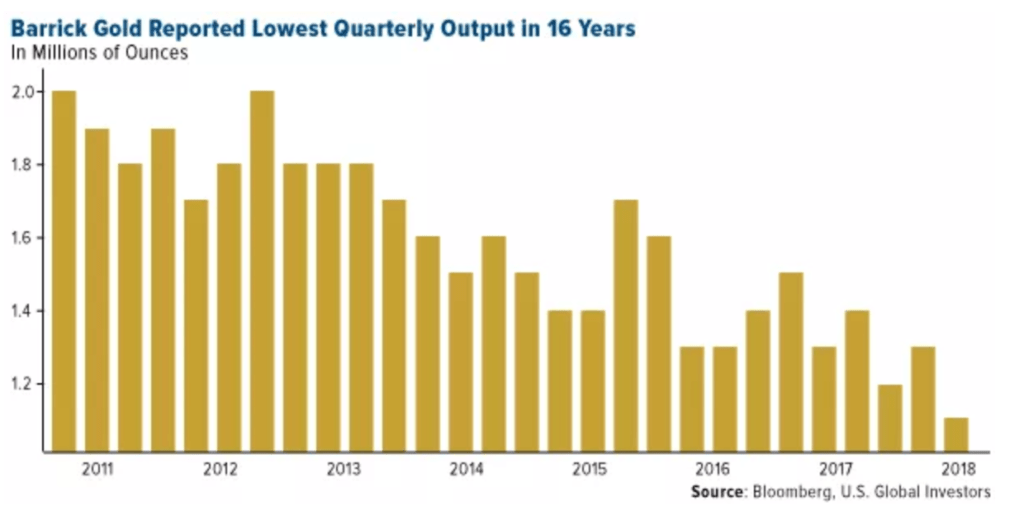
The decline in mining output by the “world’s largest gold miner,” Barrick Gold, seems to point towards undeniable reasons, as we have been saying for the past year, for gold to climb much, much higher. Gold, and silver, will break the chains of the bullion banks’ grip as the gold and silver traders begin to see more charts that look like the one below. This chart should get the attention of any gold bug – especially the trend that really began almost 7 years ago.


chart – Gold Core


It doesn’t take a genius to see a very serious decline in output beginning third quarter 2013 – five years ago. There is the one outlier in mid-2015 but it was completely washed out during the next two quarters. The downward trend seems to be intensifying – lower highs and much, much lower lows.


American Gold Eagle sales in March 2018 fell by 83% compared to March 2017, if that doesn’t constitute a frequency change not sure what does. As we reported last month


If we compare March 2017 to March 2018 we see a dramatic change


A mere 2,500 AGE one ounce coins were sold to the AP’s in March 2018 with an additional 10,000 one-tenth ounce coins (1,000 ounces) being sold as well for a total of 3,500 ounces and 12,500 total coins. Not a single half or quarter ounce AGE coin sold in March 2018. This is an 83% nosedive in sales in the all important year-over-year category in the total amount of gold ounces sold in March. If this were a normal business the doors would be closed, the inventory sold off and business shuttered.


We have been gathering up low mintage American Gold Eagles (AGEs) and Buffaloes and if anyone sees charts like the one below and can not see there may be an opportunity for higher premiums in the future, then it may require a second look.


chart – Gold Core


American Gold Eagles sales collapsed in 2017 and with the exception of three of the past sixteen months, going back to December 2016, sales have been absolutely abysmal. Any of the AGE coins – 1 ounce, 1/2 ounce, 1/4 ounce or 1/10 ounce – minted in 2017 or 2018 has the potential to command much higher premiums over the next few years. Remember, at the end of the day if the premiums collapse in the face of much higher gold values, will it really matter? If a person has the gold bullion that’s all that will matter. As Alasdair Macleod said – If you’ve got gold, you’ve got money. If you don’t have gold, you’ve got a problem – that’s a fact right there.


U.S. Mint American Eagle gold coin sales collapse to weakest April since 2007 giving contrarian value buyers another buy signal


Sales of U.S. Mint American Eagle gold coins dropped to their weakest April since 2007, while silver coin purchases for the month rose 10 percent higher than last year, U.S. government data showed on Monday.


The U.S. Mint sold 4,500 ounces of American Eagle gold coins in April, down 25 percent from the year prior. However, April sales were up 29 percent from March.


During April, spot gold prices rallied to a 2-1/2-month high of $1,365.23 per ounce as concerns over escalating tensions in Syria, U.S. Sanctions on Russia and the U.S.-China trade stand-off weighed on stock markets and helped to knock the dollar index to a two-week low against a basket of currencies. Gold Core


Two years ago during a July 2016 conversation with an independent market analyst, he suggested we had reached an inflection point. It seems he was spot on as the market has completely deteriorated from that time. Mining output has completely collapsed, Pan American silver mine recently shuttered operations and now we learn today the reality of Barrick Gold and their collapsing gold mining output. It is impossible to dig something out of the ground that either no longer exists, or the expense makes it impossible to retrieve. The inflection point Eric Dubin referenced is laid bare for all to see.


Rory Hall’s site is The Daily Coin, where this article first appeared. Beginning in 1987 Rory has written over 1,000 articles and produced more than 300 videos on topics ranging from the precious metals market, economic and monetary policies, preparedness as well as geopolitical events. His articles have been published by Zerohedge, SHTFPlan, Sprott Money, GoldSilver, Silver Doctors, SGTReport, and a great many more. Rory was a producer and daily contributor at SGTReport between 2012 and 2014. He has interviewed experts such as Dr. Paul Craig Roberts, Dr. Marc Faber, Eric Sprott, Gerald Celente and Peter Schiff, to name but a few. Don’t forget to visit The Daily Coin and Shadow of Truth YouTube channels to enjoy original videos and some of the best economic, precious metals, geopolitical and preparedness news from around the world.

Geopolitical Expert: The Coming Financial Crisis Is ‘Going To Be A BLOODBATH’


Charles Nenner, a geopolitical expert, and financial cycle analyst says the coming financial crisis will see the DOW Jones at 5,000. Nenner went on to say that it’s going to be “very bad,” yet he remains “dollar positive.”


Nenner, who appeared in an interview with USA Watchdog’s Greg Hunter said the coming financial crisis will be “Very bad. I called for Dow Jones 5,000, and I still call for Dow Jones 5,000. . . . It’s going to be a bloodbath, but as I said the last time, in the 1990’s when the Dow was 5,000, the world still looked okay.”


“The mainstream media talking heads are telling you to buy, but never tell you to sell,” Nenner says. He added that the time to sell stocks is getting close and explains, “It’s just a hopeless situation. I feel sorry for people who invest their money. We have had a nice ride, but soon the whole thing will come tumbling down. They listen to all these things and have no clue on how to invest . . . . I think soon . . . this will become the longest expansion in financial history. . . . So, this could be the longest expansion ever, what are you playing with? You are gambling with nonsense. So, it’s over.”


Nenner goes on to say, “Then, you have the inflation story. The inflation story is brought about by people who don’t do their historical homework. They remember for the last 30 years, there was always inflation. So, they continue to talk about inflation. I proved that in most of the financial history that deflation is the norm. . . . They have talked about inflation for two years, and there is still no inflation. . . . Copper is going down. Crude is going down, and we have a deflation problem, not an inflation problem.”


When asked about whether or not a big debt reset is coming, Nenner says, “The last time we were in this situation was when Roosevelt was President. It was very interesting because they paid off only 25% on the dollar because the inflation that came. Now, the problem is if you don’t have inflation, you still owe the whole amount of money. This is why they urgently need this inflation. So, the value of the money goes down, and you have to pay off less. There is no inflation. So, it is a big problem, but they can keep this going forever. I don’t think it’s a problem because countries can keep printing money as long as they want.”


The other huge concern is a big cycle Nenner has been seeing and is the so-called “war cycle.” Nenner says, “The next four or five years in this war cycle is very dangerous.” But on gold and silver, Nenner is bullish, but “not until after this summer.”


Geopolitical Expert: The Coming Financial Crisis Is ‘Going To Be A BLOODBATH’


Charles Nenner, a geopolitical expert, and financial cycle analyst says the coming financial crisis will see the DOW Jones at 5,000. Nenner went on to say that it’s going to be “very bad,” yet he remains “dollar positive.”


Nenner, who appeared in an interview with USA Watchdog’s Greg Hunter said the coming financial crisis will be “Very bad. I called for Dow Jones 5,000, and I still call for Dow Jones 5,000. . . . It’s going to be a bloodbath, but as I said the last time, in the 1990’s when the Dow was 5,000, the world still looked okay.”


“The mainstream media talking heads are telling you to buy, but never tell you to sell,” Nenner says. He added that the time to sell stocks is getting close and explains, “It’s just a hopeless situation. I feel sorry for people who invest their money. We have had a nice ride, but soon the whole thing will come tumbling down. They listen to all these things and have no clue on how to invest . . . . I think soon . . . this will become the longest expansion in financial history. . . . So, this could be the longest expansion ever, what are you playing with? You are gambling with nonsense. So, it’s over.”


Nenner goes on to say, “Then, you have the inflation story. The inflation story is brought about by people who don’t do their historical homework. They remember for the last 30 years, there was always inflation. So, they continue to talk about inflation. I proved that in most of the financial history that deflation is the norm. . . . They have talked about inflation for two years, and there is still no inflation. . . . Copper is going down. Crude is going down, and we have a deflation problem, not an inflation problem.”


When asked about whether or not a big debt reset is coming, Nenner says, “The last time we were in this situation was when Roosevelt was President. It was very interesting because they paid off only 25% on the dollar because the inflation that came. Now, the problem is if you don’t have inflation, you still owe the whole amount of money. This is why they urgently need this inflation. So, the value of the money goes down, and you have to pay off less. There is no inflation. So, it is a big problem, but they can keep this going forever. I don’t think it’s a problem because countries can keep printing money as long as they want.”


The other huge concern is a big cycle Nenner has been seeing and is the so-called “war cycle.” Nenner says, “The next four or five years in this war cycle is very dangerous.” But on gold and silver, Nenner is bullish, but “not until after this summer.”


Tuesday, May 1, 2018

“Mayday, Mayday, Mayday”: 13 Random Revelations from April, 2018

This article was originally published by Doug “Uncola” Lynn at TheTollOnline.com


As we travel the stormy seas on the way to our forthcoming destination, thirteen revelations from April, 2018 are now randomly recorded by this mate as follows:


1.) According to a April 22-24, 2018 Fox News poll of 1,014 randomly chosen registered voters nationwide:  Two-thirds said it is at least “somewhat important” that Mueller’s Russia investigation continues, and “56 percent think it’s likely the special council’s probe will find that Donald Trump committed criminal or impeachable offenses”.


2.)  A recent Quinnipiac poll found that 70% of Democratic voters would like to see impeachment hearings begin if Democrats regain control of the House and Senate.


3.) At a rally in Washington Township, Michigan on Saturday, April 28th, Trump claimed Republicans will retain the House and Senate in the 2018 midterm elections because of the economy:


‘Jobs are booming and confidence is soaring. All over the world, they’re talking about this success,’ the president crowed.


Since Trump took office, the U.S. economy has added 2.7 million jobs — an average of 181,000 per month — while growth was fastest in counties that gave Trump the most votes, according to a Washington Post analysis of U.S. Labor Department data.


 4.) According to Kiplinger:  Interest rates will continue rising due to “government deficits and an expanding economy with slightly higher inflation”. This means, although the Fed raised rates only once during Obama’s presidency, they have raised rates five times so far since Trump’s election and with two more increases anticipated in June and December of 2018; plus three to four more hikes expected in 2019. If all those occur, then rates will be raised 10-11 times in the 38 months between Trump’s 2016 election win and the start of 2020.


5.) At an engagement over the weekend attended by my family and friends –  I spoke with several Republican voters and NOT ONE had heard of the April 2018 criminal referrals by Congress to the Justice Department and FBI. In fact, when I informed them of the referrals which included James Comey, Hillary Clinton, Andrew McCabe, and others, most thought I was joking; while one politically conservative relative simply told me he was sick of Trump’s twittering.


6.) On April 12, 2018 – James Mattis, the US Secretary of Defense, admitted there was no evidence of the recent chemical attack in Syria; and the lack of proof was also reported to have been confirmed by the Organization for the Prohibition of Chemical Weapons (OPCW) last week. It looks like Trump may have bombed Syria for nothing, but it’s okay because Americans don’t really care.


7.) At Saturday’s debauched, even x-rated, White House Correspondents’ Association dinner –  hatred, misogyny, and hypocrisy were celebrated even though some CNN reporters in attendance later said it was uncomfortable, cringeworthy, and harsh. Of course, no one expressed outrage DURING comedian Michelle Wolf’s disastrously devious and disrespectful diatribe. Not even one heckler. Not one.


8.) The Political Left is comprised of bona fide racists who, last week, called rap star, Kanye West, and conservative commenter, Candace Owens, “Uncle Tom, Coon, Uncle Ruckus, and other insults”. Moreover, it is now in vogue for comedians like Stephen Colbert to broadcast fried chicken and crazy negro jokes.


9.) In April, the U.S. Department of Justice continued to cover-up the corruption of the same intelligence agencies that Senator Chuck Schumer once claimed had “six ways from Sunday” at “getting back” at Trump. The collusion of the intelligence agencies against a constitutionally elected president is now a matter of public record and the legal double standards have been exposed for all to see. It appears the Justice Department’s latest strategies are to stall, or comprehensively redact, the release of documents and to ignore deadlines imposed by Congress in the hopes of a Blue Wave this fall carrying, and burying, all of their dirt back into the swamp.


10.) The unprecedented and disgraceful April 9, 2018 raid  of a lawyer currently representing the sitting President of the United States, proves that both the constitution, and attorney client privilege, are now dead in America. It is, perhaps, fitting the raid was the result of a referral from Robert Mueller’s likely illegal special counsel investigation.


11.) Trump’s allies are drowning in legal fees, his pick to lead Veteran’s affairs was forced to withdraw from the nomination process, and his immigration policies remain overturned by federal judges.


12.) The head coordinator for an illegal migrant caravan that is now attempting to invade the U.S. southern border, is originally from Mexico and remains a permanent resident of Minnesota. If the caravan was legitimately seeking political asylum, they would have remained safe within Mexico’s borders; yet they all kept marching north. That means any claims of asylum were always a farce and, although Attorney General Jeff Sessions has called the caravan “a deliberate attempt to undermine our laws and overwhelm our system”, none of its organizers here in America appear to be in any legal jeopardy at this time.


13.) Congressman Mo Brooks (R-AL) has recently stated that many of the Republicans who have announced their retirement from Congress in 2018, did so for fear of being assassinated by crazed, gun-toting leftists.


Indeed. Transitions are markers to what will pass as our voyage traverses the ocean of time from history to revelations unknown. So stay awake, keep your eyes on the horizon, your hands steady at the helm, and, look for true north to guide some, but not all. Most importantly, keep your life preservers near and dear.


Up and down, round and round it goes; how it ends, we just don’t know. Either the storm will pass or the ship will sink. All aboard and bottoms up. Anchors away.


It’s May.