Showing posts with label Economic history of the United States. Show all posts

Monday, December 25, 2017

The Dollar"s Reign As The Global Reserve Currency Is Running Out - Fast

The dollar’s hegemony over the global financial system can’t last forever. Like all things, it will eventually come to an end.


The only question left, as MacroVoices" Erik Townsend puts it, is whether we’re in the second inning and there’s going to be another hundred years of the dollar serving as the world’s global reserve currency? Or whether we’re in the bottom of the ninth and it’s all about to fall apart? Or maybe somewhere in between.


In an interview with Jeffrey Snider, CIO at Alhambra Partners, Luke Gromen, founder of Forest for the Trees, and Mark Yusko, founder and fund manager for Morgan Creek, Townsend explores the issue in greater detail. For many, the decline of the dollar as the world’s reserve currency is difficult to imagine. But the first blow to the petrodollar system has already been delivered: By refusing to accept oil payments in dollars, Venezuela has demonstrated to the world that an alternative system to the petrodollar is indeed possible. Furthermore, Latin America’s socialist paradise has begun publishing an oil-price index denominated in yuan. We"ve also highlighted reports that Russia, Venezuela and Iran - three countries that have trouble accumulating dollars because of Treasury Department sanctions - are considering launching a cryptocurrency backed by oil.


Townsend begins his interview with Gromen, who points out that, counterintuitively, the dollar’s rapid appreciation beginning in Q3 2014 has coincided with a drop in the share of global trade settled in dollars. Gromen predicts that this trend will continue to benefit the dollar – until it doesn’t.


I would probably say in the later innings. Certainly the last third of the game. Maybe the eighth inning.


The reason I say that is that, given the Eurodollar system as it’s structured, early on, if any nations or major parties wanted to move away from using the dollar for any number of reasons, ironically, what that moving away from the dollar would do would drive significant dollar strength. So, ironically, accelerating moves to dump the dollar in global trade usage, which in the long run is the most bearish development for the dollar, in the near term is the most bullish development for the dollar.


And so when we look back, we think, beginning in 3Q14 was when you started to see a marked acceleration in the dollar’s share loss in global trade. And, in particular, in energy trade centered between China and Russia. And so we think things began to accelerate in 3Q14 and, like we’ve said, the process of moving away from the dollar, or the dollar losing share in trade, is a big positive for the dollar – until it’s not.


However, Gorman believes an important shift happened in Q3 2016 when the dollar’s share loss in global trade started to accelerate. At that point, the dollar’s climb from 2014 and 2015 had already been unwound to a degree. Furthermore, Gorman posits that the dollar will weaken because it’s in the national security interest of the US for the dollar to weaken.


And then the “until it’s not” part of this movie began over a year ago now, in 3Q16. The reason we say that is because from 3Q14 until 3Q16 you saw a rising dollar, rising Libor, and a pretty traditional dollar strengthening cycle up to that point.


Where it started to become non-traditional relative to what pretty much any market participant trading in markets today – or even alive today – was when in 3Q16 rising dollar, rising Libor, drove a year-over- year decline in US tax receipts and therefore an increase in the US deficit as a percent of GDP. And it did this before you had a major emerging crisis.


This was the first time the US’s tax receipts declined before a major emerging market crisis, in a dollar-tightening cycle, in the post-Bretton Woods period.


And so, then, when you combine that with what has become effectively a system that requires as infinitum asset price appreciation in order to drive tax receipts for the US government, it sets up – beginning in 3Q16, where we started to get into late innings of this game. Where, not only are foreign creditors looking to move away from the dollar in trade usage for a number of reasons, but it also started to become a matter of national security for the


US government for the dollar to weaken.


Moving on, Townsend turns next to Jeff Snider, CIO at Alhambra investments. Snider explains how the Eurodollar system harms emerging-market economies and ultimately weakens the global financial system with each cycle of tightening.


The last tightening cycle, which lasted from 2014 through 2016, was particularly destabilizing, Snider explained, particularly for emerging markets like Brazil, Russia, and China. Many EM countries and corporations based in those countries issue dollar-denominated debt, which becomes more expensive to pay down when the greenback climbs.


But, for now at least, Snider expects the system to endure – if for no other reason than there’s nothing to take its place.


My position is that the dollar system, the supply of dollars in the global network of trade, continues to be a problem. But it isn’t a problem in a straight line. It’s not like it’s a straight-line decay from where you can draw a singular line from 2007 to 2013. Instead, it’s more of an intermittent type of thing where we have these alternating periods where things tighten up. Then they loosen up relatively.


But, as we go through each of these periods, the system is worse off for having gone through each one. And so the last tightening episode, starting in 2014 and lasting through 2016, was severe. Especially in emerging markets like Brazil, Russia, and China, the BRICs, because that’s where that part of the dysfunction was focused. More in FX and more into the Asian part of the system, as it has evolved since 2007 in that direction.


So, from my perspective, nothing has really changed except the system continues to get weaker. And I think right now where we are is we’re waiting for the next tightening event to start taking place. That there’s plenty of evidence that the system continues to decay, particularly with China and some of the other emerging markets.


So it doesn’t add up to a bullish position, necessarily. And I think that’s one of the things I want to define, is what exactly is a rising dollar? And it’s not bullish. And I’m certainly not of the position that most dollar bulls take, which is that the dollar goes up because the US is going to strengthen either economically, financially, or otherwise. I think that’s just not the case. So if we couch these in terms of the Eurodollar system and its continued decay, it’s not a bullish thing. But I think the dollar continues to go up, at least for the next little while. Because, frankly, there is nothing there to take its place.


So we’re kind of stuck with it.


Moving on, while Yusko didn’t feel comfortable attaching an expected expiration date for global dollar hegemony, he did draw some interesting parallels between the dollar and the British pound, the global reserve currency that immediately preceded the dollar.


You know, the interesting thing about world reserve currency is there have been lots of them over time. And I always joked that Americans are like Notre Dame football fans – they remember a past that never was. Notre Dame football fans think that we win all the time, which, clearly, we don’t. I was down in Miami. That was horrible.


And, you know, Americans think that we’ve always been the world reserve currency, for some reason. And we clearly haven’t. It’s only been since 1944. What’s interesting about that is the transition can last a long time. The sun never set on the British Empire for 70 years. They had the world reserve currency. They had the strongest navy.


And then in 1913 they invaded Mesopotamia, incurred a bunch of debt, the pound sterling collapsed, the dollar ascended. We, 31 years later, became the world reserve currency. And then in 2013, we (coincidentally) invaded Mesopotamia, incurred a bunch of debt, the dollar collapsed, and the Renminbi ascended.


Well, that hasn’t all happened yet. But I think it’s on its way to happening. And when I look around the world, I think it’s supremely clear that China has a plan. And for the last 50 years, their stated goal was a harmonious rise.


Doesn’t that sound poetic? It’s beautiful. It’s non-confrontational.


Ultimately, Yusko believes the Chinese yuan will replace the dollar as the world’s reserve currency sometime before 2050, the time by which Yusko expects China will become the dominant global power.


This contrasts with the consensus view, that, after the dollar, there won’t be one dominant currency, but several in separate spheres of influence.


The conversation is part one of a five-part series from MacroVoices exploring the dollar’s future as the world’s dominant currency.


Readers can listen to the whole conversation below:


The podcast targeting pro finance and sophisticated investors, hosted by Hedge Fund Manager Erik Townsend


Friday, December 15, 2017

Swedish Housing Bubble Pops As Stockholm Apartment Prices Crash Most Since June 2009

Even though Sweden’s property bubble is not the longest running (that accolade goes to Australia at 55 years), it is probably the world’s biggest with prices up roughly 6-fold since starting its meteoric rise in 1995.


Of course, as we noted last month when the SEB"s housing price indicator, which measures the difference between those who believe prices will rise and those who expect them to drop, took its first substantial tumble, the era of the steadily inflating housing bubble in Stockholm may finally have come to an end.


Sweden


Now, it seems that the "hard data" is aligning with the "soft data" as Swedish home prices across the Nordic country posted their first decline since the spring of 2012, down 0.2% year-over-year and 2.9% sequentially.  Per Bloomberg:


The property market in the largest Nordic economy is rapidly cooling after years of price increases that were driven largely by housing shortages and ultra-low interest rates. Supply is now outstripping demand and stricter mortgage rules, as well as growing apprehension among households, are driving prices lower. The drop is being led by high-end apartments in Stockholm.


According to Maklarstatistik’s number, nationwide apartment prices fell a monthly 3 percent in November, adding to October’s 1 percent drop. House prices fell 1 percent in the month, after being unchanged in October. Apartment prices in greater Stockholm fell 3 percent in the month and were down 4 percent from a year earlier, the first such decline in almost six years.


Worse yet, the slump in Stockholm specifically is even more dramatic with apartment prices down 4.2% sequentially, the steepest since October 2008, and 6.0% year-over-year, the biggest June 2009.


Not surprisingly, the sudden pricing collapse has sparked a bit of a panic supply boost as sellers attempt to beat the bursting of the bubble.  Of course, we"re sure this strategy will work out perfectly, as it always does, because nothing helps correct an over-supplied market like a massive flood of even more supply. 


Greater supply “has resulted in buyers having more to choose from and taking longer before buying,” Hans Flink, head of sales and business development at Maklarstatistik, said in a statement. “The sellers are therefore starting to adjust their prices to the tougher competition, which is pushing prices down somewhat.”


Luckily, Bloomberg was able to find at least one economist who dug up some "rather encouraging" signs amongst the wreckage...


But there may be glimmers of hope. Andreas Wallstrom, an economist at Nordea Bank AB in Stockholm, said data for the last few weeks from property-listings website Booli “are rather encouraging,” as they indicate that prices have leveled out since mid-November and up until the first week of December. Average prices per square meter have even increased somewhat in both Stockholm and in the country as a whole in that period, he said.


“Our tentative call for December is that home prices will stay unchanged compared to November,” Wallstrom said. “In all, we forecast relatively stable home prices from here. To see a sustained downturn in prices, it will likely require a change in households’ housing costs. As long as mortgage rates remain low, which we expect, it is difficult to see a marked decline.”


Of course, we remember some Bear Stearns analysts who saw similarly "rather encouraging" signs in the U.S. housing market back in 2008...


Sunday, October 8, 2017

I Know What the Economy Did Last Summer Part 2: The Real Estate Rollover

A global 2017 housing bubble may be ready to collapse.

In fact, I knew what the economy did last summer before summer even began. Since the beginning of the year, I have been writing that it appeared housing was reaching a new bubblicious peak and that the real estate market was getting ready to roll over. Just before the start of the summer, I confirmed that prediction by saying that it looked like that process had begun. I anticipate it will be a slow turnover at first, just as it was in 2007, which did not reach free fall until late in 2008. Likewise, I anticipate the present decline will not reach free fall until 2018.

While housing played out about as I expected this summer (see below), the more obvious collapse right now is developing in metropolitan commercial real estate, particularly in retail space due to the retail apocalypse. Even longtime commercial real-estate mogul Sam Zell warned last week that he would not consider investing any capital in retail real estate. In Zell’s words, the real estate landscape looks “like a falling knife.”


“An area that’s in this much disarray, with so many weak players, is not an area where I would want to deploy capital at this time. And I’m generally a contrarian, and I generally rub my hands together at the opportunity for serious dislodgment, but I think what we’re dealing with here is very significant… It’s going to be very hard to take that shopping center land and redevelop it with all of these competing people having rights.” (Newsmax)


Zell sees retail’s mortal throes as a violent struggle that is going to take a few years to play out.


A second problem the commercial real estate bubble faces (and Zell describes it as a bubble in that there is way too much space dedicated to retail in the US compared to other nations), is that Chinese investors are being forced to exit, and they have been a major support to that space. In Manhattan, for example, Chinese investors have made half of all commercial real estate purchases. The Chinese government decided this summer to squeeze that dry in order to stop the flow of yuan out of the country. In London and Australia, Chinese buyers accounted for about a quarter of commercial real-estate purchases. The Chinese government is pressuring Chinese banks to stay away from these deals.


Morgan Stanley estimates that China overseas direct property investment could plunge by 84% in 2017 and another 15% in 2018. (Business Insider)


After a seven-year boom, commercial real estate prices peaked this year with July showing the first year-over-year decline. Transactional volume also declined 8% in the first half of 2017 with the second quarter turning out to be the third consecutive quarter to see year-on-year declines. Without the Chinese bellows pumping a lot of oxygen into the fire, it looks like the flame is going out.


The second US housing bubble in a decade started showing several signs of topping this summer


Exactly as predicted on this blog…


U.S. homebuilding unexpectedly fell in July amid broad declines in single- and multi-family home construction, suggesting the housing market was struggling to rebound after slumping in the second quarter. Housing starts declined 4.8 percent. (Newsmax)


While it was “unexpected” to economists, who couldn’t even see the Great Recession coming, it certainly wasn’t unexpected here. I pointed out during the second quarter that the slump back then looked like the beginning of a rollover in housing that would become more evident in the summer. July added momentum to spring’s decline; at which point, June also also got revised downward. The concurrent decline in building permits indicated the deteriorating condition of the housing market would persist.


Housing is now falling at its steepest pace since 2010. New-home sales fell even harder in July than new-home construction, crashing a whopping 9.4% month on month. That amounted to an 8.9% plunge year on year and established a seven-month low. (Economists had actually expected a 0.3% gain! I can only wonder how they came by their lame prediction.)


Then homebuilding fell again in August when a rebound in single-family home construction was more than offset by persistent weakness in multi-family home construction and when the number of permits issued for new single-family homes took yet another drop, while the permits for multi-family homes went up. In all, a mixed month.


Likewise, pending sales dropped in August, backtracking 2.6% (YoY) to their lowest since January of last year to which the chief economist of the National Association of Realtors said the housing market has been drained of all of its past year’s momentum. He attributed this in large part to home prices having risen far above incomes.


The continual decline in sales (number of houses sold) means that housing prices have to start falling again, which so far they have resisted, in order for homes to start to become affordable under rising interest rates. Affordability based on the slight rise in income over the huge rise in prices since the Great Recession is at the lowest it has been since 2008, so buyer pessimism about ever being able to afford a house is rising quickly.


With another bump in interest from the Federal Reserve anticipated by nearly everyone in December, a price decline is now inevitable as there are very few potential buyers left at current prices. Each hike reduces the number of qualified potential buyers unless prices drop or wages rise. Of course, falling prices will also mean homes start to go underwater on their mortgages. Then defaults will start to rise as a result because adjustable rates will go up some, and people who bought to flip will be underwater; everyone will be less able to refinance. The math is the same as in 2007.


The summer plunge, therefore, shouldn’t have surprised any economist, given that rising interest rates are certain to force people out of the market when wages are not rising and prices have risen a lot in many regions. Immigration is also tightening, thereby reducing the number of first-time buyers. One has to wonder how economists missed all of this. How are house-warming parties not going to come to an end when the cheap booze is taken away? Apparently economists learned nothing from the situation that created the Great Recession. Nor did politicians, for we are right back where we were in the fall of 2007.


In fact …


U.S. consumers slowed their borrowing in August to an annual pace of 4.2 percent — a pullback from a pace of nearly 7 percent over the past three years.(Newsmax)


Of course they did. How could they not? While those figures do not include mortgages, the same forces are at work in both credit markets.


Moreover …


Economists and financial markets monitor the consumer borrowing report for insights about consumer spending, a category that represents about 70 percent of U.S. economic activity.


So, how could a 40% slowdown in the annual expansion of consumer borrowing (compared to the previous three years) not be indicative of an economy that is showing some major cracks, as I had said we’d see emerge this summer?


The hurricanes’ helping hand for housing construction strikes a blow to banks and insurance


As noted in other articles, the recent hurricanes are bound to help the housing construction market, as a massive number of new homes will have to be rebuilt and old homes will have to be repaired; but economically, that doesn’t really help the economy overall (as also noted earlier). As with auto sales, the hurricanes shift the hurt from one part of the economy to another as insurance companies, banks, and the national debt all take major hits. (Banks were not fully covered by insurance on these mortgages because not all homes were in areas that required flood insurance to get a loan.)


According to Black Knight Financial Services, of the 1 million or so mortgaged homeowners in the [Hurricane Harvey] disaster area, more than 75,000 will become delinquent within two months, and 45,000 are at risk of becoming seriously delinquent or even face foreclosure inside a four-month period. (Newsmax)


[As assessments of damage continued, Black Knight updated its figures to 300,000borrowers in the vicinity of Houston (and adding Florida) could become delinquent on their loans and 160,000 could become seriously delinquent, or more than 90 days past due. And the count for Irma is still unfolding.]


If the latest figures prove out, it will amount to, at least, a 25% increase in nationwide foreclosures just from Hurricane Harvey! $700 billion in mortgage balances are at some level of increased risk in those two hurricane areas. That means the reconstruction after Hurricanes Harvey, Irma and Maria (and now unfolding … Nate) will be happening at a time when banks will be less able to make loans or, at least, lest likely, as they are entering a period of intensified strains.


I would also expect some lag between the loss of housing construction that was already underway before Harvey and the pickup in housing that will come in its aftermath. That’s because debris has to be cleared out of the way, infrastructure repaired, materials brought in, permits issued, plans made, qualified labor hired, etc.


All of this is likely to make prices rise even higher because of labor shortages and material shortages. Labor shortages, however, may mean a lot of reconstruction has to wait for a long time. (All good news if you’re a carpenter, plumber, electrician, etc.; but not if you’re not.) The downward effects of the hurricanes are likely to be far greater in the near term than any lift from reconstruction:


“With the pace of housing starts in July and August retreating, and a likely depressed September, we now anticipate that housing starts will fail to expand much, if at all, in the third quarter,” said Kristin Reynolds, a U.S. economist at IHS Markit in Lexington, Massachusetts. (Reuters)


Overall, growth in construction in the US dropped this summer to its lowest level since 2011, matching the growth level it held just before the financial crisis in the fall of 2007 — a common theme in Summer’s data.


And this last week brought another piece of data in common with that theme of reverting back to the mean of Great Recession statistics:


Wall Street was completely clueless ahead of today’s payroll, with most expecting a small positive print but two brave forecasters went so far as to predict that the recent hurricanes would result in a negative print, and sure enough, moments ago the BLS reported that in September, the US economy lost 33,000 hurricane distorted jobs, the first payrolls decline since September 2010. (Zero Hedge)


The hurricanes forced the first decline in jobs since the tail end of the Great Recession. While that’s an anomaly, it’s an anomaly that is starting to sound like a new statistical trend toward reversion.


Non-farm payroll change chart


As anticipated, none of this stopped the Federal Reserve from commencing with its great QE unwind this month.


So, three major cracks that I have been predicting all showed up this year on schedule:


  1. A significant decline in auto sales and prices and accompanying rise in auto loan defaults.

  2. A major decline in retail sales, resulting in rising defaults and mall and store closures.

  3. The start of a rollover in real estate.

(See “I Know What the Economy Did Last Summer Part 1 : Carmageddon and the Retail Apocalypse.”)


I’ll close with a summary of the summer from Jeffrey Snider that isn’t very summery:


We can’t pretend as if the economy was cooking before Mother Nature interfered. It wasn’t. If one thing has become absolutely clear about the economy in 2017, it is that it has fallen off dramatically when compared to the last half of 2016. This is the opposite of what was supposed to happen, what most people and all Economistswere expecting. The rebound off the early 2016 trough was only the first part of bigger things, or so it may have seemed. For reasons beyond the mainstream grasp, however, the farther into 2017 we go the farther away that dream seems to get.(TalkMarkets)


In my next article, I’ll review the stock market where I said I anticipate a crash sometime between the start of summer and January of 2018. While a stock-market crash has not yet begun, I allotted myself a broader window for that one, noting that central banks could easily hold the market up well beyond the start of summer now that stocks are entirely rigged by central banks … even to the point of CB’s directly purchasing certain companies that are most notably driving the market up.

Friday, September 29, 2017

Rickards Warns "Cracks In The Dollar Are Getting Larger"

Authored by James Rickards via The Daily Reckoning,


Many readers are familiar with the original petrodollar deal the U.S made with Saudi Arabia.


It was set up by Henry Kissinger and Saudi princes in 1974 to prop up the U.S. dollar. At the time, confidence in the dollar was on shaky ground because President Nixon had ended gold convertibility of dollars in 1971.


Saudi Arabia was receiving dollars for their oil shipments, but they could no longer convert the dollars to gold at a guaranteed price directly with the U.S. Treasury. The Saudis were secretly dumping dollars and buying gold on the London market. This was putting pressure on the bullion banks receiving the dollar.


Confidence in the dollar began to crack. Henry Kissinger and Treasury Secretary William Simon worked out a plan. If the Saudis would price oil in dollars, U.S. banks would hold the dollar deposits for the Saudis.


These dollars would be “recycled” to developing economy borrowers, who in turn would buy manufactured goods from the U.S. and Europe. This would help the global economy and help the U.S. maintain price stability. The Saudis would get more customers and a stable dollar, and the U.S. would force the world to accept dollars because everyone would need the dollars to buy oil.


Behind this “deal” was a not so subtle threat to invade Saudi Arabia and take the oil by force.


I personally discussed these invasion plans in the White House with Kissinger’s deputy, Helmut Sonnenfeldt, at the time. The petrodollar plan worked brilliantly and the invasion never happened.


Now, 43 years later, the wheels are coming off. The world is losing confidence in the dollar again. China just announced that any oil-exporter that accepts yuan for oil can convert the oil to gold on the Shanghai Gold Exchange and hedge the hard currency value of the gold on the Shanghai Futures Exchange.


The deal has several parts, which together spell dollar doom.


The first part is that China will buy oil from Russia and Iran in exchange for yuan.


The yuan is not a major reserve currency, so it’s not an especially attractive asset for Russia or Iran to hold. China solves that problem by offering to convert yuan into gold on a spot basis on the Shanghai Gold Exchange.


This straight-through processing of oil-to-yuan-to-gold eliminates the role of the dollar.


Russia was the first country to agree to accept yuan. The rest of the BRICS nations (Brazil, India and South Africa) endorsed China’s plan at the BRICS summit in China earlier this month.


Now Venezuela has also now signed on to the plan. Russia is #2 and Venezuela is #7 on the list of the ten largest oil exporters in the world. Others will follow quickly. What can we take away from this?


This marks the beginning of the end of the petrodollar system that Henry Kissinger worked out with Saudi Arabia in 1974, after Nixon abandoned gold.


Of course, leading reserve currencies do die — but not necessarily overnight. The process can persist over many years.


For example, the U.S. dollar replaced the UK pound sterling as the leading reserve currency in the 20th century. That process was completed at the Bretton Woods conference in 1944, but it began thirty years earlier in 1914 at the outbreak of World War I.


That’s when gold began to flow from the UK to New York to pay for badly needed war materials and agricultural exports.


The UK also took massive loans from New York bankers organized by Jack Morgan, head of the Morgan bank at the time. The 1920s and 1930s witnessed a long, slow decline in sterling as it devalued against gold in 1931, and devalued again against the dollar in 1936.


The dollar is losing its leading reserve currency status now, but there’s no single announcement or crucial event, just a long, slow process of marginalization. I mentioned that Russia and Venezuela are now pricing oil in yuan instead of dollars. But Russia has taken its “de-dollarization” plans one step further.


Russia has now banned dollar payments at its seaports. Although these seaport facilities are mostly state-owned, many payments, like those for fuel and tariffs, were still conducted in dollars. Not anymore.


This is just one of many stories from around the world showing how the dollar is being pushed out of international trade and payments to be replaced by yuan, rubles, euros or gold in this case.


I believe gold is ultimately heading to $10,000 an ounce, or higher.


Now, people often ask me, “How can you say gold prices will rise to $10,000 without knowing developments in the world economy, or even what actions will be taken by the Federal Reserve?”


It’s not made up. I don’t throw it out there to get headlines, et cetera.


It’s the implied non-deflationary price of gold. Everyone says you can’t have a gold standard, because there’s not enough gold. There’s always enough gold, you just have to get the price right.


I’m not saying that we will have a gold standard. I’m saying if you have anything like a gold standard, it will be critical to get the price right.


The analytical question is, you can have a gold standard if you get the price right; what is the non-deflationary price? What price would gold have to be in order to support global trade and commerce, and bank balance sheets, without reducing the money supply?


The answer is, $10,000 an ounce.


I use a 40% backing of the M1 money supply. Some people argue for 100% backing. Historically, it’s been as low as 20%, so 40% is my number. If you take the global M1 of the major economies, times 40%, and divide that by the amount of official gold in the world, the answer is approximately $10,000 an ounce.


There’s no mystery here. It’s not a made-up number. The math is eighth grade math, it’s not calculus.


That’s where I get the $10,000 figure. It is also worth noting that you don’t have to have a gold standard, but if you do, this will be the price.


The now impending question is, are we going to have a gold standard?


That’s a function of collapse of confidence in central bank money, which is already being seen. It’s happened three times before, in 1914, 1939 and 1971. Let us not forget that in 1977, the United States issued treasury bonds denominated in Swiss francs, because no other country wanted dollars.


The United States treasury then borrowed in Swiss francs, because people didn’t want dollars, at least at an interest rate that the treasury was willing to pay.


That’s how bad things were, and this type of crisis happens every 30 or 40 years. Again, we can look to history and see what happened in 1998. Wall Street bailed out a hedge fund to save the world. What happened in 2008? The central banks bailed out Wall Street to save the world.


What’s going to happen in 2018?


We don’t know for sure.


But eventually a tipping point will be reached where the dollar collapse suddenly accelerates as happened to sterling in 1931. Investors should acquire gold and other hard assets before that happens.


The Global Housing Bubble Is Biggest In These Cities

Two years ago, when UBS looked at the world"s most expensive housing markets, it found that London and Hong Kong were the only two areas exposed to bubble risk.


What a difference just a couple of years makes, because in the latest report by UBS wealth Management, which compiles the bank"s Global Real Estate Bubble Index, it found that eight of the world"s largest cities are now subject to a massive speculative housing bubble.  And while perpetually low mortgage rates are clearly to blame for the rapid ascent of home prices, Chinese money laundering operations clearly seem to also be playing a role as their favorite markets of Vancouver, Toronto and Sydney all made this year"s list.


Bubble risk seems greatest in Toronto, where it has increased significantly in the last year. Stockholm, Munich, Vancouver, Sydney, London and Hong Kong all remain in risk territory, with Amsterdam joining this group after being overvalued last year. Valuations are stretched in Paris, San Francisco, Los Angeles, Zurich, Frankfurt, Tokyo and Geneva as well. In contrast, property markets in Boston, Singapore, New York and Milan seem fairly valued, while Chicago remains undervalued, just as it was last year.


Price bubbles are a regularly recurring phenomenon in property markets. The term “bubble” refers to a substantial and sustained mispricing of an asset, the existence of which cannot be proved unless it bursts. But recurring patterns of property market excesses are observable in the historical data. Typical signs include a decoupling of prices from local incomes and rents, and distortions of the real economy, such as excessive lending and construction activity. The UBS Global Real Estate Bubble Index gauges the risk of a property bubble on the basis of such patterns.


As UBS points out, artificially low interest rates in Europe, for example, have kept mortgage payments below their 10-year average despite real prices surging 30% since 2007. 


Falling mortgage rates over the last decade have made buying a home vastly more attractive, which increased average willingness to pay for home ownership. In European cities, for example, the annual usage costs for apartments (mortgage interest payments and amortization) are still below their 10-year average, despite real prices escalating 30% since 2007. In Canada and Australia, too, a large part of the negative impact of higher purchase prices on affordability was cushioned by low mortgage rates.


The intuition is that the national and global growth of high-wealth households creates continued excess demand for the best locations. So, as long as supply cannot increase rapidly, prices in the so-called “Superstar cities” are supposed to decouple from rents, incomes and the respective countrywide price level. The superstar narrative has received additional impetus in the last couple of years from a surge in international demand, especially from China, which has crowded out local buyers. An average price growth of almost 20% in the last three years has confirmed the expectations of even the most optimistic investors.


Of course, at some point even artificially low interest rates can"t offset 10%-20% annual real home price increases, which imply a doubling of prices every 4-7 years.  


Annual price-increase rates of 10% correspond to a doubling of house prices every seven years, which is not sustainable. Nevertheless, the fear of missing out on further appreciation predominates among home buyers. After all, the price increases appear rational, for three reasons.


First, financing conditions in many cities are now more attractive than ever before. Second, the global increase in wealthy households seemingly creates constant demand for the most attractive residential areas. Third, building activity cannot keep pace with this demand.


Expectations tend to be prone to exaggerations in boom phases. The optimistic projections of the trends outlined above create ever-greater price fantasies. However, should sentiment change or interest rates increase, a correction is practically inevitable. In the past, rising interest rates almost always triggered a crash in housing markets. In addition, the dependence of prices on international flows of capital represents an incalculable risk. Plus, once demand fell, even the low growth in supply would no longer provide an anchor.


Meanwhile, the U.S. has managed to avoid UBS"s bubble territory, and a repeat of the 2007 housing crisis, for now...even though markets like San Francisco and Los Angeles look set to give it another try...


Friday, September 22, 2017

"You're Going To See A Rush For Gold" - Katusa Warns De-Dollarization Is Accelerating

Authored by Mac Slavo via SHTFplan.com,


Global strategist Marin Katusa is the New York Times best selling author of The Colder War, which details the geo-political power shift that threatens the global dominance of the United States. He’s also a well known resource hedge fund manager who legendary investor Doug Casey has called one of the best market analysts he’s ever worked with.


His prior forecasts noted that countries around the world would soon stop trading commodities like oil in the U.S. dollar, something we’re already seeing with China, Russia, Iran, and Venezuela, all of which are preparing non-dollar, gold-backed mechanisms of exchange.


This trend, according to Katusa in a must see interview with Future Money Trends, will only continue to weaken the U.S. dollar going forward and the result will be a massive capital flight to gold in coming years:


I think we’ll have a near term bounce on the U.S. dollar… then it’s going to be very weak… and then it’s going to go much, much lower… With China and Russia working together to de-dollarize the U.S. dollar starting with oil, which is the biggest market… and then all the other commodities.


You’re going to start seeing a massive unwind of these U.S. dollars in the emerging markets.


...


When that money comes back… which it will… and the world starts cluing in that the emerging markets need gold to convert the Yuan and the Ruble and all these different factors, you’re going to see a massive rush for gold.


Watch the full interview:


Katusa notes that he is preparing to “load up” on gold-based assets as the dollar strengthens and puts additional pressure on gold prices, but says that by next year major fund managers will start moving capital back into precious metals in response to dollar weakness, global de-dollarization and economic crisis:


Everybody wants to rush in when something’s exciting… but you take your position before the massive flow of money…


I think we have a near term dead cat bounce for the U.S. dollar… which will mean we’re going to have a little bit of weakness here in gold in the near term… the next six months is my time to load up.


…And when the funds flow come in… it’s going to be the equivalent of Niagra Falls coming through your garden hose.


The geo-political realignment taking place now stands to upend the financial and economic systems as we know them. This shift will not come without crisis and panic. The time to position yourself in gold-based assets is now.

Monday, September 11, 2017

Poverty, Prosperity, and Precious Metals

Written by Jeff Nielson, Sprott Money News


In the 20th century; by the end of the 1960’s, Western societies and especially Canada and the United States reached a level of prosperity never seen before – or since. Since the early 1970’s; the standard of living across the Western world has been in a relentless trajectory downward.


An article from April 2012 noted that the standard of living in the United States had already fallen by more than 50% since its zenith. Since that time, the standard of living in the U.S. (and across the West) has been devoured by 5 ½ years more “inflation” – the same “inflation” that the criminal bankers and corrupt politicians insist does not exist.


At the end of the 1960’s; a chocolate bar cost a dime. Today, a smaller version of that same chocolate bar costs close to a dollar. That 90% loss in purchasing power of the paper in our wallets is all inflation.


The beginning of the collapse in our standard of living in the early 1970’s wasn’t the only event of note at that time. The early 1970’s also marked the end of the gold standard.


Coincidence?


From the end of World War II until the end of the gold standard, the standard of living across the Western world went almost straight up. Since Paul Volcker assassinated the gold standard, our standard of living has gone straight down. Seventy-five years of “coincidence”?


Of course not. The Criminals themselves have already confessed to their crime.


In the absence of the gold standard, there is no way to protect savings[wealth] from confiscation [theft] through inflation.


- Alan Greenspan


The correct, economic definition of inflation is simple: an increase in the supply of money. Print and steal. The bankers print more of their funny-money, and that dilution causes the value of the sunny-money to decline.


Where does the wealth go? Where has the 90% loss in the purchasing power of our paper gone since the bankers assassinated the gold standard? Into the bankers’ vaults.


All of the new funny-money that is printed up is handed to the Big Banks. The Big Banks, and only the Big Banks (and their oligarch owners) are immune to the crime of print-and-steal. Everyone else loses.


For 1,000 years, this has been the bankers’ Game. That is why for 1,000 years, every one of their paper fiat currencies has gone to zero. Print-and-steal long enough and eventually you reach zero.


The affluence of the end of the 1960’s was obvious: two-car garages, with only one wage-earner. Virtually everyone who wanted to own their own home could afford to do so, with no more than a 20-year mortgage.


Today, with the typical family, it’s two wage-earners and a one-car garage – for the fortunate minority who can afford to live in their own home. For many of the Working Poor, it’s two wage-earners, an apartment, and no car. And they are still luckier than many: the Homeless People. No car. No roof.


This is what 45+ years of print-and-steal has produced. Readers have been previously alerted to this crime against humanity.


At first glance, this chart may be indecipherable to some, insignificant to others. Look closer.


We see that even though the West and India have nearly identical populations, the West has more than 20% more of the poorest-of-the-poor. When we compare the West with Africa, we see that the West (with a slightly greater population) hosts a slightly greater percentage of the poorest-of-the-poor. In proportionate terms; the West and Africa have roughly identical percentages of the poorest-of-the-poor.


Let me repeat this. When it comes to the poorest people on Earth, as percentages of our populations, there are now more of the poorest-of-the-poor in the West than in India, and a virtually identical percentage when compared to Africa.


To be clear, when considering starvation-level poverty, the plight is still worse in so-called Third World nations. However, when it comes to the lowest two deciles of wealth (the bottom 20%), in proportionate terms there are more of such people in the West than in India – and the same amount as in Africa.


Things aren’t much better for the 30% of the population right above that.


About half of Canadian workers living paycheque to paycheque: survey


Print and steal. From one wage earner and a two-car garage to “paycheque to paycheque”.


Print and steal. The bankers’ Crime can’t continue for another 45 years because print-and-steal does more than impoverish populations. It bankrupts entire societies.


Global Debt Hits 325% Of World GDP, Rises To Record $217 Trillion


Most of this debt has been created in the West: 10% of the world’s population, more than half of the world’s debts. Debt Jubilee is now inevitable in the West. For most of the Rest of the World it will be a matter of choice: not allowing only the West’s Deadbeat Debtors to walkaway from their debts.


Greece already tried for its own Debt Jubilee – after its economy was totally destroyed by the economic terrorism of the One Bank. The bankers said “no”, telling this bankrupt nation that it had to borrow more money. How perverse is that?


As the holder of all these (illegal and unenforceable) debts, the One Bank will try to delay Debt Jubilee as long as possible. Until then, it is just more print-and-steal. But we do not have to be victims.


Our corrupt governments refuse to protect us from print-and-steal by resurrecting the gold standard. So there is no protection available at the Systemic level. However, we can still protect ourselves as individuals.


Regular readers and astute investors know the antidote to print-and-steal: precious metals. The logic could not be more elementary.


The crime of print-and-steal is how the bankers loot the wealth from inside our paper. How do we protect ourselves? We don’t hold our wealth inside the bankers’ paper. We store our wealth in gold and silver. There it is safe from the One Bank.


Forget about the phony paper prices for gold and silver. Their only significance is a favorable exchange rate when we jettison more of the bankers’ paper.


With our wealth safely stored in gold and silver, all that the Criminals are capable of doing is to temporarily depress the paper exchange rate – they are the Rulers of all that (fraudulent) paper. They can do no more than that. And even here it is important to maintain perspective.


Two thousand years ago in ancient Rome; with a one-ounce gold coin a gentlemen could purchase a suit of the finest clothing, along with accessories – a hand-made toga, belt, and sandals.


Five hundred years ago; with a one-ounce gold coin a gentleman could purchase a tailor-made suit, along with accessories.


Today, despite decades of the One Bank attacking the price of gold, with a one-ounce gold coin we can still buy a suit and accessories. We just have to buy “off the rack”.


Compare that to the 90% loss in purchasing power with the bankers’ paper. There is no comparison. Safety, or financial rape.


Paper = poverty. Precious metals = prosperity. It is a simple equation.


For a small number, they can earn more wealth even faster than the bankers are stealing it. For everyone else, the bankers’ paper is a one-way ticket to poverty.


Ignore the paper prices. Remember the equation. It may be your only financial hope.


Questions or comments about this article? Leave your thoughts HERE.


Written by Jeff Nielson, Sprott Money News


Friday, August 25, 2017

Paul Craig Roberts Explains How We Know The So-Called "Civil War" Was Not Over Slavery

Authored by Paul Craig Roberts,


When I read Professor Thomas DiLorenzo’s article, the question that lept to mind was, “How come the South is said to have fought for slavery when the North wasn’t fighting against slavery?”


Two days before Lincoln’s inauguration as the 16th President, Congress, consisting only of the Northern states, passed overwhelmingly on March 2, 1861, the Corwin Amendment that gave constitutional protection to slavery. Lincoln endorsed the amendment in his inaugural address, saying “I have no objection to its being made express and irrevocable.”


Quite clearly, the North was not prepared to go to war in order to end slavery when on the very eve of war the US Congress and incoming president were in the process of making it unconstitutional to abolish slavery.


Here we have absolute total proof that the North wanted the South kept in the Union far more than the North wanted to abolish slavery.


If the South’s real concern was maintaining slavery, the South would not have turned down the constitutional protection of slavery offered them on a silver platter by Congress and the President. Clearly, for the South also the issue was not slavery.


The real issue between North and South could not be reconciled on the basis of accommodating slavery. The real issue was economic as DiLorenzo, Charles Beard and other historians have documented.


The North offered to preserve slavery irrevocably, but the North did not offer to give up the high tariffs and economic policies that the South saw as inimical to its interests.


Blaming the war on slavery was the way the northern court historians used morality to cover up Lincoln’s naked aggression and the war crimes of his generals.


Demonizing the enemy with moral language works for the victor. And it is still ongoing. We see in the destruction of statues the determination to shove remaining symbols of the Confederacy down the Memory Hole.


Today the ignorant morons, thoroughly brainwashed by Identity Politics, are demanding removal of memorials to Robert E. Lee, an alleged racist toward whom they express violent hatred. This presents a massive paradox. Robert E. Lee was the first person offered command of the Union armies. How can it be that a “Southern racist” was offered command of the Union Army if the Union was going to war to free black slaves?


Virginia did not secede until April 17, 1861, two days after Lincoln called up troops for the invasion of the South.


Surely there must be some hook somewhere that the dishonest court historians can use on which to hang an explanation that the war was about slavery. It is not an easy task. Only a small minority of southerners owned slaves. Slaves were brought to the New World by Europeans as a labor force long prior to the existence of the US and the Southern states in order that the abundant land could be exploited. For the South slavery was an inherited institution that pre-dated the South. Diaries and letters of soldiers fighting for the Confederacy and those fighting for the Union provide no evidence that the soldiers were fighting for or against slavery. Princeton historian, Pulitzer Prize winner, Lincoln Prize winner, president of the American Historical Association, and member of the editorial board of Encyclopedia Britannica, James M. McPherson, in his book based on the correspondence of one thousand soldiers from both sides, What They Fought For, 1861-1865, reports that they fought for two different understandings of the Constitution.


As for the Emancipation Proclamation, on the Union side, military officers were concerned that the Union troops would desert if the Emancipation Proclamation gave them the impression that they were being killed and maimed for the sake of blacks. That is why Lincoln stressed that the proclamation was a “war measure” to provoke an internal slave rebellion that would draw Southern troops off the front lines.


If we look carefully we can find a phony hook in the South Carolina Declaration of Causes of Secession (December 20, 1860) as long as we ignore the reasoning of the document. Lincoln’s election caused South Carolina to secede. During his campaign for president Lincoln used rhetoric aimed at the abolitionist vote. (Abolitionists did want slavery abolished for moral reasons, though it is sometimes hard to see their morality through their hate, but they never controlled the government.)


South Carolina saw in Lincoln’s election rhetoric intent to violate the US Constitution, which was a voluntary agreement, and which recognized each state as a free and independent state. After providing a history that supported South Carolina’s position, the document says that to remove all doubt about the sovereignty of states “an amendment was added, which declared that the powers not delegated to the United States by the Constitution, nor prohibited by it to the States, are reserved to the States, respectively, or to the people.”


South Carolina saw slavery as the issue being used by the North to violate the sovereignty of states and to further centralize power in Washington. The secession document makes the case that the North, which controlled the US government, had broken the compact on which the Union rested and, therefore, had made the Union null and void. For example, South Carolina pointed to Article 4 of the US Constitution, which reads: “No person held to service or labor in one State, under the laws thereof, escaping into another, shall, in consequence of any law or regulation therein, be discharged from such service or labor, but shall be delivered up, on claim of the party to whom such service or labor may be due.” Northern states had passed laws that nullified federal laws that upheld this article of the compact. Thus, the northern states had deliberately broken the compact on which the union was formed.


The obvious implication was that every aspect of states’ rights protected by the 10th Amendment could now be violated. And as time passed they were, so South Carolina’s reading of the situation was correct.


The secession document reads as a defense of the powers of states and not as a defense of slavery. Here is the document: http://teachingamericanhistory.org/library/document/south-carolina-declaration-of-causes-of-secession/


Read it and see what you decide.


A court historian, who is determined to focus attention away from the North’s destruction of the US Constitution and the war crimes that accompanied the Constitution’s destruction, will seize on South Carolina’s use of slavery as the example of the issue the North used to subvert the Constitution. The court historian’s reasoning is that as South Carolina makes a to-do about slavery, slavery must have been the cause of the war.


As South Carolina was the first to secede, its secession document probably was the model for other states. If so, this is the avenue by which court historians, that is, those who replace real history with fake history, turn the war into a war over slavery.


Once people become brainwashed, especially if it is by propaganda that serves power, they are more or less lost forever. It is extremely difficult to bring them to truth. Just look at the pain and suffering inflicted on historian David Irving for documenting the truth about the war crimes committed by the allies against the Germans. There is no doubt that he is correct, but the truth is unacceptable.


The same is the case with the War of Northern Aggression. Lies masquerading as history have been institutionalized for 150 years. An institutionalized lie is highly resistant to truth.


Education has so deteriorated in the US that many people can no longer tell the difference between an explanation and an excuse or justification. In the US denunciation of an orchestrated hate object is a safer path for a writer than explanation. Truth is the casualty.


That truth is so rare everywhere in the Western World is why the West is doomed. The United States, for example, has an entire population that is completely ignorant of its own history.


As George Orwell said, the best way to destroy a people is to destroy their history.

Saturday, July 22, 2017

How The Elites Betrayed Working-Class America

Authored by Bill Bonner via InternationalMan.com,


Win-win deals get people more of what they want. Win-lose deals – usually imposed by government – bring them less. The few (the insiders) use government to exploit the many (the rest of us).


Win-lose deals also depress economic progress for everybody. Partly, this happens for an obvious reason.


Dropping the atom bomb on Hiroshima was a technical milestone, but not the kind of progress we’re talking about. Progress only makes sense if it means that people are able to get more of what they want.


By definition, when a person is forced into a bad deal, he gets less of what he wants.


Progress is also a learning process. You try something. You see what works and what doesn’t. As people experiment in this way, they learn… and the economy accumulates knowledge and wealth.


They learn to get to work in the morning, for example… to say please and thank you… to save their money… and to invest it wisely.


Win-lose deals interrupt the learning process. That’s why welfare programs fail: People get money without learning.


Temptation to Cheat


That is the real reason the Soviet Union failed, too.


Consumers were forced to buy whatever shoddy products were made available to them; producers had no way to learn how to make good ones.


Toward the end, products available for purchase in the Soviet Union were worth less than the raw materials and labor that went into them.


What do you need for win-win deals?


Three things:


1) People must be free to make choices with their time and money.


2) They must have money they can trust.


3) They must trust each other to respect their rights and property.


These things don’t happen smoothly and without interruption.


Progress is cyclical. Win-win deals add wealth and move society forward. But they depend on trust. And as trust increases, so does the temptation to cheat. When everyone leaves his liquor cabinet open, for example, who can resist having a drink?


Then trust declines. Barriers go up. Costs increase. Win-win gives way to win-lose. Progress goes into reverse.


Money You Could Trust


The invention of real money – based on gold – gave a boost to win-win deals… and to progress.


Why?


It was money you could trust.


If you are paid a gold coin for a day’s labor, you don’t have to trust the person who pays you. You don’t have to wonder if he has the money in his account to cover his check… or what will happen to his money in the future.


You don’t have to trust him; you put your trust in gold. This allows you to do transactions more freely – and speeds up economic progress.


Gold-backed dollars were trustworthy for nearly 200 years (setting aside Lincoln’s phony “greenbacks”).


People became so confident in the integrity of the dollar that they hardly noticed when the gold backing was removed (on March 19, 1968, when President Johnson signed a bill eliminating the “gold cover” for Federal Reserve notes).


But that’s the way it works: The more trusting people become, the easier it is to rip them off.


Set Up by the Elite


Of course, as trust expands and win-win deals proliferate, some people gain more than others.


The typical Chinese day laborer makes six times as much today as he did in 1999. The typical American day laborer has gained little.


And job competition from overseas made him feel like a loser. Now he wants walls – to keep out foreigners and foreign-made products. He wants win-lose deals that guarantee to make him a winner again.


He has no idea that he was set up by his own elite.


Former Fed chiefs Ben Bernanke and Alan Greenspan got their pictures on the cover of Time magazine. Most people think they are heroes, not rascals. Most people think they saved the economy from another Great Depression by dropping interest rates and injecting it with trillions of dollars in quantitative easing (QE) money.


Most people – even the POTUS – believe we need more fake money to “prime the pump” and get the economy rolling again.


Almost no one realizes it, but it was these stimulating, pump-priming, new credit-based dollars that fueled the trends that ruined America’s working-class wage earner.


Overseas, his competitors used cheap credit to gain market share and take away his job. At home, the elite imposed their crony boondoggles… their regulations… and their win-lose deals – all financed with fake money.


The average American’s medical care now costs him more than seven times more than it did in 1980. His household debt rose nearly 12 times since 1980.


Subtle “Bezzle”


He blamed the Chinese, the Mexicans, the liberals… the media… and the government.


He wanted change.


But who would have guessed that he had been ripped off by his own untrustworthy money?


After you account for inflation, the American worker has not had a significant raise in 40 years – almost since the new money system was put into place after 1971.


But the rich – as measured by the inflation-adjusted Dow – are 10 times richer.


Who would have imagined that after 3,000 years, the elite would have come up with money that betrayed his trust… a “bezzle” so subtle that he didn’t even notice?


*  *  *


Recently we’ve been wondering if it’s possible that America could be on the brink of a second civil war. We did some digging… and while the stuff we found may offend and shock you… We recommend you take a look anyway by clicking here.

Monday, July 17, 2017

Stockholm Syndrome Gold Report, 16 July 2017

Stockholm Syndrome is defined as “…a condition that causes hostages to develop a psychological alliance with their captors as a survival strategy during captivity.” While observers would expect kidnapping victims to fear and loathe the gang who imprison and threaten them, the reality is that some don’t.


There is a loose analogy between being held hostage and being an investor in a regime of irredeemable paper currency and zero interest rates. In both cases, the victim has little hope of escape and must seek to somehow survive under malevolent conditions.


Key behaviors in Stockholm Syndrome are positive feelings for their captors, a refusal to work with law enforcement afterwards, and even a belief in the terrorist’s humanity.


Key behaviors of investors today show eerie parallels: a desire to bid on dollars with their assets, a refusal to support the gold standard, and even a belief that the dollar is money. This last always shows when someone—even a gold bug—says gold is going up, or gold is the best performing currency, or gold has good returns.


These words up, performance, and returns indicate that the victim accepts the dollar as money, the dollar as the measure of value, the dollar as the unit of account. The victim seeks to view gold in terms of his captor’s paradigm. Much the way the kidnapping victim seeks to understand his capture and even geopolitics in terms of his captor’s world view.


Many victims are so thoroughly in thrall, that they scoff at the very idea of earning interest from a productive enterprise. They seek only the latest bubble, wherein they can make a profit: more dollars. Or, if not more dollars, at least more purchasing power. For years, they sought to do this in the gold and especially silver markets. Some gold bugs go even farther, and opposed a gold standard. Perhaps they don’t want sound money, they want gold to go up which means something external that gold can go up against.


We watched bemused, as a speaker at the Metal Writers Conference in Vancouver on May 29 told a standing-room-only crowd that bitcoin would hit $1 million (it went up after that, but is now down about 15% from that day). A 436X return would be nice, but of course the profits can only come from later speculators. There is an ugly little word for schemes in which profits come from those who buy in later. It is named for a gentleman who came from Italy, promoting his scheme in Boston.


We blame the game, not the player. It is important to emphasize this—don’t blame the players, blame the game—and we probably don’t do it enough. The fault lies not with those who bet on gold or bitcoin or anything else, nor even with those who regard betting as investing. The fault lies with the Fed and the other central banks who have the hubris to think they can centrally plan their way to prosperity. And the gun to force it on us, whether we agree or not. And the madness to cause the interest rate to fall for 36 years and counting (the Fed is not going to push the interest up much farther in this cycle, if they even dare one more hike). When freedom seems so remote as to be hopeless, it may be natural (we leave this to psychologists to say) to find a way to compromise, to get along to go along.


As to us, we will go on working towards that day of freedom, a big part of which is helping people see the monetary system for what it is: the current implementation of the fifth plank proposed by Karl Marx. Another part is to pay interest on gold…


Last week, we said:


“Peak hype, peak desperation, all selling in the streets with little buying… we are not technicians and do not focus on sentiment… but this description sounds like the definition of capitulation.


Also, we would add something important. Even if this is a capitulation low, that does not necessarily a mean a moonshot to $5,000 or even $2,000. We don’t expect that, and won’t expect it without evidence of a much more serious shift in the fundamentals. We would expect a normal trading bounce within the range and perhaps a few bucks over $1,300.”


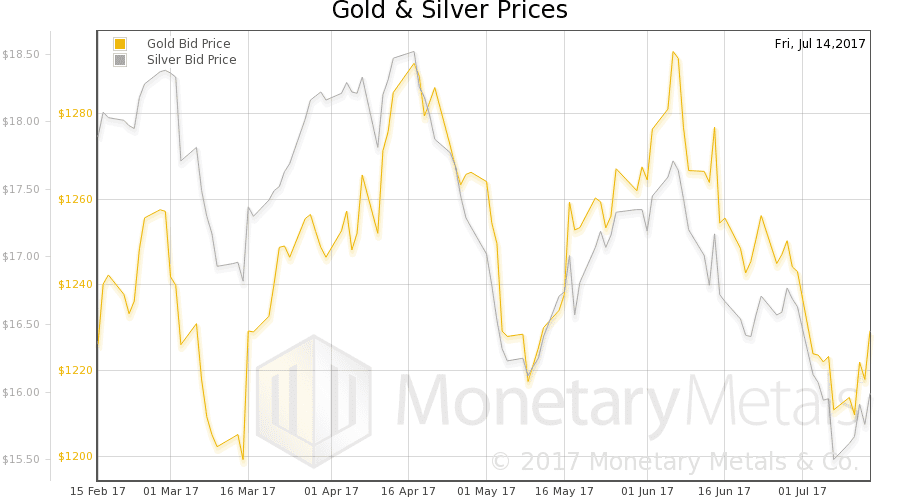
This week, the prices of the metals bounced somewhat, within the trading range. Gold closed last week at $1212, and this week at $1229. In silver, last week’s close was $15.56, and this’s week was $15.96.


Will the bounce continue? Have the fundamentals firmed up?


We will show graphs of the true measure of the fundamentals. But first charts of their prices and the gold-silver ratio.


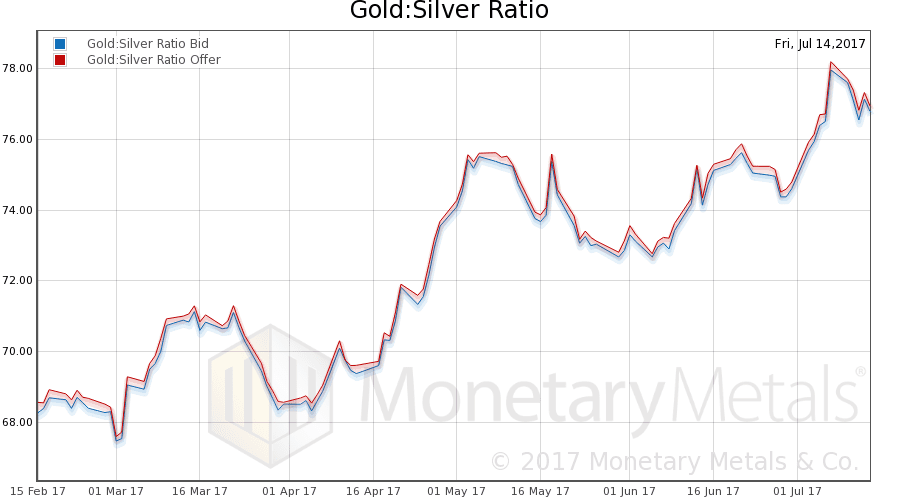
Next, this is a graph of the gold price measured in silver, otherwise known as the gold to silver ratio. The ratio moved down this week.


In this graph, we show both bid and offer prices for the gold-silver ratio. If you were to sell gold on the bid and buy silver at the ask, that is the lower bid price. Conversely, if you sold silver on the bid and bought gold at the offer, that is the higher offer price.


For each metal, we will look at a graph of the basis and cobasis overlaid with the price of the dollar in terms of the respective metal. It will make it easier to provide brief commentary. The dollar will be represented in green, the basis in blue and cobasis in red.


Here is the gold graph.


The dollar fell a bit this week (the mirror image of the rising price of gold). Now it is the dollar hostages who use gold as their preferred hostage-bargaining chip to feel a bit better. One ounce of this commodity now fetches 17 more of the kidnapper’s paper scrip than it did a week ago.


As the dollar fell, the cobasis fell (especially in farther-out contracts). The August cobasis is still above zero (i.e. temporary backwardation).


Our calculated gold fundamental price is not much changed, still above the market price by a goodly margin (chart here).


Now let’s look at silver.


As the dollar has dropped (i.e. silver trades for more gang-scrip than last week), the cobasis has come down. But it’s still higher than gold’s cobasis, and this is the September contract, a month further from expiry than the August gold contract.


Our calculated silver fundamental is rising again, also a healthy margin above the market price.


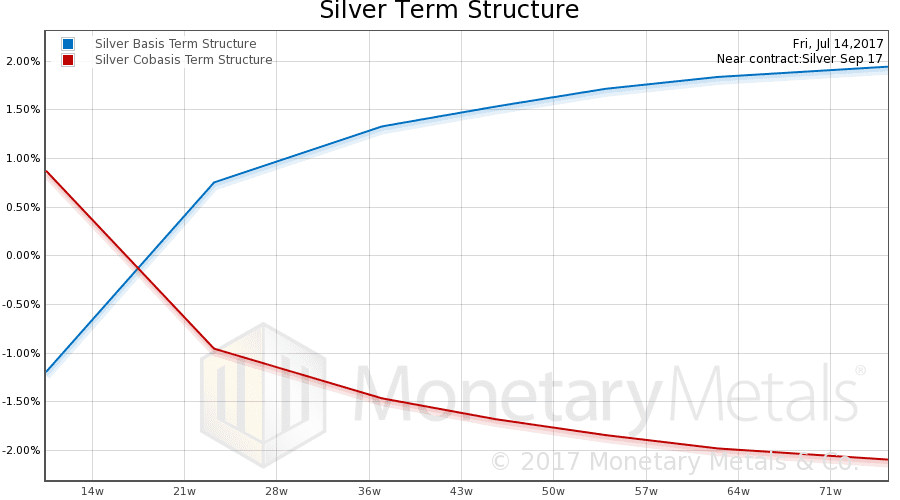
We thought it would be worth addressing the question: “is there a shortage in silver?” Let’s do it with a device that’s famously worth 1,000 words. This picture shows the term structure of the silver futures market.


What we see is what Sherlock Holmes observed that people heard in the night in the story Silver Blaze. There are no interesting features. Other than the temporary backwardation in the September contract, we see a rising basis and falling cobasis as we look out to December 2018. The rising basis looks a lot like the yield curve in the dollar, though slightly lower (6-month LIBOR is 1.5%).


If a real shortage developed in silver, the above curve would look quite different. And we would be publishing pictures of it.


Monetary Metals will be exhibiting at FreedomFest in Las Vegas in July. If you are an investor and would like a meeting there, please click here. Keith will be speaking, on the topic of what will the coming gold standard look like.


© 2017 Monetary Metals

Saturday, June 17, 2017

The Treasonous Secession Of Climate Confederacy States

Authored by Daniel Greenfield via FrontPageMag.com,


After President Trump rejected the Paris Climate treaty, which had never been ratified by the Senate, the European Union announced that it would work with a climate confederacy of secessionist US states.


Scotland and Norway’s environmental ministers have mentioned a focus on individual American states. And the secessionist governments of California, New York and Washington have announced that they will unilaterally and illegally enter into a foreign treaty rejected by the President of the United States.


The Constitution is very clear about this. “No state shall enter into any treaty.” Governor Cuomo of New York has been equally clear. “New York State is committed to meeting the standards set forth in the Paris Accord regardless of Washington"s irresponsible actions.”


Cuomo’s statement conveniently comes in French, Chinese and Russian translations.


“It is a little bold to talk about the China-California partnership as though we were a separate nation, but we are a separate nation,” Governor Brown of California announced.


In an interview with the Huffington Post, the radical leftist described California as “a real nation-state”.


Brown was taking a swing through China to reassure the Communist dictatorship of California’s loyalty to an illegal treaty at the same time as EU boss Juncker was bashing America and kissing up to Premier Li Keqiang at the EU-China summit. It’s one thing when the EU and China form a united front against America. It’s quite another when California and China form a united front against America.


The Climate Alliance of California, New York, Washington, Vermont, Massachusetts, Connecticut, Oregon, Colorado, Hawaii, Virginia and Rhode Island looks a lot like the Confederacy’s Montgomery Convention. Both serve as meeting points for a secessionist alliance of states to air their grievances against the Federal government over an issue in which they are out of step with the nation.


"We’re a powerful state government. We have nine other states that agree with us," Brown boasted.


Two more and Jim Jones" old pal could have his own confederacy.


All the bragging and boasting about how much wealth and power the secessionist states of the climate confederacy represent sounds very familiar. But that wealth and power is based around small enclaves, the Bay Area and a few dozen blocks in Manhattan, which wield disproportionate influence.


Like the slaveowner class, leftist elites are letting the arrogance of their wealth lead them into treason. And as they look out from their mansions and skyscrapers, they should remember that the majority of working class people in California and New York will be far less enthusiastic about fighting a war to protect their dirty investments in solar energy plants and carbon credits funded by taxes seized from many of those same people in these left-wing slave states.


The declared intention of the Climate Alliance, in words appearing on the New York State government website, is to treasonously “convene U.S. states committed to upholding the Paris Climate Agreement”.


States cannot and are not allowed to unilaterally choose to “uphold” a treaty rejected by the President. Their leaders are certainly not allowed to travel to enemy nations to inform foreign powers of their treasonous designs and to solicit their aid against the policies of the United States government.


This is all the more treasonous at a time when the United States is on a collision course with the People’s Republic of China over North Korea’s nuclear weapons and trade agreements.


“It’s important for the world to know that America is not Washington," Brown declared. "Yes, we’re part of the union, but we’re also a sovereign state that can promote the necessary policies that are required for survival.”


Governors don’t normally feel the need to declare that their state is still part of the union. But they also don’t announce that they’re a separate nation and then set off to cut separate deals with enemy powers. No state should be issuing, “Yes, we’re part of the union, but” disclaimers before going to China.


The disclaimer is the first step to leaving the union.


Governor Brown"s trip to China isn"t funded by California taxpayers. That might be a relief to that overburdened tribe except that it"s partially being paid for by the Energy Foundation. Behind that generic name for a pass through organization are a number of left-wing foundations who have been paying for American politicians to travel to the People’s Republic of China.


Donors to the energy foundation include Ecocrat billionaire Tom Steyer who has pumped millions into EF. Steyer’s finances are entangled with China and even with members of the Chinese government.


Steyer has accused President Trump of treason for rejecting the unconstitutional Paris Climate Treaty. But who are the real traitors here?


Other major EF donors include the Rockefeller Brothers Fund, Bloomberg and George Soros.


There is something deeply troubling about a governor’s treasonous trip being funded by private interests with business ties to a foreign power. If Democrats were really serious about rooting out influence by foreign powers, they would be taking a very close look at Brown’s backers.


But the greater outrage is that the governors of secessionist states are using a manufactured crisis to conduct “diplomacy” with foreign governments in defiance of the policies of the United States.


Washington’s Jay Inslee was recently talking Global Warming in a meeting with Canadian PM Justin Trudeau. “We’re both very strongly engaged on issues of climate change, on issues of openness to trade, on leadership on refugees as well,” Trudeau declared.


“We share an incredible commitment to defeating climate change,” Inslee flattered him. “And it is a great pleasure we have a national leader on the North American continent who is committed to that.”


And he didn’t mean the President of the United States.


Inslee’s fondness for the illegal Paris Climate treaty is unsurprising as his own efforts on Global Warming similarly depended on unilateral moves that lacked legislative support. But that is a problem for Washington’s Constitution. His participation in a secessionist pact is a problem for our Constitution.


And the problem isn’t limited to the Climate Alliance.


California and many of the other entities declaring that they will enforce an illegal treaty are also sanctuary states and cities. They are choosing not to follow Federal law while implementing foreign treaties that they have no right to unilaterally participate in.


This is a treasonous situation that is more troubling in some ways than the original Civil War because it involves states making open alliance with enemy powers such as China and welcoming them in. State governments are undermining the united front of the national government in the face of the enemy.


"California will resist this misguided and insane course of action," Governor Brown ranted. The logic of “resistance” has inevitably turned into treason.


A civil war is underway. In the last election the territorial majority of Americans rejected the rule of a minority of wealthy and powerful urban enclaves. Outside of their bicoastal bases, the political power of the Democrat faction has been shattered. And so it has retreated into subversion and secessionism.


“China is moving forward in a very serious way, and so is California,” Brown declared. “And we"re going in the opposite direction of Donald Trump.”


While Democrats have spent the better part of the previous week waving their arms in the air over a back channel with Russia, one of their faction’s leading governors is openly allying with China against the President of the United States. And the treasonous Democrat media is cheering this betrayal.


Brown and his colleagues are in blatant violation of the Logan Act. Their actions are in violation of the United States Constitution. And all this is another dark step on the road to another civil war.


If the climate confederacy is not held accountable for its treason, the crisis will only grow.