Gold and silver have risen substantially off the price bottom put in just 2-½ years ago, but the gains have yet to attract much notice. Gold has gained roughly 28% and silver is up 20%.
Meanwhile, another metal has more than doubled since bottoming. This performance should have been more than enough to catch the attention of metals investors, if only they were watching. The metal is palladium and, for those who haven’t paid much attention, it is time for a brief update.
Palladium is one of the platinum group metals (PGMs) and it has a lot in common with its higher profile brother.
Like platinum, palladium is a lustrous, silver-white metal. It has many of the same applications. The largest application is in automobile catalytic converters, but there are also uses in jewelry, dentistry, surgical instruments, and electronics.
Palladium also shares platinum’s troubled supply chain.
The top producers are Russia and South Africa. The latter nation has fallen deeper into turmoil in recent months.
Mines there have dealt with unreliable electricity and labor strife for years. Operators are now at great risk of the having mine properties seized by government officials.
PGMs represent a good way for bullion investors to diversify and gain exposure to different market fundamentals.
Diversification can reduce the volatility in any investment and can produce better results – particularly in weaker markets. Just consider the relative outperformance of palladium versus gold and silver over the past 30 months.
Investing in palladium makes sense for investors who anticipate rising demand for cars and trucks which produce lower emissions globally. If the economies of China and India continue to develop rapidly, demand for the metal should keep rising. It will not take a lot of additional demand to completely outstrip supplies.
One wild card is the adoption of electric vehicles, which do not have catalytic converters and require very little of the metal. For now, these types of vehicles are more costly and have severe limitations in terms of range and power.
Palladium Bullion Options
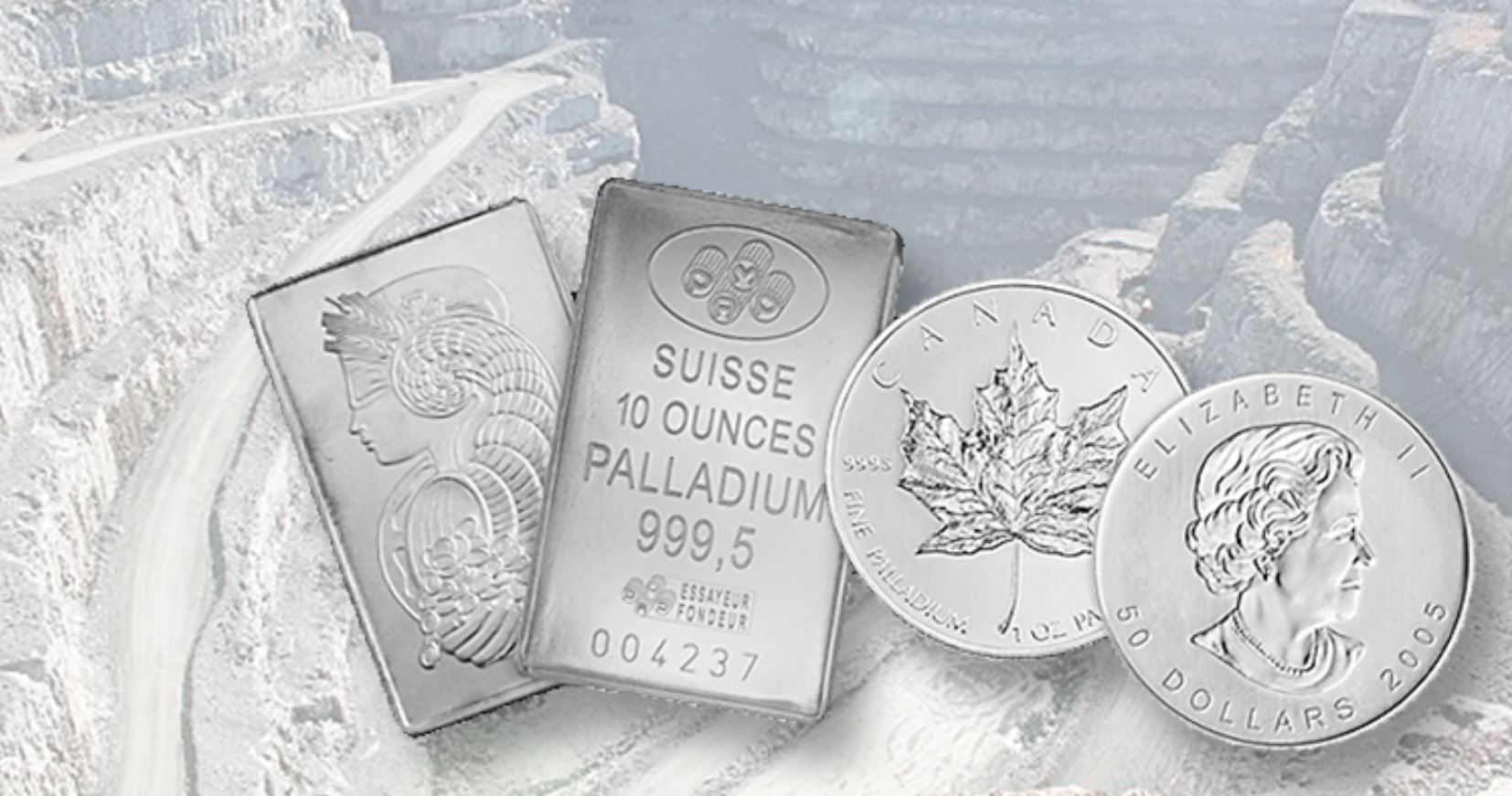
The number of product options available to bullion investors has grown. The U.S. Mint produced a 1 oz palladium American Eagle for the first time in 2017.
The small issuance of those coins sold out very quickly, but more are expected in 2018 and the number of coins minted will likely increase.
The Royal Canadian Mint has been producing a palladium Maple Leaf since 2005, though not consistently each year. Today, this is the best option for investors who want an official, government issue coin. They are almost always in stock and premiums are affordable.
Finally, investors can get palladium in bar form. Bars in assay packaging from Swiss refiners such as PAMP and Credit Suisse are comparably priced to the Maple Leaf. And there are more size options available – including 1-gram and 10-ounce.
Clint Siegner is a Director at Money Metals Exchange, the national precious metals company named 2015 “Dealer of the Year” in the United States by an independent global ratings group. A graduate of Linfield College in Oregon, Siegner puts his experience in business management along with his passion for personal liberty, limited government, and honest money into the development of Money Metals’ brand and reach. This includes writing extensively on the bullion markets and their intersection with policy and world affairs.
Gold and silver expert David Morgan recently appeared in an interview with USA Watchdog‘s Greg Hunter. Morgan said point blank that “if the Deep State gets pushed into a corner much further, they can basically pull the plug,” and may just crash our economy.
Morgan explains why he thinks it is a great idea to have some physical gold and silver in your portfolio. “That means the stock market could come tumbling down, and then they [the deep state] could blame the Trump Administration,” said Morgan.
“If you are losing the chess game, you just get up and turn the table over and the pieces go flying everywhere. That is a metaphor for a war. That’s a metaphor for crashing the stock market. That’s a metaphor for crashing the bond market, and it’s a metaphor for it happening on its own. I am concerned that if you win, you lose. This is why the unraveling is being done extremely carefully,” he continued.
“I am not saying it is going to happen. I am saying it could happen. These people are so used to winning a rigged game, if they start being caught, and they have been caught, then they are going to do things that are not necessarily predictable. They are not going to act in a rational manner. They are going to do anything possible to protect themselves. You cannot rule out the possibility that they will turn the table over and that’s it.”
Morgan explains that the problem with the market is its manipulation by the deep state. Once they begin to lose their grip on those they feel are underneath them, they could just “end the chess game” by “flipping the table.”
A good portion of the interview shows Morgan discussing the importance of silver.
There is some free information on TheMorganReport.com regarding precious metals. You can also become a subscriber to The Morgan report and get much more timely and detailed analysis of the financial markets. If you want to find out more about the “cryptographic silver monetary system” mentioned by Morgan in the interview, click here to go to Ag.Lode.One.
It is generally well known in economic circles and in the general public that precious metals, including gold, tend to be the go-to investment during times of fiscal uncertainty. There is a good reason for this. Precious metals have foundation qualities that provide trade stability; these include inherent rarity (rather than artificially engineered rarity such as that associated with cryptocurrencies), tangibility (you can hold gold in your hand, and it is relatively difficult to destroy accidentally), and precious metals are easy to trade. Unless you are attempting to make transactions overseas, or in denominations of billions of dollars, precious metals are the most versatile, tangible trading platform in existence.
There are some limitations to metals, but the most commonly parroted criticisms of gold are in most cases incorrect. For example, consider the argument that the limited quantities of gold and silver stifle liquidity and create a trade environment where almost no one has currency to trade because so few people can get their hands on precious metals. This is a naive notion built upon a logical fallacy.
Gold backed paper currencies existed for centuries in tandem with the metals trade. Liquidity was rarely an issue, and when such events did occur, they were short lived. In fact, the last great liquidity crisis occurred in 1914, the same year the Federal Reserve began operations and the same year that WWI started. This crisis was, as always, practically fabricated by central banks around the globe. Benjamin Strong, the head of the New York Fed in 1914 and an agent of the JP Morgan syndicate, had interfered with the normal operations of gold flows into the U.S. and thus sabotaged the natural functions of the gold standard.
Central banks in Germany, France and England also applied influence to disrupt currency and gold flows, causing a global panic. This engineered disruption seemed to take place through conscious co-operation between central banks. Does any of this sound familiar?
For those who are interested, the history of the 1914 liquidity crisis is outlined in detail in the book ‘Lords Of Finance: The Bankers Who Broke The World’, by Liaquat Ahamed.
When gold and currency are tied together, gold prices tend to remain rather stable, as they are often set by the national treasury. In 1914, the price of gold was $20 per ounce and had maintained that approximate value for decades. To give some perspective on value, in 1914 the average house cost $3,500, or 175 ounces of gold.
But what happens when gold and national currencies become disjointed from each other? Take a look at the hyperinflationary crisis in Weimar Germany. The price of gold per ounce went from 170 marks to 87 trillion marks within five years! Over that same five year period, gold value in Germany had increased at almost TWICE the rate of inflation, indicating that gold not only kept up with the devaluing mark, but made anyone holding gold rather rich in the process.
This is a very important fact. The common argument against gold is that the metal is not really a wealth creating investment, but merely protects your buying power. As the Weimar crisis shows, this is not always the case. In some circumstances, often during times of economic disaster, precious metals can in fact generate more wealth than what you put into them.
Then there is the issue of government interference in gold markets and trade during crisis. As the Great Depression in the U.S. began to take hold, investors turned aggressively to gold and silver as a means to offset the crashing values of most other assets. In a highly controversial move in 1933, President Roosevelt outlawed the private ownership of gold bullion and set the price of gold at $35 per ounce.
Keynesian economists like Ben Bernanke often try to assert that the gold standard was the reason why interest rates had to be hiked as the depression was escalating, and that this was the cause of a greater crash. They are only half correct. Increased rates did indeed cause a larger and more prolonged crisis, but this had little to do with the gold standard.
Clearly, in 2008 the U.S. and most of the world was NOT on a gold standard, yet we suffered a very similar collapse in credit and equities as happened in the Great Depression. Also, there is no gold standard forcing the Federal Reserve to raise interest rates today, yet they are doing so despite escalating negative indicators in the real economy.
Whether or not this will cause an even more violent economic catastrophe remains to be seen, but Jerome Powell, the new Fed Chairman himself, warned in 2012 that this is exactly what could happen. Jerome Powell has stated in no uncertain terms that rate hikes will continue under his watch in 2018.
Central banks were the core institutions to blame for the Great Depression, not the gold standard, considering the fact that central banks did NOT follow a true classical gold standard exchange internationally, and instead tried to establish a global basket exchange system of multiple currencies and gold in what they called the “gold exchange standard”.
Add to this the unnecessary interest rate hikes as deflation was pummeling assets, and you have a perfect recipe for calamity. Even Ben Bernanke, in a 2002 speech to honor Milton Friedman, openly admitted that the Fed was the root cause of the prolonged economic carnage during the Great Depression:
“In short, according to Friedman and Schwartz, because of institutional changes and misguided doctrines, the banking panics of the Great Contraction were much more severe and widespread than would have normally occurred during a downturn.
Let me end my talk by abusing slightly my status as an official representative of the Federal Reserve. I would like to say to Milton and Anna: Regarding the Great Depression. You’re right, we did it. We’re very sorry. But thanks to you, we won’t do it again.”
The use of gold prohibition had mixed results. Obviously, it did not stop the freight train of the Great Depression. In fact it probably exacerbated difficulties in trade and savings. Black markets took over and precious metals were still highly sought after.
As far as the crash of 2008 is concerned (a crash which is still ongoing today), we all know what happened with gold markets. In the lead up to the crash, from 2004 to 2008, gold doubled in value. Then, after the initial crash from 2008 to 2012, it doubled again.
Despite predictions by mainstream economic naysayers, gold has not collapsed back down to pre-crash levels. In fact, gold has remained one of the most effective investment performers for years.
The question is, what happens next? Setting aside gold confiscation as a factor (a factor which I believe would be impossible to enforce in today’s markets), we can see that massive fiat stimulus as a means to artificially support a deflationary fiscal system, as well as central bank intervention in general, leads to collapse and a flight to hard assets like gold. Even with rising interest rates and the potential for a spike in the dollar index, if the rest of the economy is in steep decline, investors and others will still turn towards precious metals.
As I have mentioned in previous articles, the initial reaction of gold prices to faster interest rate hikes may be negative. That said, I do not believe gold will drop as dramatically as mainstream economists expect. Once higher interest rates kill the stock market bubble as well as the renewed housing and credit bubble, gold will skyrocket as one of the only asset classes with tangible real world value.
If you would like to support the publishing of articles like the one you have just read, visit our donations page here. We greatly appreciate your patronage.
After 8 long years of ultra-loose monetary policy from the Federal Reserve, it’s no secret that inflation is primed to soar. If your IRA or 401(k) is exposed to this threat, it’s critical to act now! That’s why thousands of Americans are moving their retirement into a Gold IRA. Learn how you can too with a free info kit on gold from Birch Gold Group. It reveals the little-known IRS Tax Law to move your IRA or 401(k) into gold. Click here to get your free Info Kit on Gold.
Congressmen Alex Mooney (R-WV) criticized the United States Mint for its “disappointing and concerning” lack of awareness or action on the growing problem of high-quality counterfeits of U.S. precious-metals coins entering the country from China and elsewhere.
In a letter dated March 6, Rep. Mooney took the U.S. Mint to task on its perfunctory one-page response to a prior letter that he and Congressman Frank Lucas sent last October asking for information as to whether, and to what extent, the U.S. Mint has taken proactive steps to protect the integrity of America’s minted coins, including reviewing and implementing the anti-counterfeiting measures already put in place by certain foreign government and private mints.
“The U.S. Mint’s response dated November 17, 2017, seemed to suggest a belief that the problem was not significant,” wrote Mooney in his March 6 letter.
“However, the U.S. Secret Service has since briefed my office about the extent of this activity and its frustration with a lack of supportive actions by other agencies, including the U.S. Mint.”
“The matter of counterfeits has been repeatedly raised as a serious issue in the coin industry press… As your team is aware, there have been anti-counterfeiting technologies on the market for some time – and many of these technologies have already been adopted by some of your ‘competitors,’” continued Rep. Mooney.
Mooney also mentioned one of these technologies (called Veriscan) and relayed an interesting offer by U.S. based Manfra, Tordella & Brookes, which currently provides the blanks for the U.S. Mint’s Palladium Eagle Coins, “to arrange the incorporation of (the anti-counterfeiting technology) on the next issuance of the U.S. Mint’s palladium coins without charge” as well as “back authenticate already issued U.S. Mint coins, provided the dies and production samples are available.”
As a member of the House Financial Services subcommittee which oversees the U.S. Mint, Congressmen Mooney has been leading a congressional inquiry into the counterfeiting problem, seeking information from federal agencies about the nature and quantity of complaints — and resulting investigations — regarding counterfeit U.S. gold, silver, and platinum coins and what anti-counterfeiting programs, if any, are in place to protect the integrity of U.S. coins minted specifically of gold, silver, platinum, and palladium.
“We commend Representative Mooney for his ongoing action in defending sound money and for helping Congress exercise its oversight duties in accordance with Article I, Section 8, Clause 5 of the U.S. Constitution,” said Stefan Gleason, Director of the Sound Money Defense League.
“It’s vital the U.S. Mint stop sitting on the sidelines and provide support to the U.S. Secret Service as well as the precious metals industry in tackling the problem of counterfeit precious metals coins.”
“Unfortunately, there is clearly a lackadaisical attitude at the U.S. Mint toward protecting the only constitutional currency that is currently even produced by the federal government,” continued Gleason.
A full copy of the Rep. Mooney’s March 6, letter can be found here. His original October 27, 2017 letter is found here, and the U.S. Mint’s perfunctory response dated November 17, 2017 is here.
The U.S. Mint produces 1-ounce American Gold Eagles, Silver Eagles, and other precious-metals coins.
The Sound Money Defense League is an Idaho-based public policy group working nationally to bring back gold and silver as America’s constitutional money. For comment or more information, call 1-208-577-2225 or email jp.cortez@soundmoneydefense.org.
Financial guru, Peter Schiff, who accurately predicted the recession of 2008 says the problems we face now are even bigger. We will live through another Great Depression if Schiff is correct. And One of the main concerns is something very few dare to even mention or show a concern about: the national debt.
Schiff’s podcast from a few days ago highlights a very important problem with not only the economy as we know it but the mainstream media as well. Unable to take their attention off gun control regulations for even a moment to focus on a much bigger concern, the national debt, the mainstream media is effectively trying to hide what’s coming down the pipe. The lack of coverage seems to be spurring a lackadaisical attitude about the almost $21 trillion debt.
“The bad news is, we are going to live through another Great Depression and it’s going to be very different. This will be in many ways, much much worse, than what people had to endure during the Great Depression,” Schiff says. “This is going to be a dollar crisis.”
“These hot inflation numbers that we’ve been getting are going to get a lot hotter…all this inflation that has been in the financial markets, in the stock markets, in the bond market, in the real estate market, everybody loved inflation when it was making you rich…the problem is going to be when it makes you poor. That’s when it starts showing up in the cost of living; all the things you need to buy end up being a lot more expensive.”
“When you are talking about the magnitude of the debt we have, that extra money [raising interest rates] is big. That’s going to be a big drain on the economy to the extent that we have to pay higher interest to international creditors…a lot of this phony GDP is coming from consumption, while the average American who is consuming is deeply in debt and they are going to impacted dramatically in the increase in the cost of servicing that debt…given how much debt we have, and how much debt is going to be marketed the massive increase in supply will argue for interest rates that are higher.”
“The Fed thinks they create economic growth…by [saying] ‘let’s jack up the stock market and then the economy’s going to grow and people are going to go out and spend more money.’ It’s actually doing damage. If you create a bunch of phony wealth, and people end up spending money that they otherwise would have saved, you are undermining economic growth.”
“Everything the Fed has done has undermined real economic growth, that is why this coming collapse is going to be so devastating,” says Schiff. “It’s shrinking government that grows the economy. When you make government smaller and you free up resources back into the private sector, that’s what grows the economy.”
Schiff again suggests looking at gold as a way to protect yourself against the dollar’s collapse.
Investors got lulled into a state of inflation complacency. Persistently low official inflation rates in recent years depressed bond yields along with risk premiums on all financial assets.
That’s changing in 2018. Five drivers of higher inflation rates are now starting to kick in.
Inflation Driver #1: Rising CPI
The Consumer Price Index (CPI) is a notoriously flawed measure of inflation. It tends to understate real-world price increases. Nevertheless, CPI is the most widely followed measure of inflation. When it moves up, so do inflation expectations by investors.
On February 13th, the Labor Department released stronger than expected CPI numbers. Prices rose a robust 0.5% in January, with headline CPI coming in at 2.1% annualized (against expectations of 1.9%).
In response to the inflationary tailwinds, precious metals and natural resource stocks rallied strongly, while the struggling U.S. bond market took another hit.
Inflation Driver #2: Rising Interest Rates
Since peaking in mid-2016, the bond market has been stair-stepping lower (meaning yields are moving higher). In February, key technical levels were breached as 30-year Treasury yields surged above 3%. Some analysts are now calling a new secular rise in interest rates to be underway after more than three decades of generally falling rates.
The last big surge in interest rates started in the mid 1970s and coincided with relentless “stagflation” and soaring precious metals prices. It wasn’t until interest rates hit double digit levels in the early 1980s that inflation was finally quelled and gold and silver markets tamed.
Rising nominal interest rates are bullish for inflationary assets such as precious metals so long as interest rates are following the lead of inflation rates. Only when interest rates get out ahead of inflation and turn positive in real terms are rising rates bearish.
The Federal Reserve will face tremendous political pressure to keep its benchmark rate accommodative and also keep boatloads of bonds on its balance sheet in order to suppress long-term rates.
Inflation Driver #3: Trumpian Politics
Donald Trump has tied the success of his presidency to the level of the stock market like no other president has before. It started the very day after election night 2016, when markets experienced a dramatic reversal higher…and never looked back.
Tax cuts, de-regulation, and plans for big infrastructure spending have helped stimulate the economy and equity markets. President Trump touted the stock market during his 2018 State of the Union address. But shortly thereafter the market got hit with heavy selling as Trump’s new handpicked Fed chairman took over at the central bank.
You can bet Jerome Powell will feel the heat from the White House if his policies hurt the stock market. The path of least political resistance is keep inflating – especially given the government’s enormous and growing debt load.
Inflation Driver #4: Rising Deficits
Trumponomics means greater economic stimulus….and larger budget deficits. The fiscal year ahead is now projected to deliver a funding gap of nearly $1 trillion (with future deficits expected to exceed $1 trillion).
These new trillions in spending will just get charged to the national credit card. It currently has a balance of $21 trillion (not including tens of trillions of dollars more in off the book unfunded liabilities).
All this new debt in a period of relative economic strength is setting up for a disaster when the economy eventually turns down and the deficits spike to unimaginable new highs. The Fed can keep printing the dollars needed to keep the government solvent. But at some point, the world may lose confidence in the devaluing currency in which all these federal IOUs are denominated.
The gathering debt crisis virtually ensures there will be a dollar crisis – which means there will be a massive inflation spike to “pay” for the government’s otherwise unpayable debts.
Inflation Driver #5: Rising Commodity Cycle
Commodity markets are cyclical in nature. When prices for a commodity are low, production falls. As new supplies diminish, the market tightens and prices move higher. The higher prices incentivize producers to invest in production capacity and increase output. Eventually, the market becomes oversupplied, prices fall, and the cycle starts all over again.
Where are we in the commodity cycle now? Most likely in the early stages of a major upswing. Precious metals, base metals, and crude oil have all moved up off their most recent respective cycle lows. Agricultural commodities have lagged but are gaining some upside momentum so far in 2018.
The commodity markets slump from 2011-2016 caused investment in mining, drilling, and exploration to dry up. According to the International Energy Agency, new oil discoveries by 2016 sunk to their lowest number in decades. Meanwhile, gold, silver, and copper mines got “high graded” – leaving the most difficult and most expensive to process ore for future mining efforts that will only be viable with much higher prices.
A position in physical gold and silver should be viewed as a core long-term holding. However, there are some times in the commodity cycle that are more favorable than others for buying.
Right now the cycle appears set to pressure metals prices higher. How much higher is unknowable. If renewed inflation fears drive investors into gold and silver markets for safety and later, speculation, prices could easily exceed the 2011 cycle highs by significant margins.
Stefan Gleason is President of Money Metals Exchange, the national precious metals company named 2015 “Dealer of the Year” in the United States by an independent global ratings group. A graduate of the University of Florida, Gleason is a seasoned business leader, investor, political strategist, and grassroots activist. Gleason has frequently appeared on national television networks such as CNN, FoxNews, and CNBC, and his writings have appeared in hundreds of publications such as the Wall Street Journal, TheStreet.com, Seeking Alpha, Detroit News, Washington Times, and National Review.
The first trading days of 2018 are confirming signs of renewed investor interest in the precious metals sector after a long period of malaise.
Gold and silver markets entered the year with some stealth momentum after quietly posting gains late in 2017. Gold finished the year above $1,300/oz. – its best yearly close since 2012.
Over the past five years, the yellow metal has been basing out in a range between $1,050 and $1,400. A push above $1,400 later this year would therefore be significant.
It would get momentum traders and mainstream financial reporters to take notice.
The alternative investing world was enthralled by Bitcoin in 2017. While we don’t expect a Bitcoin-like mania to take hold in precious metals in 2018, we do expect gold and silver markets to make some noise.
Stimulus to Push Up Commodity Prices Again
Even as the Federal Reserve vows to continue raising its benchmark interest rate and “normalizing” its balance sheet, a flood of new fiat stimulus is set to hit the economy. The recently passed tax cuts will cause hundreds of billions – perhaps eventually trillions – of dollars to be repatriated back to the United States.
For years, many corporations have hoarded business assets overseas in more favorable tax environments. The U.S. had one of the world’s least competitive corporate tax structures. With the corporate rate dropping to 21% in 2018, the U.S. suddenly becomes a much more attractive place in which to set up shop.
The good news is that dollars are coming back home and getting reinvested in capital projects, wage increases, new hiring. The potentially bad side effect is that higher inflation increasingly shows up in consumer prices.
An inflation uptick would likely cause long-term interest rates to rise, which would dig the government’s $20.6 trillion debt hole deeper. (Federal deficits are expected to grow by more than $1 trillion under the GOP’s latest budget, which fails to pair tax cuts with spending cuts.)
The flood of deficit-financed stimulus sets the economy up for a short-lived spurt of gains… followed by longer duration debt and inflation pains. For now investors are still enjoying gains, as reflected by the ongoing strength of the stock market. But inflationary pressures are already building in raw materials markets.
Mining Output Continues to Decline
The supply and demand fundamentals for precious metals are improved in 2018. Low gold and silver prices over the past few years have hurt the mining industry. Although it has continued to operate existing mines – sometimes even at losses – it has slashed exploration and development of new projects. That will means years of stagnating or even declining output ahead.
Metals Focus projects mining output of gold in 2018 will be 3,239 tonnes, a slight decrease from 2017. Analysts expect a more significant drop could occur in 2019.
A similar pattern is expected to play out in silver, though it’s more difficult to forecast since few primary silver miners exist (most silver comes as a byproduct of base metals mining operations). Demand for silver is also more variable, with investment demand being the biggest wild card.
Commodity markets analysts at TD Securities believe silver may be the metal to own in 2018. According to TD’s 2018 Global Outlook, silver prices should hit $20/oz this year (after finishing 2017 just under $17).
Palladium Is on a Tear
Turning to the platinum group metals, platinum is widely expected to go into a supply deficit this year or next after finishing 2017 at a small surplus. Its sister metal palladium experienced an annual supply deficit of 680,000 ounces last year and growing concerns of shortages, helping drive its big price gains.
Even with palladium prices now touching all-time highs, available supply is still on the wane. HSBC forecasts an expanding palladium deficit in 2018 to more than 1 million ounces.
The growing shortage figures to continue pressuring palladium prices upward. It’s also bullish for platinum. That’s because automakers and other industrial users of palladium now have an incentive to switch to less expensive platinum where possible.
Large-scale substitutions don’t take place immediately. But in 2018, demand drivers could finally start shifting back in favor of platinum.
Platinum, silver, and gold investors who have sat patiently on their positions waiting for them to break through to the upside will be rewarded. It’s a question of whether that happens early in 2018 with the economic stimulus, late in 2018 as a reaction to potential tremors in bond and stock markets, or in 2019 when supply destruction starts to kick in more strongly.
Only “Mr. Market” knows for sure.
While you can still buy gold under $1,400 and silver under $20, they remain (for now) compelling values. Silver looks especially compelling given its cheapness relative to gold and virtually every asset on the planet.
Stefan Gleason is President of Money Metals Exchange, the national precious metals company named 2015 “Dealer of the Year” in the United States by an independent global ratings group. A graduate of the University of Florida, Gleason is a seasoned business leader, investor, political strategist, and grassroots activist. Gleason has frequently appeared on national television networks such as CNN, FoxNews, and CNBC, and his writings have appeared in hundreds of publications such as the Wall Street Journal, TheStreet.com, Seeking Alpha, Detroit News, Washington Times, and National Review.
The rate at which global silver production increased over the past century is quite astonishing. When Columbus arrived in America (1492), the world was only producing 7 million oz of silver a year. Today, the world"s largest primary silver mine, Fresnillo"s Sauicto Mine, produced three times that amount in just one year (22 million oz, 2016). Yes, we have come along way in 500 years.
Just think about that for a minute. One silver mine last year produced three times the global amount in 1493. According to the U.S. Bureau of Mines 1930 Report on Summarized Data of Silver Production, the average annual silver production in the world from 1493 to 1600 was 6.9 million oz (Moz). If we look at the following chart, we can see how world silver production increased over the past 500+ years:
As we can see, average annual world silver production increased from 6.9 Moz during 1493-1600, to 13 Moz from 1600-1700, 18 Moz from 1700-1800, 51 Moz from 1800-1900, 274 Moz from 1900-2000 and a stunning 722 Moz from 2000-2017. Again, these figures represent the average annual silver production for each time period.
In the current period, 2000-2017, the world has produced 103 times more silver per year than from 1493-1600. However, the next chart shows the total silver production for each period. From 1493-1600, the world produced a total of 747 Moz of silver, compared to 13,000 Moz (13 billion oz) in just 18 years from 2000-2017:
Now, the reason the last silver bar on the right of the chart is lower than the previous one has to do with comparing 18 years worth of silver production (2000-2017) versus 50 years (1950-2000). It took 50 years to produce 17,061 Moz during 1950-2000 versus 13,000 Moz in the 18 years from 2000-2017.
If we compare world silver production from the different periods, here is the result:
Percentage Of World Silver Production (1493-2017)
2000-2017 = 26.4%
1950-2017 = 61%
1900-2017 = 82%
While a little more than a quarter of all world silver production (1493-2017) was produced in the past 18 years, 82% were produced since 1900. That is a lot of silver. It turns out that 40.4 billion oz was produced from 1900-2017 out of the total 49.3 billion oz produced since 1493. Interestingly, more than half of that silver was consumed in industrial silver applications. I will be writing more about that in future articles.
The last chart I find quite interesting. If we go back a little more than a century, the United States was the largest silver producer in the world. In 1915, the U.S. produced 75 Moz of silver out of the total 189 Moz mined in the world that year:
Thus, in 1915, the U.S. produced 40% of all world silver production. Mexico came in second in 1915 by producing 39.3 Moz. However, U.S. silver production in 2017 will only be 34 Moz versus the estimated 870 Moz globally. Thus, U.S. silver production only accounts for 4% of world mine supply versus 40% back in 1915. What a change in 100 years.
Lastly, the U.S. imports approximately 22% of world mine production each year. That is 193 Moz of the total 870 Moz in 2017. While domestic mine supply is only 34 Moz, the United States has to import more than a fifth of global mine production to meet its silver market demand.
Today, mankind stands at a crossroads, and as GoldSilver.com"s Mike Maloney explains,the path that humanity chooses may have a greater impact on our freedom and prosperity than any event in history.
In 2008 a new technology was introduced that is so important that its destiny, and the destiny of mankind are inextricably linked.
It is so powerful that if captured and controlled, it could enslave all of humanity.But if allowed to remain free and flourish - it could foster unimaginable levels of peace and prosperity.
It has the potential to replace many functions of Wall Street and even of government, as a tool to empower individuals. In the latest episode In the latest episode of Hidden Secrets of Money, Mike Maloney examines this technology and its incredible potential.
Whether you believe in the potential or not, we think Bitcoin and cryptocurrencies have proven at a minimum that they must be taken seriously. All investors would be wise to ensure they understand the phenomenon.
It has the power to replace all financial systems globally, to supplant ninety percent of Wall St, and to provide some functions of government.
It has no agenda.
It"s always fair and impartial.
It can not be manipulated, subverted, corrupted or cheated.
And - it inverts the power structure and places control of one"s destiny in the hands of the individual.
In the future, when we look back at the 2.6 million-year timeline of human development and the major turning points that led to modern civilization - the creation of farming, the domestication of animals, the invention of the wheel, the harnessing of electricity and the splitting of the atom - the sixty year development of computers, the internet and this new technology will be looked upon as a single event...a turning point that will change the course of human history.
It"s called Full Consensus Distibuted Ledger Technology, and so far its major use has been for cryptocurrencies such as Bitcoin....but its potential goes far, far beyond that.
The Crypto Revolution: From Bitcoin to Hashgraph is our latest episode of Hidden Secrets of Money.
It’s about the evolution of cryptocurrencies and full consensus distributed ledger technology, and how they will change our world. I believe that this video is by far the easiest way for the average person to gain an understanding of what cryptocurrencies are and how they work, but more importantly, the immense power of full consensus distributed ledger technology and the impact it will have on our daily lives. I have an absolute passion for monetary history and economics, and I love teaching them. Cryptocurrencies are our future, and there is no escaping it… this is the way everything will be done from now on. But, we now stand at a crucial turning point in history. Full consensus ledgers such as Blockchain and Hashgraph have the power to enslave us, or free us… it all depends on how we choose to use them.
If we choose to support centralized versions issued by governments and the financial sector we will be granting them more control over our daily lives. Politicians and bureaucrats will be able raise taxes instantly, whenever they want, on every dollar you make as you make them, and every dollar you spend as you spend them. If they think the economy needs stimulating they"ll be able to enforce huge negative interest rates, effectively punishing you for not spending everything you earn before you earn it. They"ll be able to decide where you can go and where you can’t, what you can buy and what you can’t, and what you can do and whatever they decide you can’t do… and if they don"t like you, they can just disconnect you from the monetary system.
So, will the monetary system become fully distributed and help to free mankind, or will it be centralized and enslave us?
The choice is in front of us right now, and our decisions will create our future. I believe that this will be a binary outcome, there is no middle ground, it will either be one future or the other. The question is, will it be the future we want? Or the future they want? I’m a precious metals dealer and one thing I’ve learned is that gold, silver, and now free market decentralized cryptocurrencies, represent freedom.
Because of this knowledge I started investing in crypto currencies long ago and also became one of the first precious metals dealers to accept bitcoin as payment for gold and silver.
I would really appreciate it if you could share this video with everyone you know. I think it’s very important that as many people as possible find out about the changes to the global monetary system that are happening right now… nothing will affect us more, and everyone’s future depends on it.
By now, many readers will have seen the popular American YouTube video by Mark Dice in which he stands on a city sidewalk and offers passers-by a free gift. They may choose between a 10-ounce silver bar or a large Hershey’s candy bar.
Each taker chooses the candy - most of them with no deliberation. The only taker who seems to hesitate at all soon decides on the candy, as “I don’t have any way to do anything with the silver.” (Behind them is a coin shop. Mister Dice offers to take the silver bar inside if she wishes, but she’s uninterested and takes the candy.)
A 10-ounce silver bar is presently valued at about $140, the Hershey’s bar at about $2.
(Editor’s Note: If you have not seen the video, please see below.)
Mister Dice doesn’t comment in the video as to what lesson might be learned from this, but an obvious one would be that Americans (or at least those who reside in his home town of San Diego, California) are prone to prefer instant gratification over something of substantially greater, but delayed value.
If this is his intent, he’s succeeded well in his light-hearted, but instructive video.
Since the 1950’s, much of the world has perceived Americans as being on “Easy Street,” and in recent decades, the U.S. government has fuelled American complacency through a consciousness of easy money and entitlement.
And so, Americans are often perceived by those outside the U.S. as being somewhat insulated, spoiled, naïve, and short-sighted. But, if this is true, Americans certainly aren’t alone. Much the same exists in Europe, Canada, and quite a few other countries that have, over recent decades, followed the American socio-economic model.
Trouble is, all that easy money and entitlement exists only as long as a source for the “freebies” exists. Unfortunately, the idea that freebies are free is inaccurate. Freebies of any description must be paid for by someone.
In business, freebies are sometimes provided as “loss-leaders” to attract more business. They therefore become a line item on the monthly balance sheet, a cost-of-doing-business expense. The business hopes to make the loss back through sales generated by the loss-leader.
But, when governments hand out freebies, no sales will be generated, so the loss will not be recovered. When governments hand out freebies, the cost is paid with tax revenues. And when taxes have been raised to the point that further increases would be difficult without inciting rebellion, governments generally rely on borrowing.
But, of course, borrowing, too, eventually reaches the point that it has become so great that it cannot be repaid. What then?
Invariably, economic collapse is the outcome. But, why should this be so? Well, when the tipping point is reached (as in jurisdictions like the EU and U.S., where more than 50% of the public are net recipients and the other 50% must pay for both themselves and the other 50%), there’s no turning back. Those who have been receiving the candy have been told that they’re entitled to it and now they believe it. They will not tolerate the suggestion that the freebies must end, even though no further tax can be reasonably levied; no further funds can be borrowed. Therefore, in every case, the result is systemic collapse, not a gradual tapering off.
For thousands of years, governments have sought to appease people with freebies. In ancient Rome, a dole of grain and free entertainment (bread and circuses) helped to usher in the decline of the empire. Like all great empires, it collapsed under a weight of debt and mismanagement.
Much of the world is presently at this tipping point. Governments continue to promise benefits that they know will soon come to an end. If history repeats, they will continue repeating this promise right up until the day when the candy stops being dished out.
They will then say that no one could have seen this coming.
Amongst the public who will be the victims, there will be three general groups. First will be the Takers, those who have been the recipients who depended upon the freebies the most. They will be the hardest hit, as not only will they lose the freebies, they will have neither the skills nor the imagination to become self-reliant overnight.
The second group will be the Payers, those whose tax dollars paid for the freebies. They will be hard hit, as the system in which they live and operate has broken down, although they will fare better than the Takers. They will have the skills and imagination to rebuild their lives (having previously been productive enough to pay for themselves and others.)
Third will be the Preparers, those who envisioned the inevitability of the collapse of the system. They most certainly will have the skills and imagination to rebuild their lives, but, additionally, they’ll have the means with which to rebuild quickly. They will be the very few who chose the silver bar over the candy and had the wisdom to store the silver in a jurisdiction where it was not likely to be appropriated by a dying empire.
Much of the world is now running out of candy. The latest version of Bread and Circuses is reaching its inevitable end.
Replaying the video, we observe Mister Dice offering chocolate or silver. Each Taker looks at him incredulously, then makes the obvious choice, the candy. Each of them gives him a smile. Each is pleased to walk away with the chocolate, but, likely as not, each will have consumed the bar before the day is out and the benefit of the freebie will be short-lived.
After giving out eight bars, Mister Dice is all out of chocolate and he presumably goes home. He has no candy, but he does have 10 ounces of silver. Perhaps he owns other silver bars as well, stored in a safer jurisdiction.
Each of us has the opportunity to make a choice as to whether we wish to be Takers, Payers, or Preparers. The choice we make may define our future.
* * *
The U.S. government’s bad financial decisions and massive debt levels will cause another financial crisis sooner rather than later.
Like most governments that get into financial trouble, we think American politicians will keep choosing the easy option…money printing on a massive scale.
This has tremendous implications for your financial security. These politicians are playing with fire and inviting a currency catastrophe.
This is a big reason why we think everyone should own some physical gold and silver. Precious metals are the ultimate form of wealth insurance. They have preserved wealth through every kind of crisis imaginable. They will preserve wealth during the next crisis, too.
But, if you want to be truly “crisis-proof”, there is more to do...
Most people have no idea what really happens when a currency collapses, let alone how to prepare…
How will you protect your savings in the event of a currency crisis? This just-released video will show you exactly how. Click here to watch it now.
Former Reagan White House Budget Director David Stockman is warning that the wealth created since the 2008 financial crisis is “phony.” He also wants everyone to know that they only safe asset right now, is gold or silver.
David Stockman sat down with USA Watchdog‘s Greg Hunter, and plainly laid out the terrifying state of affairs our financial system is currently in. Stockman contends that record high stock and bond prices are flashing danger signs and that everyone should be aware of that. He’s also not trusting of Bitcoin and sees it’s collapse as inevitable.
There’s a lot to talk about in “the midst of all this craziness that’s happening both in Washington and on Wall Street,” said Stockman.
David Stockman
“I don’t think we are going to have a liquidity crisis. I think it’s going to be a value reset. I think there is going to be a jarring downward price adjustment both in the stock market and in the bond market. This phantom or phony wealth that has been created since the last crisis is going to basically evaporate.”
Stockman’s appraisal of the tax cuts mirrors rational Americans’ thoughts.
“I think it’s going to be a fiscal calamity of Biblical proportions. I want to be clear. I am always for tax cuts and shrinking the size of government, but you have to earn it. You have to cut spending and entitlements and this massive defense budget. Obviously, they didn’t do that. If you look at honest accounting . . . this bill will add $2.5 trillion to the public debt which, and this is a key point, is already going to rise by $10 trillion over the next decade based on the current law and taxes that is still in.”
Stockman also places the blame of the “phantom wealth” on the government’s money printing scheme.
“More importantly, the central banks realize they cannot keep printing money at these crazy rates, and by that I mean the bond buying. Now, they are going to begin to normalize and shrink their balance sheet. . . . By the fall (of 2018), they (the Federal Reserve) will be shrinking their balance sheet by $600 billion a year. What that means in plain simple English is that they (the Fed) are dumping $600 billion a year of existing bonds into the market just as Uncle Sam will be attempting to borrow $1.25 trillion more. Now, if you don’t think that is a financial collision waiting to happen, then I am not sure what would be. We are heading for a thundering collision in the bond market that will drive yields upward far more than the market is expecting. The stock market operates on the illusion of permanently low interest rates. When interest rates start to rise, everything is going to come apart because cheap debt has been priced in forever, and we are heading for far more expensive debt. . . . Bond prices are going to collapse when yields begin to rise. . . . Stock prices are going to collapse big-time when the underlying predicate of cheap debt, massive stock buy backs and M&A deals and everything else supporting the market today finally reverses. So, we are going to have deflation in the canyons of Wall Street, and that will not be a happy day.”
But there’s one safe asset. And Stockman explains:
“I think the time to buy (gold and silver) is ideal. Gold is the ultimate and only real money. Gold is the only safe asset when push comes to shove. They tell you to buy the government bond, that’s a safe asset. It’s not a safe asset at its current price. I am not saying the federal government is going to default in the next two or three years. I am saying the yield on a 10-year bond of 2.4% is way below of where it’s going to end up. So, the only safe asset left is gold. This crazy Bitcoin mania has drained off what would otherwise be a demand for gold. . . . When Bitcoin collapses, spectacularly, which it will because it’s sheer mania in the markets right now. When it collapses, I think a lot of that demand will come back into gold, as well as people fleeing the standard stock and bond markets for the first time in 9 or 10 years.”
So, in other words, the time to buy gold is now, before Bitcoin’s collapse leaves people scrambling.
If you are a libertarian, a gold person, a blockchain/ bitcoin person, a middle class person who feels betrayed by his government, a tea-party person how sees that his ideals have been co-opted by the GOP for votes and then cast aside, then you may want to give this a listen. If you do, I thank you in advance
This verbal post is something that had to be gotten out of my system before I prepare for a 3pm interview on Gold with Daniela Cambone on Kitco. Otherwise, the visceral feeling in my gut will not permit me to focus on the more erudite Daniela"s questions. There are enough loons with tinfoil hats out there. I do not seek to be one, or worse, one pretending to be a Libertarian hawking survivalist products to scared and frustrated Americans who have been sold out by their government. Or some carpetbagger riding a wave of crypto mania (prices, not ideas) which will end badly for many people soon. I"d like people to wake up, not unlike the message of fight club, but not in a nihilistic way. We don"t have to blow up the credit data centers to level the playing field as they did. We just have to wake up, myself included.
Pictured: One opiate of the masses.
People should be spoken it as if they had brains, and not sold with dumbed down rhetoric and hot button nonsense. There is no angry moderate voice. An infuriated voice of reason, if you will. There should be. Some wars are just. Who am I? I am no-one of consequence who"d like to give voice to the people too busy working subsidizing others" prosperity and blindly hoping things will be ok. They won"t be in this generation. Not when Paul Ryan claims he is a fan of anarcho-communist bands like Rage Against the Machine to get votes and then sells those voters out. Losing misplaced hope that someone will save you in this earthly realm is the first step in obtaining the freedom to help yourself.
Over the last few days, I"ve been lucky enough to have met some brilliant people in banking, technology, the military, and entrepreneurs who are acting to make the USA and the world a place where the pursuit of success and happiness is a inalienable right.
This search for knowledge was rooted in understanding better the guts of Blockchain tech and what it can do. But it ended where I started; believing again that change is coming. Try as globalist monetary incumbents might to stop it, the zeitgeist has changed.
The tech is merely a tool to make scalable what our founding fathers intended. I am not saying you are entitled to success. Like our fathers, I am saying you are entitled to pursue that success unimpeded. But we are now very impeded by the incumbency of those who are "above us"
For me, this is about a better society and government fulfilling its duty properly to protect its citizenry. That means no power abuse. And that means decentralization in the monetary system, our circulatory system in business, will bring those changes to bear. I am no marketer, no salesman, and rarely a self promoter for money. Money is easy to make if that is all you want to do with your life. I have seen the middle class destroyed including my grandfather"s business as the pursuit of money became the first priority, replacing the providing of a valuable service in our society. I have been on bot hsides of every situation spoken of in these issues of asymetry, unfair market structure and unethical practices. And I"m telling you capitalism as originally created and in the democratic republic our founding fathers created, is dead. It is a husk of an idea., an empty shell of its former glory.
But something new is coming. in fact, it is already here. And it cannot be stopped. It can be slowed by incumbent, status quo, unelected globalist leaders; but it cannot be stopped. It is the revolutionary event that is always a part of our evolution. And G-d willing, it will be a bloodless one this time.
Power must be used and self-obviating. Not perpetual when nothing needs to be done. Decentralization helps make this happen. If you have the patience to listen to this, these points will be made more clear.
If you are a libertarian, a gold person, a blockchain/ bitcoin person, a middle class person who feels betrayed by his government, a teaparty person how sees that his ideals have been co-opted by the GOP for votes adnthen cast aside, then you may want to give this a listen.
Good Luck
vbl
About the author:Vince Lanci has 27 years’ experience trading Commodity Derivatives. Retired from active trading in 2008 after netting $90MM in an Energy arbitrage strategy he devised for a NY hedge fund; Vince now manages personal investments through his Echobay entity and advises natural resource firms on market risk. Over the years, his expertise and testimony have been requested in energy, precious metals, and derivative fraud cases. Lanci is known for his passion in identifying unfairness in market structure and uneven playing fields going back to his first anonymous Zerohedge poston Silver. He remains a contributor to Kitco, Zerohedge, and Marketslant on such topics. Vince contributes to Bloomberg and Reuters finance articles as well. He continues to lead the Soren K. Group of writers on Marketslant.
It took a lot longer than it should have, but gold futures traders have finally started behaving “normally.” The speculators who were extremely, stubbornly long – and who are usually wrong when they’re this excited — had maintained their over-optimistic bets when they should have been stampeding for the exits, making the last few months both boring and depressing for gold bugs and related investors.
This departure from the familiar script raised questions about whether the action in futures (aka paper gold) was still relevant in the age of Chinese physical gold exchanges and cryptocurrency. The jury’s still out on that one, but for now the numbers are reassuring.
The following table (courtesy of GoldSeek) shows speculators cutting way back on long bets and adding to short bets, while the “commercials” – who tend to be right at sharp turns — did the opposite, going a lot less short.
Same thing only more so in silver, where another week like the last one will bring net positions into balance for both groups, which has historically been extremely bullish.
Here’s the same data depicted graphically for gold: Note how both the speculators (silver columns) and the commercials (red columns) held their positions from spring into fall, producing the previously-mentioned boredom and depression. Also note the sharp drop in the most recent reporting week.
The numbers we’re seeing here are as of Tuesday the 5th, and the final three days of last week were a bloodbath for precious metals, so it’s highly likely that the next COT numbers – due out on Friday the 15th – will show absolute panic among speculators, leading to an even bigger swing in the right direction.
If history is still reliable, January will be a great month to own precious metals and mining stocks.
Questions or comments about this article? Leave your thoughts HERE.
Phil Sloan has been in the Investment business since 1962 and he’s sounding the alarm for those willing to listen. He is saying “prepare yourself; your way of life in the United States is about to change.”
Sloan was the Managing Director of Fox Asset Management, a subsidiary of Easton Vance at Fox. He was also on the Investment Committee, the Strategy Committee, and the Management Committee. Sloan was also the Vice President of PaineWebber (now UBS) Investment Consulting services and worked with financial advisors nationwide, setting Investment Policy, Asset Allocation, hiring outside managers, and monitoring results. As if that wasn’t enough, Sloan was also the Vice President consulting services for Merrill Lynch. It’s safe to say he may know a thing or two about the financial crises (both past and future) in the United States.
Sloan says the economy is moving at a snail’s pace, but that isn’t all. He expects that at some point we (the US economy) will run out of gas. He says that pension problems are headed our way. “Pensions have problems because they were never funded properly and the idea that somebody could retire and get paid their full compensation for 20 or 30 years is a ludicrous concept. So, therefore, now that you have an aging population and they have all these crazy schemes built in that ‘we’re gonna pay you for the next 20…25 years at your full salary..there’s just no pension in the world that can do that. ” Pension issues are becoming a problem. Many states are struggling with these unfunded liabilities.
“The pensioners are going to wake up one day and get an email or a phone call or whatever, saying ‘by the way, you were supposed to get 100 bucks, but unfortunately, we don’t have enough money, so you’re going to get 50 bucks’…60 bucks…40 bucks…or whatever their number is. I can’t tell you what that number is, but it’s not going to be 100.” Sloan goes on to say that the United States is $20 trillion in debt, so governors that seek to pad pensions with money from the treasury are going to be massively disappointed. Sloan also says that if anyone ever approves funding pensions this way, the US will become Zimbabwe. “There is no way to pay these Ponzi schemes,” Sloan said.
When Sloan was asked about his take on the elites keeping gold down, he said:
“…it’s some central bank trying to disrupt the marketplace. If you look around the world, the Chinese central banks are getting gold reserves. The Russian central bank; getting gold resesrves. So, they want to have a currency system, a payment system, whatever you wanna call it, that’s based on real money. Gold has been around for thousands of years and has always had value.”
Sloan was also asked what happens in the United States when the dollar system finally breaks apart, which it will do inevitably. Sloan said:
“Inflation will come back rampantly in this country, and we will be, you know, having this real problem of potentially hyperinflation to deal with. Because if the dollar goes down by 25%, and you are, you know, China or Europe or whomever, selling goods to the United States, you’re no longer gonna say ‘well, I’m gonna accept the dollar, you want a dollar and a quarter, a dollar and a half, a dollar and three quarters, etc. So, I think, if inflation comes back, it will affect everybody in a very negative way. AND, we will no longer be able to live beyond our means…Which is going to be a shock to this country….it will be chaos.” -Phil Sloan
There is a Disinformation War taking place in the silver market as certain industry analysis is confusing individuals by purposely disregarding the tremendous impact of rising investment demand. Not only do I find this troubling, but I am also quite surprised how much the silver industry pays attention to this faulty analysis. So, it"s time once again to set the record straight.
Setting the record straight has now become a new mission for me at the SRSrocco Report because the amount of disinformation and faulty analysis being published in the mainstream and alternative media is quite disturbing. I decided it was time to say enough was enough, so I started by destroying the myth about the 1 million tons of gold hidden in the Grand Canyon in my recent article, THE BLIND CONSPIRACY: The Gold Market Is Heading Towards A Big Fundamental Change.
If you haven"t read that article and are still confused on whether or not there are billions of ounces of gold hidden in the Grand Canyon, I highly recommend that you do. Now, if you read the article and still believe the U.S. Government decided to make the Grand Canyon a national park to protect all that gold, then you have my sympathies. However, the reason certain individuals in the U.S. Government decided to make the Grand Canyon a national park because it was probably a GOOD IDEA to keep a beautiful part of the country off-limits from those who had no problem with destroying the banks of the Colorado by trying to extract gold at a pathetically low uneconomical yield.
If you have seen some of the episodes of the Discovery Channel"s Gold Rush show, the result of gold dredging operations isn"t pretty. Here is a picture of the beautiful landscape outside of Dawson City in the Yukon that shows the effects of placer mining and gold dredging. Now, how many families in the U.S. and abroad would have taken their kids on vacation to the Grand Canyon if it looked like this? I am quite amazed at the lack of dignity and respect by individuals who only seek at the almighty Dollar.
(aerial photo of Dawson City, Yukon - picture courtesy of Peter Mather)
To tell you the truth, I am glad that Teddy Roosevelt had the foresight to dedicate the Grand Canyon as a national monument back in 1908. At least some politicians had the wisdom to keep OFF LIMITS parts of the country, so we weren"t able to destroy it by mining it for ultra low-grade gold or bulldoze it, pour concrete and build another million suburban homes.
Okay, let"s get back to subject at hand... Silver Market Disinformation.
The motivation to write this article came from several of my readers who sent me an interview by CPM Group"s Jeff Christian, at the San Franciso Gold and Silver Summit. In the video, Jeff claims that there has been a silver market surplus for ten years and those industry analysts, who have reported deficits, "Are simply wrong." Jeff goes onto to say, "they have been wrong the entire time they have been on the silver market."
Jeff continues by explaining that to analyze the silver market correctly, you must look at surplus and deficits based on total supply versus total fabrication demand. Furthermore, he criticizes industry analysts who may be promoting metal by throwing in investment demand to arrive at a deficit. He says this is not the proper way to do "commodities research analysis."
Jeff concludes by making the point, "that if you keep silver investment demand as an "off-budget item," then the price matches your supply-demand analysis almost perfectly." Does it? Oh... really?
If we look at the CPM Group"s Supply & Demand Balance chart, I wonder how Jeff is calculating his silver price analysis:
This graph is a few years old, but it still provides us with enough information to show that the silver price has nearly quadrupled during the period it experienced supposed surpluses. According to the CPM Group"s methodology of analyzing total fabrication demand versus supply, how on earth did the silver price rise from an average of $5.05 during the deficit period to an average of $19.52 during the surplus period? I arrived at the silver prices by averaging the total for each time-period.
Again, Jeff states during the interview that their supply-demand analysis, minus investment demand, provides an almost perfect price analysis. According to the CPM Group"s 2016 Silver Yearbook, the total surplus for the period 2008-2016 was approximately 900 million oz. With the market enjoying a near one billion oz surplus, why would that be bullish for a $20 silver price?? It isn"t... and I will explain why.
As I have mentioned in many articles and interviews, the price of silver has been based upon the price of oil which impacts its cost of production. If we look at the following chart, we can plainly see how the price of silver has corresponded with the oil price going back until 1900:
You will notice the huge price spike in the 1970"s after Nixon dropped the Gold-Dollar peg causing inflation to run amuck in the United States. Now, the oil price didn"t impact just silver; it also influenced the value of gold:
As with the oil-silver trend lines, the gold and oil price lines remained flat until the U.S. went to a 100% Fiat Currency system in 1971. So, if we decided to throw out all gold and silver supply-demand forces, we can see that these precious metals prices paralleled the oil price. Now, the reason the price of silver shut up to an average of $19.52 from 2006-2017 was due to its average cost of production. Today, the market price of silver is $16.42, and the average cost of primary silver production is between $15-$17 an ounce. According to my analysis of the top two gold mining companies, their cost of production is about $1,150. Hence, the 71-1 Gold-Silver price ratio.
Did Jeff Christian include the cost of production in his analysis of the silver price? How many silver mining companies are producing silver for $5 an ounce and making an $11 profit? Or how many silver mining companies are producing silver at $35 and losing nearly $20 an ounce? I will tell you... ZERO.
The only way an individual would believe that the primary silver mining companies are producing silver at $5 an ounce is if they believe in the investor presentations that report CASH COSTS. Anyone who continues to use CASH COST accounting needs to get their head examined. It is by far the most bogus metric in the industry that has caused more confusion for investors than anything else... well, if we don"t include faulty analysis by certain individuals.
I find it utterly amazing that the CPM Group entirely omits silver investment from their fundamental analysis. Here is a chart of their total world silver fabrication demand from their 2016 Silver Outlook Report:
If you are a silver investor, your demand doesn"t count. It doesn"t matter if you purchased 100 of the half a billion oz of Silver Eagles sold by the U.S. Mint since 1986. How many Silver Eagles have been sold back, melted down and returned to the market to be used for industrial applications?? According to the 2017 World Silver Survey (GMFS), total Official Silver Coin sales were 965 million oz (Moz) since 2007. If we add Official Silver Coin sales for 2017, it will be well over one billion. I highly doubt any more than a fraction of that one billion oz of Offical Silver Coins were remelted and sold back into the market.
Moreover, what term do we give to companies who produce Silver Eagles or private silver rounds?? Aren"t companies fabricating silver bars and coins? While it is true that physical silver bar and coins can be sold back into the market, a lot of new demand is coming from fabricating new silver bullion products.
CPM Group only values silver as a mere commodity for the sole purpose of supplying the market for industrial, jewelry, silverware, photography and photovoltaic uses. I gather 2,000+ years of silver as money no longer matters. Yes, I would imagine some precious metals investors are feeling a bit frustrated as they watch Bitcoin go vertical towards $12,000. But a word of caution to Bitcoin investors who are dreaming about sugar plums dancing in their heads and dollar signs in the eyes.
There is a wonderful scene where a pole dancer is explaining to a fund manager how she"s buying five houses.
A lowly paid pole dancer who survives on unpredictable tips should not be able to afford multiple houses, but this was the sub-prime USA where the ability to repay a loan was apparently not a prerequisite.
What a coincidence... ah?? Pole dancers buying five homes and becoming a Bitcoin Guru. What"s next? LOL.
Regardless, the notion by CPM Group that investment demand shouldn"t be included in supply and demand forecasts suggests that the gold market has experienced a total 418 million oz (Moz) surplus since 2006. Yes, that"s correct. I calculated total global gold physical and ETF investment demand by using the World Gold Council figures:
The reason for the drop-off in net gold investment in 2013-2015 was due to Gold ETF liquidations. For example, 915 metric tons (29 Moz) of Gold ETF inventories were supposedly liquidated into the market. Even though the gold market experienced a record 1,707 metric tons of physical bar and coin demand in 2013, the liquidation of 915 metric tons of Gold ETF"s provided a net 792 metric tons of total gold investment. Please understand, I am just using these figures to prove a point. I really don"t care if the Gold ETFs have all their gold. I look at Global Gold ETF demand (spikes) as an indicator for gauging the amount of fear in the market.
The CPM Group does the same sort of supply and demand analysis for gold. They omit investment demand from the equation:
(CPM Group Chart Courtesy of Kitco.com)
Again, according to the CPM Group, gold bar and coins aren"t fabricated. They must be produced by Gold Elves in some hidden valley in the Grand Canyon. No doubt, under the strict control by the NSA department of the U.S. Government.
For anyone new to reading my work... I am being sarcastic.
Moreover, the significant change in gold investment demand is a clear sign that investors are still quite concerned about the highly inflated bubble markets. If we go back to 2002, total gold investment was a paltry 352 metric tons compared to 358 metric tons of technology consumption and 2,662 metric tons of gold jewelry demand. However, in 2011, the gold market experienced a massive 1,734 metric tons of total gold investment versus 2,513 metric tons of jewelry and technology fabrication.
What is significant about this trend change? In 2002, global gold investment was a mere 10% of total gold demand. However, by 2011, gold investment demand surged to 41% of the total, not including Central Bank demand. Even in 2016, global gold investment demand was still 40% of the total. As we can see, investors still represent 40% of the market, whereas they were only 10% in 2002.
Precious metals investors need to understand there is a huge difference between Gold and Silver versus all other metals and commodities. The overwhelming majority of commodities are consumed while gold and to a lesser extent, silver, are saved. And, they are being purchased as investments and saved for an excellent reason.
The world continues to add debt at unprecedented levels. In just the month of November, the U.S. Government added another $137 billion to its total debt. This doesn"t include the $610 billion of additional debt added since the debt ceiling was lifted on September 8th. So, the American public is indebted by another $747 billion in less than three months.
Getting back to silver, according to the GFMS team at Thomson Reuters, who provide the World Silver Survey for the Silver Institute, the market will experience a small annual silver surplus this year for the first time in several decades:
The reason for the surplus has to do with a marketed decline of silver investment demand this year. With the election of President Trump to the Whitehouse and the "Pole Dancing Guru" Bitcoin market moving up towards $12,000, demand for the silver investment fell by 50% this year. However, I don"t look at it as a negative. Oh no... it"s an indicator that the market has gone completely insane.
This reminds me once again of the movie, The Big Short. In the movie, the main actor bets big against the Mortgaged-Backed Securities. Unfortunately, just as the housing markets start to crash and the mortgage-back security market begins to get in trouble, the bets that the main actor in the movie made, began to go against him. That"s correct. His short bets against the market should have started to gain in value, but the banks wanted to dump as much of that crap on other POOR UNWORTHY SLOB INVESTORS before they would let it rise.
We are in the very same situation today. However, the entire market is being propped up, not just the housing market.
It is impossible to forecast a more realistic gold and silver price when 99% of the market is invested in the wrong assets. So, for the CPM Group to value gold and silver based on their fabrication demand totally disregards 2,000+ years of their use as monetary metals.
Thus, it comes down to an IDEOLOGY on why Gold and Silver should be valued differently than mere commodities, or even most STOCKS, BONDS, and REAL ESTATE. Valuing gold and silver can"t be done with typical supply and demand fundaments. The only reason I analyze supply and demand fundamentals is to understand what is happening to the market over a period of time.
For example, if we look at total global silver investment demand and price, there isn"t a correlation:
But, if we look at what happened to silver investment demand since the 2008 Housing and Banking collapse, we can spot a significant trend change:
As we can see, world physical silver bar and coin demand nearly quadrupled after the 2008 Housing and Banking collapse. This is the indicator that is important to understand. While silver investment demand after 2008 has increased partly due to the higher price, the more important motivation by investors is likely a strategic hedge against the highly-leveraged fiat monetary system and stock market.
Investors who follow the CPM Group"s analysis on gold and silver based upon fabrication demand only, are being misinformed. Jeff Christian who runs the CPM Group has no idea about the Falling EROI - Energy Returned On Investment or does he understand the dire energy predicament we are facing. Thus, Mr. Christian and the CPM Group still look at the markets as if they will continue business as usual for the next 50 years.
We are heading into a future that we are not prepared. The economy and markets will likely disintegrate much quicker than anything we have experienced before. I believe the Bitcoin-Cryptocurrency market is going to collapse shortly due to what I see as extreme leverage in the system with very little in the way of cash reserves. I hear stories that trading in and out of cryptos isn"t a problem until you want to receive a substantial amount of funds in your bank. That is a huge RED FLAG.
So, take this warning... as well as the knowledge that pole dancers are becoming Bitcoin gurus. If it"s too good to be true, it"s likely too good to be true.
Lastly, I want to thank everyone who continues to support the SRSrocco Report site. Those who have become members of my site or Patreon might wonder why the membership count does not rise that much. This is because while I receive new members, some fall off each month for various reasons. However, I sincerely appreciate the support and believe the SRSrocco Report site is providing analysis, information, and data not found anywhere else on the internet.