Showing posts with label Exchange-traded fund. Show all posts

Monday, December 11, 2017

After $150 Billion Buying Binge, "Tokyo Whale" Seen Paring Back ETF Purchases In 2018

A few months ago, we noted that the Bank of Japan had decided to throw every textbook out of the window and crank their plunge-protection to "11"after reports surfaced that they owned a staggering 75% of Japan"s ETFs.


The BOJ first started their buying spree in December 2010 - when they held no ETFs at all - and have since accumulated some $150 billion in aggregate holdings.  The buying was all as part of unprecedented "economic stimulus" which has undoubtedly contributed to the Nikkei 225 Stock Average surging roughly 125% since December 2010.


Here"s a quick graphical recap of the program courtesy of Bloomberg...


...and another look which shows the central bank owns three quarters of ETFs by market value...


...all of which has resulted in the following bubble stock market appreciation...


Not surprisingly, since the program started, everyone from the head of the country’s stock exchange to the chairman of the Japanese Bankers Association has questioned the ETF program’s size and whether it artificially depresses volatility.


Now, with the Nikkei surging to 25 year highs, analysts are increasingly saying it"s time for the BOJ to put this specific component of their many controversial bubble-blowing policies to rest.  Per Bloomberg:


Sometime next year, the BOJ will cut its annual buying target for domestic exchange-traded funds by as much as a third from the current 6 trillion yen ($53 billion), says Toru Ibayashi, head of Japanese equities at UBS Wealth Management in Tokyo. Soichiro Monji of Daiwa SB Investments Ltd. expects a similar reduction, but by the end of March.


“Four trillion yen,” UBS’s Ibayashi predicted. “And everybody will understand.”


"Fear of deflation was behind the 6 trillion yen target,” Daiwa SB’s Monji said in an interview. “We’re no longer in that kind of environment. Risks are now skewed toward the upside, rather than the downside. It’s hard for the central bank to justify its buying spree.”


“Given the circumstances at this point in time, it is difficult for the BOJ to keep buying ETFs at six trillion yen per year,” Ibayashi said.


Jonathan Garner, chief Asia and emerging markets equity strategist at Morgan Stanley in Hong Kong, described the ETF purchases as “perhaps the most controversial part” of the bank’s stimulus program which includes everything from negative interest rates and yield-curve control to buying tens of trillions of yen of bonds each year, on top of its stock purchases. 


Of course, not everyone agrees as Naoki Kamiyama, chief strategist for Nikko Asset Management Co. in Tokyo, and Hisao Matsuura, a strategist at Nomura Holdings Inc., both saying the BOJ won’t cut its ETF target anytime soon as "it would hurt investor confidence and make a pickup in inflation much less likely..."


You know, because every central bank"s primary objective is to boost "investor confidence" by creating massive asset bubbles that make the masses feel richer...at least until the marginal stimulus fails and the whole ponzi comes crashing down...


A Gift From The Oldies

By Chris at www.CapitalistExploits.at


I bumped into a friendly bloke at my local gym last week. Jim is his name.


Jim tells me he just started because, and I quote, "my doctor says I"m going to die unless I do something".


Now, I assure you it doesn"t take a doctor to figure this out.


One glance in Jim"s direction and you can tell that underneath all that weight there"s a big struggling heart in there... just ready to explode. He was surprisingly frank and tells me it"s so bad that he can only do little bits of exercise because if he pushes it too hard, there is a very serious risk that his ticker just says, "You know what... f*ck it," and gives up.


Jim"s 52, which is really a ripe old age and about normal life expectancy — if we lived in the 1700"s. But we don"t.


I feel for Jim, told him so, and naturally we all hope that he can bring himself back from the brink. But the fact is many people aren"t like Jim. As mentioned in a previous article on pensions, they"re living longer and stronger.


Years ago it seemed that when you hit 65 you’d retire, receive a gold watch, and proceed to spend your pension money on a rocking chair and pot plants. Ten years later you’d be in a box and, since pot plants are cheap, the cost of keeping you alive wasn’t prohibitive.


Not anymore. Today things are different. My wife belongs to a running club and there are a bunch of octogenarians there who put us both to shame. Nope, today you retire and spend your pension on kickboxing classes and second wives, with no plan of dying anytime soon.


Now, this second group (our kickboxing oldies) pose a grave problem.


You see, unlike Jim, these folks, who’ve spent their life exercising, go on and on and on.


70 is spring chicken young for them, and many make it well into their 80"s and 90"s when inevitably they need nappies, nursing care, accommodation, and mushy food to eat. And then finally machines on wheels need to be wheeled in and they end up with tubes in their noses. Don"t laugh. We"re all going to get there, unless we"re fortunate enough to just drop dead quick and fast. The point is this all costs a boatload of money.


Now, I"m aware that this topic isn"t rosy Friday red or shampoo advert fresh and clean, but there are some serious implications that I think you"ll thank me for so hear me out.


Demographics and Pensions


Demographics is an elephant in the room we shouldn"t ignore. It"s stomped around, defecated in the corner, and is now proceeding to knock over all the furniture. Ignore it at your peril. Rather, there are a number of ways to invest.


Let"s explore a few...


Old people (Mabel and Bob) pay for their retirements with pensions, and those pensions are held in pooled accounts at the DTC and managed by folks with pointy shoes and Tom Ford suits.


And because old Mabel and Bob are closer to the box than younger folks, the pointy shoed gents are extremely risk averse (as they should be), and this is where it gets exciting because you know what?


They"re presently engaged in the worst possible leveraged speculation you can think of.


Nope, it"s not Bitcoin.


First, to understand the insanity we have to take a step back and examine how these pointy shoed gents think.


They like fixed income because it"s far less volatile and ostensibly less risky than equities.


They hate small caps and frankly can"t invest in them due to their size, and they have a disdain for commodity markets. That volatility thing again...


In fact, volatility is like a barometer in their world by which everything else is measured.


The problem is with central banks shatbit crazy interest rate policies none of them have been able to make any money in a yield starved world and so they"re, wait for it, selling volatility.


Either through tailor made products from the investment banks or by buying any number of the low volatility ETPs out there.


Volatility isn"t even an asset.


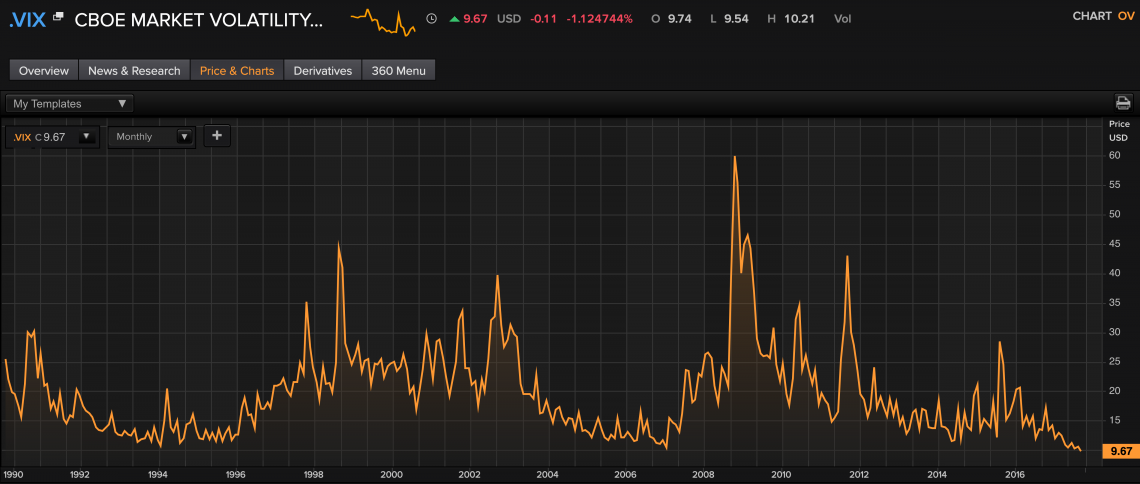
In fact, the VIX is an index of volatility on 1 month to expiry ATM puts and calls on stocks in the S&P 500.


But now the geniuses on Wall Street have figured that they can actually package this animal, which as you can see, is a derivative of a derivative, and treat it like a bond. Fun, heh?


In all fairness, hats off to the asset managers who"ve had the balls to do this. They believed in the central banks" liquidity machine, and they backed their belief and for that they deserve to be paid. I sure wouldn"t have been able to do it.


Now, I"m not some miserable jealous git here to tell you that armageddon is coming and I"ve the answers.


God knows there"s enough of that nonsense in the financial publishing blogosphere for you to get your fill elsewhere. What we do know, however, is that this entire game: the selling of vol, the passive indexing — all of it is predicated on one thing. The central banks keeping rates low and pumping liquidity into the market. It"s why BTFD has become a meme.


The problem that I have with it, other than the distortions made, is that when so many are on one side of the boat like right now and that boat has many moving pieces, then I begin to wonder.


I"m reminded that markets change at the margin, where the slightest hiccup can act like a spark to light the fire of volatility, and these poor suckers who"ve managed to earn steady incomes selling puts find out what "unlimited risk" actually looks like as they"re forced to cover in a market that"s gapping the other way.


I"ve thought about this a lot and, in fact, we recently published how we are going "long vol" for members. And no, it"s not buying puts on VIX because that is, in my humble opinion... how do I say this politely, like begging to be stabbed in the eyes. repeatedly.


In any event that"s just one angle to this market. Here"s another.


Redemptions


I would be remiss in mentioning that as retirees retire, these pension funds will be drawn down.


It"s what Mabel and Bob do to pay for their mushy food, viagra, and bingo nights.


Now, I"m sure you"re all sharp enough to figure out what can happen to the assets these guys have been buying when they have to go from flat out full throttle, to stall, to reverse.


How big is this problem?


Well, for some context global institutional pension fund assets in 22 major markets stood at US$36.4 trillion at year end 2016, amounting to 62% of global GDP.


That is a staggeringly large amount of money.


Pension funds are big cumbersome dumb money. And they"re all allocated in equally dumb indexes, passive strategies, and bonds. So what happens when pensioners draw down on their funds?


You tell me...


Talking of staggeringly large amounts of money, the passive bubble grows bigger as I write this because this beast is fuelled not just by our pointy shoed friends but by Joe Sixpack himself.


Bloomberg just ran a piece:


BlackRock and Vanguard Are Less Than a Decade Away From Managing $20 Trillion


Two towers of power are dominating the future of investing.

Dominating indeed. Here"s how come the pointy shoed crowd can afford Tom Ford suits.


The article goes on to say:


Investors from individuals to large institutions such as pension and hedge funds have flocked to this duo, won over in part by their low-cost funds and breadth of offerings. The proliferation of exchange-traded funds is also supercharging these firms and will likely continue to do so.


Sometimes when everyone is zigging and you zag, you just get run over. But think about it...


We don"t need to go the other way. All we need to do is look where others are no longer.


These behemoths don"t do battle in the little unloved sectors or with stocks that don"t make it into an index. They can"t because they"re too big.


This means that there are a lot of orphans out there and here"s the good news. If it"s not in an index, passives aren"t buying it. And if passives aren"t buying it, it"s only active money that"s even looking at it.


Which brings me to the double helping of good news.


Here"s your competition in active with the accompanying passive.


Right now, it"s a mosh pit food fight to grab and create the next index or ETF so that more capital can be attracted, earning more fees, buying more suits.


This is all well and good.


Markets do what markets do, and I"m not here to grumble about it. I"m here to make money. And indeed if I was in the passive business, I"d be enjoying the steady stream of fees and hoping like hell the market keeps going up.


QE more? Yes, please.


But I"m not.


I"m a humble squirrel searching for nuts in the forest. And gosh, with all this moshing going on it"s wonderful how few other squirrels there are about. The same Bloomberg article makes a good point on this.


While bigger may be better for the fund giants, passive funds may be blurring the inherent value of securities, implied in a company’s earnings or cash flow.


Nah. You think?


Stocks in the index funds no longer trade on fundamentals but rather on asset flows, which sucks the oxygen out of the small guys who don"t make it into the indexes where brain dead passive money is playing.


It means we can gladly play in a sandpit with all the toys and there are very few we have to share them with.


The Cracks Have Already Appeared


Nothing lasts forever, and as I argued when discussing the impact of the incoming strong men on the global economy, there are 3 critical points worth thinking about:


  1. Political cohesion and stability can no longer be relied upon as politics becomes inward looking with everything from trade deals to central bank swap lines being renegotiated or cancelled altogether.

  2. Global coordinated central bank action. The era of global coordinated monetary policy which we’ve been experiencing since the GFC, especially with the three largest players (ECB, FED and BOJ), will be looked back upon with nostalgia by the current clutch of central bankers who muddy the halls of power. Policy will increasingly be driven with greater sensitivity to nationalist rather than international concerns, which brings me to…

  3. Liquidity in the financial system which has stemmed from easing monetary policy is already contracting. In a world where derivatives traverse borders, connecting financial systems like never before, a liquidity crisis presents enormous tail risk in a leveraged world.


Invest accordingly, and thank you for reading.


- Chris


“If you can’t take a small loss, sooner or later you will take the mother of all losses.” — Ed Seykota


--------------------------------------


Liked this article? Then you"ll probably like my other missives on


this topic as well. Go here to access them (free, of course).


-------------------------------------

Monday, November 27, 2017

The Perfect Storm (Of The Coming Market Crisis)

Authored by Lance Roberts via RealInvestmentAdvice.com,


It is always refreshing to step away from the keyboard for a few days and hit the “reset button,” which is exactly what I did last week. My wife and I took a quick trip to Mexico to get a little sun on our face while we wiggled our toes in the sand.


I came back astonished.


Over my 30-odd years of working with money in various capacities, I learned to “shut-up and listen.” This is particularly the case when you are in an airport lounge or packed like sardines in a missile-shaped tube hurling through the air at 35,000 feet.


People love to talk…if you let them.


I had a dozen “listening sessions” with a wide variety of people who each told me roughly the same thing summarized as follows:


  1. The market is a “can’t lose” proposition.

  2. So is “Bitcoin” (even though they had no idea what it really is when I asked them.)

  3. The market is only going higher from here because the Fed won’t let it go down.

You get the idea.


And just when I thought I was sure I had the most bullish views wrapped up – Kevin Matras fro Zack’s Research hit my inbox with the following:


“The S&P will double. And not just eventually. But over the next 5 years (or sooner).


Sounds like a Herculean task on the surface, but it’s really not. In fact, the market only needs to gain on average of 14.9% per year in order to do so. That’s not such a stretch given the market has been averaging 14.9% per year since this bull market began in early 2009, even though GDP (prior to this year) has only been increasing at an anemic 1.48% annual rate.


My 5-year doubling thesis also means that we won’t see another recession until stocks double again, nor will we see another bear market until stocks double again.


So, there you have it.


No bear market until the market racks up another 2600 points and dwarfs every other economic growth cycle in history.


Meanwhile….Back On Earth


Before I go further, let me clarify one thing.


As a portfolio manager, I am neither bullish nor bearish. I don’t really care which way the market is headed personally. If it is rising, as it is now, I am long equities. When it reverses that trend, I will either be short equities and long bonds and cash.


That’s my job.


My job is also to pay attention to the risks that could quickly remove large chunks of investment capital from my client’s portfolios. Like any professional gambler knows, you can only play the game as long as you have a “stake” to play with. Lose your capital, and you lose the game. 


The Perfect Storm Cometh


In the movie, “The Perfect Storm,” George Clooney plays the Captain of the “Andrea Gail.” The Captain, after having a bad start to the fishing season, convinces his crew to go out one last time and they venture well past their usual fishing grounds leaving a developing thunderstorm behind them. After ignoring repeated warnings, a desperate Captain, and crew, head into a confluence of two powerful weather fronts and a hurricane in order to cash in on their bounty.


They all died.


Investors today, after having missed out on the first few years of the current bull market cycle, have now decided to throw all caution to the wind and ignore the repeated warnings in hopes of attaining the “riches” they have been promised.


And, like the “Andrea Gail,” they are currently heading into a perfect storm.


Storm One


Currently, there are many articles pointing our various risks in the market. One that caught my attention over the weekend was a note on the volatility index by Kevin Muir.


“For the longest time, I felt the concerns from the VIX were overblown. For years, market pundits have been bandying about charts meant to scare investors about the potential dislocation in the VIX market. I even wrote a piece called, The VIX Article no one will like.”


He is right.  For the last several years, each time the volatility index hit new lows, there were fears of a massive reversal on the horizon. Yet stocks marched higher while the volatility index made even lower lows.


But Kevin goes on to make an important point:


Yet the frenetic pace of VIX shorting has intensified to a level that frightens me. There is now $1.2 billion of market cap of the inverse VIX ETF XIV, with another $1.3 billion of SVXY (another inverse ETF). This is insanity.


If we get a sharp move higher in VIX, there will be a snowball effect. If it is big enough, monster positions, like $2.5 billion of short VIX ETFs will have to be bought back in a hurry. And let me break it to you, there is no one large enough to take the other side of that trade. At least no one willing to do it without extracting many pounds of flesh first.”


Kevin is absolutely correct.


The only question is how far does it have to rise before the “margin calls” begin to occur. More importantly, volatility runs very long cycles which, unsurprisingly, follow the psychological investment cycles of the market from fear to greed back to fear.


But that is not the only problem.


Storm Two


Once the $VIX trade begins to fail, investors will find themselves almost immediately confronted the “high-yield bond storm.”


American corporations are levered to the hilt with total corporate debt surging to $8.7 trillion – its highest level relative to U.S. GDP (45%) since the financial crisis. In just the last two years, corporations have issued another $1 trillion of new debt NOT for expansion but primarily for share buybacks to boost bottom line earnings per share.


Note: This is also why “repatriation” won’t lead to massive economic growth, wages or employment. Instead, it will go to share buybacks, dividends, and executive compensation. 


For the last 9-years, the Fed’s “zero interest rate policy” have left investors chasing yield and corporations were glad to oblige. The end result is the risk premium for owning corporate bonds over U.S. Treasuries is at historic lows.


I have written for some time that during the next market reversion, the 10-year rate will fall towards “zero” as money seeks the stability and safety of the U.S Treasury bond. However, corporate bonds are an entirely different issue. When “high yield,” or “junk bonds,” begin to default, as they always do, which is why they are called “junk bonds” to begin with, investors will face sharp losses on the one side of their portfolio they “thought” was supposed to be safe. 


Let the panic selling begin.


As shown below, when the rout begins, the yields on junk bonds sharply deviate from that of the U.S. Treasury bond. Again, the 10-year Treasury rate is not going higher anytime soon, but everything else likely will.


Storm Three – The Hurricane


Of course, as investors begin to get battered by the “volatility and junk bond storms,” the subsequent decline in equity valuations begins to trigger “margin calls.” 


As the markets decline, there will be a slow realization “this decline” is something more than a “buy the dip” opportunity. As losses mount, the anxiety of those “losses” mounts until individuals seek to “avert further loss” by selling.


There are two problems forming.


The first is leverage. While investors have been chasing returns in the “can’t lose” market, they have also been piling on leverage in order to increase their return.


It is often stated that margin debt is “nothing to worry about” as they are simply a function of market activity and have no bearing on the outcome of the market.


That is a very short-sighted view.


By itself, margin debt is inert.


Investors can leverage their existing portfolios and increase buying power to participate in rising markets. While “this time could certainly be different,” the reality is that leverage of this magnitude is “gasoline waiting on a match.”


When an “event” eventually occurs, it creates a rush to liquidate holdings. The subsequent decline in prices eventually reaches a point which triggers an initial round of margin calls. Since margin debt is a function of the value of the underlying “collateral,” the forced sale of assets will reduce the value of the collateral further triggering further margin calls. Those margin calls will trigger more selling forcing more margin calls, so forth and so on.


That Sinking Feeling


Unwittingly, investors have compounded their risks by piling into exchange-traded funds under the mistaken assumption it is an “easy way to invest.”


Over the past 9-years, the number of ETF’s available to investors has now eclipsed the number of stocks available for them to invest in. This leads to a liquidity problem and the risk of a “disorderly unwinding of portfolios.” As the head of the BOE, Mark Carney, warned:


“Market adjustments to date have occurred without significant stress. However, the risk of a sharp and disorderly reversal remains given the compressed credit and liquidity risk premia. As a result, market participants need to be mindful of the risks of diminished market liquidity, asset price discontinuities and contagion across asset markets.”


The issue of liquidity is not a small one.


Investors mistakenly assume there is ALWAYS a buyer at the price at which they wish to sell. 


This is wrong.


While the answer is “yes,” as there is always a buyer for every seller, the question is always “at what price?” 


At some point, that reversion process will take hold. It is at that point where the storms all collide into a massive wave of panic driving selling. It will not be a slow and methodical process, but rather a stampede with little regard to price, valuation or fundamental measures.


It will be the equivalent of striking a match, lighting a stick of dynamite and throwing it into a tanker full of gasoline.


Importantly, as prices decline it will trigger margin calls which will induce more indiscriminate selling. The forced redemption cycle will cause catastrophic spreads between the current bid and ask pricing for ETF’s, junk bonds, and option pricing. As investors are forced to dump positions to meet margin calls, the lack of buyers will form a vacuum causing rapid price declines which leave investors helpless on the sidelines watching years of capital appreciation vanish in moments.


Don’t believe me? It happened in 2008 as the “Lehman Moment” left investors helpless watching the crash.


Over a 3-week span, investors lost 29% of their capital and 44% over the entire 3-month period. This is what happens during a margin liquidation event. It is fast, furious and without remorse.


Currently, with complacency and optimism near record levels, no one sees a severe market retracement as a possibility. But maybe that should be warning enough. 


Where the majority of mainstream punditry gets it wrong, in my opinion, is they keep saying we “can’t have another ‘great financial crisis’ again” because things are different.


That’s true.


NO market “mean reverting” event has EVER been based on the same issues that caused the previous event.


The next event won’t be the same as any past event either.


Only the outcomes remain the same.


The “perfect storm” is coming.


Friday, November 17, 2017

"Nightmare On Bond Street": HY Turmoil Leads To Third Largest Junk Outflow In History

Following this month"s drop in junk bond prices and the 40 bps spread widening in high yield last week - the largest since November 2016 - Bank of America has come up with an apt title for its weekly fund flow report: "Nightmare on Bond Street"...


... and with good reason: last week, US junk bond funds and ETFs reported a $4.43bn outflow this past week - the third largest outflow on record and the largest since August 2014. This follows a smaller $0.94Bn outflow the prior week. Non-US HY contributed an additional $2.3bn worth of redemptions, bringing the global junk outflow figure to -$6.7bn, also the 3rd largest ever.


The near record outflows accompanied the second most aggressive round of selling in the US junk bond market in 2017. The weakness in performance only trails a sell-off that occurred in March, when spreads widened by 61 points in less than three weeks according to FT.


“It was very much a flows driven sell-off last week and in the beginning of this week,” said Tim Schwarz, a credit analyst with Investec Asset Management. “We saw a lot of . . . pockets of illiquidity.”


According to EPFR, roughly half of the US HY withdrawals came last Friday, when more than $2bn left the space in one day. Since then, the outflows have been slowly declining each day, from $585mn on Monday to $494mn yesterday. Somewhat surprisingly, large outflows such as the most recent bout are not correlated with subsequently weak performance. In fact, out of the 15 largest-ever daily high yield outflows recorded, next 3 month returns have been positive 10 times, with an average annualized return of 7.2%. According to BofA, this is likely because most of the spread widening occurs just before the flood of withdrawals, providing an opportunity to capture excess returns should the selloff prove to be temporary. Indeed, as BofA"s credit strategist note, given Thurdsday"s strong secondary performance, "we think such is likely to be the case in last week"s episode as investors have once again embraced a buy-the-dip mentality."


In contrast, EPFR also reports that flows for other fixed income asset classes were relatively stable. However, the large outflows from high yield and loans resulted in a net $1.32bn outflow from all bond funds and ETFs, after a $2.27bn inflow in the prior week.


Inflows to high grade were little changed at $3.31bn, down from $3.41bn a week earlier. Inflows to short-term fixed income increased (to $0.65bn from $0.27bn) while inflows outside of short-term declined (to $2.66bn from $3.15bn). Inflows were higher for high grade funds (to $1.83bn from $1.52bn), but lower for ETFs (to $1.48bn from $1.89bn). Inflows to global EM bonds weakened to $2.66bn from $3.15bn, mostly driven by local currency funds / ETFs. Inflows to munis instead improved to $0.34bn from $0.28bn. Finally, inflows to money markets were close to flat at $0.02bn, down from a $7.58bn inflow in the prior week.


Speaking to the FT, Robert Cusack, a PM at WhaleRock Point Partners, said that the recent high-yield sell-off could be short lived, likening it to the brief but rapid move higher in credit premiums earlier this year. But Cusack added that he is still looking to reduce exposure to the asset class.


“It’s a topic each week in our investment committee meetings and we have been discussing the risk reward in high yield now,” he said. “Our next move is to reduce our exposure in high yield.”


Meanwhile, there were no problems in equity land: flows to stocks improved to a $3.2 billion inflow, which however once again masked an ongoing divergence, as $9.9bn of this amount went to ETFs. Active, i.e., human managers, saw another outflow, this time for $6.7 billion as the non-ETF financial sector continues to die a slow, painful death.


Thursday, September 28, 2017

Warning: Danger Lurks Here

By Chris at www.CapitalistExploits.at


Take a look at the volume of stocks listed vs. indexes listed going all the way back to the days of bellbottoms, loud hair, and orange wallpaper.


Since 1995, the supply of stocks, particularly in the US, has been shrinking faster than Trump"s approval ratings. At the same time, the number of indexes have exploded like one of Kim"s shiny new missiles.


Why?


In a falling interest rate environment, the twin pressures of reduced returns and relative cost pressures have meant that investors, in order to make a buck, have flooded into the low fee structures offered by passive strategies. These include indexing, ETFs, and those truly insane creatures I"ve written about before: low volatility ETFs.


But what about those alpha generating hedge funds? Aren"t they meant to be smart and able to beat the market... any market?


Those alpha generating hedge funds have things called LPs. And though LPs may be smarter, and certainly wealthier than Joe Sixpack, they"re no less human. And human attention span and patience level has been in decline... correlated no doubt with the rise of social media and the Kardashian crowd. Like a virus, it infects everything.


As performance from hedge funds has been poor relative to the benchmarks, a self reinforcing situation where hedge funds, in order to ensure LPs don"t redeem, have landed up hugging the indexes.


This is the exact opposite of what hedge funds were meant to do, of course. In many cases, they themselves are simply buying the indexes, trying desperately to figure out how the hell they"re going to survive through the next quarter but determined simply NOT to underperform the index. It"s a losing strategy no matter how you slice and dice it.


For those hedge funds who refuse to chase the indexes... Well, they are now fighting the tidal wave of capital that has been shifting into passive investments, which forces those passive investments even higher.


This, in turn, leaves active hedge funds who refuse to get sucked in with increasingly substandard returns. They can explain until they"re blue in the face why certain indexes make no sense but when those indexes just keep rising day after day, month after month, it becomes a very tough stance to keep. Redemptions follow, and so by doing the right thing, they"re punished. And by doing the wrong thing (following the mob), they may get to stay alive just a little longer and this is what many have resorted to.


We all know that at some point there are no new buyers available to enter the market and hoo boy, do we then have a problem.


So... you either join the party or you leave the party.


The last to leave the party is Hugh Hendry and his baby Eclectica.


Hugh Hendry Murders His Hedge Fund


Og aye, tis tae tough


Hugh follows Eton Park and Perry Capital to name but a few more.


Paul Singer of Elliot Management fame put it well in his July investor letter to stakeholders.


"In a passive investing world, small shareholders have little-to-no voice and no realistic possibility of banding together, while the biggest shareholders have no (repeat, no) skin in the game so long as the money manager does not underperform the index."


Make no mistake, the rise of passive indexing is a bubble in dumb money.


We have a situation where the market is becoming completely lopsided and increasingly so at a blistering pace.


If it gets anymore lopsided, it"s going to be upside down. What"s more, the market participants have no interest or even determination of valuations.


An index doesn"t give an isht what the P/E ratio of any stock included in the index is, and the investors buying it have even less idea. It doesn"t care if the aggregate of stocks sitting inside its womb are over or indeed undervalued. It"s just a dumb bloody index, and you can"t blame it anymore than I can blame my dog for not understanding Shakespeare.


Those investing in passive have done so partly due to relative fee differentials, partly due to performance. But now also dangerously so... due to increasing inflows, which have continued to push values higher.


Now, having markets or sectors get silly is obviously as normal as a peanut butter sandwich, and provided you"re aware of it, we"ve little to worry about.


But what"s more frightening than the Kardashians in skinny pants is that as capital has fed into passive, the usual countering forces (active managers) of the market have been leaving the party, which has left the passive world to increasingly swell like a neglected infected wound.


What we need to think about is that increasingly there is no active market to stabilise this. It"s akin to having a 5-year-old"s party, inviting a troop of the critters, and then promptly sending all the parents down to the pub for a few hours.


Just as short sellers provide a balance to a market so, too, active management (who incidentally typically have skin in the game) have always provided a stabiliser to the overall market. What happens when the stabilisers all leave the room?


We can see this manifesting itself in the volatility index. As more capital enters at a steady pace so, too, the volatility falls.


And here"s the thing. The algos constantly feed back the daily data to recalculate their probabilities (read this article on VAR shocks). Risk? Nah!


At the extreme of the passive world sits volatility.


Selling volatility works really well. Just ask Neiderhoffer who has made godawful amounts doing it over the years.


Look closely, though, and you notice that even Neiderhoffer, who knows what game he"s playing, blows himself up spectacularly from time to time... and I mean complete armageddon wipeout stuff. Until that blow up comes, though, you just keep plugging away at it day after day and it just keeps paying you... day after day. You make money, make money... and then, well...


It all turns to isht and blows up in your face.


My friend Mark Yusko from Morgan Creek Capital places capital with the smartest strategies and hedge funds - active capital.


Who"s willing to bet with me that over the next decade being long smart active strategies and short passive (low volatility ETFs) will be a winning trade?


Wow Poll - 27 Sep


Cast your vote here and also see what others think


- Chris


“What could be more advantageous in an intellectual contest – whether it be bridge, chess, or stock selection than to have opponents who have been taught that thinking is a waste of energy?” – Warren Buffett, 1985 Berkshire Hathaway Letter to Shareholders


--------------------------------------


Liked this article? Then you"ll probably like my other missives on


this topic as well. Go here to access them (free, of course).


--------------------------------------

Friday, June 30, 2017

Bob Rodriguez: "We Are Witnessing The Development Of A Perfect Storm"

Authored by Robert Huebscher via AdvisorPerspectives.com,


Robert L. Rodriguez was the former portfolio manager of the small/mid-cap absolute-value strategy (including FPA Capital Fund, Inc.) and the absolute-fixed-income strategy (including FPA New Income, Inc.) and a former managing partner at FPA, a Los Angeles-based asset manager. He retired at the end of 2016, following more than 33 years of service.


He won many awards during his tenure. He was the only fund manager in the United States to win the Morningstar Manager of the Year award for both an equity and a fixed income fund and is tied with one other portfolio manager as having won the most awards. In 1994 Bob won for both FPA Capital and FPA New Income, and in 2001 and 2008 for FPA New Income.


The opinions expressed reflect Mr. Rodriguez’ personal views only and not those of FPA.


I spoke with Bob on June 22.


In a recent quarterly market commentary Jeremy Grantham posited that reversion to the mean may not be working as it has in the past. What are your thoughts on mean reversion?


There will be a reversion to the mean. We are in a very difficult and challenging time for active managers, and in particular, value style managers. Many of these managers are fighting for their economic lives.


Given that I am no longer involved professionally in managing money, I believe the standards in the industry are being compromised; monetary policy has so totally distorted the capital markets. You are now into the eighth year of a period that is unprecedented in the likes of human history.


The closest policy period to what we have now would have been between 1942 and 1951, when the Fed and Treasury had an accord to keep interest rates low. Interest rates were artificially held lower to help finance the World War II effort. With the renewal of inflation after the war, a policy war developed between the Treasury and the Fed on the continuation of a low interest rate policy. The Treasury-Fed of 1951 brought this period to a close. But that is the only time we’ve had a period of nine years of manipulated, price-controlled interest rates.


This was a historical policy I discussed with my colleagues upon my return from sabbatical in 2011: what could unfold were controlled, manipulated and distorted pricing that could disrupt the normal functioning of the capital markets. The historical cycles that Jeremy would be referring to that entailed a reversion to the mean could be distorted, for a period of time, by this type of monetary policy action.


But I do not believe the economic laws of gravity have been permanently changed.


At a Grant’s Conference last year Steven Bregman asserted that indexation in general and ETFs in particular were factors in the under-performance of active managers and are potentially a bubble. Are you familiar with his work and what are your thoughts on ETFs? What is driving the flow of mutual fund assets to passive strategies and what can or should fund companies do in the face of this trend?


I go back to a speech I gave in 2009, Reflections and Outrage, and buried within that speech is a section that said that if active managers did not get their act together then the likelihood would be that passive strategies would continue to take market share. When you have a market that is distorted by zero interest rate policy, David Tepper said it very well many years ago, “Well, you’ve got to ride it.”


It’s a rocket ship that’s going up. If you are fully invested in the right areas, you have a shot at out-performing. However, if you are an active manager who has a valuation discipline, given the valuation excesses in the capital markets now and that have been developing for the past several years, then an elevated level of liquidity would be held, if you were allowed to do so. As such, you will likely underperform the market.


Active managers have not demonstrated a value-add to an appreciable extent over the last 20 years. When I look back at what happened prior to 2000, if an active growth stock manager could not see the most extraordinary distortion and elevated, speculative market in history, when will they? In the lead up to the 2007-2009 financial crisis, many value-style managers did not cover themselves in glory either. If you looked at what their major stock ownership concentrations were, they were very much in large banks and various types of financial institutions that were going to get crushed in the credit downturn. If they couldn’t acknowledge or identify the greatest credit excess in history, when will they?


I’m picking on both growth- and value-style managers for missing two of the great bubbles in history. This miss led to capital destruction. Now we have a clueless Fed, in my opinion, that has never known what a bubble is beforehand. It is accentuating one that has been developing as a result of its policy insanity of QE. Markets are going straight up predicated on it.


The public looks at these outcomes and says, “Why should I pay higher fees to managers who can’t outperform or can’t even identify a major speculative blow off. I might as well be fully invested. I might as well be in an ETF or index fund.”


Thus, since 2007, indexing or passive activities have risen from approximately 7% to 9% of total managed assets to almost 40%. As you shift assets from active managers to passive managers, they buy an index. The index is capital weighed, which means more and more money is going into fewer and fewer stocks.


We’ve seen this act before. If you didn’t own the nifty 50 stocks in the early 1970s, you underperformed and, thus, money continued to go into them. If you were a growth stock manager in 1998-1999 and you were not buying “net” stocks, you underperformed and were fired. More and more money went into fewer and fewer stocks. Today you have a similar case with the FANG stocks. More and more money is being deployed into a narrower and narrower area. In each case, this trend did not ended well.


When the markets finally do break, as they always have historically, ETFs and index funds will be destabilizing influences, because fear will enter the marketplace. A higher percentage of assets will be in indexed funds and ETFs. Investors will hit the “sell” button. All you have to ask is two words, “To whom?” To whom do I sell? Index funds and ETFs don’t carry any cash reserves. The active managers have been diminished in size, and most of them aren’t carrying high levels of liquidity for fear of business risk.


We are witnessing the development of a “perfect storm.”


The Wall Street Journal has reported that central banks from Switzerland to South Africa are investing their reserves in equities. How should investors respond to the participation in the price discovery system by players that can print money and may not be performance-driven?


The last thing I ever wanted to do as a professional was allocate capital to areas that government was buying. With governmental-driven decisions there are virtually no penalties for bad decision making. Look at the rank stupidity of Dodd-Frank, or Paulson, Bernanke, and Greenspan. They were clueless before each of the last crises. They helped drive a system off the tracks. What penalty have they paid? None! They get to keep their pensions.


But when you have central banks deploying capital and their cost of money is zero, they destroy the capital-asset pricing mechanism; they destroy comparability; the distortions continue.


As a dedicated contrarian, the last place I want to invest money is where governments are deploying the capital because they are so totally distorting the market.


How did the discipline of value investing as you practiced it at FPA, change over the course of your career, particularly since the financial crisis?


It’s an interesting question and I’ve asked myself that many times.


The markets moved more slowly prior to this century – the ebbs and flows, the decision-making and the conveyance of information. With the advance of electronics and the internet, the speed of dissemination of news accelerated. I don’t believe that judgments have improved; just the speed has accelerated and the time frames of patience have shortened.


I bet my entire business in the spring of 1998 when for the prior 11 or 12 years I ran my mutual fund, the FPA Capital Fund, on fumes, with 1% to 2% cash and sometimes even less than 1%. Had you held liquidity, with short-term bond yields in the high-single to double-digits, you would have underperformed the stock market by anywhere from 900 to 1,100 basis points. By 1998 the consultant’s mantra was to be “fully invested.”


I went out in the spring of 1998 arguing that the equity market was becoming excessively priced, and it continued to do so. I sought permission to move my liquidity limits from 7% to 10% which were the typical maximums, to upward of 30%. I had to fight every client on that. By the spring of 2000, without losing any money and avoiding the carnage, I took a little bit over a 50% reduction in my assets under management. I got fired. In 2007-2009, I did far more preparation and communication prior to that crisis and entered it with 45% cash.


In the first phase of a debacle like what went on in the financial crisis, it doesn’t matter whether you are a virgin or are the opposite. When they raid the entertainment house and you happen to be a person walking by, just out of the church right next door, you get caught with all of the people there.


In the aftermath the police discover, “Oh, you shouldn’t be here.” Well, it’s the same way in a crash; virtually everything gets hit. Then in the second and third stages, the real values start to unfold and you get a greater differentiation. That is what happened with my fund between 2007 and 2009 and subsequently.


A cash level of 45% was a real tough strategy for clients to handle. I had one client say, “Please stay fully invested for my account and just do your thing with the others.” I said, “No, the price you ask me to pay is too high. By being fully invested managing your money, I will contaminate my thinking, which will negatively affect my other clients. I’m sorry, that’s a price too high to pay.” I said, “Where do you want me to return the money?” He said, “Let me think about it.” The next day his response was, “Okay, you’ve got flexibility.” But I still took over a 50% hit in redemptions during that crisis.


Looking back at these two prior major cycles, it is far more difficult for a value manager to hold liquidity today in light of the policies that are being deployed. These are the worst fiscal and monetary policies in human history.


If I were still professionally managing money, despite my background of pain-and-suffering from being redeemed, my liquidity allocation would be north of 60% today.


So-called “smart-beta” products have become very popular, particularly those that incorporate a quantitatively-driven value strategy based on the Fama-French factor models. For investors that want a value-oriented portfolio, what concerns should they have with these strategies?


I have never seen a quantitative strategy succeed longer term. They are predicated on models. The models are predicated on history. When history changes, they have to develop a new factor model.


We witnessed this in the last cycle. There was an article in the WSJ quoting a quant manager who said on a Wednesday, we had experienced a 1-in-10,000 year event. On Thursday, we had a 1-in-10,000 year event. On Friday we had a 1-in-10,000 year event. A former colleague wrote an email that weekend that said, “I have a quick question to ask. On Monday, are we safe for the next 30,000 years?”


All of these strategies are meant to enhance or give an essence of how you are going to try and minimize risk and enhance return. When you are in an environment where the lead entity, the Federal Reserve, has its foot on the scale and is distorting the information coming out of the capital markets, where interest rates can go to zero, what is the proper hurdle rate for budgetary or capital allocation decisions? These actions distort the price comparison or discovery process in the capital asset-pricing model. This is highly disturbing.


By the way, I wrote a piece in 2008 before the Fed even knew they were going to balloon their balance sheet. It said they would have to increase the balance sheet by at least a trillion to a trillion and a half. They hadn’t got to that realization yet.


After 45 years of watching the Fed, the only Fed chairman that was worth spit was Paul Volcker. The last great central banker that we had in the last 110 years other than Volcker was J.P. Morgan. The difference is, when Morgan tried to contain the 1907 crisis, he wasn’t using zeros and ones of imaginary computer money; he was using his own capital. As long as you have anointed centralized bureaucratic decision makers like the Federal Reserve, that in many ways is similar to the concentrated decision making structure of the former Soviet Union, decisions will be late and generally wrong. The Fed is a large organization and like all large organizations, there are internal pressures where they try to come to a consensus, and so they do.


This is not how you make your greatest decisions.


If there is one piece of investment advice you would offer to a young professional embarking on a career now, what would that be?


I will give the same advice that I got when I was a very young professional back in 1973. I was two years into the field and a gentleman spoke before my investment class. After everybody had walked out, I walked up to Mr. Munger and I asked him, “Sir, if I could only do one thing that would make myself a better investment professional, what would you recommend?” He responded, “Read history, read history, read history.” I have done that over the years. Had you read about the banking crisis of 1907 and what preceded it in the 1890s, you would have recognized it in a form in 2007.


If there is one piece of management advice that you could offer to that same person, what would that the?


You must have two things – discipline and integrity. Compromise either and you will fail.


That’s true in all walks of life.


Yes, but it’s very easy to use the justification that this time is different.


The world has changed. I gave a speech in 2001 to some pension advisors. I said, “Look at you people out there.” I hadn’t shown them my chart yet but I said, “Look at what we have just gone through. We had the greatest, the highest level of computerization in the history of man, the most timely acquisition to information, the highest percentage of advanced degreed professionals and college graduates in the field, and we got an outcome no different than 1974, 1929, 1907. There is something more here going on.”


Then I held up two hand-written stick figures – I was not a good artist. They were cows and they were talking to one another. One cow said to the other, “Glad we’re not part of the herd.” The other cow said, “Yea.” The next exhibit was an aerial shot. It showed the two cows are in a ravine, so they can only see themselves. But all around them is the herd. I looked out and said, “People, whether you realize it or not, you are part of the herd. All you have to understand is one word, now let’s say it all together. Moo.” What a way to influence friends and make new clients.


How are you investing your personal assets?


I am at my lowest exposure to equities since 1971. They represent less than a fraction of one percent. Liquidity is north of 65%, all in Treasury-type securities, nothing beyond a three-year term. I do not trust what is going on fiscally or monetarily, and I’ll circle back on this in a moment. The balance is in rare fully paid-for physical assets.


Circling back, after I stepped down from daily money management at the end of 2009, I took a sabbatical. One of my goals was to meet a gentleman by the name of David Walker, the former comptroller general of the U.S. He wrote a book called Comeback America that I read in January of 2010. I sent my review to Dave. Two days later Dave called me and said, “My name is Dave Walker. Is this Bob Rodriguez? If so, I want to thank you for your review.” That’s how we came to know one another. I’d used his work for over 10 years. For the next three and a half years I was a sponsor of his program, Comeback America. He closed it down in 2013, a complete unmitigated failure.


Think about the budgetary battles of 2011; the only thing that was cut was defense. Two thirds of the expenditure cuts that were going to get controlled under the system would not occur until after 2016. Funny how that works. In the presidential debates, only one candidate used a word that I think has now left the English language, “sequester.” That was Bush and it was to eliminate sequestration to raise defense spending.


The 2016 election was one of the most important elections in the last 80 years. Back in 2009 I said if we do not get our economic house in order sometime between 2014 and 2018, we could see a crisis of equal or greater magnitude than the 2007-2009 crisis. I also argued that we would have a substandard recovery that would be no better than 2% real GDP growth for as far as the eye can see. Productivity and capital spending would be substandard. All of those have played out.


Here we are in 2017. I have seen absolutely nothing that would give me any degree of confidence that Washington will get its act together. We are into a period of expanding deficits. We are hitting a time where the entitlements are worsening in terms of their funding status. We are in a decade that is unprecedented from anything that we’ve seen before with monetary policy and fiscal policy.


Why on Earth should I allocate capital into a system where the scales are completely manipulated, price discovery is distorted, and the Fed doesn’t have a clue what’s going on? They’ve missed every economic forecast for the last nine years straight. Why would anybody pay any attention to what those people are doing?


I have confidence in one thing. The Fed will blow it.


My thoughts are very much analogous to those of Lacy Hunt. Where Lacy and I part company is what happens after the deformation hits. He would argue that we will be in a dis- or deflationary period for an extended period of time; therefore, you should own 30- and 20-year Treasury bonds.


I’m not so sure about that scenario. It occurred in Japan because it has a very cohesive society. That is not the case in the United States or in Europe. Our patience will be far shorter. At some point, in no more than one to two years, the Fed would likely panic and panic big time, and we will see QE on steroids. We will see monetary inflation. Lacy and I have a similar view. But the really big question is what the outcomes will be on the other side of this mess. Both of us could be very right, or very wrong, or partially in between.


I am managing my estate in a hedged fashion because what we are going through is without any precedent in human history. How can anybody have confidence that their particular view is the right view?


Tuesday, June 27, 2017

BofA Institutional Clients Sell Tech Stocks For 3rd Straight Week

As tech stocks continue to hit new all time highs, the general assumption is that they are being, well, bought by the broader population even if non-growth stocks remain largely shunned. Well, at least according to Bank of America that is not happening. And it"s not just tech stocks.


In the latest client flow report from BofA" Jill Hall, we learn that last week, during which the S&P 500 climbed 0.2%, BofAML clients were net sellers of single stocks for the third consecutive week, although the number was almost offset by net buying of ETFs. Institutional clients were the biggest sellers and have now sold stocks the last two weeks, while private clients were also sellers following two weeks of buying. Hedge funds were net buyers for the second consecutive week. Clients bought mid caps for the third week in a row, and sold both large and small caps. Buybacks by corporate clients slowed ahead of quarter-end, and continue to track below typical June levels.


As for Tech, it appears thatit goes up the more traders sellit:


  • While hedge funds were buyers of Tech stocks for the second week, institutional and private clients continued to sell Tech stocks for the third and fifth consecutive week, respectively. Quarter-end rebalancing may pose risk to Tech, where mutual funds carry their biggest overweight positioning in our post-2008 data history.

  • Energy and Staples stocks saw net selling by institutional clients, hedge funds and private clients alike last week. No sector saw net buying by all three groups.

  • Pension fund clients were net buyers of US equities for the fourth week, chiefly due to ETFs. Single stock buying was mostly in defensive sectors, while the group’s biggest net sales were in Tech and Energy stocks. See Pension fund flows for deta


Some other details:


Clients’ biggest net sales last week were in both defensive sectors (Staples, Health Care) and cyclical sectors (Discretionary, Energy and Tech). Only stocks in the bond proxy sectors of Telecom, Utilities and Real Estate – along with the Industrials sector—saw net buying, as interest rates continued to tick downward. Staples—where fundamentals remain challenged—continues to see the longest net buying trend at 11 consecutive weeks, but flow sentiment remains most persistently negative within Health Care, where four-week average flows have been negative since March’16. Telecom has seen four straight weeks of net buying and is the only sector which has seen cumulative net buying year-to-date.


Institutional clients were the biggest net sellers, while private clients were also net sellers vs. hedge funds who were buyers. Corporate buybacks continued to slow and remain  below typical June levels. Large and small caps saw net sales while clients bought mid caps.


Finally, here is the rolling four-week average trends by sector


  • Net buying: ETFs since early Oct 2016; Industrials since mid-April 2017; Telecom since mid June 2017.

  • Net selling: Health Care since mid-March 2016; Consumer Discretionary since mid- Jan 2017; Tech since early March 2017; Staples since early April 2017; Materials since early May 2017; Telecom since late May 2017; Real Estate (not shown; data since Sept. 2016) since mid June 2017; Financials since mid-June 2017.

  • Notable changes in trends: Energy is now back to seeing net selling after a brief period of buying; Utilities is now seeing net buying after sales since early May ‘17.

Tuesday, June 20, 2017

Investors Go All-In On Europe

Investors added $871 million to the Vanguard FTSE Europe exchange-traded fund in the five days through Friday, pushing the largest European ETF to its largest two-week inflow in history.


As Bloomberg notes, investor optimism after last week’s agreement between Greece and its creditors, and Macron"s successful majority in French parliament have helped pull hot money into Europe. Hedge funds increased their euro positions to “net long” in the week ended June 13 for the first time in more than three years, Commodity Futures Trading Commission data show. And overall net Euro futures positioning is now at its longest in over 6 years...


Further supporting the relative risk appetite for European assets is the massive outperformance of its economic data relative to the US...


But of course, as we have shown before, it appears hi-tech, high-valuation, high-momentum US equities remain the favored vehicle for central bank sheet expansion to save the world...


We"ll just have to see how this ends.


Friday, June 9, 2017

Destroying The Myth Of 'Cash On The Sidelines'

Authored by Lance Roberts via RealInvestmentAdvice.com,


With the markets breaking out to new highs, it is not surprising to see a continued stream of analysis grappling for bits of data to support the bullish mantra. As you know, I have increased equity allocations in models with the breakout, but this is a tactical position only as the fundamentals simply do not support the rising risk levels currently.


However, despite 8-years of a bull market advance, one of the prevailing myths that seeming will not die is that of “cash on the sidelines.” To wit:


“Underpinning gains in both stocks and bonds is $5 trillion of capital that is sitting on the sidelines and serving as a reservoir for buying on weakness. This excess cash acts as a backstop for financial assets, both bonds and equities, because any correction is quickly reversed by investors deploying their excess cash to buy the dip,” Nikolaos Panigirtzoglou, the managing director of global market strategy at JPMorgan, wrote in a client note.


This is the age old excuse why the current “bull market” rally is set to continue into the indefinite future. The ongoing belief is that at any moment investors are suddenly going to empty bank accounts and pour it into the markets. However, the reality is if they haven’t done it by now after 3-consecutive rounds of Q.E. in the U.S., a 200% advance in the markets, and ongoing global Q.E., exactly what will that catalyst be?


However, Clifford Asness previously wrote:


“There are no sidelines. Those saying this seem to envision a seller of stocks moving her money to cash and awaiting a chance to return. But they always ignore that this seller sold to somebody, who presumably moved a precisely equal amount of cash off the sidelines.”


Every transaction in the market requires both a buyer and a seller with the only differentiating factor being at what PRICE the transaction occurs. Since this must be the case for there to be equilibrium to the markets there can be no “sidelines.” 


Furthermore, despite this very salient point, a look at the stock-to-cash ratios also suggest there is very little available buying power for investors current.


Each month, the Investment Company Institute releases information related to the mutual fund industry. Included in this data is the total amount of assets invested in mutual funds, ETFs and money market funds. As a rough measure of investor sentiment, this indicator looks at the total assets invested in equity mutual funds and ETFs, and compares it to the total assets invested in the safety of money market funds.


The higher the ratio, the more comfortable investors have become holding stocks; the lower the ratio, the more uncertainty there is in the market. Currently, with the ratio at the highest level on record there is little fear of holding stocks.


Negative free cash balances also suggest the same as investors have piled on the highest levels of leverage in market history.


Furthermore, with investors once again “fully invested” in equities, it is not surprising to see cash and bond allocations near historic lows.


Cash on the sidelines? Not really.


Everyone “all in the boat?” Absolutely.


Historical outcomes from such situations? Not Great.

Wednesday, May 31, 2017

Lance Roberts: This Market Is Like A Tanker Of Gasoline

Lance Roberts, chief investment strategist of Clarity Financial and chief editor of Real Investment Advice has authored a number of impressive recent reports identifying potential failure points in today"s financial markets. 


In this week"s podcast, Lance explains how the massive flood of investment capital into passively-managed ETFs, along with record amounts of margin debt, has the potential to set the markets afire:


Fundamentally, there’s nothing different in today"s markets because, at the end of the day, they are about evaluations, earnings -- those types of things. Technically, the market is very different today because of quantitative easing, computerized trading etc.


What we see are two things happening, in particular, that people should be paying attention to. One is that investors are herding into passively-managed ETFs now, which is creating a dislocation between the underlying realities of individual stocks and their prices, because the piling into ETFs is requiring stocks like Facebook, Amazon, and Google to be bought in much greater volumes than they otherwise would. And people are making an assumption that there will always a buyer for every seller in the market.


Now that’s absolutely true. But it"s often argued by the mainstream media that "For every buyer there’s a seller, so it doesn’t matter when the market turns. You’ll be okay." But you won’t, because, yes, at some point there is a buyer for every seller, but it always begs the question: At what price? And because of all the piling into these ETFs, when the market eventually breaks, yes, there will be a buyer; but that buyer could be at many percentages lower than where prices were before. We could very well see a vacuum appear in prices, with a gap down so sharp and so fast that it not only paralyzes most investors who may be hoping to get a little bit of recovery to sell into, but then will start triggering margin calls.


There’s been numerous articles written about margin debt: "margin debt is not a problem; don’t worry about margin debt." Well, margin debt is not fine. We’re at record levels of margin debts. It’s like a can of gasoline. If I set a can of gasoline in the middle of a room and nobody touches it, it"s fine. But drop a match into that can of gasoline you have a different story.


So, the only thing that’s been missing up to this moment right now is the herding of individuals into a specific type of investment. But just like with real estate in the past, we have now people herding into ETFs. And now, with all these computers basically acting on the same set of information pushing stocks in the same direction because they’re all working off the same set of information, the market is like a tanker of gasoline. And somebody’s going to put a lit stick a dynamite into it because when this all reverses, you have these passive indexers become panic sellers. And then that beings to immediately trigger a reversal in the algorithms, which all feed on themselves in a negative direction. And the gap that opens up between the bid and sell prices will be staggering.  


Click the play button below to listen to Chris" interview with Lance Roberts (45m:28s).

Saturday, May 13, 2017

WTF Chart Of The Day: There Are Now More Indexes Than Stocks

For the first time ever, the number of market indexes now exceeds the number of U.S. stocks...


As Bloomberg reports, traditional ones such as the S&P 500 are collections of securities weighted by market value, and index funds mimic them as a low-cost way to deliver the market’s performance. Many new indexes are different: They include stocks based on custom criteria, such as having low volatility or high dividends. The recent explosion in indexes has been driven by demand as many new benchmarks essentially repackage active investment strategies into indexes, says Eric Balchunas, senior exchange-traded fund analyst at Bloomberg Intelligence. They can then be tracked by so-called smart-beta ETFs, which fund companies are rolling out rapidly. Money managers are under pressure to cut costs, says Balchunas, as investors shift their money into funds with low fees. Smart-beta ETFs are generally more expensive than S&P 500 funds but cheaper than actively managed funds. It remains to be seen how well the new funds will perform.


As we wrote previously, for now, the debate about the impact of ETFs rages, and will do so inconclusively as long as trillions in central bank liquidity prop up broader risk assets and equity markets. It is only once central banks take start soaking up some $18 trillion in excess liquidity that the true impact of ETFs will be visible. Until then, we leave readers with thoughts from a recent note by JPM"s Nikolaos Panigirtzoglou, first reported here last October, and summarized below, on what the take over by ETFs really means:


  • Markets become more brittle, risky: "The shift towards passive funds has the potential to concentrate investments to a few large products. This concentration potentially increases systemic risk making markets more susceptible to the flows of a few large passive products."

  • Passive or index investing favours large caps as most equity indices are market cap weighted. "This could exacerbate the flow into large companies beyond to what is justified by fundamentals, creating potential misallocation of capital away from smaller companies. To the extent that these passive funds become even more dominant in the future, the risk of bubbles being formed in large companies, at the same time crowding out investments from smaller firms, would significantly increase."

  • The proliferation of index funds increases the size of stock inclusion flows. In turn, market moves around index constituent changes become more pronounced overpenalizing companies leaving the index and causing excessive gains to companies entering the index.

  • Crashes, when they happen, will be bigger and badder: "the shift towards passive funds tends to intensify following periods of strong market performance as active managers underperform in such periods of strong market performance. In turn, this shift exacerbates the market uptrend creating more protracted periods of low volatility and momentum. When markets eventually reverse, the correction becomes deeper and volatility rises as money flows away from passive funds back towards active managers who tend to outperform in periods of weak market performance."

  • Markets become less efficient: "if passive investing becomes too big, potentially crowding out skilled active managers also, market efficiency would start declining. In turn, this would present opportunities for active managers to extract arbitrage profits."

Monday, May 8, 2017

Jack Bogle Warns Of Market "Chaos, Catastrophe" If Passive Investing Wins

In 2016 investors poured $480 billion into passive funds, a mix of mutual funds and exchange-traded funds, while pulling more than $380 billion from active mutual funds, according to data compiled by Bloomberg. Passive equity investments may become as much as 45 percent of the mutual fund industry within five years as investors move to low-cost funds, Bogle said in an interview on Bloomberg Radio in March. But just how much can the market take?


"If everybody indexed, the only word you could use is chaos, catastrophe," warned Jack Bogle, 88-year-old founder of Vanguard, at the Berkshire Hathaway annual meeting on Saturday.


“There would be no trading,” Bogle told Yahoo Finance editor-in-chief Andy Serwer. “There would be no way to turn a stream of income into a pile of capital or a pile of capital into a stream of income... the markets would fail."


“We have too much trading in the market,” Bogle said. “The index really just neutralizes x-percent of the market… And it just, those stocks don’t get traded. So the other stocks would get traded, the market would go on as ever."


“So [the market] gets a little less efficient, but if it gets less efficient some managers can win by more. And some managers will lose by more. This is the equation. So, I’m not concerned about it. It’s going to take a long, long time [for indexing to get] anywhere near 50% [of the market], and things will change a lot in other ways by then."


“Markets are going to be efficient as long as there are managers, or investors, trying to find little holes in the system... price discovery, as they call it,” Bogle said.


Yahoo"s Myles Udland reports that currently, Bogle notes, about one-quarter of the U.S. stock market is currently indexed. In his view, indexing could account for 50% of the market “easily.” Asked by Serwer what level of indexing would concern him, Bogle said he expects indexing could exceed 75% of the market and not have it become dangerous.

Saturday, May 6, 2017

Bank Of Japan "Bought The Dip" Over Half The Time In The Last 4 Years

A year ago, we noted that The Bank of Japan (BoJ) was a Top 10 holder in 90% of Japanese stocks. In December, we showed that BoJ was the biggest buyer of Japanese stocks in 2016. And now, as The FT reports, the real "whale" of the Japanese markets is stepping up its buying (up over 70% YoY) entering the market on down days more than half the time in the last four years.


Since the end of 2010, The FT notes that the BoJ has been buying exchange traded funds (ETFs) as part of its quantitative and qualitative easing programme. The biggest action began last July, when its annual acquisition target was doubled to ¥6tn. Since then, the whale designation has seemed pretty obvious: the central bank swallows a minimum of ¥1.2bn of ETFs every single trading day (tailored to support stocks that further “Abenomics” policies), and lumbers in with buying bursts of ¥72bn roughly once every three sessions.


Some traders say the bank’s supposedly targeted buying has cushioned the whole market. Last year, foreign investors were net sellers of ¥3tn of Japanese shares - a retreat that might have decimated benchmarks had the BoJ not swum in with ¥4.3tn of support via ETFs.


In the afternoon sessions on days the BoJ comes in big, the average return on the index is about 14 basis points higher.


Since the annual quota was increased to ¥6tn, Nomura says, the BoJ has provided a cumulative boost to the Nikkei of about 1,400 points.


But, as we"ve noted in the past, it appears to be the flow, not the stock, that is the big driver...


As in a casino, The FT"s Joe Lewis concludes, the whale definition may hinge less on the cash on the table and more on the psychological impact on other gamblers. The BoJ has been at the game long enough for the market to know it reliably buys on weakness.


Of the 1,038 business days between April 2013 and March 2017 there were 449 sessions where the market was down: the BoJ bought on more than half of them. Whale or not, investors are now primed to think they are swimming with one.


So given that we know SNB is extremely active in stock markets, and The BoJ is the Japanese stock market, does anyone realistically doubt The Fed is/has been active?