Showing posts with label default. Show all posts

Tuesday, December 26, 2017

3-Month Bills Turmoil Ahead Of March Debt Ceiling Showdown: Bid To Cover Plunges To 8 Year Lows

Despite the GOP"s tax reform victory, over the past few weeks, Congress once again punted on a formal decision how to keep government funded and what to do with America"s debt ceiling and as a result US legislators simply kicked the can on the agreement of raising the nation’s borrowing limit for another few months. However, with the Treasury expected to breach the ceiling as soon as late March, today"s $45 billion 3-Month Bill auction was closely watched as it serves as a fresh gauge of investor anxiety about the ongoing impasse.


As a reminder, in the first week of December, the Treasury deployed a series of extraordinary measures to stay under the debt ceiling cap since it was reinstated on December 8. But T-bill investors, in both the primary and secondary market,  remain especially wary given questions over what’s known as the debt ceiling’s drop-dead date. Today"s Bills mature March 29, within the Congressional Budget Office’s late-March to early-April window for when Treasury will exhaust the extra capacity it’s using to keep below the $20.5 trillion limit.


Quoted by Bloomberg, Justin Mandeville of Inveso said that the late-December bill auctions “speak volumes to investors being cautious as to when the potential drop-dead date will be,” adding that “we saw it back in July when we had concerns about the October bills.”


And sure enough, having just concluded, the 3M bill was especially ugly, pricing at 1.445%, or a 3bps tail to the 1.415% When Issued, with Indirect Buyers fleeing, and taking down just 20.1% of the finally allotment, down from 30.8% in the last 6 auctions, while Primary Dealers had no choice but to step up aggressively from 61.9% in the 6MMA, to 74% as Direct interest also fizzled from 7.3% in the last 6 auctions to just 5.9%. But nowhere was the revulsion quite so visible as in the bid to cover, which plunged from 3.04 in the past 6 auctions to just 2.71 on Dec. 26: this was the lowest Bid to Cover since January 2009.


As Bloomberg reminds us, at the government’s July 24 auction, the US Treasury sold $39 billion of three-month bills at 1.18 percent, then the highest rate since 2008. The bid to cover for that particular sale also matched the lowest for the maturity since 2009. Congress wound up passing a three-month debt-ceiling suspension Sept. 8, weeks before Treasury Secretary Steven Mnuchin estimated the government would run out of cash.


However, revulsion to paper that could be impacted by the debt ceiling was not just in the primary market: it also hit the secondary Bill market, as the previously noted kink that has emerged in the bill curve between securities maturing in late March and those in early April, has gotten even more pronounced. For several days after the Dec. 18 auction of bills maturing March 22, the rate on these securities was higher than debt maturing a week later. Since then, the rate on securities expiring March 29 has climbed to 1.44%, exceeding those on bills due the following week by nearly 10 bps as shown in the chart below.


And so, looking at the debt ceiling fight that refuses to go away despite the can being kicked every few months, while there is still a chance the issue could be resolved without going down to the wire, it is unlikely: while lawmakers hammered out a spending bill this week to keep the government open through Jan. 19, they didn’t include a provision to lift or suspend the debt ceiling. The longer a resolution remains at the bottom of Congress’s to-do list, the larger the T-bill dislocations could grow. Sooner or later, the bond market - which has been crying wolf on a technical US default - will eventually be right.


Friday, December 22, 2017

Canadian Homeowners Take Out HELOCs To Fund Subprime Purchases

Authored by Steve Saretsky via VanCityCondoGuide.com,


The HELOC (Home Equity Line of Credit) has been a blessing and a curse for Canadian households. While it has helped spur house prices and simultaneously provided consumers the ability to tap into their new found equity, it has also crippled many Canadian households into a debt trap that seems insurmountable.


Between 2000 and 2010, HELOC balances soared from $35 billion to $186 billion, according to the Financial Consumer Agency of Canada, an average annual growth rate of 20%.


As of 2016, HELOC balances sit at $211 billion, a 500% increase since the year 2000. While also pushing Canadian household debt to incomes to record highs of 168%.


HELOC Debt in Canada


Scott Terrio, a debt consultant, says the situation is a full blown “extend and pretend” meaning borrowers are just continuously refinancing or taking on more and more debt in order to sustain their lifestyle. Canadians can extend their debt repayment terms and pretend to live a lifestyle they can’t otherwise obtain.


What the HELOC has also been able to do is help spur the private lending space which has ultimately supported rising house prices. Seth Daniels of JKD Capital, one of the most astute Canada-Watchers says theres a growing trend where “a homeowner acts as a sub-prime lender by drawing a HELOC at 3% interest only, and lends it to a subprime borrower at 8-12% for one year (interest only).”


This is something i’ve been hearing on an ongoing basis from mortgage brokers and lawyers who help facilitate these deals. Especially since mortgage lending conditions tightened, starting with OSFI’s first mortgage stress test back in November, 2016 which required high ratio borrowers (less than 20% down payment) to qualify for a mortgage at the borrowing rate plus 2%. So basically you’re getting qualified on what you can borrow at 5% even though you’re borrowing at 3%.


This strategy has been bulletproof, because, well, prices can only go up.


The lender makes a juicy return, and the borrower gets his house. The borrower then transitions into a traditional mortgage once his home equity rises after the one year expires.


This has created a situation where, as of September 2017, personal loans secured against residential real estate hit a record high $247 Billion.


Source: Better Dwelling via OSFI


Thanks to an endless supply of new loans (credit) and rising house prices, mortgage arrears rate continue to fall to rock bottom lows.


Source: CMHC


But as Seth Daniels remarked, “Up to a point, the greater the debt growth, the lower the arrears because as they say ‘a rolling loan gathers no loss’. In other words when debt growth is exploding people can find ways of avoiding default by rolling the loan, refinancing, selling the asset, or whatever. So, paradoxically, the default rate will seem to improve when the actual risk in the economy is exploding”.


With another mortgage stress test set to roll out January 1, 2018, this will likely push another swarm of borrowers into the private lending space. We’re already witnessing a huge end of the year push as buyers scramble to secure a home prior to further mortgage clamp downs.


The new mortgage stress test which previously only targeted high ratio borrowers (less than 20% downpayment), will now include low ratio borrowers (more than 20% downpayment) as well. This could be substantial, considering  85% to 90% of all mortgages in Toronto & Vancouver are low-ratio.
(American Readers: Canadians can only secure a mortgage rate for a maximum term of 5 years, meaning a rising interest rate environment is much more impactful)


It’s anticipated to eliminate some 12% of low ratio borrowers while simultaneously reducing borrowing power by 20%.


This could signal a final boom for the private lending space in Canada.


Tuesday, December 12, 2017

John Burbank Shuts Flagship Hedge Fund, Plans Launch Of Cryptocurrency Unit

The writing for John Burbank"s Passport Capital was on the wall back in August, when as we reported, in his latest letter to investors Burbank reported that at what was once a multi-billion fund, total firm assets at Passport had shrunk to just $900 million as of June 30 as a result of net outflows totaling a whopping $565 million, or a nearly 40% loss of AUM due to redemptions. The collapse in assets took place just a few months after Passport announced it was liquidating its long/short strategy in April.


And unfortunately for Burbank, just four month later, a chapter of Passport Capital"s history comes to a close, because as Bloomberg reported, the fund would shutter its flagship hedge fund after returns slumped and following unprecedented redemptions. Passport - which shot to fame for its lucrative bet against subprime housing ahead of the global financial crisis - peaked at around $5 billion but lately managed a fraction of that after a double digit loss last year and further losses in 2017.


The fund’s "returns over the past two years are unacceptable and cause me to rethink how to manage money in this environment," Burbank wrote in a Dec. 11 letter to investors, the Wall Street Journal first reported overnight. Passport will continue to operate its roughly $300 million special opportunities fund, which holds some of the firm’s more successful bets on companies such as Alibaba Group Holding Ltd.


As Bloomberg reminds us, Burbank founded Passport in 2000 which was best known for its big bet on a tumble in subprime mortgages in 2006. His fund made 220% the following year, ushering in the good times - if only briefly - with Passport AUM briefly hitting a peak of $5 billion before a double-digit loss last year and more losses in 2017, as we reported previously. Total assets declined to $2.4 billion in April, then plummeted further to $900 million amid client withdrawals and after it wound down its Long-Short Strategy fund after an "incredibly disappointing 2016," Bloomberg reported earlier this year.


“You will not hear about Passport shutting down -- there is too much opportunity available to do that,” Burbank wrote, adding that the firm may announce a new area of investment in the near future.


Well, yes, hedge funds rarely want to publicize that they are closing. And yes, even as Passport the hedge fund as we know it no longer exists, the company has decided to pivot into Mike Novogratz" sandbox, and as the WSJ reports this morning, even as Burbank"s hedge fund is pulling back from traditional investing and trading, it is launching a new arm that focuses only on cryptocurrencies such as bitcoin. More from the WSJ:


Despite his recent performance, Mr. Burbank’s pronouncements remain closely followed by his peers. He would become one of the more prominent major investors to go big on bitcoin and the like, along with the former Fortress Investment Group hedge-fund manager Michael Novogratz and Horizon Kinetics Chief Investment Officer Murray Stahl.


To be sure, the burly John Burbank - a Duke University graduate - is in some ways an unlikely evangelist for digital currency. As the WSJ describes him, "he made his name buying up credit default swaps ahead of the financial crisis, resulting in a more-than 200% gain for his main fund in 2007. That year, he made $370 million personally, Forbes estimated."


His predictions have mostly failed to pan out since. Passport bet big on gold mining companies in 2014, but prices dropped thereafter, and slashed its overall exposure to rising stocks in early 2015, missing out on some of the subsequent rally.


Burbank"s interest in bitcoin and cryptos is hardly new, however, and was reinforced in his last investor letter in which he shared the following perspective:


We have been monitoring block chain technology and cryptocurrencies for some time. We believe this technology represents a secular change with the potential to profoundly disrupt many markets. AMD is the first position in the portfolio that has been a net beneficiary of this trend, but we expect our understanding of block chain technology’s potential to be an increasingly relevant factor in stock selection.


Burbank continued in Monday"s letter:


“Technological progress and its non-linear enhancement or deflation of the biggest industries and markets in the world is my choice for what will have mattered most five years from now. I want to capture these extraordinary outcomes in new ways appropriate to the current era.”


The new cryptocurrency-focused fund’s leadership will include longtime Passport executive Seth Spalding, the WSJ said. While Passport hasn’t told prospective investors much about its strategy, but has scheduled a call for later this week to lay out more.


It is unclear if bitcoin - in addition to everything else - will also emerge as a "hail mary" pass for fading hedge fund managers desperate to attract just enough capital - through the use of buzzwords or otherwise - to stay in business for just one more lap. If Burbank is successful, watch as every other hedge fund and family office promptly launches their own [Insert Name Here] Crypto Asset Special Situations LLC.


How Fed Rate Hikes Impact US Debt Slaves

Authored by Wolf Richter via WolfStreet.com,


But savers are still getting shafted.


Outstanding “revolving credit” owed by consumers – such as bank-issued and private-label credit cards – jumped 6.1% year-over-year to $977 billion in the third quarter, according to the Fed’s Board of Governors. When the holiday shopping season is over, it will exceed $1 trillion. At the same time, the Fed has set out to make this type of debt a lot more expensive.


The Fed’s four hikes of its target range for the federal funds rate in this cycle cost consumers with credit card balances an additional $6 billion in interest in 2017, according to WalletHub. The Fed’s widely expected quarter-percentage-point hike on December 13 will cost consumers with credit card balances an additional $1.5 billion in 2018. This would bring the incremental costs of five rates hikes so far to $7.5 billion next year.


Short-term yields have shot up since the rate-hike cycle started. For example, the three-month US Treasury yield rose from near 0% in October 2015 to 1.33% today. Credit card rates move with short-term rates.


Mortgage rates move in near-parallel with the 10-year Treasury yield, which, at 2.39%, has declined from about 2.6% a year ago. Hence, 30-year fixed-rate mortgages are still quoted with rates below 4%, and for now, homebuyers have been spared the impact of the rate hikes.


Auto loans, in line with mid-range Treasury yields, have wavered a lot and moved up only a little. The average APR on a 48-month new-car loan rose only 40 basis points over the past two years to 4.4% in August 2017, according to WalletHub, citing the most recent data available. Note that the offers of “0% financing” are usually in lieu of rebates or other incentives and are therefore rarely free.


The chart below shows the increase in the Fed’s target for the federal funds rate, from 0-0.25% to 1-1.25% (not including a hike on December 13), so an increase of 100-basis points. Credit card rates have increased in lockstep by 101 basis points. But bank deposits rates have lagged woefully behind, on the logic that credit-card borrowers and savers, both, are going to get shafted:


So how do these rate hikes translate for households with credit card balances?


Revolving credit outstanding of $1 trillion, spread over 117.72 million households, would amount to $8,300 per household. But many households do not carry interest-bearing credit card debt; they pay their cards off in full every month. Finance charges are concentrated on households that use this form of debt to finance their spending and that cannot pay off their balances every month. Many of these households are already strung out and are among the least able to afford higher interest payments.


Consumer credit bureau TransUnion shed some light on this in its Q3 2017 Industry Insights Report, according to which 195.9 million consumers had a revolving credit balance at the end of Q3, with total account balances of $1.35 trillion. This equals $6,892 per person with revolving credit balances. If there are two people with balances in a household, this would amount to nearly $14,000 of this high-cost debt. If the average interest rate on this debt is 20%, credit-cart interest payments alone add $233 a month to their household expenditures.


What is next for these folks?


For now, the Fed has penciled in, and economists expect, three hikes next year. But recent developments – particularly the expected tax cuts and what the Fed calls “elevated asset prices” – suggest that the Fed might “surprise” the markets with its hawkishness in 2018.


The Fed is currently pegging the “neutral” rate – the rate at which the federal funds rate is neither stimulating nor slowing the economy – at somewhere near 2.5% to 2.75%, so about five or six more rates hikes from today’s target range.


Interest rates on credit cards would follow in lockstep. These rate hikes to “neutral” would extract another $8 billion or so a year, on top of the additional $7.5 billion from the prior rate hikes.


But that’s not all. Credit card balances continue to rise as our brave consumers are trying to prop up US consumer spending and thus the global economy by borrowing more and more. Thus, rising credit card balances combined with rising interest rates on those balances conspire to produce sharply higher interest costs.


Since consumers with high-interest credit-card balances already don’t have enough money to pay off their costly debt, these additional interest payments will further curtail their efforts at making principal payments and thus inflate their credit card balances further.


For many consumers whose credit is already challenged, this scheme eventually ends in default. Credit card delinquencies have started to tick up, from 2.16% in Q1 2016 to 2.53% in Q3. While still soothingly low overall, the damage is always concentrated in the subprime segment – and on lenders that specialize in subprime lending. And there, delinquency rates are jumping. Yet these are still the best of times, with the lowest unemployment rate since the year 2000.


This parallels the delinquencies in auto loans. The 90+ day delinquency rate for loans originated by auto finance companies has hit 9.7% in Q3 2017, the highest since Q1 of 2010, when it was on the way down from the Financial Crisis. Delinquencies first hit that rate on the way up in Q3 2008, during the Lehman moment. But now, there is no Financial Crisis. These are the boom times.


Read…  Auto-Loan Subprime Blows Up Lehman-Moment-Like


Chinese Banks Push Back On Shadow Banking Regulations - Expose "Catch-22" For Financial System

In November, we discussed how the post-Party Congress measures to deleverage and crackdown on the worst abuses in China’s credit bubble took an important step forward with the announcement of a new era of regulation for China’s $15 trillion shadow banking and asset management industry. See "A New Era In Chinese Regulation Means Turmoil For $15 Trillion In China"s Shadows". In particular, the authorities turned their sights on wealth management products (WMPs).


On the way out are “guaranteed returns” and “capital pools” which had turned the $4 trillion sector into a leveraged Ponzi scheme. We joked that in a “radical and shocking” departure from the norm, financial institutions would have to offer yields based on the risk and returns of the underlying assets. Paying out guaranteed returns with new funds from depositors would no longer be allowed.


Commentators at the time described it as “a new era of regulation” which would lead to tighter risk control and slower but higher quality growth in the Chinese economy, blah, blah. However, our interest was piqued by the implementation date for the new rules. This is slated for the end of June 2019, providing Chinese banks and the entire shadow banking system a grade period to get their house in order. As we suggested.


We can only guess the delay reflects the enormity of the problems discovered by China’s regulators when they finally looked under the hood.


We didn’t have to wait long for confirmation that our cynicism was justified. It turns out that there was a “closed-door meeting” last week during which Chinese banks laid out the systemic risk if the regulators pursue their reform plan. According to Reuters.


Ten Chinese banks have raised strong objections to the central bank’s recent move to tighten rules on the asset management sector, saying it may cause a rush of redemptions among other risks, three sources with knowledge of the matter told Reuters.


Senior executives from the joint-stock banks said during a closed-door meeting in Shanghai last week that the rules would have a big impact on financial markets and could even “trigger systemic financial risks”, according to the sources, who declined to be identified due to the sensitivity of the matter. The executives also said the new rules on removing implicit guarantees for wealth management products (WMPs) could spark liquidity risks and increase market volatility, the sources said late on Thursday.


Unlike the Big Four state-owned banks, the smaller banks have limited scope to increase lending in the absence of WMP funding...and that"s ignoring the "black holes" hidden beneath the surface.


In short, the entire Chinese financial system, from depositors to banks to asset management companies, has become addicted to the WPM model. Reforming it will only advance the crystallization of losses and bankruptcies, never mind largescale protests from investors who have always assumed that, somehow, the banks would make good on their promises. On a small scale, the clearest example of the near-impossibility of reforming WMPs without threatening China’s financial system, was the example of Foresea Life Insurance in May this year. This report from Fortune captured Ponzi nature and risk of civil unrest.


A Chinese insurer has warned the country’s regulators of defaults in the billions and possible unrest unless it is allowed to launch new products again. Foresea Life Insurance asked the China Insurance Regulatory Commission (CIRC) in a letter dated Apr. 28 to lift its ban, “in order to avoid inciting mass incidents by clients and localized and systemic risks, producing greater damage to the industry,” reports the Financial Times. It further warned that, with an expected redemption of $8.7 billion this year, the insurer might not be able to meet payouts without selling new products.


The Bloomberg article portrays the feedback they gave to regulators on the new regime as “a rare protest by Chinese bankers as pressure mounts amid a government campaign to de-leverage and de-risk the country’s massive and increasingly complex financial system”. However, it’s much more than that, it’s essentially a plea for the survival on the part of smaller banks. Without large pools of deposits, smaller banks have relied on WMP and other shadow banking conduits for funding. In the absence of guaranteed returns, leverage and fraud, that might not have been a problem.


The new rules will pose a direct challenge to a business model that small- and mid-tier banks have been relying on to drive asset expansion and profit growth, bankers told Reuters earlier. “Every time when the regulators announce tighter regulations it would almost always benefit the large state banks and hurt the smaller ones, because they (the latter) are taking much bigger risks,” said a senior executive at one of the country’s big four state-controlled lenders.


The joint-stock banks, which are unable to compete against large state banks for public deposits, have depended on selling WMPs with implicit guarantee of fixed returns to attract retail funds. In turn, they invest the money they manage into stocks, bonds and non-standard debt assets to generate profit. Bank executives said at the meeting the 28.38 trillion yuan of banks’ WMPs, part of the so-called shadow banking sector, have allowed them to bypass regulatory restrictions on credit expansion and capital constraints.


The problem for Xi Jinping and his cronies is that they left the situation to fester for way too long before attempting to intervene. In an effort to dissuade the authorities, here is Reuters on more warnings from the threatened banks.


If the current draft of the rules takes effect, banks will be forced to offload assets beforehand, including selling bonds, stocks and other liquid assets at a discount and asking clients to repay loans before time, the sources said. “No matter which solution we choose, it will hit financial markets,” they added.


The banks also said rules on strictly limiting bank WMP investments in non-standard debt assets and private equities would reduce their support for the real economy and increase financing costs for companies, the sources said. They also suggested the central bank remove certain rules and extend the transition period for the new rules - currently up to June 2019 - to three years to smooth the impact, the sources said.


…which basically amounts to a “Catch-22” situation for China’s financial system.


Meanwhile, it’s worth highlighting a (very) recent example of fraud in the Chinese banking system which encompassed the WMP sector. Last Friday, the South China Morning Post (SCMP) reported on the 722 million yuan ($109 million) fine – the industry’s biggest penalty - served on Guangfa Bank, the largest bank in Guangzhou city. The bank covered up the default of two bonds issued by phone maker, Cosun Group, which had ben sold on an Ant Financial Holdings’ WMP platform. As the SCMP explains.


Ant Financial and 10 other banks sought compensation for investors from Zheshang Property and Casualty Insurance, which had provided insurance coverage on the debt, only to discover that the insurer had been issued fake letters of guarantee by Guangfa’s branch in Huizhou city. The fraudulent documents were created using counterfeit corporate seals made by branch staff. The case involved as much as 12 billion yuan, as the bank tried to channel money to cover its mounting bad loans and operational losses.


“Guangfa did everything that regulators hate the most,” said Chen Shujin, chief financial analyst at Huatai Securities. “They gave an under-the-table guarantee, and made illegal interbank investments to cover up a non-performing loan.”


The epidemic of fraud across China’s financial system has been obvious for years. The Catch-22 situation faced by the Chinese authorities boils down to a timing preference. With Xi’s position cemented for the next five years, the authorities can bring on the “Minsky moment” adjustment, knowing that the economy can recover by 2022. Or they can postpone it, leading to a truly catastrophic collapse down the road.


Sunday, December 10, 2017

What You"re Not Being Told About The Real Economy

Authored by Jeffrey Snider via Alhambra Investment Partners,


The year 2000 was a transition year in a lot of ways. Though Y2K amounted to mild mass hysteria, people did have to get used to writing the date with 20 in front of the year rather than 19. It was a new millennium (depending on your view of Year 0) that seemed to have started off under the best possible terms.


Not only were stocks on fire at the outset, the economy was, too. The idea of this “new economy” leading toward a permanent new plateau of low inflation growth, driven by the breathtaking productivity gains in telecommunications and computing, seemed quite real on the surface. US GDP advanced by more than 3% in 15 straight quarters from Q2 1996 through Q4 1999, averaging a sizzling 4.7% in those nearly four years of dot-com supremacy.


The labor market was clearly robust, too. In March 2000, the BLS estimates (current benchmarks) that total payrolls (Establishment Survey) rose by 468k from that February. That brought the 6-month average up to +303k, a record of expansion that also mystified economists for its lack of inflationary wage pressures. In any case, the late nineties had roared up to the doorstep of the 21st century.


We all know what happened in April 2000, as investors suddenly got cold feet about first the high flying NASDAQ. It wasn’t just stock prices and IPOs, of course, as it really meant one of the major economic themes of that age was in danger being undermined, if not thoroughly debunked. The new economy of the 21st century might not have been grounded so solidly in true economics (small “e”) as everyone thought (especially those running the Fed).


The labor market of 2000 was a study in contrasts, starting out as good as it did, but by that June, there was a shocking minus for the monthly headline payroll number. It wasn’t just a one-time problem, either, as despite all assurances in all the usual places payrolls would contract again in August and also in October. To end the year 2000, the 6-month average for the Establishment Survey had fallen to just +109k.


It was, again, a year of transition, beginning as the “sky is the limit” dot-com era and ending in almost a tailspin just two months shy of official recession. In many ways, the economy has never recovered from it, the labor market (the eurodollar’s giant sucking sound) most prominently.


Because of this and really the length of time involved between then and now, we have forgotten what a good economy actually looks like. There have been, of course, brief moments when we get the sense that something just isn’t right, such as the “jobless recovery” of 2002 and 2003, as well as the whole aftermath of the Great “Recession” up until 2014. By and large, however, the economy and the labor market are described in terms that just don’t apply if almost by default (it’s less bad today, so mustn’t it be good?).


The current payroll report for November 2017 suggests a gain of 228k. It is characterized as everything from “solid” to “robust.” Is it? How would we really know?


The best way to confirm that suspicion is to compare the current labor statistics to those in the past, calibrating the most recent numbers by those before that were recorded during what were inarguably the best of times; such as the late nineties.


Using monthly payroll gains, though, can be misleading simply because of geometric progression. A gain of 228k in November is not equivalent to the 228k gain in November 2000. The latter is actually a better single month result starting as it did from a smaller base.


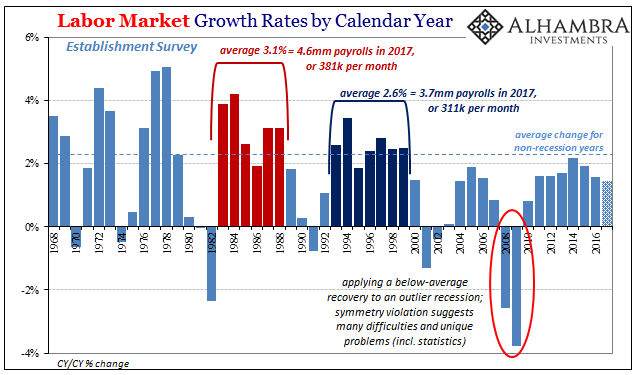
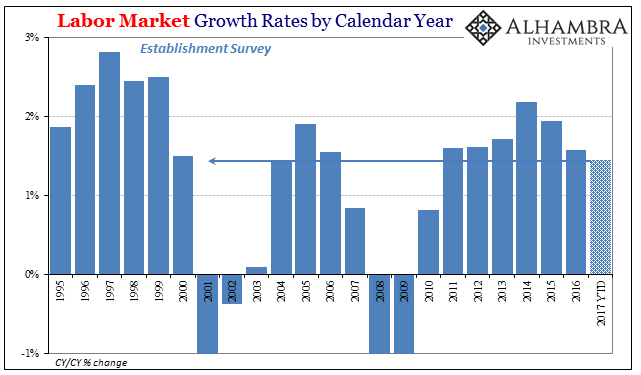
From 1993 through 1999, the labor market gained, on average, 2.6% per year according to the Establishment Survey. Since that time period is universally accepted as one featuring a strong economy, that is our standard for measurement. We can also go back to the eighties for what might amount to as an upper limit of sorts, the economy and labor market at that time being whatever is better than strong and robust – truly awesome.


Translating those average gains into the 2016 base equals an expectation of 3.7mm payrolls gained for 2017 to be as good as the nineties, and 4.6mm, which would signal a splendid economic year consistent with the eighties. Through 11 months so far up to November, the Establishment Survey gives us just 1.9mm for 2017. Assuming December turns out equal or better than November’s “good” number, the year should end with a total payroll expansion around 2.1mm, maybe 2.2mm.


That’s less than two-thirds of the way to the nineties, and significantly less than half of the eighties. This year, no matter how many months at 200k plus, has not been a good one. In fact, payroll gains in the eleven months so far tallied by the BLS’s Establishment Survey are less than those presented in that transitional year of 2000.


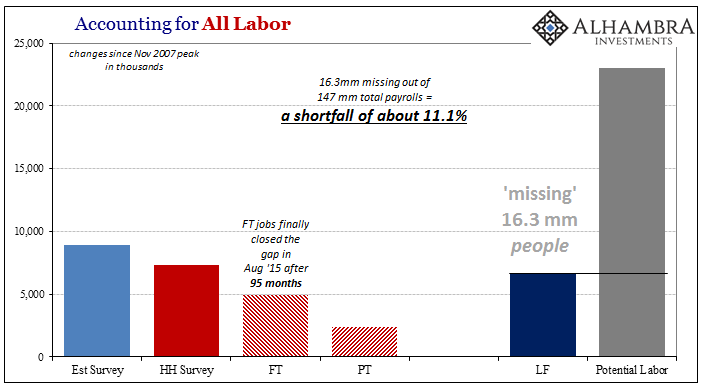
This is how you get the newest generation of American adults yearning in greater numbers for something vastly different, a radical political change if for no other reason than the establishment here continuing to say that everything is good when by every reasonable standard it isn’t even close! The “robust” labor market even of the past few years isn’t nearly enough to draw in those still sitting on the sidelines struggling, however, they do (parents’ basements) to just get along, leaving the economy instead it’s “missing” 16.3 million; a number that in a truly robust economy would be falling not rising.


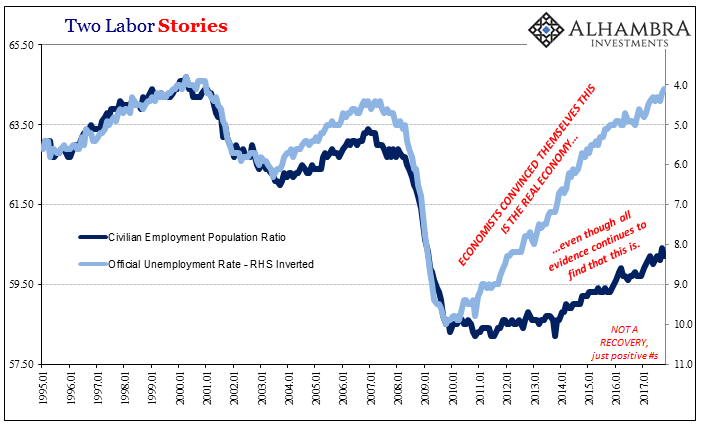
The issue clearly cannot be labor supply (Baby Boomer retirements, heroin, and fentanyl abuse in the Rust Belt) but shrunken labor demand; permanently shrunken economic demand. Therefore, there really should be no expectation for accuracy in the unemployment rate and what that means all around (inflation, baseline growth, monetary policy).


Once again in yet another month where the unemployment rate registers a ridiculous low, wages, and payroll earnings remain stuck at visibly low levels. The average weekly earnings of production and non-supervisory employees rose by just 2.6% year over year in November, after gaining 2.2% in October, 2.6% in September, and 2.7% in August. That’s nothing like in the past when the unemployment rate was where it is now. There is nothing like acceleration in earnings, not even solid growth.


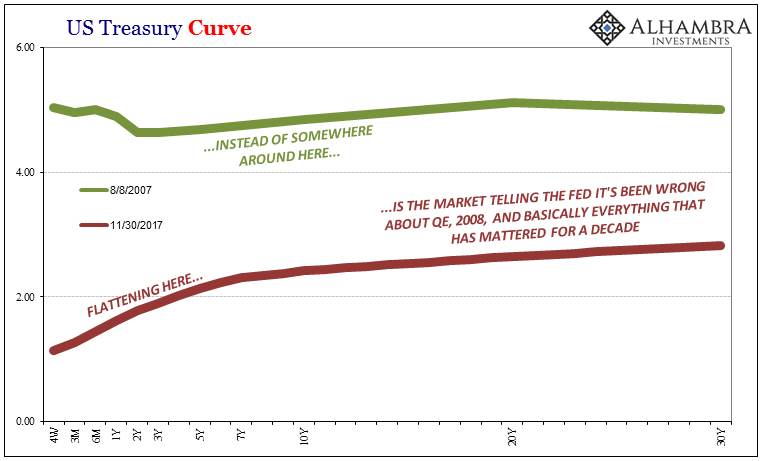
I don’t mean to make all this about the bond market every time (actually it’s appropriate), but the idea that treasuries at the long end have to be wrong has no basis other than misconception or intentional misdirection.


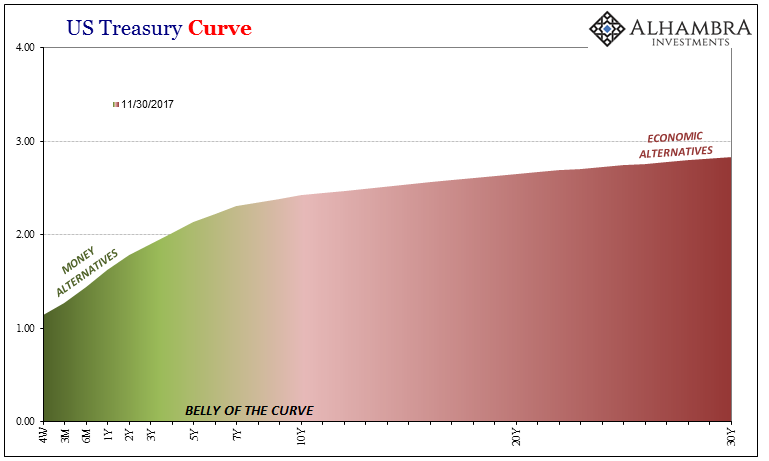
The data, including the BLS data, remains firmly on the side of flattening, and like the Establishment Survey’s paltry 1.9mm in 2017, it’s not even close.


Friday, December 8, 2017

Is it "Late 2007" For the Everything Bubble?

Timing the end of a major bubble is extraordinarily difficult as it entails figuring out when a critical mass of investors shift from greed to fear.


Having said that, we’ve recently seen a number of developments that would suggest we’re near the end of the current Bond Bubble.


Back in June the world saw the unveiling of perhaps the single most insane investment of all time: the 100-year bond.


To make matters more insane, the countries that were issuing these bonds (Argentina and Austria) both have experienced numerous sovereign dent crises in the last 100 years.


More recently, Austria almost went bust in 2015. And Argentina only just resolved issues with debt-holders from its 2001 default last year (2016).


Of course, 100-year bonds are not entirely new: Belgium and Ireland issued 100-year bonds last year (2016).


However, both of these issues were via private placements (meaning the bonds were sold at set prices to a select group of investors).


By way of contrast, both Argentina and Austria issued their 100-year bonds on the open market to anyone and everyone. Even more insane, both debt issues experienced tremendous investor demand!


Argentina sold $2.75 billion of a hotly demanded 100-year bond in U.S. dollars on Monday, just over a year after emerging from its latest default, according to the government.


The South American country received $9.75 billion in orders for the bond, as investors eyed a yield of 7.9 percent in an otherwise low yielding fixed income market where pension funds need to lock in long-term returns.


Source: Reuters


Austria has sold €3.5bn of 100-year debt in the largest century bond to hit the markets to date, the latest indication of hot investor demand for very long-dated debt. Bids from potential investors reached €11.4bn, dealmakers said.


Source: Financial Times


Let’s put this in very simple terms… two countries, both of which struggled with sovereign debt issues in the last four years, saw investors place between $3 and $4 in bids for every $1 in new debt issuance… on 100-year bonds.


This is beyond insanity. It is the textbook definition of a bubble. And it indicates we are nearing the end of the line for this current bubble.


The time to prepare for this is NOW before the carnage hits.


On that note, we are putting together an Executive Summary outlining all of these issues as well as what’s to come when The Everything Bubble bursts.


It will be available exclusively to our clients. If you’d like to have a copy delivered to your inbox when it’s completed, you can join the wait-list here:


https://phoenixcapitalmarketing.com/TEB.html


Best Regards


Graham Summers


Chief Market Strategist


Phoenix Capital Research

Gold Hangs Above 2016 Low Despite BTC (Now in BitCon Futures), Brexit Deal,Tax Bill, and Fund Pukers


The only thing that truly trends is humans extrapolating their rates of return emotionally. Everything else will regress to the mean at some point.  


Investors are being given a gift and do not see it. Every rally in stocks should be used to lighten exposure to a crash  and every corresponding dip in gold should be bought from a balanced portfolio approach.  You should be peeling back equity exposure on every new high and adjusting your risk into something that is stable, holds buying power, and is liquid. That is the point of investing. Your home, your art, and your bitcoin will not fit those guidelines. Gold and silver do.


Do you think the millennials will be buying your 401k shares in 5 Years? Don’t be naive. No one went broke banking profits. And the Fed is handing you an opportunity retire with enough money now as they have moved the housing bubble back into the stock market. It took 10 years. Do you have another 10 years to wait if we crap out again? Protect your profits now. 


Admittedly the title sounds like a Gold Bull rationalizing a losing position, as so many gold salesmen do, and we are long and are not selling you Gold. We are also swing trading from the short side. So it is what it is.


It"s jobs day and noone really thnks that matters to Fed policy anymore,  Brexit breakthrough agreed, and shutdown avoided for now. A couple points before getting to the reason for our title. Let’s first count the ways in which Gold has had to deal with bad news these past 2 months. 


Counting the Ways Gold is Bashed


Fund liquidation, Trump Tax Bill, Bitcoin, Brexit deal, Venezuela default (bearish for gold as they had to sell), and the usual short side players with deeper Fed sponsored  pockets than the longs woth which they do battle. These are a few of Gold’s obstacles these past couple months. And yet here we are $100 above last years lows. 


Kicking Gold Today’s Edition


The Brexit deal and Govt shutdown avoidance alluded to above, along with the end of year puke-age and Trump’s Tax Bill (as we have written about here extensively) have all been major negatives for Gold the past few weeks. And yet gold sells off (again) before the news comes out.. strange... 


To be fair, we are seeing more longs with end of year hopes dashed selling these last couple days. There are some shorts getting in now however. Just not enough to spur  a sustainable  a rally we think. 


Banks and The Fed in Bed Again And Gold Suffers for It


Post 2008 banks have been on the outs with The Fed as risk managers. The Fed had mandated more risk be cleared through exchanges. And they have succeeded somewhat.


In doing so, the border collies that run our monetary system have herded much derivative risk into a larger basket. TBTF became Bigger and more centralized (like Fannie Mae..).Their reason is this basket is more easily watched, and since they regulate exchanges, can be “advised” on policy.


But along comes an existential threat not just to global fiat backed governments, but to the US Banks that are their overlords. And boom! They have a common enemy. And that Enemy is Bitcoin.


Gold is suffering real collateral damage now as the banks pitch their new wonderful product to replace gold.. and it’s having an effect. 


BTC Futures: Regulation and Repression to Follow


Note the complete banking industry turnabout to hailing BTC as the new gold on the coincidental heels of new futures contracts approved by the CFTC. Banks and brokers have a new product to sell you folks, and they are actually calling it a store of value, a new gold, if you will. This is in complete contrast not just to BTC behavior (volatile and a wealth generating currency, but don’t call it money yet), but to gold itself (low volatility, wealth preserver, money but not currency)  Line up suckers for a new product to be castrated, regulated, and repressed by banks through exchanges with government blessing and oversight. People not long  Bitcoins will be buying futures on margin while banks long BTC  will be hedging and killing their much shallower pocketed but greedy clients. Let the fleecing begin in the NEW GOLD.  JPM Calls BTC “New Gold”; Spoofing Starts Monday


Love Michael, Hate it When he’s Right


Michael Moor has been spot-on in handicapping market moves given price triggers. Read UPDATE: “Bear Trend with a $1700 Target” Has Problems for more. He saw for different reasons than us, a large bull move fermenting last month. He gave a level where that was negated. That level was breached. Now,to our chagrin, he’s called this sell-off from the $1272 area very nicely. In the process, he stopped us from buying dips for now. But we wish he’d see the end.. for our sake! 


UPDATING OUR LEVELS


1-Our macro trade system says we should be out If the market is here come December 31.


2-The VBS indicator has yet to be triggered for a longer term volatility expansion. So according to that indicator we are still in a trading range, hard as that is to feel when you are long as we are. 


Point being; Nothing has Changed


We made the observation that funds like to get in above the 12 month MA for punts. They did and they are now puking. We have a long position based on this and are swing trading around it. 


We secondly stated that volatility would be expanding in 90 days. We are 45 into that and things are starting to percolate. We did say November would be one to remember. So that was a bit premature.


We believed a $50 move one way was coming which would cause  a spike in volatility and a follow up move anywhere between $50 and $200.


All of this is in play and lining up from our original statements to today’s activity.


The only thing you have to ask yourself is will you be in a position to buy gold if it drops another $50 and then another $100 from there. Because that is what gold is for. It is to be bought when it gets cheaper. We will be buying to hold for 12-18 months at least as we roll equity profits into wealth preservation vehicles. We will also be trading it from both sides of the table. But this is what we do professionally. 


You should be peeling back equity exposure on every new high and adjusting risk into something that is stable, holds buying power, and is liquid. Your home, your art, and your bitcoin will not fit those guidelines. Gold and silver do.


On combination, Michael says we may have another $30 or so of downside coming. This would trigger the VBS indicating a $50-$200 move relatively quickly in one or the other direction. 


Which brings us back to our original post a month ago declaring volatility is soon to expand in about 90 days. We also stated then a $50 move in either direction will yield another $200 in continuation or reversal of that first move. 


VBS Trading Algo Levels for Gold Oct 25th


Notes From a call today on potential gold trades.


  1. It looks like we will be seeing a move of $50 to $75 in either direction in the next 90 days. 

  2. That move could be slow and orderly, or fits and starts, that is not handicappable  or important to the system

  3. If a move like above occurs, then we will most definitely get a signal to be long Vol. on a risk reward basis as the monthly indicator will expand

  4.  Directionally, our first play would be to go with the direction at time of the trigger. Our second would be to stop and reverse at a predetermined level.

  5. this is a longer term play than usual for the VBAS so we will most likely express the position traditional way via long straddles. 

  6. Direction would then be expressed by NOT hedging gamma on daily break evens but more like every 2 weeks, and then only half of accumulated deltas. In this way we would remain long/ short in direction of the trend.

Monthly:


  1. Buy straddles or hedged call spreads on a monthly settlement above 1305 or below 1191 [Edit- now $1338 and $1192 per chart below]

  2. early entry- put on 1/2 position on a day signal as described above.

  3. exit everything on 3 bars if not profitable. 

  4. Gamma hedging TBD.


Monthly chart updated today. Gold has dropped approximately $35 thus far from that call. A $75 drop from Oct 25th"s level would be in shouting distance of $1192 and likely trigger the indicator of even higher volatility.


The plan is: Gold drops $50 from that post date, triggering the VBS for expanding volatility. 


At that point one either goes with the trend, or waits for a quick exhaustive selloff and reversal for a major rally. In simple terms: of Gold trades $1192, it will not sir there long. We will sell if it hits there, initiating a short. But that is only to keep our finger on the pulse. Having a position in a market heightens your radar and forces you to respect your discipline. Doing so will tell us if being short is wrong. This will in turn mean being long is right. And we will reverse hard. 


So, here’s to a market dump to $1193 and what could be the beginning of a new run higher. Yes, VBS also implies lower is equally possible from $1193, but given the seasonal nature of Gold and it’s tendency to make lows at end of the year as funds sell, we’re optimistic that the buy low and sell high rule of investment will replace our current swing trading behavior of selling weakness and buying it lower. This as we described all part of trading around a core long position. We’d love to start swing- trading from the long side with a core long position. Stay tuned.


Previously:


About the author:Vince Lanci has 27 years’ experience trading Commodity Derivatives. Retired from active trading in 2008 after netting $90MM in an Energy arbitrage strategy he devised for a NY hedge fund; Vince now manages personal investments through his Echobay entity and advises natural resource firms on market risk. Over the years, his expertise and testimony have been requested in energy, precious metals, and derivative fraud cases. Lanci is known for his passion in identifying unfairness in market structure and uneven playing fields going back to his first anonymous Zerohedge post on Silver. He remains a contributor to Kitco, Zerohedge, and Marketslant on such topics. Vince contributes to Bloomberg and Reuters finance articles as well. He continues to lead the Soren K. Group of writers on Marketslant. 


Bloomberg reports:


Progress


An early-morning breakthrough on Brexit first-round negotiations takes the process toward the next stage of forging the U.K.’s post-exit relationship with the European Union. The thorny issue of the Irish border was effectively parked while outline agreements on citizen rights and the divorce bill were achieved.  Leading Brexit campaigner Nigel Farage labeled the deal a “humiliation.” Gilts dropped and the pound remained relatively unchanged in the wake of the deal. 


Bank rally


Shares in European lenders are soaring this morning, with the Stoxx 600 Banks Index climbing as much as 3 percent, after Basel III capital rules will see “no significant increase” in provisioning for the institutions. The final batch of post-crisis regulations announced yesterday will see requirements decline for some large banks. The agreement and culmination of intense lobbying removes a regulatory risk which had been hanging over the sector for almost a decade. 


Markets rise


Overnight, the MSCI Asia Pacific Index added 0.6 percent, while Japan’s Topix index closed 1 percent higher following data showing the country’s economy expanded faster than expected. In Europe, the surge in bank shares is lifting the Stoxx 600 Index, which was trading 0.9 percent higher at 5:45 a.m. S&P 500 futures added 0.3 percent, the 10-year Treasury yield was at 2.389 percent and gold continued its recent slide. 


Shutdown


Congress sent President Donald Trump a bill extending federal funding for government spending to Dec. 22, avoiding a shutdown which was scheduled to begin today. Lawmakers, who already have a busy schedule coming into the year end, will seek to resolve issues on spending limits in the next couple of weeks which would allow for agreement on a longer-term budget.


Thursday, December 7, 2017

Banks Issue Last Minute Warning About Risks Of Bitcoin Futures, Ask Regulator For Review

As we countdown to the launch of bitcoin futures trading on the CBOE (10 December) and CME (18 December), the big banks – via the Futures Industry Association - have suddenly got cold feet about the risks. We don"t blame them, somebody"s going to get hurt, the only question is who. The banks are worried it could be them. The FIA’s “primary” members include all of the usual suspects like JPM, Goldman, Citi, Bank of America, Morgan Stanley, etc. The risk they are most concerned about relates to clearing houses which, ultimately, they stand behind. The problem, of course, boils down to Bitcoin’s volatility, something we flagged after the CME announced circuit breakers early last month.


Having taken a gamble on bitcoin futures, which are set to begin trading by the end of the year, the CME is now seeking to avoid the consequences of what has emerged as both the cryptocurrency"s best and worst selling point: its unprecedented volatility…While the CME already uses daily vol limits on most other markets, including crude, gold and market futures, to temporarily halt trading when price swings get out of control, the CME has never before dealt with something like bitcoin


In June, Bloomberg showed how Bitcoin’s 30-day volatility had risen to 100%, which was comparable (at the time) with one of the most volatile financial instruments they (and we) could probably think of - a three-times levered ETF in junior gold miners.


The CME has proposed three trading limits for Bitcoin futures, 7%, 13% or 20% up or down from the previous day’s closing price. The first two thresholds, for 7% and 13% moves, are “soft” limits, which would trigger a two-minute pause in trading of bitcoin futures. The 20% limit would be a hard stop after which trading would be halted. In the first ten months of Bitcoin trading in 2017, Coindesk calculated there had been 69 days in which Bitcoin moved at least 7%, 11 days in which it moved 13% and two days in which it moved 20%. In fact, we had another 20% intra-day move on 29 November 2017.


As the Financial Times reports, the banks – via the Futures Industry Association – is sending a letter to the CFTC which it will publish today.


The world’s largest banks are pushing back on the introduction of bitcoin futures, raising concerns with US regulators that the financial system is ill-prepared for the launch of the contracts as the value of the volatile cryptocurrency has soared. On Wednesday, the price of bitcoin climbed to a fresh record high of more than $14,000. Institutional investors have been keen to trade the asset but only via a regulated market.


However, the planned launch in the next 10 days of futures contracts by the Chicago exchanges CME Group and CBOE Global Markets, given a green light from the Commodity Futures Trading Commission last week, has prompted a backlash among the major brokers who backstop trading across the industry. The Futures Industry Association, the main futures industry lobby group, plans to send a letter to the CFTC that will be published on Thursday.


We could be forgiven for thinking this is all very “last minute”. The CME announced its launch of Bitcoin futures trading back in October and had been canvassing opinion from market participants, including the banks, for months beforehand. The FT confirms that it was seen a draft of the FIA’s letter in which the latter states that the introduction of Bitcoin futures “did not allow for proper public transparency and input”. This is self-evident, resulting from the launch of futures trading contracts being fast-tracked by all parties after Bitcoin’s price rose parabolically this year. As part of this fast track process, the CME and CBOE adopted a “self-certified regime” for the contracts, meaning that the normal regulatory oversight didn’t take place. As the FT notes, the FIA is belatedly calling for a review.


Using it (self-certified regime) for “these novel products does not align with the potential risks that underlie their trading and should be reviewed”, the draft reads. The CFTC warned last week during its approval process that the emerging cryptocurrency markets were largely unregulated and the agency had “limited statutory authority”. “It is also our understanding that not all risk committees of the relevant exchanges were consulted before the certification to launch these products,” the letter added.


Getting into the “nitty gritty”, even though the banks have been discussing the specification of the contracts for about six months (according to the CME), as the moment of truth approaches, they’ve “zeroed in” on the fragility of clearing houses. With so much Bitcoin trading occurs on other exchanges and outside the hours of CME/CBOE (even if they trade Sundays), the banks have realised their vulnerability.


Futures brokers are worried they will bear the brunt of the risk associated with bitcoin futures, because the margin that backstops the contract is placed in a clearing house. Clearing houses stand between two parties in a trade, managing the risk to the rest of the market if one side should default. They are mutually funded in part by banks to guard against the failure of their largest members. Several brokers among the top 10 largest providers have privately confirmed to the Financial Times that they will not clear the products immediately.


One clearing broker said that it would be open-minded about cryptocurrencies, as they were US dollar products, but only if they were “properly controlled and regulated”. However he added: “We’d still be on the hook in a worst-case scenario as we are exposed as members of the clearing house.”


Sometimes “old heads” are useful in these circumstances. Speaking on Bloomberg TV, Royal Bank of Scotland Chairman, Howard Davies, said he would advise the CME and CBOE against launching Bitcoin futures.


"I’m not quite sure that they know enough about what the underlying is, about the nature of the supply and demand of the underlying. I think it would be a very risky move for them in reputation terms. This is irrational exuberance. This is a very, very unusual market, that shows we’re not in a normal two- way trading market. Blockchain is much more interesting. The idea of a distributed ledger, which makes transactions and payment systems much cheaper and faster in real time is a good one. Blockchain, I think, has got life in it.”


Thomas Peterrfy, the founder, Chairman and CEO of Interactive Brokers (the one who fronts the company’s slightly irritating TV ads) is one of the “giants” of electronic trading in US financial markets. The FT noted Interactive Brokers" stance.


”Thomas Peterffy, a pioneer of electronic trading and head of Interactive Brokers, has warned that the introduction of bitcoin futures into a clearing house could increase systemic risk. On Wednesday Interactive said its clients would be unable to short the bitcoin futures market because of the extreme volatility of bitcoin.


It looks like the banks have realised Peterffy might be right in limiting trading of Bitcoin futures.


Peter Schiff Warns Of "Too Big To Pop" Bubble - "Everybody Is Going To Get Wiped Out!"

via Greg Hunter"s USAWatchdog.com,


Money manager Peter Schiff correctly predicted the financial meltdown in 2008.


Now, 10 years later, what does Schiff see today?  Schiff says,


“I predicted a lot more than just the stock market going down back then.  I predicted the financial crisis, but more importantly, I predicted what the government would do as a result of the financial crisis and what the consequences of that would be because that’s where we’re headed. 


The real crash I wrote about in my most recent book is still coming...


This is the third gigantic bubble that the Fed has inflated, and when this one pops, it’s not going to be ‘the third time is a charm.’  It’s going to be ‘three strikes and you’re out.’ 


I think this bubble is too big to pop.  I think it’s the mother of all bubbles, and when it bursts, there is not a bigger one that the Fed is going to be able to inflate to mask these problems, meaning we can’t kick the can down the road anymore.”


This time, the crisis is going to hit everyone in the wallet. Schiff goes on to say,


“I think the problem we are going to be confronted with is going to be much worse than a financial crisis.  It is going to be a dollar crisis, and it is going to be a sovereign debt crisis where the bonds people are worried about are not some sub-prime mortgages...


It’s going to be the U.S. government that people are worried about and the solvency of the U.S. government and the Treasury bonds.  If it’s a dollar crisis and people are worried about the dollar, the only thing worse than owning a dollar today is owning the promise of being paid in dollars in the future. 


I don’t think we have the courage to default and admit to our creditors that we don’t have the money and we can’t repay.  I think we will create all the money that we need so we can pretend to repay, but what we end up doing is wiping out the debt with inflation.”


So, how long can it go on? Schiff says,


“How high can the debt go?  I don’t know and you don’t know...


How many straws can you put on a camel’s back?  You don’t know until you put that final straw that’s one too many and you break his back.  So, can we go to $25 trillion in debt?  Maybe.  At some point, we are going to break the back of the camel with all this debt.  Then we are going to find out how much debt we can pile on, and it’s not going to be pretty. 


Everybody is going to lose.  Everybody is going to get wiped out who has been partying in the stock market, the bond market and the real estate market.  The dollar is going to tank, and purchasing power is going to get wiped out.”


Inversely, Schiff says it is the same with the suppressed gold and silver markets. Schiff contends,


“They can’t keep doing it, and it will end.  It’s just like how much debt can we take on.  It’s not an unlimited amount.  We will know when we get there. 


How long can they keep the price of gold suppressed?  We will know when we get there.  At some point, the price is going to explode because there is real physical buying, and all that paper selling can’t camouflage that...


People don’t trust fiat currencies . . . . More and more people are looking for alternatives, and the real alternative is gold.  When they embrace it, it’s going to overwhelm central banks’ ability to suppress the price.  In the meantime, enjoy the gift that they are giving.”


Join Greg Hunter as he goes One-on-One with money manager and financial expert Peter Schiff, founder of Euro Pacific Capital...


(To Donate to USAWatchdog.com Click Here) 


Friday, December 1, 2017

Moody"s To State & Local Governments - Prepare For Climate Change Or Lose Access To Cheap Credit

The 2017 Atlantic hurricane season, which officially began on June 1 and ends today, featured the highest number of major hurricanes since the 2005 season and was only the second time that two Category 5 hurricanes made landfall. However, it was by far the costliest hurricane season on record, with a preliminary total of $368.7 billion in damages, more than twice the cost in 2005. Nearly all of the damage resulted from the season’s three major hurricanes, Harvey, Irma and Maria. Yesterday, nine scientists writing in PLOS ONE estimated that almost 14,000 DINAA archaeological sites (Digital Index of North American Archaeology) on the Atlantic and Gulf Coasts in the US could be lost by 2100 as seas rise due to climate change.


In these circumstances, it’s not surprising that the rating agencies are looking to incorporate risks from climate change, e.g. rising seas and major storms, into the credit ratings of public sector borrowers with coastal communities. Business Insurance magazine quotes from Moody’s report.


“Climate shocks or extreme weather events have sharp, immediate and observable impacts on an issuer’s infrastructure, economy and revenue base, and environment,” the New York-based ratings agency said in its report published Tuesday. “As such, we factor these impacts into our analysis of an issuer"s economy, fiscal position and capital infrastructure, as well as management’s ability to marshal resources and implement strategies to drive recovery. The interplay between an issuer"s exposure to climate shocks and its resilience to this vulnerability is an increasingly important part of our credit analysis and one that will take on even greater significance as climate change continues.”


Moody’s acknowledges that there is likely to be some adaptation on the part of state and local governments in the form of mitigation strategies to lessen the impact. Nonetheless, the rating agency is serving a warning, as Bloomberg notes.


“Coastal communities from Maine to California have been put on notice from one of the top credit rating agencies: Start preparing for climate change or risk losing access to cheap credit. In a report to its clients Tuesday, Moody’s Investors Service Inc. explained how it incorporates climate change into its credit ratings for state and local bonds. If cities and states don’t deal with risks from surging seas or intense storms, they are at greater risk of default.


"What we want people to realize is: If you’re exposed, we know that. We’re going to ask questions about what you’re doing to mitigate that exposure," Lenny Jones, a managing director at Moody’s, said in a phone interview. "That’s taken into your credit ratings."


In its report, Moody’s lists six indicators it uses "to assess the exposure and overall susceptibility of U.S. states to the physical effects of climate change." They include the share of economic activity that comes from coastal areas, hurricane and extreme-weather damage as a share of the economy, and the share of homes in a flood plain. Based on those overall risks, Texas, Florida, Georgia and Mississippi are among the states most at risk from climate change. Moody’s didn’t identify which cities or municipalities were most exposed.


Why the sudden focus on climate change from ratings agencies, like Moody’s. Because, as is almost always the case, they only react after the event. In May 2017, Bloomberg reported that when Ocean County (there’s a clue in the name) issued $31m of bonds in 2016, neither Moody’s nor S&P asked any questions about the impact of climate change on its finances. As Bloomberg highlights.


Few parts of the U.S. are as exposed to the threats from climate change as Ocean County, New Jersey. It was here in Seaside Heights that Hurricane Sandy flooded an oceanfront amusement park, leaving an inundated roller coaster as an iconic image of rising sea levels. Scientists say more floods and stronger hurricanes are likely as the planet warms.


It becomes apparent that Moody’s focus on climate change has little to do with being pro-active, rather it’s a response to pressure from investors who, no doubt, remember what happened to many AAA-rated sub-prime mortgage bonds not too many years ago. Indeed, when asked, Moody’s was not ale to recall an example where the credit rating of a city or state had been downgraded for failing to address climate change. Bloomberg continues.


If repeated storms and floods are likely to send property values -- and tax revenue -- sinking while spending on sea walls, storm drains or flood-resistant buildings goes up, investors say bond buyers should be warned.


Jones said Tuesday that the company had been pressured by investors to be more transparent about how it incorporates climate change into the ratings process. Some praised the move, while also urging it to go further.


What are investors’ views on this issue? Bloomberg provides some feedback.


"This kind of publication shoots for municipalities to think harder about disclosure," Adam Stern, a senior vice president at Breckinridge Capital Advisors in Boston, said in an interview. "The action would start to happen when and if you start seeing downgrades."


Eric Glass, a fixed-income portfolio manager at Alliance Bernstein, said real transparency required having a separate category or score for climate risk, rather than mixing it in with other factors like economic diversity and fiscal strength. Still, the new analysis is "certainly a step in the right direction," Glass said by email.


Public administrators are doubtful that anything will change until Moody’s and other ratings agencies show they mean business with actual downgrades.


Others worried that Moody’s is being too optimistic about cities’ desire to adapt to the risks associated with climate change. Shalini Vajjhala, a former Obama administration official who consults with cities on preparing for climate change, says that won’t happen on a large scale until cities start facing consequences for failing to act -- in this case, a ratings downgrade.


"Investors and governments alike are looking for clear market signals to pursue, and perhaps even more importantly, to defend investments in major adaptation and resilience projects to their constituents and taxpayers," Vajjhala, who now runs Re:Focus Partners, said in an email. "Outside of the rating agencies, it is not obvious who else could send a meaningful market-wide signal."


Unfortunately, our suspicion is that, for now, Moody’s focus on climate change risk is driven by the need to be seen saying the right things. We hope the agency “will walk the walk”, rather than merely “talk the talk”, with some downgrades. That would undoubtedly create a response from state and local governments.