Showing posts with label ATM. Show all posts

Wednesday, December 27, 2017

Europe"s Runaway Train Towards Full Digitization Of Money & Labor

Authored by Peter Koenig via The Saker blog,


The other day I was in a shopping mall looking for an ATM to get some cash. There was no ATM. A week ago, there was still a branch office of a local bank – no more, gone. A Starbucks will replace the space left empty by the bank. I asked around – there will be no more cash automats in this mall – and this pattern is repeated over and over throughout Switzerland and throughout western Europe. Cash machines gradually but ever so faster disappear, not only from shopping malls, also from street corners. Will Switzerland become the first country fully running on digital money?


This new cashless money model is progressively but brutally introduced to the Swiss and Europeans at large – as they are not told what’s really happening behind the scene. If anything, the populace is being told that paying will become much easier. You just swipe your card – and bingo. No more signatures, no more looking for cash machines – your bank account is directly charged for whatever small or large amount you are spending. And naturally and gradually a ‘small fee’ will be introduced by the banks. And you are powerless, as a cash alternative will have been wiped out.


The upwards limit of how much you may charge onto your bank account is mainly set by yourself, as long as it doesn’t exceed the banks tolerance. But the banks’ tolerance is generous. If you exceed your credit, the balance on your account quietly slides into the red and at the end of the month you pay a hefty interest; or interest on unpaid interest – and so on. And that even though interbank interest rates are at a historic low. The Swiss Central Bank’s interest to banks, for example, is even negative; one of the few central banks in the world with negative interest, others include Japan and Denmark.


When I talked recently to the manager of a Geneva bank, he said, it’s getting much worse. ‘We are already closing all bank tellers, and so are most of the other banks’. Which means staff layoffs – which of course makes it only selectively to the news. Bank employees and managers must pass an exam with the Swiss banking commission, for which they have study hundreds of extra hours within a few months to pass a test – usually planned for weekends, so as not to infringe on the banks’ business hours. You got to chances to pass. If you fail you are out, joining the ranks of the unemployed. The trend is similar throughout Europe. The manager didn’t reveal the topic and reason behind the ‘retraining’ – but it became obvious from the ensuing conversation that it had to do with the ‘cashless overtake’ of people by the banks. These are my words, but he, an insider, was as concerned as I, if not more.


Surveillance is everywhere. Now, not only our phone calls and e-mails are spied on, but our bank accounts are too. And what’s worse, with a cashless economy, our accounts are vulnerable to be invaded by the state, by thieves, by the police, by the tax authority, by any kind of authority – and, of course, by the very banks that have had your trust for all your life. Remember the ‘bail-ins’ first tested in early 2013 in Cyprus? – Bail-ins will become common practice for any bank that has abused its greed for profit and would go belly-up, if there wouldn’t be all those deposits from customers. Even shareholders are not safe. This has been quietly decided on some two years ago, both in the US and also by the non-elected white-collar mafia, the European Commission – EC.


The point is, ‘banks über alles’. And which country would be better suited to introduce ‘cashless living’ than Switzerland, the epicenter – along with Wall Street – of international banking. Bank’s will call the shots in the future, on your personal economy and that of the state. They are globalized, following the same principles of deregulation worldwide. They are in collusion with globalized corporations. They will decide whether you eat or become enslaved. They are one of the tree major weapons of the 0.1 % to beat the 99.9% into submission. The other two at the service of the master hegemon’s Full Spectrum Dominance drive, are the war- and security industry and the ever more brazen propaganda lie-machine. Banking deregulation has become another little-propagated rule of the World Trade Organization (WTO). Countries who want to join WTO, must deregulate their banking sector, prying it open for the globalized money-sharks, the Zion-controlled banking conglomerates.


Retrenchment of personnel in the banking employment market is increasing. The news only selectively reports on it, when there are large amounts of jobs being eliminated. Statistics lie everywhere, in the EU as well as in Washington. – Why scare people? They will be scared enough, when they are offered jobs at salaries on which they can barely survive. That’s happening already. It used to be a tactic applied for developing countries: Keep them enslaved by debt and low pay, so they don’t have time and energy to take to the streets to protest – they have to look for food and work, whatever menial jobs they can get, to feed their families. It’s now hitting Europe, the West in general. Some countries way more than Switzerland.


Cashless trials are going on elsewhere, especially in Nordic countries, where selected department stores and supermarkets do no longer take cash. Another monstrous trial has been carried out in India a year ago, in the last quarter of 2016, where from one day to another 80% of the most popular money notes were eliminated, and could only be exchanged for new notes by banks and through bank accounts. And this in an almost pure cash country, where half the population has no bank account, and where remote rural areas have no banks. People were lied to so that the sudden introduction had maximum effect.


It caused massive famine and thousands of people died, as they had suddenly no acceptable cash to buy food – all instigated by the USAID Project ‘Catalyst’, in connivance with the Indian rulers and central bank. It was a trial. It was a disaster. If it works in India with 1.3 billion people, two thirds of whom live in rural areas and most of them have no bank account, the scam could be applied in any developing country – see also India – Crime of the Century – Financial Genocide


What is going on in Switzerland is a trial with the high end of populations. How is the upper crust taking to such radical changes in our daily monetary routine? – So far not many protests have been noticed. There is a weak referendum being launched by a group of people who want the Swiss Central Bank be the only institution that can make money, like in the ‘olden days’. Though a very respectable idea, the referendum has no chance in today’s banking and debt-finance environment, where youth is being indoctrinated with the idea that swiping your card in front of an electronic eye is cool. Today, most money is made by private banks, like elsewhere in Europe and the US. Worldwide banking deregulation, initiated by the Clinton Administration in the 1990s – today a rule for any member of the World Trade Organization (WTO) – has made this all possible.


Digitalization and robotization is just beginning. Staffed check-out counters in supermarkets are dwindling; most of them are automatic – and that happened within the last year. – Where are the employees gone? – I asked an attendant who helped the customers through the self-checkout. ‘They joined the ranks of unemployed’, she said with a sad face, having lost several of her colleagues. ‘It will hit me too, as soon as they don’t need me anymore to show the customers on how to auto-pay.’


Bitcoins


Digitalization also includes the cryptocurrencies, the blockchain moneys floating around – of which the most famous one is Bitcoin. It brings digitalization of money to an apex. The system is complex and seems to lend itself only to ‘experts’. Cryptocurrencies are fiat money, based on nothing, not even on gold. Cryptos are electronic, invisible and highly, but highly speculative, an invitation for gangsters and fraudsters. With extreme speculative values, it looks as if cryptocurrencies were designed for crooks and speculators.


Bitcoin was allegedly invented by Satoshi Nakamoto which could be a pseudonym of a man or a group of people, suspected to live in the US. “Nakamoto’s” identity is believed to be commonwealth origin, due to the vocabulary used in his writings. One of his close associates is purportedly a Swiss coder, who is also an active member of the cryptocurrency community. He is said to have graphed the time stamp of each of Nakamoto’s more than 500 bitcoin forum posts. Such ‘forum posts’ exist in the thousands, worldwide. They form an elaborate network based on algorithms.


Bitcoin was formally created in January 2009 with a fix amount of 21 million ‘coins’, of which more than half are already in circulation, and 1 million, or about 4.75% (of the total) can be traced to Nakamoto – which according to the current market value corresponds to close to US$15 billion. Today’s overall Bitcoin market cap is more than US$ 315 billion. The market is highly volatile. Drastic daily fluctuations are common, especially within the last 12 months. If one of the major Bitcoin holders, like Nakamoto, would capitalize his profit by selling a big portion of his holdings, the Bitcoin price would be in free fall, functioning pretty similar to the regular stock exchange.


On 24 August 2010, when Bitcoin was first traded, its value was US$ 0.06. On 24 December 2017, the coin was worth US$ 13,800, an increase of 230,000%. In the last twelve months, its value increased from about US$ 800 in December 2016 to a peak of close to US$ 20,000 in December 2017, an increase of nearly 2,500 %. However, in the last 7 days, the price has dropped by US$ 5,160, i.e. by more than 27%, and the trend seems to be downward; perhaps a sign of quick profit-taking? However, this shows how instable this cryptocurrency is, apparently much more so than trading corporate shares on the stock market.


The number of cryptocurrencies available over the internet as of 27 November 2017 is above 1300 and growing. A new cryptocurrency can be created at any time and by anyone. By market capitalization, Bitcoin is presently the largest blockchain network (database network, storing data in different publicly verifiable places), followed by Ethereum, Bitcoin Cash, Ripple and Litecoin.


Bitcoin may be the next bubble, bringing down a parallel economy which has already its fingers clawing into our regular western economy. Cryptocurrencies are officially forbidden in Russia and China, though stopping cryptocurrency dealings by individuals is hardly possible. They do not touch the traditional banking system. That’s why major banks hate them. They circumvent the banking suckers, prevent them from making ever higher profits from horrendous commissions, against which the people at large are powerless.


Here is Bitcoin’s positive value. It escapes bank and state controls. If countries’ economies were run on Bitcoins or another cryptocurrency, they would escape US sanctions which function only because western currencies are foster-children of the US-dollar, hence, subject to the dollar hegemony; meaning all international transactions have to pass through a US bank. A typical case is ‘banking blockades’, when Washington decides to stop all international transactions of a country until it submits to the wishes of the empire. It is blackmail; totally illegal, but unless there is a monetary alternative, the (western) world is subject to this system.


A typical case was Argentina, when she was forced by a New York judge in June 2014 to pay a New York based Vulture Fund US$1.6 billion, an illegal ruling according to a UN resolution. Argentina refuse to pay, so the judge, interfering in a sovereign nation, blocked more than US$ 500 million in Argentina’s debt payment to creditors, bringing Argentina to the brink of a second bankruptcy in 13 years. Eventually, neoliberal Macri negotiated a deal with the Vultures of a payment in excess of US$ 400 million.


This US blackmail would not have been possible had Argentina been able to make its foreign transactions in Bitcoins or another cryptocurrency. Venezuela is currently using a national cryptocurrency for some of its foreign transactions, thereby escaping the sanctions stranglehold of Washington. Had Greek and Cyprus citizens had a cryptocurrency alternative to the euro, they would not have been subject to the cash control imposed by the European Central Bank.


On the other hand, funding of terror organizations, like ISIS, cannot be disrupted, if the terror group deals in cryptocurrencies. – This shows, for good or for bad, Bitcoins, or cryptocurrencies are for now unique in resisiting censure and blackmail, or any kind of authoritarian outside interference in electronic money transactions.


Cashless Living


If Switzerland accepts the change to digital money, a country where until relatively recently most people went to pay their monthly bills in cash to the nearest post office – then we, in the western world, are on a fast track to total enslavement by the financial institutions. It goes, of course, hand-in-hand with the rest of systematic and ever faster advancing oppression and robotization of the 99.9% by the 0.1%.


We are currently at cross-roads, where we still can either decide to follow the discourse of a new electronic monetary era, with ever less to say about the product of our work, our money; or whether, We the People, will resist a banking / finance system that has full control over our financial resources, and which can literally starve us into submission or death, if we don’t behave. In order to resist we need an alternative monetary system or monetary network, away from the dollar-euro hegemony.


All the more important is the ascent of another economy, another payment and transfer scheme which already exists in the East, the Chinese International Paymen, totally System (CIPS), effectively a replacement of SWIFT, totally privately run and linked to the US-dollar and US banks. The world needs a multipolar economy, based on the real output of a country or society, as is the case in China and Russia, not one based on fiat money as is the current western economy.


Will Switzerland, the stronghold of world finance, along with New York, London and Hongkong, resist the temptation of increased profit, power and control, offered by digital money? – We, the People, have still the chance to decide either for continuing rotting in a fraud economy, based on wars and greed – for which digital money, exacerbated by cryptocurrencies, is a new tool for a new maximizing profit bonanza on the back of the common people; or do we opt for an honest future and for a life that leaves us free to take sovereign political and monetary decisions in a full cash society. For the latter we must wake up to see the propaganda fraud going on before our eyes, and to resist the robot and electronic money onslaught being unleashed on us.


Tuesday, December 26, 2017

Man Arrested For Punching Wells Fargo ATM: "It Gave Him Too Much Money"

Call it the holiday"s token bizarro incident: according to Florida Today, a 23-year-old man who told police he punched a Wells Fargo ATM because it gave him too much cash, was arrested after bank officials said the attack caused at least $5,000 in damages, which elevated the inexplicable and idiotic temper tantrum into a felony crime.


Michael Oleksik, 23, 5"11", 155lbs, of Rockledge, FL; charges: Criminal mischief >$1000.


Cocoa police charged Michael Joseph Oleksik, of Merritt Island, on Friday with criminal mischief nearly a month into the investigation of a disturbance at the Wells Fargo bank branch at 834 N. Cocoa Boulevard, in Cocoa. According to authorities, Oleksik could be seen on surveillance video standing at the ATM, pummeling the electronic teller’s touch screen on Nov. 29.


A short time later, an apologetic Oleksik called the bank and told a manager that he punched the ATM because he was "angry the ATM was giving him too much money and he did not know what to do," Florida Today reported. Oleksik then explained that he was in a hurry for work and apologized for the damage to the bank"s ATM.


While Oleksik"s behavior may appear irrational at first glance, a quick look at his arrest record, which reveals not only domestic violence charges, but also disorderly drug intoxication and resisting and intimidating a police officer, and suddenly his vendetta with the ATM makes sense.


Wells Fargo - clearly distraught at the treatment one of its ATM machines was subjected to - contacted the Cocoa Police Department and asked to press charges. Oleksik was arrested Friday and booked into the Brevard County Jail Complex in Sharpes.


Thursday, December 21, 2017

Bitcoin Dominatrix Makes $1 Million Pimping Out Clients In "Crypto Slave Farm"

MarketWatch is out with a hard hitting story of a Paris dominatrix who"s been pimping out clients to mine cryptocurrency in a "Crypto Slave Farm" where they deposit the proceeds in a digital wallet.


The woman who goes by Theodora is a financial dominatrix, which MarketWatch describes below: 


...clients — many of whom never meet her in person — derive sexual pleasure from giving her gifts and money. Exchanges of money can range from several dollars in “tributes,” as they are called, to gifts of more than six figures. Some clients even become a “human ATM,” meaning they give her complete control over a bank account.


Theodora says she makes between $7,000 and $10,000 per month in cryptocurrencies, on top of $10,000 per month she earns making video hypnosis sessions and financial domination videos. Last year she claims she made nearly $1 million from cryptocurrencies alone.


 Theodora


It’s a form of psychological domination where money is the tool for the transfer of power,” says Theodora, adding “It’s quite common for powerful men like politicians or CEOs to look for a form of sexual release by submitting to a woman — they are in control all the time during the day — and giving up control financially is a more tangible instrument of power for them.”


Theodora has been working as a dominatrix for eight years, and accepting payment in cryptocurrency for four. Her clients, mostly from the U.S. and U.K., are typically men in their late 30s to early 50s - and include a "core group of 20 to 25 regular big spenders who make donations as high as $100,000 at once - some of whom she does "real time" session with in person." She also has a following of 200 to 300 people who make smaller contributions online for $25 / minute video chats. 


MarketWatch sat down with Theodora for a few questions about her adventures in crypto: 


MarketWatch: When did you decide to start taking cryptocurrency?


Theodora: In this business of domination, it’s common for dominatrixes to take crypto payments. We cannot take PayPal because they blacklist sex workers. I have been making my clients mine for me for a couple of years.


[Mining is the electricity-heavy process of using computer power to verify cryptocurrency transactions — miners are given a monetary prize for their contributions, which Theodora routes to her wallet.]


MarketWatch: What is your crypto slave farm?


Theodora: It is a little tool where people use the resources of your computer to mine [cryptocurrency] for me from a distance. So even though it might be a tiny amount, I have quite a lot of traffic on my website so it adds up quite nicely.


MarketWatch: How do you make money in cryptocurrencies?


Theodora: I take donations and also have people mining for me. I take a lot of geek clients who like new technology and they were really excited when I taught them how to build a mining rig for me so they could mine 24/7 from their home.


Theodora says she has her "favorite currencies" she"s betting on, noting "Bitcoin could crash in two days, you don"t know what"s going to happen, so if you have enough to invest in smaller currency you should," and adding "For me, it"s play money.


Wednesday, December 20, 2017

"It"s Not Politics, It"s Survival" - Bitcoin, Local Currencies Are Taking Over In Venezuela

Anybody who believes that central banks are essential pillars of economic stability that deserve the untrammeled authority to issue currencies, which they presently enjoy, should take a close look at what’s happening in Venezuela.


Central bankers have tended to dismiss the notion of private currencies as an idea embraced only by techno-libertarian wingnuts (they have invariably described bitcoin as a “store of value” that’s “not yet big enough to threaten the economy."


But in Venezuela, the collapse of the bolivar has forced locals to turn to alternatives like bitcoin and local community-issued currencies with fixed exchange rates. The rapid erosion of the bolivar’s value made everyday transactions like buying groceries and paying cabbies untenable - customers had to pay with large, cumbersome stacks of bolivars that were difficult to transport.


Patricia Laya, a Venezuela-based reporter, tweeted a photo of the 5,000 bolivars - the maximum amount - she was able to withdraw from an ATM in Caracas. They"re worth around $0.05. Laya stated that she had waited 20 minutes in line to obtain $0.05 in hyperinflated currency worth little to no value, according to CCN.


Even though bitcoin transactions can take hours - even days - to settle, local merchants have readily embraced the digital currency.


A Venezuelan student named John Villar said he uses bitcoin more than bolivars because it’s literally the only viable option.


“This is not a matter of politics. This is a matter of survival,” said Villar.


Villar said he has bought two plane tickets to Colombia, his wife’s medication, and paid his employees with bitcoin in the past month. Villar emphasized that he intends to continue utilizing bitcoin like the majority of Venezuelans, according to CCN.


In Venezuela, the majority of the population has lost trust in the government, the central bank and the banking system, which has clearly helped predispose Venezuelans to bitcoin.


In addition to bitcoin, communities are beginning to launch local currencies, the revival of an idea that the late Hugo Chavez became a proponent of late in life where Venezuela would adopt a series of 10 community currencies like the ones currently being issued by pro-government forces.


In one Caracas neighborhood, several shops have started accepting the panal, according to the Associated Press.


The panal, which means honeycomb in Spanish, can be spent in just a few stores. But residents of one neighborhood desperate for spending cash said they welcome the idea proposed by pro-government groups.


"There is no cash on the street," said Liset Sanchez, a 36-year-old housewife who plans to use her freshly printed panals to buy rice for her family. "This currency is going to be a great help for us."


Amid triple-digit inflation and a currency meltdown, there has been a run on cash in Venezuela.


Buying common items such as toilet paper, or paying a taxi driver, requires stacks of the official currency, called the bolivar.


To be sure, not everybody agrees that these alternative currencies are necessary or even helpful.


Jose Guerra, an opposition politician, knocked the idea of an alternative currency, arguing that having multiple currencies could add "monetary chaos" to the ongoing economic crisis. Perhaps Guerra has never been faced with the prospect of either starving or finding an alternative means of procuring food.


Indeed, President Nicolas Maduro inadvertently helped validate bitcoin - even though his government is cracking down on bitcoin miners - by announcing that the country would adopt a national digital currency called the petro, similar to bitcoin, to replace the bolivar. He has offered few additional details about the plan, however.


Friday, December 15, 2017

Cryptocurrency Bank AriseBank To Acquire 100 Year Old FDIC Bank; Partner With BitShares.

Intro by Vince Lanci


via the Soren K. Group at Marketslant.com


The Next Revolution is already Happening


Over the past few weeks, I"ve had the pleasure of meeting the next revolutionaries in the democratization of money. This was while looking to understand better the guts of the blockchain tech and how it differed from crypto to crypto. I had the  pleasure of meeting with and  speaking to several people involved with Bitshares and those  involved  at the  periphery with Arisebank. During that time, by coincidence, Arisebank was in the process of doing the deal described in the headline. And I was able to look through the glass at this event where people were ,to my eye, looking to facilitate the transition from intellectual ideas to applications in reality. That is what Capitalism is in part about. Providing a service that fills a need and makes it easier which  gets you paid. Not making a dollar and being apathetic if the service actually helped someone. Free market capitalism allows for new ideas to make it (or not) on their own merits. That is what I saw. The potential  for self-clearing markets to  reassert themselves and for money to get to where it is needed most without incumbent toll booth operators throttling ideas fortheri own benefit.


I saw people who will make a bundle of money by adding value to a system in need of overhaul. i spoke wit ha few on a guarantee of anonymity. One key person said to me  in response ot me pointed question that blockchain is the beginning, Bitcoin may be the early pioneer, but like the Palm pilot, it was replaced by better tech. Why wed yourself to Blockchain?:


"Look, the tech is evolving, and we are already looking at how Quantum computing will make different types of tech more palatable than blockchain. I agree with you. In a few years at most, something better will come along. And that is a good thing. Because the goal here is to use these new tools to remove the friction in all things that prevents ideas from getting their chance to make it or not on their own merits. If you ( he was addressing me directly here) have an idea that will make a market more efficient and serve the greater good, I want to hear about it. Because now, I can help you get it into "production" much easier because  of what we can  do."


My response was: Sure, I feel intermediaries in general that do not add value need to be removed. Frankly, I feel Precious metals producers"  have been victims of their own ignorance for years. As a result they are captive clients to intermediaries who tell them when to hedge in order to maintain their credit line. Meanwhile those same firms that manage the producer"s banking, LOC, ISDAs, and production hedging are making money not just from those services, but on the prop-side of being able to benefit from the natural sell order flow captive producers provide. This is too much friction from production to user. It"s like a poorly connected pipeline slows waterflow"


His response was simple:


"Exactly. And we are already working with someone who is working on solving that problem right now. You should connect with them. "


And in 24 hours I was involved in a pressure cooker with a couple geniuses having conceptual discussions on how to use the available tech to make more precious metals distribution from producer to end user more efficient. The point is, the man quoted above was all about making  it happen. And it likely will if the people I"m now talking with and learning from get their wish. i hope to be sharing more on this topic soon. Moving on to the event at hand today.


Better Money Needs a Better Banking Model


If money is the life blood of capitalism, then banks are the valves that control the flow of that blood. In this way, traditional banks can sometimes make errors in allocation of investment capital, errors in custodial trust, and due to their centralized “gatekeeper” status have a Fed sponsored franchise that can be a deterrent to efficient, free markets. If you had the time to listen to my podcast yesterday on this topic you can see where I was coming from in light of today"s events.


This is actually why crypto currencies are vulnerable. They are not regarded as money officially, like Gold is not anymore either . They are also in the process of being regulated via futures listing and “crackdowns” to protect us so we are told; also what happened to precious metals. 


There are many of them, and this fragmentation itself has risk that comes with its promise of economic freedom. Many will not make it. And they exist outside the banking network. 


But what happens if a crypto (or all crypto currencies) gets access to the circulatory system itself? What happens when a cryptocurrency, due to Blockchain’s distributed ledger accounting tech, obviates the need for those custodial trustee valves that  exist like manned toll booths when ez pass exist? They unionize in a panic to protect their jobs. That is what happens. And that has begun. 


To digress a second, we actually pay to get access to our money now. Cash Remember the advent of the ATM? It was heralded as a cost reducer for banks and a convenience for the client. Now, it is a profit center where people frequently are charged to get their money. This is basically cash trading at a discount to digital cash. You are paying the bank money to use your money in private transactions . But Quick-Pay, in which they monitor all cash use and collect data from, is free; for now. 


Supply Side Scalability is No Longer a Viable Business Model in a World Without Scarcity. Demand Side"s Network Effect Model Is


Banking’s centralized method of  “service” which at one time was necessary for orderly and counter-party trustworthiness in markets, has either outlived itself or become easily abused in its use. The trust resided in the person who did the  custodial duties.  Their supply side-market structure based on scalability, key to the industrial revolution, is no longer the most efficient. Scarcity is not the problem anymore. Distribution is. And that means another business model applies more efficiently. It is the demand side market structure model based on the network effect. And  to implement that, we need  a better way of mitigating counterparty trust that removes the  human element and bottleneck that comes along with its centralized systems. 


Traditional brick and mortar centralized Banking, like every industry before it, is jeopardized by the most important concept behind the current disruptive technological movement: decentralization. The problem with decentralization for banking until the advent of Crypto and blockchain tech is: it was not compatible with mitigating counterparty risk.  Therefore a centralized authority was needed. Distributed ledger accounting tech removes the need for a central custodial trustee to protect you from counter-party risk. This is what tech geeks say when they refer to a "trustless" transaction. They mean; there is no need for a human to verify the authenticity of the deal. The trust is verified at its DNA level so to speak.


The Bank Teller"s Revenge


When they fired the tellers it was a good thing for everyone but the tellers. What happens when the credit officers are not needed in a few years? What happens when those technologies that banks use to lower costs actually replace their revenue streams like Letters of Credit, banking fees and other overpriced franchises? White collar people get fired, that"s what happens. Credit lawyers alongside operations managers. The corporation will triage every extremity it has to, to continue to perpetuate its own incumbent authority and existence. It could get very weird. Call it the Teller"s Revenge if it plays out as it could.


The replacement is not crypto per-se; it is Crypto , Gold, Fiat, or anything that people agree is money but in a decentralized system where perfect money (whatever that may be) can exist in a perfect banking system. One that does not need to violate privacy to ensure custodial trust anymore.


Centralized Clearing will be less needed like centralized execution was obviated before it by things like Globex.  Electronic trading platforms removed the need for Central Limit Order Books (CLOBberred Clients) in commodities. CLOBs were comprised of resting orders entrusted by clients and handled by their bankers who traded both principle and agency. This was how the Gold , Silver and LiBor Fixes were run, and we now know how that worked out.


Specifically, a decentralized crypto-exchange that operates network across the borders of nation states on combination with decentralized bank with FDIC approval? Globalism without centralization, organically better for all and a remover of walls for the flow of free capital would be possible. Enter Arisebank in partnership with Bitshares..


- Vince Lanci


contact Vince at vlanci@echobay.com


Cryptocurrency Bank AriseBank To Acquire FDIC-Insured Bank; Partners With BitShares.


Written by Michael Taggart at Huffington post


Arise Bank offers a myriad of services to consumers looking for a banking alternative. 


Dallas, TX —- AriseBank announced that they have reached an agreement with an FDIC insured bank, that has been operating in the United States for over a century, that they will acquire them before the end of the year. This comes on the heels of their record ICO launch, where AriseBank plans to raise one billion dollars, which would end up being a record in the ICO investment space. 


“We are very excited to be at the forefront of history today. We feel like this was going to happen eventually and wanted to get the process started for the industry as a whole. There are certain people who may disagree with this move but, it has to happen eventually. The bank we are acquiring has hundreds of banking partnerships across the world and many certifications and licenses that make sense when it comes to interacting with our decentralized cryptocurrency platform”, said Jared Rice Sr., a co-founder and current CEO of AriseBank. 


Arise Bank is the worlds first decentralized bank.


With this acquisition, AriseBank, the world’s first decentralized cryptocurrency bank, now has the full financial capabilities of traditional banking coupled with the power and platform of real-time crypto-banking including a global network of ATM’s, debit cards and an AI trading platform. 


“The world’s first federally compliant, decentralized bank invites visionary strategic partners from all countries”, said Eddy Taylor a BitShares partner and a current advisor to AriseBank. “Arise features will include quantum computer-safe operating systems, multi-crypto debit cards, cell to satellite global outreach and much more”, he said. 


Also included in the acquisition is a 25-year old investment bank that Arise plans on converting to a crypto-investment house for consumers around the world. “We plan on growing investor confidence outside of our decentralized platform, which will enable many other outside services in areas like real estate, among many others on a global scale. 


Bitshares DEX is the worlds first decentralized cryptocurrency exchange.


This acquisition is happening concurrently with the announcement of a strategic partnership with BitShares, the world’s busiest financial blockchain as seen on blocktivity.info. AriseBank, the first decentralized bank is teaming with BitShares, the first decentralized exchange to provide a comprehensive platform for real-time delivery of incorruptible financial products and services. 


BitShares (BTS), with a market cap of $680M, is also a smart coin factory with hundreds of innovative financial products and compliant ICO offerings. It currently holds the record for over one million blockchain transactions per day dwarfing the performance of Bitcoin and all other blockchain networks. BitShares has in turn, teamed with the United Precious Metals Association (UPMA) to bring real-time metal-backed digital currencies into the mainstream. 


Gold and Silver can be used as legal tender in many states in the US, and other countries around the world.


The combined strengths of a conventional bank + decentralized bank + decentralized exchange + smart coin factory + gold depository + enterprise integrator makes the first full service alternative financial system to offer honest money and a level the playing field for all mankind. 


For more information contact:


Eddy Taylor (310) 940-2404 or visit SovereignHero.com.


John 469-71-ARISE or visit AriseBank.com

Monday, December 11, 2017

A Gift From The Oldies

By Chris at www.CapitalistExploits.at


I bumped into a friendly bloke at my local gym last week. Jim is his name.


Jim tells me he just started because, and I quote, "my doctor says I"m going to die unless I do something".


Now, I assure you it doesn"t take a doctor to figure this out.


One glance in Jim"s direction and you can tell that underneath all that weight there"s a big struggling heart in there... just ready to explode. He was surprisingly frank and tells me it"s so bad that he can only do little bits of exercise because if he pushes it too hard, there is a very serious risk that his ticker just says, "You know what... f*ck it," and gives up.


Jim"s 52, which is really a ripe old age and about normal life expectancy — if we lived in the 1700"s. But we don"t.


I feel for Jim, told him so, and naturally we all hope that he can bring himself back from the brink. But the fact is many people aren"t like Jim. As mentioned in a previous article on pensions, they"re living longer and stronger.


Years ago it seemed that when you hit 65 you’d retire, receive a gold watch, and proceed to spend your pension money on a rocking chair and pot plants. Ten years later you’d be in a box and, since pot plants are cheap, the cost of keeping you alive wasn’t prohibitive.


Not anymore. Today things are different. My wife belongs to a running club and there are a bunch of octogenarians there who put us both to shame. Nope, today you retire and spend your pension on kickboxing classes and second wives, with no plan of dying anytime soon.


Now, this second group (our kickboxing oldies) pose a grave problem.


You see, unlike Jim, these folks, who’ve spent their life exercising, go on and on and on.


70 is spring chicken young for them, and many make it well into their 80"s and 90"s when inevitably they need nappies, nursing care, accommodation, and mushy food to eat. And then finally machines on wheels need to be wheeled in and they end up with tubes in their noses. Don"t laugh. We"re all going to get there, unless we"re fortunate enough to just drop dead quick and fast. The point is this all costs a boatload of money.


Now, I"m aware that this topic isn"t rosy Friday red or shampoo advert fresh and clean, but there are some serious implications that I think you"ll thank me for so hear me out.


Demographics and Pensions


Demographics is an elephant in the room we shouldn"t ignore. It"s stomped around, defecated in the corner, and is now proceeding to knock over all the furniture. Ignore it at your peril. Rather, there are a number of ways to invest.


Let"s explore a few...


Old people (Mabel and Bob) pay for their retirements with pensions, and those pensions are held in pooled accounts at the DTC and managed by folks with pointy shoes and Tom Ford suits.


And because old Mabel and Bob are closer to the box than younger folks, the pointy shoed gents are extremely risk averse (as they should be), and this is where it gets exciting because you know what?


They"re presently engaged in the worst possible leveraged speculation you can think of.


Nope, it"s not Bitcoin.


First, to understand the insanity we have to take a step back and examine how these pointy shoed gents think.


They like fixed income because it"s far less volatile and ostensibly less risky than equities.


They hate small caps and frankly can"t invest in them due to their size, and they have a disdain for commodity markets. That volatility thing again...


In fact, volatility is like a barometer in their world by which everything else is measured.


The problem is with central banks shatbit crazy interest rate policies none of them have been able to make any money in a yield starved world and so they"re, wait for it, selling volatility.


Either through tailor made products from the investment banks or by buying any number of the low volatility ETPs out there.


Volatility isn"t even an asset.


In fact, the VIX is an index of volatility on 1 month to expiry ATM puts and calls on stocks in the S&P 500.


But now the geniuses on Wall Street have figured that they can actually package this animal, which as you can see, is a derivative of a derivative, and treat it like a bond. Fun, heh?


In all fairness, hats off to the asset managers who"ve had the balls to do this. They believed in the central banks" liquidity machine, and they backed their belief and for that they deserve to be paid. I sure wouldn"t have been able to do it.


Now, I"m not some miserable jealous git here to tell you that armageddon is coming and I"ve the answers.


God knows there"s enough of that nonsense in the financial publishing blogosphere for you to get your fill elsewhere. What we do know, however, is that this entire game: the selling of vol, the passive indexing — all of it is predicated on one thing. The central banks keeping rates low and pumping liquidity into the market. It"s why BTFD has become a meme.


The problem that I have with it, other than the distortions made, is that when so many are on one side of the boat like right now and that boat has many moving pieces, then I begin to wonder.


I"m reminded that markets change at the margin, where the slightest hiccup can act like a spark to light the fire of volatility, and these poor suckers who"ve managed to earn steady incomes selling puts find out what "unlimited risk" actually looks like as they"re forced to cover in a market that"s gapping the other way.


I"ve thought about this a lot and, in fact, we recently published how we are going "long vol" for members. And no, it"s not buying puts on VIX because that is, in my humble opinion... how do I say this politely, like begging to be stabbed in the eyes. repeatedly.


In any event that"s just one angle to this market. Here"s another.


Redemptions


I would be remiss in mentioning that as retirees retire, these pension funds will be drawn down.


It"s what Mabel and Bob do to pay for their mushy food, viagra, and bingo nights.


Now, I"m sure you"re all sharp enough to figure out what can happen to the assets these guys have been buying when they have to go from flat out full throttle, to stall, to reverse.


How big is this problem?


Well, for some context global institutional pension fund assets in 22 major markets stood at US$36.4 trillion at year end 2016, amounting to 62% of global GDP.


That is a staggeringly large amount of money.


Pension funds are big cumbersome dumb money. And they"re all allocated in equally dumb indexes, passive strategies, and bonds. So what happens when pensioners draw down on their funds?


You tell me...


Talking of staggeringly large amounts of money, the passive bubble grows bigger as I write this because this beast is fuelled not just by our pointy shoed friends but by Joe Sixpack himself.


Bloomberg just ran a piece:


BlackRock and Vanguard Are Less Than a Decade Away From Managing $20 Trillion


Two towers of power are dominating the future of investing.

Dominating indeed. Here"s how come the pointy shoed crowd can afford Tom Ford suits.


The article goes on to say:


Investors from individuals to large institutions such as pension and hedge funds have flocked to this duo, won over in part by their low-cost funds and breadth of offerings. The proliferation of exchange-traded funds is also supercharging these firms and will likely continue to do so.


Sometimes when everyone is zigging and you zag, you just get run over. But think about it...


We don"t need to go the other way. All we need to do is look where others are no longer.


These behemoths don"t do battle in the little unloved sectors or with stocks that don"t make it into an index. They can"t because they"re too big.


This means that there are a lot of orphans out there and here"s the good news. If it"s not in an index, passives aren"t buying it. And if passives aren"t buying it, it"s only active money that"s even looking at it.


Which brings me to the double helping of good news.


Here"s your competition in active with the accompanying passive.


Right now, it"s a mosh pit food fight to grab and create the next index or ETF so that more capital can be attracted, earning more fees, buying more suits.


This is all well and good.


Markets do what markets do, and I"m not here to grumble about it. I"m here to make money. And indeed if I was in the passive business, I"d be enjoying the steady stream of fees and hoping like hell the market keeps going up.


QE more? Yes, please.


But I"m not.


I"m a humble squirrel searching for nuts in the forest. And gosh, with all this moshing going on it"s wonderful how few other squirrels there are about. The same Bloomberg article makes a good point on this.


While bigger may be better for the fund giants, passive funds may be blurring the inherent value of securities, implied in a company’s earnings or cash flow.


Nah. You think?


Stocks in the index funds no longer trade on fundamentals but rather on asset flows, which sucks the oxygen out of the small guys who don"t make it into the indexes where brain dead passive money is playing.


It means we can gladly play in a sandpit with all the toys and there are very few we have to share them with.


The Cracks Have Already Appeared


Nothing lasts forever, and as I argued when discussing the impact of the incoming strong men on the global economy, there are 3 critical points worth thinking about:


  1. Political cohesion and stability can no longer be relied upon as politics becomes inward looking with everything from trade deals to central bank swap lines being renegotiated or cancelled altogether.

  2. Global coordinated central bank action. The era of global coordinated monetary policy which we’ve been experiencing since the GFC, especially with the three largest players (ECB, FED and BOJ), will be looked back upon with nostalgia by the current clutch of central bankers who muddy the halls of power. Policy will increasingly be driven with greater sensitivity to nationalist rather than international concerns, which brings me to…

  3. Liquidity in the financial system which has stemmed from easing monetary policy is already contracting. In a world where derivatives traverse borders, connecting financial systems like never before, a liquidity crisis presents enormous tail risk in a leveraged world.


Invest accordingly, and thank you for reading.


- Chris


“If you can’t take a small loss, sooner or later you will take the mother of all losses.” — Ed Seykota


--------------------------------------


Liked this article? Then you"ll probably like my other missives on


this topic as well. Go here to access them (free, of course).


-------------------------------------

Thursday, December 7, 2017

What Life Is Like For A Million People In Puerto Rico Who Still Don"t Have Power

Authored by Daisy Luther via The Organic Prepper blog,


If you ever wondered what it would look like if the grid collapsed here on the mainland, the island of Puerto Rico is a tragic, real-life case study.


These stories show us what life is like for more than a million people who STILL don’t have power and running water nearly 3 months after Hurricanes Irma and Maria devastated their communities.


According to a website showing the status of utilities on the island, four months after two hurricanes wrought havoc, 32% of Puerto Ricans are still without power and nearly 10% are still without running water. However, even those who have running water must boil it.


But statistics don’t tell the real story.


At first, it was a war zone.


In the first days after the grid went down, chaos ruled. I vetted as many of the stories as I could and concluded:


…there is very little food, no fresh water, 97% are still without power, limited cell signals have stymied communications, and hospitals are struggling to keep people alive. There is no 911. Help is not on the way. If you have no cash, you can’t buy anything. As people get more desperate, violence increases. (source)


A friend wrote this post about her family on Puerto Rico:


“My family has lost everything. My uncle with stage 4 cancer is in so much pain and stuck in the hospital. However, conditions in the island are far worse than we imagined and my greatest fear has been made reality. The chaos has begun. The mosquitos have multiplied like the plague. Dead livestock are all over the island including in whatever fresh water supplies they have.


My family has been robbed and have lost whatever little they had left. The gang members are robbing people at gunpoint and the island is in desperation. People are shooting each other at gas stations to get fuel.


They’re telling us to rescue them and get them out of the island because they are scared for their lives. We’re talking about 3.5 million people on an island, with no food, no drinking water, no electricity, homes are gone. Family if you have the means to get your people out, do it. This is just the first week. Imagine the days and weeks to come. These are bad people doing bad things to our most vulnerable.


Imagine a few weeks with no resources and the most vulnerable become desperate. What are you capable of doing if your children are sick and hungry? We have to help.” (source)


Other outlets told the same stories. Jeffrey Holsman wrote a guest post for USA Today, sharing what he was witnessing.


The sounds of automatic weapons firing were audible Tuesday evening in San Juan. We were told the National Guard had arrived, but I hadn’t personally seen a Jeep or uniform in the streets yet.


Total darkness has swallowed Puerto Rico, as it has every night since the 12-hour monster Hurricane Maria roared across the island with more than 20 inches of rain and 155 mph winds. I’ve never experienced anything like it: wind and rain from every direction, pounding continuously.


Now, a war zone best describes what’s left of what was once an emerald green gem in the Caribbean…


…after Maria, we face hours upon hours of waiting in lines for gas that might not be there; hours waiting in bank and ATM lines for money that might not be there; hours waiting in grocery store lines for food that might not be there. (source)


It only took a few days before people began to become ill from the tainted water. There were many injuries related to the storm, as well as the aftermath, and these crises were compounded by the lack of medical assistance.


Only 11 of 69 hospitals on Puerto Rico have power or are running on generators, FEMA reports. That means there’s limited access to X-ray machines and other diagnostic and life-saving equipment. Few operating rooms are open, which is scary, considering an influx of patients with storm-related injuries. (source)


People were unable to acquire essential medications and treatments like dialysis.


And this was only the beginning.


One month after the disaster…


A month after Hurricane Maria, the situation was still very grim. Three million residents were still without electricity and one million were without running water. (source) Officials reported 54 deaths attributed to the hurricane but many said that the number was far higher. The mayor of San Juan said that the number of cremations had doubled and put the actual casualties at closer to 500 people.


She said: “It appears, for whatever reason, that the death toll is much higher than what has been reported. What we do know for sure is that people are being catalogued as dying…natural deaths”.


She explained that some of the deaths relating to the hurricane were being reported as “natural causes” because the storm was the secondary factor in their death.


For example, some people reportedly suffocated after their respirators stopped due to the power cut…


…The bodies were cremated before the medical examiner could determine whether they should have been included in the official death toll.


Accurate information about the figure is particularly important in the US because if a person dies in a natural disaster, their family has the right to claim federal aid. (source)


Evelyn Milagros Rodriguez, a librarian at the University of Puerto Rico wrote a first-person account of the aftermath during the first month post-Maria. She reported that the books, computers, and furniture at the library were mostly ruined and that mold had invaded the building. Here’s an excerpt from her story:


What outsiders are unable to see, perhaps, is that an entire culture has arisen around the catastrophe caused by Hurricane Maria – one with typically catastrophic traits: material scarcity, emotional trauma, economic catastrophe, environmental devastation.


Puerto Ricans are now facing a dramatically different way of life, which means our relatives and friends in the diaspora are, too.


Nothing about life resembles anything close to normal. An estimated 100,000 homes and buildings were demolished in the storm, and 90 percent of the island’s infrastructure is damaged or destroyed. Not only are there shortages of water and electricity but also of food, highways, bridges, security forces and medical facilities.


It’s dangerous to venture outside at night. An island-wide curfew was lifted last week, but without streetlights, stoplights or police, driving and walking are dangerous after dark.


The official tally of missing people varies, with police tallies ranging from 60 to 80 right now. Considering Puerto Rico’s hazardous conditions and limited health care services, that number is sure to rise. We are well aware that epidemic diseases, including leptospirosis and cholera, could come next. Health concerns are further stoked by the delays and disarray of the various federal agencies tasked with handling this emergency. (source)


Leyla Santiago, a CNN journalist who had been born in Puerto Rico and still has family there, echoed the librarian’s story in her own report.


Puerto Rico has also changed forever.


The struggles are everywhere. And where there is help or supplies, there are lines, always lines.


Some days, it would be people lining up for gas. And then for food at the supermarket. The longest lines were now to use the ATM.


I became numb to the lines quickly.


When we passed another long one at the port, I didn’t think anything of it. Until it hit me.


Thousands were lining up to leave Puerto Rico. I watched as an old man dragged an oxygen tank, while pleading with organizers to let him on that massive cruise ship now acting as a refugee transport. Another man lifted his shirt to show the scars from an operation, hoping it would convince the right people that he needed to get off the island. (source)


Although unthinkable, it’s even worse in more remote areas of Puerto Rico. Despite their preparations, Rosana Aviles Marin’s elderly parents’ lives were devastated in their central mountain village.


The winds of up to 155 miles per hour that roared across the island buckled the house’s walls and tore holes in the ceiling, letting in water that destroyed furniture, framed photos of Marin and her siblings, and brightly colored ceramic statues of Jesus.


That wasn’t all it destroyed. The storm also downed power lines throughout the area, and Marin and her parents have been entirely without electricity for weeks. Much of their food went bad, they have no cellphone service, and local markets and restaurants remain closed. Her parents use a small diesel generator to power lights and, for a few hours per day, a small refrigerator. The rest of the time, she tells me during a recent trip to the area, “my parents live in darkness.” (source)


The island’s major source of revenue has been tourism, and that has all but stopped since the hurricane. Considering how badly they were struggling economically before, that is just another blow to a place driven to its knees.


The narrow blue cobblestone streets of Old San Juan are deserted. Cigar shops are boarded up. Boutiques in bright colonial buildings are closed...


...About a third of the hotels in Puerto Rico remain shuttered. Restaurants and shops are still without power. Beaches are closed for swimming because of possible water contamination.


The high season begins in December, and tourism officials are hoping to lure some visitors, but that depends on when power is fully restored and how quickly hotels and attractions can repair the catastrophic damage. (source)


It’s a Catch-22. Until the tourists return, many won’t be able to afford to restore their businesses. But until they restore their businesses, the tourists won’t return.


Two months after…


Two months to the date after Maria struck with a vengeance, only half of the residents of the island had power. The return of infrastructure began in the cities and wealthier areas. Those in poor or remote areas are still waiting. 


Here’s a video of what it looks like in Puerto Rico right now as people struggle to restore electricity.


Billions of dollars were allocated by the government and millions has come in from private donors.


Politicians have been in and out of the island and that has led to a spending law that provides $5 billion for Puerto Rico’s recovery and billions for government agencies providing disaster assistance. Projections are that a lot more will be needed.


On top of that, millions has been raised and contributed by private groups and foundations and individuals.


Cruz (the mayor of San Juan) said people from around the United States have been sending small donations, money orders, $50 or $10 attached to cards or pieces of paper. Some gave as much as $300 to $500.


“We’re going to use it to rebuild homes, to make sure people have good drinking water, because even if it comes out of a faucet it has to be drinkable, to schools for children. Some of the schools have been in really bad shape. Twenty-five percent of what comes into the foundation goes to other towns outside of San Juan,” she said. (source)


At two and a half months post-hurricane, PBS reported the following statistics:


  • 66 percent of power on the island has been restored

  • 93 percent of the island has access to water, but it remains on a boil advisory

  • 73 percent of cell sites are up and running

  • 982 survivors remain in 41 shelters across the island

The island still looks like a war zone.


Trash and debris from the storm remain a rampant problem. The U.S. Army Corps of Engineers reported it has removed more than 639,000 cubic yards of debris. But it is still tasked with removing at least 2.7 million remaining cubic yards. (source)


Residents of the island are without resources and are at the mercy of FEMA…and government funding.


Democratic Sens. Bernie Sanders and Elizabeth Warren unveiled a bill that would provide $114 billion in aid to Puerto Rico and the U.S. Virgin Islands…


[But] the package is unlikely to get a vote, analysts say


Meanwhile, more than 200,000 people from Puerto Rico have arrived in Florida since Maria hit, according to the Florida Division of Emergency Management.


FEMA is now moving from response to recovery mode. FEMA is still providing daily food, fuel, and water to survivors of Maria, the longest such sustained distribution after a disaster in FEMA history. (source)


You can get more details about the proposal here.


And now, the return of electricity has been further delayed.


Previously, Puerto Rican officials estimated that the island would have electricity again by December? It turns out they were wrong. Now it looks like everyone in Puerto Rico won’t have power until February… at the earliest.


PREPA acting Director Justo Gonzalez cited “natural” and hurricane damage to the power grid that was initially unidentified as the reason for the delay of power generation.


Others have said full power and other utilities will not be completely restored until March. (source)


Between Puerto Rico’s economic problems and an aging grid, this isn’t a speedy process.


Before the storm hit, I wrote an article predicting at least a 6-month wait before power was restored, and this was for a variety of reasons. I cited Philipe Schoene Roura, the editor of a San Juan, Puerto Rico-based newspaper, Caribbean Business, who wrote of the many reasons that it would take so long:


“The lifespan of most of Prepa’s equipment has expired. There is a risk that in light of this dismal infrastructure situation, a large atmospheric event hitting Puerto Rico could wreak havoc because we are talking about a very vulnerable and fragile system at the moment,” Ramos added…


…Francisco Guerrero (a fictitious name to protect his identity), a Prepa field worker for 23 years, said it would take months for Prepa to bring up Puerto Rico’s power system should a hurricane like Harvey strike the island.


The lack of linemen and other technical personnel, as well as a lack of equipment—including replacement utility poles for powerlines and replacement parts—are the issues of greatest concern among public corporation employees, who say they risk their lives working with equipment in poor condition that provides them with little safety.


Guerrero said that today only 580 linemen remain out of the 1,300 who were part of the workforce in previous years—and that’s not counting the upcoming retirement of another 90 linemen. Likewise, he said there are only 300 electrical line testers to serve the entire island.


The source also said that much of Prepa’s equipment dates back to the 1950s—and the more “modern” equipment that is still functional dates from the 1990s; in other words, it’s from the past century.


“If a hurricane like this one [Harvey] hits us, the system is not going to come online, I’d say, in over six months. Right now, the warehouses don’t even have materials. I’m talking about utility poles and other stuff,” Guerrero explained. (source)


It turns out that Rora was not exaggerating. But money and a dilapidated system aren’t the only problems. There is an issue of geography as well.


Puerto Rico’s biggest power generators are on the south of the island, but most of its inhabitants live on the north side, primarily in San Juan. There are four high-capacity transmission lines that carry power from the south to the north, and they pass through the center part of the island, the region Marin calls home. The problem is that central Puerto Rico is mountainous, full of huge swaths of thick forest, and mainly reachable only by driving on terrifyingly narrow dirt roads.


That makes it hard to reach those four vital lines even in the best of circumstances. In post-Maria Puerto Rico it’s even harder, because the center of the island was the region hardest hit by the hurricane. Since the government is trying to get power to San Juan first, that means those in the regions devastated most by the hurricane will be waiting the longest for power to be restored. Sánchez, the engineer, says workers would need to be flown in by helicopter to clear debris before repairs could even begin. (source)


Would you be prepared for something like this?


If you think something like this couldn’t happen to us on the mainland, you’re deluding yourself.


Our grid isn’t in fantastic shape either. For years, people in the know have been warning that our electrical infrastructure is aging and unstable. It would cost us a mindboggling 5 trillion dollars to replace the decrepit system, and age isn’t the only threat. The possibility of an EMP strike could take it down permanently (and that threat seems more real every day as tensions with North Korea rise.) If our grid was taken down by such an attack, it could kill 90% of Americans within the first year.


We would lose


  • Power.

  • Refrigeration.

  • Heating and cooling.

  • Our economy.

  • Fresh, running water.

  • Medical care.

The list could go on and on.


Few people would be ready for an event that took out the entire infrastructure for an extended period of time.  I personally lean toward a more low-tech plan for long-term scenarios like this. (For one reason, look how difficult fuel is to come by in Puerto Rico right now.)


Learning from the real-life experience of others give us just a glimpse of what we could expect.


Monday, December 4, 2017

America"s Military-Industrial Addiction

Authored by JP Sottile via ConsortiumNews.com,


Polls show that Americans are tired of endless wars in faraway lands, but many cheer President Trump’s showering money on the Pentagon and its contractors, a paradox that President Eisenhower foresaw...


The Military-Industrial Complex has loomed over America ever since President Dwight D. Eisenhower warned of its growing influence during his prescient farewell address on Jan. 17, 1961. The Vietnam War followed shortly thereafter, and its bloody consequences cemented the image of the Military-Industrial Complex (MIC) as a faceless cadre of profit-seeking warmongers who’ve wrested control of the foreign policy. That was certainly borne out by the war’s utter senselessness … and by tales of profiteering by well-connected contractors like Brown & Root.


Over five decades, four major wars and a dozen-odd interventions later, we often talk about the Military-Industrial Complex as if we’re referring to a nefarious, flag-draped Death Star floating just beyond the reach of helpless Americans who’d generally prefer that war was not, as the great Gen. Smedley Darlington Butler aptly put it, little more than a money-making “racket.”


The feeling of powerlessness that the MIC engenders in “average Americans” makes a lot of sense if you just follow the money coming out of Capitol Hill. The Project on Government Oversight (POGO) tabulated all “defense-related spending” for both 2017 and 2018, and it hit nearly $1.1 trillion for each of the two years. The “defense-related” part is important because the annual National Defense Authorization Act, a.k.a. the defense budget, doesn’t fully account for all the various forms of national security spending that gets peppered around a half-dozen agencies.


It’s a phenomenon that noted Pentagon watchdog William Hartung has tracked for years. He recently dissected it into “no less than 10 categories of national security spending.” Amazingly only one of those is the actual Pentagon budget. The others include spending on wars, on homeland security, on military aid, on intelligence, on nukes, on recruitment, on veterans, on interest payments and on “other defense” — which includes “a number of flows of defense-related funding that go to agencies other than the Pentagon.”


Perhaps most amazingly, Hartung noted in TomDisptach that the inflation-adjusted “base” defense budgets of the last couple years is “higher than at the height of President Ronald Reagan’s massive buildup of the 1980s and is now nearing the post-World War II funding peak.” And that’s just the “base” budget, meaning the roughly $600 billion “defense-only” portion of the overall package. Like POGO, Hartung puts an annual price tag of nearly $1.1 trillion on the whole enchilada of military-related spending.


The MIC’s ‘Swamp Creatures’


To secure their share of this grandiloquent banquet, the defense industry’s lobbyists stampede Capitol Hill like well-heeled wildebeest, each jockeying for a plum position at the trough. This year, a robust collection of 208 defense companies spent $93,937,493 to deploy 728 “reported” lobbyists (apparently some go unreported) to feed this year’s trumped-up, $700 billion defense-only budget, according to OpenSecrets.org. Last year they spent $128,845,198 to secure their profitable pieces of the government pie.


The Pentagon, headquarters of the U.S. Defense Department, as viewed with the Potomac River and Washington, D.C., in the background. (Defense Department photo)


And this reliable yearly harvest, along with the revolving doors connecting defense contractors with Capitol Hill, K Street and the Pentagon, is why so many critics blame the masters of war behind the MIC for turning war into a cash machine.


But the cash machine is not confined to the Beltway. There are ATM branches around the country. Much in the way it lavishes Congress with lobbying largesse, the defense industry works hand-in-glove with the Pentagon to spread the appropriations around the nation. This “spread the wealth” strategy may be equally as important as the “inside the Beltway” lobbying that garners so much of our attention and disdain.


Just go to U.S. Department of Defense’s contract announcement webpage on any weekday to get a good sense of the “contracts valued at $7 million or more” that are “announced each business day at 5 p.m.” A recent survey of these “awards” found the usual suspects like Raytheon, Lockheed Martin and General Dynamics. The MIC was well-represented. But many millions of dollars were also “won” by companies most Americans have never heard of … like this sampling from one day at the end of October:


  • Longbow LLC, Orlando Florida, got $183,474,414 for radar electronic units with the stipulation that work will be performed in Orlando, Florida.

  • Gradkell Systems Inc., Huntsville, Alabama, got $75,000,000 for systems operations and maintenance at Fort Belvoir, Virginia

  • Dawson Federal Inc., San Antonio, Texas; and A&H-Ambica JV LLC, Livonia, Michigan; and Frontier Services Inc., Kansas City, Missouri, will share a $45,000,000 for repair and alternations for land ports of entry in North Dakota and Minnesota.

  • TRAX International Corp., Las Vegas, Nevada, got a $9,203,652 contract modification for non-personal test support services that will be performed in Yuma, Arizona, and Fort Greely, Alaska,

  • Railroad Construction Co. Inc., Paterson, New Jersey, got a $9,344,963 contract modification for base operations support services to be performed in Colts Neck, New Jersey.

  • Belleville Shoe Co., Belleville, Illinois, got $63,973,889 for hot-weather combat boots that will be made in Illinois.

  • American Apparel Inc., Selma, Alabama, got $48,411,186 for combat utility uniforms that will be made in Alabama.

  • National Industries for the Blind, Alexandria, Virginia, got a $12,884,595 contract modification to make and advanced combat helmet pad suspension system. The “locations of performance” are Virginia, Pennsylvania and North Carolina.

Sharing the Largesse


Clearly, the DoD is large enough, and smart enough, to award contracts to companies throughout the 50 states. Yes, it is a function of the sheer size or, more forebodingly, the utter “pervasiveness” of the military in American life. But it is also a strategy. And it’s a tactic readily apparent in a contract recently awarded to Raytheon.


On Oct. 31, 2017, they got a $29,455,672 contract modification for missions systems equipment; computing environment hardware; and software research, test and development. The modification stipulates that the work will spread around the country to “Portsmouth, Rhode Island (46 percent); Tewksbury, Massachusetts (36 percent); Marlboro, Massachusetts (6 percent); Port Hueneme, California (5 percent); San Diego, California (4 percent); and Bath, Maine (3 percent).”


Frankly, it’s a brilliant move that began in the Cold War. The more Congressional districts that got defense dollars, the more votes the defense budget was likely to receive on Capitol Hill. Over time, it evolved into its own underlying rationale for the budget.


As veteran journalist William Greider wrote in the Aug. 16, 1984 issue of Rolling Stone, “The entire political system, including liberals as well as conservatives, is held hostage by the politics of defense spending. Even the most well intentioned are captive to it. And this is a fundamental reason why the Pentagon budget is irrationally bloated and why America is mobilizing for war in a time of peace.”


The peace-time mobilization Greider referred to was the Reagan build-up that, as William Hartung noted, is currently being surpassed by America’s “War on Terror” binge. Then, as now … the US was at peace at home, meddling around the world and running up a huge bill in the process. And then, as now … the spending seems unstoppable.


And as an unnamed “arms-control lobbyist” told Grieder, “It’s a fact of life. I don’t see how you can ask members of Congress to vote against their own districts. If I were a member of Congress, I might vote that way, too.”


Essentially, members of Congress act as secondary lobbyists for the defense industry by making sure their constituents have a vested interest in seeing the defense budget is both robust and untouchable. But they are not alone. Because the states also reap what the Pentagon sows … and, in the wake of the massive post-9/11 splurge, they’ve begun quantifying the impact of defense spending on their economies. It helps them make their specific case for keeping the spigot open.


Enter the National Conference of State Legislatures (NCSL), which notes, or touts, that the Department of Defense (DoD) “operates more than 420 military installations in the 50 states, the District of Columbia, Guam and Puerto Rico.” Additionally, the NCSL is understandably impressed by a DoD analysis that found the department’s “$408 billion on payroll and contracts in Fiscal Year 2015” translated into “approximately 2.3 percent of U.S. gross domestic product (GDP).”


And they’ve become a clearinghouse for state governments’ economic impact studies of defense spending. Here’s a sampling of recent data compiled on the NSCL website:


  • In 2015, for example, military installations in North Carolinasupported 578,000 jobs, $34 billion in personal income and $66 billion in gross state product. This amounts to roughly 10 percent of the state’s overall economy.

  • In 2014, Coloradolawmakers appropriated $300,000 in state funds to examine the comprehensive value of military activities across the state’s seven major installations. The state Department of Military and Veterans Affairs released its study in May 2015, reporting a total economic impact of $27 billion.

  • Kentuckyhas also taken steps to measure military activity, releasing its fifth study in June 2016. The military spent approximately $12 billion in Kentucky during 2014-15. With 38,700 active duty and civilian employees, military employment exceeds the next largest state employer by more than 21,000 jobs.

  • In Michigan, for example, defense spending in Fiscal Year 2014 supported 105,000 jobs, added more than $9 billion in gross state product and created nearly $10 billion in personal income. A 2016 study sponsored by the Michigan Defense Center presents a statewide strategy to preserve Army and Air National Guard facilities following a future Base Realignment and Closure (BRAC) round as well as to attract new missions. 

Electoral Impact


But that’s not all. According to the DoD study cited above, the biggest recipients of DoD dollars are (in order): Virginia, California, Texas, Maryland and Florida. And among the top 18 host states for military bases, electorally important states like California, Florida and Texas lead the nation.


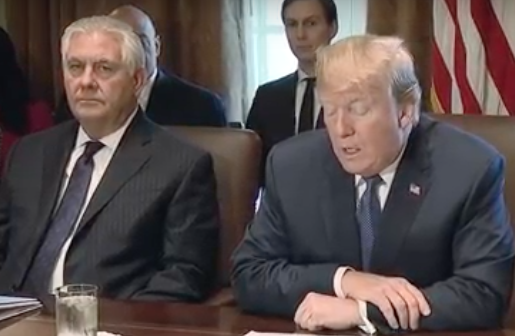
President Trump speaking at a Cabinet meeting on Nov. 1, 2017, with Secretary of State Rex Tillerson to Trump’s right and son-in-law Jared Kushner seated in the background. (Screen shot from whitehouse.gov)


And that’s the real rub … this has an electoral impact. Because the constituency for defense spending isn’t just the 1 percent percent of Americans who actively serve in the military or 7 percent of Americans who’ve served sometime in their lives, but it is also the millions of Americans who directly or indirectly make a living off of the “defense-related” largesse that passes through the Pentagon like grass through a goose.


It’s a dirty little secret that Donald Trump exploited throughout the 2016 presidential campaign. Somehow, he was able to criticize wasting money on foreign wars and the neoconservative interventionism of the Bushes, the neoliberal interventionism of Hillary Clinton, and, at the same time, moan endlessly about the “depleted” military despite “years of record-high spending.” He went on to promise a massive increase in the defense budget, a massive increase in naval construction and a huge nuclear arsenal.


And, much to the approval of many Americans, he’s delivered. A Morning Consult/Politico poll showed increased defense spending was the most popular among a variety of spending priorities presented to voters … even as voters express trepidation about the coming of another war. A pair of NBC News/Survey Monkey polls found that 76 percent of Americans are “worried” the United States “will become engaged in a major war in the next four years” and only 25 percent want America to become “more active” in world affairs.


More to the point, only 20 percent of Americans wanted to increase the troop level in Afghanistan after Trump’s stay-the-course speech in August, but Gallup’s three decade-long tracking poll found that the belief the U.S. spends “too little” on defense is at its highest point (37 percent) since it spiked after 9/11 (41 percent). The previous highpoint was 51 percent in 1981 when Ronald Reagan was elected in no small part on the promise of a major build-up.


So, if Americans generally don’t support wars or engagement in the world, why do they seem to reflexively support massive military budgets?


Frankly, look no further than Trump’s mantra of “jobs, jobs, jobs.” He says it when he lords over the sale of weapon systems to foreign powers or he visits a naval shipyard or goes to one of his post-election rallies to proclaim to “We’re building up our military like never before.” Frankly, he’s giving the people what they want. Although they may be war-weary, they’ve not tired of the dispersal system that Greider wrote about during Reagan’s big spree.


Ultimately, it means that the dreaded Military-Industrial Complex isn’t just a shadowy cabal manipulating policies against the will of the American people. Nor is the “racket” exclusive to an elite group of Deep State swamp things. Instead, the military and the vast economic network it feeds presents a far more “complex” issue that involves millions of self-interested Americans in much the way Eisenhower predicted, but few are willing to truly forsake.