Showing posts with label Active management. Show all posts

Monday, November 6, 2017

Tech Stocks Accounted For 75% Of The Market"s October Return

For some context on the unprecedented dominance of the tech sector on the overall market, here is some perspective from BofA"s Savita Subramanian on October returns, when Tech continued to lead the other ten sectors, generating +7.8% on a total return basis. This translates into a whopping 75% of the S&P 500"s return last month!


Furthermore, with virtually every lagging hedge fund rushing to buy the tech sector, chasing such activist central banks as the SNB, the sector"s 24.5% weight in the S&P 500 is now the highest since October 2000.


That said, considering tech companies reported some of the strongest 3Q earnings results, the best revision trends, and rank at the top of BofA"s quant model, is there anything to be concerned about?


According to BofA, the biggest risk is the extreme crowding and positioning by fund managers. As Subramanian expains: "we hear frequently from clients, "you don"t want to sell Tech until year end." And funds certainly reflect this sentiment: Tech is the most overweighted sector by large cap active managers, displacing Discretionary whose relative weight dropped for the sixth consecutive month." As noted above, the recent Tech rally means the sector now represents 24% of the S&P 500 index - a post-tech bubble high - and a remarkable 30% of all active fund holdings today, the highest levels in BofA data history since 2008 (Chart 1).


What about other sectors: in addition to Tech, Utilities (+3.9%), Materials (+3.9%), and Financials (+2.9%) outperformed last month. Laggards were generally defensive: Telecom (-7.6%), Staples (-1.4%) and Health Care (-0.8%) underperformed the most, while Energy (-0.7%) was also in the red despite the rally in oil prices.


YTD, Tech maintains its dramatic lead (+37.2%), contributing just under half of the S&P 500"s 16.9% total return, followed by Materials (+20.3%) and Health Care (+19.4%). Telecom (-11.9%) and Energy (-7.2%) remain in the red.


To be sure, the impact of tech on underlying financial metrics is also staggering, as the following charts from Credit Suisse show: with tech, EBITDA margins are near all time high. Ex tech, they are roughly 3% lower and in secular decline, courtesy of high barriers to entry.


The next chart shows that while tech holds the highest share of S&P market cap, it is also the fastest growing sector.


And while the massive crowding in the tech sector is a red flag for Bank of America, for Credit Suisse this is perfectly normal, and in a report released today, its analyst Andrew Garthwaite writes that "many clients cite data indicating that just a handful of stocks (largely tech) account for almost half of returns. However, we don"t find such analysis to be particularly informative; such dynamics are far from unusual – in fact, it is often the case that a small number of stocks account for an outsized share of market gains, as shown in the chart below."


Of course, it is also that same small number of stocks that gets hammered once the tide reverses. For now, however, with vol at all time lows, traders have yet to express any concerns that the tremendous tech rally of 2017 is in dangers of ending. Ironically, the single biggest threat to the US tech sector may be the US government itself, which is starting to realize that it is leaving just a little too many pounds of flesh on the table...


Tuesday, October 24, 2017

How A Quant Hedge Fund Surpassed Renaissance And DE Shaw To Become A $50 Billion Behemoth

In a time when traditional long/short, macro and other fundamental-analysis based hedge funds are losing the war to ETFs and passive investing...


... one group of funds is thriving, and none more so than quant powerhouse Two Sigma which according to the FT, has quietly grown assets under management mark over $50 billion "putting it on a par with Renaissance Technologies as the biggest global quantitative hedge fund, as investors continue to pile into computer-powered investment strategies."


Putting Two Sigma"s staggering growth rate in context, the New York-based hedge fund, which was launched in 2001 by computer scientist David Siegel and mathematician John Overdeck, had $6bn in 2011 but soared past the $50bn mark earlier this month, according to FT sources:


"That puts it roughly level with Renaissance Technologies, which manages just over $50bn, and more than DE Shaw’s $45bn. Both are older than Two Sigma."


The reason for the unprecedented growth rate is that while the rest of the hedge fund industry has struggled with poor performance and outflows, investor demand for lower-cost, quant and algorithmic investing has exploded in recent years.  Morgan Stanley recently estimated that various quant strategies, ranging from cheap next-generation exchange traded funds to pricey sophisticated hedge fund vehicles, have grown at 15 per cent annually over the past six years, and now control about $1.5tn.


As MS reported in early October:


"$1.5 trillion of AuM currently managed under quantitative guidelines could continue its double-digit growth over the next five years. Part of this growth is a  ‘pull’ from investors broadening their search for risk premium and uncorrelated returns at lower fees than traditional alternatives. Part of this is a ‘push’, as asset managers see systematic strategies that lend themselves well to automation and scale, offering value over pure ‘beta’ in a traditional active management framework. Relatively small further reallocation by asset owners towards these strategies could still drive significant growth."


To be sure, this invasion of Math Ph.D will harldy come as a surprise to regular readers: back in 2009 we predicted that with central banks obviating fundamentals, it was only a matter of time before the mathematicians and physicists took over. Well, they have:


Quants tend to have a different background to typical hedge funds. More than half of Two Sigma’s 1,200 staff come from outside the finance industry, with most educated in mathematics and computer science. They include the winner of a Japanese backgammon tournament and the “world’s first open-source software artist”, according to a graphic novel handed to new recruits.


As programmers and data scientists have taken advantage of ever-cheaper computing power and ravenous investor appetite, a flurry of new start-ups have emerged in the quant investing field in recent years, But the biggest growth is happening at the largest, most-respected players, according to Emma Bewley, head of fund investment at Connection Capital.


“The big firms are getting bigger,” she said. “There’s a real sense that while a lot of hedge funds are building out their quantitative side, they don’t have the know-how of the established quant firms.”


There are pros and cons to this substantial reallocation to quant funds away from conventional, fundamental "active" managers: on one hand, "the rapid growth of quantitative investing has sparked a ferocious war for talent, with banks, traditional asset managers and hedge funds desperate to attract more coders." But, as the FT"s Robin Wigglesworth observes, such clustering creates a risk of all "traders" being on the same side at the same time:


The greater worry for investors and the industry is that the inflows of money into the space is ramping up risks to markets.  While strategies can vary greatly, there is concern that with more money gushing in some trades can become “crowded”, and unravel quickly if the market environment shifts.


To avert such concerns, many quant funds are careful to monitor for signs of crowding, and limit how much money a strategy or fund manages at any time.


For example, Two Sigma’s equity and macro hedge funds, which manage about $35bn, have long been closed to outside investors.


And while quants claim their strats are now less aggressive, and use less leverage and deploy more varied strategies, there is no way to know until the next downturn, a downturn which refuses to occur precisely because of quants, whose primary directive it appears is to Buy The Dip, Any Dip before the other Math PhD does, and not only ask questions later, but ideally never ask anything as more greater fools emerge to bid up risk even higher, which luckily these days also includes central banks.


Tuesday, October 10, 2017

Human Traders Are Trouncing The Machines

The contemporary low volatility trading environment has been kind to actively managed equity funds - particularly if they piled into large-cap momentum stocks like Facebook and Amazon, which have been responsible for the bulk of this year’s rally.


But while active managers have enjoyed three quarters of strong returns, quant funds – purportedly the future of asset management, according to many an “expert” on Wall Street – are falling further and further behind. As Bloomberg reports, during the first nine months of 2017, the average equity fund was up 9.7 percent while quant funds rose only 0.6 percent, according to data from Hedge Fund Research.


The striking reversal has validated the views of the handful of quant-fund skeptics on Wall Street, many of whom were previously branded as “luddites” for questioning the inherent superiority of algorithm-driven investment strategies. Quant funds, as we are learning, don’t function well in a low volatility environment because there are fewer opportunities to exploit small disparities in price.


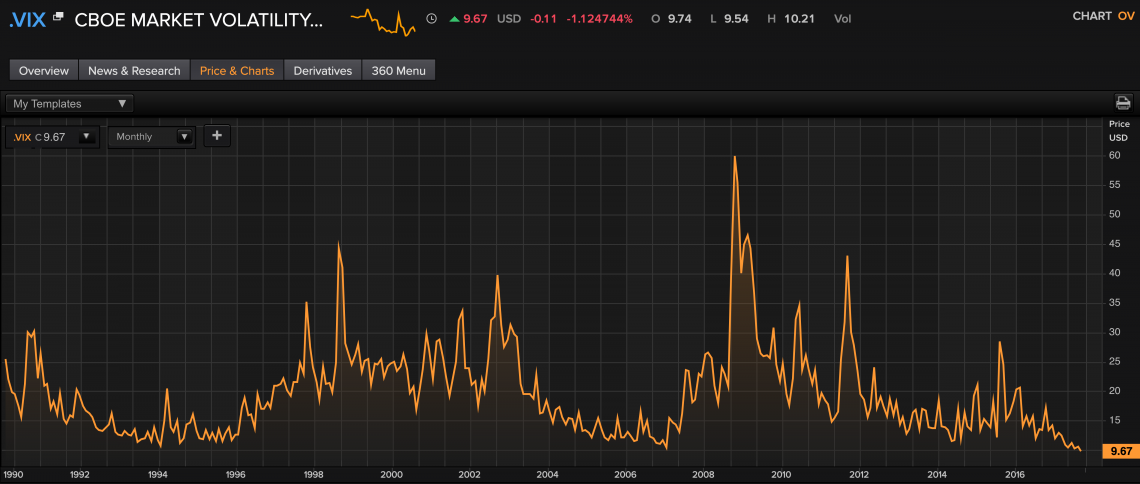
The environment that lifts stock pickers - steady markets that enable their long-term trades - is not so friendly to quants. They do best in periods of volatility and dispersion, when their algorithms can find small price disparities to exploit. But the U.S. stock market has been unusually tranquil since last year’s presidential race. At an average level of 11.6 since Election Day, the CBOE Volatility Index has hovered about 40 percent below its lifetime average.


“To a certain extent they are lowly correlated," Tim Ng, chief investment officer of Clearbrook Global Advisors, said of the two strategies. “The factors that drive positive returns in each are different, so what helps one doesn’t necessarily help another.” His firm invests in hedge funds.


Despite their recent underperformance, quant funds have continued to receive the bulk of hedge fund inflows. Last year, total hedge fund assets AUM dropped for the first time in years as investors pulled money from actively managed funds and reallocated to both passive and quantitative strategies.


Still, both quant funds and traditional discretionary managers have on average continued to underperform the S&P 500.


Equity funds betting on technology have posted some of the biggest gains in the first three quarters. Light Street Capital Management’s Halogen fund, which focuses on technology, media and telecommunications stocks, soared 44 percent, said a person familiar with the matter. The flagship fund at Philippe Laffont’s tech-focused Coatue Management jumped almost 24 percent, according to an investor letter seen by Bloomberg News.


Computer-driven funds struggled to keep pace in the period. BlueTrend, the main fund at Leda Braga’s Systematica Investments, dropped almost 7 percent, another person said. The Diversified fund at $6.6 billion Aspect Capital fell 4.7 percent, according to an investor letter seen by Bloomberg News. Winton Group’s Futures fund is about flat on the year, according to a person with knowledge of the returns.


While the hedge fund industry’s overall performance is improving, it still lags behind the S&P 500 Index, which was up 14.2 percent with reinvested dividends this year through September. Funds across all strategies on average returned 4.3 percent on an asset-weighted basis in the period, compared with 0.7 percent in the first nine months of last year, according to Hedge Fund Research.


As we noted above, funds focusing on tech stocks have posted some of this year"s biggest gains:


Equity funds betting on technology have posted some of the biggest gains in the first three quarters. Light Street Capital Management’s Halogen fund, which focuses on technology, media and telecommunications stocks, soared 44 percent, said a person familiar with the matter. The flagship fund at Philippe Laffont’s tech-focused Coatue Management jumped almost 24 percent, according to an investor letter seen by Bloomberg News.


And to be sure, not all quant funds have had a bad year. Bloomberg managed to find one that’s up 53%.


Not all quants have had a bad year. The QIM Tactical Aggressive Fund gained 53 percent in the first nine months, according to a letter seen by Bloomberg. Nor have all traditional stock pickers done well. Crispin Odey, who is known for his bearish bets, saw his European equity fund sink 14 percent this year through Sept. 15 in its U.S. dollar share class.


* * *


After Eagle’s View Asset Management, a $500 million fund-of-funds that invests with 30 managers, half of them quants, recorded its worst monthly performance ever in June, the fund’s manager Neal Berger penned a letter to clients explaining why quant strategies have broken down over the past year.


It comes down to two factors, he said:


1.Increased competition: more investors are using algorithms to fight over the same inefficiencies in the market.


“Now every bank has a factor model,” said Benjamin Dunn, president of the portfolio consulting practice at Alpha Theory LLC, which works with managers overseeing about $200 billion.


“You’ve had a democratization of a lot of data and analytics that were once the domain of very systematic quant investors. Everything is getting arbitraged away.”


2. Low volatility: quantitative funds are most successful in an environment where there is large disagreements in the market over the prices of assets. Today there is little disagreement, and the best way to earn outsized returns is placed highly leveraged bets that the market will remain calm. That"s working for some investors, but is far too risky for others.


In fact, the persistently low level of volatility has brought out an increasing number of hedge funds strategies oriented toward regularly selling volatility. Although we believe that this is "picking up nickels in front of a bulldozer", shockingly, these Funds have been some of the best performing strategies over the past years.


Although our guess is as good as anyone"s, we believe the shockingly low levels of volatility has to do with an increase in computer driven, quantitative trading coupled with banks selling options to offer "yield enhancement" structured products to investors who are starving for this yield.


This feedback loop, the increase in assets run by hedge funds, and, the rise of quants, has created unusual patterns, dislocations, and low levels of volatility.


While those simply following the broader market indices wouldn"t realize anything is amiss, it is our belief that these factors have created a challenging mix for trading oriented strategies. It won"t last forever, but, it could last longer than we can.


Additionally, he explains, systematic strategies require an endless supply of victims to thrive, and the growth of quant and passive funds has caused dumb money to behave unpredictably or disappear altogether.


With all the geniuses in quant, high-powered computers, and enormous data, where are the "suckers" who are providing the juice for all of these absolute return quantitative strategies?


Simply put, the "edge providers" have moved aggressively into passive index funds and broader market ETFs.


As such, we have a condition amongst the traditional quantitative strategies whereby we have robots trading against robots. Without a steady source of "edge providers", these "edge demanders" are just trading money back and forth with each other.


We believe increased quantitative trading coupled with passive indexation by retail, and, low levels of realized and implied volatility may be creating a feedback loop that has caused unusual price movements in a variety of securities that have challenged trading oriented strategies.


Of course, all of this could change shortly as market strategists like Bank of America’s Michael Hartnett warn that a sharp selloff could be in store for the fourth quarter. Investors have upped their bullish bets through S&P 500 calls, buying more S&P 500 delta over the past two weeks than at any point since 2007.


In summarizing the contemporary market, Hartnett explains that the "best reason to be bearish in Q4 is there is no reason to be bearish.”


Complacent active managers ought to keep this in mind.

Thursday, September 28, 2017

Warning: Danger Lurks Here

By Chris at www.CapitalistExploits.at


Take a look at the volume of stocks listed vs. indexes listed going all the way back to the days of bellbottoms, loud hair, and orange wallpaper.


Since 1995, the supply of stocks, particularly in the US, has been shrinking faster than Trump"s approval ratings. At the same time, the number of indexes have exploded like one of Kim"s shiny new missiles.


Why?


In a falling interest rate environment, the twin pressures of reduced returns and relative cost pressures have meant that investors, in order to make a buck, have flooded into the low fee structures offered by passive strategies. These include indexing, ETFs, and those truly insane creatures I"ve written about before: low volatility ETFs.


But what about those alpha generating hedge funds? Aren"t they meant to be smart and able to beat the market... any market?


Those alpha generating hedge funds have things called LPs. And though LPs may be smarter, and certainly wealthier than Joe Sixpack, they"re no less human. And human attention span and patience level has been in decline... correlated no doubt with the rise of social media and the Kardashian crowd. Like a virus, it infects everything.


As performance from hedge funds has been poor relative to the benchmarks, a self reinforcing situation where hedge funds, in order to ensure LPs don"t redeem, have landed up hugging the indexes.


This is the exact opposite of what hedge funds were meant to do, of course. In many cases, they themselves are simply buying the indexes, trying desperately to figure out how the hell they"re going to survive through the next quarter but determined simply NOT to underperform the index. It"s a losing strategy no matter how you slice and dice it.


For those hedge funds who refuse to chase the indexes... Well, they are now fighting the tidal wave of capital that has been shifting into passive investments, which forces those passive investments even higher.


This, in turn, leaves active hedge funds who refuse to get sucked in with increasingly substandard returns. They can explain until they"re blue in the face why certain indexes make no sense but when those indexes just keep rising day after day, month after month, it becomes a very tough stance to keep. Redemptions follow, and so by doing the right thing, they"re punished. And by doing the wrong thing (following the mob), they may get to stay alive just a little longer and this is what many have resorted to.


We all know that at some point there are no new buyers available to enter the market and hoo boy, do we then have a problem.


So... you either join the party or you leave the party.


The last to leave the party is Hugh Hendry and his baby Eclectica.


Hugh Hendry Murders His Hedge Fund


Og aye, tis tae tough


Hugh follows Eton Park and Perry Capital to name but a few more.


Paul Singer of Elliot Management fame put it well in his July investor letter to stakeholders.


"In a passive investing world, small shareholders have little-to-no voice and no realistic possibility of banding together, while the biggest shareholders have no (repeat, no) skin in the game so long as the money manager does not underperform the index."


Make no mistake, the rise of passive indexing is a bubble in dumb money.


We have a situation where the market is becoming completely lopsided and increasingly so at a blistering pace.


If it gets anymore lopsided, it"s going to be upside down. What"s more, the market participants have no interest or even determination of valuations.


An index doesn"t give an isht what the P/E ratio of any stock included in the index is, and the investors buying it have even less idea. It doesn"t care if the aggregate of stocks sitting inside its womb are over or indeed undervalued. It"s just a dumb bloody index, and you can"t blame it anymore than I can blame my dog for not understanding Shakespeare.


Those investing in passive have done so partly due to relative fee differentials, partly due to performance. But now also dangerously so... due to increasing inflows, which have continued to push values higher.


Now, having markets or sectors get silly is obviously as normal as a peanut butter sandwich, and provided you"re aware of it, we"ve little to worry about.


But what"s more frightening than the Kardashians in skinny pants is that as capital has fed into passive, the usual countering forces (active managers) of the market have been leaving the party, which has left the passive world to increasingly swell like a neglected infected wound.


What we need to think about is that increasingly there is no active market to stabilise this. It"s akin to having a 5-year-old"s party, inviting a troop of the critters, and then promptly sending all the parents down to the pub for a few hours.


Just as short sellers provide a balance to a market so, too, active management (who incidentally typically have skin in the game) have always provided a stabiliser to the overall market. What happens when the stabilisers all leave the room?


We can see this manifesting itself in the volatility index. As more capital enters at a steady pace so, too, the volatility falls.


And here"s the thing. The algos constantly feed back the daily data to recalculate their probabilities (read this article on VAR shocks). Risk? Nah!


At the extreme of the passive world sits volatility.


Selling volatility works really well. Just ask Neiderhoffer who has made godawful amounts doing it over the years.


Look closely, though, and you notice that even Neiderhoffer, who knows what game he"s playing, blows himself up spectacularly from time to time... and I mean complete armageddon wipeout stuff. Until that blow up comes, though, you just keep plugging away at it day after day and it just keeps paying you... day after day. You make money, make money... and then, well...


It all turns to isht and blows up in your face.


My friend Mark Yusko from Morgan Creek Capital places capital with the smartest strategies and hedge funds - active capital.


Who"s willing to bet with me that over the next decade being long smart active strategies and short passive (low volatility ETFs) will be a winning trade?


Wow Poll - 27 Sep


Cast your vote here and also see what others think


- Chris


“What could be more advantageous in an intellectual contest – whether it be bridge, chess, or stock selection than to have opponents who have been taught that thinking is a waste of energy?” – Warren Buffett, 1985 Berkshire Hathaway Letter to Shareholders


--------------------------------------


Liked this article? Then you"ll probably like my other missives on


this topic as well. Go here to access them (free, of course).


--------------------------------------

Monday, July 24, 2017

These Are The 10 Most Crowded Long And Short Trades According To UBS

In this market where fundamentals long ago ceased to matter, and where positioning remains one of the few remaining sources of alpha, investors have been focusing on lists showing the most over and under-owned stocks. However, contrary to the narrative that the most heavily owned stocks outperform the most shorted, or underowned ones, and vice versa, recently BofA calculated that for the third year in a row, "the Top 10 most overbought stocks have trailed the S&P for each of the past three years, while the Top 10 "most neglected" stocks outperformed the S&P on average by 11.6%."


This is what BofA"s quant team found:


As flows from active to passive funds have accelerated, one strategy that has worked unusually well for the last several years is a simple positioning trade of selling the 10 most overweight stocks and buying the 10 most underweight stocks by active managers. This single trade has yielded over 16ppt of alpha year-to-date. And implied derisking/ outflows on Brexit alone have been fierce, with the same strategy generating 5.2ppt of alpha just since last Thursday’s close. Even if Brexit’s impact on funds is limited from here, we believe that crowded stocks will likely continue to underperform neglected stocks: a whopping two-thirds of US large cap AUM still resides in active funds - there is likely a lot more to go in the rotation from active to passive.


Visually:


As such, a useful trading framework, would be to look at the Top 10 most crowded trades of active managers - on either side of the ledger - and to short the 10 most overweight, while going long the 10 most underweight stocks.


Conveniently UBS has updated its list of the Top 10 most crowded trades, revealing "where are the largest active positions." How does UBS  measure the most active positions?


Using the institutional ownership data provided by FactSet, we form an active trading portfolio by aggregating positions across global active managers. Essentially, we sum up all the holdings in dollar value across all the active managers and calculate the weights of stocks in this active trading portfolio. We then compare this weight with the relevant equity index benchmark to form the active weight.


So, without further ado, here according to UBS are the Top 10 most crowded long and short trades, and not surprisingly, it"s all tech among the top 5 longs, which include Google, Alibaba, Amazon (a jump from 8th spot as of the last ranking), Facebook and Visa (with AAPL sliding into 6th spot), while on the short side one name stands out: Tesla in the perennial top slot, which may explain why no matter how bad the news, even the smallest glimmer of hope, whether a tweet from Elon Musk or an upgrade, prompts a sharp squeeze, like today for example.


Based on UBS data, this is how these two baskets have performed on a YTD basis:


Finally for those wondering, here is a breakdown of how levered hedge funds are as mid-July courtesy of JPM Pribe Brokerage. It will probably not come as a surprise that every single category has increased its leverage on a 3M, 6M and 12M basis.


Friday, June 30, 2017

Bob Rodriguez: "We Are Witnessing The Development Of A Perfect Storm"

Authored by Robert Huebscher via AdvisorPerspectives.com,


Robert L. Rodriguez was the former portfolio manager of the small/mid-cap absolute-value strategy (including FPA Capital Fund, Inc.) and the absolute-fixed-income strategy (including FPA New Income, Inc.) and a former managing partner at FPA, a Los Angeles-based asset manager. He retired at the end of 2016, following more than 33 years of service.


He won many awards during his tenure. He was the only fund manager in the United States to win the Morningstar Manager of the Year award for both an equity and a fixed income fund and is tied with one other portfolio manager as having won the most awards. In 1994 Bob won for both FPA Capital and FPA New Income, and in 2001 and 2008 for FPA New Income.


The opinions expressed reflect Mr. Rodriguez’ personal views only and not those of FPA.


I spoke with Bob on June 22.


In a recent quarterly market commentary Jeremy Grantham posited that reversion to the mean may not be working as it has in the past. What are your thoughts on mean reversion?


There will be a reversion to the mean. We are in a very difficult and challenging time for active managers, and in particular, value style managers. Many of these managers are fighting for their economic lives.


Given that I am no longer involved professionally in managing money, I believe the standards in the industry are being compromised; monetary policy has so totally distorted the capital markets. You are now into the eighth year of a period that is unprecedented in the likes of human history.


The closest policy period to what we have now would have been between 1942 and 1951, when the Fed and Treasury had an accord to keep interest rates low. Interest rates were artificially held lower to help finance the World War II effort. With the renewal of inflation after the war, a policy war developed between the Treasury and the Fed on the continuation of a low interest rate policy. The Treasury-Fed of 1951 brought this period to a close. But that is the only time we’ve had a period of nine years of manipulated, price-controlled interest rates.


This was a historical policy I discussed with my colleagues upon my return from sabbatical in 2011: what could unfold were controlled, manipulated and distorted pricing that could disrupt the normal functioning of the capital markets. The historical cycles that Jeremy would be referring to that entailed a reversion to the mean could be distorted, for a period of time, by this type of monetary policy action.


But I do not believe the economic laws of gravity have been permanently changed.


At a Grant’s Conference last year Steven Bregman asserted that indexation in general and ETFs in particular were factors in the under-performance of active managers and are potentially a bubble. Are you familiar with his work and what are your thoughts on ETFs? What is driving the flow of mutual fund assets to passive strategies and what can or should fund companies do in the face of this trend?


I go back to a speech I gave in 2009, Reflections and Outrage, and buried within that speech is a section that said that if active managers did not get their act together then the likelihood would be that passive strategies would continue to take market share. When you have a market that is distorted by zero interest rate policy, David Tepper said it very well many years ago, “Well, you’ve got to ride it.”


It’s a rocket ship that’s going up. If you are fully invested in the right areas, you have a shot at out-performing. However, if you are an active manager who has a valuation discipline, given the valuation excesses in the capital markets now and that have been developing for the past several years, then an elevated level of liquidity would be held, if you were allowed to do so. As such, you will likely underperform the market.


Active managers have not demonstrated a value-add to an appreciable extent over the last 20 years. When I look back at what happened prior to 2000, if an active growth stock manager could not see the most extraordinary distortion and elevated, speculative market in history, when will they? In the lead up to the 2007-2009 financial crisis, many value-style managers did not cover themselves in glory either. If you looked at what their major stock ownership concentrations were, they were very much in large banks and various types of financial institutions that were going to get crushed in the credit downturn. If they couldn’t acknowledge or identify the greatest credit excess in history, when will they?


I’m picking on both growth- and value-style managers for missing two of the great bubbles in history. This miss led to capital destruction. Now we have a clueless Fed, in my opinion, that has never known what a bubble is beforehand. It is accentuating one that has been developing as a result of its policy insanity of QE. Markets are going straight up predicated on it.


The public looks at these outcomes and says, “Why should I pay higher fees to managers who can’t outperform or can’t even identify a major speculative blow off. I might as well be fully invested. I might as well be in an ETF or index fund.”


Thus, since 2007, indexing or passive activities have risen from approximately 7% to 9% of total managed assets to almost 40%. As you shift assets from active managers to passive managers, they buy an index. The index is capital weighed, which means more and more money is going into fewer and fewer stocks.


We’ve seen this act before. If you didn’t own the nifty 50 stocks in the early 1970s, you underperformed and, thus, money continued to go into them. If you were a growth stock manager in 1998-1999 and you were not buying “net” stocks, you underperformed and were fired. More and more money went into fewer and fewer stocks. Today you have a similar case with the FANG stocks. More and more money is being deployed into a narrower and narrower area. In each case, this trend did not ended well.


When the markets finally do break, as they always have historically, ETFs and index funds will be destabilizing influences, because fear will enter the marketplace. A higher percentage of assets will be in indexed funds and ETFs. Investors will hit the “sell” button. All you have to ask is two words, “To whom?” To whom do I sell? Index funds and ETFs don’t carry any cash reserves. The active managers have been diminished in size, and most of them aren’t carrying high levels of liquidity for fear of business risk.


We are witnessing the development of a “perfect storm.”


The Wall Street Journal has reported that central banks from Switzerland to South Africa are investing their reserves in equities. How should investors respond to the participation in the price discovery system by players that can print money and may not be performance-driven?


The last thing I ever wanted to do as a professional was allocate capital to areas that government was buying. With governmental-driven decisions there are virtually no penalties for bad decision making. Look at the rank stupidity of Dodd-Frank, or Paulson, Bernanke, and Greenspan. They were clueless before each of the last crises. They helped drive a system off the tracks. What penalty have they paid? None! They get to keep their pensions.


But when you have central banks deploying capital and their cost of money is zero, they destroy the capital-asset pricing mechanism; they destroy comparability; the distortions continue.


As a dedicated contrarian, the last place I want to invest money is where governments are deploying the capital because they are so totally distorting the market.


How did the discipline of value investing as you practiced it at FPA, change over the course of your career, particularly since the financial crisis?


It’s an interesting question and I’ve asked myself that many times.


The markets moved more slowly prior to this century – the ebbs and flows, the decision-making and the conveyance of information. With the advance of electronics and the internet, the speed of dissemination of news accelerated. I don’t believe that judgments have improved; just the speed has accelerated and the time frames of patience have shortened.


I bet my entire business in the spring of 1998 when for the prior 11 or 12 years I ran my mutual fund, the FPA Capital Fund, on fumes, with 1% to 2% cash and sometimes even less than 1%. Had you held liquidity, with short-term bond yields in the high-single to double-digits, you would have underperformed the stock market by anywhere from 900 to 1,100 basis points. By 1998 the consultant’s mantra was to be “fully invested.”


I went out in the spring of 1998 arguing that the equity market was becoming excessively priced, and it continued to do so. I sought permission to move my liquidity limits from 7% to 10% which were the typical maximums, to upward of 30%. I had to fight every client on that. By the spring of 2000, without losing any money and avoiding the carnage, I took a little bit over a 50% reduction in my assets under management. I got fired. In 2007-2009, I did far more preparation and communication prior to that crisis and entered it with 45% cash.


In the first phase of a debacle like what went on in the financial crisis, it doesn’t matter whether you are a virgin or are the opposite. When they raid the entertainment house and you happen to be a person walking by, just out of the church right next door, you get caught with all of the people there.


In the aftermath the police discover, “Oh, you shouldn’t be here.” Well, it’s the same way in a crash; virtually everything gets hit. Then in the second and third stages, the real values start to unfold and you get a greater differentiation. That is what happened with my fund between 2007 and 2009 and subsequently.


A cash level of 45% was a real tough strategy for clients to handle. I had one client say, “Please stay fully invested for my account and just do your thing with the others.” I said, “No, the price you ask me to pay is too high. By being fully invested managing your money, I will contaminate my thinking, which will negatively affect my other clients. I’m sorry, that’s a price too high to pay.” I said, “Where do you want me to return the money?” He said, “Let me think about it.” The next day his response was, “Okay, you’ve got flexibility.” But I still took over a 50% hit in redemptions during that crisis.


Looking back at these two prior major cycles, it is far more difficult for a value manager to hold liquidity today in light of the policies that are being deployed. These are the worst fiscal and monetary policies in human history.


If I were still professionally managing money, despite my background of pain-and-suffering from being redeemed, my liquidity allocation would be north of 60% today.


So-called “smart-beta” products have become very popular, particularly those that incorporate a quantitatively-driven value strategy based on the Fama-French factor models. For investors that want a value-oriented portfolio, what concerns should they have with these strategies?


I have never seen a quantitative strategy succeed longer term. They are predicated on models. The models are predicated on history. When history changes, they have to develop a new factor model.


We witnessed this in the last cycle. There was an article in the WSJ quoting a quant manager who said on a Wednesday, we had experienced a 1-in-10,000 year event. On Thursday, we had a 1-in-10,000 year event. On Friday we had a 1-in-10,000 year event. A former colleague wrote an email that weekend that said, “I have a quick question to ask. On Monday, are we safe for the next 30,000 years?”


All of these strategies are meant to enhance or give an essence of how you are going to try and minimize risk and enhance return. When you are in an environment where the lead entity, the Federal Reserve, has its foot on the scale and is distorting the information coming out of the capital markets, where interest rates can go to zero, what is the proper hurdle rate for budgetary or capital allocation decisions? These actions distort the price comparison or discovery process in the capital asset-pricing model. This is highly disturbing.


By the way, I wrote a piece in 2008 before the Fed even knew they were going to balloon their balance sheet. It said they would have to increase the balance sheet by at least a trillion to a trillion and a half. They hadn’t got to that realization yet.


After 45 years of watching the Fed, the only Fed chairman that was worth spit was Paul Volcker. The last great central banker that we had in the last 110 years other than Volcker was J.P. Morgan. The difference is, when Morgan tried to contain the 1907 crisis, he wasn’t using zeros and ones of imaginary computer money; he was using his own capital. As long as you have anointed centralized bureaucratic decision makers like the Federal Reserve, that in many ways is similar to the concentrated decision making structure of the former Soviet Union, decisions will be late and generally wrong. The Fed is a large organization and like all large organizations, there are internal pressures where they try to come to a consensus, and so they do.


This is not how you make your greatest decisions.


If there is one piece of investment advice you would offer to a young professional embarking on a career now, what would that be?


I will give the same advice that I got when I was a very young professional back in 1973. I was two years into the field and a gentleman spoke before my investment class. After everybody had walked out, I walked up to Mr. Munger and I asked him, “Sir, if I could only do one thing that would make myself a better investment professional, what would you recommend?” He responded, “Read history, read history, read history.” I have done that over the years. Had you read about the banking crisis of 1907 and what preceded it in the 1890s, you would have recognized it in a form in 2007.


If there is one piece of management advice that you could offer to that same person, what would that the?


You must have two things – discipline and integrity. Compromise either and you will fail.


That’s true in all walks of life.


Yes, but it’s very easy to use the justification that this time is different.


The world has changed. I gave a speech in 2001 to some pension advisors. I said, “Look at you people out there.” I hadn’t shown them my chart yet but I said, “Look at what we have just gone through. We had the greatest, the highest level of computerization in the history of man, the most timely acquisition to information, the highest percentage of advanced degreed professionals and college graduates in the field, and we got an outcome no different than 1974, 1929, 1907. There is something more here going on.”


Then I held up two hand-written stick figures – I was not a good artist. They were cows and they were talking to one another. One cow said to the other, “Glad we’re not part of the herd.” The other cow said, “Yea.” The next exhibit was an aerial shot. It showed the two cows are in a ravine, so they can only see themselves. But all around them is the herd. I looked out and said, “People, whether you realize it or not, you are part of the herd. All you have to understand is one word, now let’s say it all together. Moo.” What a way to influence friends and make new clients.


How are you investing your personal assets?


I am at my lowest exposure to equities since 1971. They represent less than a fraction of one percent. Liquidity is north of 65%, all in Treasury-type securities, nothing beyond a three-year term. I do not trust what is going on fiscally or monetarily, and I’ll circle back on this in a moment. The balance is in rare fully paid-for physical assets.


Circling back, after I stepped down from daily money management at the end of 2009, I took a sabbatical. One of my goals was to meet a gentleman by the name of David Walker, the former comptroller general of the U.S. He wrote a book called Comeback America that I read in January of 2010. I sent my review to Dave. Two days later Dave called me and said, “My name is Dave Walker. Is this Bob Rodriguez? If so, I want to thank you for your review.” That’s how we came to know one another. I’d used his work for over 10 years. For the next three and a half years I was a sponsor of his program, Comeback America. He closed it down in 2013, a complete unmitigated failure.


Think about the budgetary battles of 2011; the only thing that was cut was defense. Two thirds of the expenditure cuts that were going to get controlled under the system would not occur until after 2016. Funny how that works. In the presidential debates, only one candidate used a word that I think has now left the English language, “sequester.” That was Bush and it was to eliminate sequestration to raise defense spending.


The 2016 election was one of the most important elections in the last 80 years. Back in 2009 I said if we do not get our economic house in order sometime between 2014 and 2018, we could see a crisis of equal or greater magnitude than the 2007-2009 crisis. I also argued that we would have a substandard recovery that would be no better than 2% real GDP growth for as far as the eye can see. Productivity and capital spending would be substandard. All of those have played out.


Here we are in 2017. I have seen absolutely nothing that would give me any degree of confidence that Washington will get its act together. We are into a period of expanding deficits. We are hitting a time where the entitlements are worsening in terms of their funding status. We are in a decade that is unprecedented from anything that we’ve seen before with monetary policy and fiscal policy.


Why on Earth should I allocate capital into a system where the scales are completely manipulated, price discovery is distorted, and the Fed doesn’t have a clue what’s going on? They’ve missed every economic forecast for the last nine years straight. Why would anybody pay any attention to what those people are doing?


I have confidence in one thing. The Fed will blow it.


My thoughts are very much analogous to those of Lacy Hunt. Where Lacy and I part company is what happens after the deformation hits. He would argue that we will be in a dis- or deflationary period for an extended period of time; therefore, you should own 30- and 20-year Treasury bonds.


I’m not so sure about that scenario. It occurred in Japan because it has a very cohesive society. That is not the case in the United States or in Europe. Our patience will be far shorter. At some point, in no more than one to two years, the Fed would likely panic and panic big time, and we will see QE on steroids. We will see monetary inflation. Lacy and I have a similar view. But the really big question is what the outcomes will be on the other side of this mess. Both of us could be very right, or very wrong, or partially in between.


I am managing my estate in a hedged fashion because what we are going through is without any precedent in human history. How can anybody have confidence that their particular view is the right view?


Saturday, May 13, 2017

WTF Chart Of The Day: There Are Now More Indexes Than Stocks

For the first time ever, the number of market indexes now exceeds the number of U.S. stocks...


As Bloomberg reports, traditional ones such as the S&P 500 are collections of securities weighted by market value, and index funds mimic them as a low-cost way to deliver the market’s performance. Many new indexes are different: They include stocks based on custom criteria, such as having low volatility or high dividends. The recent explosion in indexes has been driven by demand as many new benchmarks essentially repackage active investment strategies into indexes, says Eric Balchunas, senior exchange-traded fund analyst at Bloomberg Intelligence. They can then be tracked by so-called smart-beta ETFs, which fund companies are rolling out rapidly. Money managers are under pressure to cut costs, says Balchunas, as investors shift their money into funds with low fees. Smart-beta ETFs are generally more expensive than S&P 500 funds but cheaper than actively managed funds. It remains to be seen how well the new funds will perform.


As we wrote previously, for now, the debate about the impact of ETFs rages, and will do so inconclusively as long as trillions in central bank liquidity prop up broader risk assets and equity markets. It is only once central banks take start soaking up some $18 trillion in excess liquidity that the true impact of ETFs will be visible. Until then, we leave readers with thoughts from a recent note by JPM"s Nikolaos Panigirtzoglou, first reported here last October, and summarized below, on what the take over by ETFs really means:


  • Markets become more brittle, risky: "The shift towards passive funds has the potential to concentrate investments to a few large products. This concentration potentially increases systemic risk making markets more susceptible to the flows of a few large passive products."

  • Passive or index investing favours large caps as most equity indices are market cap weighted. "This could exacerbate the flow into large companies beyond to what is justified by fundamentals, creating potential misallocation of capital away from smaller companies. To the extent that these passive funds become even more dominant in the future, the risk of bubbles being formed in large companies, at the same time crowding out investments from smaller firms, would significantly increase."

  • The proliferation of index funds increases the size of stock inclusion flows. In turn, market moves around index constituent changes become more pronounced overpenalizing companies leaving the index and causing excessive gains to companies entering the index.

  • Crashes, when they happen, will be bigger and badder: "the shift towards passive funds tends to intensify following periods of strong market performance as active managers underperform in such periods of strong market performance. In turn, this shift exacerbates the market uptrend creating more protracted periods of low volatility and momentum. When markets eventually reverse, the correction becomes deeper and volatility rises as money flows away from passive funds back towards active managers who tend to outperform in periods of weak market performance."

  • Markets become less efficient: "if passive investing becomes too big, potentially crowding out skilled active managers also, market efficiency would start declining. In turn, this would present opportunities for active managers to extract arbitrage profits."

Thursday, May 11, 2017

Public Service Announcement for Stock Investors

Dear reader, if you are overcome with fear of missing out on the next stock market move; if you feel like you have to own stocks no matter the cost; if you tell yourself, “Stocks are expensive, but I am a long-term investor”; then consider this article a public service announcement written just for you.


 Before we jump into the stock discussion, let’s quickly scan the global economic environment. The health of the European Union did not improve in 2016, and Brexit only increased the possibility of other “exits” as the structural issues that render this union dysfunctional went unfixed. 


Japan’s population has not gotten any younger since the last time I wrote about it — it is still the oldest in the world. Japan’s debt pile got bigger, and it remains the most indebted developed nation (though, in all fairness, other countries are desperately trying to take that title away from it). Despite the growing debt, Japanese five-year government bonds are “paying” an interest rate of –0.10 percent. Imagine what will happen to its government’s budget when Japan has to start actually paying to borrow money commensurate with its debtor profile.


 Regarding China, there is little I can say that I have not said before. The bulk of Chinese growth is coming from debt, which is growing at a much faster pace than the economy. This camel has consumed a tremendous quantity of steroids over the years, which have weakened its back — we just don’t know which straw will break it.


 S&P 500 earnings have stagnated since 2013, but this has not stopped analysts from launching their forecasts every year with expectations of 10–20 percent earnings growth . . . before they gradually take them down to near zero as the year progresses. The explanation for the stagnation is surprisingly simple: Corporate profitability overall has been stretched to an extreme and is unlikely to improve much, as profit margins are close to all-time highs (corporations have squeezed about as much juice out of their operations as they can). And interest rates are still low, while corporate and government indebtedness is very high — a recipe for higher interest rates and significant inflation down the road, which will pressure corporate margins even further.


 I am acutely aware that all of the above sounds like a broken record. It absolutely does, but that doesn’t make it any less true; it just makes me sound boring and repetitive. We are in one of the last innings (if only I knew more about baseball) of the eight-year-old bull market, which in the past few years has been fueled not by great fundamentals but by a lack of good investment alternatives.


 Starved for yield, investors are forced to pick investments by matching current yields with income needs, while ignoring riskiness and overvaluation. Why wouldn’t they? After all, over the past eight years we have observed only steady if unimpressive returns and very little realized risk. However, just as in dating, decisions that are made due to a “lack of alternatives” are rarely good decisions, as new alternatives will eventually emerge — it’s just a matter of time.


 The average stock out there (that is, the market) is very, very expensive. At this point it almost doesn’t matter which valuation metric you use: price to ten-year trailing earnings; stock market capitalization (market value of all stocks) as a percentage of GDP (sales of the whole economy); enterprise value (market value of stocks less cash plus debt) to EBITDA (earnings before interest, taxes, depreciation, and amortization) — they all point to this: Stocks were more expensive than they are today only once in the past century, that is, during the dot-com bubble. 


In reference to this fact, my friend and brilliant short-seller Jim Chanos said with a chuckle, “I am buying stocks here, because once they went higher . . . for a year.”


 Investors who are stampeding into expensive stocks through passive index funds are buying what has worked — and is likely to stop working. But mutual funds are not much better. When I meet new clients, I get a chance to look at their mutual fund holdings. Even value mutual funds, which in theory are supposed to be scraping equities from the bottom of the stock market barrel, are full of pricey companies. Cash (which is another way of saying, “I’m not buying overvalued stocks”) is not a viable option for most equity mutual fund managers. Thus this market has turned professional investors into buyers not of what they like but of what they hate the least (which reminds me of our political climate).


 In 2016 less than 10 percent of actively managed funds outperformed their benchmarks (their respective index funds) on a five-year trailing basis. Unfortunately, the last time this happened was 1999, during the dot-com bubble, and we know how that story ended.


 To summarize the requirements for investing in an environment where decisions are made not based on fundamentals but due to a lack of alternatives, we are going to paraphrase Mark Twain: “All you need in this life [read: lack-of-alternatives stock market] is ignorance and confidence, and then success is sure.” To succeed in the market that lies ahead of us, one will need to have a lot of confidence in his ignorance and exercise caution and prudence, which will often mean taking the path that is far less traveled.

Tuesday, May 9, 2017

Ira Sohn Conference Summary Highlights And Investment Picks

While the hedge fund world finds itself in a time of crisis, with a "great rotation" of capital away from active management which continues to largely underperform the broader market, and toward cheaper, passive strategies, nothing could spoil the mood at one of the industry"s biggest events held today at the Lincoln Center, the 22nd annual Ira Sohn conference, where a dozen of the hedge fund industry"s most prominent names presented their best ideas.


Below is a summary of the hedge fund managers who spoke at the Sohn Conference in order of appearance, and the investment ideas they presented, courtesy of Reuters and Bloomberg.


Corvex’s Keith Meister:


  • Bullish on CenturyLink; Reported 5.5% stake in 13-D today; Corvex’s largest position

  • Said CenturyLink/Level 3 merger is gamechanging

Fine Capital’s Debra Fine:


  • Recommends DHX Media; sees upside to C$20-C$30/share;

Pershing Square’s Bill Ackman:


  • Reiterated his Howard Hughes Corp. long call

  • Said South Street seaport is highly valuable citing tax efficiency and excellent locations.

Social Capital’s Chamath Palihapitiya:


  • Bullish on Tesla 2022 convertible bonds

  • Said there is "incredible opportunity" in the 2022 Tesla converts that the company could capture 5% of the global car market and be worth hundreds of billions of dollars

Algebris’s Davide Serra:


  • Recommends shorting U.K. rates, warning of UK inflation and said that is one reason bonds are overvalued; also said Brexit will cost 7% of UK GDP over the next 8 years.

  • Llikes UniCredit shares

Blue Harbour’s Cliff Robbins:


  • Reiterates long Investors Bancorp which is undervalued relative to peers; sees upside to $19 due to significant growth in net income and franchise value; a potential M&A candidate

Greenlight’s David Einhorn:


  • Bearish on Core Laboratories; Sees 45% downside to $65/share in "way overvalued" stocks

  • Also said oil prices are unlikely to stage a V-shaped recovery, which will hit Core Lab"s business

DoubleLine’s Jeff Gundlach:


  • Recommends pair trade of long EEM ETF, short S&P 500 ETF

  • "When emerging markets outperform the S&P 500, active is outperforming the S&P 500"

Altimeter’s Brad Gerstner:


  • Likes United Airlines Long; sees upside to as much as $235/share

  • Millennials travel more than their parents; sees airlines as a secular growth story

Jericho’s Josh Resnick:


  • Recommends Frontier Communications short; accused company of aggressive accounting practices; having a massive debt load and bad customer service

Glenview’s Larry Robbins:


  • Likes DXC Technology: has good management, good acquisition of HPE by CSC, partnerships with innovative companies, tax reform could help

  • Likes FMC: bought good assets from Dow and DuPont; transaction was advantaged to FMC. Also good lithium batter business that could be split off

  • Likes Quintiles: significant strategies between Quintiles and IMS; Good for potential market share growth.

Sohn contest winner picked EBAY as long; sees ~45% upside


Next Wave Sohn picks below:


  • Trafalgar’s David Copley Recommends Shorting Mirvac, JB Hi- Fi

  • ThornTree’s Mark Moore Likes Liberty-Formula One

  • Totem Point’s Neal Nathani Likes Xilinx

  • Blockhouse’s Jack Franke Recommends Going Long MPLX

  • Half Sky’s Li Ran Recommends Fevertree Drinks Long

Saturday, May 6, 2017

Axel Merk: "There's More To Investing Than Chasing Companies That Want To Make Mars Inhabitable"

Authored by Axel Merk via MerkInvestments.com,


How does one construct a portfolio in an era of seemingly ever rising and highly correlated asset prices? Years of asset prices moving higher has changed both retail and institutional investors; it has changed the industry; and, in my humble opinion, those changes spell trouble. The prudent investor might want to take note to be prepared.


I allege that for many, investing is no longer about prudent asset allocation, but about expressing themes. If you like green technology, you tilt your portfolio towards green energy. If you are socially conscious, there’s an ETF for that. I have no problem with anyone allocating money to any specific theme. However, has anyone else noticed that it doesn’t matter what theme you allocate money to? Investors are all playing the lottery and guess what: everyone’s a winner!


Now, clearly, that’s an over simplification, as not every industry does well all the time - just ask those who invested in MLPs (master limited partnerships) in pursuit of income from fracking. Let me rephrase: the more of a monkey you have been, i.e. the less you have been thinking, the better you’ve likely performed over the past nine years. “Buying the dips” has been a consistently profitable strategy.


That has created numerous oddities:


  • Take the investor who diversifies, rebalancing part of a portfolio to near zero-income generating fixed income. Advisors pursing such strategies have seen their clients take money away, as they are not willing to pay a management fee for essentially holding cash.

The problem: cash is discarded even if it may be a prudent investment choice.


  • Take the investor who diversifies, rebalancing part of a portfolio to alternative income streams.

The problem: Anything that generates an income in a zero-income environment is, almost by definition, risky. That is, both stock and fixed income securities in such a portfolio are so-called risk assets, i.e. I believe they are likely to move in tandem, not providing desirable diversification in a downturn.


  • Take the prudent investment advisor who has allocated part of a portfolio to true alternatives, such as long/short equities or long/short currencies. While providing diversification, such portfolios have likely underperformed during the relentless rise of equities. Worse, when the markets have had a hiccup, such as in early 2016, many of those portfolios still lost money, as the volatility of risk assets overwhelmed the cushion provided by the alternatives. Read: clients have been abandoning advisors, lured by competitors showing how great their performance has been, investing 100% in equities since the spring of 2009.

The problem: Those solicitations conveniently skip the inconvenient fact that their clients lost huge in 2008.


  • Take the investor who wants to participate in the upside, but be protected on the downside.

The problem: they spend a small fortune buying insurance, even when they might be better off just holding a cash buffer (again, advisors don’t hold cash, as clients would withdraw that cash at some point).


  • If many want to buy insurance, someone needs to write insurance. The one thing more profitable than buying stocks may well have been to write insurance. Funds that “sell volatility”, amongst others, have been amongst the best performers in the first quarter. Mind you, we do not recommend you touch any such product with a broomstick unless you know exactly what you are doing and able to stomach some serious losses. The theory behind many of these funds is that you collect what amounts to an insurance premium when volatility is low; the periods when you have to pay up are short and intense, but those setbacks are ultimately temporary.

The problem: Earlier this year, one such fund was in the news for substantial losses, not because volatility spiked, but because portfolio management got cornered when they tried to roll derivative contracts. Let’s just say: something that looks too good to be true, may well be. Interesting things may well happen (read “contagion”) if and when these positions unwind.


  • Active management is dead. Long live passive investing. Never mind that anything but an index fund on the broad market is an active investment choice. The point being that you don’t want to pay some smart cookie to try to beat the market. That’s because those so-called experts were wrong in 2008 (and many times since). What can they possibly know? Besides, your favorite green tech investment fund is doing just fine, thank you very much.

The problem: Cautions provided by active managers help one frame possible risk scenarios. Managing risk is important, even if many risks never materialize.


  • Active managers are leaving the industry. Who needs anyone skilled in navigating rough waters when you have robots providing liquidity?

The problem: it may be helpful to have a captain on board when the auto-pilot fails.


  • Brokers are increasingly hand-holding relationship people, with portfolio allocation decisions being made by a small group creating model portfolios. After all, why risk your job trying to go out on a limb for your client?

The problem: there’s nothing wrong per se with this trend, except that it increasingly concentrates investment decisions for huge amounts of money into very few people. We hope they are smart. Importantly, we hope investors understand who makes the investment decisions and what the conflicts are. Let’s just say: when something goes wrong, class action lawyers will have their day in court.


  • An increasing number of investors are skipping advisers altogether. After all, why not cut out the middle man if they don’t know any better than you do?

The problem: there’s no problem with do-it-yourself investing except, just as professionals, investors owe it to themselves to make prudent investment decisions. We think that many individual investors do a better job than some professional investors these days in allocating their money. That said, that’s a very low bar.


  • If you have enough money, you allocate some money to venture capital. At least you have something to talk about at cocktail parties. It might help if you knew what your venture capital fund invested in, but let’s not get distracted by details.

The problem: no problem if you can afford it. May I make the suggestion, though, that you first try to understand your overall portfolio, before you dabble in illiquid investments?


What could possibly go wrong?


Quite simply, markets do go down, not just up. In my view there is an increased risk of a flash crash in an environment where we are ever more dependent on automated liquidity providers that might withdraw liquidity the instant there’s an anomaly in the market (read: if you place a market order to sell a security, don’t complain if the market price is dramatically below the most recent trade on an exchange).


While regulators may be all over flash crashes and possibly bail you out by canceling your order, a more pronounced decline is something you might want to prepare for as well. We hear pundits proclaim that we cannot have a bear market unless there’s a recession. There are couple of problems with that:


  • First, it’s not true. There was no recession during the October 1987 crash.

  • Second, we often don’t know whether there’s a recession until we are well into it; there have been instances when we didn’t know there was a recession until it was over.

  • Third, we’ll only know we are in a “bear market” when the market is down 20%. That’s kind of late to prepare for a bear market. Except, of course, if the market tumbles much more than that, such as the Nasdaq after 2000; or the S&P 500 in 2008.

Is there a better way?


The other day, we met with an investor who has 40% of his portfolio in cash. He doesn’t like market valuations and has decided, he’ll put money to work if the market declines by 10%; then more money to work if it declines another 10%. We think this investment philosophy beats that of many. At least, he has taken chips off the table during the good times and has money to deploy. Before readers cry out: “There’s so much cash on the sidelines, this market must go up!”, I would like to caution that this investor is a rare exception of many investors I talk to - and I talk to retail investors, advisors, family offices, to name a few. The same person, by the way, told me he is at a loss on what to advise his friends, as he doesn’t want to encourage them to get into the markets given current valuations.


Indeed, this appears to be a market where just about every pessimist is fully invested. Because folks have been wrong so many times calling the market top, we believe many market bears are fully invested.


I think there’s a better way. The better way of investing is to take the long view. Sure it’s great to have one’s stock portfolio surge, but investing, in the opinion of yours truly, isn’t about gambling, but about asset allocation with humility. Passive investing is all right for certain things, but should not replace common sense. When the likely successor to Janet Yellen (we put our chips on Kevin Warsh) has complained that asset holders have disproportionally benefited from monetary policy, and that the focus has to shift, I think it’s but one indication to do a reality check on one’s portfolio, as headwinds to asset prices may well increase.


The short answer is that investors may well look at their portfolios more like pension funds or college endowments do. Except, well, many pension funds and college endowments have fallen into the same traps individual investors and advisors have. Let me rephrase: investors might want to invest according to a philosophy a well-run endowment might have. Let me just mention a few principles here. Here’s the investment allocation of an endowment of a private college - I’m not suggesting this specific allocation is the right one for any specific person or institution, but want to provide it as food for thought:


  • 31% hedged strategies

  • 27% equities

  • 21% private equity

  • 8% real assets

  • 6% cash

  • 5% fixed income

  • 2% equity-like credit

Note that the equity holdings are less than 30%, not the 60% often touted in a “60/40” portfolio (with 40% referring to bonds). The number can be larger or smaller for any one investor, but I believe we should get away from the notion that one needs to have a large portion invested in equities. Endowments are long-term investors, yet don’t go to 100% equities; so why should a young investor be all in equities? By allocating a far smaller portion, you don’t need to lose sleep over asset bubbles. Instead, you can indeed rebalance or make gradual shifts.


Note the biggest bucket is “hedged strategies.” We have long advocated that investors need to look for uncorrelated returns. A long/short equity strategy or long/short currency strategy might generate such returns. Importantly, this bucket of alternatives is far higher than what many advisors choose. In an era of very expensive assets, we think this may be rather prudent. This doesn’t solve the issue of how to find the right hedged strategy - remember that those strategies will have under-performed the overall market. Important here is the investment process of the underlying ETF, mutual fund or whatever product one might want to consider.


Private equity is obviously not accessible to many investors. Relevant though is that there’s a big bucket allocated to investments where one expects a long-term return without seeing the daily price moves. Sometimes it’s good not to have tick-by-tick data. An individual investor might be able to replicate this by opening another account, selecting a few long-term ideas, then throwing away the key to the account for a few years. Well, one should still review the investments periodically, but the point being: it is okay to invest different portions of a portfolio according to different philosophies. Say, be a day trader for a small portion, but do hold strategic positions. Some of this can be achieved by intentionally mixing up the styles of different investment products. If not all of them perform well at the same time, that’s a good thing!


This particular portfolio has a small allocation to “equity-like credit”; we are not making a judgment whether this is too high or too low; the point again is that there’s a very broad allocation to different asset classes. Note, by the way, that ‘equity-like credit’ is likely to perform, well, like equities. Even with those assets added, the equity portion is still modest.


Not mentioned in this particular portfolio, as least not in the headline numbers, is an allocation to precious metals or commodities. Those who have followed us for some time know that we encourage investors to consider gold as a diversifier. We have often referred to gold as the “easiest” diversifier because it’s easier to understand than some exotic long/short strategy. In our analysis, the price of gold has had a near zero correlation to the S&P 500 since 1970; however, over shorter periods, correlations can be elevated. In our analysis, gold has done well in every bear market since 1971, with the notable exception of the bear market in the early 1980s when then Fed Chair Volcker raised interest rates rather substantially.


The point of all of this is not to suggest that investors need to add equity-linked credit or private equity to their portfolio. No, the point is that there’s more to investing than chasing high flying companies that promise to make Mars habitable.


You might have also noticed that I squeezed in the word “humility” in asset allocation above. Have some respect that things that go up can also go down. Having respect means that one doesn’t adjust one’s lifestyle (expenditures) as a reaction to rising asset prices. Investors can control expenses more so than income. So maybe we should be spending far more time talking about how we spend our money rather than how we invest it. But I digress...

Monday, April 17, 2017

Dear Hedge Funds: This Is Who Is Responsible For Your Deplorable Returns

Over the past several years we have repeatedly stated that despite protests to the contrary, the single biggest factor explaining the underperformance of the active community in general, and hedge funds in particular, has been the ubiquitous influence of the Fed and other central banks over the capital markets. 


Specifically, back in October 2015, we wrote that "as central planning has dominated every piece of fundamental news, and as capital flows trump actual underlying data (usually in an inverse way, with negative economic news leading to surging markets), the conventional asset management game has been turned on its head. We have said this every single year for the past 7, and we are confident that as long as the Fed and central banks double as Chief Risk Officers for the market, "hedge" funds will be on an accelerated path to extinction, quite simply because in a world where a central banker"s money printer is the best and only "hedge" (for now), there is no reason to fear capital loss - after all the bigger the drop, the greater the expected central bank response according to classical Pavlovian conditioning."


Several years later, Goldman Sachs confirms that we were correct.


In a note released overnight by Goldman"s Robert Boroujerdi titled "An Rx for Active Management" and which seeks to explain the now chronic underperformance of the "smart money", the Goldman analyst says he has identified two key considerations impacting the performance of actively managed equity funds including 1) the nature of market regimes and 2) behavioral tendencies of portfolio managers.


Among the various considerations described by Goldman, both market and behavioral, chief among which the observation that alpha is cyclical and that "there have been 4 distinct alpha cycles since 1990, with prior periods of persistent alpha (1990-94; 2000-09) each followed by a respective period of underperformance (1995-99; 2010-2016)"...


... the smoking gun in the report was the admission that "QE has been a headwind… Low Rates, Low Vol, Low Dispersion -> Low Alpha."


And the punchline: in a slide titled "A word on QE: Does Active Have A QE Hangover", the simple answer is: yes.


He makes three main points:  


1. The current run of active manager underperformance began shortly after the onset of QE (see top-left exhibit).


2. QE drove real interest rates lower (measured by the yield on 10yr TIPS). This trend towards 0%, and even negative, real rates coincided with the shift from active outperformance to underperformance (see bottom-left exhibit).


3. Equity market dispersion and volatility, both key drivers of manager tracking error and excess returns, have remained stubbornly low throughout QE and served as headwinds for manager performance (see bottom-right exhibit).


The slide in full:


Ironically, it has been the hedge fund community which during the current decade has been among the most vocal supporters of first Bernanke and then Yellen, and QE in general. Meanwhile, as central banks "saved" markets, they unleashed the passive, ETF revolution which is the real "great rotation", as every weeks sees tens of billions in funds shifted from hedge funds and other active managers to low-cost passive alternatives.


What can fix this abnormal market state? Here the answer is also straightforward: a market crash.


As Goldman shows, active investing lags in up markets and outperforms but only in down markets:


  • Market upside vs. downside capture for actively managed mutual funds is not symmetric.

  • In “up markets” (SPX 1-month return +2% or more), the median active manager underperforms the market by approximately 20bps, on average.

  • However, in “down markets” (SPX -2% or more), actively managed funds have outperformed their benchmark by nearly 40bps, on average.

  • In the two most significant drawdowns since 1990 (Sept. 2000 – Sept. 2002) and (Nov 2007 – Feb 2009), the median long-only active manager was able to cushion downside and outperform the market.


Which brings us to a conclusion we have stated repeatedly on many previous occasions: while hedge funds, especially established ones with significant AUM, find the current status quo relatively comfortable - after all they get to clip their management fees year after year (forget the "performance" upside), extrapolating current trends in central-bank dominated markets would eventually lead to "active" extinction, and the complete domination of ETF-based and other low-cost passive strategies. Furthermore, taken to its thought experiment extreme, a situation in which there is only passive management would guarantee that the next market crash would be truly unprecedented with few hedge funds there to hunt for bargains.


Ironically, the only event that can break this sequence of events would be a market crash, one which finally ends the current pernicious equilibrium and resets the capital markets. For that to happen however, both the Yellen and now Trump put would have to be eliminated. And that, as the past 8 years have shown, is easier said than done. For the sake of hedge funds and their dwindling assets under management, however, they better fund a way and soon.


Sunday, April 9, 2017

Hedge Fund CIO: "Expect Enormous Losses In The Next Correction As There Is No Price Discovery In Index Investing"

In today"s excerpt from Eric Peters Weekend Note to clients, the CIO of One River Asset Management focuses on the one topic that is first and foremost on the minds of the active investing community: the unprecedented shift from active to passive management, and what it means for not only the industry, but for markets during the next "normal correction."


“Each day since the election $1bln has moved from active to passive management,” said VICE, standing in the shadow of America’s mountain of private wealth assets. When you buy the S&P 500, you pay the prevailing price for every one of those stocks.


“There is no such thing as price discovery in index investing.” And there will be no price discovery on the downside either. The stocks that have been blindly bought on the way up will be blindly sold.


“When these markets do finally have a correction there will be no bid for many of these stocks.” 


“The people who are indexing now are the same ones who were selling in 2009,” continued VICE, agitated. “I just spoke at a conference filled for wealth advisors from all the major players. They say the same thing - today’s buyers are not long-term investors.” They’re guys who put $1mm into index ETFs.


“When they lose 6%-7% and decide to sell, who will be on the other side of those trades?” And the stocks that will be savaged worst will be the ones that lagged the indexes on the way up. “It reminds me of 2000, when people piled into the QQQs.” 


“I don’t know when the next major crisis will hit, no one does,” admitted VICE. “But I do know that even in the next normal correction, the market’s losses will be amplified enormously by this move away from active management.”


$500bln has shifted to index investments, distorting the way equities are valued and the historical relationship between short sellers and buyers. This flow creates artificial demand for poor-quality securities that have few natural buyers. “And now even Warren Buffett is telling investors to shift to passive.”


And a bonus: the world as seen through the eyes of active managers.


 “Long-only investors have the longest memories,” he said, just back from a grueling march through countless offices. “They don’t believe bond yields will ever rise.” Secular stagnation has cast a long shadow. “The age of disruption has shifted their psyche too.”


Every day their assets decline, fees too. Their job future is more uncertain today than in 2008. So much for the return of animal spirits, the running of the bulls. “And these guys are not alone. For all the talk of bullishness, it’s hard for anyone to be euphoric when our industry is in such decline.”


We doubt, however, that as the active managed industry slides into the sunset that the rest of the world will shed too many tears.