Showing posts with label Berkshire Hathaway. Show all posts

Monday, December 11, 2017

Visualizing The World"s Most Valuable Companies Of All Time

MODERN JUGGERNAUTS LIKE APPLE DON’T EVEN COME CLOSE


The Chart of the Week is a weekly Visual Capitalist feature on Fridays.


Courtesy of: Visual Capitalist


Before speculative bubbles could form around Dotcom companies (late-1990s) or housing prices (mid-2000s), Visual Capitalist"s Jeff Desjardins notes that some of the first financial bubbles formed from the prospect of trading with faraway lands.


Looking back, it’s pretty easy to see why.


Companies like the Dutch East India Company (known in Dutch as the VOC, or Verenigde Oost-Indische Compagnie) were granted monopolies on trade, and they engaged in daring voyages to mysterious and foreign places. They could acquire exotic goods, establish colonies, create military forces, and even initiate wars or conflicts around the world.


Of course, the very nature of these risky ventures made getting any accurate indication of intrinsic value nearly impossible, which meant there were no real benchmarks for what companies like this should be worth.


SPECULATIVE PEAK


The Dutch East India Company was established as a charter company in 1602, when it was granted a 21-year monopoly by the Dutch government for the spice trade in Asia. The company would eventually send over one million voyagers to Asia, which is more than the rest of Europe combined.


However, despite its 200-year run as Europe’s foremost trading juggernaut – the speculative peak of the company’s prospects coincided with Tulip Mania in Holland in 1637.


Widely considered the world’s first financial bubble, the history of Tulip Mania is a fantastic story in itself. During this frothy time, the Dutch East India Company was worth 78 million Dutch guilders, which translates to a whopping $7.9 trillion in modern dollars.


MODERN COMPARISONS


The peak value of the Dutch East India Company was so high, that it puts modern economies to shame.


In fact, at its height, the Dutch East India Company was worth roughly the same amount as the GDPs of modern-day Japan ($4.8T) and Germany ($3.4T) added together.


Even further, in today’s chart, we added the market caps of 20 of the world’s largest companies, such as Apple, Microsoft, Amazon, ExxonMobil, Berkshire Hathaway, Tencent, and Wells Fargo. All of them combined gets us to $7.9 trillion.


At the same time, the world’s most valuable company (Apple) only makes it to 11% of the peak value of the Dutch East India Company by itself.


HISTORIC HEAVYWEIGHTS


Despite the speculation that fueled the run-up of Dutch East India Company shares, the company was still successful in real terms. At one point, it even had 70,000 employees – a massive accomplishment for a company born over 400 years ago.


The same thing can’t be said for the other two most valuable companies in history – both of which were the subject of simultaneous bubbles occurring in France and Britain that popped in 1720.


In France, the wealth of Louisiana was exaggerated in a marketing scheme for the newly formed Mississippi Company, and its value temporarily soared to the equivalent of $6.5 trillion today. Meanwhile, a joint-stock company in Britain, known as the South Sea Company, was granted a monopoly to trade with South America. It was eventually worth $4.3 trillion in modern currency.


Interestingly, both would barely engage in any actual trade with the Americas.


The other historic heavyweights included in our chart?


  • Saudi Aramco, at $4.1 trillion, based on calculations by University of Texas finance professor Sheridan Titman in 2010, and adjusted for inflation.

  • PetroChina surpassed $1 trillion in market cap in 2007. Adjusted for inflation that’s $1.4 trillion today.

  • Standard Oil, before its famous breakup due to monopolistic reasons, was worth at least $1 trillion. Adjusted for inflation it would likely be more, but we kept this conservative.

  • Microsoft reached its peak valuation in 1999, at the top of the Dotcom Bubble. Today, that would be equal to $912 billion.


Friday, December 8, 2017

Bloomberg Has Identified Buffett"s Successor At Berkshire Hathaway (It Thinks)

There are some well-kept secrets in the financial world. For example, there’s the identity of the person or people who designed Bitcoin under the pseudonym, Satoshi Nakamoto. Then there’s the identity of the parties responsible for the frequent dumping of billions of dollars of gold futures contracts on to the market without regard for maximising price. Another one is Warren Buffett’s successor as Chief Executive Officer Berkshire Hathaway.


Besides his advancing years, he’s 87, there are other signs that curtain is coming down on the era of the world’s most successful investor. As we noted in August in “The Value Of Lunch With Warren Buffett Plunges 22%”.


The winning bidder in legendary investor Warren Buffett’s annual charity auction haspledged $2.68 million for the privilege of eating lunch with the billionaire investor…While the sum is far greater than the $25,000 paid in 2000 - the first year Buffett held the fundraiser - it’s about $800,000 shy of the record sum of $3,456,789 paid in 2012 and 2016.


By his own admission, Buffett has also found it increasingly challenging to find “value” in keeping with his investment style which he modelled on an earlier doyen of value investing, Benjamin Graham. That’s not Buffett’s fault, it merely reflects the longevity of the latest iteration of central bank bubbles.


Speaking to the usual throngs of shareholders as Berkshire’s AGM in May 2017, Buffett admitted that.


“If I die tonight, I think the stock would go up tomorrow.”


He wasn’t joking, the world’s greatest capital allocator was merely acknowledging that the market would likely price the parts of his very disparate conglomerate higher than the whole. “It would be a good Wall Street story”, he was reported to have said.


Bloomberg Businessweek has published an article on Buffett and Berkshire Hathaway arguing that the pressure to break up the company will mount after he steps down. Buffett’s successor will be critical if that is to be prevented…and Bloomberg thinks it knows his identity. For the time being, while Buffett remains in situ, nothing is going to change.


The glue is Buffett, who’s argued persuasively for decades that this hodgepodge makes sense. His market-beating returns have helped: $100 invested in Berkshire in 1964, when he began aggressively buying shares to take control, would be worth more than $2 million today.


Nothing of the sort is likely to happen while Buffett is there. He’s still the controlling shareholder, Berkshire is his life’s work, and he doesn’t want it torn apart by investment bankers or activist investors. To slow that process, Buffett assembled a board that backs his approach, and after his death he’ll leave his remaining shares to charities run by family and friends who know his wishes. But the pressure to dismantle his creation will mount—eventually.


The bulwark against that impulse will be Buffett’s successor as chief executive officer, whose identity is one of the business world’s best-kept secrets. In all his years of giving interviews and taking questions at the company’s marathon annual meeting, Buffett has acknowledged that the board has picked his replacement, but he’s never disclosed the name.


In a cheeky dig at Buffet’s ego, the Businessweek article suggests that by naming his successor, it might take the spotlight away from the man himself, “who loves the attention”. While we think there’s some truth to that, we also agree that Berkshire’s board is keen to give itself room to maneuver. Prior to his resignation from Berkshire, it was widely accepted that David Sokol, known as his “Mr Fix-It and major influence on acquisition targets, would succeed Buffett.


 Arguing that “These days, however, most arrows are pointing toward one man”, Bloomberg begins making its case by re-capping what Buffett has said about the qualifications for his job.  


Buffett, at least, has talked about the qualifications for the position. In a 2015 letter to shareholders, he said the board wants his successor to be drawn from the company’s ranks and “relatively young, so he or she can have a long run in the job.” He suggested future Berkshire CEOs should hold the post for more than a decade and that they should be “rational, calm, and decisive.” And, he noted, they should have upstanding character, be unmotivated by ego or a big paycheck, and be “all-in” at Berkshire.


As the article points out, Buffett neglected to mention stockpicking skills, although the next CEO will be able to call on the two former hedge fund managers hired by Buffett, Todd Combs and Ted Weschler. The two manage about $20 billion of Berkshire’s stock portfolio, but are unlikely to have the skills or the desire to oversee Berkshire string of operating businesses. The role of Chairman is expected to be given to eldest son, Howard Buffet who’s job will be to “guard the company’s culture—and force out any future CEO who messes with it”.


Bloomberg thinks that a major clue to the identity was dropped by Buffett’s partner, Charlie Munger.


Munger called two executives—Ajit Jain and Greg Abel—examples of the company’s “world-leading” managers who are in some ways better than their boss. While Buffett later denied that any executives were in a “horse race” to succeed him, the logical inference from Munger’s letter was that the board had already settled on one of these two—and probably wasn’t as seriously considering other internal candidates such as BNSF Executive Chairman Matt Rose or Tony Nicely, the CEO of Geico. Abel declined to comment, and Jain and Buffett didn’t respond to requests for comment.


Jain and Abel each fit many aspects of Buffett’s carefully tailored job description. They’re deeply committed to Berkshire’s culture, which prizes efficiency and long-term thinking. Neither has outward character flaws that would immediately be disqualifying. And each has built large businesses for Buffett.


Jain runs the insurance business, which remains the core of Berkshire, while Abel runs the energy/utility businesses. It’s tough to make a judgement between the two, but Bloomberg thinks that, in the end, Abel’s youth will sway it.


Jain runs the company’s namesake reinsurance operation, which for decades has provided Berkshire with billions of premium dollars for investments and acquisitions. Buffett has repeatedly said that Jain has probably made more money for shareholders than he has. In 2011 he said the board would make Jain CEO if he wanted the job.


Abel has steadily expanded a utility holding company in Iowa into a colossus in the energy industry. It runs several power companies throughout North America and the U.K., interstate natural gas pipelines, and giant wind and solar farms. It’s a big part of Berkshire that stands to get only bigger, Buffett said in May, adding that it’s “hard to imagine a better-run operation.”


A key distinction between the two executives is age: Jain is 66, Abel is 55. Buffett is proof that the CEO can do well by shareholders long past typical retirement age. Even so, Jain has been facing some health challenges that could eventually make working more difficult, according to people who’ve recently spent time with him. Analysts and some longtime investors don’t think he wants the job. He’s also spent his career in insurance, a business less essential to Berkshire than it once was.


Bloomberg notes that others are increasingly sharing the same view about Greg Abel, including Berkshire investors and analysts. If Abel is the man for the job, he will have to contend with Berkshire’s need to allocate around $400 billion of capital over the next decade, a larger sum than Buffett deployed during the last half century. The article argues that Abel is far from a bad allocator.


That’s a skill Abel has spent years honing. An accountant by training, he joined the business he now runs in 1992 when it was a small geothermal power producer in California. Its head at the time was Sokol, who spotted talent in the young executive and promoted him to bigger roles. In 2000, as investors chased the latest dot-com stocks, Berkshire bought a majority stake in the business.


Being part of Buffett’s empire created an opportunity. Abel’s company, then called MidAmerican Energy Holdings, was able to retain its earnings, a rarity in the utility industry, where the norm is to pay generous dividends..For a time, he ran a utility in the U.K. People who’ve worked for him say he’s steeped in the details of his operations. He often visits his far-flung utilities in person. “He’s made big bets,” says Jeff Matthews, an investor who’s written three books about Berkshire. “He’s as smart as they come.”


Ironically, if Abel is promoted to fill Buffet’s considerable boots, one scenario which would make his job considerably easier would be a market crash. Finding value would be much easier in deploying the company’s $100 billion cash mountain.


Wednesday, November 29, 2017

Katy Perry Asks Warren Buffett For His Thoughts On Cryptocurrency

Popstar Katy Perry set crypto twitter aflame Tuesday when she posted a picture of her and investing legend Warren Buffett with the caption: “nbd asking Warren Buffet [sic] his thoughts on cryptocurrency.”


The post came shortly before bitcoin hit $11,000 as its inexorable march higher accelerated…


As we noted earlier, it"s been quite a year....


$0000 - $1000: 1789 days
$1000- $2000: 1271 days
$2000- $3000: 23 days
$3000- $4000: 62 days
$4000- $5000: 61 days
$5000- $6000: 8 days
$6000- $7000: 13 days
$7000- $8000: 14 days
$8000- $9000: 9 days
$9000-$10000: 2 days
$10000-$11000: 1 day


Buffett, of course, has been more than willing to share his views on the digital currency in the past, famously describing the bitcoin market as “a real bubble.”


As for Perry, her views on the subject are less widely known. The popstar earned $33 million last year, according to Forbes, and will likely build on that number in 2018, with endorsement deals inked for Procter & Gamble Co.-owned CoverGirl, Hennes & Mauritz-owned H&M and a gig on "American Idol." In 2015, Perry was the third-highest-paid celebrity in the US with earnings of more than $100 million.


Friday, November 3, 2017

Visualizing How Billionaire Investors Hedge Against Geopolitical Black Swans

Investors must always be comfortable with the idea that the market bears risk.


Sometimes this risk flies under the radar and isn’t as pronounced as it probably should be. However, as Visual Capitalists"s Jeff Desjardins notes, in other cases, the topic of risk can catapult to the forefront of discussion. There can be specific events or signals unfolding that give investors the jitters – and during these times, investors will make adjustments to their portfolios to avoid getting caught off guard.


HOW BILLIONAIRES ARE HEDGING


In the following infographic from Sprott Physical Bullion Trusts, we explain the particular geopolitical risks that have the world’s most elite investors concerned today – and what moves they are making to protect themselves from black swans.


Courtesy of: Visual Capitalist


The world isn’t predictable at the best of times – but after unanticipated occurrences such as Brexit and the election of Trump in 2016, the geopolitical tea leaves are getting even more difficult to read.


The world is approaching a major inflection point and the intense amount of global angst we’re experiencing now stems from deep, structural forces that have been building over decades.


– Reva Goujon, VP Global Analysis of Stratfor


According to Reva Goujon, VP Global Analysis of Stratfor, we are experiencing the perfect storm of “-isms”: nationalism, nativism, protectionism, and isolationism.


As a result, the following potential geopolitical risks are at the top of the agenda for experts and top investors:


Domestic risks:
Unpredictability of the Trump administration, government inaction, a trade war with China, and NAFTA renegotiations


International risks:
Economic nationalism, further “exits” from the EU, Russia and China seeking to assert authority, terrorism, escalation of Middle East conflicts, and North Korea’s nuclear ambitions


ELITE INVESTORS TAKING ACTION


With these risks perceived to be on the table, some of the world’s most elite investors like Ray Dalio and Warren Buffett are taking action. Here’s what they are up to:


Ray Dalio


Ray Dalio, the founder of the world’s largest hedge fund, Bridgewater Associates, had this to say:


When it comes to assessing political matters we are very humble.


-Ray Dalio, Aug 2017


Dalio’s advice: to stay liquid, stay diversified, and not be overly exposed to any particular economic outcomes. He also recommends a 5%-10% position in gold.


Warren Buffett


The Oracle of Omaha has a similar but very different perspective.


No one can tell you when these traumas will occur – not me, not Charlie, not economists, not the media.


– Warren Buffett, Feb 2017


With this in mind and with equities expensive, the seasoned value investor holds onto piles of cash to prepare for potential buying opportunities. Berkshire Hathaway now has $99.7 billion in undeployed cash, the most in the company’s history.


Bill Ackman


Billionaire hedge fund manager Bill Ackman took a position in “out of the money” call options on the VIX.


This will protect against stock market risk.


– Bill Ackman, Aug 2017


David Einhorn


The billionaire founder of Greenlight Capital says he is keeping gold as a top position.


The (Trump) administration comes with a high degree of uncertainty.


– David Einhorn, Feb 2017


Howard Marks


Lastly, the famous value investor Howard Marks warned his clients to move into lower-risk investments to protect against future losses.


The uncertainties are unusual in terms of number, scale and insolubility in areas including secular economic growth; the impact of central banks; interest rates and inflation; political dysfunction; geopolitical trouble spots; and the long-term impact of technology.


– Howard Marks, July 2017


Friday, October 27, 2017

Federal Prosecutors Are Investigating Wells Fargo"s FX Business

Last week, WSJ stoked fears that the Feds might be ramping up another probe into abuse and manipulation in the foreign exchange market when it reported that Wells Fargo had abruptly terminated four bankers from its FX business and transferred another. Now, Wall Street’s paper of record is reporting that Federal prosecutors are investigating Wells for abuses in its FX shop - but the scope of the investigated is limited to one disputed trade.


According to WSJ, prosecutors have subpoenaed information from Wells and from the recently fired bankers as they investigate a trade and ensuing dispute between Wells and one of its clients, Restaurant Brands International Inc.


RBI owns several fast-food franchises, including Burger King, Tim Hortons and Popeyes Louisiana Kitchen. In an amusing twist, both companies count Warren Buffett’s Berkshire Hathaway as one of their largest shareholders.


In a statement, Wells Fargo said it “learned of an issue associated with a foreign exchange transaction for a single client. The matter was reviewed, the client was promptly notified regarding the issue, and Wells Fargo leadership took steps to hold accountable the individuals who were involved. Wells Fargo remains committed to our foreign exchange business, meeting our clients’ financial needs in an ethical way, and ensuring ongoing review of this and all business operations.”


The foreign-exchange issue revolves around a trade made within the past three years that included positions running into the billions of dollars, the people said. The trade resulted in a loss to Restaurant Brands, the people added, which led to a dispute between it and the bank. WSJ pointed out that the investigation into Wells Fargo’s foreign-exchange business, which is housed within its investment bank, are separate from sales-practices issues that rocked the bank more than a year ago. Wells Fargo is planning to refund Restaurant Brands hundreds of thousands of dollars related to the trading loss, WSJ"s sources said.  The Federal Reserve is also looking into the issue. Specifically, Federal prosecutors are looking into the sequencing of the trade in question and whether it could have involved so-called front-running, some of the people familiar with the matter said. That should send a chill down the spine of the fired bankers, as earlier this week a US jury found a former HSBC currency trader guilty of fraud related to front-running a large trade that netted the bank some $8 million in profits. The US is also in the process of extraditing another UK-based FX trader to face front-running related charges in the US.


Last year, a wide-ranging investigation into abuse and front-running in the global foreign-exchange market led to a rash of settlements worth billions of dollars involving Barclays and a handful of other global banks. 


While probes like this are never convenient, the investigation comes at a particularly trying time for the bank and its management. Earlier this month, WFC CEO Tim Sloan received a widely publicized tounge lashing from Massachusetts Senator Elizabeth Warren during Congressional testimony (Sloan became the second straight Wells CEO whom Warren said should resign during a public hearing). He has also participated in a handful of media interviews lately as he tries to burnish the bank"s once-wholesome reputation and bolster its lagging share price, which has never quite recovered from last year"s cross-selling scandal.


However, as WSJ explains, front-running is often difficult to gauge given the ambiguity around pre-hedging strategies in currency trading. Typically a bank must purchase currency as part of a trade and price it differently than it would price a stock. Wells Fargo’s investment-banking, securities and markets division, known as Wells Fargo Securities, is a fraction of the size of its U.S. big-bank peers, as is its foreign-exchange business. The bank doesn’t break out financial results or metrics for that group or its foreign-exchange business.


And while the investigation is the latest embarassment for the bank, which over the summer disclosed that it had overcharged mortgage and auto-loan borrowers, there is, at least, one mitigating factor: Unlike the retail banking scandal, which stoked widespread public outrage, few Americans understand how the foreign-exchange market works - indeed, many don"t even realize that such a market exists. This means that even in the worst-case scenario, Wells"s brand should remain untarnished from this latest scandal.


The US Attorney’s Office for the Northern District of California is leading the investigation.


Monday, October 9, 2017

Flatliners - Dead Market Walking

Authored by Sven Henrich via NorthmanTrader.com,


In the movie Flatliners aspiring medical doctors tried to unlock the mysteries of death by, well, killing themselves. It was meant to be a controlled death of course, to flat line on the heart rate monitor for a few minutes to find out what wonders where to be found “on the other side” only to then return safe & sound thanks to medical intervention. Well, they soon found out the other side wasn’t everything it was cracked up to be and the main character soon got regular beatings as the sins of his past came back to haunt him.


In my view markets find themselves in a very similar script. The promise of investor nirvana where the pains of real life no longer matter. If you only pay attention to the record highs headlines it all looks rather fantastical these days.


Prices only go up no matter what time frame you look at.


Annually:


Quarterly:


Monthly:


And still central bankers can’t find any evidence of inflation. Funny.


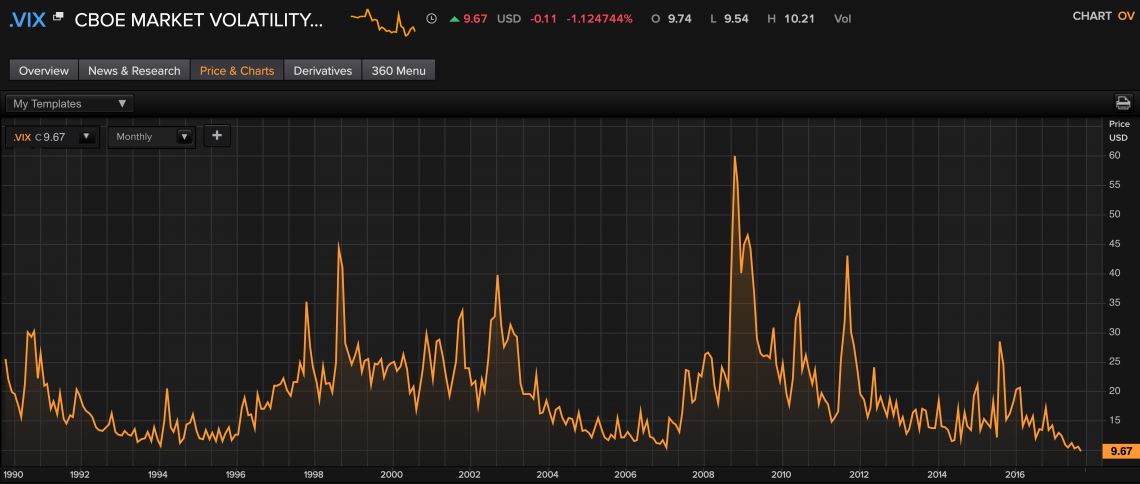
Indeed all risk has been flat-lined in this grand central bank experiment as the following chart of the $VIX shows:


Oh I’m kidding of course, but any trader staring at the tape knows that we find ourselves in the most compressed price environment in history.


This is not normal, there’s no heartbeat:


As I’m writing this I’m fully aware I may be viewed as the bear who cried wolf. After all I’ve been outlining structural risk factors for a while and markets have moved past my technical risk zones of 2450-2500 and most recently 2530. That’s what bubbles do. They blow past anyone’s expectations, they make believers of the unbelievers, make bears look like idiots and the most reckless look like geniuses.


But an extreme market that only becomes more extreme is not any less extreme, it is just more extreme. As no risk is apparent these extremes are then dismissed as the new normal.


Yet momentum driven price appreciation has absolutely zero predictive value of future price appreciation, it only appears as such at the time.


Here’s the $NDX leading up to the 2000 top:


It looked fantastic.


It meant absolutely nothing:


For traders of course the key is how to trade set-ups (I’ll post more on this in the near future, but I’ve talked a bit about it in The Relevance of Technical Charts) and for investors it is a matter of how to take advantage while at the same time know when things change.


At this time I want to document a bit of what I see here in markets and the structural world as I don’t want anyone to be surprised when the flat risk line we currently see brings about those nasty consequences.


Let’s be clear.


We find ourselves in a very unique point in history and in a world dominated by false narratives. It is a challenge to keep an analytical grip on reality, but I’ll try to tie a few threads together here to put everything in a macro context.


Firstly the underlying base reality: Free money, easy money, whatever you want to call it, permeates everything we see in financial markets. Indeed I would argue price appreciation has been paid for with unprecedented and, in my view, unsustainable volatility compression.


A couple of charts really highlight this.


Most clearly perhaps is the precise trend line tagging we can observe in the correlated picture of price appreciation and volatility compression since the February 2016 lows:


The $VIX’s corollary, the inverse $XIV, embarked on an explosive near one way journey since the US election coinciding with over $2 trillion central bank intervention in just the first 9 months of 2017:


And it has continued to this day and just made another all time high this past week on a massive negative divergence. It is the magnitude of this volatility compression that explains the current trading environment we find ourselves in.


Aside from the obvious artificial liquidity avalanche we’ve had speculated about the driver of all this and the answer may simply be the promise of even more free money, specifically tax cuts.


As some of you may recall from my analysis over the past year  I’ve been very clear that math ultimately will bring out truth in any narrative. In this case that notion that tax cuts pay for themselves is a fantasy. It always has been. Can it result in a short term bump in spending or even growth? Yes it is possible, especially if structured right. But any historical analysis will show you that tax cuts, especially already coming from a relatively low base, will just add to debt via larger deficits.


Recently the White House budget director finally acknowledged this very reality:


“a tax plan that doesn’t add to the deficit won’t spur growth”


My criticism has been that all this marketing talk is simply a lie and will structurally put the country further at risk of trillion dollar deficits and a massive debt explosion that is already baked in even without tax cuts.


Indeed the further one digs through the details the bigger the expense of these tax cuts become:


“We have a lot of businesses… I don’t think any of them are non-competitive in the world because of the corporate tax rate,” Buffett, the chairman and CEO of Berkshire Hathaway Inc told CNBC.


Fink said a corporate rate as high as 27 percent could satisfy U.S. businesses’ need for tax relief, while avoiding an increase in the federal deficit.


“What is being proposed is a pretty large expansion of our deficits,” Fink told Bloomberg TV. The plan contains up to $6 trillion in tax cuts, according to independent analysts.”


I bet you if you ran these tax cuts through a budget that accounts for a recession case somewhere in the future this entire budget would be an utter disaster and they could never sell it. And this is why you won’t see a stress tested scenario, all you will see is happy steady 2.9% growth projections in perpetuity. Nonsensical. Unrealistic. And frankly intellectually insulting to anyone that insists on any base line of intellectual veracity to any budget process.


Running the numbers it’s clear who actually benefits:


So I ask, how will any of this change this trend?


The answer is it won’t despite public narratives to the contrary. People will choose to believe what they want, but math is independent of beliefs and the math is very clear on this.


Put this proposal in context of standing trends:


Real disposable personable income growth remains meager at best:


Debt expansion at low rates continues to sustain the illusion of real prosperity for the 90%:


A meager set of rate hikes is already putting pressure on revolving credit obligations and personal interest payments:


Why does all this matter for us here?


Look no further than to the earlier quoted Warren Buffett who may have explained much of the reason we see no sellers in these markets currently:


“Buffett also said he would wait to see how the tax push played out before doing any significant selling of Berkshire Hathaway stock to avoid paying unnecessary taxes on his gains.


“I would feel kind of silly if I realized $1 billion worth of gains and paid $350 million in tax on it if I just waited a few months and would have paid $250 million,” Buffett said.”


I get it, why sell anything if you can save on taxes and while central banks keep pushing markets higher with record liquidity? Steady as she goes after all.


And we have to acknowledge that the combined effect may be here to stay until clarity has emerged. If current legislative efficiency is any indicator then this may drag on for months with perhaps nothing accomplished.


Health care? Still nothing has happened. And let’s be clear: Not a single health care proposal (and there have been multiple efforts) have had anything to do with health care. They have been proposals that would have knocked millions off health care coverage and financially benefitted the 1% in form of tax reversions. That’s the analytical reality.


I don’t know why anyone still believes this administration will implement anything substantive to help the middle class. Previous administrations (both Democrat & Republican) have failed miserably on the wealth inequality front. And this administration looks no different and perhaps only worse. Every proposal looks to disproportionally benefit the top 1% and this latest tax cut proposal is no exception. Every analysis I have seen shows disproportionate benefit going to the wealthy. And how will that stimulate growth for the middle class? Or the bottom 50%?


And don’t think I’m alone bemoaning wealth inequality & associated inbred dynastic economic structure as an increasing drag on society and its future prospects.


Here’s Buffett himself again:


Ironically it is those 400 that would benefit the most by getting rid of the estate tax that is currently proposed as part of the tax cut package.


Bottom-line, it’s all tied together in a package that promises more and more debt.


Central banks do whatever it takes to keep reality at bay:


And hence I’ve called this entire central bank talk of “normalization” a fantasy. They can’t do it, they’re trapped and even the quants at JPM are out in force warning of it:


As central banks begin shrinking their balance sheets, they risk triggering another financial crisis, something that may be sharpened by the shift away from active investing, JPMorgan’s top quant strategist has warned.


“Such outflows (or lack of new inflows) could lead to asset declines and liquidity disruptions, and potentially cause a financial crisis,” said Mr Kolanovic (who, it is worth noting, has issued such warnings before). “The timing will largely be determined by the pace of central bank normalisation, business cycle dynamics and various idiosyncratic events, and hence cannot be known accurately.” Mr Kolanovic pointed out that “this is similar to the 2008 [Great Financial Crisis], when those that accurately predicted the nature of the GFC started doing so around 2006.”


“The shift from active to passive assets, and specifically the decline of active value investors, reduces the ability of the market to prevent and recover from large drawdowns,” Mr Kolanovic said. He added that the move towards passive and momentum strategies, where traders chase market cues as opposed to company fundamentals, has “eliminated a large pool of assets that would be standing ready to buy cheap public securities and backstop a market disruption.”


And this is precisely why we won’t see any real normalization ever again. Or perhaps only after a massive reset in the financial system.


This new administration wants massive tax cuts. This year the military budget was already increased by $80B to $700B. The costs of the recent hurricanes are providing the perfect excuse for running larger deficits and you can already see the narrative creeping in:


“I hate to tell you Puerto Rico, but you’ve thrown our budget a little out of whack,” said Trump as he introduced his budget director Mick Mulvaney.


Not the $80B increase in military spending of course.


Look, I can read between lines with the best of them and the message is clear.


Low rates are here to stay and the administration needs low rates to keep it all going and justify tax cuts.


The writing is on the wall, no, actually it is coming to you courtesy Jeffrey Gundlach:


“Bond King” Jeffrey Gundlach has an unusual pick for who President Donald Trump will choose to be the next Federal Reserve chief.


“I actually have a very non-consensus point of view. I think it’s going to be Neel Kashkari,” the the CEO of DoubleLine Capital told the Vanity Fair New Establishment Summit on Tuesday in Los Angeles. “He happens to be the most easy money guy that’s in the Federal Reserve system today and that’s why he may win.”


Kashkari is the president of the Minneapolis Fed and happened to say Monday that the central bank is making a mistake by continuing to raise rates, comments Gundlach referenced as helping him possibly get the job.


“I think there is no chance that she wants to be chairwoman, nor do I think the president wants her to be,” said the manager of $109 billion.


Gundlach said that Trump needs someone who will keep rates low in order to keep his populist reputation and help his base voters and that’s why he’ll pick Kashkari.


“A stronger dollar is not good for achieving that agenda,” he said.


And there you have it. We need an easy money guy. Now I don’t know if Kashkari will be it, but it’s pretty clear Yellen is toast and some version of an easy money guy is coming and the Fed’s balance sheet reduction plan may be out the window shortly after February.


But that’s the combined message, massively more debt is coming, normalization is at best a marketing ploy, and easy money will continue to be part of the equation with perhaps more coming in form of tax cuts.


So yes, I get and receive comments about how it’s different this time, how price discovery as we know it may be a thing of the past.


An asset price inflation world, without core inflation, where valuations don’t matter and debt flows continue unabated and consequence free…


…and market caps rise in asymptotic fashion every quarter, month and week:


The end result: The $SPX is now 18.8% above its annual 5 EMA:


As far as I can tell this is the largest, or one of the largest disconnects ever.


And I’ve shown the chart of $MSFT as an individual stock example of how historically extreme the current disconnect is:


$MSFT is now 35% above its annual 5 EMA. There’s been only 1 year prior to 2017 when it did not touch its 5 EMA: 1999. Did it have any predictive value of future price appreciation? Nope.


Speaking of 1999: Greed is back with a vengeance.


It is all around us:


Central bankers have flat lined risk and investors have crossed to the other side expecting nirvana & free money forever.


So far so good it seems. Just remember in Flatliners the allure of nirvana turned into a running nightmare:


What would be signs of nirvana turning into a nightmare?


Keep an eye on this thin red line:


It will get tested again. Currently the trend line is barely 2% below current prices and it is rising steeply.


When price breaks below this line it’s time to return to real life.


After all you do want a heart beat:


Don’t you? I know I do.

Thursday, October 5, 2017

"It Won't Pass" - Larry Fink, Warren Buffett Blast Trump's Tax Reform Plan

In the week that’s passed since the White House unveiled its tax-reform plan, Republicans and Democrats have expressed their reservations about the proposal, particularly after an analysis from the non-partisan Tax Policy Center suggested that taxes would rise over the coming ten years for most members of the middle class if the proposal were passed into law.


Wall Street, for the most part, has ignored these criticisms and US stocks have continued to climb to ever-higher record highs - even after two industry luminaries joined a growing chorus of skeptics warning that tax reform may not pass by year end.


Both Warren Buffett and Blackrock chief Larry Fink have spoken out against the administration’s proposal, echoing the most trenchant criticism of the bill. Namely, that it’s overly generous toward corporations without doing enough to help the middle class, according to Reuters.


With the White House and top Republicans in Congress already on the defensive over claims the plan would not cut taxes for many middle-class Americans, Buffett and BlackRock Inc Chief Executive Larry Fink suggested in separate interviews that the corporate rate may not have to be cut as deeply as proposed.


“We have a lot of businesses... I don’t think any of them are non-competitive in the world because of the corporate tax rate,” Buffett, the chairman and CEO of Berkshire Hathaway Inc told CNBC.


Meanwhile, Fink, who was rumored to be on Hillary Clinton’s short list of Treasury Secretary candidates, echoed Republican Sen. Bob Corker’s criticisms by admitting that he’s nervous about how the bill would impact the deficit, while adding that if the administration insists on incorporating the elimination of deductions for state and local taxes into the final bill, that the measure would almost certainly fail.  


Fink predicted tax legislation would not pass if it includes a proposal to eliminate a popular deduction for state and local tax payments.


“I don’t believe we’re going to get tax reform if there is the elimination of deductibility of state and local taxes,” he said.


Eliminating the state and local tax deduction would raise about one-quarter of the $4 trillion in revenues that some Republicans say they need to prevent tax cuts from creating a massive increase in the federal budget deficit.


Buffett, who’s a well-known advocate for progressive taxes on the wealthy, said that eliminating the estate tax would be a “terrible mistake” that unnecessarily benefits rich people.


Watch CNBC"s full interview with Warren Buffett from CNBC.


Fortunately for the market, Republican leaders are reportedly backing away from the proposed elimination of the SALT deductions – a measure that would impact some 40 million tax-paying Americans.


But even if Republicans ultimately decide against eliminating the SALT deduction, they will still need to find some other way to pass tax reform without massively blowing out the deficit. To be sure, the administration has maintained that revenue lost from corporate-tax cuts will be partly offset by closing loopholes for special interests.


But no matter what form, or forms, the bill ultimately takes, it’s chances of passing are far from assured. And while stocks have so far (mostly) ignored these nagging doubts, challenges to the market’s sanguine outlook are growing increasingly frequent.


Earlier this week, David Stockman, the Reagan administration"s director of the Office of Management and Budget, told CNBC earlier this week that Wall Street is "delusional" for believing it will even be passed.


And earlier today, Bill Blain posited that deficit hawks like Corker would ultimately kill the reform effort.


In its analysis, the TPC found that by 2027, taxes would rise for roughly one-quarter of taxpayers, including nearly 30 percent of those with incomes between about $50,000 and $150,000 and 60 percent of those making between about $150,000 and $300,000. Meanwhile, 80% of the benefits would accrue to the top 1% of taxpayers.


The market greeted Republicans’ failure to repeal and replace Obamacare as investors quickly retreated back inside their bubble of complacency.


At the time, market strategists reasoned that it’d be easier for the administration and the Republicans’ Congressional leadership to rally support for tax reform. This no longer appears to be true.  


And with the Fed preparing to begin the arduous process of reducing its balance sheet next month, the market is quickly running out of excuses to keep stocks bid. 
 

Tuesday, October 3, 2017

Warren Slams Wells CEO "You Should Be Fired" As Buffett Counters "He Has My Faith"

In a repeat of what she said almost exactly one year ago, when Senator Elizabeth Warren told then-Wells Fargo CEO Stumpf "You should resign, you should be criminally investigated" - not long before Stumpf indeed resigned, moments ago the kangaroo court was back in session and Warren doubled down her attack on Stumpf"s replacement, Wells CEO Tim Sloan, blasting that he should be fired as he was part of a culture that pushed the bank to create millions of fake accounts for customers without their knowledge.


In prepared testimony, Sloan apologized for the creation of unauthorized accounts and said the bank has hired back more than 1,000 workers who were wrongly fired or left under a cloud. In late August, Wells admitted that as many as 3.5 million accounts were created for customers without their permission, nearly 70% more than originally thought. The scandal led to the departure of several executives including former CEO John Stumpf.


While the practice had been going on for years at the bank, it only became public last year, when Wells agreed to pay a $185 million settlement with regulators. Since then, it was revealed that the tactics extended to enrolling customers in auto insurance that they didn"t need as we previously reported and as CNBC noted. Wells paid a $142 million class-action settlement and $2.8 million in refunds to affected customers.


Meanwhile, Warren attacked Sloan over his past comments to investors, saying he “bragged” about high levels of new accounts even though he was aware of sales-practice problems at the bank: "You went to the stock market and you bragged about it," Warren said at the Senate Banking Committee hearing Tuesday.


"At best you were incompetent, at worst you were complicit," the Massachusetts Democrat lashed out at Sloan, adding that "either way, you should be fired" as “you enabled this fake account scam, you got rich off it, and you tried to cover it up."


Warren pushed Sloan on transcripts she found in earnings calls that she said showed the CEO was bragging about the bank"s sales ability even as he knew about the cross-selling problems. "I"ve read through them, and on these calls no one, not even John Stumpf, who was the CEO at the time, bragged more about Wells Fargo"s ability and commitment to open new accounts for existing customers," Warren said, referring to earnings calls between 2011 and 2014.


"I"m proud of the credit card products we have at Wells Fargo," Sloan defended himself, saying comments cited by Warren were taken "out of context."


Warren wasn"t alone, and other members of the committee also pressed Sloan about how the bank could have allowed the sales scandal to get so out of control. "What in God"s name were you thinking?" asked Republican Sen. John Kennedy of Louisiana, quoted by CNBC.


As a reminder, as many as 3.5 million accounts were violated as employees tried to meet aggressive cross-selling goals that have since been scrapped, and while Sloan vowed that the bank was making strides in restoring its reputation, Warren and others weren"t impressed. "Wells Fargo needs to start over, and that won"t happen until the bank rids itself of people like you who led it into this crisis," said Warren, who previously had demanded that the 12 board members in place during the scandal be removed, only to be defied by Warren Buffett during the bank"s last shareholder meeting.


Sloan defended his role at the bank, sidestepping questions over why he hadn"t acted sooner and instead focusing on the steps he was taking now. Sloan was chief operating officer before succeeding Stumpf, who was forced out as CEO last October, a month after the bank settled charged with regulators over the cross-selling practice. Sloan outlined a number of steps Wells Fargo is taking to improve operations and prevent a similar scandal.


"I don"t believe your criticisms of the board are accurate," he later said. "I think the reason I am the right person to run this company today, notwithstanding your criticisms, is because I have been making change at this company for 30 years."


"I"m not afraid to make hard decisions when it"s needed, and I have the support of 270,000 people," he said, referring to the bank"s employees. "That"s why I think I"m the right person."


"Are you kidding?" Warren responded.


One person who wasn"t kidding, was prominent democrat and billionaire Warren Buffett, who earlier told Becky Quick that he still believes in the CEO of Wells Fargo after the fake accounts fallout at the bank. "Tim Sloan has my faith," said the CEO of Berkshire Hathaway. "When you find a problem, you have to jump on it... Somebody messed up and the job is to find out who messed up."


Berkshire remains Wells Fargo"s largest shareholder, with a 9.4% stake. When asked whether he sold any shares of Wells Fargo, Buffett said "only enough to stay under 10 percent, which was something the Fed requires."


And since the decision whether Sloan stays or goes ultimately is in the hands of Wells Fargo"s shareholders, perhaps Warren should target her anger at the Omaha billionaire: it was his input during the last Wells Fargo proxy vote that made sure the current board escaped unscathed from the bank"s ongoing scandals.

Thursday, September 28, 2017

Warning: Danger Lurks Here

By Chris at www.CapitalistExploits.at


Take a look at the volume of stocks listed vs. indexes listed going all the way back to the days of bellbottoms, loud hair, and orange wallpaper.


Since 1995, the supply of stocks, particularly in the US, has been shrinking faster than Trump"s approval ratings. At the same time, the number of indexes have exploded like one of Kim"s shiny new missiles.


Why?


In a falling interest rate environment, the twin pressures of reduced returns and relative cost pressures have meant that investors, in order to make a buck, have flooded into the low fee structures offered by passive strategies. These include indexing, ETFs, and those truly insane creatures I"ve written about before: low volatility ETFs.


But what about those alpha generating hedge funds? Aren"t they meant to be smart and able to beat the market... any market?


Those alpha generating hedge funds have things called LPs. And though LPs may be smarter, and certainly wealthier than Joe Sixpack, they"re no less human. And human attention span and patience level has been in decline... correlated no doubt with the rise of social media and the Kardashian crowd. Like a virus, it infects everything.


As performance from hedge funds has been poor relative to the benchmarks, a self reinforcing situation where hedge funds, in order to ensure LPs don"t redeem, have landed up hugging the indexes.


This is the exact opposite of what hedge funds were meant to do, of course. In many cases, they themselves are simply buying the indexes, trying desperately to figure out how the hell they"re going to survive through the next quarter but determined simply NOT to underperform the index. It"s a losing strategy no matter how you slice and dice it.


For those hedge funds who refuse to chase the indexes... Well, they are now fighting the tidal wave of capital that has been shifting into passive investments, which forces those passive investments even higher.


This, in turn, leaves active hedge funds who refuse to get sucked in with increasingly substandard returns. They can explain until they"re blue in the face why certain indexes make no sense but when those indexes just keep rising day after day, month after month, it becomes a very tough stance to keep. Redemptions follow, and so by doing the right thing, they"re punished. And by doing the wrong thing (following the mob), they may get to stay alive just a little longer and this is what many have resorted to.


We all know that at some point there are no new buyers available to enter the market and hoo boy, do we then have a problem.


So... you either join the party or you leave the party.


The last to leave the party is Hugh Hendry and his baby Eclectica.


Hugh Hendry Murders His Hedge Fund


Og aye, tis tae tough


Hugh follows Eton Park and Perry Capital to name but a few more.


Paul Singer of Elliot Management fame put it well in his July investor letter to stakeholders.


"In a passive investing world, small shareholders have little-to-no voice and no realistic possibility of banding together, while the biggest shareholders have no (repeat, no) skin in the game so long as the money manager does not underperform the index."


Make no mistake, the rise of passive indexing is a bubble in dumb money.


We have a situation where the market is becoming completely lopsided and increasingly so at a blistering pace.


If it gets anymore lopsided, it"s going to be upside down. What"s more, the market participants have no interest or even determination of valuations.


An index doesn"t give an isht what the P/E ratio of any stock included in the index is, and the investors buying it have even less idea. It doesn"t care if the aggregate of stocks sitting inside its womb are over or indeed undervalued. It"s just a dumb bloody index, and you can"t blame it anymore than I can blame my dog for not understanding Shakespeare.


Those investing in passive have done so partly due to relative fee differentials, partly due to performance. But now also dangerously so... due to increasing inflows, which have continued to push values higher.


Now, having markets or sectors get silly is obviously as normal as a peanut butter sandwich, and provided you"re aware of it, we"ve little to worry about.


But what"s more frightening than the Kardashians in skinny pants is that as capital has fed into passive, the usual countering forces (active managers) of the market have been leaving the party, which has left the passive world to increasingly swell like a neglected infected wound.


What we need to think about is that increasingly there is no active market to stabilise this. It"s akin to having a 5-year-old"s party, inviting a troop of the critters, and then promptly sending all the parents down to the pub for a few hours.


Just as short sellers provide a balance to a market so, too, active management (who incidentally typically have skin in the game) have always provided a stabiliser to the overall market. What happens when the stabilisers all leave the room?


We can see this manifesting itself in the volatility index. As more capital enters at a steady pace so, too, the volatility falls.


And here"s the thing. The algos constantly feed back the daily data to recalculate their probabilities (read this article on VAR shocks). Risk? Nah!


At the extreme of the passive world sits volatility.


Selling volatility works really well. Just ask Neiderhoffer who has made godawful amounts doing it over the years.


Look closely, though, and you notice that even Neiderhoffer, who knows what game he"s playing, blows himself up spectacularly from time to time... and I mean complete armageddon wipeout stuff. Until that blow up comes, though, you just keep plugging away at it day after day and it just keeps paying you... day after day. You make money, make money... and then, well...


It all turns to isht and blows up in your face.


My friend Mark Yusko from Morgan Creek Capital places capital with the smartest strategies and hedge funds - active capital.


Who"s willing to bet with me that over the next decade being long smart active strategies and short passive (low volatility ETFs) will be a winning trade?


Wow Poll - 27 Sep


Cast your vote here and also see what others think


- Chris


“What could be more advantageous in an intellectual contest – whether it be bridge, chess, or stock selection than to have opponents who have been taught that thinking is a waste of energy?” – Warren Buffett, 1985 Berkshire Hathaway Letter to Shareholders


--------------------------------------


Liked this article? Then you"ll probably like my other missives on


this topic as well. Go here to access them (free, of course).


--------------------------------------