Showing posts with label Financial services. Show all posts

Tuesday, December 26, 2017

Man Arrested For Punching Wells Fargo ATM: "It Gave Him Too Much Money"

Call it the holiday"s token bizarro incident: according to Florida Today, a 23-year-old man who told police he punched a Wells Fargo ATM because it gave him too much cash, was arrested after bank officials said the attack caused at least $5,000 in damages, which elevated the inexplicable and idiotic temper tantrum into a felony crime.


Michael Oleksik, 23, 5"11", 155lbs, of Rockledge, FL; charges: Criminal mischief >$1000.


Cocoa police charged Michael Joseph Oleksik, of Merritt Island, on Friday with criminal mischief nearly a month into the investigation of a disturbance at the Wells Fargo bank branch at 834 N. Cocoa Boulevard, in Cocoa. According to authorities, Oleksik could be seen on surveillance video standing at the ATM, pummeling the electronic teller’s touch screen on Nov. 29.


A short time later, an apologetic Oleksik called the bank and told a manager that he punched the ATM because he was "angry the ATM was giving him too much money and he did not know what to do," Florida Today reported. Oleksik then explained that he was in a hurry for work and apologized for the damage to the bank"s ATM.


While Oleksik"s behavior may appear irrational at first glance, a quick look at his arrest record, which reveals not only domestic violence charges, but also disorderly drug intoxication and resisting and intimidating a police officer, and suddenly his vendetta with the ATM makes sense.


Wells Fargo - clearly distraught at the treatment one of its ATM machines was subjected to - contacted the Cocoa Police Department and asked to press charges. Oleksik was arrested Friday and booked into the Brevard County Jail Complex in Sharpes.


Friday, December 15, 2017

And So Begins The Rug-Yank Phase Of Fed Policy

Authored by MN Gordon via EconomicPrism.com,


The political differences of today’s leading two parties are not over ultimate questions of principles.  Rather, they’re over opposing answers to the question of how a goal can be achieved with the least sacrifice.  For lawmakers, the goal is to promise the populace something for nothing while pretending to make good on it.


Take the latest tax bill, for instance.  The GOP wants to tax less and spend more.  The Democrat party wants to tax more and spend even more.  We don’t recall seeing any proposals to tax less, spend less, and shrink the size of the state.  And why would we?


Today’s central planners and social engineers are enlightened and progressive.  They know much more about anything and everything than the rest of us.  In particular, they share a general sense that they know how to spend your money better than you.


At best, the central planners call your money to Washington so they can then distribute it back to your friends and neighbors.  In reality, the lawmakers call your money to Washington where they distribute it to their friends and neighbors – not yours.  This is not a matter of opinion.  It’s a matter of fact.


Is it a coincidence that the top three wealthiest counties in the country are in the shadow of the Capitol in the D.C. suburbs?  What it is exactly that the residents of these counties do that’s of tangible value is unclear.  However, what is clear is that bogus government jobs in Loudoun County and Fairfax County, Virginia, pay big bucks.  But that’s not all…


Garbage In Garbage Out


Further up the eastern seaboard, Wall Street has a good thing going too.  The big bankers and brokers make big bucks extracting capital from Main Street America.  That’s a fair characterization, right?


Perhaps the big bankers and brokers really are efficiently allocating capital to its highest and best use.  Who knows?  But as far as we can tell, they’re gambling with other people’s money – and collecting fees regardless of how their coin tosses fall.  It’s always, ‘heads I win, tails you lose.’  Not a bad fugazi gig, if you can get it.


Of course, the cornerstone of it all is the Federal Reserve.  Through what they call “open market operations,” the Fed rigs the game in Washington’s and Wall Street’s favor.  Indeed, the process is really quite elegant.


Under the smokescreen cover of garbage in economic data, the Fed’s economists produce garbage out bar charts and line graphs.  These, in short, are fabricated depictions of the economy’s growth, consumer and producer prices, personal consumption expenditures, unemployment rate, and whatever other aggregate metrics are deemed to be of vital importance.  What’s more, these fabricated depictions serve as the basis for the Fed’s monetary policy decisions.


Do the graphs show price inflation heating up or cooling down?  What about GDP or the unemployment rate?  Is one going up while the other’s going down?  Is one going down while the other’s going up?


The Federal Open Market Committee (FOMC) deliberates over these questions about every six weeks.  Then the Fed goes to work inflating the nation’s money supply, with the occasional rug yank, for the stated purpose of getting the charts and graphs to illustrate the garbage data to their liking.  What to make of it?


The Rug Yank Phase of Fed Policy


From the outside, the Fed’s economists and planners appear to be esteemed professionals, making decisions with the intent of providing for the greater good of the country.  They even attend economic conferences and forums where they present their latest research findings on abstract topics like liquidity traps.  Some of their studies even include footnotes, as if the professional economists are building upon a concrete knowledge base of human intellect.


Yet beneath this cover of bogus science, the real sausage is made.  Capital is borrowed into existence where it is directed to Washington and Wall Street.  There, having first dibs on this phony money, Washington and Wall Street get to spend it as if it has real value.


However, the real value does not coming from the Fed’s phony money.  In fact, as this new phony money appears on the scene, it extracts incremental wealth from the workers and producers across the country that – through their time, talent, and labor – created the wealth to begin with.


At the moment, we’re in the rug yank phase of the Fed’s monetary policy.  This is where they reel back credit ever so slightly after letting it run wild over the last decade.  This tightening of credit markets has the effect of pulling the rug out from under financial markets and the economy.


Monetary policy, without question, is not an exact science.  It’s rudimentary guess work that’s based on committee interpretations of bogus data.  This week, the FOMC raised the federal funds rate by 0.25 percent to between 1.25 and 1.5 percent.  This marks the third increase this year and the fifth increase this cycle.


Incidentally, Janet Yellen also delivered her last press conference as Chair of the Federal Reserve, though she’ll likely still Chair the FOMC meeting scheduled for late January.  Then Jay “Count Dracula” Powell will take over the helm of the nation’s central bank.  The broad expectation is for Powell to continue the rate increase playbook that Yellen has laid out, which includes three quarter percent hikes in 2018.


We wish Powell the best in his endeavors.  But we suspect he’ll unwittingly pull the rug out from under financial markets and the economy before he completes his first year.  After that, the fun really begins.


Thursday, December 14, 2017

Financial Times Survey: Banks" Brexit Relocations By March 2019 Much Lower Than Feared

In the run-up to the recent agreement on phase I of Brexit, there was mixed news on the extent to which jobs in the City of London would be relocated to other European hubs, primarily Frankfurt. On one hand, we discussed the meeting between US Commerce Secretary, Wilbur Ross, and executives of JPM, Goldman, HSBC and other banks at Wilton’s restaurant during his trip to London in early November. The banks warned that they were close to a “point of no return” on moving jobs.


A group of large financial institutions with big London operations, led by Wall Street’s pre-eminent banks, have told the US commerce secretary that Britain’s unstable government and slow progress in Brexit planning may force them to start moving thousands of jobs out of City in the near future. The warnings came on Friday during a closed-door meeting between executives from the banks, which included JPMorgan Chase, Goldman Sachs and HSBC, and Wilbur Ross during the US commerce secretary’s visit to London, according to people briefed on the discussions.


A week earlier, we reported the head of Swiss bank, UBS, saying that the possibility that a fifth of its 5,000-strong UK workforce would be shifted was now unlikely to materialise following some “regulatory and political clarification about what we need to do”.
 
We can now, thanks to a survey by the Financial Times, get a better idea of the likely London exodus by March 2019 after the newspaper reviewed public statements by fifteen of the UK’s biggest financial institutions and conducted interviews with more than a dozen executives about Brexit plans. According to the newspaper, the number is…


The UK’s biggest international banks are set to move fewer than 4,600 jobs from London in preparation for Brexit — just 6 per cent of their total workforce in the financial centre — according to Financial Times research.


The FT analysis contrasts with consultants’ original claims that tens of thousands of jobs could move from London after Brexit — including an EY study this week that claimed 10,500 could leave on “day one”.


Some bankers say the lower estimates emerged as they thought through how many jobs and operations would need to move to the EU if the UK loses access to the bloc’s single market. “Every city wants thousands of people, but what are they going to do?” said one senior executive at a large US institution, adding that the thousands of people sitting in his London office “cover clients” who will mostly be remaining in the UK.


Two banks in particular, Deutsche Bank (not surprisingly) and JPMorgan Chase, had stated that several thousand jobs could move, although the FT estimates that the number is likely to be only several hundred. It’s the same with Goldman, despite Lloyds Blankfein’s famous tweet about spending “a lot more time” in Frankfurt.


In the case of Deutsche Bank, where Sylvie Matherat, head of regulation, publicly said up to 4,000 jobs could move, the FT estimates that just 350 jobs may leave by April 2019. The figure amounts to 5 per cent of Deutsche’s London headcount, a proportion broadly in line with other big banks. At JPMorgan, where chief executive Jamie Dimon warned before the Brexit vote of up to 4,000 London job losses, the number leaving before April 2019 is set to be closer to 700. Goldman Sachs, which has taken a new office in Frankfurt that could accommodate 1,000 people, expects to move fewer than 500 from London. HSBC is still planning to move “up to 1000 people”, although its chief financial officer recently said the figure could fall.


So the initial London exodus by March 2019 will be fairly modest and the banks have the prized transition period of two years. However, some banks are leaving the door open for further relocations in the aftermath of Brexit. According to Rob Rooney, CEO of Morgan Stanley International the real Brexit story will only be apparent “three to five years out”. As the FT explains.


Several banks say they are planning to move relatively few people in the immediate aftermath of Brexit because it will take time for their EU operations to build up. They expect to have very small balance sheets when the EU entities begin handling client business on April 1, 2019, and to be able to run some of the risk and support functions for those small EU entities from London.


Next year, banks are likely to begin “repapering” some clients to their new EU entities. The FT noted that one bank EMEA CEO said that he expected the ECB to push for more “market risk to be run onshore”.


However, a key question will be, where do the clients want to do business? We could be wrong, but our guess is that the majority will opt for the status quo if at all possible. The EU has already inflicted the nightmare of MiFID II on them.


Wednesday, December 13, 2017

How GDP Became A Joke, In One Chart

For all the rhetoric about above-trend US growth, one month ago UBS shattered the narrative of surging GDP by showing just one chart, which revealed that excluding contributions from energy investment, which are about to hit a brick wall now that the price of oil has peaked and is reverting lower once again, US growth for the past 2 years has been slowing.


On the other hand, things get even more complicated thank to a chart released yesterday by UBS" global chief economist Paul Donovan who makes a point we have repeatedly underscored over the past decade, namely that economic data is largely worthless, and any instant snapshot reveals more about the political and "goalseeking" climate of the agency releasing the "data" than about the underlying economy itself.


As Donovan shows, here are the no less than 6 answers one gets to the question of "how fast was the US growing at the start of 2015?."


By way of context, recall that this was the quarter when the US was blanketed by deep snow, and when every "expert" was rushing to convince those who bothered to listen that the economy would suffer a sharp slowdown as a result of the weather and nothing but the weather (and yes, that included UBS). And when the number was first reported, that was indeed the case: with Q1 2015 GDP reportedly growing only 0.2%. The problem is that within just over a year, that 0.2% initial GDP print turned to -0.7%, before subsequently surging to 2% and ultimately 3.2%!


Here is the sarcastic take of UBS" own chief economist on this GDP travesty, which is even more sarcastic  - and ironic - considering his entire job is to predict the exact number associated with said travesty:


Economic data is not very precise. Economists are trying to hit a target that is moving rapidly. Economic data is being revised more often, and the revisions are larger than in the past. The following chart shows annualized US GDP growth in the first quarter of 2015.


Growth was initially reported very weak, below consensus and barely moving. Then the data was revised to show the US economy was shrinking – and shrinking a lot (the number was –0.7% annualized). Then it was revised to show the economy was shrinking a bit. Then it was revised to show the economy was growing, but a long way below trend growth.


The growth number was then revised to be basically in line with trend growth. Now, US growth at the start of 2015 is thought to be 3.2%.


So which number in the range of –0.7% to 3.2% is the economist supposed to be forecasting? An economist predicting 3.2% growth when the data was first released would have been ridiculed. According to the latest information we have, that economist would have been right.


In other words, that terrible weather which at the time was used to justify why the economy ground to a halt - when in reality it was all a function of China"s credit impulse crashing - would eventually serve as a the catalyst to grow the economy at a pace that has been recorded on just a handful of occasions in the past decade.


No wonder then economists - especially those who work at the Fed but all of them really - their predictions and their analyses have become the butt of all jokes; and by implication, no wonder traders and algos no longer respond to economic "data."


Tuesday, December 12, 2017

How Will The Market Absorb Trillions Of US Treasury Bonds to Replace The Feds Balance Sheet Wind Down?

First, the facts:


At Powell"s Nov 28th 2017 testimony to Congress, Powell said that as the Fed allows its 4 trillion dollar balance sheet to wind down, the US Treasury would issue new bonds to the market to replace them (so, technically, US notional debt will neither increase nor decrease as a result of QE).


Recall that QE is a sterile operation (this is why we don"t have hyper-inflation).  What does that mean?  Sterile means that the US public debt will neither increase or decrease as a result of QE, and neither will the money supply.  Another way to say this is that QE is a cash neutral operation.  Where cash is pushed into the system at one point, it must be drained someplace else (in our case, the Fed offers interest to banks to store their cash at the Fed...mostly with IOER - interest on excess reserves..and all the banks have indeed been doing this).  This is also why banks are not over-excited to lend you money...they get risk free money to deposit their cash at the Fed.  QE simply took US debt off the markets balance sheet, and placed onto the Fed"s (yes, the Fed printed digital fiat currency to make this happen...but the unwind will reverse  this "money" creation).  So, the Fed bought 10yr notes with funny money..will hold them to maturity...and then when those 10yr notes mature, the US Treasury will auction new bonds into the market to repay the Fed, making the funny money disapear like magic.  This whole process together "sterilizes" the Feds money printing...but in the meatime, the market pushed that money into other assets (mostly stocks).


Here is the simplified flow of money:
Fed QE --> bond market --> stock market --> bank accounts --> Fed accounts(IOER)


Such that total dollars in circulation didn"t change much...they ended up back at the Fed (with a nice uptick in asset prices as an inbetween step).
There was a nice side effect to this...while the Fed holds a large balance sheet...the US Treasury doesn"t have to pay interest on its debt (because the Fed remits all its profits back to the Treasury...and interest income is considered profit).  When the Fed winds down its balance sheet, the Treasury will have to start paying interest on that debt again.


The interesting question is thus:  When the US Treasury tries to sell 1-2 Trillion dollars of long term debt back into the market...what happens to interest rates and the stock market?  Recall #1 that after the Trump election, 10 year interest rates moved from 1.80% to now 2.40% (expectation of Trump borrowing lots of long term money to finance his infrastructure and deregulation projects).  But that hasn"t even happend yet (analysis of the Republican tax plan cost estimates an additional 1 Trillion US long term debt).  Recall #2 that the Fed is currently holding a lot of that debt...which minimized the need to liquidate bad long positions in the post Trump bond market selloff.  US Treasury debt is "high quality" and so the market will buy it...but at what price?  This is the big question.  Will the market sell stocks to make room to buy up all this new debt (reverse QE)?  Does this cause the next stock market crash?  (hint hint - probably)


The piper must be paid eventualy.  However, just like in Cyprus...the banks will have a heads up...and their assets will be safe.  What will happen to yours?

Tuesday, December 5, 2017

JPMorgan, BofA Trading Revenues Tumble 15%; Blame Lack Of Volatility, "Excitement"

Stop us when you"ve heard this before... and you"ve heard it exactly two times in the last two quarter: both Bank of America and JPMorgan warning their revenue will be down double digits year over year because volatility is so low, and traders are so paralyzed, there is much less money to be made trading either flow or prop, or simply from collecting commissions.


Well, today marks the third time in the last three quarters when both JPMorgan and Bank of America both said - again - that there hasn’t been a rebound in the relentless slump in trading revenue.


Speaking at an investor conference in New York on Tuesday, JPMorgan CFO Marianne Lake said that revenue from trading has dropped 15% so far this quarter compared with the same period a year ago, while Bank of America CEO Brian Moynihan gave the same decline for his firm. Both said the business faces a difficult comparison to last year, when activity spiked after Donald Trump’s surprising presidential election win.


Commenting on the ongoing deterioration in bank revenues, Lake said that “there hasn’t been that many catalysts, it hasn’t been that exciting,” Lake said. “Volatility sill remains pretty low across the spectrum; it’s a very competitive environment.”


Lake spoke alongside Goldman Sachs CFO Marty Chavez and BofA COO Tom Montag, who said at a conference last month that the languor that has plagued their trading businesses in the last two quarters has persisted into the fourth period. According to Bloomberg, Chavez said his bank’s commodities unit is on pace for its worst year in the firm’s history as a public company.


With traditional revenue streams clogged, banks are forced to come up with alternatives. Sure enough, JPM claimed that the lack of volatility hasn’t been a problem in the bank"s corporate and investment bank, where fees should rise in the “high single digits” as activity levels have been healthy, Lake said. And, if passed, the proposed U.S. tax changes should continue to help that business, Lake said.


Clearly markets aren"t too worried, with JPM stock soaring to all time highs, and BofA trading at pre-financial crisis levels.


Thursday, November 30, 2017

Breslow: "The Answer To This Question Will Drive Just About Everything"

Having passed the first hurdle this morning (PCE did not drop further), The Fed"s December hike is now locked and loaded, but, as former fund manager Richard Breslow notes, at the end of the day, the real elephant in the room is if, when and how fast the big central banks shift toward policy normalization. Everything else is derivative. Get this one right and quibbling over some sector rotation or the relative prospects of the Australian versus New Zealand dollars pale in comparison.  


The answer to this question will drive just about every other market.


Via Bloomberg,


It’s an interesting issue to contemplate as we wind down a year when sovereign yields, with the exception of China, have been moribund, at best.


All eyes have correctly been on the yield curves but it could very well be that the focus needs to change.


And if it does, it could happen quickly because, unlike previous episodes it’s likely to be a generalized phenomenon rather than country specific. It’s hard to discount one central bank’s normalizing steps should it come to pass that everyone is looking to join in.


We know that the Fed wants to get official rates up. Nothing in the latest communications should have disabused anyone of that notion, even as the market continues to discount the trajectory. Pooh-poohing the trajectory is only a viable course of action if the ECB and BOJ continue to soften the FOMC’s actions.


But what happens if traders begin to realize that these central banks are far less dovish and scared than their official communiques suggest? I’ve got news for you, their speeches don’t line up with the post-meeting press conferences. Especially as they introduce alternative theories on the externalities of negative rates. And they’ll have a pretty good case to argue that they warned us.


We talk a lot about trades for the new year. The risk reward of taking a bearish view on rates is tempting from a technical point of view quite aside from the fundamental fact that global growth rates keep being revised up. And let’s face it, the consensus love-fest with emerging markets is predicated on a long global-growth outlook.


Ten-year U.S. Treasury yields are pathetically low, having failed to even sustain above 2.4%, let alone take a run at 3%. That’s the glass half-empty scenario.


On the flip-side, from a purely technical standpoint, resistance at 2.3% looks unquestionably impressive.


It seems almost laughable to talk about Bund and JGB yield upside but the charts argue that 30 and zero basis points, respectively, look like much more formidable lines in the sand than comparable support.


And since we all love a good conspiracy story, check out today’s Eonia fixing which jumped 6 basis points. (implying rate-hikes)


Aberration? Probably. Canary? Unlikely. But how cool would that be? All we do know is it was verified by the EMMI and we need to wait for further data.


But one thing we do know is the fixing was followed by some heavy volume block selling of the December Euribor contract (rate-hike bets).


An inexpensive trade, to be sure, but someone big wants to see what’s up.


The U.S. isn’t the only place where unemployment continues to improve and, at some point, fixed-income prices just might try to match up better with the economic story we are buying into for the new year.


Frankfurt: 20 New Residential Skyscrapers Are Being Built To Meet Brexit Demand

Last month, we discussed how Frankfurt was emerging as the clear winner. When UBS staff were asked to rank which city they would prefer to be relocated to, their options were Frankfurt, Amsterdam and Madrid. Our top picks would have been Paris and Dublin, which didn’t even make the short list. On 19 October 2017, Goldman’s Chairman, Lloyd Blankfein, garnered lots of media attention after he tweeted.


"Just left Frankfurt. Great meetings, great weather, really enjoyed it. Good, because I"ll be spending a lot more time there. #Brexit."


If Lloyds is thinking about buying himself a smart pied-a-terre in Frankfurt, he’s going to have plenty of options as a Brexit-driven construction boom is taking place in the city. The sharp rise in residential property prices is justifying the construction of “skyscrapers”, as Bloomberg explains.


The prices for new condominiums in Frankfurt have now reached such a high level that it pays off for project developers to build high-rise residential buildings and more and more such towers are being built in the German financial capital. This emerges from an assessment by consulting company Bulwiengesa AG.


In 2017 alone, asking prices rose by 15 percent compared to the previous year. A total of eight residential high-rise buildings have been completed since 2014 in the city. 20 more could be added by 2022. Five are currently under construction and another 15 are planned. These are key findings of the study.


"The cost of building skyscrapers is about twice as high as in ordinary multi-storey housing," Sven Carstensen, Frankfurt branch manager at Bulwiengesa, said in an interview with Bloomberg. "Therefore, you also need correspondingly higher revenue."


He explains the increase in prices above all with the high demand pressure. Unlike other cities, Frankfurt offers little land potential. That applies especially in the city center, he said. Skyscraper are the answer. A factor should also be the exit of Great Britain from the EU. "The expected influx of Brexit newcomers will help to absorb the volume of high-rise housing," Carstensen said.


One of the highest profile of the new residential skyscrapers is the 51-storey Grand Tower which, conveniently, has been under construction since the beginning of 2016 – although the Brexit vote was not until 23 June 2016. The Grand Tower will be Germany’s tallest residential building at 172 metres and contain 401 apartments and penthouses.


It’s clear that many thousands of jobs will relocate from London, even if some banks, like UBS, are reversing their initial apocalyptic estimates (one fifth of its 5,000 strong workforce). While the exact figure is subject to debate, some commentators are predicting that Frankfurt will be the recipient of more than half. Bloomberg continues.


While it is unknown how many bankers will ultimately move to Frankfurt, there are plenty of forecasts. "We expect that at least half of London’s declining financial jobs will be relocated to Frankfurt, which will be at least 8,000 employees over a period of several years," Helaba Chief Economist Gertrud Traud said at the end of August.


According to Bulwiengesa, this year’s highest construction activity for new condominiums overall, not just for high-rise buildings, can be found in downtown Frankfurt. The consulting firm identified 24 projects with around 2200 apartments in this area. The company takes a closer look at the market once a year. The weighted average price of new condominiums is around 6190 euros per square meter in Frankfurt, according to the data.


Skyscrapers are not new for Frankfurt. In the office sector, they have long dominated the skyline. But now they are increasingly being built for apartments. Carstensen: "There are thus few acceptance problems - both from the administration and from the urban society".


While the shiny new towers will help, Frankfurt’s attempts to shake off its dull image and promote itself as a “lifestyle destination” still ring a little hollow. As the architecture magazine, Dezeen, noted.


Frankfurt lacks the cultural and lifestyle attractions of London as well as continental rivals such as Paris and Amsterdam, but is now working hard to become more appealing to high-spending financial workers.


Time will tell, but our question is how will the former London-based UBS or Goldman employee, who relocated to Frankfurt, feel on a cold Monday night as he sips a glass of Riesling 25 floors up in his glass tower?


Monday, November 27, 2017

The Candle Problem (Why Bitcoin Is Misunderstood)

By Chris at www.CapitalistExploits.at


Karl Duncker, that"s who came up with it.


The Candle Problem, that is.


If you haven"t heard of the candle problem, here"s the skinny.


In 1945, just as Hitler was murdering himself (thankfully), psychologist Karl Duncker was turning his attention to how humans solve problems. He came up with "the candle problem," a cognitive performance test measuring the influence of functional fixedness on a participant"s problem solving capabilities.


Here"s the problem he presented...


Participants are given the following task: They have to fix and light a candle on a cork board that"s attached to a wall in such a way that the candle wax won"t drip wax onto the table below. To do so, they can only use the following objects:


A book of matches, a box of thumbtacks, and a candle


Here"s what most do...


Oh, and by the way, if you think you"re different...


This has been tested on numerous "subjects" including MBA students. Odds are you"re not.


Many subjects try all sorts of creative, but inefficient, methods such as trying to tack the candle to the wall. Nah, doesn"t work. Others attempt to melt some of the candle’s wax and use it as an adhesive to stick the candle to the wall. Nope. Doesn"t work either.


Here"s the sneaky little kicker. When the task is presented with the tacks piled next to the box (rather than inside it). Like this:


Tacks... outside the box


Virtually all of the participants manage to achieve the optimal solution, which is...


Thinking of the box as something other than a mere receptacle, participants quickly find the solution.


A "box of thumbtacks" vs. a "box and thumbtacks". You"d think we homo sapiens are smarter. Proof if you ever needed it we"re only a half chromosome away from chimps.


Which Brings Me Neatly to the Internet...


Grab your beanie babies and holster your Pokémon cards. We"re stepping back in time to the 90"s — you know when the internet was just cranking up. 1995 to be precise when famous astronomer Clifford Stoll wrote an op-ed for Newsweek stating:


"The truth is no online database will replace your daily newspaper, no CD-ROM can take the place of a competent teacher and no computer network will change the way government works."


Around the same time, Nicholas Negropone, director of the MIT Media Lab, predicted:


"We’ll soon buy books and newspapers straight over the Internet."


Ah... no.


And just one more for good measure.


"We’re promised instant catalog shopping–just point and click for great deals. We’ll order airline tickets over the network, make restaurant reservations and negotiate sales contracts. Stores will become obsolete. So how come my local mall does more business in an afternoon than the entire Internet handles in a month?"


Hindsight is a wonderful thing, and we can all scoff and laugh now, but the truth is 99% of people who use the internet today don"t know how it works. And guess what? They don"t need to. The fact that it does is what matters.


The internet solved problems we never even knew existed with respect to communication, shopping, banking, trading, entertainment, authentication, education, marketing, finding out what the hell a tranny is, and a zillion other things.


The pieces necessary for it had existed for some time — the proverbial thumbtacks, candles, boxes, and matches if you will. But until it actually happened, nobody saw how to put it all together, let alone how thoroughly it would transform our lives.


And here"s why it was so hard to understand what the internet was and how it would work.


Search and Retrieval Systems


That"s what our brains are. If I"d never seen a pear before, how would you explain it to me?


You: "Well, Chris do you know what an apple is?"


Me: "Sure, of course. I"m working on one now. Only kidding. Yes, red, crunchy, sweet... got it."


You: "Well, it"s like that only green and a bit fatter at the bottom than at the top. But it"s quite similar."


My brain does the search and retrieve thing and comes up with this.


Ok, I say to myself, so a pear is basically a wonky apple... and green. I think I understand.


But as you can see, I don"t really, though I"ve a better idea now thanks to your explanation, but I"m still unlikely to visualise this.


So when the internet came along, people used their search and retrieval databases (brains) to come up with what it was and what it could look like.


But there was nothing in there to retrieve. And so unless you"d taken way too much LSD as a teenager and seen things that the rest of us hadn"t, you had nothing to go on. Which is why folks struggled to see the pear. Heck, it was like having no idea what fruit was.


And then bam! Along came a pear.


The reason I bring up the internet is because we all know about it now. And that"s important because it"s easily the best reference point we"ve got to understanding bitcoin.


Who Owns the Internet?


The answer to this is the reason Bitcoin is succeeding where E-Gold (shut down by the USG) didn"t.


For reference, E-Gold was a gold backed digital currency. Its flaw? Centralisation.


Things which are decentralised are much tougher to kill. This is why the US army. despite being the world"s largest, is still embroiled in places like Afghanistan fighting guerrillas (decentralised). It"s the same reason that the stinger missile changed the power balance of warfare.


The internet is owned by everyone.


Ok, sure there are significant players in it, but there is no single party, rather hundreds, actually thousands of parties that make up the pieces that we today call the internet.


Should one or more of these significant players get taken down, rest assured the arbitrage and value gap that would open up would be filled faster than you can say "Darling, take a look, this site"s not working anymore."


And this doesn"t even get into mesh networks, IPFS, and an entire smorgasbord of fun stuff like that which is coming and will further decentralise the internet. The point is this: Sometimes there is push, and sometimes there is pull.


As we sit here today, we all know it. We can all feel it. The existing government and financial systems are creaking and groaning under their ever increasingly incompetent weight. The foundation cracked in 2008 but they all banded together to "solve" the problem.


The thing is instead of repairing the shonky foundations, they dug out more of the existing foundation and piled it on top of this creaking groaning mess. And that nearly non-existent foundation is what folks are relying on.


Now, let me introduce a really radical monetary (Shatbit crazy really) experiment to you...


Imagine you"re a little green alien just landed. You know nothing about the world but you understand that value needs to be transferred, thus money is needed.


Now, imagine a type of money. This money is issued by a cluster of central authorities. These central authorities determine what the price is to borrow this type of money, they issue it with wild abandon most regularly to their friends, and here"s the mind blowing part:


More than 20 of these central authorities in control of this money have their interest rates at negative. It"s never happened before in the history of mankind, though I"m sure it"s ok because men with badges and letters and authority stand behind it.


And then you take a look at Bitcoin.


Which of these sounds like a radical monetary experiment to you?


So, you might ask,
"well, if these incompetent sociopaths stand behind this monetary system, then who stands behind Bitcoin?"


Well, none of that. Mathematics and cryptology. Which would you trust more?


What is Money


Bitcoin as money? Sure, why not?


Money is anything that we believe is money. Heck, money is simply an abstract token of value. Humans have gone through 5 distinct phases of money.


  1. Barter exchange

  2. Things such as sea shells, salt, beads, etc.

  3. Precious metals

  4. Paper money, followed by plastic money

  5. And now we"re moving into the stage of using network based, cryptographically secure, programmable, digital money


Furthermore, prior to nation states and kings and queens, transactions were conducted using anything that was deemed to have value, which had nothing to do with a centralised authority or issuer.


Bitcoin takes us back to such a time, which is why most people can"t get their head around it. They are still looking around for someone with a uniform or a badge (or both) to tell them it"s OK and their government approves of it.


The world needs a global currency. Not one that is so deeply flawed as the one we have.


Have you ever asked yourself why should banks and intermediaries make money from you when you exchange dollars to yen, yen to baht, or any other currency?


Have you ever asked yourself why should they have the power to create wealth and distribute it to whomever they please?


Have you ever thought of the incredible friction caused and constraints placed on human progress by the inefficient and corrupt systems of central banking?


Now, if you"d asked me these questions 10 years ago, I would have shrugged my shoulders, nursed my beer, and acknowledged grudgingly that I could see your point but it all looked pretty hopeless. We"re just destined to roll from one disaster to the next, and the best we can do is to navigate our way through it all.


Blockchain can actually solve this problem. Crazy to think about, sure, but true nonetheless.


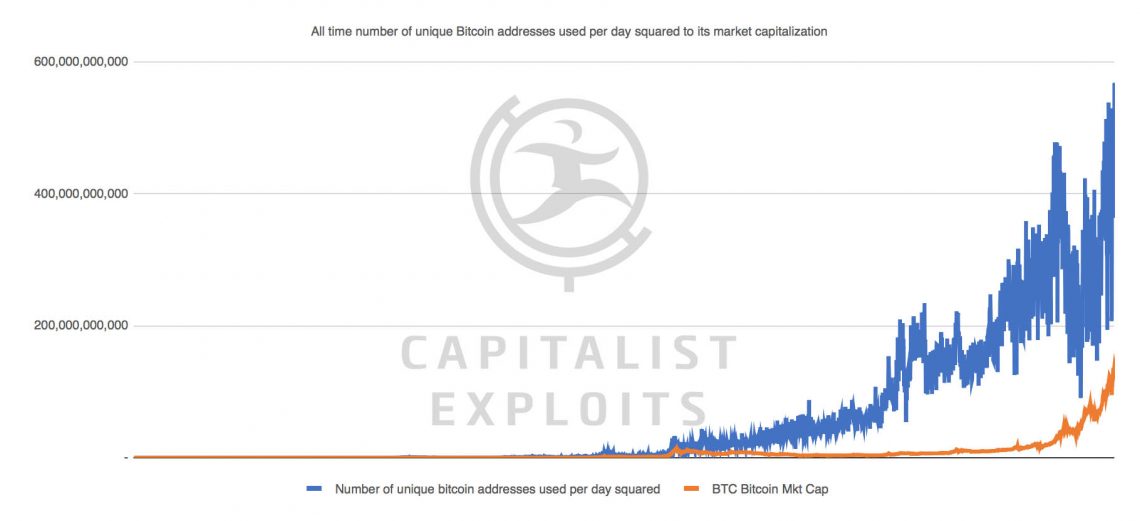
It was crazy to think that a bootstrapped currency maintained by literally anyone who cares to code for "core-dev" on something called Bitcoin could be utilised to transact value securely and efficiently all around the world. But here we are today.


Looks like a bubble right?


Of course, if you"re using your old search and retrieval system looking for that pear it does.


Let me show you something else.


Here"s another chart showing the relationship between the number of users and price. I prematurely nicked this from some work we"ve been doing here at Capitalist Exploits HQ.


By the way, if you"re on the mailing list, you"ll get access to what I promise you will be a very cool report as soon as we"re finished with it. To get on the mailing list just go here.


Bitcoin doesn"t fit into anything we"ve seen before, aside maybe from the Internet, and so nobody"s seen this before. And the easy thing to do is to compare it to something you"ve seen before.


I think that"s a mistake.


Now, before you run out and mortgage the house to start buying frantically remember this: 90% of the crypto coins being issued will almost certainly vaporise and become worthless, taking with them all the dreams and hopes of those who invested.


Peter Brandt pointed this out the other day and I replied.


Come what may this is, I believe, the future of money.


Right now, there are thousands of very sharp geeks worldwide who are building the infrastructure of a completely new financial system. Much of what they"re building and have already built requires looking at the box and thumbtacks — not the box of thumbtacks.


If only to educate yourself, I believe everyone should learn the ropes. Because picking the 10% that make it will be next to impossible if you don"t know where to start, and the odds are that the clutch of winners in this round will bring the world"s first trillionaire.


Right now, this space is still wide open.


I think it"ll be Bitcoin which acts as the final settlement ledger system for what will ultimately be millions of coins used for millions of applications, but I"m not so foolish to think I know the future. And so I"ll be keeping my beady eye on what takes place regardless.


Best of luck and thanks for reading. Have yourself a great weekend!


- Chris


“Bitcoin gives us, for the first time, a way for one Internet user to transfer a unique piece of digital property to another Internet user, such that the transfer is guaranteed to be safe and secure, everyone knows that the transfer has taken place, and nobody can challenge the legitimacy of the transfer. The consequences of this breakthrough are hard to overstate.” — Marc Andreesen, inventor of the first browser, thought leader, and top VC


--------------------------------------


Liked this article? Then you"ll probably like my other missives on


this topic as well. Go here to access them (free, of course).


-------------------------------------

Monday, November 20, 2017

Victoria"s Secret Staff Think The Chinese Are Spying On Them

Stories about the shambolic Victoria’s Secret fashion show – which is slated to take place Tuesday Nov. 28 in Shanghai – just keep getting weirder.


Chinese bureaucrats have so far refused to cooperate with the show’s producers and planners, denying visas to Gigi Hadid, one of the show’s highest-profile models, and Katy Perry, the US pop superstar who was slated to be the musical guest.


The Communist Party has also inexplicably refused to issue press passes and visas to members of the western media who were supposed to travel to China to cover the event.


Already, we imagine the marketing brass at L Brands have learned their lesson, and that this will be both the first, and the last, VS fashion show held in China.


But as if all this weren’t enough, the New York Post is now reporting that the show’s organizers believe the Chinese government is spying on them. Which, of course, is probably true, given Chinese authorities’ well-known penchant for monitoring foreigners.


The Post says e-mails of VS show staffers and production crew are apparently being monitored by Chinese authorities.


TV and media-industry insiders who are desperately trying to figure out what’s going on amid the production chaos are getting frustrated by messages from colleagues in China simply saying that they can’t speak frankly about the issues with the government because their communications are being watched.


Perry had her visa application declined because she once showed support for Taiwan (which is in an independence struggle with China) during a Beijing concert. Hadid’s was denied because of a picture her sister, Bella Hadid, published on Instagram that the Chinese public deemed offensive. Plus, fellow Angel Adriana Lima’s visa application has been imperiled by an unknown “diplomatic issue.” Meanwhile, a host of other models have also had their visas denied.


Many fashion bloggers have also been denied visas, and TV producers have discovered that they need permits to shoot outside of the Mercedes-Benz Arena, where the show, which is slated to air on CBS later this month, is set to take place.


As one source put it, “If you’re going to China you want to show that you’re in China!”


The surveillance is apparently making it difficult for the show’s organizers to find replacements for the models who have been denied entry. Harry Styles has already been booked to fill in for Perry.


“They want to discuss what’s going on as far as replacements for those denied visas and alternative arrangements, but they have to be tight-lipped because it seems that the government is watching their e-mails,” said a source.


With more than a week to go before the show, we can only imagine what fresh entanglements will crop up as the date draws nearer.


Sunday, November 19, 2017

ECB Proposes End To Deposit Protection

Submitted by GoldCore


It is the "opinion of the European Central Bank" that the deposit protection scheme is no longer necessary:


"covered deposits and claims under investor compensation schemes should be replaced by limited discretionary exemptions to be granted by the competent authority in order to retain a degree of flexibility."


To translate the legalese jargon of the ECB bureaucrats this could mean that the current €100,000 (£85,000) deposit level currently protected in the event of a bail-in may soon be no more. But worry not fellow savers, as the ECB is fully aware of the uproar this may cause so they have been kind enough to propose that:


"...during a transitional period, depositors should have access to an appropriate amount of their covered deposits to cover the cost of living within five working days of a request."


So that"s a relief, you"ll only need to wait five days for some "competent authority" to deem what is an "appropriate amount" of your own money for you to have access to in order eat, pay bills and get to work.


The above has been taken from an ECB paper published on 8 November 2017 entitled "on revisions to the Union crisis management framework".


It"s 58 pages long, the majority of which are proposed amendments to the Union crisis management framework and the current text of the Capital Requirements Directive (CRD).


It"s pretty boring reading but there are some key snippets which should be raising a few alarms. It is evidence that once again a central bank can keep manipulating situations well beyond the likes of monetary policy. It is also a lesson for savers to diversify their assets in order to reduce their exposure to counterparty risks.


Bail-ins, who are they for?


According to the May 2016 Financial Stability Review, the EU bail-in tool is "welcome" as it:


...contributes to reducing the burden on taxpayers when resolving large, systemic financial institutions and mitigates some of the moral hazard incentives associated with too-big-to-fail institutions.


As we have discussed in the past, we"re confused by the apparent separation between "taxpayer" and those who have put their hard-earned cash into the bank. After all, are they not taxpayers? This doesn"t matter, believes Matthew C.Klein in the FT who recently arguedthat "Bail-ins are theoretically preferable because they preserve market discipline without causing undue harm to innocent people."


Ultimately bail-ins are so central banks can keep their merry game of easy money and irresponsibility going. They have been sanctioned because rather than fix and learn from the mess of the bailouts nearly a decade ago, they have just decided to find an even bigger band-aid to patch up the system.


"Bailouts, by contrast, are unfair and inefficient. Governments tend to do them, however, out of misplaced concern about “preserving the system”. This stokes (justified) resentment that elites care about protecting their friends more than they care about helping regular people." - Matthew C. Klein


But what about the regular people who have placed their money in the bank, believing they"re safe from another financial crisis? Are they not "innocent" and deserving of protection?


When Klein wrote his latest on bail-ins, it was just over a week before the release of this latest ECB paper. With fairness to Klein at the time of his writing depositors with less than €100,000 in the bank were protected under the terms of the ECB covered deposit rules.


This still seemed absurd to us who thought it questionable that anyone"s money in the bank could suddenly be sanctioned for use to prop up an ailing institution. We have regularly pointed out that just because there is currently a protected level at which deposits will not be pilfered, this could change at any minute.


The latest proposed amendments suggest this is about to happen.


Why change the bail-in rules?


The ECB"s 58-page amendment proposal is tough going but it is about halfway through when you come across the suggestion that "covered deposits" no longer need to be protected. This is determined because the ECB is concerned about a run on the failing bank:


If the failure of a bank appears to be imminent, a substantial number of covered depositors might still withdraw their funds immediately in order to ensure uninterrupted access or because they have no faith in the guarantee scheme.


This could be particularly damning for big banks and cause a further crisis of confidence in the system:


Such a scenario is particularly likely for large banks, where the sheer amount of covered deposits might erode confidence in the capacity of the deposit guarantee scheme. In such a scenario, if the scope of the moratorium power does not include covered deposits, the moratorium might alert covered depositors of the strong possibility that the institution has a failing or likely to fail assessment.


Therefore, argue the ECB the current moratorium that protects deposits could be "counterproductive". (For the banks, obviously, not for the people whose money it really is:


The moratorium would therefore be counterproductive, causing a bank run instead of preventing it. Such an outcome could be detrimental to the bank’s orderly resolution, which could ultimately cause severe harm to creditors and significantly strain the deposit guarantee scheme. In addition, such an exemption could lead to a worse treatment for depositor funded banks, as the exemption needs to be factored in when determining the seriousness of the liquidity situation of the bank. Finally, any potential technical impediments may require further assessment.


The ECB instead proposes that "certain safeguards" be put in place to allow restricted access to deposits...for no more than five working days. But let"s see how long that lasts for.


Therefore, an exception for covered depositors from the application of the moratorium would cast serious doubts on the overall usefulness of the tool. Instead of mandating a general exemption, the BRRD should instead include certain safeguards to protect the rights of depositors, such as clear communication on when access will be regained and a restriction of the suspension to a maximum of five working days by avoiding a cumulative use by the competent authority and the resolution authority.


Even after a year of studying and reading bail-ins I am still horrified that something like this is deemed to be preferable and fairer to other solutions, namely fixing the banking system. The bureaucrats running the EU and ECB are still blind to the pain such proposals can cause and have caused.


Look to Italy for damage prevention


At the beginning of the month, we explained how the banking meltdown in Veneto Italy destroyed 200,000 savers and 40,000 businesses.


In that same article, we outlined how exposed Italians were to the banking system. Over €31 billion of sub-retail bonds have been sold to everyday savers, investors, and pensioners. It is these bonds that will be sucked into the sinkhole each time a bank goes under.


A 2015 IMF study found that the majority of Italy’s 15 largest banks a bank rescue would ‘imply bail-in of retail investors of subordinated debt’. Only two-thirds of potential bail-ins would affect senior bond-holders, i.e. those who are most likely to be institutional investors rather than pensioners with limited funds.


Why is this the case? As we have previously explained:


Bondholders are seen as creditors. The same type of creditor that EU rules state must take responsibility for a bank’s financial failure, rather than the taxpayer. This is a bail-in scenario.


In a bail-in scenario the type of junior bonds held by the retail investors in the street is the first to take the hit. When the world’s oldest bank Monte dei Paschi di Siena collapsed ordinary people (who also happen to be taxpayers) owned €5 billion ($5.5 billion) of subordinated debt. It vanished.


Despite the biggest bail-in in history occurring within the EU, few people have paid attention and protested against such measures. A bail-in is not unique to Italy, it is possible for all those living and banking within the EU.


Yet, so far there have been no protests. We"re not talking about protesting on the streets, we"re talking about protesting where it hurts - with your money.


As we have seen from the EU"s response to Brexit and Catalonia, officials could not give two hoots about the grievances of its citizens. So when it comes to banking there is little point in expressing disgust in the same way. Instead, investors must take stock and assess the best way for them to protect their savings from the tyranny of central bank policy.


To refresh your memory, the ECB is proposing that in the event of a bail-in it will give you an allowance from your own savings. An allowance it will control:


"...during a transitional period, depositors should have access to an appropriate amount of their covered deposits to cover the cost of living within five working days of a request."


Savers should be looking for means in which they can keep their money within instant reach and their reach only. At this point physical, allocated and segregated gold and silver comes to mind. This gives you outright legal ownership. There are no counterparties who can claim it is legally theirs (unlike with cash in the bank) or legislation that rules they get first dibs on it. Gold and silver are the financial insurance against bail-ins, political mismanagement, and overreaching government bodies. As each year goes by it becomes more pertinent than ever to protect yourself from such risks.


Friday, November 17, 2017

After Slamming Bitcoin As A Money Laundering Tool, JPMorgan Busted For Money Laundering

Score one for the poetic irony pages.


Two months after JPMorgan CEO Jamie Dimon lashed out at bitcoin, calling it a "fraud" which is "worse than tulip bulbs, warning it won"t end well", will "blow up" and "someone is going to get killed" and threatened that "any trader trading bitcoin" will be "fired for being stupid" as it was merely a tool for money-laundering, today Swiss daily Handelszeitung reported that the Swiss subsidiary of JPMorgan was sanctioned by the Swiss regulator, FINMA, over money laundering and "seriously violating supervision laws."


As the newspaper adds, the Swiss sanctions relate to breaches of due diligence in connection with money laundering standards. In other words, JPMorgan was actively aiding and abeting criminal money laundering.


The report further notes, the Finma decision was issued on June 30 and should have been published the following week but JPMorganm tried to prevent the publication of the judgment. More recently, the Federal Administrative Court dismissed the appeal.


In response to money-laundering violation, JPM said that in support of safety and soundness of global monetary system, “we have made and continue to make significant enhancements to the firm’s AML program to ensure we are meeting regulatory expectations,” according to an emailed statement sent to Bloomberg.


Unfortunately, JPMorgan also said that it can’t, or rather won"t, provide further details since the Finma resolution from June 2017 isn’t public.


This means that anyone wondering if Jamie Dimon"s bank was using (and thus trading) bitcoin to circumvent Swiss anti-money laundering regulations, will just have to ask Jamie Dimon in person during his next public appearance.  


Monday, November 13, 2017

The Truth About Wall Street Analysis

Authored by Lance Roberts via RealInvestmentAdvice.com,


Turn on financial television or pick up a financially related magazine or newspaper and you will hear, or read, about what an analyst from some major Wall Street brokerage has to say about the markets or a particular company. For the average person, and for most financial advisors, this information as taken as “fact” and is used as a basis for portfolio investment decisions.


But why wouldn’t you?


After all, Carl Gugasian of Dewey, Cheatham & Howe just rated Bianchi Corp. a “Strong Buy.” That rating is surely something that you can “take to the bank”, right?


Maybe not.


For many years, I have been counseling individuals to disregard mainstream analysts, Wall Street recommendations, and even MorningStar ratings, due to the inherent conflict of interest between the firms and their particular clientèle. Here is the point:


  • YOU, are NOT Wall Street’s client.

  • YOU are the CONSUMER of the products sold FOR Wall Street’s clients.

Major brokerage firms are big business. I mean REALLY big business. As in $1.5 Trillion a year in revenue big. The table below shows the annual revenue of 32 of the largest financial firms in the S&P 500.


(The combined revenue of the 32 largest firms last year was in excess of $1 Trillion with the revenue of the 97 financial firms in the S&P 500 bringing in $1.5 Trillion.)


As such, like all businesses, these companies are driven by the needs of increasing corporate profitability on an annual basis regardless of market conditions.


This is where the conflict of interest arises.


When it comes to Wall Street profitability the most lucrative transactions are not coming from servicing “Mom and Pop” retail clients trying to work their way towards retirement. Wall Street is not “invested” along with you, but rather “use you” to make income.


This is why “buy and hold” investment strategies are so widely promoted. As long as your dollars are invested the mutual funds, stocks, ETF’s, etc, brokerage firms collect fees regardless of what happens in the market. These strategies are certainly in their best interest – they are not necessarily in yours.


But those retail management fees are simply a sideline to the really big money.


Wall Street’s real clients are multi-million, and billion, dollar investment banking transactions, such as public offerings, mergers, acquisitions and bond offerings which generate hundreds of millions to billions of dollars in fees for Wall Street each year.


In order for a firm to “win” that business, Wall Street firms must cater to those prospective clients. In this respect, it is extremely difficult for the firm to gain investment banking business from a company they have a “sell” rating on. This is why “hold” is so widely used rather than “sell” as it does not disparage the end client. To see how prevalent the use of the “hold” rating is I have compiled a chart of 4625 stocks ranked by the number of “Buy”, “Hold” or “Sell.”


See the problem here. There are just 2.8% of all stocks with a “sell” rating.


Do you actually believe that out of 4625 stocks only 124 should be “sold?”


You shouldn’t.  But for Wall Street, a “sell” rating is simply not good for business.


The conflict doesn’t end just at Wall Street’s pocketbook. Companies depend on their stock prices rising as it is a huge part of executive compensation packages.


Corporations apply pressure on Wall Street firms, and their analysts, to ensure positive research reports on their companies with the threat that they will take their business to another “friendlier” firm.  This is also why up to 40% of corporate earnings reports are “fudged” to produce better outcomes.


Earnings Magic Exposed, an article written by Michael Lebowitz last year, provides details on the games played on Wall Street when it comes to forecasting corporate earnings. He summarized the article as follows:


Consider the ploy that companies and Wall Street are using to fool the investing public.


  • First, they grossly overestimate earnings for the upcoming year. By overestimating earnings, they tout financial ratios based upon inaccurate expected earnings and sell investors on a bright future. How many times have analysts claimed that forward looking price to earnings ratios are constructive for price gains? How “constructive” would they be if the expectations were reconciled to reality and lowered by 75%?

  • Second, they progressively lower expectations prior to the earnings release so that financial results are effectively underestimated. The same analysts that peddled double digit earnings growth a year earlier somehow can now claim that earnings are better than they expected.

If actual earnings varied somewhat randomly from above expectations to below expectations, we would likely fault the analysts and corporations with being poor forecasters. But when such one-directional forecasting errors routinely and consistently occur, it is more than bad forecasting. At best one can accuse Wall Street analysts and the companies that feed them information of incompetence. At worst this is another pure and simple case of institutions gaming the system through a fraud designed to prop up stock prices.  Take your pick, but in either case it is advisable to ignore the spin that accompanies earnings releases and apply the rigor of doing your own analysis to get at the veracity of corporate earnings.


Wall Street Needs You To Sell Product To


When Wall Street wants to do a stock offering for a new company they have to sell that stock to someone in order to provide their client, a company, with the funds they need. The Wall Street firm also makes a very nice commission from the transaction.


Generally, these publicly offered shares are sold to the firm’s biggest clients such as hedge funds, mutual funds, and other institutional clients. But where do those firms get their money? From you.


Whether it is the money you invested in your mutual funds, 401k plan, pension fund or insurance annuity – at the bottom of the money grabbing frenzy is you. Much like a pyramid scheme – all the players above you are making their money…from you.


In a study by Lawrence Brown, Andrew Call, Michael Clement and Nathan Sharp it is clear that Wall Street analysts are clearly not that interested in you. The study surveyed analysts from the major Wall Street firms to try and understand what went on behind closed doors when research reports were being put together. In an interview with the researchers John Reeves and Llan Moscovitz wrote:


“Countless studies have shown that the forecasts and stock recommendations of sell-side analysts are of questionable value to investors. As it turns out, Wall Street sell-side analysts aren’t primarily interested in making accurate stock picks and earnings forecasts. Despite the attention lavished on their forecasts and recommendations, predictive accuracy just isn’t their main job.”


The chart below is from the survey conducted by the researchers which shows the main factors that play into analysts compensation.  It is quite clear that what analysts are “paid” to do is quite different than what retail investors “think” they do.


“Sharp and Call told us that ordinary investors, who may be relying on analysts’ stock recommendations to make decisions, need to know that accuracy in these areas is ‘not a priority.’ One analyst told the researchers:


‘The part to me that’s shocking about the industry is that I came into the industry thinking [success] would be based on how well my stock picks do. But a lot of it ends up being “What are your broker votes?”‘


A ‘broker vote’ is an internal process whereby clients of the sell-side analysts’ firms assess the value of their research and decide which firms’ services they wish to buy. This process is crucial to analysts because good broker votes result in revenue for their firm. One analyst noted that broker votes ‘directly impact my compensation and directly impact the compensation of my firm."”


The question really becomes then “If the retail client is not the focus of the firm then who is?”  The survey table below clearly answers that question.


Not surprisingly you are at the bottom of the list. The incestuous relationship between companies, institutional clients, and Wall Street is the root cause of the ongoing problems within the financial system.  It is a closed loop that is portrayed to be a fair and functional system; however, in reality, it has become a “money grab” that has corrupted not only the system but the regulatory agencies that are supposed to oversee it.


Why You Need Independence


So, where can you go to get “real investment advice” and a true consideration of the value of YOUR money?


Thankfully, starting at the turn of the century, the rise of independent, fee-only, financial advisors, private investment analysts, research and rating firms began to infiltrate the system. 


Here is an example of the difference.


As an independent money manager, I use valuation analysis to determine what equities should be bought, sold or held in client’s portfolios. While there are many measures of valuation, two of my favorites are Price to Sales and the Piotroski f-score among others. I took the same 4625 stocks as above and ranked them by these two measures.


See the difference. Not surprisingly, there are far fewer “buy” rated, and far more “sell” rated, companies than what is suggested by Wall Street analysts.


Here is something even more alarming.


Just after the “dot.com” bust, I wrote a valuation article quoting Scott McNeely, who was the CEO of Sun Microsystems at the time. At its peak the stock was trading at 10x its sales. (Price-to-Sales ratio) In a Bloomberg interview Scott made the following point.


“At 10 times revenues, to give you a 10-year payback, I have to pay you 100% of revenues for 10 straight years in dividends. That assumes I can get that by my shareholders. That assumes I have zero cost of goods sold, which is very hard for a computer company. That assumes zero expenses, which is really hard with 39,000 employees.That assumes I pay no taxes, which is very hard. And that assumes you pay no taxes on your dividends, which is kind of illegal. And that assumes with zero R&D for the next 10 years, I can maintain the current revenue run rate. Now, having done that, would any of you like to buy my stock at $64? Do you realize how ridiculous those basic assumptions are? You don’t need any transparency. You don’t need any footnotes. What were you thinking?


How many of the following “Buy” rated companies do you currently own that are currently carrying price-to-sales valuations in excess of 10x?


So, what are you thinking?


As more and more “baby boomers” head into retirement the need for firms that can do organic research, analysis and make investment decisions free from “conflict,” and in the client’s best interest, will continue to be in high demand in the years to come.


This is particularly the case when the next downturn occurs and the dangers of passive ETF indexing and robo-advisors are readily exposed.


Independent advice can help remove those emotional biases from the investing process that lead to poor investment outcomes over time. There are a raft of advisors with the the right team, tools and data, who can spend the time necessary to manage portfolios, monitor trends, adjust allocations and protect capital through risk management.


The next time someone tells you that you can’t “risk manage” your portfolio and just have to “ride things out,” just remember, you don’t.


You, and your money, deserve better.