Showing posts with label Dumb Money. Show all posts

Friday, December 15, 2017

One Trader Reflects On A Bad Trade - The Never-Ending Grain Pain (And Whose Fault It Was)

Authored by Kevin Muir via The Macro Tourist blog,


I have had some bad trades in my day. But lately, one call has been especially atrocious.


For the past couple of years, I have taken stabs on the long side of the grain market. At different times, I have held various positions for different lengths of time, but make no mistake - grains have done nothing but cost me money. Sure, I might have a decent sounding argument, The Last Remaining Cheap Asset, but the market is indisputably telling me that I am dead wrong.


And it’s hard to sit and watch the grains go down. Day after day. Week after week. Month after month. Like the slow drip of a leaky faucet that no one can fix, it can drive you insane.


Have a look at the 5-year chart for front month Wheat.


Tough to make money writing any blue tickets with that sort of action. All rallies have been opportunities to sell, not the start of any sustainable uptrend.


This recent grain bear market has pushed the big three contracts (wheat, corn and soybeans) down to near all time lows when measured in real terms.


I don’t want to bother with another forecast about why this time will be different, and how the low will be made in the coming weeks. After a certain number posts, I begin to more closely resemble a degenerate gambler than a cool calculating macro trader (I think that number might be three, which means it’s too late for me, and I do in fact resemble Richard Dreyfuss a whole lot more than George Soros).


And although I poke fun at myself, it’s no laughing matter. The amount of economic pain in farming is downright scary. According to an article in The Guardian, Why are America’s farmers killing themselves in record numbers?, the stress from low grain prices is causing an epidemic amongst the agricultural community.


Once upon a time, I was a vegetable farmer in Arizona. And I, too, called Rosmann. I was depressed, unhappily married, a new mom, overwhelmed by the kind of large debt typical for a farm operation.


We were growing food, but couldn’t afford to buy it. We worked 80 hours a week, but we couldn’t afford to see a dentist, let alone a therapist. I remember panic when a late freeze threatened our crop, the constant fights about money, the way light swept across the walls on the days I could not force myself to get out of bed.


“Farming has always been a stressful occupation because many of the factors that affect agricultural production are largely beyond the control of the producers,” wrote Rosmann in the journal Behavioral Healthcare. “The emotional wellbeing of family farmers and ranchers is intimately intertwined with these changes.”


Last year, a study by the Centers for Disease Control and Prevention (CDC) found that people working in agriculture - including farmers, farm laborers, ranchers, fishers, and lumber harvesters - take their lives at a rate higher than any other occupation. The data suggested that the suicide rate for agricultural workers in 17 states was nearly five times higher compared with that in the general population.


After the study was released, Newsweek reported that the suicide death rate for farmers was more than double that of military veterans. This, however, could be an underestimate, as the data collected skipped several major agricultural states, including Iowa. Rosmann and other experts add that the farmer suicide rate might be higher, because an unknown number of farmers disguise their suicides as farm accidents.


The US farmer suicide crisis echoes a much larger farmer suicide crisis happening globally: an Australian farmer dies by suicide every four days; in the UK, one farmer a week takes his or her own life; in France, one farmer dies by suicide every two days; in India, more than 270,000 farmers have died by suicide since 1995.


The lightbulb


For the longest time, I had no idea why grain prices were so low. It perplexed me. Central Banks around the globe were printing money at an unprecedented pace. All else being equal, you would expect a real asset, like grains, to have rallied in these circumstances. Yeah sure the advances in farming technology might keep the price of grains pressured, but at the same time, demand has also never been higher, so you would expect the debasement of money to eventually win out and send grains prices skyward.


But more importantly, these situations are usually self correcting. Nothing solves the problem of oversupply like low prices. Except this time. Even with the state of farming littered with heartbreaking stories of ruined families, not enough farmers are giving up planting crops to allow the price to rise.


This conundrum would still be a mystery to me, if it wasn’t for one of my sharp readers, who sent me a note last week. It was actually a response to a post I made about Grandma’s Bond Portfolio is in Trouble, but Shaeffer Steward from Nesvick Trading Group, related it back to the grain market in such a unique original way, I felt it was too important not to share.


I suggest that while Kevin’s assessment for the economy in general might be eerily accurate, it is ENTIRELY BACKWARDS for agriculture.


Before you dismiss my hypothesis, hear me out.


I hypothesize that the farm economy is in dire circumstances (recall article I sent you the other day: https://www.dtnpf.com/agriculture/web/ag/news/article/2017/11/20/bankers-gearing-difficult?referrer=twitter#.WhLWFmNMPIE.twitter&DCMP=Todd )


Primarily because commodity prices skyrocketed during the 2004-2008 super-cycle triggered by the ethanol buildout combined with huge demand growth out of China and when the GFC occurred in 2007-2008, many sectors of the economy literally collapsed under their own weight but agriculture actually thrived because the QE provided the accelerant to keep things going. You see, agriculture did exactly what you would’ve expected - lower cost of money & greater availability of credit (greater supply) - commodity prices remained rather high so farmers levered up, borrowed money and banks were glad to loan it to them as many were using land as collateralization on loans and after all, the land values were based off of what people were willing to pay (rent) to farm it or what sort of return they needed to make it a worthwhile investment.


What we’ve seen happen is massive leveraging, steadily increasing cost of production (seed, chemical, fertilizer, equipment, insurance, land rents, etc) and now as prices come under pressure due to massive global oversupplies, margins have quickly collapsed and the cost structure hasn’t responded. Instead, farmers have levered up further by refinancing land and/or selling off some land to keep their bankers going along with them and the cycle has continued.


Why would the banks lend to farmers when they didn’t lend to normal citizens? Why would farmers be willing to borrow money when normal citizens weren’t willing to borrow money? Glad you asked.


CROP INSURANCE


Specifically, federally subsidized crop insurance.


Farmers take extraordinary risks doing what they do BUT they now have access (and have had access) to crop insurance that protects a portion of their historical production and/or projected revenue. When I say “a portion” I mean upwards of 75-85%. When I say “federally subsidized crop insurance” I mean that the federal govt pays upwards of 65% of the premium on behalf of the farmer on some crop insurance policies. WHOA.


Let me put figures to it for you. Imagine that you were a farmer and your history showed that your 5 year avg yield (actual production history) on your farm was 55 bu/ac and at planting time the insurance price for soybeans was $10.19/bu. Let’s say that it was going to cost you $550/ac to grow soybeans, so a breakeven type situation if you make ordinary yields at ordinary prices. Imagine that you could guarantee yourself $420.00/ac in revenue ($10.19/bu x 55 bu/ac = $560 bu/ac revenue x 75% coverage = $420 /ac) and it only cost you $3.70/ac. You’re paying $3.70/ac to guarantee yourself $420.00/ac in revenue. Pretty cheap, right? Yes, but the REAL cost of that insurance is more like $8.23/ac with the govt paying $4.53/ac and the farmer paying $3.70.


Granted, there are some situations in which you can lose more and some causes of loss, such as hail are not covered by basic crop insurance and require a separate policy but in the grand scheme of things, the cost of protecting 75% of revenue is reasonable enough that farmers buy it and banks make loans that they might not otherwise make sans crop insurance policies. There is also increased risks because the loss calculations are based on futures prices at planting and harvest time and do not address the cash markets which might have wide, unfavorable basis so it isn’t anywhere near a complete failsafe but enough to keep the borrowed money flowing.


Now we need to put it all together. The relatively “cheap” cost of subsidized crop insurance encourages the farmer to take risks he wouldn’t take otherwise. The balance sheet equity he has goes a lot further if you consider that he “really” only has $130/ac at risk instead of the full $550/ac so he’s willing to a) stay in the game and b) expand his acreage because if he hits a homerun on larger yields and/or higher prices, then JACKPOT!!. If it goes bad, he’s out $130/ac and it doesn’t completely wipe him out - plus he’s using the bank’s money at very low interest rates.


The farmer not only wants to stay in the game but he wants to grow so he’s bidding up inputs and more importantly land rents because if you don’t have the land, then you’re out of the game. Revenues continue to be good, in general so the farm cash flow has meat on the bone and where there is meat on the bone, the dogs come chewing. Seed costs are higher every year and sometimes much higher. Equipment costs have gone FREAKIN’ PARABOLIC. Land rents have skyrocketed. Since many farmers are self-insured, health insurance prices have… well you know what they’ve done. Much of this expansion has been done with debt financing on equipment meaning that while the interest rates are low, interest costs are accumulating. You see, there HAS been demand for debt from agriculture and the lenders have seen positive cash flows and the revenue safety net of crop insurance as courage to continue to lend to farmers.


Let’s take a detour for a moment here - banks have wanted to lend money but “conservatively” and if the average consumer really hasn’t had the appetite for borrowing money, that makes it a difficult task. If you’re a regional bank or small town bank and you can lend out money on 10-12 month agricultural operating notes to the tune of $500k-2.5 mil each isn’t it much easier to put $10-20 mil to work than if you were dealing with making retail loans for cars, houses, etc particularly since those loans are longer maturity loans? What if you could effectively put $20 mil out in annual operating loans with 12 month or less maturities at 4.5-5.5% via 25-30 loans PLUS the person borrowing it has 75% revenue protection bought via crop insurance as well as land & equipment collateralizing the notes at a time that equipment and land prices are zooming into the stratosphere?!?!?!?!?!


You see, the ag community kept growing and the appetite for debt was there from the start but encouraged by federally subsidized crop insurance. Lenders needed to put money to work and they found it too easy NOT to make large operating notes that renewed annually at decent interest rates to individuals/businesses that were a) looking at positive cash flows, b) partially protected by federally subsidized crop revenue protection in the form of crop insurance and c) collateralized by rapidly appreciating assets (equipment & land). Farmers get to expand, rural America gets a hand, bankers put money to work and everyone lives happily ever after…


Until commodity prices come under pressure because the supply side gets overstimulated, revenue side drops dramatically while the cost side remains sticky and then we get the massive transfer of equity from the farmer to a variety of beneficiaries including a) banks in the form of interest, b) landlords in the form of higher rent and higher asset(land) values, c) equipment companies in the form of inflated revenues due to inflated equipment prices, d) input providers in the form of higher prices for seed, chemical and fertilizer… all being transferred from the farmer’s balance sheet.


Then you add in the intangible side to the equation: what is the farmer going to do if he decides to quit because he doesn’t want to take all of these risks? If he decides NOT to farm because he sees what is happening in terms of greater and greater risks to his equity what is he going to do to put food on his table? If he doesn’t pay the extra $25/ac land rent to keep a neighbor from renting it out from under him he’ll lose the land and then what will he do? There are only so many jobs “in town” to get and rural America is drying up so what will he do? You see, here is the hard part. He made the decision to get in or stay in the rat race even when he knew that the numbers didn’t make sense because he didn’t see a viable “plan B” and there was a banker standing there able and willing to continue to give him more and more rope until he finally hanged himself when the mouse trap flipped on him.


THAT, fine sir, is where we are today in US agriculture.


I apologize that this turned out as lengthy as it did BUT I felt that it was a worthwhile exercise to put these thoughts into email and share them with you because you are a student of the markets and also because you will hopefully be joining us for our Commodity Roundtable in January so a better framing of the situation might help you understand the circumstances they are facing.


As a macroeconomist, how do we work out from under this situation? What is the roadmap for the US farmer? Higher commodity prices are a temporary fix as we’ve seen because as long as the money is available (available credit) and affordable (low interest rates) the inflationary explosion continues on the cost/input side of the equation. Currently we’re shrinking farmer balance sheets until banks won’t be able to lend to them any longer at which time the decisions will be made FOR the farmer not BY the farmer.


Brilliant! I mean, f’ng brilliant. Shaeffer completely nailed it. The government’s subsidies have created a situation where far too much credit has been extended to an industry. This has caused inflation in prices of the inputs that go into farming, but not the output.


Want another example? Have a look at Student Loans versus tuition inflation.


Tuition inflation has greatly outpaced regular CPI, but it has gone hand in hand with the growth of student debt. Over allocations of credit have peculiar effects on the pricing of both the inputs and the outputs of the affected area.


What to do about it?


Now I am not sure what to do about Shaeffer’s deduction. As long as subsidies exist, it seems that too much money will be allocated to agriculture loans, and will therefore, keep grain prices lower.


But here’s a thought. Over the past half dozen years, there has been little demand for loans in the regular economy. This has encouraged bankers to lend to farmers with their government backstop.


Yet what will happen if economic activity picks up? Loan demand across all sectors will increase, decreasing the amount of credit that will be extended to farmers. This will occur at a terrible time as grain prices are near rock bottom levels. Unfortunately, without as much credit, many of these farmers might be forced to quit. However, that will cause the price of the grains to rally. Maybe to a more sustainable level where farmers can once again make a living. Ironically, rising interest rates, might be the best thing for both farmers, and grain prices.


Wait! Did I just make another bullish argument for buying grains?


Yeah, yeah, I did. As Richard Dreyfuss taught me so well, let it ride…


Market On Close in December


What’s that famous Wall Street saying? The dumb money trades in the morning, the smart money trades at the close. Well, astute market watcher Helene Meisler recently highlighted that the Market on Close (MOC) imbalances have consistently been to the sell side lately.


In fact, every single day in December has seen MOC sell imbalances.


Institutions often trade at the close, while the public is more prone to trading closer to the open. There has even been an indicator created to measure this phenomenon.


If we look at the SMART Index, the late day selling shows up clearly with a big retreat from the highs.


So far, the stock market has not followed the SMART Index lower in any meaningful way. But don’t worry, I am sure this distribution by institutions is somehow bullish. After all, don’t you know? Stocks only go higher.


A Perfect Forecast


While I am on the topic of the stock market, earlier in the week Meb Faber noted that Barrons reported:


These strategists are usually bullish, so it’s not terribly surprising. But it does smack of another period when universal optimism also reigned. At the end of 2007, the S&P 500 stood at 1468 and Wall Street’s smartest had the following forecasts:


And where did it close? Down 38.5% to 903. Ooops. Just a little off.


Thanks for reading and have a great weekend,


Monday, December 11, 2017

A Gift From The Oldies

By Chris at www.CapitalistExploits.at


I bumped into a friendly bloke at my local gym last week. Jim is his name.


Jim tells me he just started because, and I quote, "my doctor says I"m going to die unless I do something".


Now, I assure you it doesn"t take a doctor to figure this out.


One glance in Jim"s direction and you can tell that underneath all that weight there"s a big struggling heart in there... just ready to explode. He was surprisingly frank and tells me it"s so bad that he can only do little bits of exercise because if he pushes it too hard, there is a very serious risk that his ticker just says, "You know what... f*ck it," and gives up.


Jim"s 52, which is really a ripe old age and about normal life expectancy — if we lived in the 1700"s. But we don"t.


I feel for Jim, told him so, and naturally we all hope that he can bring himself back from the brink. But the fact is many people aren"t like Jim. As mentioned in a previous article on pensions, they"re living longer and stronger.


Years ago it seemed that when you hit 65 you’d retire, receive a gold watch, and proceed to spend your pension money on a rocking chair and pot plants. Ten years later you’d be in a box and, since pot plants are cheap, the cost of keeping you alive wasn’t prohibitive.


Not anymore. Today things are different. My wife belongs to a running club and there are a bunch of octogenarians there who put us both to shame. Nope, today you retire and spend your pension on kickboxing classes and second wives, with no plan of dying anytime soon.


Now, this second group (our kickboxing oldies) pose a grave problem.


You see, unlike Jim, these folks, who’ve spent their life exercising, go on and on and on.


70 is spring chicken young for them, and many make it well into their 80"s and 90"s when inevitably they need nappies, nursing care, accommodation, and mushy food to eat. And then finally machines on wheels need to be wheeled in and they end up with tubes in their noses. Don"t laugh. We"re all going to get there, unless we"re fortunate enough to just drop dead quick and fast. The point is this all costs a boatload of money.


Now, I"m aware that this topic isn"t rosy Friday red or shampoo advert fresh and clean, but there are some serious implications that I think you"ll thank me for so hear me out.


Demographics and Pensions


Demographics is an elephant in the room we shouldn"t ignore. It"s stomped around, defecated in the corner, and is now proceeding to knock over all the furniture. Ignore it at your peril. Rather, there are a number of ways to invest.


Let"s explore a few...


Old people (Mabel and Bob) pay for their retirements with pensions, and those pensions are held in pooled accounts at the DTC and managed by folks with pointy shoes and Tom Ford suits.


And because old Mabel and Bob are closer to the box than younger folks, the pointy shoed gents are extremely risk averse (as they should be), and this is where it gets exciting because you know what?


They"re presently engaged in the worst possible leveraged speculation you can think of.


Nope, it"s not Bitcoin.


First, to understand the insanity we have to take a step back and examine how these pointy shoed gents think.


They like fixed income because it"s far less volatile and ostensibly less risky than equities.


They hate small caps and frankly can"t invest in them due to their size, and they have a disdain for commodity markets. That volatility thing again...


In fact, volatility is like a barometer in their world by which everything else is measured.


The problem is with central banks shatbit crazy interest rate policies none of them have been able to make any money in a yield starved world and so they"re, wait for it, selling volatility.


Either through tailor made products from the investment banks or by buying any number of the low volatility ETPs out there.


Volatility isn"t even an asset.


In fact, the VIX is an index of volatility on 1 month to expiry ATM puts and calls on stocks in the S&P 500.


But now the geniuses on Wall Street have figured that they can actually package this animal, which as you can see, is a derivative of a derivative, and treat it like a bond. Fun, heh?


In all fairness, hats off to the asset managers who"ve had the balls to do this. They believed in the central banks" liquidity machine, and they backed their belief and for that they deserve to be paid. I sure wouldn"t have been able to do it.


Now, I"m not some miserable jealous git here to tell you that armageddon is coming and I"ve the answers.


God knows there"s enough of that nonsense in the financial publishing blogosphere for you to get your fill elsewhere. What we do know, however, is that this entire game: the selling of vol, the passive indexing — all of it is predicated on one thing. The central banks keeping rates low and pumping liquidity into the market. It"s why BTFD has become a meme.


The problem that I have with it, other than the distortions made, is that when so many are on one side of the boat like right now and that boat has many moving pieces, then I begin to wonder.


I"m reminded that markets change at the margin, where the slightest hiccup can act like a spark to light the fire of volatility, and these poor suckers who"ve managed to earn steady incomes selling puts find out what "unlimited risk" actually looks like as they"re forced to cover in a market that"s gapping the other way.


I"ve thought about this a lot and, in fact, we recently published how we are going "long vol" for members. And no, it"s not buying puts on VIX because that is, in my humble opinion... how do I say this politely, like begging to be stabbed in the eyes. repeatedly.


In any event that"s just one angle to this market. Here"s another.


Redemptions


I would be remiss in mentioning that as retirees retire, these pension funds will be drawn down.


It"s what Mabel and Bob do to pay for their mushy food, viagra, and bingo nights.


Now, I"m sure you"re all sharp enough to figure out what can happen to the assets these guys have been buying when they have to go from flat out full throttle, to stall, to reverse.


How big is this problem?


Well, for some context global institutional pension fund assets in 22 major markets stood at US$36.4 trillion at year end 2016, amounting to 62% of global GDP.


That is a staggeringly large amount of money.


Pension funds are big cumbersome dumb money. And they"re all allocated in equally dumb indexes, passive strategies, and bonds. So what happens when pensioners draw down on their funds?


You tell me...


Talking of staggeringly large amounts of money, the passive bubble grows bigger as I write this because this beast is fuelled not just by our pointy shoed friends but by Joe Sixpack himself.


Bloomberg just ran a piece:


BlackRock and Vanguard Are Less Than a Decade Away From Managing $20 Trillion


Two towers of power are dominating the future of investing.

Dominating indeed. Here"s how come the pointy shoed crowd can afford Tom Ford suits.


The article goes on to say:


Investors from individuals to large institutions such as pension and hedge funds have flocked to this duo, won over in part by their low-cost funds and breadth of offerings. The proliferation of exchange-traded funds is also supercharging these firms and will likely continue to do so.


Sometimes when everyone is zigging and you zag, you just get run over. But think about it...


We don"t need to go the other way. All we need to do is look where others are no longer.


These behemoths don"t do battle in the little unloved sectors or with stocks that don"t make it into an index. They can"t because they"re too big.


This means that there are a lot of orphans out there and here"s the good news. If it"s not in an index, passives aren"t buying it. And if passives aren"t buying it, it"s only active money that"s even looking at it.


Which brings me to the double helping of good news.


Here"s your competition in active with the accompanying passive.


Right now, it"s a mosh pit food fight to grab and create the next index or ETF so that more capital can be attracted, earning more fees, buying more suits.


This is all well and good.


Markets do what markets do, and I"m not here to grumble about it. I"m here to make money. And indeed if I was in the passive business, I"d be enjoying the steady stream of fees and hoping like hell the market keeps going up.


QE more? Yes, please.


But I"m not.


I"m a humble squirrel searching for nuts in the forest. And gosh, with all this moshing going on it"s wonderful how few other squirrels there are about. The same Bloomberg article makes a good point on this.


While bigger may be better for the fund giants, passive funds may be blurring the inherent value of securities, implied in a company’s earnings or cash flow.


Nah. You think?


Stocks in the index funds no longer trade on fundamentals but rather on asset flows, which sucks the oxygen out of the small guys who don"t make it into the indexes where brain dead passive money is playing.


It means we can gladly play in a sandpit with all the toys and there are very few we have to share them with.


The Cracks Have Already Appeared


Nothing lasts forever, and as I argued when discussing the impact of the incoming strong men on the global economy, there are 3 critical points worth thinking about:


  1. Political cohesion and stability can no longer be relied upon as politics becomes inward looking with everything from trade deals to central bank swap lines being renegotiated or cancelled altogether.

  2. Global coordinated central bank action. The era of global coordinated monetary policy which we’ve been experiencing since the GFC, especially with the three largest players (ECB, FED and BOJ), will be looked back upon with nostalgia by the current clutch of central bankers who muddy the halls of power. Policy will increasingly be driven with greater sensitivity to nationalist rather than international concerns, which brings me to…

  3. Liquidity in the financial system which has stemmed from easing monetary policy is already contracting. In a world where derivatives traverse borders, connecting financial systems like never before, a liquidity crisis presents enormous tail risk in a leveraged world.


Invest accordingly, and thank you for reading.


- Chris


“If you can’t take a small loss, sooner or later you will take the mother of all losses.” — Ed Seykota


--------------------------------------


Liked this article? Then you"ll probably like my other missives on


this topic as well. Go here to access them (free, of course).


-------------------------------------

Monday, November 27, 2017

The Dumbest Dumb Money Finally Gets Suckered In

Authored by John Rubino via DollarCollapse.com,


Corporate share repurchases have turned out to be a great mechanism for converting Federal Reserve easing into higher consumer spending. Just allow public companies to borrow really cheaply and one of the things they do with the resulting found money is repurchase their stock. This pushes up equity prices, making investors feel richer and more willing to splurge on the kinds of frivolous stuff (new cars, big houses, extravagant vacations) that produce rising GDP numbers.


For politicians and their bureaucrats this is a win-win. But for the rest of us it’s not, since the debts corporations take on to buy their own stock at market peaks tend to hobble them going forward, leading eventually to bigger share price declines than would otherwise be the case.


The ultimate loser? The only people traditionally willing to buy in after corporations are finished overpaying for their stock: Retail investors, of course.


Let’s see how it’s playing out this time.


First, corporations spent several years elevating stock prices with share repurchases. Note the near perfect correlation between the two lines:


Now they’re scaling back their purchases:


Saying Bye to Buybacks


(Wall Street Journal) – Companies in the S&P 500 are on pace to spend the least on buybacks since 2012


Large companies are repurchasing their shares at the slowest pace in five years, as record U.S. stock indexes and an expanding economy propel more money out of flush corporate coffers into capital spending and mergers.


Companies in the S&P 500 are on pace to spend $500 billion this year on share buybacks, or about $125 billion a quarter, according to data from INTL FCStone. That is the least since 2012 and down from a quarterly average of $142 billion between 2014 and 2016.


Buyback activity among top-rated nonfinancial debt issuers, many of which have regularly borrowed money to finance share repurchases, declined for the third straight quarter in the July-to-September period, according to Bank of America Merrill Lynch. Meanwhile, mergers and acquisitions among that group of companies had their biggest quarter of the year, analysts at the bank said.


Factors including high stock price, historically high share valuations and uncertainty over the future shape of the tax code mean that “companies may be less likely to favor buybacks over other uses of cash in 2018,” analysts at Goldman Sachs Group Inc. said in a report this week.


And – here’s the really sad part – individual investors are taking up the slack:


The emboldened retail investor may be a new catalyst to help take stocks higher — for now.


(CNBC) – “The level of enthusiasm about the market … has been building. We’re seeing more individuals come in,” said Liz Ann Sonders, chief investment strategist at Charles Schwab.


Sonders said she’s anecdotally seeing signs of more individuals putting money to work in the stock market in the last several months, after years of skepticism and concerns about “every variety of doom and gloom.”


She says she is getting fewer investors asking about bubbles or about what’s the next shoe to drop.


“I think it’s finally starting to suck people in … emotionally, and actually it’s hard to judge why now all of a sudden, but maybe it’s because of how persistent the move has been with so little volatility on the upside and on the downside,” Sonders said. “This year has been different. This kind of year pulls people in.”


Retail brokers have been reporting an influx of accounts. Charles Schwab, in its earnings release, said clients opened more than 100,000 new brokerage accounts a month in the third quarter, making for a record-breaking 10-month streak of new accounts topping 100,000. Its rival, TD Ameritrade, said on its earnings call last month that new accounts, asset inflows and other indicators are at the highest since the financial crisis.


What’s frustrating about this is the repeating pattern of government creating conditions in which smart money (that is, the guys who donate big to political campaigns) is allowed to get in early, make huge profits, and then hand the bag to regular people who aren’t connected or sophisticated enough to see what’s happening. The rich, who are or will soon be shorting the hell out of this market, get richer and the rest see their hopes for a decent (or any) retirement dashed one more time.


And the political class wonders why voters don’t like them anymore.


Friday, November 10, 2017

Sweet melt up potential here says Joe Friday


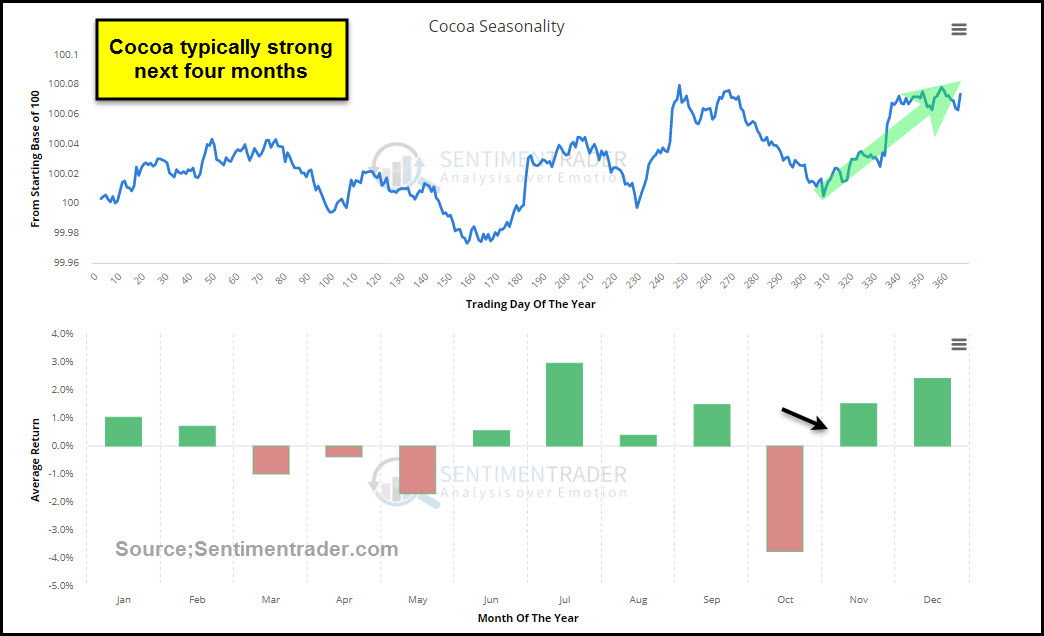
Tis the season for Chocolate (Cocoa) to do well, will it repeat its historical pattern again this year?


Below looks at the seasonal pattern of Cocoa from Sentimentrader


CLICK ON CHART TO ENLARGE


Going into this period of seasonal strength, Cocoa bulls of late are hard to find and dumb money traders have established one of the largest short positions in this commodity in years. The triple combo could make the price action of this commodity very interesting going forward.


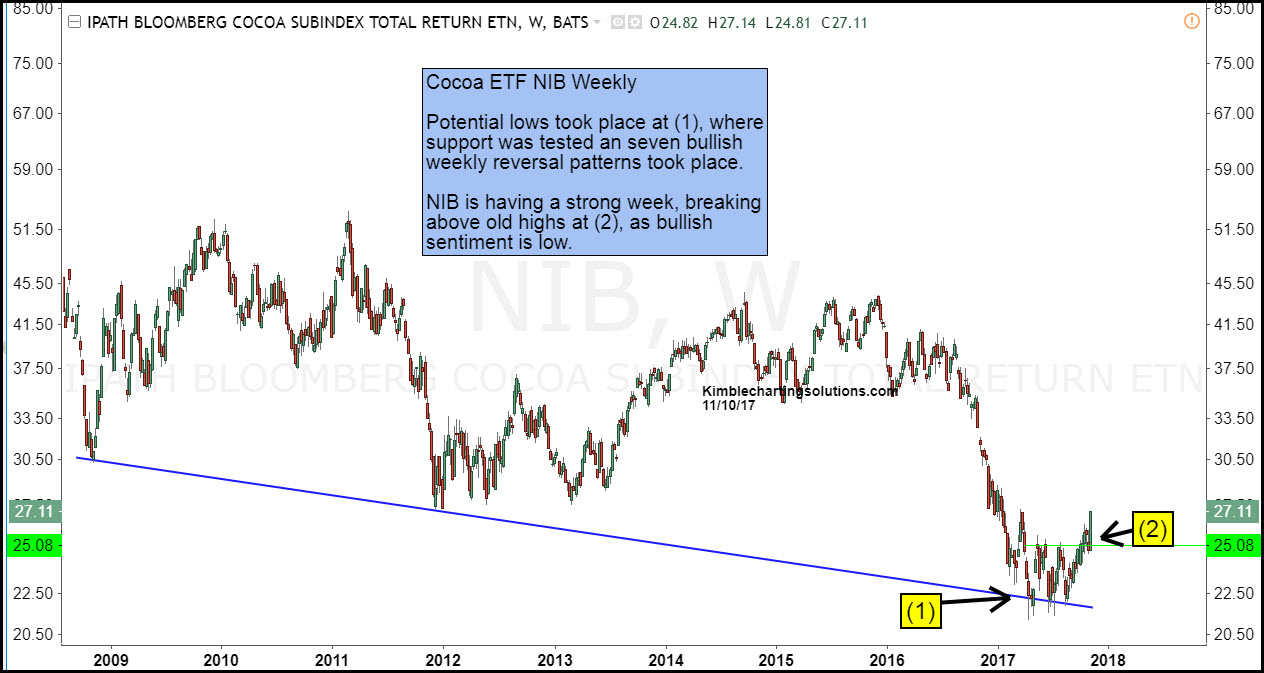
This commodity can be played in the futures markets or two different ETF’s (NIB & CHOC). Below looks at NIB


CLICK ON CHART TO ENLARGE


Cocoa ETF NIB could have built a base at, where seven different bullish wicks (reversal wicks) took place just above 10-year support at (1). Of late NIB has been moving higher and this week looks to be breaking above highs hit earlier this week at (2).


A nice combo of pattern, sentiment and traders positions is in play in this asset that is down nearly 50% in the past couple of years.


Some perspective- since the first of this month, NIB has gained over 7%, which is nearly half of what the S&P has done year-to-date.


Full disclosure Premium and Sector members have been long NIB since the end of October. If you would like to become aware of these type of pattern and sentiment setups, we would be honored if you were a member.


Why you see chart pattern analysis with brief commentary:   There is a ton of news and opinions about markets and stocks that make the decision-making process more difficult than it needs to be.   


I believe the Power of the chart Pattern provides all you need to see what is taking place in an asset and determine the action to take. 


This approach has worked well for me and our clients and I encourage you to test it for yourself.


Receive my free research posted on the blog daily here 


Or,  send an email if you would like to see sample research and take me up on a trial of my premium or weekly research where I provide actionable alerts on breakouts and reversals in broad market indices, sectors, commodities, the miners and select individual stocks 


Email services@kimblechartingsolutions.com  


Call us Toll free 877-721-7217 international 714-941-9381 


Website: KIMBLECHARTINGSOLUTIONS.COM 


follow on Twitter 


See our latest webinar


Tuesday, October 10, 2017

Extremes Are Everywhere

Authored by Lance Roberts via RealInvestmentAdvice.com,


This past weekend, I discussed what appears to be the markets ongoing melt-up toward its inevitable conclusion. Of course, that move is supported by the last of the “holdouts” that finally capitulate and take the plunge back into a market that “can seemingly never go down.” But therein lies the danger. To wit:


“However, it should be noted that despite the ‘hope’ of fiscal support for the markets, longer-term conditions are currently present that have led to rather sharp market reversions in the past.”


“Regardless, the market is currently ignoring such realities as the belief ‘this time is different’ has become overwhelming pervasive.”


The other problem on a short-term basis is the market is pushing very elevated levels currently. As shown below, with RSI (14) now above 70, the market 3-standard deviations above the 50-dma, and the MACD over 13, in both previous cases over the last year a short-term reversal followed.


A similar outcome would not be surprising this time either, so some caution is advised.


Positioning Review


The COT (Commitment Of Traders) data, which is exceptionally important, is the sole source of the actual holdings of the three key commodity-trading groups, namely:


  • Commercial Traders: this group consists of traders that use futures contracts for hedging purposes and whose positions exceed the reporting levels of the CFTC. These traders are usually involved with the production and/or processing of the underlying commodity.

  • Non-Commercial Traders: this group consists of traders that don’t use futures contracts for hedging and whose positions exceed the CFTC reporting levels. They are typically large traders such as clearinghouses, futures commission merchants, foreign brokers, etc.

  • Small Traders: the positions of these traders do not exceed the CFTC reporting levels, and as the name implies, these are usually small traders.

The data we are interested in is the second group of Non-Commercial Traders.


This is the group that speculates on where they believe the market is headed. While you would expect these individuals to be “smarter” than retail investors, we find they are just as subject to human fallacy and “herd mentality” as everyone else.


Therefore, as shown in the series of charts below, we can take a look at their current net positioning (long contracts minus short contracts) to gauge excessive bullishness or bearishness. With the exception of the 10-Year Treasury which I have compared to interest rates, the others have been compared to the S&P 500.


Volatility Extreme


The extreme net-short positioning on the volatility index suggests there will be a rapid unwinding of positions given the right catalyst. As you will note, reversals of net-short VIX positioning has previously resulted in short to intermediate-term declines. With the largest short-positioning in volatility on record, the rush to unwind that positioning could lead to a much sharper pickup in volatility than most investors can currently imagine.


Crude Oil Extreme


The recent attempt by crude oil to get back to $50/bbl coincided with a “mad rush” by traders to be long the commodity. For investors, it is also worth noting that crude oil positioning is also highly correlated to overall movements of the S&P 500 index. With crude traders currently extremely “long,” a reversal will likely coincide with both a reversal in the S&P 500 and oil prices being pushed back towards $40/bbl. 


While oil prices could certainly fall below $40/bbl for a variety of reasons, the recent bottoming of oil prices around that level will provide some support. Given the extreme long positioning on oil, a reversion of that trade will likely coincide with a “risk off” move in the energy sector specifically. If you are overweighted energy currently, the data suggests a rebalancing of the risk is likely advisable.


US Dollar Extreme


Recent weakness in the dollar has been used as a rallying call for the bulls. However, a reversal of US Dollar positioning has been extremely sharp and has led to a net-short position.


As shown above, and below, such negative net-short positions have generally marked both a short to intermediate-term low for the dollar as well as struggles for the S&P 500 as a stronger dollar begins to weigh on exports and earnings estimates.


Interest Rate Extreme


One of the biggest conundrums for the financial market “experts” is why interest rates fail to rise. Apparently, traders in the bond market failed to get the “memo.” With the net positioning in bonds at some of the highest levels since the financial crisis, there is little reason to believe the “bond bull” market is over. Look for a reversal of the current positioning to push bond yields lower over the next few months.


It is also worth watching the net-short positioning the Euro-dollar as well which has also begun to reverse in recent weeks. Historically, the reversal of the net-short to net-long positioning on the Eurodollar has often been reflected in struggling financial markets.


Smart Vs. Dumb Money Extreme


While we have been looking at solely the large non-commercial traders above, they are not the only ones playing in the future markets. We can also dig down into the overall net exposure of retail investors (considered the “dumb money”) versus that of the major institutional players (“smart money”)


The first chart below shows the 3-month moving average of both smart and dumb-money players as compared to the S&P 500 index. With dumb-money running close to the highest levels on record, it has generally led to outcomes that have not been favorable in the short-term.


We can simplify the index above by taking the net-difference between the two measures. Not surprisingly, the message remains the same. With the confidence of retail investors running near historic peaks, outcomes have been less favorable.


None of this analysis suggests that a market “crash” is about to occur tomorrow. However, with complacency high, and investors scrambling to find excuses why markets can only go higher, suggests that extremes in positioning have likely been reached. 


This was a point made by Macquarie’s Viktor Shvetz, the bank’s head of global equity strategy, yesterday:


Investors seem to be residing in a world without any notable perceived risks. It is an extraordinary and unprecedented situation, particularly given unresolved issues of over-leveraging and associated over-capacity as well as profound disruption of business and economic models, which are not just depressing inflation but also causing extreme political and electoral outcomes while feeding Maslowian-type disappointments across labor markets.


What can explain such lack of concern regarding potential risks?


In our view, the only answer is one of investors’ perception that, as we discussed in our preview of 2H’17, ‘slaves must remain slaves’ and hence, neither Central Banks nor other public institutions can afford to step aside but need to continue to guarantee asset price inflation. In its turn, this can only be achieved by ensuring that volatilities are contained (as they are the deadliest enemy of an ongoing leveraging) and liquidity is expanding at a sufficient pace to accommodate nominal demand.


We remain constructive on financial assets (both equities and bonds), not because we expect a return to self-sustaining private sector-led recovery and growth but because we believe that an ongoing financialization is the only politically and socially acceptable answer.


In our view, therefore, the greatest risk is one of policy.”


The complete disregard for “risk” has never worked out well for investors in the past and is unlikely to be different this time either. But remember, in the short-term, the markets can remain irrational longer than logic would predict and they always “feel” their best at the peak.

Human Traders Are Trouncing The Machines

The contemporary low volatility trading environment has been kind to actively managed equity funds - particularly if they piled into large-cap momentum stocks like Facebook and Amazon, which have been responsible for the bulk of this year’s rally.


But while active managers have enjoyed three quarters of strong returns, quant funds – purportedly the future of asset management, according to many an “expert” on Wall Street – are falling further and further behind. As Bloomberg reports, during the first nine months of 2017, the average equity fund was up 9.7 percent while quant funds rose only 0.6 percent, according to data from Hedge Fund Research.


The striking reversal has validated the views of the handful of quant-fund skeptics on Wall Street, many of whom were previously branded as “luddites” for questioning the inherent superiority of algorithm-driven investment strategies. Quant funds, as we are learning, don’t function well in a low volatility environment because there are fewer opportunities to exploit small disparities in price.


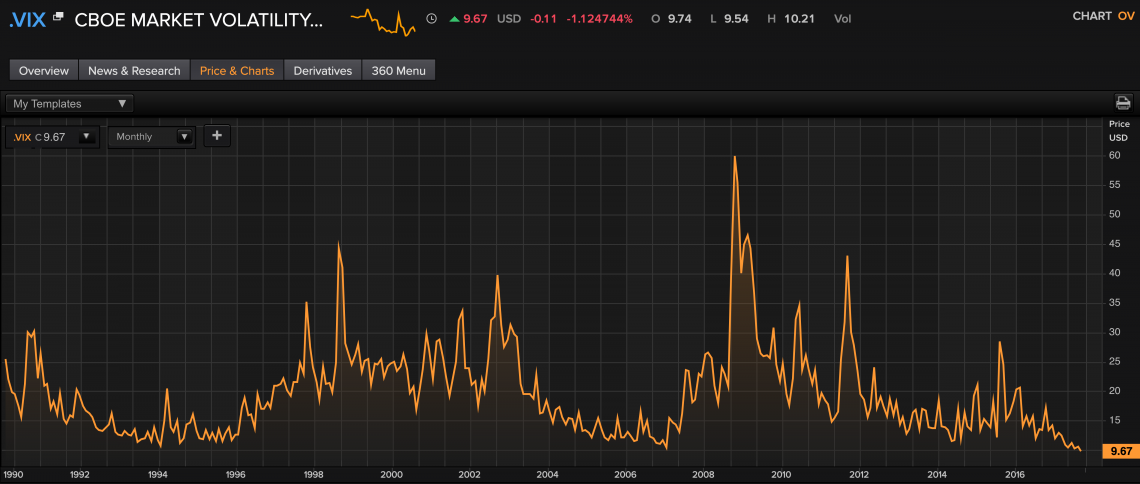
The environment that lifts stock pickers - steady markets that enable their long-term trades - is not so friendly to quants. They do best in periods of volatility and dispersion, when their algorithms can find small price disparities to exploit. But the U.S. stock market has been unusually tranquil since last year’s presidential race. At an average level of 11.6 since Election Day, the CBOE Volatility Index has hovered about 40 percent below its lifetime average.


“To a certain extent they are lowly correlated," Tim Ng, chief investment officer of Clearbrook Global Advisors, said of the two strategies. “The factors that drive positive returns in each are different, so what helps one doesn’t necessarily help another.” His firm invests in hedge funds.


Despite their recent underperformance, quant funds have continued to receive the bulk of hedge fund inflows. Last year, total hedge fund assets AUM dropped for the first time in years as investors pulled money from actively managed funds and reallocated to both passive and quantitative strategies.


Still, both quant funds and traditional discretionary managers have on average continued to underperform the S&P 500.


Equity funds betting on technology have posted some of the biggest gains in the first three quarters. Light Street Capital Management’s Halogen fund, which focuses on technology, media and telecommunications stocks, soared 44 percent, said a person familiar with the matter. The flagship fund at Philippe Laffont’s tech-focused Coatue Management jumped almost 24 percent, according to an investor letter seen by Bloomberg News.


Computer-driven funds struggled to keep pace in the period. BlueTrend, the main fund at Leda Braga’s Systematica Investments, dropped almost 7 percent, another person said. The Diversified fund at $6.6 billion Aspect Capital fell 4.7 percent, according to an investor letter seen by Bloomberg News. Winton Group’s Futures fund is about flat on the year, according to a person with knowledge of the returns.


While the hedge fund industry’s overall performance is improving, it still lags behind the S&P 500 Index, which was up 14.2 percent with reinvested dividends this year through September. Funds across all strategies on average returned 4.3 percent on an asset-weighted basis in the period, compared with 0.7 percent in the first nine months of last year, according to Hedge Fund Research.


As we noted above, funds focusing on tech stocks have posted some of this year"s biggest gains:


Equity funds betting on technology have posted some of the biggest gains in the first three quarters. Light Street Capital Management’s Halogen fund, which focuses on technology, media and telecommunications stocks, soared 44 percent, said a person familiar with the matter. The flagship fund at Philippe Laffont’s tech-focused Coatue Management jumped almost 24 percent, according to an investor letter seen by Bloomberg News.


And to be sure, not all quant funds have had a bad year. Bloomberg managed to find one that’s up 53%.


Not all quants have had a bad year. The QIM Tactical Aggressive Fund gained 53 percent in the first nine months, according to a letter seen by Bloomberg. Nor have all traditional stock pickers done well. Crispin Odey, who is known for his bearish bets, saw his European equity fund sink 14 percent this year through Sept. 15 in its U.S. dollar share class.


* * *


After Eagle’s View Asset Management, a $500 million fund-of-funds that invests with 30 managers, half of them quants, recorded its worst monthly performance ever in June, the fund’s manager Neal Berger penned a letter to clients explaining why quant strategies have broken down over the past year.


It comes down to two factors, he said:


1.Increased competition: more investors are using algorithms to fight over the same inefficiencies in the market.


“Now every bank has a factor model,” said Benjamin Dunn, president of the portfolio consulting practice at Alpha Theory LLC, which works with managers overseeing about $200 billion.


“You’ve had a democratization of a lot of data and analytics that were once the domain of very systematic quant investors. Everything is getting arbitraged away.”


2. Low volatility: quantitative funds are most successful in an environment where there is large disagreements in the market over the prices of assets. Today there is little disagreement, and the best way to earn outsized returns is placed highly leveraged bets that the market will remain calm. That"s working for some investors, but is far too risky for others.


In fact, the persistently low level of volatility has brought out an increasing number of hedge funds strategies oriented toward regularly selling volatility. Although we believe that this is "picking up nickels in front of a bulldozer", shockingly, these Funds have been some of the best performing strategies over the past years.


Although our guess is as good as anyone"s, we believe the shockingly low levels of volatility has to do with an increase in computer driven, quantitative trading coupled with banks selling options to offer "yield enhancement" structured products to investors who are starving for this yield.


This feedback loop, the increase in assets run by hedge funds, and, the rise of quants, has created unusual patterns, dislocations, and low levels of volatility.


While those simply following the broader market indices wouldn"t realize anything is amiss, it is our belief that these factors have created a challenging mix for trading oriented strategies. It won"t last forever, but, it could last longer than we can.


Additionally, he explains, systematic strategies require an endless supply of victims to thrive, and the growth of quant and passive funds has caused dumb money to behave unpredictably or disappear altogether.


With all the geniuses in quant, high-powered computers, and enormous data, where are the "suckers" who are providing the juice for all of these absolute return quantitative strategies?


Simply put, the "edge providers" have moved aggressively into passive index funds and broader market ETFs.


As such, we have a condition amongst the traditional quantitative strategies whereby we have robots trading against robots. Without a steady source of "edge providers", these "edge demanders" are just trading money back and forth with each other.


We believe increased quantitative trading coupled with passive indexation by retail, and, low levels of realized and implied volatility may be creating a feedback loop that has caused unusual price movements in a variety of securities that have challenged trading oriented strategies.


Of course, all of this could change shortly as market strategists like Bank of America’s Michael Hartnett warn that a sharp selloff could be in store for the fourth quarter. Investors have upped their bullish bets through S&P 500 calls, buying more S&P 500 delta over the past two weeks than at any point since 2007.


In summarizing the contemporary market, Hartnett explains that the "best reason to be bearish in Q4 is there is no reason to be bearish.”


Complacent active managers ought to keep this in mind.

Thursday, September 28, 2017

Warning: Danger Lurks Here

By Chris at www.CapitalistExploits.at


Take a look at the volume of stocks listed vs. indexes listed going all the way back to the days of bellbottoms, loud hair, and orange wallpaper.


Since 1995, the supply of stocks, particularly in the US, has been shrinking faster than Trump"s approval ratings. At the same time, the number of indexes have exploded like one of Kim"s shiny new missiles.


Why?


In a falling interest rate environment, the twin pressures of reduced returns and relative cost pressures have meant that investors, in order to make a buck, have flooded into the low fee structures offered by passive strategies. These include indexing, ETFs, and those truly insane creatures I"ve written about before: low volatility ETFs.


But what about those alpha generating hedge funds? Aren"t they meant to be smart and able to beat the market... any market?


Those alpha generating hedge funds have things called LPs. And though LPs may be smarter, and certainly wealthier than Joe Sixpack, they"re no less human. And human attention span and patience level has been in decline... correlated no doubt with the rise of social media and the Kardashian crowd. Like a virus, it infects everything.


As performance from hedge funds has been poor relative to the benchmarks, a self reinforcing situation where hedge funds, in order to ensure LPs don"t redeem, have landed up hugging the indexes.


This is the exact opposite of what hedge funds were meant to do, of course. In many cases, they themselves are simply buying the indexes, trying desperately to figure out how the hell they"re going to survive through the next quarter but determined simply NOT to underperform the index. It"s a losing strategy no matter how you slice and dice it.


For those hedge funds who refuse to chase the indexes... Well, they are now fighting the tidal wave of capital that has been shifting into passive investments, which forces those passive investments even higher.


This, in turn, leaves active hedge funds who refuse to get sucked in with increasingly substandard returns. They can explain until they"re blue in the face why certain indexes make no sense but when those indexes just keep rising day after day, month after month, it becomes a very tough stance to keep. Redemptions follow, and so by doing the right thing, they"re punished. And by doing the wrong thing (following the mob), they may get to stay alive just a little longer and this is what many have resorted to.


We all know that at some point there are no new buyers available to enter the market and hoo boy, do we then have a problem.


So... you either join the party or you leave the party.


The last to leave the party is Hugh Hendry and his baby Eclectica.


Hugh Hendry Murders His Hedge Fund


Og aye, tis tae tough


Hugh follows Eton Park and Perry Capital to name but a few more.


Paul Singer of Elliot Management fame put it well in his July investor letter to stakeholders.


"In a passive investing world, small shareholders have little-to-no voice and no realistic possibility of banding together, while the biggest shareholders have no (repeat, no) skin in the game so long as the money manager does not underperform the index."


Make no mistake, the rise of passive indexing is a bubble in dumb money.


We have a situation where the market is becoming completely lopsided and increasingly so at a blistering pace.


If it gets anymore lopsided, it"s going to be upside down. What"s more, the market participants have no interest or even determination of valuations.


An index doesn"t give an isht what the P/E ratio of any stock included in the index is, and the investors buying it have even less idea. It doesn"t care if the aggregate of stocks sitting inside its womb are over or indeed undervalued. It"s just a dumb bloody index, and you can"t blame it anymore than I can blame my dog for not understanding Shakespeare.


Those investing in passive have done so partly due to relative fee differentials, partly due to performance. But now also dangerously so... due to increasing inflows, which have continued to push values higher.


Now, having markets or sectors get silly is obviously as normal as a peanut butter sandwich, and provided you"re aware of it, we"ve little to worry about.


But what"s more frightening than the Kardashians in skinny pants is that as capital has fed into passive, the usual countering forces (active managers) of the market have been leaving the party, which has left the passive world to increasingly swell like a neglected infected wound.


What we need to think about is that increasingly there is no active market to stabilise this. It"s akin to having a 5-year-old"s party, inviting a troop of the critters, and then promptly sending all the parents down to the pub for a few hours.


Just as short sellers provide a balance to a market so, too, active management (who incidentally typically have skin in the game) have always provided a stabiliser to the overall market. What happens when the stabilisers all leave the room?


We can see this manifesting itself in the volatility index. As more capital enters at a steady pace so, too, the volatility falls.


And here"s the thing. The algos constantly feed back the daily data to recalculate their probabilities (read this article on VAR shocks). Risk? Nah!


At the extreme of the passive world sits volatility.


Selling volatility works really well. Just ask Neiderhoffer who has made godawful amounts doing it over the years.


Look closely, though, and you notice that even Neiderhoffer, who knows what game he"s playing, blows himself up spectacularly from time to time... and I mean complete armageddon wipeout stuff. Until that blow up comes, though, you just keep plugging away at it day after day and it just keeps paying you... day after day. You make money, make money... and then, well...


It all turns to isht and blows up in your face.


My friend Mark Yusko from Morgan Creek Capital places capital with the smartest strategies and hedge funds - active capital.


Who"s willing to bet with me that over the next decade being long smart active strategies and short passive (low volatility ETFs) will be a winning trade?


Wow Poll - 27 Sep


Cast your vote here and also see what others think


- Chris


“What could be more advantageous in an intellectual contest – whether it be bridge, chess, or stock selection than to have opponents who have been taught that thinking is a waste of energy?” – Warren Buffett, 1985 Berkshire Hathaway Letter to Shareholders


--------------------------------------


Liked this article? Then you"ll probably like my other missives on


this topic as well. Go here to access them (free, of course).


--------------------------------------

Wednesday, August 30, 2017

Emerging Market Debt: Dumb, Dumber, And Dumbest

Authored by Jonathan Rochford via Narrow Road Capital,


One of the classic signs that the credit cycle is nearing the end is that borrowers that shouldn’t be getting financed not only get funded, but get it at terms that seem crazy. I’ve recently written about the silly things happening in global high yield debt, Chinese debt and the global attitude to sovereign debt. Continuing this theme are recent examples of emerging market sovereign debt; Greece, Argentina and Iraq. Each of these shouldn’t have been funded, but the desperation for yield saw all three get funded on terms that seem crazy. Here’s the detail on each.


Argentina


In June, Argentina sold $2.75 billion of US dollar denominated 100 year bonds at a yield of 7.92%. At the time, this was a mere 5.18% yield pick-up over 30 year US treasuries. Argentina has a long history of defaulting on its government debt, including 4 defaults in the last 35 years. The 2001 default took 15 years of negotiation and litigation to resolve, with most bondholders losing their shirts and a few who bought late and fought hard getting extraordinary returns.


 The current outlook shows that not much has changed for Argentina. Inflation is running at over 20% and the government is aiming to cut the deficit this year to 4.2% of GDP, hoping to stimulate the economy out of recession. Investors are banking on the recent change in government to increased foreign investment and see sound economic management implemented. The need to reduce politically popular subsidies will be a major hurdle to that. S&P’s rating of “B” and Moody’s at “B3” reflect the country’s weak credit profile. Taking all of this into account, Argentina is unlikely to get through a decade without defaulting let alone 100 years.


Greece


In July, Greece sold €3 billion of 5 year bonds at 4.63%, a 4.78% yield pick-up relative to 5 year German government bonds. Investors have particularly short memories on Greece’s debt, with the 2012 default seeing bondholders take losses of around 75%. The 2014 issue of 5 year bonds traded as low 56% of face value, a horrible ride for those who bought into it. The constant negotiations for further bailouts always come with the threat that Greece won’t make further concessions and this time the Europeans and the IMF might have had enough.


Greece’s position remains precarious, debt to GDP currently stands at 179%. The economy has been stagnant for years as its government continues to resist the structural reforms proposed by the IMF and Europeans. Some are optimistic as Greece recorded a primary surplus (before interest expenses) in 2016. However, to achieve a fulsome surplus Greece needs to be funded at around 1%, well below the 4.78% yield it is paying bond investors. Unlike the buyers of the recent bond issue, S&P (B-) and Moody’s (Caa2) don’t see good prospects for Greece paying back its creditors.


Iraq


In early August, Iraq sold $1 billion of 5 year bonds at 6.75%, a 4.93% premium to US treasuries. Iraq faces three major medium term issues; the ongoing war, export revenues reliant on upon oil prices and dependence upon military and financial support from the US government. Each of these is out of its control. The 2016 deficit at 14% of GDP shows Iraq clearly cannot service its debts without a substantial financial turnaround. By buying the bonds, investors have effectively banked the equity case of the war ending and oil prices improving. The credit ratings from S&P (B-) and Moody’s (Caa1) are a better reflection of Iraq’s economic prospects.


Conclusion


In considering emerging market debt, investors have to be careful to consider each country on its own merits. In the examples of Argentina, Greece and Iraq, bond buyers have suspended sceptical analysis. They’ve banked the equity case, hoping for a substantial change from historical precedents, even though they won’t get a share of the upside if the rosy scenario occurs.


The examples aren’t unusual; as shown in the graph below from Bloomberg Belarus, Mongolia and Ukraine are all CCC+ rated but have bonds yielding less than 6%.


These examples point to the greater fool theory playing out in many credit markets. We’ve now reached the point in the credit cycle where further gains seem dependent upon more dumb money arriving and pushing spreads even tighter.


How much longer can this farce contiunue?


Calling the top of any cycle is nearly impossible, but calling out the current higher risk/lower return environment is simply common sense.