Showing posts with label Hugh Hendry. Show all posts

Sunday, October 1, 2017

A Market In Which "Shocks No Longer Shock": Deutsche's Kocic Explains How To Trade It

Back in June, one of Wall Street"s more philosophical derivatives strategists, DB"s Aleksandar Kocic looked at the state of the market and postulated that far from "stable" the existing risk  "equilibrium" is one which can be described as "metastable", the result of widespread complacency, and which he compared to an avalanche where "a totally innocuous event can trigger a cataclysmic event (e.g. a skier’s scream, or simply continued snowfall until the snow cover is so massive that its own weight triggers an avalanche." Putting it in his usual post-modernist style, Kocic said that "complacency encourages bad behavior and penalizing dissent – there is a negative carry for not joining the crowd, which further reinforces bad behavior."


This is the source of the positive feedback that triggers occasional anxiety attacks, which, although episodic, have the potential to create liquidity problems. Complacency arises either when everyone agrees with everyone else or when no one agrees with anyone. In these situations, which capture the two modes of recent market trading, current and the QE period, the markets become calm and volatility selling and carry strategies define the trading landscape. But, calm makes us worry, and persistent worrying causes fear, and fear tends to be reinforcing.


Kocic framed the current state of the market as follows:


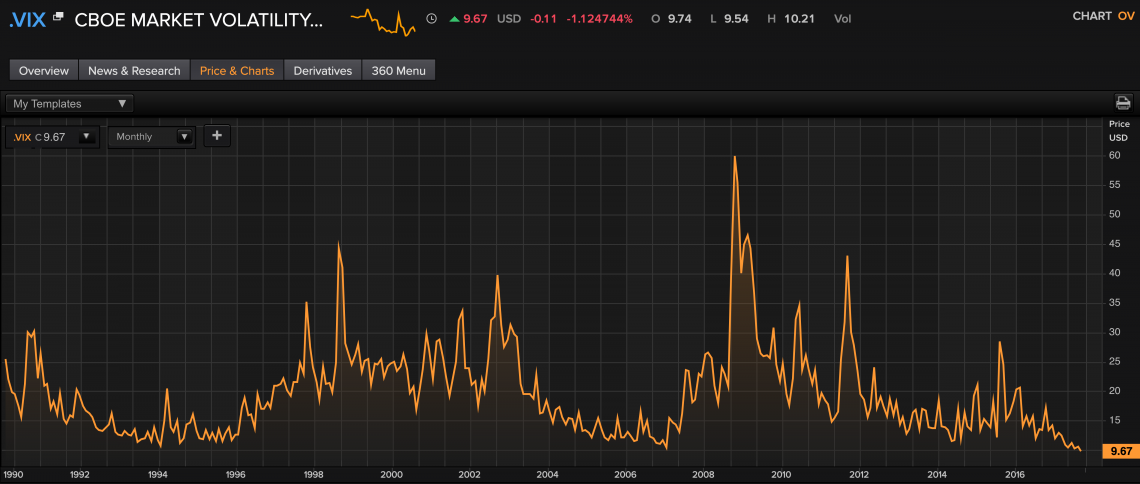
Unfortunately, the relentless grind ever lower in volatility, which as reported yesterday has resulted in both the lowest average September VIX on record...


... as well as the lowest September monthly settlement on record and only the second sub-10 monthly settlement... 


... appears to have finally unsettled Kocic" expectations, even if ever so tacitly implied, for a spike higher in suppressed vol, and as he writes in his latest ruminations on volatility, "as volatility continues to be unfazed by what lies ahead in the near term, short of surprises in inflation, we are likely to linger at low levels."


Following up to his note from last week, which explained how the Fed"s fake "transparency" killed long-term investor, Kocic writes that "as transparency became the word of the decade, by its very nature it created the forces that push everything to the surface. Things exist thanks only to the attention they produce. There is no room for ambiguity." 


Which ties in to the current news cycle, a relentless barrage of flashing red headlines, one scarier than the other, yet which on aggregate have zero adverse impact on volatility, and certainly on risk assets, which on Friday spiked to a new all time high following the latest last-second VIX-smash. Or, as Kocic puts it, "although shocks (political and other) keep arriving in the market, they seem to be appearing at what looks like predictable time intervals (usually, on Fridays). Practically every week, there is a new issue that eclipses the previous one, and we lose interest in past issues, before there is any semblance of resolution."


And with traders" attention spans already severely lacking, this habituation to hyperbolic, staccato newsflow means that not only is the market not discounting the future as Matt King postulated several months ago, but it is no longer able to even respond to the present, to wit:


Shocks, if they are predictable, lose their spell and gradually become facts of life. Predictable political shocks feed back into their source. Due to their antagonistic character, they gradually erode the ability to make consensus and reduce the ability to legislate, making further reforms at least questionable, if not highly unlikely. The market “euphoria” (aka the Trump trade) that followed immediately after the elections is being perceived as increasingly remote. Despite all the promises of reflation of the economy, fiscal stimulus, expectation of economic turnaround, no change is on the horizon. We are stuck with the status quo, albeit a noisy one.


So what does this mean for risk assets, and markets? According to the Deutsche analyst, "despite all the distortions and disruptions introduced by the central banks’, which has created a semi-permanent state of exception, markets have not lost one main characteristic, their adaptability. As the markets are getting inoculated against event risk, volatility continues to be under pressure. While we are distancing ourselves from the idea of political change, the Fed is seen, once again, as the main source of volatility. However, the Fed’s position is an uncomfortable one. The main problem it faces is the balance between preventing inflation from becoming a risk while at the same time not causing a rapid and substantial rise of rates. This requires a high level of fine tuning. It means that the Fed has to continue with rate hikes, but the hikes have to be done carefully without triggering the bond unwind."


The implication for vol traders is that contrary to warnings of market "metastability" and "suppressed cataclysmic vol events", Kocic - in many ways pulling a Hugh Hendry of his own - comes to the admission that fighting the Fed"s control over vol has become a futile pastime, and even though further complacency is in the cards, "continued vol selling" is encouraged.


... the market gradually, and reluctantly, trails behind the Fed, one hike at a time, and adjusts expectations on the go, without taking a longterm view on the Fed. It is difficult to see how this can lead to any excitement capable of inspiring higher volatility. As long as things evolve according to this scenario, everything shoiuld remain “predictable” with occasional noise that the market has learned to ignore. This is an environment that is bearish for volatility. It fosters further complacency and encourages continued vol selling.


Finally, Kocic takes a "Greek" detour and asks whether in this environment, in which every shock is ignored by a market now programmed to sell vol no matter what, "there is hope for Gamma?" Here is his answer:


In our recent publications, we have extracted one possible measure of liquidity from the volume data of Treasury futures. This measure quantifies sensitivity of the price to changes in trading volume. The liquidity index is expressed as a negative log of this sensitivity, so that large sensitivity corresponds to low liquidity and vice versa. The figure shows the (smoothed) liquidity (on the inverted axis) overlaid with the 3M10Y– low vol goes hand in hand with high liquidity.


Liquidity has a logical connection with volatility. This starts at the very short end and propagates across the term structure: By making a price, market makers are implicitly short volatility for which they are required to allocate risk capital and the bid/ask spread (which is an indirect measure of liquidity) is the compensation they receive for this risk exposure. All else equal, the ability to hedge an option is a function of liquidity of the underlying, and the option prices should reflect that. From the figure, we note that post 2004, with the disappearance of mortgage negative convexity hedging and the growth of  volume on the exchanges, liquidity has been providing a lower bound for gamma – whenever gamma reached this lower bound, it has been pushed up. Also, the departures from that lower bound have been increasingly rarer and short lived. This holds not only for rates, but for equities as well.


As volatility continues to be unphased by what lies ahead in the near term, short of surprise in inflation, we are likely to linger at low levels. In that context, liquidity constraints are going to define the lower bound on gamma.


As a reminder, none of this is new: those who have traded this market (for more than just a few years) instead of merely commenting on it, will recall all those vol traders who lost their jobs in early 2007 when vol crashed so hard, there literally wasn"t a swaptions market. If Kocic is right, vol traders in 2017 (and perhaps 2018) will suffer the same fate. Of course, the 2007 episode is best remembered not for the the vol linked pink slips, but the explosion in VIX shortly thereafter and the resultant near collapse of the US financial system. Despite the Fed"s relentless pressure, trillions in liquidity injections and vol selling, we see nothing that has changed since then, and no reason why this time will be different.

Thursday, September 28, 2017

Whitney Tilson Shuts His Hedge Fund... Again

Back in the summer of 2012, we had some fun when we reported that Whitney Tilson - the consummate, if always late immitator of other prominent investors especially Warren Buffett and Bill Ackman - following several years of abysmal returns, closed his then-hedge fund T2 (with Glenn Tongue), splitting off into his own, oddly-named venture, Kase Capital. Well, Whitney - who in recent years was better known for his bizarre family photos from Africa than managing money- has done it again and according to the WSJ, Tilson closed his hedge fund... again, "the latest high-profile investor to close shop amid an extended period of disappointing returns for the industry."


As the WSJ adds, Tilson, 50, shared his decision with clients (apparently he still had some) on Sunday. His latest hedge fund, Kase Capital, which was managing a whopping 50 million at the time of closure, and down from a peak of $180 million, lost about 8% so far this year, a more than 20% underperformance relative to the S&P YTD gain of more than 13%.


As the WSJ adds sarcastically, "while he ran a relatively small fund, Mr. Tilson was a well-known hedge-fund manager thanks to television and conference appearances, as well as books and regular writing about investing and other topics." In other words, Tilson was not so much a "hedge fund manager" as its straight-to-CNBC marketer, and the results have confirmed it.


In an amusing twist, in 2016 Tilson - a staunch never-Trumpter - inexplicably found himself the subject of scathing criticism by Elizabeth Warren, after Tilson expressed modest public support of some of President Donald Trump’s cabinet and other appointments from the banking world, "even though Mr. Tilson is a lifelong Democrat who voted for Hillary Clinton."


“The next four years are going to be a bonanza for the Whitney Tilsons of the world,” the Massachusetts Democrat said at the time. She later apologized to Mr. Tilson for her criticism.


And so Tilson joins a long procession of managers, some of whom managed actual real money, who decided that it was impossible to navigate these centrally planned markets and an exit was the noble way to go.


He is hardly the last one: in the past several months, a couple of well-known hedge funds have closed. Among them, investor Eric Mindich closed his $7 billion hedge-fund firm, Eton Park Capital Management LP, billionaire Richard Perry shuttered his hedge-fund firm and Hugh Hendry exited his flagship fund in London. “I died in active combat,” Mr. Hendry told Bloomberg at the time. “The last three months were harrowing.”


Many more closures are coming as investors redeem cash ahead of year-end at a pace not seen since the financial crisis.


As for Whitney, who somehow managed money for more than 18 years, the WSJ says that he is "expected to manage his own money." Considering Tilson was one of the founding, and most vocal members of "Patriotic Millionaires" group begging to be taxed more, we assume he does, in fact, have money to manage (we are not so sure about his clients) and this wasn"t just yet another marketing gimmick from the now former hedge fund manager.


Whitney"s full farewell letter below:


Dear friends,


I recently decided to close my funds and return capital to investors (excerpts from my letter to them are below). It was a hard decision, but the right one.


Now, I am filled with enthusiasm about what I will do with the second half of my life. What might that be? I’m not sure, but I want to share a few thoughts – and would be grateful for your feedback and ideas.


I’ve been working full time for more than 30 years, almost all of that time in an entrepreneurial capacity. While my one “regular” job early in my career was a good experience, I like being independent and plan to remain so. My goal is to find opportunities that are personally interesting, give me the chance to collaborate with great people, and are sufficiently remunerative (contrary to Elizabeth Warren’s belief, I am most definitely not a billionaire!).


I expect that most of my work will continue to be in the investment field, as I still love it and am confident that I can put my energy and 18 years of experience to good use. While I no longer intend to manage others’ money, I’m exploring a number of ideas, such as:


1) Unearthing a few great investment opportunities each year, in which I can invest personally as well as share with a few others;
2) Serving on corporate boards;
3) Doing consulting in areas in which I have expertise such as capital allocation, strategy, and activist investing; and
4) Teaching and mentoring young value investors via writings, videos and seminars.


I would welcome your advice and suggestions, so please don’t hesitate to email me at WTilson@kasecapital.com or call me at (646) 258-0687.


Sincerely yours,


Whitney


Warning: Danger Lurks Here

By Chris at www.CapitalistExploits.at


Take a look at the volume of stocks listed vs. indexes listed going all the way back to the days of bellbottoms, loud hair, and orange wallpaper.


Since 1995, the supply of stocks, particularly in the US, has been shrinking faster than Trump"s approval ratings. At the same time, the number of indexes have exploded like one of Kim"s shiny new missiles.


Why?


In a falling interest rate environment, the twin pressures of reduced returns and relative cost pressures have meant that investors, in order to make a buck, have flooded into the low fee structures offered by passive strategies. These include indexing, ETFs, and those truly insane creatures I"ve written about before: low volatility ETFs.


But what about those alpha generating hedge funds? Aren"t they meant to be smart and able to beat the market... any market?


Those alpha generating hedge funds have things called LPs. And though LPs may be smarter, and certainly wealthier than Joe Sixpack, they"re no less human. And human attention span and patience level has been in decline... correlated no doubt with the rise of social media and the Kardashian crowd. Like a virus, it infects everything.


As performance from hedge funds has been poor relative to the benchmarks, a self reinforcing situation where hedge funds, in order to ensure LPs don"t redeem, have landed up hugging the indexes.


This is the exact opposite of what hedge funds were meant to do, of course. In many cases, they themselves are simply buying the indexes, trying desperately to figure out how the hell they"re going to survive through the next quarter but determined simply NOT to underperform the index. It"s a losing strategy no matter how you slice and dice it.


For those hedge funds who refuse to chase the indexes... Well, they are now fighting the tidal wave of capital that has been shifting into passive investments, which forces those passive investments even higher.


This, in turn, leaves active hedge funds who refuse to get sucked in with increasingly substandard returns. They can explain until they"re blue in the face why certain indexes make no sense but when those indexes just keep rising day after day, month after month, it becomes a very tough stance to keep. Redemptions follow, and so by doing the right thing, they"re punished. And by doing the wrong thing (following the mob), they may get to stay alive just a little longer and this is what many have resorted to.


We all know that at some point there are no new buyers available to enter the market and hoo boy, do we then have a problem.


So... you either join the party or you leave the party.


The last to leave the party is Hugh Hendry and his baby Eclectica.


Hugh Hendry Murders His Hedge Fund


Og aye, tis tae tough


Hugh follows Eton Park and Perry Capital to name but a few more.


Paul Singer of Elliot Management fame put it well in his July investor letter to stakeholders.


"In a passive investing world, small shareholders have little-to-no voice and no realistic possibility of banding together, while the biggest shareholders have no (repeat, no) skin in the game so long as the money manager does not underperform the index."


Make no mistake, the rise of passive indexing is a bubble in dumb money.


We have a situation where the market is becoming completely lopsided and increasingly so at a blistering pace.


If it gets anymore lopsided, it"s going to be upside down. What"s more, the market participants have no interest or even determination of valuations.


An index doesn"t give an isht what the P/E ratio of any stock included in the index is, and the investors buying it have even less idea. It doesn"t care if the aggregate of stocks sitting inside its womb are over or indeed undervalued. It"s just a dumb bloody index, and you can"t blame it anymore than I can blame my dog for not understanding Shakespeare.


Those investing in passive have done so partly due to relative fee differentials, partly due to performance. But now also dangerously so... due to increasing inflows, which have continued to push values higher.


Now, having markets or sectors get silly is obviously as normal as a peanut butter sandwich, and provided you"re aware of it, we"ve little to worry about.


But what"s more frightening than the Kardashians in skinny pants is that as capital has fed into passive, the usual countering forces (active managers) of the market have been leaving the party, which has left the passive world to increasingly swell like a neglected infected wound.


What we need to think about is that increasingly there is no active market to stabilise this. It"s akin to having a 5-year-old"s party, inviting a troop of the critters, and then promptly sending all the parents down to the pub for a few hours.


Just as short sellers provide a balance to a market so, too, active management (who incidentally typically have skin in the game) have always provided a stabiliser to the overall market. What happens when the stabilisers all leave the room?


We can see this manifesting itself in the volatility index. As more capital enters at a steady pace so, too, the volatility falls.


And here"s the thing. The algos constantly feed back the daily data to recalculate their probabilities (read this article on VAR shocks). Risk? Nah!


At the extreme of the passive world sits volatility.


Selling volatility works really well. Just ask Neiderhoffer who has made godawful amounts doing it over the years.


Look closely, though, and you notice that even Neiderhoffer, who knows what game he"s playing, blows himself up spectacularly from time to time... and I mean complete armageddon wipeout stuff. Until that blow up comes, though, you just keep plugging away at it day after day and it just keeps paying you... day after day. You make money, make money... and then, well...


It all turns to isht and blows up in your face.


My friend Mark Yusko from Morgan Creek Capital places capital with the smartest strategies and hedge funds - active capital.


Who"s willing to bet with me that over the next decade being long smart active strategies and short passive (low volatility ETFs) will be a winning trade?


Wow Poll - 27 Sep


Cast your vote here and also see what others think


- Chris


“What could be more advantageous in an intellectual contest – whether it be bridge, chess, or stock selection than to have opponents who have been taught that thinking is a waste of energy?” – Warren Buffett, 1985 Berkshire Hathaway Letter to Shareholders


--------------------------------------


Liked this article? Then you"ll probably like my other missives on


this topic as well. Go here to access them (free, of course).


--------------------------------------