Showing posts with label EuroDollar. Show all posts

Monday, December 25, 2017

The Dollar"s Reign As The Global Reserve Currency Is Running Out - Fast

The dollar’s hegemony over the global financial system can’t last forever. Like all things, it will eventually come to an end.


The only question left, as MacroVoices" Erik Townsend puts it, is whether we’re in the second inning and there’s going to be another hundred years of the dollar serving as the world’s global reserve currency? Or whether we’re in the bottom of the ninth and it’s all about to fall apart? Or maybe somewhere in between.


In an interview with Jeffrey Snider, CIO at Alhambra Partners, Luke Gromen, founder of Forest for the Trees, and Mark Yusko, founder and fund manager for Morgan Creek, Townsend explores the issue in greater detail. For many, the decline of the dollar as the world’s reserve currency is difficult to imagine. But the first blow to the petrodollar system has already been delivered: By refusing to accept oil payments in dollars, Venezuela has demonstrated to the world that an alternative system to the petrodollar is indeed possible. Furthermore, Latin America’s socialist paradise has begun publishing an oil-price index denominated in yuan. We"ve also highlighted reports that Russia, Venezuela and Iran - three countries that have trouble accumulating dollars because of Treasury Department sanctions - are considering launching a cryptocurrency backed by oil.


Townsend begins his interview with Gromen, who points out that, counterintuitively, the dollar’s rapid appreciation beginning in Q3 2014 has coincided with a drop in the share of global trade settled in dollars. Gromen predicts that this trend will continue to benefit the dollar – until it doesn’t.


I would probably say in the later innings. Certainly the last third of the game. Maybe the eighth inning.


The reason I say that is that, given the Eurodollar system as it’s structured, early on, if any nations or major parties wanted to move away from using the dollar for any number of reasons, ironically, what that moving away from the dollar would do would drive significant dollar strength. So, ironically, accelerating moves to dump the dollar in global trade usage, which in the long run is the most bearish development for the dollar, in the near term is the most bullish development for the dollar.


And so when we look back, we think, beginning in 3Q14 was when you started to see a marked acceleration in the dollar’s share loss in global trade. And, in particular, in energy trade centered between China and Russia. And so we think things began to accelerate in 3Q14 and, like we’ve said, the process of moving away from the dollar, or the dollar losing share in trade, is a big positive for the dollar – until it’s not.


However, Gorman believes an important shift happened in Q3 2016 when the dollar’s share loss in global trade started to accelerate. At that point, the dollar’s climb from 2014 and 2015 had already been unwound to a degree. Furthermore, Gorman posits that the dollar will weaken because it’s in the national security interest of the US for the dollar to weaken.


And then the “until it’s not” part of this movie began over a year ago now, in 3Q16. The reason we say that is because from 3Q14 until 3Q16 you saw a rising dollar, rising Libor, and a pretty traditional dollar strengthening cycle up to that point.


Where it started to become non-traditional relative to what pretty much any market participant trading in markets today – or even alive today – was when in 3Q16 rising dollar, rising Libor, drove a year-over- year decline in US tax receipts and therefore an increase in the US deficit as a percent of GDP. And it did this before you had a major emerging crisis.


This was the first time the US’s tax receipts declined before a major emerging market crisis, in a dollar-tightening cycle, in the post-Bretton Woods period.


And so, then, when you combine that with what has become effectively a system that requires as infinitum asset price appreciation in order to drive tax receipts for the US government, it sets up – beginning in 3Q16, where we started to get into late innings of this game. Where, not only are foreign creditors looking to move away from the dollar in trade usage for a number of reasons, but it also started to become a matter of national security for the


US government for the dollar to weaken.


Moving on, Townsend turns next to Jeff Snider, CIO at Alhambra investments. Snider explains how the Eurodollar system harms emerging-market economies and ultimately weakens the global financial system with each cycle of tightening.


The last tightening cycle, which lasted from 2014 through 2016, was particularly destabilizing, Snider explained, particularly for emerging markets like Brazil, Russia, and China. Many EM countries and corporations based in those countries issue dollar-denominated debt, which becomes more expensive to pay down when the greenback climbs.


But, for now at least, Snider expects the system to endure – if for no other reason than there’s nothing to take its place.


My position is that the dollar system, the supply of dollars in the global network of trade, continues to be a problem. But it isn’t a problem in a straight line. It’s not like it’s a straight-line decay from where you can draw a singular line from 2007 to 2013. Instead, it’s more of an intermittent type of thing where we have these alternating periods where things tighten up. Then they loosen up relatively.


But, as we go through each of these periods, the system is worse off for having gone through each one. And so the last tightening episode, starting in 2014 and lasting through 2016, was severe. Especially in emerging markets like Brazil, Russia, and China, the BRICs, because that’s where that part of the dysfunction was focused. More in FX and more into the Asian part of the system, as it has evolved since 2007 in that direction.


So, from my perspective, nothing has really changed except the system continues to get weaker. And I think right now where we are is we’re waiting for the next tightening event to start taking place. That there’s plenty of evidence that the system continues to decay, particularly with China and some of the other emerging markets.


So it doesn’t add up to a bullish position, necessarily. And I think that’s one of the things I want to define, is what exactly is a rising dollar? And it’s not bullish. And I’m certainly not of the position that most dollar bulls take, which is that the dollar goes up because the US is going to strengthen either economically, financially, or otherwise. I think that’s just not the case. So if we couch these in terms of the Eurodollar system and its continued decay, it’s not a bullish thing. But I think the dollar continues to go up, at least for the next little while. Because, frankly, there is nothing there to take its place.


So we’re kind of stuck with it.


Moving on, while Yusko didn’t feel comfortable attaching an expected expiration date for global dollar hegemony, he did draw some interesting parallels between the dollar and the British pound, the global reserve currency that immediately preceded the dollar.


You know, the interesting thing about world reserve currency is there have been lots of them over time. And I always joked that Americans are like Notre Dame football fans – they remember a past that never was. Notre Dame football fans think that we win all the time, which, clearly, we don’t. I was down in Miami. That was horrible.


And, you know, Americans think that we’ve always been the world reserve currency, for some reason. And we clearly haven’t. It’s only been since 1944. What’s interesting about that is the transition can last a long time. The sun never set on the British Empire for 70 years. They had the world reserve currency. They had the strongest navy.


And then in 1913 they invaded Mesopotamia, incurred a bunch of debt, the pound sterling collapsed, the dollar ascended. We, 31 years later, became the world reserve currency. And then in 2013, we (coincidentally) invaded Mesopotamia, incurred a bunch of debt, the dollar collapsed, and the Renminbi ascended.


Well, that hasn’t all happened yet. But I think it’s on its way to happening. And when I look around the world, I think it’s supremely clear that China has a plan. And for the last 50 years, their stated goal was a harmonious rise.


Doesn’t that sound poetic? It’s beautiful. It’s non-confrontational.


Ultimately, Yusko believes the Chinese yuan will replace the dollar as the world’s reserve currency sometime before 2050, the time by which Yusko expects China will become the dominant global power.


This contrasts with the consensus view, that, after the dollar, there won’t be one dominant currency, but several in separate spheres of influence.


The conversation is part one of a five-part series from MacroVoices exploring the dollar’s future as the world’s dominant currency.


Readers can listen to the whole conversation below:


The podcast targeting pro finance and sophisticated investors, hosted by Hedge Fund Manager Erik Townsend


Sunday, December 17, 2017

WTF Chart Of The Week

Authored by Jeffrey Snider via Alhambra Investment Partners,


Back in early October, I noted that repo fails had jumped above $250 billion (combined “to receive” and “to deliver”) for three weeks straight. That wasn’t an auspicious result, as sustained collateral problems like that don’t correlate to happy things. It all began the week of September 5, in what seemed like a minor one-day nuisance over the 4-week bill yield.


October was something of lull in repo and other things, too. Nothing ever goes in a straight line, of course, so it wasn’t surprising to find by mid-November a resumption of concerns based so much in repo. The week of Thanksgiving, fails totaled again more than $400 billion, similar in scale to that week of September 5. Then they spiked by 50% more to $600 billion the week after.


FRBNY records $523 billion in repo fails now for the first week of December. That’s three straight more than $400 billion, two in a row better than half a trillion.


The 8-week average is even just shy of $350 billion. You can get rich being a collateral owner under these terms, raising the question where are they all?


While these are good charts, important charts, neither is our Chart of the Week. What we are looking for in this context of really another burgeoning “dollar shortage” episode is, as always, escalation.


I’m going to go out on a limb and claim there is something seriously wrong in repo.


All jokes aside, I know it sounds like a broken record but the dimension that matters is not intermittent collateral problems so much as the greater intensity to them and in a condensing timeframe. Escalation is a description you really don’t want to fit the circumstances.


Just as raging wildfires have a horrific tendency to jump fire-lines and even whole valleys given enough energy, funding issues can jump markets. The global “dollar” market is not a monolithic whole and never has been. It may be (very likely is) more fragmented today than at any point in the past owing to persistent balance sheet capacity problems (therefore the breakdown of covered interest parity that used to keep various funding markets working together in what sure seemed like a seamless whole). It would be a clear point of magnification, then, to find serious problems in one part of the eurodollar system spilling over into another one.


Leading us to our Chart of the Week:


The 3-month €/$ cross currency basis swap has plunged this week, a descent that really started the week after Thanksgiving. It has reached a level today last seen during the 2011 crisis. And this latest detour clearly marks its inflection where else but the week of September 5. In other words, you rarely find an exact match like the one we have here repo to €/$ swaps.


This particular instrument isn’t alone among XCurrBasisSwaps, either, it is merely the tenor and counterpart currency that right now is at the most extreme.


Because these are two very different funding mechanisms, repo and FX (Footnote dollars), there can be little doubt what is really at issue – “dollar” shortage as a matter of supply and therefore balance sheet capacity.


That’s the one common element linking collateral flow with the severe unwillingness (broken covered interest parity) to make a killing lending FX dollars to euro counterparties.


This doesn’t mean there is a crash right ahead. It does, however, suggest coming difficulties in various markets and more than that the global economy.


You can blame regulations all you want, as the mainstream has already rushed to do, being forced by such a huge move in €/$ cross to at least report on it, but there is no way this comes out as anything other than an escalating warning.


As a reminder, what negative premiums on XCurrBasisSwaps mean:


The cross currency basis swap is somewhat unique in that by fixing exchange values at both the outset and back end, it reveals purely financial perceptions in its values and changing values about the differences in interest payments. For example, in the 1990’s the basis swap for Japanese banks (again, not companies) was structurally negative, meaning that they had to pay a premium to swap into dollar funding because of negative perceptions of creditworthiness. This is the legacy of the downside of the “global dollar short”, as Japanese banks had accumulated large dollar asset positions (long US$ assets, short US$ funding) leaving them susceptible to such vagaries in dollar funding, whether repo or basis swaps or anything else someone on Wall Street or in London might dream up that wasn’t gold or actual cash…


The negative yen basis swap acts like leverage where even yields on the interim “investment” are negative. Any speculator or bank with spare “dollars” could lend them in a yen basis swap meaning an exchange into yen. Because you end up with yen you are forced into some really bad investment choices such as slightly negative 5-year government bonds, but that is just part of the cost of keeping risk on your yen side low. Instead, the real money is made in the basis swap itself since it now trades so highly negative. The very fact of that basis swap spread means a huge premium on spare dollars; which is another way of saying there is a “dollar” shortage.


Because of the shortage and its premium, you can swap into yen and invest in negative yielding JGB’s in size and still make out handsomely. There has been, in fact, a rush of foreign “money” into Japan to take advantage of this dollar shortage; the fact that there has been such enthusiasm and it still has not alleviated the imbalance proves scale and intractability.


Tuesday, December 12, 2017

"Statists Don"t Share" - A Race To The Potential For Bitcoin

Authored by Jeffrey Snider via Alhambra Investment Partners,


The timing just never seems to fall in our favor. If we had had this conversation ten years ago as would have been appropriate, then this evolution might have fell perfectly in our collective laps. Just as the global financial system, really the international, interbank monetary system of the eurodollar, was crashing all around us, the genesis block of the Bitcoin blockchain was hard coded.


Within it contained very insightful if superfluous (from a technical standpoint) text, a truly elegant starting point for a competing monetary idea:


The Times 03/Jan/2009 Chancellor on brink of second bailout for banks


Officials, particularly Western central bankers, were at that time in no mood for thinking about alternative global arrangements. Even those other monetary officials (Zhou Xiaochua) who happened to know what was really wrong were still willing to give the Ben Bernanke’s a second chance to fix it. It was our lost opportunity because central bankers didn’t then, and still don’t now, know what’s actually broken.


The world is far too focused today on Bitcoin, not without legitimate reasons. It has in 2017 taken it by storm, rising parabolically for quite a remarkably sustained period. People who have no idea what it really is are rushing toward it, some buying it without first appreciating the whole complexity and texture of the technology behind it.


As such, it forces unwanted political attention that might have been better served understanding the motivations behind the message contained within the genesis block. Now, they can simply claim it’s in a destructive bubble and lump every form of crypto, both what’s already in existence and what is yet to come (the really exciting part), into the same negative category.


Economists, even those who still bother trying to resemble free market thinkers, rush to ban it.


As I wrote last week on the topic of what’s really, in my view, motivating Bitcoin mania:


Statists don’t share power. Economists in the realm of money are thorough statists, however they might describe themselves as some range of capitalist.


Bitcoin is not, to me, the part to focus on. It is in many important ways, as President Obama was often fond of saying, a distraction. The potential lies not in it being a competing currency but upgrading as to what the eurodollar has been for half a century already. If you understand that the eurodollar system isn’t really a currency system but a set of network standards and protocols, then blockchain seems like it was made to be if not the perfect solution than still perhaps the right one given where we are (to really make sense of this, you really should read the whole thing).


That’s what the acceptance market essentially became – a way for banks to conduct their thousands of individual transactions across time and geography with only having to ship, or wait to receive, money once the net sum of all those trades would come due. It was a ledger system (poker chips) that was backed by deposits of gold and cash (with the dealer), as well as central banks (the house).


The eurodollar which supplanted the acceptance market even while the Bretton Woods gold exchange system remained nominally the official reserve standard was merely the next step for international monetary evolution along these lines. How much more elegant might the whole operation become if we just eliminate the need for cash deposits altogether? To a true money adherent, such an idea was and is today abhorrent. To a bank merely trying to operate as efficiently as possible, this was a dream scenario.


The primary problem with the eurodollar system is that it is a decentralized ledger, where much of what goes on with them doesn’t ever see the light of day (the shadows). It was an attempt at a pure medium of exchange, and for a very long time it seemed to work that way as if nobody really needed to know what was on all those darkly hidden registers. From August 9, 2007, forward, it was proven that even a decentralized ledger system really needs full private scrutiny.


This is where blockchain may hold an answer. The technology behind Bitcoin (don’t get hung up on specifically Bitcoin) is nothing more than a network ledger. It is instead centralized, but it could in theory (with a bit more work, pun intended) take the place of the decentralized eurodollar ledger. In the latter, the credit-based money system, the banks are what matter for creation of money supply (the dealers create all the chips, and even control what kind of chips may be played). In the former, that weakness is removed as is the foolish dependency on incompetent, ideologically stunted central bank statisticians.


In other words, it’s not so much ridding ourselves of dollars or even “dollars”, but changing the way they are accounted for while still allowing for some positive attributes (there are some) of the eurodollar system to be maintained. A pure medium of exchange is a truly tantalizing idea, a dedicated payment system alone, but it needs to be far more robust in a way the dispersed and spread out eurodollar format just never could be.


More than that, I think it offers the shortest distance between A and B; A being where we are now stuck in chronic monetary instability and thus the worst economic case; B being the very happy day when that problem is solved and the great global recovery, real not imagined, takes off.


We are going to get to B at some point in the future, and the journey we take to that point will determine what that means. If we arrive at B in the same way as the Great Depression era (Bretton Woods taking place toward the end of another world war), meaning doing nothing but the same thing that Economists tell us to do over and over, it will have been the worst of the worst cases. The idea is to get started as soon as possible so that we can work out the solution and the way to implement it as painlessly and with as little disruption as possible so as to arrive at B long before the political and social sh#& hits the fan.


That’s where the timing may have us unlucky. Maybe our fate was sealed the minute Ben Bernanke started acting courageously and we let him off the hook for why he felt that way in the first place (he’s never answered for “subprime is contained”, and nobody has ever made him). It’s too late now, and with Bitcoin off like a rocket there is a very real, dispiriting chance blockchain may never get enough work and then its real trial run.


Nobel Prize-winning economist Joseph Stiglitz said “bitcoin is successful only because of its potential for circumvention, lack of oversight.”


“So it seems to me it ought to be outlawed,” Stiglitz said Wednesday in a Bloomberg Television interview with Francine Lacqua and Tom Keene. “It doesn’t serve any socially useful function.”


Stiglitz is a buffoon and a thorough statist, but he is influential because Economics still dominates the political end of things. From China to Europe there are official and unofficial voices expressing grave doubts and discomfort over Bitcoin without really considering blockchain. It may end up where Bitcoin sinks the blockchain given that its greatest risks are all political (an outright ban).


The only way to thwart those intentions is for enough people to take a determined interest in cryptos as a class rather that solely as speculation in the one; to see the great potential in the real stuff of its evolution, and not get hung up on something like price. We have to step ourselves outside of currency and appreciate the currency system, and do it with enough of a broad basis of appreciation that it overcomes and survives what will surely be an effort to kill it. 


It may be that our future depends upon how successful we can become in this way, accepting blockchain no matter what ancient Economist decries it, or whichever political figure who clearly doesn’t get it or our real monetary problem seeks its official exile. As if we needed any more of them, it’s another race or countdown. The primary issue after losing one decade is always really going to be time.


We are going to go from A to B one way or another; willingly by design, in a messy, uncontrolled reset, or some ways in between . There are today even after ten years still some positive outcomes possible. I worry that timing (Bernanke’s real legacy) may be conspiring to take one of those few away before it ever really gets started.


Sunday, December 10, 2017

What You"re Not Being Told About The Real Economy

Authored by Jeffrey Snider via Alhambra Investment Partners,


The year 2000 was a transition year in a lot of ways. Though Y2K amounted to mild mass hysteria, people did have to get used to writing the date with 20 in front of the year rather than 19. It was a new millennium (depending on your view of Year 0) that seemed to have started off under the best possible terms.


Not only were stocks on fire at the outset, the economy was, too. The idea of this “new economy” leading toward a permanent new plateau of low inflation growth, driven by the breathtaking productivity gains in telecommunications and computing, seemed quite real on the surface. US GDP advanced by more than 3% in 15 straight quarters from Q2 1996 through Q4 1999, averaging a sizzling 4.7% in those nearly four years of dot-com supremacy.


The labor market was clearly robust, too. In March 2000, the BLS estimates (current benchmarks) that total payrolls (Establishment Survey) rose by 468k from that February. That brought the 6-month average up to +303k, a record of expansion that also mystified economists for its lack of inflationary wage pressures. In any case, the late nineties had roared up to the doorstep of the 21st century.


We all know what happened in April 2000, as investors suddenly got cold feet about first the high flying NASDAQ. It wasn’t just stock prices and IPOs, of course, as it really meant one of the major economic themes of that age was in danger being undermined, if not thoroughly debunked. The new economy of the 21st century might not have been grounded so solidly in true economics (small “e”) as everyone thought (especially those running the Fed).


The labor market of 2000 was a study in contrasts, starting out as good as it did, but by that June, there was a shocking minus for the monthly headline payroll number. It wasn’t just a one-time problem, either, as despite all assurances in all the usual places payrolls would contract again in August and also in October. To end the year 2000, the 6-month average for the Establishment Survey had fallen to just +109k.


It was, again, a year of transition, beginning as the “sky is the limit” dot-com era and ending in almost a tailspin just two months shy of official recession. In many ways, the economy has never recovered from it, the labor market (the eurodollar’s giant sucking sound) most prominently.


Because of this and really the length of time involved between then and now, we have forgotten what a good economy actually looks like. There have been, of course, brief moments when we get the sense that something just isn’t right, such as the “jobless recovery” of 2002 and 2003, as well as the whole aftermath of the Great “Recession” up until 2014. By and large, however, the economy and the labor market are described in terms that just don’t apply if almost by default (it’s less bad today, so mustn’t it be good?).


The current payroll report for November 2017 suggests a gain of 228k. It is characterized as everything from “solid” to “robust.” Is it? How would we really know?


The best way to confirm that suspicion is to compare the current labor statistics to those in the past, calibrating the most recent numbers by those before that were recorded during what were inarguably the best of times; such as the late nineties.


Using monthly payroll gains, though, can be misleading simply because of geometric progression. A gain of 228k in November is not equivalent to the 228k gain in November 2000. The latter is actually a better single month result starting as it did from a smaller base.


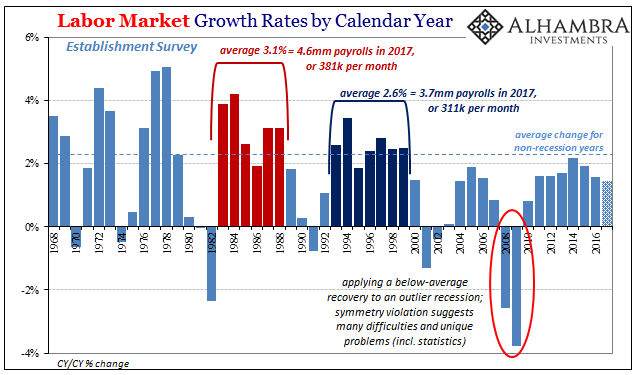
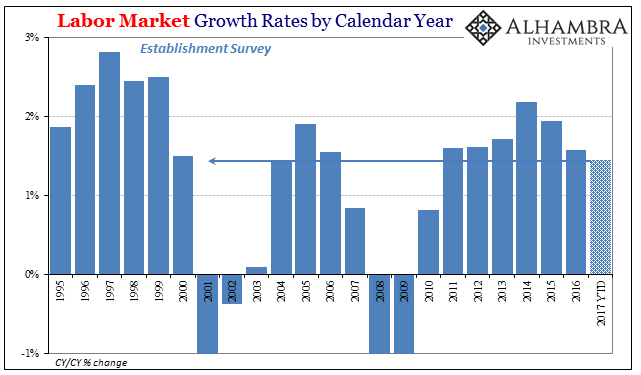
From 1993 through 1999, the labor market gained, on average, 2.6% per year according to the Establishment Survey. Since that time period is universally accepted as one featuring a strong economy, that is our standard for measurement. We can also go back to the eighties for what might amount to as an upper limit of sorts, the economy and labor market at that time being whatever is better than strong and robust – truly awesome.


Translating those average gains into the 2016 base equals an expectation of 3.7mm payrolls gained for 2017 to be as good as the nineties, and 4.6mm, which would signal a splendid economic year consistent with the eighties. Through 11 months so far up to November, the Establishment Survey gives us just 1.9mm for 2017. Assuming December turns out equal or better than November’s “good” number, the year should end with a total payroll expansion around 2.1mm, maybe 2.2mm.


That’s less than two-thirds of the way to the nineties, and significantly less than half of the eighties. This year, no matter how many months at 200k plus, has not been a good one. In fact, payroll gains in the eleven months so far tallied by the BLS’s Establishment Survey are less than those presented in that transitional year of 2000.


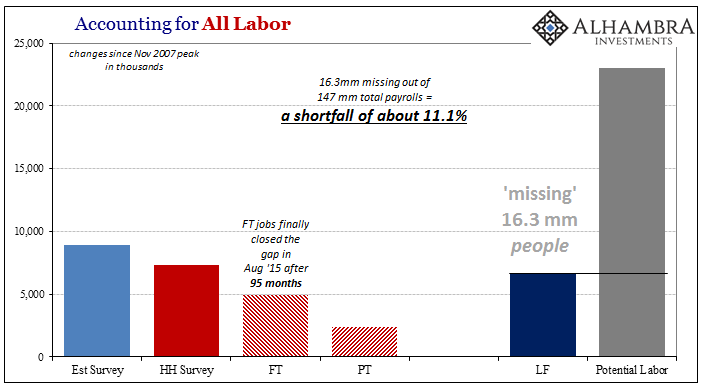
This is how you get the newest generation of American adults yearning in greater numbers for something vastly different, a radical political change if for no other reason than the establishment here continuing to say that everything is good when by every reasonable standard it isn’t even close! The “robust” labor market even of the past few years isn’t nearly enough to draw in those still sitting on the sidelines struggling, however, they do (parents’ basements) to just get along, leaving the economy instead it’s “missing” 16.3 million; a number that in a truly robust economy would be falling not rising.


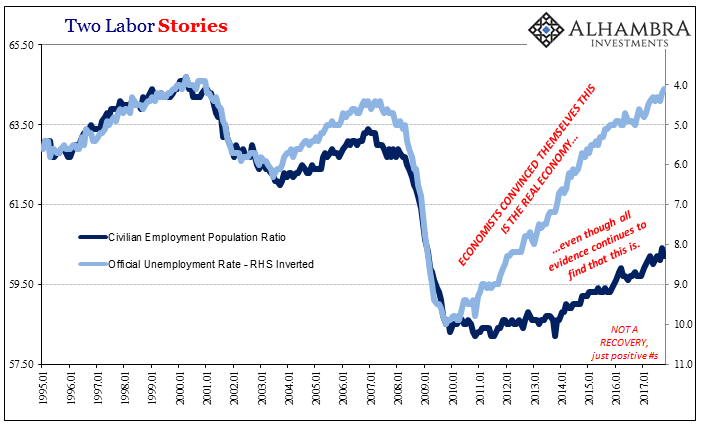
The issue clearly cannot be labor supply (Baby Boomer retirements, heroin, and fentanyl abuse in the Rust Belt) but shrunken labor demand; permanently shrunken economic demand. Therefore, there really should be no expectation for accuracy in the unemployment rate and what that means all around (inflation, baseline growth, monetary policy).


Once again in yet another month where the unemployment rate registers a ridiculous low, wages, and payroll earnings remain stuck at visibly low levels. The average weekly earnings of production and non-supervisory employees rose by just 2.6% year over year in November, after gaining 2.2% in October, 2.6% in September, and 2.7% in August. That’s nothing like in the past when the unemployment rate was where it is now. There is nothing like acceleration in earnings, not even solid growth.


I don’t mean to make all this about the bond market every time (actually it’s appropriate), but the idea that treasuries at the long end have to be wrong has no basis other than misconception or intentional misdirection.


The data, including the BLS data, remains firmly on the side of flattening, and like the Establishment Survey’s paltry 1.9mm in 2017, it’s not even close.


Wednesday, December 6, 2017

How "Ghost Collateral" And "Yin-Yang" Property Deals Will Collapse China"s Credit Bubble

One lesson from the 2007-08 crisis was that the vast majority of financial market participants, never mind the general public, were unfamiliar with subprime mortgages until the crisis was underway. Even now, we doubt many have much understanding of repo, the divergence between LIBOR and Fed Funds from 9 August 2007 and Eurodollar liquidity. In a similar way, when China’s bubble bursts, we doubt the majority will be that familiar with “ghost collateral” and “yin-yang” property contracts either.
 
A second lesson from the 2007-08 crisis was that as the value of the collateral underpinning the vast amount of leverage declined, the surge in margin calls led to cascading waves of selling in a downward spiral.


A third lesson was that the practice of re-hypothecating the same subprime mortgage bonds more than once, meant collateral supporting the most vulnerable part of the credit bubble was non-existent. It only became apparent with the falling prices and margin calls. Few people realised the bull market was built on such flimsy foundations, as long as prices kept rising.


A fourth lesson was that in order for the bubble to reach truly epic proportions, key financial institutions, especially banks, needed to conduct themselves in a negligent fashion and totally ignore increasing risks.


Each of these warning signs from the 2007-08 crisis exists in China’s property market now – and other parts of its financial system - bar one…falling prices leading to cascading waves of selling. However, as we’ll explain, we think it’s only a matter of months away now.


We should note that our thesis that China’s bubble would eventually be undermined by a “black hole” of insufficient collateral is one that we have been developing for several years. What we came to realise is that insufficient collateral is nothing more than normal business practice in the Chinese economy. It doesn’t matter whether it’s related to commodity-backed loans, property speculation or managing redemptions in the Wealth Management Products (WMPs) sector.


The first sign of this practice to received worldwide attention came to light in 2014 with the collateral fraud at China’s third largest port, Qingdao, which spreading to another port, Penglai, before it suddenly got covered up stopped. Numerous borrowers were found to have pledged the same copper and steel inventory as collateral to obtain funding from various banks, including state-owned Citic Resources, as well as Citi, Standard Chartered and others.


Not long after the scandal emerged, media attention began to wane, as commentators either assumed it was fixed or were distracted by other issues. However, it wasn’t fixed and we had a shocking reminder last month with the first major publicly announced loss. ED&F Man took an $80m hit after acting as a broker between Australia’s ANZ Bank and two Hong Kong-based trading companies in a sale-and-repurchase financing deal. The trade was backed by storage receipts for about $300 million of nickel stored in Glencore-owned warehouses in Asia. The problem was that the warehouse receipts were forged. As we said.


What is surprising is that it has taken over three years for the first serious hit from China"s "ghost collateral" to emerge. Or perhaps not: in a time of generally rising prices, few if any traders actually bother to check if their pledged collateral ever exists. The problem emerges when prices decline, which courtesy of China"s bubble machine, has so far not been an issue.


In June 2017, we discussed an article, “Ghost collateral’ haunts loans across China’s debt-laden banking system”, by our favourite Reuters reporter and forensic investigator of China’s collateral black hole, Engen Tham. Here are a few soundbites from Tham’s impressive piece.


One lawyer said he discovered that the same pile of steel was used to secure loans from 10 different lenders.


Most of the bankers said that kickbacks were prevalent, with loan officers turning a blind eye to the quality of collateral and knowingly accepting dubious and even fraudulent documents. Two of the bankers said they themselves had taken bribes to smooth the approval of loans.


Overall, 23 of the 30 bankers described the existence of ghost collateral as a serious problem and expected more instances to emerge as the Chinese economy slows. The bankers interviewed come from 13 banks in China, including some of the nation’s biggest lenders.


…fraudulent collateral is “a huge issue,” said Violet Ho, senior managing director and co-head of Greater China Investigations and Disputes Practice at Kroll, which conducts corporate investigations on the mainland. “Often you also see that the paperwork around collateral may be dodgy, and the bank loan officer knows, the intermediary knows, and the goods owner knows – so it’s essentially a Ponzi scheme.”


More than six months later and Egen Tham is back with a “special report” on loan fraud and missing collateral in China’s property market, “Hidden peril awaits China"s banks as property binge fuels mortgage fraud frenzy”. We strongly recommend the article as Tham goes into forensic detail as he examines specific legal disputes which act as a window on the broader Chinese property market.


Here is our summary.


Reuters discovered an epidemic of mortgage fraud in China’s property market from extensive research and interviews with buyers, sellers, real estate agents, loan agents (see below), bankers and lawyers from three major Chinese cities and four smaller ones.


Buyers habitually overvalue the cost of the house or property they are buying so they can borrow more funds which are typically channelled into the property market, e.g. buyers who have insufficient down payment or income. A mortgage banker at Shanghai Pudong Development Bank estimated that 20-30% of his clients borrowed the down payment from a third party.


Small banks and loan companies do not have the resources to monitor if money is borrowed to finance down payments on property deals. Reuters notes that short-term household loans increased by 243% to 1.6 trillion yuan in the first ten months of 2017.


There are up to three contacts for an individual property transaction – the legitimate one, one for the bank providing the loan which overstates the property’s value and one for the tax authorities. These are widely known as “yin-yang” contracts in which real and fake agreements operate side-by-side.


In these re-packaged loan arrangements, all parties, including the bank and the seller, can be complicit in the fraud. Tham provides detailed examples. Since “everybody is doing it”, the crimes go unpunished, even when the guilty admit them in court documents regarding related claims.


Reuters reports that it interviewed twelve estate agents who admitted to helping clients commit mortgage fraud. One salesperson at the E-House China agency said that about 50% of his clients engaged in mortgage fraud. Another real estate agent estimated that about 60% of Shanghai property deals involve “some kind of re-packaging”.


A separate industry of loan agents has evolved which help property buyers to fraudulently secure mortgage loans. Real estate agents, and the banks themselves, introduce borrowers to the loan agents which keeps the criminal activity at “arm’s length”. 


While many western websites are blocked by the Chinese authorities, discussions about securing a fraudulent mortgage, the price of fake documents and adverts from loan agents are prevalent on social media.


The motivation for mortgage fraud is the fear of missing out in the great Chinese property bubble. While official data showed that house prices rose 12.4% in 2016 (fastest since 2011), this understates reality. The state-controlled Chinese Academy of Social Sciences estimates that prices rose by an average of 42% in 33 major cities.


Reuters noted that property market insiders “see little prospects” of an end to mortgage fraud, even though the Chinese regulators have asked banks to stop over-valuations and “yin-yang” contracts. Even when evidence of fraud is specifically shown to a bank, it is likely to be ignored.  


To add some colour to our prose, here are a handful of soundbites from Tham’s article.


Almost all contracts for the sale of existing property in China have some “yin-yang” element, according to Denny Jiang, a former banker and recent home buyer in Beijing.


A Hong Kong property investor surnamed Fu, who declined to give his full name because he was admitting criminal behavior, told Reuters that 20,000 yuan (about $3,000) in a traditional red gift envelope was enough for a valuation company to inflate the price of the apartment he wanted to buy in Shenzhen by 40 percent. That increased the amount the bank was prepared to lend him by 1.26 million yuan.


While property prices in China continue to rise, mortgage fraud remains largely a hidden danger, much as subprime loans in the United States remained mostly out of sight ahead of the 2008 global financial crisis. The fear is that in a property correction, fraudulent mortgages would unravel, accelerating a collapse of housing prices in the world’s second biggest economy. This, in turn, would imperil China’s debt-laden financial system.


“It seems banks don’t consider the issue a serious one.”


We think the last two comments are particularly poignant, harking back to some of the key themes of the 2007-08 crisis. As we noted above, the one thing missing from China’s bubble is falling prices leading to cascading selling which exposes the “ghost collateral” in the financial system. As this chart from Bloomberg shows, the month-on-month growth in Chinese house prices has slowed dramatically from the heady levels of 2016, as Chinese authorities have increasingly tried to cool the bubble.


“Houses are for living in, not for speculation” as Xi Jinping stated at the recent Party Congress. Even though property sales have been slowing, The Standard reported the state’s CCTV said that the property sector’s three regulators, the PBoC, the Ministry of Housing and Urban-Rural Development and the Ministry of Land and Resources, remained committed to stepping up financial regulation and cracking down on speculation after a joint meeting in Wuhan last month.


The regulators said China would prevent funds from being illegally channelled into the property market, and ensure capital allocation between real estate and other industries was balanced. The three central government entities also told provinces to stick to their tightening measures and be consistent in policy, warning against lax regulation that could lead to big fluctuations in the market and a build-up in financial risks.


"(We) must not tolerate any thinking that we can sit back and relax," the regulators said, according to CCTV. China will also improve its management of the land market and prevent cases of high land prices pushing up property prices.


In Deutsche Bank’s latest China macro presentation, “Risks to watch in next six months, part IV”, the bank explained why property prices will cool further and could be declining on a year-on-year basis by the middle of next year (the month-on-month decline would likely be apparent in early 2018). DB’s rationale is as follows. Leverage in the financial sector is slowing rapidly.


Financial deleveraging is a key factor behind rising interest rates…


…which will deflate China’s property bubble during 2018.


DB believes that unless the Chinese authorities rein back their deleveraging policies, H2 2018 could see the market slow rapidly…


…which assumes China’s central planners can fine tune a deflating bubble once it starts. We have our doubts.


Thursday, November 16, 2017

What Central Banks Have Done Is What They"re Actually Good At

Authored by Jeffrey Snider via Alhambra Investment Partners,


As a natural progression from the analysis of one historical bond “bubble” to the latest, it’s statements like the one below that ironically help it continue. One primary manifestation of low Treasury rates is the deepening mistrust constantly fomented in markets by the media equivalent of the boy who cries recovery.


That narrative “has ruffled a few feathers,” BMO Capital Markets strategists Ian Lyngen and Aaron Kohli wrote in a note last week.


“Growth is moving at a solid clip and the labor market is ostensibly at full employment — so why aren’t we in an environment with a steeper curve and higher yields?”


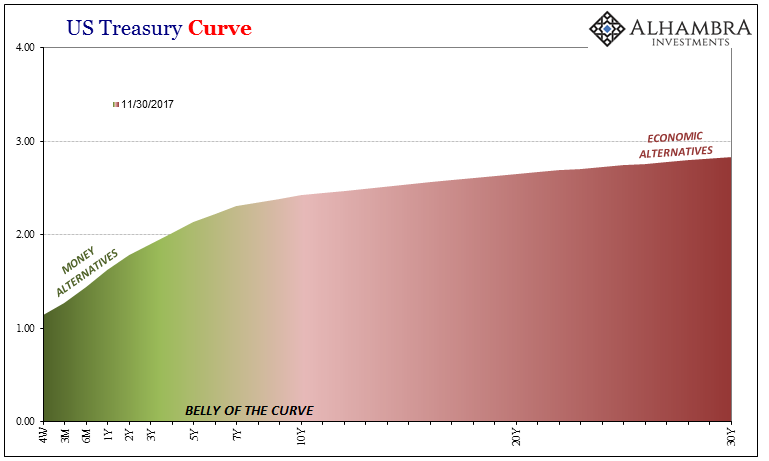
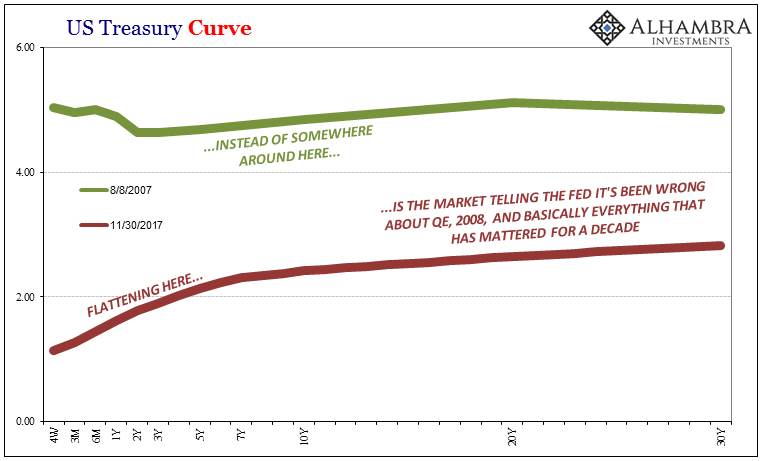
If solid growth plus full employment equals a steeper yield curve and higher long rates, and they do, then a flatter curve at lower nominal rates must then equal what?


The answer is far easier than the media makes it out to be. In what is pure Aristotelian sophistry, they try very hard to ignore their own logic where the answer to this “conundrum” is clearly choppy, lackluster growth that has left the (global) economy considerable hangover slack.


That’s what the yield curve continues to say, the only thing it has said for many years now.


It’s amazing that after more than a decade now of these markets (UST’s, eurodollar futures, swaps, FX, etc.) declaring that “something” is wrong how easily it is for these people to simply set it all aside because their highly optimistic view on the economy, derived exclusively from central bank forecasts and actions, just has to be right. They are actually saying that markets need to conform to their opinions without evidence, and without recognizing the market prices are evidence, as if theirs is the only correct possibility.


Time plays a significant component of that backwards view because it is extremely hard to believe the global economy could ever be stuck in such an awful place for so long.


It just seems so impossible, completely out of our own experience. Even if by random luck you would think enough would have gone right in just monetary policy by now that what is claimed for the economy in the mainstream might actually have come true. But this set of circumstances is not absent from all experience, just the modern one.


The point of failure is right where it shouldn’t be. That’s what’s making it so difficult. Even the bond market (as eurodollar futures and the rest) is declaring this to be the case. The issue is central banks and central bankers who have done nothing right, failed to achieve any positive offsets, and left the global economy to stand naked against the intermittent forces (three so far) of negative monetary decay.


So the real problem in the mainstream is over who to believe; the central bank technocrats who most people have been thoroughly schooled to trust without question, or these markets where actual discipline is the order of operation?


As hard as it may be to believe, I once gave central bankers the benefit of the doubt, too (though perhaps not as stridently as some still today). I had come to expect in early 2007 that the Fed, though clearly behind the curve, would catch up and fix the problem before it got out hand. Greenspan’s reputation had lost a lot of luster in my eyes as a result of lingering unanswered questions about the dot-com era and “jobless recovery” after that (mild) recession, but surely he wasn’t grossly incompetent. He couldn’t have been, could he?


It was really difficult to accept that it was all smoke and mirrors, one of those viral kind of things where you tend to believe something is true simply (solely) because everyone else does. It becomes such hardened “fact” that to even think about challenging it makes people wonder what’s wrong with you. The wisdom of the crowd is perhaps just as often that sort of mass delusion wrapped in an impenetrable bubble.


Then August 9 happened, and similar days happened afterward in repeating fashion. Then 2008. That should have been more than enough to dispel any notions of competence on any subject related and not; monetary as well as economic. The panic itself and the enormous global economic consequences should have ended Economics.


They really don’t know what they are doing. They never have. The central bank holds only one specialty to which it is any good, a capability that Milton Friedman pointed out in one of the last interviews he ever gave more than a decade ago just prior to the onset of all this trouble.


The difficulty of having people understand monetary theory is very simple - the central banks are good at press relations. The central banks hire people and the central banks employ a large fraction of all economists so there is a bias to tell the case - the story - in a way that is favorable to the central banks.


But the Great Depression was such a major event and such a disaster that there was no way in which you could talk it away, although they tried to do so. If you read the annual reports of the Federal Reserve Board or its testimony before Congress, you will find that as late as 1933, at the very depths of the depression, it’s talking about how much worse things would have been if the Fed hadn’t behaved so well. [emphasis added]


Central bankers simply did it again.


What was Ben Bernanke’s message at the end of 2008? He was no longer talking about prevention, as had been standard up until Lehman, and accounting for what he had done prior.


Bernanke simply began speaking and writing and televising exclusively about “jobs saved”, what the Fed was going to do in the future to cushion the blow that was then some devious, exogenous factor no reasonable person could ever think to blame monetary officials about. No longer would there be much about the past, what they had done prior. All the world’s central banks were suddenly victims, too.


And like the thirties, it was all BS.


But “we” let them off the hook to write their books, revise the official history of the crisis so that somehow they come off the heroes when they were seriously, perhaps criminally, as well as obviously (when you look), derelict. The degree of gross incompetence was absolutely staggering – and it never ceased. You require no special training to easily understand that if as a central banker you “need” a second QE (let alone a third or fourth) the whole thing just doesn’t work (how can it be “quantitative” if you don’t know the right quantity?)


Central banks are the epitome of PR and media manipulation. And that’s all they are, certainly no money in monetary policy. They’ve done such a masterful job of it that even today no matter how much market data disagrees, people just refuse to believe it.


Tuesday, October 10, 2017

Extremes Are Everywhere

Authored by Lance Roberts via RealInvestmentAdvice.com,


This past weekend, I discussed what appears to be the markets ongoing melt-up toward its inevitable conclusion. Of course, that move is supported by the last of the “holdouts” that finally capitulate and take the plunge back into a market that “can seemingly never go down.” But therein lies the danger. To wit:


“However, it should be noted that despite the ‘hope’ of fiscal support for the markets, longer-term conditions are currently present that have led to rather sharp market reversions in the past.”


“Regardless, the market is currently ignoring such realities as the belief ‘this time is different’ has become overwhelming pervasive.”


The other problem on a short-term basis is the market is pushing very elevated levels currently. As shown below, with RSI (14) now above 70, the market 3-standard deviations above the 50-dma, and the MACD over 13, in both previous cases over the last year a short-term reversal followed.


A similar outcome would not be surprising this time either, so some caution is advised.


Positioning Review


The COT (Commitment Of Traders) data, which is exceptionally important, is the sole source of the actual holdings of the three key commodity-trading groups, namely:


  • Commercial Traders: this group consists of traders that use futures contracts for hedging purposes and whose positions exceed the reporting levels of the CFTC. These traders are usually involved with the production and/or processing of the underlying commodity.

  • Non-Commercial Traders: this group consists of traders that don’t use futures contracts for hedging and whose positions exceed the CFTC reporting levels. They are typically large traders such as clearinghouses, futures commission merchants, foreign brokers, etc.

  • Small Traders: the positions of these traders do not exceed the CFTC reporting levels, and as the name implies, these are usually small traders.

The data we are interested in is the second group of Non-Commercial Traders.


This is the group that speculates on where they believe the market is headed. While you would expect these individuals to be “smarter” than retail investors, we find they are just as subject to human fallacy and “herd mentality” as everyone else.


Therefore, as shown in the series of charts below, we can take a look at their current net positioning (long contracts minus short contracts) to gauge excessive bullishness or bearishness. With the exception of the 10-Year Treasury which I have compared to interest rates, the others have been compared to the S&P 500.


Volatility Extreme


The extreme net-short positioning on the volatility index suggests there will be a rapid unwinding of positions given the right catalyst. As you will note, reversals of net-short VIX positioning has previously resulted in short to intermediate-term declines. With the largest short-positioning in volatility on record, the rush to unwind that positioning could lead to a much sharper pickup in volatility than most investors can currently imagine.


Crude Oil Extreme


The recent attempt by crude oil to get back to $50/bbl coincided with a “mad rush” by traders to be long the commodity. For investors, it is also worth noting that crude oil positioning is also highly correlated to overall movements of the S&P 500 index. With crude traders currently extremely “long,” a reversal will likely coincide with both a reversal in the S&P 500 and oil prices being pushed back towards $40/bbl. 


While oil prices could certainly fall below $40/bbl for a variety of reasons, the recent bottoming of oil prices around that level will provide some support. Given the extreme long positioning on oil, a reversion of that trade will likely coincide with a “risk off” move in the energy sector specifically. If you are overweighted energy currently, the data suggests a rebalancing of the risk is likely advisable.


US Dollar Extreme


Recent weakness in the dollar has been used as a rallying call for the bulls. However, a reversal of US Dollar positioning has been extremely sharp and has led to a net-short position.


As shown above, and below, such negative net-short positions have generally marked both a short to intermediate-term low for the dollar as well as struggles for the S&P 500 as a stronger dollar begins to weigh on exports and earnings estimates.


Interest Rate Extreme


One of the biggest conundrums for the financial market “experts” is why interest rates fail to rise. Apparently, traders in the bond market failed to get the “memo.” With the net positioning in bonds at some of the highest levels since the financial crisis, there is little reason to believe the “bond bull” market is over. Look for a reversal of the current positioning to push bond yields lower over the next few months.


It is also worth watching the net-short positioning the Euro-dollar as well which has also begun to reverse in recent weeks. Historically, the reversal of the net-short to net-long positioning on the Eurodollar has often been reflected in struggling financial markets.


Smart Vs. Dumb Money Extreme


While we have been looking at solely the large non-commercial traders above, they are not the only ones playing in the future markets. We can also dig down into the overall net exposure of retail investors (considered the “dumb money”) versus that of the major institutional players (“smart money”)


The first chart below shows the 3-month moving average of both smart and dumb-money players as compared to the S&P 500 index. With dumb-money running close to the highest levels on record, it has generally led to outcomes that have not been favorable in the short-term.


We can simplify the index above by taking the net-difference between the two measures. Not surprisingly, the message remains the same. With the confidence of retail investors running near historic peaks, outcomes have been less favorable.


None of this analysis suggests that a market “crash” is about to occur tomorrow. However, with complacency high, and investors scrambling to find excuses why markets can only go higher, suggests that extremes in positioning have likely been reached. 


This was a point made by Macquarie’s Viktor Shvetz, the bank’s head of global equity strategy, yesterday:


Investors seem to be residing in a world without any notable perceived risks. It is an extraordinary and unprecedented situation, particularly given unresolved issues of over-leveraging and associated over-capacity as well as profound disruption of business and economic models, which are not just depressing inflation but also causing extreme political and electoral outcomes while feeding Maslowian-type disappointments across labor markets.


What can explain such lack of concern regarding potential risks?


In our view, the only answer is one of investors’ perception that, as we discussed in our preview of 2H’17, ‘slaves must remain slaves’ and hence, neither Central Banks nor other public institutions can afford to step aside but need to continue to guarantee asset price inflation. In its turn, this can only be achieved by ensuring that volatilities are contained (as they are the deadliest enemy of an ongoing leveraging) and liquidity is expanding at a sufficient pace to accommodate nominal demand.


We remain constructive on financial assets (both equities and bonds), not because we expect a return to self-sustaining private sector-led recovery and growth but because we believe that an ongoing financialization is the only politically and socially acceptable answer.


In our view, therefore, the greatest risk is one of policy.”


The complete disregard for “risk” has never worked out well for investors in the past and is unlikely to be different this time either. But remember, in the short-term, the markets can remain irrational longer than logic would predict and they always “feel” their best at the peak.