Showing posts with label Recession. Show all posts

Friday, April 20, 2018

Peter Schiff Economy Warning : ‘Enjoy The Calm Before The Storm’


Financial analyst Peter Schiff is warning to “enjoy the calm before the storm.” Schiff, who predicted the 2008 recession says that inflation and interest rates are about to go up much more than expected.


In his most recent podcast, Schiff basically said to enjoy things now, because the storm will eventually hit. With the United States missile strike in Syria, rumblings of a trade war and a generally weak dollar, gold briefly flirted with $1,365 last week. But the anticipation of Federal Reserve rate hikes continues to create strong headwinds against the yellow metal. Many people now think the Fed will nudge interest rates up again in June, leaving six months to get in the much-anticipated third hike of the year, and possibly even get in a fourth.


The Fed is not going to be able to deliver the rate hikes the Fed is expecting, and again, it’s the expectation of more rate hikes that is what is keeping the lid on the price of gold. But it’s only a matter of time before the market blows the lid off and the price of gold goes up. –Peter Schiff


Peter said gold is basically trading sideways right now, in advance of a breakout. Meanwhile, the dollar is doing the same thing in the other direction. The greenback is weak but not breaking down. On the other hand, it isn’t recovering any of its losses. Peter thinks it’s treading water right now before it heads lower again, according to Seeking Alpha. 


Of course, the economic growth was supposed to help “pay for” the tax cuts and the massive amounts of deficit spending. If the economic growth doesn’t materialize, the deficits will be even bigger and they are already going sky-high. On top of that, rising interest rates are going to increase the annual payments on the debt.


So, these deficits are blowing through the roof and this is going to be the driving force in moving the dollar substantially lower and moving gold substantially higher.


We are in the perfect storm, I think, of massive explosion in deficits, not just the budget deficit but the trade deficit, these tariffs or a trade war is only going to compound the problem. We’ve got the economy weakening. We’ve got the dollar teetering on the brink of collapse. We’ve got gold about to break out and the bond market is in the same thing.


Right now, everything seems pretty calm on the horizon, but we are in the calm before the storm.


The three major markets – bonds, gold, and the dollar – are all moving sideways, getting ready to continue their most recent moves, which for gold is up, for the dollar is down, and for bonds are down, which means interest rates are up – and it’s one, two, three strikes and you’re out.

Tuesday, April 17, 2018

Doug Duncan: Even US Government Economists Predict Trouble Ahead

This report was originally published by Adam Taggart at PeakProsperity.com


Doug Duncan is not your average beltway economist.


The chief economist for Fannie Mae is surprisingly outspoken about the troublesome outlook for the US economy. He’s worried about the rising cost of debt service as outstanding credit continues to mount at the same time interest rates are starting to ratchet higher, too.


He predicts the US will enter recession within a year, concurrent with a topping out of America’s real estate market. It wouldn’t surprise him to see the stock market falter, too, as central banks around the world begin a coordinated tightening of monetary policy and — similar to the thoughts recently expressed within our podcast with Axel Merk — Doug expects Jerome Powell to be much more reluctant to intervene in attempt to support asset prices. Having met personally with Powell, Doug thinks the Fed is now happy to see some of the air come out of the Everything Bubble (just not too much and not too fast) — a market change from past Fed administrations:


Our forecast definitely sees slowing economic activity, particularly in the second half of ’19. Part of it has to do with the length of the expansion. Just because an expansion is long doesn’t mean it’s going to end; but they all have eventually ended, and this one is getting pretty old. I think if it’s not the second longest, it’s getting to be the second longest that we’ve ever had shortly.


The tax bill was viewed differently by different parties, but the capital markets initially took that — plus the $300 billion agreement to get past the expiration of government funding plus the budget agreement — they took all those things as inflationary. The tax bill itself has a lot of temporary provisions – some of them don’t expire for up to seven years – but some start expiring as soon as three years out. Like, on occasions, take actions today which they see having benefits up until that time of the expiration of those terms, plus the spending component – the $300 billion – also will likely take place in the next four quarters. That suggests that the second half of ’19 we may well see the impulse from those things starting to fade. And that will be happening at the same time as the Fed, if it does what it says its going to do, will be continuing its tightening(…)


So,what keeps me up at night? Well, I don’t like the idea that we have a debt to GDP ratio of 100 percent. I don’t think we’re Japan because we have a more entrepreneurial economy, not a mercantilist economy, but that doesn’t mean that debt doesn’t reduce your flexibility. It definitely reduces your flexibility, so it raises risks from that perspective.


The trade negotiations, obviously, are of a concern. Milton Freeman said a good free trade agreement can be written on one page. NAFTA was two thousand pages. It would be silly to suggest Trump doesn’t have a point that there’s not something in that two thousand pages that didn’t work against American interests. On the other hand, if you’re going to throw $150 billion of tariffs at the second largest economy in the world, you should expect a reaction. Those who read the history books and the Smoot Hawley tariffs and the Depression and have some understanding of the relationship between the two of those have to be a bit nervous. The Fed, I’m sure, is looking at that.


And the domestic economy, the thing that probably troubles me more than anything else is the decline in new business formation. It’s been underway for thirty years. I’ve got staff that are working just trying to understand that. There’s a couple reasons why I worry about that. I just make a comment about ours being an entrepreneurial economy which means it is ‘dynamic’ – people don’t care if the average income is higher than theirs if theirs is the median. If they expect that there’s an opportunity for them to grow and gain one of those high incomes, then they’re OK. But if they lose that hope, that leads us to some different possible political economy outcomes which I don’t view as particularly optimal.


But from a self-interested perspective — remember that we’re in the housing and new business formation space – it used to be the case that a when small business would start, it couldn’t afford to pay the same wage rate as a large business did because it didn’t have the scale or the output or that kind of thing. But what the worker who got the lower wage job also got was training on how to get to work on time, how to work a full day. They would pick up some skills and some behaviors that worked broadly in the employment market. Over time they would move up, and most of them would eventually get to the middle class and buy a house. That’s breaking down.


If that engine of growth for people has been cut off, then we could be facing a permanent underclass which carries a whole different set of connotations for a society which, to me, is pretty troubling.


Click the play button below to listen to Chris’ interview with Doug Duncan (45m:19s).


To read the transcript of this podcast, please click here.

Wednesday, April 4, 2018

Peter Schiff: We Are In A Bear Market, All News Is Bad News


After rallying on Friday, stocks tanked on Monday, dropping over 450 points. In fact, it was the worst first day of the second quarter since the Great Depression.


Stocks dove Wednesday as well on the heels of China’s announcement that they will intensify the trade war with more tariffs, according to most analysts.  But Peter Schiff, the financial guru who accurately predicted the 2008 recession has a different take.


According to Schiff’s blog, Schiff Gold, most analysts blamed the plunge on the escalating trade war, but Peter Schiff sees it quite a bit differently. He said it was just another bad day in a bear market. In fact, he said the market could have rallied because the Chinese response wasn’t as bad as it could have been. But when you’re in a bear market, all news is bad news.


Schiff says that the media’s talking heads are simply using the tariffs as an excuse. The real truth is that most people are in a selling mood. “Stocks are expensive. The bull market is over. It’s now a bear market. People want to get out. People are allocating out. Growth is slowing whether people want to acknowledge it or not,” said Schiff.


The media pundits are optimistic too; just like they were before the 2008 recession, said Schiff. “That’s what’s going on now. Nobody thinks there’s a problem. Everybody is optimistic. Everybody is bullish. So, when you see these classic signs that something is going wrong, you just ignore it.”


The bottom line is Schiff thinks the economy is going to tank (although he isn’t sure how soon that will occur) and the stock market is going to continue its bear run. But the Fed is not going to be able to come to the rescue this time around because of inflation. If it does try to launch more QE to bail out the stock market, it will completely tank the dollar.


When we do all that, the dollar is going to implode because everybody is going to know that the experiment failed. Everybody is going to know there is no way out of this box. There is no normalization of rates that is ever going to happen. Their balance sheet is never going to shrink. The balance sheet is going to grow permanently, which means this banana republic debt monetization. They can no longer pretend that they’re not doing the same things as South American banana republics. It’s a pure ‘we just print money to finance government spending,’ which is going to explode.


The national debt is an often overlooked aspect of the economy, but in truth, it will play a big role in an economic collapse and Schiff is sounding the alarms.

Thursday, March 22, 2018

Peter Schiff: There’s A BIG Problem With The Economy, ‘Americans Are BROKE’


Financial analyst Peter Schiff says there’s a big problem with the economy even though the mainstream media is reporting that rising interest rates are a good thing.  The problem, however, is that Americans are broke, and those interest rates could have a major impact on some of our wallets.


“The bad news is, we are going to live through another Great Depression and it’s going to be very different. This will be in many ways, much much worse, than what people had to endure during the Great Depression,” Schiff says. “This is going to be a dollar crisis.”


“When you are talking about the magnitude of the debt we have, that extra money [raising interest rates] is big. That’s going to be a big drain on the economy to the extent that we have to pay higher interest to international creditors…a lot of this phony GDP is coming from consumption, while the average American who is consuming is deeply in debt and they are going to impacted dramatically in the increase in the cost of servicing that debt…given how much debt we have, and how much debt is going to be marketed the massive increase in supply will argue for interest rates that are higher.” –Peter Schiff


Retail sales “unexpectedly” fell again in February even though most media outlets are touting a booming economy that can support raising the interest rates. It was the third straight monthly drop and the first time the US economy has seen three straight months of declining retail sales since 2012.


Sales fell 0.1% in February even though analysts had expected an uptick of 0.3%. According to CNBC, households cut back on purchases of motor vehicles and other big-ticket items, pointing to a slowdown in economic growth in the first quarter. But Peter Schiff won’t sugarcoat this one for us: Americans are broke.


And the worse things get, the less investors seem to notice.


What makes matters even worse is on Friday, we got the “too good to be true” and “just what the doctor ordered” Goldilocks jobs report that said 1 million people got jobs. Schiff said this “good news” report doesn’t make any sense, actually.


“So why didn’t any of those million people take their paychecks and spend them at a retailer? I mean, Trump is talking about all the great jobs, and all the raises that people have, and all the tax cuts. Why are retail sales down for three months in a row?” –Peter Schiff


Unfortunately, we also saw Americans running up record high levels of debt at the same time that the government is running massive deficits.


Last month, the New York Fed released the latest data on US household debt, revealing it has grown to a record $13 trillion. So yes, Americans have been spending, but they’ve been putting a lot of it on plastic. Credit card balances grew by $24 billion in the last quarter of 2017 alone. Could it be that Americans have maxed out the plastic?


At some point, a house of credit cards will collapse.


Schiff is hard on Donald Trump too, and rightfully so.  Lower taxes are always a good thing, the lower the better, in fact.  But Republicans refused to cut any government spending while instead, increasing it to the point of running massive deficits, making them worse than Democrats when it comes to being fiscally conservative.


The cold truth is that a back plan is needed, and most Americans don’t have that.  Many would be in some serious trouble during a financial downturn, and the country is most definitely headed that way.

Monday, March 19, 2018

Financial Strategist: Trade War Could Usher In Dire Financial Crisis MUCH SOONER


According to a Societe Generale strategist Albert Edwards, a trade war would bring about a financial crisis a lot sooner than anyone expected. Edwards has warned in the past that currency devaluation could spark an economic recession worse than 2008, and now he’s sounding the alarm about Donald Trump’s trade policies.


Edwards now points to the Trump administration’s trade policy as yet another catalyst that could hasten the next crisis. Recent tariffs the US imposed on steel and aluminum imports threaten a full-scale trade war, he claimed.  While tariffs and taxes always get passed onto the American consumer in the form of higher costs for goods, it is unfortunate that the tariff talk is ongoing.


The US could also turn on other trading partners as Trump continues to advance his “America First” agenda, reported the Financial Tribune. “Boiling away in the background is Germany’s, and now also the eurozone’s, outsized trade surpluses” with the US, Edwards said. He added, “Expect Trump to soon turn his protectionist fire on both Germany and the EU. That will be messy.”But there is some good news many in the mainstream media continue to ignore:


While much of what Trump is announcing today has already been leaked, here are the details of the import tariffs Donald Trump formally adopted on steel and aluminium imports which allow US allies to negotiate and apply for exemptions, a sign of the growing concern that the president was alienating America’s closest international partners, and that 2 of the 4 largest foreign suppliers of steel will be exempt. –Zerohedge


“A trade war and competitive currency devaluation was always going to be the end game in our Ice Age thesis as a global deflationary bust destroyed wealth, profits, and jobs,” Edwards said in a note on Thursday. “But it looks as if it might be arriving sooner than we had anticipated.”


China exports just 1.1% of its steel to the United States, therefore, the tariffs are considered unlikely to do any serious damage to Chinese businesses. The more immediate fuel for a trade war, Edwards said, is retaliatory action against China by the US for alleged intellectual property theft. The Nikkei Asian Review reported Wednesday that the US was set to impose tariffs on $60 billion worth of Chinese products as punishment. Yet remember, a tariff isn’t going to punish the Chinese; it will punish the American consumer as prices go up to cover the cost of the new tax.


A White House official says there will be no significant downstream price effects, and thus no significant downstream job effects, according to Zerohedge. But that expectation counters multiple statements and prognostications from several companies and industry groups that use steel and aluminum, as well as lawmakers representing them, who have warned the tariffs will harm their businesses or industries.

Friday, March 9, 2018

Inflation Markets Just Flashed Recession-Red-Flag For The First Time Since 2008

This report was originally published by Tyler Durden at Zero Hedge


Amid all the talk of wage growth and surveys suggesting input and output prices are soaring, the market for ‘inflation expectations’ is suddenly flashing a recessionary red flag not seen since July 2008.


The last few months have seen short-term (5Y) inflation expectations in the breakevens market surge to their highest in 5 years; and while longer-dated inflation expectations have also risen, they have not kept pace with the short-end. A similar move was last seen in Q1/2 2008.


Simply put, markets are expecting an inflationary impulse in the short-term, but do not expect it to last as it will likely be swamped out by a recession as the economy is not grown fast enough to justify prices rising at that pace, and instead either profit margins will collapse or end demand shrivels as companies fail to pass through rising costs.


And, as a result, for the first time since July 2008, the inflation breakevens yield curve has inverted, with the market’s expectations for 30Y inflation now below that just 5 years ahead.


What is especially notable, is that the last time this happened, the US was already deep in recession (and we note that each time the 5Y has approached the 30Y, it has backed away – which given the sensitivity of stocks to breakevens could be problem going forward).


Wednesday, February 21, 2018

Money Manager: ‘The Chaos Coming To The Markets Is Here’


Money manager Michael Pento says that profound chaos surrounding the economy is coming. The insolvency is becoming clear, and soon, we will no longer be able to sweep the problem under the rug.


Sitting down with USA Watchdog’s Greg Hunter, Pento discussed the chaos people predicting in the markets and says that it’s already here. Pento is the author of the book titled The Coming Bond Market Collapse, as well as a financial expert and he says the media is lying when they say the economy is doing well.


“There are so many things that can go wrong with rising interest rates.  First of all, you have to understand that the permabulls that you hear on CNBC will tell you there is nothing wrong with rising interest rates.  It is a symbol of growth.  If you look at industrial production and retail sales for January, they were negative.  So, rising rates are occurring, not because of growth, they are caused by insolvency concerns.  That is the key metric here, and they are credit risks and insolvency concerns.”


“For the first time in 40 years, you are going to have bond prices and equity prices in free-fall. That happened in the 1970’s, but it’s going to be worse because in the 1970’s, you didn’t have an insolvency concern. . . The chaos coming to markets is here. It’s not going away, and it’s not going to be brushed under the rug. It’s not going to stay on the sidelines for another few years. The years from 2007 to 2017 were the years central banks were buying everything. There was no volatility, and stocks just went up. Those days have ended, and the volatility is only going to become much more profound.”


Hunter then asks Pento to explain who is insolvent.  The answer isn’t calming in the least.


“They’re all insolvent. Europe is insolvent. The United States is insolvent. We have $21 trillion of national debt…it’s seven times our revenue. So we are technically insolvent. And you haven’t seen anything yet because as interest rates rise, debt service expenses rise. The ECB is insolvent, certainly, beyond a shadow of a doubt, the Bank of Japan is insolvent.  I’ll tell you who else is insolvent…you asked me what’s gonna happen.  So, as interest rates rise from 1.4 from where they were in the summer of 2016, to well about 4 %, and I think it can go much higher…I think the end game here is that central banks are going to come back and buy everything.


What we’re gonna have here is a collapse in the bond market…and as interest rates rise, it’s not just treasuries that are gonna blow up.”


Pento is not the first market analyst to show a grave concern over insolvency. The U.S. deficit is beyond any control at this point. But Hunter presses Pento after he uses the term “unwinding” to describe the dire economic situation the government has gotten us into.  Hunter asks if there are people whose debt is just going to be wiped out and if at some point, the debt is going to go to “zippo.”


“According to the Bank for International Settlements, 10% of all corporations don’t have enough…to cover interest expenses. That’s ten percent of the world’s corporations. So, how have they even existed in the past eight, nine, years? By issuing debt to pay debt. So when yields rise, it’s very likely that a high percentage, maybe even all ten percent of these (they call them zombie corporations) go out of business.”


“That would be millions of jobs globally!” Hunter said. And there’s no way out.  The central banks are now out of options.

Wednesday, January 31, 2018

Peter Schiff: ‘The Price Of Gold Is Going To Soar’ And ‘The Dollar WILL Collapse’

peterschiff


Peter Schiff recently attended the Vancouver Resource Investment Conference. While he was there, he did an interview with Daniela Cambone of Kitco News and Schiff said gold is going to soar.


But Schiff (who predicted the 2008 recession) also explains why he believes now may be a good opportunity to invest in physical gold. Schiff said that the standard sentiment shared by many is that once the Federal Reserve jacks up interest rates, gold will stay level and unaffected. But that didn’t happen. Schiff said that the yellow metal has surprised the initial expectations that it would fall when the Fed raised rates; gold has climbed 9% since the Fed hiked last month.


Gold has not really rallied. It’s been going up, right? But it’s been creeping higher. Now, everybody expected it to fall. Everybody believed that as soon as the Fed hiked rates, gold’s gonna tank. And it didn’t tank. It rallied. -Peter Schiff


Investors tend to sell the rumor of rate hikes and buy the fact when in reality, the higher interest rates are not bearish for gold. But as Peter points out, that mindset still exists in the market.


But you know, the Fed keeps raising rates a little bit, every once in a while, and everybody still believes that, well, the Fed is raising rates, so that’s bearish for gold. So, everybody expects gold to fall, yet it continues to creep higher. But I think once it overcomes some of this resistance –  it has a lot of resistance around $1,350 – and I think if we can decisively move above that and then get above $1,400, just to make sure it’s cleared out, then I think it’s off to the races.


Schiff also touched on the optimism in the markets, as he so often does, claiming still that the tax cuts won’t help much because the size of government hasn’t shrunk.  He also says the rising interest rates will suck up the benefits of those tax cuts either way.


 These tax cuts are not going to provide the economic boos that everybody believes.


I think the impact of rising interest rates and rising consumer prices will more than offset whatever benefits are to be had from the tax cuts. So, I think the economy is going to be weaker despite the tax cuts. I still think we’re heading into recession.


It’s rare to have this much optimism, but there are more problems now than there’s probably ever been, yet everybody is overlooking that. So, at some point, people are going to rush into gold, and the problem is there’s no one that’s going to rush out. So the price, I think, is just going to soar. I think you’re going to see 50 or 100 dollar moves per day up in the price of gold, once we break out.


Schiff holds firm that the consequence of the Federal Reserve manipulating the economy will be the crash of the dollar.


They actually made the bubbles bigger than the ones that popped. So now, the dollar’s collapse is going to be that much bigger, because it’s now a bigger bubble with more air to come out of it. And I think they have no more tricks up their sleeves. When this happens – it’s over.”


Monday, January 29, 2018

The Importance Of Prepping: Alaskans Turn To Government For Food Amid Recession

foodstamps


Tens of thousands of people have turned to the government for healthcare and food amid Alaska’s recession, prompting questions from state lawmakers about the sustainability of those “safety-net” programs. Simple state-wide recessions such as Alaska’s highlight the importance of being prepared.


According to Alaskan Governor Bill Walker’s administration, the estimates are 240,000 people will be enrolled in the Medicaid health-care program next year, up from 163,000 in 2015. And 101,000 Alaskans were receiving food stamps in September, up from 72,000 a year earlier, according to preliminary federal data. Although the federal government covers most of the cost of Alaska’s food stamp program, Medicaid is supported by both the state and federal governments and is one of the biggest line-items in Alaska’s budget, at about $700 million. And some conservative lawmakers say they’re worried about the growth in enrollment.


Anti-hunger advocates want to see adequate budgets for their government programs rather than rely on the free market. They also oppose making it more difficult for people to qualify for assistance programs given how many Alaskans are struggling, said Sarra Khlifi, program manager at the Alaska Food Coalition.


Khlifi said her members — social service organizations focused on fighting hunger and its causes — have been noticing more consistent demand, instead of in the past when clients arrived at the end of the month after using up their food stamps.


But higher taxes to fund government programs only force those living paycheck to paycheck to also enter into these very programs, which were supposed to be designed to eliminate hunger. It’s the vicious cycle of a government attempt to fix a problem they started. But simply storing canned foods can be a good start to prepare for a recession.


Due to the overwhelming nature of preparedness, it can be difficult to simply begin the journey. But as we all know, anything can happen, and when it does, we could benefit from having extra food on hand.


preppers-blueprint


Recessions, such as the one Alaskans are experiencing, dictate the importance of a backup plan. Being prepared to the best of your ability rather than relying on the dwindling funds from government programs will give someone the best chance at survival without putting yourself at the mercy of the state. Great references exist to help anyone prepare for any situation.

Monday, December 25, 2017

Uninvestable Tesla

Tesla is an uninvestable stock for me, not just because of its high valuation but also because it fails our fairly basic quality test, which I shamelessly borrowed from Warren Buffett: Would I still buy this stock if right after the purchase the stock market were to close for ten years? If you are a big Tesla car and stock fan, before you start throwing rocks at me, pause and wait till you finish this article – the rocks and I will still be there.


Think about the next ten years. But before you start mentally drawing upward-sloping lines from the current environment into the next decade and drooling over the rosy vision of Tesla’s future that Elon Musk has painted – produce half a million model 3s and bunches of semis and roadsters, and then send a roadster to Mars (I kid you not; that is in his 2018 plan – I’d like you to think about another version of the next ten years: higher (maybe much higher) interest rates, a recession in the US and around the globe, and a less promiscuous bond market where Tesla would have pay a substantial premium to US Treasuries (as would any other company that loses over a billion dollars a year in a highly cyclical industry). And now answer this question: Would Tesla survive this change in economic weather if it happened next year or even three years out? And the answer is … a weak “maybe” at best, and “unlikely” at worst.


The counterargument I’d get: Yes, but we are not going into a recession. Actually, we are. I (and nobody else, for that matter) just don’t know when. After nine years of appreciating stock markets and tepid economic growth, we tend to forget that recessions are a regular  economic fact of life, usually arriving every four to five years (so we are overdue for one). Most Millennials have yet to experience adulthood (have a job and a family) through a recession. They have also never had to borrow at high interest rates – but that is liable to happen, too.


Recessions are usually caused by expansions. Recessions are like the hangover that comes after the wild college party (economic expansion). It’s hard to have a good, fun college party with lots of booze and then not experience a hangover. (I am not speaking from recent personal experience but rather am trying to communicate in language to which Millennials can relate). During the expansion party, companies may build up too much inventory or erect too many factories, and consumers may overconsume.


If you own high-quality companies, ones that meet Buffett’s “ten-year stock market closed rule” (as we do), you don’t have to spend a lot of time and energy thinking about when the recession will hit (we don’t). However, if you own Tesla you’d better have a very clear, shiny crystal ball that will reveal lots of detail about the direction of interest rates and the global economy.


Recessions are tough for deeply cyclical companies: The bulk of their costs are fixed, and thus lower sales usually result in significant declines in net income and often lead to losses. This is why car companies and their deeply cyclical brethren don’t trade at high price-to-earnings levels when the economy is doing well. That is when their earnings are high. The market doesn’t usually take these high earnings at face value, knowing full well that there are lower earnings (or losses) around the corner when recession comes. Tesla, however, doesn’t have to worry about this low price-to-earnings problem, because in spite of its $50 billion market valuation, it has no earnings, just losses. It trades at whatever price-to-future Elon Musk tells you it does.


If you own Tesla stock and you only see one rosy (Musk) version of the future, you are ignoring the very real risk that the benign economic environment of today will not persist indefinitely into the future . Good luck – you’ll need plenty.


One additional but very important point. In the past I was dismissive of traditional automakers’ ability to compete with Tesla. I felt their hundred-year past of producing internal combustion engine (ICE) cars was going to hold them back, the same way Nokia’s dumb-phone past prevented it from effectively competing against Apple’s iPhone. Nokia tried to take the dumb-phone operating system Symbian and turn it into a smartphone operating system. It had a lot of engineers who knew the Symbian operating system, and thus it seemed a logical path at the time. The right approach would have been the more difficult one: Hire new engineers and create a brand new operating system. There was absolutely no reason why Nokia could not have developed its own Android-like OS, even if doing so would have required either retraining or, more likely, laying off Symbian engineers.


For a while it looked like I was right about cars, as the Big Three took a hybrid (Symbian-like) approach to electric cars – they were having a hard time saying goodbye to ICE. However, as we look at the future lines of electric cars coming from  US and German automakers, we now see them severing the connection to their ICE past and embracing electric.


Disclosure: I am an unsecured lender to Tesla through my $1,000 deposit on a Model 3. 


So, how does one invest in this overvalued stock market? Our strategy is spelled out in this fairly lengthy article.


Vitaliy Katsenelson is chief investment officer at  Investment Management Associates  in Denver, Colo. He is the author of “Active Value Investing” (Wiley) and “The Little Book of Sideways Markets” (Wiley). Read more on Katsenelson’s  Contrarian Edge  blog.

Saturday, December 23, 2017

Silicon Valley Obscenity - 1 In 4 People Are "Food Insecure"

In the years since the first dot-com bubble burst, Silicon Valley has become emblematic of the intensifying wealth inequality that’s making life increasingly unaffordable for millions of working- and middle-class Americans.


And while the unprecedented wealth creation in the region has helped enrich hundreds of thousands of tech workers and entrepreneurs, virtually everybody else in the region – from college students to the cafeteria workers and janitors who service the headquarters of storied tech firms like Google and Facebook – has suffered from rising rents and a cost of living that’s far outstripped wage inflation.


Now, a study has found that more than one in four Silicon Valley residents is food insecure – meaning they go without at least one meal or rely on food pantries due to lack of financial resources, according to researchers at the Second Harvest food bank.


Using hundreds of community interviews and data modeling, a new study suggests that 26.8% of the population – almost 720,000 people – meet this ignominious designation. Furthermore, nearly a quarter are families with children.


“We call it the Silicon Valley paradox,” says Steve Brennan, the food bank’s marketing director. “As the economy gets better we seem to be serving more people.” Since the recession, Second Harvest has seen demand spike by 46%.


The Guardian interviewed local residents who qualify as food insecure for a story about the worsening wealth gap in one of the wealthiest regions in the US.


Karla Peralta is surrounded by food. As a line cook in Facebook’s cafeteria, she spends her days preparing free meals for the tech firm’s staff. She’s worked in kitchens for most of her 30 years in the US, building a life in Silicon Valley as a single mother raising two daughters.


But at home, food is a different story. The region’s soaring rents and high cost-of-living means that even with a full-time job, putting food on the table hasn’t been simple. Over the years she has struggled to afford groceries – at one point feeding her family of three with food stamps that amounted to $75 a week, about half what the government describes as a “thrifty” food budget. “I was thinking, when am I going to get through this?” she said.


In a region famed for its foodie culture, where the well-heeled can dine on gold-flecked steaks, $500 tasting menus and $29 loaves of bread, hunger is alarmingly widespread, according to a new study shared exclusively with the Guardian.


According to the Guardian, the food bank is literally at the center of the Silicon Valley boom – both literally and figuratively. It sits just half a mile from Cisco’s headquarters and counts Facebook’s Sheryl Sandberg among its major donors. But the need it serves is exacerbated by this industry’s wealth; as high-paying tech firms move in, the cost of living rises for everyone else.


As we’ve pointed out, faced with some of the most expensive rental housing in the nation, some Bay Area residents are feeling priced out and are seeking low-cost alternatives like living in their cars, or commuting nearly two hours to work each way.


All of this is happening as the Nasdaq – which includes many of the tech behemoths like Facebook, Google and Apple that are based in the region – reached an all-time high above 7,000 on Monday.


Food insecurity often accompanies other poverty indicators, such as homelessness. San Jose, Silicon Valley’s largest city, had a homeless population of more than 4,000 people during a recent count.


For workers like Karla Peralta – the Facebook cafeteria worker who shared the story of her daily struggles with the Guardian – there’s a stark division between well-heeled salaried tech workers at Facebook, and others like herself who work under contract.


What’s worse, many workers like Peralta are finding themselves mired in an uncomfortable gray area: they make too much to qualify for government assistance, but not enough to get by.


These days Peralta earns too much to qualify for food stamps, but not enough not to worry. She pays $2,000 a month – or three-quarters of her paycheck – to rent the small apartment she shares with her youngest daughter. “Even just the two of us, it’s still a struggle.” So once a month, she picks up supplies at the food bank to supplement what she buys at the store.


She isn’t one to complain, but acknowledges the vast gulf between the needs of Facebook employees and contract workers such as herself. “The first thing they do [for Facebook employees] is buy you an iPhone and an Apple computer, and all these other benefits,” she laughs. “It’s like, wow."


Second Harvest is the only food bank serving Silicon Valley. It’s also one of the largest in the country. In any given month, it provides meals for 257,000 people. It served 66 million pounds of food last year. When the Guardian visited its cavernous, 75,000 square foot main warehouse space, boxes of produce stretched to the ceiling. Strip lights illuminated crates of cucumbers and pallets of sweet potatoes with a chilly glow. Volunteers in PayPal T-shirts packed cabbages and apples that arrived in boxes as big as paddling pools, while in the walk-in freezer turkeys waited to defrost.


To Silicon Valley’s wealthy tech workers, the struggles of the hundreds of thousands of working poor in the region are often invisible.


“Often we think of somebody visibly hungry, the traditional homeless person,” Brennan said. “But this study is putting light on the non-traditional homeless: people living in their car or a garage, working people who have to choose between rent and food, people without access to a kitchen."


He added, “you’re not thinking when you pick up your shirts from dry cleaning, or getting your landscaping done, or going to a restaurant, or getting your child cared for, ‘is that person hungry?’ It’s very easy to assume they are fine."


The cost of housing is one of the biggest contributor to inequality – and the main reason many workers in the region are forced to go hungry. In Santa Clara County, the median price of a family home has reached a new high of $1.125 million, while the supply of homes continues to shrink. A family of four earning less than $85,000 is now considered low income. Meanwhile, the median income in the US is less than $60,000.


These realities mean food insecurity cuts across lines of race, age and employment status.


Minority communities in the Bay Area have been hit the hardest.


The Latino community is “passing through a hard time”, says Vicky Avila-Medrano, a food connection specialist. She runs a program that sends current and former food bank users out into the community, which has been disproportionately affected by the cost-of-living crisis.


“Here in Silicon Valley, we have a big problem. This is a beautiful place to live for people in the tech industry, but we are not working in that industry."


Of course, the problems posed by rising rents aren’t unique to the San Francisco Bay Area. As we noted back in October, rental costs growing faster than disposable income for 22 consecutive months. In September, rent ate up more disposable income than at any prior time in history.


All of this underscores the hypocrisy of the ultra-liberal Bay Area. While well-heeled tech workers spurn anybody who disagrees with their narrow-minded worldview in the name of progress, many of these same workers drift through their daily routines largely ignorant of the dire circumstances of the people who handle their dry cleaning and prepare their food.


Google famously fired former engineer James Damore for publishing an open letter pointing out flaws in the company’s diversity hiring program.


Meanwhile, the more than 10,000 employees who work at the Googleplex in Mountain View, Calif. are some of the biggest contributors to wealth inequality in the region.


While we"re sure the Bay Area"s insistence on social equality in the workplace is well intentioned, progress won"t feed the working poor.


Friday, December 22, 2017

US Consumers Tap Out: Personal Savings Rate Plunges To 10 Year Low While Americans Splurge

This report was originally published by Tyler Durden at Zero Hedge


money1


The latest confirmation that the US consumer is now effectively tapped out came moments ago when the Dept of Commerce reported that in November, Personal Income rose by a lower than expected 0.3% (exp. 0.4%), while US consumers continued to splurge at an accelerated rate, with personal spending rising 0.6%, above the 0.5% expected, as Americans decided to splurge on holiday products and services.


A way of visualizing the historical change in income, spending – and savings – is the next chart below:


However, and speaking of savings, therein lay the rub, because as Americans splurged in November – and much of 2017 – the personal savings rate continued to decline, and in the latest month it tumbled from 3.2% to 2.9%, the lowest since November 2007, which as a reminder is one month before the recession started.


This incidentally explains the surge in credit card usages we noted last night. As a reminder, the 13-week annualized credit card balances in the U.S. have gone completely vertical in the last few months of 2017, a troubling sign and yet another confirmation that US household savings are almost gone, forcing Americans to resort to savings.


What is somewhat strange is that this collapse in savings took place even as US wage growth actually surprised to the upside, with wage growth rising at 4.5% Y/Y (private rose 4.8%, government 3.0%), more than core consumer spending (4.3%) for the first time since December 2015.


And yet, despite this favorable wage background, Americans were not only unable to save but saw collective savings decline by $41 billion in November to $426 billion.


At this rate the Fed will have to step in and bailout the plunge in bitcoin or else risk a complete collapse in holiday spending.

Thursday, December 21, 2017

These PE Firms Are About To Get Crushed By Their Subprime Auto Bets

In the aftermath of the "great recession," private equity firms placed massive bets on subprime auto finance companies with the typical "thesis" going something like this: "well, people have to get to work don"t they?"...genius, if we understand it correctly.


Of course, the "thesis" seemed to be confirmed when auto securitizations performed relatively well throughout the financial crisis, amid a sea of mortgage bonds getting wiped out, and private equity titans were off to the races with wall street titans from Perella Weinberg to Blackstone and KKR scooping stakes in small niche lenders.


Unfortunately, as Bloomberg points out today, the $3 billion bet on subprime auto lenders hasn"t played out precisely to plan as the "well, people have to get to work" thesis has proved to be somewhat less than full proof.


A Perella Weinberg Partners fund has been sitting on an IPO of Flagship Credit Acceptance for two years as bad loan write-offs push it into the red. Blackstone Group LP has struggled to make Exeter Finance profitable, despite sinking almost a half-billion dollars into the lender since 2011 and shaking up the C-suite multiple times. And Wall Street bankers in private say others would love to cash out too, but there’s currently no market for such exits.


Since the turn of the decade, buyout firms, hedge funds and other private investors have staked at least $3 billion on non-bank auto lenders, according to Colonnade. Among PE firms, everyone from Blackstone and KKR & Co. to Lee Equity Partners, Altamont Capital and CIVC Partners waded in.


Many targeted smaller finance companies that often catered to the least creditworthy borrowers with nowhere else to turn. Overall, subprime car loans -- those extended to people with credit scores of 620 or lower -- have increased 72 percent since 2011. Last year, about 20 percent of all new car loans went to subprime borrowers.


“The PE guys sailed into this thing with stars in their eyes. Some of the businesses have done fine and some haven’t,” said Chris Gillock, managing director at Colonnade Advisors, a boutique investment bank. But right now, “it’s about as out-of-favor a sector as I can think of.”


Of course, the turnaround strategy was "simple." Given that subrpime auto collateral held up well during the great recession, private equity investors figured they were sitting on rock solid collateral that would holdup under even the most egregious loosening of underwriting standards.  Therefore, given that there was "no downside", lenders wholeheartedly embraced deteriorating underwriting standards, like stretching out terms so borrowers could "afford" cars they couldn"t really afford, as a way to grow their loans books. 


Alas, it didn"t work out as planned as subprime delinquencies are suddenly soaring and used car prices are tanking...making profits somewhat elusive.


Take Exeter. The company, which is licensed in all 50 states and works with roughly 10,000 dealerships, hasn’t been profitable since 2011, when Blackstone took a majority stake, an S&P Global Ratings report in September showed. That’s after the PE firm invested $472 million to help Exeter expand and cycled through three CEOs at the lender.


On a pretax basis, Exeter turned a profit in 2016 and 2017, according to Matthew Anderson, a spokesman at Blackstone. He added the New York-based firm hasn’t tried to sell the lender.


Blackstone may look to unload Exeter later next year, said a person familiar with the matter, who asked not to be identified because it’s private.


Bad loans remain an issue. This year, a rash of delinquencies in two bonds stuffed with loans that Exeter made in 2015 caused the securities to dip into their extra collateral to keep investors whole.


Another example is Flagship, which Perella Weinberg bought in 2010. (Innovatus Capital Partners, which manages the lender on behalf of Perella Weinberg, was formed by former Perella Weinberg managers last year after they split from the firm.)


As it turns out, the "well, people have to get to work" thesis only works to the extent that auto manufacturers maintain some level of discipline and refrain from exploiting their captive finance companies to flood the market with new supply...a move which will eventually lead to crashing used car prices and massive subprime securitization losses.


Unfortunately, as we pointed out last month, a review of the latest Fed data on auto loans underwritten by "Banks and Credit Unions" compared to those loans provided by "Auto Finance" companies prove that the nightmare scenario is playing out for subprime lenders...


First, taking a look at auto loans provided by traditional banks and credit unions, one can see some marginal deterioration in subprime auto loans.  That said, the deterioration is certainly nothing substantial with 90-day delinquencies pretty much in line with 2004/2005 levels and no where near the rates experienced in 2008/2009.


But, a drastically different picture emerges when looking at just the auto loans originated by America"s auto finance captives.  To our great "shock", auto OEMs in the U.S. seem to have been much more "flexible" on underwriting standards over the past couple of years resulting in delinquency rates that nearly rival those last experienced at the height of the great recession.


Of course, we"re sure that GM Financial and Ford Motor Credit just got unlucky with their deteriorating credit portfolios...certainly they would never knowingly attempt to game their own short-term financial success by putting millions of Americans into cars they can"t possibly afford, right?


Monday, December 11, 2017

Near Record 5.6 Million Americans Were Hired In October, Most In Over 16 Years

After a burst of record high job openings which started in June and eased modestly in August, today"s October JOLTS report  - Janet Yellen"s favorite labor market indicator - showed a sharp drop in job openings across most categories now that hurricane distortions have cleared out of the system, with the total number dropping from 6.177MM to 5.996MM, well below the 6.135MM estimate, the biggest monthly drop and the lowest job openings number since May, resulting in an October job opening rate of 3.9% vs 4% in Sept.


After nearly two years of being rangebound between 5.5 and 6 million, the latest drop in job openings despite the alleged improvement in the economy is another inidication that an increasingly greater number of jobs may simply remain unfilled in a labor market where skill shortages and labor imbalances are becoming structural.


The number of job openings was down for total private and was little changed for government. Job openings increased in accommodation and food services (+94,000), construction  (+48,000), and real estate and rental and leasing (+40,000). Job openings decreased in wholesale trade (-90,000), finance and insurance (-47,000), information (-32,000), and nondurable goods manufacturing (-26,000). The number of job openings was little changed in all four regions. Now if only employers could find potential employees that can pass their drug test...


One notable change in this report was that despite the sharp drop in job openings, the number of hires in October soared by 232K to 5.552MM in October, the highest since March 2001, and further reducing the hiring rate from 3.8% to 3.6%. At the industry level, the number of hires increased in other services (+55,000) and health care and social assistance (+45,000). Hires decreased for state and local government, excluding education (-32,000). The number of hires increased in the Northeast region.


On an annual basis, the pace of hiring spiked in October, rising from 2.7% Y/Y in Sept., to 6.8% in October, the highest since February 2016.


The other closely watched category, the level of quits - which indicates workers" confidence they can leverage their existing skills and find a better paying job - was unchanged in October, and was identical to the 3.18MM quits in September, suggesting little change to worker confidence about demand for their job skills. The number of quits was little changed for total private, for government, and in all industries. In the regions, the number of quits increased in the South and decreased in the Midwest.


And with a total 5.2 million separations (a 3.5% rate), this means that there were 1.6 million layoffs and discharges in October, little changed from September. The layoffs and discharges rate was 1.1 percent in Oct. The layoffs and discharges level increased in finance and insurance (+37,000) and in mining and logging (+7,000). Layoffs and discharges decreased in construction (-69,000) and in state and local government, excluding education (-15,000). The number of layoffs and discharges decreased in the Northeast region.


Putting all the data in context:


  • Job openings have increased since a low in July 2009. They returned to the prerecession level in March 2014 and surpassed the prerecession peak in August 2014. There were 6.0 million open jobs on the last business day of October 2017.

  • Hires have increased since a low in June 2009 and have surpassed prerecession levels. In October 2017, there were 5.6 million hires.

  • Quits have increased since a low in September 2009 and have surpassed prerecession levels. In October 2017, there were 3.2 million quits.

  • For most of JOLTS history, the number of hires (measured throughout the month) has exceeded the number of job openings (measured only on the last business day of the month). Since January 2015, however, this relationship has reversed with job openings outnumbering hires in most months.

  • At the end of the most recent recession in June 2009, there were 1.2 million more hires throughout the month than there were job openings on the last business day of the month. In October 2017, there were 444,000 fewer hires than job openings.


Finally, and perhaps most notably, the Beveridge Curve (job openings rate vs unemployment rate), appears to be gradually normalizing after a nearly decade-long "drift" from its conventional pattern. From the start of the most recent recession in December 2007 through the end of 2009, the series trended lower and further to the right as the job openings rate declined and the unemployment rate rose. In October 2017, the unemployment rate was 4.1 percent and the job openings rate was 3.9 percent.


Bank of America: "We"ve Seen This Movie Before: It Ends With A Recession"

In a merciful transition from Wall Street"s endless daily discussions and more often than not- monologues - of why vol is record low, and why a financial cataclysm will ensue once vol finally surges, lately the main topic preoccupying financial strategists has been the yield curve"s ongoing collapse - with the 2s10s sliding and trading at levels last seen in April 2015, and with curve inversion predicted by BMO to take place as soon as March 2018. And, according to at least one other metric, the yield curve should already be some -25bps inverted. This is shown in the following chart from Bank of America which lays out the correlation between the US unemployment rate and the 2s10s curve, and which suggests that the latter should be 80 bps lower, or some 25 basis points in negative territory.


Here is some additional context from BofA"s head of securitization Chris Flanagan, who views "the recent sharp flattening of the yield curve, which has seen the 2y10y spread go from 80 bps to almost 50 bps since late October, as the natural course of events at this stage of the economic cycle. Unemployment is low, and probably headed lower, and the Fed is intent on raising rates to stave off future inflation; we"ve seen this movie before and it typically ends with a flat or inverted yield curve. Based on history (and gravity), we think the most likely path forward is that the 2y10y spread reaches zero or inverts sometime over the next year or so and that recession of some kind follows in 2020 or 2021. (Given that the curve has flattened 30 bps in just over a month, projecting an additional 50 bps flattening over the next year is not really too bold.) Of course, much can happen along the way to change that outcome, but for now that seems to us to be the most likely course of events to us."


Here Flanagan openly disagrees with the BofA"s "house call" of a steepening yield curve, and explains why:


We note that flattening is not the house call: BofAML rates strategists believe the curve will steepen due to easier fiscal policy, higher deficits, and a higher inflation expectation and the Fed will require higher 5y-10y yields as a precondition to flattening or inverting the curve. We recognize that the flattening process has already taken longer than we expected a few years back, due to multiple dovish Fed hikes, and we acknowledge the potential for what we think would be steepening detours along the way. In our Year Ahead Outlook, we tried to be especially mindful of the fact that a year is a long time and a lot can happen along the way. This would be a good example. Nonetheless, the Fed"s recent intentness on tightening in the face of low inflation readings makes us believe the last 50 bps of flattening likely will be achieved over the course of 2018.


Flanagan asks if a flattening curve is "a serious (grave) present day problem?" While it is true that a yield curve flattening and inversion always precedes a recession, the timing remains in flux. As a result, BofA notes that based on the history of the late 1990s and the 2005-2007 period, when the curve previously flattened into the 50 bps area, "we think it could be as long as 2+ years from now before spreads begin to meaningfully widen, which means 2020. In the meantime, again with history as a guide, we think securitized products spreads can continue to grind tighter. In other words, we are unlikely to see meaningful spread widening until recession actually arrives or is imminent. The recent sharp curve flattening is certainly noteworthy, but, in our view, it is way too early to start positioning for meaningful spread widening. The bull run in credit spreads has not yet ended and probably will last longer than many might expect."


Finally, for some timing context, BofA shows the following chart of GDP growth vs the yield curve: the curve hit zero by the end of 2005 and inverted in 2006; economic growth steadily slowed in 2006 and 2007 but it wasn"t until 2008 that the downturn accelerated. Credit spreads widened and began anticipating the downturn in mid-2007, after the curve had been flat for over a year.


Sunday, December 10, 2017

What You"re Not Being Told About The Real Economy

Authored by Jeffrey Snider via Alhambra Investment Partners,


The year 2000 was a transition year in a lot of ways. Though Y2K amounted to mild mass hysteria, people did have to get used to writing the date with 20 in front of the year rather than 19. It was a new millennium (depending on your view of Year 0) that seemed to have started off under the best possible terms.


Not only were stocks on fire at the outset, the economy was, too. The idea of this “new economy” leading toward a permanent new plateau of low inflation growth, driven by the breathtaking productivity gains in telecommunications and computing, seemed quite real on the surface. US GDP advanced by more than 3% in 15 straight quarters from Q2 1996 through Q4 1999, averaging a sizzling 4.7% in those nearly four years of dot-com supremacy.


The labor market was clearly robust, too. In March 2000, the BLS estimates (current benchmarks) that total payrolls (Establishment Survey) rose by 468k from that February. That brought the 6-month average up to +303k, a record of expansion that also mystified economists for its lack of inflationary wage pressures. In any case, the late nineties had roared up to the doorstep of the 21st century.


We all know what happened in April 2000, as investors suddenly got cold feet about first the high flying NASDAQ. It wasn’t just stock prices and IPOs, of course, as it really meant one of the major economic themes of that age was in danger being undermined, if not thoroughly debunked. The new economy of the 21st century might not have been grounded so solidly in true economics (small “e”) as everyone thought (especially those running the Fed).


The labor market of 2000 was a study in contrasts, starting out as good as it did, but by that June, there was a shocking minus for the monthly headline payroll number. It wasn’t just a one-time problem, either, as despite all assurances in all the usual places payrolls would contract again in August and also in October. To end the year 2000, the 6-month average for the Establishment Survey had fallen to just +109k.


It was, again, a year of transition, beginning as the “sky is the limit” dot-com era and ending in almost a tailspin just two months shy of official recession. In many ways, the economy has never recovered from it, the labor market (the eurodollar’s giant sucking sound) most prominently.


Because of this and really the length of time involved between then and now, we have forgotten what a good economy actually looks like. There have been, of course, brief moments when we get the sense that something just isn’t right, such as the “jobless recovery” of 2002 and 2003, as well as the whole aftermath of the Great “Recession” up until 2014. By and large, however, the economy and the labor market are described in terms that just don’t apply if almost by default (it’s less bad today, so mustn’t it be good?).


The current payroll report for November 2017 suggests a gain of 228k. It is characterized as everything from “solid” to “robust.” Is it? How would we really know?


The best way to confirm that suspicion is to compare the current labor statistics to those in the past, calibrating the most recent numbers by those before that were recorded during what were inarguably the best of times; such as the late nineties.


Using monthly payroll gains, though, can be misleading simply because of geometric progression. A gain of 228k in November is not equivalent to the 228k gain in November 2000. The latter is actually a better single month result starting as it did from a smaller base.


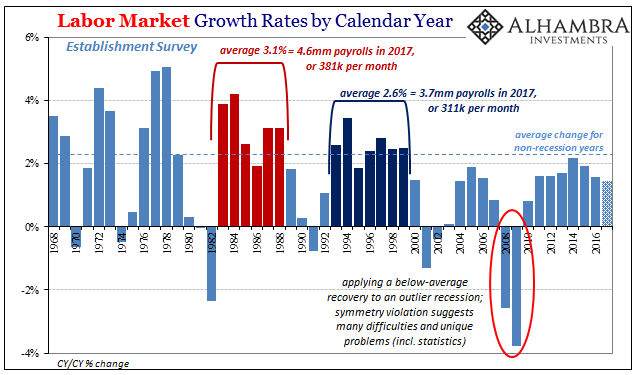
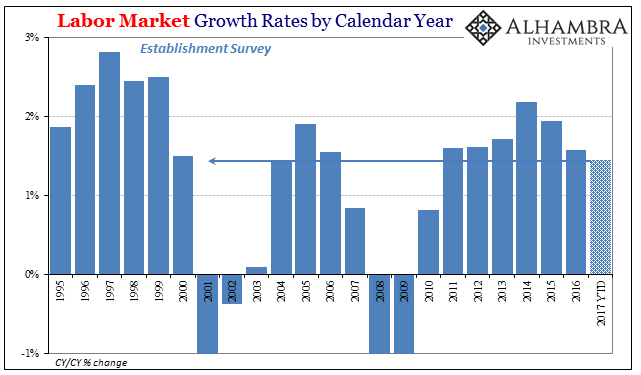
From 1993 through 1999, the labor market gained, on average, 2.6% per year according to the Establishment Survey. Since that time period is universally accepted as one featuring a strong economy, that is our standard for measurement. We can also go back to the eighties for what might amount to as an upper limit of sorts, the economy and labor market at that time being whatever is better than strong and robust – truly awesome.


Translating those average gains into the 2016 base equals an expectation of 3.7mm payrolls gained for 2017 to be as good as the nineties, and 4.6mm, which would signal a splendid economic year consistent with the eighties. Through 11 months so far up to November, the Establishment Survey gives us just 1.9mm for 2017. Assuming December turns out equal or better than November’s “good” number, the year should end with a total payroll expansion around 2.1mm, maybe 2.2mm.


That’s less than two-thirds of the way to the nineties, and significantly less than half of the eighties. This year, no matter how many months at 200k plus, has not been a good one. In fact, payroll gains in the eleven months so far tallied by the BLS’s Establishment Survey are less than those presented in that transitional year of 2000.


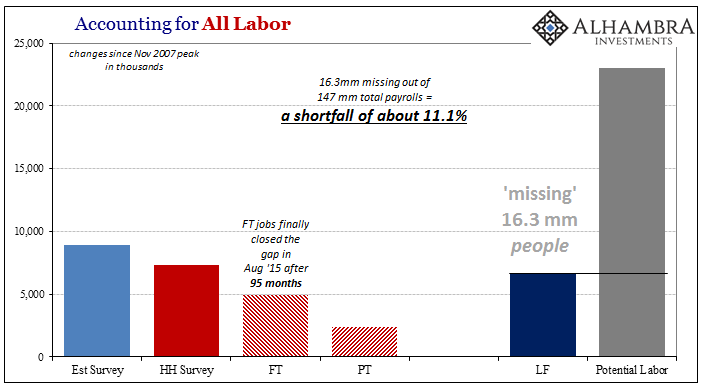
This is how you get the newest generation of American adults yearning in greater numbers for something vastly different, a radical political change if for no other reason than the establishment here continuing to say that everything is good when by every reasonable standard it isn’t even close! The “robust” labor market even of the past few years isn’t nearly enough to draw in those still sitting on the sidelines struggling, however, they do (parents’ basements) to just get along, leaving the economy instead it’s “missing” 16.3 million; a number that in a truly robust economy would be falling not rising.


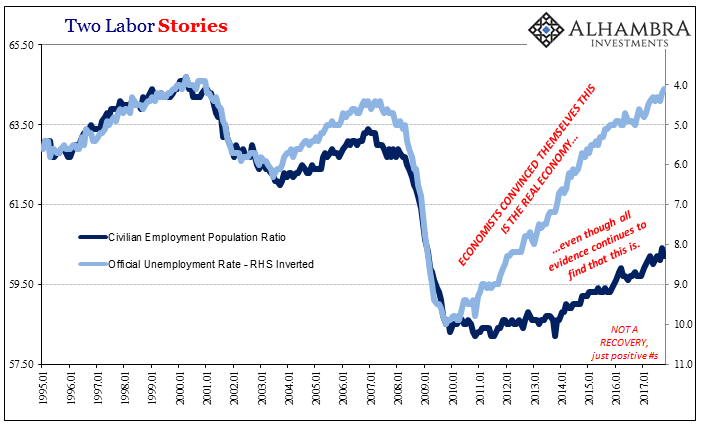
The issue clearly cannot be labor supply (Baby Boomer retirements, heroin, and fentanyl abuse in the Rust Belt) but shrunken labor demand; permanently shrunken economic demand. Therefore, there really should be no expectation for accuracy in the unemployment rate and what that means all around (inflation, baseline growth, monetary policy).


Once again in yet another month where the unemployment rate registers a ridiculous low, wages, and payroll earnings remain stuck at visibly low levels. The average weekly earnings of production and non-supervisory employees rose by just 2.6% year over year in November, after gaining 2.2% in October, 2.6% in September, and 2.7% in August. That’s nothing like in the past when the unemployment rate was where it is now. There is nothing like acceleration in earnings, not even solid growth.


I don’t mean to make all this about the bond market every time (actually it’s appropriate), but the idea that treasuries at the long end have to be wrong has no basis other than misconception or intentional misdirection.


The data, including the BLS data, remains firmly on the side of flattening, and like the Establishment Survey’s paltry 1.9mm in 2017, it’s not even close.