Showing posts with label Personal life. Show all posts

Wednesday, December 27, 2017

The Rent Is Too Damn High: Record High 30% Of U.S. Adults Now Live With A Roommate

A staggering new analysis from Zillow highlights perfectly the unintended consequences of central banking policies that drive massive asset bubbles but minimal job/wage growth.  According to the study, surging home prices and rising rents have now resulted in a record 30% of American adults, up from 21% in 2005, being forced take on roommates just to afford monthly rent payments.


As rent consumes a growing share of household income in many cities, some people must relocate or find ways to offset rising prices. An increasingly popular way to cut costs is by adding a roommate. Nationally, 30 percent of working-age adults—aged 23 to 65—live in doubled-up households, up from a low of 21 percent in 2005 and 23 percent in 1990.


We define a doubled-up household as one in which at least two working-age, unmarried or un-partnered adults live together. For example, a 25-year-old son living with his middle-aged parents would constitute a doubled-up household, as would two 23-year-old roommates who are not partnered to each other. A doubled-up household contains people who might choose to live apart under different circumstances, financial or otherwise.


Not surprisingly, large metropolitan areas like New York, LA, Miami and San Francisco saw the highest percentage of their adult populations doubling up on housing.


Of course, as the following chart illustrates, there is a strong correlation between doubling-up and rent affordability with the most expensive cities seeing more than 40% of their adult residents living with roommates.


"As rents have outpaced incomes, living alone is no longer an option for many working-aged adults," said Zillow senior economist Aaron Terrazas. "By sharing a home with roommates -- or in some cases, with adult parents -- working adults are able to afford to live in more desirable neighborhoods without shouldering the full cost alone. But this phenomenon is not limited to expensive cities. The share of adults living with roommates has been on the rise in historically more affordable rental markets as well. Unless current dynamics shift and income growth exceeds rent growth for a sustained period of time, this trend is unlikely to change."


As we"ve noted frequently, the biggest increases in doubled-up houses has come from the millennial generation as thousands of college seniors, armed with their $250,000 anthropology degrees, are apparently finding it difficult to land their dream jobs after graduation.  That said, while millennials have seen the biggest increases, people across the age spectrum have also become increasingly reliant on roommates to meet their monthly rent obligations...


...so at least we all have that to look forward to in retirement.


With that, here are the full results from Zillow:


Tuesday, December 26, 2017

Christmas In Venezuela: What It"s Like After Socialism Destroys Your Country

Authored by Daisy Luther via The Organic Prepper blog,


The situation in Venezuela is grim and not getting any better.


A socialist government has destroyed what used to be one of the healthiest economies in the world and turned it into something for which few were prepared. As we get ready for the holidays here in America, with our usual spending frenzies and feasts, Christmas in Venezuela is looking a lot different than it did a mere decade ago. Maybe some of the young people who think socialism is the answer to all our societal woes will read this and realize that this form of government doesn’t work – it destroys all hope.


Last week, I got an email from a prepper named J.G. Martinez D, or Jose. He offered to send me some on-the-ground articles for as long as the internet is up and running. I thought, given the season, that it would be interesting to follow up the interview with Selco regarding his SHTF Christmas with an interview about Christmas in Venezuela. Jose is one of the few people in Venezuela who was a prepper before this collapse happened so his perspective is quite valuable.


Can you tell us a bit about yourself?


I am an upper middle class, professional former worker of the oil state company, in my 40s. A Bachelor’s degree from one of the best national Universities. I have a small 4 members family, plus two cats and a dog. An old but in good shape SUV, a good 150 square meters house in a nice neighborhood, in a small but (formerly) prosperous city with two middle size malls. Everything in the period 2004-2012 was just fine. After that period, the economy started a declining trend that has been increasing faster each week.


Being a prepper, and having experienced two major similar crisis in my lifetime (civil turmoil 1989, and Caracas coup d’état in 1992), inspired me to find a second (and even a third) income source and some months’ worth of food at home. I started to write for a Forex blog, and earning some extra cash for preppings: a genset, (now used twice weekly because of the power cuts) additional freezers, a CNC machine for a home-based small business, and some professional audio equipment for voice over and podcast broadcasting, another economical activity that I enjoy, after my career in the oil company stopped. A water tank with a concrete base (the power cuts stop the water supply pumping system), and reinforced bars for the windows, enclosing the patio for security, and some other improvements.


This has allowed my family to deal with most of the terrible situation in Venezuela. I am now outside the country, planning for the exile of my family. I know things are going to get a lot worse before they start to get better, and don´t want them there once the shooting begins.


Tell me a little bit about the traditions in Venezuela. What was Christmas like before the economic collapse?


Christmas in Venezuela was one of the most popular times of the year, after school holidays. A lot of people, mostly in the big cities, went to the beach to enjoy those free days. Venezuelans are very family-oriented people. For us, Christmas is a season for being with family even in the entire year we have not been able to visit them. There was an exodus from one side of the country to the other one, people traveling in all directions to gather with their beloved ones, mainly from the big cities to the province states.


Since December 1st, shops, coffees, restaurants, houses, entire subdivisions and streets, government offices, schools, and all kind of business were decorated and the traditional “Nacimientos” or representations of baby Jesus birth in the crib, with Saint Joseph, virgin Maria, and the three wizard kings. There were contests with the most elaborated Nacimiento would be the winner. And the traditional living Nacimiento.


The general environment was a happy one, one of hope and confidence in the future. One of our Christmas carols, called “gaita” totally unrelated to the western anglophone ones, are played with drums and all kind of instruments, and for the untrained ears, it could sound something like merengue. It has been a totally pleasant surprise for the foreigners to come to a church for the services and find people dancing and singing traditional songs. Lights and all kind of ornaments hanged from doors, walls, windows and every imaginable place.


Malls were full with people buying all kind of presents, and temporary employment was a permanent need for the merchants since the first day of December.  All kind of toys and kid’s articles were sold even in the streets, for the baby Jesus birth night.


Many people piled up their mattresses, pots, and pans in the family car, heading for wonderful vacation destinations like Isla Margarita, with lots of beautiful beaches, or the mountains in Merida, in Los Andes. Another tradition is buying new clothing and or shoes (“estrenos”) for the 24, 25, and 31 December evening, to dress up in dinner while the children played with their new toys, and receiving the new year with the best new clothing to ask for prosperity.


How have the traditions you described above changed now that there is very little money?


Without money, and cash scarcity, traveling is very hard. Many people have restricted their family gatherings. Prices of bus tickets are very high for the common person, and airplane tickets are a joke. 75% of the national flights fleet is on hold because of lack of maintenance.


I have not known of anyone with kids in the last 4 years that could buy a new attire for themselves to use on the 24 and 31 December nights. Most of the available money is for 24/31 December dinner, or kid’s toys, if any.


Many kids these years have received a very simple toy, instead of those most expensive and fancy ones. And many others have not been able to receive any toy at all. They have seen people looking inside the garbage bags for food, and despite their age they seem to understand what is happening and don’t ask for expensive toys to baby Jesus, leaving the parents to relieve some pressure and get them whatever they can.


However, the hard part is that many kids were used to going to visit their grandparents, and nowadays this kind of family trips are just not possible. There is no cash, collapsed transportation, no parts for the family cars. You get the picture.


What was your traditional Christmas dinner before?


Our family Christmas dinner includes roasted pork leg, with olives and capers; a special loaf of bread (“pan de jamon”) with lots of olives, ham, bacon, and capers inside, and hen salad, with potatoes, carrots, mayonnaise, petit pois, the very unique and traditional “Hallaca”. This is sort of an envelope with banana leaves, filled up with a tasty mixture: beef and pork stew, olives, boiled eggs (recipe varies with the region, East, Center, West, and/or the origin of the family), surrounded by a mass elaborated with the corn flour, the same we use for the arepas. It was common to cook about 150 or 200 hallacas for a 4-person family.


For bigger families, everyone collaborated with money and the hallacas-making was a team labor, with over 10 people or more, and the result was 1200 or 1500 hallacas. A family of four, like us, with 100 hallacas, a roasted leg, and a huge bowl of hen salad in our extra freezer, we would eat hallacas and Christmas food until middle January!


Normally, since my childhood, in our table on Christmas Eve, there were grapes, apples, dried fruits, raisins, nuts, and even hazelnuts. Most of these were imported (we only grow grapes in some places), but there were plenty of all this in the middle class tables the Christmas and New Year eve. For dessert, a sweet called “dulce de lechoza”, made with slices of green papaya, boiled with lots of sugar and clove, served with a slice of Christmas cake, a cake with raisins, chocolate, dried fruits and some rum, called “Torta negra” or Black Cake. There is a very traditional punch, mainly for ladies, called “Ponche Crema”, with a secret recipe invented 140 years ago by Eliodoro Gonzalez, a chemist from Caracas.


Of course, most of the people could afford a whisky bottle. Most of the time we had some cider for the New Years Eve toast to receive the incoming year; people who could afford it bought champagne.


Before, it was common for someone who was shopping or just passing by, to go to wish a merry Christmas to a friend and receive a plastic bag with 6 or 8 hallacas “so you can taste them”, and some “Dulce de lechoza” or Torta Negra.


What are families eating for Christmas dinner now?


Nowadays, families are mostly eating beans and lentils, whenever they can be found, and white rice, sometimes hard to find. Middle class made an extra effort for at least one hallaca for each member of the family at the Christmas dinner eve, and mostly bought to people who makes a temporary business by preparing, cooking and selling hallacas. Those who can afford to make hallacas at home are not too many, and people does not give away hallacas to friends and family so often. The most easy meal for Christmas dinner seems to be just the hen salad. There are no wheat flour at fair prices for ham bread or cake, nor olives or other ingredients at affordable prices. Instead of a complete pork leg, some people just buy (if they can find it)some pork meat and roast it in the oven, just for Christmas Eve.


Fortunately last year we had bought a lot of staples for hallacas and other things for the dinner in August, like a small frozen pork leg and flour, and we were able to deal not just the high prices, but the scarcity as well. Our Christmas dinner was a very normal one, a little bit sad, as you may suppose. A lot of neighbors have left the country, and their houses were empty and silent. The subdivision main street once filled with kids in bicycles, dogs and people with babies, now looks like a ghost town.


What kind of gifts are people giving this year? How are they acquiring them?


Pricing of the toys, after 18 years of currency control exchange, makes them extremely hard to afford. Families with many children just don’t buy toys, or new clothing. All the money goes for feeding needs, if some staples can be found somewhere.


Old toys, in good shape, are sold in garage sales, mainly from struggling middle class people, but that was the last two years…because the middle class is running away from the country. People who can’t afford to buy new toys just trade work hours, or buy used cheaper toys. With a pair of shoes costing several minimum wages, many people is not buying anything else but basic staples. Other people who really wants to give something are using as gifts previously used items. There is not enough money in people’s hands.


Prepping allowed us to get the toys for our child early, in September, so we are not with the last minute rush.


How are children dealing with the changes during the holiday season? Is it easier or more difficult for them than the adults?


Many children are pretty aware of the situation. Middle class kids have noticed the people roaming in the streets and ripping the garbage bags looking for something to eat, and asking for bread, money or something outside bakeries, malls and supermarkets.


They have come to understand, the hard way, that everyone is having a rough time, and they are lucky to have a good house, that their relatives (mostly) still have a car they can use (many of middle class families cars are awaiting for non-affordable spare parts like tires, batteries or others).


This said, children know that anything Baby Jesus or Santa could bring along is a plus. It is touching to read that in their letters, they have asked for toys as well for the poor children. They see their parent’s faces arriving at home with a couple of grocery bags, and hear the adults conversations about the crisis. It is has been very hard for many of them. I have known by mouth of a psychologist friend of us that his little patients (he works mainly with children) are having nightmares and night terrors associated to what they see on the streets. Everyone is having a hard time.


What are some of the creative solutions that people are coming up with to make the holidays special?


People are trying to deal with the situation by means of making clear to the kids that what is important is being healthy, and that the family is all together, for instance. But the most needy are having a harsh time.


Some people has risen chickens for Christmas dinner, in whatever space they had available, but with the danger to be robbed. Other people puts together whatever cash they can find, scarce as well, and buy in bakeries all the ham bread and other stuff, to resell in the streets.


They generate scarcity in the bakeries, and inflate the prices to awesome levels. I have known that in coastal towns like those all around Margarita Island, they are using fish in the Hallacas, instead of beef and pork, for example. And instead of hen salad, sardines salad. My wife is using some sugar substitutes, as a traditional cane juice.


Are politics/government affecting the holidays in any way? Are they providing any type of relief or treats for families? Are they offering any suggestions to make this time of year more special?


Sure, they are trying to wash their nasty face with handouts. The relief, or treats was a Christmas bonus for those holding that carnet imposed by the Government to their supposed followers, and it was not even for all of the carnet holders neither.


They openly offered pork legs, toys and other goodies at low prices for those who vote for the Socialist Party. Of course this was all lies. The goodies are for the NGs, for the riot police, and the military who suffocated the recent demonstrations with over 130 persons killed.


Do you have any stories you could share of post-collapse Christmas in Venezuela?


The worst of the collapse has not been seen yet. But it is quite remarkable to notice that in other countries, the rush for electronic appliances sales generate turmoil in the stores, meanwhile in Venezuela it is the access to basic staples.


My wife was casually in a small supermarket a few days ago, when unexpectedly a couple of employees started nervously to stack powdered milk in the shelves. This is one of the most precious staples in Venezuela, much more than the liquid milk, for reasons known only to Venezuelans, and that I myself can´t explain despite being a Venezuelan. Maybe the low price, and that it can be stashed for a long time.


So there were some soldiers custodying the supermarket, and ask the people to make a line. Suddenly, a large amount of people invaded the supermarket, and pushed aside the two employees, who fell to the ground under the avalanche of people. My wife took the kid to her side, just on time so the horde would not push him and knock him to the ground and step on him. My wife, terrified with that scene, once she was able to move around to get if she could get a package, stood next to a soldier. My kid look at the soldier and, innocently asked with his little voice if he could get him some milk for his cereal. The soldier look down on the kid, and just patted his little head, with a knot in his throat, looking at my wife with a sense of impotence.


Would you be prepared?


The stories of Christmas in Venezuela should be eye-opening to anyone who is trying to get prepared for a long-term event.


The way that life has changed there is stark, dramatic, and something that could happen in any country in which the government turns to socialism. Would you be prepared for life in a collapse situation? Would you be able to provide special things for those you love to make the holidays a little bit happier?


Wednesday, November 29, 2017

World"s First Vending-Machine For The Homeless To Be Unveiled In UK In December; LA, NYC Next Year

This is a first, a new charity in the UK called Action Hunger plans to install a vending machine for the homeless in December. The organization describes itself as a charity with a “new approach to combating homelessness.” The initial plan will be installing a machine in the town of Nottingham in the December time-period, then a second machine in Manchester sometime early 2018. If all goes well, Action Hunger plans to do a full release across the UK in attempt to alleviate poverty and hardships– something the government is having trouble in doing.


Action Hunger is working with Tesco and other partners to stock the machines with water, fresh fruit, energy bars, crisps, chocolate, and sandwiches, as well as socks, sanitary towels, antibacterial lotion, toothbrush and toothpaste combination packs, and books. A majority of the food will be provided by a localized network of regional food vendors who will donate excessive food waste.


The charity has partnered with The Friary, an outreached centre in the city, to oversee the people’s access to the vending machines. The machines will operate 24-hours a day accessed by a special card given out by the Friary and can service up to 100 homeless people per day. Key cards are programmed to permit up to three items per day, which offers a low-cost automated solution in dealing with the poor.


Action Hunger explains how the process works: 


According to the Independent, homelessness has increased 34% per cent since the Conservatives came to power in 2010, partly due to benefit cuts and welfare changes. A new study reveals that 300,000 people in Britain are now homeless, with the crisis growing as much as 13 per cent last year alone.


Number of rough sleepers across England on a given night


Number of homelessness applications made to local authorities


Action Hunger is targeting Nottingham and Manchester, two areas where homelessness is out of control.


Across England, housing market affordability is once again above 2006 to 2008 levels— signaling that house prices are once more outpacing income.


Besides the exploding homelessness situation in the UK, there is an even larger market in the United States, where Action Hunger will be installing the vending machines next year in Seattle, New York, and LA.


In August, we reported 1 in 7 New York City Public-School students is homeless. On top of that, NYC shelter officials have admitted a record number of homeless to shelters each night.


In a preview of things to come, automation in the form of vending machines seems to be the short term solution in dealing with the homeless in the UK. The next step for Action Hunger appears to be a multi-city rollout in the United States targeting a much larger homeless population as the middle class deteriorates.


For our American audience, an automated vending machine for the homeless is coming to a town near you. The dying middle class will no longer be able to shop at the Dollar Tree nor Walmart, as they will resort to automated vending machines. The future is bleak.


Wednesday, November 22, 2017

Give Thanks For Turkey-flation

Via LPLResearch.com,


As we near Thanksgiving Day, investors have many things for which to be thankful; from a global bull market in equities, led partly by a strong resurgence in corporate earnings, to very few signs of a recession starting over the next 12-18 months. There are a few near-term catalysts we’re watching, but there are also many longer-term positive signs. And since we’ve already talked a lot about how 2017 has so far been one of the strongest and least volatile bull markets ever, today we’ll change gears and talk turkey!


In honor of everyone’s favorite Thanksgiving Day bird, did you know that the size of your average turkey has grown substantially over the past 50 years?


That’s right: the average turkey was 17 pounds in 1960 and was more than 30 pounds last year.


Per Ryan Detrick, Senior Market Strategist,


“Although this is purely spurious and in no way should you ever invest based on it, you have to smile when you compare the average size of turkeys in the U.S. to the S&P 500 Index.


Both have moved steadily higher over the decades, suggesting investors and Thanksgiving dinner lovers alike have many things to be thankful for this year.”


To everyone from the LPL Research team, have a great Thanksgiving!


The Psychology Of Desperate People: 15 Dead, 40 Injured In Food Stampede In Morocco

Authored by Daisy Luther via The Organic Prepper blog,


In prepper lore, there is a theory about how badly desperate people are likely to behave.


Many folks outside the community scoff at this theory. They believe that we have become more civilized than to utilize violent measures when hunger strikes.


But an incident in Morocco the other day showed us exactly how hungry people behave.


And it isn’t pretty.


Food was being distributed in a rural market in Sidi Boulaalam, a poor village. Women had come to the market with baskets to get food for their families, when suddenly, what could only be described as a stampede erupted.


At least 15 women died and five were wounded in a stampede during a food distribution operation on Sunday morning in rural Morocco, government officials said.


The victims were crushed as hundreds of people, mostly women, gathered to collect baskets of food at the market…


…In the aftermath of the stampede, clothes and other personal items were left scattered across the ground. (source)


That number was later updated to 40 people who were injured in the crush.


Witnesses told local media that this year’s annual food aid distribution at a local market in Sidi Boulaalam, an impoverished town with just over 8,000 inhabitants, attracted a larger crowd than usual.


“This year there were lots of people, several hundred people,” a witness who asked to remain anonymous told AFP news agency.


“People shoved, they broke down the barriers,” he said, adding that the injured had been evacuated to a hospital in Marrakesh. (source)


Here’s a video of the aftermath in this Tweet. (If it won’t play for you, go here.)


The value of the food being handed out? $16


15 families were left without mothers over $16 of food. To be fair, villagers in that part of the world live on about $3 per day, but still – this shows what desperation can do.


It’s not just Morocco.


It happens somewhere in the world every day. Here are some acts of desperation that have happened just in recent months.


When you are desperate, the normal rules do not apply.


Every year, we get a glimpse of this kind of insanity in America


Every year, on “Black Friday” we get a glimpse of the kind of behavior that causes people to be crushed to death and assaulted. The day after Thanksgiving (ironically) people get up before daylight, stand in line, and shove their way through a crowd to get the best deals. (Stay tuned this weekend for the 2017 Black Friday Hall of Shame.)


And they aren’t even hungry.


People climb all over each other for cheap electronics. Fistfights erupt over vegetable steamers. People are ready to throw down and do battle for sale priced bath towels and televisions.


I’d hazard a guess that folks who spend time and money fighting over electronics are not the kind of people who prep. That means that these are the people who will be hungry in a long-term disaster.  Look at those people, stampeding to get to a sale on things that they don’t actually need to survive. Their inhibitions are loosened because those around them are behaving in the same way.


You have to look at the psychology of this.


People can justify pretty much anything when they or their children are starving. And I can understand that to a large degree – who could stand to watch their babies suffering?  But if someone can devolve to the above degree just to because everyone else is doing it, the chaos we saw above is only a tiny sample of what could come if people were truly hungry.


The line between civilization and THIS is very thin.


Desperate people do desperate things.


We need to be prepared by having the essential supplies on hand to keep us from becoming one of those desperate people in the middle of a stampede for a few days’ worth of food, but what’s more, we need to be prepared for the prospect of those desperate people. Keeping a low profile is the best defense but sometimes it’s not enough.


In a desperate situation, you have to be ready for desperate people to behave in a desperate manner. It happens in real life all the time. Somewhere on this planet, someone is desperate and they will do anything to meet their needs.


It only takes one person to start the charge in a tense scenario, and when that happens, the others will follow.


Don’t count on the rules of “civilization” to save you.


Friday, November 10, 2017

Sweet melt up potential here says Joe Friday


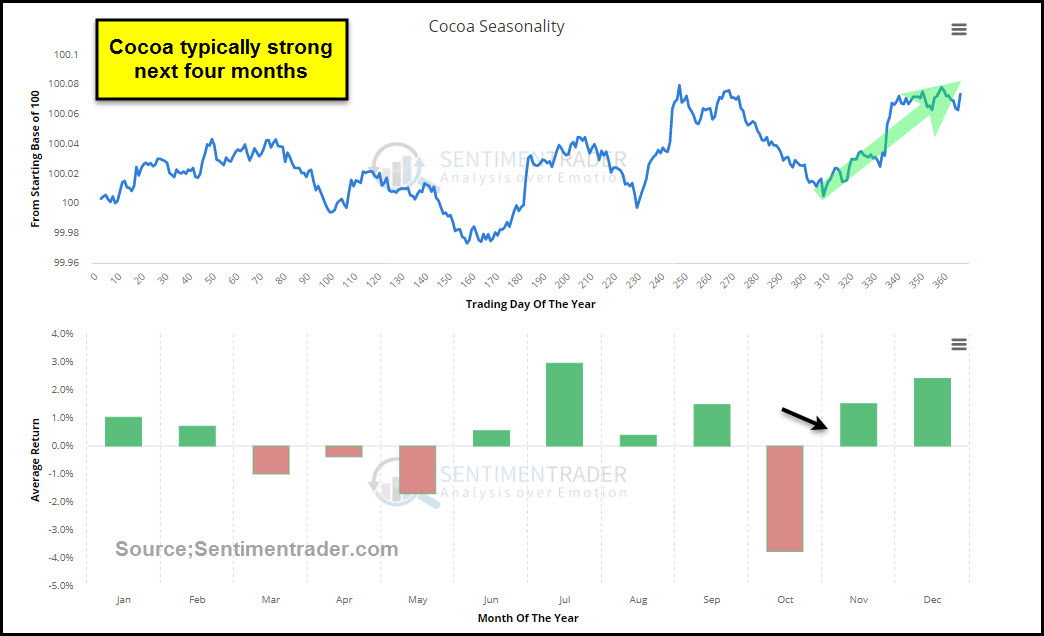
Tis the season for Chocolate (Cocoa) to do well, will it repeat its historical pattern again this year?


Below looks at the seasonal pattern of Cocoa from Sentimentrader


CLICK ON CHART TO ENLARGE


Going into this period of seasonal strength, Cocoa bulls of late are hard to find and dumb money traders have established one of the largest short positions in this commodity in years. The triple combo could make the price action of this commodity very interesting going forward.


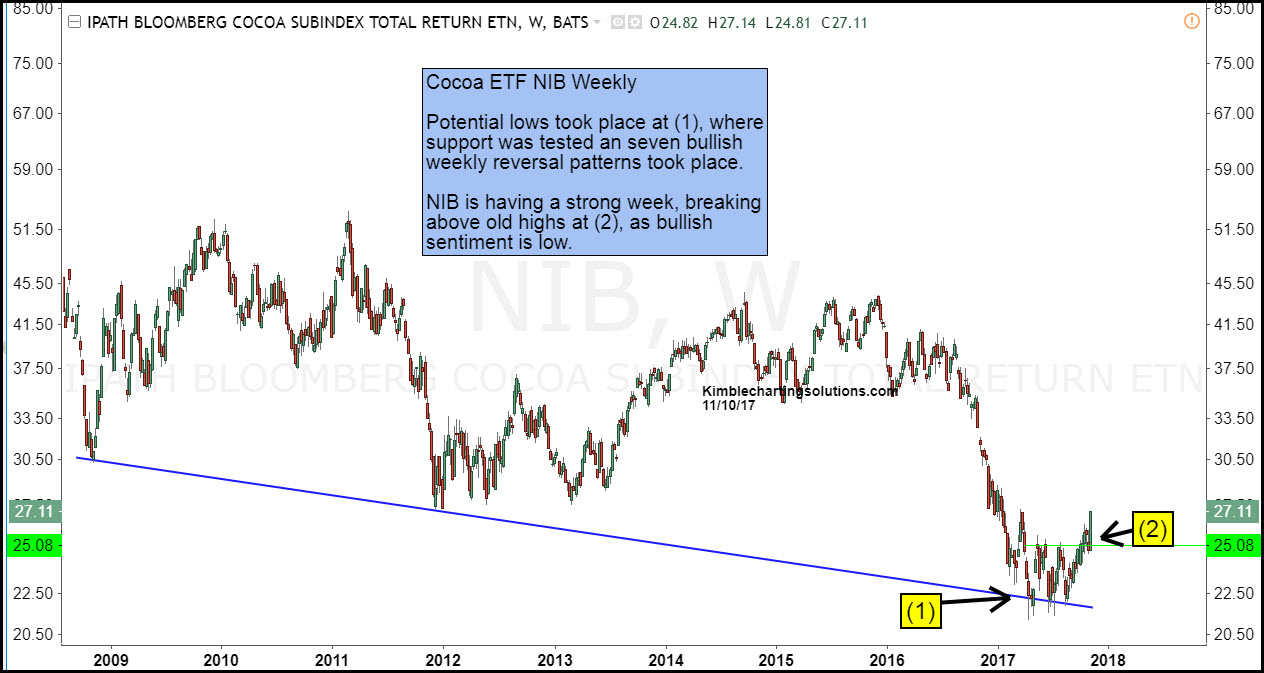
This commodity can be played in the futures markets or two different ETF’s (NIB & CHOC). Below looks at NIB


CLICK ON CHART TO ENLARGE


Cocoa ETF NIB could have built a base at, where seven different bullish wicks (reversal wicks) took place just above 10-year support at (1). Of late NIB has been moving higher and this week looks to be breaking above highs hit earlier this week at (2).


A nice combo of pattern, sentiment and traders positions is in play in this asset that is down nearly 50% in the past couple of years.


Some perspective- since the first of this month, NIB has gained over 7%, which is nearly half of what the S&P has done year-to-date.


Full disclosure Premium and Sector members have been long NIB since the end of October. If you would like to become aware of these type of pattern and sentiment setups, we would be honored if you were a member.


Why you see chart pattern analysis with brief commentary:   There is a ton of news and opinions about markets and stocks that make the decision-making process more difficult than it needs to be.   


I believe the Power of the chart Pattern provides all you need to see what is taking place in an asset and determine the action to take. 


This approach has worked well for me and our clients and I encourage you to test it for yourself.


Receive my free research posted on the blog daily here 


Or,  send an email if you would like to see sample research and take me up on a trial of my premium or weekly research where I provide actionable alerts on breakouts and reversals in broad market indices, sectors, commodities, the miners and select individual stocks 


Email services@kimblechartingsolutions.com  


Call us Toll free 877-721-7217 international 714-941-9381 


Website: KIMBLECHARTINGSOLUTIONS.COM 


follow on Twitter 


See our latest webinar


Friday, October 20, 2017

Philly Admits Soda Tax Is Crushing Local Small Businesses, Expanding "Food Deserts"

 Just one week after Chicago shockingly repealed their soda ban following a revolt from local business owners (see: Soda Tax Fizzles In Chicago As Cook County Officials Cast Decisive 15-1 Repeal Vote), it seems that Philadelphia"s flirtations with forming a more perfect "nanny state" via the elimination of sugary drinks could be on a collision course with a similar fate.


As WHYY points out today, a survey conducted by Philadelphia"s Controller Alan Butkovitz — a longtime opponent of the soda tax — found that nine out of 10 businesses reported revenue loss since the city’s sweetened beverage tax took effect earlier this year. Of those reporting revenue loss, 60% of them blamed the soda tax for their woes.


City Controller Alan Butkovitz today released the results of the Philadelphia Beverage Tax survey that found more than 60 percent of businesses indicated a revenue loss as a direct result of the new tax.


Of the 650 businesses that reported a decline in year-to-year revenue, more than 400 attributed “most” or “all” of the decline to the implementation of the Beverage Tax.  The majority of these businesses reported revenue losses of more than 10 percent.


“The overwhelming majority of businesses that carry products subject to the Philadelphia Beverage Tax feel a significant impact as a result of the tax,” said Controller Butkovitz.  “The tax has had detrimental effects.”


Butkovitz’s team, with help from various business groups, reached out to “more than 1,600” businesses that sell or sold taxed beverages. Response was purely voluntary, and 741 businesses filled out questionnaires.


“This is not going to be the comprehensive answer to everything, but I think it does create a serious warning and an attestation of what has been stated by a number of the businesses,” he said during a Monday news conference. “Because I think the administration has minimized and ridiculed the idea that businesses are fighting for survival.”


To our great "shock", many Philadelphia grocers reported that customers were simply driving to the suburbs to do their weekly shopping which means that local retailers lost not only their soda sales but everything else as well.


Coments


And, as usual, the Office of the Controller noted that this latest misinformed regulatory overstep by Philly"s liberal elites is most detrimental to the very same people it was intended to help, namely low-income, inner-city families who can"t afford to travel to the suburbs for groceries and who are about to get crushed with higher prices following a wave of business failures.


According to Controller Butkovitz, the areas with the most businesses reporting revenue losses included West Philadelphia along the Market Street and 52nd Street corridors (19139), Hunting Park in North Philadelphia (19140), and areas around Juniata and Frankford (19124).  Many businesses in these neighborhoods reported losses of more than 10 percent.


“Consequently, these zipcodes have neighborhoods with some of the highest poverty rates in the city,” said Controller Butkovitz.  “These businesses cannot afford a one percent loss in business – let alone more than 10 percent.


“These are also neighborhoods subject to food deserts in Philadelphia. If these stores cannot continue to operate, it will be even more difficult to buy affordable or good-quality fresh food.”


Grocery stores reported the most revenue losses followed by convenience stores and restaurants.  Forty percent of businesses indicated they would have to make significant changes to keep their doors open.


"The tax seems to be impacting behavior and orientation toward the future,” said Controller Butkovitz.  “Many business owners seem apprehensive about the viability of their enterprises in the near and medium term."


Of course, facts have never really had much impact on political discourse in the past so absent an uprising from local business owners, similar to what we saw recently in Chicago, we wouldn"t suggest holding your breadth while waiting for a repeal.


Saturday, October 14, 2017

Flashback: Barbara Walters Shames Pedo Victim Corey Feldman On National TV For ‘Damaging An Entire Industry’

Content originally published at iBankCoin.com


Six years ago, former child star Corey Feldman admitted that he and fellow child actor Corey Haim, who died from a 2010 overdose, were sexually molested by adult males throughout Hollywood during their time in the limelight. Haim is said to have received far more brutal abuse – having been raped at age 11 by a producer, while Feldman was groomed and abused by a man employed by his father at the age of 15.


In a 2011 interview with ABC, Feldman said Pedophilia was the Number 1 problem for child stars, saying “I was surrounded by [pedophiles] when I was 14 years old. … Didn’t even know it. It wasn’t until I was old enough to realize what they were and what they wanted … till I went, Oh, my God. They were everywhere.”


And in a 2016 interview – days after actor Elijah Wood gave an interview in which he said “Hollywood has a Pedophilia Problem,” Feldman revealed that he was ‘molested and passed around‘ by men in the industry. The former child actor has refused to name his abusers, citing legal reasons.


Feldman has also written about Corey Haim’s time with Hollywood child-actor manager Martin Weiss, an agent primarily for children who appeared on Nickelodeon and the Disney Channel – who enjoyed sleepovers and road trips with his clients. Weiss was arrested in 2011 and plead no contest to eight felony counts of molesting young actors – sentenced to a year in jail but released for time served.


Weiss raped a child actor 30 to 40 times until the age of 15, according to the police report. In an affidavit obtained by the Los Angeles Times, the victim told police that Weiss said what they were doing was ‘common practice in the entertainment industry.’


Weiss was caught when the 15 year old victim went to his apartment in November of 2011 and recorded a conversation in which Weiss admitted to the abuse.


Barbara’s Genuine Outrage – at Feldman…


In a 2013 interview on The View, Feldman told hosts Barbara Walters, Sherri Shepherd, Jenny McCarthy and Nick Offerman that “some of the richest, most powerful people” in Hollywood were pedophiles still operating in the industry:


Corey Feldman: There are people that were the people that did this to both me and Corey that are still working, they’re still out there, and they’re some of the richest, most powerful people in this business – and they do not want me saying what I’m saying right now.


Barbara Walters: Are you saying that they’re pedophiles?


Corey Feldman: Yes


Barbara Walters: And that they’re still in this business?


Corey Feldman: Yes


After telling host Sherri Shepherd that child acting is a “many feathered bird – be careful what you wish for. Don’t go into it with naievity,” Barbara Walters exclaimed “You’re damaging an entire industry!”


Walters’ comment echoed her defense of Woody Allen days after his adopted daughter Dylan Farrow wrote an open letter to the New York Times, accusing Allen of sexually abusing her as a 7 year old child. Walters suggested Farrow had waited to come public to hurt Allen’s chances of winning an Oscar that year, adding "the fact that he likes younger women (in reference to Allen"s marriage to the adopted daughter of ex-wife Mia Farrow), that has nothing to do with."


And when it came to Corey Feldman, Barbara Walters shamed a man on national TV who had the courage to stand up and tell the world about the sexual abuse he suffered at the hands of Hollywood pedophiles – seemingly more concerned about her industry than a victim of its most vile and degenerate predators. The “richest, most powerful people” in the business.


Watch below:


Follow on Twitter @ZeroPointNow § Subscribe to our YouTube channel

Thursday, October 12, 2017

Florida's Farmers Produce Smallest Orange Harvest Since WWII After Irma Wiped Out Half Of Crops

Hurricane Irma wiped out nearly 50% of Florida’s iconic orange crop when it buffeted the state with 160 mph winds and a massive storm surge last month, sending orange concentrate futures rocketing higher and stoking speculation that the state’s embattled orange growers – already struggling to fend off a worsening “greening” epidemic that’s constrained production over the past decade – might never recover.


And in a development that confirmed traders fears that this year’s crop could be the smallest in decades, which in turn increases the likelihood that prices will remain elevated for the time being (no doubt conferring some small boost to headline CPI), Bloomberg is reporting that the state’s 2017 orange crop was its smallest since 1942, with 31 million boxes harvested.


Oranges are also grown in California, but the drop in Florida orange stocks was largely responsible for the smallest national yield since 1964. In the season that ended Sept. 30, orange output was 68.7 million boxes, according to US Department of Agriculture data. The record low was 4 million boxes in 1918. The data go back to 1913.


While it ultimately bypassed the state, Hurricane Katia terrified farmers and traders when it briefly appeared set to deliver the second devastating blow to the industry in two weeks.


When it tore through the state in September, Irma caused an estimated $2.5 billion in damage to the state’s agriculture, the Florida Department of Agriculture and Consumer Services said on Oct. 4. Preliminary estimates showed $760.8 million in damage to the citrus industry.


But more importantly, if CPI climbs in the coming months, will Janet Yellen (or maybe her successor) credit the oranges, like she once blamed falling prices for cellphone data plans for a "transitory" decline?

Thursday, September 21, 2017

The Best Jobs Without A College Degree 2017 (In One Simple Chart)

The Great Recession destroyed the job market for workers without college degrees, and the situation hasn’t gotten any better.


This begs the question - can you still enjoy a high standard of living without a college degree? And what are the highest paying jobs for people without a traditional higher education?


This new chart, from HowMuch.net, sheds some light on these pressing questions.


The Bureau of Labor Statistics tracks which professions do not require a college education, how many people currently hold those jobs, and their median salaries. We combined this information into a scatter plot graph. The more dots you see, the more people work in that profession. And the higher the dots on the vertical axis, the more money they make.


You can quickly see some pretty interesting trends. There are a lot of people without college degrees who make a great living. The median household income in the U.S. is $56,516. By that standard, all the jobs on our chart pay well above average.


Specialization is the key to earning a high wage, especially in an area that cannot be outsourced. Elevator installers, power plant operators, transportation inspectors—these are all professions that require a high level of skill and must be done in person by someone with years of experience and certifications. Regardless of how automation affects the economy, you won’t ever be able to replace jobs like firefighting and law enforcement, despite what futuristic movies like Minority Report may have you believe.


Top Ten Highest Paying Jobs Without Needing a Degree 


1. Nuclear power reactor operator - $91,170 (salary) & 7,170 (workers)


2. Transport manager - $89,190 (salary) & 113,270 (workers)


3. Police supervisor - $84,840 (salary) & 100,200 (workers)


4. Power distributor - $81,900 (salary) & 11,380 (workers)


5. Elevator installer - $78,890 (salary) & 22,240 (workers)


6. Detective - $78,120 (salary) & 104,980 (workers)


7. Commercial pilot - $77,200 (salary) & 38,980 (workers)


8. Media equipment worker - $75,700 (salary) & 18,620 (workers)


9. Electrician - $75,670 (salary) & 23,060 (workers)


10. Power plant operator - $74,690 (salary) & 35,010 (workers)


And now, a word of caution. The top 25 professions where you don’t need a college degree only employ about 1.4 million people. That’s a lot of people, but the entire working population in the U.S. is over 205 million people. In other words, these jobs not only demand years of experience and specialization, but they’re also pretty rare. And don’t be mistaken: you may not need a college degree, but you do need some type of post-secondary training. You can’t just graduate high school and start your own electrical company. You have to work as an apprentice or join a training program first.


That being said, it’s still possible for people without a formal college education to earn a respectable salary. The big takeaway from our chart is that you want to be in a position that can’t easily be replaced through automation or outsourcing. If you can find a career like that, then you’re in good shape to enjoy a high standard of living.

Monday, September 11, 2017

These Are America's Fattest States

According to a new report, one third of U.S. adults are obese along with one in six children.


The research was conducted by the Trust for America"s Health and the Robert Wood Johnson Foundation and, as Statista"s Nial McCarthy explains, it found that the adult obesity rate exceeded 35 percent in five states, 30 percent in 25 states and 25 percent in 46 states.


In 2016, West Virginia had the highest rate of obesity at 37.7 percent, followed closely by Mississippi with 37.3 percent. Alabama and Arkansas jointly round off the top three with 35.7 percent each.


Infographic: America


You will find more statistics at Statista


Back in 2000, no U.S. state had an obesity rate higher than 25 percent.


As bad as the obesity epidemic is, the report also found that rates are starting to stabilize and actually decline in some places. Colorado, Minnesota, Washington and West Virginia all saw their obesity rates climb while Kansas saw a decrease.


The situation remained stable everywhere else.


Progress in halting the spread of expanding waistlines can be attributed to state policies improving access to healthy food and increasing physical activity.


The report notes that early childhood education has proven particularly effective at preventing obesity in early life, instead of having to reverse the problem in later years.

Tuesday, September 5, 2017

Paul Craig Roberts' Brief Reflection On The Vanishing American Dream

Authored by Paul Craig Roberts,


Today is Labor Day, a difficult day to celebrate now that American labor has been cast aside and US jobs offshored and given to foreigners.


The remainder of the jobs is slated to be replaced by robotics.


Friday’s payroll jobs report was full of bad news. Full-time jobs declined by 166,000. The meager 156,000 new jobs claimed are really only 115,000 net of the prior month’s revision, and this 115,000 jobs estimate is within the range of statistical insignificance. In other words, there is no confidence that the jobs are actually there.


The US work force continues to develop a Third Word complexion of lowly paid part-time domestic service employment.


The American Dream continues its closedown.


Meanwhile the government tells us that we are at full employment with an unemployment rate of 4.4%.

Monday, August 21, 2017

Grab A Beer Philadelphia, The Soda Is Too Damn Expensive

Via SovereignMan.com,


What happened:


Turns out when soda cost the same as beer, people choose to drink beer. That is what is happening in Philadelphia.


The city’s 1.5 cent per ounce tax on soda has made beer a cheaper option. But that isn’t the only effect of the ill conceived plan to raise revenue.


The tax didn’t raise the money expected, according t o a study by the Tax Foundation.


Stores have already seen huge declines in soda sales, meaning people are either going outside the city to buy, buying beer instead, or not drinking soda.


Now if the residents did cut down on soda, some might see this as a win, despite the low tax revenue. But from the outset, the Mayor was quite clear that the aim of the tax was to raise money, not to influence health.


The city claimed the tax revenue would fund pre-kindergarten programs. But less than half of the meager revenue is actually being put into the school system.


What this means:


Looks like “for the children” was just another excuse for government greed.


Governments refuse to believe in economics. They think they can just continue to pile the taxes on. But once the costs get too high, people change their behavior.


Sometimes that means going somewhere else to buy your soda. Sometimes that means making different choices, like beer instead of soda.


But hardly ever do governments get what they predict. The mayor even originally wanted the tax to be 3 cents per ounce. Some stores are reporting a 50% drop in soda sales, so you can imagine what would have happened at double the tax rate. Yet all the greedy politicians imagine is dollar signs.


The beer companies are really the only ones who made out on the deal.


Might make a conspiracy theorist wonder...

Thursday, August 10, 2017

From Coke To Coors: Philly Soda Tax Leading To Alcoholism As Beer Now Cheaper Than Soda

Perhaps The Burning Platform summarized the idiocy of Philadelphia"s soda tax better than anyone to date:


In a shocking development, the Philadelphia soda tax is a big fucking fail. Who could have predicted that. Democrat government drones and their brain dead minions are so desperate for money to fund their gold plated union pensions and bloated salaries, they lie, cheat and tax the poor into oblivion. Result: lost jobs, further impoverished poor people, no help for children, more closed businesses, and a further hole in the city budget. But at least the city union workers can keep their gold plated pensions – for now. Maff is hard for liberals, but it always wins in the end.


But, as The Washington Free Beacon points out, the unfortunate side effects of Philly"s disastrous soda tax may not be limited just to the economic consequences enumerated above.  As a study by the Tax Foundation recently found, there are social consequences as well with people now choosing to substitute beer for soda in light of the fact that, well, beer is just cheaper.


Philadelphia"s tax on sugary drinks has made soda more expensive than beer in the city.


The Tax Foundation released a new study on the excise tax last week, finding that the 1.5-cent per ounce tax has fallen short of revenue projections, cost jobs, and has forced some Philadelphians to drive outside the city to buy groceries.


The study finds that the tax is 24 times higher than the Pennsylvania tax rate on beer.


"Purchases of beer are also now less expensive than nonalcoholic beverages subject to the tax in the city," according to the study, written by Courtney Shupert and Scott Drenkard. "Empirical evidence from a 2012 journal article suggests that soda taxes can push consumers to alcohol, meaning it is likely the case that consumers are switching to alcoholic beverages as a result of the tax. The paper, aptly titled From Coke to Coors, further shows that switching from soda to beer increases total caloric intake, even as soda taxes are generally aimed at caloric reduction."


Soda


While not terribly surprising, the study found that while Philly"s soda tax was sold to taxpayers as a way to raise money for local schools, less than half of the proceeds are actually being used for that purpose. 


The Tax Foundation points out that unlike most cities, Philadelphia passed the tax specifically to raise revenue, not to fight obesity. The city even includes diet sodas in its tax, as a way to raise money for pre-kindergarten programs.


However, less than half of the $39.4 million collected since the tax went into effect on Jan. 1 has gone to education funding.


"[T]he tax was originally promoted as a vehicle to raise funds for prekindergarten education, but in practice it awards just 49 percent of the soda tax revenues to local pre-K programs," Shupert and Drenkard write. "Another 20 percent of the soda tax revenues fund government employee benefits or city programs, while the rest of the money will go towards parks, libraries, and community schools."


Meanwhile, lower soda sales have already started to claim the jobs of grocery and soda distribution workers.


Collections from the soda tax are also well below original projections of $92 million per year, due to tax avoidance.


"Soda sales in Philadelphia have also declined since the tax went into effect at the beginning of 2017, threatening the long-run sustainability of the tax," Shupert and Drenkard write. "According to some local distributors and retailers, sales have declined by nearly 50 percent. This is likely primarily due to higher prices, which discourage purchasing beverages in the city."


Earlier this year PepsiCo announced it was laying off up to 100 workers because of the tax, which the company blames for costing a 43 percent drop in business.


Philadelphians are also no longer able to buy 12-packs or 2-liters of Pepsi products in grocery stores due to the tax, the Tax Foundation said.


Way to think it through...

Study Warns Of Binge-Drinking "Crisis" As Alcoholism Rates Spike 49%

The opioid epidemic isn’t the only public-health crisis plaguing the US.


Americans are hitting the bottle harder than ever, according to a new study published by JAMA Psychiatry, posing new challenges for the US’s strained health-care system as local hospitals and first responders struggle with the spike in substance-abuse related maladies, including overdoses and alcohol poisoning that warrant urgent care.


The JAMA study showed that rates of dangerous binge drinking rose dramatically between 2001 and 2013, with women, ethnic minorities, Americans over the age of 65 and low-education adults registering the largest increases.


“Twelve-month alcohol use significantly increased from 65.4% in 2001-2002 to 72.7% in 2012-2013, a relative percentage increase of 11.2%. Significant increases, seen across all sociodemographic subgroups, were particularly notable among women (15.8%), racial/ethnic minorities (from 17.2% among Hispanic to 29.1% among Asian or Pacific Islander individuals), adults 65 years and older (22.4%), and respondents with lower educational level and family income (range, 11.7%-22.3%).”


Furthermore, rates of diagnosed alcoholism climbed 49% to roughly one in eight Americans.


“The prevalence of 12-month DSM-IV AUD increased significantly from 8.5% to 12.7% (change, 49.4%) in the total population. Significant increases in AUD were seen in all subgroups except Native Americans and those residing in rural areas. Notable increases were found among women (83.7%), racial/ethnic minorities (51.9% for Hispanic and 92.8% for black individuals), adults 65 years and older (106.7%), those with a high school education (57.8%) and less than a high school education (48.6%), those earning incomes of $20?000 or less (65.9%), those living within 200% of the poverty threshold (range, 47.1%-55.8%), and those residing in urban areas (59.5%).”


Rates of “high risk” drinking increased by 30%, with women and minorities again registering the biggest gains.


"The prevalence of 12-month high-risk drinking increased significantly between 2001-2002 and 2012-2013 from 9.7% to 12.6% (change, 29.9%) in the total population. Significant increases in high-risk drinking were also seen for all sociodemographic subgroups except Native Americans and respondents residing in rural areas. Increases were most notable among women (57.9%), other racial/ethnic minorities (from 40.6% among Hispanic to 62.4% among black individuals), adults 65 years and older (65.2%), persons previously married (widowed, divorced, or separated) (31.9%) and married or cohabitating respondents (34.2%), those with a high school education (42.3%) and less than a high school education (34.7%), those earning incomes of $19?999 or less (35.1%), and those residing in urban areas (35.1%)."


The spike in abuse rates among women was perhaps the study’s most alarming finding. The study’s authors speculated that, although men still struggle with higher rates of alcohol abuse, several factors are helping women close the gap. Women increasingly hold high-stress jobs, and social mores surrounding female behavior have grown more permissive.


“Greater sensitivity to adverse health effects of heavy drinking among women are potential biological factors influencing the convergence of rates between the sexes within the context of increasing rates of high-risk drinking and AUD. Drinking norms and values have become more permissive among women, along with increases in educational and occupational opportunities and rising numbers of women in the workforce, all of which may have contributed to increased high-risk drinking and AUD in women during the past decade.”


The rise in alcohol-abuse rates among older Americans was another discouraging revelation from the study – particularly because they’ve typically exhibited lower rates of abuse in the past. The study uncovered an unprecedented increase in abuse rates among the elderly, which is particularly problematic given the increased risk of mortality. Data for the study was collected from surveys of nearly 80,000 people, with the first conducted in 2001-2002, and the second in 2012-2013.

Thursday, July 27, 2017

Real Fake News: Science Used As Propaganda

Authored by Joe Jarvis via The Daily Bell,


Did you know that doctors and scientists can be corrupt or simply wrong?


People seem to give doctors and scientists the benefit of the doubt when it comes to their findings and opinions on things like global warming, genetically modified organisms, pesticides, chemicals, and how unhealthy certain foods and habits are.


But like any other humans, scientists and doctors are, well, human. They can be misguided, confused, corrupt, and stubbornly opinionated.


According to Natural News, as many as 20,000 doctors once recommended smoking cigarettes to aid digestion.


In 1940’s Camel ran an ad campaign that claimed “More Doctors Smoke Camels.”


They even handed out packs of Camels to doctors at a medical convention and then polled the doctors on their way out the door, asking what their favorite cigarette brand was, or what kind they had in their pocket at that moment.


Unfortunately, money has corrupted industries like big pharma who pay doctors and scientists to take a position and prescribe particular drugs and treatment. Many peer-reviewed studies have predetermined outcomes which basically find the facts to fit their narrative. It is more a marketing ploy to publish in scientific and medical journals than proof of the actual findings.


Sugar was long considered fine to dump down children’s throats because in the 1960’s a handful of scientists were paid off.


The documents show that a trade group called the Sugar Research Foundation, known today as the Sugar Association, paid three Harvard scientists the equivalent of about $50,000 in today’s dollars to publish a 1967 review of research on sugar, fat and heart disease.


The studies used in the review were handpicked by the sugar group, and the article, which was published in the prestigious New England Journal of Medicine, minimized the link between sugar and heart health and cast aspersions on the role of saturated fat.


But even absent actual corruption, basic mistakes are being made in scientific conclusions.


Correlation is not causation. This is a basic foundational tenet of science. Two things may be very strongly correlated, but that does not prove that one causes the other.


According to Reason Magazine:


When it comes to separating the wheat from the chaff of studies that are mediocre or just plain bad, Albert Einstein College of Medicine epidemiologist Geoffrey Kabat is a national treasure.


“Most research findings are false or exaggerated, and the more dramatic the result, the less likely it is to be true,” he declares in his excellent new book Getting Risk Right.


Kabat discusses how “the dose makes the poison,” in that saying something doubles your risk of a disease could actually be statistically irrelevant.


For example, you may have heard that eating bacon increases the risk of colorectal cancer. Technically, this is true. If you eat two slices of bacon every day of your life the risk of colorectal cancer increases from 5 to 6 percent. That is not exactly the same risk as smoking cigarettes, which increases the risk of lung cancer by 20 to 50 times over.


And then, of course, you must consider the editorial bias. You’re Risking Your Life Eating Bacon is more likely to get a click than Everyday Bacon Eating Increases Cancer Risk by 1%.


Kabat suggests that the precautionary principle–“better safe than sorry”–is largely an ideological ploy to alarm the public into supporting advocates’ policy preferences.


He also decries “the simplistic notion that ‘consensus among scientists’ is always correct.” He notes that scientific consensus once held that ulcers were caused by spicy foods and stress instead of bacteria…


Here’s the thing, I like to be healthy, and I personally often follow the better safe than sorry principle. But it is a huge miscarriage of authority to push this view on others through fear. It is the idea of I know better than these silly peasants that unfortunately seems to permeate the scientific and medical communities.


Are GMOs, pesticides, and chemicals like BPA really as bad as they say? I personally avoid them, but I honestly haven’t done enough of my own research to know for sure.Salt and fat have gone back and forth as being considered healthy


Salt and fat have gone back and forth as being considered healthy then unhealthy, then healthy again by experts.


People look to doctors and scientists for guidance and too often are brainwashed with those individuals’ own biases and unsubstantiated opinions.


If an expert cannot or will not answer questions about their work, that is a red flag. When people talk about consensus among experts instead of the actual facts, that is another red flag.


There have been too many times in recent history when the experts, the scientists, and the doctors were willfully or mistakenly wrong.


Sometimes, yes, we must defer to experts, since it is simply impossible to research it all on your own. But that doesn’t mean we should forgo the due diligence in critical thinking that goes along with it.


Fear sells. We are used to it in the media but don’t usually expect it from doctors and scientists. But they are humans too, and just as likely to push their agenda instead of the truth.

Monday, July 24, 2017

“We are declaring war on cash,” Visa's Andy Gerlt

Introduction by Vince Lanci


Originally posted on marketslant.com


Here is yet more proof of what happens when slow, methodical planning, manufactured consent, and corporate influence combine their forces. The result is an unholy union between academic ideologists, political puppets, and corporate greed manifested in what can only be described as a juggernaut; A slow, relentlessly moving object that will crush anything in its path. Note juggernauts are also prone to crushing their devotees as well. 


Per Wikipedia


A juggernaut  in current English usage, is a literal or metaphorical force regarded as mercilessly destructive and unstoppable. This usage originated in the mid-nineteenth century[2] as an allegorical reference to the Hindu temple cars of Jagannath Temple in Puri, which apocryphally were reputed to crush devotees under their wheels.


When you have political, capitalistic, and ideological forces aligned; you get economic, political, and technological forces almost religiously agreeing on a course  of action. In this case, Multiculturalist Ideology, Government Shills, and New Tech can now make their play on creating an even more captive consumer / sheeple. 


Visa"s Pitch to India


And among the people championing the convenience of a cashless society are those who use  iphones to buy Starbucks coffee. These devotees who will sacrifice freedom for convenience will not be spared. They will be crushed under the juggernaut when alternate choices of transacted commerce are eliminated.


Kind of like the middle class thinking Trump was going to help them. Or the bitter left that thought Hillary was actually liberal. There are only degrees of authoritarianism now. And those in power are the elitists who state they know what is best for you. It also happens to be what is best for them. And cash - or more correctly control of how cash is spent - is an obstacle to that


There is nowhere to hide. The cashless society is coming, and with it, your freedom to spend where and when you see fit. Your ability to get fair prices from open trade borders will be closed. And when you convert your paper to Gold, that will be attacked next. 


And those  people using Bitcoin to transfer wealth out of countries to retain their economic freedom we say  this; What are you going to transfer your wealth into? Are you going to leave it in Bitcoins? Then enjoy 100% volatility.


Risk cannot be created or destroyed, it can only be  exchanged for different risk. The wall is being built alright. It is being built around your economic freedom. Then the cries of BUY AMERICAN will sound out,  as you will not be able to buy anywhere  else. And American corporations will own your spending habits. Do you think supermarkets want to make less money when they ask for your "Club Card"?


You should be very scared when a bank spokesperson feels confident enough to actually say what he did. That means he thinks its a done deal. That headline is an actual quote. 


- VBL


Banks Are Scheming to Dominate a Future Cashless Society


Written by Shaun Bradley for theantimedia.org


Visa recently announced its new Cashless Challenge program, which offers $10,000 to restaurants willing to transition into accepting only digital payments.  As the largest credit card processor in the U.S., it’s no surprise Visa is spearheading this campaign. Under the guise of increasing transparency and efficiency, they’ve partnered with governments around the world to help convert financial systems into cashless models, but their real incentive is the billions of dollars in extra transaction fees it would generate.


“We are declaring war on cash,” Visa spokesman Andy Gerlt proudly proclaimed after the program was announced.


The food-based small businesses Visa is targeting are among those that benefit most from accepting cash from customers. When transactions are for amounts less than $10, the fees charged cut significantly into profits. Only 28% of food trucks currently accept credit card payments because of the huge losses they incur from them. The bribe from Visa may seem appealing up front but will be mostly paid back to them over the next few years in fees alone.


Liz Garner, Vice President of the Merchant Advisory Group, which represents over 100 of the largest businesses in the U.S., explained some of the hurdles faced when dealing with card networks:


“For many businesses – both large and small – the cost of accepting plastic cards and other forms of electronic payments is one of their highest operating costs. Most business owners have no qualms about paying reasonable fees for business services, and they do so every day for items such as cleaning services, security systems, Wi-Fi, and other basic needs. However, they have the ability to negotiate for those services in a fair and transparent marketplace, which they do not with the two major credit and debit card networks….Credit card and debit card fees are dictated directly by Visa and MasterCard and are imposed on the majority of merchants in a take-it-or-leave-it fashion. Most businesses feel that failing to accept these major card brands is not a competitive option so they continue accepting electronic payments even though the costs are squeezing their business, and the inflexible acceptance rules fly in the face of free market enterprise,”


This ongoing push for a cashless society in Europe, Asia, and the Americas is about much more than just phasing out paper money — it’s about central planners solidifying control over the public’s wealth. This ongoing merger of corporate and government interests is the definition of crony capitalism. Regardless of the blatant collusion, the choices individuals make will still ultimately decide the direction for the future. Buying material goods on credit has become a lifestyle for millions, but the long-term costs of those decisions must be understood if there’s any chance for progress.


Americans have made a huge mistake by running up a staggering $1 trillion dollars in credit card debt with an average interest rate of over 16%. Thanks to the Federal Reserve system, companies like Mastercard, Discover, and American Express can issue bonds paying extremely low-interest rates to the investors while simultaneously lending that money out to credit card holders at sky high rates. Companies will always take advantage of opportunities to increase profits, but the people’s willingness to keep borrowing from them is at the core of the problem.


Access to cheap capital has been extended to the largest corporations for over a decade, but when it comes to small businesses or individuals there is a completely different set of standards. The pressure to consistently increase revenues and stock prices has led to an unnatural parasitic relationship between these companies and their customers. Cash is one of the last options that allows people a way to avoid dealing with this kind of shakedown.


More than 


30% of all payments


 in the U.S. are still conducted in cash, but 


financial intermediaries


 that charge processing fees are 


joining


 with the State and central banks to ensure the public has no room to innovate. Credit and debit cards have been the most convenient way to make purchases for over a decade, but emerging competition is slowly making them irrelevant.


Bitcoin and smart contract platforms have introduced an entirely new marketplace for businesses and individuals outside the dominion of the old financial vanguard. Dozens of large corporations have founded the Enterprise Ethereum Alliance to build support for other developing alternative blockchain technologies aside from Bitcoin. This ongoing evolution towards peer-to-peer payments will eventually doom companies like Visa to the same fate as Blockbuster. Those in power may champion the benefits of going cashless, but going bankless may be the only way out of this extortion matrix.


The efforts by governments and the financial industry to eliminate cash are only going to intensify. Those who adapt to the new paradigm of peer-to-peer payments will thrive, while those who don’t will have their hard earned money extracted to support a failing system. The illusion of banks being safe should have been shattered after the 2008 crisis, but eventually, the reality of how unstable the current institutions are will become apparent. Educating entrepreneurs and businesses on the benefits of Bitcoin and other decentralized options is the only way to shift this economy away from the control of central planners and towards a free and voluntary market.