Showing posts with label Social justice. Show all posts

Wednesday, February 28, 2018

How To Stamp Out Cultural Marxism In A Single Generation

How To Stamp Out Cultural Marxism In A Single Generation | cultural-marxism | Politics Sleuth Journal Society US News


There are very few legitimate cultural divisions in the world. Most of them are arbitrarily created, not only by political and financial elites, but also by the useful idiots and mindless acolytes infesting the sullied halls of academia.


It is perhaps no mistake that cultural Marxists in the form of “social justice warriors”, PC busybodies and feminists tend to create artificial divisions between people and “classes” while attacking and homogenizing very real and natural divisions between individuals based on biological reality and inherent genetic and psychological ability. This is what cultural Marxists do: divide and conquer or homogenize and conquer, whatever the situation happens to call for.


They do this most commonly by designated arbitrary “victim status” to various classes, thus dividing them from each other based on how “oppressed” they supposedly are.  The less statistically prominent a particular group is (less represented in a job field, media, education, population, etc.) in any western society based on their color, ethnicity, sexual orientation, gender, etc., generally the more victim group status is afforded to them by social justice gatekeepers.  Whites and males (straight males) are of course far at the bottom of their list of people who have reason to complain and we are repeatedly targeted by SJW organizations and web mobs as purveyors of some absurd theory called “the patriarchy”.


Although cultural marxism does indeed target every individual and harm every individual in the long run, my list of personal solutions outlined in this article will be directed in large part at the categories of people most attacked by the social justice cult today.


I do not write often about PC cultism and social justice because the movement is only a symptom of a greater problem, namely the problem of collectivism. The only true and concrete social (group) division is the division between collectivists and individualists: between those who believe the individual should be subservient to the group mind and those who believe the group is meaningless without the individual mind.


I have already spoken on the root dangers and logical inconsistencies of the social justice cult in articles such as ‘The Twisted Motives Behind Political Correctness’ and ‘The Future Costs Of Politically Correct Cultism.’


There are many intelligent commentators on the Web who have consistently demolished the PC mob with reason and logic, and I leave that battle to them. In this article I would like to continue my examination but with the goal of presenting some real and tangible solutions. And like most solutions to most problems, it is the individual who is required to draw the line in the sand and change the way he approaches the realm of cultural Marxism. It is not up to groups, organizations or governments.


First, let’s be clear, cultural Marxism has already done most of the damage it can possibly do to our way of life. And by damage, I mean the end of long-standing foundational pillars of society that provide stability and prosperity, including traditional marriage (not government-licensed marriage), family, gender “roles,” etc. (which cultural Marxists openly boast about tearing down).


In Western nations male suicide rates are way up. Women’s proclaimed levels of happiness and contentment are way down, despite the fact that they have had wage equality for decades (yes, the wage gap is a perpetually pontificated Lochness monster-sized myth that was debunked years ago by economists like Thomas Sowell), despite the fact that they have surpassed men in educational participation and despite the fact that they have total control over family planning.


Marriage rates are at historic lows since the 1970s and the rise of social justice activism. Of course, the argument is often presented that economic decline has more to do with this than cultural Marxism. However, setting aside the rising tide of men who fear being bled dry through divorce settlements based on double standards, the West’s economic decline (and thus marriage decline) can be correlated to the increase in overt debt spending. And debt spending is driven directly by socialist legislation, entitlement programs and social welfare addiction, more so even than it can be correlated to military spending.


Therefore, cultural Marxism and its vicious attempts to forcefully “harmonize” wealth through taxation and welfare have indeed caused the very economic conditions by which marriage is made untenable and families are made unstable.


While women become more and more unhappy, men and masculinity are essentially demonized by cultural Marxists (mainly feminists) as “toxic.” This propaganda campaign has been so successful that men in many first world nations are beginning to pursue, for all intents and purposes, an asexual lifestyle safer from collectivist intrusions and judgments.


As if the psychological browbeating were not enough, the chemistry of the male body is also being warped by estrogen-imitating chemicals present in industrial products, plastics and soy-based foods. A decline in normal levels of male testosterone and an ever increasing hormonal feminization of younger generations of men and boys is becoming prevalent.


Indirect chemical influences aren’t the only threat. Direct drugging of boys (with far greater frequency than girls) with psychotropics in order to subdue their natural tendencies towards physicality and frenetic activity is epidemic in public schools, all with the goal of making boys behave more like girls.


Finally, the erasure of free speech and thought is always the holy grail of cultural Marxists; but this is not always done through government power — at least not right away. Social justice cultists rely more on collective pressure and public shaming tactics to engineer an environment in which people feel compelled to self-censor rather than deal with the hailstorm of witch hunters and wagging fingers.


Cultural Marxists do use government force to police what they consider thought crimes, but usually in an incremental manner. One day, it’s the use of government to demand associations, as with a Christian-owned cake business being forced to work for another party that feels entitled to a gay wedding cake. Another day, it might be a public school being forced to allow boys dressed as girls in the girls’ bathroom or locker room. Another day, it might be the implementation of lowered standards and quotas to force businesses to hire people with victim-group status, even if they are unqualified for the job.


All of these actions impede upon the individual freedoms and privacy rights of others, all under the guise of “equality.” And because cultural Marxists need to constantly observe ever greater modes of oppression and inequality in order to justify their existence, the impositions on individual liberty will never end. Today, people may argue that such violations are “minor” and not to be concerned over. It is happening to strangers or distant neighbors, not to them; so why should they care? Liberty movement champions know full well why this thinking is idiotic; the trampling of one person’s individual liberties is the trampling of ALL people’s individual liberties. Totalitarianism is a virus that feeds on one person to the next until everyone is on the menu.


It is not enough anymore to simply continue pointing out the insanity of political correctness; we must also take useful steps toward reversing the destruction already wrought.


And so, here are my solutions, which must be enacted by individuals in their daily lives regardless of the potential backlash. Do you have leftist leaning friends or family members? It doesn’t matter. Are you employed in a workplace crawling with social justice ideologues? Stop seeing them as part of the equation because they do not matter. Worried about losing a relationship if you make a stand? Say good riddance. This is what must be done by free thinkers if they are to counter and reverse the collectivist nightmare of cultural Marxism.


Feel no shame: Social justice relies on shaming tactics, usually by slandering an opponent with a label that does not really apply to him, in order to control his arguments and behavior. If you don’t care about being called a bigot, a racist, a sexist, a misogynist, a homophobe, etc., then there is not really much that they can do to you.


Do not self-censor: This does not mean you should go out of your way to be antagonistic or act like an ass, but the thought police have power only if you give power to them. Say what you want to say when you want to say it, and do it with a smile. Let the PC police froth and scream until they have an aneurism. Cultural Marxists are generally weaklings. They avoid physical confrontation like they avoid logic, so why fear them?


Realize there is no such thing as white privilege or male privilege: In reality, there is only institutionalized “privilege” for victim-status groups. There is no privilege for whites, males, white males or straight white males. When confronted with such claims, demand to see proof of such privilege. Invariably, you will get a long list of first world problems and complaints backed by nothing but easily debunked talking points and misrepresented statistics. People should not feel guilty for being born the way they are, and this includes us “white male devils.”


Demand facts to back claims: Cultural Marxists tend to argue on the basis of opinion rather than fact. Present facts to counter their claims, and demand facts and evidence in return. Opinions are irrelevant if the person is not willing to present supporting facts when asked.


Do not play the game of “unconscious bias”: If social justice cultists can’t counter your position with facts or logic, they will invariably turn to the old standby that you are limited in your insight because you have not lived in the shoes of a – (insert victim group here).  I agree.  In fact, I would point out that this reality of limited perception also applies to THEM as well.  They have not lived in my shoes, therefore they are in no position to claim I enjoy “privilege” while they do not.  This is why facts and evidence are so important, and why anecdotal evidence and personal feelings are irrelevant where cultural Marxism is concerned.


Let cultural Marxists know their fears and feelings do not matter: No one is entitled to have their feelings addressed by others. And, a person’s fears are ultimately unimportant. Whether the issue is the nonexistent “rape culture” or the contempt cultural Marxists feel over private gun ownership, their irrational fears are not our concern. Why should any individual relinquish his liberties in the name of placating frightened nobodies?


Demand that society respect your inherent individual rights: Collectivism’s ultimate propaganda message is that there is no such thing as inherent rights or liberties and that all rights are arbitrary and subject to the whims of the group or the state. This is false. I have written extensively in the past on inherent rights, inborn psychological contents and natural law, referencing diverse luminaries, scientists and thinkers, including Thomas Aquinas, Carl Gustave Jung, Steven Pinker, etc., and I welcome readers to study my many articles on individualism.  Freedom is an inborn conception with universally understood aspects. Period. No group or collective is more important than individual liberty. No artificial society has preeminence over the individuals within that society. As long as a person is not directly impeding the life, liberty, prosperity and privacy of another person, he should be left alone.


Maintain your rights; they do not hurt other people: PC cultists will invariably argue that every person, whether he knows it or not, is indirectly harming others with his attitude, his beliefs, his refusal to associate, even his very breathing.  “We live in a society”, they say, “and everything we do affects everyone else…”.  Don’t take such accusations seriously; these people do not understand how freedom works.


Say, for instance, hypothetically, that I refuse to bake a gay wedding cake for a couple and I am accused of violating their rights in the name of preserving my own. I would immediately point out that no one is entitled to a gay wedding cake, baked by me or anyone else and I have every right to choose my associations based on whatever criteria I see fit. Now, a corrupt government entity may claim I do not have that right. But the fact is I do, and no one — not even government — can force me to bake a cake if I don’t want to. Also, I would point out that the gay couple in question has every right in a free society to bake their OWN damn cake or open their own cake shop to compete with mine. This is how freedom works. It is not based on collective entitlement; it is based on personal responsibility.


Refuse to deny the scientific fact of biological gender: Gender is first and foremost a genetic imperative. Society does not determine gender roles; nature does. A man who chops up his body and takes hormone pills to look like a woman is not and will never be a woman. A woman who tapes down her breasts and gets a short haircut will never be a man. There is no such thing as “transgendered” people. No amount of social justice or wishful thinking will ever allow them to reverse their genetic proclivities. Their psychological and sexual leanings do not change their inborn biological reality.


By extension, we should refuse to play along with this nonsense. I will never refer to a man in a wig and dress as a “woman.” I will never refer to a woman with identity issues as “transgendered.” They are what nature made them, and we should not police our pronouns just to falsely reassure them that they can deny nature.


Deny the illusion of Utopian equality: There is no such thing as pure equality.  Society is not a homogeneous entity, it is an abstraction built around a group of unique individuals.  Individuals can be naturally gifted, or naturally challenged.  But there will always be some people who are more apt towards success than others.


I have no problem whatsoever with the idea of equality of opportunity, which is exactly what we have in this country (except in the world of elitist finance which is purely driven by nepotism).  I do have a problem with the lie of universal equality through engineered means.


Standards of success should not be lowered in order to accommodate the least skilled people to facilitate artificial parity.  For example, I constantly hear the argument that more people with victim group status should be given greater representation in positions of influence and regard within our culture, from science and engineering, to media, to business CEO’s, to politics, etc.  The key word here is “given”, rather than “earned”.  There is nothing wrong with one group of people excelling in a field more than another group, and there is nothing wrong with inequality when it comes to individual achievement.  We must begin refusing to reward people for mediocrity and punishing success simply because the winners are not part of a designated victim group.


If you are a man, embrace your role: I am a man and cannot claim to know what specific solutions women should take to counter cultural Marxism. I would love to read an article written on the subject by a woman in the Liberty Movement.  I will say that men in particular have a considerable task ahead in terms of their personal endeavors if they hope to repair the destruction of social justice.


For thousands of years, men have been the primary industrial force behind human progress. Today, they are relegated to cubicles and customer service, to video games and Web fantasies, to drug addictions and a lack of responsibility. If we have any chance of undoing the damage of cultural Marxism, modern men must take on their original roles as producers, inventors, entrepreneurs, protectors, builders and warriors once again. They should do this for their own benefit, and not for the validation of others.


You don’t have to prove to anyone you do “manly things”, just go out and do them. Most importantly, become dangerous. Men are meant to be dangerous beings. That does not mean we are meant to be indiscriminately violent (just as women aren’t meant to be indiscriminately violent), but we are supposed to be threatening to those who would threaten us. Modern society has NOT removed the need for masculinity and I believe people will begin realizing this the more our culture sinks into economic despair. Train in martial arts, learn tactical firearms handling, go hunting and don’t take lip from people. In my opinion, every man should know how to kill things, even if he never plans on using those abilities.


Home-school your children: It’s simple, if you don’t want your kids propagandized, if you truly want them to be free from collectivist conditioning, then you will make the sacrifice and extract them from public schooling. With the introduction of Common Core into U.S. schools in particular, there is no other recourse but home schooling to prevent the brainwashing of cultural Marxism. If you do not do this, you are relying on the hope that your children will escape with their critical thinking abilities intact. Some do, and some don’t. Others turn into mindless social justice zombies. You can give them an advantage by removing them from a poisonous environment, and that is what matters.


The insane lie that cultural Marxists seem to have conned themselves and others into believing is that their “activism” is somehow anti-establishment. In fact, social justice is constantly coddled and supported by the establishment. From politicians to judges to media pundits to the blogosphere, the overwhelming majority of people in positions of traditional power (even in supposedly conservative circles) have been more than happy to become the enforcers of the social justice warrior agenda, an agenda representing a minuscule portion of the public. There is no establishment for the PC army to fight; the establishment bias works vastly more in favor of their ideology than any other. Cultural Marxists ARE the establishment.


If you would like to support the publishing of articles like the one you have just read, visit our donations page here.  We greatly appreciate your patronage.


The post How To Stamp Out Cultural Marxism In A Single Generation appeared first on The Sleuth Journal.

Monday, December 11, 2017

Near Record 5.6 Million Americans Were Hired In October, Most In Over 16 Years

After a burst of record high job openings which started in June and eased modestly in August, today"s October JOLTS report  - Janet Yellen"s favorite labor market indicator - showed a sharp drop in job openings across most categories now that hurricane distortions have cleared out of the system, with the total number dropping from 6.177MM to 5.996MM, well below the 6.135MM estimate, the biggest monthly drop and the lowest job openings number since May, resulting in an October job opening rate of 3.9% vs 4% in Sept.


After nearly two years of being rangebound between 5.5 and 6 million, the latest drop in job openings despite the alleged improvement in the economy is another inidication that an increasingly greater number of jobs may simply remain unfilled in a labor market where skill shortages and labor imbalances are becoming structural.


The number of job openings was down for total private and was little changed for government. Job openings increased in accommodation and food services (+94,000), construction  (+48,000), and real estate and rental and leasing (+40,000). Job openings decreased in wholesale trade (-90,000), finance and insurance (-47,000), information (-32,000), and nondurable goods manufacturing (-26,000). The number of job openings was little changed in all four regions. Now if only employers could find potential employees that can pass their drug test...


One notable change in this report was that despite the sharp drop in job openings, the number of hires in October soared by 232K to 5.552MM in October, the highest since March 2001, and further reducing the hiring rate from 3.8% to 3.6%. At the industry level, the number of hires increased in other services (+55,000) and health care and social assistance (+45,000). Hires decreased for state and local government, excluding education (-32,000). The number of hires increased in the Northeast region.


On an annual basis, the pace of hiring spiked in October, rising from 2.7% Y/Y in Sept., to 6.8% in October, the highest since February 2016.


The other closely watched category, the level of quits - which indicates workers" confidence they can leverage their existing skills and find a better paying job - was unchanged in October, and was identical to the 3.18MM quits in September, suggesting little change to worker confidence about demand for their job skills. The number of quits was little changed for total private, for government, and in all industries. In the regions, the number of quits increased in the South and decreased in the Midwest.


And with a total 5.2 million separations (a 3.5% rate), this means that there were 1.6 million layoffs and discharges in October, little changed from September. The layoffs and discharges rate was 1.1 percent in Oct. The layoffs and discharges level increased in finance and insurance (+37,000) and in mining and logging (+7,000). Layoffs and discharges decreased in construction (-69,000) and in state and local government, excluding education (-15,000). The number of layoffs and discharges decreased in the Northeast region.


Putting all the data in context:


  • Job openings have increased since a low in July 2009. They returned to the prerecession level in March 2014 and surpassed the prerecession peak in August 2014. There were 6.0 million open jobs on the last business day of October 2017.

  • Hires have increased since a low in June 2009 and have surpassed prerecession levels. In October 2017, there were 5.6 million hires.

  • Quits have increased since a low in September 2009 and have surpassed prerecession levels. In October 2017, there were 3.2 million quits.

  • For most of JOLTS history, the number of hires (measured throughout the month) has exceeded the number of job openings (measured only on the last business day of the month). Since January 2015, however, this relationship has reversed with job openings outnumbering hires in most months.

  • At the end of the most recent recession in June 2009, there were 1.2 million more hires throughout the month than there were job openings on the last business day of the month. In October 2017, there were 444,000 fewer hires than job openings.


Finally, and perhaps most notably, the Beveridge Curve (job openings rate vs unemployment rate), appears to be gradually normalizing after a nearly decade-long "drift" from its conventional pattern. From the start of the most recent recession in December 2007 through the end of 2009, the series trended lower and further to the right as the job openings rate declined and the unemployment rate rose. In October 2017, the unemployment rate was 4.1 percent and the job openings rate was 3.9 percent.


Sunday, December 10, 2017

What You"re Not Being Told About The Real Economy

Authored by Jeffrey Snider via Alhambra Investment Partners,


The year 2000 was a transition year in a lot of ways. Though Y2K amounted to mild mass hysteria, people did have to get used to writing the date with 20 in front of the year rather than 19. It was a new millennium (depending on your view of Year 0) that seemed to have started off under the best possible terms.


Not only were stocks on fire at the outset, the economy was, too. The idea of this “new economy” leading toward a permanent new plateau of low inflation growth, driven by the breathtaking productivity gains in telecommunications and computing, seemed quite real on the surface. US GDP advanced by more than 3% in 15 straight quarters from Q2 1996 through Q4 1999, averaging a sizzling 4.7% in those nearly four years of dot-com supremacy.


The labor market was clearly robust, too. In March 2000, the BLS estimates (current benchmarks) that total payrolls (Establishment Survey) rose by 468k from that February. That brought the 6-month average up to +303k, a record of expansion that also mystified economists for its lack of inflationary wage pressures. In any case, the late nineties had roared up to the doorstep of the 21st century.


We all know what happened in April 2000, as investors suddenly got cold feet about first the high flying NASDAQ. It wasn’t just stock prices and IPOs, of course, as it really meant one of the major economic themes of that age was in danger being undermined, if not thoroughly debunked. The new economy of the 21st century might not have been grounded so solidly in true economics (small “e”) as everyone thought (especially those running the Fed).


The labor market of 2000 was a study in contrasts, starting out as good as it did, but by that June, there was a shocking minus for the monthly headline payroll number. It wasn’t just a one-time problem, either, as despite all assurances in all the usual places payrolls would contract again in August and also in October. To end the year 2000, the 6-month average for the Establishment Survey had fallen to just +109k.


It was, again, a year of transition, beginning as the “sky is the limit” dot-com era and ending in almost a tailspin just two months shy of official recession. In many ways, the economy has never recovered from it, the labor market (the eurodollar’s giant sucking sound) most prominently.


Because of this and really the length of time involved between then and now, we have forgotten what a good economy actually looks like. There have been, of course, brief moments when we get the sense that something just isn’t right, such as the “jobless recovery” of 2002 and 2003, as well as the whole aftermath of the Great “Recession” up until 2014. By and large, however, the economy and the labor market are described in terms that just don’t apply if almost by default (it’s less bad today, so mustn’t it be good?).


The current payroll report for November 2017 suggests a gain of 228k. It is characterized as everything from “solid” to “robust.” Is it? How would we really know?


The best way to confirm that suspicion is to compare the current labor statistics to those in the past, calibrating the most recent numbers by those before that were recorded during what were inarguably the best of times; such as the late nineties.


Using monthly payroll gains, though, can be misleading simply because of geometric progression. A gain of 228k in November is not equivalent to the 228k gain in November 2000. The latter is actually a better single month result starting as it did from a smaller base.


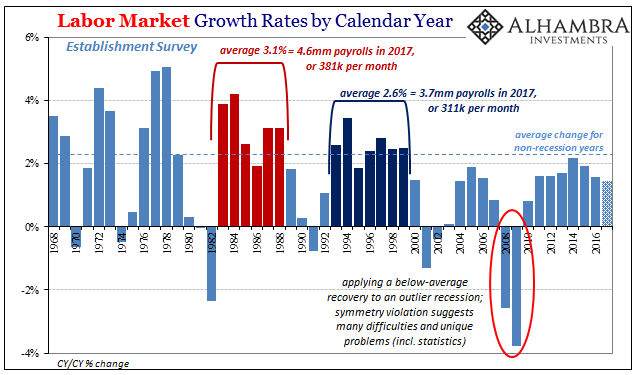
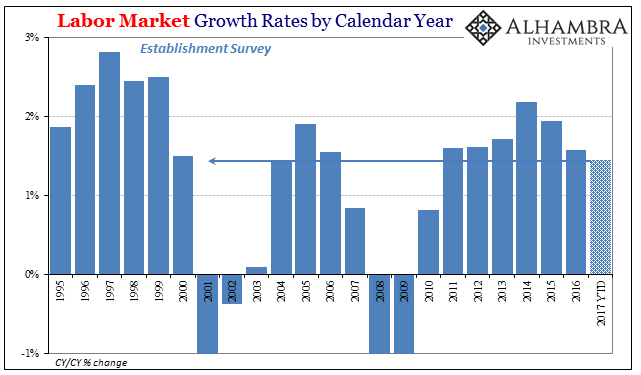
From 1993 through 1999, the labor market gained, on average, 2.6% per year according to the Establishment Survey. Since that time period is universally accepted as one featuring a strong economy, that is our standard for measurement. We can also go back to the eighties for what might amount to as an upper limit of sorts, the economy and labor market at that time being whatever is better than strong and robust – truly awesome.


Translating those average gains into the 2016 base equals an expectation of 3.7mm payrolls gained for 2017 to be as good as the nineties, and 4.6mm, which would signal a splendid economic year consistent with the eighties. Through 11 months so far up to November, the Establishment Survey gives us just 1.9mm for 2017. Assuming December turns out equal or better than November’s “good” number, the year should end with a total payroll expansion around 2.1mm, maybe 2.2mm.


That’s less than two-thirds of the way to the nineties, and significantly less than half of the eighties. This year, no matter how many months at 200k plus, has not been a good one. In fact, payroll gains in the eleven months so far tallied by the BLS’s Establishment Survey are less than those presented in that transitional year of 2000.


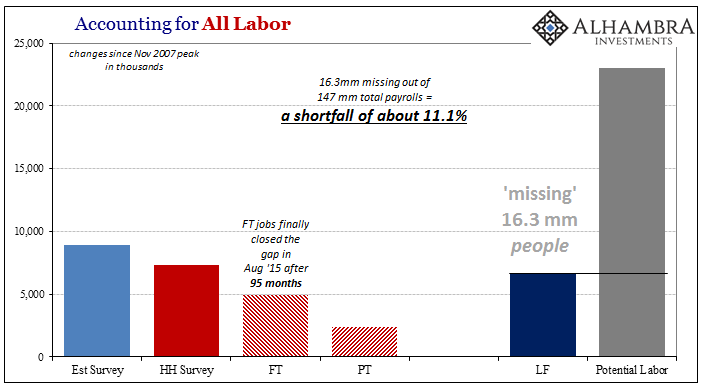
This is how you get the newest generation of American adults yearning in greater numbers for something vastly different, a radical political change if for no other reason than the establishment here continuing to say that everything is good when by every reasonable standard it isn’t even close! The “robust” labor market even of the past few years isn’t nearly enough to draw in those still sitting on the sidelines struggling, however, they do (parents’ basements) to just get along, leaving the economy instead it’s “missing” 16.3 million; a number that in a truly robust economy would be falling not rising.


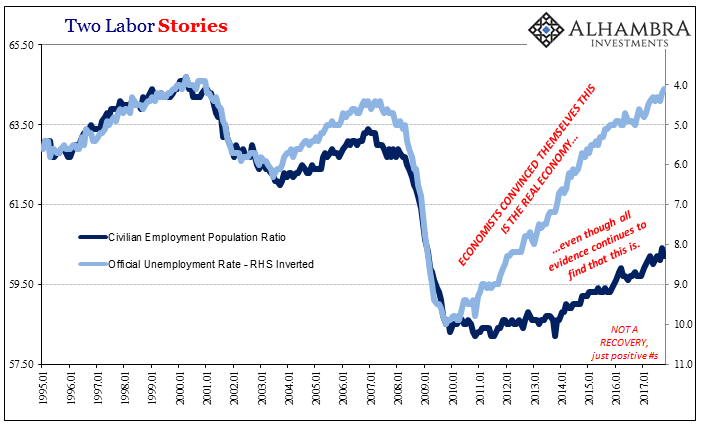
The issue clearly cannot be labor supply (Baby Boomer retirements, heroin, and fentanyl abuse in the Rust Belt) but shrunken labor demand; permanently shrunken economic demand. Therefore, there really should be no expectation for accuracy in the unemployment rate and what that means all around (inflation, baseline growth, monetary policy).


Once again in yet another month where the unemployment rate registers a ridiculous low, wages, and payroll earnings remain stuck at visibly low levels. The average weekly earnings of production and non-supervisory employees rose by just 2.6% year over year in November, after gaining 2.2% in October, 2.6% in September, and 2.7% in August. That’s nothing like in the past when the unemployment rate was where it is now. There is nothing like acceleration in earnings, not even solid growth.


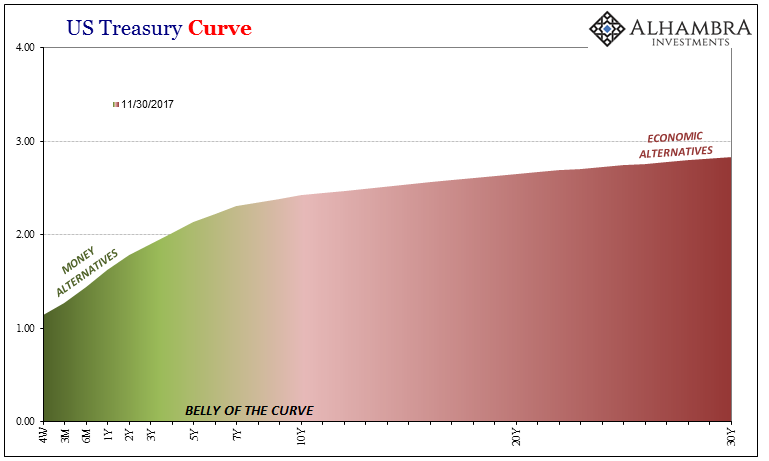
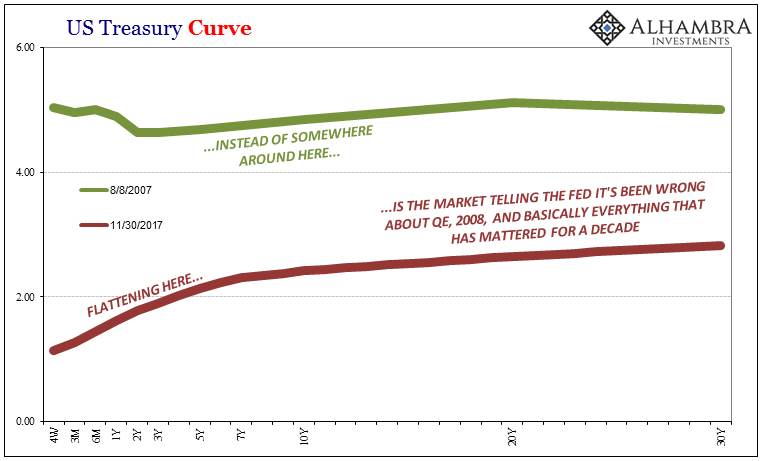
I don’t mean to make all this about the bond market every time (actually it’s appropriate), but the idea that treasuries at the long end have to be wrong has no basis other than misconception or intentional misdirection.


The data, including the BLS data, remains firmly on the side of flattening, and like the Establishment Survey’s paltry 1.9mm in 2017, it’s not even close.


Tuesday, November 7, 2017

JOLTS: Hiring Slides To Lowest In 6 Months As Job Openings Remain Near All Time High

After a burst of record high job openings which started in June and eased modestly in August, today"s September JOLTS report  - Janet Yellen"s favorite labor market indicator - showed another modest increase in job openings across most categories in the hurricane-affected month, with the total number rising fractionally 6.090MM to 6.093MM, above the 6.091MM estimate, resulting in an unchanged Sept. job opening rate of 4%. Still, after nearly two years of being rangebound between 5.5 and 6 million, the latest job openings number confirms that there may be a "breakout" about what was the previous resistance level, as increasingly more jobs remain unfilled in a labor market where skill shortages and labor imbalances are becoming structural.


The number of job openings was little changed for total private and for government. Job openings increased in professional and business services (+156,000), other services (+52,000), state and local government education (+36,000), and federal government (+15,000). Job openings decreased in accommodation and food services (-111,000) and information (-28,000). The number of job openings was little changed in all four regions. Now if only employers could find potential employees that can pass their drug test...


Comment on the impact from the hurricanes, the BLS said that "Hurricane Irma made landfall in Florida during September, the reference month for the preliminary estimates in this release. All possible efforts were made to contact and collect data from survey respondents in the hurricane-affected areas. A review of the data indicated that Hurricane Irma had no discernible effect on the JOLTS estimates for September."


One notable change in this report was the sharp slump in hiring, which declined by 147K to 5.273MM in September, the lowest month since April, and further reducing the hiring rate from 3.7% to 3.6% percent.


On an annual basis, the pace of hiring slowed down once again, declining to 1.8% in Sept. from 2.5% Y/Y in August, down from 3.6% in July.


The other closely watched category, the level of quits - which indicates workers" confidence they can leverage their existing skills and find a better paying job - reversed last month"s declined, and in Sept. rose from 3.093 MM to 3.182MM, suggesting workers were feeling just a little more confident about demand for their job skills than the previous month. The number of quits was little changed for total private and for government. Quits rose in  professional and business services (+82,000) and state and local government, excluding education (+10,000). Quits fell in other services (-45,000) and real estate and rental and leasing (-16,000).


And with a total 5.2 million separations (a 3.6% rate), this means that there were 1.7 million layoffs and discharges in September, unchanged from August. The layoffs and discharges rate was 1.2 percent in Sept.  The number of layoffs and discharges was little changed for total private and for government. The layoffs and discharges level decreased in wholesale trade (-30,000) and mining and logging (-7,000). The number of layoffs and discharges was little changed in all four regions.


Putting all the data in context:


  • Job openings have increased since a low in July 2009. They returned to the prerecession level in March 2014 and surpassed the prerecession peak in August 2014. There were 6.1 million open jobs on the last business day of September 2017.

  • Hires have increased since a low in June 2009 and have surpassed prerecession levels. In September 2017, there were 5.3 million hires.

  • Quits have increased since a low in September 2009 and have surpassed prerecession levels. In September 2017, there were 3.2 million quits.

  • For most of JOLTS history, the number of hires (measured throughout the month) has exceeded the number of job openings (measured only on the last business day of the month). Since January 2015, however, this relationship has reversed with job openings outnumbering hires in most months.

  • At the end of the most recent recession in June 2009, there were 1.2 million more hires throughout the month than there were job openings on the last business day of the month. In September 2017, there were 820,000 fewer hires than job openings


Finally, and perhaps most notably, the Beveridge Curve (job openings rate vs unemployment rate), appears to be gradually normalizing after a nearly decade-long "drift" from its conventional pattern. From the start of the most recent recession in December 2007 through the end of 2009, the series trended lower and further to the right as the job openings rate declined and the unemployment rate rose. In Sept 2017, the unemployment rate was 4.2% and the job openings rate was 4.0%.


Wednesday, September 27, 2017

NFL Players Have A First Amendment Right To Act Like Little Bitches

The following article was originally published by Brandon Smith of Alt-Market.com


kaepernick


Frankly, in my view, the sporting world should be a politics free zone, and the fact that I am compelled to write about politics in sports in America today is bewildering beyond belief. That said, to be clear, I am not a fan of the NFL. I think the sport, like most professional sports, is overrun with whiny, juiced-up morons paid millions of dollars for providing nothing to the public except sub-par entertainment and little-to-no loyalty to the state or city in which they happen to be employed. NFL players are not legitimate role models for society anymore that costumed television wrestlers are role models for society.


Add to this the rampant politicization of the NFL over the past several years with social justice undertones and overtones, and I can’t think of a single redeeming quality to the arena. The best thing that could possibly happen to U.S. athletics would be if the entire system was scrapped and rebuilt from the ashes with truly local teams composed of local players driven purely by the desire for athletic excellence and healthy competition.


To me, it seems the appeal of sports, at least for spectators, is the possibility that anything could happen according to the merit of the players and the teams. In a society in which so much is restricted and controlled and dictated by political correctness and appeals to artificial “fairness,” the idea that, at least on a football field, baseball diamond or hockey rink, all of that garbage goes out the window for a few hours is enticing to say the least. Spontaneous moments of greatness are what people want to see, not blithe displays of ideological ignorance.


There is no social justice in real sports. There is no affirmative action. There are no safe spaces. The best men or women rise to the top and the losers go home with nothing. That is the way it should be. Champions soar to the heights as easily as they fall to the depths, and underdogs can shock the world through sheer determination. You cannot lie or steal your way to athletic superiority. You cannot use victim-group status to win trophies and medals. You have to work hard. You have to earn it. If you are a fraud you will be found out eventually. This is a philosophy which has been lost in modern athletics. Leftists in our culture are also oblivious to the notion.


When I see one of the last fields of American heritage and meritocracy being destroyed by cultural Marxism, I do feel what I’m sure many people feel — enraged. However, the situation is more complex than surface conflicts suggest.


NFL players refusing to stand for the national anthem is not really the issue here. Donald Trump admonishing them for their actions is also not the issue here. It is the motivations behind both sides that concerns me.


For activist NFL players and owners the motivation is rather clear; social justice cultism has seeped into their profession and some of them have decided to use the platform they have been given to pontificate rather than play the game they are paid to play. Protests attacking non-existent racism and “patriarchy” against a system that has made these men multi-millionaire celebrities regardless of their skin color would be relegated to the idiocy of college campuses if any of these people had any sense of judgment.


For Donald Trump, the motivation is far more foggy. I would prefer if the president of the United States spent his energies on fulfilling his campaign promise of “draining the swamp” of banking elites and neo-con warmongers instead of loading his cabinet with them and spouting off on Twitter about forcing a few football players to stand for a national anthem that praises the freedom of rebellion.


My readers are well aware that I view Trump as a pied piper, leading conservatives down a path back to neo-con totalitarianism rather than towards libertarian virtues of individual sovereignty. In other words, I am not seeing much difference between Trump and Obama so far. Perhaps in rhetoric, but certainly not in action.


The circus surrounding Trump’s latest feud with the NFL is just another distraction away from the fact that this administration is following a very similar policy path to every other corrupt administration before it. And conservatives are so tired of the trespasses of the social justice cult, many of them are eating up every minute of the farce.  Though, this is not what a bunch of football players are concerned about.


Let’s summarize the actual problem…


If NFL players refused to stand for the national anthem because they believed in the ideals it represents but felt that our government no longer represented those ideals, then I would be in full support of their motives. Obviously, this is not why they are protesting. If their motivation was about speaking against corrupt government, then they would have refused to stand for the anthem back when Barack Obama, a Constitution-wrecking cabana boy for the elites, was in office.


If Trump’s attacks on the NFL were motivated by a love of liberty as the anthem inspires, then he would not demand that players be forced to stand, which is indeed a violation of their First Amendment rights. Instead, he would have dropped that concept completely and stuck with the rational side of his position, which was for spectators to vote with their wallets and stop supporting the league with their dollars.


The bottom line is, whether or not you or I support their motives, constitutionally, legal precedence is on the side of the players. They have every right to act like bitches on an SJW plantation, kneeling and virtue signaling to their heart’s content. And, the public has every right to stop watching the NFL, drop their ESPN subscriptions, throw their overpriced sports jerseys in the trash and move on to more important issues… like what the hell is all this nonsense with North Korea? And why do we keep hearing about economic recovery when the average American can’t make it from month-to-month without running up their credit cards? And why are so many of us so damn fat and unhealthy?


Hell, here’s an idea — how about more people stop watching sports and start playing sports instead? Why not simply let the NFL die out along with every other venture poisoned by social justice?


The point is, the NFL battle with Trump is irrelevant compared to the greater battle of ideals behind it. It is not for Trump to fight this battle; it is for the spectators and consumers to fight this battle. The solution is not Trump’s Twitter account or his interference. The solution is for Americans to walk away and take their money with them.


The solution is also not to attempt legislation or government force to strike fear into those who might disagree with us. I have seen far too many so-called “liberty minded” people repeat the fanatically stupid mantra of “stomp my flag and I’ll stomp your ass!” The great sacrifice of living in a free country is that you have to support the individual rights of EVERYONE, even people who don’t believe in individual rights.


Some might argue that this is not a path that is being pursued so we should not be concerned. I say the social undercurrent today is ripe for zealotry on both sides, and conservatives need to take the high road even if it means things will be more difficult for us in the short term.


Finally, to the players that have so far jumped on the Colin Kaepernick bandwagon; understand that you have delusions of grandeur. You are NOT Jesse Owens proving your worth in the face of Hitler’s Aryan dystopia. You are not important or effective activists in the grand scheme of things because your political and philosophical views are ill informed and generally incompetent. In fact, your views work in FAVOR of the corrupt system, not against it.


While you do have the right to sit during the national anthem, knowing why you are sitting is more important than the action itself. If you are sitting because you have bought into a cultural Marxist con game that is using you as fodder for political division, then perhaps you should rethink your little protest and try working towards concrete solutions.


If you are going to use race and social inequality as a crux for your theatrical displays of “defiance” as you are cashing checks for millions in sponsorship deals paid for primarily by white people, then I think you will find most of America laughing at you in the end. Show us your true resolve and refuse that dirty imperialist money. Otherwise, you are just another over-privileged punk pretending to be under-privileged in order to gain notoriety at the expense of reason.


If you would like to support the publishing of articles like the one you have just read, visit our donations page here.  We greatly appreciate your patronage.


You can contact Brandon Smith at: brandon@alt-market.com


Unsuspecting Americans to be Hit Hard by this U.S. Scheme to Confiscate Your Savings:Alan Greenspan, 20-year head of the US Fed, reveals Washington’s nasty trick to confiscate the savings of unsuspecting Americans. Here’s How Some Americans Are Preparing

Tuesday, September 5, 2017

Paul Craig Roberts' Brief Reflection On The Vanishing American Dream

Authored by Paul Craig Roberts,


Today is Labor Day, a difficult day to celebrate now that American labor has been cast aside and US jobs offshored and given to foreigners.


The remainder of the jobs is slated to be replaced by robotics.


Friday’s payroll jobs report was full of bad news. Full-time jobs declined by 166,000. The meager 156,000 new jobs claimed are really only 115,000 net of the prior month’s revision, and this 115,000 jobs estimate is within the range of statistical insignificance. In other words, there is no confidence that the jobs are actually there.


The US work force continues to develop a Third Word complexion of lowly paid part-time domestic service employment.


The American Dream continues its closedown.


Meanwhile the government tells us that we are at full employment with an unemployment rate of 4.4%.

Monday, August 7, 2017

Cafe Brags That They Discriminate Against Men

Via The Daily Bell


As a business, if you want to promote equality, the first thing you need to do is make sure you treat your customers unequally based on their gender.


I love when people empower themselves by becoming business owners. Running a business is certainly not easy, but it still frees you from certain constraints. For instance, pay is not decided arbitrarily by a boss, it is based on the services you provide.


Ironically, one business owner in Australia is using her success to promote inequality.


The cafe in Australia touts their discriminatory practices. An article about the cafe on The Mirror reads: Cafe charges men more than women – for a very powerful reason.


Yes, for a powerful reason. Their discrimination is powerful because statistically, women earn 18% less than men in Australia. That is why it is okay to discriminate in hiring as well; the cafe called Handsome Her only hires women. And they also give preferential seating to women. Men must get to the back of the bus–or cafe, whatever.


The 18% “man tax” is technically optional during the one week per month the tax applies, with the proceeds going towards women’s causes. I wonder how many women volunteer to pay the tax, seeing as it is for a cause they presumably agree with.


Also ironic: the fact that it is all women working at the cafe. About 81% of workers in the category, “Hosts and hostesses, restaurant, lounge, and coffee shop,” are women. This gives us a glimpse into the true issue of the pay gap. Sometimes is not actually a pay gap, it is a work choice gap.


But hey, if this cafe owner wants to discriminate against men, I fully support her right to do so. She will probably face legal challenges, and that is too bad in my opinion. I don’t think the government should interfere with businesses. No one is forced to patronize the coffee shop.


Likewise, I wish all proponents of fixing the wage gap would take up the issue in the private sector. But when you start advocating legal repercussions, you are limiting the freedom of others.


The media promotes certain types of discrimination. Discrimination is only okay when it corrects a historical wrong.


One headline from a 2015 Huffington Post article reads: Ethnic Minorities Deserve Safe Spaces Without White People.


“Our” ancestors kept slaves, so affirmative action, all black schools, and white free zones are all now acceptable. Nevermind that my ancestors were in Italy and Scotland in 1865. In fact, likely the majority of white Americans descend from post Civil War immigrants. Not that it should matter anyway; since when are we responsible for the sins of our relatives?


Private organizations should absolutely be allowed to discriminate. I wouldn’t want to force a black tailor to sew the white robes for a KKK outfit. Nor do I wish to force a baker or a florist to provide services for a gay wedding if they don’t want to.


I still don’t understand why a gay couple would want to give their business to a florist or a baker who is anti-gay. Ironically the same people understand that boycotting Chick-Fil-A is the proper response if you don’t like the organizations to which they donate.


I want to know who doesn’t want my money so that I don’t fund the promotion of something with which I disagree. I am glad the cafe is vocal against their anti-man stance. Otherwise, I might accidentally spend my money there.


I want to know about “white free zones.” I will feel much safer staying far away from them.


Of course, we need to stay vigilant about the legal action taken against honest business owners. But the true solution is obviously only supporting businesses which match up with your values.


Another thought; is humor a good way to combat these media driven cultural memes? I think the tv show Portlandia does a pretty good job of that. Check out the video below, and let me know what you think.


Thursday, July 20, 2017

Greece Brain Drain: 33% Of Unemployed Looking For Jobs Abroad Vs 11% In 2015

Authored by Mike Shedlock via MishTalk.com,


The  Unemployment Rate in Greece is down to 21.7% in April from a record 27.9% in July of 2013 and a record low of 7.3% in May of 2008.


Despite the falling rate, the percentage of those unemployed seeking jobs abroad has risen from 11% in 2015 to 33% this year.


The message seems to be “get me the hell out of here”.


The Greek Reporter notes Brain Drain Gathers Pace as One in Three Greeks Looks for a Job Abroad.


According to the annual survey by the firm Adecco titled “Employability in Greece,” the brain drain phenomenon has been increasing over the last three years.


In 2015 only about 11% of unemployed respondents said that they were actively looking for a job abroad. This figure increased to 28% in 2016 and reached 33% this year.


The responses show that the unemployed have different reasons to seek work abroad. Whereas in 2005, the main reason was the prospect of a better wage, in 2016 and 2017 the main reason given were better career opportunities.


The study conducted for the third year running, in collaboration with polling company LMG, was based on a sample of 903 people from the age of 18 to 67.


According to other findings, 37% of respondents say that they have been out of the labor market for at least 12 months.


Unemployment vs Wanting a Job


More than 1 out of 4 (28%) are out of the labor market, a higher rate compared with the previous two years.


In Greece, as in the US and elsewhere, there is a difference between wanting a job but not having one, and being officially unemployed.

Tuesday, July 18, 2017

Another Reason Men Don't Work: Imaginary World More Enjoyable Than The Real World

Authored by Mike Shedlock via MishTalk.com,


President Trump, like President Obama before him, point out the low unemployment rate as a measure of success.


What they don’t point out are masses of people on welfare via fraudulent disabilities, people in school wasting money in dead-end retraining exercises, people who have simply given up looking for a job, and people in forced retirement needing Social Security payments to survive.


A team of researchers from Princeton, the University of Chicago, and the University of Rochester discusses another class of individuals who are not working but are not counted as unemployed: People, primarily young men who are addicted to games. For such individuals, games provide a fantasy world that is far more enjoyable than the real world.


Please consider their report on Leisure Luxuries and the Labor Supply of Young Men.


Between 2000 and 2015, market hours worked fell by 203 hours per year (12 percent) for younger men ages 21-30, compared to a decline of 163 hours per year (8 percent) for men ages 31-55. These declines started prior to the Great Recession, accelerated sharply during the recession, and have rebounded only modestly since. We use a variety of data sources to document that the hours decline was particularly pronounced for younger men.


Not only have hours fallen, but there is a large and growing segment of this population that appears detached from the labor market: 15 percent of younger men, excluding full-time students, worked zero weeks over the prior year as of 2016. The comparable number in 2000 was only 8 percent.


A natural question is how these younger men support themselves given their decline in earnings. We document that 67 percent of non-employed younger men lived with a parent or close relative in 2015, compared to 46 percent in 2000.


One avenue to gauge how younger men perceive their fortunes is to use survey data on happiness. In this spirit, we complement the patterns in hours, wages, and consumption with data on life satisfaction from the General Social Survey. We find that younger men reported increased happiness during the 2000s, despite stagnant wages, declining employment rates and increased propensity to live with parents/relatives. This contrasts sharply with older men, whose satisfaction clearly fell, tracking their decline in employment.


Annual Hours and Employment Rates


Zero Weeks Worked


Real Wages


Two Questions


1. The study found gaming trends apply to younger men, not older men and not women. Do women more than men like to live in the real world?


2. Is happiness a function of increased gaming or a reflection on changing attitudes of millennials in general towards material things?


The research report ties in nicely with Growing Number of Companies Complain About Inability to Find Workers: So Why is Wage Growth So Low?

Monday, July 10, 2017

One Hedge Fund CIO's Conversation With His Uber Driver

In his latest weekly letter to clients, One River CIO Eric Peters shifts his attention away from his two favorite topics of monetary policy and capital markets, to unveil a streak of contrarian skepticism on the topic of "technological disruption", and in his trademark anecdotal style, present a hypothesis that would be most unwelcome in virtually every Econ 101 class and Venture Capitalist Headquarters: stating that "we should be careful not to overlook the possibility that today’s disruptive technology companies may be not much more than mechanisms to drive wages down to subsistence levels” alleging that “these companies rely less on technological innovation per se, but on changing employment styles and reducing total wages, while imposing harsher working conditions."


His conclusion: “the nature of technology depends very much upon what the public can be induced to put up with.” 


And just to make his view more palpable he presents the following conversation with his Uber driver:


“Paying my way through college,” said my Uber driver. I was asking about his life.


“My girlfriend pays most of our rent.” She’s carrying $150k in college debt. Four years of university, one year abroad. Spain. Then graduate school.


“She’s got a job at Verizon. I think she’s doing really well. They gave her a promotion.” Sounded like he really loved her. But didn’t have the remotest idea what she did for Verizon. Or how much her monthly loan cost.


I asked what he’d do with his degree? “No idea. I just don’t want to graduate with that much debt.”


In a separate tangent, here is Peters on another case of disruptive technology:


Amazon is building an army of 10k independent Tokyo couriers by 2020 to eliminate their reliance on the major parcel delivery companies.


The company ships 300mm packages per year in Japan, 10% of door-to-door deliveries. The jobs-to-applicants ratio for cargo delivery drivers is 2.01, outstripping the 1.25 ratio for the broad economy, denoting a labor shortage. But pay remains inexplicably low; the work is hard, back-breaking.


The new Amazon army will be small mom and pop proprietors. Each one unable to bargain. Divided, conquered by technology.  


Just as Jeff Bezos likes it.


Finally, we excerpt three anecdotes on the interplay between "technological innovation" and the now defunct Phillips curve.


“Quantitative Easing and all of its paraphernalia of ‘managing inflation expectations’ was always a scholastic fantasy,” said the Englishman. “First and foremost, it was a way of charging the public for bailing out banks without being forced to make the case in parliament,” he continued. “Second, it was a political expedient for central banks to be seen to be doing something to protect their ‘independence,’ and third, it was a sign of the self-regarding over-confidence of central bankers that precise control of the inflation rate was within their power.” 


“The BOE chief economist analyzed the relationship between unemployment and inflation since 1500,” continued the Englishman. Nerds call this relationship the Phillips Curve, and they’re hyperventilating because it appears broken. With US unemployment at 4.4%, inflation should be rising swiftly. Ain’t happening. “It appears the Phillips Curve is an artefact of its time.” From 1500-1700 it was flat. From 1860-1950 it sloped steeply upwards. It’s flat again. “There’s no ‘normal’ Phillips Curve, because the labor/capital bargain is always evolving.”


“We should be careful not to overlook the possibility that today’s disruptive technology companies may be not much more than mechanisms to drive wages down to subsistence levels,” said the Englishman. “These companies rely less on technological innovation per se, but on changing employment styles and reducing total wages, while imposing harsher working conditions.” I called an Uber, this convo had gotten too depressing. “The nature of technology depends very much upon what the public can be induced to put up with.” 


Saturday, June 17, 2017

WATCH: Elderly Man Dies After Officers Slam Him On His Head, Break His Neck

elderly


Orange County, FL — There’s probably no better example, to highlight the systemic problem our system of justice currently faces, than the following story. An elderly man, William Howard (75), who had never been in trouble with the law before, had a run-in with police after his wife said he “began to act strange.”


Howard was arrested and taken to jail for attacking his wife with a knife. But it’s what happened next which illustrates just how violent the system truly is.


The convergence of mental health issues, crime, and the criminal justice system worked against Howard’s favor following his arrest. Why he wasn’t taken to a mental health facility following the attack is a question which remains to be answered — especially considering the fact that this man with no arrest history did something so outlandish. Nevertheless, Howard found himself an inmate in Florida’s Orange County Jail on November 16, 2016.


Because of his diminished mental state, jail personnel were having a hard time getting Howard to cooperate with their orders. Appearing confused, according to reports, Howard would not come out of his jail cell.


The corrections officers on the scene worked patiently, it seems, to coax Howard into compliance. They jingled keys and spoke to the man, advising him to come to the sound of the clanging noise. “I’m over here,” a jailer can be heard saying as he shook the keys.” “Come over here,” he implored.


Howard didn’t budge, and so the controversial decision to use force was made. In hindsight, it probably wasn’t the wisest of decisions. While Howard appears to be a tall man of formidable stature, it doesn’t take a brain surgeon to know the man, being elderly, is also quite frail.


READ MORE:  Mom Calls Cops to Take Her Son to a Mental Health Facility, Cop Shows Up & Kills Him


A crew of more than a few jailers entered his cell and grappled with him. But it’s what happened after they controlled him which is reportedly leading Howard’s family to consult an attorney.


After controlling the elderly man, the same use of force procedures were used on him as are used on inmates much younger. He was taken to the ground — but not gently. He was slammed to the ground on his face, an action which the coroner stated led to his death.


According to the autopsy, two vertebrae in his neck were broken, and his spinal cord was crushed. Yet even though the actions of the officers ultimately led to his death, the Orange County district attorney concluded no laws were broken and no jail employee would be criminally charged.


The resolution to Howard’s unfortunate death will likely be determined in civil court, as a result. But to date, no lawsuit has been filed on behalf of Howard’s family.


Attempting to dissect the problems with Howard’s death is difficult, especially since the officers involved have already been cleared of any wrongdoing. Given the nature of Howard’s behavior, in attacking his wife with a knife, it may be that he was suffering from some sort of medical issue. Indeed, it is what all signs point to, especially considering his wife’s description of him acting strangely.


Strokes, manic episodes, schizophrenia and other illnesses can lead someone to carry out an attack on the ones they love the most, even a concussion can create such behaviors.


It’s unclear if Howard’s actions were the result of such a medical condition, nor is it clear that his mental state was evaluated prior to locking him up in jail. What is certain is that submission methods when dealing with an elderly inmate must be reevaluated.


READ MORE:  Dashcam of Cops Beating 83yo Man Mysteriously Deleted Due to "Technical Failure"


If there’s a risk a man’s bones can be broken, his spinal chord crushed, and death can be a result, some other method of containment must be employed. More must be done to ensure jailers do not end up being executioners.

Wednesday, June 7, 2017

Elderly Americans Are Taking Their Grandkids' Summer Jobs

Compared with their peers in the European periphery, American teenagers looking for a part-time job this summer are in an enviable position: With the unemployment rate at a post-crisis low and demand for seasonal workers set to rise by more than 10 percentage points compared with last year, they shouldn’t have much trouble finding work, Bloomberg reported.


However, despite these encouraging circumstances, the teenage workforce participation rates are already at their lowest levels in more than a decade – and they’re expected to keep falling. The Bureau of Labor Statistics expects the workforce participation rate among teens to break below 27 percent in 2024, or 30 points lower than the peak seasonally adjusted rate in 1989.


Why? Because teens these days are facing stiff competition from Americans over the age of 65 – i.e. their parents and grandparents.


As Bloomberg reports: American teens are “being crowded out of the workforce by older Americans, now working past 65 at the highest rates in more than 50 years.”


Of course, senior citizen aren’t the only demographic group vying for the service-industry jobs once coveted as a rite of passage among American teens. Immigrants have also taken some of those jobs, as Bloomberg reports.


“Why aren"t teens working? Lots of theories have been offered: They"re being crowded out of the workforce by older Americans, now working past 65 at the highest rates in more than 50 years. Immigrants are competing with teens for jobs; a 2012 study found that less educated immigrants affected employment for U.S. native-born teenagers far more than for native-born adults.”


Whether you"re looking at summer jobs or at teen employment year-round, the work trends for teenagers show a clear pattern over the last three decades. When recessions hit, in the early 1990s, early 2000s, and from 2007 to 2009, teen labor participation rates plunge. As the economy recovers, though, teen labor doesn"t bounce back.


Today"s college-bound teens are finding that the ROI for focusing on their studies in the hopes of obtaining outside scholarships or merit-based aid packages is more attractive than a minimum-wage paycheck, according to a study by the BLS.


“Parents are pushing kids to volunteer and sign up for extracurricular activities instead of working, to impress college admission counselors. College-bound teens aren"t looking for work because the money doesn"t go as far as it used to. ‘Teen earnings are low and pay little toward the costs of college,’ the BLS noted this year. The federal minimum wage is $7.25 an hour. Elite private universities charge tuition of more than $50,000.”


Whereas decades ago, summer school was for remedial-track students who failed courses offered during the academic year, teens from affluent families are enrolling in enrichment courses and taking classes for college credit as high school curriculum grows increasingly more intense.


In 1982, fewer than one in 10 high school graduates had completed at least four years of English classes, three years of math, science, and social science, and two years of a foreign language. By 2009, the most recent data in the U.S. Digest of Education Statistics, the share of grads taking those classes was almost 62%.


All this studying has obvious benefits, but a single-minded focus on education has disadvantages, too; a summer job helps provide teens with real work experience that they can’t get at school or home. Working teens learn how to interact with co-workers, operate as part of a team and – most importantly – deal with bosses.


Last year, 43 percent of 16- to 19-year-olds were either working or looking for a job. That"s 10 points lower than in July 2006. In 1988 and 1989, the July labor force participation rate for teenagers nearly hit 70 percent.


In July 2016, more than two-fifths of American students aged 16-19 were enrolled in a summer course. That’s more than four times the enrollment totals from July 1965, Bloomberg reported.

Saturday, June 3, 2017

"It's Not Just Wages" - Workers Without College Degrees Face "More Instability"

If you believe San Francisco Fed President John Williams, the US labor market has almost never been ore robust than it is today. Of course, middle- and working-class Americans who are struggling with levels of financial uncertainty that would be unfamiliar to their parents’ generation don’t necessarily care that the official unemployment rate is 4.4%. They’re too busy struggling to make ends meet when real wages have been stagnant for decades and economic growth is expected to slouch along at 2% for the foreseeable future.


While researching their new book “The Financial Diaries,” Jonathan Morduch and Rachel Schneider followed more than 200 working and middle-class families around for a year and tracked “every dollar of their financial lives." They found that millions of workers without college degrees, especially those who are paid hourly, or who are paid by commission, experience what they call call income variability - when their pay fluctuates by 25% above or below their average. One of Murdoch and Schneider"s subjects, a truck mechanic named Jeremy, even quit his job to take a lower paying job with a steady salary.


They discussed their findings during an episode of Bloomberg"s "Benchmark" podcast.


“When we first met him, his weekly paychecks were very variable. And he was bearing all that risk. At the end of the year, he quit his job for another job with lower pay that was more steady. ”


“On average, we’re seeing households spend about five months of the year where their income was 25% above their average or 25% below their average. So income insecurity wasn’t about ‘am I going to lose my job,’ it’s about ‘how am I going to navigate the ups and downs in my given job.’”


The pair also found that existing financial services don"t adequately serve the needs of workers struggling with income variability. Schneider discussed how one subject whom she called Jane intentionally placed obstacles to withdrawing money from her savings account.


“Often the strategies they were using to make that money stretch show gaps in how financial services are or are not serving them. For example, we tell the story in the book of a woman called Janice who has a savings account and a checking account but she cut up her checkbook for her checking account and she cut up her ATM card. She has those accounts in different institutions and the savings account is an hour’s drive from her home.”


“A bank might say she’s not using those products right, she’s paying check cashers and fees on money orders to pay her bills she’s using it wrong. But I look at it the other way she actually wants some wall between herself and her spending or savings. She cut up the check book because she doesn’t want temptation to take out payday loans which she’s had trouble with in the past.”


Regardless of race, workers without degrees are stuggling "in a lot of ways."


“One of the things that we see is that today workers without college degrees are struggling in a lot of ways. We see that in the labor market in terms of wages and what our data and related data are showing is it’s not just average wages they also are facing much more instability than other workers."


"The economic backlash is being felt by lower class workers, regardless of race, because the system isn’t working for the poor.Black workers have a hard time and white worker as well are living very precarious lives. Even though they have jobs there’s economic anxiety in America even for people with jobs. And that’s the big puzzle in America. That people are trying to sort out what the big answer is but you spend time and follow people month to month you see exactly why there’s so much anxiety in a sense because the system really isn’t working for them.”


Saturday, April 8, 2017

Morgan Stanley: "Wage Growth Is Leveling Off, May Be Slowing"

While Friday"s headline payrolls print - the lowest since May - was disappointing even to the biggest economic optimists, many found refuge in the sharp drop in the unemployment rate, which ticked lower to 4.5%, the lowest print in a decade. And yet there was a problem: with the unemployment rate tumbling, at least in theory indicating even less slack in the labor market, wage growth barely hit consensus estimates. Instead, if indeed the growth narrative is accurate, and if more people were employed, wages should be rising. However, it was this weakest link of the entire reflation/recovery narrative that disappointed once again.


In fact, it was even worse: as Morgan Stanley"s Robert Rosener write overnight, "wage pressures in March were supported almost entirely by a massive jump in earnings in Professional & Business Services. Outside of this bright spot, wages in other industries were muted, and suggests wage growth in a broad range of industries may be leveling off, or even slowing."


As Rossener further notes, to describe wage pressures in March as "spotty" may be an understatement. The 0.19%M gain in average hourly earnings was supported almost entirely by a massive jump in the Professional & Business Services industry. Outside of this one bright spot, wage pressures in other industries were surprisingly muted (Exhibit 1), and suggests wage growth in a broad range of industries may be leveling off or even slowing.


According to MS, the 0.92% sequential gain in average hourly earnings in Professional & Business Services was the second largest monthly increase on record, and this accounted for nearly all of the increase in aggregate average hourly earnings. In other words, average hourly earnings would have been roughly flat on the month were it not for the outsized increase in earnings for Professional & Business Services. To be sure, the bounce in wage growth for this job category was decidedly welcome: As a generally high-paying industry, stronger wage growth in Professional & Business Services can go a long way in supporting stronger aggregate outcomes for average hourly earnings.


The key question from here is whether or not the upside in March can be sustained, or if it"s just noise.


Yet while the silver lining in professional services will be closely watched, a bigger question is what happens to wages in all the other key indudtries, where as noted above, March saw substantial weakness.


Here, Rosener writes that "consistent with signs of a recent softening in wage pressures in a number of industries, our wage growth diffusion index has shown a meaningful narrowing in the breadth of wage pressures across industries in recent months—only 38.5% of industries are now showing above-trend rates of wage growth, down from 46.2% in February and a high of 61.5% in August 2016."


Some more observations from Morgan Stanley:


  • The jump in average hourly earnings in Professional & Business Services helped boost wage growth in the broader high-wage industry segment as a result, with average hourly earnings in high-wage industries rising to 3.0%Y in March from 2.7%Y in February (Exhibit 5).

  • Wage growth in middle-wage industries fell sharply in March to 2.1%Y vs 2.6%Y in February (Exhibit 6).

  • Wage growth in low-wage industries ticked down to 2.6%Y from 2.8%Y, although smoothing through the volatility shows a steady trend for wage growth in low-wage industries around 2.6%Y (Exhibit 7).

  • Consistent with fewer workers experiencing wage gains, the median rate of wage growth across industries fell notably in March. Median wage growth fell to 2.5%Y in March from 2.8% (Exhibit 8)


* * *


Taking all that, and the bigger jobs picture in mind, what does the labor market mean for the Fed"s June decision? The answer: it depends on whether you see the glass as half empty or half full.


The optimist says, "Well, the unemployment rate continues to fall and the Fed has been expecting the pace of job gains to slow. At 163k per month over the past 6 months, shown in Exhibit 2, the economy has been adding jobs well above the pace needed to keep the unemployment rate moving lower." The labor market is tightening, right?


The pessimist says, "Despite continued strength in the labor market, signs of labor market tightness are few and far between. Yes, the unemployment rate is falling, but core measures of wage growth remain anemic. Just look at the year-on-year rate of wage growth among production and non-supervisory workers, as shown in Exhibit 3. At 2.3% Y/Y in March, growth in wages of these workers was lower than it was in the year ending early 2014. This just means NAIRU (Natural Rate of Unemployment) is lower."


Morgan Stanely"s summary:


"Even though NAIRU could be (much) lower, we don"t think the FOMC consensus will let that affect their decision on rates for now. One weak headline payroll number is also unlikely to dissuade the consensus from believing that continued gradual rate hikes remain appropriate. However, if the April or May payroll number disappoints, that could change.... we"ll be watching carefully for clues as to whether small business hiring slows in the wake of inaction by the Trump administration and Republican-controlled Congress. So we"ll be watching with interest the NFIB Small Business Optimism index released on Tuesday, April 11."


What this means for markets and the economy: the Trump "reflation" rally, having already withered across many market indicators, has finally moved to the economy and actual wages, where it increasingly appears to have been nothing more than a mirage.