Showing posts with label Hurricane Irma. Show all posts

Tuesday, November 21, 2017

What We Can Expect For Gold Prices in the Wake of the Hurricane Season


The recent spate of back-to-back hurricanes in the US is expected to compound the economic damage of an already over-extended debt. As the stock market braces for a correction, traders are inclined to sell out of riskier stock markets and take refuge in safe havens like gold.


Although it will take months for the impact of the hurricane season to be apparent, investors are already losing appetite for risk and investing in secure assets as gold. This was evident from the figures leading up to the hurricane season this year. Gold watchers have seen this precious metal on a summer turnaround, spiking up to $1300 even as markets remained uncertain.


The performance of gold from 2016


An 18-month gold chart: April 2016 - September 2017


Source: NASDAQ


The historical 5-year volatility of gold witnessed a brief 2016 July surge in the aftermath of the surprise Brexit vote. Gold prices rose sharply driven by macroeconomic uncertainty caused by the unexpected EU referendum. Prices peaked at $1372 in August but dived 7.63% in November 2016 to finish at a record low of $1133. Presidential pro-business policies buoyed the equity markets and strengthened the US dollar driving investors away from gold. Gold prices plunged by nearly 5 % to notch a record low of $1143 in early January 2017. According to aForbes commentary, this can be “attributed to fluctuations in the investment demand for gold”. Another reason why gold prices remained under pressure was a strengthened dollar, which makes the commodity more expensive for investors.


However, the post-presidential-election unstable scenario brought back the sheen of gold. Since January this year, gold prices have been slowly rising along the $1200 mark with rates clinging to the $1260 - $1300 range. TheUS Federal Reserve’s interest rates hike of June, followed by July, resulted in the gold price dipping to a rock-bottom $1210. The end of July saw gold staying put at $1270. Since August, the sluggish trend of gold finally got over with a 4 % surge to trade at $1290. This trend continued despite hurricane warnings and the escalating US-North Korea tensions and a globally uncertain geopolitical landscape.


Source: Marketwatch


The significance of the gold price turnaround cannot be overlooked. It can be partly attributed to hedge investor wariness with the American and European economies, particularly the US, where debt-based assets are at an all-time high.


Usually, near-term losses to an economy are offset by a medium-term boost to growth, but with the US parliament functioning in silos and government support programs yet to kick-in amidst the political instability, private investment in rebuilding the economy has taken a beating. Safe investing in gold became the option.


What was seen prior to the hurricane weekend of Irma was an upsurge in the gold price as investors sought to take the safe route. As perInvesting, “the dollar remained under pressure amid doubts over prospects for a third Federal Reserve rate hike this year”. With the U.S. debt ceiling talks getting postponed and a rate hike doubtful, the optimism on gold has kept up


The direct impact of hurricanes Harvey and Irma


A 7-day gold chart: 8 September – 15 September


Source:NASDAQ


According toThe Street, “a $300 billion hit from hurricanes Harvey and Irma is likely to affect jobs, growth and inflation in the months ahead”. The U.S. dollar hovered near a two-and-a-half year low last Friday on the 8th September when the Irma touched upon Florida. The dollar index slipped to the lowest since January 2015, coupled with a two-year high jobless claims data, mostly coming from the hurricane-hit Texas.


After rising to a three-year high in August-September, gold prices took a hit on Friday. Soon after the weekend as the hurricane risk damage of Irma was downsized, gold prices fell with risks receding in the markets. As the stock market rebounded and the dollar joined the recovery, the double impact had “the gold prices reeling at this point of time” as perNASDAQ. The prices recorded a $23 drop touching $1328. This was a short-term effect. Recovery from threat perceptions of the double whammy of hurricane Irma and North Korea missile launch may have triggered the downslide of gold prices. The sudden optimism post Irma weekend and apprehensions of North Korea dwindling, helped the stock markets and the dollar to rebound and consequently the prices of gold to move lower


Gold Prices in Q4 after the hurricane season


The fall of gold prices post-hurricane weekend cannot be seen in exclusion to other situations plaguing America.  The dip during the week till 13th can be seen more as a knee-jerk reaction. This weak trend will not last long as is evident from the recovery from 14th. The hurricane season will soon be over by the end of Q3 and so will the uncertainties revolving around it. The short-term status of dipping gold prices as seen this week is already witnessing a correction which will continue through Q4. Another reason why one can expect a high demand and buying to continue is the festival season across gold consuming countries.


Notwithstanding the market expectations in the US and Europe, gold can be expected to steady and rise. Even as this goes to print, the dipping price has stabled and recovered. Safe havens such as gold will continue to be in demand, with prices of the precious metal surging to a one-year high.


Gold is considered secure from an investment point of view to hedge against macroeconomic uncertainty. The GDX, as well as the currently over-valued stock markets, may be due for a correction shortly, which will again impact gold prices, causing another surge. According to theForex Time market analysis, “Investors are likely to continue buying stocks with overstretched valuations because when compared to treasuries, they still look much more attractive”.


A three-month gold chart: July - September 2017


Source: NASDAQ


Presently, it appears that the gold prices will hold up during the Q4, despite unpredictability, as two constants remain – a weakening dollar and a low interest/credit position.


After the Q3 the gold prices can be expected to surge along comfortably till the end of 2017, although whether theGlobal Intergold prediction of 1,515 $ per ounce come true, it remains to be seen. The year 2017 will go down in gold history as the year ofthe breakout from the 6-year downward trend. The bottom line is that gold prices will be largely unaffected by the hurricane season in the mid and long-term.  AsHubert Moolman suggests, the current situation for gold is similar to that of May 1979, when prices of assets like gold and silver soared while bonds and stock market collapsed. An event likea stock market crashis also likely to push many banks to that point of failure With the likelihood of such major monetary events around the corner, gold is likely to spike much higher over the coming 12 months.


Tuesday, November 7, 2017

JOLTS: Hiring Slides To Lowest In 6 Months As Job Openings Remain Near All Time High

After a burst of record high job openings which started in June and eased modestly in August, today"s September JOLTS report  - Janet Yellen"s favorite labor market indicator - showed another modest increase in job openings across most categories in the hurricane-affected month, with the total number rising fractionally 6.090MM to 6.093MM, above the 6.091MM estimate, resulting in an unchanged Sept. job opening rate of 4%. Still, after nearly two years of being rangebound between 5.5 and 6 million, the latest job openings number confirms that there may be a "breakout" about what was the previous resistance level, as increasingly more jobs remain unfilled in a labor market where skill shortages and labor imbalances are becoming structural.


The number of job openings was little changed for total private and for government. Job openings increased in professional and business services (+156,000), other services (+52,000), state and local government education (+36,000), and federal government (+15,000). Job openings decreased in accommodation and food services (-111,000) and information (-28,000). The number of job openings was little changed in all four regions. Now if only employers could find potential employees that can pass their drug test...


Comment on the impact from the hurricanes, the BLS said that "Hurricane Irma made landfall in Florida during September, the reference month for the preliminary estimates in this release. All possible efforts were made to contact and collect data from survey respondents in the hurricane-affected areas. A review of the data indicated that Hurricane Irma had no discernible effect on the JOLTS estimates for September."


One notable change in this report was the sharp slump in hiring, which declined by 147K to 5.273MM in September, the lowest month since April, and further reducing the hiring rate from 3.7% to 3.6% percent.


On an annual basis, the pace of hiring slowed down once again, declining to 1.8% in Sept. from 2.5% Y/Y in August, down from 3.6% in July.


The other closely watched category, the level of quits - which indicates workers" confidence they can leverage their existing skills and find a better paying job - reversed last month"s declined, and in Sept. rose from 3.093 MM to 3.182MM, suggesting workers were feeling just a little more confident about demand for their job skills than the previous month. The number of quits was little changed for total private and for government. Quits rose in  professional and business services (+82,000) and state and local government, excluding education (+10,000). Quits fell in other services (-45,000) and real estate and rental and leasing (-16,000).


And with a total 5.2 million separations (a 3.6% rate), this means that there were 1.7 million layoffs and discharges in September, unchanged from August. The layoffs and discharges rate was 1.2 percent in Sept.  The number of layoffs and discharges was little changed for total private and for government. The layoffs and discharges level decreased in wholesale trade (-30,000) and mining and logging (-7,000). The number of layoffs and discharges was little changed in all four regions.


Putting all the data in context:


  • Job openings have increased since a low in July 2009. They returned to the prerecession level in March 2014 and surpassed the prerecession peak in August 2014. There were 6.1 million open jobs on the last business day of September 2017.

  • Hires have increased since a low in June 2009 and have surpassed prerecession levels. In September 2017, there were 5.3 million hires.

  • Quits have increased since a low in September 2009 and have surpassed prerecession levels. In September 2017, there were 3.2 million quits.

  • For most of JOLTS history, the number of hires (measured throughout the month) has exceeded the number of job openings (measured only on the last business day of the month). Since January 2015, however, this relationship has reversed with job openings outnumbering hires in most months.

  • At the end of the most recent recession in June 2009, there were 1.2 million more hires throughout the month than there were job openings on the last business day of the month. In September 2017, there were 820,000 fewer hires than job openings


Finally, and perhaps most notably, the Beveridge Curve (job openings rate vs unemployment rate), appears to be gradually normalizing after a nearly decade-long "drift" from its conventional pattern. From the start of the most recent recession in December 2007 through the end of 2009, the series trended lower and further to the right as the job openings rate declined and the unemployment rate rose. In Sept 2017, the unemployment rate was 4.2% and the job openings rate was 4.0%.


Monday, October 30, 2017

FBI Is Probing Puerto Rico"s $300 Million Power Contract With Whitefish Energy

Just a day after Puerto Rico"s cash-strapped power authority on Sunday canceled its controversial $300 million contract with Whitefish Energy, a small Montana company tasked with rebuilding the island"s power grid after it was completely destroyed by Hurricanes Maria and Irma, the WSJ is reporting that the FBI is looking into the circumstances surrounding the contract.


The contract was canceled on orders from Puerto Rico Gov. Ricardo Rossello, who pointed to the burgeoning controversy surrounding the company - including its relationship with Secretary of the Interior Ryan Zinke, who is from the same small Montana town where Whitefish is based.


Zinke issued a statement last week denying any involvement in the deal. Zinke is reportedly friends with Whitefish CEO Andy Techmanski.


The company has been criticized for moving too slowly in its efforts to restore power to the island. To date, only 30% of power customers on the island have had electricity restored, more than a month after Maria first made landfall along the island"s southeastern coast.


As WSJ explains, the firm had more than 350 workers and 2,500 tons of heavy equipment on the ground for rebuilding electrical lines destroyed in Hurricane Maria. But the firm’s small size and limited track record, as well as the terms of the contract, ignited concerns around Puerto Rico’s management of the flow of federal disaster-relief dollars to the island.


The Federal Emergency Management Agency, multiple congressional committees and local auditors also have raised concerns and begun requesting documents about the deal. Ricardo Ramos, the executive director of Prepa, had defended the selection of Whitefish and said the contracting process was done according to the utility’s regulations for handling emergency situations.


Thursday, October 26, 2017

FEMA Is Failing America After These Massive Hurricanes — and I Know Why

(ANTIMEDIA Op-ed) Recently, I’ve been reading and hearing a lot about groups like the Cajun Navy, which rescued hundreds of people during Hurricane Harvey. The organization formed spontaneously in the wake of Hurricane Katrina and is stimulating a new and much-needed conversation. When you compare the voluntary provision of important public services by the “Cajun Navies” of the world to those provided by government agencies like FEMA, it’s hard to deny how much better the voluntary organizations perform.


Based on many of the discussions I’ve been having about recent events, it is obvious that many people realize something important is almost “hiding in plain sight.” ‘We the People’ already provide each other with most of the services we rely on, but this fact often goes unnoticed. Whether it’s the production and supply of foodclotheselectrical powerhousessystems and modes of transportationmedical treatments, or most modern forms of communication — all public services on which we depend — We the People are responsible for most of them.


And yet almost half of the country’s resources go to the government.


Common sense says we should send more resources to those who can do the best work with them. Yet when it comes to the public services, that common sense seems lacking.


Whenever we simply increase the amount we are sending to a government program or agency to deliver a public service, we are skipping the critical step of identifying the best way of doing something before we do it – or doing more of it.


In almost every other area of life, when we want to improve outcomes, we look at methods of delivery. If we did this for the services the public relies on, we would all do better.


The provision of public services by the government has some unique and fundamental flaws. For example, the guaranteed supply of potentially unlimited revenue (through taxation) reduces the accountability of those who spend it, creating an imbalance between inputs and outcomes. This contributes to ever-increasing waste and inefficiency over time. FEMA had a $13.9 billion budget in 2016 yet was expected to run out of money even before superstorm Irma hit Florida as this year’s hurricane season was just beginning. And that’s after $6.7 billion was allocated to disaster relief in the 2017 budget.  In contrast, volunteer organizations have been performing many of the same functions of FEMA even more effectively without taking any tax dollars from the public to do so. Amazingly, the Cajun Navy does its life-saving work without taxpayer funds.


The fact that the Cajun Navy arrived on the scene quicker than FEMA and saved more lives on a shoestring budget begs a profoundly important question: How much more good could be done by the “Cajun Navies” of the world if they had even a small fraction of the resources the “FEMAs” have?


The Cajun Navy is just another example of Americans coming together and putting their differences aside to help each other in times of need. It’s truly a beautiful thing to witness. As Charlie Chaplin famously said in the film The Great Dictator, “We all want to help one another; human beings are like that.”


The good news is that we are already spending more than enough to do the good we would like to see done – if only a small fraction of those resources were redirected to those who do better with them so they could give those most in need the best possible assistance.


A model for this has already been implemented with excellent results.


In Arizona, residents are able to redirect some of their tax dollars to organizations that do better in supporting the causes they believe in. Arizona’s “charitable tax credit” allows each taxpayer to redirect up to $400 (recently doubled from $200) of their individual state income tax liability to a nonprofit in their local area that serves the poor more effectively than does the government. Taxpayers receive a dollar-for-dollar credit for donations, so if they have a tax bill of $1,000 from the state of Arizona but have sent $400 to their favorite local charities, they only owe the state $600.


Whether we are responding to catastrophic events such as hurricanes or the basic, everyday needs of our communities, doesn’t it make the most sense to ensure those who do the most good have the resources they need to do even more good? If we do, the sky will be the limit for the “Cajun Navies” out there in both number and effectiveness.  Given the uncertain environment we live in, why would we want to do anything less than put ourselves in the best possible position to meet tomorrow’s needs or to deal with the next emergency — whatever it may be?


There are countless examples of harm done by the wasting of resources by those who have no real incentive to deploy them carefully. How about New York City spending $2 million on a bathroom, the GSA spending more than $800,000 at a conference in Vegas, and the Pentagon fudging its own accounts by $6.5 trillion? The list goes on and on.


Recognizing all of this, the We Do Better project is about finding organizations that do better in each community, ensuring that those who need help know where and how to get it, and empowering communities to send their resources where they will do the most good.


In Arizona, where the charitable credit was implemented, local charities in several communities formed tax credit coalitions to publicize the credit, making it easier for donors to give and for beneficiaries to find them. This increased cooperation among charities has had the wonderful side effect of making them more effective in helping people who were facing multiple challenges at once (such as food insecurity, homelessness, and addiction), hugely improving human outcomes and the strength of the community’s social safety net.


Doing the most good means being morally committed to better human outcomes rather than ideologically committed to a particular method of achieving them.  Let us start measuring our compassion not by our good intentions, the efforts we make, or even the money we spend – but by the good we do for each other.


As Margaret Mead famously said, “Never doubt that a small group of thoughtful, committed citizens can change the world. Indeed, it is the only thing that ever has.


We already do better. We can do more of that.


Op-ed / Creative Commons / Anti-Media / Report a typo


This article was submitted by Jason Casella of We Do Better, a voluntary aid organization.


Thursday, October 12, 2017

Florida's Farmers Produce Smallest Orange Harvest Since WWII After Irma Wiped Out Half Of Crops

Hurricane Irma wiped out nearly 50% of Florida’s iconic orange crop when it buffeted the state with 160 mph winds and a massive storm surge last month, sending orange concentrate futures rocketing higher and stoking speculation that the state’s embattled orange growers – already struggling to fend off a worsening “greening” epidemic that’s constrained production over the past decade – might never recover.


And in a development that confirmed traders fears that this year’s crop could be the smallest in decades, which in turn increases the likelihood that prices will remain elevated for the time being (no doubt conferring some small boost to headline CPI), Bloomberg is reporting that the state’s 2017 orange crop was its smallest since 1942, with 31 million boxes harvested.


Oranges are also grown in California, but the drop in Florida orange stocks was largely responsible for the smallest national yield since 1964. In the season that ended Sept. 30, orange output was 68.7 million boxes, according to US Department of Agriculture data. The record low was 4 million boxes in 1918. The data go back to 1913.


While it ultimately bypassed the state, Hurricane Katia terrified farmers and traders when it briefly appeared set to deliver the second devastating blow to the industry in two weeks.


When it tore through the state in September, Irma caused an estimated $2.5 billion in damage to the state’s agriculture, the Florida Department of Agriculture and Consumer Services said on Oct. 4. Preliminary estimates showed $760.8 million in damage to the citrus industry.


But more importantly, if CPI climbs in the coming months, will Janet Yellen (or maybe her successor) credit the oranges, like she once blamed falling prices for cellphone data plans for a "transitory" decline?

Sunday, October 8, 2017

Mysterious Soviet Buoy Washes Up On Florida Beach

If you think this sounds like the plot of a cold-war era spy flick, well, you’re not wrong…


A mysterious 12-foot Soviet buoy washed ashore on Dania Beach in southern Florida following Hurricane Irma, the Sun Sentinel reports, mystifying authorities who have struggled to explain where it came from, or how it ended up in Florida.


Their best guess: The buoy was knocked loose by Irma and floated the 350 miles from Cuba to Florida.


As the Sun Sentinel notes, the buoy looks like it belongs in a James Bond movie. “?????????????? ????” - which the Library of Congress says is Russian for Hydrometrical Service of the USSR - is painted in black on its side.


The first word is an abbreviation for “Gidrometricheskaia,” which means “water-measuring,” like an instrument that measures water temperature, movement and depth, he said. Some Russian-language experts translate it as “Hydrometeorological,” referring to a branch of meteorology involving the study of water in the atmosphere.


Workers at Dr. Von D. Mizell-Eula Johnson State Park pulled the buoy off the beach just days after Hurricane Irma swept through town. It almost immediately drew the attention of the Coast Guard, which tried to seize the buoy from the park.


According to the Sun Sentinel, Bill Moore, the park’s maintenance mechanic, spotted the buoy at the same time as the Coast Guard. He told the paper that his first thought was “You don’t find that too often.”


Officials from an administrative Coast Guard building located right next to the park tried to seize the buoy, but Moore retrieved it before they could take it. The buoy was too heavy to budge, so Moore tied a rope around it and with a skid-steer loader dragged it up the embankment and then brought it to the office’s parking lot.


“They tried to confiscate it.”


Robert Molleda, a meteorologist with the National Weather Service, said the buoy could have come from Cuba, given the geographical proximity.


“In Irma, the storm came from the south-southeast. And in a storm like that, something could get dislodged,” he said. “It could go adrift and easily wind up in Florida.”


Since the buoy showed up, strange things have been happening at the park, according to one employee. At one point, a group of men claiming to work for the Navy investigative team came to inspect the buoy and offered to haul it away, but never returned.


“I said, ‘leave your business card,’” but the men left — without leaving a card — and haven’t returned.


We expect that it will be appended to the Russia collusion narrative by Monday.

Wednesday, October 4, 2017

6 Survival Lessons From Puerto Rico’s Crisis

6 Survival Lessons From Puerto Rico’s Crisis

Photo by Sgt. Jose Ahiram Diaz-Ramos


Oct. 4, 2017


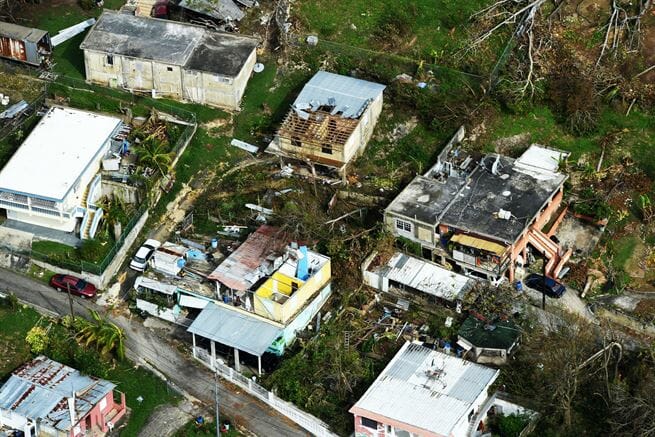
The recent one-two punch of Hurricane Irma passing north of Puerto Rico and then Hurricane Maria crossing over the island has given us a rare opportunity to witness about as serious a crisis situation as one can imagine.


While you and I are not on the ground in Puerto Rico to gain first-hand knowledge about what the people are going through, there have been enough reports come out of the island to give us a pretty clear picture of what is happening.


Even the worst-case disaster — an EMP — wouldn’t leave the people any worse off than Hurricane Maria has left them. In fact, they would probably be better off, simply because the EMP wouldn’t flatten buildings or tear their roofs off like the hurricane did.


1. Protect your backup power


Probably the biggest problem the citizens of Puerto Rico are facing is the loss of electrical power. Our modern society is dependent on electricity for pretty much everything. Without it, civilization, as we know it, comes to a standstill.


One hundred percent of the Puerto Rican grid was taken down in the hurricanes. So, while the electrical power plants are still operational, having suffered very little damage, they can’t transmit that electrical power to the end users. The entire grid must be rebuilt, which they are projecting will take up to six months (which probably means longer).


Few people in Puerto Rico have any means of producing their own electricity, such as solar panels or wind turbines.


Here in Texas, there was one point in time when Hurricane Harvey was headed right for my home, before it turned and headed for Corpus Christi, missing us. Because of that, I took down my wind turbine and the solar panels, which were easily moved. While the hurricane ended up missing us entirely, had I not taken them down and the hurricane hit our area, I am certain that they would have been destroyed, too.


Get Free Backup Electricity — That Works Even During Blackouts!


This has caused me to rethink my power production. As I remount my equipment, I am looking for ways to make it easy to take down, should another hurricane come my way. Having emergency power production on hand, which can’t survive the emergency, isn’t going to do me the least bit of good.


2. It’s difficult to prep a home


Many thousands of homes were totally destroyed by Puerto Rico, along with whatever property the people had inside their homes.


American home construction methods are not effective for surviving hurricanes and flooding. We not only see this in Puerto Rico, but in Houston and Florida, as well. Every home that was flooded has major damage, requiring removal of drywall, insulation, carpeting and underlayment. Since many of those homeowners did not have flood insurance, they’re going to have to foot the bill for those repairs themselves. Even government aid won’t be enough.


By comparison, homes built of cement blocks, like they are in much of Latin America (including Puerto Rico), survive flooding and high winds much better. I have friends in southern Mexico who have had their homes flooded. All they had to do was clean them up, dry them out and paint. While that took time and effort, it was much easier than repairing a wood home would be.


3. Don’t forget water purification


6 Survival Lessons From Puerto Rico’s CrisisWater was shut down for more than 98 percent of Puerto Rico, mostly due to the lack of electrical power. During the first few days, the Red Cross delivered more than 5 million liters of water. But considering the population of Puerto Rico, that wasn’t even enough for two liters per person, a minimal daily intake.


This was a situation where rainwater capture would have been highly valuable. The ability to capture some of the water from a hurricane or major storm and make it usable is something that none of us should overlook. I’m not just talking about a few barrels attached to our gutters and downspouts, either, but rather the ability to store large quantities of water, such as in a swimming pool.


The problem wasn’t so much water, as the means to purify it. Puerto Rico has lakes and rivers, just like other places do, over and above the massive amount of rainwater that fell on the island. But few people had any means of purifying that water. Most were resorting to boiling it, which isn’t as effective.


This is one area where we, in the preparedness community, should look at being an asset to our communities. Rather than just thinking of water purification for ourselves and our families, we should consider expanding our ability, so that we can provide water to friends and neighbors. That way, we are seen as good guys, rather than just caring about ourselves.


It would be easy to work out an arrangement in a time of crisis, where we are trading water filtration for labor. Our neighbors could provide the labor, hauling water to our homes, and we could provide them with purified water.


4. You might need to bury your food


As with any other place in the country, few people had food supplies stockpiled to see them through. Stores started running out and many began rationing; only allowing shoppers to buy a certain amount of food on each trip.


But the bigger problem is that all of Puerto Rico’s farms were demolished in the storm. There will be no harvest this year and in some cases, they may not even have a harvest next year. So, all the food for at least the next year must be shipped in, raising prices to the consumer. For those who are on a limited budget, that will be a problem.


The other problem I see here is for those who had food stockpiles which were destroyed when their homes were destroyed. This is not something that most of us are prepared for. Our food supplies are in our homes, often in the basements. But if our homes would ever be destroyed, we would most likely lose our survival stockpile, too.


One solution to this problem is to create caches of food in other locations. However, that really wouldn’t have helped the people of Puerto Rico much. There really weren’t any safe places for them, as the whole island was hit. About the only thing they could have done to ensure that their food was stored safe from the storm was to bury it underground, in waterproof containers.


This really isn’t all that hard to do. Five gallon buckets, of the kind that many of us use to store our food stockpiles, are waterproof, insect proof and rodent proof. So, we could bury them as a way of storing food that will survive such a disaster.


5. Store some cash


We are gradually becoming a cashless society, with credit and debit cards taking the place of cash. While that is very convenient on a day-to-day basis, it assumes that there will be electricity to run the cash registers and ATM machines, as well as communication between all those points and our banks. When that electric supply and those communications are out, so is our money.


Goofy Gadget Can Recharge Your Laptop — And Jump-Start Your Car!


This is a very practical demonstration of why we need to keep cash on hand. I have heard some preppers say that they can’t see any reason to keep cash, but that’s because they are thinking of situations where cash won’t be usable anymore, such as in the wake of an EMP or a financial collapse. But those aren’t the only disasters that might strike us. We could very well find ourselves in a similar situation as in Puerto Rico, where we don’t have access to our electronic funds.


6. Stockpile medicine


As is often the case in the wake of a disaster, medical facilities in Puerto Rico have been stretched to the limit. The large number of injuries from the hurricane, as well as their normal workload, is making it difficult for people to receive the attention they need. On top of that, roads are damaged or blocked, and gas supplies are limited, making it hard for people to get to the hospital.


But this isn’t the biggest problem they face. All hospitals in the U.S. are required to have backup generators, and the hospitals in Puerto Rico are no exception. But the fuel for those generators is limited. So, there have been cases in which the power to the hospital cut out before fuel could be replenished. Without electricity, it is impossible for medical personnel to accomplish many of their tasks.


Two groups hard hit by the aftermath of the hurricane are diabetics and those on kidney dialysis. Insulin must be refrigerated, but without electricity that’s impossible to do. Kidney patients who require dialysis need treatments three times per week. Otherwise, the amount of minerals in their bloodstream can reach a point of becoming toxic. Some medical patients have been flown out of the country, where they can receive the care they need. But that has not been possible in all cases, especially for those who live far from airports.


Should any of us find ourselves in a similar situation, we must have the necessary medical supplies and training to take care of our own families. It is not unreasonable to keep a year’s supply of prescription medications on hand, if you have any family members with chronic conditions that require medication.


We also should be sure to stockpile enough emergency medical supplies to take care of major injuries, as there’s a strong possibility of family members and others that we know being injured. Medical supplies may be one of the slowest items to be resupplied, as any supplies that are shipped in will go to hospitals and clinics long before they become available to the public.


What lessons would you add to our list? Share your thoughts in the section below:

Wednesday, September 27, 2017

The Millions it Will Cost for President’s Photo Op in Puerto Rico Could Feed Starving Citizens Instead

Puerto Rico

The United States Virgin Islands and the Commonwealth of Puerto Rico are witnessing historic damage as millions of people recover from the devastation caused by Hurricanes Irma and Maria—but President Trump’s promise of a multi-million-dollar photo-op, is the opposite of what the ravaged islands actually need.


When Hurricane Maria made landfall in Puerto Rico, it left nearly the entire island without power, 60 percent without drinking water, and it destroyed 80 percent of the island’s crop value. The U.S. Virgin Islands also experienced historic tragedy as two category 5 hurricanes—Irma and Maria—hit in just 12 days, destroying 70 percent of the island’s buildings.


Advertisment


While both territories are in the midst of a humanitarian crisis, the U.S. government is receiving heavy criticism for its lack of an adequate response. Not surprisingly, President Trump is at the center of that criticism, as he took to Twitter to call for a boycott of the National Football League, and to call out players who dared to kneel during the National Anthem—a song that has only been played before football games since 2009, when the Department of Defense began “paying for Patriotism” to increase support for war.


Then it finally happened—Trump heard the anger of the public, and he decided it was time to get involved, and to give them what they wanted. He pledged his support to Puerto Rico and the U.S. Virgin Islands, and he said he is planning to visit the ravaged territories next week.


READ MORE:  Anonymous Declares "Total War" on Trump -- Promises to "Dismantle His Campaign"


“Puerto Rico is very important to me and Puerto Rico—the people are fantastic people,” Trump said. “I grew up in New York so I know many people from Puerto Rico. I know many Puerto Ricans. These are good people and we have to help them. The island is devastated.”


While the estimated cost of this visit has not been publicized, there is no doubt that it will be in the millions. The task of taking a disaster-stricken island with no power, no running water and scarce resources, and establishing the means necessary to accommodate the president, possibly First Lady Melania, and their entire staff and secret service team is no easy or inexpensive feat.


Presidential travel is a highly complex logistical operation involving hundreds of people, dozens of planes, cars, military vehicles, and more.


As a result, it easy to see how the bill can skyrocket very quickly. According to a Freedom of Information Act request filed by Judicial Watch, the VC-25A cost a whopping $206,000 an hour to operate. The flight time from Washington D.C. to Puerto Rico is about 4 hours. The plane flight alone will cost taxpayers upwards of 2 million—only if he goes directly there and back.


That is just the plane. When the president travels, he uses several military aircraft, including Air Force One, carrying the president, his entourage and guests, cargo planes packing motorcade limousines and other equipment, and aircraft to transport personnel who conduct security sweeps before the president arrives.


READ MORE:  Google is Hiding Popular Searches for Hillary Clinton"s Health


A conservative estimate of Trump’s trip to Puerto Rico will be upwards five or six million dollars—hardly a just expense for a photo op.


However, Trump’s presence in Puerto Rico seems to be what the public and the mainstream media crave. They want the money shot of him kissing some random baby, or serving food to a family who has just lost all of their possessions. Don’t mind the outrageous cost of the trip, or the fact that the residents of Puerto Rico would be better off if the government just took the estimated cost of such a visit, and wrote a check for the same amount in aid.


Six million dollars could pay power companies to restore electricity, buy food for those in need, purchase clean water, or any number of other helpful ways. But not this time. Instead, the six million dollars will go to six minutes of propaganda.


The term “presidents are puppets” can be applied in a number of situations, but in this one, it is painfully evident. Trump’s trips to Puerto Rico and the U.S. Virgin Islands will be nothing more than a multi-million-dollar photo-op used to cover up the government’s negligence in providing proper aid to millions of American citizens, while it wastes billions of dollars on foreign aid programs in countries run by dictators.

Sunday, September 24, 2017

WTF? “Black Sky” drill went live just two days before Hurricane Harvey made landfall


(INTELLIHUB) — Hurricane Harvey made landfall in Texas on August 25 just two days after the Electric Infrastructure Security Council (EIS) held its annual EARTH EX drill which focused on a “Black Sky” event.


According to literature found on the EIS Council’s official website, ‘severe malicious or natural “Black Sky” hazards’ pose a risk to critical infrastructure and on a “sub-continent scale” which may lead to cascading long-term “power outages” thus creating “a grim and difficult dilemma” because of the fact that the “restoration of any sector will only be possible with at least minimal operation of all the others.”


Ladies and gentlemen, this is exactly what we saw with both Hurricane Harvey and Hurricane Irma after hundreds of thousands of residents were left without power for extended periods of time.


In fact, in Florida, Irma’s heavy wind, and flooding were so bad that 11 people died in a nursing home as they patiently waited for waited for workers to restore power.


“To deal with this deadlock, careful sector by sector and cross-sector resilience planning is crucial. However, such plans, to be effective, must be exercised. With the diversity and the national and global scale of the infrastructures we now depend on, this requires an unprecedented, multi-sector, national and international exercise series,” the CIS Council confirms.


So what is EARTH EX?


According to the EIS Council, “EARTH EX is an evolving, distributed, collaborative partner-developed exercise designed to meet this need. Hosted by EIS Council as part of the EPRO® Resource Family, these annual multi-sector, international exercises are being developed to evaluate and improve restoration support, preparedness, response and recovery plans for severe hazards. As the series continues, it will provide increasing opportunities to enhance coordinated planning across all infrastructure sectors, and their corporate, government and NGO partners.”


Additionally, the NIS Council’s official website lists the four areas of focus for their Aug. 23, 2017, drill as follows:


  • Executive and senior operational decision-making

  • Initiating and coordinating initial sector response and restoration actions

  • Multi-sector emergency communication and coordination

  • Developing sector recommendations for Improved restoration support and resilience

What is a “Black Sky” hazard?


A “Black Sky” hazard has been separated by the NIS Council into two potential categories: “natural,” and “manmade.”


The council suggests that “manmade hazards” include EMP’s, such as a high-altitude magnetic pulse, intentional electromagnetic interference, cyberterrorism, or a coordinated physical assault. All of which are viable potentials for sure but the “natural hazards” listed by the council are what have my mind spinning.


A major seismic event, a geomagnetic disturbance — yes such natural disasters are possible and can occur — but what stands out to me is the fact that the NIS Council lists “hurricanes and other severe weather events” on their list of “natural disasters” and may quite possibly have drilled for such a scenario as Hurricane Harvey approached, made landfall, in Texas.


Remember, Harvey made landfall just two days after EARTH EX was scheduled to take place! Is this a coincidence? It has already been speculated that hurricane Harvey was engineered and was steered into Houston as a weather weapon!


Hat Tip: @Tabertronic on Twitter


Featured Image: Joe Diaz/Flickr

©2017. INTELLIHUB.COM All Rights Reserved. 


Shepard Ambellas is an opinion journalist, analyst, and the founder and editor-in-chief of Intellihub News & Politics (Intellihub.com). Shepard is also known for producing Shade: The Motion Picture (2013) and appearing on Travel Channel’s America Declassified (2013). Shepard is a regular contributor to Infowars. Read more from Shep’s World. Follow Shep on Facebook. Subscribe to Shep’s YouTube channel.


Thursday, September 21, 2017

Hurricane Irma Disaster Relief: Helping Our Fellow Man


Hurricane Irma Disaster Relief: Helping Our Fellow Man


By Steve Baldassari


In this video, Stewart Rhodes and Pastor Josh Paul of Christian Fellowship Church are seen purchasing massive amounts of food at Sam’s Club in Lakeland, FL for distribution to families who have no food in Immokalee, FL.


You too have a role to play. You too can make a difference in the lives of these struggling families. Please make a donation (big or small), to assist the Oath Keepers as they deliver crucial food, water, diapers, toiletries, pet food, clothes, hygiene products, etc. to devastated Florida communities at Gofundme.com/oathkeepersirma and/or at OathKeepers.org.


Corporate Tax deductible donations can be made to Christian Fellowship Church. We will be posting those details later.


To donate supplies directly, please bring them to Christian Fellowship Church, located at 16 E 1st St, Frostproof, FL 33843.


Hurricane Irma Disaster Relief: Helping Our Fellow ManIn this video, Stewart Rhodes and Pastor Josh Paul of Christian Fellowship Church are seen purchasing massive amounts of food at Sam"s Club in Lakeland, FL for distribution to families who have no food in Immokalee, FL.You too have a role to play. You too can make a difference in the lives of these struggling families. Please make a donation (big or small), to assist the Oath Keepers as they deliver crucial food, water, diapers, toiletries, pet food, clothes, hygiene products, etc. to devastated Florida communities at Gofundme.com/oathkeepersirma and/or at OathKeepers.org.Corporate Tax deductible donations can be made to Christian Fellowship Church. We will be posting those details later.To donate supplies directly, please bring them to Christian Fellowship Church, located at 16 E 1st St, Frostproof, FL 33843.


Posted by Oath Keepers on Wednesday, September 20, 2017


Gofundme.com/oathkeepersirma 


.


Sunday, September 17, 2017

As Thousands Left Homeless from Hurricanes, Trump Sends $75 Million MORE to Israel

hurricanes

As many Americans struggle to get back on their feet after their homes were destroyed by Hurricanes Harvey and Irma, the United States government has insisted that the only way to raise money for relief efforts is to increase the national debt—while setting aside another $75 million in aid for Israel.


Just one year ago, the Obama Administration signed the largest military aid deal in U.S. history, promising Israel $38 Billion over the next 10 years. However, while the deal stated that Israel was expected to return any money that was more than the original amount, the Trump Administration is breaking the rules.


According to a report from the Jerusalem Post, while Secretary of State Rex Tillerson was against giving an additional $75 million to Israel, a senior State Department official insisted that, “The administration is committed to ensuring that Israel receives the assistance that has been appropriated by Congress,” and that Trump will “work to ensure the $75 million in additional aid is delivered.”


Advertisment


While Congress had no problem giving Israel another $75 million in military aid, it did so by once again turning a blind eye to the long list of human rights abuses carried out by the Israeli military—and funded by the United States. Israel has occupied Palestine since 1967, and in those 50 years, it has been accused of numerous categories of human rights violations, according to a report from Human Rights Watch:


“At least five categories of major violations of international human rights law and humanitarian law characterize the occupation: unlawful killings; forced displacement; abusive detention; the closure of the Gaza Strip and other unjustified restrictions on movement; and the development of settlements, along with the accompanying discriminatory policies that disadvantage Palestinians.”


When Donald Trump ran a campaign based on “Making America Great Again” and truly putting “America First,” his supporters latched on to his promises, as if his presence in the White House would make everything different. While some of Trump’s supporters were adamant about his support for Israel, it should be noted that the Trump Administration is not just putting Israel first—it is also putting every country that is a recipient of U.S. foreign aid at a time when Americans desperately need help, first.


As Congress debated raising the Debt Ceiling, in order to find money for hurricane relief efforts, Sen. Rand Paul proposed an amendment that would allocate $7.85 billion in aid for repairing the damage caused by Hurricane Harvey, with an additional $2.5 billion set aside to prepare for Hurricane Irma—all by simply making cuts to foreign aid.


READ MORE:  Trump Says He Saw Muslims Celebrating On 9/11 -- But He Was Wrong, It was Israeli Mossad Agents


“My amendment, the ‘America First’ amendment, would take the money from money that we were going to send to foreign countries,” Paul said. “We send billions and billions of dollars to countries who hate us. We send billions and billions of dollars to countries who burn our flag. I think it’s a very simple choice that when we’re looking at those in need in our country, we quit sending money to other countries.”


In response to Paul’s proposal, Senate Majority Leader Mitch McConnell made a motion to table it, which passed 87-10. Unfortunately, while the majority of Congress does not seem to care about how much money the U.S. is wasting on foreign aid, it also does not seem to care about the status of the National Debt.


The United States’ National Debt surpassed $20 TRILLION this week, after jumping $317,645,000,000 in one day. The Trump administration’s $75 million gift to Israel is in addition to the record-breaking $3.8 billion a year the country already receives from the U.S.


The idea that the United States should continue to hand out obscene amounts of money it doesn’t have to the nations it favors—with no oversight—is a reminder that the vast majority of the elected officials who claim to represent the will of the American public, do not have their best interest in mind.

Thursday, September 14, 2017

Before And After Satellite Images Of Irma’s Destruction In Caribbean


A satellite image of Virgin Gorda before Hurricane Irma hit (left) and after (right)

A satellite image of Virgin Gorda before Hurricane Irma hit (left) and after (right)


These before and after images, taken by the Landsat 8 satellite, show plainly and clearly how destructive Hurricane Iram was to the Caribbean islands in its path.  The satellite had been busy snapping photos as a way to document the damage.


NASA has released a series of satellite imagery showing islands in the Caribbean before and after the major storm.  The photos were taken on August 25 and September 10, 2017, respectively.


The image below is of the island Barbuda both before and after the storm.  Locals and authorities in the Caribbean have said that this storm was so strong, it wiped Barbuda off the map. 


barbuda


Around 90% of Barbuda’s buildings are rubble, and a majority of the island is still underwater, making it uninhabitable for the 1800 residents who before Iram ripped through, called the island home.  It didn’t fare as well as Antiqua, which is still green, meaning its tropical vegetation is still mostly in tact.


Aside from the slightly patchy cloud coverage in the post-hurricane images, the main thing you will notice is the different coloring of the land. In the images from late-August, the islands are a lush vibrant green, while the ones after the hurricane are a duller brown. This is because the hurricane’s violent 185 miles per hour (298 kilometer per hour) winds literally stripped the land of much of its tropical vegetation. Additionally, salt spray spat up by the storm can damage the leaves still on the trees. –IFLScience


But that may not be the only major difference.  The color of the ocean water appears to be a little more on the light side. But that’s most likely due to some differences in the sea’s surface. Choppier waters are less smooth on the surface and therefore reflect less light, so they will appear to be darker.


tortola


The image above, of the British Virgin Islands, shows that this section of the Caribbean had also undergone some major damage.  NASA Earth Observatory says that these islands took a battering from the hurricane.  Among the widespread looting and damage caused to property, over 100 prisoners escaped when Hurricane Irma hit the British Virgin Islands.


Many experts say that it will take months, and perhaps even years, to undo the damage done to the Virgin Islands during Hurrican Irma.


Click here to subscribe: Join over one million monthly readers and receive breaking news, strategies, ideas and commentary.

Gas Masks, Filters, Body Suits, Anti Radiation Pills

Please Spread The Word And Share This Post


Author: Mac Slavo
Views: Read by 358 people
Date: September 14th, 2017
Website: www.SHTFplan.com


Copyright Information: Copyright SHTFplan and Mac Slavo. This content may be freely reproduced in full or in part in digital form with full attribution to the author and a link to www.shtfplan.com. Please contact us for permission to reproduce this content in other media formats.


Weather Channel Makes Shock Claim That Meteorologists Saw ‘A Face’ In A Satellite Image Of Hurricane Irma

Weather Channel Makes Shock Claim That Meteorologists Saw ‘A Face’ In A Satellite Image Of Hurricane Irma | Hurricane-Irma-Face-NASA-Earth-Science-Office | Sleuth Journal Special Interests US News


A senior meteorologist at The Weather Channel is claiming that a satellite image of Hurricane Irma that comes from NASA’s earth science office “has an embedded face”. Some say that it kind of looks like a dinosaur, others believe that it looks like a pig, and yet others seem to think that it sort of resembles an elephant. Since most hurricanes have a clearly defined “eye”, all it really takes to make a “face” is to find a “mouth” on a satellite image somewhere. So I can understand what the guys over at the Weather Channel are saying, but it is not the type of claim that I would make. But needless to say, this photograph will probably be shared a few million times on Facebook. Here is an excerpt from the original Weather Channel article


For the second year in a row, as a large hurricane threatened the United States, some swore they saw a face in satellite imagery of the storm.


The image above was posted early Saturday morning to Twitterby Stu Ostro, a senior meteorologist at The Weather Channel. As Hurricane Irma made landfall along the coast of northern Cuba, it appeared as if the satellite imagery of the storm had an embedded face.


You can argue whether the face better resembles a pig or an elephant, but it’s the second such face Ostro has spotted in a satellite image of a hurricane in as many years. Last October, as Hurricane Matthew’s eye moved away from Haiti, a very sinister face appeared in satellite imagery.


Storms such as this definitely seem to bring out the strangeness in people. Within hours of hurricane winds striking south Florida, people were already breaking into homes and looting stores. In fact, one local news stationcaptured footage of a “group of about 8-9 people” looting a retail store in broad daylight…


Local 10 cameras caught a group breaking into the Simon’s Sportswear on Sunrise Blvd. and Powerline Road.


The group of about 8-9 people broke through the front window and were seen walking in and then walking out with stolen items.


The group then began looting a Footlocker and CashAmerica Pawn Store in the same area.


Both Hurricane Harvey and Hurricane Irma have caused absolutely catastrophic damage, and millions of lives have been completely turned upside down. For those of us that live in areas that were not affected by these storms, it can be difficult to grasp the extreme stress that people down in Texas and Florida have been experiencing.


I would like to share with you a letter that was sent to me by a reader named Carol. She said that I could share this with my readers, and my hope is that this will encourage you to pray for those that have been caught in the middle of these storms…


*****


Dear Michael,


I felt impressed to write to you this morning. The situation here in Florida is very, very tense. My husband and I live in Boynton Beach, FL, near West Palm Beach, on the southeast coast. My son lives in a condo close by.


When the storm appeared to be coming straight towards us, we had to quickly decide what was important to us, and literally threw everything in the back of our car that we ever expected to own again, as we left the east coast to go to his brother’s house in Tampa, FL on the west coast.


Now that we are in Tampa, the storm is , at least for now, coming straight for us here. My 21 year old son refused to come with us as he wants to stay behind and experience the “adventure”. I begged and pleaded, but he would not come.


As the path trajectory vascillates around, we have noticed how the track is going from one coast to the other, throwing everyone in the whole state into a panic. Except for the snowflakes of course, who also think this is no big deal.


Why I’m writing, Michael, is that strange things have been happening in the last couple of days. I am a Christian, and so are my friends. But I don’t hear God’s voice talking to me, or have prophetic dreams, or anything like that.


2 days ago, when I was in panic mode, driving around town trying to find gas, a CD in my car CD player popped out. I DID NOT TOUCH THE EJECT BUTTON. I was not even listening to the radio. I was focused on getting supplies .


I don’t even know what CD it was or when or how it got into my car, other than I was frantically packing stuff. I don’t even know the name of the CD or the musician. I tried to pushing it in , but it kept on jutting out , aggravating me as it was in the way. I finally just pushed the load button and it played.


And the song said:


I am the EYE in the SKY…I CAN READ YOUR MIND… I’M DEALING WITH FOOLS, BUT YOU WILL BE FINE.


At least those are the words that I heard. And the Holy Spirit came over me as I had to pull off the side of the road. It was God giving me a message. I broke down and cried.


Then that night I woke up in a sweat from a dream. I saw those 3 biblical guys, Mesach and ABendego , forgot the other name, in the middle of the fire , where they were protected. You know the story.


But the middle of the fire was the eye of the hurricane, which was 180 mph.


I think that God was saying that either myself or His people would be protected, even thought we are in the hurricane, like those biblical guys in the middle of the fire were protected.


The a girlfriend who lives in Melbourne, FL called me and said she was totally freaked out about something strange that just happened to her. She has one of those clear, plastic cutting boards on her counter. She came into the kitchen, had not touched the cutting board, nor was anything on it , and the board was sitting there completely shattered, into hundred of pieces.


She was totally freaked out and couldn’t understand how it happened. I then told her that very day I had the CD pop out of my CD player for no reason.


I don’t know what the cutting board means, but I told her that maybe it meant her house would be shattered, and she then went into full preparation mode. This is a girl that had nothing in her fridge, nor her cupboard, who doesn’t even have a battery operated radio, and lives alone.


Maybe it means that the whole state of Florida will be shattered like glass.


When the evacuation order was issued for Miami Beach, I knew it was time to decide whether to stay in our house, or go. We have 2 very large trees on either side of the house, plus it was built in 1960 and the roof could come off. We decided to go to Tampa, as the storm appeared to be going to the east coast at the time.


I had to leave by myself with our 2 dogs first, as my husband needed more time to put up our hurricane shutters. I drove across the state on one tank of gas, with no gas at the gas stations available. I had only slept 3 hours , was exhausted, and didn’t even have time to map out my route. I knew I had to stay off the main roads, which are literally bumper to bumper. So I got on a back road and simply headed west.


My phone GPS maps brought me way out in the country, with no houses, near cow pastures and railroad tracks, in the middle of Florida. There were no cars, and I did not know if I would end up on a dirt road that led nowhere, with no gas, in thunderstorms and heavy rain. The roads were starting to flood.


But the GPS brought me straight to my brother in law’s house with no traffic, after 6 hours of driving.


Now that we are here, it appears the storm is headed straight for Tampa, where we now are. I am exhausted. The panic from the sheer gravity of the situation, doesn’t allow me to sleep but 3 hours.


For years I have been prepping for the “economic collapse”, when the SHTF. I now believe that this is the moment I have been preparing for. I believe that God will bring people to their knees, if they aren’t already there, with this storm.


I am prepared to have no home to go back to, nor for my son to even be alive.


I should be panicked, but after 5 long days of frantically facing the realism of what was happening, and God talking to me through my CD player, I now feel ready for whatever happens.


Knowing what hurricane Andrew did, and this storm being much stronger than Andrew, I know that we will be on our own for days, weeks, maybe months. We will have to live on the food that we bought yesterday, as we had to leave our preps behind, live without electricity, no air conditioning in 90 degree heat, and possibly in a house with no roof or walls.


But I will be here, along with others, helping strangers, getting to know our neighbors. And hopefully sharing stories of God’s mercy. It is the time for Christians to no longer be silent, no longer worry about what others may think of what they say. God is showing his Mighty Hand through mother nature.


I believe he is showing Florida that there is no way to get out of His wrath, because as people think they are getting away from the storm, it turns and starts coming towards them. There is no safe place in Florida right now.


Sure, there will be the ones who say that these storms are due to “global warming”. Those are the FOOLS, as the song said to me.


I doubt there will be internet here for awhile, but if there is, and you want to know what’s going on , on the ground here, I’d be glad to inform you. I fully realize we may not make it out of this alive, but now feel calm, despite that fact.


I want to thank you Michael, for your moral support and hard work, in bringing the truth to the people with your terrific articles. You have worked tirelessly for years with your research and writing. And I fully expect you to win your political race. Godspeed.


I’ll talk to you on the other side, either the storm or in heaven. May God have mercy on us here in Florida.


PS…You can print what I said if you want..


Sincerely,


Carol


Create your own review


Average rating:  

 0 reviews