Showing posts with label new economy. Show all posts

Sunday, December 10, 2017

What You"re Not Being Told About The Real Economy

Authored by Jeffrey Snider via Alhambra Investment Partners,


The year 2000 was a transition year in a lot of ways. Though Y2K amounted to mild mass hysteria, people did have to get used to writing the date with 20 in front of the year rather than 19. It was a new millennium (depending on your view of Year 0) that seemed to have started off under the best possible terms.


Not only were stocks on fire at the outset, the economy was, too. The idea of this “new economy” leading toward a permanent new plateau of low inflation growth, driven by the breathtaking productivity gains in telecommunications and computing, seemed quite real on the surface. US GDP advanced by more than 3% in 15 straight quarters from Q2 1996 through Q4 1999, averaging a sizzling 4.7% in those nearly four years of dot-com supremacy.


The labor market was clearly robust, too. In March 2000, the BLS estimates (current benchmarks) that total payrolls (Establishment Survey) rose by 468k from that February. That brought the 6-month average up to +303k, a record of expansion that also mystified economists for its lack of inflationary wage pressures. In any case, the late nineties had roared up to the doorstep of the 21st century.


We all know what happened in April 2000, as investors suddenly got cold feet about first the high flying NASDAQ. It wasn’t just stock prices and IPOs, of course, as it really meant one of the major economic themes of that age was in danger being undermined, if not thoroughly debunked. The new economy of the 21st century might not have been grounded so solidly in true economics (small “e”) as everyone thought (especially those running the Fed).


The labor market of 2000 was a study in contrasts, starting out as good as it did, but by that June, there was a shocking minus for the monthly headline payroll number. It wasn’t just a one-time problem, either, as despite all assurances in all the usual places payrolls would contract again in August and also in October. To end the year 2000, the 6-month average for the Establishment Survey had fallen to just +109k.


It was, again, a year of transition, beginning as the “sky is the limit” dot-com era and ending in almost a tailspin just two months shy of official recession. In many ways, the economy has never recovered from it, the labor market (the eurodollar’s giant sucking sound) most prominently.


Because of this and really the length of time involved between then and now, we have forgotten what a good economy actually looks like. There have been, of course, brief moments when we get the sense that something just isn’t right, such as the “jobless recovery” of 2002 and 2003, as well as the whole aftermath of the Great “Recession” up until 2014. By and large, however, the economy and the labor market are described in terms that just don’t apply if almost by default (it’s less bad today, so mustn’t it be good?).


The current payroll report for November 2017 suggests a gain of 228k. It is characterized as everything from “solid” to “robust.” Is it? How would we really know?


The best way to confirm that suspicion is to compare the current labor statistics to those in the past, calibrating the most recent numbers by those before that were recorded during what were inarguably the best of times; such as the late nineties.


Using monthly payroll gains, though, can be misleading simply because of geometric progression. A gain of 228k in November is not equivalent to the 228k gain in November 2000. The latter is actually a better single month result starting as it did from a smaller base.
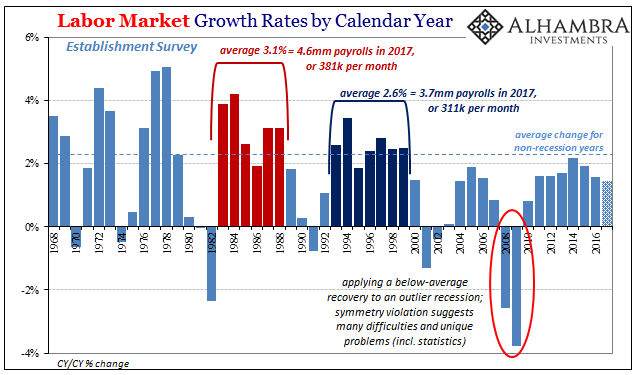


From 1993 through 1999, the labor market gained, on average, 2.6% per year according to the Establishment Survey. Since that time period is universally accepted as one featuring a strong economy, that is our standard for measurement. We can also go back to the eighties for what might amount to as an upper limit of sorts, the economy and labor market at that time being whatever is better than strong and robust – truly awesome.


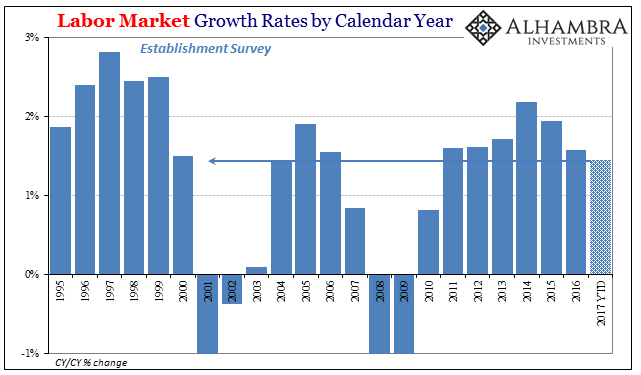
Translating those average gains into the 2016 base equals an expectation of 3.7mm payrolls gained for 2017 to be as good as the nineties, and 4.6mm, which would signal a splendid economic year consistent with the eighties. Through 11 months so far up to November, the Establishment Survey gives us just 1.9mm for 2017. Assuming December turns out equal or better than November’s “good” number, the year should end with a total payroll expansion around 2.1mm, maybe 2.2mm.


That’s less than two-thirds of the way to the nineties, and significantly less than half of the eighties. This year, no matter how many months at 200k plus, has not been a good one. In fact, payroll gains in the eleven months so far tallied by the BLS’s Establishment Survey are less than those presented in that transitional year of 2000.


This is how you get the newest generation of American adults yearning in greater numbers for something vastly different, a radical political change if for no other reason than the establishment here continuing to say that everything is good when by every reasonable standard it isn’t even close! The “robust” labor market even of the past few years isn’t nearly enough to draw in those still sitting on the sidelines struggling, however, they do (parents’ basements) to just get along, leaving the economy instead it’s “missing” 16.3 million; a number that in a truly robust economy would be falling not rising.
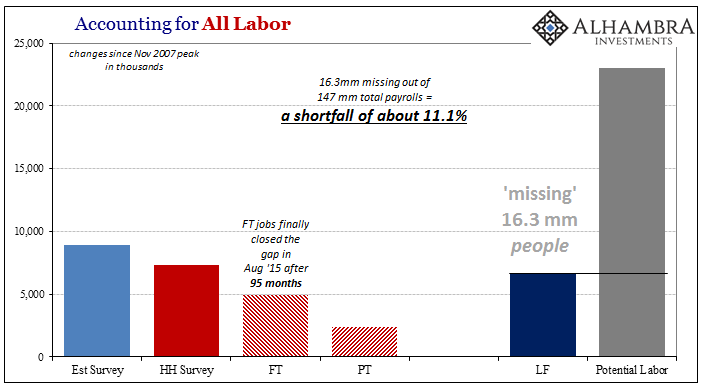


The issue clearly cannot be labor supply (Baby Boomer retirements, heroin, and fentanyl abuse in the Rust Belt) but shrunken labor demand; permanently shrunken economic demand. Therefore, there really should be no expectation for accuracy in the unemployment rate and what that means all around (inflation, baseline growth, monetary policy).

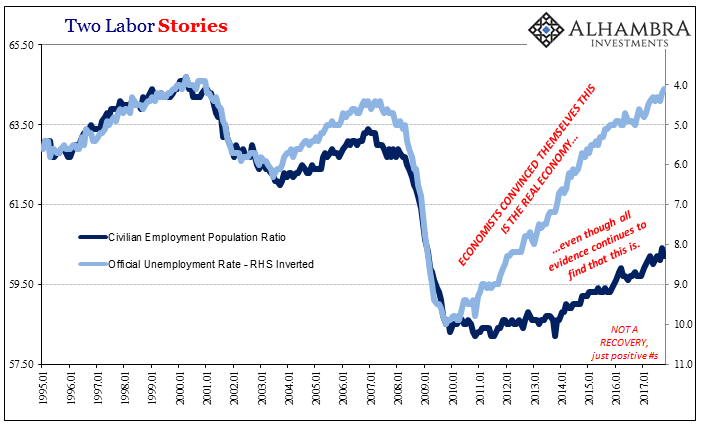


Once again in yet another month where the unemployment rate registers a ridiculous low, wages, and payroll earnings remain stuck at visibly low levels. The average weekly earnings of production and non-supervisory employees rose by just 2.6% year over year in November, after gaining 2.2% in October, 2.6% in September, and 2.7% in August. That’s nothing like in the past when the unemployment rate was where it is now. There is nothing like acceleration in earnings, not even solid growth.


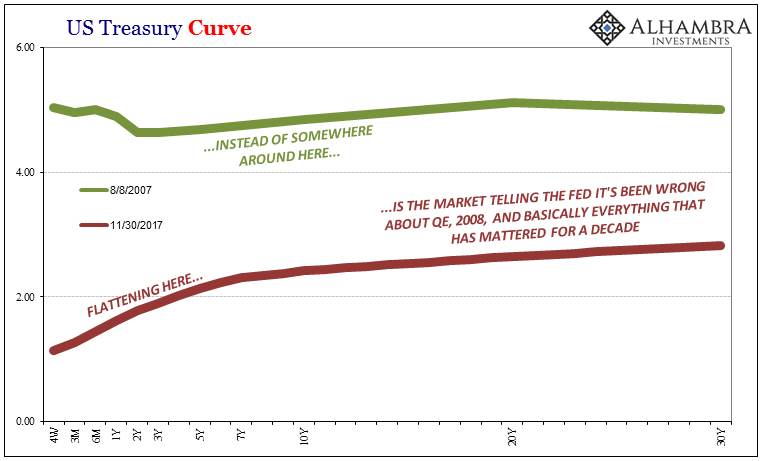
I don’t mean to make all this about the bond market every time (actually it’s appropriate), but the idea that treasuries at the long end have to be wrong has no basis other than misconception or intentional misdirection.
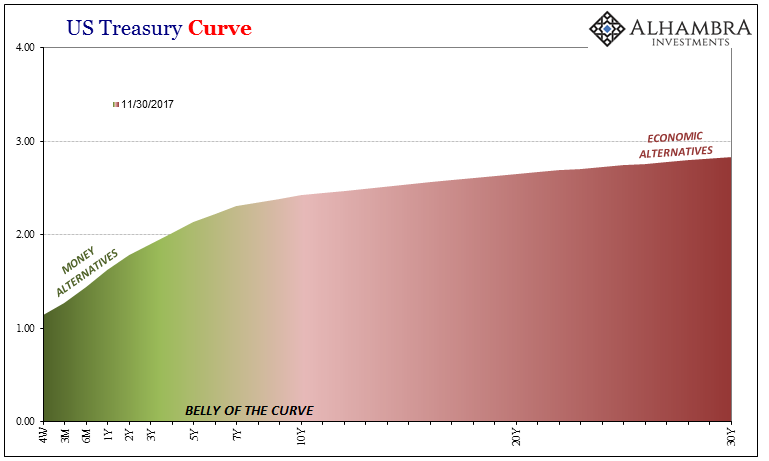


The data, including the BLS data, remains firmly on the side of flattening, and like the Establishment Survey’s paltry 1.9mm in 2017, it’s not even close.


Saturday, November 18, 2017

Mark Zuckerberg"s Long Litany Of Failings - Mainstream Media Turns On Social Media

The mainstream media is a fickle beast beholden to the direction of the prevailing political winds. Unfortunately for Facebook, Google and Twitter, those winds have turned about face in recent weeks as the political establishment thrashes about in its misguided efforts to prove that – aided by social media - Russia changed the course of the 2016 presidential election. While Facebook’s share price has suffered very little so far, the mainstream media is going to work on the reputations of Facebook and its billionaire founder. For example, according to Vanity Fair last month.


"…the tech giant is broadly focused on repairing its reputation following revelations that its platform was weaponized by Russia in the 2016 election."


“Weaponized” seemed a very strong word to use.


With the social media platform deemed “fair game” in the mainstream media, the Financial Times has lined up Mark Zuckerberg in its crosshairs. The FT journalist who penned the piece on Zuckerberg, Edward Luce, is cut from establishment cloth…and then some. Luce is the son of Richard Luce, now Baron Luce, the former MP, former Lord Chamberlain to the Queen and Knight of the Garter. Edward Luce read PPE at Oxford, took a sabbatical as a speech writer for Larry Summers and is the FT’s chief US commentator.


We are no fans of Zuckerberg and sympathise with some of it, but we recognise a hatchet job when we see it. In the article, Luce accuses Zuckerberg of...


Self-evident observation, or “stating the bleeding obvious”, to use the English vernacular:


Here is what Mark Zuckerberg learned from his 30-state tour of the US: polarisation is rife and the country is suffering from an opioid crisis. Forgive me if I have to lie down for a moment. Yet it would be facile to tease Mr Zuckerberg for his self-evident observations. Some people are geniuses at one thing and bad at others. Mr Zuckerberg is a digital superstar with poor human skills.


Political inadequacy and insincerity:


Facebook’s co-founder is not the first Silicon Valley figure to show signs of political inadequacy - nor will he be the last. But he may be the most influential. He personifies the myopia of America’s coastal elites: they wish to do well by doing good. When it comes to a choice, the “doing good” bit tends to be forgotten. There is nothing wrong with doing well, especially if you are changing the world. Innovators are rightly celebrated. But there is a problem with presenting your prime motive as philanthropic when it is not. Mr Zuckerberg is one of the most successful monetisers of our age. Yet he talks as though he were an Episcopalian pastor. “Protecting our community is more important than maximising our profits,” Mr Zuckerberg said this month after Facebook posted its first ever $10bn quarterly earnings result — an almost 50 per cent year-on-year jump.


Self-promotion, acting like a Soviet dictator and losing touch with ordinary people:


When a leader goes on a “listening tour” it means they are marketing something. In the case of Hillary Clinton, it was herself. In the case of Mr Zuckerberg, it is also himself. Making a surprise announcement that Mr Zuckerberg would be having dinner with an ordinary family is the kind of thing a Soviet dictator would do — down to the phalanx of personal aides he brought with him. This is not how scholars find out what ordinary families are thinking. Nor is it a good way to launch a political campaign. Ten months after Mr Zuckerberg began his tour, speculation of a presidential bid has been shelved. Say what you like about Donald Trump but he knows how to give the appearance of understanding ordinary people.


Helping Russia in its attempts to secure Trump’s election victory:


More to the point, Facebook has turned into a toxic commodity since Mr Trump was elected. Big Tech is the new big tobacco in Washington. It is not a question of whether the regulatory backlash will come, but when and how. Mr Zuckerberg bears responsibility for this. Having denied Facebook’s “filter bubble” played any role in Mr Trump’s victory — or Russia’s part in helping clinch it — Mr Zuckerberg is the primary target of the Democratic backlash. He is now asking America to believe that he can turn Facebook’s news feed from an echo chamber into a public square. Revenue growth is no longer the priority. “None of that matters if our services are used in a way that doesn’t bring people closer together,” he says.


Avoiding Tax (indirectly via Facebook) and masking self-interest:


How will Mr Zuckerberg arrange this Kumbaya conversion? By boosting the community ties that only Facebook can offer. Readers will forgive me if I take another lie down. Mr Zuckerberg suffers from two delusions common to America’s new economy elites. They think they are nice people — indeed, most of them are. Mr Zuckerberg seems to be, too. But they tend to cloak their self-interest in righteous language. Talking about values has the collateral benefit of avoiding talking about wealth. If the rich are giving their money away to good causes, such as inner city schools and research into diseases, we should not dwell on taxes. Mr Zuckerberg is not funding any private wars in Africa. He is a good person. The fact that his company pays barely any tax is therefore irrelevant.


Destroying communities and the noble profession of journalism:


The second liberal delusion is to believe they have a truer grasp of people’s interests than voters themselves. In some cases that might be true. It is hard to see how abolishing health subsidies will help people who live in “flyover” America. But here is the crux. It does not matter how many times Mr Zuckerberg invokes the magic of online communities. They cannot substitute for the real ones that have gone missing. Bowling online together is no cure for bowling offline alone. The next time Mr Zuckerberg wants to showcase Facebook, he should invest some of his money in an actual place. It should be far away from any of America’s booming cities — say Youngstown, Ohio. For the price of a couple of days’ Facebook revenues, he could train thousands of people. He might even fund a newspaper to make up for social media’s destruction of local journalism. The effect could be electrifying. Such an example would bring a couple more benefits. First, it would demonstrate that Mr Zuckerberg can listen, rather than pretending to. Second, people will want to drop round to his place for dinner.


Having dinner with Mark Zuckerberg was way down the list at ZH, with top choices including Donald Trump, Vladimir Putin, Neil Young, Bruce Springsteen, Margaret Thatcher (if she was still alive), David Bowie (if he was still alive), John Lennon (ditto) and John F. Kennedy (ditto).


While we are finding the FT’s attempts at ridiculing Zuckerberg and his company entertaining, we are questioning whether it merely reflects the shifting political winds. Maybe there is more to it. When Pearson sold the Financial Times in 2015 after being the “proud proprietor” for almost 60 years, it cited the “inflection point in media, driven by the explosive growth of mobile and social”. 


Friday, August 25, 2017

Slumping College Enrollment Signals Americans Are No Longer Buying The College Lie

Authored by Keli"i Akina via TheHill.com,


For decades, teachers and parents around the country have been repeating the same message to children: “To have a bright future, you need to go to college.”


But now, in Hawaii at least, it’s starting to look like the younger generation isn’t buying it.


Across the state, University of Hawaii college enrollment has plummeted by 15 percent in just six years, from a high of 60,300 students in 2012 to 51,300 as of 2017.


Trying to explain this decline, university President David Lassner pointed to the fact that college enrollment has been declining around the country. Some have blamed demographics, citing the decline in birthrates. Others blame economic factors such as an improving economy, which may entice high school graduates into the workforce instead.


In response, the state is attempting to bolster enrollment by (what else?) throwing money at the problem. There are proposals to increase education spending across the board, but in particular the state legislature during its past session approved the “Hawai’i Promise” scholarship program, an initiative approved by Gov. David Ige that will provide free community college tuition for qualifying residents, starting this fall.


“Qualifying residents” would be locals who are enrolled in a degree program, take at least six credits per semester and maintain a minimum 2.0 grade point average. Supporters of the free tuition program say it is needed to remove the barriers to higher education that prevent such students from succeeding.


But there’s another consideration they might be missing: This might just be a matter of supply, demand and perceived value.


As we all know, the cost of a college education has been increasing for years, so it was only a matter of time before potential students began weighing the costs and benefits of substantial debt and asking whether it’s really worth it. In an age of mobile-app startups and social media marketing, it might not be obvious to recent high school graduates that college can provide the employment skills they need at a price they can afford.


Instead, potential college students may be looking for ways outside the college system to make themselves desirable to employers. Apprenticeships, online programs, mentorship opportunities and entrepreneurship all provide avenues for jobs in the new economy. In fact, they may be a better way for ambitious young workers to set themselves apart from those with a conventional college degree.


Meanwhile, colleges are faced with a separate problem: What happens if the tuition money stops flowing in? UH President David Lassner has confirmed that tuition makes up approximately half the Manoa campus’ operating budget. If enrollment continues to decline, and student retention, which is stuck at about 75 percent, stays flat or also continues to decline, the school’s financial situation will deteriorate further.


Pouring state money into “free” tuition might stave off collapse of an imbalanced university system, but it cannot continue forever. If young people continue to reject the idea of a college degree and enrollment continues to decline, something is going to break. And it might be the state budget.


In the end, it may be that the market is finally catching up to higher education.


If students are no longer convinced of its value relative to its price, then either that value will have to increase or the price will have to come down.


Potential students are already looking at their options and deciding that college might not be worth the high price. States such as Hawaii might try to salvage their sinking state university systems by creating taxpayer-funded “free” college education programs, but it won’t be long before taxpayers start asking if it’s worth the price too.

Saturday, June 3, 2017

Puerto Rico's Population Drain Since 2013 Equivalent To US Losing 20 Million People

Puerto Rico’s economic decline and, now bankruptcy, has triggered an astonishing exodus as thousands flee the commonwealth in search of economic opportunity in the Continental US, Bloomberg reported.


The population has been declining rapidly. The island has lost 2 percent of its people in each of the past three years, a comparable departure in the 50 states would mean 18 million people moving out since 2013. About 400,000 fewer Puerto Ricans live on an island of 3.4 million today compared with a decade ago, when its economy began contracting, Bloomberg reports.


“I had to choose for my family,’’ said Aledie Amariah Navas Nazario, 39, a pediatric pulmonologist, told Bloomberg. She left behind young asthma patients when she, her husband and two small daughters moved to Orlando, Florida.
Reasons for leaving were compelling enough for Navas Nazario, who treated asthma on an island where it’s more prevalent than anywhere else in the U.S.


Puerto Rico’s economy had taken yet another leg down, and she was worried about her future income because of uncertainty about health insurance.


“I’m sad about not being able to take care of those kids anymore,’’ said Navas Nazario, who keeps in touch with former patients on Facebook. “You have to make a hard decision to leave relationships with friends and family just to get out, just because you need a better life.’’


Departures like Navas Nazario’s have trapped the commonwealth’s economy in a downward spiral, Bloomberg reports.


Joblessness at 11.5 percent, and a $74 billion mountain of debt that pushed the island to insolvency have made collecting taxes key to an economic rebound, Bloomberg said. At the same time, more Puerto Ricans from all walks of life are moving away to better their lives, meaning government revenue is dwindling.


The island’s debt has grown 87% since 2006, and one easy way to avoid paying any of the debt is for Puerto Ricans to leave the island. But one telling sign for anyone who owns Puerto Rican debt: The government’s official turnaround plan – a path to sustainability approved by a US oversight board – assumes the population will shrink by just 0.2% each year for the next decade.


The government is using this number as the basis for its projections of tax receipts and economic growth. Expect it to fall far short on both measures.


“Most people believe that those forecasts in the fiscal plan are really, really optimistic and probably would have to be revised at some point,’’ said Sergio Marxuach, public policy director at the Center for the New Economy in San Juan, told Bloomberg.


And professionals aren’t the only ones leaving: The exodus includes blue-collar construction workers and taxi drivers. Research by the New York Fed found that college graduates make up roughly the same proportion of emigres as they do the broader population, suggesting, as Bloomberg reports, that the departures have touched “every corner” of the commonwealth.


The reason for leaving is obvious: The earnings disparity between PR and the mainland can be wide. John Starkey, a principal of the Lafayette International Community High School in upstate Buffalo, New York, told Bloomberg he traveled to the island to recruit teachers after it started shutting down schools to save money. On the mainland, Starkey said, educators find they can double or triple their earnings, even if it means trading a balmy Caribbean island for the frigid shores of Lake Erie.


“Many of the candidates wanted to stay on the island to help their community,’’ Starkey said. “Our pitch was: come up to Buffalo and you’ll be able to better provide for your family, but you’ll also be able to help your community here.’’


The commonwealth applied for Title III protection from its creditors last month in what will be the largest-ever US municipal debt restructuring, further complicating the territory’s efforts to pull itself out of a financial crisis.


The Puerto Rico restructuring would be far larger than Detroit’s record-setting bankruptcy, with little to no details how long a court proceeding would last or what cuts would are imposed on bondholders. The island’s financial recovery plan covers less than a quarter of the debt payments due over the next decade.


The island has been a U.S. possession since American troops invaded in the Spanish-American War, and Puerto Ricans have been U.S. citizens since 1917. That means there’s little to prevent them from seeking better prospects on the mainland, something they’ve always done, just not to this extent.


Migration to the US mainland is by far the biggest driver of the island’s declining population, but a declining fertility rate isn’t helping either. The natural population increase -- excess births over deaths -- fell to 3,000 last year from 20,000 a decade ago, as families facing poorer economic prospects and the threat of the Zika virus put off having kids, Bloomberg reported. At the same time, younger generations of child-bearing age are more likely to take off for the mainland.
 

Friday, May 12, 2017

Uber Suffers Major Setback In Efforts To Conquer European Market

For years Uber has been battling with Barcelona taxi drivers who have argued that UberPOP engages in unfair competition by using unlicensed drivers that are not subject of the same regulatory hurdles as a regular "transport company."  And while Uber has historically taken the approach of just entering new markets and sorting out the regulatory hurdles later, it looks like those hurdles are finally catching up with them in the European Union...which we suspect will not be well received by Uber"s private investors that recently dumped money into the company at a modest $68 billion valuation.


As Reuters noted today, the Court of Justice of the European Union"s (ECJ) Advocate General Maciej Szpunar has just issued a preliminary opinion that Uber is actually a "transport service" and not just an app.  Of course, the ruling is significant because, if it stands, it would require Uber to operate effectively as a taxi company and thus provide insurance to drivers and guarantee that they are properly licensed and complying with all safety regulations.  Per Reuters:


Although the opinion of the Court of Justice of the European Union"s (ECJ) Advocate General Maciej Szpunar is non-binding, its judges usually follow such advice and are likely to reach a final ruling in the landmark case in the coming months.


If the ECJ does rule that Uber is a transport service, this is likely to have an impact on the Silicon Valley firm"s operations in Estonia, Poland, Czech Republic, and Finland where it still runs UberPOP, using amateur drivers to pick up riders.


The ECJ"s final ruling cannot be appealed by Uber


Uber


While Uber has repeatedly argued in similar cases that they are merely a "market maker" matching taxi demand with supply, the ECJ"s Szpunar saw it differently finding that Uber "does much more than link supply and demand: it created this demand itself" adding that "Uber can thus be required to obtain the necessary licenses and authorizations under national law."


However, the ECJ"s Szpunar said that Uber"s argument that it merely matches supply and demand between drivers and passengers was a "simplistic view of its role."


"The Uber electronic platform, whilst innovative, falls within the field of transport: Uber can thus be required to obtain the necessary licenses and authorizations under national law,"


"In effect, Uber does much more than link supply and demand: it created this demand itself," Szpunar wrote.


The service provided by Uber amounts to the "organization and management of a comprehensive system for on-demand urban transport," the ECJ said.


Regulating the software company as a "new economy" information service meant treating Uber as if it was simply an air traffic controller or market maker connecting drivers to passengers.


Instead, by forcing Uber to comply with myriad local transportation regulations – some dating back as long as a century – it must take more responsibility for certifying, insuring and paying its drivers, as taxi firms now do.


Meanwhile, Uber representatives were dismissive of the initial ruling saying that such decisions only serve to "undermine the much needed reform of outdated laws..."


A spokeswoman for Uber said it would await the ECJ"s final ruling, but added it "would not change the way we are regulated in most EU countries as that is already the situation today".


And a ruling against it would "undermine the much needed reform of outdated laws which prevent millions of Europeans from accessing a reliable ride at the tap of a button," she added.


Of course, the real question is just how long the negative news can continue to pile up for Uber before all those investors who just added nearly $13 billion to company coffers at a $68 billion valuation start to get a little nervous that the company is still burning a couple billion dollars a year.  Do we smell a dreaded "down round" coming up?

Wednesday, April 12, 2017

"You Are Here"

In case you wondered...


You Are Here... Valuation?


And here... Sentiment?


And here... Cognitive Dissonance?


And finally... no it"s not a "new economy" or "different this time"...


So as a reminder, Peak Valuations and Trough Labor Force Participation...


"Probably Nothing"

Thursday, January 5, 2017

In Surprise Move Venezuela's President Reshuffles Cabinet, Dumps Oil Minister, Names New "Economy Czar"

In an unexpected move, Venezuela"s embattled President Nicolas Maduro on Wednesday reshuffled his cabinet by naming a new economy czar to oversee the OPEC country"s decaying socialist system and a new oil minister to face the economic difficulties caused by low oil prices, suggesting that the economic upheavals faced by much of the nation have reached the very top.


According to Reuters, economist Ramon Lobo, who has been serving as a legislator for the ruling Socialist Party, will assume the dual roles of finance minister and economy vice president - making him the country"s top economic authority.


"You shall assume, with a firm hand, the oversight of the economy," said Maduro during a televised broadcast, describing Lobo as an expert in budget matters.


Meanwhile, in a move that will likely have far greater consequences, especially within the OPEC community, Nelson Martinez, who has led the U.S.-based refiner Citgo, will take on the role of oil minister. Outgoing minister Eulogio Del Pino, who was the source of so many oil-algo spooking headlines, will remain on as president of state oil company PDVSA. The oil minister has traditionally served as the
representative to OPEC, where Venezuela has for nearly three years been
one of the strongest voices for production cuts.


At the same time, Maduro also named state governor Tarek El Aissami as new vice president, replacing outgoing Aristobulo Isturiz, who had served as an intermediary with the opposition-run legislature.


Maduro shakes hands with Venezuela"s new Vice-President Tarek El Aissami.


The vice presidential post is an appointed position, and Maduro has swapped it out in the past. But the position holds extra significance this year as the opposition has vowed to force Maduro from office. That could lead to his vice president serving the rest of his term, which ends in 2019. El Aissami was interior minister before being elected governor of the central state of Aragua. He has been accused of participating in the drug trade by members of the opposition. He has called those who speak ill of him traitors who seek to harm Venezuela.


Unfortunately, the cabinet shuffle will achieve nothing. Venezuela is suffering from triple-digit inflation, Soviet-style production shortages and increasing street protests as a combination of dysfunctional state controls and low oil prices. Maduro says he is the victim of an "economic war." Furthermore, such cabinet reshuffles have been relatively common in Venezuela where officials tend to come from the inner circle of the ruling Socialist Party, and as such do not tend to be the leaders of broad policy changes.


Economists say Venezuela"s economy will not return to growth until it lifts corruption-riddled exchange controls and dysfunctional price control system and rolls back hundreds of nationalizations that have left many industries unproductive.


Which is also unlikely.


But the real question on everyone"s minds is when does Venezuela finally default. So far, its crude exports have prevented such a terminal fate. Furthermore, the recently disclosed "mysterious" $5 billion bond deal in which China had dubious involvement, confirms that Venezuela may no longer even have full sovereignty, having effectively become a Chinese oil producing output which persists in exchange for vendor financing.


It is unclear how today"s power move will change the status quo between Venezuela and China, and whether or not it is Beijing that is ultimately pulling the strings in the country"s government.