Showing posts with label Payroll. Show all posts

Sunday, December 10, 2017

What You"re Not Being Told About The Real Economy

Authored by Jeffrey Snider via Alhambra Investment Partners,


The year 2000 was a transition year in a lot of ways. Though Y2K amounted to mild mass hysteria, people did have to get used to writing the date with 20 in front of the year rather than 19. It was a new millennium (depending on your view of Year 0) that seemed to have started off under the best possible terms.


Not only were stocks on fire at the outset, the economy was, too. The idea of this “new economy” leading toward a permanent new plateau of low inflation growth, driven by the breathtaking productivity gains in telecommunications and computing, seemed quite real on the surface. US GDP advanced by more than 3% in 15 straight quarters from Q2 1996 through Q4 1999, averaging a sizzling 4.7% in those nearly four years of dot-com supremacy.


The labor market was clearly robust, too. In March 2000, the BLS estimates (current benchmarks) that total payrolls (Establishment Survey) rose by 468k from that February. That brought the 6-month average up to +303k, a record of expansion that also mystified economists for its lack of inflationary wage pressures. In any case, the late nineties had roared up to the doorstep of the 21st century.


We all know what happened in April 2000, as investors suddenly got cold feet about first the high flying NASDAQ. It wasn’t just stock prices and IPOs, of course, as it really meant one of the major economic themes of that age was in danger being undermined, if not thoroughly debunked. The new economy of the 21st century might not have been grounded so solidly in true economics (small “e”) as everyone thought (especially those running the Fed).


The labor market of 2000 was a study in contrasts, starting out as good as it did, but by that June, there was a shocking minus for the monthly headline payroll number. It wasn’t just a one-time problem, either, as despite all assurances in all the usual places payrolls would contract again in August and also in October. To end the year 2000, the 6-month average for the Establishment Survey had fallen to just +109k.


It was, again, a year of transition, beginning as the “sky is the limit” dot-com era and ending in almost a tailspin just two months shy of official recession. In many ways, the economy has never recovered from it, the labor market (the eurodollar’s giant sucking sound) most prominently.


Because of this and really the length of time involved between then and now, we have forgotten what a good economy actually looks like. There have been, of course, brief moments when we get the sense that something just isn’t right, such as the “jobless recovery” of 2002 and 2003, as well as the whole aftermath of the Great “Recession” up until 2014. By and large, however, the economy and the labor market are described in terms that just don’t apply if almost by default (it’s less bad today, so mustn’t it be good?).


The current payroll report for November 2017 suggests a gain of 228k. It is characterized as everything from “solid” to “robust.” Is it? How would we really know?


The best way to confirm that suspicion is to compare the current labor statistics to those in the past, calibrating the most recent numbers by those before that were recorded during what were inarguably the best of times; such as the late nineties.


Using monthly payroll gains, though, can be misleading simply because of geometric progression. A gain of 228k in November is not equivalent to the 228k gain in November 2000. The latter is actually a better single month result starting as it did from a smaller base.
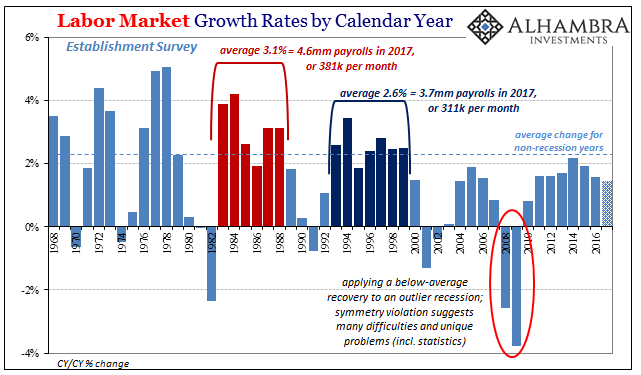


From 1993 through 1999, the labor market gained, on average, 2.6% per year according to the Establishment Survey. Since that time period is universally accepted as one featuring a strong economy, that is our standard for measurement. We can also go back to the eighties for what might amount to as an upper limit of sorts, the economy and labor market at that time being whatever is better than strong and robust – truly awesome.


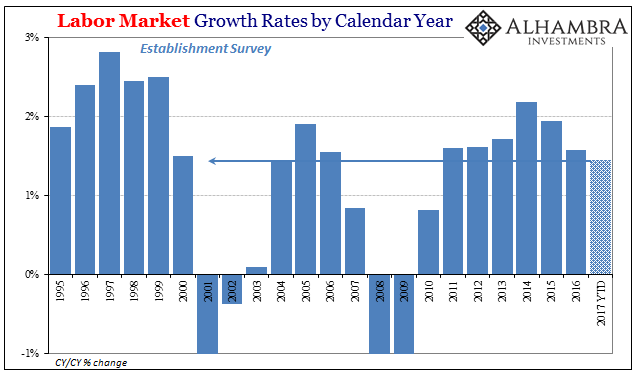
Translating those average gains into the 2016 base equals an expectation of 3.7mm payrolls gained for 2017 to be as good as the nineties, and 4.6mm, which would signal a splendid economic year consistent with the eighties. Through 11 months so far up to November, the Establishment Survey gives us just 1.9mm for 2017. Assuming December turns out equal or better than November’s “good” number, the year should end with a total payroll expansion around 2.1mm, maybe 2.2mm.


That’s less than two-thirds of the way to the nineties, and significantly less than half of the eighties. This year, no matter how many months at 200k plus, has not been a good one. In fact, payroll gains in the eleven months so far tallied by the BLS’s Establishment Survey are less than those presented in that transitional year of 2000.


This is how you get the newest generation of American adults yearning in greater numbers for something vastly different, a radical political change if for no other reason than the establishment here continuing to say that everything is good when by every reasonable standard it isn’t even close! The “robust” labor market even of the past few years isn’t nearly enough to draw in those still sitting on the sidelines struggling, however, they do (parents’ basements) to just get along, leaving the economy instead it’s “missing” 16.3 million; a number that in a truly robust economy would be falling not rising.
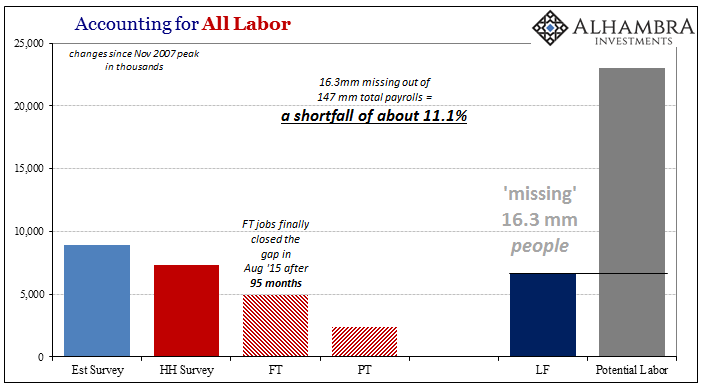


The issue clearly cannot be labor supply (Baby Boomer retirements, heroin, and fentanyl abuse in the Rust Belt) but shrunken labor demand; permanently shrunken economic demand. Therefore, there really should be no expectation for accuracy in the unemployment rate and what that means all around (inflation, baseline growth, monetary policy).

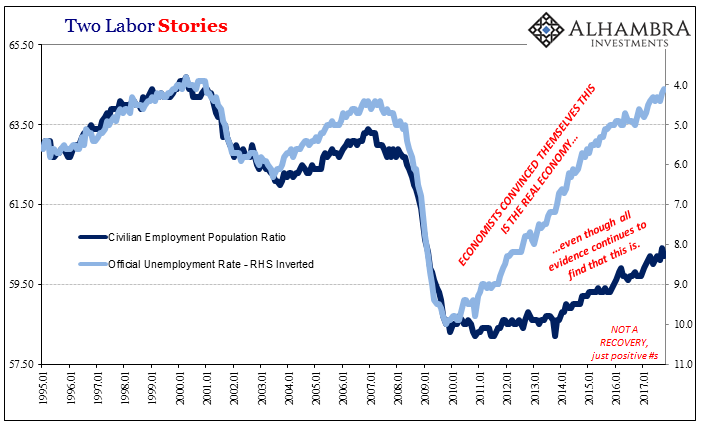


Once again in yet another month where the unemployment rate registers a ridiculous low, wages, and payroll earnings remain stuck at visibly low levels. The average weekly earnings of production and non-supervisory employees rose by just 2.6% year over year in November, after gaining 2.2% in October, 2.6% in September, and 2.7% in August. That’s nothing like in the past when the unemployment rate was where it is now. There is nothing like acceleration in earnings, not even solid growth.


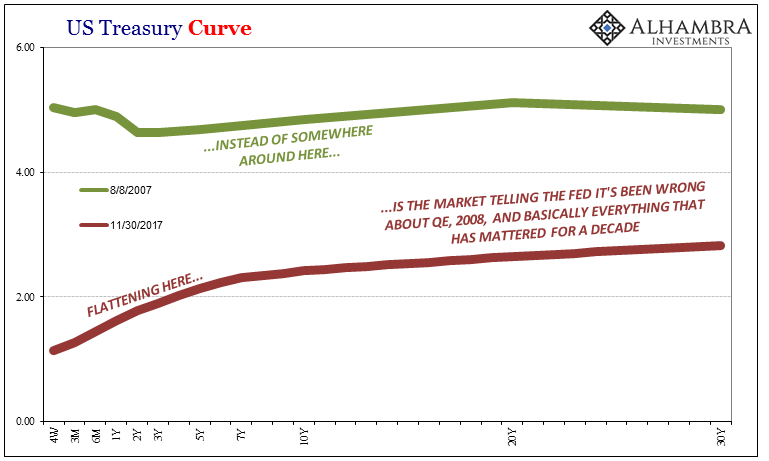
I don’t mean to make all this about the bond market every time (actually it’s appropriate), but the idea that treasuries at the long end have to be wrong has no basis other than misconception or intentional misdirection.
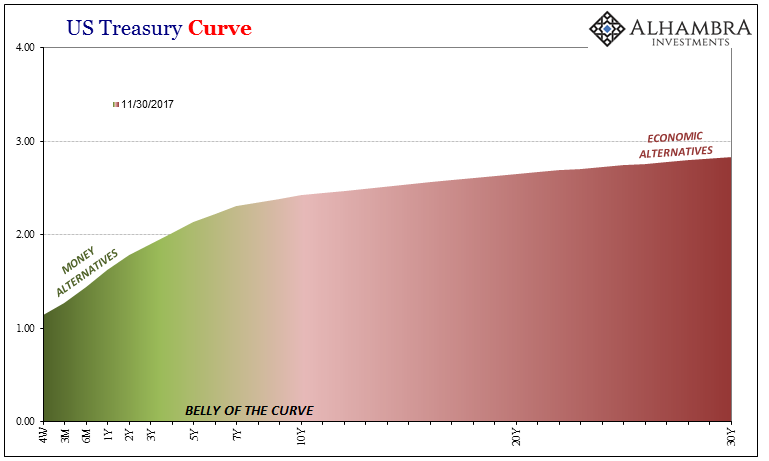


The data, including the BLS data, remains firmly on the side of flattening, and like the Establishment Survey’s paltry 1.9mm in 2017, it’s not even close.


Tuesday, September 19, 2017

If You Like Your Stagnant Wages, You Can Keep Your Stagnant Wages

Ever since the great recession of 2008/2009, economists have grown increasingly perplexed by the lack of real wage growth in the U.S. economy despite improving unemployment trends.  Even with a 4.4% unemployment rate, real wage growth has been elusive and hovered between negative 1% and positive 1% for years now.


Of course, it all could have something to do with the ~95 million people who have given up looking for jobs and/or the massive transition to part-time laborers in the Obamacare era, but we"re just spitballing here.


Regardless of the reasons, according to a new survey from Aon Hewitt, the downward pressure on U.S. wage growth is unlikely to subside in 2018 with many employers saying their wage growth will be flat YoY.  Per the Wall Street Journal:


Businesses are planning to keep budgets for raises relatively flat in 2018, while continuing to devote more payroll dollars to performance-based pay, according to a survey of salary planning at 1,062 organizations conducted by consulting firm Aon Hewitt.


Despite low unemployment and increased competition for talent, companies are bearish on across-the-board pay raises, said Ken Abosch, an Aon Hewitt executive who works on the annual survey, now in its 41st year.


“Organizations are expressing reservations about the years coming and, for the first time since the recession, are signaling doubt or uncertainty about what they think their performance will look like in the coming year,” he said.


Moreover, in a move that will undoubtedly draw the ire of Bernie Sanders and his socialist followers, companies are increasingly saying that a higher percentage of their overall compensation will be dedicated to merit-based bonuses. 


Companies are paying to keep their highest performers happy and in place, with an average 12.5% of payroll going to incentive and bonus pay next year.


Overall, two-thirds of the organizations in the survey said they will use merit pay to show workers who’s doing a good job, and who could stand to improve. Of those companies, 40% said they would reduce or eliminate raises for low performers. And some high performers will have to work harder next year—15% of the companies changing merit pay say they will set more aggressive targets for bonuses and incentive pay.


Lindenwood University, a liberal-arts school near St. Louis, Mo., recently introduced a merit pay system for the school’s staff of 950. Previously, there was no formal structure for rewarding performance.


High performers get rewarded for their extra effort, said Dr. Deb Ayres, the university’s vice president of human resources. “They’re not getting the same small increases as everyone else. It’s very motivating for them.”


All of which is just a long way of confirming that "if you like your stagnant wages, you can keep your stagnant wages."

Friday, August 11, 2017

Trump Thanks Putin For Kicking Out 755 Diplomats: "We"ll Save A Lot Of Money"

In a statement that has been buried by the rest of Trump"s barrage of soundbites today, including the ongoing back on forth verbal war on North Korea, as well as Mueller, Manafort and McConnell, during his second meeting with reporters at his golf complex in Bedminster, President Trump said something which could push his war with the intel community and the "deep state" into uncharted territory.


In his first public comment on the recent decision by the Kremlin to seize two US compounds and kick out 755 US diplomats in retaliation for a similar move by Obama in December, Trump said "I want to thank" Russian President Vladimir Putin for ousting hundreds of US embassy employees "because we"re trying to cut down our payroll."


The president said the move would "cut payroll." And even as many have received the comments in jest, we are confident that hundreds of humorless spooks will use this as a green light to leak even more NSA intercepts. Trump has so far been quiet on the expulsion of US workers from Russia.


"I greatly appreciate the fact that we"ve been able to cut our payroll of the United States," Trump said, adding "we"re going to save a lot of money… there"s no real reason for them to go back."


Hardly a glowing endorsement of the US "intelligence" apparatus.


Trump did not stop here, and noting of Putin"s decision, said "I"m very thankful that he let go of a large number of people because now we have a smaller payroll."


“I want to thank him because we’re trying to cut down on payroll and as far as I’m concerned I’m very thankful that he let go of a large number of people because now we have a smaller payroll."


"There’s no real reason for them to go back. I greatly appreciate the fact that we’ve been able to cut our payroll of the United States. We’re going to save a lot of money.”


Following the latest sanctions targeting Russia, North Korea, and Iran, Moscow moved to reduce the number of US diplomatic personnel by 755 people, bringing parity to the size of diplomatic staffs in each country. Previously, US State Department spokeswoman Heather Nauert had said "the expulsions of our US diplomats and other citizens who are working over there at our embassy, we consider that to be a regrettable step."


Friday, June 2, 2017

Huge Miss: Only 138K Jobs Added In May; April Revised Much Lower As Wages Disappoint

As previewed last night, the jobs "whisper" risk was to the downside, and in what was a very disappointing print released moments ago by the BLS, the whisper was spot on with only 138K jobs added in May, far below the 185K estimate, and below the lowest estimate of 140K. This was the second lowest print going back all the way to last October. Additionally, April"s big beat of 211K was revised substantially lower to only 174K, suggesting that any expectation the Fed may have had of "evidence" the recent economic slowdown was transitory was just crushed.


The change in total payrolls for March was revised down from +79,000 to +50,000, and the change for April was revised down from +211,000 to +174,000. With these revisions, employment gains in March and April combined were 66,000 less than previously reported. This means that over the past 3 months, job gains have averaged 121,000 per month, a far cry from the 181,000 average jobs added over the past 12 months.


To be sure, as SouthBay Research points out, a big reason for the unexpected miss was the sharp seasonal adjustment favtor, which was the biggest going back to the financial crisis days:


Not helping the Trump agenda, manufacturing jobs declined sharply, posting the weakest growth of 2017.


Looking at the Household survey revealed an even uglier picture as the number of employed workers declined by 233K to 152,923, the lowest since March.


Even worse for wage watchers, while the average hourly earnings rose by 0.2% monthly, the annual increase also missed printing at 0.2%, with April revised from 0.3% to 0.2%, while the annual increase was 2.5%, also missing the expectations of a 2.5% print. This was the lowest annual increase in average hourly earnings since March 2016.


On an absolute basis, the rebound in average hourly earnings has now fizzled completely.


While there was a silver lining in the unemployment rate which declined again to 4.3% from 4.4%, a bigger problem emerged in the participation rate which took a big step lower from 62.9% to 62.7%.


More details from the report:


Total nonfarm payroll employment increased by 138,000 in May, compared with an average monthly gain of 181,000 over the prior 12 months. In May, job gains occurred in health care and mining. 


Employment in health care rose by 24,000 in May. Hospitals added 7,000 jobs over the month, and employment in ambulatory health care services continued to trend up (+13,000). Job growth in health care has averaged 22,000 per month thus far in 2017, compared with an average monthly gain of 32,000 in 2016.


Mining added 7,000 jobs in May. Employment in mining has risen by 47,000 since reaching a recent low point in October 2016, with most of the gain in support activities for mining.


In May, employment in professional and business services continued to trend up (+38,000). The industry has added an average of 46,000 jobs per month thus far this year, in line with the average monthly job gain in 2016. 


Employment in food services and drinking places also continued to trend up in May (+30,000) and has grown by 267,000 over the past 12 months. 


Employment in other major industries, including construction, manufacturing, wholesale trade, retail trade, transportation and warehousing, information, financial activities, and government, showed little change over the month.  


The average workweek for all employees on private nonfarm payrolls was unchanged at 34.4 hours in May. In manufacturing, the workweek also was unchanged at 40.7 hours, while overtime edged up by 0.1 hour to 3.3 hours. The average workweek for production and nonsupervisory employees on private nonfarm payrolls edged down by 0.1 hour to 33.6 hours. 


In May, average hourly earnings for all employees on private nonfarm payrolls rose by 4 cents to $26.22. Over the year, average hourly earnings have risen by 63 cents, or 2.5 percent. In May, average hourly earnings of private-sector production and nonsupervisory employees increased by 3 cents to $22.00. 


The change in total nonfarm payroll employment for March was revised down from +79,000 to +50,000, and the change for April was revised down from +211,000 to +174,000. With these revisions, employment gains in March and April combined were 66,000 less than previously reported. Monthly revisions result from additional reports received from businesses and government agencies since the last published estimates and from the recalculation of seasonal factors. Over the past 3 months, job gains have averaged 121,000 per month. 


Tuesday, March 7, 2017

How The Market Creates Jobs (And How Government Destroys Them)

Via Walter Block of The Mises Institute,


The Creation of Jobs


If the media tell us that "the opening of XYZ mill has created 1,000 new jobs," we give a cheer. When the ABC company closes and 500 jobs are lost, we"re sad. The politician who can provide a subsidy to save ABC is almost assured of wide spread public support for his work in preserving jobs.


But jobs in and of themselves do not guarantee well-being. Suppose that the employment is to dig huge holes and fill them up again? What if the workers manufacture goods and services that no one wants to purchase? In the Soviet Union, which boasts of giving every worker a job, many jobs are just this unproductive. Production is everything, and jobs are nothing but a means toward that end.


Imagine the Swiss Family Robinson marooned on a deserted South Sea island. Do they need jobs? No, they need food, clothing, shelter, and protection from wild animals. Every job created is a deduction from the limited, precious labor available. Work must be rationed, not created, so that the market can create the most product possible out of the limited supply of labor, capital goods, and natural resources.


The same is true for our society. The supply of labor is limited. We must not allow government to create jobs or we lose the goods and services which otherwise would have come into being. We must reserve precious labor for the important tasks still left undone.


Alternatively, imagine a world where radios, pizzas, jogging shoes, and everything else we might want continuously rained down like manna from heaven. Would we want jobs in such a utopia? No, we could devote ourselves to other tasks - studying, basking in the sun, etc. - that we would undertake for their intrinsic pleasure.


Instead of praising jobs for their own sake, we should ask why employment is so important. The answer is, because we exist amidst economic scarcity and must work to live and prosper. That"s why we should be of good cheer only when we learn that this employment will produce things people actually value, i.e., are willing to buy with their own hard,earned money. And this is something that can only be done in the free market, not by bureaucrats and politicians.


The Destruction of Jobs


But what about unemployment? What if people want to work, but can"t get a job? In almost every case, government programs are the cause of joblessness.


Minimum Wage. The minimum wage mandates that wages be set at a government-determined level. To explain why this is harmful, we can use an analogy from biology: there are certain animals that are weak compared to others. For example, the porcupine is defenseless except for its quills, the deer vulnerable except for its speed.


In economics there are also people who are relatively weak. The disabled, the young, the untrained—all are weak economic actors. But like the weak animals in biology, they have a compensating advantage: the ability to work for lower wages. When the government takes this ability away from them by forcing up pay scales, it is as if the porcupine were shorn of its quills. The result is unemployment, which creates desperate loneliness, isolation, and dependency.


Consider a young, uneducated, unskilled person, whose productivity is $2.50 an hour in the marketplace. What if the legislature passes a law requiring that he be paid $5 per hour? The employer hiring him would lose $2.50 an hour.


Consider a man and a woman each with a productivity of $10 per hour, and suppose, because of discrimination or whatever, that the man is paid $ 10 per hour and the woman is paid $8 per hour. It is as if the woman had a little sign on her forehead saying, "Hire me and earn an extra $2 an hour."


This makes her a desirable employee even for a sexist boss. But when an equal-pay law stipulates that she must be paid the same as the man, the employer can indulge his discriminatory tendencies and not hire her at all, at no cost to himself.


Comparable Worth. What if government gets the bright idea that nurses and truck drivers ought to be paid the same wage because their occupations are of "intrinsically" equal value? It orders that nurses" wages be raised to the same level, which creates unemployment for women.


Working Conditions. Laws which force employers to provide certain types of working conditions also create unemployment. For example, migrant fruit and vegetables pickers must have hot and cold running water and modern toilets in the temporary cabins provided for them. This is economically equivalent to wage laws because, from the point of view of the employer, working conditions are almost indistinguishable from money wages. And if the government forces him to pay more, he will have to hire fewer people.


Unions. When the government forces businesses to hire only union workers, it discriminates against non-union workers, causing them to be at a severe disadvantage or permanently unemployed. Unions exist primarily to keep out competition. They are a state-protected cartel like any other.


Employment Protection. Employment protection laws, which mandate that no one can be fired without due process, are supposed to protect employees. However, if the government tells the employer that he must keep the employee no matter what, he will tend not to hire him in the first place. This law, which appears to help workers, instead keeps them from employment. And so do employment taxes and payroll taxes, which increase costs to businesses and discourage them from hiring more workers.


Payroll Taxes. Payroll taxes like Social Security impose heavy monetary and administrative costs on businesses, drastically increasing the marginal cost of hiring new employees.


Unemployment Insurance. Government unemployment insurance and welfare cause unemployment by subsidizing idleness. When a certain behavior is subsidized—in this case not working—we get more of it.


Licensing. Regulations and licensing also cause unemployment. Most people know that doctors and lawyers must have licenses. But few know that ferret breeders, falconers, and strawberry growers must also have them. In fact, government regulates over 1,000 occupations in all 50 states. A woman in Florida who ran a soup kitchen for the poor out of her home was recently shut down as an unlicensed restaurant, and many poor people now go hungry as a result.


When the government passes a law saying certain jobs cannot be undertaken without a license, it erects a legal barrier to entry. Why should it be illegal for anyone to try their hand at haircutting? The market will supply all the information consumers need.


When the government bestows legal status on a profession and passes a law against competitors, it creates unemployment. For example, who lobbies for the laws which prevent just anyone from giving a haircut? The haircutting industry—not to protect the consumer from bad haircuts, but to protect themselves against competition.


Peddling. Laws against street peddlers prevent people from selling food and products to people who want them. In cities like New York and Washington, D.C., the most vociferous supporters of anti-peddling laws are established restaurants and department stores.


Child Labor. There are many jobs that require little training—such as mowing lawns—which are perfect for young people who want to earn some money. In addition to the earnings, working also teaches young people what a job is, how to handle money, and how to save and maybe even invest. But in most places, the government discriminates against teenagers and prevents them from participating in the free enterprise system. Kids can"t even have a street-corner lemonade stand.


The Federal Reserve. By bringing about the business cycle, Federal Reserve money creation causes unemployment. Inflation not only raises prices, it also misallocates labor. During the boom phase of the trade cycle, businesses hire new workers, many of whom are pulled from other lines of work by the higher wages. The Fed subsidy to these capital industries lasts only until the bust. Workers are then laid off and displaced.


The Free Market. The free market, of course, does not mean Utopia. We live in a world of differing intelligence and skills, of changing market preferences, and of imperfect information, which can lead to temporary, market-generated unemployment, which Mises called "catallactic." And some people choose unemployment by holding out for a higher paying job.


But as a society, we can insure that everyone who wants to work has a chance to do so by repealing minimum wage law, comparable worth rules, working condition laws, compulsory union membership, employment protection, employment taxes, payroll taxes, government unemployment insurance, welfare, regulations, licensing, anti-peddling laws, child-labor laws, and government money creation.


The path to jobs that matter is the free market.