Showing posts with label Canadian Dollar. Show all posts

Thursday, December 7, 2017

The Latte Index: Using The Impartial Bean To Value Currencies

Like any other market, there are many opinions on what a currency ought to be worth relative to others.


With certain currencies, that spectrum of opinions is fairly narrow. As an example, for the world’s most traded currency – the U.S. dollar – the majority of opinions currently fall in a range from the dollar being 2% to 11% overvalued, according to organizations such as the Council of Foreign Relations, the Bank of International Settlements, the OECD, and the IMF.


For other currencies, the spectrum is much wider. The Swiss franc, which some have called the world’s most perplexing currency, has estimates from those same groups ranging from about 13% undervalued to 21% overvalued.


As VisualCapitalist"s Jeff Desjardins notes, such a variance in estimates makes it hard to come up with any conclusive consensus – so in today’s chart, we refer to a more caffeinated and fun measure that also approximates the relative value of currencies.


THE IMPARTIAL BEAN


The “Latte Index”, developed by The Wall Street Journal, uses purchasing-power parity (PPP) – comparing the cost of the same good in different countries – to estimate which currencies are overvalued and undervalued.


In this case, the WSJ tracked down the price of a tall Starbucks latte in dozens of cities around the world. These prices are then converted to U.S. dollars and compared to the benchmark price, which is a tall Starbucks latte in New York City (US$3.45).


Courtesy of: Visual Capitalist


The Latte Index is mostly for fun, but it’s also broadly in line with predictions made by the experts.


For example, the price of a latte in Toronto, Canada works out to US$2.94, which is about 14.8% under the benchmark NYC price. This suggests that relative to the USD, the Canadian dollar is undervalued. Interestingly, estimates from the aforementioned sources (BIS, OECD, CFR, IMF) have the Canadian dollar at being up to 10% undervalued – which puts the Latte Index not too far off.


Given the wild range of estimates that exist for currency values, using the relative cost of a cup of joe might be as good of a proxy as any.


Friday, December 1, 2017

Yes, Cash Is An Asset Class Again!

Authored by Steven Vannelli via Knowledge Leaders Capital blog,


In a US Dollar bull market with interest rates at zero, cash is rightfully dismissed as a non-asset class. But, when the US Dollar is in a bear cycle, things change, irrespective of what US interest rates are.


There are a handful of indicators we use to identify US Dollar bull and bear cycles.


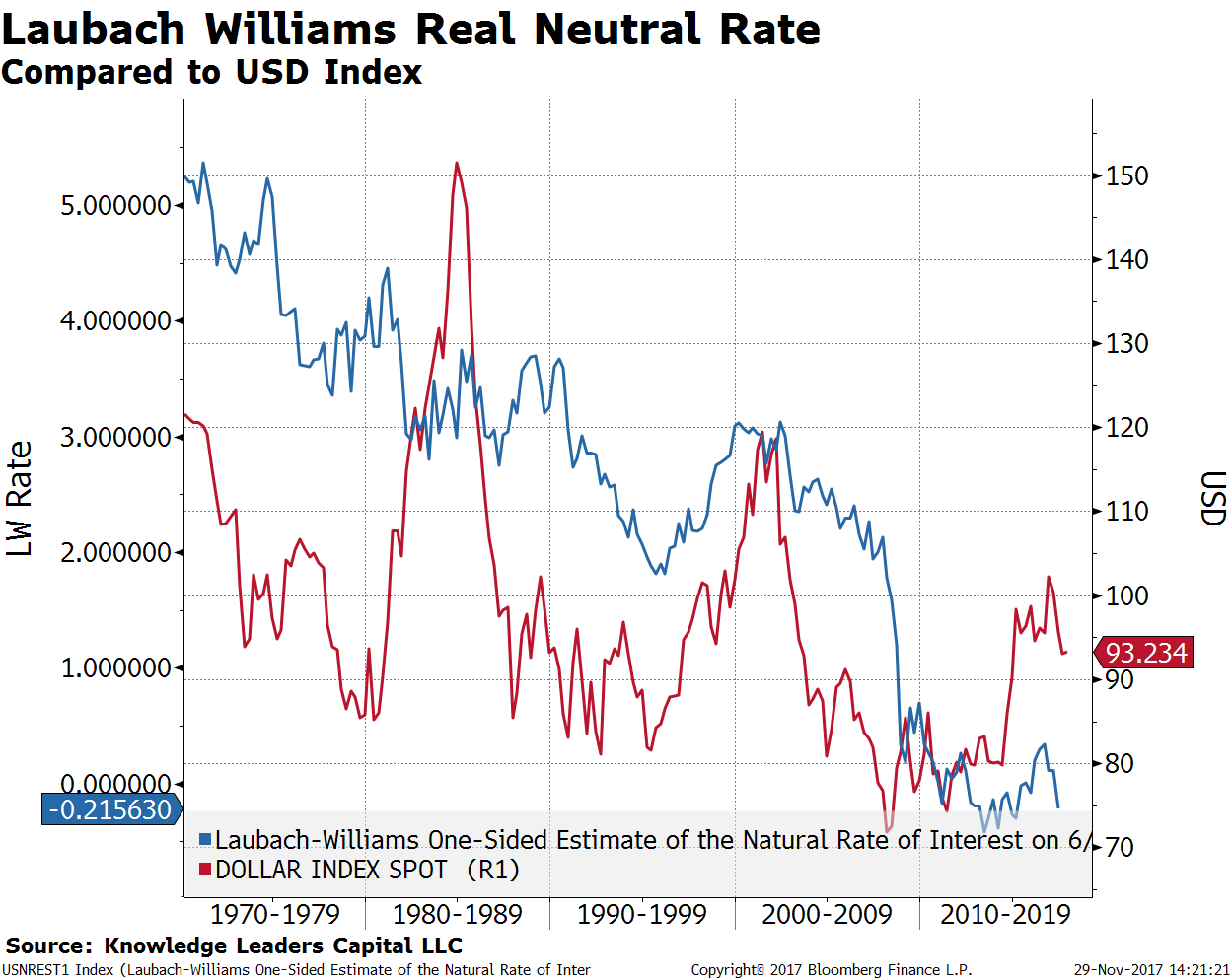
One indicator - the Laubauch-Williams (LW) Real Neutral Rate - has gained traction with the Fed and is often referred to as r-star. It is a measure of the real (after inflation) neutral interest rate that the US economy can handle without stimulating or restraining the economy. Over time, the LW Real Neutral Rate is one of the better signals for the US Dollar.


Every US Dollar bull market since 1970 has been marked by an increasing LW rate. In the chart below, I plot the LW Real Neutral Rate (blue line, left axis) against the US Dollar Index (red line, right axis). In the early 1980s the US Dollar bull market occurred with the LW rate rising from about 3% to about 4%. Similarly, the US Dollar bull run of the late 1990s occurred with the LW rate rising from just over 2% to just over 3%. The most recent US Dollar bull market has been no exception. While admittedly harder to see because the numbers are so small, the most recent US Dollar bull occurred with the LW rate rising from around -.5% to about +.3%.


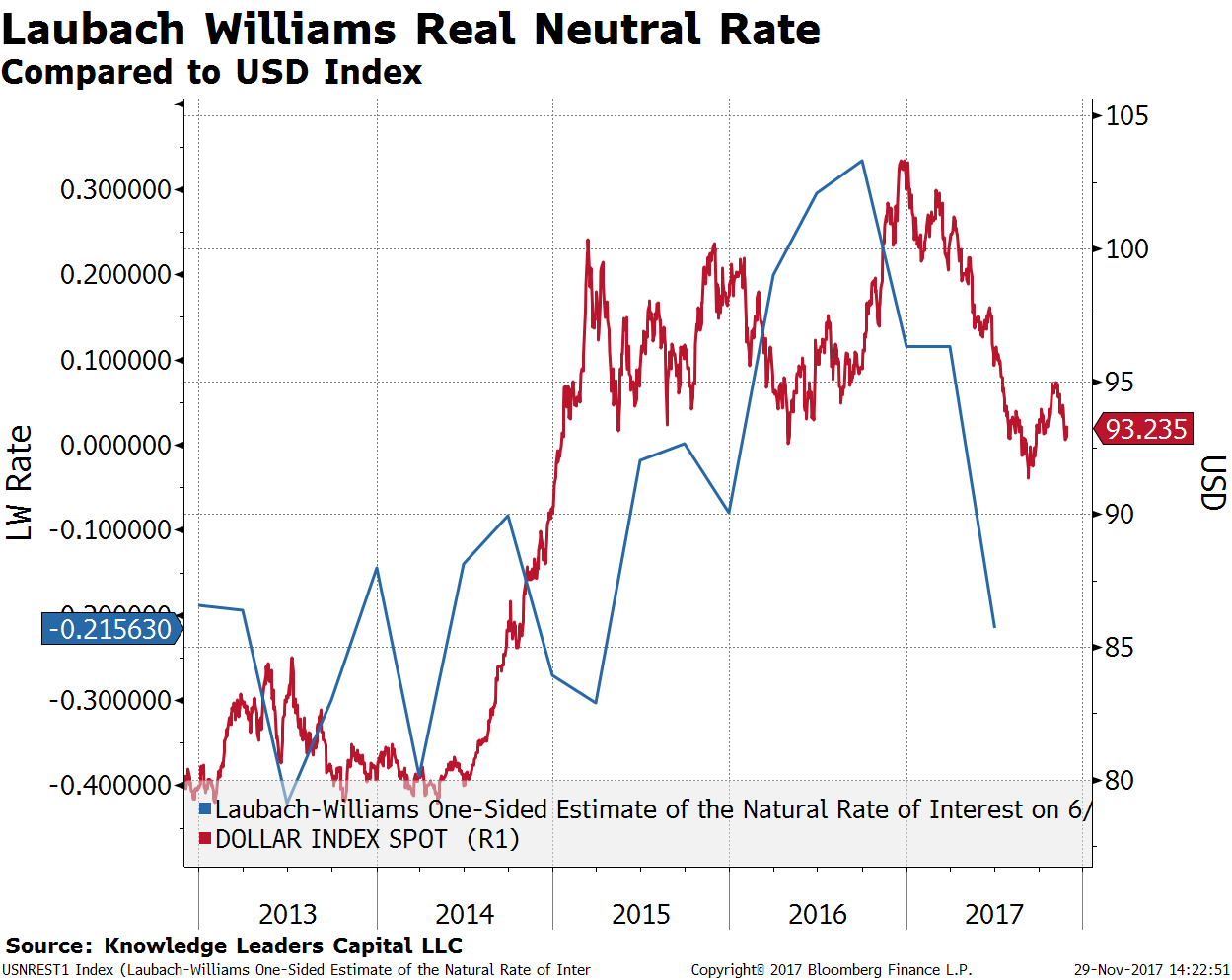
This relationship suggests the US Dollar bull run has come to a conclusion as the LW Real Neutral Rate has rolled over again. In the chart below, I focus on the last five years. Notice the US Dollar following the trend in the LW rate. The pop in the LW rate in the first quarter of 2014 led the 25% gain of the US Dollar from mid-2014 through early 2017. Notice also that the LW rate peaked in mid-2016, having fallen back by about 50bps in the last few quarters, leading the peak and decline in the US Dollar.


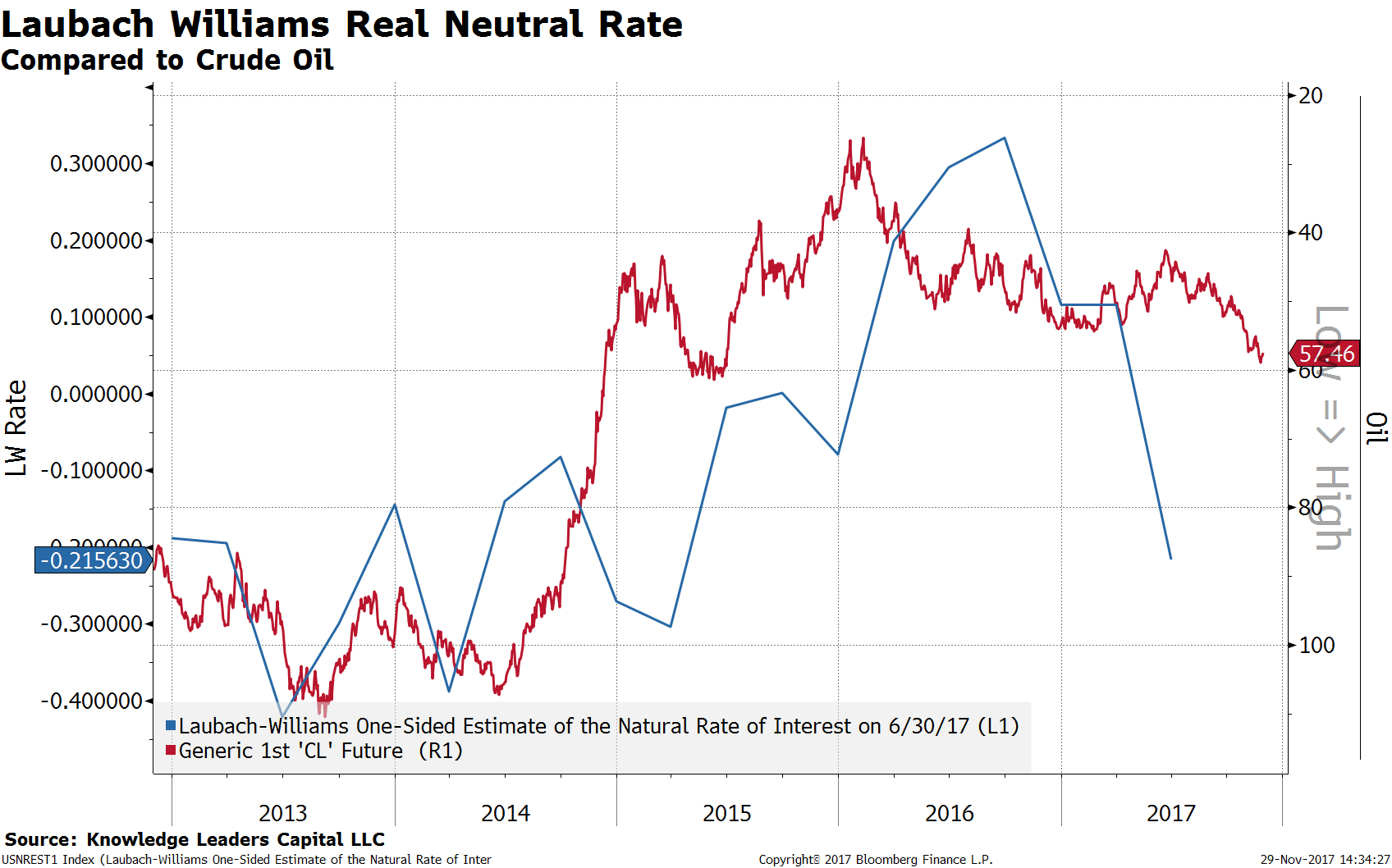
The fact that the LW rate has declined for three quarters in a row suggests this isn’t a temporary fluke. It is likely driven by the slow turnaround in oil prices. In the chart below, I plot the LW rate against oil prices. Simply, falling oil prices (red line, right scale, inverted) pull the LW rate (blue line, left axis) up. And, the reverse is true also that rising oil prices dampen the LW rate.


So, if we are now in a US Dollar bear market, driven by, among other factors, a falling LW rate and rising commodity prices, the good news is that cash is an asset class again.


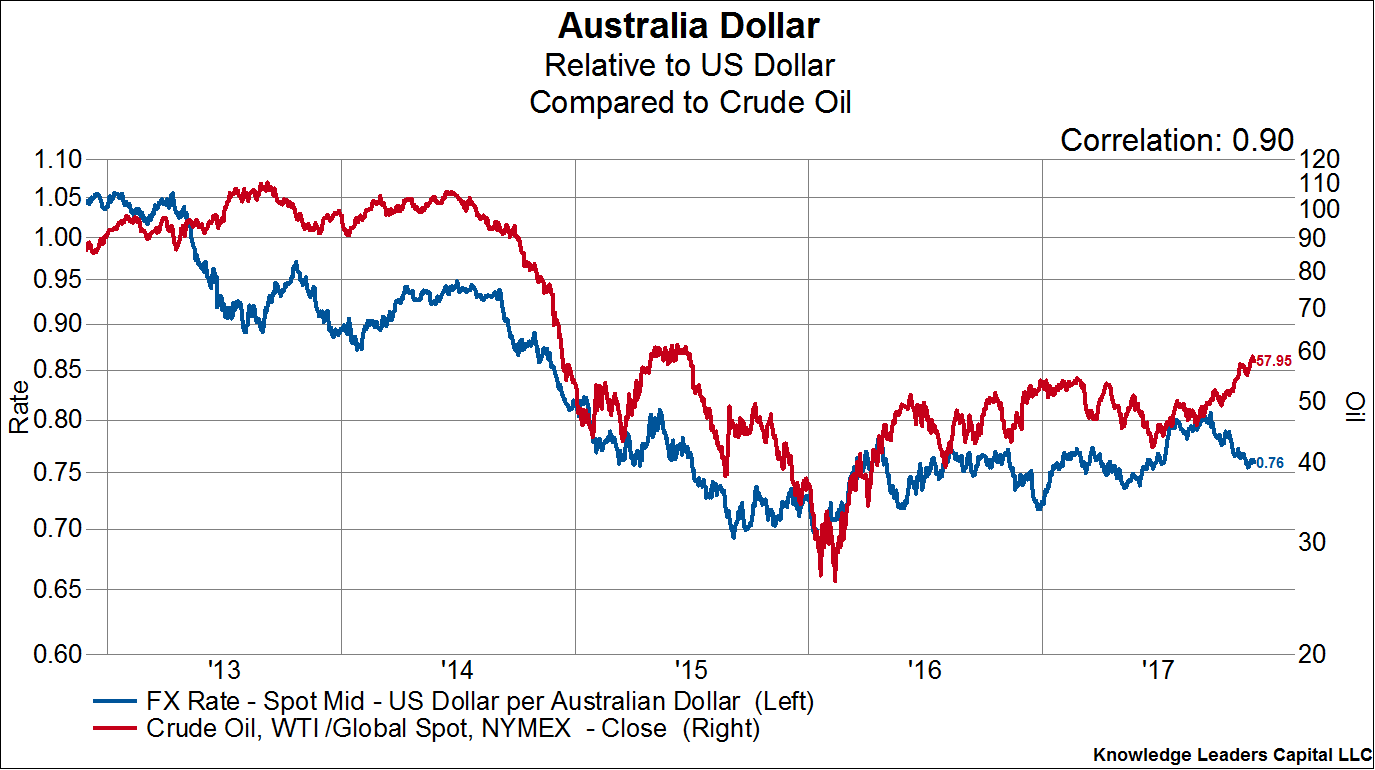
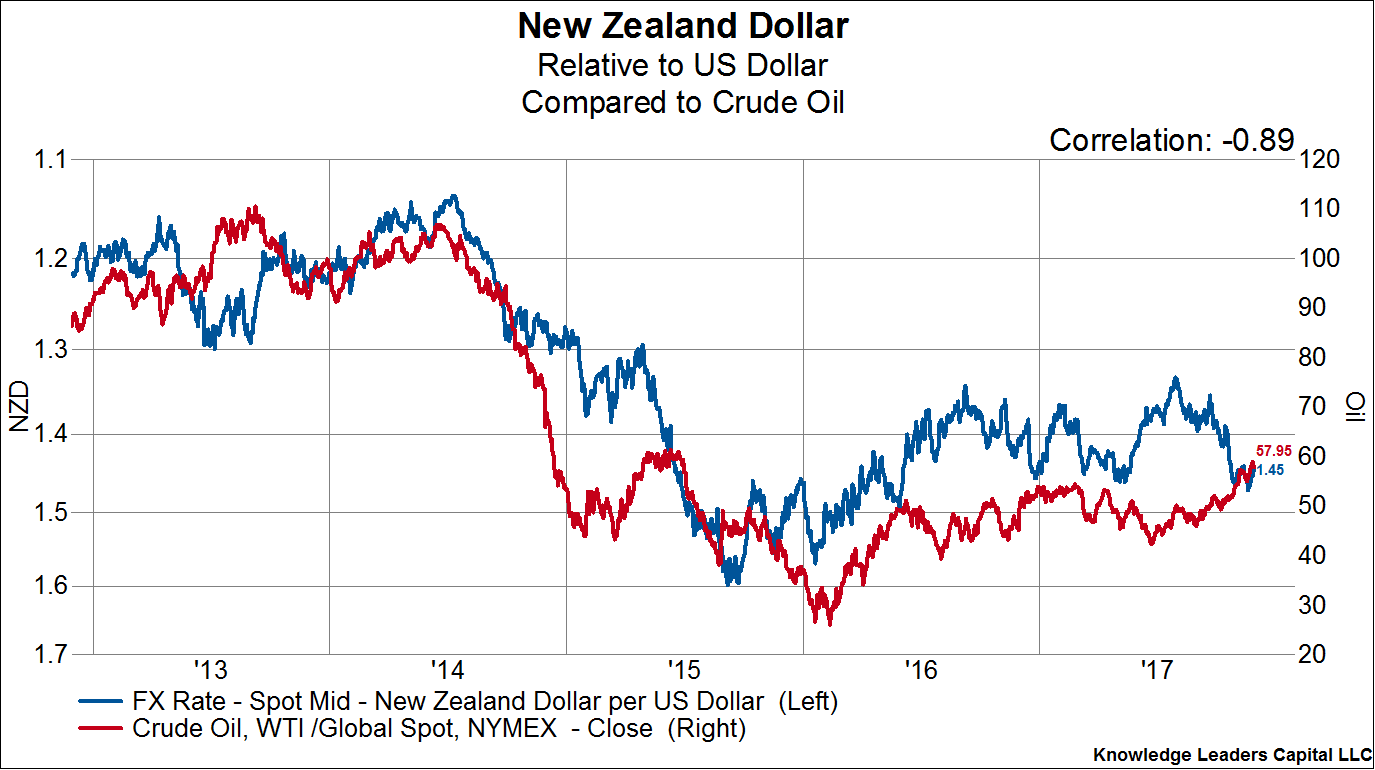
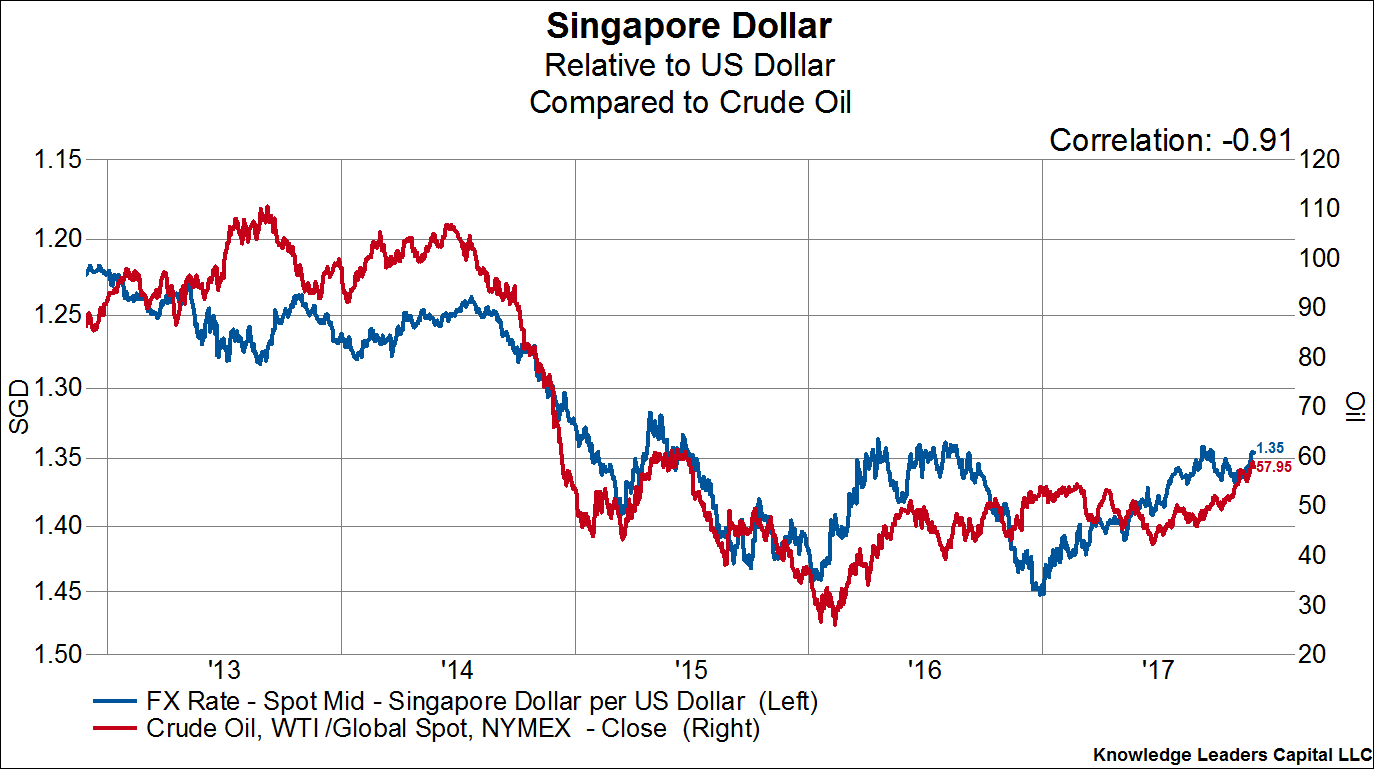
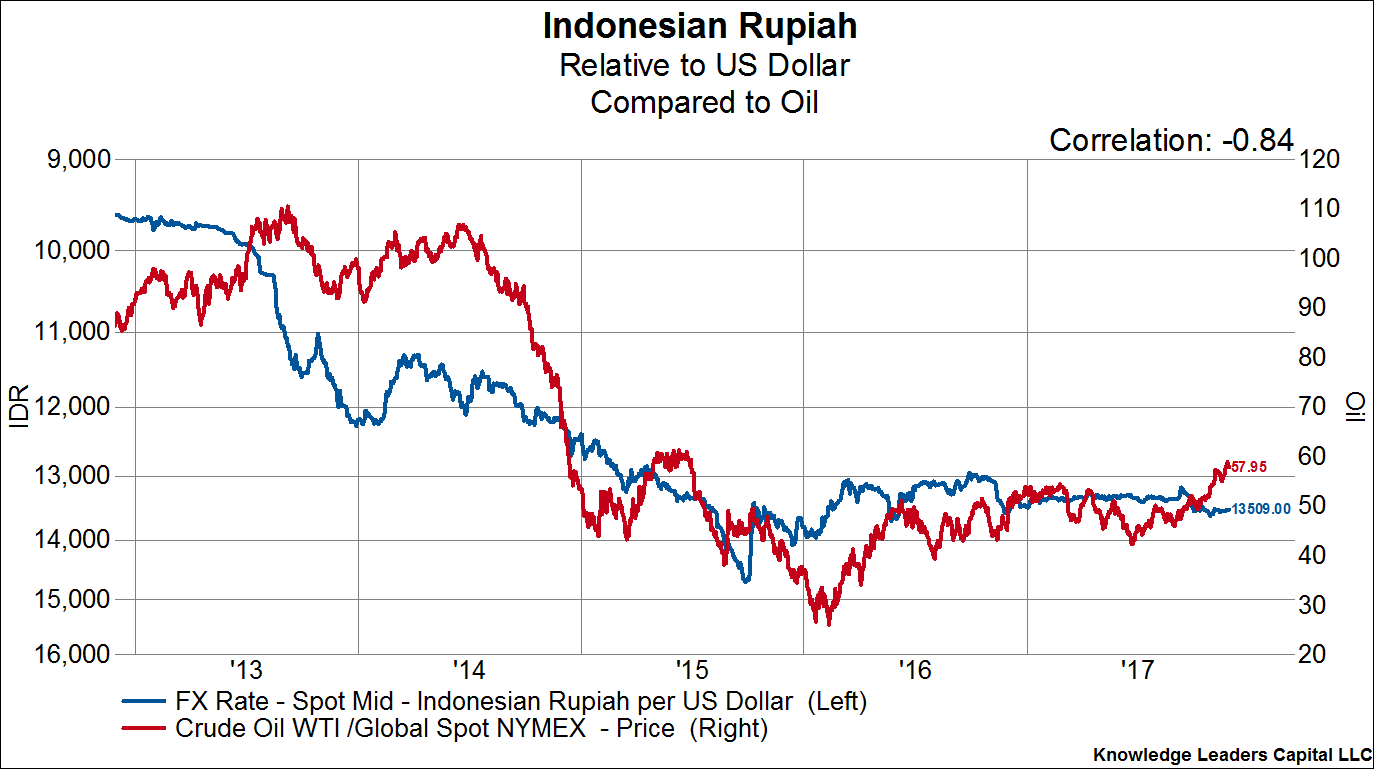
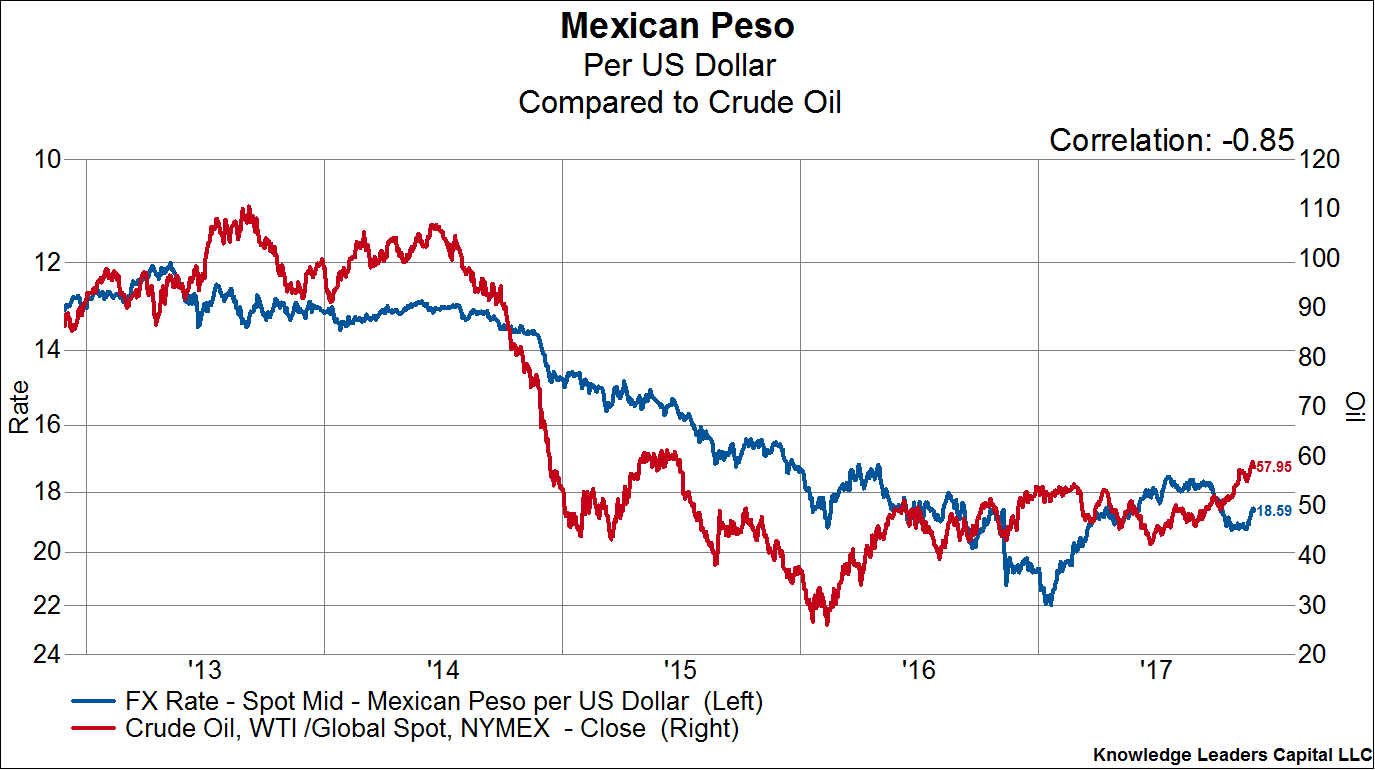
Which currencies should investors focus on? An easy place to start are those currencies with the tightest linkages to oil prices.


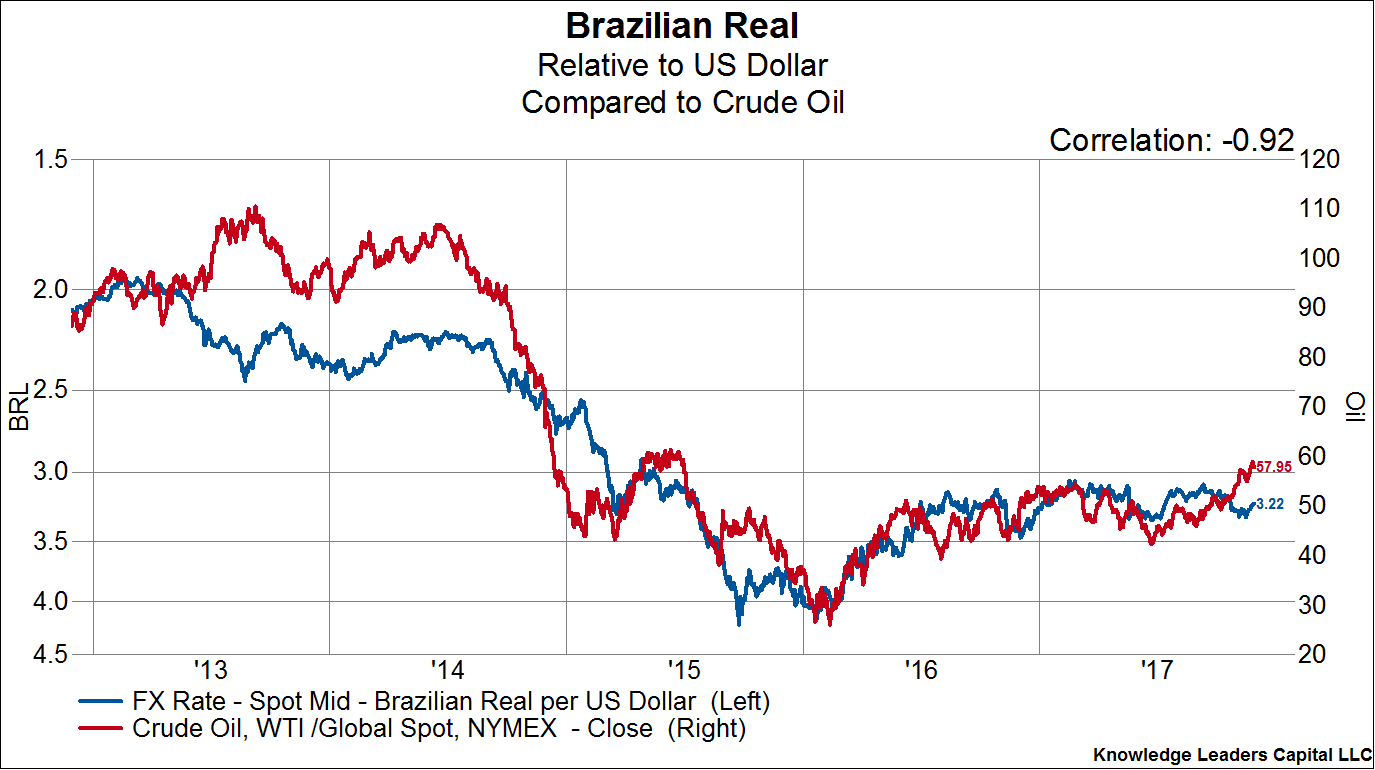
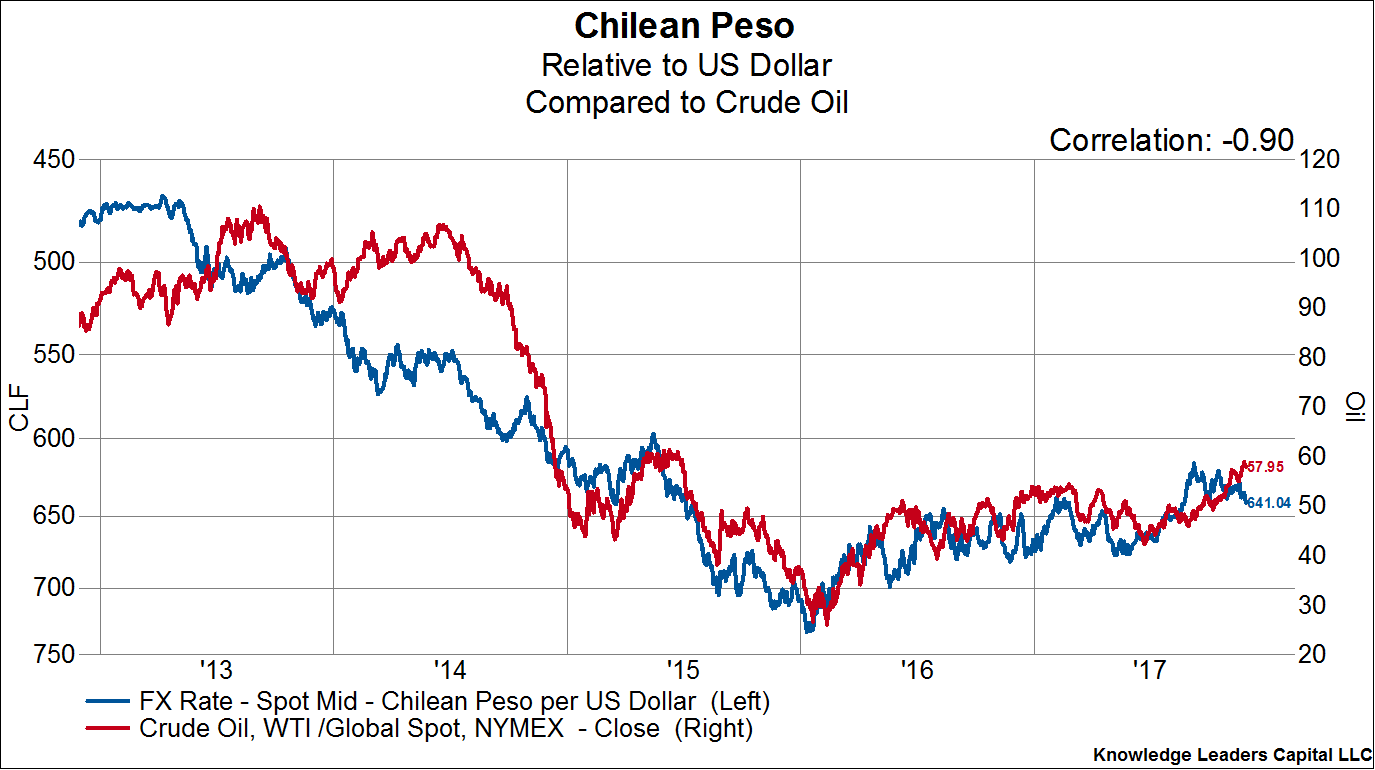
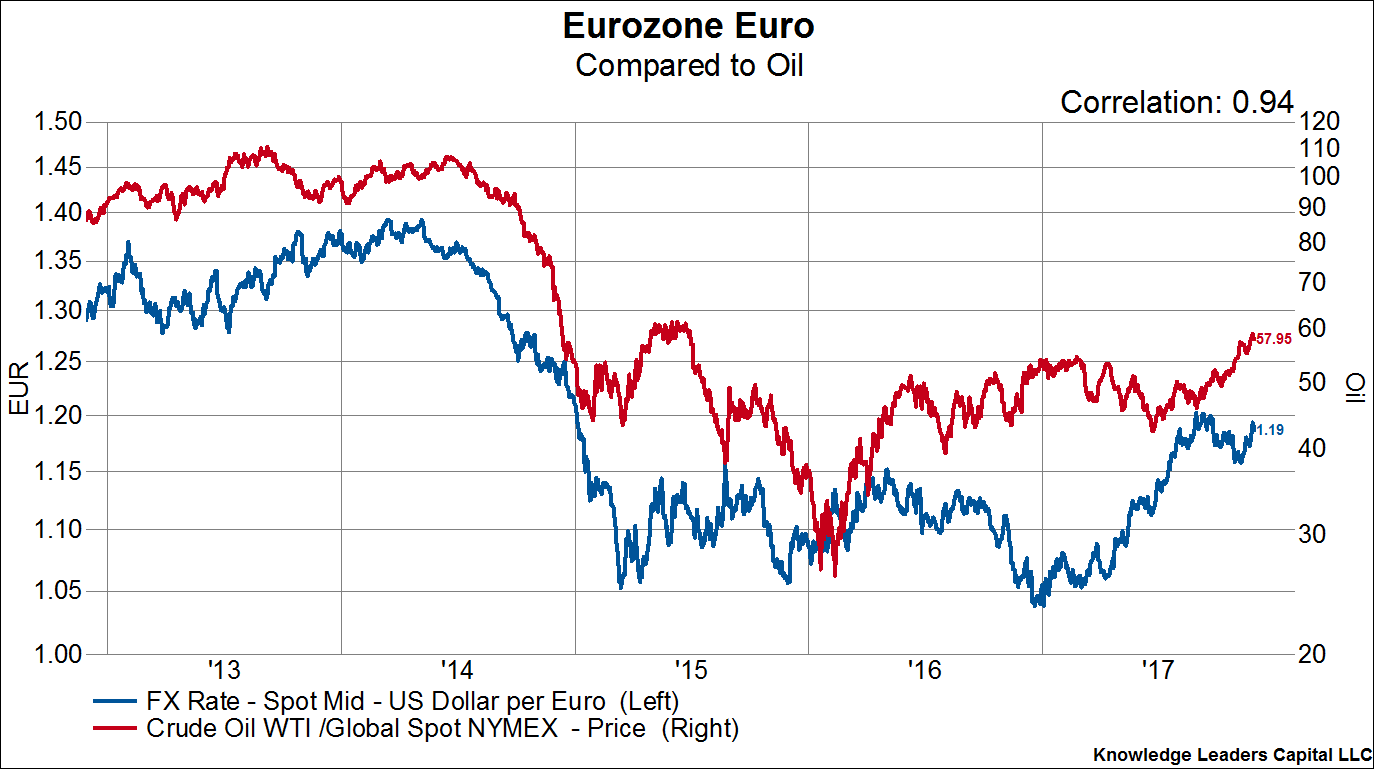
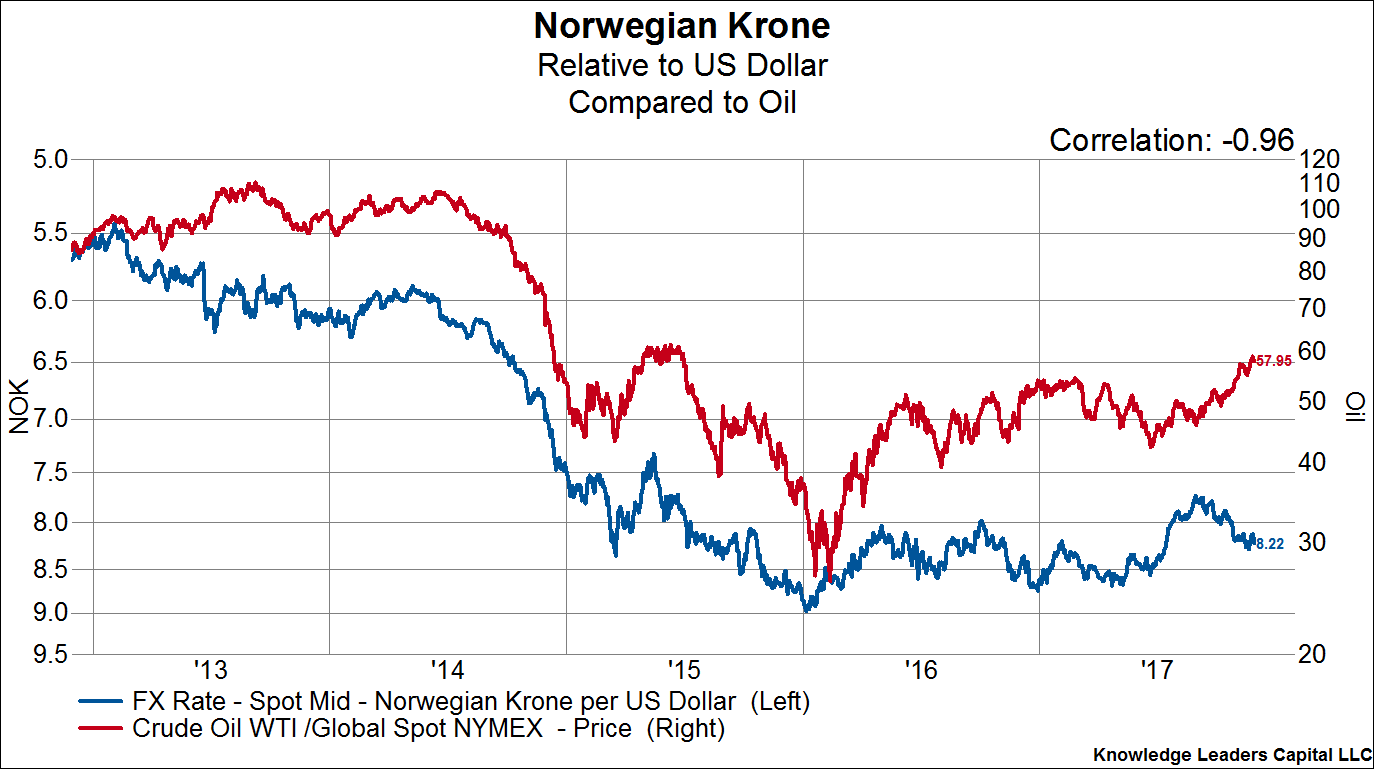
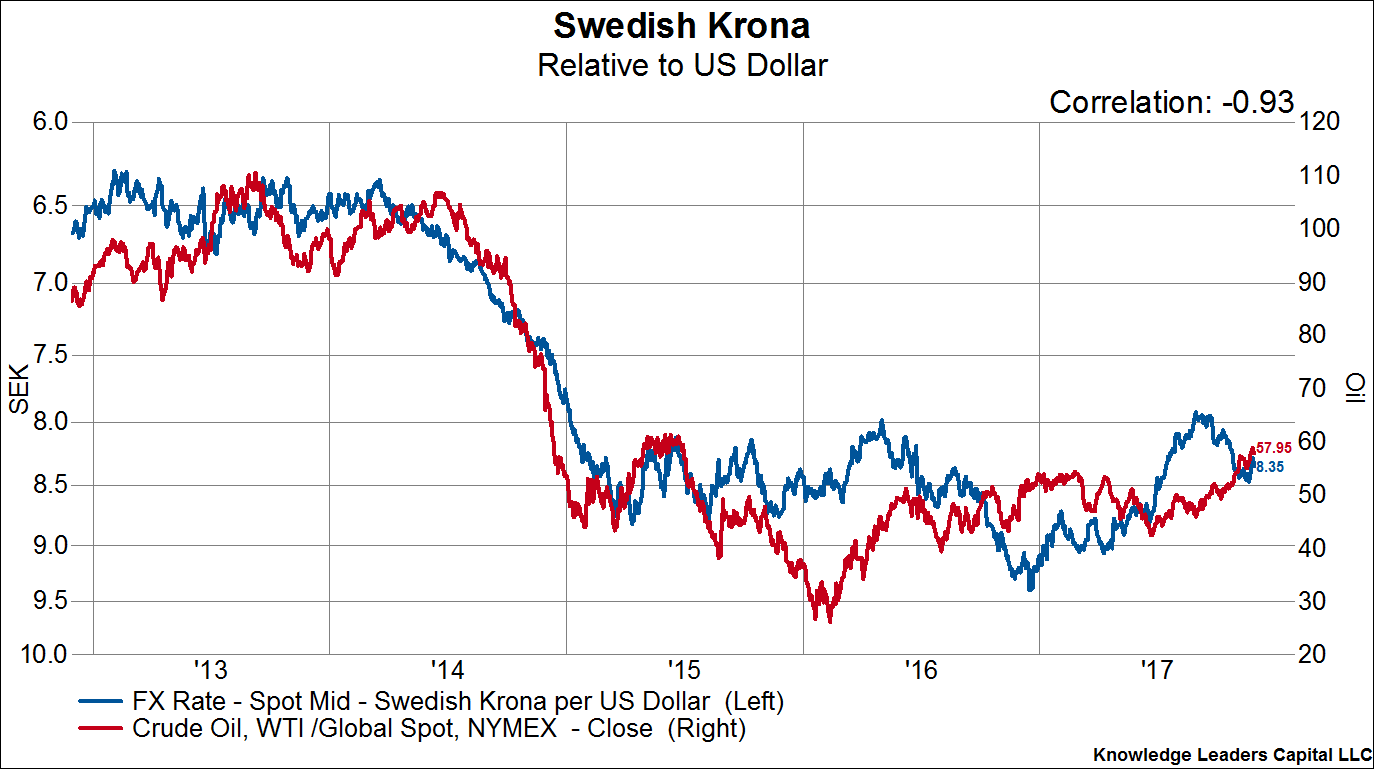
Let’s start in Asia. Among interesting developed market options for a cash allocation are the Australia Dollar, Singapore Dollar and New Zealand Dollar. In each chart below, I plot the US Dollar FX rate against oil prices, with the correlation shown in the upper right corner.


Among emerging market currencies in Asia, the most interesting are the Indonesian Rupiah and Thai Baht.


Moving to the Americas, the Canadian Dollar, Mexican Peso, Brazilian Real and Chilean Peso all look interesting.


Moving on to Europe, the most interesting currencies are Euro, Norwegian Krone and Swedish Krona.


While there are many asset allocation decisions that hinge on whether the US Dollar is in a bull or bear market cycle, one of the easier is currency allocation. An investor following an Anything but US Dollars policy has the chance to capitalize on the new US Dollar bear market. Cash is now an asset class again, and this creates new possibilities for alpha generation and risk management.


Sunday, November 19, 2017

The Coming Economic Downturn In Canada

Authored by Deb Shaw via MarketsNow.com,


  • Canadian GDP growth has outperformed this year, helping the Canadian dollar

  • As GDP growth slows and the Bank of Canada turns neutral, catalysts turning negative

  • Crude oil and real estate look set for a downturn, with negative implications for the currency


Given its natural resource-based economy, Canada is a boom and bust kind of place. This year, the country has enjoyed a significant boom. Thanks to a government stimulus program, rising corporate capital expenditures and consumer spending, Canada’s GDP growth has been nothing short of spectacular in 2017. According to Statistics Canada, the latest reading for year-over-year GDP growth is a healthy 3.5% (as of August 2017). While this is stronger than all major developed countries, growth is decelerating from its most recent peak in May 2017 (when GDP growth was an astounding 4.7%). A visual overview of historical GDP growth is shown below for reference:


Turning a corner: Canadian growth comes back down to earth


11-17-2017 CAD GDP growth


Source: Statistics Canada


Following the crude oil bust in the second quarter of 2014, Canadian growth rates cratered. While the country avoided a technical recession, the economic outlook was poor until early 2016. After crude oil returned to a bull market in the first quarter of 2016, the fortunes of the country turned. Given limited growth in 2015, the economy had no problem delivering 2%+ year-over-year growth rates in 2016. As a substantial stimulus program ramped up government spending in 2017, growth rates have continued to accelerate this year.


Storm clouds on the horizon: crude oil and real estate


While Canada has delivered exceptional growth in the last two years, the future outlook is much more challenging. Beyond the issue of base effects (mathematically, year-over-year GDP growth will be much tougher next year), key sectors including the oil & gas industry and Canadian real estate look ripe for a downturn.


Crude bull market intact today, but at risk in 2018


As WTI crude strengthens beyond $55, crude oil is clearly in a bull market today. Looking at figures from the International Energy Agency, global demand growth continues to run ahead of supply growth. Thus the ongoing bull market is supported by fundamentals. Thanks to the impact of hurricanes and infrastructure bottlenecks in 2017, US shale hasn’t entirely fulfilled its role as the global ‘swing producer’ this year. The dynamics of supply growth versus demand growth are shown below:


Who invited American shale? US supply ruins the crude oil party


10-13-2017 crude oil supply demand


Source: International Energy Agency, forward OPEC supply estimates via US EIA


Unfortunately, the status quo looks set to change as US supply returns with a vengeance. According to estimates from the IEA, supply growth will outstrip demand growth in the first quarter of 2018. Digging deeper into supply estimates, US shale is once again to blame. Our view is that this changing dynamic will lead to a new bear market in crude oil. Looking back at recent history, crude prices formed a long-term top in the second quarter of 2014 once supply growth overtook demand. Similarly, crude prices bottomed in the first quarter of 2016 once supply growth fell below demand in early 2016. Given Canada"s dependence on crude oil exports, a bear market for the commodity is likely to result in a weaker currency.


As China enters its latest real estate downturn, Canada not far behind


While Canadian real estate has enjoyed a great year, the future outlook is much tougher. Similar to its peers in Australia and New Zealand, Canadian real estate prices tend to lag real estate prices in China. This is both because Canada’s economy is deeply intertwined with China, and because the country is a big destination for overseas investment from China. While overseas investors make up a relatively small portion of buyers (around 5% according to government estimates), they serve an important role by acting as the marginal buyer for prime property. A comparison of new house prices in China versus Canada is shown below for reference:


Canadian real estate boom set to run out of steam


11-17-2017 China Canada real estate


Source: Statistics Canada, China National Bureau of Statistics


As Chinese new house prices accelerated significantly in early 2015, Canadian real estate prices followed in 2016. As the Chinese market is now decelerating, negative growth appears to be on the horizon. In March 2015, Chinese house price growth bottomed at -6.1%. While the Canadian bull market continues for now (September new house prices registered at 3.8%), a downturn is likely over the next 6-12 months. As real estate makes up 13% of Canadian GDP, a significant decline in the fortunes of the industry are likely to spill over to the broader economy.


Implications for the Canadian dollar


At the beginning of the year, the Canadian dollar enjoyed a wide number of bullish catalysts including accelerating GDP growth, rising rate hike expectations, a relatively strong crude oil market and speculator sentiment that was at a bearish extreme. These catalysts, and the Bank of Canada’s actions in particular, helped the currency strengthen until late September.


Today, almost every factor that drives the Canadian dollar is working against it. Future GDP growth rates are set to keep decelerating. Looking at the Bank of Canada, its outlook for future rate hikes is now “cautious”. This is a big change from its hawkish tilt earlier this year. While speculator sentiment is no longer at bullish extremes, waning interest in the Canadian dollar is weighing on the currency. The ongoing NAFTA negotiations are another source of potential political risk. Finally, an impending downturn for both crude oil and Canadian real estate further worsen the picture. Thus, our longer term outlook on the Canadian dollar is bearish.


Monday, October 23, 2017

Are Cryptocurrencies Inflationary?


Are Cryptocurrencies Inflationary?


Posted with permission and written by John Rubino, Dollar Collapse 


Are Cryptocurrencies Inflationary? - John Rubino


There’s a debate raging over what, exactly, bitcoin and the thousand or so other cryptocurrencies actually are. Some heavy-hitters are weighing in with strong, if not always coherent opinions:


Jamie Dimon calls bitcoin a ‘fraud’


JPMorgan Chase CEO Jamie Dimon did not mince words when asked about the popularity of virtual currency bitcoin.


Dimon said at an investment conference that the digital currency was a “fraud” and that his firm would fire anyone at the bank that traded it “in a second.” Dimon said he supported blockchain technology for tracking payments but that trading bitcoin itself was against the bank’s rules. He added that bitcoin was “stupid” and “far too dangerous.”


————————


Peter Schiff: Even at $4,000 bitcoin is still a bubble


One of the best-known among the bears, investor Peter Schiff, is now making his case in even stronger terms for why bitcoin has advanced ever farther into bubble territory.


Schiff, who predicted the 2008 mortgage crisis, famously referred to bitcoin as digital fool’s gold and compared the cryptocurrency to the infamous bubble in Beanie Babies.


Moreover, the recent run-up in bitcoin hasn’t softened Schiff’s view: If anything, it’s reinforced his sense of impending doom.


Schiff told CoinDesk:


“There’s certainly a lot of bullishness about bitcoin and cryptocurrency, and that’s the case with bubbles in general. The psychology of bubbles fuels it. You just become more convinced that it’s going to work. And the higher the price goes, the more convinced you become that you’re right. But it’s not going up because it’s going to work. It’s going up because of speculation.”


“What it comes down to is that bitcoin ain’t money.”


“Libertarian-minded crypto fans saw this was a way to liberate people from the government,” he said, concluding:


“I think it will have the opposite effect. People are going to lose money. This could really backfire, giving libertarian ideals a bad name by making fiat look good. The downside can be really spectacular.”


————————


Hedge fund manager James Altucher: Cryptocurrencies Could Be Worth $200 Trillion One Day


I’m not exaggerating when I say cryptocurrencies are the biggest innovation since the internet. We’re on the ground floor of an enormous trend that’s going to change the world.


Cryptocurrencies are currencies with no government in the middle. No bank in the middle. No organizations in the middle keeping track of all your payments, or taking advantage of your spending so they can invade your privacy, and on and on.


Cryptocurrencies solve trillions of dollars’ worth of problems, which is why they will be worth trillions of dollars one day.


Consider the potential:


There is currently $200 trillion in cash, money and precious metals used as currencies in the world. Meanwhile, there’s only $200 billion in cryptocurrencies. Cryptocurrencies are eventually replacing traditional currencies.


So that $200 billion will eventually rise to the level of currencies. And probably sooner than we can imagine.


Ask yourself, why does the world need multiple currencies? There’s actually no real reason. The only reason we have a U.S. dollar and also a Canadian dollar is that in 1770 the people in Canada decided not to join the U.S. So an artificial border created two currencies. It’s all dictated by artificial borders.


In the past, an ounce of gold would be accepted almost anywhere in the world. In that sense, unbacked modern fiat currencies are a step backwards.


But in cryptocurrency world, there are what I call “Use Borders.” Every currency is defined by its use. For instance, Ethereum is like Bitcoin but it makes “smart contracts” easier. Contract Law is a multi-trillion dollar industry so this has a huge use case. Filecoin makes storage easier. It’s a $100 billion industry. And on.


Studying the “use” cases, and the effectiveness of the coin to solve those use cases can help us make investment decisions confidently.


This is the great promise of cryptocurrencies and why they will change the world. It’s just getting started.


Don’t try to make sense of the above. Instead, let’s just assume that the cryptocurrency universe will continue to expand for a while and narrow the discussion down to a single question: Are cryptocurrencies inflationary? That is, will their spread lead to higher or lower prices for the average person, and greater or lesser financial instability for the markets, and what does this mean for today’s fiat currencies?


One common opinion is that cryptocurrencies can’t be inflationary because their owners have to pay for them in fiat currencies. So one bitcoin bought means one dollar, yen, or euro sold, with the net effect on prices being zero.


This makes intuitive sense at first glance, but only holds for the moment of purchase. Consider what happened after someone in, say, 2014 exchanged dollars for bitcoins. The dollars held most of their value, which means the total amount of dollar purchasing power in the world remained constant. But those bitcoins went up by several thousand percent, dramatically increasing the purchasing power – and thus the potential inflationary impact – of the bitcoin complex.


A real world example is Julian Assange:


Julian Assange Says Wikileaks Has Made a 50,000% Return on Bitcoin. Here’s What That Means


Wikileaks has seen an amazing return on investments in bitcoin, founder Julian Assange says, and he is “thanking” the U.S. government for forcing the controversial organization to get into bitcoin in the first place.


In a Tweet on Saturday, Assange said the group’s investment in the cryptocurrency has seen a return greater than 50,000% since 2010. Wikileaks began investing in bitcoin back then because global payment processors like Visa, Mastercard, and Paypal were under pressure by the U.S. government to block the ability of the group to take payments.


In fact, Bitcoin has seen a more-than 9 million percent return over the dates Assange references. In certain periods in 2010, bitcoin was trading for mere pennies. According to coindesk.com, one unit of bitcoin is now worth a record high of roughly $5,700. Anyone buying bitcoin through much of 2011 and 2012, when one unit was sometimes trading below $1 and was often under $10, would indeed see a return on investment of more than 50,000%, assuming they never sold.


The difference between Wikileak’s purchasing power pre and post-bitcoin is immense. If Assange decides to spend his windfall on goods and services he’d have, at the margin, an inflationary impact on the stuff he buys.


So the answer to the question of cryptocurrencies’ impact on price levels depends on how their values change. If they rise after people buy them, then they’re inflationary. If they rise a lot, they’re potentially very inflationary.


In this sense, it might be helpful to view cryptocurrencies as assets like houses or stocks rather than as money. When they rise relative to fiat currencies they increase the purchasing power of their owners, generate a “wealth effect” in which owners feel richer and more comfortable with splurging, and in that way push up prices. Based on the following chart, a lot of early adopters are feeling a whole lot richer these days.


Which then leads to what might be the major cryptocurrency theme of the coming year: Why would governments allow such an inflationary supernova to explode right in front of them when they presumably have the power to stop it? Here’s one possible — and of course disturbing — answer:


Will cryptocurrencies trash cash? ‘Fedcoin’ could do it


Economist Ed Yardeni of Yardeni Research asks the obvious question: Why would central banks—which derive their power as the centralized gatekeepers of fiat currency creation, check clearing and payment processing—embrace a movement that’s primary motivation has been to usurp this power in a decentralized way?


Part of that, according to St. Louis Federal Reserve president James Bullard, is recognition that the technology has achieved critical mass. Thus, there’s a fear of being left behind as the very foundations of banking and monetary policy—intermediation, funds transfers, transactions—rapidly change, not unlike the way the creation of mortgage-backed securities and credit default swaps changed housing finance in the mid-2000s.


There’s another, more self-serving purpose: Central banks could use their own cryptos to put the squeeze on paper currency. Why? To facilitate the use of negative interest rate policy, which has been deployed in Europe and Japan in recent years in half-baked forms. Currently, in Switzerland, short-term interest rates are at -0.75%.


When another recession hits, especially if one comes soon, a dive to even deeper rates of negative interest would be hampered by the hoarding of cash since banks would charge for deposits (vs. absorbing the cost of negative rates themselves, as they’re doing now). This is known by the economics cognoscenti as the “zero lower bound” in that interest rates cannot go much below negative before the traditional functions of deposits, loans and fractional money creation break down. Mattress stuffing ensues en masse.


The Fed is clearly thinking about it. In testimony to Congress last year, Fed chairman Janet Yellen admitted policymakers “expect to have less scope for interest-rate cuts than we have had historically,” adding she would not completely rule out the use of negative interest rates.


The BIS­—the central bank of central banks—in its latest quarterly review posited that a crypto backed by the Fed “has the potential to relieve the zero lower bound constraint on monetary policy.” Any distinction between regular dollars and this new “Fedcoin” could be removed by establishing a fixed one-to-one valuation. Any competition

from the likes of bitcoin could be squashed by regulation; not unlike how the private ownership of gold was outlawed in the 1930s when it threatened the Fed’s ability to ease credit conditions.


At the risk of being repetitious, pretty much all of the above looks good for gold and great for silver.


Questions or comments about this article? Leave your thoughts HERE.


Are Cryptocurrencies Inflationary?


Posted with permission and written by John Rubino, Dollar Collapse


Wednesday, September 27, 2017

Loonie Loses All 'Surprise Rate Hike' Gains As Canada's Poloz Gets Cold Feet

The Canadian Dollar is tumbling - erasing all the gains following September"s surprise rate-hike - as in his first speech since the, Bank of Canada Governor Stephen Poloz warns there is no “predetermined path for interest rates” and said the central bank will proceed “cautiously” as it assess the performance of the economy from here on.


“Monetary policy will be particularly data dependent in these circumstances and, as always, we could still be surprised in either direction. We will continue to feel our way cautiously as we get closer to home”


“The appropriate path for interest rates in this situation is very difficult to know, because there are a number of unknowns around the inflation outlook”


“We will not be mechanical in our approach to monetary policy”


And on that the Loonie is tumbling...


As Bloomberg notes, Poloz is seeking to balance bringing interest rates back to more normal levels amid the strongest growth spurt in more than a decade, while at the same time not harming the fledgling recovery. Wednesday"s speech -- like one given by Deputy Governor Tim Lane last week -- may be interpreted as a further attempt by policy makers to pare expectations that the central bank is moving headlong into more rate increases, after hiking borrowing costs twice since July.

Tuesday, July 4, 2017

PBOC Hires Blockchain Engineers Who Will Oversee Creation Of The "Digital RMB"

For those who can’t quite reconcile the Chinese government’s tentative acceptance of bitcoin and other cryptocurrencies with the inherently anarchistic principles espoused by bitcoin"s creator, here’s yet another clue to support the theory that the Chinese government has decided to tolerate and regulate digital currencies in hopes of learning how to apply the technology to its own digital currency.


At its core, the hypothetical “digital RMB” will subvert bitcoin’s core mission – that is, to enable individuals to circumvent government control and monitoring. Instead, Chinese policy makers intend to use the currency to strengthen the Communist Party’s ability to monitor its citizens for evidence of money laundering and other financial crimes, as MarketWatch noted earlier this year.


Of course, the PBOC’s official line is that it believes a blockchain-based digital currency would allow it to make more accurate monetary policy decisions by improving its ability to gather data on financial flows…but, as with all policies in China, maintaining social control and enforcing laws is the No. 1 priority here. People’s Bank of China Gov. Zhou Xiaochuan has said it will take China approximately 10 years to fully embrace the digital renminbi, though he said later that there is no official timeline.


To that end, the Shanghai Daily reports that the PBOC has officially launched its own blockchain research institute, and is seeking to hire engineers who to oversee the creation of what could become the first blockchain-based fiat currency.


Here’s SD:


“The People’s Bank of China’s institute of printing science is offering six positions for the design and development of digital currency-related software and hardware framework, a recruitment notice said, adding that candidates with experience in blockchain and Big Data technologies will be preferred.


The candidates must hold master’s or doctoral degree in computer science, information security and cryptography, according to the notice.”


As Cryptocoins News points out, the hiring drive comes soon after the bank’s vice-governor, Fan Yifei, published a Bloomberg column opining that the best way for governments to drive innovation of digital currencies is by creating their own, which will stay under their control. Yifei sees reduced operating costs, increased efficiency and a broad range of new applications as the many outcomes of moving from a paper-based currency to its digital form.


The creation of the institute represents an expansion on a public-private partnership sponsored by the Chinese government that was launched to explore the feasibility of creating a digital RMB. That partnership, which involves experts from Citibank and Deloitte, was first reported in early 2016. China is also already experimenting with using a blockchain-based shadow system for clearing trades in local interbank credit markets.


The PBOC isn’t the only central bank that’s exploring the feasibility of its own digital currency. The Bank of England joined with researchers at University College in London to create RSCoin, a digital currency for central banks. The Bank of Canada has also said it is developing a blockchain-based digital version of the Canadian dollar. Central banks in Russia and Australia have also expressed interest in exploring digital currencies.

Tuesday, May 30, 2017

Is This The "Mystery" Massive Long Supporting The Oil Market?

Authored by Kevin Muir via The Macro Tourist blog,


Usually when CFTC data shows a big speculative position, it is easy to spot the corresponding mood amongst traders. For example, take the current situation with the Canadian dollar. There are record net speculative shorts, and that bias is obvious amongst hedge funds and other professional traders.


https://www.thefringenews.com/wp-content/uploads/2017/05/themacrotourist.comCADMay3017-6f1ace3f14b61cae9ed6991ba0982ef4202b5cfc.png


However, over the past few years, I have been puzzled by the building of a massive record net long speculative position in the WTI crude oil market.


https://www.thefringenews.com/wp-content/uploads/2017/05/themacrotourist.comCrudeMay3017-07fb70a71964043653d2e628998524d37cb6ee4b.png


The monster speculative long position doesn’t correspond to the general attitude amongst traders. In fact, without looking at the data, I would argue most specs are negative towards crude oil. The data does not jive with my anecdotal evidence.


I have written about the problems of solely using net contracts as a measure of speculative positioning before (Re-evaluating crude oil spec positioning). Increases in open interest, and dramatic changes in the price of the underlying asset can make some of these contract-only indicators less effective. This is why experts who focus on CFTC Data, often use net position as a percent of open interest. Adam Collins at Movement Capital has created a terrific website called Free COT Data that uses this sort of analysis. For those interested in CFTC positioning, I highly recommend Adam’s site.


When we transform net crude spec positioning to a percent of open interest, the recent rise does not seem so scary.


https://www.thefringenews.com/wp-content/uploads/2017/05/themacrotourist.comCrudeOIMay3017-bc6b375f71cd716cbb7642f3ac39eae2736673fb.png


Yet I don’t think that completely explains what is going on.


For 25 years, the net crude oil spec position sat in a range.


https://www.thefringenews.com/wp-content/uploads/2017/05/themacrotourist.com25YearsMay3017-726f3e3ef13782eba10bba41549b6eebadee0175.png


Then in 2010, it broke out, and has been rising steadily since then.


Now maybe there has been a whole raft of new speculators entering the crude oil market. Maybe hedge funds are secretly long gobs of futures. I don’t know for sure, but I somehow doubt it.


If they were long tons of futures, I would expect to see them doing what they do with all their other positions - jumping on TV touting their idea, or writing up reports about why oil is going to $100. Sure there is the occasional crude oil bull, but nowhere near what you would expect if they had a record long position.


I don’t buy that this increase in net spec longs is a traditional increase in speculation. There is something different about it.


I don’t have any answers. But I wonder if we are missing a new player that may have entered the market.


I am not sure how China would be classified if they were to buy futures, but I think there is a decent chance they might not be classified as a hedger.


Since the 2008 credit crisis, Chinese crude oil imports have increased from 11.5 million metric tonnes, to over 35 million.


https://www.thefringenews.com/wp-content/uploads/2017/05/themacrotourist.comChinaMay3017-f62fec719736ab91c4de5d449bd87085f6f352e8.png


We know that over the past decade China has been ramping up their SPR (Strategic Petroleum Reserve). What if they are also trading crude oil futures?


It might explain the recent massive expansion in open interest and net speculative long position.


I understand the bear argument that crude oil is about to roll over due to the weak longs, but what if they are misinterpreting the extent of speculative long positioning?


There is no doubt that the supply side story is bearish. There is a wall of crude oil out there.


But what if the demand side surprises to the upside? What if everyone is underestimating China’s appetite? I don’t know about you, but if I were a Central Bank with too many U.S. dollars, I certainly would be selling the fiat currency and buying some real assets. And if you think about it, nothing is a better real asset than crude oil. It is storable, and most importantly, it represents a unit of energy that is the basis for man’s unbelievable productivity. Take away crude oil and see how many houses, skyscrapers, etc. are built. Take away crude oil and see how you get your fresh vegetables, or even your summer hamburgers. Crude oil is in the price of almost everything we build and consume.


China buying crude oil as a way to diversify their US dollar holdings makes complete sense. And don’t forget, China is not like Bank of Japan or the Federal Reserve. They aren’t going to announce their purchases ahead of time.


I know this theory is a little out-there. But I look at the recent expansion of crude oil net positioning, and it just doesn’t reflect what I see in the market. China as a big silent buyer is a much more plausible explanation than the fact hedge funds are net long record crude oil because they are so bullish.

Tuesday, May 23, 2017

Why The Chinese Yuan Won't Be The World's Reserve Currency

Authored by Valentin Schmid via The Epoch Times,


Whenever someone gets too big and too important, the other players who can’t compete by themselves call for a challenger. This is true in sports, business, and even for currencies.


Because the dollar is so big and important, smaller countries were happy when the euro was launched to provide a counterbalance, if not to challenge the dollar’s position outright.


The euro ultimately provided that counterbalance, but never managed to dethrone the dollar as the world’s foremost reserve currency. The euro is used in 30 percent of all global payments, according to payment provider SWIFT; the dollar is still number one, at 40 percent.


But what about the Chinese currency, the yuan, the one that investment bank HSBC predicted would become the third-largest global trade currency by 2015—is it the ultimate challenger to the dollar’s top status? Not so much.


Only 16 percent of Chinese trade is settled in yuan, or renminbi (RMB), and the share of global payments ranks sixth at only 1.78 percent, behind the dollar, euro, pound, yen, and even the Canadian dollar.


To be fair, China’s leadership never called for the yuan to overtake the dollar. It was mainly Western cheerleaders like HSBC that looked at the country’s economic growth and applied it to the currency. 


Many pundits also thought the yuan would take a stronger role after Donald Trump’s election last November.


“No longer is the U.S. dollar the only haven of safety. There is an alternative—renminbi,” Daryl Guppy, CEO of the Guppytraders financial market training platform, told CNBC in November


Reserve Qualities


But what does a currency have to be or do to become the world’s reserve currency? Will the yuan ever qualify, and is the Chinese leadership pushing to replace the dollar?


According to a report by investment bank Natixis, there are four functions a successful currency needs to fulfill for both the private and the public sectors.


The first is being a medium of exchange. For private sector payments, we already saw that the RMB’s share is minuscule compared to the euro and dollar. Even the RMB’s use in trade with and investment into China is relatively small and no longer growing, according to the report.


Public sector payments between governments and central banks are conducted via central bank swap lines. They allow central banks of different countries to issue money that is not their own. For example, during the financial crisis of 2008, the Federal Reserve provided the world’s central bank with as much as $620 billion in liquidity. China’s swap lines amount to $430 billion, but are hardly ever used.


The second function is being a store of value, so that private players can invest their money in yuan assets like stocks and bonds and preserve their purchasing power. Also here, foreign ownership of Chinese equities is not very large, at around 0.8 percent, and for Chinese bonds, only slightly larger at 2 percent. Foreign bank deposits and loans into China have also been falling since 2014.


For the public sector store of value, that is, global central banks’ holding of foreign currency, the yuan’s share is 1 percent, despite the admission to the International Monetary Fund’s (IMF) special drawing rights (SDR) basket late in 2016. The dollar still takes the lion’s share at 64 percent.


The third function is the so-called unit of account. This means that trade invoices, for example, are issued in RMB and then paid in RMB rather than dollars. Also here, even for Australia, one of China’s biggest trading partners, only 0.5 percent of exports to China are invoiced in RMB.


For the official unit of account, another country would need to peg its currency to the RMB, but given China’s relatively closed capital account, this hasn’t happened yet. At least the RMB is now part of the SDR, which functions as a unit of account for the IMF, but it only has a 10.9 percent weight.


Lastly, the currency needs to have developed fixed income markets where payments can be parked in the form of bank deposits or bonds.


And while local Chinese corporate bond issuance is strong, foreigners aren’t buying into it, and the Chinese government bond market remains small in comparison to those in the United States and Europe.


Furthermore, bank deposits in RMB in the so-called global clearing centers are also falling. In Hong Kong, for example, only 5 percent of all bank deposits are in RMB and 37 percent in dollars.


Zhou Xiaochuan, governor of the People’s Bank of China, in Beijing on March12, 2015. Unlike Western pundits, the Chinese central bank never wanted the yuan to replace the dollar.  (Feng Li/Getty Images)


This, however, is not a disappointment for the Chinese regime, but rather for their Western cheerleaders. The Chinese have always favored an international solution to replace the U.S. dollar, namely in the form of the SDR, as China’s central bank governor Zhou Xiaochuan called for in a 2009 speech at the Council on Foreign Relations.


“The desirable goal of reforming the international monetary system, therefore, is to create an international reserve currency that is disconnected from individual nations,” he said.


Disconnected from the dollar, yes - but not connected to the yuan.

Thursday, April 27, 2017

Dollar testing highs against the Canadian Dollar as Canada struggles with identity crisis

Is Canada a "real" country?  What is a "real" country anyway?  Is a "country" defined by ethnic lines, borders, corporations, or what the United Nations says?  Is Kosovo a country?  Some say yes, some do not agree:


Kosovo, self-declared independent country in the Balkans region of Europe. Although the United States and most members of the European Union (EU) recognized Kosovo"s declaration of independence from Serbia in 2008, Serbia, Russia, and a significant number of other countries—including several EU members—did not.


Well Canada is lucky to have self-declared itself as a country during a period where many breakaway regions and colonies became countries (let"s not get into the debate about USA because America Inc. is an artificial country, actually it is a corporation).  But the point here is that, as we explain in Splitting Pennies - Understanding Forex - A COUNTRY IS A CURRENCY.  Yes, this means that Germany, Italy, and others - have given up their sovereignty for the chance to participate in the Euro.  This point is one of the main reason nationalists throughout the European Union rally for its demise.   


But what about Canada?  One of the ex-colonial British states which still is part of the "commonwealth" Canada enjoys the best of both worlds - independence but protection from two big brothers; USA and the UK.  And at least for the time being, Canada is really a real country, at least more than EU nation states are.  Canada is not part of a "super state" although a "super alliance" called the Commonwealth is similar, London doesn"t directly control Canada"s monetary supply (vis a vis the currency) so for now, Canada is really an independent country.


Take a look at recent FX activity in the "loonie" USD/CAD pair:


usd cad


For those new to FX, the above chart shows USD vs. CAD which means that the US Dollar is UP against the Canadian dollar.  This area of 1.36 has been a top at least for 2017 and the latter part of 2016; a break here could signify a bull run where there"s no further technical resistance until the Jan 2015 high of 1.47.


The loonie as the CAD is called (because of the bird, not because of lunatics in Canada) is considered a commodity currency due to oil and other resources up there.  Another reason that it"s time the US just annexed Canada and made it the 51st state (much better than Puerto Rico, me thinks).  Here"s a list of reasons the US should invade Canada as explained in a previous article exclusively on ZH by Global Intel Hub.


What"s the FX trade here?  Simple; place limit orders above and below the several day range; whichever way USD/CAD breaks out (up or down) it will break hard, as Canada struggles to establish its own identity as a real G8 Currency.


usd cad break up


Of course, if you"re in one of the 50% of publicly listed companies that doesn"t hedge FX (don"t see=don"t exist), this is a potential risk if you do business in or with Canada (and thus have CAD exposure).  


If all this is confusing, you can always invest in futures strategies and forget it.


For a detailed play by play breakdown of how to trade such an event; checkout Fortress Capital Trading Academy, or Splitting Pennies the Book.

Saturday, April 8, 2017

David Rosenberg: "This Is A Bubble Of Historic Proportions"

Shortly after we remarked most recently on the unprecedented Canadian housing bubble that has migrated from Vancouver to Toronto, Gluskin Sheff"s Chief Economist David Rosenberg joined the growing chorus of calls for government intervention into the Toronto housing market. In an interview on BNN, Rosenberg, who correctly called the U.S. housing bubble in 2005 when still at Merrill Lynch, said the massive deviation from historical norms has him drawing comparisons between the two situations.


This bubble is on par with what we had in the States back in ’05, ’06, ’07,” he said. “We have to actually take a look at the situation. The housing market here is in a classic price bubble. If you don’t acknowledge that, you have your head in the sand.”


Rosenberg warned unchecked increases in home prices are becoming a social issue. “It’s not an equity, it’s not a bond -- it’s where people live,” he said. “Where home prices are in Toronto, they absorb 13 years of average family income. That is completely abnormal. We’ve never seen this before.”


“We’re out of equilibrium, and when we’re out of equilibrium, or there’s some sort of market failure, are there grounds there for government intervention? I think even the most ardent libertarian would say ‘yes"." Rosenberg said there are a trio of levers the government can pull to cool down the market. Authorities can address supply, which he said has already been “kiboshed.” Interest rates can be raised, but Rosenberg doesn’t believe the Bank of Canada will do that.  Or new policy can be drafted to address the prevalence of speculation.


“These are not prices driven by the local fundamentals -- this is the foreign buyer coming in,” Rosenberg said. “Toronto has really emerged as a first-class city, not just politically, not just culturally and economically, but also in terms of being a major financial centre. But if you’re going to ask me at this stage, ‘do we need to approach taxation of this capital coming in differently to curb the demand?’ [That’s] absolutely right.”


And just to make his position clear, Rosenberg also an op-ed in Canada"s Financial Post on the topic, titled simply enough:


"Make no mistake, the Toronto real estate market is in a bubble of historic proportions"


by David Rosenberg


The concerns about froth in Toronto’s housing market are not likely to subside given the sticker-shock from the latest report from the Toronto Real Estate Board.


As per the March report, the average single-detached house in the Greater Toronto Area (GTA) sold for $1,214,422 last month up from $910,375 in March of last year — that is a 33 per cent YoY surge, and follows a 16 per cent run-up over the prior 12 months.


Whatever the term is for an acceleration in an already parabolic curve, well, that is what we have on our hands today.


And it isn’t just detached homes seeing this degree of rapid price appreciation — the benchmark single-family home selling price was up 29 per cent YoY, the benchmark townhouse price was up 28 per cent and the condo/apartment composite was up 24 per cent.


This is a bubble of historic proportions.


Not only to have home prices in the GTA now absorb an unprecedented 13 years of median family income, but to have 30 per-cent-ish run-ups against a backdrop of a 2 per cent inflation rate, wages that are barely going up 2 per cent as well, and nominal GDP growth of around 4 per cent. This should put 30 per cent into some sort of perspective when we conclude that what we have on our hands is a near three standard deviation event.


That alone qualifies as a bubble — if you don’t like that term, then call it a giant sud. In the past, Toronto home prices went up at an annual rate of 4 per cent in real terms, in the past year they have surged by nearly 30 per cent.


Some context, however, is needed here.


First, this aggressive increase in home prices in Canada’s most populous city has come (at least in part) due to strong competition among potential buyers for comparatively scant homes for sale.


Active listings of homes available for sale in Toronto plunged 35.2 per cent YoY in March, which means that the months’ supply of houses on the market is a miniscule 0.65, down from 1.18 last March — for reference, a “balanced market” sees a months’ supply figure around 6.0. The average home that was put up for sale remained on the market for just 10 days, down from 16 days a year ago.


These measures of “tightness” in the market are without precedent — not even the red-hot late-1980s bubble experience could ever compete with today’s backdrop.


As well, the sales-to-new listings ratio sits well into “sellers’ market” territory at 70.8 per cent, which compares to 69.4 per cent a year ago — a ratio between 40 per cent and 60 per cent is considered indicative of a “balanced market.”


No wonder nobody wants to list their home! It’s become such a valuable asset.


But you see, this is where the danger comes in: when people start to view their house as some investment as opposed to a home — a place to raise the kids and play with them in the backyard.


A house is an asset indeed, but should never be compared to a stock or a bond or even other investable properties. It is a place to live.


Unlike a stock, which you can sell anytime and tuck away the winnings, if you sell your house, well, you still need a roof over your head. A stock with a dividend gives you an income stream, as does a fixed-income instrument. Unless you are a landlord, your house is burning cash (utilities, property taxes, maintenance), not bringing in cash.   


So there are indeed some supply and demand fundamentals that are underpinning prices. Insofar as the demand is rising because people think they are investing in something hot just because of the accelerating momentum, well, these people are going to end up being pretty big losers. For if the government catches a whiff that it is now speculative fever that is dominating the uber-hot housing market, well that could very well elicit a response (as in capital gains taxes for those who sell within a year or two).


At some point, a correction would be very healthy because on the other side, owners of homes will then realize that no, they did not win some lottery, and will finally be willing to start listing their property, especially those who deep down want to sell (it could well be that the move-up buyers would like to sell but can’t afford that mansion of their dreams).


Not to mention first-time buyers who do not have the income for a down payment that any lender would consider appropriate. After all, we have hit the bizarre stage where a typical home now (and we are talking about a bungalow in Pape Village, not exactly an estate on Warren Road) would absorb 13 years of median household income.


Not even in the late 1980s, did housing get this expensive on this basis, and we know all too well how the Bank of Canada ultimately reacted and what happened next. Stephen Poloz is definitely no John Crow — though things can always change.     


One caveat should be noted because what is different this time around (oh, how I hate using that phrase) is that Toronto has emerged as a world-class city and the foreign buyer is clearly having an impact.


So while Toronto residential real estate is indeed expensive for the locals, it is far less so for foreign investors, especially for Americans who can buy Canadian assets at a 25 per cent discount from a currency perspective.


In the mid to late 1980s, Toronto did not have the Rogers Center. It did not have the Raptors. It had no decent hotel outside of the Four Seasons and the Windsor Arms. Truly great restaurants were not to be found (unless you want to count Winston’s!). There was no Drake. And Toronto FC was not in existence. Not to mention there was very little in the way of a theater district.


While the separatist threat in Quebec gave Toronto the mantle of being Canada’s financial center back in 1976, the city was never seriously viewed as a global player in this respect until very recently. With more than 250,000 employed in the financial services sector, Toronto has very quietly emerged as the second largest financial hub in North America (after New York). Of the 84 cities surveyed in the 2015 Global Financial Centres Index, Toronto ranked 8th!


So while prices may seem a little nutty, it is important to note that Toronto is a major financial, economic and cultural centre, and when compared to its peers globally, prices appear far less crazy, too.


This doesn’t make the current price action justified based on local income fundamentals, but based on the foreign incomes of those wanting to establish a toehold in a stable Toronto amidst a sea of global instability, the prices are not that much out of whack.


As per data compiled by Global Property Guide, Toronto home prices on a U.S. dollar per square metre basis rank just 14th in the world, well behind the likes of London, New York, Paris and Tokyo.


And at the same time, if you are a family in say, Brooklyn Heights looking to buy property in Toronto it would only absorb six years of income; and if you reside in Santa Monica and feel like dipping your toes in the Toronto real estate market, it would only take up four years of your annual median take-home pay. The same (four years) holds true for those wealthy enough to be living in Knightsbridge.


You see, when Toronto home prices are measured against incomes in other places of the world, it is not nearly as onerous (especially in Canadian dollar terms).


In other words, many well-heeled foreigners can far better afford what the locals can’t afford here, and housing in recent years has truly become in internationally-traded asset class (though I wouldn’t recommend ripping out the foundation and exporting the structure anywhere).


So it goes without saying that if the name of the game is to tame the flame then have the foreign investor share the blame. A tax on foreign transactions, as was already done in Vancouver, seems like a pretty good idea. And the government can at the very least use the revenues to either provide greater tax incentives to build and/or provide tax relief for the low/mid income entry-level buyer who is struggling to cobble together the funds for a down payment.


So yes, in this sense, I would be advocating a Robin Hood style of economic policy.


Indeed, what may be needed is a very progressive tax on foreign buying of local residential real estate in the bid to cool demand and reverse the exponential surge in home prices — a surge that is creating tremendous social problems by crowding out young families (or individuals) from chasing the homeownership dream (a typical response is for these folks is to go out and buy a condo instead, but the reality is that average prices here have also skyrocketed 24 per cent in the past year and are in a bubble of their own).


Everyone says that the Bank of Canada cannot raise interest rates to curb the excess demand because of the deleterious effect this would have on the economy writ large (for example, taking the Canadian dollar back up to or above 80 cents which would thwart our export competitiveness which has become a longstanding role of the central bank).


Be that as it may, the home price surge in the GTA over the past year has impaired homeowner affordability to such an extent that it is basically the equivalent of the Bank of Canada having raised rates 150 basis points — actually a 200 basis point increase if you were to look at what home prices have done to affordability ratios over the past two years (so you can’t have it both ways; the price action is basically equivalent to having five-year mortgage rates closer to 5.75 per cent than the actual posted rate of 3.75 per cent).


Barring a bold move by the government to bring home prices to levels consistent with domestic economic fundamentals as opposed to income levels from well-heeled buyers from the U.S., China, and Europe, maybe it is time for the Bank of Canada to start playing a role and follow the Fed on a gradual rising interest rate path.

Monday, March 27, 2017

RBC Emergency Market Update: "Big Trouble For Consensus Trades"

Markets may not be turmoiling yet, but as per this "emergency" Sunday night "hot take" from RBC"s cross-asset head Charlie McElligott notes, things are certainly starting to break.


SPECIAL EDITION RBC Big Picture: BIG TROUBLE FOR CONSENSUS "REFLATION" TRADES AS "FISCAL POLICY" FEARS CONFIRMED
 
#HOTTAKE: ‘Risk-off’ in a sloppy Asian opening to start the week (ES1 -18 handles, $/Y -100pips to 110.34, UST 10Y ylds at 2.36), as markets digest the scope and viability of the US ‘fiscal policy’ narrative going-forward off the tremors of Friday’s failed healthcare repeal vote. 


Reflation” themes were already staggering in recent weeks off-the-back of the recent the crude oil sell-off (and the implications for weakened ‘inflation expectations’)—but to now see the longer-term ‘US fiscal policy upside kicker’ looking especially threatened, it is likely that the ‘big three’ trade expressions (longs in US Dollar US Banks and shorts in US Rates) are looking very exposed for an acceleration of recent drawdowns (in conjunction with longs in HY, ‘cyclicals / defensives’ L/S pairs, equities ‘value’ factor, equities high beta, US equities small cap).


Long Dollar’ trades are currently seen unwinding ‘real-time’ as ‘the world’s most crowded trade’ and ‘reflation’ proxy earlier this evening broke the convergence of both its 200dma and the 76.4% Fibo Retracement of the entire Dollar move since the US election—exposing significant downside.  Legacy shorts held against the US Dollar in Euro (making 2017 highs vs USD), Yen (making 2017 highs vs USD), Pound and Canadian Dollar are being painfully squeezed as traders are liquidating after ‘processing’ the implications of the Trump Administration’s failed ACA repeal Friday, with many ‘late-comers’ to these trades significantly ‘under water’ already and looking to ‘tap out’ on losers.  Tactical funds and discretionary macro were already pivoting ‘short USD’ last week on the new “policy CONVERGENCE” dynamic, and now with momentum having clearly pivoted in the other direction, one would expect systematic / trend / CTA to be heavily-involved now as well on the short-side of USD trades.


The story that we were getting Friday from some buyside traders and sellside strategists (by-and-large) was that a “no” vote was almost irrelevant to risk-assets, as market participants want the US Administration to ‘move on’ and ‘focus its efforts’ on tax policy anyhow (versus being mired in further debate with the ‘repeal and replace’ of the ACA).  What many were missing here though (and noted by Mark Orsley Friday afternoon) is that the sequencing of ‘healthcare’ and ‘budget’ before ‘taxes’ was intentional and critical, as spending cuts from a repeal of the ACA were effectively a ‘requirement’ against the pending new administration’s tax-plan which will only further increase the deficit.  This is obviously an impediment then to efforts to keep any new tax plan ‘deficit neutral,’ so essentially, the GOP is starting in a bigger hole, some say to the tune of $1T dollars….and this of course is not including the extremely controversial BAT component, which too has lost much momentum over the past two months, despite projections that it could provide upwards of $1T of revenues over a 10 year period in order to fund the individual and corporate tax cut proposals (ironically, the same ‘Freedom Caucus’ of GOP’ers which symbolically defeated the ‘new’ healthcare plan on Friday are also against the BAT…yikes).


What does it all mean?  Some of the talk emanating from DC policy-circles is now of the view that this now means an almost certainty of a ‘watered down’ tax plan, which instead of deep ‘headline’ cuts planned will now feature much more modest cuts (corporates as priority over individuals) and focus on “streamlining” tax code / loopholes.  This is not the ‘joy’ that many of those 2500 S&P targets ‘signed-up’ for.


What is at risk?  I noted many of the ‘consensual longs’ which have already showed significant signs of being de-grossed in recent weeks.  But as we now see a high likelihood of the potential for a rates reversal to accelerate and long duration’ rallies in the face of the ‘rates short’ crowd, there will be major implications within equities too, as ‘low vol’ defensives (REITS / Utes / Staples / Telcos) and ‘anti-beta’ market neutral strategies are certain to see further escalation of their recent strength.  The good news for equities-longs  is that ‘secular growers’ like tech, consumer discretionary and biotech is too likely to benefit from money rotating out of ‘deep cyclicals’and ‘value.’  


Stay tuned…


Friday, February 17, 2017

Trump's Currency War Hit List - Is Canada a Target?

A lot has been said about the potential for a US-Canada trade war. And judging from a lot of what’s happened, especially with respect to a strengthen USD, it looks like currencies may be what could light the spark to the barrel of gunpowder.


THE BACKDROP


The fact of the matter is that a strong dollar isn’t necessarily good for all sectors of the U.S economy. A strengthening dollar can have a “deleterious feedback loop” for export-oriented companies, since it means their products are now more expensive for foreign customers to buy. The net effect is that US-based manufacturers could suffer tremendously – including in terms of having to cut jobs and downsize their operations.


Another sour pill to swallow for Team Trump, if the USD continues to rise against major currencies, is the fact that foreign corporations, such as German pharmaceutical giant Bayer or Euro aerospace behemoth Airbus that do significant business in the U.S, profit more than U.S corporations selling overseas.   


And that’s exactly contrary to the platform of ‘Buy America”, job creation and boosting exports that Mr. Trump ran on during his campaign. So when a country’s currency weakens, in relation to the USD (i.e. the Greenback grows comparatively stronger), the war hawks in the Trump administration sit up and take notice!


WAR CLOUDS GATHER


Since November 2016, the PowerShares DB US Dollar Index (UUP), which tracks the USD against a basket of world currencies, has been on a steady increase, from $25.59 (Nov 11, 2016) to a high of $26.70 (Dec 20th, 2016). Granted that some of those gains have been paired back by Mr. Trumps jawboning statements ($25.89 at the time of writing); but it still represents a nearly 4.8% rise over a 6-month period ($24.71 on Aug 15, 2016).


Back on the campaign trail, Mr. Trump had already started beating the war drums. However, his war cries were largely directed towards China, and to his neighbour to the South – Mexico. But the battle cries keep getting louder. More recently, Trump senior trade advisors have levied similar accusations against Germany, and have also been severely critical about the Japanese currency “malpractices”. 


CANADA IN TRUMP’s CROSSHAIRS?


Things could get messy for Canada’s economy, if the same rhetoric is applied to the US dollar’s performance versus the Canadian dollar. Back in November, the USD traded at $1.34 per CAD, with “Trump Talk” pushing it up in strength to $1.36 (Dec 27, 2016). At the time of writing, the Greenback has lost some steam, trading at $1.31 per CAD – roughly just about where it traded 6 months ago.


So what will a stronger USD mean for the Canadian economy, if the Trump Administration decides to label Canada a “Currency manipulator”? What could a currency war with the US mean for Canada?


Well, the US is Canada’s largest trading partner, and any strengthening of the Greenback against the Loonie is positive for Canadian exporters, but negative for the US – since it tilts the balance of trade. Mr. Trump may therefore do all he can to ensure the dollar does not gain too much strength versus the CAD. One way to retaliate might be to target specific Canadian industries, like Energy, Forestry and Auto. 


In terms of specific impacts to Canadian economy, New Brunswick, Alberta and Ontario will be the worst three provinces to be hit by any currency war fallout; that’s according to TD Economics analysis. These three provinces have exports that are significantly exposed to the US, and any retaliatory measures by the US, such as a border tax, will have deleterious effect on provincial economies.


With respect to specific industries that could become casualties of any currency-initiated trade war between the two neighbours, based on TD Economics figures (Share of total goods exported to the US), it is likely that Auto Parts, Regulatory Consultants, Consumer goods and Forestry products will be the hardest hit.


SILVER LINING?


Searching for a sliver of sunlight peeking out of the dark currency war clouds, Trump advisors have assured Canada that, should trade and currency be up for discussions and renegotiations, then Canada may have nothing to be worried about from the new administration. However, as has been the hallmark of the new occupant at the Whitehouse, what’s said (or promised) and what’s actually delivered might be two entirely different things.


Brace for it…the USD-CAD currency wars might just be about to begin!

Wednesday, January 18, 2017

Loonie Plunges As Canadian Central Bank Warns "Rate Cuts Remain On The Table"

The loonie is tumbling this morning after Bank of Canada Governor Stephen Poloz, speaking at a press conference in Ottawa, said if downside risks materialize then rate cuts remain on the table.


As Bloomberg details:


  • Higher Canadian bond yields, driven by rising U.S. yields, are not consistent with the country’s economic outlook

  • “While this reaction is consistent with past correlations, it is at odds with Canada’s macroeconomic situation where there is material excess capacity, unlike the US economy.”

  • Some Trump policies incorporated into forecast show a boost of GDP by 0.1 percent by 2018.

  • Excess capacity has boosted risk of missing the inflation target

  • The elimination of excess capacity in the economy is reliant on fiscal stimulus. Main ingredient however is infrastructure spending, which is not yet evident in economic data.

And the Canadian dollar is losing ground fast...


How long before Trump accuses Canada of currency manipulation?


Additionally the peso is getting pounded after Wilbur Ross comments on border taxes and tariffs...