Showing posts with label G8. Show all posts

Tuesday, September 19, 2017

The World Is Creeping Toward De-Dollarization

The issue of when a global reserve currency begins or ends is not an exact science. There are no press releases announcing it, and neither are there big international conferences that end with the signing of treaties and a photo shoot. Nevertheless we can say with confidence that the reign of every world reserve currency has to come to and end at some point in time. During a changeover from one global currency to another, gold (and to a lesser extent silver) has always played a decisive role.


Central banks and governments have long been aware that the dollar has a sell-by date as a reserve currency. But it has taken until now for the subject to be discussed openly. The fact that the issue has been on the radar of a powerful bank like JP Morgan for at least five years, should give one pause. Questions regarding the global reserve currency are not exactly discussed on CNBC every day. Most mainstream economists avoid the topic like the plague. The issue is too politically charged. However, that doesn"t make it any less important for investors to look for answers.


On the contrary. The following questions need to be asked:


What indications are there that the world is turning its back on the US dollar?


And what are the clues that gold"s role could be strengthened in a new system?


The mechanism underlying today"s “dollar standard” is widely known and the term “petrodollar” describes it well. This system is based on an informal agreement the US and Saudi Arabia arrived at in the mid-1970s. The result of this deal: Oil, and consequently all other important commodities, is traded in US dollars — and only in US dollars. Oil producers then “recycle” these “petrodollars” into US treasuries. This circular flow of dollars has enabled the US to pile up a towering mountain of debt of nearly $20 trillion — without having to worry about its own financial stability. At least, until now.


For a long time the basis on which this global currency system rests was poorly documented. Finally, Bloomberg published a comprehensive article in May 2016, which provided detailed confirmation of the agreement that was hitherto only known as a rumor. The fact that this article is published now also represents a subtle clue that there are simmering shifts in the global currency system.


The trend becomes ever more tangible and can be described by the following term: de-dollarization. The world is looking for alternatives to the dollar — and finds them more and more often. At the same time the big oil producers and the largest exporters have stopped accumulating US debt securities. In one sentence: Since 1973 the dollar standard has been based on “usage demand” for dollars — they were needed. But when China and Russia find alternatives for their bilateral trading activity, they need fewer dollars. The same applies to European countries which have adopted the euro since 1999.


There have been many attempts by various nations to undermine the dollar"s preeminence in recent decades.


Some were nipped in the bud by US interventions — such as the plan of Iraq"s former dictator Saddam Hussein to sell oil for euros.


Or the rumored plan of Libya"s eccentric ruler Muammar al-Gaddafi to issue a pan-African gold currency.


Others are less well known, but are indeed continuing to “bubble” below the surface: For example, since 2008, an agreement exists between Saudi Arabia, Kuwait, Bahrain, and Qatar which provides for the creation of a monetary union. The planned new currency is nicknamed — rather unimaginatively — the “gulfo.” “The project is inspired by the European currency union, which is seen as a great success in the Arab world,” according to an article by Telegraph journalist Ambrose Evans-Pritchard. He inter alia quotes Nahed Taher, the CEO of Bahrain Gulf One Investment Bank: “The US dollar has failed. We need to delink from it.” However, it appears the plan has been put on hold in recent years. As recently as mid-2013 a statement was issued according to which the common currency was going to be put in place “by 2015 at the latest.” Today it is no longer even talked about. Moreover, other potential members such as the United Arab Emirates or Oman have so far failed to join the club. One should nevertheless keep an eye on developments in the Gulf.


A clear signal that something is afoot would be the abolition of the Saudi riyal"s peg to the US dollar. As recently as April of this year economist Nasser Saeedi advised Middle Eastern countries to prepare for a “new normal” — and specifically to review the dollar pegs of their currencies:


“By 2025 it is clear that the center of global economic geography is very much in Asia. What we’ve been living in over the past two decades is a very big shift in the political, economic, and financial geography.”


While the role of oil-producing countries (and particularly Saudi Arabia) shouldn"t be underestimated, at present the driving forces with regard to de-dollarization are primarily Moscow and Beijing. We want to take a closer look at this process.


There exist numerous political statements in this context which leave no room for doubt. The Russians and Chinese are quite open about their views regarding the role of gold in the current phase of the transition. Thus, Russian prime minister Dimitri Medvedev, at the time president of Russia, held a gold coin up to a camera on occasion of the 2008 G8 meeting in Aquila in Italy. Medvedev said that debates over the reserve currency question had become a permanent fixture of the meetings of government leaders.


Almost ten years later, the topic of currencies and gold is on the Sino-Russian agenda again. In March, Russia"s central bank opened its first office in Beijing. Russia is preparing to place its first renminbi-denominated government bond. Both sides have intensified efforts in recent years to settle bilateral trade not in US dollars, but in rubles and yuan. Gold is considered important by both countries.


The gradual move away from the USD to a multi-polar monetary order has several important effects, which only make sense when viewed through this lens. Contrary to what is asserted in most mainstream reports, oil-producing countries are not so much interested in a much higher oil price in USD terms, but rather in competition for market share. They are increasingly able to choose in which currencies they want to trade. The most important effect has become evident since 2014: two of the largest holders of US treasuries (China and Saudi Arabia) have abandoned their support of Washington. On the other hand, oil producers have no interest in recycling their revenues as “petrodollars.”


The process of moving away from the dollar - prepared by Europe and triggered by China and Russia - can no longer be stopped. And as a “supra-national” reserve asset, gold plays an important role in it.

Thursday, April 27, 2017

Dollar testing highs against the Canadian Dollar as Canada struggles with identity crisis

Is Canada a "real" country?  What is a "real" country anyway?  Is a "country" defined by ethnic lines, borders, corporations, or what the United Nations says?  Is Kosovo a country?  Some say yes, some do not agree:


Kosovo, self-declared independent country in the Balkans region of Europe. Although the United States and most members of the European Union (EU) recognized Kosovo"s declaration of independence from Serbia in 2008, Serbia, Russia, and a significant number of other countries—including several EU members—did not.


Well Canada is lucky to have self-declared itself as a country during a period where many breakaway regions and colonies became countries (let"s not get into the debate about USA because America Inc. is an artificial country, actually it is a corporation).  But the point here is that, as we explain in Splitting Pennies - Understanding Forex - A COUNTRY IS A CURRENCY.  Yes, this means that Germany, Italy, and others - have given up their sovereignty for the chance to participate in the Euro.  This point is one of the main reason nationalists throughout the European Union rally for its demise.   


But what about Canada?  One of the ex-colonial British states which still is part of the "commonwealth" Canada enjoys the best of both worlds - independence but protection from two big brothers; USA and the UK.  And at least for the time being, Canada is really a real country, at least more than EU nation states are.  Canada is not part of a "super state" although a "super alliance" called the Commonwealth is similar, London doesn"t directly control Canada"s monetary supply (vis a vis the currency) so for now, Canada is really an independent country.


Take a look at recent FX activity in the "loonie" USD/CAD pair:


usd cad


For those new to FX, the above chart shows USD vs. CAD which means that the US Dollar is UP against the Canadian dollar.  This area of 1.36 has been a top at least for 2017 and the latter part of 2016; a break here could signify a bull run where there"s no further technical resistance until the Jan 2015 high of 1.47.


The loonie as the CAD is called (because of the bird, not because of lunatics in Canada) is considered a commodity currency due to oil and other resources up there.  Another reason that it"s time the US just annexed Canada and made it the 51st state (much better than Puerto Rico, me thinks).  Here"s a list of reasons the US should invade Canada as explained in a previous article exclusively on ZH by Global Intel Hub.


What"s the FX trade here?  Simple; place limit orders above and below the several day range; whichever way USD/CAD breaks out (up or down) it will break hard, as Canada struggles to establish its own identity as a real G8 Currency.


usd cad break up


Of course, if you"re in one of the 50% of publicly listed companies that doesn"t hedge FX (don"t see=don"t exist), this is a potential risk if you do business in or with Canada (and thus have CAD exposure).  


If all this is confusing, you can always invest in futures strategies and forget it.


For a detailed play by play breakdown of how to trade such an event; checkout Fortress Capital Trading Academy, or Splitting Pennies the Book.

Thursday, February 9, 2017

Martin Armstrong Warns "World War III Looms In Eastern European Tensions"

Submitted by Martin Armstrong via ArmstrongEconomics.com,


Europe could become the site of a new global war in the East as tensions build there against refugees and the economic decline fosters old wounds. The EU is deeply divided over the refugee issue and thus it is fueling its own demise and has failed to be a stabilizing force. After five days of demonstrations, Romania’s month-old government backed down and withdrew a decree that had decriminalized some corruption offenses. They were still acting like typical politicians and looking to line their pockets. After one month, the people have been rising up saying “We can’t trust this new government.”


On the eastern border of the EU, only a few hundred miles from Berlin as well as Vienna, there is a growing danger that the world will stumble into a global war. The leading cause is primarily stemming from through the incompetence of the politicians in the EU as well as in the East. The EU is more concerned about punishing Britain and trying to hold on to overpaid political jobs that to address the real issues facing Europe, while these seemingly regional disputes in the East are being ignored.


The problem with NATO has been that most members have not paid into the support of NATO that they had agreed to. The USA has been shouldering the majority of the cost of NATO, which would be like the EU funding US military. Then NATO leaders agreed back in 2016 to deploy military forces to the Baltic states and Eastern Poland for the first time and increase air and sea patrols to reassure new allies who use to be part of the Soviet bloc that they would defend them following Russia’s seizure of Crimea from Ukraine. This has merely increased the confrontations with Russia on the one hand but the Eastern countries themselves are not really aligned. The chaos inside the EU and the overreaching of NATO are the major factors inviting war. This also raises a most serious question: Exactly where does the power of NATO end and Russian power end? Effectively, where precisely is the border of influence?


This question cannot truly be answered in the midst of this chaos. Following the collapse of the Soviet Union, the agreement emerged whereby Belarus, Ukraine and Georgia were to form the buffer for Russia. NATO’s influence on the borders between Poland, the Czech Republic and Slovakia, Hungary, Romania and Bulgaria were to come to an end. Russia directly borders Estonia and Latvia, while Lithuania shares a common border with Belarus. Thereby, a meeting between the West and Russia developed in the 1990s with agreements between the EU and Moscow along with several treaties including the USA. Russia was to then enter the G7 making it now the G8. It was Obama who did his best to undo all of this.


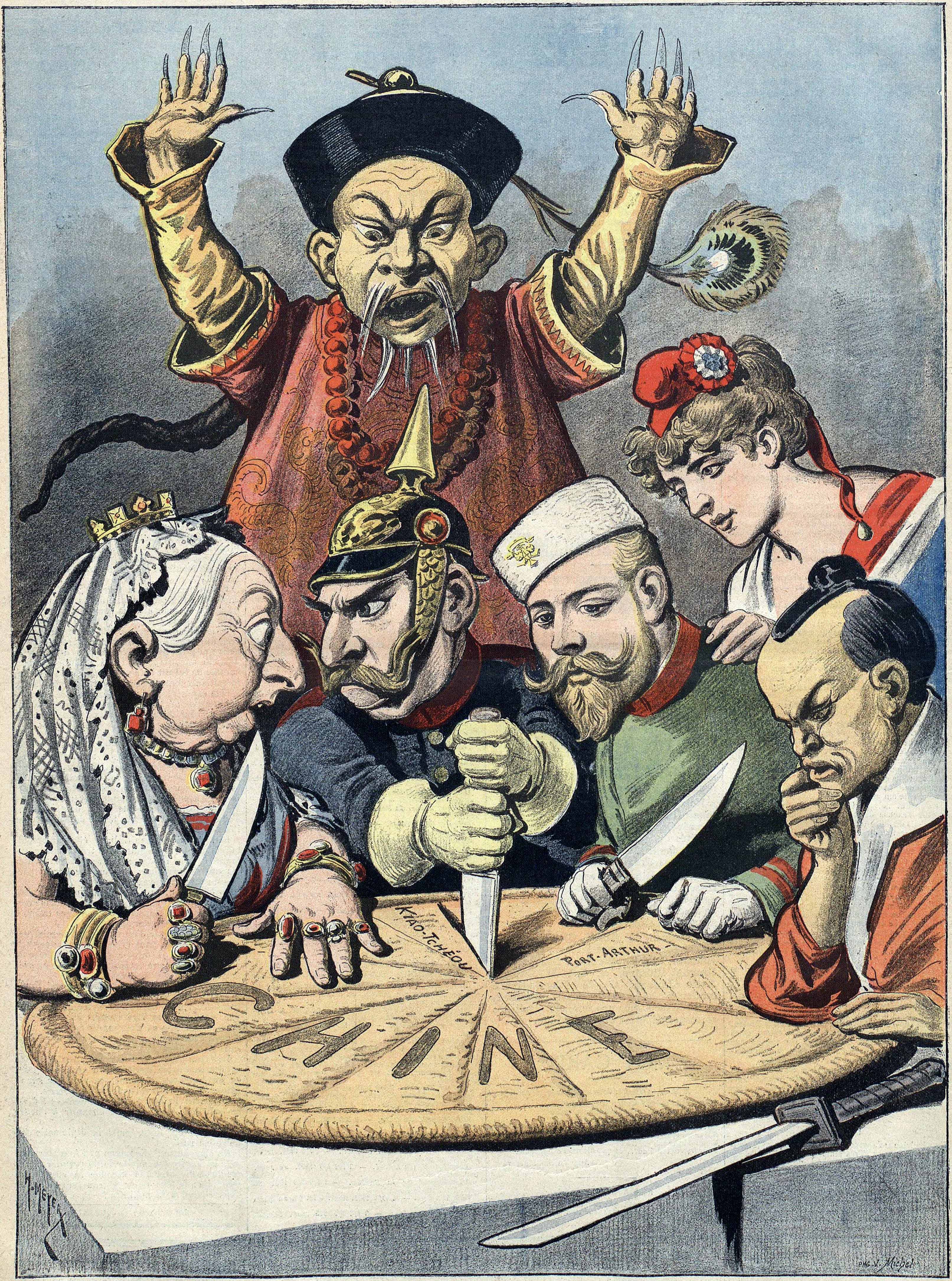
Carving Up China_imperialism


The annexation of the Crimean peninsula by Russia in 2014 is seen as a trigger of the crisis and Russia is described as an aggressor. But Crimea was always Russian territory and it was given to Ukraine to manage back in 1954. What if Spain wanted Puerto Rico back? It is not part of the United States.


Risk


The predominant language in Crimea was Russian – not Ukrainian. Ukraine should have been split along the line of language and instead of funding military forces, offered the people to buy their property on either side who desired to move to the West or East. Instead, we have a cold war simply over territory and the people have no say. Politicians still act as if they are playing the board game RISK, but for real. This has always been about territory as if we are still living the dreams of Napoleon, Hitler, Genghis Khan, or Alexander the Great. There are people who live in these regions who are oblivious to the games politicians play. All wars are begun by politicians, ministers, or kings.


Carving up world


Politicians have been carving up the world for a very long time. People mean nothing. They carved up the Ottoman Empire and created the chaos of the Middle East. This is what Trump has been against – nation building. The so called “progressives” who protest against Trump would have been in the front lines of war under Hillary, who was simply keeping the game going. How many lives has it cost when politicians are so concerned over territory rather than the people living in such territories?


From 2004 onwards, NATO has sought to expand its sphere of influence beyond the bounds of peace and go right at the throat of Russia inviting World War III so they get to play with their toys. These activities were first conducted in Georgia. The President at that time was Mikhail Saakashvili from 2004 to 2013. He promoted an active pro-Western policy and was welcomed as a friend and partner of the West. At first, it was supposed to be about democracy, something the EU itself rejected in its new structure with all the power-players being UNELECTED officials, and economic cooperation with the EU and the USA. It did not take long to create the impression in Georgia that NATO would also help the country in an engagement with Russia. Then in the summer of 2008, the conflict escalated. Russia invaded Georgia and occupied the provinces of Abkhazia and Ossetia. These were dominated by Russians originally. Most people have no idea but Joseph Stalin was from Georgia.


NATO did not come to the aid of Georgia. There were no sanctions imposed for occupying Georgia as there were for the occupation of the Crimea. Why? What was the difference when Georgia was actually being solicited by the West and Crimea was not? Was it simply that Crimea was an important military base for Russia all along? It appears that the world politicians sitting at the table playing the game RISK were really just trying to end Russia’s port in the Black Sea and isolate it. That is certainly something the USA would have done in a second if the roles were reversed. The sanctions imposed against Russia were not to really protect Ukraine, but because the West was trying to take away Russia’s access to the Black Sea.


Economic cooperation with the West was accepted by Moscow under Reagan. The cold war had ended. Ronald Reagan worked hard to bring down the Berlin Wall. Why did Obama work so hard to reestablish the cold war? NATO has clearly raised hopes in Eastern Europe as they did in Georgia. Indeed, the Ukrainian crisis is in many ways a continuation of the events in Georgia. Since the “Orange Revolution” in 2004, Ukraine was seen as a knife to poke in the ribs of Russia. The pretend President Viktor Yanukovych was pro-Russia because he came from the East and spoke Russian. He could not even speak proper Ukrainian. But he and his sons sought to rule Ukraine like a Russian oligarch. Businesses had to pay protection money to even survive. The Ukrainian Revolution was real. The West’s politicians moved in to try to seize control of the new government, but the uprising was against corruption as we now see in Romania.


In November 2013, Yanukovych put a “freeze” on negotiations with the EU. As a result, the people began to rise up. The police were ruthless exploiting the people and were not there to protect the people from the State. Revolution began and since June 2014, Ukraine has sought a pro-Western course reaching treaties with the EU and with NATO. Indeed, once again, NATO gave the impression to Ukraine that it would implicitly defend it but Ukraine has not formally become a member of NATO.


The EU is no longer an economic community, but a political union that is closely linked to NATO. Most have overlooked the  Treaty of Lisbon (initially known as the Reform Treaty) which was an international agreement that amended the two previous treaties thereby creating the federalized constitutional basis of the European Union (EU) without ever putting that to a vote. The Treaty of Lisbon was signed by the EU member states on December 13th, 2007, and went into force on December 1st, 2009. This treaty has decisively altered the very core foundation of the EU transforming from 2009 onwards. This fact is always overlooked in the EU because few have read the text of the Treaty of Lisbon. Ever since, there have been closer ties between the EU which is now linked to NATO, which is why Trump says the USA should exit NATO and Le Pen is arguing the same in France. Additionally, Ukraine was given direct contracts with the EU with regard to a military alliance. This is a “soft” membership in NATO addition Ukraine but not really.


There is no way the US would give up its pacific military basis in Japan at Okinawa. Yet we impose sanction upon Russia for annexing its original territory pre-Ukraine where it maintain its Black Sea Fleet is stationed in the Crimea. The sanctions imposed upon Russia for Crimea are very hypocritical. From Russia’s perspective, the alternative would have been that Moscow’s Black Sea Fleet would be docked in a NATO country. That would present a circumstance that was totally unacceptable leaving the annexation of the Crimea a logical and obvious reaction that the USA would have done if the roles were reversed.


Ukrainian eastern region of the country remains a strategic concern. The IMF (International Monetary Fund) was willing to provide loans to Ukraine but demanding they engage Russia in the East. This demonstrated that the IMF was playing military politics – not economic. The fact that in the Eastern Ukraine is composed of Russian-speaking people, gives Moscow justification to protect its ethic citizens. This is why Ukraine should have simple been divided along the ethic lines and stop trying to poke Russia for the sake of military ambitions as was the case with Vietnam against China.


Ukraine assumes that NATO will intervene. This has not happened so far, but the danger remains that Russia could be forced into an invasion as was the case in Ukraine especially if the EU begins to break apart. Likewise, the border of Belarus against Russia also presents a potential power keg. Belarus is also now in conflict with Moscow. As in the case of Ukraine, Minsk and Moscow are also arguing about gas prices, oil supplies and disabilities in foreign trade. Additionally, Moscow imposed border controls, whereby a two-country agreement on open borders existed for twenty years. Belarus imposed a 5-day visas for citizens of 79 states, including all EU states and the US. This measure is seen in Moscow as the approach of Belarus to the West. Belarus has been courting the West with trade playing both sides of the world Russia v West.


Moreover, Belarus is now also breaking up, where border controls are apparently being carried out by Russia. We are witnessing the fragmentation of countries and governments all due to failing economic systems. We are looking at the Baltic countries opposing Russia. Estonia, Latvia and Lithuania are all full members of the EU and NATO. So where exactly does NATO end and Russian influence begins? This is becoming a very dangerous and grey area.


Cold-War


The new US Secretary of State Rex Tillerson may help and he was a wise choice on the part of Trump. NATO is the focus of attention right now. The military alliance is dominated by Washington yet this is actually contradictory to the Treaty of Lisbon. Donald Trump has questioned NATO as a whole, and the press do not fully explain what has evolved. Is the USA just paying the military bill for the EU yet the Treaty of Lisbon makes the NATO the national force of the EU?


The new US Secretary of State Rex Tillerson expressed it best: “Russia is dangerous, but predictable”. Tillerson does know Russia well and far better than any politician filling that role before. Tillerson could actually establish a dialogue with Russia to secure world peace. The machinations of Obama have merely ended dialogue and reestablished the cold war that took more than 30 years to thaw. Democrats are too preoccupied with trying to stop Trump and fueling protests to distract the press and the American people from the real risk of war the Obama administration has created.