Showing posts with label Currency symbols. Show all posts

Monday, December 18, 2017

FX Weekly Preview: Dollar Squeeze A Growing Concern, But Longer Term Bears Likely To Temper It

Submitted by Shant Movsesian and Rajan Dhall MSTA

from fxdailyterminal.com


Over the past week, the argument that the tax reform aimed at corporates specifically could prompt a period of USD repatriation - much like an amnesty - has been growing in sentiment, and whether one believes in this, remains an upside risk we shouldn"t ignore.  Since the Fed"s much anticipated rate hike, we have seen a moderate hit on the USD reversed in full, but put in perspective, the overall ranges traded so far have been modest to say the least.  We also shouldn"t ignore the time of year, where liquidity is not at its best, though has been enough to send the major indices on Wall Street to new record highs.  There was a time this would have sent USD/JPY soaring, but it hasn"t, but times have changed and most of us can see that global growth reflected in the stock markets is a far cry from that seen through wage growth and inflation. 


There has also been some focus on cross currency basis, turning negative to further signal year end USD demand and into early 2018, which can be tied-in in part to the repatriation story above.  Some will attribute it to regulatory pressures in Europe (derivatives market) as well as Japan, and although immeasurable for the most part, is a risk worth noting given our focus for the week ahead. 


As such, we look for concurrent moves in EUR/USD and USD/JPY, with a move in the former through 1.1700 likely to correspond with a USD/JPY push for 113.50-114.00 again.  Once again, in light of the illiquid period ahead, these are merely risks we are highlighting, and given where the respective spot rates ended up on Friday night, it is noteworthy risk at this stage. 


Through 1.1700, EUR/USD will test the band of support seen in the 1.1650-1.1550 area, where the longer term interest based on the Euro zone recovery continues to carry favour.   Based on the rising PMIs in Germany and other leading states, notably France, few can argue that there is momentum here, but this is largely priced in for now as we can see in some of the relative performance in the cross rates.  Even a supported EUR/CHF rate is struggling at 1.1700. 


In the final week into Christmas, we should see the EU wide inflation reading for Nov confirmed at 1.5% while the German IFO survey will likely continue with a healthy business climate.  Italian industrial production and orders later in the week will give us some insight into whether the rest of Europe is keeping up pace, but all of the above - as we have already alluded to - will do little to materially better the EUR position for now.


USD/JPY in the meantime survived the short lived post FOMC sell off, in a move which was seemingly pre-empted as "dovish hike fade", but that lasted for all of a day at best.  We held 112.00 on the downside, with 111.50-60 the strong base lower down, and despite the longer term bias for USD weakness and a return through 110.00 at some stage, the consolidation phase looks set to continue with 114.00-115.00 yet to be retested in any substantial way. 


The BoJ meeting towards the end of the week will again maintain current policy stance aimed at getting inflation back to 2.0% target, so the only interesting potential is of any dissenters to the persistent asset purchasing and an eventual unwind.  Domestic data is improving, albeit slowly, but the central bank have their mandate - the markets have their own take, and it is one which looks likely to test the BoJ"s tolerance for JPY strength at some point down the line.  When rather than if!


In the UK, GBP looks capped now that the EU-UK passage to the round of talks on trade have been secured.  Once again, the agreements made to facilitate this are nothing more than a "statement of intent" - as David Davis put it - so we are now at the crux of the negotiation, and this should start to weigh on some of the (blind) optimism which has driven GBP to better levels across the board.  To temper this, we are not advocating a return to the doom and gloom scenario, rather some moderation which would put Cable back to levels closer to 1.3000-1.3100 rather than creating a platform for a move through 1.3500-1.3600 for 1.4000 as some have suggested.  It is all sentiment here for now.


EUR/GBP has found good support in the mid 0.8700"s, but we also see limited scope for an aggressive push through 0.9000 unless Brexit cordiality breaks down completely.  On the UK economy, notable was the lack of positive response to the bumper spending results seen for Nov.  Naturally there will be a discounting factor in pre Xmas buying incorporating the Back Friday sales, and next year"s numbers will make for a far better reading on consumer appetite and more importantly disposable income.  The final Q3 GDP print is the only notable data point next week including business investment numbers. 


We also saw some reprieve for the AUD and NZD last week, with both consistently getting hammered into their recent lows with very little breathing space.  NZD had recovered first, again, largely down to over-exhaustion and traders throwing the towel in, so suggestions that the market have eased up on their bearish sentiment on the new coalition government look a little premature, not to say "convenient" at this stage.   This is not to say that the recovery does not have a little more to run, and could be generated through the EUR and GBP crosses, with over-extensions here - much in the same way as we have seen in EUR/AUD and GBP/AUD - redressed into year end at least. 


Lots of data in NZ next week, with more business confidence surveys (ANZ), current account and trade all leading up to Friday"s Q3 GDP number. 


Little in the way of stats to consider in Australia, so markets will focus on the RBA minutes and what the central bank take is on the economy.  With bearish sentiment emanating on low wage growth, low inflation and high household debt, the AUD got a welcome boost from a 60k+ rise in jobs, which keeps hopes alive for the Phillips Curve kicking in.  Little evidence of that in the US, but hope is hope and the AUD has weakened enough for now, with 0.7500 proving a strong base.  AUD/NZD is now the one to watch, where we took out pre 1.0900 demand, but the late Sep lows ahead of 1.0800 remain intact as yet.


CAD traders have some hard data to feed on rather than hang on every speech and reported rhetoric from the BoC.  Accused of a hard turnaround from the post rate hike hawkishness, the market was once again wrong-footed on governor Poloz"s statements this week, who stated that he saw the need for less stimulus going forward.  The CAD push up was brief however, and found fresh buyers looking for an eventual push through 1.2900 based on the retrenchment in CAD rates.  The jobs report for Nov was strong however, and if CPI, retail sales and ultimately GBP can can improve on the moderate expectations (0.2% growth seen for Oct), then perhaps USD/CAD can survive a push on the heavily offered 1.2900-1.3000 area.  Fear of long(s) liquidation by some banks suggest this could facilitate a move through the above mentioned area, but this assumes intent, which again, is immeasurable.  We could also say this about strong positioning in the market for (long) EUR"s!


Friday, December 1, 2017

Yes, Cash Is An Asset Class Again!

Authored by Steven Vannelli via Knowledge Leaders Capital blog,


In a US Dollar bull market with interest rates at zero, cash is rightfully dismissed as a non-asset class. But, when the US Dollar is in a bear cycle, things change, irrespective of what US interest rates are.


There are a handful of indicators we use to identify US Dollar bull and bear cycles.


One indicator - the Laubauch-Williams (LW) Real Neutral Rate - has gained traction with the Fed and is often referred to as r-star. It is a measure of the real (after inflation) neutral interest rate that the US economy can handle without stimulating or restraining the economy. Over time, the LW Real Neutral Rate is one of the better signals for the US Dollar.


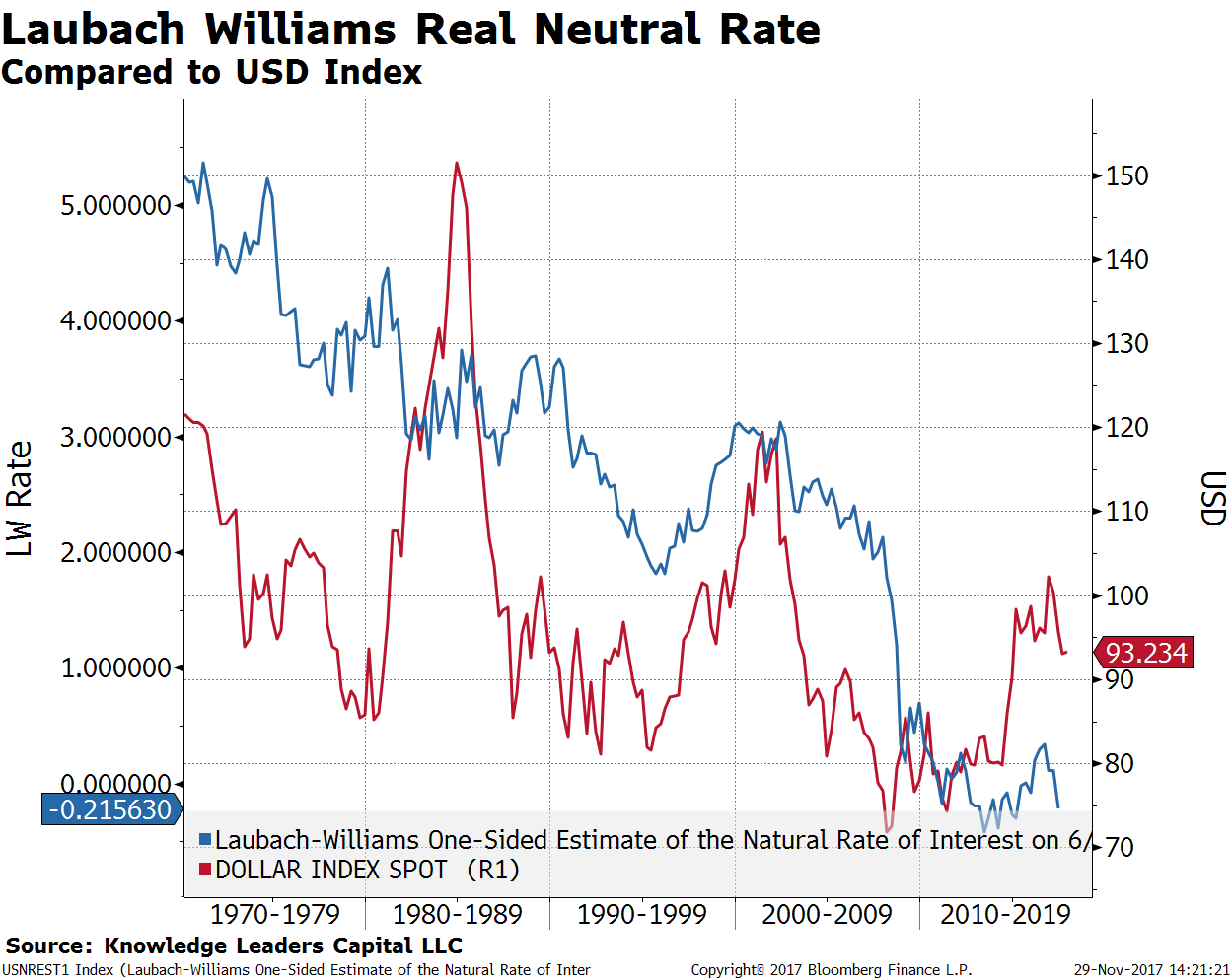
Every US Dollar bull market since 1970 has been marked by an increasing LW rate. In the chart below, I plot the LW Real Neutral Rate (blue line, left axis) against the US Dollar Index (red line, right axis). In the early 1980s the US Dollar bull market occurred with the LW rate rising from about 3% to about 4%. Similarly, the US Dollar bull run of the late 1990s occurred with the LW rate rising from just over 2% to just over 3%. The most recent US Dollar bull market has been no exception. While admittedly harder to see because the numbers are so small, the most recent US Dollar bull occurred with the LW rate rising from around -.5% to about +.3%.


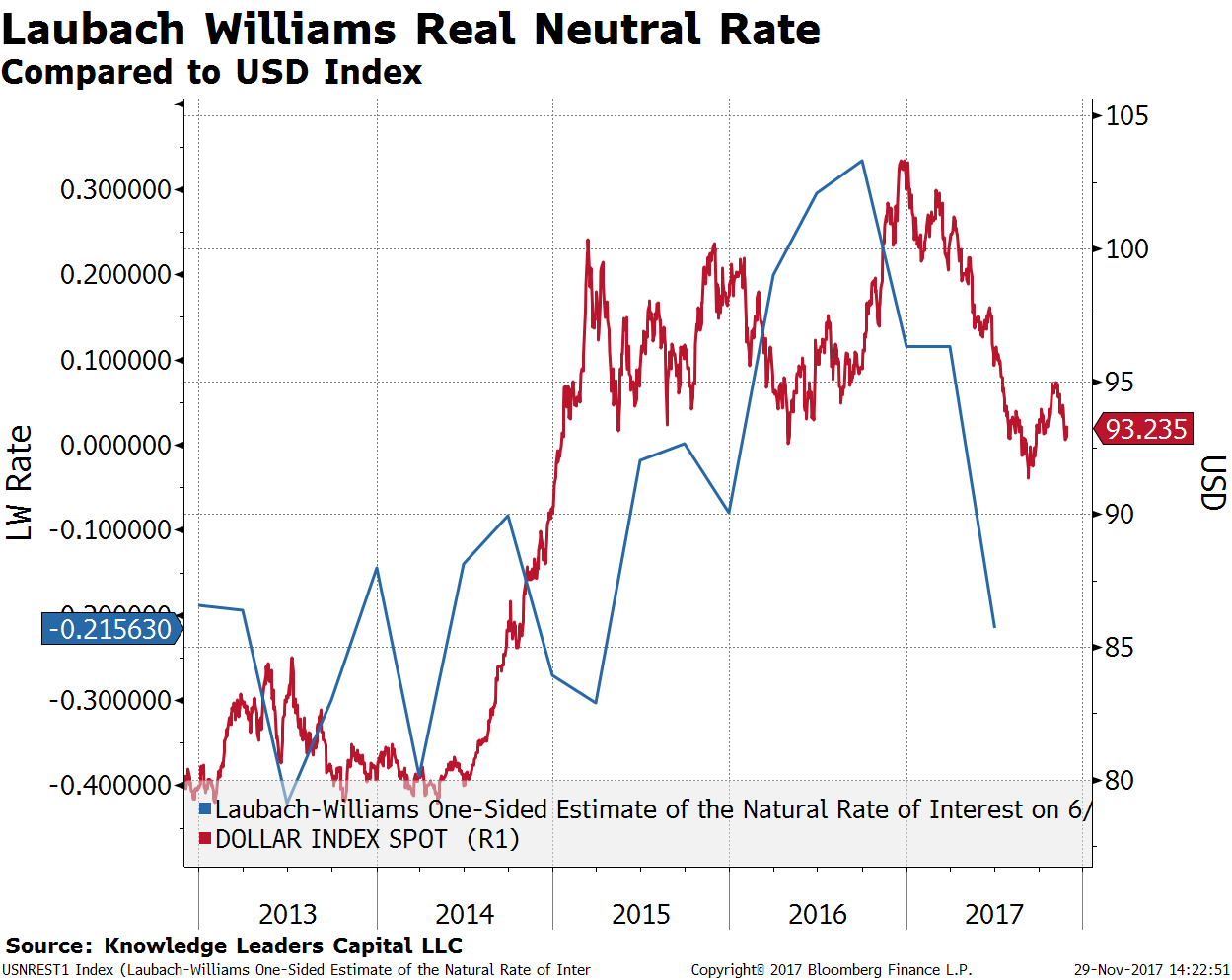
This relationship suggests the US Dollar bull run has come to a conclusion as the LW Real Neutral Rate has rolled over again. In the chart below, I focus on the last five years. Notice the US Dollar following the trend in the LW rate. The pop in the LW rate in the first quarter of 2014 led the 25% gain of the US Dollar from mid-2014 through early 2017. Notice also that the LW rate peaked in mid-2016, having fallen back by about 50bps in the last few quarters, leading the peak and decline in the US Dollar.


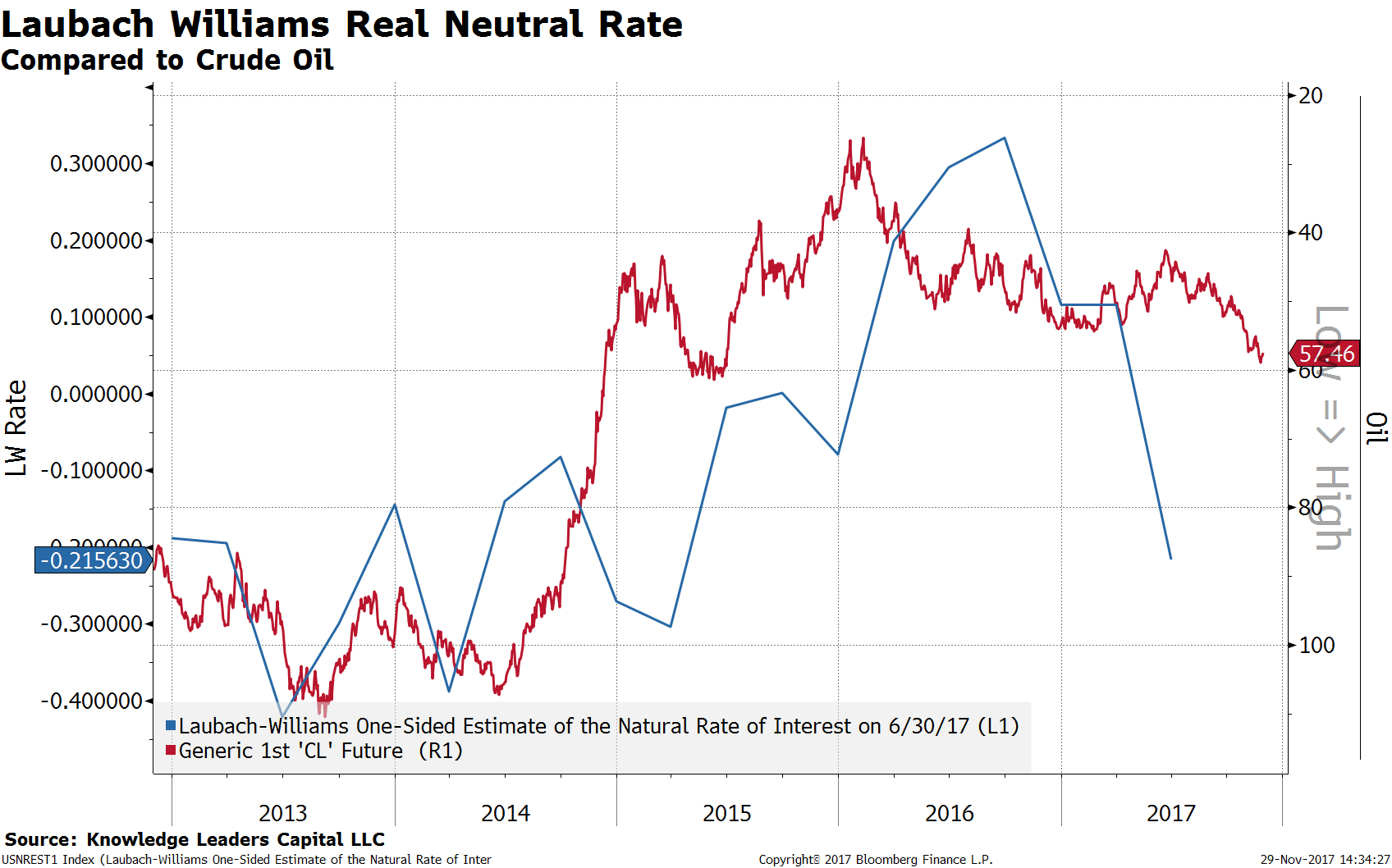
The fact that the LW rate has declined for three quarters in a row suggests this isn’t a temporary fluke. It is likely driven by the slow turnaround in oil prices. In the chart below, I plot the LW rate against oil prices. Simply, falling oil prices (red line, right scale, inverted) pull the LW rate (blue line, left axis) up. And, the reverse is true also that rising oil prices dampen the LW rate.


So, if we are now in a US Dollar bear market, driven by, among other factors, a falling LW rate and rising commodity prices, the good news is that cash is an asset class again.


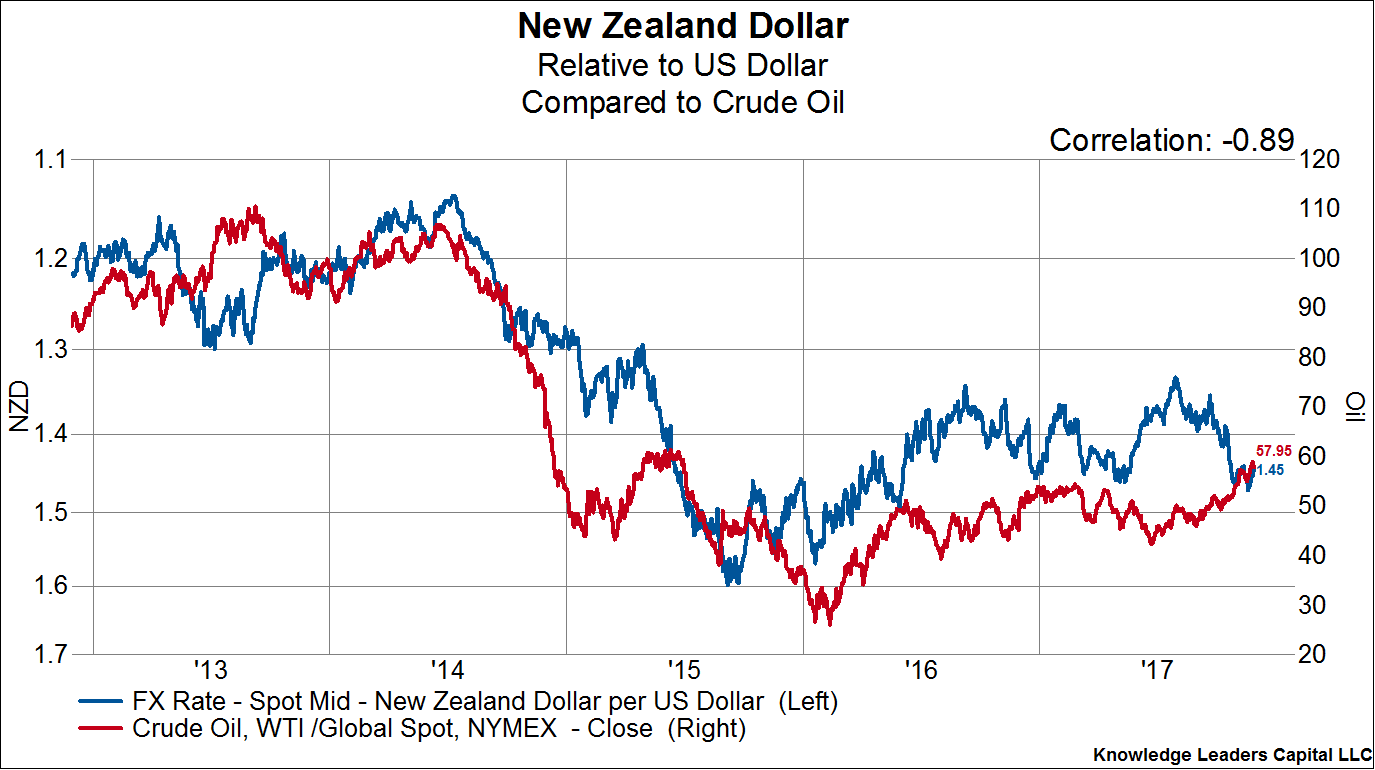
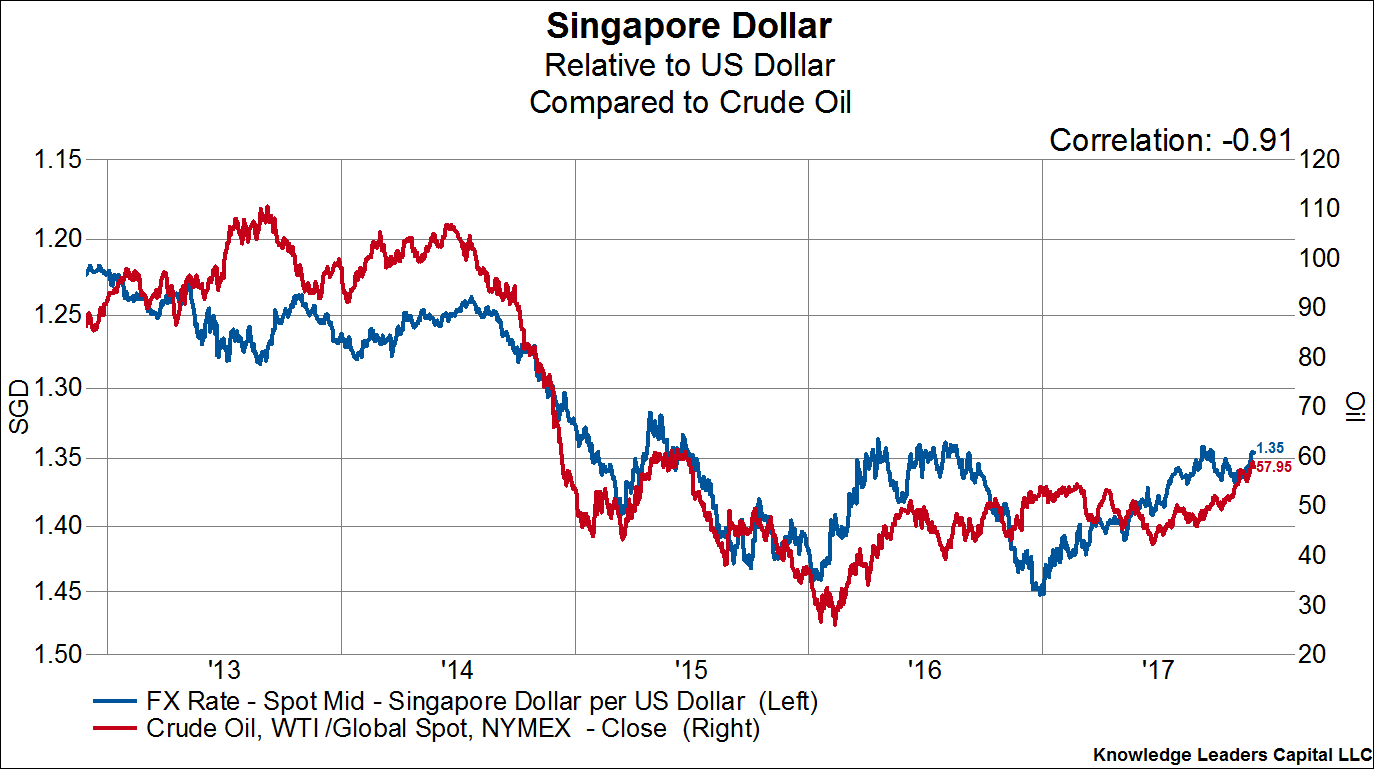
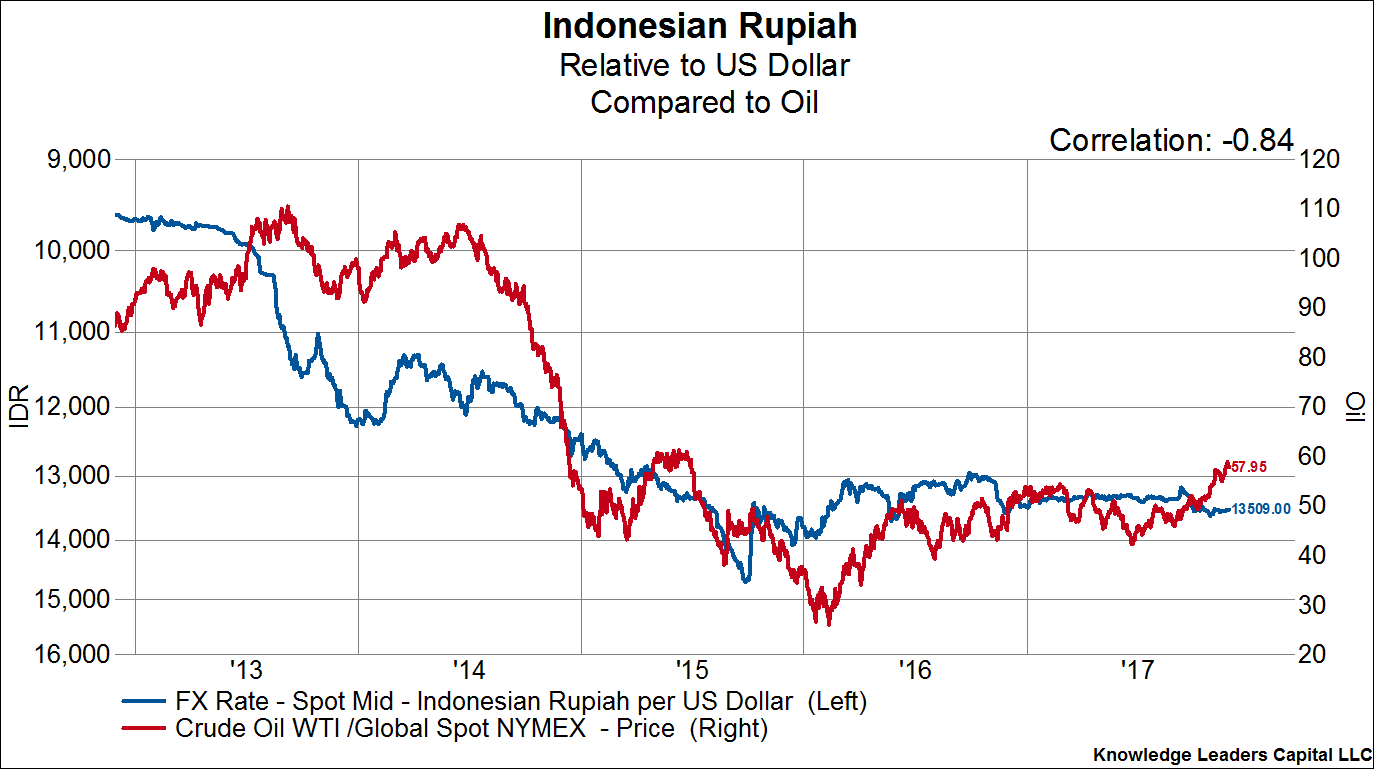
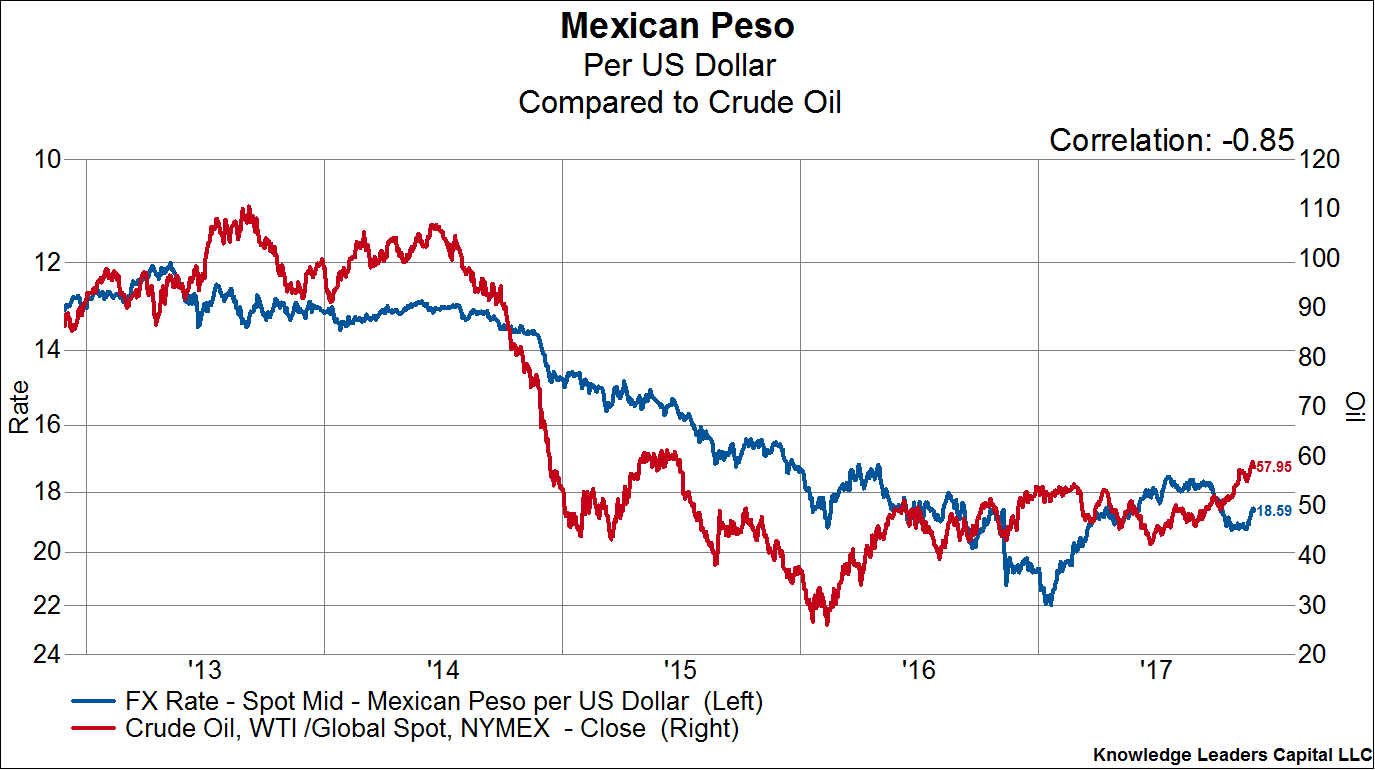
Which currencies should investors focus on? An easy place to start are those currencies with the tightest linkages to oil prices.


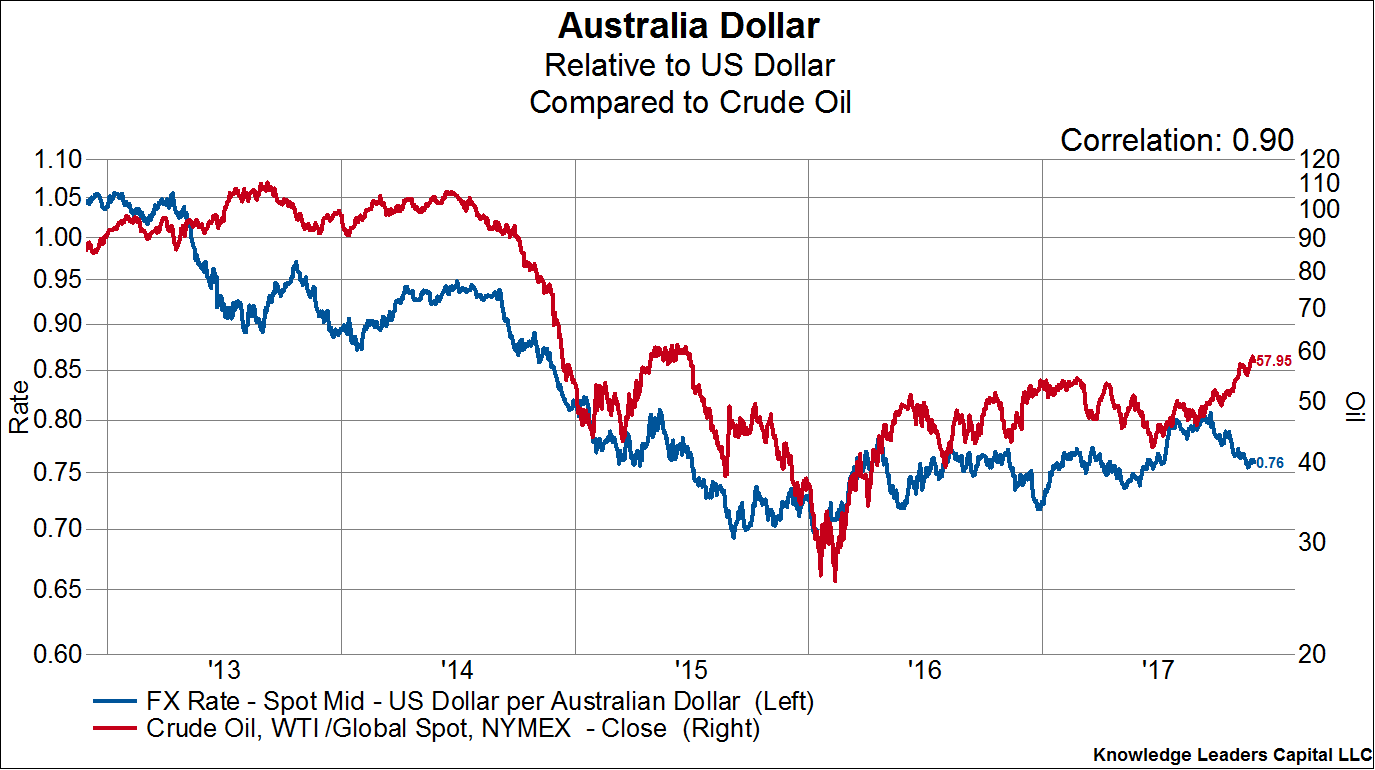
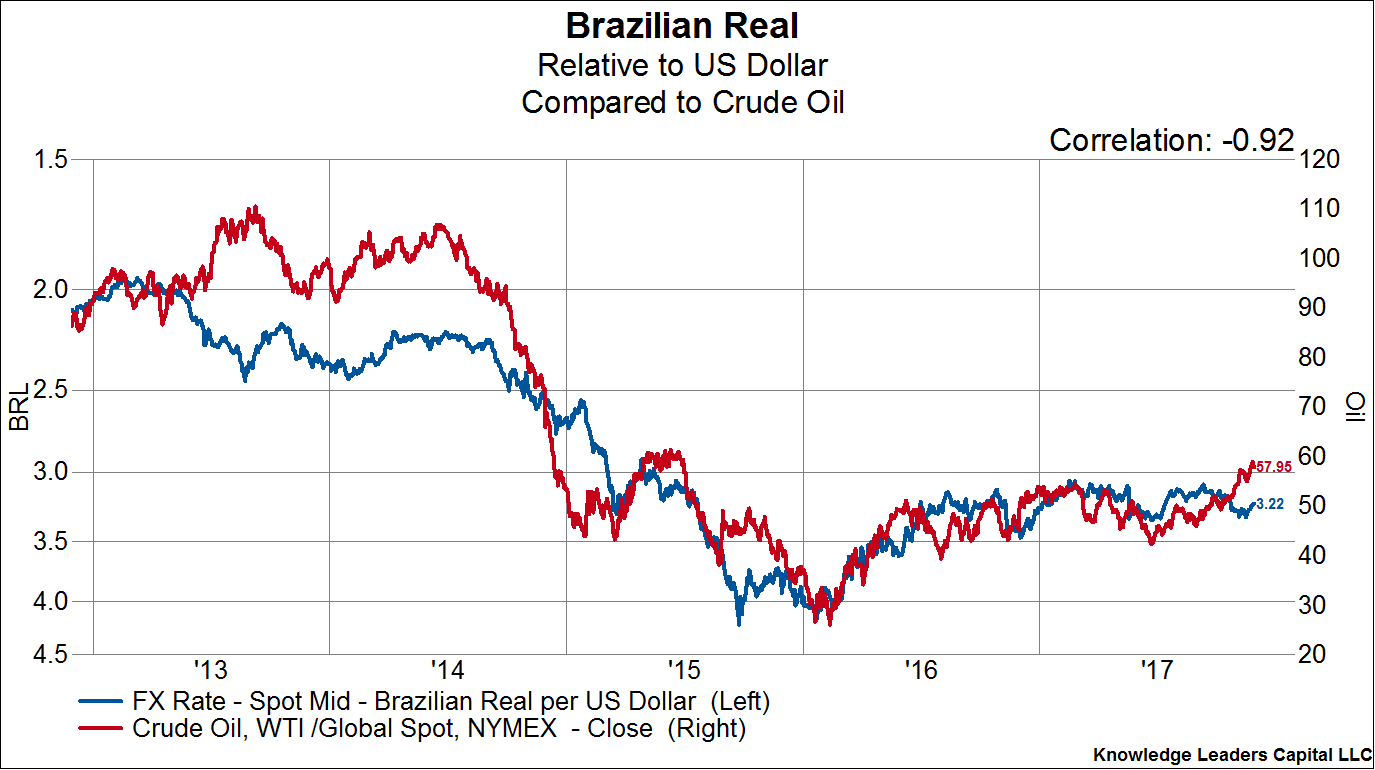
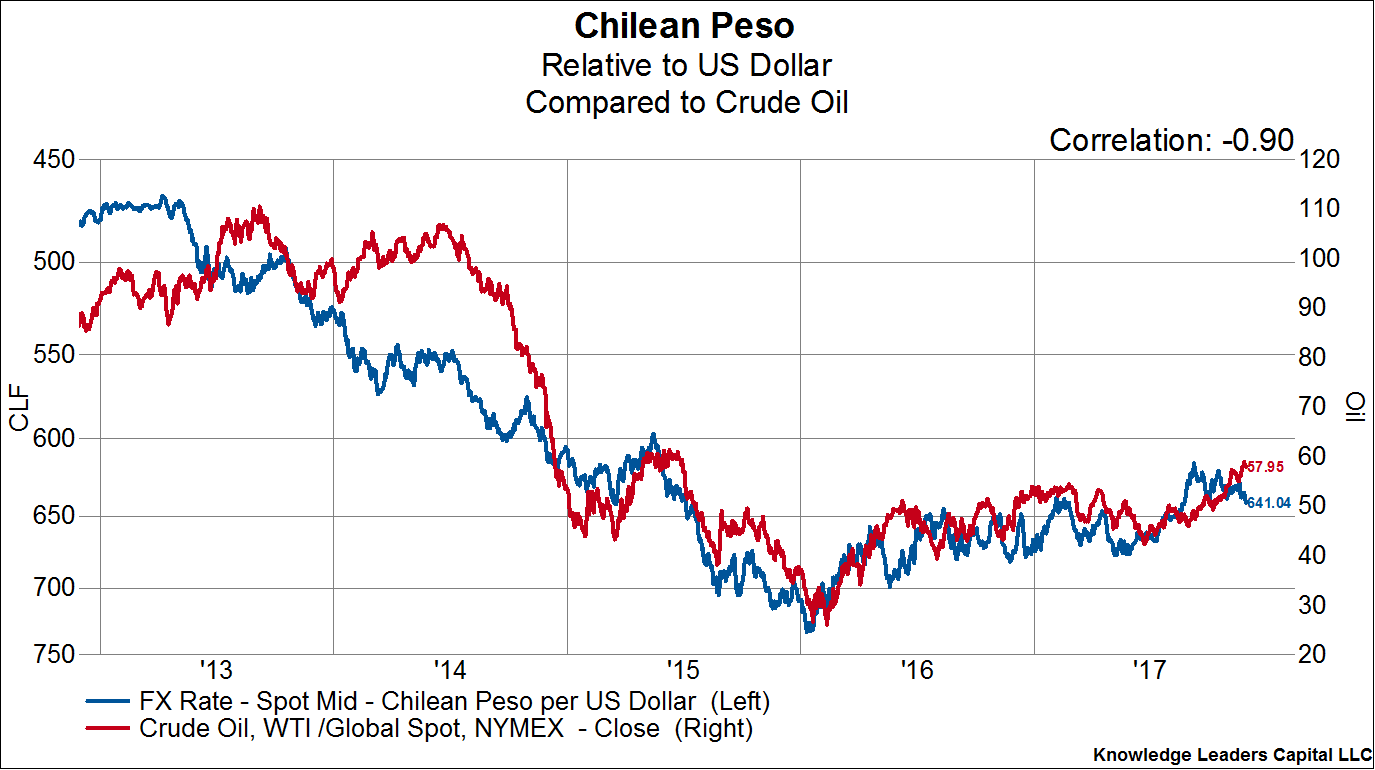
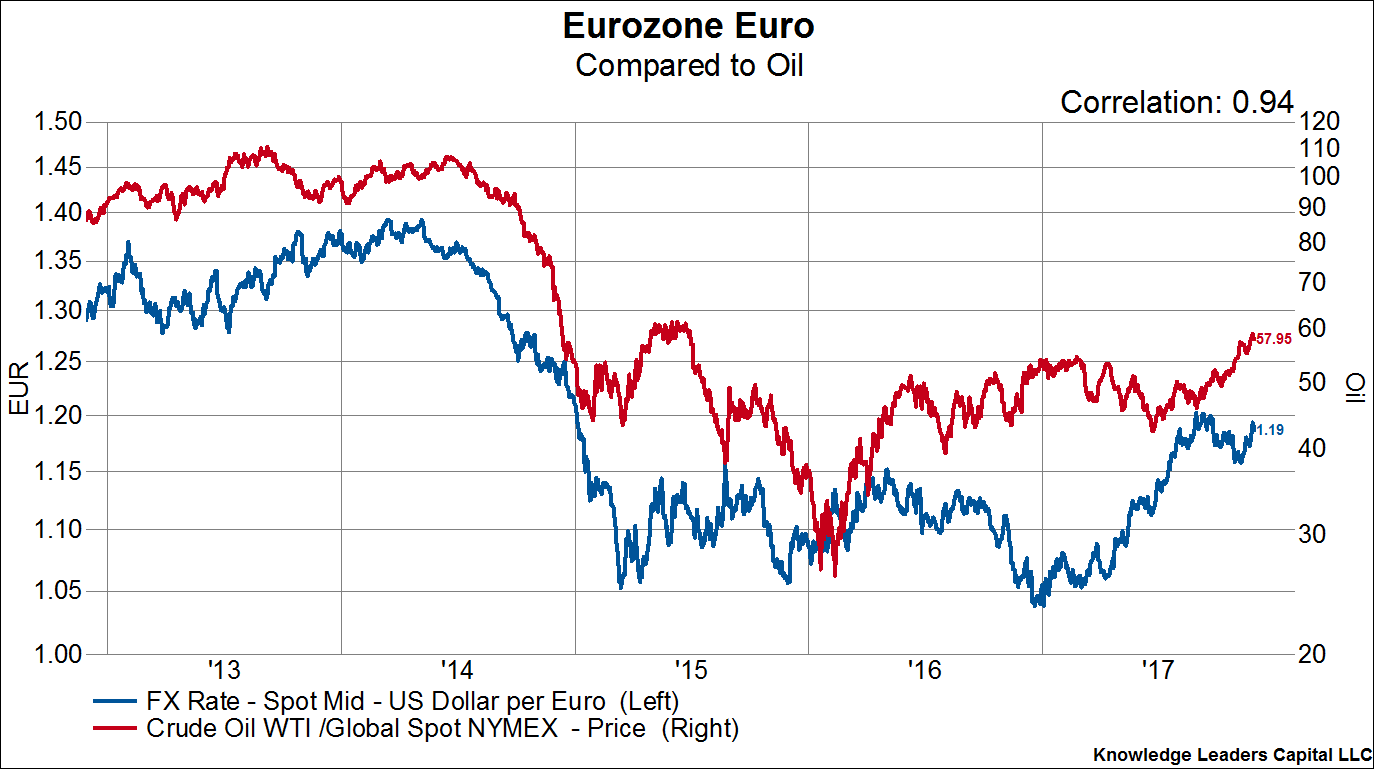
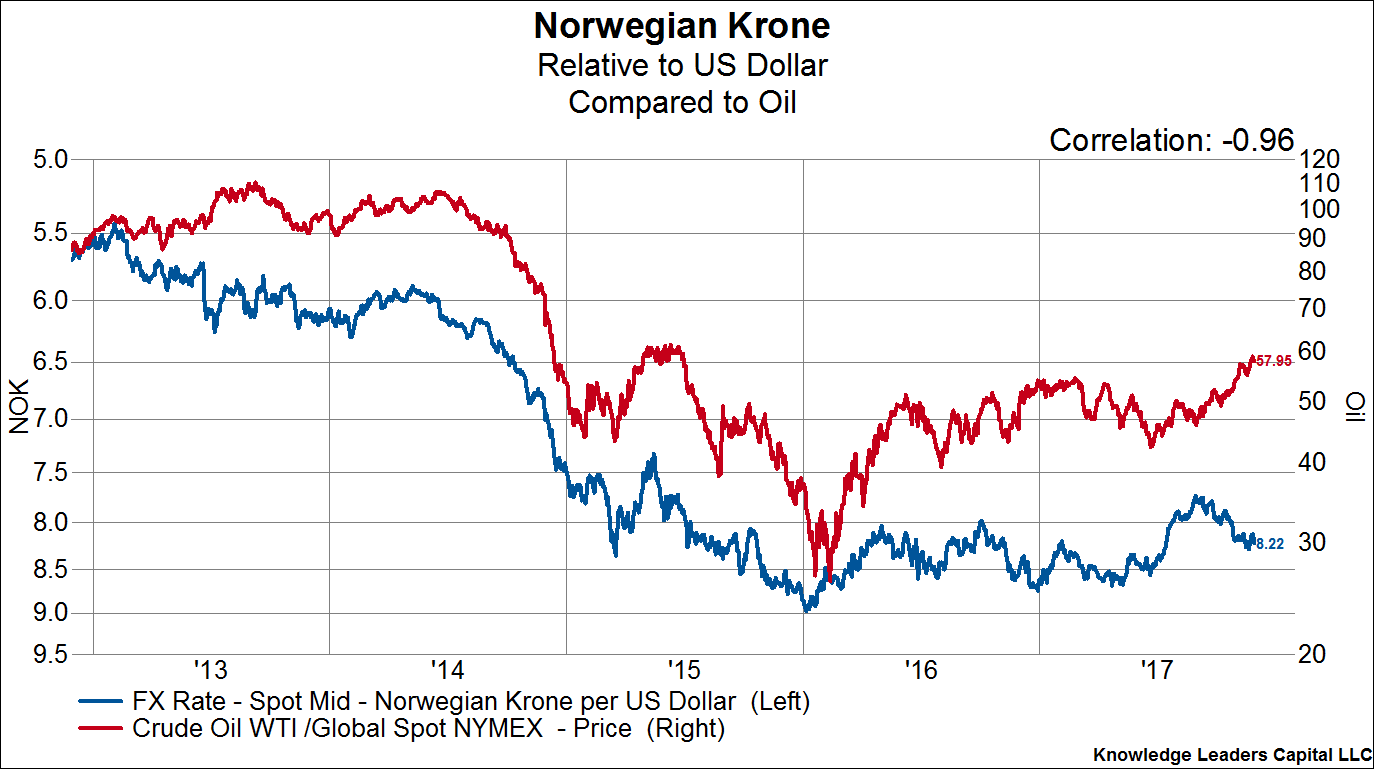
Let’s start in Asia. Among interesting developed market options for a cash allocation are the Australia Dollar, Singapore Dollar and New Zealand Dollar. In each chart below, I plot the US Dollar FX rate against oil prices, with the correlation shown in the upper right corner.


Among emerging market currencies in Asia, the most interesting are the Indonesian Rupiah and Thai Baht.


Moving to the Americas, the Canadian Dollar, Mexican Peso, Brazilian Real and Chilean Peso all look interesting.


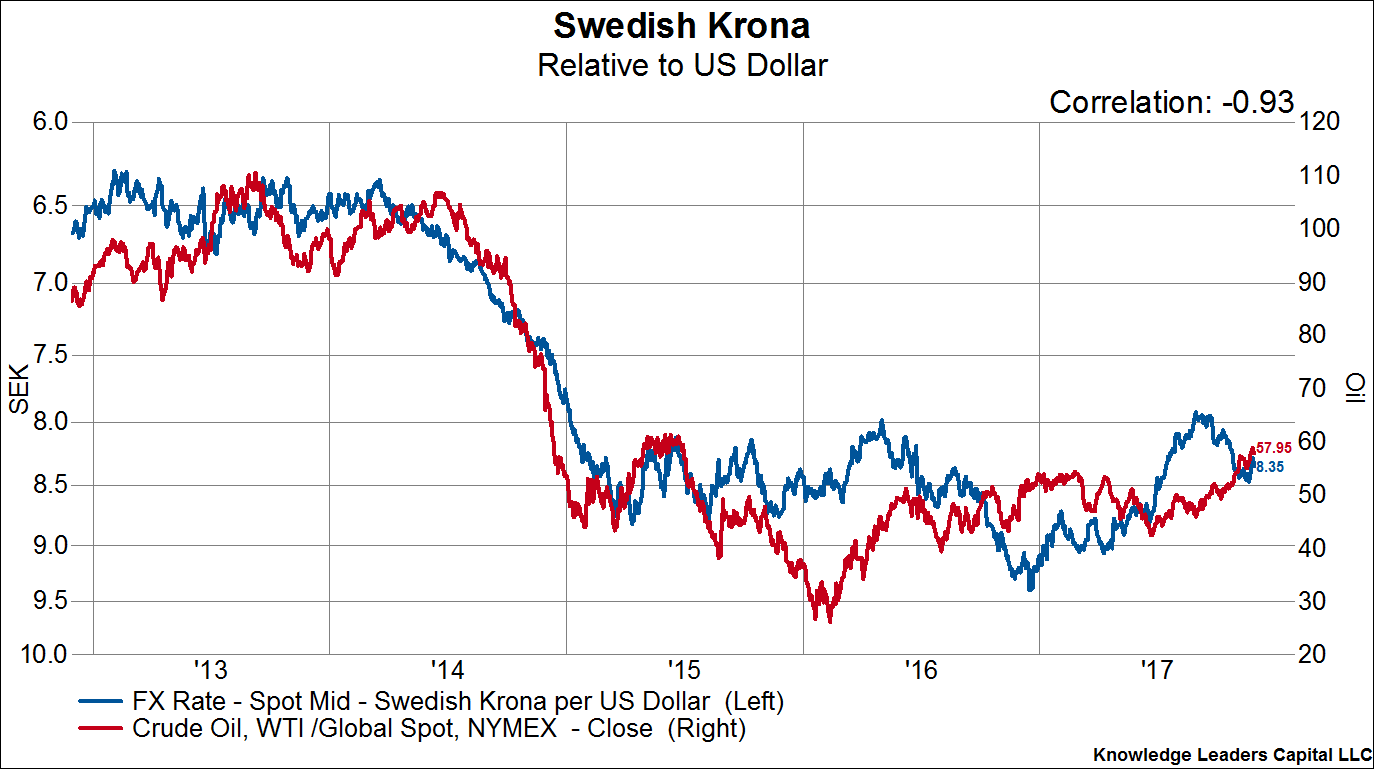
Moving on to Europe, the most interesting currencies are Euro, Norwegian Krone and Swedish Krona.


While there are many asset allocation decisions that hinge on whether the US Dollar is in a bull or bear market cycle, one of the easier is currency allocation. An investor following an Anything but US Dollars policy has the chance to capitalize on the new US Dollar bear market. Cash is now an asset class again, and this creates new possibilities for alpha generation and risk management.


Monday, January 23, 2017

Trump Warns "We Are Going To Be Imposing A Very Major Border Tax", Will "Cut Regulations By 75%"

One look at the Dollar Index in the last week and it"s clear just how "variable" President Trump"s position has been on trade and so-called "border adjustments". In the space of a few days, he has swung from being against a border adjustment, to possibly being for it, and now today confirming that "we are going to impose a major border tax."  Yen, Peso, and Loonie are all sliding further on the headline.


Specifically, as the clips below show, Trump promised business leaders a "very major" border tax and said he would cut regulations by 75%. Trump held a breakfast meeting with the business leaders he named to an advisory panel on manufacturing, led by Andrew Liveris, chief executive officer of Dow Chemical Co. Other business leaders at the morning meeting with Trump included Michael Dell, chairman and CEO of Dell Inc.; Jeff Fettig, chairman and CEO of Whirlpool Corp.; Mark Fields, president and CEO of Ford Motor Co.; and Marillyn Hewson,chairman and CEO of Lockheed Martin Corp.


Some highlights:


  • “We’re trying to get it down to anywhere from 15 to 20 percent, and it’s now 35 percent, but it’s probably more 38 percent than it is 35”

  • “What we want to do is bring manufacturing back... It’s what the people wanted”

  • “What we want is fair trade”

  • “That doesn’t mean we don’t trade because we do trade”

  • “If you go to another country” and cut thousands of jobs, “we are going to be imposing a very major border tax” on the product the comes in

  • “You are great people,” Trump tells CEOs

  • “I’m a very big person when it comes to the environment,” Trump says

  • “But some of that stuff makes it impossible to get anything built”

Later in the day, Trump will meet with a group of labor leaders and U.S. workers, according to his public schedule. In between, he’ll sign executive orders related to trade and labor issues, an administration official said. The official didn’t provide further detail on the orders.


And the instant reaction is a jolt higher in the dollar.


While Yen knee-jerked lower on his statement, it is still the Peso and the Loonie that are hardest hit so far.


Friday, December 30, 2016

Markets In 2016: Winners & Losers

As 2016 comes to a close, Reuters has compiled a list of the biggest winners and losers of the year from across the globe.  Of course, after global equities started out the year on a weak note, in the closing weeks of 2016 computer algos investing professionals have rarely seen a stock they didn"t want to buy more of.  That said, currency traders with exposure to the Egyptian pound or Nigerian naira didn"t make out quite so well.  And then there were the Dr. Jekyll and Mr. Hyde trades of 2016 that, after gyrating wildly throughout the year and giving a bunch of high-strung traders heart attacks, ended up the year, righly or wrongly, roughly where they started.


First, the WINNERS:


Glencore:  After losing 70% of it value in 2015, the outlook for Glencore at the start of this year couldn"t have been bleaker.  But those who had the intestinal fortitude to invest in the beginning of 2016 were handsomely rewarded for their efforts.  After initially shedding another 20% of it"s value in January 2016, Glencore bottomed-out along with oil and, after a successful $8 billion debt refinancing, rallied more than 200% this year, with a trough-to-peak rise closer to 300%.


Anglo American:  After posting a 2015 similar to Glencore (down ~80%), Anglo American , the world"s fifth-largest diversified mining company, took drastic action in the new year as the commodity rout deepened. In February, the company announced it would retain only 16 of its 45 core assets (dumping its coal, nickel and iron ore businesses, among others) and shed around 60% of its 128,000-strong workforce.  Those who lived through the restructuring efforts enjoyed a 290% rise in 2016, and a trough-to-peak rise closer to 500%.


Mining


Bitcoin:  The digital cryptocurrency is closing the year at a three-year peak. It has more than doubled in 2016, and the total value of all bitcoins in circulation is now at record high above $15 billion.  Of course, the exponential growth of Bitcoin in 2016 coincides with the steady depreciation of the Chinese yuan (the majority of bitcoin trading is done in China), the abolition of high-value banknotes in India and continued growing demand to move money across the globe quickly and anonymously.


Bitcoin


Tencent:  Finally, the winners list was capped off with Tencent Holding Ltd, China"s largest social network and online entertainment firm.  With a market cap of $225 billion, Tencent is the most valuable emerging market company in the world and its shares were up 20% in 2016, far outperforming the broader Hang Seng index, which is down 0.7%.


China Tech


Now for the LOSERS:


Egyptian Pound:  Egypt floated its currency in November in a move widely seen as a necessary step to help secure a $12 billion IMF loan. The initial devaluation from its peg of 8.8 per dollar was by around a third. But as 2017 draws closer, the currency is trading at more than 19 per dollar, and has lost around 60% of its value this year. It is the worst performing currency in the world in 2016.


Nigerian Naira:  Nigeria"s naira initially slumped by around 30% when the central bank removed its peg of 197 per dollar back in June. This was the central bank"s attempt to alleviate a chronic foreign currency shortage that was choking growth in Africa"s biggest economy. But the Naira soon fell through 300 per dollar, and its 37% fall since Dec. 31, 2015 makes it the second-worst performing currency of the year.


Egyptian Pound


India Inc.:  Foreign investors" enthusiasm for Indian stocks and bonds dimmed in 2016. Net selling of stocks hit $2.6 billion in November, the heaviest outflow in eight years, as investors took fright at rising U.S. bond yields and what a Donald Trump administration could mean for emerging markets. The government"s recent move to ban the two most popular banknotes in circulation has raised concern over the potential impact on corporate profits.


The worry is if a rush for the exits turns into a stampede. India remains the strongest overweight among foreign investors in emerging markets. Allocations to Indian stocks by EM equity funds, managing more than $250 billion in assets on aggregate, were more than 250 basis points above their weight in the MSCI EM index, according to Goldman Sachs and EPFR.


India


And last, but not least, the UGLY:


Deutsche Bank:  It"s been a wild ride this year for shareholders in Germany"s biggest lender, a bank the IMF in June said probably posed the biggest single systemic risk to the global financial system. A host of legal cases costing billions and profit-sapping negative interest rates pushed its share price below 10 euros in September for the first time ever. Talk of a forced merger or even state-led rescue abounded (see ""It All Has A Very 2008 Feel To It" - For Deutsche Bank, The News Just Keeps Getting Worse").


As 2017 looms, DB shares are still down 23% for 2016, significantly underperforming the broader euro zone and European banking indices, but the recovery from the record low set back in September has been 75%.


DB


United Kingdon:  On June 23, 2016 Britons voted to leave the European Union and the following day, pure panic ensued as UK stocks took a nosedive. The shock referendum result had an even more negative and longer-lasting impact on sterling, so much so that the 11% fall in dollar terms that day was the FTSE 100"s second biggest one-day fall ever.


Alas, six months later the FTSE 100 looks as if it will close at or near all times highs and is up 23% from its low on June 24.


FTSE


Toshiba:  It"s been a rocky 2016 for Toshiba.  As of last week, shares in the Japanese tech-to-nuclear conglomerate were up 80% YTD and up around 200% from the record low struck in February. But all of that changed earlier this week when the company announced a potential multi-billion dollar writedown from cost overruns at a U.S. nuclear business it bought last year.  In a matter of days, Toshiba has lost half its market cap (~$9BN) leaving shares roughly at the same level they started the year.


Toshiba