Showing posts with label FOOD. Show all posts

Sunday, April 29, 2018

Food Storage Done In Phases


Food storage can be very important

Long term food storage is best done in phases.


Do you already have a short-term food storage plan or stockpile that will last you a week, a month, or three months?  Are you ready to now plan for an even longer period of food storage?  Long-term food storage is a form of stockpiling food meant to sustain you for months and even years.  With a long-term stockpile of food, you will be able to weather events ranging from job loss to a large-scale catastrophe without going hungry.


When you begin your preparedness plan for a long-term food storage stockpile, you want to know what items you should select for storage, in what amounts, and how to best store these food items (not only in what sort of container but also where).  This article will address suggested items for long-term storage, containers and storage locations, and how to estimate your long-term needs so that you have the most useful stockpile possible.


STEP ONE: ARE YOU READY TO BEGIN LONG-TERM FOOD STORAGE?


When should you begin long-term food storage?  Before beginning, you should have a shorter-term stockpile in place.  If you are just beginning to put together a food supply, begin with a very short time period, such as a week, and then double that to two weeks, and from there a month, and increase until you have a two to three-month supply of stored food. The long-term stockpile planning and supply comes when you already have a good shorter term stockpile in place, and you now want to extend your supply to ensure survival for much longer time periods.


STEP TWO: WHAT TO STORE


Grains and dried beans are the main items you will need for long-term storage. Rice, pasta, dried beans, nuts, & flour and other grains can last for decadesunder the right conditions.


Is your long-term stockpile sustainable? Can you plan for meat to be available “on the hoof” by raising it now, and having a sustainable breeding herd or flock?  Will you fish as part of your long-term stockpile? If yes, plan to lay away extra hooks and a rod or two, and develop fishing skills now if you don’t already have them.  While beans and nuts, livestock and fish can provide protein, also consider peanut butter, and freeze dried meats, items which are probably already a part of your shorter term stockpile.


Another consideration for long-term sustainability in your stockpile or food storage plan is to plan edibles into your landscape with plants like blueberries, raspberries, apples, pears, mushrooms, and nut trees. Edible landscaping is an investment in time and plants that you can enjoy now, and may help to sustain your stockpile in a time of great need—and it won’t take up space in the same way your main stockpiled food does.  You will need sources of fruit and vegetables to meet nutritional needs.  For example, scurvy can be deadly, but it is easily prevented with the vitamin C found in fruits.


Plan to include leavening agents like yeast, baking powder, baking soda, a sweetener such as sugar, and oils.  Salt is essential: do not forget to include a supply of salt in your stockpile!


Don’t forget about non-edible essentials: water treatment (such as bleach), toilet paper, buckets, jars, and bags to store items, seeds, mix, and planting trays, canning and drying supplies, cooking & food preparation tools and a source of heat, and any supplies needed to care for livestock or pets.


What about coffee?  Is it a luxury, or will you make room for it in a long-term stockpile?  While the long-term food supply is meant for survival, you need to determine what you actually need, and something like coffee might be ok to skip for you, but not for someone else. Similarly, you may choose to store powdered milk, but others may skip it.  You need to plan for your individual tastes, and your budget.


Buying items you will not eat is a waste. In some ways, the long-term readymade food kits available for purchase may not be right for you.  Why? They have an expiration date, and might consist of foods you don’t currently eat, or would not eat unless in an emergency.  A well planned stockpile is made up of items you eat now, but that store well.  You can keep a stockpile up to date by cooking from it, and then shopping to replenish your stockpile instead of shopping to replenish your kitchen cupboards. With a readymade kit, unless you plan to use it and replenish, you are essentially purchasing a time capsule of food that will have lost all nutritional value once it ages to a certain date.


Similarly, don’t buy items you can’t prepare, and plan to have needed tools for preparing what you do store.  It does no good to have ingredients without the tools and means to prepare and cook them.  For example, if you are storing canned items, is your can opener electric, or do you have at least two manual can openers (two because they do break)? Do you have a plan for how you will heat or cook food without electricity if needed?  Do you have the equipment needed to do so?


STEP THREE: WHERE TO STORE IT


For the longest storage, your stockpile should be in a relatively cool and dry location. Items will store longer if they are stored between 50 and 70 F. A cool cellar or basement may be ideal if you can store food in airtight containers to prevent dampness from spoiling your supply. Pests are another consideration, which will be discussed under with containers in step four, below.


Your stockpile should be accessible for rotating and replenishment of items.  Rotating items is a term for using items in your stockpile before they expire their useful life, while replenishing your supply with a similar fresher item.


You also may want to test your stockpile, by using it for a week or longer, and seeing what planning gaps you come up with, or items that you need to consider adding, or removing, or substituting.


Visibility of your food supply is another consideration.  You want your stockpile easily accessible to you, but you may not want to have it readily visible to all visitors.  Take some time to consider the best location for your long-term and short-term stockpiles.


STEP FOUR: HOW TO STORE IT


For long-term food storage, you have to consider preserving your supply against the enemies of moisture, air exposure and temperature, and finally: pests.As mentioned above, a cool cellar or basement may be ideal for your long-term stockpile if you can seal food items away from moisture and pests.


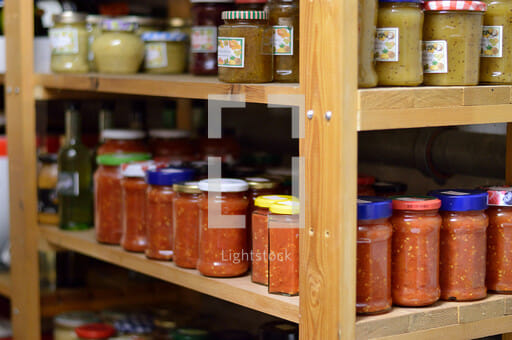
Do you have shelving? Clean and reuse glass jars with tight lids, or even store grains in clean soda bottles.  If you need to buy jars, Mason jars are great, and Weck jars are amazing.  Buy extra in the event you need them for canning or pickling.


Use food safe PETE plastic lidded buckets to store, sort, and stack items.  These buckets are available for from local bakeries or an online supply.  If you have used a food sealer, toss sealed items in a lidded stackable bucket to further protect them from vermin or sudden environmental changes, and to organize foods by type or time period.


Be sure your containers are food safe, or that you have protected your supply from contact with a potentially toxic item.  For example, if you are using a non-food safe container, line it with a food safe bag or use a food sealer to package items before storing them.  Consider using Mylar to create packets (it heat seals quite easily).


Dried foods will last longer the less they are exposed to oxygen.  Consider adding oxygen removal packets with airtight containers to reduce or eliminate oxygen in stored foods.  Note that plastic 5 gallon buckets are not airtight, and that any food stored with these packets must be at a 10% or less moisture content or you risk contracting illnesses such as deadly botulism.


STEP FIVE: ESTIMATE AMOUNTS


There are food storage calculators that you can make use of, as well as spreadsheets to track your current food use. One estimate is that one adult will need 25-31 pounds of grains (such as wheat, barley, oats, rice, corn, pasta) and 5 pounds of dried beans or nuts per month.  For that same time period, about a pound of salt, two pounds of fats, and up to 52 gallons of water will be necessary. Consider running a test from your food supply for several days or a week to determine storage levels per person.


When you are estimating amounts, don’t forget to also calculate for non-edible essentials: water treatment (such as bleach), toilet paper, buckets, jars, and bags to store items, seeds, mix, and planting trays, canning and drying supplies, cooking & food preparation tools and a source of heat, and any supplies needed to care for livestock or pets.


STEP SIX: ORGANIZE FOR LONGEVITY AND USE


Your long-term stockpile needs to be effectively labeled, so that you know not only the contents but when the items were stored. It is important to rotate stock out and replenish it. Consider cooking from your stockpile, and then replenishing it when you grocery shop rather than cooking from your grocery shopping. In this way, you have a consistently updated and fresh stockpile rather than a time capsule.


These first steps for long-term food storage should help you develop and build your own food stockpile, and ensure that it is as useful as possible.  Keep your eye out for forthcoming articles about how to begin a short-term stockpile, and how to stockpile fresh produce.


Do you have any stockpile favorites?  Let us know in the comments below!


The post Food Storage Done In Phases appeared first on Off The Grid News.

Thursday, April 19, 2018

Interview With Boy In ‘Chemical Attack’ Video: ‘We Didn’t See Any Chemical Attack Symptoms’


A new interview with the now infamous boy in the alleged chemical attack video used as a justification for the United States-led bombing of Syria is adding more doubt to the official narrative.  The boy says he was told to go to the hospital where people started dousing him with water.


One of the main “characters” in the footage at the hospital is a water-soaked boy, who is seen being sprayed with water by people who claim to be “rescue workers.” It’s not clear whether they are doctors from the hospital, human rights activists, or White Helmets members. The latter usually make such videos and send them to news agencies, including Reuters.


In what could be the biggest fabrication in recent months, the Douma boy in the chemical attack video and his family have spoken about their ordeal to a Russian TV crew.  It sure appears that the chemical attack was “staged suffering” by the White Helmets.  The boy said that he was asked to go to the hospital, where people “grabbed” him and started “pouring water” over his head for no apparent reason.


Panic, fear, screaming adults, and frightened children featured in the purported footage of the aftermath following the alleged chemical attack in the Eastern Ghouta city. The video has been widely circulated by the mainstream media since April 7 after being posted by the so-called Douma Revolution group and “evidence” of the aftermath of the alleged attack.


A Russian broadcaster VGTRK said it found the boy in the video, who appeared to be 11-year-old Hassan Diab. His story differed from the one presented by the activists and later propagated by the mainstream media.


Hassan said he was in the basement with his mother, who said they ran out of food when they heard some noise outside. When they went outside, they heard random shouting that they should go to the hospital, so they did. Somebody was shouting that we had to go to the hospital, so we went there. When I came in, some people grabbed me and started pouring water over my head,” he told Evgeny Poddubny, a war correspondent from Russian broadcaster VGTRK. Hassan confirmed that he was the boy in the video, and was very scared when the whole situation unfolded. He is now fine and shows no symptoms of having experienced a chemical attack two weeks ago.


Instagram Photo


In an Instagram post, Poddubny claimed that 11-year-old Hassan got some much-needed food in exchange for his participation in the staged video.  Hassan’s father’s story corroborates his son’s.  The boy was eventually found by his father, who said he didn’t hear about any chemical attack that day. I went to the hospital, walked upstairs, and found my wife and children. I asked them what had happened, and they said people outside were shouting about some smell and told them to go to the hospital. At the hospital, they gave dates and cookies to the kids,” he said.


One of the medical workers, who was reportedly on shift at the time, said he was surprised by the sudden influx. “Some people came here and washed people. They said: ‘Chemical attack. Chemical attack.’ We didn’t see any chemical attack symptoms, he added. He did, however, say that there were many people with respiratory problems as a result of dust from recent bombings in the city. British war journalist Robert Fisk also noted that that was the story he’d gotten when speaking with a doctor from Douma.


More importantly, The Independent‘s famous war journalist Robert Fisk haspublished a report which affirms the story so many western government lapdogs have been dismissing as Kremlin propaganda for days now. After interviewing a doctor from the hospital of the area where the Douma attack was supposed to have occurred, Fisk was told by Dr. Assim Rahaibani that what was in actuality an outbreak of respiratory distress among occupants of a dusty oxygen-deprived tunnel was made to look like the aftereffects of a chemical weapons attack when a member of the White Helmets started shouting about a gas attack in front of a bunch of video cameras. Everyone panicked and started hosing themselves down, but in the video, according to Rahaibani, “what you see are people suffering from hypoxia — not gas poisoning.” –SHTFPlan


Moscow is planning to show the video about Hassan’s experience at the next meeting of the United Nations Security Council, Russia’s UN envoy Vassily Nebenzia told Rossiya 1 on Thursday.


The U.S, the U.K., and France launched a coordinated attack on Syria using the video young Hassan says was staged as justification. Also damming for the West was that the timing of the strikes. The announcement of the attack on Syria came hours before the Organization for the Prohibition of Chemical Weapons (OPCW) team was scheduled to arrive in Douma to determine whether chemical weapons had been used there.  It appears that the West was all too eager to destroy evidence, or lack thereof, of alleged chemical weapons use.

Thursday, April 12, 2018

Many Food Products Contaminated with Acrylamide

Many Food Products Contaminated with Acrylamide | potato-chips | General Health Special Interests Toxins


A few days ago a Los Angeles Superior Court judge, Elihu Berle, put acrylamide on the mainstream map by forcing California coffee shops – including Starbucks – to add a health warning about the carcinogenic risks of this chemical present in the coffee.


Next Wednesday, April 11, comes into force a regulation of the European Commission that requires implementing a series of measures to limit as much as possible the presence of acrylamide in food: because it is not only in the coffee, it is in potato chips and baby jars.


Acrylamide is a substance that can be formed in many ways, but one that is very common: when food is cooked or processed at temperatures above 120 degrees.


It is then that food-reducing sugars – those that break down more easily, such as potato starch and cereals, fructose or honey-containing products – and proteins react with each other in the heat, and give rise to this element. The higher the temperature and the lower the degree of humidity, the more acrylamide is produced.


It happens in all foods, although those rich in starch are those that have higher levels when fried and roasted. This is what happens with coffee during its roasting process, regardless of whether it is roasted or natural. Hence, the regulation puts a special focus on fried potatoes, bread in all its formats, biscuits, cookies, coffee and substitutes.


Have we been exposed to a carcinogenic substance?


Before alarms are triggered, it is important to clarify that these measures are based on the precautionary principle because, as the regulation itself explains, “in between 10% and 15%” of foods that have excess acrylamide can be reduced by application of good practices “.


“There is no doubt that this substance is carcinogenic in laboratory mice, but no one has been able to prove that the acrylamide that comes to humans through food have an impact on cancer, ” says Dr. Ricardo Cubedo, an oncologist at the IOB Institute of Oncology.


The measure is based on the precautionary principle: although it has not been proven that acrylamide is carcinogenic in people, it is “likely”, and also in 10% of cases, “easy to reduce”, according to the European Commission


In fact, the International Agency for Research on Cancer (IARC) considers acrylamide as a probable carcinogen for humans, because, so far, it is not conclusive, after investigations carried out experiments in animals subjected to very high doses of acrylamide and whose results can be extrapolated to humans.


In addition, workers in industries that are exposed to higher levels of this substance – it may be by inhalation, in contact with the skin or through food – have not recorded a higher incidence of cancer than the rest of the population. The main source of exposure remains tobacco smoke.


The alarms jumped in 2002, when the Swedish Food Safety Agency revealed that acrylamide appeared not only in industrial processes, or in tobacco smoke, but also in food.


Since then, the World Health Organization and the rest of the international health institutions have begun to exercise caution.


“In 2007 and 2012, the European Agency for Food Safety (EFSA) established some guidelines to reduce their consumption through diet,” says Marhuenda.


According to this dietician-nutritionist, the levels of acrylamide in daily consumption are low enough to be considered dangerous.


“What EFSA does is what we commonly know as placing the plaster before making the wound, always proposing values as low as possible.”


Can I develop cancer if I eat a lot of chips?


“The minimum consumption stipulated for acrylamide to be related to the probability or the increased probability of cancer is 170 micrograms (0.17 milligrams) per kilo of body weight,” says Marhuenda. “In a person weighing 80 kilos, for example, that minimum dose would be 13,600 micrograms of acrylamide a day.” In addition, he points out, “not to reach this amount on a daily basis we will develop cancer directly, but there is an increase in risk.”


And we arrived? “It is complicated to consume that dose, to get an idea, the average coffee intake per person in Europe represents between 30% and 35% of the minimum amount of risk.”


A calculation: according to the levels of reference that from day 11 the manufacturers will have to comply as far as possible (see table below), so that a person of 80 kilos reaches that amount would have to eat something more than 27 kilos of chips a day.


On average, Spaniards are exposed to 0.53 micrograms of acrylamide per kilogram of body weight per day, according to a study that served as a doctoral thesis to the researcher at the University of Valencia Eva Molina Périz. According to Dr. Cubedo, “the half comes for the chips, one quarter for the coffee and the other quarter for the biscuits or the biscuits “.


In Spain, the bags of potatoes went beyond the limit


That despite the fact that in 2015, in Spain, almost one in five bags of these snacks exceeded the amounts of acrylamide recommended by the European Commission, as found in a study by the Institute of Science and Technology of Food and Nutrition (Ictan-CSIC) . Although it observed a positive evolution: an average of 1,484 micrograms per kilo of fried potato in 2004, 740 in 2009 and 630 micrograms in 2014.


The new European regulation does not establish maximum limits, but reference levels – for this product, 500 micrograms per kilo of potatoes – that must be met unless the manufacturer can justify its excess, for example, by the properties of the variety of potato used.


Kiss that potato chip goodbye


For years the food industry has been reducing the levels of acrylamide in its products, but as of Wednesday it won’t be with the typical small potato and toast that appears in some bags.


The regulation of the European Commission establishes among its measures that warnings must appear on the package. Messages on packagings for biscuits, bread slices and toasts will now be clearer.


In addition, bread, chips, puff pastry dough, pizzas and all those products that contain ingredients such as potato or starch will be accompanied by recommendations to cook them at home, reducing the risk.


Despite the new measures of the European Commission and the low exposure to acrylamide, it is advised to reduce or avoid the consumption of this substance: “Potato chips, snacks, cookies, some cereals, bread crunch, and others.


If we want to reduce the levels of acrylamide in the ingestion we must avoid cooking at high temperatures these particular foods, and, in general, we have to always cook in a non-aggressive way “.


The post Many Food Products Contaminated with Acrylamide appeared first on The Sleuth Journal.

Tuesday, April 10, 2018

Are You Ready for the New Wave of GMO Food?

Are You Ready for the New Wave of GMO Food? | biotechnology-gmo-food | General Health GMOs Science & Technology Sleuth Journal Special Interests

(image credit: brsi.in/publications/)


By Stacy Malkan, U.S. Right to Know


Everyone loves a feel-good story about the future. You’ve probably heard this one: high-tech foods enhanced by science will feed the 9 billion people expected on the planet by 2050. GMO Food made in labs and crops and animals genetically engineered to grow faster and better will make it possible to feed the crowded world, according to stories that spin through our institutions of media and education.


“6th grade students brainstorming big biotech ideas to #Feedthe9″ touted a recent tweet tagged to the chemical industry’s promotional website GMOAnswers. Student ideas included “breed carrots to have more vitamins” and “corn that will grow in harsh winter conditions.”


It all sounds so promising until you look at the realities behind the rhetoric.


For starters, in a country that leads the world in growing genetically modified organisms (GMOs), millions go hungry. Reducing food waste, addressing inequality and shifting to agroecological farming methods, not GMOs, are the keys to world food security, according to experts at the United Nations.


CONTINUE READING


The post Are You Ready for the New Wave of GMO Food? appeared first on The Sleuth Journal.

Are You Ready for the New Wave of GMO Food?

Are You Ready for the New Wave of GMO Food? | biotechnology-gmo-food | General Health GMOs Science & Technology Sleuth Journal Special Interests

(image credit: brsi.in/publications/)


By Stacy Malkan, U.S. Right to Know


Everyone loves a feel-good story about the future. You’ve probably heard this one: high-tech foods enhanced by science will feed the 9 billion people expected on the planet by 2050. GMO Food made in labs and crops and animals genetically engineered to grow faster and better will make it possible to feed the crowded world, according to stories that spin through our institutions of media and education.


“6th grade students brainstorming big biotech ideas to #Feedthe9″ touted a recent tweet tagged to the chemical industry’s promotional website GMOAnswers. Student ideas included “breed carrots to have more vitamins” and “corn that will grow in harsh winter conditions.”


It all sounds so promising until you look at the realities behind the rhetoric.


For starters, in a country that leads the world in growing genetically modified organisms (GMOs), millions go hungry. Reducing food waste, addressing inequality and shifting to agroecological farming methods, not GMOs, are the keys to world food security, according to experts at the United Nations.


CONTINUE READING


The post Are You Ready for the New Wave of GMO Food? appeared first on The Sleuth Journal.

Tuesday, March 27, 2018

Socialism: Child Gangs Fight For ‘Quality Garbage’ With Machetes In Venezuela


While many politicians and civilians in the United States focus on making the country a socialist regime, Venezuela’s children are forming gangs and using machetes to fight each other for “quality garbage” so they have something to eat.


Socialism is only good for those already at the very top.  It’s a very important lesson for anyone seeking to “remove the wealth” from the 1%.  Never assume that the rich will allow you vote their money away in the first place. The other issue most socialists forget that the 1% is made up the very wealthy politicians from both parties who will profit immensely from the implementation of socialism.  Of course, when that does happen children starve and become violent as a means to survive and have just one more meal.


The Miami Herald has detailed the lives of children forced to live under the harsh realities of socialism. Liliana, at the age of only 16, has become the mother figure for a gang of Venezuelan children and young adults called the Chacao, named after the neighborhood they’ve claimed as their territory. The 15 members, ranging in age from 10 to 23, work together to survive vicious fights for “quality” garbage in crumbling, shortage-plagued, socialist dystopia of Venezuela. Their weapons are knives and sticks and machetes. And their only prize is garbage that contains food scrapes barely good enough to eat.


Many of the children in the Chacao gang flock to a life of violence but a family-oriented one because there’s no other option if they want to eat.  There are at least 10 gangs in the capital of Caracas according to social workers and police estimate. “There were always children on the street in Venezuela but now we are seeing a new phenomenon — kids who get more food on the street than at their homes,” says Beatriz Tirado, who leads “Angeles de Calle,” or Street Angels, a non-governmental charity.


“Our kids are finding ways to survive because neither in their homes nor in their communities is there enough food,” explains social worker Roberto Patino, who has established 29 public diners all over the country to feed the massive numbers of hungry children. But Patino also bemoans that there are not enough resources to help the children get their lives back on track let alone feed them properly. For now, many have turned to trash bags as a source of nutrition.


But the gang life is dangerous for the children. Often, they venture into the more affluent neighborhoods of the politicians. One of those territories is Las Mercedes. It has high-end restaurants that attract the political elite Venezuelans. Because garbage bags there often contain leftovers and even untouched food, they are sought after by a number of the gangs. The clashes over bags of trash can be deadly.


The children often take to the consumption of street drugs at an early age as well.  They become criminals, tossing the law out the window to survive.  They steal, assault people, and use drugs like crack, sometimes smoked in makeshift pipes made from the parts of discarded plastic dolls, but for a very disturbing reason. “When you smoke you don’t feel hungry,” explains Patricio.


The few failures of capitalism are much preferable to the few success of socialism. Although one can argue that there haven’t been any successes with regards to socialism unless you count the lining of the pockets of the politicians who rule over everyone else.

Tuesday, March 20, 2018

Let Them Eat Dirt!

Let Them Eat Dirt! | gardening-soil | General Health Special Interests


Dr. Maya Shetreat-Klein’s son suffered a severe episode of asthma on his first birthday. Conventional treatments failed to reverse his condition and he hit a developmental plateau.


That personal experience led the pediatric neurologist down an investigative path that led her to the conclusion that food was to blame for her son’s illness.


The solution, she discovered, was simple: Heal the food, heal the gut, heal the brain . . . and heal the child.


In her book, “The Dirt Cure,” Shetreat-Klein argues for a dirt-filled chemical-free life. She shares success stories from her practice, and from her experience as a mother. She also provides tips for stocking up on healing foods, deciphering labels and getting even the pickiest of eaters to try a new menu.


Shetreat-Klein’s research and advice isn’t just for kids. Her book explains why so much food today contains arsenic and lead, the real reason milk is pasteurized, and why salmon is no longer the miracle fish.


She even includes recipes for healing “from the inside out.”


Read ‘‘The Dirt Cure:’ Why Human Health Depends on Soil Health


h/t: Organic Consumers Association


The post Let Them Eat Dirt! appeared first on The Sleuth Journal.

Tuesday, March 13, 2018

Selco: What We Ate and How We Got Food When the SHTF

This report was originally published by Selco at The Organic Prepper


Editor’s Note: If a disaster is bad enough and lasts long enough, it isn’t going to take long before there is no food to be had. In this interview with Selco, he shares his real-life experiences and explains how people kept from starving to death when there was no food in the stores. ~ Daisy


How do you get food when there are no stores?


At the beginning of everything, most of the people did not have any significant “stash” of food in their homes.


In other words, the majority of common folks had food a or couple of days in their pantry and that was it. There were exceptions to that because the process of collapse did not happen in a few hours (in terms of suddenly there is no food in the stores).


When the chaos started, people looted stores after a short period of everyone buying things in a panic. Still, the majority of folks did not manage to get a decent stash of food from stores. Some did not want to believe that they were gonna need a stash. Others did not want to go out and participate in looting because it was dangerous. But I think the most obvious reason was that all food from stores was taken very fast.


In beginning period of SHTF, events unfold at a very fast pace. Actually, events go one after another so fast that if you find yourself lost in one event at the end of several events, you ask yourself, “Why in the name of God I did not go out and buy a whole bunch of food while I still could do that?”


Was gardening an option? If so, how did people protect their gardens?


Yes, it was an option, but the percentage of food from a garden was low because of a few reasons.


It was a city, without enough land for significant food growing, and the second reason is that even people who had some land (small gardens near houses) needed time to grow food there.


People usually did not grow food there in normal times, flowers, tea, maybe some particular kind of tomato, salad greens, and similar.


I remember going and checking gardens for tomatoes because people had tried some new sort of tomato close to their home, not as a way to have food, but as an attempt so they could see is if it was OK to have it somewhere before they had a bigger piece of land for growing (before SHTF in a peacetime).


So yes, gardening was an option, people used every part of the available land, but that was not enough, and it was like you are checking every day how your tomato is growing and you wait for it, but then you pick it and realize you have food for only a couple of days.


We were not prepared at the time to use every piece of land for food growing. It takes time to establish that.


Still, it was precious, and it was protected of course, just like your home, in the same way.


How often did MREs get dropped?


There was no schedule for food drops, at least no real schedule because it was all based on rumors like, “Tonight they are gonna drop food from airplanes.” If you asked, “Who told you that?” the answer was “a guy who heard it from guy who heard…” So, of course, it was completely based on luck.


Sometimes, it would “fall down” every second night, or you heard it had fallen somewhere, it would be “I heard it from a guy who heard it…”


Sometimes it was 3-4 times per week. Of course, they dropped it, but that does not mean we could find any of the food. Other people would simply grab it before you.


Some folks headed for the hills every night in order to wait. People would choose one guy from family to go up every night and wait.


If those food drops had any schedule there where they loaded planes (as I understand later, the place was in an air base in Italy) it was completely lost on us down in the city in the chaos and empire of rumors.


You need to understand that in that time those planes were not the only ones to fly, so sometimes we were out waiting for food but actually other planes bombarded us.


But very early we learned to recognize the low humming sound of food planes, distant but powerful.


Now when I look back, it is weird how we trusted some of that information. For example, if we heard that food was gonna be dropped that night in some particular part of the city, some small area of some hill, people would go there.


A reasonable man would have thought, “Oh, so some poor ragged guy in the middle of civil war and information blockade suddenly has info on where several huge military airplanes are gonna do some operation?” Not to mention the fact that the whole city together with all the hills looked to those people in the airplanes like small dots.


It was nonsense. But we were hungry, scared, and in the middle of chaos without any real information, so people trusted in a lot of things, especially in good news.


Do not underestimate the power of rumors in hard times.


“Food drops” were performed for many cities in this area during the hardest part of the war. They helped on different levels.


Even today I find one of the happiest sounds to be the sound of MREs raining on a hard surface. I did not know the technical details (and still don’t) of how exactly that worked, but most of the things that were dropped would break apart in the air, so on the ground, it would “rain”.


It was like a lottery to be in the middle of that rain because the MREs were good stuff, and valuable, but some of the bigger stuff coming down could kill people. (It happened with bigger packages).


MREs were meals all in one package: food, sweet stuff, matches, even that hot sauce that was pretty handy when we want to add taste to some weird food that we ate or to mask a bad taste.


What food were you able to forage?


When it comes to foraging for plants, I know it is a popular opinion in some circles that you can survive and live by foraging.


In terms of urban survival, it is, in my opinion, overestimated if you are an average man.


Maybe it would work if you have lots of knowledge about edible plants, and maybe if you have many resources of those plants and are in the wilderness.


We were average urban folks. Our knowledge about edible plants was limited to the one or two usable plants that could be used for homemade tea.


For example yes, we used pine needles for tea. It sounds great today, it is good healthy tea with vitamins and so on, but you can not live on it, it can be in addition to your food, but not your main resource.


Older folks jumped in with their knowledge. They were folks that in those times remembered WW2 and hunger, and people usually listened to them when it came to what plant you could use for food.


Plants like nettle and dandelion were used, and in the worst periods, people simply started to use any available grass mixed with small amount of flour.


Eating plants and herbs in that time was not a case of healthy living. It was a matter of not having anything else to eat. 


Were you able to scavenge for food from deserted buildings?


Yes.


When the SHTF, especially in the beginning, some houses became empty. People left or died inside (for whatever reason, for example, shelling). Then folks would go through the empty houses and scavenge for food.


One memory from that time is the endless stench of rotten food (there was no electricity for the fridges). In the beginning, you could find food on that way.


If you were lucky sometimes you could find a bigger amount of food. Sometimes you came upon a house where the ex-occupant clearly hoarded food in the first days of rioting.


That period of time did not last for long. The stench of rotten food was pretty much substituted with another kind of stench. Soon there were more dead people then spoiled food in the city.


But even later, you would never know what you could find in destroyed and abandoned houses. Maybe few cans of food hidden or forgotten somewhere under the rubble, or in a destroyed fridge.


One thing interesting from that period (when it comes to scavenging) and also very important in prepper terms is that I witnessed and was part of something that I can call the transition of scavenging or maybe resetting the values of goods.


It goes something like this:


First people ran riot on stores and looked for valuables like gold, money, TVs, stereos, cars…then as they realized the situation, they looked for weapons, fuel, then candles, batteries, and food, then they’d dig up some gardens for few potatoes.


People needed some time to realize what was really important. It didn’t take very long but sometimes even a few days or a week is important.


I have seen people running from a mall with items that, in few days, would become most ridiculous items to possess (and to take from a burning mall) in the middle of a collapse, things like a TV or a laundry machine or a music collection of a famous band.


The majority of people could not imagine what was coming, so they could not fathom that a bag full of AA batteries was gonna worth more than 50 laundry machines.


For example, the laundry machine was usable only to plug a hole in the wall from shelling or to reinforce the door.


I am not advocating that you go out rioting and taking stuff from malls and stores when SHTF, but let’s say that if you find yourself there, think about what is useful to take in prepper terms.


Here is one example: if the SHTF again here, there is parking machine in front of my home that gives you an automatic ticket when you sin here insert coins. As soon as I see someone busting it open to take money from inside I will go and take the small solar panel from it (it is solar power operated). While other people think about money inside, I am thinking about solar power on the outside of it.


Where you able to hunt or trap anything for meat?


It was the city, so hunting or trapping anything more complicated than a pigeon was not really an option. The other reason was that it was city in the middle of a war, so real trapping had its own complications like shelling, constant noises, and similar.


If your situation is extreme, hunting or trapping can be about trapping pigeons or shooting a stray dog. 


What are some things you can eat that most people wouldn’t think of as food?


It is a matter of levels. Sometimes I get questions over mail asking if we had cases of cannibalism, and the answer is no. People need to realize that the road to that extreme is very, very long.


There are many bad things to eat before getting to that extreme (even if you are willing to go there) and people do not realize that.


I ate spoiled and old food of different kinds, expired food (cans of cookies from military storages that were expired for decades), food with worms (cooked together with those expired cans), grass that was boiled in water, leaves from trees. We ate different kind of meat, pigeon for sure, and I am quite positive cat meat once, and rat meat once probably.


How did you extend food to make it feed more people?


Over time, it gets important to have some food, or in other words to have your belly “full” of something so easiest solutions were to water food down, or to mix it with plants.


In other words, we ate a lot of “soups.” For example, if we had a small amount of meat and rice, but we have water and some plants, we would make a big pot of soup.


In some cases it looked more like tea (a lot of hot water with a small amount of food inside) but it solved the problem of how to make something big out of small amounts of something.


When a situation is hard – when it is hard and demanding on both psychological and physical way – you cannot really ration yourself. You need to eat something, because of the simple fact that you can not operate if you are not fed. So we ate a lot of very low quality food, and yes we were always more or less hungry.


How did you cook food without power?


We cooked with fire, a stove that used wood, and often an open fire in the yard. It was a constant equation of heating and cooking with low wood resources.


For example if we needed to get a fire for heating it was used at the same time for cooking. (See Selco’s article on staying warm during a long-term SHTF scenario.)


A small open fire on the yard was used in weather when there was no need for heating.


Was there a black market for food?


Of course, and it was matter that changed all the time based what was available in the city at a given moment.


For example if food drops that week were good you could find MREs cheaper. Other times, all you could find was suspicious-looking meat cans without manufacture or expiration dates on them.


Nothing was fixed and for sure on black market, not even fact that you gonna survive the trade not to mention other things. (See Selco’s article on the dangers of barter and trade)


Again, it was a matter of levels, so there were people who “owned” the black market (people with strong organizations, firepower, and connections). Sometimes they dictated the “pricing” of food in the city, and sometimes there were common folks who could offered you few cans of meat or two MREs from their stash.


Sometimes you could run into a man who was offering you “powdered eggs” but in a dark, not secure environment (you are trading with unknown armed people for example), you needed to be sure it is not some useless powder.


There were scams and you needed to be sure who you were trading with, how secure the place was, and what you were actually trading for.


How much of your time was taken up with acquiring and preparing food?


It was a matter of economic thinking. It was not about making it delicious because we had scarce resources like wood for fire. and simply because often it was impossible to make it delicious.


It was brought down to the level of getting your stomach full of something so you can continue to operate one more day.


Things to know about eating when the SHTF


There are options of foraging for edible plants and hunting or trapping some animals in the city when the SHTF, but do not count on that as the main resource for your food, not in the long run.


Acquiring food in urban settings comes down to the idea of taking food from other people – either people that are not there anymore (empty houses) or people that are still there (through the trade or attack).


All of the above options (just like lot of other prepper activities when SHTF) usually are not fancy and romantic/friendly.


When scavenging through deserted places, you can get injured and that injury can get complicated when there is no medical care. During a trade, you can get scammed, ripped off, or simply attacked and injured or killed because of the resources you possess in that moment or due to a lack of careful planning.


By attacking other people to get food (if you find yourself that desperate or if you wish to go that way) you are risking, of course, being killed.


In the end, it comes again to the idea that you need to be prepared very well for SHTF with your stash of food or your small garden where you are gonna choose what to have and how to use it in the most efficient way. You should minimize the need to go out and scavenge, at least until, you figure out some things.


About the Author


Selco survived the Balkan war of the 90s in a city under siege, without electricity, running water, or food distribution. In his online works, he gives an inside view of the reality of survival under the harshest conditions. He reviews what works and what doesn’t, tells you the hard lessons he learned, and shares how he prepares today. He never stopped learning about survival and preparedness since the war. Regardless what happens, chances are you will never experience extreme situations like Selco did. But you have the chance to learn from him and how he faced death for months. Real survival is not romantic or idealistic. It is brutal, hard and unfair. Let Selco take you into that world. Read more of Selco’s articles here: https://shtfschool.com/blog/ And take advantage of a deep and profound insight into his knowledge and advice by signing up for the outstanding and unrivaled online course. More details here: https://shtfschool.com/survival-boot-camp/


The Pantry Primer


Please feel free to share any information from this article in part or in full, giving credit to the author and including a link to The Organic Prepper and the following bio.


Daisy Luther is the author of The Pantry Primer: A Prepper’s Guide To Whole Food on a Half Price Budget.  Her website, The Organic Prepper, offers information on healthy prepping, including premium nutritional choices, general wellness and non-tech solutions. You can follow Daisy on Facebook and Twitter, and you can email her at daisy@theorganicprepper.ca</e


Thursday, March 1, 2018

How To Avoid GMOs When You’re On A Budget

How To Avoid GMOs When You’re On A Budget | shopping-grocery-store | General Health GMOs Organic Market Classifieds Organics


What’s the most controversial topic at the grocery store these days?


It’s GMOs.


Should you consume them? Are they okay in moderation? Should you strictly avoid them at all times? And if so, how on earth can you manage to navigate the store without stepping into a genetically modified landmine? And if you really want to challenge yourself, how can you do that on a budget?


The anti-GMO movementHow To Avoid GMOs When You’re On A Budget | EpUbGBhbeXlLkAc2IXnWWCdjrdmn51ccsXdym9DWo0bS7F0unVzlehYBRQRvAPSD_R3ZNzbPn9Kh47Khxe7D4IPw0oLZuq08DOhkaBWy4l_CwrudD2RNUxegSQ7idNESjkLjAqPDitM | General Health GMOs Organic Market Classifieds Organics  is picking up steam, for a multitude of excellent reasons. My family is making continuous efforts to remove genetically modified products from our lives. If you want to learn how you can banish them too, read on!


Forget about GMO labeling.


First of all, let’s face some facts here.  Crony capitalism in America isn’t going to allow changes that would require the labeling of genetically modified ingredients in your food.  While in a perfect world, a place that requires people selling healthfully grown organic foods to jump backwards through hoops and turn a cartwheel to be allowed to place a “certified organic label” on their items, Big Agri can blithely don hazmat suits to spray ever-increasing amounts of glyphosate on crops that have been genetically modified to withstand the poisons, with nary a word to consumers.


The reality is, Monsanto and their ilk have incredibly deep pockets. The Big Food companies that purchase vast amounts of GMO crops are also rolling in money. If you want to avoid GMOs, you can’t look to those who have a vested interest in selling them to protect you. You have to constantly educate yourself to beat them at their own game.


And their game, of course, is Monopoly.


If they refuse to label their products, we can refuse to buy them.  Money talks, and to large corporations it SHOUTS.  If their bottom line begins to dwindle because people refuse to consume their products, eventually they will have to make a change.


That’s exactly what happened with Dean Foods, actually. In 2009, Dean Foods switched their formula for their popular Silk Soymilk.  Instead of using organic soybeans, they began purchasing conventional soybeans. As we all know, nearly all of the soy grown in the United States is genetically modified – at last report it was over 94%.  So, more than likely, the soymilk that Dean Foods was putting out was GMO.  When outraged customers refused to purchase the product, Dean realized that they were losing money hand over fist, and they switched back to organic soy.


Victory: Team Anti-GMO.


So, you see, that’s how it works. In a free market where consumers have adequate information, their desires direct what is produced. The issue right now is that consumers do NOT have adequate information – at least not without a diligent search for it.


We can wish for labeling until the rBGH-free cows come home, but the battle will have to be fought without the aid of labels.


Avoiding GMOs is easier than you might think. And it can be done on a budget. Here’s how.


Learn to use the labels that DO exist.


How To Avoid GMOs When You’re On A Budget | non-gmo-verified-project | General Health GMOs Organic Market Classifieds Organics


Although companies are no required to put warning labels on GMOs, companies can opt to boast when their products are GMO-free.


The Non-GMO Project is focused in the opposite direction of the activists that insist GMOs be labeled. They are working to label products that have been scrupulously tested and are verified NOT to contain genetically modified material.


(Here’s a list of  1,000 non-gmo foods)


The pretty little butterfly label is your best indication that the product in your hand doesn’t contain GMOs.   Through a third-party verification process, the products are tested and audited to maintain their standing.


The retailers who started the Non-GMO Project were motivated by a simple idea. They believed that consumers in North America should have access to clearly-labeled non-GMO food and products, now and in the future. That conviction continues to guide the Non-GMO Project, as North America’s only independent verification for products made according to best practices for GMO avoidance.


The verification seal indicates that the product bearing the seal has gone through our verification process. Our verification is an assurance that a product has been produced according to consensus-based best practices for GMO avoidance:


  • We require ongoing testing of all at-risk ingredients—any ingredient being grown commercially in GMO form must be tested prior to use in a verified product.

  • We use an Action Threshold of 0.9%. This is in alignment with laws in the European Union (where any product containing more than 0.9% GMO must be labeled). Absence of all GMOs is the target for all Non-GMO Project Standard compliant products. Continuous improvement practices toward achieving this goal must be part of the Participant’s quality management systems.

  • After the test, we require rigorous traceability and segregation practices to be followed in order to ensure ingredient integrity through to the finished product.

  • For low-risk ingredients, we conduct a thorough review of ingredient specification sheets to determine absence of GMO risk.

  • Verification is maintained through an annual audit, along with onsite inspections for high-risk products.


Other products sometimes say that they do not contain GMOs.  While this may be true, the Non-GMO Project Verified seal is earned through rigorous testing, and you can feel fairly confident that foods bearing this seal are free of genetically modified ingredients.


Another label to look for is USDA Certified Organic.


According to the USDA’s official blog, the inclusion of any type of GMOs is prohibited in an organic product.


The use of genetic engineering or genetically modified organisms (GMOs) is prohibited in organic products. This means an organic farmer can’t plant GMO seeds, an organic cow can’t eat GMO alfalfa or corn, and an organic soup producer can’t us any GMO ingredients. To meet USDA organic regulations, farmers and processors must show they aren’t using GMOs and that they are protecting their products from contact with prohibited substances, such as GMOs, from farm to table.


Sadly, it’s important to note that the USDA has relaxed their standards and “organic” now means 95% or more organic.


Learn about the likely suspects.


In the United States and Canada, two things shout “GMO” like no other: corn and soy. As of 2012, more than 94% of the soy and 88% of the corn in America was genetically modified.


The sad fact is, if you are buying anything processed at all, corn or soy is most likely to be an ingredient. And given the statistics above, it’s almost guaranteed that the corn or soy is GMO unless it’s otherwise noted. Both ingredients masquerade under many names. The lists below may seem overwhelming, but it’s important to see the number of aliases that allow these products to sneak into your food.


Here’s a sobering chart from the website Corn Allergens that shows many of the names under which corn lurks in your food.


  • Acetic acid

  • Alcohol

  • Alpha tocopherol

  • Artificial flavorings

  • Artificial sweeteners

  • Ascorbates

  • Ascorbic acid

  • Aspartame (Artificial sweetener)

  • Astaxanthin

  • Baking powder

  • Barley malt* (generally OK, but can be contaminated)

  • Bleached flour*

  • Blended sugar (sugaridextrose)

  • Brown sugar* (generally OK if no caramel color)

  • Calcium citrate

  • Calcium fumarate

  • Calcium gluconate

  • Calcium lactate

  • Calcium magnesium acetate (CMA)

  • Calcium stearate

  • Calcium stearoyl lactylate

  • Caramel and caramel color

  • Carbonmethylcellulose sodium

  • Cellulose microcrystalline

  • Cellulose, methyl

  • Cellulose, powdered

  • Cetearyl glucoside

  • Choline chloride

  • Citric acid*

  • Citrus cloud emulsion (CCS)

  • Coco glycerides (cocoglycerides)

  • Confectioner’s sugar

  • Corn alcohol, corn gluten

  • Corn extract

  • Corn flour

  • Corn oil, corn oil margarine

  • Corn starch

  • Corn sweetener, corn sugar

  • Corn syrup, corn syrup solids

  • Corn, popcorn, cornmeal

  • Cornstarch, cornflour

  • Crosscarmellose sodium

  • Crystalline dextrose

  • Crystalline fructose

  • Cyclodextrin

  • DATUM (a dough conditioner)

  • Decyl glucoside

  • Decyl polyglucose

  • Dextrin

  • Dextrose (also found in IV solutions)

  • Dextrose anything (such as monohydrate or anhydrous)

  • d-Gluconic acid

  • Distilled white vinegar

  • Drying agent

  • Erythorbic acid

  • Erythritol

  • Ethanol

  • Ethocel 20

  • Ethyl acetate

  • Ethyl alcohol

  • Ethyl lactate

  • Ethyl maltol

  • Ethylcellulose

  • Ethylene

  • Fibersol-2

  • Flavorings*

  • Food starch

  • Fructose*

  • Fruit juice concentrate*

  • Fumaric acid

  • Germ/germ meal

  • Gluconate

  • Gluconic acid

  • Glucono delta-lactone

  • Gluconolactone

  • Glucosamine

  • Glucose syrup* (also found in IV solutions)

  • Glucose*

  • Glutamate

  • Gluten

  • Gluten feed/meal

  • Glycerides

  • Glycerin*

  • Glycerol

  • Golden syrup

  • Grits

  • High fructose corn syrup

  • Hominy

  • Honey*

  • Hydrolyzed corn

  • Hydrolyzed corn protein

  • Hydrolyzed vegetable protein

  • Hydroxypropyl methylcellulose

  • Hydroxypropyl methylcellulose pthalate (HPMCP)

  • Inositol

  • Invert syrup or sugar

  • Iodized salt

  • Lactate

  • Lactic acid*

  • Lauryl glucoside

  • Lecithin

  • Linoleic acid

  • Lysine

  • Magnesium citrate

  • Magnesium fumarate

  • Magnesium stearate

  • Maize

  • Malic acid

  • Malonic acid

  • Malt syrup from corn

  • Malt, malt extract

  • Maltitol

  • Maltodextrin

  • Maltol

  • Maltose

  • Mannitol

  • Methyl glucose

  • Methyl glucoside

  • Methyl gluceth

  • Methylcellulose

  • Microcrystaline cellulose

  • Modified cellulose gum

  • Modified corn starch

  • Modified food starch

  • Molasses* (corn syrup may be present; know your product)

  • Mono- and di- glycerides

  • Monosodium glutamate

  • MSG

  • Natural flavorings*

  • Olestra/Olean

  • Polenta

  • Polydextrose

  • Polylactic acid (PLA)

  • Polysorbates* (e.g. Polysorbate 80)

  • Polyvinyl acetate

  • Potassium citrate

  • Potassium fumarate

  • Potassium gluconate

  • Powdered sugar

  • Pregelatinized starch

  • Propionic acid

  • Propylene glycol monostearate*

  • Propylene glycol*

  • Saccharin

  • Salt (iodized salt)

  • Semolina (unless from wheat)

  • Simethicone

  • Sodium carboxymethylcellulose

  • Sodium citrate

  • Sodium erythorbate

  • Sodium fumarate

  • Sodium lactate

  • Sodium starch glycolate

  • Sodium stearoyl fumarate

  • Sorbate

  • Sorbic acid

  • Sorbitan* (anything)

  • Sorbitol

  • Sorghum* (not all is bad; the syrup and/or grain CAN be mixed with corn)

  • Splenda (Artificial sweetener)

  • Starch (any kind that’s not specified)

  • Stearic acid

  • Stearoyls

  • Sucralose (Artificial sweetener)

  • Sucrose

  • Sugar* (not identified as cane or beet)

  • Threonine

  • Tocopherol (vitamin E)

  • Treacle (aka golden syrup)

  • Triethyl citrate

  • Unmodified starch

  • Vanilla, natural flavoring

  • Vanilla, pure or extract

  • Vanillin

  • Vegetable anything that’s not specific*

  • Vinegar, distilled white

  • Vinyl acetate

  • Vitamin C* and Vitamin E*

  • Vitamins*

  • Xanthan gum

  • Xylitol

  • Yeast*

  • Zea mays

  • Zein


Likewise, soy is another item that wears many hats and can be difficult to avoid. Here are some of the names under which soy could be hiding in your food. (List is from About.com)


  • Bean curd

  • Bean sprouts

  • Bulking agent

  • Edamame (fresh soybeans)

  • Guar gum

  • Gum arabic

  • Hydrolyzed plant protein (HPP) or hydrolyzed vegetable protein (HVP)

  • Hydrolyzed soy protein (HSP)

  • Kinako

  • Lecithin

  • Miso (fermented soybean paste)

  • Mixed tocopherols

  • Mono- and di-glycerides

  • MSG (monosodium glutamate)

  • Natto

  • Natural flavoring

  • Nimame

  • Okara

  • Shoyu

  • Soy (albumin, cheese, fiber, grits, milk, nuts, sprouts, yogurt, ice cream, pasta)

  • Soy lecithin

  • Soy protein (concentrate, hydrolyzed, isolate)

  • Soy sauce

  • Soya

  • Soybean (curds, granules)

  • Soybean oil

  • Stabilizer

  • Tamari

  • Tempeh

  • Teriyaki sauce

  • Textured vegetable protein (TVP)

  • Thickener

  • Tofu (dofu, kori-dofu)

  • Vegetable gum, starch, shortening, or oil

  • Vitamin E

  • Yuba


As you can see, it’s difficult to avoid potential GMOs if you eat anything that comes from a package.  Despite the fact that many people suffer from food allergies, these items are allowed to be included under names that make it difficult to discern what you’re actually getting.  Names like “thickener”, “natural flavoring”, and “drying agent” do not give the label reader much of a clue.


More than 60 GMO crops that have been approved in the US are:


  • Corn (20 varieties)

  • Oilseed Rape/Canola (11 varieties)

  • Cotton (11 varieties)

  • Tomato (6 varieties)

  • Potato (4 varieties)

  • Soybean (3 varieties)

  • Sugar Beet (3 varieties)

  • Squash (2 varieties)

  • Cantaloupe

  • Rice

  • Flax

  • Raddicchio

  • Papaya

  • Alfalfa

  • Wheat


Fortunately, not all of these are currently on the market.  Currently corn, soybeans, cotton, canola, squash, and papaya are all sold commercially. (Source: Organic Consumers)


The best possible choices have no label at all.


Bluntly put, food manufacturers are out to deceive the consumer. They know that many people are trying to avoid GMOs, but they still want you to buy their products. This is why they are adamantly against labeling the products, although they like to say it’s because we, the mere mortal customers, just aren’t smart enough or educated enough to comprehend in our fuzzy little brains that GMOs are “safe”.  So, they opt not to disclose the inclusion of genetically modified ingredients.


If you shop at the grocery store, then I have to be honest – it’s nearly impossible to avoid GMOs. If every item you purchase is organic, then you can probably get through the checkout line unscathed. But these days, who can afford to push a cart full of organic grocery store food up to the register? I know that I certainly can’t.  Prices are sometimes triple that of a conventionally grown item. If you truly want to avoid GMOs – and by avoid I mean banish them from your dinner table and cupboards for good – you need to stop buying food with ingredients. You need to rethink where your food comes from.


Food shouldn’t contain ingredients. Food should BE ingredients.  What you purchase when doing your weekly food shopping should be the basis for delicious meals.  When you no longer eat things from packages that have long lists of ingredients in them, you will begin to free yourself from the ridiculous Monopoly game that you have been playing with Big Food.


Here are some examples:


Instead of buying a package of pasta and a jar of Alfredo sauce, make zucchini noodles and a homemade Alfredo primavera.


Instead of buying a box of flavored, sugar-y cereal for breakfast, have oatmeal (cooked from scratch – not the little packets) and top it with fruit and nuts.


Instead of a sandwich made from a loaf of processed bread and a deli meat, have a salad made from fresh greens and vegetables, and topped with a slice of chicken that you cooked yourself.


Instead of opening a can of tomato soup, puree some tomatoes and make your own soup. Top it with freshly chopped basil.


Instead of a breakfast sandwich with rubbery eggs on a processed English muffin, make a decadent omelet with farm fresh cheese and vegetables.


None of these meals takes a diploma from Le Cordon Bleu to make. None of these meals started their journey to your table at a factory farm and then on to a facility to be processed into a box on the grocery store shelf, either. They came straight from the garden or farm. Grab some farm-to-table cookbooksHow To Avoid GMOs When You’re On A Budget | EpUbGBhbeXlLkAc2IXnWWCdjrdmn51ccsXdym9DWo0bS7F0unVzlehYBRQRvAPSD_R3ZNzbPn9Kh47Khxe7D4IPw0oLZuq08DOhkaBWy4l_CwrudD2RNUxegSQ7idNESjkLjAqPDitM | General Health GMOs Organic Market Classifieds Organics  or vintage cookbooksHow To Avoid GMOs When You’re On A Budget | EpUbGBhbeXlLkAc2IXnWWCdjrdmn51ccsXdym9DWo0bS7F0unVzlehYBRQRvAPSD_R3ZNzbPn9Kh47Khxe7D4IPw0oLZuq08DOhkaBWy4l_CwrudD2RNUxegSQ7idNESjkLjAqPDitM | General Health GMOs Organic Market Classifieds Organics , and you’ll find loads of recipes that are simple, fast, and filling.  (My favorites are The Nourished KitchenHow To Avoid GMOs When You’re On A Budget | EpUbGBhbeXlLkAc2IXnWWCdjrdmn51ccsXdym9DWo0bS7F0unVzlehYBRQRvAPSD_R3ZNzbPn9Kh47Khxe7D4IPw0oLZuq08DOhkaBWy4l_CwrudD2RNUxegSQ7idNESjkLjAqPDitM | General Health GMOs Organic Market Classifieds Organics  and The Fanny Farmer Cookbook How To Avoid GMOs When You’re On A Budget | EpUbGBhbeXlLkAc2IXnWWCdjrdmn51ccsXdym9DWo0bS7F0unVzlehYBRQRvAPSD_R3ZNzbPn9Kh47Khxe7D4IPw0oLZuq08DOhkaBWy4l_CwrudD2RNUxegSQ7idNESjkLjAqPDitM | General Health GMOs Organic Market Classifieds Organics  from 1896.)  For more inspiration, think about what you like to eat, and then about how your grandmother would have made it.


It’s time to change your definition of food shopping.


It’s entirely possible for many of us to completely break up with the grocery store. I grow veggies in my backyard and I purchase what I can’t grow from farmers, farmer’s marketsCSAs, and the local co-op.  Specific staples like organic sugar and baking items come from online vendors. (I realize that these are the same items I could be purchasing at the grocery store, but I have made the personal choice to no longer do business with that industry. I try to buy direct from farms and small producers as much as possible.)


Don’t limit yourself to produce, either. Be sure to look for meat and dairy products from local vendors as well!  The organic free-range chicken that you get from your local farmer is well worth the additional price you’ll pay.  If you have a freezer, you can buy many types of meat in bulk (quarter of a cow, anyone?) I’m able to serve free range chicken, rabbit, and grass-fed beef to my family, even on a tight budget, by shopping direct from the farmers. There are few occupations where people work so hard for such a small amount of profit. Farming is a noble profession that doesn’t get the respect it deserves, and I like nothing better than giving my hard-earned dollars to people who give me true nourishment.


I can hear some of you saying, “That’s fine in the summer, but what am I supposed to eat in the winter, when there’s nothing local that is being harvested? I’ll have to go back to the grocery store.”


Not necessarily. It’s possible to skip the grocery stores (and the GMOs) even in the winter if you are prepared to do some food preservation when produce is at its peak. If you aren’t familiar with the lost arts, check out some websites, go to a class at your county extension office, or read a book. CanningdehydratingHow To Avoid GMOs When You’re On A Budget | EpUbGBhbeXlLkAc2IXnWWCdjrdmn51ccsXdym9DWo0bS7F0unVzlehYBRQRvAPSD_R3ZNzbPn9Kh47Khxe7D4IPw0oLZuq08DOhkaBWy4l_CwrudD2RNUxegSQ7idNESjkLjAqPDitM | General Health GMOs Organic Market Classifieds Organics root cellaringHow To Avoid GMOs When You’re On A Budget | EpUbGBhbeXlLkAc2IXnWWCdjrdmn51ccsXdym9DWo0bS7F0unVzlehYBRQRvAPSD_R3ZNzbPn9Kh47Khxe7D4IPw0oLZuq08DOhkaBWy4l_CwrudD2RNUxegSQ7idNESjkLjAqPDitM | General Health GMOs Organic Market Classifieds Organics , and freezingcan make your summer bounty last all through the year. I like to take extra effort when canning fruits and vegetables to make them special, so that we are excited to pop open a jar in the winter.  I add vanilla and spices to pears. I toss a little bit of garlic into the jar with green beans. Carrots have a dash of cinnamon and a dollop of honey. Jams are bursting with intense fruity flavor. Relishes, chutneys, and sauces await their invitations to the table, dressing up a wintery dish with a dash of summer. Jars of chewy dehydrated fruits are ready to go into lunchboxes, and dehydrated veggies add a burst of out-of-season nutrition to soups and sauces.


It’s amazing how far you can make a bushel of peaches extend if you use the “whole buffalo” – a family theory of food economics named by my youngest daughter that means we use every edible part of the item to help stretch our budget. We recently took 100 pounds of peaches (purchased for $1 a pound from an orchard down the road) and made 3 kinds of jam, 3 kinds of canned peaches, peach peel candy, peach liqueur, and peach iced tea. Only then, after getting every last drop of flavor and goodness out of those peaches, pit and all, did we cast the remnants onto the compost pile.


If you think you don’t have time to eschew the grocery store, with its convenient boxes and freezer aisle, reconsider. Fruits and vegetables are the original “fast food”.  Many of them can be consumed right after you pick them from the plant.


Challenge yourself to one week without groceries – you may find that the food is so much more delicious and satisfying that you don’t want to go back to the store!


Here are the top 10 things to remember when shopping for non-GMO foods.


Don’t buy into the malarkey that it’s impossible to avoid GMOs these days. It’s entirely possible when you stop playing by the rules laid out by Big Food!


Keep these things in mind when purchasing food:


  1. Stop looking for labels. Assume that if it isn’t labeled GMO-free, that it contains GMOs.


  2. Look for products that are USDA Certified Organic or Non-GMO Project Verified.


  3. Avoid all corn, soy, and canola that is not specifically labeled as non-GMO.


  4. Familiarize yourself with the abundant aliases for corn and soy.


  5. Buy ingredients, instead of food with ingredients.


  6. Cook from scratch.


  7. Stop shopping at the grocery store.


  8. Get to know your farmers personally.


  9. Preserve food while it’s in season.


  10. Don’t be wasteful. Use every single edible part to make your food dollars go further.


Do you have other ways of avoiding GMOs?  Please share them in the comments section.


Resources


GMO OMGHow To Avoid GMOs When You’re On A Budget | ir?t=theorgpre-20&l=as2&o=1&a=B00J2PQY5E | General Health GMOs Organic Market Classifieds Organics


GMO Free Diet: How to stay healthy by identifying and avoiding dangerous foodsHow To Avoid GMOs When You’re On A Budget | ir?t=elg02-20&l=as2&o=1&a=1494384264 | General Health GMOs Organic Market Classifieds Organics


Genetic Roulette: The Gamble of Our LivesHow To Avoid GMOs When You’re On A Budget | ir?t=theorgpre-20&l=as2&o=1&a=B0096DP4CG | General Health GMOs Organic Market Classifieds Organics


GMO Food Poison Handbook: ‘Genetically-Modified’ Agriculture and Animals


The post How To Avoid GMOs When You’re On A Budget appeared first on The Sleuth Journal.