Showing posts with label Bullion. Show all posts

Wednesday, March 28, 2018

Now is the time to buy gold, major commodities team suggests

(INTELLIHUB) — A Goldman Sachs commodities team suggests that gold may “outperform” in the coming months amid growing fears of an upcoming stock market bobble.


A man by the name of Eugene King leads a team of Goldman Sachs analysts who believe now is the time to invest in gold.


“Last week, the Federal Reserve approved the widely anticipated quarter-point rate hike to put the new benchmark funds rate at 1.75 percent. Central bankers, led by Jerome Powell in his first meeting as chairman, also hinted the path of rate hikes could be more aggressive,” as CNBC reports.


Historically speaking, when the stock market has fallen from rate hikes gold typically climbs which is what makes the tangible metal such an appealing investment.


“Based on empirical data for the past six tightening cycles, gold has outperformed post rate hikes four times,” one analyst explained.


©2018. INTELLIHUB.COM. All Rights Reserved.

The post Now is the time to buy gold, major commodities team suggests appeared first on Intellihub.

Thursday, December 7, 2017

The End Is Near?


The End Is Near?


Written by Craig Hemke, Sprott Money News & TF Metals Report


The End Is Near? - Craig Hemke


For gold investors, the major thorn in our side continues to be the USDJPY so we need to discuss it again.


Over the past weekend at TFMR, we had a discussion about how so many well-intentioned people could have been so wrong about "the metals" over the past five years. It included this sentence: "What we failed to predict was the successful, collective manipulation of nearly all "markets" by the CBs, their primary dealers and their willing/sycophant media through HFT."


That one sentence could be the subject of a full post or podcast but, for now, let"s just focus upon the market manipulation through HFT. As you know by now, the USDJPY is just about the single most important general input for HFT buy/sell decisions. Whether it"s S&P futures, bond futures or Comex Gold, the direction of the USDJPY generally impacts all of these "markets" more than anything else. The chart below plots the inverse of USDJPY (JPYUSD) with gold futures. Note clear correlation that began in 2008.


In observing the central bank market manipulation...when we see the same pattern again and again...and this pattern is followed by the desired equity or bond market reaction...then you know something is up. How many times have we captured screenshots of the BoJ, Fed, SNB or whomever buying the USDJPY in size at just the right moment to create and paint a double bottom on the chart? From there, how many times have we watched a near perfect and uninterrupted, 45-degree angle recovery ensue?


Here are just a couple of egregious examples that I just chose at random from my desktop folder that holds about 40 charts. (I"ve only been keeping them since late summer.)


Well, since we just used the term "egregious", let"s apply it again to the charts below. Recall that things were sailing along surprisingly well last Monday. Over the previous week, the USDJPY had failed to hold support near 113 and again near 112 and it had fallen to near and just below the very-important 111 level. Then, as we chronicled that day, a sudden spike occurred on NO NEWS and not even any rumors. Just a spike from out of the blue that drove the pair immediately back above 111.


And what followed over the next five days? Well, outside of the sudden plunge on the now disproven stories from Brian Ross at ABC News, the USDJPY has followed the same glide path all the way back to 113. Also, IT"S VERY IMPORTANT TO NOTE where USDJPY reopened Sunday afternoon...RIGHT ON the glidepath. Remove the reaction to Friday"s unexpected headlines and it"s a near-perfect, 45-degree angle for nearly FIVE FULL DAYS.


(And in case you"re wondering which tail wags which dog, note the turn in USDJPY last Monday clearly preceded the turn in the S&P.)


How is this even possible? It"s not...well, at least not in the traditional and "free market" sense...the pre-2008 and pre-2012 sense. All of these things used to move somewhat independently as human, carbon-based traders made rational investment decisions based upon a number of inputs. However, in 2017, where 90% of all trading is now done through HFT....well, the results are pretty clear. The Central Banks and their Primary Dealer trading desks manipulate the key inputs and HFT does the rest. This is why yours truly and so many other "experts and mavens" have been confounded for the past five years. It"s not nefarious intent and it"s not because gold bugs are cruel, heartless charlatans who are intent upon stealing as many dollars as possible from the easily-duped. Instead, it is a failure to anticipate the levels to which The Central Banks would successfully go to keep their system alive.


Understanding this is why you consistently hear me cite the refrain of PHYSICAL DEMAND. It is only through a renewed crisis of confidence that this system can be broken...at least as it pertains to the precious metals. Physical demand will bust The Bullion Banks by breaking their just-in-time and unallocated delivery system. Physical demand will force price to be discovered through the exchange of physical metal, not the alchemized digital garbage that permeates the system today.


We"ll leave you today with stories from each end of The Bank monster. The first, and one that we"ve been following closely since last March, is the continued run-up to renewed war on The Korean Peninsula. WHILE NO ONE IN THEIR RIGHT MIND IS CHEERING THIS ON, it is important to be prepared for all of the unknown unknowns that would come with such a catastrophe, one of them being financial calamity that could again shatter confidence in the current system.


http://theweek.com/articles/740264/why-north-korea...


And the other story deals with gold alchemy and the continued shunting of physical demand into sham/scam paper investments. It seems the World Gold Council is hungry to increase their fees. They are apparently planning to offer a whole new "gold" ETF, perhaps designed to compete with the IAU. Ask yourself, from where will this fund get the 200-300 metric tonnes of gold needed to fund its "inventory"? Once again, The Banks will simply perform the alchemy of leveraging current unallocated stockpiles into more and more digital "gold".


http://www.etf.com/sections/daily-etf-watch/new-ph...


Again, true physical demand is the only antidote to the poison created by the Central Bankers and the Bullion Banks. Sadly, 2018 promises another surge in war, debt, negative interest rates and de-dollarization. Will these events finally prompt enough physical demand to break The Banks? Only time will tell.


Questions or comments about this article? Leave your thoughts HERE.


The End Is Near?


Written by Craig Hemke, Sprott Money News & TF Metals Report


Check out these other articles by our contributors:


Craig Hemke -   Another Tradable Low Coming


John Rubino - Finally, An Honest Inflation Index – Guess What It Shows


Jeff Thomas - Tilt! Game Over


Ask The Expert: Jim Willie

Saturday, December 2, 2017

An Interview with GoldCore Founder, Mark O’Byrne

An Interview with GoldCore Founder, Mark O’Byrne


An interview with GoldCore founder, Mark O’Byrne


“Uber-bull predictions of gold at over $5,000 per ounce are not beyond the realms of possibility…”


So says GoldCore founder and self-confessed gold bug, Mark O’Byrne.


Indeed, I recently caught up with Mark to get his thoughts on gold and what’s going on with it right now…


But before we got to the nitty-gritty, I started by asking him a little about his background:


GLENN: How long have you been in the gold business, Mark?


MARK: Well, I founded GoldCore more than 14 years ago and it’s been my passion and a huge part of my life ever since.


I strongly believe that due to the significant macroeconomic and geopolitical risks of today, saving and investing a portion of one’s wealth in gold bullion is prudent.


Indeed, I believe it will reward patient investors again in the coming years.


GLENN: Interesting… and I want to dig into your views on where you see gold going in a moment. First, though, for those who don’t know about GoldCore, can you tell us a little about what you do?


MARK: Sure. Basically, my passion is helping people to protect and grow their wealth with the provision of the safest forms of precious metals ownership – allocated and segregated physical gold, silver, platinum and palladium bullion coins and bars.


GLENN: And that ownership is key, right, as far as you’re concerned?


MARK: Definitely. We believe actual outright legal ownership of physical coins and bars is vital, rather than owning digital and paper gold.


We now have over 15,000 clients in over 140 countries with over $130 million in bullion assets under management & storage.


We completed the sale of our wealth management division in 2015 to focus on our core business. A major milestone of sales of over $1 billion was reached in September and it’s our next corporate goal to help our clients own $1 billion worth of coins and bars stored through us in the safest vaults in the world.


GLENN: Those are some big numbers – well done.
MARK: Thanks. It’s great to be moving in the right direction and you know I have long endeavoured to educate our clients and the wider public about our modern monetary and financial system and how a precious metals diversification remains an important way to grow wealth in today’s uncertain world.


Today, I am concerned that we have not learnt our lessons, we are repeating the same mistakes as before and there will be similar negative consequences for the unprepared.


So, the more we can help people protect themselves with physical gold, the better as far as I’m concerned.


GLENN: Makes sense. And obviously, you’re a major gold bull… but let me ask you, as I’m sure many other would ask the same: why do you think gold makes a good investment?


MARK: Well, that’s the question isn’t it?


Put it this way…


We live in a world beset by risks – Brexit, Trump, North Korea and major central banks, including the Bank of England, are all engaged in a gigantic monetary experiment.


Fact is, the UK – and most other country’s economic recoveries remain very fragile.


But gold is a proven safe haven asset and acts as a hedge against a fall in stocks and property and against currency devaluation. This was seen during the global financial crisis.


And it was the same for those with sterling exposure after Brexit, when gold rose 30% in sterling terms last year.
GLENN: In other words, over the long term gold has performed well?


MARK: Exactly. Since GoldCore was established in 2003, gold has seen average gains of over 12% per annum in British pound terms. I think that makes it pretty good investment.


GLENN: Indeed, here’s the thing, though… for a while now gold seems to have been underperforming. Many commentators suggest the gold price should be much higher right now? Do you agree?


MARK: Yes I do.


We believe gold will reach a new inflation adjusted high over $2,500 per ounce in the coming years.


Indeed, uber-bull predictions of gold at over $5,000 per ounce are not beyond the realms of possibility given the scale of the coming global debt crisis and the magnitude of the geo-political risks facing us.


GLENN: Hmm. That is very interesting. What do you think could be the next catalyst for a significant rise in the gold price?


MARK: For me it has to be geopolitics and the supply demand fundamentals…


We are on the cusp of peak gold production.


Gold production is South Africa has already fallen over 75% and it is the canary in the gold mine so to speak.


All the data is suggesting this and leading people in gold mining industry itself to say we are on the verge of peak gold.


GLENN: That’s interesting you mention mining there… I’m currently working on a project with our in-house gold mining expert all about an area in British Columbia called ’The Golden Triangle’… are you familiar with it?


MARK: Yeah, a little. I’m aware that there sizeable gold deposits in the area and that they are seeing a lot of exploration and increased mining.


Canada is interesting from a gold supply perspective as it is the 5th largest gold producer, after China, Australia, Russia and the U.S.


Arguably given its size and the inaccessibility of many of the mines, Canada likely has to best potential for an increase in gold production.
This supply will be needed to meet global demand as global gold production faces the challenge of peak gold production.


[Editor’s note: This backs up exactly what Simon Popple has been writing about in a new report he’s preparing right now. I’ll be in touch with more details on this as soon as it’s ready.]


GLENN: Great. I’m glad an expert like yourself is hearing the same things we are and I must thank you for all you’ve shared today. I think our readers will find it really interesting to get your view.


Before I let you go, though… before we started talking properly, I mentioned I saw a piece recently suggesting cryptocurrencies are now ‘the new gold’ when it comes to a safe haven asset and you, shall we say, smirked somewhat. What are your thoughts on that and cryptocurrencies generally?


MARK: Look, Bitcoin and cryptos generally, are very interesting and we were actually one of the first bullion dealers and wealth managers to write about them. We were even on CNBC back in 2015 discussing them.


And to be frank, the fledgling digital currency and the technology behind Bitcoin itself is exciting and has potential.


However, it has become massively speculative and has the hallmarks of a bubble after its meteoric 6-fold increase in the last year.


Coinbase, a leading bitcoin exchange saw 100,000 accounts opened in just 24 hours on November 1st, as reported by Bloomberg. In my opinion, Bitcoin is significantly overvalued in the short term.


Conversely, gold appears undervalued as it is flat to mildly higher this year and appears to be consolidating on last year’s gains.


It is important to think of gold in local currency terms. Gold is trading at just below £1,000 per ounce and is still 16% below its record nominal high of £1,160 per ounce in August 2011 and the height of the global financial crisis.


So, gold looks good value versus stocks, bonds and many property markets (especially London) – many of which are at all-time record highs and look overvalued. We are advising clients to rebalance portfolios.


GLENN: Great. Thanks again for taking the time to share your thoughts with our readers, Mark. It’s much appreciated.


Indeed, if people would like to find out more about Mark and what he and the team are GoldCore are up to, you can visit www.goldcore.com.


Important Guides


For your perusal, below are our most popular guides in 2017:


Essential Guide To Storing Gold In Switzerland


Essential Guide To Storing Gold In Singapore


Essential Guide to Tax Free Gold Sovereigns (UK)


Please share our research with family, friends and colleagues who you think would benefit from being informed by it.

Thursday, November 30, 2017

Eat Gold

Submitted by BullionStar.com


A popular phrase in segments of the mainstream financial media is that “You Can’t Eat Gold”. We don’t know who first uttered this comment, but it was more than likely a talking-head or Wall Street analyst on CNBC or Bloomberg.


The disparaging claim seems to be based on concluding that in a financial or monetary crisis, if you own gold, that “You Can’t Eat It”. And so, according to the logic of whoever came up with the phrase, this would make gold useless during a financial crisis.


In addition to the misleading and irrelevant nature of the comment, which we will discuss below, the claim that “you can’t eat gold” is actually factually wrong. And that is because you can eat gold. And also drink it.


Eating and Drinking Gold


While gold can be eaten, it cannot be digested. But it is non-toxic to the human body. And it does not react chemically in the human body. That is why gold can and does appear safely in a number of foods and drinks, not surprisingly foods and drinks which are predominantly at the luxury end of the market.


Some readers will have heard of Goldschläger, a Swiss/Italian liquor which has flakes gold suspended within it. On a similar note, a Swiss gin called ‘Studer Swiss Gold Gin’ also contains flakes of gold. Staying within Switzerland, you can also buy edible gold products including “Swiss chocolate truffles with gold flakes”. Not to be outdone by the Swiss, the Emirates Palace Hotel in Abu Dhabi (United Arab Emirates) offers a ‘Palace Cappucino” which is sprinkled with gold flakes.


In Selfridges department store in London, you can buy a “billionaires soft serve” ice cream cone topped with both sprinklings of gold leaf and a gold leaf covered flake. While in New York, in Manhattan’s Upper East Side, a high-end restaurant offers a "Golden Opulence Sundae” topped with gold leaf, for US$ 1000 a glass. Back in England, a specialist cheese producer in Leicestershire created Britain"s most expensive cheese - "Clawson Stilton Gold", a stilton cheese interwoven with edible gold leaf and shot-through with gold liqueur. These uses of gold in food and beverages illustrate that gold is a sought after and prestigious substance, but also that gold is real, that gold is tangible and that gold is of value.


Wall Street"s Selective Focus


The logic of the “you can’t eat gold” comment, as well as being wrong, is also flawed. Because by extension, you can’t eat any of Wall Street"s favorite investment assets. Imagine chewing on financial securities or fiat currencies. But whoever coined the phrase “you can’t eat gold” conveniently failed to mention this on CNBC. We would challenge anyone, especially CNBC and MSNBC, to eat share certificates or bond certificates or the electronic equivalent thereof.


Nor can you eat the electronic coins of cryptocurrencies such as Bitcoin, Ethereum’s Ether or Litecoin. Real assets such as art, antiques, real estate, agricultural land, or vintage cars are also off the menu. A possible exception is that can drink an expensive investment wine collection, but would you really want to do this, as then you would be consuming your principal investment?


Wall Street analysts fail to mention that you can"t eat stocks and ETFs


Gold"s Many and Varied Benefits


But beyond the fact that you can in fact eat gold, and that Wall Street never points out the non-edibility of stocks and bonds, there are many beneficial reasons to buy and own investment grade physical gold of which we recently pointed out in 28 reasons to buy and own physical gold. What we are talking about is real physical gold in the form of gold bars and gold coins. This is true both during times of financial crisis, and also over the long-term as a form of investment and savings.


Gold is without doubt the ultimate safe haven asset. In times of financial crisis and turmoil, investors and savers flock to gold as a wealth preservation strategy. The reason for investing in gold during times of crisis is based on the fact that investors instinctively know that the gold price behaves differently to the prices of other assets, particularly during crises. This is because the gold price moves independently of economic and business cycles.


In times of war and social upheaval, physical gold"s benefits also come to the fore. Since gold has a high value to weight ratio, significant personal wealth can discreetly be carried in the form of gold across borders and frontiers and within areas of conflict.


Since gold is a universal money supported by a highly liquid global market, it will always be accepted everywhere at the going gold price. Gold can easily be sold. Gold can easily be traded or even bartered with, especially in non-functioning economies where the local paper currency has collapsed or has become worthless. The fact that gold coins are regularly issued to elite military personnel in areas of conflict attests to gold"s critical benefits in times of monetary crisis and localized economic collapse.


Gold as Store of Value


But gold is not just of use during financial crises. It is also an essential asset to own over the long-term as a strategic form of saving and investment. Physical gold retains its purchasing power over long periods of time. This is in contrast to fiat currencies issued by the world"s central banks, which generally lose most of their purchasing power over time. In other words, gold is a great hedge against inflation, as the gold price adjusts upwards to offset inflation. The gold price even adjusts to inflation expectations, hence it is sometimes called an inflation barometer and is watched like a hawk by central bankers because the gold price signals future inflation.


Physical gold is also an asset without counterparty risk. This is because when you own physical gold in the form of gold bars or gold coins, there are no counterparties. In other words, the physical gold that you own outright is no one else"s liability. Nor are there any governments or central banks involved in issuing gold, or in trying to increase and debase its supply. Gold also lacks default risk, because it cannot default.


Physical gold is also inherently valuable because it is a scarce precious metal that is difficult and costly to mine and refine. Gold"s price will never go to zero because it has a finite and significant production cost. Physical gold is difficult to counterfeit, impossible to create artificially, and cannot be debased.


These are just some of the reasons for buying and owning physical gold. Please see BullionStar"s recent article "28 Reasons to Buy Physical Gold" for a  list of reasons why you should consider buying physical gold.


Gold in Zimbabwe & Venezuela & South Korea


In the real world, owning physical gold can be of critical importance in scenarios where trust in a nation"s money supply has evaporated, such as is currently the case in Venezuela or Zimbabwe.


Gold can also be of critical importance when entire nations suffer economic shocks.  A case in point is the interesting experience of South Korea during the Asian financial crisis that swept the region in the late 1990s. This crisis left the South Korean economy severely impaired, with it’s currency, the Won, collapsing against the US dollar.


In addition to a bailout by the International Monetary Fund, the South Korean government also launched a patriotic campaign in early 1998 to actually collect physical gold from the South Korean citizens which was then sold on the international market to raise much-needed foreign currency. This collective campaign was pursued precisely because the South Korean government understood that gold is a high-quality liquid asset that has substantial value.


National Mobilization of Gold


By mid-March 1998, the South Korean citizenry had donated more than 220 tonnes of gold, worth over US$2 billion, in the form of investment gold coins and bars, and other gold in the form of rings, jewelry, and gold medals. More than 3 million households were said to have contributed. This collective mobilization of gold to overcome a nation"s economic adversity and raise financing is a great illustration of how gold comes to the fore in a time of crisis, due to its store of value, safe haven, and high liquidity characteristics.


In conclusion, knowing the many compelling reasons to buy and hold gold, and how gold can sometimes be a lifeline in a time of crisis, the claim that "you can"t eat gold" is exposed for what it is, misguided and disingenuous, and shows either ignorance on the part of the people who use it, or more likely, a deliberate intention to mislead and deceive.


This article originally appeared under the same title on the BullionStar.com website.

Thursday, November 23, 2017

28 Reasons to Buy Physical Gold

Submitted by BullionStar.com


Throughout human history, gold has constantly emerged as an unparalleled form of savings, investment and wealth preservation. Due to its unique characteristics and features, gold has inherent value and cannot be debased. When holding physical gold, there is no counterparty risk or default risk. Wealth in the form of gold can also be held and stored anonymously.


From its ability to retain its purchasing power over time, to its safe haven status in times of financial turmoil, to gold"s ability to diversify investment risk, there are many and varied reasons to own physical gold in the form of investment grade gold bars and gold coins.


1. Tangible with Inherent Value


Physical gold is real and tangible. It is indestructible, impossible to create artificially, and difficult to counterfeit. Mining physical gold is arduous and costly. Physical gold therefore has inherent value and worth. In contrast, paper money doesn"t have any inherent value.


2. No Counterparty Risk


Physical gold has no counterparty risk. When you hold and own gold bars and gold coins outright, there is no counterparty. In contrast, paper gold (gold futures, gold certificates, gold-backed ETFs) all involve counterparty risk.


3. Scarcity


Gold deposits are relatively scarce across the world and difficult to mine and extract. New supply of physical gold is therefore limited and explains why gold is a precious metal. Gold"s scarcity reinforces it"s inherent value.


4. Cannot be Debased


Because of its physical characteristics and features, gold cannot be debased, and gold supply is immune to political meddling. Compare this to fiat money supplies which are constantly being debased and destroyed via deficit government spending, central bank quantitative easing and financial system bailouts. On a survivorship scale, gold has far outlived all fiat currencies by thousands of years.


5. Store of Value


Gold is a preeminent store of value. Physical gold, in the form of gold bars or gold coins, retains its purchasing power over long periods of time despite general increases in the price of goods and services.


In contrast, fiat currencies such as the US Dollar are not stores of value and their purchasing power consistently becomes eroded by inflation or the general increase in the price level. Fiat currencies have a long history of either becoming totally worthless and going out of circulation, or else becoming completely debased, such as the US dollar, while remaining in circulation.


Since the creation of the US Federal Reserve in 1913, the US dollar has lost over 98% of its value relative to gold, i.e. the US dollar has lost over 98% of its purchasing power relative to gold.


Since 1913, the US Dollar has lost more than 98% of its value, while gold has retained its value.


6. Long- Term Inflation Hedge


Physical gold’s ability to retain its purchasing power over time is sometimes referred to as the “Golden Constant”. This reflects the fact that gold’s purchasing power is constant over long periods of time. This ‘constant’ exists because the gold price adjusts to changes in inflation and future inflation expectations. Therefore, physical gold is a long-term hedge against inflation.


7. A 6000 Year History


Gold has played a central role in society for thousands of years from the early civilizations of ancient Egypt, right up to the contemporary era. Gold has facilitated international trade throughout history, has been directly responsible for the economic expansion and prosperity of numerous civilizations throughout history, and has even been, due to gold exploration and mining, the direct catalyst for the growth of some of today’s best-known cities such as San Francisco, Johannesburg, and Sydney.


8. A 2500 Year Track Record as Money


Because of its ability to retain value and act as a store of value, physical gold has been used as money for over 2500 years. Gold coins were first issued in the Lydian civilization in what is now modern Turkey. Subsequently gold was used as a stable form of money in Persia, ancient Greece, ancient Rome, the Spanish and Portuguese Empires, the British Empire, and right through to the various international gold standards of the 20th century.


It was only in August 1971 that the US famously suspended the convertibility of the US dollar into gold, a move which triggered the debt fueled expansion that is still having repercussions within today’s monetary system.


To put gold’s monetary importance into perspective, for 97% of the last 2500 years, gold has been chosen by numerous sophisticated civilizations as the form of money par excellence and an anchor of stability, precisely because of its ability to retain its value.


9. Safe Haven


Physical gold acts as a safe haven asset in times of conflict, war and geopolitical turmoil. During the financial market stresses and heightened uncertainties caused by wars, conflicts and turmoil, the counterparty risk of most financial assets spikes. But since physical gold does not have any counterparty risk, investors rush to gold during these periods so as to preserve their wealth. This is analogous to sheltering in a safe harbor. Gold can thus be seen as a form of financial insurance against catastrophe.


10. Portable Anonymous Wealth


Gold bars and gold coins combine high value with high portability. In times of conflict and war, gold bars and gold coins are ideal for transporting wealth and savings across borders and within conflict zones in an anonymous fashion.


11. Universal Acceptance


Gold is universally accepted as money across the world, with the highly liquid global market always providing ample sales opportunities for gold bars and gold coins. This means that whichever city you are in across the world, you can always sell or trade your gold bars and gold coins.


12. Emergency Money


Military personnel are often issued with gold coins that they carry with them in conflicts zones as a form of emergency universal money. For example, the British Ministry of Defense often issues RAF pilots and SAS soldiers with Gold Sovereign coins to carry on their persons during combat missions and activities, such as in the Middle East.


Worthless paper Currencies vs the Inherent Value of Owning Physical Gold


13. Outside the Banking System


In the current era of global financial repression, physical gold is one of the few assets outside the financial system. Gold is not issued by any monetary authority or central bank or government. Because its not issued by any government or central bank, gold is independent of the banking system. Fully owned physical gold, if stored in a non-bank vault or held in one’s possession, is outside the banking system.


14. No Default Risk


Unlike a government bond, there is also no default risk with gold because it is not issued by any authority that could default. Gold bars and gold coins are no one else’s liability. Physical gold cannot go bankrupt or become insolvent. Therefore, there is no need to have to trust any other party when holding physical gold.


15. Portfolio Diversification


Adding an investment in gold to an existing portfolio of other investment assets such as stocks and bonds, reduces the volatility (risk) of the investment portfolio and can increase portfolio returns. This is because the gold price has a low to negative correlation with the prices of most other financial assets, because gold is less influenced by business cycles and macro-economic cycles than most other assets.


Numerous empirical studies by financial academics, as well as industry bodies, such as the World Gold Council, have validated gold’s role as a strategic portfolio diversifier. Optimal allocations to gold in multi-asset portfolios have found to be in the 5% to 10% range.


16. Currency Hedge


There is generally an inverse relationship between the gold price and the US dollar, in that the gold price generally moves in opposite directions to the US dollar. Therefore, holding gold can act as a currency hedge of the US dollar, and help manage the currency risk of portfolios denominated in US dollars.


17. Gold"s Metallic Properties


Gold has many and varied metallic properties. These properties provide gold with many technological and commercial applications and uses, which in turn contribute as additional demand drivers in addition to the investment and monetary demand for gold.


Gold is highly ductile (can be drawn into very thin wire). It is also highly malleable (can be hammered and flattened into very thin film). Gold is a very good conductor of electricity and heat. Gold does not corrode or tarnish. It is chemically unreactive and non-toxic to the human body. Gold has a high luster and shine, and an attractive yellow glow.


These properties explain gold’s use in electrical and electronic wiring and circuits (e.g. computers and internet switches), its use in the medical and dental fields, gold’s use in solar panels, space travel, and gold’s traditional uses in jewelry, decoration, and ornamentation. With new technological uses being found for gold all the time, gold"s demand pattern is diversified and underpinned by its commercial importance.


18. Physical gold - A tiny fraction of Paper Gold


The London wholesale gold market and the US-based COMEX gold futures market generate huge trading volumes of paper gold that dwarf the size of the physical gold market. However, these markets only trade derivatives on gold (futures and unallocated positions), representing fractionally-backed and unbacked claims on gold that could never be convertible into physical gold by claim holders.


In a scenario under which these paper gold markets became unsustainable, the prices of paper gold and physical gold would diverge, with the paper gold markets ceasing to trade and collapsing, and only physical gold retaining any real value. Physical gold is therefore an insurance against the collapse of the world"s vast paper gold markets.


19. By Definition - Not an ETF


Physical gold Provides all the benefits that gold-backed Exchange Traded Funds (ETFs) do not. ETFs provide exposure to the gold price, not to gold. Holding physical gold is by definition direct exposure to gold. With most gold-backed ETFs, you cannot convert the units into gold and take delivery of the gold, and in many cases, the locations of the vaults are not even known. If holding physical allocated gold bars or gold coins in a vault, such as with BullionStar in Singapore, you can always take delivery.


Gold ETFs have many counterparty risks since there are many moving parts in an ETF such as a trustee, a custodian, and a sponsor / issuer. Physical gold has no counterparty risks. When you hold a gold-backed ETF, the quantity of gold backing the ETF declines over time due to management fees being offset against the gold holdings. When you hold physical gold, you always remain with 100% of the actual gold you first purchased. There is no erosion of holdings.


20. Anonymous Storage


Gold can be stored anonymously, either in your possession within your house or property, or in a vault in a jurisdiction, such as Singapore, that has no reporting requirements. Since gold has a high value to weight ratio, storing gold does not take up much space.


21. Independent of Internet


Owning physical gold is not reliant on having internet access and access to electronic wallets and cryptocurrency exchanges. Furthermore, gold cannot be stolen by hacking an electronic address or by transferring or deleting a number in a computer.


Owning Gold Coins and Gold Bars Provides Many and Varied Benefits


22. Real Gold is Measured by Weight


Physical gold is measured in weight, not through a number set by a politician or central banker. When you buy a 1 Kilo gold bar, or a 10 Tola gold bar, or a 1 troy ounce gold coin, or a 5 Tael gold bar, you will always have that gold bar or gold coin, irrespective of the fluctuations of fiat currencies.


While thinking of the value of physical gold in terms of a fiat currency might be convenient, a better way is to think of a gold holding in terms of weight.


23. Coins and Bars - Build a Collection


Buying investment gold bars and bullion gold coins allows you to build a diverse collection of bars and coins that are at the same time a fascinating pastime and a form of investment and saving.


Bullion gold coins from the world’s major mints are beautifully illustrated and often have a connection to history. Investment gold bars from the world"s major gold refineries are distinctively different from each other and you can vary a collection by cast or minted bars, and a selection of weights.


24. Physical Gold Feels like Real Wealth


Physical gold feels like real wealth. When you hold ten 1 ounce gold coins in your hand, you intrinsically know that you are holding real wealth, gold that is scarce and that has been costly to produce.


25. Gold as Loan Collateral


Gold can be used as loan collateral. Since gold is highly liquid and valuable, it can be lent and used as a form of financing, and as a way of generating interest. The wholesale gold lending market between central banks and bullion banks is highly active. Likewise, retail gold holders can also in various ways lend their gold to receive financing or interest, with new innovations to do this arising all the time.


26. Central Banks hold Gold


Although the world’s central banks like to downplay the importance of gold because it competes with their fiat currencies, most central banks continue to hold substantial amounts of physical gold bars and gold coins in vaults around the world. They hold this gold as a reserve asset on their balance sheets, and they value this gold at market prices.


Like private gold investors, central banks hold physical gold because it is highly liquid, it lacks counterparty risk, and because gold is a safe haven or ‘war chest’ asset that acts as a financial insurance in times of crisis. Central banks also hold gold for the unpublished reason that if and when gold re-emerges at the centre of a new monetary system, these very same central banks will not be caught out having no gold.


27. Gold for Gifting


Gold coins and small gold bars make great gifts and presents, and gold is a traditional form of gifting in many societies around the world. Gifting a gold coin or small gold bar to mark a birth, or anniversary, or a wedding or other special occasion, is an ideal present that will be highly appreciated by the recipient.


28. Gold for Inheritance


Gold bars and gold coins are a great form of inheritance for your children and family members. Because gold is real, tangible, valuable, and has a highly liquid trading market, it is an ideal asset for inter-generational wealth transfers. Because physical gold is fabricated in convenient weight denominations, such as troy ounces and kilograms, it can be distributed equitably among recipients, and specified equitably in wills and trusts.


This article originally appeared on the BullionStar.com website under the same title "28 Reasons to Buy Physical Gold".

Sunday, November 19, 2017

Golden Catalysts

Authored by James Rickards via The Daily Reckoning,


The physical fundamentals are stronger than ever for gold.


Russia and China continue to be huge buyers. China bans export of its 450 tons per year of physical production.


Gold refiners are working around the clock and cannot meet demand.


Gold refiners are also having difficulty finding gold to refine as mining output, official bullion sales and scrap inflows all remain weak.


Private bullion continues to migrate from bank vaults at UBS and Credit Suisse into nonbank vaults at Brinks and Loomis, thus reducing the floating supply available for bank unallocated gold sales.


In other words, the physical supply situation has been tight as a drum.


The problem, of course, is unlimited selling in “paper” gold markets such as the Comex gold futures and similar instruments.


One of the flash crashes this year was precipitated by the instantaneous sale of gold futures contracts equal in underlying amount to 60 tons of physical gold. The largest bullion banks in the world could not source 60 tons of physical gold if they had months to do it.


There’s just not that much gold available. But in the paper gold market, there’s no limit on size, so anything goes.


There’s no sense complaining about this situation. It is what it is, and it won’t be broken up anytime soon. The main source of comfort is knowing that fundamentals always win in the long run even if there are temporary reversals. What you need to do is be patient, stay the course and buy strategically when the drawdowns emerge.


Where do we go from here?


There are many compelling reasons why gold should outperform over the coming months.


Deteriorating relations between the U.S. and Russia will only accelerate Russia’s efforts to diversify its reserves away from dollar assets (which can be frozen by the U.S. on a moment’s notice) to gold assets, which are immune to asset freezes and seizures.


The countdown to war with North Korea is underway, as I’ve explained repeatedly in these pages. A U.S. attack on the North Korean nuclear and missile weapons programs is likely by mid-2018.


Finally, we have to deal with our friends at the Fed. Good jobs numbers have given life to the view that the Fed will raise interest rates next month. The standard answer is that rate hikes make the dollar stronger and are a head wind for the dollar price of gold.


But I remain skeptical about a December hike. As I explained above, the market is looking in the wrong places for clues to Fed policy. Jobs reports are irrelevant; that was “mission accomplished” for the Fed years ago.


The key data are disinflation numbers. That’s what has the Fed concerned, and that’s why the Fed might pause again in December as it did last September.


We’ll have a better idea when PCE core inflation comes out Nov. 30.


Of course, the Fed’s main inflation metric has been moving in the wrong direction since January. The readings on the core PCE deflator year over year (the Fed’s preferred metric) were:


January 1.9%


February 1.9%


March 1.6%


April 1.6%


May 1.5%


June 1.5%


July 2017: 1.4%


August 2017: 1.3%


September 2017: 1.3%


Again, the October data will not be available until Nov. 30.


The Fed’s target rate for this metric is 2%. It will take a sustained increase over several months for the Fed to conclude that inflation is back on track to meet the Fed’s goal.


There’s obviously no chance of this happening before the Fed’s December meeting.


A weak dollar is the Fed’s only chance for more inflation. The way to get a weak dollar is to delay rate hikes indefinitely, and that’s what I believe the Fed will do.


And a weak dollar means a higher dollar price for gold.


Current levels look like the last stop before $1,300 per ounce. After that, a price surge is likely as buyers jump on the bandwagon, and then it’s up, up and away.


Why do I say that?


There’s an old saying that “a picture is worth a thousand words.” This chart is a good example of why that’s true:


Gold Breakout Chart


Gold analyst Eddie Van Der Walt produced this 10-year chart for the dollar price of gold showing that gold prices have been converging into a narrow tunnel between two price trends - one trending higher and one lower - for the past six years.


This pattern has been especially pronounced since 2015. You can see gold has traded up and down in a range between $1,050 and $1,380 per ounce. The upper trend line and the lower trend line converge into a funnel.


Since gold will not remain in that funnel much longer (because it converges to a fixed price) gold will likely “break out” to the upside or downside, typically with a huge move that disrupts the pattern.


At the extreme, this could imply a gold price on its way to $1,800 or $800 per ounce. Which will it be?


The evidence overwhelmingly supports the thesis that gold will break out to the upside. Central banks are determined to get more inflation and will flip to easing policies if that’s what it takes.


Geopolitical risks are piling up from North Korea, to Saudi Arabia, to the South China Sea and beyond.


The failure of the Trump agenda has put the stock market on edge and a substantial market correction may be in the cards. Acute shortages of physical gold have also set the stage for a delivery failure or a short squeeze.


Any one of these developments is enough to send gold soaring in response to a panic or as part of a flight to quality. The only force that could take gold lower is deflation, and that is the one thing central banks will never allow. The above chart is one of the most powerful bullish indicators I’ve ever seen.


Get ready for an explosion to the ups ide in the dollar price of gold. Make sure you have your physical gold and gold mining shares before the breakout begins.


Sunday, November 5, 2017

New LME gold and silver Reference Prices: Will anyone notice?

Submitted by Ronan Manly, BullionStar.com


On 29 August, the London Metal Exchange (LME) began publication of a set of daily reference prices for gold and silver. These reference prices aim to capture and reflect paper gold and silver market prices as at 10:30 am, 12:00 midday, and 3:00 pm London time.


Anyone familiar with the former London gold and silver fix auctions, or the successor LBMA Gold Price and LBMA Silver Price auctions, will know that the LBMA gold auction is conducted twice daily at 10:30 am and 3.00 pm London time, while the silver auction is held once daily at midday. These auctions are also for unallocated book entry gold and silver (paper gold and silver) in the London market. ICE Benchmark Administration (IBA) is the auction administrator for both of these LBMA auctions.


Peak Liquidity


As these new reference prices published by the London Metal Exchange are timed to report ‘market’ prices for gold and silver at exactly the same times as the LBMA Gold and LBMA Silver auctions, they add an element of future competition between the LME and ICE in the benchmark price provision business. However, the LME’s prices for both gold and silverare calculated at each of the 3 times of the ICE / LBMA auctions, i.e. at 10:30am (LBMA morning gold auction), 12:00 (LBMA silver auction) and 3:00pm (LBMA afternoon gold auction), periods which the LME describes as having ‘peak liquidity’.


In July 2017, the LME launched a suite of gold and silver futures contracts (LME Gold and LME Silver) for the London market, 2 of which are Spot daily contracts in gold and silver, respectively. Under the hood, these new gold and silver daily reference prices published by the LME are just volume weighted average prices (VWAP) of these LME Gold and LME Silver spot contracts calculated over a 2 minute window at the relevant times each day (i.e. 10:30 am, midday, and 3:00 pm) based on trades on  the LMEselect trading platform. These contracts also represent claims on unallocated book entry paper gold and silver in the London market.


Therefore, the LME reference prices are not based on any auction trades, and merely use prices ‘discovered’ (generated) on the LME’s own trading platform at the time of the LBMA / ICE auctions. Given that these new LME reference prices only began to be published on 29 August, there are only about 50 daily data points so far for each of gold and silver. All prices since 29 August can be seen on the LME website for gold and silver.


Different But Similar


But are these LME prices the same as those generated by the ICE / LBMA daily auctions? No, they are not the same, but they are similar. The reason both sets of prices are not the same is that they are derived differently. The LBMA price resulting from an auction is the price derived in the final round of an auction when the imbalance between the auction’s buy and sell volumes is in tolerance (less than 10,000 ounces). The LME reference prices are average prices calculated (and volume weighted) using trades executed on the LME’s trading platform over a 2 minute interval from the start of an auction until 2 minutes after the start of an auction.


The LBMA auction prices and the LME reference prices are similar in that they are both based on market activity over similar time periods within the wholesale gold and silver markets, and in practice (or at least in theory), arbitrage trading should act to keep prices in the OTC market, and in the LBMA auctions, and in COMEX precious metals futures trading, and in LME gold and silver futures trading in line with each other.


Like their predecessors the London Gold fix and London Silver fix, the LBMA Gold Price and LBMA Silver Price are used every day to value everything from ISDA contracts to  gold-backed ETFs, and the daily auction prices are also referenced widely in the global precious metals industry to execute trades involving miners, refineries, bullion banks, central banks, jewellers and coin shops. In short, these LBMA gold and silver reference prices are the dominant incumbent reference prices, and they also qualify as Regulated Benchmarks regulated by the UK Financial Conduct Authority. But will anyone end up using these new LME precious metals reference prices? Possibly, but it could it a while.


In 2018, the LME intends to offer trading based on its new gold and reference price reference levels. According to a Reuters article from 10 October:


“As of mid-2018 participants will be able to trade at those prices, Chamberlain [LME CEO] said, with technology being developed to match buy and sell orders for execution at the settlement price.


‘Benchmarks take a long time to evolve,’ he said. ‘What we can do is put in place the infrastructure, show that we have day after day of robust prices, but ultimately it is for end-users to decide what they want to use."”


Being able to trade at the LME reference prices will add more relevance to the published numbers and could add legitimacy in terms of market data and financial media interest.


Conclusion


Right now the LME gold and silver reference prices are published daily and are “available for market participants to use free of charge.” But real world usage in the sense of being used to value precious metals funds, contracts or transactions looks to be a case of “down the road” rather than today.


Ideally the London gold and silver markets do not need an additional benchmark reflecting fractionally-backed unallocated gold and silver trading, but a benchmark and reference price reflecting the trading of real physical gold and silver. However, as the LME has chosen not to upset the status quo of the London unallocated trading system, a system which remains one of the key determinants of the international gold price, then real physical gold and silver reference prices in the London market will unfortunately remain a pipe dream.


This article originally appeared on the BullionStar.com website under the same title.

Friday, October 20, 2017

ScotiaMocatta Put For Sale After Multibillion Money-Laundering Scandal

The world"s oldest gold trader is for sale after a massive money laundering scandal may have terminally crippled one of the most iconic names in the business.


Canada’s Bank of Nova Scotia is exploring options for its gold business ScotiaMocatta, the Financial Times reported, which include a possible sale of Canada"s most popular precious metals trader. Scotiabank made a decision to sell ScotiaMocatta following a massive money laundering scandal centered on a U.S. refinery that involved smuggled gold from South America. The ScotiaMocatta business, a mainstay in PM trading, is one of London’s main gold trading banks and is being sold by JPMorgan.


According to the FT sources, ScotiaMocatta’s future had been underway for several months, with ScotiaBank allegedly seeking a buyer for up to a year and was likely to shrink the business if a sale is not completed, although according to the article Chinese buyers - the world"s dumbest money these days - are rumoured to be the key targets of the sale.


While gold trading has been in a cyclical decline in recent years, the “straw that broke the camel’s back” in prompting the sale was Scotiabank’s lending to Elemetal, a precious metals refinery in Dallas. Scotiabank was one of its biggest lenders, they said. The problem emerged in March, when US prosecutors accused workers at a subsidiary of Elemetal, NTR Metals in Florida, of a money laundering scheme using “billions of dollars of criminally derived gold” mostly from Peru.


Here the story take a turn into a slightly surreal detour:


NTR imported more than $3.6bn of gold from Latin America between 2012 and 2015, the court documents allege. Two of the accused, Samer Barrage and Juan Granda, pleaded guilty last month to a charge of money laundering in plea deals.


After the story came to light in March, Elemetal was kicked off the London Bullion Market Association’s “Good Delivery List” of gold refiners;


This was an almost instant death sentence for the company as buyers will usually only buy gold from a refiner on the list. Indeed, in the same month, New York’s Comex futures exchange said it was no longer taking gold from Elemetal for delivery against futures contracts in the world’s biggest gold futures market.


And this is where the scourge of gold rehypothecation emerged, as in the scandal surrounding Elemetal, it became impossible for holders of Elemetal gold to sell the gold bars on, leaving them sitting in bank vaults, according to traders quoted by the FT. Buyers are reluctant to take the gold, given the investigations.


This means that hundreds of millions in loans made to Elemetal by ScotiaMocatta are suddenly stuck in limbo. It also means that one of five bullion banks that settle gold trades in the London market, the world’s largest, has effectively been blackballed. It was built on the 1997 purchase by Scotiabank of Mocatta Bullion, which traces its roots back to 1671. And with Mocatta crippled, Scotiabank, which has the biggest foreign presence of any Canadian bank, is focusing its international strategy on the Pacific Alliance, a Latin American trade bloc comprising Mexico, Peru, Chile and Colombia. It will also hope to find a willing Chinese buyer for the gold trading operation.


Mocatta"s exit will be good news for HSBC and JPMorgan, which dominate the London market; their large balance sheets enable them to provide credit to clients and refiners around the world. Additionally, and unlike Scotiabank, they also have vaults in London. Gold trading in London is estimated to be worth more than $5tn a year, although as the FT notes, there are no precise figures on how much gold is traded there every day.


Tuesday, September 26, 2017

Gold Drops, USD Pops As Yellen Warns "Fed Should Be Wary Of Moving Too Gradually"

On the heels of Fed chair Janet Yellen warning of looming inflation and the need for The Fed to perhaps not move as slowly as they have suggested, gold has snapped back below $1300 (erasing North Korean risks) and the dollar is extending gains...


As Citi notes, for those hoping for hawkish comments, Yellen has certainly delivered.


“It would be imprudent to keep monetary policy on hold until inflation is back to 2 percent,”


The Fed “should also be wary of moving too gradually.”


“My colleagues and I must be ready to adjust our assessments of economic conditions and the outlook when new data warrant it”


“My colleagues and I may have misjudged the strength of the labor market, the degree to which longer-run inflation expectations are consistent with our inflation objective, or even the fundamental forces driving inflation”


And that has sent Dec rate hike odds to 78%...


And banged gold lower...


Stocks, bonds, and bullion are all sliding...


Notably so is the 5s30s yield curve...


Saturday, September 2, 2017

Precious Metals Outperform Markets In August – Gold +4%, Silver +5%

Precious Metals Outperform Markets In August – Gold +4%, Silver +5%


 - All four precious metals outperform markets in August
- Gold posts best month since January, up nearly 4%
- Gold reaches highest price since US election, climbs due to uncertainty and safe haven demand
- S&P 500 marginally higher; Euro Stoxx, Nikkei lower for month

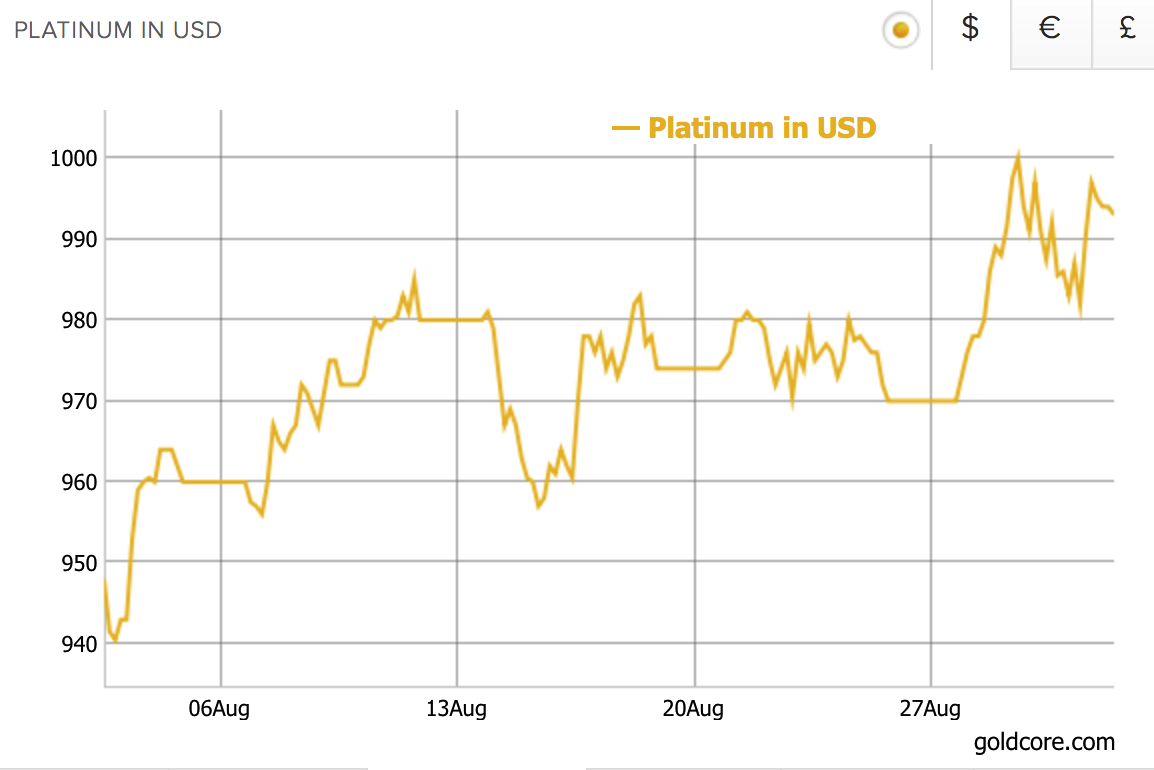
- Platinum is best performing metal climbing over 5%
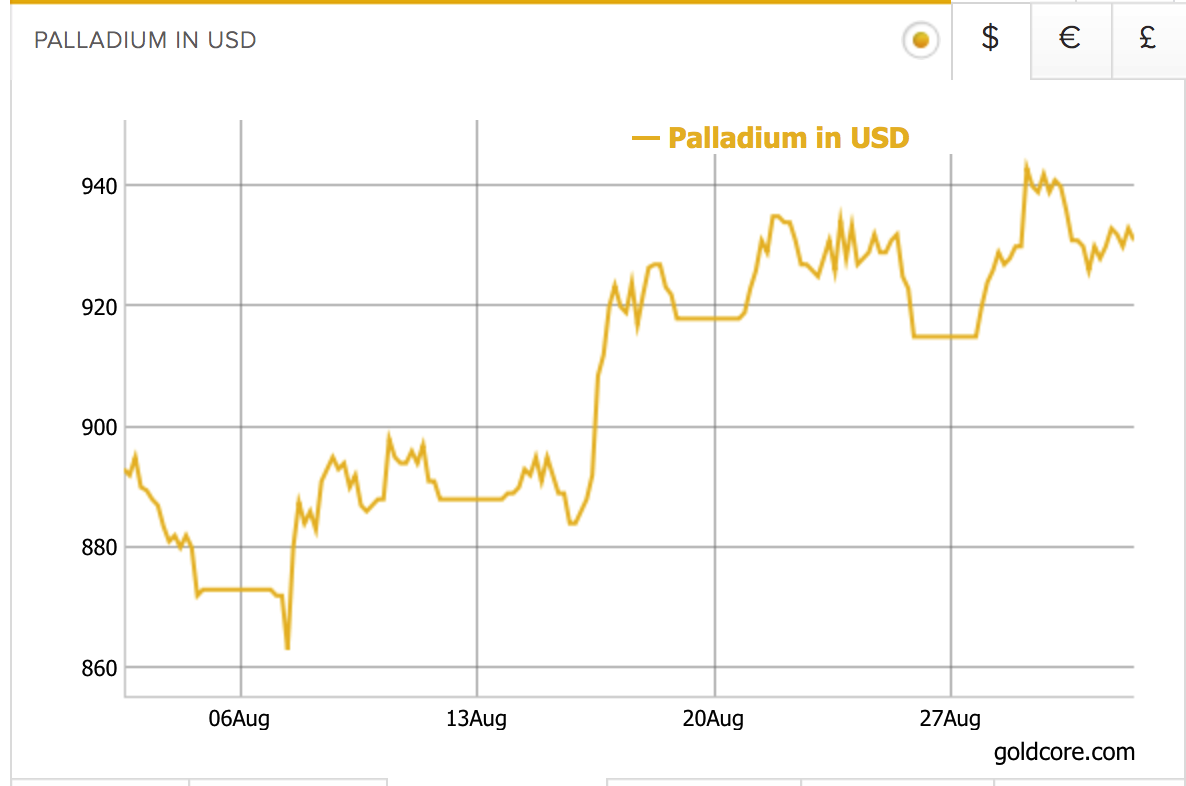
- Palladium climbs over 4% thanks to seven year supply squeeze
- Fear, uncertainty and political sanctions are amongst biggest drivers for precious metals
- Never been a better time to diversify and rebalance portfolios with stocks and bonds near record highs and looking vulnerable


Editor: Mark O"Byrne


Market Performance in August (Finviz.com)


All four precious metals have made gains in the month of August.


Whilst platinum and palladium"s leading performances can largely be attributed to industrial factors they have also benefited from the safe haven demand which is driving gold and silver prices.


Safe haven demand really came into its own this last month. Issues with North Korea have stepped up a level whilst markets have finally begun to question the complacency they have been feeling in regard to the US political and financial situation, geopolitical risk and the increasingly uncertain outlook for the global economy.


Ultimately very little is known about what will happen with the US debt ceiling, increasingly overvalued stocks (both the NASDAQ and  the S&P500), Trump"s plans for corporate tax, dealings with North Korea and (not forgetting) Venezuela.


We are living in very uncertain times indeed and investors decided to allocate funds to the ultimate safe havens - the precious metals.


Gold shines as investors rush into safe havens


This week gold rose to its highest point so far in 2017 as tensions between North Korea (but really, the rest of the world) and the US ramped up. For the month of August the price is up 3.59%.


Silver was also up thanks to safe haven demand, but its 5% climb was also in part due to manufacturing demand. Currently, about 55% of all silver consumed is for industrial use.


Gold has so far risen in every month, bar June.


Gold"s climb has in part been due to ongoing demand from countries such as China and India, but it has primarily been driven by the desire in the West to own a safe haven. This is not surprising given the ongoing concerns regarding North Korea, Venezuela, the Middle East and a lack of cohesion in the Trump administration.


One of the dampeners on gold and silver has been the Federal Reserve"s plans to raise interest rates. However, when they did so it had little effect. Expectations for further hikes are falling. Going forward Yellen and team are expected to slow down on further interest-rate increases which has provided an additional boost for the gold price.


In the very short-term storm Harvey in Houston, Texas has also impacted the price of gold and silver. As a result of lost income and recovery operations, US GDP is expected to be lower in the third-quarter than was initially expected.


In the long-term investors will look to gold and silver as they begin to price risk into the market. Yesterday we expressed our concerns over market complacency whilst other financial organisations have begun to warn clients about the overpriced equity markets and lack of perceived risk.

It is also worth noting an expected climb in demand from China. Mark Tinker, Head of AXA Framlington wrote in a note that China’s pricing of assets in yuan (together with the plan by the Hong Kong Stock Exchange to  sell yuan-priced physical gold contracts) could allow them to trade out of the banking system in the US


“Having accepted payment for oil or gas in RMB, the seller, be it Russia or Saudi Arabia or anyone else for that matter, does not have to worry about having excess RMB, they can simply trade it back into gold,” Tinker said. “We are moving to a multi-polar world.”


Platinum gains as Russia feels the pain


Platinum has performed very well so far in the second half of the year. This most recent surge has likely come about thanks to further sanctions being placed on Russia by the US. Russia is the world"s second biggest producer of the metal.


The World Platinum Investment Council outlined the following arguments for platinum"s role as a safe haven investment asset:


- Supply demand fundamentals are strong and ETF holdings are stable, despite price volatility
- Risks of supply declines are underestimated - cost pressure and falling mining investment continue - Downside risks to platinum automotive demand are overestimated
- Futures positioning follows poor sentiment with high correlation to price
- Platinum is undervalued against its past, its production cost and against gold


Palladium climbs on Vauxhall’s woes


Palladium is currently at a 16 year high. There is a major tightening in the supply of palladium because of increased demand for it in engines. 67% of palladium supply is used in car engines to clean exhaust gases from gasoline engines. There is obviously a major push for ‘clean’ transport and the Vauxhall emissions scandal and obviously helped boost demand.


Inventories of palladium supply are down by abut 45% this year, whilst supply trails demand by the most in the seven years.


Despite the increase in supply, there has been a significant number of redemptions in the the two main U.S. and European palladium ETFs - the ETFS Physical Palladium Shares and the ZKB Palladium. By the 22nd August $49 million had been traded in. Supply in the spot market is reportedly so tight that companies are being forced to trade in multiple ETF shares in order to redeem them with the issuer in exchange for physical palladium.


ETFs are now being treated like palladium warehouses.


It is also important to note that, like platinum, palladium is also hugely affected by the sanctions on Russia.


It is also important to note that ETFs are a risky way to invest in precious metals and most investors would be better served owning actual precious metals rather than paper or digital proxies.


Conclusion: Stars aligning? Outlook good for rest of 2017


Earlier this week we explained how investors shouldn"t always be focused on price. Whilst it is nice to look at the metrics for August and see that all precious metals are up, we should instead focus on why they are up and most importantly the diversification benefits for our portfolios.


Precious metals are largely climbing because the perceived risk in the political and financial system is also climbing. Interestingly many commentators do not feel some risky issues have been wholly appreciated by the markets.


Problems such as North Korea are such serious risks that even someone who pays no attention to markets could spot it. The issue is that you have an overvalued stock market and a US President who cannot get his people together. This means that the US debt ceiling issue might ground the U.S. government to a halt.


These issues are ones which have not yet been fully priced into the markets. They likely will be in the coming months and then the safe haven role of the precious metals and gold in particular will come into its own.


News and Commentary


Gold up 4% in August - largest monthly gain since January (Marketwatch)


Gold steady near 9-1/2 month highs as N.Korea tensions persist (Reuters)


Gold Scores Fifth Monthly Increase; US Mint Bullion Sales Slow in August (Coin News)


Gold edges lower, but N.Korea worries lend support (Nasdaq)


Massive wartime bomb to be defused near German gold reserves (Irish Times)


Source: Marketwatch


From Stocks to Bonds, the Bear-Market Signals Are Multiplying (Bloomberg)


Rothschild reduces exposure to US stocks amid turmoil (Standard)


Five charts show why millennials are worse off than their parents (FT.com)


When the Butterfly Flaps Its Wings - Kunstler (Zerohedge)


Buffett: North Korea situation is very concerning (CNBC)


Gold Prices (LBMA AM)


01 Sep: USD 1,318.40, GBP 1,020.18 & EUR 1,107.98 per ounce
31 Aug: USD 1,305.80, GBP 1,013.17 & EUR 1,098.31 per ounce
30 Aug: USD 1,310.60, GBP 1,014.93 & EUR 1,096.71 per ounce
29 Aug: USD 1,323.40, GBP 1,020.34 & EUR 1,097.36 per ounce
25 Aug: USD 1,287.05, GBP 1,003.90 & EUR 1,090.90 per ounce
24 Aug: USD 1,285.90, GBP 1,003.26 & EUR 1,090.44 per ounce
23 Aug: USD 1,286.45, GBP 1,004.33 & EUR 1,091.68 per ounce


Silver Prices (LBMA)


01 Sep: USD 17.50, GBP 13.53 & EUR 14.69 per ounce
31 Aug: USD 17.34, GBP 13.47 & EUR 14.62 per ounce
30 Aug: USD 17.44, GBP 13.49 & EUR 14.60 per ounce
29 Aug: USD 17.60, GBP 13.59 & EUR 14.62 per ounce
25 Aug: USD 17.02, GBP 13.26 & EUR 14.40 per ounce
24 Aug: USD 16.93, GBP 13.20 & EUR 14.36 per ounce
23 Aug: USD 17.06, GBP 13.32 & EUR 14.48 per ounce


Recent Market Updates


- 4 Reasons Why “Gold Has Entered A New Bull Market” – Schroders
- Gold Reset To $10,000/oz Coming “By January 1, 2018” – Rickards
- Gold Surges 2.6% After Jackson Hole and N. Korean Missile
- Diversify Into Gold On U.S. “Political Instability” Advise Blackrock
- Trump Presidency Is Over – Bannon Is Right
- The Truth About Bundesbank Repatriation of Gold From U.S.
- Cyberwar Risk – Was U.S. Navy Victim Of Hacking?
- Global Financial Crisis 10 Years On: Gold Rises 100% from $650 to $1,300
- Mnuchin: I Assume Fort Knox Gold Is Still There
- Buffett Sees Market Crash Coming? His Cash Speaks Louder Than Words
- Gold, Silver Consolidate On Last Weeks Gains, Palladium Surges 36% YTD To 16 Year High
- Must See Charts – Gold Hedges USD Devaluation, Rise in Oil, Food and Cost of Living Since Nixon Ended Gold Standard
- World’s Largest Hedge Fund Bridgewater Buys $68 Million of Gold ETF In Q2


Important Guides


For your perusal, below are our most popular guides in 2017:


Essential Guide To Storing Gold In Switzerland


Essential Guide To Storing Gold In Singapore


Essential Guide to Tax Free Gold Sovereigns (UK)


Please share our research with family, friends and colleagues who you think would benefit from being informed by it.

Saturday, August 5, 2017

How Many Gold Bars Do London Vaults Hold

This week for the first time - in the name of "transparency" - the London Bullion Market Association unveiled that as at 31 March, 2017 there were 7,449 tonnes of gold, or 596,000 gold bars, valued at $298 billion sotred in the vaults around London as well as $19 billion in silver. Only the gold hoard at Fort Knox and among Indian households said to account for more than the LBMA"s inventory, which clears just over $18 billion in gold daily. Most London gold is stored in the Bank of England, with the rest in private vaults, including those operated by HSBC and JPMorgan, both profiled previously (here and here).


The Bank of England holds most of the gold and silver in London, or over 60% of the total gold, and already publishes some details of its holdings. The new LBMA data supposedly also reveals how much private custodians, HSBC, JP Morgan, and ICBC Standard Bank among them, keep in their vaults.


The publication of vaulting statistics marks the first step toward the LBMA"s promise of greater transparency, which will eventually be enhanced further by trade reporting that is set to also be published later on.
respectively.


As UBS strategist Joni Teves writes, this addition to the available pool of information helps various market participants, as well as regulators, have a better assessment of market activity in precious metals. For instance, comparing the newly released vaulting statistics with trade flows allows for a better understanding of the movement of metal and the dynamics between investment and physical demand. Combined with other indicators of market length, such as Comex net longs and ETF holdings, it also enables market watchers to have a better gauge of market positioning. The data released so far confirms relatively limited investor participation this year – perhaps as a result of a broad shift toward cryptocurrencies as the new "safe" currency, at least among some age groups. Bank of England (BoE) data, which extends further back to 2011, confirms that investor positions have declined considerably from the peak during the height of the bull-run and that there"s room for gold exposures to grow from here.


As LBMA data series extends up ahead, we should get an even better picture. All in all, changes in gold holdings as illustrated by LBMA and BoE reinforce a positive stance on gold.


Courtesy of UBS, below we present extended observations on what the LBMA data reveal, and the implications for the broader gold market in general, as well as investing in the precious metal in particular.


Never "too much of a good thing" with market data


The London Bullion Market Association (LBMA) and the London Precious Metals Clearing Limited (LPMCL) have released data on gold and silver inventories sitting in London vaults (loco London gold and silver), a move that is consistent with wider developments in the industry towards greater transparency. This addition to the available pool of information helps various market participants, as well as regulators, have a better assessment of market activity. Comparing the newly released vaulting statistics with trade flows allows for a better understanding of the movement of metal and the dynamics between investment and physical demand. Combined with other indicators of market length, such as Comex net longs and ETF holdings, it also enables market watchers to have a better gauge of market positioning. The publication of vaulting statistics marks the first step towards more transparency in the industry; trade reporting that is set to also be published later on should further enhance this. Having data on loco London gold and silver trading volumes would allow for better comparisons of trading activity and interest across various regions. As far as market analysis is concerned, there"s no such thing as "too much of a good thing" when it comes to information that provides additional insights.


The LBMA and the LPMCL first announced the plan to publish gold and silver vault holdings in May. The data published today represents aggregated data collected from the Bank of England (BoE) and seven other custodians that offer vaulting services, and covers end-period holdings of gold and silver from July 2016 to March 2017. Going forward, this data will be published each month, with a three-month lag. The data includes gold and silver in the form of large bars, kilo bars or coins, but excludes jewellery and other private holdings held in vaults that are not part of the London clearing system. These statistics only include gold and silver that is held physically in London, defined by the LBMA as “held within the environs of the M25”. This metal underpins the daily trading and clearing activities in the London bullion market.


London continues to be a key gold trading centre globally, with an average of $18.1bn worth of gold cleared each day in March 2017, according to LBMA net daily clearing statistics. Clearing data is different from turnover data, so until we get LBMA trade reporting statistics, comparing London market activity against that of other regions remains challenging. But to somehow put things into context for now, it probably still helps to note that the average daily turnover of physical gold spot contracts on the Shanghai Gold Exchange is over $1bn, while an average of about $32bn worth of gold futures trade on Comex each day.


Estimating investor gold holdings in London


One of the recurring questions that gets asked by clients and various market participants is on the level of gold or silver holdings or the level of investor positioning. This has always been very difficult to answer. The market has had to rely on third-party estimates of above-ground holdings, such as those provided by Thomson Reuters GFMS, the World Gold Council or Metals Focus. Other ways that we"ve tried to address this type of question is to look at Comex net long positions and ETF holdings. Now, with the availability of vaulting statistics, we can add another dimension to the analysis. We can start by saying that 7,449 tonnes or 239.49 moz of gold and 32,078 tonnes or 1,031.32 moz of silver were sitting in London vaults as of end-March.


For gold, we can take the analysis further: as the BoE also publishes gold vault holdings data separately, we are able to split out – at least in aggregate – what is held in other vaults. This is not possible for silver as the BoE does not provide silver custodial services. The BoE provides gold custody services primarily to central bank customers to help them get access to London gold market liquidity, although it also holds some gold custody accounts on behalf of certain commercial banks that support central bank access to the liquidity of the London gold market. On the assumption that the BoE custody service primarily caters to central bank customers, it’s probably fair to say that 1) the bulk of BoE gold represents official sector holdings and 2) gold held in other vaults is likely to be more investment-related. To be sure, this is somewhat simplistic in that, as mentioned earlier, the BoE also offers custody accounts to certain commercial banks, while at the same time it is also possible for central banks to hold their gold in non-BoE vaults.


To put some context around this, let us consider for illustration"s sake that about 80% to 90% of BoE gold holdings are accounted for by the official sector. Let us also consider for simplicity that the vast majority of gold held in commercial vaults represents investor holdings and only a negligible amount comprises official sector gold accounts. These simplistic assumptions would therefore imply that over the past year, an average of about 96.68 to 110.92 moz ($119-139 bn) of investment-related gold was held in London. These inventories would include metal held on behalf of ETFs. Based on our database of gold ETFs, we estimate an average of around 48.78 moz or about $60bn worth of gold was held in London vaults to back ETF shares during the same period. Taking these ETF-related holdings into account would then leave roughly around 47.90 to 62.14 moz or about $60bn to $78bn worth of gold in unallocated and allocated accounts as available pool of liquidity for OTC trading activities.


While we now have a starting point with the vaulting statistics, a breakdown of the type of gold holdings remains unavailable. As such, the discussion above and the charts and tables below are presented here to provide some context. Nevertheless, despite these limitations, the data still somehow supports the broad assumption on how loco London gold stocks may be split between official sector and investor holdings. For instance, the data shows that gold held at the BoE appears to be more stable relative to gold held in other London vaults, such that changes in total loco London gold over the past nine months have been driven more by changes in non-BoE gold. Intuitively, it would make sense for investment-related gold holdings to be more volatile relative to official sector holdings. Central banks hold gold as part of their official reserves and also serve monetary purposes, typically having much longer.


While we now have a starting point with the vaulting statistics, a breakdown of the type of gold holdings remains unavailable. As such, the discussion above and the charts and tables below are obviously only presented here to provide some context. Nevertheless, despite these limitations, the data still somehow supports the broad assumption on how loco London gold stocks may be split between official sector and investor holdings. For instance, the data shows that gold held at the BoE appears to be more stable relative to gold held in other London vaults, such that changes in total loco London gold over the past nine months have been driven more by changes in non-BoE gold. Intuitively, it would make sense for investment-related gold holdings to be more volatile relative to official sector holdings. Central banks hold gold as part of their official reserves and also serve monetary purposes, typically having much longer time horizons.


Matching ETF data against total loco London inventories


Gold and silver held in London vaults that back shares in exchange-traded funds (ETFs) are also included in the statistics, regardless of where the ETF is listed. In general, this means that although gold or silver ETF shares may trade on exchanges elsewhere, as long as the metal is held physically in London, these would be considered loco London and form part of the LBMA’s monthly statistics. For instance, the largest gold ETF is listed and trades on the New York Stock Exchange (NYSE), but its designated custodian ultimately holds the underlying metal in its London vaulting facilities. Similarly for silver, the ETF with the largest holdings trades on the NYSE, but some of the metal underpinning the shares is allocated in London.


We estimate that as of last week there are around 68.65 moz of gold and about 687.57 moz of silver held in ETFs globally. Our database of gold and silver ETFs suggests that, using average gold and silver prices over the past year, about 48.78 moz of gold worth about $60bn and about 427.67 moz of silver worth about $8bn are likely to be held in London to back ETF shares. This is obviously a rough estimate that’s provided here only for indicative purposes.


Looking at changes in ETF holdings vs changes in total vault holdings between July 2016 and the end of the first quarter this year shows that the trend is broadly similar for gold, yet divergent for silver. Considering the period as a whole, the divergence continues for silver with total holdings up by 8% or 79.89moz, but ETFs down 3% or 12.06 moz. For gold, the change in total stocks vs the change in ETFs also diverges when the entire period from July 2016 to March 2017 is taken into account – total loco London gold inventories increased by a modest 2% or 5.34 moz but ETF holdings were down 8% or 3.87 moz.


Given the data series is quite short, it is challenging to form any strong conclusions at this juncture. We expect that as the series extends in time we will be able to gather more insights from these flows. Intuitively, divergences in total London gold stocks and ETF holdings could reinforce other indicators that suggest declines in ETF shares do not always reflect net exit from gold or silver exposures. Instead, outflows from ETFs could represent a switch to different forms of exposure such as allocated or unallocated accounts.


Tracking gold trade flows vs changes in London stocks


Comparing total gold holdings data with UK gold import and export flows confirms a strong link between the two, regardless of whether one is using UK trade data or what may be implied by Swiss Customs statistics. This is intuitive in that net inflows of gold into the UK should understandably translate into a build in holdings, while net outflows would suggest a reduction in overall levels. In addition to UK trade statistics, Swiss data on gold flows from and to the UK is also a useful indicator of how much gold is leaving or entering London vaults. Given Switzerland’s key role in global gold refining, it is an important hub for the movement of metal and essentially acts as an interface between investment demand in Western markets and consumer demand in Asia. Combining Swiss and UK trade data with London vault holdings allows for a more complete picture.


Periods of strong physical demand out of key markets such as India and China could attract the movement of large investment bars sitting in London vaults to Switzerland for conversion into kilo bars. These gold kilo bars would subsequently be shipped to physical buyers in Asia and ultimately be converted into jewellery or other investment products to meet consumer demand. Net outflows of gold from the UK should coincide with declines in vault holdings in this case. In fact, this scenario occurred back in 2013: as the Fed"s taper tantrum led to a sharp rise in US real rates, gold collapsed by 29% as investors exited gold exposures. In turn, the sharp drop in the gold price made it very attractive for physical buyers, especially in the context of a decade-long bull market. Investor gold positions held in London vaults – whether OTC or ETF-related – were being heavily liquidated. This metal then made its way to Switzerland, was converted into kilo bars, and shipped to Asia to satisfy the surge in demand in China, India as well as other parts of the region.


Interestingly, LBMA data shows that in Q3 last year, the opposite occurred – the UK was a net importer of gold and vault holdings increased. This coincided with weak physical demand for most of last year, which was more than offset by a pickup in investment interest. Given strong demand from the investor community, gold still managed to rally 8% in 2016 (and as much as 30% from trough to peak) despite the weak fundamental backdrop. Towards the end of the year, market forces became conducive for gold to once again leave London vaults and be shipped out of the UK. Investors unwound positions in anticipation of the first Fed rate hike, while at the same time, seasonal and regulatory factors in key markets boosted physical demand, allowing buyers in Asia to absorb the liquidation from Western investors. Demand out of China kicked in heading into year-end, in anticipation of the Lunar New Year holidays, while the demonetisation of highvalue banknotes in India led to a knee-jerk spike in demand. So far this year, physical markets have been more stable, while investment demand has been positive yet broadly more subdued. As mentioned earlier, the data tends to reflect this, with changes in loco London gold holdings relatively  limited during the first quarter of 2017.


A marginal benefit of this link between vault holdings and trade flows is that there is a shorter lag in trade data reporting. This means that trade statistics should help market watchers anticipate changes in loco-London inventories before getting confirmation a couple months later from the LBMA report.


Insights on investment activity


Looking at the entire data series from July last year to March this year, an observation that"s worth noting is the modest 2% increase in total gold holdings equivalent to around 166 tonnes. This change is likely a function of investor liquidations in Q4 2016, as markets anticipated a Fed rate hike, which has since reversed but at a subdued pace. This also coincides with ETF flows – heavy liquidations towards the end of last year have been succeeded by net inflows this year, but volumes lag considerably compared to the same period in 2016.


More importantly, according to LBMA data loco London gold holdings during Q1 this year were relatively flat. This coincides well with the broadly limited investor participation in the gold market that we have been highlighting. Many investors are keeping an eye on the gold market and continue to appreciate gold"s value as a diversifier in a portfolio, yet few have been actively involved in putting on meaningful, strategic positions. Subdued investor participation has been an important factor holding gold back, in our view, in spite of supportive macro factors.


Subdued investor activity has been apparent in speculative positioning data indicated by the CFTC Commitment of Traders Report as well as gold ETF flows. In June, sentiment towards gold understandably came under pressure given the rise in real rates – not just in the US but also in Europe – and the seemingly hawkish shift in tone among central banks (see Gold falls as real rates rise). As of early July, CFTC data showed that gold net longs on Comex had fallen to the lowest levels since January last year. Despite the rebound in gold prices in recent weeks, net speculative positions on Comex have remained very lean. Meanwhile, gold ETFs marked the first month of net outflows in July. Although gold ETF holdings are up on a net basis year-to-date, the increase is much more subdued at only 107 tonnes compared to over 598 tonnes during the same period in 2016. Changes in gold positioning on Comex and ETF holdings coincide with the subdued changes in loco London gold inventories.


As mentioned earlier, the data shows a larger increase in silver vault holdings vs gold. Relative speculative positioning between gold and silver on Comex similarly shows a stronger build in investor positions in silver than gold, at least during the first half of the year. Given silver"s large industrial demand component, it initially attracted some attention on the back of growth and risk optimism amid the reflation theme. This translated into persistent gains in Comex investor positioning, which reached a fresh all-time high in May. Yet as fiscal stimulus hopes faded and reflation trades were unwound, so did the interest in silver. Comex positioning has since given back about 81% from the highs, mainly driven by a strong increase in gross short positions, which have been reaching record highs in recent weeks. It would be interesting to see Q2 and Q3 data on loco London silver holdings to find out whether OTC positions followed a similar trend. Loco London silver holdings could potentially be relatively more robust than what Comex speculative positions imply. Silver ETF holdings have generally been resilient over the past few years, despite heavy liquidations in gold ETFs, which could mean that silver OTC positions could also show a similar sense of stability.


Finding clues on positioning from BoE gold data, for now


Given that only limited historical data is available, it is difficult to put total London gold inventories fully into perspective. For instance, we cannot compare current levels versus the amount of gold and silver held during the peak of the bull run nor during the trough reached at the end 2015. However, for gold we can look to BoE vault holdings, which go back to 2011, for some hints. Based on LBMA data, the BoE accounts for the bulk of loco London gold inventories, representing about 68% of the total on average over the period covered. As the LBMA data series extends up ahead, we should be able to have a better idea of how closely linked trends in BoE and non-BoE gold are, and in turn get a better perspective on investor positions.


The amount of gold held at the BoE was at a high of 6,250 tonnes or 200.50 moz in February 2013 and fell to a low of 4,693 tonnes or 150.87 moz in March last year. As of end-Q1, levels are about 8% or 12.49 moz higher at 163.36 moz, but still considerably below the highs. As we argued earlier, the BoE"s gold holdings likely mainly reflect official sector positions. Some central banks manage their gold reserves more actively than others while there have been a few such as the Bundesbank which have repatriated gold held in various foreign locations over the past few years. These flows are likely also reflected in the BoE"s data. Nevertheless, the BoE does hold some gold custody accounts for certain commercial banks. To the extent that non-official sector gold holdings influences these flows, the trends should be broadly similar to changes in loco London gold held in other vaults. The trend in gold holdings would in this case be consistent with our view that exposure to gold has been reduced considerably from the highs during the peak of the bull run. And although investment interest has been revived over the past year and a half, levels of exposure likely remain limited by historical standards. Much leaner positioning is one of the key factors supporting gold this year and suggests that there is ample room for positions to be rebuilt against a backdrop of benign rates, soft dollar and lingering uncertainties.