Showing posts with label Bundesbank. Show all posts

Friday, December 1, 2017

This Cycle: It"s Not The Economy, It"s China, Stupid!

Authored by Kevin Muir via The Macro Tourist blog,


I know everything is fan-freaking-tastic - with the tax reform bill and global synchronized expansion and all. I figure the last thing you need is some nattering naysayer throwing cold water on this unbelievable party, so I won’t. At least not for the short run.


This rally will end when it ends. Maybe tomorrow, maybe next week, maybe next month, maybe next year. I don’t know and every time I try to guess, I just end up looking foolish.


But I recently listened to this terrific Bloomberg Masters in Business interview of the legendary hedge fund manager, Felix Zulauf, and he articulated such a compelling argument for the timing of the next slowdown, I felt like Felix was my Spirit Bear.


I have always enjoyed Felix’s viewpoint, but Barry Ritholtz did such a great job during this interview, that I have a new found appreciation for Felix’s career, and more importantly, his market calls. I had mistakenly assumed Felix was always bearish, but the truth of the matter is that he definitely switches from side to side, and is not the pro-typical Swiss hard money uber-bear. I didn’t agree with all of his economic philosophy by any means, but his market (and political) analysis was some of the most compelling dialog I have listened to in quite some time. If you haven’t heard it, then give it a listen.


If you don’t want to take the time, don’t fret - I have transcribed the most important part for you.


Felix: China I believe is in an interesting position right now. You heard President Xi’s speech last week, and in 2021 there is the 100th anniversary of the Chinese Communist party and it’s very clear that they want to have a strong economy at that time. If you want to have a strong economy in 2021, you stimulate in 2020. And they are central planners. So that’s means they have to take their foot off the pedal in 2018, 2019. I think in ‘18 and ‘19, they will address the imbalances in the financial sector and that will slow down the Chinese economy in ‘18 and ‘19, which will also slow down the rest of the world.


So we are entering a period where sometime in ‘18, I would say the peak of the market will be in the first half, the peak in the economy is probably from mid-2018 on, and then we slow down into 2020.


And 2022 is the next Chinese Congress, and President Xi is probably the first leader who tries to run for a third time. So he wants to have a very good economy in 2021 and 2022. That means he has to first slow things down, restructure some of the imbalances in the system because if he tries to carry through, it could backfire on him. It could be the worst of all worlds. Namely a completely overheated situation, with high inflation rates, etc…


That’s why I think the leader of this cycle, China, is going to slow down next year.


Barry: So the whole global economy is dependent on President Xi’s re-election desires in 2022?


Felix: As I said before, you always need to figure out what is the leading theme in the market cycle. In the last cycle, it was real estate, in this cycle it is China. And that’s why China is so important. China is the second largest economy, and in 10 or 15 years, it will be the largest economy of the world.


Longtime readers will instantly see why Felix’s theory appealed to me. I have long argued that China’s fiscal and monetary policy might be the most two important variables when it comes to forecasting the global economy. And here was Felix making the case that the entire global economic cycle is being driven by China. Felix - you had me at hello.


Now, make no mistake. This is a longer-term call. It’s not going to affect market prices next week, and probably not even next month. But in the coming quarters, it has the potential to be the most important determinant of financial asset performance.


I will take a little more nuanced approach to Felix’s theory, but in broad strokes, I completely agree with his analysis. The Chinese government will not allow their 100th anniversary be anything less than a rocking success. And President Xi is smart enough to know that he can’t just keep the pedal to the metal for the next four years and hope that the economic expansion lasts.


China’s performance over the past year


Remember all the dire warnings from your favourite star hedge fund managers about China’s coming collapse? Well, I don’t want to be prematurely counting any chickens, but it looks like Xi & Co. have managed to successfully navigate another year without the end of the world financial Armageddon scenario coming to fruition.


And it’s not like this has been achieved through growth-at-any-cost with super easy monetary policy. In fact, during the past year, both interest rates and the Chinese Yuan have risen.


It appears as if, bit-by-bit, China has slowly tightened monetary policy. And I suspect that trend will not only continue, but even accelerate from now. President Xi will continue strangling the excesses out of the Chinese financial economy through tighter monetary policy. The PBOC won’t plunge China into a recession, but instead slowly choke off the speculative froth.


But there’s more to the story


Now here is where I will expand on Felix’s theory. China is in the midst of a massive infrastructure spending program with their One-Belt-One-Road initiative. The program is massive, and entails many complicated and extensive transportation system upgrades in all parts of their country. This sort of development is not something that you easily turn on and off. And nor should it be. This is true investment in the future of China. Much like Eisenhower’s interstate highway program that set up America to become an economic powerhouse for decades to come, China’s OBOR initiative is a crucial step for China’s development. Xi will not alter this plan. The course is set, and the money will be spent.


In fact, it’s already happening. And it’s causing China to run the greatest fiscal stimulus in history. Have a look at this chart from the world’s most charming and well-spoken China bear, Kyle Bass:


Yup, that’s crazy. China is running a fiscal deficit of 14% of GDP. Any wonder why the global economy is cruising along so nicely? It sure helps when you have this sort of fiscal stimulus wind in our sails.


Will Xi tap this back? Sure, he might try to trim around the edges, but the reality is that he will not make any meaningful cuts to the OBOR policy.


Therefore, China will be running a hot fiscal policy for years to come, and the only way to counteract its effect, will be by tightening on the monetary side. This will also have the added benefit of causing the financial economy to slow. In fact, we are already seeing this play out in the housing market.


While I was thinking about this situation, I was reminded of a passage in the Market Wizards book where Stanley Druckenmiller spoke about his trade surrounding the unification of East and West Germany:


Everything started to come together at that time. Not only was I trading on my own without any interference, but that same eastern European situation led to my first truly major trade for Soros’s Quantum Fund. I never had more conviction about any trade than I did about the long side of the Deutsche mark when the Berlin wall came down. One of the reasons I was so bullish on the Deutsche mark was a radical currency theory proposed by George Soros in his book, The Alchemy of Finance. His theory was that if a huge deficit were accompanied by an expansionary fiscal policy and tight monetary policy, the country’s currency would actually rise. The dollar provided a perfect test case in the 1981-84 period. At the time, the general consensus was that the dollar would decline because of the huge budget deficit. However, because money was attracted into the country by a tight monetary policy, the dollar actually went sharply higher.


When the Berlin wall came down, it was one of those situations that I could see as clear as day. West Germany was about to run up a huge budget deficit to finance the rebuilding of East Germany. At the same time, the Bundesbank was not going to tolerate any inflation. I went headlong into the Deutsche mark. It turned out to be a terrific trade.


Now I know this isn’t the perfect analogy, but I can’t help but wonder if it will be more correct than all the Yuan bears who are predicting a China collapse.


Putting it all together


We have a Chinese President who wants to be re-elected shortly after his party’s 100th anniversary celebration in 2021. Therefore, it will be important that the Chinese economy is humming along at full speed at that time. To do that, he needs to stimulate in 2020, but the problem is, if he doesn’t tap the brakes now, he might risk overheating before then. President Xi will therefore take the hit, and get the pain over with in 2018 and 2019. Yet the story is further complicated by the fact that China’s long run infrastructure program is causing a hot fiscal policy. All of these factors add up to a much tighter PBOC for the next couple of years.


Call me an idiot, but I am tempted to take the long Yuan trade. I know that seems insane - all those really smart hedge fund managers are all forecasting a China collapse. But buying Yuan is probably better than betting on stocks going down because of the tight Chinese monetary policy. Not convinced it’s the best trade, and not even sure if I am going to do it in any real size, but I have often found the hardest trades, are often the best trades.


Either way, be aware of this multi-year seasonal Chinese economic timing dynamic. Maybe Felix just laid out a timetable for the market to finally roll over, albeit still many months away. That’s probably good because it certainly feels like it will be that long before we get any meaningful correction…


Friday, November 17, 2017

How Corporate Zombies Are Threatening The Eurozone Economy

The recovery in Eurozone growth has become part of the synchronised global growth narrative that most investors are relying on to deliver further gains in equities as we head into 2018. However, the “Zombification” of a chunk of the Eurozone’s corporate sector is not only a major unaddressed structural problem, but it’s getting worse, especially in…you guessed it…Italy and Spain. According to the WSJ.


The Bank for International Settlements, the Basel-based central bank for central banks, defines a zombie as any firm which is at least 10 years old, publicly traded and has interest expenses that exceed the company’s earnings before interest and taxes. Other organizations use different criteria. About 10% of the companies in six eurozone countries, including France, Germany, Italy and Spain are zombies, according to the central bank’s latest data. The percentage is up sharply from 5.5% in 2007. In Italy and Spain, the percentage of zombie companies has tripled since 2007, the Organization for Economic Cooperation and Development estimated in January. Italy’s zombies employed about 10% of all workers and gobbled up nearly 20% of all the capital invested in 2013, the latest year for which figures are available.


The WSJ explains how the ECB’s negative interest rate policy and corporate bond buying are  keeping a chunk of the corporate sector, especially in southern Europe on life support. In some cases, even the life support of low rates and debt restructuring is not preventing further deterioration in their metrics. These are the true “Zombie” companies who will probably never come back from being “undead”, i.e. technically dead but still animate. Belatedly, there is some realisation of the risks.


Economists and central bankers say zombies undercut prices charged by healthier competitors, create artificial barriers to entry and prevent the flushing out of weak companies and bad loans that typically happens after downturns. Now that the European economy is in growth mode, those zombies and their related debt problems could become a drag on the entire continent.


“The zombification of the corporate sector and banks (is) a risk for future living standards,” Klaas Knot, a European Central Bank governor and the head of the Dutch central bank, said in an interview.


In some ways, zombie firms are an unintended side effect of years of easy money from the ECB, which rolled out aggressive stimulus policies, including negative interest rates, to support lending and growth. Those policies have been sharply criticized in some richer eurozone countries for making it easier for banks to keep struggling corporate borrowers alive.


Talking of realising the risk, as usual the Bundesbank is acting as Mario Draghi silent conscience.


The ECB said in late October it would extend its giant bond-buying program through next September, likely pushing back the date of any interest-rate increase until at least 2019. A small group of central-bank officials opposed the decision, including Jens Weidmann, president of Germany’s Bundesbank. In a speech in September, Mr. Weidmann cited an academic study that concluded a bond-buying program by the ECB in 2012 had helped stabilize banks in southern Europe and boost lending but resulted in more loans to weak companies by the same banks. There was no positive impact on employment or investment, the study found.


The WSJ focuses on two industries with structural challenges, namely retail and shipping, and begins with a company which is an archetypal Zombie, Stefanel.


Italian clothing maker and retailer Stefanel SpA became famous for its knitted coats and cardigans. Many economists, investors and bankers know Stefanel as something starkly different: a zombie company. It has posted an annual loss for nine of the last 10 years and restructured its bank debt at least six times, including several grace periods when Stefanel only had to pay interest on what it owed. After booming during Italy’s post-World War II expansion, Stefanel and its lumbering factories were overwhelmed by Spanish fast-fashion giant Zara and then battered by the economic slowdown that hit Italy in 2008. Stefanel is still alive but staggering. So are hundreds of other chronically unprofitable, highly indebted companies being kept afloat with new infusions from lenders and shareholders, especially in Southern Europe.


As the WSJ goes on to highlight, even the radical corporate and debt restructuring of Stefanel has only reduced its debt by 12%.


Banks restructured Stefanel’s debt even when the apparel maker’s financial problems worsened. The banks continued to collect interest, and some of the loans were repaid, but their decisions not to wipe the debt off their balance sheets meant the banks had less money for healthy firms. Stefanel’s lenders included Banca Monte dei Paschi di Siena, where bad loans peaked at nearly $58 billion in 2016. The Italian government took over the bank earlier this year.


The bank and Stefanel declined to comment. As part of a new restructuring plan, two distressed-debt funds will get a 71% stake in Stefanel by year-end for about $13 million. Giuseppe Stefanel, the founder’s son and company’s largest shareholder, will wind up with a stake of about 16%, down from his previous 56%. Banks owed $125 million by Stefanel will see that decline to about $110 million. Banks demanded that Mr. Stefanel give up control and step down as chief executive as a precondition for approving the turnaround plan, according to a person familiar with the matter. Mr. Stefanel will remain non-executive chairman and “have no control whatsoever,” the person said. Mr. Stefanel declined to comment.


We fear that this is unlikely to be enough to see Stefanel through the next downturn. But it’s not just southern Europe, German banks have been the largest lenders to the struggling shipping industry, where Zombie companies abound. Moody’s estimated that the five biggest German lenders to the shipping industry had roughly $26 billion of distressed shipping loans at the end of last year. This is a ratio of 37% compared with total shipping loans and was up from 28% the year before.  


The relationship between Nordeutsche Vermoegen and HSH Nordbank is the example the WSJ cites to show how are keeping companies alive, barely. From the WSJ.


“Some of these zombie companies are getting financed at (interest rates of) 2% because banks are trying to throw good money after bad,” said Basil Karatzas, a shipping-industry consultant in New York…German shipping company Norddeutsche Vermoegen Holding GmbH & Co. KG suffered total losses of $1.1 billion from 2010 to 2015. Its debt quadrupled to more than $2 billion, or almost nine times revenue, from 2007 to 2010. The companthe “Zombification” of a chunk of the Eurozone’s corporate sector is not only a major unaddressed structural problem, but it’s getting worsey hasn’t reported annual results for 2016. In 2016, Norddeutsche Vermoegen got a half-billion euros in debt relief from HSH Nordbank, a German bank that was until recently the world’s largest lender to the shipping industry. According to the shipping company’s financial statements, Norddeutsche Vermoegen made a profit due to “loan forgiveness by the bank.” Norddeutsche Vermoegen and HSH Nordbank declined to comment.


The gravity of the situation has warranted greater scrutiny by the ECB as the article explains. Back in May, the ECB announced on-site inspection for banks with exposure to distressed shipping debt. In a speech earlier this month, Draghi acknowledged the bad debt problem, while lamenting that many banks lack the ability to absorb losses.


“We all know the damage that persistently high levels of NPLs can do to banks’ health and credit growth. And though NPL levels have been coming down for significant institutions – from around 7.5 per cent in early 2015 to 5.5 per cent now – the problem is not yet solved. “Many banks still lack the ability to absorb large losses, as their ratio of bad loans to capital and provisions remains high,” he said.


The ECB faces a Catch-22, pressing banks to address the problem more aggressively not only threatens the banks, but the provision of credit to the broader economy. The WSJ highlights the Morgan Stanley view that a resolution in Italy, for example, will last a decade.


Italian banks have set aside half of the value of their $407 billion in gross problem loans at the end of 2016, according to the country’s central bank. That means the banks would be hit with billions of euros in additional losses if they sell the loans. Many lenders would rather hold on to the shaky loans and hope for the best. The ECB proposed last month requiring banks to set aside more cash to cover newly classified bad loans. The proposal was criticized by senior Italian officials, including former Prime Minister Matteo Renzi.


“If they pass new rules, credit to small businesses will be impossible,” he wrote on Twitter. Some banks in Italy have begun to tackle the problem, including by announcing plans to sell billions of dollars of bad loans within three years. Analysts at Morgan Stanley estimate it will take the country’s banks 10 years to reach the European average for nonperforming loans.


This impressive piece of journalism ends on a thought-provoking note from Portugal which perfectly describes the endless suffering of the corporate “undead” in structurally challenged industries.


In Portugal, a program set up in 2012 by the government as part of the country’s bailout aimed to help heavily indebted companies reach agreements with creditors, avoid insolvency and free up money to invest and grow. In practice, the revitalization program can discourage banks from pulling the plug on battered companies, said Antonio Samagaio, an accounting professor at ISEG-Lisbon School of Economics and Management. The reason: The program allows lenders to take fewer write-downs because debt that isn’t forgiven still is considered performing for accounting purposes. Lisgráfica Impressão e Artes Gráficas SA, one of Portugal’s largest printers, entered the program in early 2013. Banks forgave 65% of the company’s debt and agreed to extend repayments. That helped Lisgráfica to keep most of its workers on the job. Now, though, Lisgráfica is having trouble making its debt payments. The company’s revenue has been hurt by the advertising decline at newspaper and magazine clients. Lisgráfica’s losses are widening.


Of course, at the heart of these structural problems are the failure by central banks to, firstly not create an artificial sense of prosperity via credit bubbles, but secondly, to accept some shorter-term pain for longer-term free-market gain. As Schumpter asserted “The process of creative destruction is the essential fact about capitalism”, but this isn"t capitalism.  


Thursday, October 19, 2017

Ray Dalio Is Shorting The Entire EU

Authored by Raul Ilargi Meijer via The Automatic Earth blog,


A point BOE Governor Mark Carney made recently may be the biggest cog in the European Union’s wheel (or is it second biggest? Read on). That is, derivatives clearing. It’s one of the few areas where Brussels stands to lose much more than London, but it’s a big one. And Carney puts a giant question mark behind the EU’s preparedness.


Carney Reveals Europe’s Potential Achilles Heel in Brexit Talks


Carney explained why Europe’s financial sector is more at risk than the UK from a “hard” or “no-deal” Brexit. [..] When asked does the European Council “get it” in terms of potential shocks to financial stability, Carney diplomatically commented that “a learning process is underway.” Having sounded alarm bells about clearing in his last Mansion House speech, he noted “These costs of fragmenting clearing, particularly clearing of interest rate swaps, would be born principally by the European real economy and they are considerable.”


Calling into question the continuity of tens of thousands of derivative contracts , he stated that it was “pretty clear they will no longer be valid”, that this “could only be solved by both sides” and has been “underappreciated” by Europe . Carney had a snipe at Europe for its lack of preparation “We are prepared as we should be for the possibility of a hard exit without any transition…there has been much less of that done in the European Union.”


In Carneys view “It’s in the interest of the EU 27 to have a transition agreement. Also, in my judgement given the scale of the issues as they affect the EU 27, that there will ultimately be a transition agreement. There is a very limited amount of time between now and the end of March 2019 to transition large, complex institutions and activities…


If one thinks about the implementation of Basel III, we are alone in the current members of the EU in having extensive experience of managing the transition for individual firms of various derivative and risk activities from one jurisdiction back into the UK. That tends to take 2-4 years. Depending on the agreement, we are talking about a substantial amount of activity.” [..] “I wouldn’t want to use financial stability issues as leverage. I wouldn’t want them to be addressed in a bloodless technocratic way in the interests of all the citizens.”


Sounds like Carney knows a thing or two that Juncker et al haven’t sufficiently thought through. The EU plans to move all – or most- derivatives clearing to the continent, but such a thing is anything but easy. That’s another very tangled web, and an expensive one to boot. Brussels probably wants to use the issue to put pressure on London in some way, but a hard Brexit might make that unlikely if not worse. Bloomberg from June this year:


EU Targets Derivative-Clearing Giants With Relocation Threat


“Today, a significant amount of financial instruments denominated in the currencies of the member states are cleared by recognized third-country CCPs,” according to the proposal. “For example, the notional amount outstanding at Chicago Mercantile Exchange in the U.S. is €1.8 trillion for euro-denominated interest-rate derivatives,” the commission said. “This also raises a series of concerns.”


The financial industry has lobbied hard against a location policy. The International Swaps and Derivatives Association said requiring euro-denominated interest-rate derivatives to be cleared by an EU-based clearinghouse would boost initial margin requirements by as much as 20% . The FIA, a trade organization for the futures, options and centrally cleared derivatives markets, has said forced relocation “could nearly double margin requirements from $83 billion to $160 billion.”


According to that Bloomberg piece, the notional amount outstanding of euro-denominated OTC interest-rate derivatives is some $90 trillion, 97% of which goes through the London Clearing House (LCH) based in .. well, you guessed it. Wikipedia:


LCH is a European-based independent clearing house that serves major international exchanges, as well as a range of OTC markets. Based on 2012 figures LCH cleared approximately 50% of the global interest rate swap market, and is the second largest clearer of bonds and repos in the world , providing services across 13 government debt markets.


In addition, LCH clears a broad range of asset classes including: commodities, securities, exchange traded derivatives, credit default swaps, energy contracts, freight derivatives, interest rate swaps, foreign exchange and Euro and Sterling denominated bonds and repos. LCH’s members comprise a large number of the major financial groups including almost all of the major investment banks, broker dealers and international commodity houses.


More details from Reuters, also in June:


Derivatives Body Warns EU Against Moving Euro Clearing From London


Shifting clearing of euro-denominated derivatives from London to the European continent would require banks to set aside far more cash to insure trades against defaults, a cost that would be passed on to companies, a global derivatives industry body says. [..]The London Stock Exchange’s subsidiary LCH currently clears the bulk of euro-denominated swaps, a derivative contract that helps companies guard against unexpected moves in interest rates or currencies.


Britain, however, is due to leave the bloc in 2019, putting it out of the EU’s regulatory reach. The International Swaps and Derivatives Association (ISDA), one of the world’s top derivatives industry bodies, said on Monday that a “relocation” in euro clearing to continental Europe would split liquidity in markets and reduce the ability of banks to save on margin by offsetting positions in the same liquidity pool.


Deutsche Bank has the world’s largest derivatives portfolio. Not all of it will be euro-denominated, but still. And I know it’s just notional amounts, but derivatives are not things one plays fast and loose with, lest the clearing becomes opaque and trouble starts.


Juncker better solve this thing. Oh, and this one too (yes, it’s quite fun to report on this):


Money Will Divide Europe After Brexit


As part of the transition period of around two years that she called for in her emollient Florence speech last month, Britain would continue to pay in to the EU budget to ensure that none of the member states was out of pocket owing to the decision to leave. These net payments of around €10 billion a year would fix the immediate problem facing the EU, the hole that would otherwise open up in its finances during the final two years of its current budgetary framework, which runs from 2014 to 2020.


[..] through its accounting procedures, the EU can and does commit it to spending that will be paid for by future receipts from the member states. What this means is that even after 2020 there will still be payments due on commitments made under the current seven-year spending plan. That pile of unpaid bills, eloquently called the “reste à liquider” (the amount yet to be settled), is forecast to be €254 billion at the end of 2020.


Estimates of what Britain might owe towards this vary, but taking into account what might have been spent on British projects it could be around €20 billion. On top of that – and the second main reason why the EU is holding out for more – the EU has liabilities, notably arising from the unfunded retirement benefits of European staff estimated at €67 billion at the end of 2016, which it is expecting Britain to share. Even taking into account some potential offsets from its share of assets, Britain may face a bill of between €30 billion and €40 billion on top of the €20 billion paid during the transition period.


The EU finances itself on the fly. It’ll have a €254 pile of unpaid bills in 3 years time. That is scary. Not for Brussels, but for its member countries. A hard Brexit, in which Britain may refuse to pay, is perhaps even scarier.


Anyway, once Juncker’s done with all that, he’ll have to move on to the next problem.


Derivatives is a big cloud hanging over Europe, but this one is potentially shattering.


Ray Dalio, manager of the world’s biggest hedge fund, is shorting, placing large bets against, anything Italian, and given Italy’s size and hence importance to the EU, his bets are effectively bets against Brussels.


Dalio’s Fund Opens $300 Million Bet Against Italian Energy Firm


Bridgewater Associates is adding to its billion-dollar short against the Italian economy. The world’s largest hedge fund disclosed a $300 million bet against Eni SpA, Italy’s oil and gas giant, data compiled by Bloomberg show. Bloomberg previously reported that Ray Dalio’s firm had wagered more than $1.1 billion against shares of six Italian financial institutions and two other companies.


This latest bet is the hedge fund’s second-largest against an Italian company, trailing only the $310 million against Enel SpA, the country’s largest utility. Eni’s majority holder is the Italian government via state lender Cassa Depositi e Prestiti SpA and the Ministry of Economy. The public involvement also is reflected in the government’s role in appointing the chief executive officer. Current CEO Claudio Descalzi has been at the helm since 2014 and was reconfirmed this year.


$1.1 billion against the banking system, $310 million against the main utility, $140 million vs pan-European insurer Generali and now $300 million vs the national oil and gas company, That adds up to quite a bit more than the Bloomberg graph says, but I’ll include it anyway.


Dalio doesn’t call the bluff of Italy, and this is not just like George Soros’ shorting the British pound in 1992, he’s calling out the entire EU and its financial system.


He’s saying I don’t believe you can keep up the charade.


He’s making a mockery of Mario Draghi’s “whatever it takes”.


So what are Rome, Brussels and Frankfurt going to do? They can’t ignore the no. 1 hedge fund forever. They will have to pump money into Italy, in large amounts. Merkel won’t like that, neither will her new coalition partner FDP, and the Bundesbank may start legal action.


Dalio’s located the Union’s achilles heel, which is not just that Italy’s insolvent (it’s not alone in that), but that there’s a gigantic theater production being performed to give everyone the impression that things are going just swimmingly, thank you. So Dalio’s said: how much for a ticket to the show?, and paid it. And now he’s inside.


Bridgewater didn’t enter that theater for nothing. $1.85 billion is not chump change for them. Intesa Sanpaolo CEO Carlo Messina may have said that Dalio will lose his bets, but according to the IMF Italy’s non-performing loans levels were €356 billion at the end of June 2016, which is 18% of total loans for Italian banks, 20% of Italy’s GDP and one-third of total Eurozone NPLs. Intesa Sanpaolo holds a nice chunk of that.


‘Whatever it takes’ may well be too much to take for the EU, and Draghi looks outsmarted, as do Juncker and Merkel. How many billions will it take for Dalio to go away? And then, who’s next, which hedge fund, which politician, which ECB chief? Coming soon to a theater near you.

Monday, September 25, 2017

The ECB's Target2 Lies - Exposing The Real Capital Flight From Italy & Spain

Authored by Mike Shedlock via MishTalk.com,


The ECB claims that Target2 does not represent capital flight. Evidence says the ECB is wrong, especially for Italy and Spain.


I have discussed this previously, but let’s recap Target2 before taking a look at new charts.


Project Syndicate writer, Hans-Werner Sinn, explains why the ECB’s asset purchases and Target2 imbalances constitute “Europe’s Secret Bailout”.


Under the ECB’s QE program, which started in March 2015, eurozone members’ central banks buy private market securities for €1.74 trillion ($1.84 trillion), with more than €1.4 trillion to be used to purchase their own countries’ government debt.


The QE program seems to be symmetrical because each central bank repurchases its own government debt in proportion to the size of the country. But it does not have a symmetrical effect, because government debt from southern European countries, where the debt binges and current-account deficits of the past occurred, are mostly repurchased abroad.


For example, the Banco de España repurchases Spanish government bonds from all over the world, thereby deleveraging the country vis-à-vis private creditors. To this end, it asks other eurozone members’ central banks, particularly the German Bundesbank and, in some cases, the Dutch central bank, to credit the payment orders to the German and Dutch bond sellers. Frequently, if the sellers of Spanish government bonds are outside the eurozone, it will ask the ECB to credit the payment orders.


In the latter case, this often results in triangular transactions, with the sellers transferring the money to Germany or the Netherlands to invest it in fixed-interest securities, companies, or company shares. Thus, the German Bundesbank and the Dutch central bank must credit not only the direct payment orders from Spain but also the indirect orders resulting from the Banca de España’s repurchases in third countries.


The payment order credits granted by the Bundesbank and the Dutch central bank are recorded as Target claims against the euro system.


For the GIPS countries [Greece, Italy, Portugal, and Spain], these transactions are a splendid deal. They can exchange interest-bearing government debt with fixed maturities held by private investors for the (currently) non-interest-bearing and never-payable Target book debt of their central banks – institutions that the Maastricht Treaty defines as limited liability companies because member states do not have to recapitalize them when they are over-indebted.


If a crash occurs and those countries leave the euro, their national central banks are likely to go bankrupt because much of their debt is denominated in euro, whereas their claims against the respective states and the banks will be converted to the new depreciating currency. The Target claims of the remaining euro system will then vanish into thin air, and the Bundesbank and the Dutch central bank will only be able to hope that other surviving central banks participate in their losses. At that time, German and Dutch asset sellers who now hold central bank money will notice that their stocks are claims against their central banks that are no longer covered.


Target2 Liabilities


A quick perusal of Target2 Balances for January shows capital flight has largely stabilized but the imbalance in Spain hit a new record.


ECB’s Story on Target2 Doesn’t Add Up


Financial Times Alphaville guest writer Marcello Minenna makes a case in pictures for what I have long stated.


It’s interesting to note that Minenna is the head of Quantitative Analysis and Financial Innovation at Consob, the Italian securities regulator.


Minenna says the ECB’s Story on Target2 Doesn’t Add Up


Mienna compares France with its stable Target2 balance to Italy and Spain.


France Target2 Over Time


The red line with dots represents the imbalance. As of July France had a Target2 liability of 12.2 billion. France shows no correlation to ECB asset purchases.


Germany Target2 Surplus


Italy Target2 Liability


Spain Target2 Liability


Mienna goes over what various colored bars represents and concludes “For Italy and Spain, the QE programme has facilitated capital outflows by domestic investors. Elsewhere, it has not.”


This is what I concluded long ago. For discussion, please see Target2 and Secret Bailouts: Will Germany be Forced Into a Fiscal Union with Rest of Eurozone?

Saturday, September 9, 2017

Conor McGregor - Worth His Weight In Gold?

Conor McGregor - Worth His Weight In Gold?


- Conor McGregor, MMA champion has gold statue made of him
- If McGregor was cast in investment grade gold bullion he would be worth ...
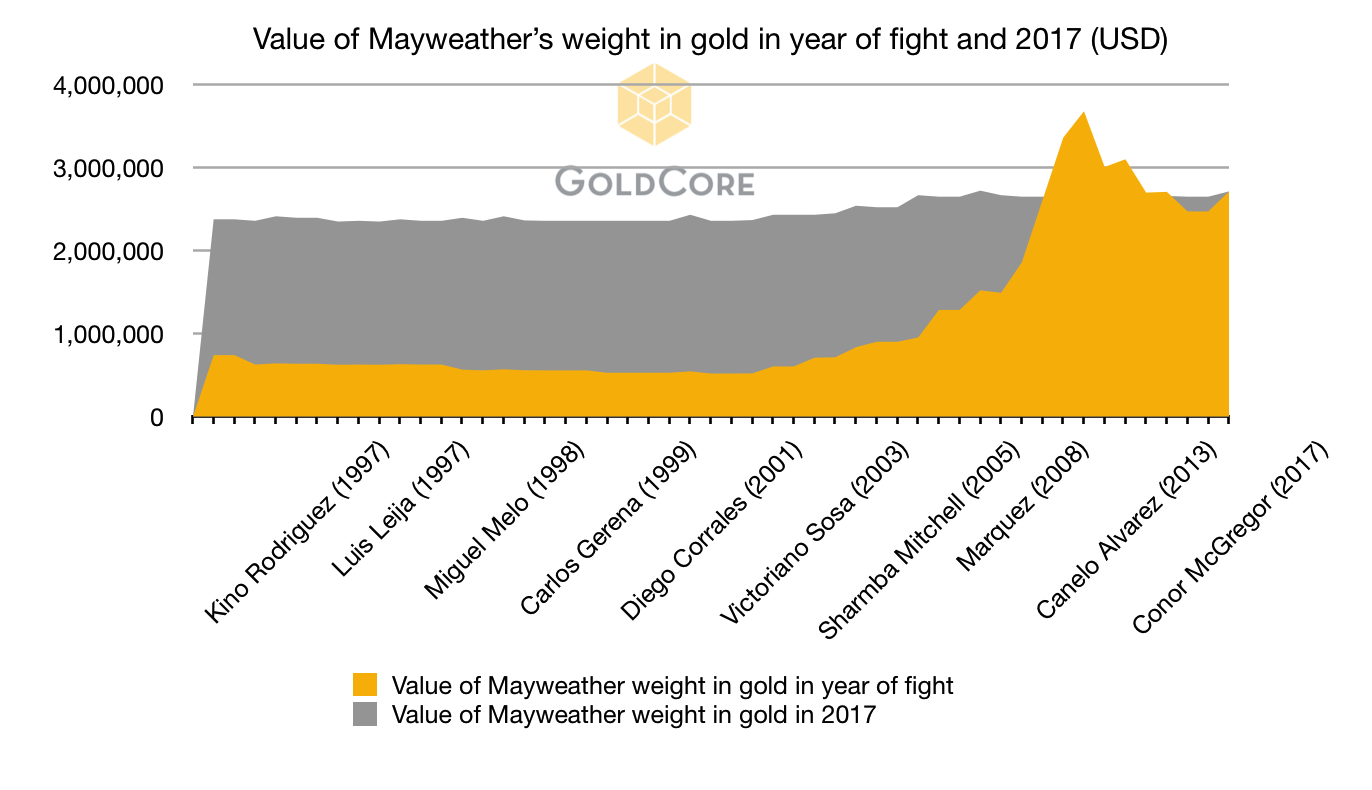
- If Mayweather were cast in gold he would be worth $2.7m
- Ali once fought equivalent of MMA fighter and nearly lost use of his legs
- Gold continues to be seen as the ultimate prize in sport
- Gold a great prize but true value is as a safe haven


At the moment there are some heated debates going on about statues that some believe should no longer stand.


Many of the figures previously cast in bronze, gold or stone are no longer seen as heroes. Time has changed some people"s perspective on what were once seen as heroic endeavours and achievements.


Today we have different measures of success and while statues of now divisive historical figures are being pulled down, statues of modern millennial heroes are being raised. Last week a statue was created of the "Notorious", world champion Mixed Martial Arts (MMA) fighter, Dublin-born Conor McGregor.


In one of the most hyped fights of all time last week, McGregor was defeated by the 50-times unbeaten boxing champion Floyd Mayweather in Las Vegas.


McGregor’s achievement of stepping out of his comfort zone and his actual sport and taking on the legend that is Floyd Mayweather was applauded by most and it is something that has not gone unnoticed by Irishman Eamon Heneghan.


Last week Heneghan unveiled a life-size gold statue of Conor McGregor, ‘I"m such a big fan and find him so inspirational.’ the amateur sculptor told the Irish Independent.


Heneghan is currently out of work. He saw that McGregor has a keen interest and penchant for gold and gold statues and decided that he would make one for him.


His hopes are that the MMA champion will notice it. We hope he does as statues are getting bad rep at the moment and this one was only made out of admiration for someone who has made history.


The gold-sprayed chicken wire and papier-mâché statue has been called a mixture of things but it was definitely one headline that declared the statue ‘belongs in the pantheon of horrible sports sculptures’ that grabbed my attention.


Whatever you think of the statue you have to admire the effort that went into it. We thought we would look at some other headline-grabbing sports statues and look at what may have happened if they had been cast in gold.


Ugly statues


A lot of sports stars have been confronted with statues that perhaps aren"t the most...flattering.


One of the most famous is Ronaldo.


The bust was cast out of bronze, but we suspect if Ronaldo had ben cast in gold he might feel a little happier about it.


Is Ronaldo worth his weight in gold? Ronaldo was bought by Real Madrid for €94 million in 2009. At the time his weight in gold was worth €1.76m, today he is worth over €2.8m in gold. This is nothing to do with Ronaldo"s performance, instead the simple climb in price of gold.


How does that compare to the other competitor for world"s best footballer, Lionel Messi. The Barcelona Forward €250m. Weighing in at 72kg, Messi"s weight in gold today is worth €2.25m.


Wimbledon champs


Photo credit: AP


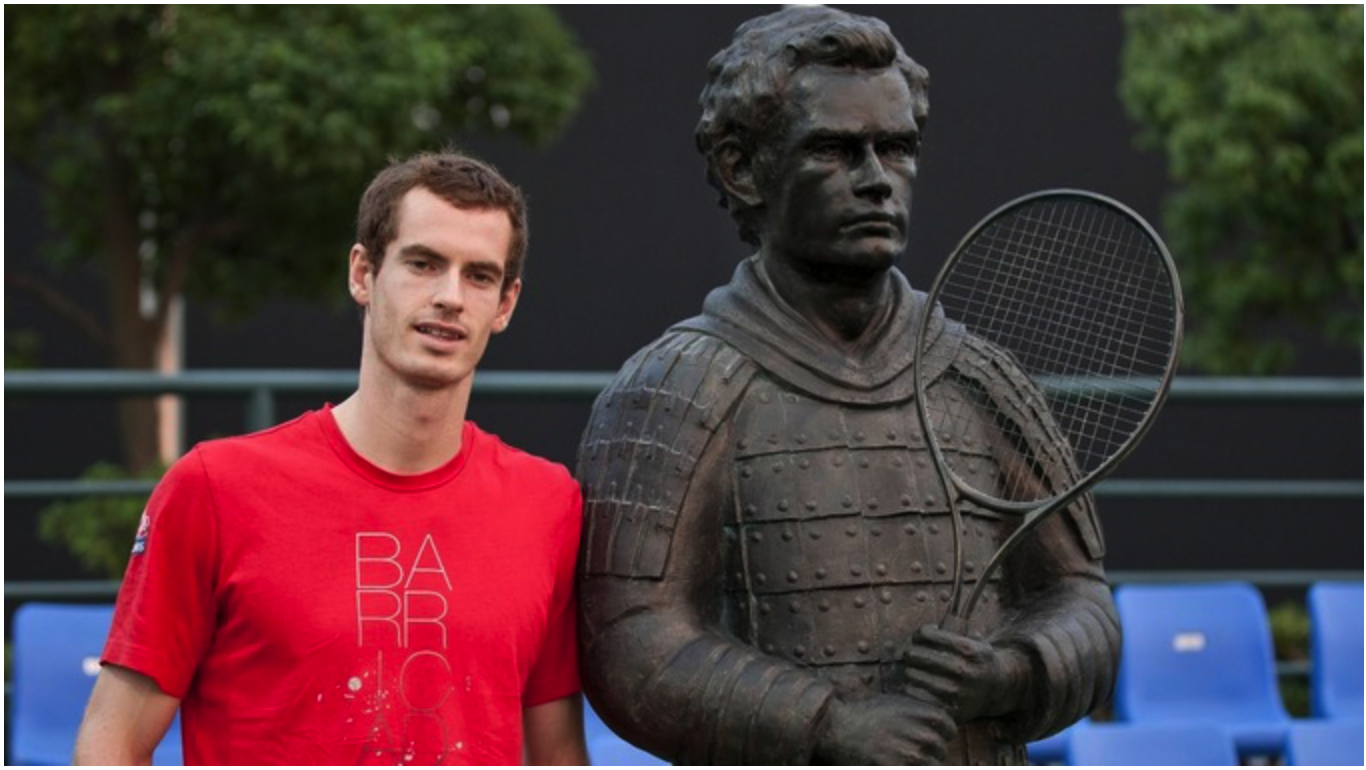
In 2011, Andy Murray was "honoured" with a Terracotta Army statue in Shanghai.


The Chinese are obviously known for their love of gold. Had they decided to make Andy"s 84kg frame into a gold statue in 2011 then it would have fallen slightly from £2.856m to £2.688m.


Murray"s statue in Shanghai was in good company. Just the year before Roger Federer had been gifted with a statue in a similar style. In contrast to Murray"s 2011 statue, Federer"s 2010 statue has climbed in value from £2.295m to £2.72m. It shows what difference a year can make.


All about the gold


What’s most interesting about the coverage surrounding this new statue is that it wouldn’t have happened if Heneghan hadn’t decided to paint it in gold.


If he’d not painted it at all or just gone for a plain colour then no-one would be interested.


We have a fascination with gold that means it makes headlines. Most people have an interest in gold.


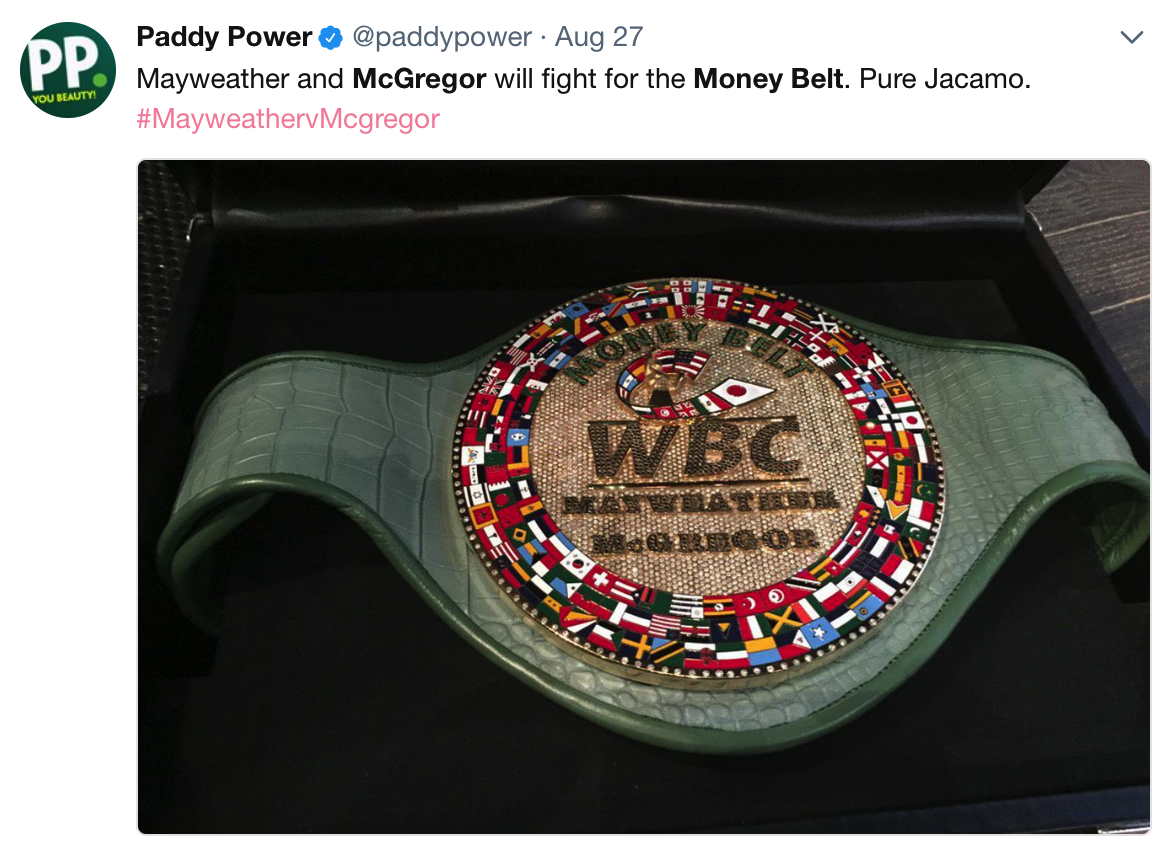
We reward people in gold. Last week the belt McG and Mayweather were fighting for was made of 1.5kg gold (plus 3,360 diamonds 600 sapphires and 160 emeralds).


The desire to reward and be rewarded in gold has been around since time immemorial. It is not a recent phenomenon of rising gold prices or flashy Instagram photos.


We know deep down inside that to be rewarded in gold is to be rewarded with something that will last long past the victories and should even secure your financial future.


Watch gold in the long-term


The last few examples of how gold can change in over time are merely short-term ones.


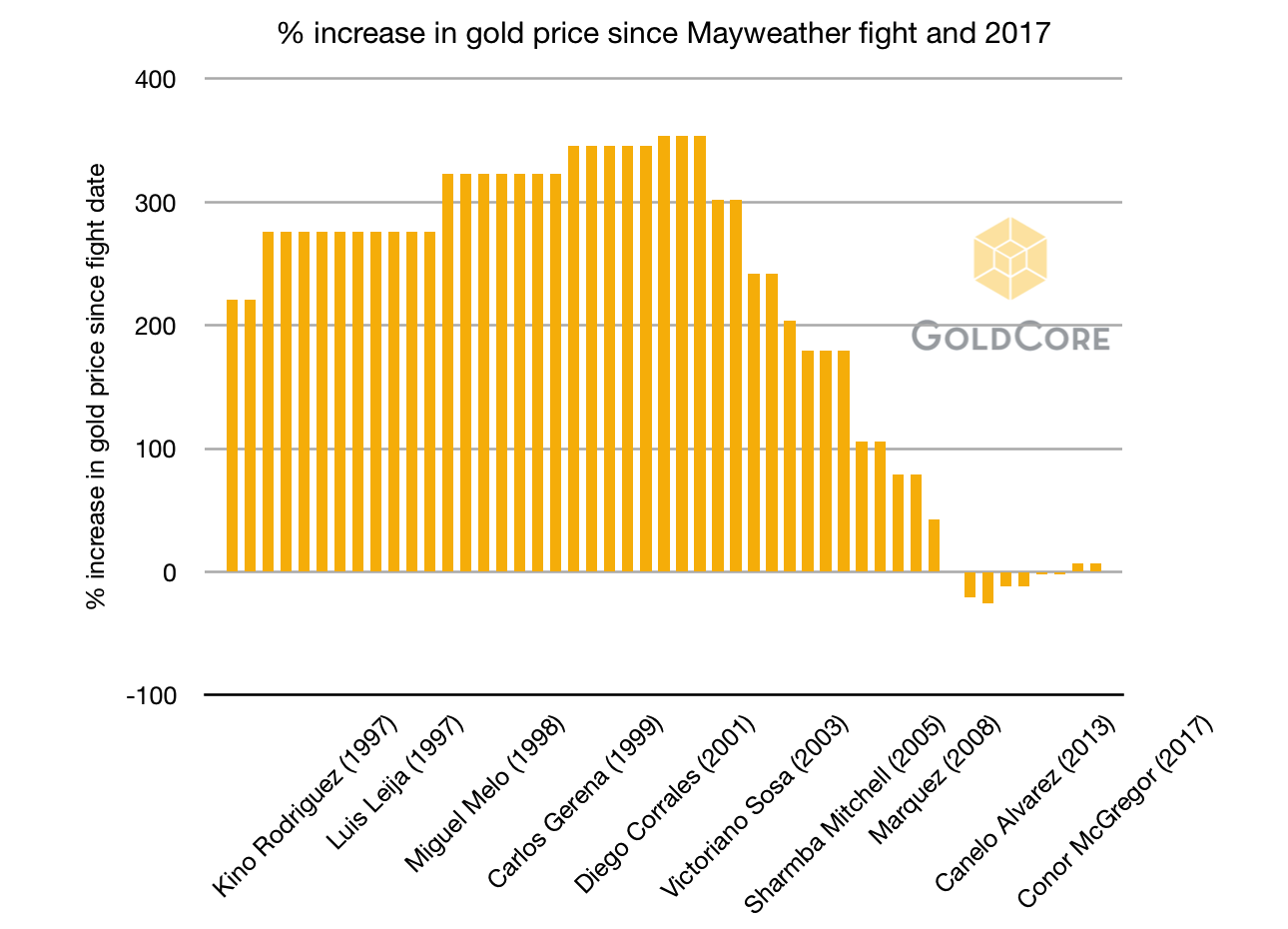
To bring it back to Mayweather we can take each of his fighting weights from his 50 fights and see how the equivalent weight in gold has climbed since.


The graph below shows the percentage gain in the gold price since Mayweather"s first fight in 1996 and in 2017. Since his 1996 fight against Roberto Apodaca the price of gold has climbed by over 226%.


Gold hasn"t demonstrated as big gains if you bought in recent years but the lesson here is that gold takes its time. A bit like property or indeed fine wine.


Conclusion: Gold"s the champion but it takes its time and doesn"t show off


The most famous boxer of all time is of course Muhammad Ali.


What"s interesting about Ali in light of the Mayweather vs McGregor fight is that the legendary boxer once took on a similar challenge.


In 1976 Ali fought Antonio Inoki, a Japanese professional wrestler. The fight was fought under special rules  and is seen as a precursor to the MMA sport which McGregor is famous for today.


The result was a draw but Ali was arguably left worse off. He was left with two blood clots in his legs. These hindered him for the rest of his career with amputation even being discussed at one point. The fight is considered one of the most embarrassing of Ali"s career.


Ali was so convinced that he could show that he was "The Greatest" that he stepped out of his comfort zone and into unfamiliar territory. As a result he nearly ruined his entire sporting future and his health.


An analogy can be drawn with Ali"s challenge with what we see today in the financial world and governments controlling the monetary system. They feel they are infallible. They are taking on riskier and riskier matches, with rules that are unfamiliar and the consequences known.


What has survived the test of time and all of the risk taking and speculative punts whether in sports or finance?


Gold has. Gold cannot be beaten to a pulp whether figuratively or literally. It has stood strong through financial crisis and crashes throughout history and will continue to protect people in the coming uncertain years.


Conor McGregor has done very well financially in recent years and is believed to have made €100 million from the Mayweather fight alone.


We sincerely hope that in order to protect his financial well being, he diversifies into physical gold bullion.


News and Commentary


Gold climbs to 1-year high as U.S. dollar sees fresh weakness (MarketWatch.com)


Gold rises to one-year high amid sluggish dollar (Reuters.com)


Dollar Tumbles as Yen, Euro Rally on Irma, ECB (Bloomberg.com)


ECB keeps door open to even more stimulus (Reuters.com)


Hurricane Harvey lifts U.S. jobless claims to more than two-year high (Reuters.com)


Source: Bloomberg


Yen Losing its Haven Sheen to Gold on North Korea (Bloomberg.com)


Gold to reach $1400 on dollar weakness and North Korea (CNBC.com)


Flight to quality may see further gains for gold bullion (CNBC.com)


Gold prices boom as fears grow over North Korea nuclear crisis (Independent.co.uk)


Own Gold for Long Term as Fiat Money is Doomed - Frisby (MoneyWeek.com)


Gold Prices (LBMA AM)


08 Sep: USD 1,350.90, GBP 1,026.82 & EUR 1,120.71 per ounce
07 Sep: USD 1,340.45, GBP 1,026.52 & EUR 1,119.54 per ounce
06 Sep: USD 1,340.15, GBP 1,028.03 & EUR 1,122.11 per ounce
05 Sep: USD 1,331.15, GBP 1,029.51 & EUR 1,120.43 per ounce
04 Sep: USD 1,334.60, GBP 1,030.98 & EUR 1,120.53 per ounce
01 Sep: USD 1,318.40, GBP 1,020.18 & EUR 1,107.98 per ounce
31 Aug: USD 1,305.80, GBP 1,013.17 & EUR 1,098.31 per ounce


Silver Prices (LBMA)


08 Sep: USD 18.21, GBP 13.80 & EUR 15.09 per ounce
07 Sep: USD 17.79, GBP 13.59 & EUR 14.85 per ounce
06 Sep: USD 17.77, GBP 13.62 & EUR 14.90 per ounce
05 Sep: USD 17.88, GBP 13.80 & EUR 15.03 per ounce
04 Sep: USD 17.80, GBP 13.75 & EUR 14.95 per ounce
01 Sep: USD 17.50, GBP 13.53 & EUR 14.69 per ounce
31 Aug: USD 17.34, GBP 13.47 & EUR 14.62 per ounce


Recent Market Updates


- ‘Things Have Been Going Up For Too Long’ – Goldman CEO
- Physical Gold In Vault Is “True Hedge of Last Resort” – Goldman Sachs
- Bitcoin Falls 20% as Mobius and Chinese Regulators Warn
- Gold Surges To $1338 as U.S. Warns of ‘Massive’ Military Response
- Precious Metals Outperform Markets In August – Gold +4%, Silver +5%
- 4 Reasons Why “Gold Has Entered A New Bull Market” – Schroders
- Gold Reset To $10,000/oz Coming “By January 1, 2018” – Rickards
- Gold Surges 2.6% After Jackson Hole and N. Korean Missile
- Diversify Into Gold On U.S. “Political Instability” Advise Blackrock
- Trump Presidency Is Over – Bannon Is Right
- The Truth About Bundesbank Repatriation of Gold From U.S.
- Cyberwar Risk – Was U.S. Navy Victim Of Hacking?
- Global Financial Crisis 10 Years On: Gold Rises 100% from $650 to $1,300


Important Guides


For your perusal, below are our most popular guides in 2017:


Essential Guide To Storing Gold In Switzerland


Essential Guide To Storing Gold In Singapore


Essential Guide to Tax Free Gold Sovereigns (UK)


Please share our research with family, friends and colleagues who you think would benefit from being informed by it.

Sunday, September 3, 2017

Vault Containing $70 Billion In German Gold To Be Evacuated As Frankfurt Defuses Massive Bomb

Approximately 60,000 residents of Germany’s financial capital, Frankfurt, will be ordered to evacuate their homes on Sunday as the city"s emergency service staff will attempt to defuse a massive World War Two bomb, discovered recently at a local building site. The 1.4-tonne HC 4000 bomb dropped by the British air force during World War Two was uncovered on a building site on Wismarer Strasse in Frankfurt’s leafy Westend where many wealthy bankers live.


“We have never defused a bomb of this size,” bomb disposal expert Rene Bennert told Reuters, adding that it had been damaged on impact when it was dropped between 1943 and 1945.


Bomb disposal experts who examined it said the massive evacuation could wait until the weekend. “We are still working on the modalities of the evacuation plan,” a spokeswoman for Frankfurt police said on Wednesday.


As a result, ahead of Sunday"s planned evacuation, more than 100 hospital patients, including premature infants and those in intensive care, were evacuated from two Frankfurt hospitals on Saturday, city councillor Markus Frank told Reuters television. 


Every year more than 2,000 tonnes of live bombs and munitions are still found in Germany, even under buildings. In July, a kindergarten was evacuated after teachers discovered an unexploded World War Two bomb on a shelf among some toys. During World War II, Germany was pummeled by 1.5 million tonnes of bombs from British and American warplanes that killed 600,000 people. German officials estimate 15% of the bombs failed to explode, some burrowing six meters (yards) deep.


And while local residents have been eager to comply with the unprecedented evacuation, the biggest since the war, Frankfurt fire and police chiefs said they would use force and incarceration if necessary to clear the area of residents, warning that an uncontrolled explosion of the bomb would be big enough to flatten a city block.


Frankfurt’s residents have to clear the area by 8 a.m. on Sunday and police will ring every doorbell and use helicopters with heat-sensing cameras to make sure nobody is left behind before they start diffusing the bomb.


Where this otherwise trivial evacuation takes on a more sinister, "Die Harder" spin, is when looking at what other structures are impacted by the 1.5 km evacuation radius: these include Frankfurt’s Goethe University, police headquarters, two hospitals, transport systems... oh and the Bundesbank headquarters, which as a reminder ten days ago completed the accelerated repatriation of 674 tonnes of gold - some three years ahead of schedule - from New York and Paris to its vault deep underground.


According to Reuters, the Bundesbank vault which stores 1,710 tonnes of gold deep underground - approximately half the country’s reserves - is located less than 600 meters from the location of the bomb. Well, that particular vault which now holds $70 billion in gold (including $28 billion in freshly repatriated physical) and everything around it, is about to be evacuated. All that"s missing are several dozen dump trucks to take advantage of the massive evacuation that will leave thousands of gold bars without security for 1.5 kilometers in any direction.


While airspace for 1.5 kilometers around the bomb site will be closed, we doubt that will prove a major hurdle to anyone eager to take a stab at a real-life reincarnation of the second Die Hard movie.


Still, to prevent anyone from getting any ideas of following in Simon Gruber"s footsteps, a spokesman for the German Bundesbank said, that "the usual security arrangements" would remain in place while experts worked to disarm the bomb.


The fate of half of Germany"s gold aside, bomb disposal experts said they will make use of a “Rocket Wrench” to try and unscrew the fuses attached to the HC 4,000 bomb. If that fails, a water jet will be used to cut the fuses away from the bomb, Bennert told Reuters. The most dangerous part of the exercise will be applying the wrench, Bennert said.


Roads and transport systems, including the underground, will be closed during the work and for at least two hours after the bomb is defused, to allow patients to be transported back to hospitals without traffic. It is not unusual for unexploded bombs from World War Two air raids to be found in German cities, but rarely are they so large and in such a sensitive position.


Meanwhile, Frankfurters can spend the day at shelters set up at the trade fair and the Jahrhunderthalle convention center. Most museums are offering residents free entry on Sunday, and a few of them will open their doors earlier in the morning than usual.

Saturday, September 2, 2017

Precious Metals Outperform Markets In August – Gold +4%, Silver +5%

Precious Metals Outperform Markets In August – Gold +4%, Silver +5%


 - All four precious metals outperform markets in August
- Gold posts best month since January, up nearly 4%
- Gold reaches highest price since US election, climbs due to uncertainty and safe haven demand
- S&P 500 marginally higher; Euro Stoxx, Nikkei lower for month

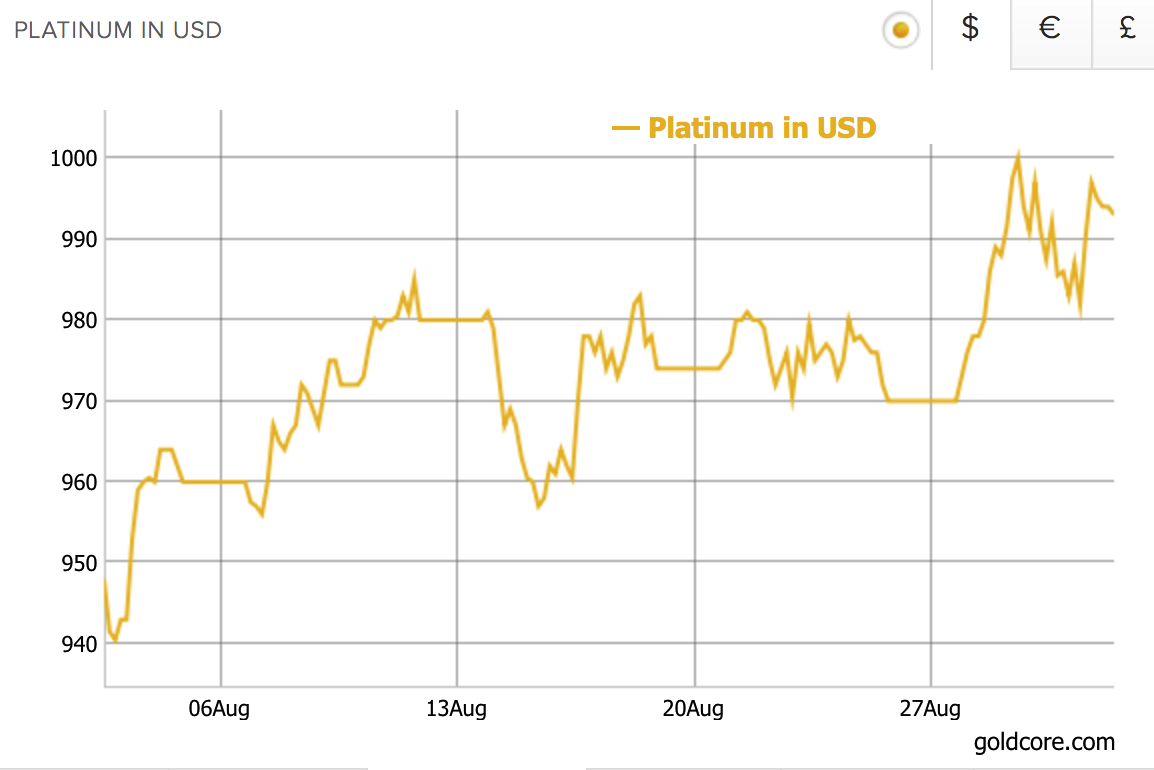
- Platinum is best performing metal climbing over 5%
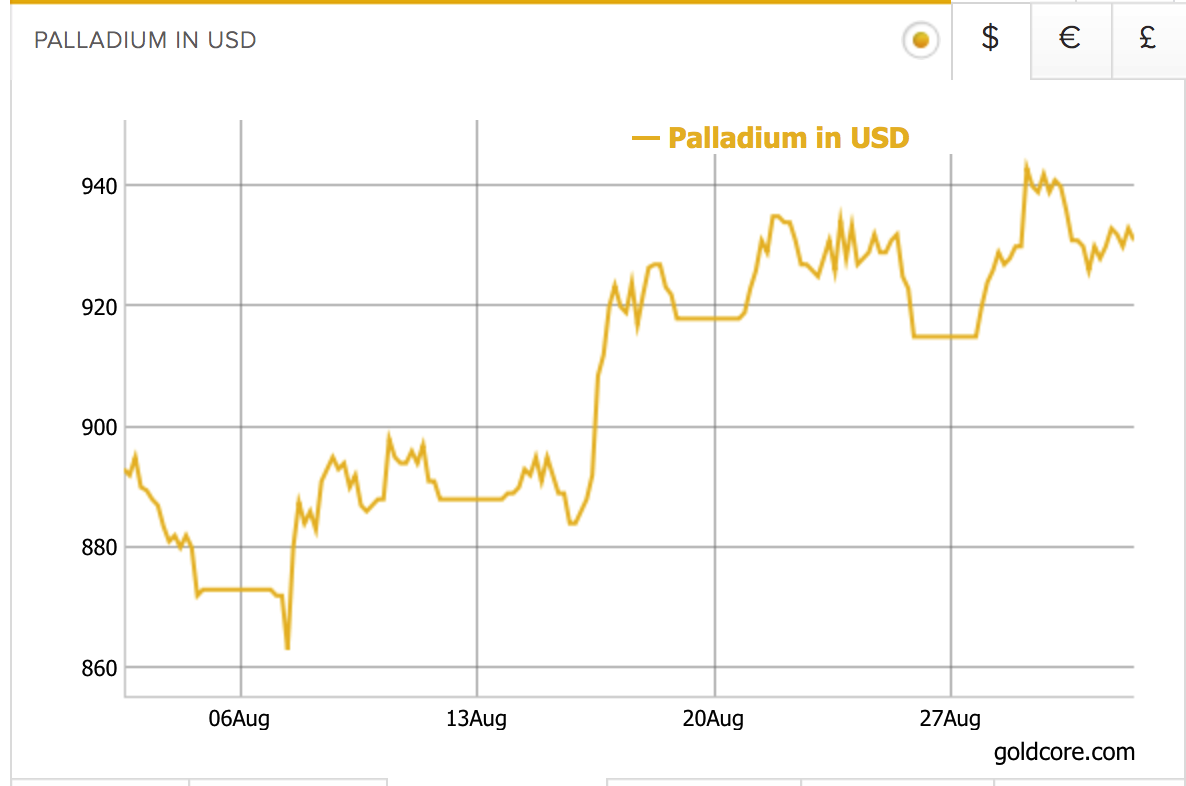
- Palladium climbs over 4% thanks to seven year supply squeeze
- Fear, uncertainty and political sanctions are amongst biggest drivers for precious metals
- Never been a better time to diversify and rebalance portfolios with stocks and bonds near record highs and looking vulnerable


Editor: Mark O"Byrne


Market Performance in August (Finviz.com)


All four precious metals have made gains in the month of August.


Whilst platinum and palladium"s leading performances can largely be attributed to industrial factors they have also benefited from the safe haven demand which is driving gold and silver prices.


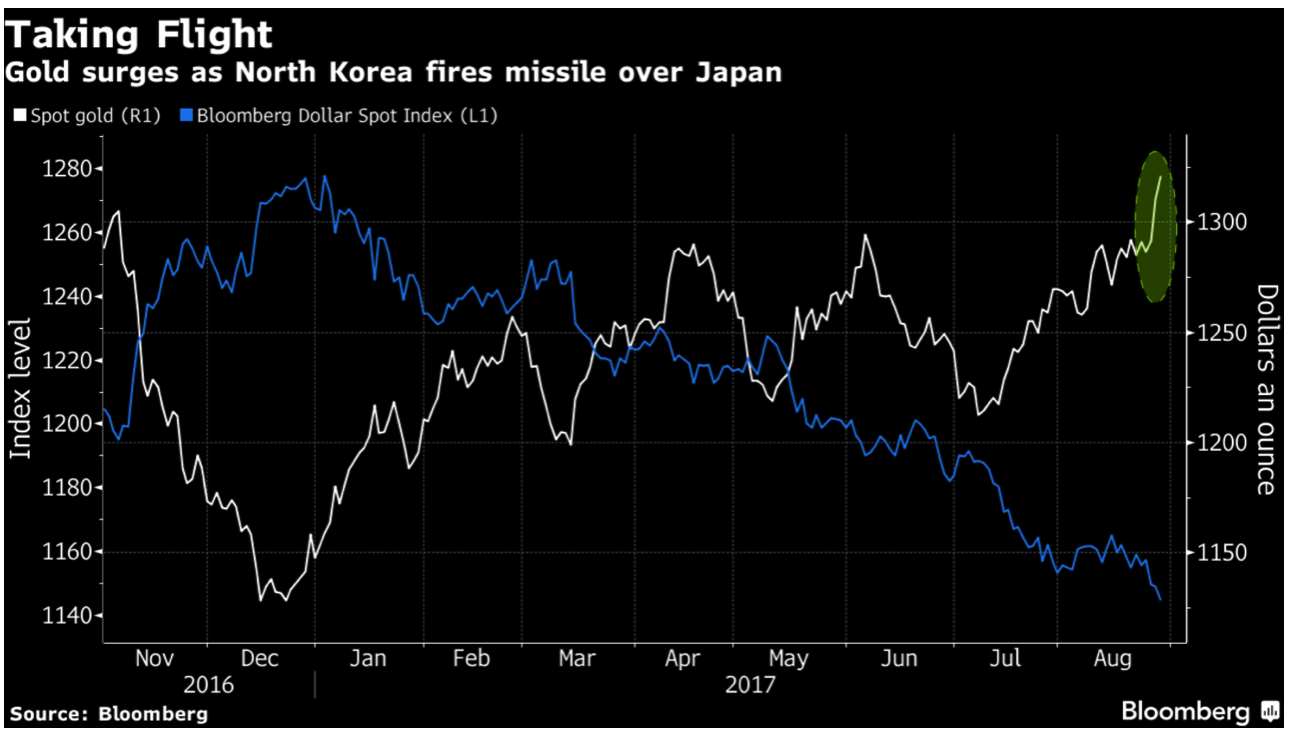
Safe haven demand really came into its own this last month. Issues with North Korea have stepped up a level whilst markets have finally begun to question the complacency they have been feeling in regard to the US political and financial situation, geopolitical risk and the increasingly uncertain outlook for the global economy.


Ultimately very little is known about what will happen with the US debt ceiling, increasingly overvalued stocks (both the NASDAQ and  the S&P500), Trump"s plans for corporate tax, dealings with North Korea and (not forgetting) Venezuela.


We are living in very uncertain times indeed and investors decided to allocate funds to the ultimate safe havens - the precious metals.


Gold shines as investors rush into safe havens


This week gold rose to its highest point so far in 2017 as tensions between North Korea (but really, the rest of the world) and the US ramped up. For the month of August the price is up 3.59%.


Silver was also up thanks to safe haven demand, but its 5% climb was also in part due to manufacturing demand. Currently, about 55% of all silver consumed is for industrial use.


Gold has so far risen in every month, bar June.


Gold"s climb has in part been due to ongoing demand from countries such as China and India, but it has primarily been driven by the desire in the West to own a safe haven. This is not surprising given the ongoing concerns regarding North Korea, Venezuela, the Middle East and a lack of cohesion in the Trump administration.


One of the dampeners on gold and silver has been the Federal Reserve"s plans to raise interest rates. However, when they did so it had little effect. Expectations for further hikes are falling. Going forward Yellen and team are expected to slow down on further interest-rate increases which has provided an additional boost for the gold price.


In the very short-term storm Harvey in Houston, Texas has also impacted the price of gold and silver. As a result of lost income and recovery operations, US GDP is expected to be lower in the third-quarter than was initially expected.


In the long-term investors will look to gold and silver as they begin to price risk into the market. Yesterday we expressed our concerns over market complacency whilst other financial organisations have begun to warn clients about the overpriced equity markets and lack of perceived risk.

It is also worth noting an expected climb in demand from China. Mark Tinker, Head of AXA Framlington wrote in a note that China’s pricing of assets in yuan (together with the plan by the Hong Kong Stock Exchange to  sell yuan-priced physical gold contracts) could allow them to trade out of the banking system in the US


“Having accepted payment for oil or gas in RMB, the seller, be it Russia or Saudi Arabia or anyone else for that matter, does not have to worry about having excess RMB, they can simply trade it back into gold,” Tinker said. “We are moving to a multi-polar world.”


Platinum gains as Russia feels the pain


Platinum has performed very well so far in the second half of the year. This most recent surge has likely come about thanks to further sanctions being placed on Russia by the US. Russia is the world"s second biggest producer of the metal.


The World Platinum Investment Council outlined the following arguments for platinum"s role as a safe haven investment asset:


- Supply demand fundamentals are strong and ETF holdings are stable, despite price volatility
- Risks of supply declines are underestimated - cost pressure and falling mining investment continue - Downside risks to platinum automotive demand are overestimated
- Futures positioning follows poor sentiment with high correlation to price
- Platinum is undervalued against its past, its production cost and against gold


Palladium climbs on Vauxhall’s woes


Palladium is currently at a 16 year high. There is a major tightening in the supply of palladium because of increased demand for it in engines. 67% of palladium supply is used in car engines to clean exhaust gases from gasoline engines. There is obviously a major push for ‘clean’ transport and the Vauxhall emissions scandal and obviously helped boost demand.


Inventories of palladium supply are down by abut 45% this year, whilst supply trails demand by the most in the seven years.


Despite the increase in supply, there has been a significant number of redemptions in the the two main U.S. and European palladium ETFs - the ETFS Physical Palladium Shares and the ZKB Palladium. By the 22nd August $49 million had been traded in. Supply in the spot market is reportedly so tight that companies are being forced to trade in multiple ETF shares in order to redeem them with the issuer in exchange for physical palladium.


ETFs are now being treated like palladium warehouses.


It is also important to note that, like platinum, palladium is also hugely affected by the sanctions on Russia.


It is also important to note that ETFs are a risky way to invest in precious metals and most investors would be better served owning actual precious metals rather than paper or digital proxies.


Conclusion: Stars aligning? Outlook good for rest of 2017


Earlier this week we explained how investors shouldn"t always be focused on price. Whilst it is nice to look at the metrics for August and see that all precious metals are up, we should instead focus on why they are up and most importantly the diversification benefits for our portfolios.


Precious metals are largely climbing because the perceived risk in the political and financial system is also climbing. Interestingly many commentators do not feel some risky issues have been wholly appreciated by the markets.


Problems such as North Korea are such serious risks that even someone who pays no attention to markets could spot it. The issue is that you have an overvalued stock market and a US President who cannot get his people together. This means that the US debt ceiling issue might ground the U.S. government to a halt.


These issues are ones which have not yet been fully priced into the markets. They likely will be in the coming months and then the safe haven role of the precious metals and gold in particular will come into its own.


News and Commentary


Gold up 4% in August - largest monthly gain since January (Marketwatch)


Gold steady near 9-1/2 month highs as N.Korea tensions persist (Reuters)


Gold Scores Fifth Monthly Increase; US Mint Bullion Sales Slow in August (Coin News)


Gold edges lower, but N.Korea worries lend support (Nasdaq)


Massive wartime bomb to be defused near German gold reserves (Irish Times)


Source: Marketwatch


From Stocks to Bonds, the Bear-Market Signals Are Multiplying (Bloomberg)


Rothschild reduces exposure to US stocks amid turmoil (Standard)


Five charts show why millennials are worse off than their parents (FT.com)


When the Butterfly Flaps Its Wings - Kunstler (Zerohedge)


Buffett: North Korea situation is very concerning (CNBC)


Gold Prices (LBMA AM)


01 Sep: USD 1,318.40, GBP 1,020.18 & EUR 1,107.98 per ounce
31 Aug: USD 1,305.80, GBP 1,013.17 & EUR 1,098.31 per ounce
30 Aug: USD 1,310.60, GBP 1,014.93 & EUR 1,096.71 per ounce
29 Aug: USD 1,323.40, GBP 1,020.34 & EUR 1,097.36 per ounce
25 Aug: USD 1,287.05, GBP 1,003.90 & EUR 1,090.90 per ounce
24 Aug: USD 1,285.90, GBP 1,003.26 & EUR 1,090.44 per ounce
23 Aug: USD 1,286.45, GBP 1,004.33 & EUR 1,091.68 per ounce


Silver Prices (LBMA)


01 Sep: USD 17.50, GBP 13.53 & EUR 14.69 per ounce
31 Aug: USD 17.34, GBP 13.47 & EUR 14.62 per ounce
30 Aug: USD 17.44, GBP 13.49 & EUR 14.60 per ounce
29 Aug: USD 17.60, GBP 13.59 & EUR 14.62 per ounce
25 Aug: USD 17.02, GBP 13.26 & EUR 14.40 per ounce
24 Aug: USD 16.93, GBP 13.20 & EUR 14.36 per ounce
23 Aug: USD 17.06, GBP 13.32 & EUR 14.48 per ounce


Recent Market Updates


- 4 Reasons Why “Gold Has Entered A New Bull Market” – Schroders
- Gold Reset To $10,000/oz Coming “By January 1, 2018” – Rickards
- Gold Surges 2.6% After Jackson Hole and N. Korean Missile
- Diversify Into Gold On U.S. “Political Instability” Advise Blackrock
- Trump Presidency Is Over – Bannon Is Right
- The Truth About Bundesbank Repatriation of Gold From U.S.
- Cyberwar Risk – Was U.S. Navy Victim Of Hacking?
- Global Financial Crisis 10 Years On: Gold Rises 100% from $650 to $1,300
- Mnuchin: I Assume Fort Knox Gold Is Still There
- Buffett Sees Market Crash Coming? His Cash Speaks Louder Than Words
- Gold, Silver Consolidate On Last Weeks Gains, Palladium Surges 36% YTD To 16 Year High
- Must See Charts – Gold Hedges USD Devaluation, Rise in Oil, Food and Cost of Living Since Nixon Ended Gold Standard
- World’s Largest Hedge Fund Bridgewater Buys $68 Million of Gold ETF In Q2


Important Guides


For your perusal, below are our most popular guides in 2017:


Essential Guide To Storing Gold In Switzerland


Essential Guide To Storing Gold In Singapore


Essential Guide to Tax Free Gold Sovereigns (UK)


Please share our research with family, friends and colleagues who you think would benefit from being informed by it.

Saturday, August 26, 2017

Trump Presidency Is Over - Bannon Is Right

Trump Presidency Is Over - Bannon Is Right


“‘The Donald’ has been White House-broken,” writes Bill Bonner in his must read daily missive on Bonner and Partners


“‘The Donald’ has been White House-broken,” was what we were trying to say, translating the phrase into something that may make sense to a French listener.


But it was too clever and complicated.


“Well, let’s just say the president has been brought into line,” we simplified.


Social Season


This is the social season in the French countryside.


Weddings, cocktails, receptions – people use the month of August to reconnect with friends before returning to work, school, and retirement in the fall.


Yesterday, we drove about a half hour over country lanes to a gracious 18th-century farmhouse. There, about 100 people had gathered on the lawn.


“You are American?” we were asked several times. “What do you think of Trump?”


We dodged as best we could. Inevitably, we were forced to explain that, yes, he is a disgrace… but, no, we would not prefer Ms. Clinton… and, no, we do not like [French president] Mr. Macron, either:


“None of them has the strength or independence you would need to buck the trend.”


“What trend is that…?”


“Oh, it’s a long story… and it is such a beautiful evening…”


The guests were a wide assortment of local farmers and Paris-based hedge fund managers. The former complain about the weather. The latter complain about the markets. Both complain about the government.


But here at the Diary… we don’t complain. We just want to know when to pack an umbrella.


Payoffs and Pimping


Yesterday, we looked at how Washington insiders have brought President Trump to heel.


He said so himself: “Decisions are much different when you sit behind the desk in the Oval Office.”


Many people believe the White House elevates its occupants so they become better people and make better decisions.


Candidate Trump may be a scoundrel or a scalawag, lusting for fame and fortune, when he announces his candidacy, they say. But when he enters the White House, the slime, incompetence, and corruption are washed down the drain. The man is born again… as POTUS.


If this were true, the Pennsylvania Avenue sewer would clog up after each election. Instead, it runs clear… because the wheeling and dealing… the payoffs and pimping… are still going on!


Alas, the White House elevator goes in both directions.


This week, President Trump hit the “down” button. Against his own “instincts”… reneging on his promises to the people who voted for him… he agreed to go along with the generals in their plan to kill more people… and spend more money… so as to make their crony friends richer and advance their own careers.


That is how things work in the “swamp.”


Today and tomorrow, we connect the dots back to the financial world.


End of an Era


Win-win deals increase prosperity. Win-lose deals reduce it.


The swamp is where the win-lose deals breed. Since the 1970s, it has grown to cover half the U.S. economy.


There, wasteful spending, stifling regulations, phony money, misleading financial signals, zombies – corporate and individual – and all the many excesses and absurdities we watch daily here at the Diary are warping honest price signals, destroying real output, and transferring real Main Street wealth to the swamp’s insiders.


Donald J. Trump promised to pull the plug. But he couldn’t even if he wanted to. And now his decisions are Oval Office decisions… that is to say, those that suit the Deep State.


He cannot drain the swamp; he is now a part of it.


There will be no cutback in domestic spending (no genuine or important reform of O’care, for example)… and no cutback in the empire’s wars abroad.


That still leaves the possibility of tax reform. But even that is extremely unlikely. The last major tax reform program was 35 years ago. The president has neither the political skills nor the ideological commitment needed to pull off another one.


No “skinny budget”… no spending cuts… no tax reform… no relief from the swamp.


And that, friends (and we don’t have to spell it out), is why Breitbart’s Steve Bannon is right: The Trump presidency is over.


Where to next?


Tune in tomorrow…


Since founding Agora Inc. in 1979, Bill Bonner has found success in numerous industries. His unique writing style, philanthropic undertakings and preservationist activities have been recognized by some of America"s most respected authorities. With his friend and colleague Addison Wiggin, he co-founded The Daily Reckoning in 1999, and together they co-wrote the New York Times best-selling books Financial Reckoning Day and Empire of Debt. His other works include Mobs, Messiahs and Markets (with Lila Rajiva), Dice Have No Memory, and most recently, Hormegeddon: How Too Much of a Good Thing Leads to Disaster. His most recent project is The Bill Bonner Letter.


Gold Prices This Week (LBMA AM)


25 Aug: USD 1,287.05, GBP 1,003.90 & EUR 1,090.90 per ounce
24 Aug: USD 1,285.90, GBP 1,003.26 & EUR 1,090.44 per ounce
23 Aug: USD 1,286.45, GBP 1,004.33 & EUR 1,091.68 per ounce
22 Aug: USD 1,285.10, GBP 1,000.71 & EUR 1,091.95 per ounce
21 Aug: USD 1,287.60, GBP 999.82 & EUR 1,096.52 per ounce


Silver Prices This Week (LBMA AM)


25 Aug: USD 17.02, GBP 13.26 & EUR 14.40 per ounce
24 Aug: USD 16.93, GBP 13.20 & EUR 14.36 per ounce
23 Aug: USD 17.06, GBP 13.32 & EUR 14.48 per ounce
22 Aug: USD 17.02, GBP 13.27 & EUR 14.48 per ounce
21 Aug: USD 17.02, GBP 13.20 & EUR 14.48 per ounce


Market Updates This Week


- The Truth About Bundesbank Repatriation of Gold From U.S.
- Mnuchin: I Assume Fort Knox Gold Is Still There
- Buffett Sees Market Crash Coming? His Cash Speaks Louder Than Words
- Gold, Silver Consolidate On Last Weeks Gains, Palladium Surges 36% YTD To 16 Year High
- Must See Charts – Gold Hedges USD Devaluation, Rise in Oil, Food and Cost of Living Since Nixon Ended Gold Standard
- World’s Largest Hedge Fund Bridgewater Buys $68 Million of Gold ETF In Q2


Important Guides


For your perusal, below are our most popular guides in 2017:


Essential Guide To Storing Gold In Switzerland


Essential Guide To Storing Gold In Singapore


Essential Guide to Tax Free Gold Sovereigns (UK)


Please share our research with family, friends and colleagues who you think would benefit from being informed by it.