Showing posts with label Bridgewater. Show all posts

Sunday, November 26, 2017

The "End Of Dreams" And The Saving Of Appearances

Authord by Alastair Crooke via The Automatic Earth blog,


Robert Kagan first called attention to the fact that America would need to awake from its ‘dream’ a decade ago in End of Dreams: The Return of History, and would have to manage the rise of ‘other’ powers, (some greater than others), with adroitness, if it were to avoid a bad road-crash as emerging competitors clashed with the waning dominant power.  


This meant that the US no longer would be able to assert its will everywhere, and on everything – and would have to give ground – especially to China and Russia.  “There’s going to have to be some very painful horse trading”, historian Sir Max Hastings suggests, adding that its pain will be none the less traumatic, since – like Germany after WW1 – America, does not feel itself defeated: Quite the converse, it sees itself having emerged from the Cold War wholly vindicated: in terms of its societal, governmental and capitalist models.


The American-shaped globalist order, in which three American generations have been steeped, had seemed so naturally to flow out from the Cold War, that the onset of world ‘order’ dissolution seems – shockingly, for many – to have struck out of the blue – as it were – with Brexit, and the election of Mr Trump. 


Commentators speak of America needing to be wary of the Thucydides’ Trap (when the then aspiring power, Athens, threatened the primacy of the established hegemon, Sparta, leading to war). But ‘the trap’ today is not simply just about who’s rising ‘up’, and who’s heading ‘down’, in the great-power stakes – for, as Josh Feinman, chief economist for Deutsche Bank, last year  warned, the problem is not just great power competition. But rather: “We’ve seen this movie before. The first great globalization wave, in the half-century or so before World War I, sparked a populist backlash too, and ultimately came crashing down in the cataclysms of 1914 to 1945.”  In short, the two world wars were not just about Germany challenging British hegemony, but were also about globalization ‘backlash’ too – something that is often overlooked. 


In other words, in the wake of WW2, America has been backing itself into the corner of an ‘American-shaped’ (imposed), second wave ‘globalisation’, and that is the major risk posed today (as much as rising China), with ‘populism’ again markedly on the up. And ‘second wave globalisation’ is again yielding predictable political volatility (i.e. in ‘unexpected’ election results).  However, as Max Hastings  suggests, (quoting former UK politician Michael Howard), “we must recognize that the élites, of which he [Howard] himself freely admits to having been a part, have failed to sustain the consent of electorates for this [Euro-centralisation and for globalisation]. This ignoring the need to sustain the consent of the electorate, bears a considerable responsibility for getting us into this mess”.


Further, as Andrew Bracevich underlines globalism has its distinct social ‘flipside’:


“[A] war [has been waged] on (genuine) culture: Under whatever guise, liberal-market globalism is hostile to tradition, community, established norms, and the very idea of a common culture – all of which impinge [adversely] upon the operation of the market, or claims of radical individual autonomy”.


The Thucydides’ Trap for America, rather, as Professor Lears of Rutgers writes, then, is not just the rising of Russia and China, but that of Americans being backed into the corner of not recognizing “that ‘they’ [the liberal globalists] are no longer defending either liberalism or democracy; [these] forms of élite rule – that provoke [such] popular anger – are merely the husk of liberal democracy: The once-vital discourse of liberal democracy has been hollowed out, and transformed into a language of managerial technique … Within this discourse, freedom has been reduced to market behaviour; citizenship to voting; and, efficiency for the public good to efficiency for profit. The rich civic culture that gave rise to popular American politics in the past—unions, churches, local party organizations—has been largely replaced, in both parties, by élites who have benefited from the ‘technocratic turn’”.


“As long as prosperity continued to increase as it has since 1945, western electorates were willing to give élites a very considerable measure of discretion about what they did, [whether in creating the EU], or whatever it might be. They were willing to acquiesce. Now, prosperity is being squeezed, wages are stagnant, and for many people unlikely to rise much in real terms.   It is going to be much more difficult to sustain the consent of Western electorates for purposes which the élites might consider as [somehow] ‘enlightened and unselfish’”. (Hastings again – with emphasis added).


And here lies the real ‘trap’: it is not that “prosperity is being squeezed” as per Hastings, but that the economy has rather, been divaricated into the ‘squeezed 60%’ and the asset-holding, and enriched 40% (as Ray Dalio describes it). Last month Dalio, the billionaire founder of top hedge fund, Bridgewater Associates, posted a new article, “The Two Economies: The Top 40% and the Bottom 60%”.  He believes it is a serious mistake to think you can analyze or understand “the” economy because we now have two of them. The wealth and income levels are so skewed between top and bottom that “average” indicators no longer reflect the average person’s experience or living conditions. Dalio explains with this chart:


The red line is the share of US wealth owned by the bottom 90% of the population, and the green line is the share held by the top 0.1%. Right now they are about the same, but notice the trend. The wealthiest 0.1% has been increasing its share of wealth since the 1980s, while the bottom 90% has been losing ground. But it would be a mistake to understand this phenomenon – ‘populism’ as it is labelled in Dalio’s chart – or, the push to recover national culture and sovereignty – as simply a gripe about inequity. It has become since 2009 much more than that: it has become a matter of survival for a major segment of the American and European population (especially, as it coincides with a pensions crisis, which will leave many impoverished in their old age): 


“Prior to 2009, debt was able to support a rising standard of living…”, Raúl Ilargi Meijer says, “but less than a decade later, [personal debt], can’t even maintain the status quo. That’s what you call a breaking point.” (Alastair: Or, even, a precursor to civil violence?)


“To put that in numbers, there’s a current shortfall of $18,176 between the standard of living and real disposable incomes. In other words, no matter how much people are borrowing, their standard of living is in decline. 


“Something else we can glean from the graphs is that after the Great Financial Crisis of 2008-9, the economy never recovered. The S&P may have, and the banks are back to profitable ways and big bonuses, but that has nothing to do with real Americans in their own real economy. 2009 was a turning point, and the crisis never looked back”.


And Max Hastings’ point is that with austerity gone, early popular acquiescence has turned to anger against the élites – for having so taken them for granted in their utopian globalist projects.


Now the wider point: what we have here is the intersection of geo-politics with geo-finance. Both are now wholly contingent on the ‘saving of appearances’.  One co-constitutes the other.  One is the saving of appearance that America is not losing ‘respect’, or being disdained in the international arena, as it attenuates its global commitments (that is the Thucydides ‘syndrome’), and two, saving the appearance that ‘recovery’ and ‘prosperity for all’, are continuing to unfold nicely in the economy (the world converging globally to western values ‘syndrome’). 


Both these aspects to the dissolution of today’s western ‘modernity’ are intertwined, and co-constituting, and therefore likely to march in tandem – at least for now:  western ‘prosperity’ underwrites the global order, and the global order underwrites American ‘prosperity’.  The American and European élites therefore find themselves painted into a globalised ‘rules-based order’ corner, geo-politically, just as the Central Bankers have been backed into their QE, low or negative interest rate corner – from which there is no easy escape, either. 


The term ‘globalisation’ has been used to paint a landscape that is both inevitable, and beneficent: “free trade floats all boats; everywhere” is the meme. Devotees of globalisation however, never examine rigorously whether David Ricardo’s comparative advantage theory still holds good in the contemporary world (Nobel prize winner Joseph Stiglitz, however, being a notable exception). There just has been no point in asking the fundamentally political (as opposed to technical) question: Has the resulting off-shoring of supply lines, truly been in our interest – politically, as well as financially?  And has the concomitant – globalist disembedding of humans from national culture, community and sovereignty, and the rise of the apolitical, neo-liberal, chameleon-identity ‘Self’, been in the general political and societal interest, too?


It may be objected that Trump is not a globalist.  Whilst it is true that he does not favour America shouldering the claims of a world order; he – himself – protests loudly that he is a globalist – but it is just that he is a hard-nosed, New York businessman, type of globalist: that’s all.  Globalisation (in the neo-liberal mode), remains as a western totem, rightly, or not, according to political taste.


Where now? In the domestic field, the Central Banks’ easy ‘group think’ on QE, low or negative interest-rates, and ballooning public and private debt, has been pursued now for so long and so extensively, that it has both given us Dalio’s Two Economies, and no way back.   It has become a vicious circle: as high debt, to GDP ratios, low-interest zombification of entities and shrinking personal disposable income in the 60%, have depressed growth. Yet, paradoxically, never has the need for more of the same – QE, low or negative interest rates, or even ‘helicopter’ income – been so widely extolled — and, at the very moment when their drawbacks have become so widely identified, even by central bankers, themselves.


So here we are: there is a messy, and bitter, divorce taking place in our societies between the 60% and the 40% ‘tribes’. Asset valuations indeed have never been higher. Yet growth by contrast, has, on average, been ratcheting down, decade by decade – and for some, the situation has become truly existential (those for whom even additional debt cannot sustain their non-discretionary outgoings).


Where do we go from here?  A continuation of the existing financial paradigm is what everyone believes; what everyone expects (wants) – and is what we likely will get.  It might even be deepened a little, in the wake of a market hiccough (S&P down by more than 2%).  And in the case of a financial black swan, we may witness the system literally ‘hosed down’ with newly created ‘money’.  But essentially, the business and trade cycle will continue to be heavily repressed – volatility slammed down – and the S&P be the metric of national well-being.


Not only do the markets ‘believe it’, President Trump needs it: geo-politically he likes to do his style of negotiating from a position of strength (and not from one of economic crisis); and internally, he is at ‘war’ with the Establishment.  With the S&P touching records daily, he is immune from taunts of incompetence (regardless of whether not the highs have anything to do with the President).  His base likes it too: their meagre retirement portfolios at least are rising in value. And in any event, it is not surprising if Trump is a low interest, plentiful liquidity, expanding balance sheet, man globally:  It is how he made his billions, personally.


Of course, the flip side to continuing the ‘easing’ paradigm is the ongoing hidden transfer of wealth from general taxpayers (the 60%) to the 40%: more populism; more unexpected election outcomes in Europe; more fake-ness; quicker dissolution of the glue holding society together; more political process, less outcome; less ability to address the needs of collective purpose, etcetera — rising rancour and push-back, in a word. This is the implication.


In parallel, the saving of appearance in geo-politics seems to require its slamming down of volatility too (and in the EU, not least – i.e. Catalonia).  People want to believe it (in American power); important sectors of the economy want it, (need it): the appearance of America’s global standing must be preserved.  Repressing North Korea, ‘slamming down’ Iran can save appearances (America is strong), but the flip-side is the increased danger of war – whether inadvertently triggered, or by the US cornering itself into it.  Actually, ebbing power is something that you smell: false bravura only heightens the odour of weakness.


So, continuance of the paradigms (financial and geopolitical), and the continuance of ‘populist push-back’ (i.e. volatility) seem set. Is Josh Feinman of Deutsche Bank then right when he says: “We’ve seen this movie before. The first great globalization wave, in the half-century or so before World War I, [it] sparked a populist backlash too, and ultimately came crashing down in the cataclysms of 1914 to 1945.” Is a financial crisis inevitable – ultimately?  Is war – a confrontation with either Russia, China or N. Korea – unavoidable?


Who can say, for sure?  But the repeating of history is not inevitable.  Financial re-set at some point, has become inevitable, it would appear. It has taken time for the old meme to fade, and weaken its hold sufficiently. Hemingway famously said about bankruptcy (his), that it starts only very slowly, but ends lightningly fast.  The political impulse for a change in the social and cultural paradigm however does seem to be unfolding at an accelerating pace. ‘Populism’ and ‘unexpected’ election results are acting as its accelerant. And the intellectual context for a seismic economic policy shift, is in place too:  monetary policy is seen to be bust, and the economic ‘models’ have been seen to be plain wrong. TINA (there is no alternative) is wobbling on her pedestal, and seems poised to topple over.


Of course there are alternatives.  But will they arrive in time?  Perhaps the existing paradigms are destined to endure a while yet … ’til Hemingway’s observation about bankruptcy sliding unstoppably fast towards the end is further proven as a truism?  In the meantime: we wait; shackled by inertia, and backed into a corner.


Friday, November 3, 2017

Visualizing How Billionaire Investors Hedge Against Geopolitical Black Swans

Investors must always be comfortable with the idea that the market bears risk.


Sometimes this risk flies under the radar and isn’t as pronounced as it probably should be. However, as Visual Capitalists"s Jeff Desjardins notes, in other cases, the topic of risk can catapult to the forefront of discussion. There can be specific events or signals unfolding that give investors the jitters – and during these times, investors will make adjustments to their portfolios to avoid getting caught off guard.


HOW BILLIONAIRES ARE HEDGING


In the following infographic from Sprott Physical Bullion Trusts, we explain the particular geopolitical risks that have the world’s most elite investors concerned today – and what moves they are making to protect themselves from black swans.


Courtesy of: Visual Capitalist


The world isn’t predictable at the best of times – but after unanticipated occurrences such as Brexit and the election of Trump in 2016, the geopolitical tea leaves are getting even more difficult to read.


The world is approaching a major inflection point and the intense amount of global angst we’re experiencing now stems from deep, structural forces that have been building over decades.


– Reva Goujon, VP Global Analysis of Stratfor


According to Reva Goujon, VP Global Analysis of Stratfor, we are experiencing the perfect storm of “-isms”: nationalism, nativism, protectionism, and isolationism.


As a result, the following potential geopolitical risks are at the top of the agenda for experts and top investors:


Domestic risks:
Unpredictability of the Trump administration, government inaction, a trade war with China, and NAFTA renegotiations


International risks:
Economic nationalism, further “exits” from the EU, Russia and China seeking to assert authority, terrorism, escalation of Middle East conflicts, and North Korea’s nuclear ambitions


ELITE INVESTORS TAKING ACTION


With these risks perceived to be on the table, some of the world’s most elite investors like Ray Dalio and Warren Buffett are taking action. Here’s what they are up to:


Ray Dalio


Ray Dalio, the founder of the world’s largest hedge fund, Bridgewater Associates, had this to say:


When it comes to assessing political matters we are very humble.


-Ray Dalio, Aug 2017


Dalio’s advice: to stay liquid, stay diversified, and not be overly exposed to any particular economic outcomes. He also recommends a 5%-10% position in gold.


Warren Buffett


The Oracle of Omaha has a similar but very different perspective.


No one can tell you when these traumas will occur – not me, not Charlie, not economists, not the media.


– Warren Buffett, Feb 2017


With this in mind and with equities expensive, the seasoned value investor holds onto piles of cash to prepare for potential buying opportunities. Berkshire Hathaway now has $99.7 billion in undeployed cash, the most in the company’s history.


Bill Ackman


Billionaire hedge fund manager Bill Ackman took a position in “out of the money” call options on the VIX.


This will protect against stock market risk.


– Bill Ackman, Aug 2017


David Einhorn


The billionaire founder of Greenlight Capital says he is keeping gold as a top position.


The (Trump) administration comes with a high degree of uncertainty.


– David Einhorn, Feb 2017


Howard Marks


Lastly, the famous value investor Howard Marks warned his clients to move into lower-risk investments to protect against future losses.


The uncertainties are unusual in terms of number, scale and insolubility in areas including secular economic growth; the impact of central banks; interest rates and inflation; political dysfunction; geopolitical trouble spots; and the long-term impact of technology.


– Howard Marks, July 2017


Thursday, October 26, 2017

Ray Dalio Warns Of "Significant" Bond Market Risk

Casting his vote in the ongoing debate of which is a bigger bubble, bonds or stocks, Bridgewater"s billionaire founder Ray Dalio, who has continued his whirlwind of media appearances in recent years, said that he sees a "significant amount of risk in the bond market" envisioning a growing risk to stability as the U.S. moves toward a bigger deficit and the Federal Reserve unwinds its balance sheet. He is, of course, referring to this projection by the CBO of the US debt over the next 30 years which, sadly, remains quite unsustainable especially in a rising rate environment and in which central banks no longer monetize deficits (which is precisely why the Fed will promptly resume QE after a brief cool off period).


Addressing this, Dalio said that "tightenings become progressively more concerning because as you move along they’re more and more difficult to get perfect." Speaking to Bloomberg radio, Dalio also warned that "as we’re progressing, we’re entering a period of greater risk in the nature of the market."


Meanwhile, confirming what anyone who has seen the fund"s 13F knows, Dalio said that Bridgewater has been long equities, but didn’t provide more details on how the world’s biggest hedge fund is trading the market. He also said he doesn’t think the Fed can continue the pace at which it has begun to unwind its $4.5 trillion balance sheet. Dalio also said he expects the U.S. budget deficit to increase to 1.5% of GDP, growing the supply of debt at the same time the central bank is offloading bonds.


“I think they’ll be cautious in this but when you’re caught in this part of the cycle it’s very delicate,” he said.


As we have discussed previously, with total federal debt over $20.4 trillion, rising interest rates will increasingly redirect a growing portion of US tax revenues to covering interest expense; the question is at what point will this become prohibitively high, and detract from other critical spending programs.


Thursday, October 19, 2017

Ray Dalio Is Shorting The Entire EU

Authored by Raul Ilargi Meijer via The Automatic Earth blog,


A point BOE Governor Mark Carney made recently may be the biggest cog in the European Union’s wheel (or is it second biggest? Read on). That is, derivatives clearing. It’s one of the few areas where Brussels stands to lose much more than London, but it’s a big one. And Carney puts a giant question mark behind the EU’s preparedness.


Carney Reveals Europe’s Potential Achilles Heel in Brexit Talks


Carney explained why Europe’s financial sector is more at risk than the UK from a “hard” or “no-deal” Brexit. [..] When asked does the European Council “get it” in terms of potential shocks to financial stability, Carney diplomatically commented that “a learning process is underway.” Having sounded alarm bells about clearing in his last Mansion House speech, he noted “These costs of fragmenting clearing, particularly clearing of interest rate swaps, would be born principally by the European real economy and they are considerable.”


Calling into question the continuity of tens of thousands of derivative contracts , he stated that it was “pretty clear they will no longer be valid”, that this “could only be solved by both sides” and has been “underappreciated” by Europe . Carney had a snipe at Europe for its lack of preparation “We are prepared as we should be for the possibility of a hard exit without any transition…there has been much less of that done in the European Union.”


In Carneys view “It’s in the interest of the EU 27 to have a transition agreement. Also, in my judgement given the scale of the issues as they affect the EU 27, that there will ultimately be a transition agreement. There is a very limited amount of time between now and the end of March 2019 to transition large, complex institutions and activities…


If one thinks about the implementation of Basel III, we are alone in the current members of the EU in having extensive experience of managing the transition for individual firms of various derivative and risk activities from one jurisdiction back into the UK. That tends to take 2-4 years. Depending on the agreement, we are talking about a substantial amount of activity.” [..] “I wouldn’t want to use financial stability issues as leverage. I wouldn’t want them to be addressed in a bloodless technocratic way in the interests of all the citizens.”


Sounds like Carney knows a thing or two that Juncker et al haven’t sufficiently thought through. The EU plans to move all – or most- derivatives clearing to the continent, but such a thing is anything but easy. That’s another very tangled web, and an expensive one to boot. Brussels probably wants to use the issue to put pressure on London in some way, but a hard Brexit might make that unlikely if not worse. Bloomberg from June this year:


EU Targets Derivative-Clearing Giants With Relocation Threat


“Today, a significant amount of financial instruments denominated in the currencies of the member states are cleared by recognized third-country CCPs,” according to the proposal. “For example, the notional amount outstanding at Chicago Mercantile Exchange in the U.S. is €1.8 trillion for euro-denominated interest-rate derivatives,” the commission said. “This also raises a series of concerns.”


The financial industry has lobbied hard against a location policy. The International Swaps and Derivatives Association said requiring euro-denominated interest-rate derivatives to be cleared by an EU-based clearinghouse would boost initial margin requirements by as much as 20% . The FIA, a trade organization for the futures, options and centrally cleared derivatives markets, has said forced relocation “could nearly double margin requirements from $83 billion to $160 billion.”


According to that Bloomberg piece, the notional amount outstanding of euro-denominated OTC interest-rate derivatives is some $90 trillion, 97% of which goes through the London Clearing House (LCH) based in .. well, you guessed it. Wikipedia:


LCH is a European-based independent clearing house that serves major international exchanges, as well as a range of OTC markets. Based on 2012 figures LCH cleared approximately 50% of the global interest rate swap market, and is the second largest clearer of bonds and repos in the world , providing services across 13 government debt markets.


In addition, LCH clears a broad range of asset classes including: commodities, securities, exchange traded derivatives, credit default swaps, energy contracts, freight derivatives, interest rate swaps, foreign exchange and Euro and Sterling denominated bonds and repos. LCH’s members comprise a large number of the major financial groups including almost all of the major investment banks, broker dealers and international commodity houses.


More details from Reuters, also in June:


Derivatives Body Warns EU Against Moving Euro Clearing From London


Shifting clearing of euro-denominated derivatives from London to the European continent would require banks to set aside far more cash to insure trades against defaults, a cost that would be passed on to companies, a global derivatives industry body says. [..]The London Stock Exchange’s subsidiary LCH currently clears the bulk of euro-denominated swaps, a derivative contract that helps companies guard against unexpected moves in interest rates or currencies.


Britain, however, is due to leave the bloc in 2019, putting it out of the EU’s regulatory reach. The International Swaps and Derivatives Association (ISDA), one of the world’s top derivatives industry bodies, said on Monday that a “relocation” in euro clearing to continental Europe would split liquidity in markets and reduce the ability of banks to save on margin by offsetting positions in the same liquidity pool.


Deutsche Bank has the world’s largest derivatives portfolio. Not all of it will be euro-denominated, but still. And I know it’s just notional amounts, but derivatives are not things one plays fast and loose with, lest the clearing becomes opaque and trouble starts.


Juncker better solve this thing. Oh, and this one too (yes, it’s quite fun to report on this):


Money Will Divide Europe After Brexit


As part of the transition period of around two years that she called for in her emollient Florence speech last month, Britain would continue to pay in to the EU budget to ensure that none of the member states was out of pocket owing to the decision to leave. These net payments of around €10 billion a year would fix the immediate problem facing the EU, the hole that would otherwise open up in its finances during the final two years of its current budgetary framework, which runs from 2014 to 2020.


[..] through its accounting procedures, the EU can and does commit it to spending that will be paid for by future receipts from the member states. What this means is that even after 2020 there will still be payments due on commitments made under the current seven-year spending plan. That pile of unpaid bills, eloquently called the “reste à liquider” (the amount yet to be settled), is forecast to be €254 billion at the end of 2020.


Estimates of what Britain might owe towards this vary, but taking into account what might have been spent on British projects it could be around €20 billion. On top of that – and the second main reason why the EU is holding out for more – the EU has liabilities, notably arising from the unfunded retirement benefits of European staff estimated at €67 billion at the end of 2016, which it is expecting Britain to share. Even taking into account some potential offsets from its share of assets, Britain may face a bill of between €30 billion and €40 billion on top of the €20 billion paid during the transition period.


The EU finances itself on the fly. It’ll have a €254 pile of unpaid bills in 3 years time. That is scary. Not for Brussels, but for its member countries. A hard Brexit, in which Britain may refuse to pay, is perhaps even scarier.


Anyway, once Juncker’s done with all that, he’ll have to move on to the next problem.


Derivatives is a big cloud hanging over Europe, but this one is potentially shattering.


Ray Dalio, manager of the world’s biggest hedge fund, is shorting, placing large bets against, anything Italian, and given Italy’s size and hence importance to the EU, his bets are effectively bets against Brussels.


Dalio’s Fund Opens $300 Million Bet Against Italian Energy Firm


Bridgewater Associates is adding to its billion-dollar short against the Italian economy. The world’s largest hedge fund disclosed a $300 million bet against Eni SpA, Italy’s oil and gas giant, data compiled by Bloomberg show. Bloomberg previously reported that Ray Dalio’s firm had wagered more than $1.1 billion against shares of six Italian financial institutions and two other companies.


This latest bet is the hedge fund’s second-largest against an Italian company, trailing only the $310 million against Enel SpA, the country’s largest utility. Eni’s majority holder is the Italian government via state lender Cassa Depositi e Prestiti SpA and the Ministry of Economy. The public involvement also is reflected in the government’s role in appointing the chief executive officer. Current CEO Claudio Descalzi has been at the helm since 2014 and was reconfirmed this year.


$1.1 billion against the banking system, $310 million against the main utility, $140 million vs pan-European insurer Generali and now $300 million vs the national oil and gas company, That adds up to quite a bit more than the Bloomberg graph says, but I’ll include it anyway.


Dalio doesn’t call the bluff of Italy, and this is not just like George Soros’ shorting the British pound in 1992, he’s calling out the entire EU and its financial system.


He’s saying I don’t believe you can keep up the charade.


He’s making a mockery of Mario Draghi’s “whatever it takes”.


So what are Rome, Brussels and Frankfurt going to do? They can’t ignore the no. 1 hedge fund forever. They will have to pump money into Italy, in large amounts. Merkel won’t like that, neither will her new coalition partner FDP, and the Bundesbank may start legal action.


Dalio’s located the Union’s achilles heel, which is not just that Italy’s insolvent (it’s not alone in that), but that there’s a gigantic theater production being performed to give everyone the impression that things are going just swimmingly, thank you. So Dalio’s said: how much for a ticket to the show?, and paid it. And now he’s inside.


Bridgewater didn’t enter that theater for nothing. $1.85 billion is not chump change for them. Intesa Sanpaolo CEO Carlo Messina may have said that Dalio will lose his bets, but according to the IMF Italy’s non-performing loans levels were €356 billion at the end of June 2016, which is 18% of total loans for Italian banks, 20% of Italy’s GDP and one-third of total Eurozone NPLs. Intesa Sanpaolo holds a nice chunk of that.


‘Whatever it takes’ may well be too much to take for the EU, and Draghi looks outsmarted, as do Juncker and Merkel. How many billions will it take for Dalio to go away? And then, who’s next, which hedge fund, which politician, which ECB chief? Coming soon to a theater near you.

Friday, October 6, 2017

The Big Banks Are Coming For Bitcoin

No matter what Jamie Dimon may say, bitcoin’s durability can be expressed by one simple fact: With a market cap of $100 billion, digital currencies have become too big for banks to ignore.


As Bloomberg recalls in a story about how banks are preparing to confront the thorny regulatory issues related to dealing in bitcoin and other digital currencies, on the same day Dimon trashed bitcoin, calling it a “fraud,” his firm’s private bank hosted a panel featuring cryptocurrency investors, and even helped some wealthy clients transact in a bitcoin exchange-traded product listed in Stockholm, raising questions about whether the bank violated its fiduciary duty in doing so.


Dimon isn’t the only one of his peers to harbor reservations about bitcoin. Bridgewater Associates’ Ray Dalio and BlackRock’s Larry Fink have criticized it as a “bubble” and a “a tool used by criminals.” Morgan Stanley CEO James Gorman defended bitcoin, arguing that it is “more than just a fad.”


But with clients demanding bitcoin exposure in greater numbers, banks have little choice but to assent to their demands, like JPM did. Goldman’s tentative embrace of bitcoin has so far also been the most ambitious, with the firm saying it is considering opening a bitcoin-trading business that would function like an interdealer broker for exchanges and large players.  


Two days ago, Goldman CEO Lloyd Blankfein tweeted that he’s still on the fence about bitcoin, and that he’s “not endorsing or rejecting” the digital currency.


      But for banks hoping to enter the bitcoin business, many unanswered questions remain.       For example, how do banks that are required by law to prevent money-laundering handle a currency that’s not issued by a government and that keeps its users anonymous?


According to Bloomberg, handling bitcoin would invite scrutiny from every major U.S. regulator, according to Joshua Satten, director of emerging technologies at Sapient Consulting.


“From the perspective of the U.S. Treasury, do you classify it as an asset class or a currency?” Satten said. “If banks are starting to manage and hold bitcoin for their clients, you would have the OCC and the FDIC looking at how they classify the assets on their balance sheet and how they state the assets for the portfolio of a client.”


However, the advent of cryptocurrency focused hedge funds like the $500 million crypto-focused fund being planned by Mike Novogratz means that banks risk falling behind their competitors if they hesitate.


Already, there are 75 funds investing in the space, according to Autonomous Research.


And that number will likely rise after the Chicago Board Options Exchange introduces bitcoin futures and options, which it says it’s planning on doing some time next year, making it easier for traditional investors to gain exposure to bitcoin.


Other potential applications for bitcoin that are being considered by banks include derivatives contracts and using the digital currency for trade finance, Bloomberg reported. For regulators considering how to move forward, Switzerland created a precedent over the summer when it granted a license to Falcon Bank to transact in bitcoin on behalf of its wealth-management clients.


However, while an endorsement by the banks would help cement bitcoin’s reputation as a legitimate asset, it could also bring changes as regulators demand more transparency. After all, the lack of transparency and the difficulty enforcing financial laws were both cited by the SEC as reasons for the rejecting two proposed bitcoin ETFs back in March.


Assuming US regulators assent to allowing banks to deal in bitcoin, the fundamental question then becomes: Will the banks change bitcoin? Or will bitcoin change the banks?

Thursday, September 28, 2017

The "Wolf Of Wall Street" Says Jamie Dimon Is Right About Bitcoin

The guy who made tens of millions of dollars misleading American retirees into buying worthless pink sheet stocks says he agrees with J.P. Morgan Chase & Co. CEO Jamie Dimon’s comment that bitcoin is “a fraud.”


Jordan Belfort, the inspiration for Leonardo DiCaprio’s character in the 2013 Martin Scorsese film “The Wolf of Wall Street,” told the Street that he believes Dimon is right, adding that bitcoin “isn’t a great model.”


In what may eventually be revealed as an important distinction, Belfort’s take was somewhat more nuanced than Dimon’s. While the JPM CEO predicted that all digital currencies would eventually become worthless, Belfort said there might be room for one.


"I"m not saying cryptocurrencies, there won"t be one – there will be one – but there has to be some backing by some central governments out there.


If any digital currency demonstrates long-term viability, it will probably be one that’s backed by a central bank."


Two weeks ago, Dimon sent the price of bitcoin tumbling when he called the digital currency a fraud and said he would fire any JPM traders caught trading it. He added that it made people like his daughter feel like “geniuses” for buying in early.  


"It’s a fraud. It’s making stupid people, such as my daughter, feel like they’re geniuses. It’s going to get somebody killed. I’ll fire anyone who touches it."


Surprisingly, given bitcoin’s role in helping disrupt the financial services industry, not every Wall Street CEO shares Dimon’s dim view on the digital currency. Two days ago, Morgan Stanley CEO James Gorman told WSJ that he believes Dimon is wrong and that "bitcoin is certainly more than a fad.” However, he conceded that “there is a government risk to it” – alluding to Chinese authorities’ decision to shutter local bitcoin exchanges. Joining Dimon and Belfort in the skeptics’ corner is Bridgewater Associates Founder Ray Dalio, who said last week that he believes bitcoin is in a bubble.


Circling back to Belfort, he explained to the Street that he just couldn’t wrap his head around bitcoin…


“Basically, the idea that it’s being backed by nothing other than a program that creates artificial scarcity it seems kind of bizarre to me.”


He also claimed that he knows people who lost money in the Mt. Gox hack, and that the incident served as a wakeup call.


“They could steal it from you I know people who have lost all their money like that..."


Of course, Dimon’s statement didn’t stop JP Morgan Securities from transacting in a bitcoin-linked exchange-traded product traded on Nasdaq Stockholm, prompting an algorithmic liquidity provider called Blockswater to sue Dimon for "spreading false and misleading information" about bitcoin.


Traders, meanwhile, have continued to vote with their wallets: Bitcoin finally filled the “Dimon gap” yesterday, and has continued to climb on Thursday...


Thursday, September 21, 2017

"Bitcoin Jesus" Says Another Network Split Is Coming In November

Since its current world-beating bull run began in late 2015, bitcoin has surmounted a series of pitfalls that were supposed to kill the market.  The list is remarkably long. The DAO hack. The PBOC crackdown. The ICO craze. The SEC’s rejection in March of two proposed bitcoin ETFs. And, most recently, the network split that spawned bitcoin cash. All were supposed to burst the roaring valuation bubble, yet in almost every example, a temporary pullback was followed by another leg higher.


Considering that it was the culmination of three years of acrimonious infighting among bitcoin core devs and the miners, the August split – particularly the market reaction – was surprisingly cavalier. Now, the faith of bitcoin investors is being tested once again as key players in the market are warning that another network split could create a third version of bitcoin as soon as November.


According to Bloomberg, bitcoin evangelist Roger Ver, better known as “Bitcoin Jesus,” said that some of the miners who supported the controversial software upgrade that triggered the split in August have withdrawn their support just as bitcoin core developers are preparing to implement the second step of the update. This could create a rift between what Ver calls “legacy bitcoin” and “the SegWit2x version of bitcoin.”


“There’s probably going to be another split between bitcoin legacy and SegWit2X version of bitcoin but that just gives me more coins that I can sell for the Bitcoin Cash version,” Ver said in an interview on Bloomberg Television at a conference organized by Bitkan in Hong Kong.


Ver was an early adopter of bitcoin. Since the split, he’s been a vocal supporter of bitcoin cash. Ver, who was born in the US but renounced his citizenship and is currently a citizen of Saint Kitts and Nevis, has also been denied visas to travel back to the states in the past. Of course, Ver has been badly wrong before. Back in the summer of 2013, he traveled to Tokyo to visit Mt. Gox shortly after customers started having issues withdrawing their funds, which the exchange attributed to unspecified "liquidity problems." Ver attested that Mt Gox CEO Mark Karpeles had shown him bank statements proving that the exchange"s troubles were a result of being temporarily shut out of the traditional banking system, and that customers" assets were safe. Of course, this excuse was merely a ruse for a massive hack that resulted in the theft of tens of thousands of customer bitcoins.


To be sure, Ver isn’t alone in warning about another potential split. Samson Mow, chief strategy officer at blockchain startup Blockstream, also says a rift is likely as more miners and developers reject the pending upgrade to SegWit2X.


“Many developers, users, miners, and businesses have already stated they do not agree with the pointless 2x fork, so we’ll likely end up with three chains,” said Samson Mow, chief strategy officer at Blockstream, which has close associations with Core developers. “Long-term, only the main bitcoin chain which has the support of users and developers can survive.”


Bloomberg summarizes the circumstances that could lead to another split below:


“If another tear occurs in November, it would create a third version of the cryptocurrency and potentially further scatter capital and resources as three offshoots of bitcoin emerge.


SegWit2x refers to a compromise proposal developed to deal with the surge in transactions. In August, miners agreed to implement the first phase of the proposal, or SegWit. They were expected to increase the blocksize to two megabytes around November in a second phase.


Avoiding such a splinter requires miners to reach at least 92-percent consensus on supporting the second phase of SegWit2x, but that’s becoming increasingly unlikely, according to Wang Chun, co-owner and chief administrator of F2Pool, one of the world’s largest mining pools.


Even though SegWit2x garnered more than 93 percent support in July, miners and developers seem to be backing away from the proposal, a compromise that harbors characteristics disliked by extremists on both sides. Wang said he thinks the split will “happen, 100 percent.”


Many Core developers agree. Several have said they’d prefer to focus on writing code in the future for only the SegWit chain: currently the largest version of bitcoin at about $64 billion in market value.”


So, would the creation of a third iteration of bitcoin (and, we presume, the spontaneous generation of billions of dollars’ in “value”) be enough to trigger the great crash that naysayers like J.P. Morgan Chase & CO CEO Jamie Dimon and Bridgewater Associates founder Ray Dalio have warned is coming?


What say you?
 

Tuesday, September 19, 2017

Biggest Hedge Fund Manager In The World Warns "Bitcoin Is A Bubble", Says Gold Is Money

Bridgewater Associates founder Ray Dalio, the 68-year-old founder of the world’s largest hedge fund, said bitcoin is "in a bubble" during an interview on CNBC Tuesday morning, arguing that the so-called currency is too difficult to spend, and too volatile to be a useful store of value.


During the interview, Dalio argued that most investors who buy the digital currency do so with the hope of making a quick speculative profit, undermining bitcoin’s functionality as a currency.


“There are two things that are required for a currency. The first thing is that you can transact in it, it’s a medium of exchange. The second thing is it’s a store of value. Bitcoin today…you can’t spend it very easily.


In terms of a storehold of wealth, it’s not an effective storehold of wealth because it has volatility to it. Unlike gold, let’s say, which reflects the value of money, its more stable than the value of money, bitcoin is a highly speculative market.”


Dalio added that he doubts that governments will allow bitcoin transactions to remain anonymous in perpetuity. The IRS has sued Coinbase, a popular US bitcoin exchange, demanding records on client transactions – a decision that many in the community saw as the beginning of the US government’s effort to unmask the currency’s users. Aleady, using sophisticated blockchain analysis techniques, US authorities have been able to trace bitcoins back to their respective owners, making it more difficult for tax cheats and money launderers to use the digital currency to facilitate their crimes.


“The idea that it will be private in terms of transaction…in other words people won’t know what you’re doing and it will be a private currency…is really questionable.”


Based on the amount of speculation alone – the price of a single coin has risen by more than 300% since the beginning of the year – Dalio argues that the only logical conclusion is that bitcoin is in a bubble.


“We take these criteria, and we define a bubble based on those criteria, bitcoin is a bubble. It’s a shame – it could be a currency, it could work conceptionally, but the amount of speculation that’s going on and the lack of transaction, the idea that it will be private in terms of transaction…is really questionable if you look at what’s gone on in terms of governments to examine it.”


Bitcoin also faces competition from other digital currencies like Ethereum, which compounds the problem of investing in digital currencies, in Dalio’s view.


“And then there are other cryptocurrencies. Bitcoin might lose competition to other cryptocurrencies. So is it a bitcoin bet that we’re making or a cryptocurrency bet. It’s very much speculative people thinking can I sell it at a higher price…and so it’s a bubble.”


Friday, September 8, 2017

China Capitulation: Corriente Advisors' Mark Hart Ends 7-Year Bet On A "Massive Yuan Devaluation"

China bears like Kyle Bass claimed victory last year after bets that the Chinese yuan would weaken paid off handsomely – particularly if they were supercharged by leverage. Hopefully, for their sake, yuan decided to lock in those gains early this year. Because since January, China’s currency has whipsawed higher, reversing most of its 2016 depreciation as the US dollar has endured a period of broad weakness, and Chinese policy makers have turned their attention to managing the currency’s valuation against a basket of currencies.


But Mark Hart, who, like Bass is a Texas-based fund manager, and who built his bear case against China on the theory that the PBOC would opt for a series of one-off devaluations in the yuan, instead of allowing it to gradually depreciate, which would be tantamount to a policy error.


Here’s more from a post on Hart’s outlook that we published last year:


“Hart believes that the Chinese crawling devaluation is an error as it carries with its the latent threat of much more devaluation in the future, thus encouraging even more outflows, which in turn forces China to sell even more reserves, which destabilizes the economy even further, forcing even more devaluation and so on.


Instead, a one-off devaluation would allow policy makers to “draw a line in the sand” at a more appropriate level for the yuan, easing pressure on China’s foreign-exchange reserves and removing an incentive for capital outflows, according to Hart, who’s been betting against the currency since at least 2011. He adds that China should devalue before its $3.3 trillion hoard of reserves shrinks much further, he said, because the country can still convince markets it’s acting from a position of strength.”


According to Hart, while a devaluation this year would be “jarring” and may initially accelerate capital outflows, it would ultimately put China in a stronger position. He said the country could explain the move by saying it would put the yuan at a level more reflective of market forces and allow the currency to catch up with declines in international peers.


However, the 50% devaluation that Hart had been anticipating never materialized. So, after seven years, Bloomberg is reporting that Hart has (pun intended ) had a change of heart after spending $240 million on his losing bet against the currency, which nearly cost him his sanity.


Hart is now taking the other side of the trade, joining the ranks of Bridgewater Capital’s Ray Dalio and other yuan bulls:


“Mark Hart spent seven years and $240 million waiting on a crash in China’s currency.


He lost sleep. He lost clients. He damn near lost his sanity.


And now he’s lost his conviction: Hart, who called for a more than 50 percent yuan devaluation last year, has turned bullish on China and its currency.”


According to Bloomberg, Hart’s dedication to his short-yuan position left employees demoralized at his Fort Worth, Texas fund. Hart claims that his investing thesis was sound. His biggest mistake? Hart says he was “too early” in putting on the trade.


“His reversal hasn’t come easily. From his base in Fort Worth, Texas, the hedge fund manager spent countless nights on the line to Hong Kong, parsing market news and exchange rates. At times, the stress took a toll on Hart personally and left his employees demoralized.


‘I always thought we had a good risk-reward trade on, but we made a number of mistakes, including being way too early,’ Hart, who started the yuan bet after predicting both the U.S. subprime mortgage bust and the European debt crisis, said in a telephone interview. ‘And now the world has changed.’”


Hart now believes that G-20 leaders tacitly conspired to a “Plaza Accord”-type agreement to stanch the dollar’s appreciation while putting a floor under the yuan last February during a G-20 summit in Shanghai.


“In cool hindsight, the 45-year-old founder of Corriente Advisors sees last year’s Group of 20 summit in Shanghai as a key turning point. Like many investors, Hart suspects the meeting resulted in a tacit agreement among world leaders to prevent the yuan from tumbling. He calls it China’s “whatever it takes” moment - when policy makers resolved to prop up the currency at any cost.”


The agreement has tremendously benefited China, Hart says.


“‘China now has the breathing room it needs to either temporarily stave off a slowdown with fiscal and monetary stimulus, or reform, grow and upgrade itself into the world’s largest developed economy,’ Hart said.”


Regardless of whether Hart’s “conspiracy theory” is accurate, China has clearly succeeded in stabilizing the exchange rate. The yuan ended a three-year slide in late December and has rallied almost 7 percent in 2017. China’s central bank strengthens its daily reference rate for onshore yuan for a ninth day on Thursday, the longest run of increases since January 2011. The PBOC raised the yuan reference rate by 0.06% to 6.5269 per dollar, extending the strengthening streak since Aug. 28 to 2%. Meanwhile, the offshore yuan surged, sending the USDCNH below 6.50 for the first time since May 3, 2016.


Even at its weakest point, the yuan never weakened enough for the options that Hart originally purchased in 2009 to pay off. His dedicated China funds, which had fixed lifespans, bought options that were designed to deliver one of two outcomes. According to Bloomberg, a massive payoff in the event of a currency crash, or a near total wipeout if a major devaluation failed to occur.

Saturday, September 2, 2017

Precious Metals Outperform Markets In August – Gold +4%, Silver +5%

Precious Metals Outperform Markets In August – Gold +4%, Silver +5%


 - All four precious metals outperform markets in August
- Gold posts best month since January, up nearly 4%
- Gold reaches highest price since US election, climbs due to uncertainty and safe haven demand
- S&P 500 marginally higher; Euro Stoxx, Nikkei lower for month

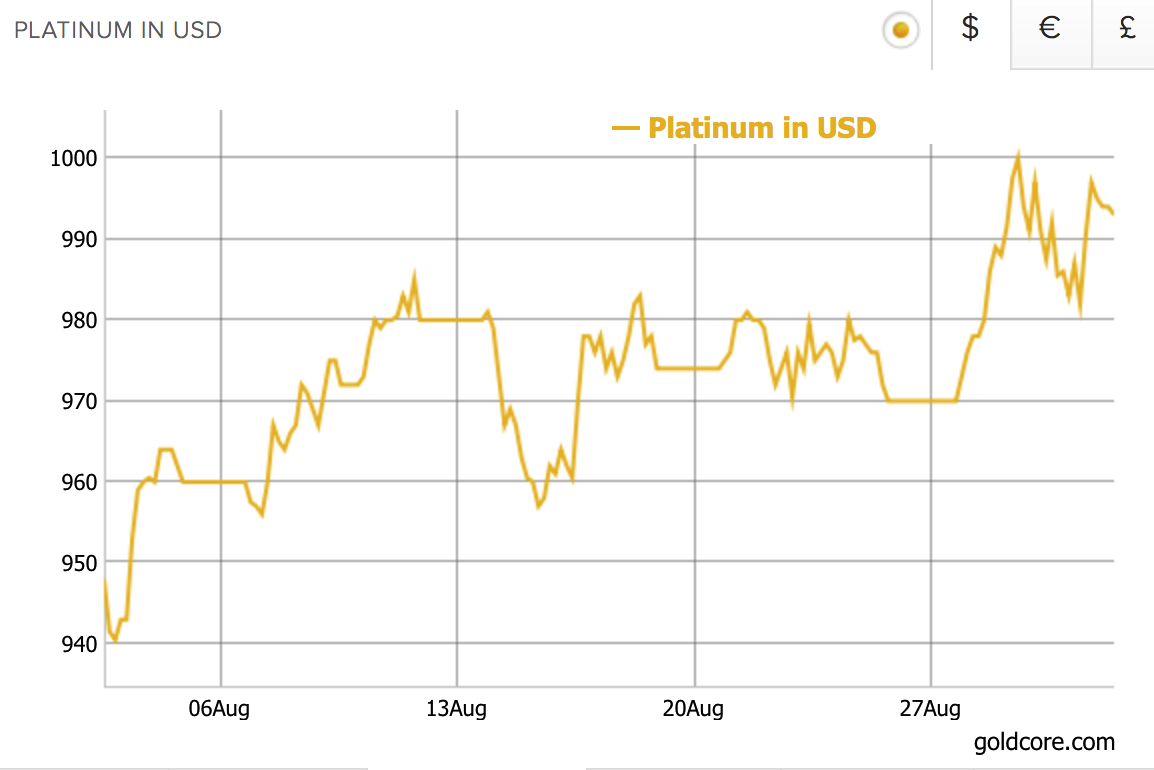
- Platinum is best performing metal climbing over 5%
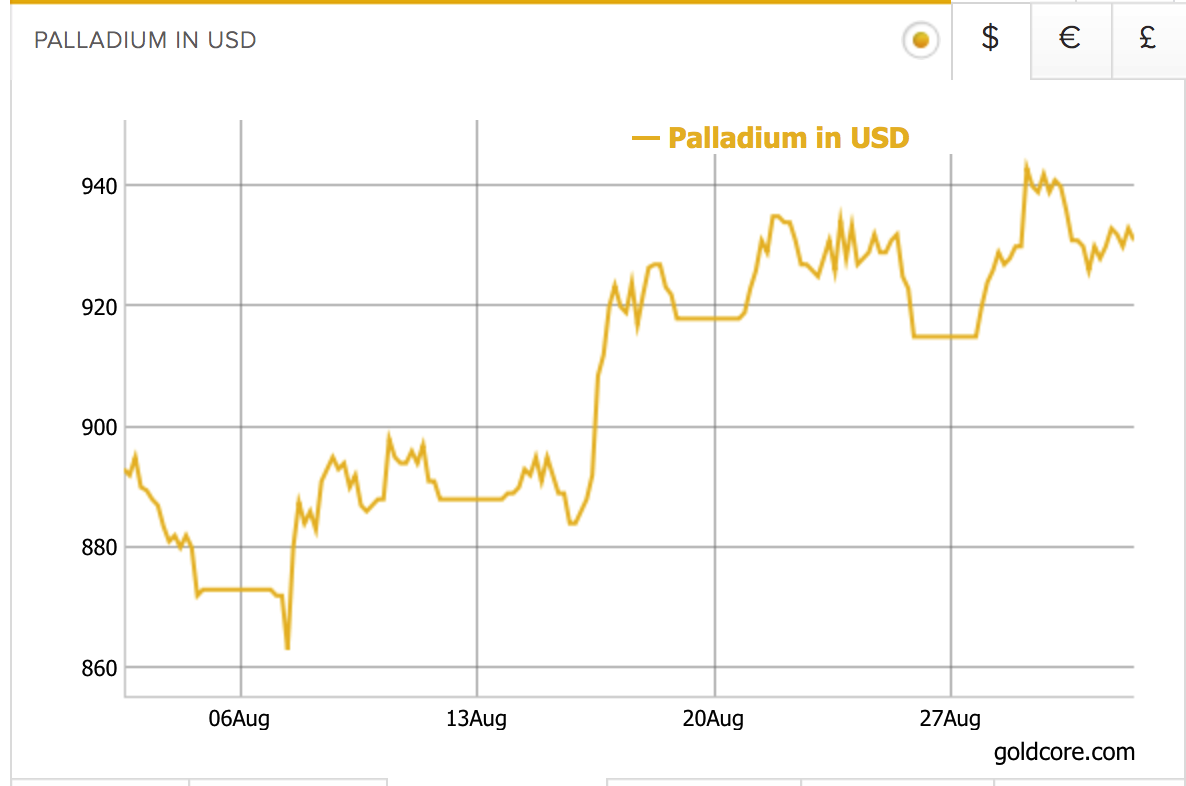
- Palladium climbs over 4% thanks to seven year supply squeeze
- Fear, uncertainty and political sanctions are amongst biggest drivers for precious metals
- Never been a better time to diversify and rebalance portfolios with stocks and bonds near record highs and looking vulnerable


Editor: Mark O"Byrne


Market Performance in August (Finviz.com)


All four precious metals have made gains in the month of August.


Whilst platinum and palladium"s leading performances can largely be attributed to industrial factors they have also benefited from the safe haven demand which is driving gold and silver prices.


Safe haven demand really came into its own this last month. Issues with North Korea have stepped up a level whilst markets have finally begun to question the complacency they have been feeling in regard to the US political and financial situation, geopolitical risk and the increasingly uncertain outlook for the global economy.


Ultimately very little is known about what will happen with the US debt ceiling, increasingly overvalued stocks (both the NASDAQ and  the S&P500), Trump"s plans for corporate tax, dealings with North Korea and (not forgetting) Venezuela.


We are living in very uncertain times indeed and investors decided to allocate funds to the ultimate safe havens - the precious metals.


Gold shines as investors rush into safe havens


This week gold rose to its highest point so far in 2017 as tensions between North Korea (but really, the rest of the world) and the US ramped up. For the month of August the price is up 3.59%.


Silver was also up thanks to safe haven demand, but its 5% climb was also in part due to manufacturing demand. Currently, about 55% of all silver consumed is for industrial use.


Gold has so far risen in every month, bar June.


Gold"s climb has in part been due to ongoing demand from countries such as China and India, but it has primarily been driven by the desire in the West to own a safe haven. This is not surprising given the ongoing concerns regarding North Korea, Venezuela, the Middle East and a lack of cohesion in the Trump administration.


One of the dampeners on gold and silver has been the Federal Reserve"s plans to raise interest rates. However, when they did so it had little effect. Expectations for further hikes are falling. Going forward Yellen and team are expected to slow down on further interest-rate increases which has provided an additional boost for the gold price.


In the very short-term storm Harvey in Houston, Texas has also impacted the price of gold and silver. As a result of lost income and recovery operations, US GDP is expected to be lower in the third-quarter than was initially expected.


In the long-term investors will look to gold and silver as they begin to price risk into the market. Yesterday we expressed our concerns over market complacency whilst other financial organisations have begun to warn clients about the overpriced equity markets and lack of perceived risk.

It is also worth noting an expected climb in demand from China. Mark Tinker, Head of AXA Framlington wrote in a note that China’s pricing of assets in yuan (together with the plan by the Hong Kong Stock Exchange to  sell yuan-priced physical gold contracts) could allow them to trade out of the banking system in the US


“Having accepted payment for oil or gas in RMB, the seller, be it Russia or Saudi Arabia or anyone else for that matter, does not have to worry about having excess RMB, they can simply trade it back into gold,” Tinker said. “We are moving to a multi-polar world.”


Platinum gains as Russia feels the pain


Platinum has performed very well so far in the second half of the year. This most recent surge has likely come about thanks to further sanctions being placed on Russia by the US. Russia is the world"s second biggest producer of the metal.


The World Platinum Investment Council outlined the following arguments for platinum"s role as a safe haven investment asset:


- Supply demand fundamentals are strong and ETF holdings are stable, despite price volatility
- Risks of supply declines are underestimated - cost pressure and falling mining investment continue - Downside risks to platinum automotive demand are overestimated
- Futures positioning follows poor sentiment with high correlation to price
- Platinum is undervalued against its past, its production cost and against gold


Palladium climbs on Vauxhall’s woes


Palladium is currently at a 16 year high. There is a major tightening in the supply of palladium because of increased demand for it in engines. 67% of palladium supply is used in car engines to clean exhaust gases from gasoline engines. There is obviously a major push for ‘clean’ transport and the Vauxhall emissions scandal and obviously helped boost demand.


Inventories of palladium supply are down by abut 45% this year, whilst supply trails demand by the most in the seven years.


Despite the increase in supply, there has been a significant number of redemptions in the the two main U.S. and European palladium ETFs - the ETFS Physical Palladium Shares and the ZKB Palladium. By the 22nd August $49 million had been traded in. Supply in the spot market is reportedly so tight that companies are being forced to trade in multiple ETF shares in order to redeem them with the issuer in exchange for physical palladium.


ETFs are now being treated like palladium warehouses.


It is also important to note that, like platinum, palladium is also hugely affected by the sanctions on Russia.


It is also important to note that ETFs are a risky way to invest in precious metals and most investors would be better served owning actual precious metals rather than paper or digital proxies.


Conclusion: Stars aligning? Outlook good for rest of 2017


Earlier this week we explained how investors shouldn"t always be focused on price. Whilst it is nice to look at the metrics for August and see that all precious metals are up, we should instead focus on why they are up and most importantly the diversification benefits for our portfolios.


Precious metals are largely climbing because the perceived risk in the political and financial system is also climbing. Interestingly many commentators do not feel some risky issues have been wholly appreciated by the markets.


Problems such as North Korea are such serious risks that even someone who pays no attention to markets could spot it. The issue is that you have an overvalued stock market and a US President who cannot get his people together. This means that the US debt ceiling issue might ground the U.S. government to a halt.


These issues are ones which have not yet been fully priced into the markets. They likely will be in the coming months and then the safe haven role of the precious metals and gold in particular will come into its own.


News and Commentary


Gold up 4% in August - largest monthly gain since January (Marketwatch)


Gold steady near 9-1/2 month highs as N.Korea tensions persist (Reuters)


Gold Scores Fifth Monthly Increase; US Mint Bullion Sales Slow in August (Coin News)


Gold edges lower, but N.Korea worries lend support (Nasdaq)


Massive wartime bomb to be defused near German gold reserves (Irish Times)


Source: Marketwatch


From Stocks to Bonds, the Bear-Market Signals Are Multiplying (Bloomberg)


Rothschild reduces exposure to US stocks amid turmoil (Standard)


Five charts show why millennials are worse off than their parents (FT.com)


When the Butterfly Flaps Its Wings - Kunstler (Zerohedge)


Buffett: North Korea situation is very concerning (CNBC)


Gold Prices (LBMA AM)


01 Sep: USD 1,318.40, GBP 1,020.18 & EUR 1,107.98 per ounce
31 Aug: USD 1,305.80, GBP 1,013.17 & EUR 1,098.31 per ounce
30 Aug: USD 1,310.60, GBP 1,014.93 & EUR 1,096.71 per ounce
29 Aug: USD 1,323.40, GBP 1,020.34 & EUR 1,097.36 per ounce
25 Aug: USD 1,287.05, GBP 1,003.90 & EUR 1,090.90 per ounce
24 Aug: USD 1,285.90, GBP 1,003.26 & EUR 1,090.44 per ounce
23 Aug: USD 1,286.45, GBP 1,004.33 & EUR 1,091.68 per ounce


Silver Prices (LBMA)


01 Sep: USD 17.50, GBP 13.53 & EUR 14.69 per ounce
31 Aug: USD 17.34, GBP 13.47 & EUR 14.62 per ounce
30 Aug: USD 17.44, GBP 13.49 & EUR 14.60 per ounce
29 Aug: USD 17.60, GBP 13.59 & EUR 14.62 per ounce
25 Aug: USD 17.02, GBP 13.26 & EUR 14.40 per ounce
24 Aug: USD 16.93, GBP 13.20 & EUR 14.36 per ounce
23 Aug: USD 17.06, GBP 13.32 & EUR 14.48 per ounce


Recent Market Updates


- 4 Reasons Why “Gold Has Entered A New Bull Market” – Schroders
- Gold Reset To $10,000/oz Coming “By January 1, 2018” – Rickards
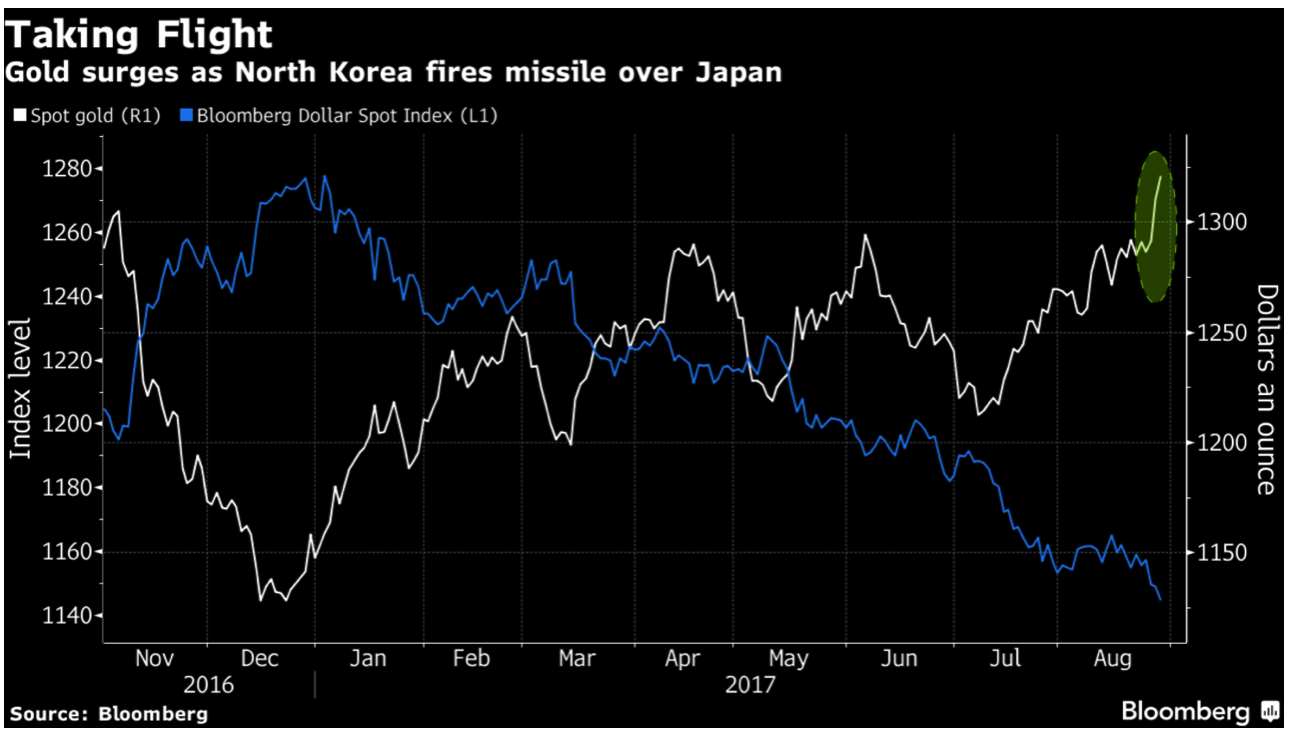
- Gold Surges 2.6% After Jackson Hole and N. Korean Missile
- Diversify Into Gold On U.S. “Political Instability” Advise Blackrock
- Trump Presidency Is Over – Bannon Is Right
- The Truth About Bundesbank Repatriation of Gold From U.S.
- Cyberwar Risk – Was U.S. Navy Victim Of Hacking?
- Global Financial Crisis 10 Years On: Gold Rises 100% from $650 to $1,300
- Mnuchin: I Assume Fort Knox Gold Is Still There
- Buffett Sees Market Crash Coming? His Cash Speaks Louder Than Words
- Gold, Silver Consolidate On Last Weeks Gains, Palladium Surges 36% YTD To 16 Year High
- Must See Charts – Gold Hedges USD Devaluation, Rise in Oil, Food and Cost of Living Since Nixon Ended Gold Standard
- World’s Largest Hedge Fund Bridgewater Buys $68 Million of Gold ETF In Q2


Important Guides


For your perusal, below are our most popular guides in 2017:


Essential Guide To Storing Gold In Switzerland


Essential Guide To Storing Gold In Singapore


Essential Guide to Tax Free Gold Sovereigns (UK)


Please share our research with family, friends and colleagues who you think would benefit from being informed by it.

Thursday, August 31, 2017

Warren Buffett Reveals His Biggest Fear

Bloomberg’s David Westin spoke with Berkshire Hathaway Chairman Warren Buffett on his 87th birthday before his charity auction lunch at Smith & Wollensky’s in New York.


Among the topics discussed was the Fed"s upcoming balance sheet normalization: Buffett told Westin that the Federal Reserve will be “very careful” with how they handle quantitative easing as the Fed may have to find buyers for "trillions" in assets. Predictably, Buffett argued in support of QE which added tens of billions to his net worth: “[QE] did wonders for us coming out of 2008. Without it we would have gone back to the economics of 100 years ago. If the Fed had not been there to ease, we would have had a far different recovery. I think the Fed has overwhelmingly done the right thing. Now, we’ve never gone through a period like this and how it will all work out, we will find out. I think they will be intelligent about it but they’ve never played this game yet either.”


Separately, Buffett said the relentless, artificial, central bank-induced rally over the last several years has made it "harder to find bargains", but that stocks "remain his choice over bonds." Asked by Westin why cash has been piling up at Berkshire, Buffett said “it tells us stocks aren’t as cheap as they’ve been most of the time.” Buying shares after the 2008 financial crisis, Buffett said, was like “shooting fish in a barrel”, although he forgot to add that the US government bailing out his core financial holdings, did not hurt either.


In any case, in recent year, Berkshire"s stock portfolio, which includes multibillion-dollar stakes in companies like Apple, the scandal-plagued Wells Fargo and Coca Cola, was valued more than $135 billion at the end of June, almost the same size as the AUM of the world"s largest hedge fund, Bridgewater.


Stocks “have gotten less attractive as they’ve gone along,” Buffett said. “They’re still very attractive compared to bonds.”


Buffett has plowed money into stocks this year, including Apple. But finding new acquisitions has been a challenge lately. Earlier this month, his bid to take control of Oncor Electric Delivery Co., Texas’s largest power distributor, fell apart. That failed effort came six months after a Berkshire-backed deal to buy Unilever hit the skids.


The collapse of two high-profile pursuits in such a short time frame is a rarity for Buffett, who did his last major deal in 2015 when Berkshire agreed to buy aerospace-parts manufacturer Precision Castparts Corp. for more than $35 billion. While he’s made many offers that went nowhere, it’s less common for such misses to play out in public.


According to Bloomberg, the recent deal drought has bigger implications for Berkshire. The company doesn’t pay a dividend and rarely buys back its own stock, so failing to consummate a few major transactions means cash piles up from its subsidiaries. At the end of June, Berkshire had just shy of $100 billion.


Finally, in a discussion of assorted items, Buffett said that the US economy does not feel like a 3% GDP, that anger in the US stems from wealth inequality and when asked what"s the one thing that Buffett generally feared, the answer was "if we"re talking broadly, the answer is weapons of mass destruction."


"Now you"ve got weapons that can kill millions and millions and millions of people, and you"ve got them in unstable hands in certain cases. We live in a dangerous world that way, it"s the only real problem for humankind."


Buffett then said that in this context, North Korea is at the top of his list: "if you have a small, relatively poor country that"s spending a significant part of its GDP trying to figure out how to get an ICBM to hit the west coast of the US, there"s something going on in somebody"s mind that I don"t like."


Finally, the reason why Buffett was in the New York Smith & Wollensky today is to dine with the winner of an annual charity auction that raises money for Glide, a San Francisco non-profit. The top bidder, who chose to remain anonymous this year, paid $2.68 million to bring as many as seven friends to lunch with the billionaire at Smith & Wollensky steakhouse. With insights such as these, we think the many could have been spent with a much higher IRR elsewhere.

Tuesday, August 29, 2017

Are You Prepared For These Potentially Disruptive Economic Storms?

Hurricane Harvey


Here in San Antonio, grocery stores were packed with families stocking up on water and canned food in preparation for Hurricane Harvey, which has devastated Houston and coastal Texas towns. I hope everyone who lives in its path took the necessary precautions to stay safe and dry—this storm was definetely one to tell your grandkids about one day.


Similarly, I hope investors have took steps to prepare for some potentially disruptive economic storms, including this past weekend’s central bank symposium in Jackson Hole, Wyoming, and the possibility of a contentious battle in Congress next month over the budget and debt ceiling.


As you’re probably aware, central bankers from all over the globe visited Jackson Hole this past weekend to discuss monetary policy, specifically the Federal Reserve’s unwinding of its $4.5 trillion balance sheet and the European Central Bank’s (ECB) ongoing quantitative easing (QE) program. Janet Yellen gave what might be her last speech as head of the Federal Reserve.


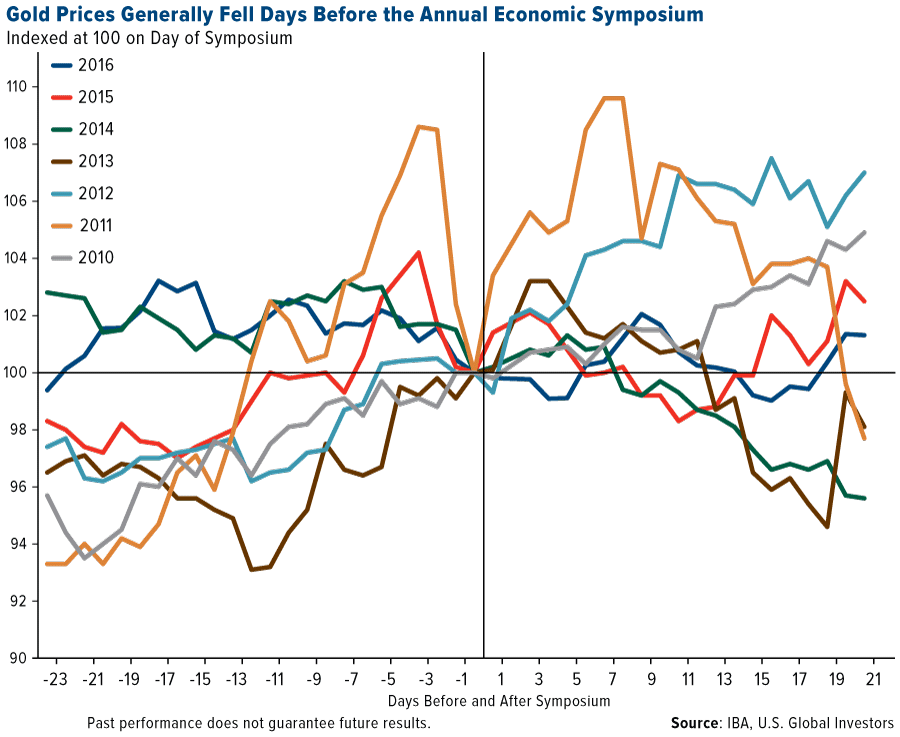
As I told Daniela Cambone on last week’s Gold Game Film, there are some gold conspiracy theorists out there who believe the yellow metal gets knocked down every year before the annual summit so the government can look good. I wouldn’t exactly put money on that trade, but you can see there’s some evidence to support the claim. In most years going back to 2010, the metal did fall in the days leading up to the summit. Gold prices fell most sharply around this time in 2011 before rocketing back up to its all-time high of more than $1,900 an ounce.


Many of the economic and political conditions that helped gold reach that level in 2011 are in effect today. That year, a similar Congressional skirmish over the debt ceiling led to Standard & Poor’s decision to lower the U.S. credit rating, from AAA to AA+, which in turn battered the dollar. The dollar’s recent weakness is similarly supporting gold prices.


In August 2011, the real, inflation-adjusted 10-year Treasury was yielding negative 0.59 percent on average, pushing investors out of government bonds and into gold. Because of low inflation, we might not be seeing negative 10-year yields right now, but the five-year is borderline while the two-year is definitely underwater. Bank of America Merrill Lynch sees gold surging to $1,400 an ounce by early next year on lower long-term U.S. interest rates.


Are Government Inflation Numbers More “Fake News”?


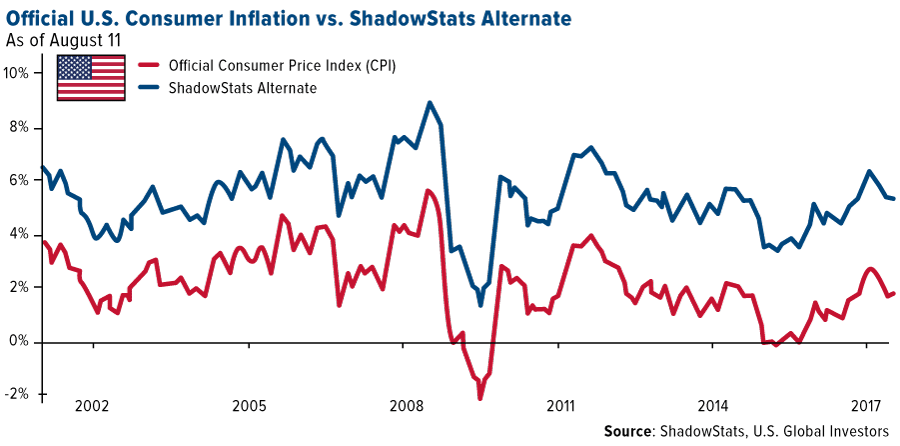
If we use another inflation measure, though, yields of all durations look very negative. For years, ShadowStats has published alternate consumer price index (CPI) figures using the methodology that was used in 1980. According to economist John Williams, an expert in government economic reporting, “methodological shifts in government reporting have depressed reported inflation” over the years. The implication is that inflation might actually be running much higher than we realize, as you can see in the chart below.


If you believe the alternate CPI numbers, it makes good sense to have exposure to gold.


Recently I shared with you that Ray Dalio—manager of Bridgewater, the world’s largest hedge fund with $150 billion in assets—was one among several big-name investors who have added to their gold weighting in recent days on heightened political risk. That includes Congress’ possible failure to raise the debt ceiling and, consequently, a government shutdown. Dalio recommends as much as a 10 percent weighting in the yellow metal, which is in line with my own recommendation of 10 percent, with 5 percent in physical gold and 5 percent in gold stocks, mutual funds and ETFs.


Falling Dollar Good for U.S. Trade


Returning to the dollar for a moment, respected CLSA equity strategist Christopher Wood writes in this week’s edition of GREED & fear that it’s “hard to believe that the political news flow in Washington has not been a factor in U.S. dollar weakness this year.”


The U.S. media certainly wants you to believe that Trump is bad for the dollar. Take a look at this chart, showing the dollar’s steady decline alongside President Donald Trump’s deteriorating favorability rating, according to a RealClearPolitics poll.


However, a weak dollar is good for America’s economy. I’ve commented before that Trump likes a falling dollar, because it is good for the country’s export trade of quality industrial products. It’s also good for commodities, which we see in a rising gold price and usually energy prices.


Ready for a Big Fight?


You might have watched the Mayweather vs. McGregor fight, but have you been watching the fight between Trump and the Fed?


At the symposium in Jackson Hole, Fed Chair Janet Yellen squared up directly against Trump when she defended the strict regulations that were put in place after the financial crisis. Echoing these comments was Dallas Fed chief Robert Kaplan. This is the opposite of what Trump has been calling for, which is the streamlining of regulations that threaten to strangle the formation of capital.


Hurricane Harvey


It’s important to recognize that the market is all about supply and demand. The number of public companies in the U.S. has been shrinking, with about half of the number of listed companies from 1996 to 2016. Readers have seen me comment on this previously, and I believe that the key reason for this shrinkage is the surge in federal regulations. The increasingly curious thing is that we are seeing the evolution of more indices than stocks, as the formation of capital must morph.


As I told CNBC Asia’s Martin Soong this week, there is a huge amount of money supply out there, and investors are looking for somewhere to invest. The smaller pool of stocks combined with the greater supply of money means that the market has seen all-time highs. In addition, major averages were regularly hitting all-time highs not necessarily on hopes that tax reform would get passed, but on strong corporate earnings, promising global economic growth and the weaker U.S. dollar.


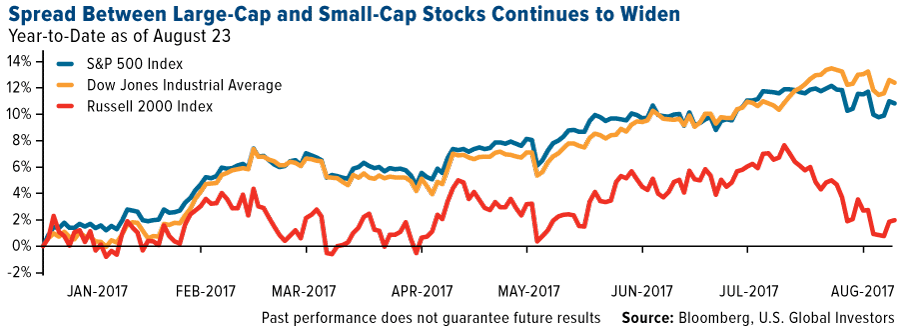
Meanwhile, small-cap stocks are effectively flat for 2017 and heading for their worst year since 1998 relative to the market, according to Bloomberg. Hedge funds’ net short positions on the Russell 2000 Index have reached levels unseen since 2009. Remember, these are the firms that were expected to be among the biggest beneficiaries of Trump’s “America first” policies.


However, the weakness in U.S. manufacturing has a great impact on the growth of these stocks, as indicated by the falling purchasing managers’ index (PMI). The slowdown in manufacturing is offset by strength in services, shown by the Flash composite PMI score of 56.0 which came out this week. Though there is a spread between large-cap and small-cap stocks, historically this strong score is an indicator of growth to come.


Some big-name investors and hedge fund managers are turning cautious on domestic equities in general. On Monday, Ray Dalio announced on LinkedIn that he was reducing his risk in U.S. marketsbecause he’s “concerned about growing internal and external conflict leading to impaired government efficiency (e.g. inabilities to pass legislation and set policies).” Pershing Square’s Bill Ackman and Pimco’s Dan Ivascyn have also recently bought protection against market unrest, according to the Financial Times. Chris Wood is overweight Asia and emerging markets.


Stay Hopeful


It’s important to keep in mind that there will always be disruptions in the market, and adjustments to your portfolio will sometimes need to be made.