Showing posts with label Geography of California. Show all posts

Wednesday, December 27, 2017

1,000s Of "Micro-Homes" Sprout Up All Over Bay Area To House The Growing Homeless Population

Roughly one year ago we shared the plans of a billionaire real estate developer in San Francisco who wanted to build communities for the homeless in Bay Area neighborhoods using stackable steel shipping containers (see: San Fran Billionaire Luanches Plan To House Homeless In Shipping Containers).  Not surprisingly, the efforts were met with some resistance from the liberal elites of Santa Clara who, despite their vocal support of any number of federal subsidy programs for low-income families, would prefer that those low-income families, and their subsidies, stay far away from their posh, suburban, "safe places."


Alas, as the San Francisco Chronicle points out today, like it or not, the boom in "micro-houses" is just getting started in the Bay Area with nearly 1,000 tiny homes, with less than 200 square feet of living space, currently being planned in San Francisco, San Jose, Richmond, Berkeley, Oakland and Santa Rosa.


Planners say that’s just the beginning. “We’re very excited about micro-homes,” said Lavonna Martin, director of Contra Costa County’s homeless programs. “They could be a big help. They have a lot of promise, and our county is happy to be on the cutting edge of this one. We’re ready.”


Contra Costa has a $750,000 federal homelessness grant to pay for 50 stackable micro-units of supportive housing, and Richmond Mayor Tom Butt would like to see them in his city. Developer Patrick Kennedy brought a prototype of his MicroPad unit to Richmond in November, and county and city leaders say they are leaning toward choosing it.


“They’re very fine, and they make a nice-looking building,” Butt said. “They’d be good for anybody looking for housing.”


MicroPad


The beauty of the tiny units is that they can be built in a fraction of the time it takes to construct typical affordable housing, and at a sliver of the cost, which means a lot of homeless folks can be housed quickly.


The homes have also caught on in San Jose where the City Council just approved $2.4 million to build a village of 40 units to help house the homeless.  Of course, just like in Santa Clara, San Jose residents are lashing out at city officials over plans that they say will only serve to increase neighborhood crime.


San Jose resident Sue Halloway told the council she was afraid putting the village near residences would increase “neighborhood crime, neighborhood blight (and) poor sanitation,” and predicted that it would be “a magnet for more homeless.”


City Councilman Raul Peralez said he understands such concerns, but that “there are no facts surrounding these tiny homes and whatever blight or crime they might bring, because we haven’t done them yet.”


“I tell people you really have two options,” said Peralez, who said he wants the village in his downtown district. “You can allow the homeless to live on the streets, or you can provide not only shelter but services in a confined area — with security. In my mind, that’s a way better option for managing this community in an organized way.”


So, what do the stackable units look like?  As seen in the video below, prototypes from one manufacturer, MicroPad, come complete with full bathrooms and kitchens and have up to 160-180 square feet of living space...


“These micro-homes may seem small at 160 to 180 square feet, but they’re actually pretty spacious when you’re in them,” she said. “And they go up very fast.”


Kennedy’s MicroPads have showers, beds and kitchens. Individually they resemble shipping containers, but once they’re bolted together with siding and utilities, they look like a regular building.


...which is more or less considered a mansion by struggling New York artist standards...


Saturday, December 23, 2017

Silicon Valley Obscenity - 1 In 4 People Are "Food Insecure"

In the years since the first dot-com bubble burst, Silicon Valley has become emblematic of the intensifying wealth inequality that’s making life increasingly unaffordable for millions of working- and middle-class Americans.


And while the unprecedented wealth creation in the region has helped enrich hundreds of thousands of tech workers and entrepreneurs, virtually everybody else in the region – from college students to the cafeteria workers and janitors who service the headquarters of storied tech firms like Google and Facebook – has suffered from rising rents and a cost of living that’s far outstripped wage inflation.


Now, a study has found that more than one in four Silicon Valley residents is food insecure – meaning they go without at least one meal or rely on food pantries due to lack of financial resources, according to researchers at the Second Harvest food bank.


Using hundreds of community interviews and data modeling, a new study suggests that 26.8% of the population – almost 720,000 people – meet this ignominious designation. Furthermore, nearly a quarter are families with children.


“We call it the Silicon Valley paradox,” says Steve Brennan, the food bank’s marketing director. “As the economy gets better we seem to be serving more people.” Since the recession, Second Harvest has seen demand spike by 46%.


The Guardian interviewed local residents who qualify as food insecure for a story about the worsening wealth gap in one of the wealthiest regions in the US.


Karla Peralta is surrounded by food. As a line cook in Facebook’s cafeteria, she spends her days preparing free meals for the tech firm’s staff. She’s worked in kitchens for most of her 30 years in the US, building a life in Silicon Valley as a single mother raising two daughters.


But at home, food is a different story. The region’s soaring rents and high cost-of-living means that even with a full-time job, putting food on the table hasn’t been simple. Over the years she has struggled to afford groceries – at one point feeding her family of three with food stamps that amounted to $75 a week, about half what the government describes as a “thrifty” food budget. “I was thinking, when am I going to get through this?” she said.


In a region famed for its foodie culture, where the well-heeled can dine on gold-flecked steaks, $500 tasting menus and $29 loaves of bread, hunger is alarmingly widespread, according to a new study shared exclusively with the Guardian.


According to the Guardian, the food bank is literally at the center of the Silicon Valley boom – both literally and figuratively. It sits just half a mile from Cisco’s headquarters and counts Facebook’s Sheryl Sandberg among its major donors. But the need it serves is exacerbated by this industry’s wealth; as high-paying tech firms move in, the cost of living rises for everyone else.


As we’ve pointed out, faced with some of the most expensive rental housing in the nation, some Bay Area residents are feeling priced out and are seeking low-cost alternatives like living in their cars, or commuting nearly two hours to work each way.


All of this is happening as the Nasdaq – which includes many of the tech behemoths like Facebook, Google and Apple that are based in the region – reached an all-time high above 7,000 on Monday.


Food insecurity often accompanies other poverty indicators, such as homelessness. San Jose, Silicon Valley’s largest city, had a homeless population of more than 4,000 people during a recent count.


For workers like Karla Peralta – the Facebook cafeteria worker who shared the story of her daily struggles with the Guardian – there’s a stark division between well-heeled salaried tech workers at Facebook, and others like herself who work under contract.


What’s worse, many workers like Peralta are finding themselves mired in an uncomfortable gray area: they make too much to qualify for government assistance, but not enough to get by.


These days Peralta earns too much to qualify for food stamps, but not enough not to worry. She pays $2,000 a month – or three-quarters of her paycheck – to rent the small apartment she shares with her youngest daughter. “Even just the two of us, it’s still a struggle.” So once a month, she picks up supplies at the food bank to supplement what she buys at the store.


She isn’t one to complain, but acknowledges the vast gulf between the needs of Facebook employees and contract workers such as herself. “The first thing they do [for Facebook employees] is buy you an iPhone and an Apple computer, and all these other benefits,” she laughs. “It’s like, wow."


Second Harvest is the only food bank serving Silicon Valley. It’s also one of the largest in the country. In any given month, it provides meals for 257,000 people. It served 66 million pounds of food last year. When the Guardian visited its cavernous, 75,000 square foot main warehouse space, boxes of produce stretched to the ceiling. Strip lights illuminated crates of cucumbers and pallets of sweet potatoes with a chilly glow. Volunteers in PayPal T-shirts packed cabbages and apples that arrived in boxes as big as paddling pools, while in the walk-in freezer turkeys waited to defrost.


To Silicon Valley’s wealthy tech workers, the struggles of the hundreds of thousands of working poor in the region are often invisible.


“Often we think of somebody visibly hungry, the traditional homeless person,” Brennan said. “But this study is putting light on the non-traditional homeless: people living in their car or a garage, working people who have to choose between rent and food, people without access to a kitchen."


He added, “you’re not thinking when you pick up your shirts from dry cleaning, or getting your landscaping done, or going to a restaurant, or getting your child cared for, ‘is that person hungry?’ It’s very easy to assume they are fine."


The cost of housing is one of the biggest contributor to inequality – and the main reason many workers in the region are forced to go hungry. In Santa Clara County, the median price of a family home has reached a new high of $1.125 million, while the supply of homes continues to shrink. A family of four earning less than $85,000 is now considered low income. Meanwhile, the median income in the US is less than $60,000.


These realities mean food insecurity cuts across lines of race, age and employment status.


Minority communities in the Bay Area have been hit the hardest.


The Latino community is “passing through a hard time”, says Vicky Avila-Medrano, a food connection specialist. She runs a program that sends current and former food bank users out into the community, which has been disproportionately affected by the cost-of-living crisis.


“Here in Silicon Valley, we have a big problem. This is a beautiful place to live for people in the tech industry, but we are not working in that industry."


Of course, the problems posed by rising rents aren’t unique to the San Francisco Bay Area. As we noted back in October, rental costs growing faster than disposable income for 22 consecutive months. In September, rent ate up more disposable income than at any prior time in history.


All of this underscores the hypocrisy of the ultra-liberal Bay Area. While well-heeled tech workers spurn anybody who disagrees with their narrow-minded worldview in the name of progress, many of these same workers drift through their daily routines largely ignorant of the dire circumstances of the people who handle their dry cleaning and prepare their food.


Google famously fired former engineer James Damore for publishing an open letter pointing out flaws in the company’s diversity hiring program.


Meanwhile, the more than 10,000 employees who work at the Googleplex in Mountain View, Calif. are some of the biggest contributors to wealth inequality in the region.


While we"re sure the Bay Area"s insistence on social equality in the workplace is well intentioned, progress won"t feed the working poor.


Monday, December 18, 2017

"It Looks Like A War Zone" - Californians Describe Thomas Fire"s Devastation

Now the third-largest wildfire in California history, the Thomas Fire has blazed through Ventura and Santa Barbara counties since it exploded into existence two weeks ago under mysterious circumstances.


With Cal Fire ordering thousands more people in Santa Barbara to evacuate as dry conditions and powerful winds help feed the flames, which were barely 40% contained as of Sunday. Twelve thousand people were evacuated in Santa Barbara County, with animals at the local zoo threatened as well. Santa Barbara Zoo closed Saturday and many animals were placed into cages in case of possible evacuations, zoo officials said.


Meanwhile, residents who had evacuated their homes in Ventura County, where the fire began, were allowed to return Saturday.


The fire is so massive that more than 8,400 firefighters are working around the clock to save lives and contain it. It"s bigger in acreage than New York City, and has turned neighborhoods to piles of soot and concrete as it churns through the area.


At least five of the six wildfires that ignited two weeks ago were still active as of Sunday, according to CNN. But the Thomas Fire is by far the biggest, as the map below illustrates.


Here’s a roundup of the latest developments from CNN and Cal Fire:


  • Cause of death: Firefighter Cory David Iverson, 32, died of "thermal injuries and smoke inhalation," according to autopsy results from the Ventura County medical examiner"s office. Iverson lost his life battling the Thomas Fire on Thursday. A total of two people have been killed since the fire started.

  • Hefty price tag: About $110 million has been spent fighting the massive blaze, fire officials said. It was 40% contained Saturday night.

  • Improving weather conditions: Santa Ana winds did not immediately materialize on Sunday morning, though firefighters had been expecting the worst. Red-flag warnings were in effect for a large swath of Southern California through late Sunday, with wind gusts of up to 55 mph expected overnight, according to CNN meteorologist Gene Norman.

  • In the record books: The blaze has charred 267,500 acres and is now the third-largest wildfire in modern California history.

Residents who spoke with CNN described being taken by surprise, as the wildfires spread faster than many expected. Residents described being awoken in the middle of the night by fire and police officials assisting in evacuation efforts.


Jeannette Frescas was not concerned about the Thomas Fire until the massive blaze reached her neighborhood in Ventura, California.


"At midnight, I woke up with a flashlight in my face," Frescas told CNN affiliate KEYT. "I looked out my window and there were flames that were like, a hundred feet, all around us."


Like many residents, Frescas was caught off guard by the fire that has roared across Southern California for 13 days. She"s one of tens of thousands of residents who piled into cars and fled as ferocious winds drove the third-largest blaze in modern state history through Ventura and Santa Barbara counties.


"What was once a paradise was like a war zone," Frescas said of her apartment complex, which was destroyed by the blaze. "It"s the scariest thing I"ve been through in my entire life."


One resident described being woken up by her son in law and told that she needed to grab her stuff and go - immediately.


Ventura resident Patricia Rye woke up to her son-in-law pounding on her door. She didn"t get a chance to pack any valuables, and fled her home of 17 years in the dead of the night.


"I didn"t have time to take anything," Rye told the affiliate. "My wallet, or any of my personal things. I literally left with the clothes on my back. If I had been thinking I would have got into my car, but I wasn"t thinking so my car was there."


The Thomas fire alone has caused well over $100 million in damage, though authorities likely won’t have a final figure for weeks, if not months. An extended stretch without rain has allowed the fires to burn without any significant natural impediments.


Friday, December 8, 2017

"It Was Like A War Zone" - Heavy Winds Push Wildfires Toward San Diego As Bel Air Burns

Images of charred palm trees and the burnt-out husks of multi-million-dollar homes flooded social media for a fifth day Friday as the SoCal wildfires that exploded into life at the beginning of the week showed no signs of slowing.


Instead, some of the largest fires have entered the heart of Los Angeles – America’s second largest city – and are menacing some of the most expensive homes in the country.


To date, six large wildfires have scorched 141,000 acres in the state, with the flames spreading as far south as San Diego, Cal Fire officials said. At least 5,700 firefighters from several agencies and at least nine states are working to contain the massive walls of flames. The fires have forced 190,000 people out of their homes in a hurry. Many took only their pets and a few choice mementos.


The Skirball fire that’s terrorizing Bel Air isn’t nearly as large as some of the other fires raging in Ventura and LA counties, but it has had an outsize impact in terms of cost. Two days ago, local media reported that the fire had torched a mansion owned by media mogul Rupert Murdoch. Though Murdoch later clarified that the property was (mostly) intact, other homes in the area are at risk of being reduced to cinders.


So far, the fire has damaged many homes in the hills of Bel Air, Los Angeles’ most expensive neighborhood according to Zillow. At least six of those, which Zillow estimates to be worth around $20 million, were completely destroyed on Wednesday.


According to the Wall Street Journal, about 1,700 homes were in mandatory evacuation zones from the Skirball Fire. The company estimates the homes’ values totaled $6.4 billion, where the median home value is just under $3 million.


Beyond Bel Air, there are 86,242 homes in Ventura and Los Angeles counties that are at "some level of risk" from the Thomas, Rye and Creek Wildfires, according to CoreLogic. The combined reconstruction cost value of these properties is $27.7 billion – nearly triple the $10 billion in damages caused by the NorCal fires.


In Ventura County alone, 14,300 homes valued at a total of $10.4 billion were in mandatory evacuation zones, according to Zillow.


Just like with the fires that devastated California’s wine country two months ago, the powerful Santa Ana winds have exacerbated the devastation. After a brief lull on Tuesday, the winds picked back up again Wednesday. And though they’re expected to taper off again – albeit briefly – late Friday, winds of up to 80 mph are expected to continue through Sunday, making it difficult for firefighters to tame the blazes.


“We are in the beginning of a protracted wind event,” Ken Pimlott, the director of the California department of forestry and fire protection, told the Los Angeles Times. “There will be no ability to fight fire in these kinds of winds."


All together, the four fires in Southern California – possibly the most destructive in the state’s history - have scorched more than 116,000 acres so far, and despite the round-the-clock work of thousands of firefighters since Tuesday, they are still burning ferociously with little to no containment. For example, the Thomas fire northwest of Ventura is barely 5% contained.


All around the region, people encountered nightmarish conditions as flames seemed to come from everywhere. Patricia Hampton, 48, said she and her boyfriend woke up at her house in Ventura on Tuesday night to the sound of helicopters. Outside, the ground was covered in ash, the air so smoky it was hard to breathe as they hopped on bicycles and tried to flee, according to the Washington Post.


“We didn’t know what had happened. We rode down into town trying to make sense of what we were seeing — police everywhere, firetrucks, helicopters,” she said at a temporary shelter at the Ventura County Fairgrounds. “It was like a war zone. You could hear transformers blowing up.”


Authorities are warning residents in nearby communities to prepare to evacuate, even if they aren’t directly impacted by the fire. Residents should be ready to evacuate even if they don"t live in areas immediately affected by flames, Cal Fire Division Chief Nick Schuler said Thursday night. Families should have an escape plan ready to go just in case, he said.


"They need to prepare as if they will be impacted. Where are they gonna go? What are their escape routes? What is their communication to their families?" he said.


Adding to the devastation in the region, the Lilac Fire in San Diego County started Thursday and grew to 4,100 acres in a few hours, leading to new evacuation orders. Evacuation centers have been set up in affected areas.


The Lilac Fire has left three people with burn injuries and two firefighters hurt. One firefighter suffered smoke inhalation while the second one had a dislocated shoulder. The latter popped it back into place and continued working, Schuler said. According to CNN, school boards have shut down schools spanning at least 16 districts.


Gov. Jerry Brown issued an emergency proclamation for Santa Barbara and San Diego counties. The declarations free state resources such as the National Guard to support response efforts. He"s also requested federal assistance to supplement state and local emergency response.


Per CNN, here’s a quick summary of the six largest fires.


  • Thomas Fire: The largest of the six blazes started Monday in Ventura County, and has scorched 115,000 acres. It"s only 5% contained, and has destroyed at least 150 homes and threatening thousands more in Ventura, about 50 miles (80 km) north-west of Los Angeles.

  • Creek Fire: The second-largest fire is in neighboring Los Angeles County, and ignited a day later. It has burned 15,323 acres and is 20% contained.

  • Rye Fire: It broke out Tuesday in Los Angeles County and has burned 7,000 acres. Firefighters are making progress, with 25% of the blaze contained.

  • Lilac Fire: This fast-moving fire erupted Thursday in San Diego County, and has consumed 4,100 acres in just a few hours. It"s unclear what percentage of it is contained.

  • Skirball Fire: It started Wednesday as a brush fire in Los Angeles County, and is now 30% contained.

  • Liberty Fire: The blaze in Riverside County has burned 300 acres since it ignited Thursday. It"s 5% contained.

While no deaths have been reported so far as a direct result of the flames, three residents have been burned while trying to flee. And one woman was found dead after a car crash in an area under an evacuation order, the authorities said on Thursday, according to the GuardianWith 2017 on track to be the most destructive year for wildfires in California history, experts are warning that this could be the new status quo, given dry conditions across the state.


The Santa Ana winds are an entirely natural phenomenon of course, and they usually peak during the month of December. What is unusual is that wildfires peak during the autumn period. But because of the ongoing drought across California and the very dry weather during October and November, the conditions have been ripe for the wildfire outbreak we are now witnessing.


The current weather pattern is consistent with what climatologists refer to as the "Ridiculously Resilient Ridge" which has become more prevalent in recent years. This results in cold weather across eastern parts of US, and unseasonably warm weather in western areas that we are seeing this month.


As this weather pattern intensifies, expect deadly blazes to become a perennial concern, Al Jazeera reported.


Silicon Valley"s "Working Homeless" Shows How Hard Life Is In "Democrat"s Paradise"

Authored by Mac Slavo via SHTFplan.com,


Silicon Valley is the home to tech giants like Facebook, Apple, and Google. It’s also home to a surging working homeless population who live in dilapidated RV’s, tents, and their own cars, all thanks to the policies Democrats love to implement.


The surging number of those working in Silicone Valley and still unable to afford adequate housing should be a warning about big government, but it sure doesn’t seem like anyone is taking notice as their taxes continue to rise.


As governments creep toward socialism though, poverty becomes the norm, not the exception.


Silicon Valley has the highest median income in the nation. But a soaring tax burden and expensive regulations have caused housing prices to increase which has also caused homelessness to surge.


More than 10,000 people were living without shelter across San Jose and Santa Clara Counties on any given night in 2016, though that figure is probably low. Thanks to big government, the cost of living is not low.


An influx of tech workers along with decades of under-building (thanks again to the regulations of big government) has created a historic homelessness in the Bay Area.


The governments in California continue to attempt to control deadly Hepatitis A outbreaks caused by a booming homeless population and usually do so by taking even more from those who actually work. The cycle will continue: socialists governments will put a cheap band-aid on the gaping wound they created themselves.


Rather than freeing poor people from dependence on benefactors and bosses, they merely transfer the dependence to the state, leaving the least politically connected people at the mercy of the political process. – FEE


The one thing government has are programs to help those in poverty. But those have proven ineffective. And the one thing that will work is the very thing government refuses to do: Climb off the backs of those they pretend they want to help.


Progressives routinely deplore the “affordable housing crisis” in American cities. But it is the very laws that Progressives favor—land-use policies, zoning codes, and building codes—that ratchet up housing costs, stand in the way of alternative housing options, and confine poor people to ghetto neighborhoods. Historically, when they have been free to do so, poor people have happily disregarded the ideals of political humanitarians and found their own ways to cut housing costs, even in bustling cities with tight housing markets.  – FEE


Imagine just how much more money the working poor would have if the big government in California wasn’t stealing over half their income to implement the very rules and laws that continue to make “scraping by” even more expensive.


Wednesday, November 15, 2017

Two-Thirds Of The Top Primary Silver Miners Suffered Production Declines In 2017

SRSrocco


By the SRSrocco Report,


It has been a rough year for many primary silver miners as two-thirds have suffered declines in production.  Also, many high ranking silver producing countries are also experiencing a pronounced reduction in their domestic silver mine supply.  According to the data put out by World Metal Statistics, Chile"s silver production is down 20% in the first eight months of the year, while Australia is down 19%, Mexico declined 2% and Peru lower by 1%.


The Silver Institute will be releasing their 2017 Silver Interim Report shortly which will provide an update on current silver production and forecasts for the remainder of the year.  However, I believe global silver production will take a big hit this year due to several factors including, falling ore grades, mine closures, and strikes at various projects.


For example, Tahoe Resources was forced to shut down its Guatemalan Escobal Mine in July due to a temporary suspension of its operating license by the country"s Supreme Court.  However, even after the Guatemalan Supreme Court reinstated Tahoe Resources Escobal Mine"s license in early September, an ongoing road blockade has hampered the ability of the project to continue mining.  Regardless, Tahoe"s silver production declined a stunning 6.7 million oz Q1-Q3 2017 versus the same period last year.


Now, on the other hand, silver production at Fresnillo"s operations in Mexico jumped by nearly six million oz during the first three-quarters of 2017 primarily due to the start-up of its San Julian Mine phase II expansion and a ramp-up of its phase I:


While the gain in silver production at Fresnillo"s operations helped to offset the significant decline at Tahoe"s Escobal Mine, two-thirds of the top primary silver companies in the group experienced a reduction in mine supply this year.  Hecla"s silver production fell by 3.7 million oz in the first three-quarters this year due to an ongoing strike at its Lucky Friday Mine in Idaho.  Moreover, output at Silver Standard"s Puna operations in Argentina fell by 3.2 million oz due to a 36% decline in ore grade at is open-pit Pirquitas Mine.  Silver Standard"s Pirquitas Mine is one of the few open-pit silver operations in the world.  The overwhelming majority of primary silver mines in the world are underground operations.


Overall, production at these top primary silver miners fell 9 million oz in 2017 compared to the same period last year:


Now, if Tahoe Resources Escobal Mine was not forced to shut down or if Hecla"s Lucky Friday Mine"s strike was resolved, overall production at these top primary silver miners would have likely increased by approximately one million oz this year.  Unfortunately for Tahoe"s Escobal Mine and its investors, it may be quite some time before full production resumes.  As I have mentioned in previous articles about the troubles plaguing the Escobal Mine by the local and indigenous peoples living by the operation, there are two very different opinions on the underlying problems.


While I have stated that the negative issues put forth by the local and indigenous peoples about the Escobal Mine are likely more valid than the pro-western stance taken by the Tahoe Managment or the Mainstream financial media, time will tell how this is resolved.  However, the notion put forth by Tahoe Management that the problems are stemming from "non-locals" who are supposedly radicalizing the locals around the plant, is unfounded when we understand that it is a huge ground-roots movement led by a large percentage of the inhabitants surrounding the mine.


According to the article, Tahoe Resources’ Social Licence in Guatemala Non-Existent, as Uncertainty Plagues Escobal Permits:


Tahoe CEO Ron Clayton is also wrong when he states in a recent press release that community opposition comes from “non-locals”. Lack of social license has dogged Tahoe Resources since the beginning of its project. Since 2011, tens of thousands of residents in eight municipalities around the Escobal mine have voted in municipal plebiscites demonstrating their opposition to the project, or any mining in the area, out of concern for their water supplies, health, and local agriculture. Five municipalities refuse to receive any royalty payments from Tahoe’s mine operations and are now parties to the legal proceedings over discrimination of the Xinka Indigenous population and the Ministry of Energy and Mines’ failure to consult with them.


As the article states, five municipalities refuse to receive any royalty payments from Tahoe"s mine operations and are now supporting legal proceedings.  This does not sound like a small group of non-locals instigating trouble.  Rather, this has been an ongoing issue ever since the Escobal Mine was initially planned, during its construction phase and ever since it produced its first ounce of silver in 2014.


Lastly, it looks like global silver production will take a big hit this year.  We could see world silver mine supply fall by 40-50 million oz in 2017 if the trend continues for the remainder of the year.  One country that I did not report on about silver production was China.  According to the World Metals Statistics, they show Chinese silver production down by a stunning 25% in the first eight months of 2017.  However, I don"t believe the decline is that high.  Even though the World Gold Council stated that Chinese gold production was down 10% so far this year, I doubt their silver production fell 25% this year.


We will have to wait and see what production figures the Silver Insitute will release in their 2017 Silver Interim Report when it"s published in the next few weeks.  Regardless, the world"s economies are being propped up by a massive amount of debt, derivatives and money printing.  When the markets finally crack, global silver production will fall considerably as for demand for base metals will drop like a rock.  We must remember, 58% of world silver production is a by-product of copper, lead and zinc production.  So, when base metal demand falls, so will base metal production.


Thus, as the market and economy continue to disintegrate, global silver supply will fall right at the very same time investment demand surges.


Check back for new articles and updates at the SRSrocco Report.

San Andreas "Quake Swarm" Has Cali Residents Fearing The "Big One" Is Imminent

Yesterday morning a series of 10 earthquakes struck Monterey County, California along the San Andreas fault line and has Cali residents increasingly concerned that the "Big One" could be next.  The quakes, the biggest of which measured 4.6 on the Richter scale, hit near Salinas, California but were felt 90 miles away in San Francisco.  Per SF Gate:


A 4.6-magnitude earthquake rattled Monterey County on Monday and was felt more than 90 miles away in San Francisco, officials said.


The quake hit at 11:31 a.m. about 13 miles northeast of Gonzales, near Salinas, and was followed by nine smaller aftershocks, with the largest measuring magnitude 2.8, said Annemarie Baltay, a seismologist with the U.S. Geological Survey in Menlo Park.


There were no reports of injuries or damage.


Baltay said the quake occurred on the San Andreas Fault, close to an area where the Calaveras Fault branches off. The quake happened at a depth of about 4 miles.


While a seismologist for the US Geological Survey, Annemarie Baltay, dismissed the recent quakes as part of "normal seismic activity", the Director of the Southern California Earthquake Center offered a slightly different opinion to the LA Times last year:


“Any time there is significant seismic activity in the vicinity of the San Andreas fault, we seismologists get nervous,” said Thomas H. Jordan, director of the Southern California Earthquake Center, “because we recognize that the probability of having a large earthquake goes up.”


As seismic activity drops, the probability of having a large earthquake also decreases.


Experts said it’s important to understand that the chance of the swarm triggering a big one, while small, was real.


“When there’s significant seismicity in this area of the fault, we kind of wonder if it is somehow going to go active,” said Caltech seismologist Egill Hauksson. “So maybe one of those small earthquakes that’s happening in the neighborhood of the fault is going to trigger it, and set off the big event.”


Of course, Thomas Jordan is the same California Seismologist who raised some eyebrows last year when he proclaimed that the San Andreas fault is well overdue for a major quake. 


“The springs on the San Andreas system have been wound very, very tight. And the southern San Andreas fault, in particular, looks like it’s locked, loaded and ready to go,” Jordan said in the opening keynote talk.


Other sections of the San Andreas fault also are far overdue for a big quake. Further southeast of the Cajon Pass, such as in San Bernardino County, the fault has not moved substantially since an earthquake in 1812, and further southeast toward the Salton Sea, it has been relatively quiet since about 1680 to 1690.


Here’s the problem: Scientists have observed that based on the movement of tectonic plates, with the Pacific plate moving northwest of the North American plate, earthquakes should be relieving about 16 feet of accumulated plate movement every 100 years. Yet the San Andreas has not relieved stress that has been building up for more than a century.


Jordan went on to say that when the tension that has been building along the San Andreas fault is finally relieved, it could potentially produce a magnitude 8 earthquake. Here"s what a Magnitude 8 quake would look like...


Back in 2008, the U.S. Geological Survey concluded that just a magnitude 7.8 earthquake along the southern San Andreas fault would cause more than 1,800 deaths, 50,000 injuries and 200 billion dollars in damage...so lets hope that Jordan is wrong.


Tuesday, October 31, 2017

After Wildfires, Californians Warned: "You Will See Rapid Flooding, People Trapped"

Authored by Mac Slavo via SHTFplan.com,


Experts are warning that California’s state capital could be the next hot spot to experience massive flooding on catastrophe levels. Officials are admitting that one particular Sacramento neighborhood is in an area that never should have been settled, to begin with.


Maxwell, California flooded in 2017


The neighborhood slopes downward from a levee that separates it from the American River, and even though officials said it should not have ever been settled, it is home to 100,000 residents.


“I am just trying to imagine what three feet of water in my house would look like, and based on that, I moved things higher,” said Marion Townsend a 53-year-old resident.


“And if the evacuation order comes, I want to know what I should grab.”


But models of the levee’s failure show not only a meager 3 feet of water inside homes. Some are predicting as much as 20 feet of water to flood Sacramento homes. 


As Northern Californians are recovering from wildfires and sifting through homes reduced to ash, officials in the state’s capital are struggling to prevent another type of natural disaster. 


If a levee were to break along the American River, which empties into the Sacramento River near downtown, water would start flowing into the city. Although floodgates could be quickly deployed to protect downtown Sacramento from a life-threatening deluge, the water would eventually seep in from other directions, covering much of the area in several feet of water, said Roger Ince, a Sacramento emergency coordinator.


“You are not going to see a wall of water coming into Sacramento, but you will see rapid flooding and people not able to get out of their homes, out of care facilities. They are trapped,” said Stephen Cantelme, chief of Sacramento County’s Emergency Services.


“I am much more confident in our levees holding up than I was 10 years ago. . . . But I am concerned 200-year [flood protection] is not enough.”


Sacramento is more vulnerable to catastrophic flooding than any other major city in the United States except New Orleans, according to federal officials, a threat created by the city’s sunken geography. No one has forgotten the devastation of Hurricane Katrina in 2005.


According to the Washington Post, levees and other flood defenses here and in the surrounding Central Valley have amassed up to $21 billion in needed repairs and upgrades, while Sacramento’s population has continued to grow. Just days before Hurricane Harvey slammed into Texas and flooded Houston, a report from the California Department of Water Resources warned that “many flood facilities” in the Central Valley “face an unacceptably high chance of failure.” The report wanted those in Sacramento to take action immediately as winter storms approach.


More than 7 million California residents are at risk of flooding, and many don’t realize it. Flooding happens throughout the state, from rural communities to urban areas, at the base of hills and along the coast. In fact, every California County has received a flood-related emergency declaration in the past twenty years. – California Department of Water Resources press release.


Two back-to-back storms of similar caliber to the 1986 flood storm is all it would take to further devastate the vulnerable state of California. It could happen anytime, soon, and would submerge 25% of the highly populated state’s land in water.


“This isn’t science fiction,” said one of the authors of a 2010 report called Overview of the ARkStorm Scenario, Keith Porter, a research professor at the University of Colorado at Boulder. “It’s a very realistic scenario, and it could happen at any time.”


Sunday, October 29, 2017

"The Incredible Shrinking Yard": Growing McMansions Are Increasingly Devouring Backyards

America"s obsession with the ever-growing McMansion, combined with a perpetual lack of funding for said McMansion, has resulted a unique phenomenon which Trulia has dubbed "The Incredible Shrinking Yard."  Analyzing public records to compare residential lot sizes to home footprints, Trulia says that homes built over the past two years occupy a staggering 25% of the land on which they sit, compared to roughly half that amount in 1975. 


Here are some of Trulia"s key findings:


  • Nationally, single family homes occupy 17.4% of the lots on which they sit, regardless of the year they were built.


  • Homes built since 2015 occupy 25% of the land on which they sit, while homes built in 1975 occupy just 13.9%. This is being driven by a combination of lots shrinking by 36.2% and home footprints growing by 15.2% size.


  • Meanwhile, some of the oldest homes in the country, built in the early 1800s, occupy less than 5.0% of the large lots they are built on. The last time lot usage was nearly as high as it is now was during the early 1900s.


  • Don’t mind the neighbors? Single family homes in places like Philadelphia, and San Francisco, which are both geographically small but dense, have the highest lot utilization at 57.7%, and 44.2%, respectively.


  • Want plenty of yard space? Head to New England. Three Connecticut metro areas, Worcester, Mass., Hartford, Conn., and Bridgeport, Conn. make up the places with the smallest amount of house occupying lot space, at less than 7.5%.


  • While most metro areas have seen lot usage grow since the mid-70s, with Oakland, Calif., and Miami seeing the largest upward swings, six metros have bucked the trend with San Francisco, Memphis, and Long Island, N.Y. moving toward less lot usage.


When national home price growth charts start to look like an Amazon stock chart, despite the fact that wage growth remains non-existent, but you know your family of 4 can never find a way to survive in a house even an inch smaller than 4,000 square feet, it only makes sense that lawn sizes would have to shrink to keep purchase prices somewhat "reasonable"...and by reasonable, of course we mean below FHA lending limits so that those McMansions can be purchased with minimal money down and backstopped by the American taxpayer.


As Trulia notes, since the mid-70s, when the proportion of lots used by new construction hit a national low of 13.6%, it climbed 11.3 percentage points to 25% of the lot of homes built in 2015 or later. Most metro areas have seen lot usage grow similarly. Oakland, Miami, and Indianapolis have seen the largest upward swing in lot usage, with homes built after 2015 occupying 25.6, 24.9, and 20.3 percentage points more, respectively, of the lots they are built on than they did in the mid-70s.


Meanwhile, 7 of the 95 metro areas analyzed by Trulia managed to buck the trend, with San Francisco, Memphis, Tenn., and Long Island, N.Y. actually seeing a 12.9, 11.6, and 6.0 percentage point decrease, respectively, in the percent of lot usage by homes constructed after 2015 when compared with homes built in the mid-70s.


With that, here"s a helpful chart depicted just how small the "American Dream" has become in your neck of the woods:


Lot Usage by MSA


Tuesday, October 17, 2017

15 Shocking Videos Expose The Reality Of Surviving The California Wildfires

Authored by Daisy Luther via The Organic Prepper blog,


The Northern California wildfires are fast-moving, unpredictable, and for some, unsurvivable.


The videos below will show you what it’s really like, trying to survive an ever-changing inferno…and why you shouldn’t wait for the official evacuation order.


A lot of folks have been critical, saying blithely, “They knew there was a fire. They should have evacuated.” It’s important to understand that it doesn’t always work like that with wildfires. Armchair quarterbacking is easy. Fleeing when the car your driving literally catches on fire and the smoke is blinding you is not.


First of all, fires move rapidly. You can be in no danger whatsoever and just see a fire on the distant horizon, and then minutes later, it’s at your back door. Secondly, they change courses. Many times, the fire gets ahold of some new fuel – like a home, tall grass, or trees, and the course veers in that direction. Finally, high winds have propelled these fires rapidly and fanned them to new heights. Every fall, California has something called the “Diablo Winds.” These are seasonal gusts that can reach as high as 80 mph and cause extremely high fire danger. When coupled with existing fires, it’s nothing less than the perfect storm.


http://www.theorganicprepper.ca/wp-content/uploads/2017/10/6364332809325... 126w, http://www.theorganicprepper.ca/wp-content/uploads/2017/10/6364332809325... 252w, http://www.theorganicprepper.ca/wp-content/uploads/2017/10/6364332809325... 55w, http://www.theorganicprepper.ca/wp-content/uploads/2017/10/6364332809325... 269w, http://www.theorganicprepper.ca/wp-content/uploads/2017/10/6364332809325... 84w, http://www.theorganicprepper.ca/wp-content/uploads/2017/10/6364332809325... 101w, http://www.theorganicprepper.ca/wp-content/uploads/2017/10/6364332809325... 265w, http://www.theorganicprepper.ca/wp-content/uploads/2017/10/6364332809325... 143w, http://www.theorganicprepper.ca/wp-content/uploads/2017/10/6364332809325... 336w" style="width: 560px; height: 667px;" />
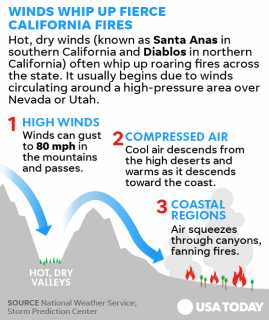
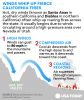
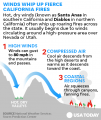

October is often the worst month of the year for wildfires in California. Not only is it the time when the Diablo winds (or Santa Ana winds in Southern California) kick up, but it’s also the driest month. California has a long dry season. It isn’t unusual to go without a single drop of rain from May through the end of October. Because of this, all the lush grass that grows during the spring rainy season is dried, crisp, and tragically perfect fuel.


In situations like this, there is often little to no warning before the fire is roaring through your property. The fire may be miles away and heading in the opposite direction one minute, then turn on a dime. Then suddenly, you find yourself directly in the path of an inferno. If you’re lucky, you escape unscathed with your life but lose all your worldly possessions. Many people have not been lucky.


15 large wildfires are blazing through Northern California’s wine country. 40 people are confirmed dead, hundreds are missing, more than a 100,000 have evacuated, and nearly 6000 homes and businesses have been completely burned to the ground. Thus far, the damage estimate is more than 3 billion dollars.


The following videos and stories show you what the Northern California wildfires are really like.


This video is shot from a fire engine from Berkeley, California on the day Santa Rosa burned. It gives you the firefighters’ firsthand view of the destruction and the speed with which it was wrought.


This video shows the utter devastation from the wildfires and includes clips of people escaping with only their lives.


These two roommates left with their dogs as the fire jumped the hill behind their home, narrowly escaping death. (Strong language)


This police officer’s body camera shows the terrifying scene when he was helping people evacuate.


This couple described their escape as being like “driving through hell.”


This video shows multiple clips of people fleeing the blaze as embers rain down and the billowing smoke gets closer. They are trappd on the freeway in slow-moving traffic.


In one tragic story, a family tried to evacuate by car. Their car caught on fire and they had to take off on foot to try and outrun the blaze. They got separated in the smoke. A 14-year-old boy burned to death and the other members of the family are burned over more than half their bodies. The mother and daughter were found by a neighbor and the father was found by paramedics. (source)


In a story with a happier ending, a farmer tried to evacuate his dogs but one refused to go. Odin, a Great Pyrenees, stayed with his herd of goats. The owners were positive they’d never see their beloved dog again, but when they returned to the farm, they discovered a slightly singed Odin with every member of his herd unharmed. This very good boy had even picked up a few baby deer. (source)


Haunting drone footage shows what Santa Rosa looks like after the fire.


While I strongly recommend evacuating in a situation like this, one man stayed behind and managed to save his home and his neighbor’s home from the wildfire.


Along the Napa/Sonoma border, these residents scrambled for safety and barely escaped with their lives. There were fires in all directions, blocking escape routes. People had to choose whether to drive through blinding smoke or flames.


This couple survived a wildfire they couldn’t escape by taking refuge in a neighbor’s swimming pool for SIX hours as the fire blazed all around them.


Another couple who tried to take refuge in a pool was not so fortunate. The woman died in her husband’s arms after 60 years of marriage.


This family’s dog ran away in a panic and they had no option but to leave. They returned home, certain their beloved pup had perished, but then they found this:


These interviews tell the stories of more narrow escapes.


This aerial footage gives you a better idea of what firefighters are dealing with during these widespread blazes.


More than eleven thousand firefighters are pushing themselves to the limits of their endurance to contain these fires, but they aren’t able to directly respond and save people. As the mayor of Calistoga said in a press conference to the few who opted to ignore evacuation orders, “You will NOT be given life safety support at this point. You are on your own.” Exhausted firefighters are grabbing moments of rest when they can.


In some areas, civilians, farmers, and construction crews have taken a stand to protect their homes from the infernos.


The story of the Capell Valley community is one that was repeated in neighborhoods and valleys across Northern California’s wine country this week, as dry conditions and high winds fueled multiple fires in Sonoma, Napa, Yuba and Mendocino counties.


It was not only firefighters who stood in the path of the blazes, but civilians too. Contractors, skilled construction workers and even former wildland firefighters came out of the woodwork to run bulldozers and drive multi-thousand gallon water tenders on twisty and damaged back roads.


They picked up what tools and equipment they could and tried to save their neighborhoods….


This wasn’t the first time Gil Pridmore had fought a fire in those hills. He spent years as the boss of a California Department of Forestry and Fire Protection bulldozer crew and fought the 1981 Atlas Peak Fire.


He used this experience to help lead a team of 30 people to cut multiple layers of firelines on the rim of the valley.


When flames would breach their lines and encroach on houses, the goal was to get the house “in the black,” or completely surrounded by burned areas so there was no fuel left to catch fire. (source)


They managed to save all but one home in the valley.


A few things to learn from the California wildfires


There are lessons to be learned from these videos (and 5 years of living in fire-prone California.) Wildfires happen in other parts of the United States as well, and it’s important to be prepared before the first spark.


You need a fire kit in your vehicle at all times. Things to include:


  • Swimming goggles: This will protect your eyes and help keep you from being blinded by smoke

  • Respirator masks: This doesn’t mean you will be able to breathe if the fire sucks all the oxygen from your environment, but it will help to filter out some of the smoke so you aren’t disabled by a coughing fit.

  • Fire extinguisher: In a worst case scenario if your vehicle catches on fire, you may be able to put it out if you attack while the blaze is small.

  • Welding gloves: Remember the guy who burned his hands opening a gate? Welding gloves will offer some protection from hot surfaces.

And here are some tips.


  • Do not wait for the official order: In some parts of Sonoma County, people are questioning why an evacuation alert never came. While officials do their best, YOU are the person who is responsible for your family’s safety. (source)

  • Have more than one escape route: In situations like this, you will often find your escape route blocked. Have more than one way out. Figure these out ahead of time and now when you are fleeing for your life and blinded by smoke.

  • Evacuate large animals ahead of time. If possible, evacuate your livestock before the emergency becomes a crisis. In a situation like this, animals can be fearful and uncooperative. Get your livestock to safety first, because if you have to rush out like many of these families did, you’ll have to leave them behind, helpless. I shared good news stories above, but a friend of mine in California went to help out with veterinary rescue. There are far more bad news stories.

  • Leash or crate pets early on: They will be affected by the same kind of panic. A normally well-behaved pet could rush off into danger, leaving you to make the choice to leave them behind or risk your family’s lives trying to save them.

  • Grab your dirty clothes hampers: If you have time to grab a few things unless you have just done laundry, grab dirty clothes hampers. They’re likely to have several days of clothing from the skin out, PJs, and socks, saving you time from searching for all those things individually.

  • Keep precious items and documents in one area: Make sure irreplaceable things are kept together. We have a decorative trunk near the door into which we can sweep precious mementos. Important documents are backed up in the Cloud, which means we don’t have to spend time packing those.

The fires are beginning to be contained, and firefighters say they are gaining an edge. Two out of three of the most destructive fires are more than 50% contained. Some people in Sonoma will be allowed to return to their homes today – or what’s left of them. Winds have lightened, but the weather will still be hot and dry until Thursday when there is a small chance of blessed rain. (source)


I wish those in the affected areas the very best.

Wednesday, September 27, 2017

How Much Space Does $1,500 Rent In The World's 'Most Magnetic' Cities?

New Yorkers who wince every time they slip a $1,500 rent check under their super’s door should consider moving to Shanghai, or maybe Berlin.


According to a new study published on RentCafe, $1,500 will buy you three times more space in Shanghai than in Los Angeles and twice as much in Frankfurt. Meanwhile, rents per square foot are five times higher in San Francisco than they are in Berlin.


Rentcafe used data from the Global Power Index and data on price-to-square footage ratios that it had collected for a previous study to compare how much space $1,500 will buy in the world’s 30 “most magnetic” cities - i.e. cities that are popular tourism hubs.


The study’s authors presented their results in an interactive graphic that allows users to compare costs between cities. Some of the most expensive markets include San Francisco, Manhattan and Zurich. Among the least expensive are Istanbul, Shanghai and Berlin.


Manhattan, for example, offers only 277 square foot (26 m2) for $1,500.  In Seoul, the same amount of money will rent you no less than a 1,389 square foot (129 m2) apartment, ample space for one person.


In San Francisco, $1,500 a month will rent you a 316 square foot apartment. Meanwhile, in Austria, $1,500 will rent you 1,009 square feet – almost three times as much. Rentcafe adds that, while SF has some of the most widely regarded cultural amenities in the world, Vienna - the City of Music – has plenty of entertainment options, from museums, vintage cinemas, live shows to recreational parks and hiking trails.


That is to say that one doesn"t necessarily need to pay sky-high rents to live in a fun urban environment.
 

Sunday, September 17, 2017

The 30 US Metros With The Highest And Lowest Incomes

Authored by Wolf Richter via WolfStreet.com,


Breath-taking differences in a vast country.


The Census Bureau released another data trove this week for 2016, based on the American Community Survey. Among many other data points, the survey details median household incomes by geographic location, such as by metro area, county, or state. And they show just how enormous the income differences in the US are from city to city.


Of the 382 metropolitan statistical areas (MSA) that the US government recognizes, the median income of $110,000 in Silicon Valley is over three times the median income of $35,600 in Laredo, TX.


These MSAs can be large. For example, the extended San Francisco Bay Area is divided in several metros including the two biggest:


  • San Jose-Sunnyvale-Santa Clara, which is the southern portion of Silicon Valley and includes Palo Alto.

  • San Francisco-Oakland-Hayward, which includes five counties (San Francisco, Alameda, Marin, Contra Costa, and San Mateo) that make up the northern part of Silicon Valley, San Francisco, parts of the East Bay, and a part of the North Bay.

These two are also the metros that had the highest median household incomes in the US in 2016, of $110,040 and $96,677 respectively.


“Household income” is income by all household members and from all sources of money, including “earnings” (wages, salaries, and the like) and investment income such as interest, dividends, and rents (#11-#13):


  1. Earnings

  2. Unemployment compensation

  3. Workers’ compensation

  4. Social security

  5. Supplemental security income

  6. Public assistance

  7. Veterans’ payments

  8. Survivor benefits

  9. Disability benefits

  10. Pension or retirement income

  11. Interest

  12. Dividends

  13. Rents, royalties, and estates and trusts

  14. Educational assistance

  15. Alimony

  16. Child support

  17. Financial assistance from outside of the household

  18. Other income

Below are the 30 metros in the US with the highest household incomes. Those in California are color-coded: bright red for the extended Bay Area, burgundy (sort of) for Southern California, and neon-pink for the Central Coast.


In total, nine of the 30 metros with the highest median incomes are in California. There are many up and down the East Coast and a number of them in the middle of the country. Hawaii has two metros on the list, as has Alaska. But even within the top 30, the median household income of Number One is 57% higher than that of Number 30:


Below here are the 30 of the 382 metros with the lowest median household incomes. Note these lists represent the extremes in the US. There are 322 MSAs in between the two lists, and their income levels cluster closely around the national median household income:


The comparison shows just how vast the income differences by geographical regions are in a vast country, and it also explains a host of other differences, such as home prices and rents, where $1.2 million, for example, buys a median condo in San Francisco (these are nothing special) or a palatial house in Laredo, TX.


But “median household income” is an aggregate number that hides as much as it reveals. Here are some details. Read…  The Chilling Fact “Record Median Household Income” is Hiding

Friday, September 15, 2017

Do 40,000 Lightning Strikes Over SoCal Point To A Mega Quake On The Horizon?

Authored by Mac Slavo via SHTFplan.com,


A volatile storm has ignited a slew of 40,000 lightning strike in southwestern California.


The strikes have hit Los Angeles, Santa Barbara, San Luis Obispo, and Ventura counties – all between September 10-11.


The electric storm was most active on Sunday with an amazing 5,000 lightning bolts in the area over a three-hour period. NWS Los Angeles took to Twitter to report the tremendous display. The intense storm brought plenty of lightning to the Golden state’s southern region, but almost no rain.  The greatest rain total of .44 inches at Sudden Peak on Sunday. By Monday morning, heavy showers, thunderstorms, and 35-mph winds were reported in eastern Los Angeles County.


But now conspiracy is swirling around this fascinating and unique electric storm.  Strange lights and electrons acting oddly seem to have been appearing either before or during major earthquakes – like the recent 8.2 magnitude quake in Mexico. Could these lightning strikes be a sign that California’s mega quake is on the horizon?


Like California, Mexico is a seismically active region that has seen smaller quakes that have caused death and destruction. But Thursday’s temblor is a reminder that even larger quakes — while rare — do occur. Scientists say it’s possible for Southern California to be hit by a magnitude 8.2 earthquake. Such a quake would be far more destructive to the Los Angeles area because the San Andreas fault runs very close to and underneath densely populated areas.


It’s often stated that California is ripe for a devastating mega earthquake and after some noticed the strange lights in the sky above Mexico during its quake, this conspiracy conclusion was an easy one to jump to.