Showing posts with label Financial analyst. Show all posts

Wednesday, May 2, 2018

Analyst: Skyrocketing Debt Cannot Be Supported By Money Printing Forever


Something is eventually going to have to give.  The United State’s debt which has shot up over $21 trillion dollars cannot be sustained by printing money forever, says a financial analyst.


According to TeleTradeBel analyst Mikhail Grachev, the US debt, supported by the printing of dollars could be coming to an end. “From 2009 to 2014. The Fed was actively buying Treasuries as part of a quantitative easing policy (QE). After the QE was scrapped, the Fed continued to purchase the securities, only in smaller quantities. American legal entities and individuals have always been the third major buyer of debt. The growth of debt and the volume of issuance of securities was possible due to the continuous flow of liquidity from the Fed at zero interest rate. It has also supported the unrestrained growth of the American stock market,” Grachev told RT.


But the tides have now turned and the Federal Reserve has begun hiking interest rates citing a “strong” market. In fact,  interest rates are expected to increase to 3.75 percent by 2020, the analyst noted. The investors’ interest in treasuries began to decline and the yield automatically went up. This week, 10-year securities showed a yield of 3.018 percent. This factor led to nervousness in the markets and raised a lot of questions, Grachev says.


As other analysts have pointed out, rising interest rates and a $21 trillion debt present a problem. With the rising interest rate and Treasuries’ yields, the question of servicing the mounting debt could become a problem for the US economy, the analyst warns. Although the economy of the US is great, even they don’t always have the extra money,” said Grachev. When the yields on the 10-Year US Treasury Note rise, it indicates that the demand for the American securities falls, Grachev explains.


“If the yield continues to grow, it can lead to a massive exodus of capital from Treasuries, and even result in the collapse of the world dollar financial system,” Grachev said. The analyst added that a dollar collapse seems far-fetched at the moment since the global economy is very dependent on the greenback. According to the expert, it is more likely that the dollar bubble will continue growing for the while, but a dollar collapse is all but imminent.

Friday, April 20, 2018

Peter Schiff Economy Warning : ‘Enjoy The Calm Before The Storm’


Financial analyst Peter Schiff is warning to “enjoy the calm before the storm.” Schiff, who predicted the 2008 recession says that inflation and interest rates are about to go up much more than expected.


In his most recent podcast, Schiff basically said to enjoy things now, because the storm will eventually hit. With the United States missile strike in Syria, rumblings of a trade war and a generally weak dollar, gold briefly flirted with $1,365 last week. But the anticipation of Federal Reserve rate hikes continues to create strong headwinds against the yellow metal. Many people now think the Fed will nudge interest rates up again in June, leaving six months to get in the much-anticipated third hike of the year, and possibly even get in a fourth.


The Fed is not going to be able to deliver the rate hikes the Fed is expecting, and again, it’s the expectation of more rate hikes that is what is keeping the lid on the price of gold. But it’s only a matter of time before the market blows the lid off and the price of gold goes up. –Peter Schiff


Peter said gold is basically trading sideways right now, in advance of a breakout. Meanwhile, the dollar is doing the same thing in the other direction. The greenback is weak but not breaking down. On the other hand, it isn’t recovering any of its losses. Peter thinks it’s treading water right now before it heads lower again, according to Seeking Alpha. 


Of course, the economic growth was supposed to help “pay for” the tax cuts and the massive amounts of deficit spending. If the economic growth doesn’t materialize, the deficits will be even bigger and they are already going sky-high. On top of that, rising interest rates are going to increase the annual payments on the debt.


So, these deficits are blowing through the roof and this is going to be the driving force in moving the dollar substantially lower and moving gold substantially higher.


We are in the perfect storm, I think, of massive explosion in deficits, not just the budget deficit but the trade deficit, these tariffs or a trade war is only going to compound the problem. We’ve got the economy weakening. We’ve got the dollar teetering on the brink of collapse. We’ve got gold about to break out and the bond market is in the same thing.


Right now, everything seems pretty calm on the horizon, but we are in the calm before the storm.


The three major markets – bonds, gold, and the dollar – are all moving sideways, getting ready to continue their most recent moves, which for gold is up, for the dollar is down, and for bonds are down, which means interest rates are up – and it’s one, two, three strikes and you’re out.

Thursday, December 7, 2017

Earnings Don"t Matter After All!

Via The Knowledge Leaders Capital blog,


Our long-time readers are familiar with the work of Professor Baruch Lev of the NYU Stern School of Business, whose research forms the basis for the Knowledge Leaders investment strategy. In his decades-long study of financial records, Lev first discovered a link between a firm’s knowledge capital and its subsequent stock performance, ultimately identifying a market inefficiency that leads highly innovative companies to deliver excess returns. We call this market anomaly the Knowledge Effect.


In a new article in Financial Analysts Journal, Lev and co-author Feng Gu continue to advance the findings on intangibles. The article, “Time to Change Your Investment Model,”  identifies that earnings prediction has lost “much of its relevance in recent years.”


As a form of predicting corporate results, “earnings no longer reliably reflect changes in corporate value and are thus an inadequate driver of investment analysis.”


The basis for this shift, the authors explain, occurred after the emergence of the semiconductor.


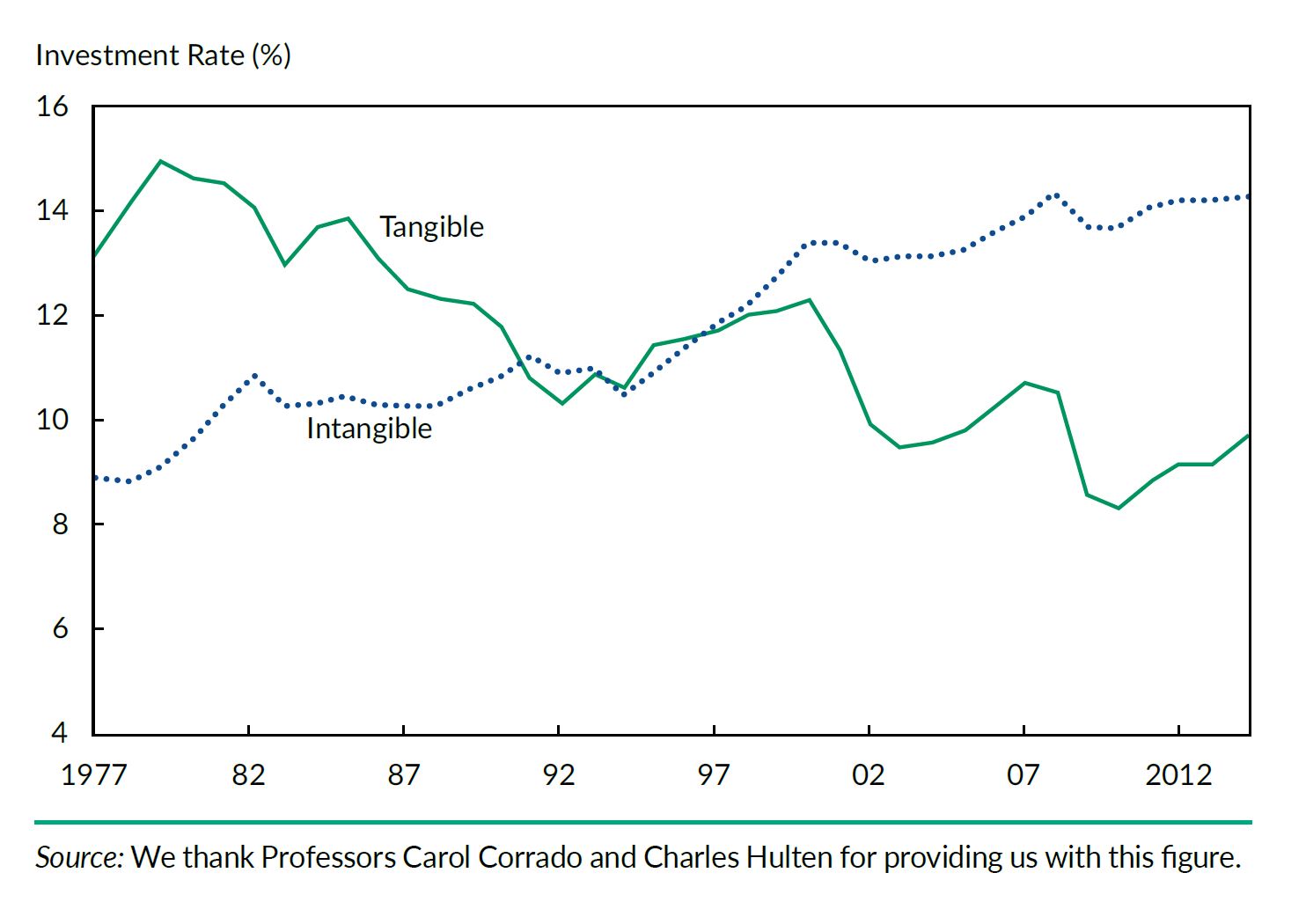
Starting in the early 1980s, investment in traditional, tangible assets (structures, factories, machinery, inventory) – considered assets by accountants and reported accordingly on the balance sheet – dropped precipitously from 15% of gross added value in 1977 to 9% in 2014, a 40% drop.


In contrast, the investment rate in intangible capital (R&D, patents, information systems, brands, media content, business processes) – mostly expensed in corporate income statements – increased continuously from 9% to 14% of added value, a 56% increase. This radical business model transformation came to be known as the knowledge – or information revolution, an irreversible trend in developed economies.”


As a result, for companies, “the only way to survive and prosper in such a competitive environment (is) through constant product and process innovation, achieved primarily by investing in intangible assets.” Therefore, “earnings’ usefulness to investors declines sharply for companies that increasingly rely on intangible value-creating assets.”


For these reasons, “GAAP-based reported earnings no longer reflect the periodic value changes (growth) of most business enterprises, and thus conventional earnings-based security analysis has lost much of its usefulness for investors in recent years.”


In summary, the authors observe:


“The disappointing returns on managed funds in recent years should raise doubts about the continued usefulness of conventional security analysis. Our extensive empirical evidence on the loss of relevance of GAAP numbers, in both this article and our recent book, confirms these doubts. Certain major investors have already departed from the status quo. … We propose a different course: Rather than replace analysts with robots, substitute an improved investment methodology for an outdated one.”


If you’re interested in reading Lev and Gu’s article, download it here. Stay tuned for more on Professor Lev’s research in early 2018 and an in-depth Q&A on his latest research on intangible capital.


Tuesday, October 24, 2017

How Much Is Equity Research Actually Worth? Probably Less Than You Thought

Over the past several months, investment banks all across Europe have scrambled to put a price tag on their equity research after years of giving it way as a "freebie" in return for trading commissions.


Of course, for wall street"s titans of finance, you know, the same guys who will look you straight in the eyes and tell you that they know with relative certainty the precise value of the synthetic CDO squared they"re selling you, we figured this would be a relatively simplistic task. Therefore, you can imagine our surprise now that the market has established a fairly wide bid-ask spread with JP Morgan on the low end at $10,000 and Barclays on the rich side at $455,000.


Luckily, since wall street"s finest don"t seem to have a clue, Bloomberg Gladfly has decided to take a look at some comps to help shed some light on the true value of equity research.


First, of course, it"s important to define what institutional clients are actually buying when they sign a research contract.  As Bloomberg points out with the chart below, and contrary to popular belief, equity research demand actually has very little to do with analyst forecasts and trade ideas but rather is dependent upon which banks provide the greatest access to those highly coveted management 1x1s.


The dirty little secret on Wall Street -- and why it"s so difficult to price research -- is that star analysts aren"t really valued for their research at all. Ask any money manager, hedge fund or research shop, and they"ll tell you it"s all about the contacts.


Many senior analysts spend only 10 percent of their time conducting research and writing reports. Teams of junior associates (or sometimes robots) maintain financial models and blast out notes. Some use pre-recorded voice mails to alert clients to new research.


Gadfly estimates that between 50 and 70 percent of a senior analyst"s time is spent on corporate access. Things like arranging lunch with a CFO or connecting a client with a lawyer, supplier or other industry expert to delve into what the data doesn"t. For this reason, analysts are often required to log the number of phone calls, meetings and events arranged each month.


The final 20 percent of an analyst"s time is spent on pre-IPO research, conferences and bespoke projects, such as flying a drone over a retailer"s parking lot to track how full it is; scoping the laundry outside apartment blocks; or conducting so-called channel checks to see how much oil"s being pumped through a particular pipeline.


So, what does that mean for the "value" of equity research?  Well, Bloomberg figures those actual "research" reports that flood your inbox all day long are worth basically nothing while the corporate access component of "research" (i.e. those annual trips to Miami Beach where 24-year-old hedge fund analysts get to interview CEO"s between binge drinking sessions at Story) should be valued at roughly the same price as an expert network service.


Access to independent research network Smartkarma starts at $7,500 a year per user for a Spotify-like subscription that opens the door to reports from more than 400 analysts. Customers can also buy additional packages of analysts" time, similar to the way lawyers or consultants get paid.


We reckon the closest approximation to corporate access is so-called expert networks, companies that maintain a stable of industry experts to match with fund managers and other financiers when they need quick access to esoteric information.


Industry leader Gerson Lehrman Group Inc. charges $100,000 a year, with the heaviest users paying millions of dollars, according to the Financial Times.


As for bespoke research projects, Morgan Stanley said it plans to charge $2,500 an hour for private meetings with its stock analysts, almost twice the rate of some of the best corporate lawyers. Partners at big management consulting firms such as Deloitte LLP or McKinsey & Co. charge clients anywhere from $800 to $1,300 an hour, according to career consulting guide Rocketblocks.


Then again, maybe those hedge fund managers could just ask young Trevor Worthington IV to stay home from Miami Beach and read a 10-K for free...just a thought.


Thursday, October 12, 2017

Would You Pay $2,500 For One Hour With An Equity Analyst? This I-Bank Seems To Think So...

Wall Street equity analysts are paid "yuge" salaries to employee the finance skills they picked up from their business school professors to value various corporate securities and asset-backed securitization structures, among other things.  And while their valuations of those securities have served as a frequent source of comic relief for many of us over the years, no bastardization of basic financial concepts tops recent attempts by the financial elites of the world to place a value on their own services.


As evidence of that fact, we present to you "Exhibit A" from a Bloomberg article published earlier today suggesting that Morgan Stanley, who is still trying to figure out how much their equity research is worth to clients after nearly a year of internal cogitation, is considering asking hedge fund clients for $2,500 for the extreme pleasure of spending just one hour with one of their esteemed research analysts.


Fund managers will have to pay about $2,500 for an hour-long, one-on-one meeting with some of Morgan Stanley’s equity analysts once Europe’s MiFID II financial rules kick in, according to people with knowledge of the plan.


The fee is on top of the annual rate Morgan Stanley plans to charge some clients for basic access to its equity research portal once the regulations come into force in January, the people said, asking not to be named as the negotiations are private. The bank also quoted a small client $25,000 annually for five users for basic equity research access and five total hours of analyst time, another person said.


Equity Research


Of course, any I-banking summer intern could easily spot the outlier in Morgan Stanley"s proposed $2,500 hourly billing rate when matched up against comps from the legal industry.  According to the National Law Journal, even the priciest partners at the best law firms can only command hourly billing rates equal to roughly half of what Morgan Stanley wants.


Meanwhile, the "median" partner at any given law firm only gets paid about one-fifth of Morgan Stanley"s proposal.


As McKinsey & Co. recently pointed out, the end result is that new European regulations designed to separate research and trading revenue for investment banks will likely cost them more than $1 billion as clients become pickier about what they pay for. 


Of course, ultimately the market will set a clearing price for the "value add" of equity analysts...and we"re almost certain it"s going to surprise some folks.

Wednesday, August 23, 2017

Would You Pay $1,000 For Each Equity Research Piece You Read? Autonomous Research Thinks You Will

Would you pay $1,000 for each piece of equity research you read throughout the day?  How about $5,000 for an industry piece? 


Well, Autonomous Research, which was founded in 2009 by former Merrill Lynch analysts, is really hoping you"ll agree that those are appropriate clearing prices for their daily market wisdom.  According to Bloomberg, as equity research providers in the Europe continue to figure out how exactly to best comply with upcoming MiFID II rules, Autonomous thinks that a piecemeal approach will allow them to reach smaller funds that lack the resources to purchase more expensive annual contracts for bulge bracket research.


Autonomous Research LLP is offering a pay-as-you-go model for its European equity product in the run-up to the MiFID II rules, which are set to shake up the way money managers pay for analyst reports, people with knowledge of the matter said.


The prices for the new service start at $1,000 for a single stock report and climb to $5,000 for high-end industry research, the people said, asking not to be identified because the information is private. Autonomous Research, which specializes in analysis of financial companies, also charges a single user $5,000 for access to its daily round-up of news and analysis, with the price per client falling as more sign up, the people said.


“We have been transparent with our clients on pricing for research since inception eight years ago,” said Chief Financial Officer Jonathan Firkins. “We have a clear and transparent pricing menu which we discuss proactively with existing and prospective clients.”


ER


Of course, as we recently pointed out, bigger firms like Barclays have opted for larger 1x, all-you-can-eat packages priced at the bargain basement rate of just $455,000 per year...it"s hard to imagine how hedgies won"t be knocking down their doors to gain access.


The firm is proposing three levels of service -- bronze, silver and gold -- with the premium package comprising unlimited reports, field trips and “occasional” one-on-one meetings with analysts and corporate executives, according to a pricing document seen by Bloomberg News. At the bottom end of the scale, read-only access to European research will start at 30,000 pounds.


At Barclays, even if clients stump up 350,000 pounds for the gold “trans-Atlantic” package, they could still end up spending more. “Bespoke” analyst work and corporate access is priced separately, according to the document. Field trips, industry events and company management meetings are also at the bank’s discretion, and analyst one-on-ones are “capped,” it shows.


Prices in the document may not apply to all clients, have been in flux and could still be subject to change, a person familiar with the process said, asking not to be identified discussing the matter. A Barclays spokesman declined to comment.


Banks are scrambling as they enter the last six months before the decades-old practice of sending out free analyst reports as a courtesy and marketing strategy comes to an end. The European Union’s MiFID II regulations, enforced from Jan. 3, require money managers to separate the trading commissions they pay from investment-research fees. This means banks in turn have to be more transparent, providing specific charges for their analysts’ time and work in order to comply.


Of course, the logical takeaway from these exorbitant offering prices, if they hold, is that institutional clients will ultimately be forced to consolidate their vendors...translation, so long to the small independent research shops.  Meanwhile, investment banks will be forced to control costs by trying to focus on writing reports that people actually read (vs. the 1% hit rate they have today).  All of which means that those shrinking analysts pools are about to completely collapse.


In fact, as McKinsey recently noted, up to 30% of research analysts could be at risk of losing their cushy banking jobs as result of Europe"s new regulations.


Europe’s impending ban on free research will cost hundreds of analysts their jobs with banks set to cut about $1.2 billion of investment on the area, according to a report by McKinsey & Co.


The consultancy estimates the $4 billion that the top-10 sell-side banks currently spend on research annually is likely to fall by 30 percent as clients become pickier about what they pay for, McKinsey Partner Roger Rudisuli said in an interview. Investment banks’ cash equity research headcount has fallen 12 percent to 3,900 since 2011 compared with as much as 40 percent in sales and trading, leaving the area facing “big cuts” to catch up, he said.


“Two to three global banking players will preserve their status in the new era, winning the execution arms race and dominating trading in equities around the globe,” McKinsey said in a report Wednesday, which Rudisuli helped write. “Over the coming five years, banks will need to make hard choices and play to their strengths. Not only will the top ranks be thinned out, there will be shakeouts in regional markets.”


Of course, as we"ve said before, almost any amount of money seems, at least to us, to be too much to have the same people give you the same advice over and over again, namely "buy more stocks, faster."

Thursday, July 27, 2017

Barclays Seeks $455,000 For 'Gold' Equity Research Package; Includes 'Field Trips' And 'Occasional' 1x1's

Literally no one knows the true "value" of equity research, not even the investment banks that are selling it.  Up until now, equity research has been treated as a "freebie" given away to institutional clients in return for trading commissions but that is all about to change thanks to the European Union’s MiFID II regulations, which require asset managers to separate trading commissions from investment-research payments.


Unfortunately, at least for the Investment Banks of the world, while the cost of generating equity research may be substantial, it turns out that the true "value", as defined by institutional clients" maximum willingness to pay for reports, may be much less.  Which is shocking given the creativity required to constantly generate new variations of daily reports politely suggesting that you "Buy The Fucking Dip."


Be that as it may, with deadlines right around the corner, 2018 offer prices for equity research in Europe are starting to roll in and we suspect there may be a little sticker shock among institutional clients who are used to having unlimited access to all research in return for placing a few trades each year.  Just a few weeks ago we noted that Credit Agricole offered their "Premium Research Package" for the bargain basement price of 400,000 Euros.  Nomura, on the other hand, played the volume game by giving away their "BTFD" reports for just $134,000 a year.


Now, we can add Barclays to the list. Coming in at $455,000 per year for their "Gold" package, it"s hard to imagine how hedgies won"t be knocking down their doors to gain access.  Per Bloomberg:


The firm is proposing three levels of service -- bronze, silver and gold -- with the premium package comprising unlimited reports, field trips and “occasional” one-on-one meetings with analysts and corporate executives, according to a pricing document seen by Bloomberg News. At the bottom end of the scale, read-only access to European research will start at 30,000 pounds.


At Barclays, even if clients stump up 350,000 pounds for the gold “trans-Atlantic” package, they could still end up spending more. “Bespoke” analyst work and corporate access is priced separately, according to the document. Field trips, industry events and company management meetings are also at the bank’s discretion, and analyst one-on-ones are “capped,” it shows.


Prices in the document may not apply to all clients, have been in flux and could still be subject to change, a person familiar with the process said, asking not to be identified discussing the matter. A Barclays spokesman declined to comment.


Banks are scrambling as they enter the last six months before the decades-old practice of sending out free analyst reports as a courtesy and marketing strategy comes to an end. The European Union’s MiFID II regulations, enforced from Jan. 3, require money managers to separate the trading commissions they pay from investment-research fees. This means banks in turn have to be more transparent, providing specific charges for their analysts’ time and work in order to comply.


Of course, the logical takeaway from these exorbitant offering prices, if they hold, is that institutional clients will ultimately be forced to consolidate their vendors...translation, so long to the small independent research shops.  Meanwhile, investment banks will be forced to control costs by trying to focus on writing reports that people actually read (vs. the 1% hit rate they have today).  All of which means that those shrinking analysts pools are about to completely collapse.


In fact, as McKinsey recently noted, up to 30% of research analysts could be at risk of losing their cushy banking jobs as result of Europe"s new regulations.


Europe’s impending ban on free research will cost hundreds of analysts their jobs with banks set to cut about $1.2 billion of investment on the area, according to a report by McKinsey & Co.


The consultancy estimates the $4 billion that the top-10 sell-side banks currently spend on research annually is likely to fall by 30 percent as clients become pickier about what they pay for, McKinsey Partner Roger Rudisuli said in an interview. Investment banks’ cash equity research headcount has fallen 12 percent to 3,900 since 2011 compared with as much as 40 percent in sales and trading, leaving the area facing “big cuts” to catch up, he said.


“Two to three global banking players will preserve their status in the new era, winning the execution arms race and dominating trading in equities around the globe,” McKinsey said in a report Wednesday, which Rudisuli helped write. “Over the coming five years, banks will need to make hard choices and play to their strengths. Not only will the top ranks be thinned out, there will be shakeouts in regional markets.”


Of course, as we"ve said before, almost any amount of money seems, at least to us, to be too much to have the same people give you the same advice over and over again, namely "buy more stocks, faster."

Thursday, June 22, 2017

McKinsey: Banks Will Have To Slash 30% Of Analyst Jobs To Comply With New Research Rules

As the global equity research market continues to wrestle with how they will comply with the European Union"s MiFID II regulations, McKinsey & Co. has just penned a new study effectively saying they"ll have no choice but to fire a ton of equity research analysts who write a bunch of stuff that no one ever reads...which seems like a reasonable guess.  Per Bloomberg:


Europe’s impending ban on free research will cost hundreds of analysts their jobs with banks set to cut about $1.2 billion of investment on the area, according to a report by McKinsey & Co.


The consultancy estimates the $4 billion that the top-10 sell-side banks currently spend on research annually is likely to fall by 30 percent as clients become pickier about what they pay for, McKinsey Partner Roger Rudisuli said in an interview. Investment banks’ cash equity research headcount has fallen 12 percent to 3,900 since 2011 compared with as much as 40 percent in sales and trading, leaving the area facing “big cuts” to catch up, he said.


“Two to three global banking players will preserve their status in the new era, winning the execution arms race and dominating trading in equities around the globe,” McKinsey said in a report Wednesday, which Rudisuli helped write. “Over the coming five years, banks will need to make hard choices and play to their strengths. Not only will the top ranks be thinned out, there will be shakeouts in regional markets.”


For those who have managed to avoid this particular distraction, the global equity research industry is in the midst of a major disruption which has been brought on by the European Union’s MiFID II regulations, enforced from Jan. 3, which aim to tackle conflicts of interest by requiring asset managers to separate the trading commissions they pay from investment-research fees.


ER


Of course, the biggest problem with such a regulation continues to be that literally no one knows the true "value" of equity research, not even the investment banks that are selling it.


Firms are also debating how to price analyst reports, with some firms modeling packages on cable TV subscriptions, running from basic to “all-in” offers, according to the report. Deutsche Bank AG has pitched clients a metered, “pay as you go” approach whereas JPMorgan Chase & Co. has quoted customers a $50,000 flat fee for basis access to fixed-income analysis, people familiar with the matter have said.


“Banks are scrambling to get these pricing infrastructures in place, as well as how they do tracking and invoicing,” Rudisuli said. “They are all rushing to the finish line to be ready in January.”


And perhaps that has something to do with the fact that, as we"ve said before, institutional clients couldn"t care less about the 300 research reports they receive daily (all of which can be boiled down to one simple thesis: Buy The Fucking Dip), but rather only about gaining access to corporate management teams so they can get "color" on upcoming earnings reports.


Another change Rudisuli foresees for the industry is the start of bidding wars for the most valuable commodity banks can offer investors: time with corporate leaders and their star analysts.


“Banks will experiment at first, but over time we could see things like auctions could take a more prominent role; at the end of the day there are only five seats in these meetings,” he said. “The challenge there will be that the people willing to pay the most will be hedge funds, but the preference for corporates will be to meet with only long-only investors.”


Of course, as we"ve said before, almost any amount of money seems, at least to us, to be too much to have the same people give you the same advice over and over again, namely "buy more stocks, faster."  There, we just summarized 90% of all equity research that will ever be written for the rest of history in 4 simple words and completely free of charge.  You"re welcome.

Wednesday, March 29, 2017

Equity Research Faces "Major Disruption" As Study Finds "Less Than 1%" Of Reports Are Actually Read

What if we were to tell you that for the bargain basement price of just $10,000 per hour you could buy yourself the privilege of a 1-hour conversation with an equity research analyst from a top-notch investment bank, would that be something that might be of interest to you?  While we hate to be overly pessimistic, we"re gonna go out a limb and guess that most of you answered in the negative to that question.


As we pointed out a few weeks ago, the traditional I-banking equity research model is about to undergo a radical transformation courtesy of the new Mifid II regulations set to go into effect in 2018 in Europe.  Among other things, the new rules require i-banks to break out the pricing of equity research charged to buyside clients, which up until now had been provided "free of charge" but effectively covered by trading commissions.


The problem, as anyone who has ever been flooded with a daily barrage of 1,000s of reports can attest, is that while the supply of equity research is seemingly endless, the demand may not be quite as pervasive as the bulge bracket banks once thought. 


As Reuters points out today, just the top 15 global investment banks produce over 40,000 research reports every single week.  Unfortunately, only about 1% of those reports are actually read by investors on any given day and we suspect even that estimate is generous.


For example, about 40,000 research reports are produced every week by the world"s top 15 global investment banks, of which less than 1 percent are actually read by investors, according to Quinlan.


More than 30 analysts cover HSBC (HSBA.L) (0005.HK) on a regular basis, though only 11 of them have a rating of three stars or above even though it is a key factor of consideration by many global fund managers.


ER


Meanwhile, the fairly massive supply/demand gap for research seems to be driving a wide bid/ask spread between what investment banks require to cover the costs of their expensive analysts and what their buyside clients are willing to pay for the end result.  In fact, a recent survey of fund managers by consultancy Quinlan & Associates found that analyst headcounts at banks would have to fall by 30% by 2020 in order to eliminate all of the costs that funds simply wouldn"t be willing to absorb (a.k.a. the "crap" as one fund manager put it).  Per the  Financial Times:


“The figures are all over the place at the moment. Some [quotes] are fair and reasonable, and [with others] we thought: there is no way we are paying that — they will have to recalibrate their business models or part ways with us altogether.”


“This is the biggest problem,” he said. “It will cause a lot of problems in 2018 because no one has worked out how much the research is worth.


“There will be a lot of c**p that clients won’t pay for and that is when the big cuts [to the analyst workforce] at the global banks will come. The feedback from many [in asset management] is that the price of research is too high and not granular enough.”


Meanwhile, with the large global banks looking to charge clients $300,000 - $500,000 per year to cover their bloated equity research budgets, the more nimble, independent research providers could be on the verge of some major share gains.


A period of severe turmoil is facing the securities research industry as a regulatory overhaul threatens the way investment research is done.


Online portals, in particular, are set to gain market share at the expense of major "bulge bracket" investment banks, reaching a forecasted market share of $1.4 billion or 15 percent of the global investment research industry spend by 2020 - from less than 1 percent last year.


"The global investment research market is on the cusp of major disruption," said Benjamin Quinlan, CEO of Hong Kong-based Quinlan & Associates and author of a report on the challenges facing the research sector.


Frankly, we"re not sure how the hedge fund industry will survive without an army of 23-year-old equity research analysts writing hourly updates instructing managers to BTFD.

Tuesday, February 28, 2017

New Rules Force Banks To Charge For Research; Hedge Funds Push Back: "We Won't Pay For Crap"

What if we were to tell you that for the bargain basement price of just $10,000 per hour you could buy yourself the privilege of a 1-hour conversation with an equity research analyst from a top-notch investment bank, would that be something that might interest you?


While we hate to be overly pessimistic, we"re gonna go out a limb and guess that most of you answered in the negative to our question posed above.  Unfortunately, at least for a bunch of research analysts in Europe who either (i) actually believe their time is a bargain at $10k per hour and/or (ii) simply require that much to justify their existence to their employers, that is exactly what investment banks in Europe are proposing to their buyside clients.


As the Financial Times points out, European investment banks are locked in a heated negotiation with their buyside clients at the moment over exactly how much they should be able to charge for equity research services.  The discussion has been prompted by a new regulation, known as Mifid II, which will go into effect in 2018 and require i-banks to break out the pricing of equity research charged to buyside clients, which up until now had been provided "free of charge" but effectively covered by trading commissions.


The tense discussions over how much analyst research is worth have intensified since the start of the year as the investment industry readies itself for the introduction of new European rules, known as Mifid II, in 2018.


The rules will force fund companies to explain clearly to investors how much of their money is spent on research. Previously research was sent to fund managers for free in return for the business asset managers provided to banks and brokerages when they placed trades. The cost of the research was included in the price of trading.


Unfortunately, there seems to be a pretty wide bid/ask spread between what research analysts think their services are worth and what their buyside clients are willing to pay.  In fact, a recent survey of fund managers by consultancy Quinlan & Associates found that analyst headcounts at banks would have to fall by 30% by 2020 in order to eliminate all of the costs that funds simply wouldn"t be willing to absorb (a.k.a. the "crap" as one fund manager put it). 


“The figures are all over the place at the moment. Some [quotes] are fair and reasonable, and [with others] we thought: there is no way we are paying that — they will have to recalibrate their business models or part ways with us altogether.”


“This is the biggest problem,” he said. “It will cause a lot of problems in 2018 because no one has worked out how much the research is worth.


“There will be a lot of c**p that clients won’t pay for and that is when the big cuts [to the analyst workforce] at the global banks will come. The feedback from many [in asset management] is that the price of research is too high and not granular enough.”


ER


Meanwhile, with banks looking to charge each client $300,000 - $500,000 per year for their equity research alone, it"s the small asset management funds that will be shut out of the market. 


The head of a boutique fund company, which has a yearly research budget of £1.1m, said brokers were now asking for $300,000 for an annual subscription to their research. “As a global house covering emerging and global markets, you might need a dozen brokers. That’s a huge bill,” he said.


“For smaller managers this is a big problem. They just don’t have the scale to put a cheque of that size through. We had one broker say it might be $500,000 [to access their research annually], but that’s a nonsense starting negotiation position.”


Brijesh Malkan, a former Legal & General fund manager and senior consultant at BCA Research, an independent research provider, said some of his clients have been asked to pay up to $10,000 for phone calls with top bank analysts.


Banks have also requested a $30,000 annual fee to provide an individual with access to their research platforms, and up to $10m to provide a fund company with the same level of access across its workforce, according to Mr Malkan, who has more than 2,200 fund management clients.


But, while equity research analysts may like to think their time is invaluable, real life comps would seem to paint a slightly different picture with CLSA just announcing today they will be shutting down their U.S. equity research efforts "driven by declining revenue."


Today, CLSA Americas CEO Rick Gould announced changes to CLSA’s equities platform in the US. Going forward, CLSA will pivot its US domestic equity broking business to focus on execution services and trading.


Driven by declining revenues in equity research and increasing investor demand for low-touch, best-execution strategies the changes announced today will impact US domestic research, sales, trading, corporate access and associated support staff.


CLSA Americas will continue to offer its current full suite of execution and trading services, including sector trading, ADR trading, portfolio trading, electronic execution and commission management to provide clients with best execution globally.


CLSA Americas has one of the largest Asia-sales teams of any brokerage operating in the United States and will continue to offer Asian research and global execution services to US clients. Asia sales and Asia trading teams located in the US will not be impacted.


Since 2009, CLSA Americas has built an outstanding equity research platform with some of the best analysts on the street. Our focus has always been to provide US and global investors differentiated insights on US stocks. While we succeeded in this regard, the economics of providing US equity research have become increasingly challenged. Our focus now, is to continue to provide our clients access to liquidity and best execution.


Of course, at least to us, this all seems like an awful lot of money to spend to have the same people give you the same advice over and over again, namely "buy more stocks, faster."  There, we just summarized 90% of all equity research that will ever be written for the rest of history in 4 simple words and completely free of charge.  You"re welcome.