Showing posts with label Dubai. Show all posts

Tuesday, March 20, 2018

Al Gore: The ‘Climate Crisis’ Is So Bad, It’s Creating ‘Flying Rivers’ And ‘Rain Bombs’


Former vice president Al Gore has gotten even stranger with his new terminology about “climate change.”  While speaking in Dubai Sunday, Gore told delegates that “the “climate crisis” has gotten so bad that it is creating “flying rivers” that eventually result in “rain bombs” dropping on unsuspecting populations.


While that might sound like a dystopian novel has just sparked to life (ignore the fact that we are living in George Orwell’s 1984), Gore,  the founder and chairman of The Climate Reality Project, assures all of us such “extreme” developments are our new “reality.” The reason, of course, is that people are using the atmosphere like an “open sewer,” where we pour our dirty fossil fuels, supposedly ramping up extreme weather and driving up humidity by 5% over the last 30 years. But remember, Gore also predicted there would be a collapse of the polar ice caps by now, but NASA’s satellite instruments have revealed the Earth’s polar ice caps have not receded at all since the satellite instruments began measuring the ice caps in 1979. Since the end of 2012, total polar ice extent has largely remained above the post-1979 average.


Another important bit of information that most of Gore’s lemmings completely miss is the fact that he’s well on his way to becoming the “world’s first carbon billionaire.”  Gore is raking in substantial amounts of money from the poor cultists he brainwashes into actually believing it is their fault the climate changes. 


Dubai’s Gulf News provided the following summary of the ominous predictions Gore laid out:


He described flying or atmospheric rivers as long streams of rain-bearing clouds that carry huge amounts of water vapour over long distances, ending as heavy rain bombs over a small, concentrated area. Gore said a city in California was recently hit by such weather, with the “river” in the air having flown thousands of kilometres from an area in the Pacific Ocean.


So should we be worried about a plague of “rain bombs” and “flying rivers”? Well, in all honesty, we should all do our best to take care of the Earth we live on, but none of us need to pad Al Gore’s pockets or suffer under the ever-increasing burdens of taxation to achieve a healthier planet. Just because one finds the flaws (and there are many) in the climate change junk science doesn’t mean we shouldn’t do our best to keep the plants and animals we eat in a healthy state.

Monday, December 25, 2017

Visualizing The Global Rush To Build Skyscrapers

As the creator of today’s visualization, Alberto Lucas López, points out, “the world’s tallest buildings have acted as barometers”.


Another way of putting it? Our biggest architectural accomplishments are highly visible symbols of what society values most, and those values have changed over time.


Today, the paramount belief system in many parts of the world is in capitalism, and there is no more potent marker of the economic might than fantastically tall commercial skyscrapers.


Today’s visualization is an effective way to take in the mind-bending scale of the newest generation of megatall buildings. It’s headlined by Jeddah Tower, a skyscraper currently under construction in Saudi Arabia that will smash the one kilometer mark when it’s completed in 2019.


Courtesy of: Visual Capitalist


CITIES ARE GROWING UP


In general, only very large cities have the resources to build and support extremely tall buildings.


With the explosion of urbanization around the world and developing economies asserting themselves in high profile ways, the stage is set for a global skyscraper boom.


In the last two years, 39 skyscrapers taller than 300m have been constructed, with five of the them eclipsing the height of the Empire State Building.


Global skyscraper construction has increased a whopping 402% since 2000.


HIGH-RISE HOT SPOTS


China


Nearly every sizeable Chinese city has skyscrapers under construction, and the numbers are staggering. Since 2012, China has added 38 skyscrapers over 300m (~1,000 ft) in height, and there are another 16 skyscrapers on the way in 2018.


In particular, the Pearl River Delta megaregion, which is anchored by Hong Kong, Shenzhen, and Guangzhou, has seen an astonishing commercial construction boom. Today, 20 of the 100 tallest buildings on earth are located in just this one urban megaregion of China.


China’s Top 10 Tallest Buildings


In total, 46 of the world’s 100 tallest skyscrapers are now located in China, and that number is sure to increase in coming years.


United Arab Emirates


Construction has been relentless in UAE for decades, and much of that development has been vertically-oriented. Today, Dubai is home to nearly 1,000 high-rise buildings, and there are 13 projects currently under construction that will hit or exceed the 300m mark.


UAE’s Top 10 Tallest Buildings


Russia


While the skylines of many European cities are conspicuously low-rise, an exception to that rule is in Moscow’s International Business Centre, where four 300m+ towers have been completed since 2012.


Russia’s Top 10 Tallest Buildings


WHAT ABOUT THE UNITED STATES?


In the early 20th century, the United States was the undisputed champion of skyscraper construction, but that has tapered off dramatically. In fact, only six commercial towers over 300m have been constructed in the last 20 years.


The exception may be the city that started it all: New York. There are currently 30 skyscrapers under construction in NYC, fueled in part by a red-hot luxury real estate market.


America’s Top 10 Tallest Buildings (Under Construction)


Philadelphia and San Francisco will soon have new additions to their skylines as Comcast and Saleforce complete their flagship construction projects. If current construction numbers are any indication, America’s love affair with the skyscraper may be reignited in urban centers across the country.


Wednesday, December 13, 2017

Cyberattacks: The Biggest Threat To OPEC

Authored by Irina Slav via OilPrice.com,


Oil and cybersecurity in one sentence certainly makes for a thrilling read, and there will be an increasing amount of information on the topic as the Internet of Things expands and the global oil industry adopts automation and digital technology.


OPEC is no exception in this digitalization drive, but unlike its non-OPEC counterparts, the cartel has emerged as much more vulnerable to cybersecurity threats.


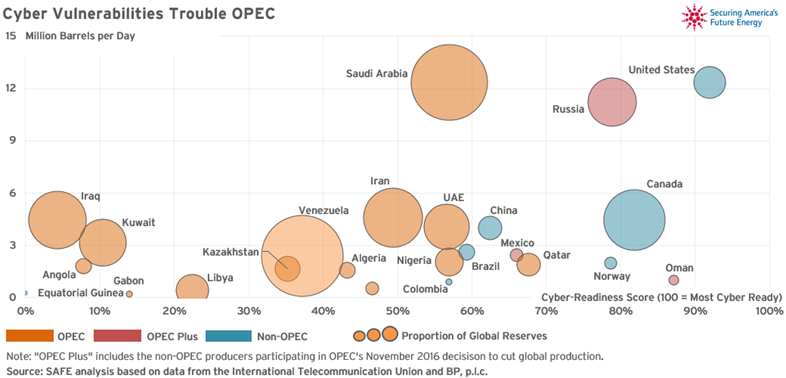
An analysis of data collected from 134 countries by the International Telecommunication Union has revealed that some of the world’s biggest oil producers, including Iraq, Saudi Arabia, Venezuela, Iran, and the UAE, are lacking in the cybersecurity department. This means that, compared to European producers and the United States, OPEC members are pretty much unprepared for a major cyberthreat.


What is the likelihood of such a threat actually materializing? Well, the general opinion in cybersecurity circles is that everything that can be hacked will be hacked at some point. Saudi Arabia’s oil and gas industry, for example, has been a favorite target for numerous attacks over the last few years, including the Shamoon virus, which in 2012 wiped clean the disks of more than 30,000 computers at Aramco, and according to reports from the cybersecurity industry, reared its ugly head again in 2016.


Overall, about half of all cyberattacks in the Middle East target the oil and gas industry, which suggests the answer to the above question is “Pretty high,” but the worse thing is that this likelihood is only going to get higher in the future. Related: Brent Spikes As This Major Pipeline Breaks Down


Middle Eastern producers are following in the footsteps of their non-OPEC counterparts in adopting digital technology and automation to improve efficiencies in the post-2014 world, where efficiency has come to the fore in oil and gas. The problem, of course, is that the more you digitalize, the more vulnerable you become to attacks through digital channels.


A recent study from Siemens and Ponemon Institute found that as digital tech adoption in the Middle East oil industry rises, so does cyber risk. What’s more, this risk is no longer limited to IT operations: the operational technology area is gaining prominence as a preferred target for cybercriminals.


The reason, according to Siemens and Ponemon Institute, is the convergence between IT and OT in the oil and gas industry. “Attackers have identified this convergence of IT and OT as a key opportunity to penetrate an organisation. As a result, an emerging trend of cyberattacks is designed to disrupt physical devices or processes used in operations. In a digital environment, industrial cyber is the new risk frontier,” says Siemens’ Vice President and Global Head of Industrial Cyber, Leo Simonovich.


The cybersecurity industry is sounding an alarm and it seems those in the Middle East that can afford it are hearing it and heeding the warning to improve their cybersecurity capabilities.


The UAE has a Dubai Cyber Security Strategy. Earlier this year, Saudi Arabia launched a National Cyber Security Center, and last month announced the set-up of a National Authority for Cyber Security, seeking to utilize international expertise and best practices to prop up government and critical infrastructure defenses. Iraq is seriously lagging behind and Iran is seen by cybersecurity insiders as more a source of cyberthreats than as a potential victim.


This sounds all well and good, but the trends in cybercrime point to a desperate need to do more. Cybercriminals do not sit on their hands while potential victims work to improve their defenses. While cybersecurity service providers continue to warn businesses and other organizations that they need to become more pro-active with regard to their cybersecurity measures, the hackers are coming up with new ways to undermine existing defenses. This is true for all industries, but it is especially true for oil and gas in the Middle East—national energy infrastructures are called critical for a reason, after all.


Sunday, December 3, 2017

Mysterious Gold Dealer"s Testimony Puts Erdogan On Shaky Ground

Authored by M K Bhadrakumar via The Asia Times,


As on the soccer field in his youth, so in a tumultuous political career spanning four decades: Turkey’s president Recep Tayyip Erdogan has consistently shown his mettle as a fighter who won’t be satisfied with anything short of total victory


But in the battle that is now unfolding around him, and which is besieging him, there isn’t going to be a winner.


What is at stake is survival – the chance to live another day, even if in some ignominy. That much is clear from the opening testimony in a federal courtroom in New York on Wednesday from the Turkish-Iranian gold trader Reza Zarrab, who allegedly helped Tehran sidestep US sanctions to export oil with the connivance of corrupt Turkish high officials and then to launder the income.


When the principal accused becomes the star witness in a US court, he has possibly struck a deal with the authorities. The remaining ambiguity is with regard to when it was that Zarrab struck the deal – was it when he landed in Miami 18 months ago, ostensibly to show his young son around Disneyland, or before he was spirited out of Turkey to America on the express understanding that he’d get clemency for providing hard evidence to nail Erdogan.


Zarrab explained before the court the elaborate scheme he orchestrated to free “a few billion euros” of Iran’s sanctioned oil using funds deposited in the Turkish state-owned Halkbank which were used to buy gold that was subsequently smuggled to Dubai and sold for cash. (The FBI also nabbed a senior functionary of Halkbank, Hakan Atilla, who is on trial.)


Turkish gold trader Reza Zarrab is shown in a court room sketch as he appears in Manhattan federal court in New York. Photo: Reuters / Jane Rosenberg


Zarrab named a confidant of Erdogan, the former Turkish Economy Minister Zafer Caglayan, as having taken bribes amounting to over US$60 million and also implicated Turkey’s Aktif Bank, which is part of a holding company headed at the time by Erdogan’s son-in-law, Berat Albayrak (the current energy minister). Zarrab is due to testify again. We have only seen the tip of the iceberg.


Meanwhile, Turkey’s main opposition leader, Kemal K?l?çdaro?lu, revealed on Tuesday that Erdo?an’s close circle – including his brother, his son and his executive assistant – made transactions worth around US$15 million to an off-shore company called Bellway Limited in the Isle of Man (a tax haven) in late 2011 and early 2012. Kilicdaroglu produced documentary evidence and promised to revert with more such disclosures.


Top Turkish officials and senior leaders of the ruling party have made the counter-allegation that all of this is a political conspiracy orchestrated by Islamist preacher Fetullah Gulen, who lives in the US. They say Gulen and his American mentors are making a second attempt to remove Erdogan from power after the failed military coup two years ago. The Turks believe that CIA officials sponsored Gulen’s exile in Philadelphia.


Evidently, the US establishment has been preparing the case file for quite some time – and the effort predates the Trump presidency.


The Turkish side have kept President Trump personally out of the firing line.


There is, in fact, an eerie similarity here to what the Russians have been saying – namely, that Trump himself desires a good working relationship with Russia and President Vladimir Putin, but, alas, the Washington establishment is pursuing a contrarian agenda.


Erdogan’s strategic defiance of Washington seriously hurts US interests. Without Turkey’s cooperation, America’s military presence in northern Syria is unsustainable. Turkey’s entente with Russia and Iran undermines US regional strategies.


Add to that Turkey’s S-400 missile deal with Russia, Erdogan’s hostility toward Israel and support of Qatar in its rift with Saudi Arabia, the downhill slide in Turkey’s relations with major European countries and its lackadaisical attitude toward NATO, and it’s not hard to see how the West might view Erdogan as a hurdle that must somehow be overcome.


Zarrab can help irreparably damage Erdogan’s reputation, and even implicate his family members and close aides as criminals.


Worse still, heavy penalties of billions of dollars could be levied on the Turkish banks involved, crippling the country’s economy. And sanctions could be imposed.


Suffice to say, Erdogan has a choice between capitulation or the desecration of the house he has built in a long and hugely successful political career. Time is running out. Erdogan is circling the wagons. He may feel tempted to ride the wings of Turkish nationalism. There is still no credible political figure who can seriously challenge him in Turkish politics. He is daring and charismatic. The next elections are due only in 2019.


But that is to cast an eye at the horizon.


Significantly, US Secretary of State Rex Tillerson quietly digressed during a speech on trans-Atlantic relations in Washington on Tuesday to pose a riddle to no one in particular – whether Turkey would be better off partnering with Russia and Iran or aligning with the West.


On the eve of Zorrab’s testimony, Tillerson seemed to hint at a passage that Erdogan has not taken, toward a door that he has never opened – one that leads into the rose-garden.


Saturday, December 2, 2017

What Gives Cryptocurrencies Their Value

Authored by Peter St.Onge via The Mises Institute,


The value of cryptocurrencies like bitcoin, just like any other kind of money, comes fundamentally from what you can do with it. As a follow up to What Backs Bitcoin, I want to dig into that value.


The idea, which comes from Austrian economist Carl Menger, is that just as a shovel’s value comes from its ability to dig, a currency’s value comes from its ability to help you do two things: transactions and savings.


Think of transactions as the money you carry in your wallet or checking account, and savings as the rest of what you have in the bank or buried in the yard. It’s worth mentioning here that that vast majority of money demand is indeed savings, making up 90% or more of all money demand.


The reason this matters is because if we know what transactions cryptocurrencies are good at, we can estimate how much money demand they’ll start pulling from fiat or gold, and therefore how much those cryptos will increase in price.


For transactions, some features that matter are cost and speed of transaction, anonymity, reversibility, counter-party risk, regulatory treatment. For savings demand, those factors are overwhelmed by the specific question of how well the currency keeps its price.


Supply and Demand Determine Price — Always


Price, as always in economics, is simply a matter of demand and supply. When demand is rising faster than supply, the currency will go up in price. And if demand is rising slower than supply, price will go down.


Since bitcoin was born in 2009, it has generally enjoyed demand rising much faster than supply, hence price has soared. While the US dollar, say, has gone down — has “price inflated” — because demand failed to keep up with dollar creation.


Those are the features, now what are the applications: what are people using money for?


When we’re looking at a currency’s price, because we’re looking at total demand we don’t care about the number of transactions rather the total amount transacted.


And here, the vast majority of money moving around in the economy is not goods and services — buying a cup of coffee, or a plane ticket — rather financial movements. Paying salaries, buying and selling stocks or bonds, investments and dividends. These occur mostly by bank transfer, which account for 80% of all money moved in the US. Another 15% goes by check, leaving just 3% for credit or debit cards, and 4% for paper cash.


Bitcoin Still under 0.01% of Global Transactions


A final part of the puzzle, what’s the competition to cryptocurrencies? Most money payments worldwide are, of course, denominated in fiat currency like dollars or yen — about 99% by amount. With the remaining 1% made in gold.


Note that fiat has both physical and electronic forms, such as credit cards and bank transfers. Even gold payments can be made with paper rather than physically moving the gold, including gold-based securities that trade in financial markets (so-called “paper gold”).


Now we’re ready to go through those features for each currency. On cost of transaction, bitcoin’s fees nowadays average about $1, and don’t vary by amount you transfer.


You can send one bitcoin, worth $5,000, or 1,000 bitcoins, worth $5 million, and the fees are still a dollar. In contrast, banks typically charge a percentage of the transaction, which adds up on million-dollar transfers.


Meanwhile, on speed bitcoin is much faster than banks; between 10 minutes and an hour to confirm a transaction, while banks take days.


So bitcoin beats on the most important application of money: financial transfers. The one caveat here is exchange costs. Just as you pay fees and spreads when you exchange your dollars for yen, every time you convert dollars into bitcoin you’ve got to pay fees and spreads.


This means that bitcoin’s low fees only really dominate if both the sender and receiver are keeping the money in bitcoin.


Bitcoin’s Exchange Rate Woes


On the other hand, if you have a bunch of dollars and want to buy a house from somebody who likes to keep dollars in the bank, then you’ll have to convert your dollars into bitcoin, send the bitcoin for a buck, then the other guy converts the bitcoins into dollars again. You saved on the transfer itself, but you had to exchange the money twice.


So, bitcoin as a technology is superior for the main type of transaction by value, but in reality that advantage is eroded if people are keeping their wealth in fiat. This isn’t really a flaw of cryptocurrencies per se, it’s just a standard penalty suffered by any minority currency — having to pay for conversion into the dominant currency.


To finish up on cost and speed, obviously physical cash or physical gold are fantastic on both cost and speed, but only if buyer and seller are touching each other. Given paper cash has only a 4% share today, touchable buyers and sellers is a very small part of demand.


For remote orders, then, bitcoin carries lower fees than credit and debit cards, but again with that double-exchange problem unless both buyer and seller are staying in bitcoin.


Bitcoin’s Potential to Outperform


Next up are some secondary benefits: anonymity, reversibility, counter-party risk, regulatory treatment.


Briefly, bitcoin is nearly anonymous unless the US government cares enough about you to put some serious people on you. In this sense it’s essentially like using cash, but with the advantage you can use it over long distances with those low fees.


In practice, the closest alternative is probably a pre-paid debit card that you buy at 7/11, which can cost several dollars in addition to the merchant fees, and isn’t going to work for large amounts nor overseas.


As for reversibility, the question is whether the buyer can cancel his payment. A problem for online vendors who get scammed by people who buy the product, get it in the mail, cancel the order and keep the goodies.


Credit card companies or Paypal famously always side with the customer, which can suck for the honest vendor getting ripped off online. Bitcoin, again like cash, is irreversible once it’s confirmed — so about 10 minutes to an hour. That’s slower than cash, but faster than Paypal or credit cards where buyers can reverse months later.


Fourth characteristic is counter-party risk; the idea that your bank could go under, taking your money with it. Remember bitcoin was invented in the wake of the 2008 financial crisis, where bank failures were common.


Because bitcoin is distributed across many computers and isn’t managed by a central organization, it has no single point of failure. On the other hand, cryptocurrencies do still have potential technical glitches that probably more than make up for that risk.


Regulation: Not If but When


Finally, regulatory treatment. This is where we’ll probably see a lot of change over the next couple years, as governments digest cryptocurrencies like bitcoin.


So far cryptos have enjoyed mostly benign neglect from regulators; tolerated, neither discouraged nor encouraged. On the bright side this has meant little regulatory burdens or fees, although this is changing in places like New York.


On the down-side, this regulatory grey-zone has meant a lot of companies and institutional investors are afraid to use, or even to buy, bitcoin. So increasing regulations could actually boost bitcoin demand, as those regulated users become unafraid to play.


As for what happens in the future, countries are gradually drifting into two camps: broadly enthusiastic (Japan, Dubai, Taiwan, Switzerland), broadly skeptical (China, Korea), with the USA and European Union still lurching between the camps.


Cryptos: For now, Only for Adrenaline Junkies


Now, given how much savings dominate money use, the elephant in the room is would you feel comfortable keeping your life savings in bitcoin.


As we mentioned, the key point here is how its price will hold up, meaning will demand grow faster than supply. While bitcoin has knocked the socks off dollars or even gold, rising 800% in the past year alone, even this soaring growth has come with the major downside that bitcoin also fluctuates a lot — easily up or down 50% in a month.


However, as with any product, service, or medium of exchange, the value of cryptocurrencies will depend on the future choices of countless users and consumers — based on their subjective valuations of the currencies themselves. Those who can successfully guess what will become more valuable in the future will become wealthy. But risks always remain.


Thursday, November 30, 2017

Lira Tumbles After Zarrab Confirms Erdogan Approved "Secret Iran Gold" Trade

In somewhat of a worst-case scenario, Turkish-Iranian gold trader Reza Zarrab just confirmed that Turkish President Erdogan approved the "secret Iran gold" trade that enabled Iran to evade US sanctions.


Full Zarrab quote:


"What I’m saying is that the prime minister at that time period Recep Tayyip Erdogan and minister of the treasury ... had given orders to start doing this trade."


The immediate reaction is clear.


Citi"s FX desk explains why Turkish markets are watching the US trial of a banker so closely.


The basics: The US government has accused Turkish banker Mehmet Hakan Atilla of helping Iran evade US sanctions.


Turkey’s former economy minister, Zafer Caglayan, and two other banking executives, have been charged in absentia but Atilla is the only one on trial.


Why it matters: It"s about the implications this has for US/Turkey diplomatic relations. Bloomberg has a good explainer here: ‘The focus will be on whether [Zarrab] implicates Turkey’s banking system or the highest levels of its government.’ The worst case scenario would hypothetically be where the trial results in diplomatic penalties to Turkey and its banks.


An October 30 document submitted to the court by federal prosecutors in New York said that the US “anticipates that the evidence introduced at trial will show that Turkish government and banking officials were integral to the sanctions evasion scheme.” Still, it’s too early to tell, and we watch the wires closely for the latest developments.


And throwing Erdogan under the bus is likely as serious as it gets.


*  *  *


By way of background, we previously detailed... While long forgotten for some, in the summer of 2014, we reported in detail on what appeared to be the biggest, most bizarre money-laundering scheme ever, involving Turkey trading "200 tons of secret gold" with Iran...


The topic of Turkey"s Oil-for-Gold "deals" has not been far from our thoughts over the last few years (here, here, and here) but as Bloomberg reports, after accessing a report leaked on March 14 of a network that spanned Turkey, China, Dubai and Iran, the plot reveals "one of the most complex illicit finance schemes [prosecutors] have seen." It included the classic money-laundering techniques of over-invoicing and false invoicing (exactly as in the case of the Chinese commodity financing scandal underway) but the secret government plan to juice Turkey"s exports goes much deeper; and if you think that the exposure of this scheme is slowing Turkey"s manipulation, think again. Turkey’s trade balance continues to fluctuate unpredictably as gold stocks flow out of the country in bursts.  “Turkey’s going to continue it,” the Turkish economy minister said. “If those casting aspersions on the gold trade are searching for immorality, they should take a look in the mirror.”


We first started noticing major "odd" exports of gold from Turkey to Iran in May 2012. But in 2013, with a plunging currency, surging inflation, slowing growth, and specter of rapid QE-driven hot money outflows leaving his nation desperate; Zafer Caglayan, the minister in charge of Turkey"s $800 billion economy decided that the only way to ensure success in the looming election... was to cheat...


Read more here...


A farcical domestic investigation was undertaken and while the judges and officials who probed the money laundering scheme were either fired or reassigned, the findings in their report were leaked.


The leaked document that Erodgan tried so hard to hide, prepared by the Turkish National Police, shows that investigators probed the activities of a cast of characters that was both powerful and dependent upon each other for favors. There have been some arrests (but no politicians).


The first was Sarraf, the Iranian businessman, who changed his name from Reza Zarrab after he took Turkish citizenship in 2007.


He and Erdogan were photographed on stage together at one public function, and met at a wedding in Ankara.


After Sarraf was arrested in December, Erdogan told reporters that his gold-dealing had “contributed to the country.”


Then, three years later, Bloomberg reports that Zarrab - the gold trader accused of helping Iran evade sanctions - invoked the name of Turkey’s president, Recep Tayyip Erdogan, as part of a scheme that U.S. prosecutors say was supported by Turkey’s government, according to court documents.


U.S. prosecutors in New York have gathered taped conversations and other records that suggest the trader may have sought support from Erdogan.


The Turkish president hasn’t been accused of wrongdoing, and it’s possible that the trader falsely invoked Erdogan’s name to influence others.


The people charged in the case are captured in the recorded conversations, which were introduced in a filing in federal court in Manhattan.


The documents introduced in the sanctions and money-laundering case against the Turkish-Iranian gold trader, Reza Zarrab, could further complicate the relationship between the U.S. and Turkey, a majority-Muslim country long considered a crucial ally in the region.


And now, the day that Turkish President Erdogan has been most fearful of has arrived, despite his best efforts to block it. Erdogan tried to pressure U.S. officials during the Barack Obama and Donald Trump administrations to drop the prosecution of the trader and has complained in public comments that prosecutors were trying to extract a confession from Zarrab and turn him into an informant. He also claimed President Trump apologized for the prosecution in a phone call.


“Erdogan clearly has a strong personal interest in Zarrab’s case, as he has raised it at the highest levels of both the Obama and Trump administrations,” said Amanda Sloat, a senior fellow at the Brookings Institute and former State Department official overseeing U.S.-Turkey relations.


“U.S. judicial proceedings could also hurt the Turkish economy. Since much of Erdogan’s popularity resulted from his successful economic reforms, his domestic political support would be undermined by a downturn.”


AP reports that a U.S. prosecutor says Turkish gold trader Reza Zarrab has pleaded guilty to charges and will reveal at a New York trial how he helped Iran evade U.S. sanctions in an "economic jihad."


Tuesday, November 28, 2017

Lira Plunges As Mystery Gold Trader Exposes "Secret" Turkish Deal To Evade Washington"s "Economic Jihad"

We detailed below that TRY was selling off on US accusations that the Turkish economic minister of taking bribes.


Citi"s FX desk explains why Turkish markets are watching the US trial of a banker so closely.


The basics: The US government has accused Turkish banker Mehmet Hakan Atilla of helping Iran evade US sanctions.


Turkey’s former economy minister, Zafer Caglayan, and two other banking executives, have been charged in absentia but Atilla is the only one on trial.


Why it matters: It"s about the implications this has for US/Turkey diplomatic relations. Bloomberg has a good explainer here: ‘The focus will be on whether [Zarrab] implicates Turkey’s banking system or the highest levels of its government.’ The worst case scenario would hypothetically be where the trial results in diplomatic penalties to Turkey and its banks.


An October 30 document submitted to the court by federal prosecutors in New York said that the US “anticipates that the evidence introduced at trial will show that Turkish government and banking officials were integral to the sanctions evasion scheme.” Still, it’s too early to tell, and we watch the wires closely for the latest developments.


*  *  *


As we detailed earlier, while long forgotten for some, in the summer of 2014, we reported in detail on what appeared to be the biggest, most bizarre money-laundering scheme ever, involving Turkey trading "200 tons of secret gold" with Iran...


The topic of Turkey"s Oil-for-Gold "deals" has not been far from our thoughts over the last few years (here, here, and here) but as Bloomberg reports, after accessing a report leaked on March 14 of a network that spanned Turkey, China, Dubai and Iran, the plot reveals "one of the most complex illicit finance schemes [prosecutors] have seen." It included the classic money-laundering techniques of over-invoicing and false invoicing (exactly as in the case of the Chinese commodity financing scandal underway) but the secret government plan to juice Turkey"s exports goes much deeper; and if you think that the exposure of this scheme is slowing Turkey"s manipulation, think again. Turkey’s trade balance continues to fluctuate unpredictably as gold stocks flow out of the country in bursts.  “Turkey’s going to continue it,” the Turkish economy minister said. “If those casting aspersions on the gold trade are searching for immorality, they should take a look in the mirror.”


We first started noticing major "odd" exports of gold from Turkey to Iran in May 2012. But in 2013, with a plunging currency, surging inflation, slowing growth, and specter of rapid QE-driven hot money outflows leaving his nation desperate; Zafer Caglayan, the minister in charge of Turkey"s $800 billion economy decided that the only way to ensure success in the looming election... was to cheat...


Read more here...


A farcical domestic investigation was undertaken and while the judges and officials who probed the money laundering scheme were either fired or reassigned, the findings in their report were leaked.


The leaked document that Erodgan tried so hard to hide, prepared by the Turkish National Police, shows that investigators probed the activities of a cast of characters that was both powerful and dependent upon each other for favors. There have been some arrests (but no politicians).


The first was Sarraf, the Iranian businessman, who changed his name from Reza Zarrab after he took Turkish citizenship in 2007.


He and Erdogan were photographed on stage together at one public function, and met at a wedding in Ankara.


After Sarraf was arrested in December, Erdogan told reporters that his gold-dealing had “contributed to the country.”


Then, three years later, Bloomberg reports that Zarrab - the gold trader accused of helping Iran evade sanctions - invoked the name of Turkey’s president, Recep Tayyip Erdogan, as part of a scheme that U.S. prosecutors say was supported by Turkey’s government, according to court documents.


U.S. prosecutors in New York have gathered taped conversations and other records that suggest the trader may have sought support from Erdogan.


The Turkish president hasn’t been accused of wrongdoing, and it’s possible that the trader falsely invoked Erdogan’s name to influence others.


The people charged in the case are captured in the recorded conversations, which were introduced in a filing in federal court in Manhattan.


The documents introduced in the sanctions and money-laundering case against the Turkish-Iranian gold trader, Reza Zarrab, could further complicate the relationship between the U.S. and Turkey, a majority-Muslim country long considered a crucial ally in the region.


And now, the day that Turkish President Erdogan has been most fearful of has arrived, despite his best efforts to block it. Erdogan tried to pressure U.S. officials during the Barack Obama and Donald Trump administrations to drop the prosecution of the trader and has complained in public comments that prosecutors were trying to extract a confession from Zarrab and turn him into an informant. He also claimed President Trump apologized for the prosecution in a phone call.


“Erdogan clearly has a strong personal interest in Zarrab’s case, as he has raised it at the highest levels of both the Obama and Trump administrations,” said Amanda Sloat, a senior fellow at the Brookings Institute and former State Department official overseeing U.S.-Turkey relations.


“U.S. judicial proceedings could also hurt the Turkish economy. Since much of Erdogan’s popularity resulted from his successful economic reforms, his domestic political support would be undermined by a downturn.”


AP reports that a U.S. prosecutor says Turkish gold trader Reza Zarrab has pleaded guilty to charges and will reveal at a New York trial how he helped Iran evade U.S. sanctions in an "economic jihad."


Assistant U.S. Attorney David Denton said Tuesday that Zarrab will be a key witness against Turkish banker Mehmet Hakan Atilla.


The prosecutor said the scheme to evade U.S. sanctions against Iran since 2011 enabled billions of dollars to be moved and threatened U.S. security.


Defense attorney Victor Rocco attacked Zarrab"s credibility in his opening statement, saying the case was really about Zarrab"s crimes.


He said Zarrab made a deal to get out of jail free, possibly joining the U.S. witness protection program so he and his family can live in the United States.


This sparked a plunge near record lows for the Lira (and sent bond yields spiking to record highs)...


Turkish officials remain furious, claiming that the U.S. trial is a "play" staged with the help of a U.S.-based cleric.


Mahir Unal, a deputy chairman of President Recep Tayyip Erdogan"s ruling party, on Tuesday also described the case as a "political" one lacking legal basis.


Unal renewed a Turkish government claim that U.S. judicial officials were cooperating with cleric Fethullah Gulen"s network against Turkey.


He said: "We know who staged this play and what its aim is."


Ultimately, the case is a test of U.S.-Turkish relations, already at one of the lowest points in the countries’ longstanding alliance, with analysts questioning how close the charges might get to Erdogan himself... and by the look of today"s opening statements, and the responses from Turkey, they are worried!


Bloomberg answers: What are the implications for the Turkey-U.S. relationship?


The U.S. “anticipates that the evidence introduced at trial will show that Turkish government and banking officials were integral to the sanctions evasion scheme,” according to an Oct. 30 document submitted to the court by federal prosecutors in New York. Embarrassing revelations of corruption or criminal activity are sure to further stress ties, already at their worst in recent history. Turkey blames Fethullah Gulen, an elderly Muslim cleric who’s been based in the U.S. since 1999, for the 2016 coup attempt against Erdogan. President Donald Trump’s first national security adviser, Michael Flynn, is said to be under investigation for allegedly plotting to seize Gulen and deliver him to Turkish officials. Further complicating the situation, Turkey hired two close allies Trump -- former New York City Mayor Rudy Giuliani and former U.S. Attorney General Michael Mukasey -- to try to broker a resolution of the case that’s reaching trial.


Friday, November 24, 2017

Gold Fund: Bitcoin Will Make Gold "Global Money" Again

The manager of Old Mutual Gold & Silver Fund, a precious metals fund with over $220 mln under control has said Bitcoin is “paving the way” for a global gold comeback.


Speaking to Bloomberg in an interview published today, Ned Naylor-Leyland said that the marriage of Bitcoin and gold was essentially a logical one given the characteristics and remit of both.


“Bitcoin was explicitly designed to be digital gold,” he said.


“So if you’re going to have a small proportion of a fund in Bitcoin, it should be in a gold fund because that’s exactly the point.”


As CoinTelegraph"s William Suberg notes, the fund, which began in April this year, is aiming to allocate up to five percent to cryptocurrency, creaming off profits from price upticks to reinvest back into gold and silver.


image courtesy of CoinTelegraph


Naylor-Leyland is highly bullish on the concept going forward, echoing CME Group’s Chairman Emeritus Leo Melamed in his desire to bring discipline to the scene for investors.


“It’s about bringing the ownership of disciplined money into the modern world,” he continued.


“Bitcoin is paving the way for the reintroduction of gold as global money.”


As we previously discussed, the real importance of bitcoin is not making cheap, easy payments. It’s not a way of making fast payments. It’s not going to allow for microtransactions or all these other use cases that we’ve heard are important for bitcoin.


The most important thing that bitcoin offers is a new form of sound money outside the control of any authority or government in the world. And that is something very, very important for the world economy. Bitcoin is hard money as opposed to easy money.


Easy money refers to money whose quantity is easy to increase, in case there is an increase in demand for it. So if people move toward using copper as money, it is very easy for copper miners to increase the supply and bring the price back down, which will hurt the people who used copper as the store of value for their savings. So copper is bad as a store of value, because it’s easy to produce in response to an increase in demand.


Gold, on the other hand, is hard money because even if the price of gold goes up a lot, it is very hard for gold miners to increase the supply of gold in the world. It is hard to bring the value down. Therefore, gold serves as a good store of value in the long run. It’s a much better store of value than other forms of money over time.


Bitcoin is far closer to gold. It is a digital equivalent of gold.


Bitcoin’s supply is strictly limited. There will only ever be 21 million bitcoins. And the code that controls the issuing of the bitcoins is decentralized among thousands, tens of thousands of nodes that operate the bitcoin software. And if it were to change, it would need the majority agreement of everybody involved.


Since everybody involved has an interest in maintaining the monetary policy in a way that maintains the value of the money, it is highly unlikely that we’re going to witness any change in the monetary policy. Even technical changes, like changing the block size or various parameters, have been almost impossible to make in bitcoin.


It’s possible to make a copy of bitcoin, but it’s not possible to change bitcoin. There will always be some people that want to stick to the inflation schedule as it is. So the monetary policy of bitcoin is immutable, it isn’t going to change, and since the supply is strictly limited and the network is distributed and nobody can control it, we might just have the digital equivalent of gold.


This, I think, is an enormously important innovation, because it has many good properties that gold doesn’t have. It’s very easy to send across the world very quickly, and it’s much harder to confiscate than gold. Therefore, the possibilities are exciting for people who believe in the importance of sound money for society.


Look at the era of the classical gold standard, from 1871, the end of the Franco–Prussian War, until the beginning of World War I. There’s a reason why this is known as the Golden Era, the Gilded Age, and La Belle Epoque. It was a time of unrivaled human flourishing all over the world. Economic growth was everywhere. Technology was being spread all over the world. Peace and prosperity were increasing everywhere around the world. Technological innovations were advancing.


I think this is no coincidence. What the gold standard allowed people to do is to have a store of value that would maintain its value in the future. And that gave people a low time preference, that gave people the incentive to think of the long term, and that made people want to invest in things that would pay off over the long term.


With bitcoin, once you’ve started holding some bitcoin and you see it appreciate, you start understanding that there is a very high opportunity cost to spending, and you start thinking twice about spending frivolously.


Also, bitcoin matters for moving very large quantities and high amounts of value, particularly in transactions in which you’re trying to avoid censorship or economic inflation from the central bank. So as a store of value, this is what bitcoin’s importance is.


*  *  *


Not everyone in the wider gold industry is as happy with the status quo, however.


Discussing a drop in profits, BullionVault Research Director Adrian Ash said earlier this month that Bitcoin “noise” was “distracting” some investors and leading to gold being sidelined.


As John Rubino previously noted, sound money advocates who love the concept of cryptocurrencies but don’t want to abandon precious metals have been trying to clarify their thoughts of late.


Risk Hedge just helped, with a comprehensive statement of the pro-gold position.


The following is an excerpt. Read the full article here.


All the Reasons Cryptocurrencies Will Never Replace Gold as Your Financial Hedge


Despite what the crypto-evangelists will tell you, digital tokens will never and can never replace gold as your financial hedge.


Here are six reasons why.


#1: Cryptocurrencies Are More Similar to a Fiat Money System Than You Think.
The definition of “fiat money” is a currency that is legal tender but not backed by a physical commodity.


It’s clear that cryptocurrencies partially fit the definition of fiat money. They may not be legal tender yet, but they’re also not backed by any sort of physical commodity. And while total supply is artificially constrained, that constraint is just… well, artificial.


You can’t compare that to the physical constraint on gold’s supply.


Some countries are also exploring the idea of introducing government-backed cryptocurrencies, which would take them one step closer toward fiat-currency status.


As Russia, India, and Estonia are considering their own digital money, Dubai has already taken it one step further. In September, the kingdom announced that it has signed a deal to launch its own blockchain-based currency known as emCash.


So ask yourself, how can you effectively hedge against a fiat money system with another type of fiat money?


#2: Gold Has Always Had and Will Always Have an Accessible Liquid Market.
An asset is only valuable if other people are willing to trade it in return for goods, services, or other assets.


Gold is one of the most liquid assets in existence. You can convert it into cash on the spot, and its value is not bound by national borders. Gold is gold—anywhere you travel in the world, you can exchange gold for whatever the local currency is.


The same cannot be said about cryptocurrencies. While they’re being accepted in more and more places, broad, mainstream acceptance is still a long way off.


What makes gold so liquid is the immense size of its market. The larger the market for an asset, the more liquid it is. According to the World Gold Council, the total value of all gold ever mined is about $7.8 trillion.


By comparison, the total size of the cryptocurrency market stands at about $161 billion as of this writing—and that market cap is split among 1,170 different cryptocurrencies.


That’s a long shot from becoming as liquid and widely accepted as gold.


#3: The Majority of Cryptocurrencies Will Be Wiped Out.
Many Wall Street veterans compare the current rise of cryptocurrencies to the Internet in the early 1990s.


Most stocks that had risen in the first wave of the Internet craze were wiped out after the burst of the dot-com bubble in 2000. The crash, in turn, gave rise to more sustainable Internet companies like Google and Amazon, which thrive to this day.


The same will probably happen with cryptocurrencies. Most of them will get wiped out in the first serious correction. Only a few will become the standard, and nobody knows which ones at this point.


And if major countries like the US jump in and create their own digital currency, they will likely make competing “private” currencies illegal. This is no different from how privately issued banknotes are illegal (although they were legal during the Free Banking Era of 1837–1863).


So while it’s likely that cryptocurrencies will still be around years from now, the question is, which ones? There is no need for such guesswork when it comes to gold.


#4: Lack of Security Undermines Cryptocurrencies’ Effectiveness.
Security is a major drawback facing the cryptocurrency community. It seems that every other month, there is some news of a major hack involving a Bitcoin exchange.


In the past few months, the relatively new cryptocurrency Ether has been a target for hackers. The combined total amount stolen has almost reached $82 million.


Bitcoin, of course, has been the largest target. Based on current prices, just one robbery that took place in 2011 resulted in the hackers taking hold of over $3.7 billion worth of bitcoin—a staggering figure. With security issues surrounding cryptocurrencies still not fully rectified, their capability as an effective hedge is compromised.


When was the last time you heard of a gold depository being robbed? Not to mention the fact that most depositories have full insurance coverage.


The gold vs bitcoin debate has a long way to run. But if the outcome is a world in which money is what the market - rather than the government - says it is, then hopefully there will be room for both.


Sunday, November 12, 2017

"Abdication Is Unthinkable": Saudis Deny King Salman Will Relinquish Throne To His Son

Three days ago, we reported that based on various unconfirmed media reports, Saudi King Salman - reeling from a just concluded purge that arrested some of the country"s wealthiest and most powerful royals and officials - was set to elevate his son, Crown Prince Mohammed bin Salman, to the throne in as little as 48 hours. Speculation peaked when Al-Arabiya tweeted, then quickly deleted, details of the allegedly imminent ascension ceremony.


To be sure, though a transfer of power to the crown prince has long been predicted and expected, especially after a lesser known round of mass arrests targeting well-known Saudi clerics took place in September, last week"s events pointed to a final "house cleaning" purge in preparation for bin Salman"s likely imminent ascent. After the September arrests against clerics who were largely seen as regime insiders, yet who were mildly critical of the new aggressive stance against Qatar, the WSJ quoted an adviser to the Saudi government as saying, “Mohammed bin Salman is definitely preparing to become king. He wants to tackle the internal debate about him becoming the king and focus on consolidating his power, rather than doing that while being distracted by dissidents.


During the September crackdown, which is currently receiving little commentary in relation to last weekend"s turmoil, over 30 prominent political figures were detained, most of them clerics with large social media followings and broad influence in the Arab world. The WSJ further noted at that time that...


The government has denied an abdication is planned, but several people close to the royal family say preparations have already started. The transfer of power, which several people close to the royal family had expected to occur this month, is likely to take place late this year or early next year, these people say.


At that time, one of the few commentators to rightly point out that this was not fundamentally about rounding up "outsiders" and "oppositionists" was Middle East history professor and expert on Saudi affairs, As"ad AbuKhalil. He predicted the crackdown was part of a broader campaign aimed at regime insiders and prominent voices who threatened push-back against the crown prince"s vision for Saudi foreign policy:


Unlike what some in the media are writing on social media, this crackdown is not directed against dissidents.  Many of those arrested are loyal propagandists for the Saudi regime.  They are being punished not for what they say but for what they are not saying: they are being punished for not being vocal against Qatar and against the Muslim Brotherhood.


Indeed, last week"s internal Saudi earthquake which witnessed the detention of about a dozen other princes, as well as the freezing in billions in assets, further confirms AbuKhalil"s analysis. Meanwhile, the Crown Prince"s path to the throne is now virtually unimpeded: as a reminder, the 32-year-old Prince Mohammed was named heir to the throne in June after replacing his cousin. Last week, Prince Miteb bin Abdullah was also dismissed from his post as head of the National Guard as part of what authorities described as a sweeping anti-corruption drive, reinforcing speculation that the crown prince was on the cusp of becoming king.


In fact, transfer of power from the King to the Royal Prince would be merely a formality at this point: Prince Mohammed already controls almost all levers of government; he oversees defense, oil and economic policies, and - in applying the script of Syriana to real life - has vowed to wean the Saudi economy off its reliance on oil and return to a more moderate form of Islam.


But perhaps the most substantial confirmation that royal succession is indeed in the cards, is the official denial that took place overnight via Bloomberg, which reported that "King Salman isn’t planning to abdicate in favor of his son, a senior Saudi official said, dismissing mounting speculation that Crown Prince Mohammed bin Salman will soon ascend to the throne." Needless to say, if mounting speculation was baseless, Saudi Arabia would simply ignore it.


There is no possibility whatsoever that the king will abdicate,’’ the official said in response to written questions. Saudi kings usually stay in power even when bad health prevents them from carrying out their job, the official said on condition of anonymity. He noted the example of King Fahd, who stayed on as monarch until his death in 2005 despite being gravely ill in the last few years of his reign.


The denial continued: "Abdication is unthinkable especially since King Salman, 81, enjoys “perfect’’ physical and mental powers, the official said. Those who suggest otherwise “do not understand royal customs and traditions in Saudi Arabia,” the official said." Or, perhaps, they do very well, which is why Riyadh felt the need to issue an official denial.


The irony is that by directly addressing the mounting speculation, the Saudi royal family merely adds credence to it. In a catch 22 described by Graham Griffiths, an analyst at consultancy Control Risks in Dubai, the government will have difficulty credibly denying that speculation “because no one expects them to acknowledge it as a possibility before it happens. As a result, rumor and speculation will continue to abound.”


Additionally, abdication is not unthinkable: as Bloomberg notes, there is one precedent of a Saudi monarch stepping down while still alive.


King Saud bin Abdulaziz abdicated in favor of his brother and heir, Prince Faisal, in the mid-1960s after pressure from ruling family members. The prince had already claimed broad powers to counter a financial crisis that engulfed the kingdom at the time.


In September Eurasia Group said the royal palace was finalizing plans to transfer power allowing “the father to oversee the transition and prevent dissent from other powerful members of the ruling family.”


In any case, while a royal accession may not be imminent, all signs now point to an orderly succession in a few years’ time, discontent with Prince Mohammed’s domestic reform program and foreign policy initiatives “could increase the family’s willingness to challenge him,’’ Griffiths said. Last week"s mega purge, which intends to confiscate up to $800 billion in assets from Saudi oligarchs, may be just the catalyst for Prince Mohammed to accelerate his accession plans as the animosity among the kingdom"s wealthiest and most powerful is rising fast.


Tuesday, November 7, 2017

Pepe Escobar: The Inside Story Of The Saudi Night Of The Long Knives

Authored by Pepe Escobar via The Asia Times,


Princes, ministers and a billionaire are "imprisoned" in the Riyadh Ritz-Carlton while the Saudi Arabian Army is said to be in an uproar...


The House of Saud’s King Salman devises a high-powered “anti-corruption” commission and appoints his son, Crown Prince Mohammad Bin Salman, a.k.a. MBS, as chairman.


Right on cue, the commission detains 11 House of Saud princes, four current ministers and dozens of former princes/cabinet secretaries – all charged with corruption. Hefty bank accounts are frozen, private jets are grounded. The high-profile accused lot is “jailed” at the Riyadh Ritz-Carlton.


War breaks out within the House of Saud, as Asia Times had anticipated back in July. Rumors have been swirling for months about a coup against MBS in the making. Instead, what just happened is yet another MBS pre-emptive coup.


A top Middle East business/investment source who has been doing deals for decades with the opaque House of Saud offers much-needed perspective:


This is more serious than it appears. The arrest of the two sons of previous King Abdullah, Princes Miteb and Turki, was a fatal mistake. This now endangers the King himself. It was only the regard for the King that protected MBS. There are many left in the army against MBS and they are enraged at the arrest of their commanders.


To say the Saudi Arabian Army is in uproar is an understatement.


 “He’d have to arrest the whole army before he could feel secure.”


Prince Miteb until recently was a serious contender to the Saudi throne. But the highest profile among the detainees belongs to billionaire Prince al-Waleed Bin Talal, owner of Kingdom Holdings, major shareholder in Twitter, CitiBank, Four Seasons, Lyft and, until recently, Rupert Murdoch’s Newscorp.


Al-Waleed’s arrest ties up with a key angle; total information control. There’s no freedom of information in Saudi Arabia. MBS already controls all the internal media (as well as the appointment of governorships). But then there’s Saudi media at large. MBS aims to “hold the keys to all the large media empires and relocate them to Saudi Arabia.”


So how did we get here?


The secrets behind the purge


The story starts with secret deliberations in 2014 about a possible “removal” of then King Abdullah. But “the dissolution of the royal family would lead to the breaking apart of tribal loyalties and the country splitting into three parts. It would be more difficult to secure the oil, and the broken institutions whatever they were should be maintained to avoid chaos.”


Instead, a decision was reached to get rid of Prince Bandar bin Sultan – then actively coddling Salafi-jihadis in Syria – and replace the control of the security apparatus with Mohammed bin Nayef.


The succession of Abdullah proceeded smoothly. Power was shared between three main clans: King Salman (and his beloved son Prince Mohammed); the son of Prince Nayef (the other Prince Mohammed), and finally the son of the dead king (Prince Miteb, commander of the National Guard). In practice, Salman let MBS run the show.


And, in practice, blunders also followed. The House of Saud lost its lethal regime-change drive in Syria and is bogged down in an unwinnable war on Yemen, which on top of it prevents MBS from exploiting the Empty Quarter – the desert straddling both nations.


The Saudi Treasury was forced to borrow on the international markets. Austerity ruled – with news of MBS buying a yacht for almost half a billion dollars while lazing about the Cote d’Azur not going down particularly well. Hardcore political repression is epitomized by the decapitation of Shi’ite leader Sheikh Al-Nimr. Not only the Shi’ites in the Eastern province are rebelling but also Sunni provinces in the west.


As the regime’s popularity radically tumbled down, MBS came up with Vision 2030. Theoretically, it was shift away from oil; selling off part of Aramco; and an attempt to bring in new industries. Cooling off dissatisfaction was covered by royal payoffs to key princes to stay loyal and retroactive payments on back wages to the unruly masses.


Yet Vision 2030 cannot possibly work when the majority of productive jobs in Saudi Arabia are held by expats. Bringing in new jobs raises the question of where are the new (skilled) workers to come from.


Throughout these developments, aversion to MBS never ceased to grow; “There are three major royal family groups aligning against the present rulers: the family of former King Abdullah, the family of former King Fahd, and the family of former Crown Prince Nayef.”


Nayef – who replaced Bandar – is close to Washington and extremely popular in Langley due to his counter-terrorism activities. His arrest earlier this year angered the CIA and quite a few factions of the House of Saud – as it was interpreted as MBS forcing his hand in the power struggle.


According to the source, “he might have gotten away with the arrest of CIA favorite Mohammed bin Nayef if he smoothed it over but MBS has now crossed the Rubicon though he is no Caesar. The CIA regards him as totally worthless.”


Some sort of stability could eventually be found in a return to the previous power sharing between the Sudairis (without MBS) and the Chamars (the tribe of deceased King Abdullah). After the death of King Salman, the source would see it as “MBS isolated from power, which would be entrusted to the other Prince Mohammed (the son of Nayef). And Prince Miteb would conserve his position.”


MBS acted exactly to prevent this outcome. The source, though, is adamant;There will be regime change in the near future, and the only reason that it has not happened already is because the old King is liked among his family. It is possible that there may be a struggle emanating from the military as during the days of King Farouk, and we may have a ruler arise that is not friendly to the United States.”


‘Moderate’ Salafi-jihadis, anyone?


Before the purge, the House of Saud’s incessant spin centered on a $500 billion zone straddling Saudi Arabia, Jordan and Egypt, on the Red Sea coast, a sort of Dubai replica to be theoretically completed by 2025, powered by wind and solar energy, and financed by its sovereign wealth fund and proceeds from the Aramco IPO.


In parallel, MBS pulled another rabbit from his hat swearing the future of Saudi Arabia is a matter of “simply reverting to what we followed – a moderate Islam open to the world and all religions.”


In a nutshell: a state that happens to be the private property of a royal family inimical to all principles of freedom of expression and religion, as well as the ideological matrix of all forms of Salafi-jihadism simply cannot metastasize into a “moderate” state just because MBS says so.


Meanwhile, a pile-up of purges, coups and countercoups shall be the norm.


Monday, November 6, 2017

Iran and 9/11: Down the Rabbit Hole of Blame

Preface: Given the new attempt to use documents (cough fake?) linking Iran and 9/11, this piece is timely indeed ...


Background here.


By Kristen Breitweiser, one of the four 9/11 widows – known as the “Jersey Girls” – instrumental in forcing the government to form the 9/11 Commission to investigate the 2001 attacks. Follow Kristen Breitweiser on Twitter: .


Largely unreported and unknown to almost everyone is the recent push to re-establish an Iranian role in the 9/11 attacks. To be more specific, some in Washington are currently trying to allege that Iran played a larger role in the 9/11 attacks than the Kingdom of Saudi Arabia. Why this assertion about Iran— that has been lying fallow for years—is so recently being resurrected raises questions, bears scrutiny, and begs an examination.


Prior to delving into the Iranian revelations, some background is needed to best understand the rather inorganic evolution of this Iranian evidence. As many know, the 9/11 Families have spent the past 16 years trying to hold the perpetrators of the 9/11 attacks accountable for the mass murder of our loved ones. First, we fought for the 9/11 Commission so that we might have an independent investigation into the attacks, learn lessons, fix problems, and hold those in government accountable for their failures that contributed to the vast devastation of that horrific day. Next, as an expressly granted right given to us by Congress in the creation of the 2001 Airline Stabilization Act (more commonly known as the 9/11 Victims’ Compensation Fund), we attempted to hold all the co-conspirators of the 9/11 attacks accountable in a federal court of law. Notably, to the 9/11 Families the definition of “co-conspirators” was always a “both-and” situation, not the more exclusionary “either-or” scenario. In other words, we wanted any and all of those who played a hand (however large or small) in the murder of our loved ones held accountable.


Trying to hold co-conspirators of the 9/11 attacks accountable in federal court is not as easy as the public might think. First, the U.S. government plays a large role with a strong hand in determining who can be qualified as a “co-conspirator.” Notably, this decision historically hinges upon who is “in favor” or “out of favor” with the U.S. government. It can also depend on the foreign and domestic policy agendas of the U.S. government. (Ironically enough, both of these things—domestic and foreign policy agendas —are what created the 9/11 attacks in the first place but that is a much larger topic in need of a tome not a blog.)


As an example of how the U.S. government and its agendas control who gets held accountable for bad acts and who doesn’t, in 2002, a lawsuit on behalf of some 9/11 families was filed against Saddam Hussein and Iraq. Obviously, this lawsuit fell in favor with the U.S. government, since at the time, President Bush was trying to establish a connection between Iraq and the 9/11 attacks to serve as a basis for the war in Iraq. Meanwhile, nearly at the same time in 2002, another group of 9/11 family members (represented by yet another attorney) filed their lawsuit against the Kingdom of Saudi Arabia. This lawsuit was not looked upon as favorably by the U.S. government for several reasons: President Bush considered the members of the Saudi Royal Family to be close family friends; the United States was extremely dependent on Saudi oil; the U.S. had always been dependent on Saudi cash; and finally, perhaps most pragmatically, the U.S. needed Saudi military bases to stage its upcoming war in Iraq. It should come as no surprise then, that the Saudi lawsuit continues to falter to this day while the Iraq lawsuit had a favorable resolution.


Fifteen years later, the 9/11 families are still trying to hold the Kingdom of Saudi Arabia accountable in a federal court of law for the mass murder of our loved ones. And, unfortunately for us, the Kingdom seems to still remain “in favor” with the U.S. government—which is probably why our path to justice has taken so long and why our court case against the Saudis is constantly getting delayed and dismissed by the Judge. To wit, 16 years after the cold-blooded murder of our loved ones, we have yet to even reach the discovery phase of our federal court case—the part of our case where we get to show our evidence (the money transfers, the checks, the FBI reports, the travel documents, the correspondence, the wiretaps, etc.). As an aside, the government in its own criminal prosecution of the co-conspirators of the 9/11 attacks, via its use of the military tribunal system, is as largely unsuccessful as the 9/11 families have been in our federal civil court case. Notably, nearly all of the GTMO cases haven’t even moved passed the pre-trial stages and/or hearings, yet. Clearly, the government’s self-created military tribunal system has proven to be (much like its twin-sister program of enhanced interrogation)—just another ill-conceived, hastily done, colossal mistake, and abject failure. And more importantly, both of these post-9/11 U.S. government-created programs have, thus far, only obstructed our rocky path to justice.


The 9/11 Families’ case against the Saudis has been dismissed at the trial level for a myriad of reasons, more recently, because the Kingdom was not a named State Sponsor of Terrorism. In case you didn’t already know this horrifying dirty little secret, for the most part, getting on and off the official State Sponsor List is mostly a political decision, having very little to do with reality—i.e. whether you really deserve to be on the list in the first place. And typically, you can get off the list by buying your way off, just as long as you are deemed “in favor” with the right people and/or Presidents at the right time. This is what happened with Pan Am Lockerbie and Libya, by the way. Notably, while Libya took responsibility for the bombing of Pan Am Lockerbie, more recent reports have shown that Iran was actually responsible for the terrorist attack.


Nevertheless, in response to being unable to hold the Saudis accountable for their role in the 9/11 attacks because the Kingdom of Saudi Arabia was not an “officially named State Sponsor of Terrorism,” the 9/11 Families fought for and won JASTA (Justice Against Sponsors of Terrorism Act). JASTA enables any victim of mass terrorism on U.S. soil to hold any nation accountable—regardless if that nation was on the list of State Sponsors of Terrorism. JASTA is a solid anti-terrorism law that can in some ways get around the “politics” that sometimes block the path to justice for victims of terrorism. Notably, the entities that fought most stridently against JASTA were certain key members of the Foreign Relations Committees and the Armed Services Committees; the U.S. State Department’s Near East Affairs Desk; former CIA Director John Brennan; former Attorney General Michael Mukasey and American Enterprise Institute’s John Bolton; Secretary of State John Kerry; and President Barack Obama. Obviously, each of these individuals and entities had their own agendas, but clearly their overall reason to oppose anti-terrorism legislation like JASTA should be fairly apparent to all. Sadly, saving lives from terrorist attacks and holding official and unofficial state sponsors of terrorism accountable for their role in supporting terrorism and/or terrorist groups—were not chief among their interests. Nevertheless, after overcoming such staunch “establishment” opposition, JASTA became the law of the land in October 2016. And, the 9/11 Families returned, once again, to federal court to hold one of the largest co-conspirators of the 9/11 attacks, the Kingdom of Saudi Arabia, accountable for their very well-documented and well-known logistic and financial support of the 9/11 hijackers and al Qaeda.


Finally last spring, directly due to the enactment of JASTA, the 9/11 Families filed our Complaint naming the Kingdom—regrettably, not specific Saudi Royal Family Members like Prince Bandar bin Sultan or his wife who sent money to the 9/11 hijackers—as defendants in our new lawsuit. In their answer to our complaint, the Kingdom of Saudi Arabia claimed that the 9/11 Families’ lawsuit should be dismissed for several reasons, chief among them, that the 9/11 Commission exonerated the Saudis from any role in the 9/11 attacks. This novel defense was not new to us. In fact, in 2016, when the infamous 28 pages were finally released to the American public, many establishment-type folks—the Saudis, the Director of the CIA, the Obama Administration, etc.—said eerily similar things about the 28 pages “exonerating the Saudis” and there being “no there, there” with regard to the evidence presented in the 28 pages. Of course, these statements were ridiculous since the pages themselves represented 28 f-u-l-l pages of facts and evidence detailing the Saudi role in the 9/11 attacks—indeed, even Forrest Gump could discern that there was plenty of “there, there.”


Nevertheless, hearing this same tired argument of “exoneration” now being put forth by the Kingdom of Saudi Arabia’s attorneys as a legal basis to dismiss the Saudi lawsuit from federal court was received with exceptional incredulity by the 9/11 Families. After all, we were the very same people who had fought for the creation of the 9/11 Commission in the first place. How could the Saudis now be using the 9/11 Commission against us?


In short, we knew everything about the Commission—we fought for its creation; its members and make-up; its budget; its timetable; its access to documents and people; its subpoena power; its open hearings; its extension; its hampered and flawed final recommendations; and, perhaps, most notably its mandate. Because of those things, we knew—first hand—exactly what the Commission’s mandate was: to specifically not find fault or finger point in order to remove any taint of embarrassment and also to achieve consensus. To quote the 9/11 Commission Chairmen in the 9/11 Commission’s Final Report’s Preface: “Our aim has not been to assign individual blame.” Logically speaking then, how could a Commission with a specifically tailored, strict and narrow mandate to not find fault or finger point, exonerate anyone? Plain and simple, it can’t. (Note: we fought very hard to try to have the Commission’s mandate strong enough to hold people responsible and accountable but we lost that fight. Regrettably, to date, not one person in the U.S. government has been held accountable, fired, or reprimanded for their role in facilitating and/or failing to prevent the 9/11 attacks. In fact, some people like former Director of the CIA, George Tenet, were given medals.)


Knowing the preposterousness of this new Saudi defense, the 9/11 families reached out to the former 9/11 Commission members and made a simple request: Please sign an affidavit saying, “Our report speaks for itself. We did not exonerate the Kingdom of Saudi Arabia.” To us, it seemed a no brainer. Note, we did not ask the Commission to say the Saudis were guilty or responsible—we merely asked for them to say that they did not exonerate the Saudis. We knew all of these men and women. We knew their work product. We knew the Commission’s Final Report and its footnotes inside and out. And, we knew the Staff Director, too. It was at this juncture that the 9/11 Families were informed by certain key members of the 9/11 Commission that they could not sign any affidavits and that they believed that Iran had more to do with the 9/11 attacks than the Kingdom of Saudi Arabia. Iran????


Obviously, as key 9/11 family members who fought to have the Commission created, closely followed the Commission’s investigation, attended every hearing, testified before the Commission, held regular conference calls with the Commission throughout its existence, monitored their progress, and were actively engaged with the follow-up to the 9/11 Commission’s Final Report, we were stunned and confused in hearing this revelation about Iran. To us, it seemed half-baked and very overcooked. Frankly, we’d been down this road before.


So, exactly where was this Iranian information coming from and how had it remained secret for 16 years? Had it been suppressed?!? Was there foreign influence involved in keeping it a secret??? (Gasp) Were the Russians perhaps responsible for keeping this Iranian evidence under wraps?!? Frankly, we always knew the Staff Director of the 9/11 Commission, Philip Zelikow, was close with Condoleeza Rice who was a so-called “Soviet expert,” but still, something that untoward just seemed too far-fetched. Should someone call Robert Mueller?!?


No, but more seriously and specifically, just how had this Iranian evidence gone unnoticed for so long?


We began to wonder: Had the FBI in its PENTTBOM investigation come across this same evidence? Were there mountains of FBI 302’s involving: Fifteen of the nineteen 9/11 Hijackers being Iranians; some of those 9/11 hijackers visiting the Iran Consulate and Embassy; Iranian officials meeting the hijackers at U.S. airports and escorting them through border security; Iranian officials paying rent, opening checking accounts, and getting drivers’ licenses for the 9/11 hijackers; an Iranianvisa-express program; the Iranian Ambassador’s personal checks and/or wire transfers to the 9/11 hijackers; an Iranian support network inside the United States for the 9/11 hijackers that was made up of Iranian officials on the Iranian payroll; evidence of Iranian FBI informants; evidence of Iranian-connected imams counseling and providing support to the 9/11 hijackers; evidence of phone calls made between the Iranian Embassy and the 9/11 hijackers; Iran paying for plane tickets for the dry-runs of the 9/11 hijackers; Iranians in U.S. flight schools; and/or, Iranian funding of the training camps in Afghanistan. Is that why we went to Afghanistan immediately after the 9/11 attacks—to ferret out Iranian funded al Qaeda training camps? Was Iran mentioned in its own 28 pages of the Joint Inquiry of Congress’ Investigation into the September 11th attacks? Were members of the Iranian Royal Family flown out of the United States in the hours after 9/11? When Abu Zubaydah was captured, did he have the phone number of the Iranian Ambassador’s home in Aspen? Or the name and phone number of the Iranian King’s nephew who was living in the United States? Did Osama Basnan meet with an Iranian prince in Houston back in 2002 prior to that same Iranian Prince meeting President Bush at his ranch in Crawford, Texas? Were the Senate and House Intelligence Committees and Foreign Relations Committees briefed about this Iranian information and evidence? Did President Bush know this Iranian information when he started the war in Iraq? More recently, did President Obama know this Iranian information when he promoted and signed his nuclear treaty with Iran merely two years ago? Of course not—>BECAUSE ALL OF THAT EVIDENCE WAS ABOUT THE KINGDOM OF SAUDI ARABIA, NOT THE REPUBLIC OF IRAN.


Incidentally, prior to promoting the Iran deal, President Obama must have known about the little bits of Iranian evidence that was actually collected by the 9/11 Commission since the person who largely took credit for selling the Iran deal to the American public, Ben Rhodes, Assistant to the President and Deputy National Security Advisor for Strategic Communications and Speechwriting for the Obama Administration, was also former 9/11 Commission Co-Chair Lee Hamilton’s right hand man during the term of the Commission. In fact, a quick search of the 9/11 Commission archives can easily show Iran documents very likely penned in Ben’s own hand revealing that Rhodes knew plenty about the Commission’s investigation and work-product—and even the scant bit of evidence the Commission was able to dig up about Iran. So, assuming arguendo, that this Iranian evidence is to be perceived as persuasive and more damning than all of the evidence the Commission collected against the Saudis, just how could Ben Rhodes and Barack Obama promote a peace treaty with these perpetrators of the 9/11 attacks? Maybe someone should ask Rhodes and Obama?


Interestingly, and nearly at the same time as President Obama and Ben Rhodes were selling the Iran nuclear deal, the 9/11 Families were fighting for JASTA–>and President Obama was strongly opposing JASTA thereby siding on behalf of the Saudis, instead of with U.S. victims of terrorism. These two things may seem unrelated until you consider how President Obama was reportedly finally able to ward off Saudi opposition to his precious Iran deal—he gave the Saudis incentives. One of these incentives was the $110 billion weapons deal that President Trump was just recently given credit for. And, perhaps, the other incentive was Obama’s promise to oppose JASTA and block the 9/11 Families’ Saudi lawsuit? One wonders.


Also going on at this very same time in the summer of 2015, an entirely different group of 9/11 Family members with an entirely different set of attorneys were in federal court and received a final default judgment against Iran for its role in the 9/11 attacks. Quite ironically, several 9/11 staffers apparently handily provided affidavits in that case attesting to an Iranian role in the 9/11 attacks. While busy fighting for JASTA in Washington (to hold the Saudis accountable for the 9/11 attacks) a few 9/11 Families took note of this Iranian final default judgment being so breezily signed off on by the usually recalcitrant federal judge (recalcitrant at least when things are related to the Kingdom of Saudi Arabia) and we clearly saw the writing on the wall: In 2016, the U.S. government wants Iran to be held responsible for the 9/11 attacks.


Which brings us to the evidence linking Iran to 9/11. To quote former Director of the CIA, George Tenet: It’s a slam dunk.


The evidence is scant and the information surrounding it is even more obscure. But it’s not like many haven’t taken such odds to the bank before—witness the war in Iraq. Indeed, most of what we know about the 9/11-Iran connection is provided by Phil Shenon in his book, “The Commission.” Shenon writes about an eleventh hour discovery of Iran evidence by a 9/11 Commission staff member named Lorry Fenner. Interestingly, while Fenner is finding this Iranian information in NSA files, nearly at the same time, Staff Director Philip Zelikow and Staff Member Dieter Snell are also doing an eleventh hour re-write of the Saudi section of the 9/11 Commission’s Final Report so as to downplay and discount the Saudi role in the 9/11 attacks. (FYI, Snell is one of the 9/11 Staffers who happily provided an affidavit in the aforementioned Iran lawsuit. How convenient.)


Some background research on Fenner reveals, according to Shenon, that Fenner was placed on the Commission staff with encouragement by Jamie Gorelick. Some believe that Gorelick, herself an “old friend” of Director of the CIA George “slam dunk” Tenet, might have been placed on the Commission to downplay CIA failures and protect the agency from undue exposure—for which the CIA had plenty—>particularly when it comes to the CIA’s role with regard to Saudi Arabia and al Qaeda, generally, and the 9/11 hijackers, specifically. Nevertheless, it is interesting to note that Gorelick’s reported staff pick, Fenner, is responsible for this eleventh-hour investigation into NSA files.


First, according to Shenon, Fenner was a staffer assigned to an entirely different part of the Commission’s investigation and was, therefore, not officially authorized to be investigating NSA files when she made her eleventh-hour discovery about Iran playing a role in the 9/11 attacks. Reportedly, according to Shenon, other 9/11 Commission staffers who did similar things (i.e. went outside official channels to investigate matters like the Saudis) were summarily fired for going outside their investigative purview. It appears that Fenner did not meet the same fate due to her Iranian forays. In fact, it appears that she received Staff Director Zelikow’s approval for same. Second, it’s probably not exactly surprising that a staffer placed on the Commission by someone like Gorelick (think CIA) would want to find dirt in NSA files as a way to discount and distract from the CIA’s own failures and facilitations. And, what better way to do this than by rifling through NSA files and finding information that pins blame on Iran so as to downplay the CIA’s largest 9/11 angle of exposure, the role played by the Kingdom of Saudi Arabia. In other words, Fenner’s foray was meant as a distraction.


Thus, Fenner, the intrepid investigator, singlehandedly pours over “tens of thousands” of documents that are “densely written, with code names and abbreviations and acronyms and geographic locations that she would not understand,” and miraculously (within a few hours) discovers proof that Iran played a role in 9/11—EUREKA! Yes, in the tens of thousands upon thousands of NSA documents—and after “several days…of two or three hours at a time” (that’s “days” not “weeks” and “2 or 3 hours” not “10 or 12 hours”) Fenner apparently found what she was likely sent to look for: a crumb of Iranian evidence.


But, according to Shenon’s account, Fenner needed more evidence. So according to Shenon, knowing that she was not supposed to be operating inside the NSA files, Fenner asked for help from a Commission ally who could legally operate within the confines of the NSA files. Shenon reports that Fenner turns to Lloyd Salvetti for help. It should come as no surprise that Salvetti, according to Shenon, is a former CIA career officer (and Staff Director Philip Zelikow appointee to the Commission). Together, Salvetti and Fenner engage the support of yet another Commission staffer, Doug MacEachin, who also, according to Shenon, just happens to be a veteran CIA analyst. How shocking. Shenon writes that these three staffers focused on these NSA files literally during the last few days, indeed the very last weekend, of the Commission’s investigative lifespan.


According to Shenon, the three learned that the connections between Hezbollah and Iran and al Qaeda were much more “direct” and “recent” than previously thought. And, they wanted to make sure this vital information made it into the Commission’s Final Report that was about to go to press. Perhaps, due in large part to Zelikow and Snell’s last minute edits and rewrites to the Saudi section of the 9/11 Commission’s Final Report (also reported by Shenon in his book), the new Iran evidence could be added just in time. (A little known fact about the Commission’s Final Report is the very tight publishing restrictions placed on the Commission’s Final Report by its publisher, Norton. In short, apparently, the 9/11 Commission’s Final Report couldn’t exceed a certain page limit. Thus, a heavy editing hand was required in writing the Final Report. Good to know the nation’s worst terrorist attack that killed 3,000 people was abridged for space concerns! And what bother if the damning evidence about the Saudis had to be cut out!) Nevertheless, this Iran evidence needed to get out to the public. In fact, in June 2004, 9/11 Commission Chairman Thomas Kean felt compelled to say, “We believe that there were a lot more active contacts, frankly, with Iran and with Pakistan than there were with Iraq.” Unfortunately, by that time, President Bush’s war in Iraq was well underway. Iran would have to wait.


As for the Iranian connections to 9/11, upon inspection, it is likely far less than what can be found about the Kingdom of Saudi Arabia. After all, the super sleuth Fenner and her two CIA cohorts only found approximately 100 instances of Iran being mentioned in the thousands and thousands of pages of NSA files. Now, I dont fancy myself a mathematician but let’s just say that out of 60,000 files, the word “Iran” was mentioned 100 times? Folks, thats less than .001%. Not exactly an overwhelming number when you consider how many times those three intrepid investigators also probably came across “KSA,” “UAE,” “Pakistan,” and/or “Qatar” in those documents.


Reportedly according to Shenon, the NSA files, “showed that Iranian authorities had helped facilitate the travels of several of the 9/11 hijackers in the year before the attacks. There was nothing to suggest Iran or Hezbollah leaders had knowledge of the 9/11 plot. But there was plenty of evidence to show that they had made special arrangements to allow many of the 9/11 hijackers to visit or pass through Iran,” from Afghanistan. Notably, the Iranian border control policy was a sort of blanket special treatment extended to al Qaeda members transiting Iran from Afghanistan—they simply did not stamp their passports and gave border security instructions to not harass them, in general. In other words, the failure to stamp these 8 hijackers’ passports was not an isolated and/or unique incident. It’s important to also know that under interrogation detainees Khalid Sheikh Mohammad and Ramzi bin al Shibh acknowledged that some of the 9/11 hijackers passed through Iran but that the Iranian government had no knowledge of the plot. Of course, this information is problematic since it was gained via torture. In addition, most of the information found in the NSA files that was discovered by Fenner, Salvetti, and MacEachin was apparently written by the NSA after the 9/11 attacks—in fact, one of the files was written as late as August 9, 2002. These revelations could seem to discount the authenticity and weight of the Iran evidence. Nevertheless, a federal court relied on this evidence surrounding the facilitation of travel of some of the 9/11 hijackers to find the government of Iran accountable for the murder of 3,000 on 9/11. Forgive me for asking, but doesn’t this legal threshold for the chain of causation seem considerably lower than that for Saudi Arabia and others?


For example, such “facilitation of travel” for al Qaeda operatives is somewhat akin to how the CIA facilitated the travel of al Qaeda operatives pre-9/11 by arranging/granting approval for visas and/or failing to “watchlist” certain known al Qaeda terrorists when they entered the United States. Frankly, the CIA has a long (and lethal) history of doing this kind of “facilitation of travel.” For example, in 1993, at the U.S. Embassy in Khartoum, Sudan it was a CIA officer who signed the May 1990 visa request that allowed Sheikh Omar Abdel Rahman— the Blind Sheikh—to enter the United States. In fact, “Central Intelligence Agency officers reviewed all seven applications made by Sheikh Omar Abdel Rahman to enter the United States between 1986 and 1990 and only once turned him down because of his connections to terrorism.” Three years later, the Blind Sheikh carried out the first World Trade Center attack killing six people and injuring more than a thousand. The CIA was not held accountable.


Undeterred, the CIA went on to also help “facilitate the travel” of (at least) two 9/11 hijackers, Khalid al Mihdar and Nawaf al Hazmi by purposefully withholding their visa information from the FBI and failing to “watchlist” the two terrorists for a full eighteen months before the 9/11 attacks. Moreover, four days before the 9/11 attacks, even though these two men were considered “armed and dangerous” and “potentially participating in terrorist acts” that might have included the use of weapons of mass destruction, the instructions to law enforcement was to let these terrorists go because they were part of an ongoing investigation. Three thousand people, including my husband, were killed during the September 11th attacks as a result of these two men being let into this country by the CIA. Unfortunately, no federal judge has ever held the CIA accountable for, in my humble opinion, arguably doing more than at least Iran with respect to the “facilitation of travel” for the 9/11 hijackers.


And, then there’s the UAE who also, in my humble opinion, arguably “facilitated the travel” of the 9/11 hijackers in a far larger way and degree than the Republic of Iran. Indeed, 17 of the 19 9/11 hijackers passed through Dubai airport in the immediate months leading up to the 9/11 attacks (that’s long after far fewer (only 8, not 17) of these same men unknowingly passed through Iran, by the way). Moreover, nearly all of the financing of the 9/11 attacks flowed through the UAE, as well. In addition, when Bin Laden was forced to leave Sudan and had to flee to Afghanistan, he was permitted to land in Dubai to refuel his airplane. Nobody knows what would have happened if the UAE did not extend this courtesy to Bin Laden back in 1997—perhaps he wouldn’t have had the ability to build his Afghan training camps, recruit al Qaeda operatives, or plan the 9/11 attacks. Thanks to the UAE, we’ll never know. But really, when one examines the “facilitation of travel” of the 9/11 hijackers and Osama Bin Laden, doesn’t it seem like UAE has more to answer for than the Republic of Iran?


And, I am not saying that Iran is innocent. They are not innocent. Far from it, especially when it comes to broader issues of terorrism beyond the 9/11 attacks. What I am asking for is the fair and honest application of the same standards of proof and evidence to be applied across the board to all entities who played a role in the 9/11 attacks—not just the nations that the U.S. government wants to demonize and go to war with.


One must wonder what other bits of evidence might have been found if the full NSA files were ever actually examined by a truly independent investigation—especially since the NSA (and CIA) had reportedly monitored what’s called the “al Qaeda Switchoard” since 1996. In short, because of this surveillance of the al Qaeda switchboard, “the NSA and CIA already had the information that could have prevented the [9/11] attacks yet for whatever reason, the Central Intelligence Agency which has an extensive history of subterfuge as well as an ongoing disregard for the law withheld the critical information from the FBI.”


Unfortunately, nearly all of the NSA information and evidence (with the exception of the scant evidence used to pin blame on Iran) has been left completely unexamined for the past 16 years—and that, in and of itself, is a crime.


Nevertheless, for right now, some in the U.S. government, for foreign policy reasons, seem to favor pinning the blame for the 9/11 attacks on the Republic of Iran. Historically speaking, the 9/11 Families have learned that when the U.S. government assigns blame (or blocks the assignment of blame) to another foreign government for whatever crime it has committed (or not committed) it’s typically done to serve a very clear foreign policy agenda of the United States—and certainly not done to provide any modicum of justice to the victims and their families. Just ask some of the families of Pan Am Lockerbie, the family of Charles Horman, or any other victim of terrorism.


To quote Charles Horman’s widow, “There is still a long way to go: the United States military continues to lie to the public, and take every opportunity available to cover up their abuses of power. We all have an interest in uncovering the truth. Charles’ mother, Elizabeth, often used the refrain, “we will leave no stone unturned.” That, too, is my mission, and should be the goal of all those dedicated to a just world in which no individual is too big, or too powerful, to answer for their crimes.”


My husband Ron was killed—murdered in cold blood. Sixteen years after I watched him—on live television—either burn alive, get crushed to death, or jump out of a window of the 94th floor of the World Trade Center to escape the horror, the smoke and flames, I still don’t know all of the facts and circumstances surrounding how and why the 9/11 attacks occurred. I want to know why three thousand innocent, beautiful souls were wantonly killed that day. And the people—every single last one of them—who are responsible for my husband’s murder along with the slaughter of 3,000 others beside him—must be held accountable for their crimes.