Showing posts with label Chemical elements. Show all posts

Tuesday, November 21, 2017

Russia Confirms Toxic Cloud Of "Extremely High" Radiation; Source Remains A Mystery

One month after a mysterious radiation cloud was observed over Europe, whose source remained unknown last week speculation emerged that it may have been the result of a "nuclear accident" in Russia or Kazakhstan, on Tuesday Russian authorities on Tuesday confirmed the previous reports of a spike in radioactivity in the air over the Ural Mountains. In a statement, the Russian Meteorological Service said that it recorded the release of Ruthenium-106 in the southern Urals in late September and classified it as "extremely high contamination."


Earlier this month, France"s nuclear safety agency earlier this month said that it recorded a spike in radioactivity, and said that "the most plausible zone of release" of this radioactive material "lies between the Volga and the Urals" from a suspected accident involving nuclear fuel or the production of radioactive material. The agency noted, however, that it is impossible to determine the exact point of release given the available data. Luckily, it said the release of the isotope Ruthenium-106 posed no health or environmental risks to European countries.


France’s Institute for Radioprotection and Nuclear Safety published this graphic
to show radiation levels.


At the time, Russia"s state-controlled Rosatom corporation - the same company implicated in the Uranium One scandal - said in a statement that there had been no radiation leak from its facilities. That changed when the Russian meteorological service (Rosgidromet) reported that it had detected record levels of radiation in the villages located in Russia"s Ural region adjacent to Rosatom"s Mayak plant for spent nuclear fuel. Some calculated that the radiation exposure levels were up to 1,000x higher than the normal rate. 


Mayak, located in the Chelyabinsk region, issued a statement on Tuesday denying it was the source of contamination. The plant said it has not conducted any work on extracting Ruthenium-106 from spent nuclear fuel "for several years." Full statement below:


“The contamination of the atmosphere with ruthenium-106 isotope registered by Rosgidromet is not linked to the activity of Mayak. The measurements which Rosgidromet has released suggest that the dose people might have received is 20,000 times less than the allowed annual dose and presents no threat at all to health.”


Quoted by Sputnik, the Rosatom represtative stated that there were "no incidents or accidents at nuclear facilities in Russia". 


The Mayak nuclear processing plant, located in the Urals, has also come out with a statement saying that "atmospheric pollution with ruthenium-106 that was found by Rosgidromet is not connected to the work of Mayak," since the work on the separation of ruthenium-106 from spent nuclear fuel (and the production of ionizing radiation sources on its basis) has not been carried out for many years at the facility.


Earlier, Rosgidromet confirmed that the the monitoring systems have detected an increase in the concentration of ruthenium over several parts of Russia. However, according to the press release, the concetration does not exceed the maximum permissible concetrations. The head of Rosgidromet, however, said that the automatic monitoring system detected an increase in the concentration of Ru-106 not only in Russia, but also in neighboring countries such as Poland, Romania, Bulgaria and Ukraine. According to him, the concentration in Romania was 1.5-2 times higher than the concentration in Russia.


The exact source of the spike, however, remains a mystery, though IRSN suggested that the cause might be an accident.


Mayak has been responsible for at least two of Russia"s biggest radioactive accidents. In 2004 it was confirmed that waste was being dumped in the local river. Nuclear regulators say that no longer happens, but anti-nuclear activists say it"s impossible to tell given the level of state secrecy. Also on Tuesday, Greenpeace said that it would petition the Russian Prosecutor General"s office to investigate "a possible concealment of a radiation accident" and check whether public health was sufficiently protected.


Thursday, November 2, 2017

Nickel Price Surging As Hype Escalates During LME Week

It’s LME Week and there’s cause for celebration in metal markets. European mining stocks rose to a 4-year high as the nickel price surged more than 5% intraday to a two-year high and rose by the daily limit in Shanghai trading today. Metals used in electronic vehicles, like lithium, cobalt, copper and nickel, are hot right now and a focal point of discussion at the LME gatherings. As Metal Bulletin noted, the 2017 event has seen record attendance.


The annual LME Dinner week kicked off in a positive note, with record numbers gathering for the exchange’s keynote metals seminar on Monday October 30. “We have over 900 people over the day here…which is a record attendance,” London Metal Exchange chief executive officer (CEO) Matthew Chamberlain said.


Despite relatively high inventories, big miners and metal traders are becoming increasingly bullish on nickel’s prospects. According to Bloomberg...


Glencore Plc and Trafigura Group Pte are often at loggerheads, but one thing they agree on: the nickel market will be transformed by the rise of electric cars. Nickel sulphate, a key ingredient in lithium-ion batteries, will see demand increase 50 percent to 3 million metric tons by 2030, Saad Rahim, chief economist at Trafigura, said in an interview. While other battery metals like cobalt and lithium have more than doubled since the start of last year, nickel prices have been subdued because of large inventories.


"When you look structurally, we should start to get bullish now,” Rahim said.


“Are you going to be able to meet that demand when the time comes, given underinvestment in the supply side?”


Glencore, which was devastated by the downturn in nickel, is also optimistic, as are some of the analysts, as Bloomberg notes...


(Glencore) told analysts recently that nickel production would need to increase 1.2 million tons by 2030, equal to more than half of current global output, to keep up with demand from the battery industry. Prices are currently more than double what it costs Glencore to mine the metal. It’s a surprising mood change for a market with a disastrous reputation. Nickel was long a thorn for Glencore, which was saddled with unprofitable operations following its takeover of Xstrata. It sold an Australian nickel mine, which Xstrata bought in 2007 for $2.4 billion, for just $19 million in 2015.


“The nickel industry’s been a bit of a dog since about 2007,” Oliver Ramsbottom, a partner at McKinsey & Co. in Tokyo, said by phone.


The battery industry could revive the fortunes of miners more than a decade after nickel collapsed from a peak of $51,600 a ton in 2007


Despite the hype, Bloomberg cautions that there are still naysayers highlighting elevated inventories and the potential for supply to ramp-up faster than currently expected.


Still, some analysts are skeptical that the bullish scenarios will play out. Electric cars are still a niche industry and nickel oversupply remains a threat, with current stockpiles four times bigger than since the start of 2012.


Indonesia has authorized its largest producer to export more nickel ore. The Philippines has also discussed ending a ban on open-pit mining, raising concerns that supply will spike.


“For years, the market has completely dismissed the idea that something positive could happen in nickel,” Ingrid Sternby, senior research analyst at Blenheim Capital Management LLP, said in an interview in London. “With the recent announcements about Indonesia and the Philippines, it’s easy to see why the market is still scary enough for people not to want to be involved…


“You can see the tightness ahead in the nickel market, but my concern is that we’re going to see a lot of value destroyed along the way,” said Colin Hamilton, managing director for commodities research at BMO Capital Markets Ltd.


“If the miners really believe in the EV growth story, the thing to do would be to keep the nickel in the ground until the deficit arrives.”


When assessing the prospects for nickel, it is really two separate markets, nickel alloyed with iron and nickel sulphate used in batteries. Bloomberg expects the latter to progressively trade at a premium to the former.


About half of global nickel production is in the form of ferronickel or nickel pig iron, which is nickel alloyed with iron, making it suitable for stainless steel. Battery makers, instead, use nickel sulphate, produced by dissolving pure nickel metal in sulphuric acid. One hope is that the pricing of nickel pig iron and the high-grade nickel sulphate will diverge in the coming years, improving the fortunes of miners that can produce battery-quality material.


The global nickel market is heading for a deficit once above-ground stockpiles of battery-grade metal are consumed, according to Wood Mackenzie. The question for miners is how quickly the premium for top-quality nickel will emerge.


The nickel alloy versus nickel sulphate certainly adds complexity to analysing nickel. However, while the fundamentals for the latter seem very positive, it makes us slightly nervous when record numbers of participants gather at industry jamborees.


Still, politicians and automakers are increasingly counting on a future of electric cars, attracting traders such as Trafigura.


“Will we see a real breakout in next 12 months? That’s hard to see, but beyond that, structurally this looks to be going up,” Rahim said.


Wednesday, November 1, 2017

Doc Copper/Gold ratio breaking 10-year support


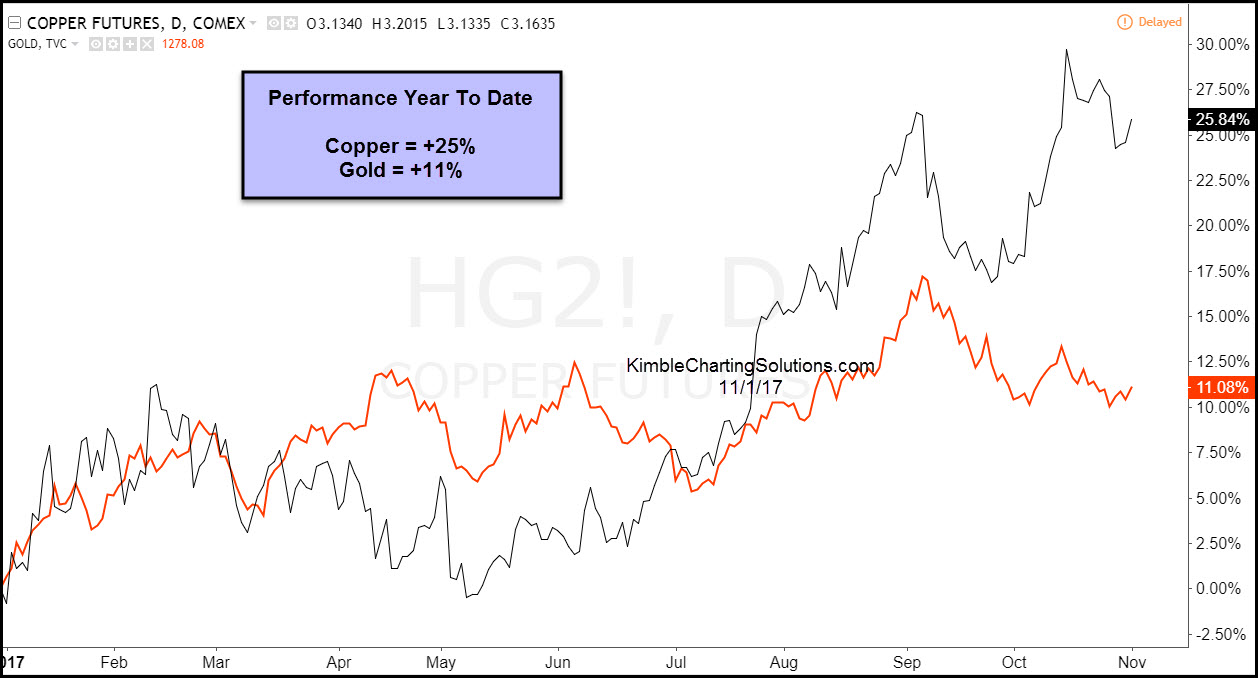
Doc Copper and Gold have both done well this year. Doc Copper has been the stronger of the two, reflected in the chart below-


CLICK ON CHART TO ENLARGE


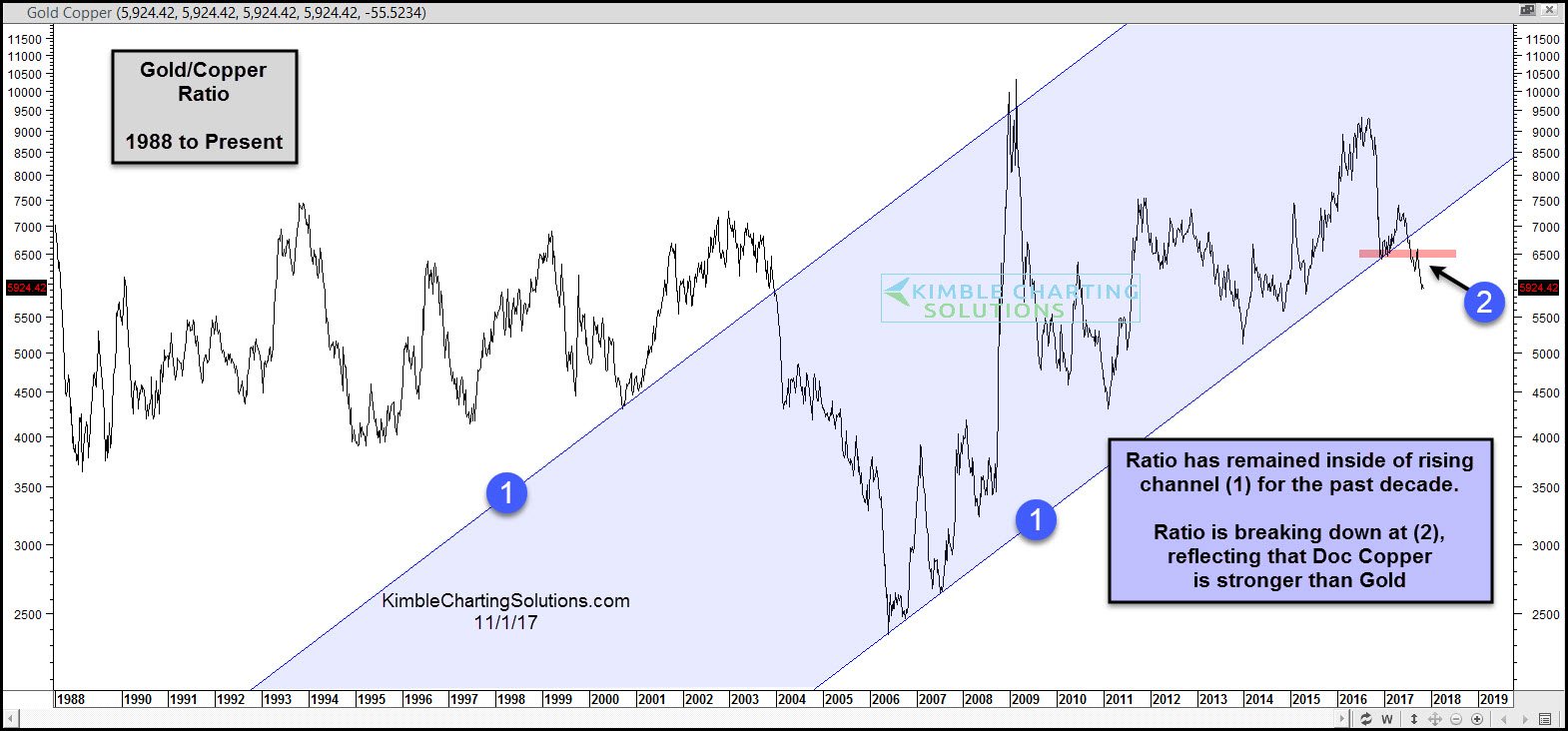
The strength in Doc Copper has the Copper/Gold ratio below doing something it hasn’t done in a long time!


CLICK ON CHART TO ENLARGE


The Doc Copper/Gold ratio has remained inside of rising channel (1) for the past decade. The ratio of late is now breaking below 10-year rising support at (2).


When attempting to decide on what metals to own, this break of 10-year rising support could be sending a very important message to the metals market and could be sending an important macro message as well.


Why you see chart pattern analysis with brief commentary:   There is a ton of news and opinions around markets and assets that make the decision-making process more difficult than it needs to be.   I believe the Power of the chart Pattern provides all you need to see what is taking place in an asset and determine the action to take.  This approach has worked well for me and our clients and I encourage you to test it for yourself.


Receive my free research posted on the blog daily here 


Or,  send an email if you would like to see sample research and take me up on a trial of my premium or weekly research where I provide actionable alerts on breakouts and reversals in broad market indices, sectors, commodities, the miners and select individual stocks 


Email services@kimblechartingsolutions.com  


Call us Toll free 877-721-7217 international 714-941-9381 


Website: KIMBLECHARTINGSOLUTIONS.COM 


Thursday, October 26, 2017

As Lithium Booms, Some Analysts Sound Note Of Caution

In “Mad Scramble for Lithium Mines From Congo to Cornwall”, Bloomberg puts some colour on current conditions in the red hot sub-sector.


For evidence of just how hot battery ingredient lithium is right now, look no further than Australia’s AVZ Minerals Ltd. A penny stock until a few months ago, the mining hopeful has surged about 1,300 percent this year. The proposition: recasting a remote, century-old tin mine in the Democratic Republic of Congo as a supplier of lithium needed to power electric cars. While its rise has been dramatic, AVZ isn’t alone in the rush to position for a rechargeable-battery boom.


In the U.K., a company (Cornish Lithium) founded by former investment banker Jeremy Wrathall Cornish Lithium is planning to tap thermal springs in Cornwall, a region more famous for its beach coves.


Cornish beach cove…but have you tried driving to one from London (takes hours).


Other companies are hunting for lithium deposits from Germany to Mali, and even Afghanistan plans to tender exploration permits.


As we explained last month, there is so much interest in lithium – mainly due to its application in electric vehicles and energy storage - that the Lithium and Battery tech ETF has seen record volumes and the LME is reportedly considering the introduction of a lithium (carbonate) contract.


While everybody has been fretting about the supply side, some analysts are starting to question whether the supply side will expand too fast in the coming years, as Bloomberg explains.


"You’ve got a scramble for deposits, a demand side that looks very impressive, the question is always around the supply," said Paul Gait, an analyst at Sanford C. Bernstein Ltd. in London. In the rush to meet demand there is a risk too many mines will be developed and too much metal supplied, Gait said.


"When the tide goes out, those that do not have good geology will always be found wanting."


Bloomberg notes that uncertainty about global production growth has encouraged some users to lock-in future supplies of the metal.


However, while production might struggle at first to catch up with demand growth, lithium isn’t really rare compared with other battery metals like cobalt and graphite, according to Bloomberg Intelligence analyst Eily Ong. And mining history is full of cautionary examples of booms that ended in bust when the rush to boost supply overshot demand growth. Iron ore is a recent example, after a boom in Chinese steel production led to a push to build new mines. That turned out poorly for many of the iron ore upstarts that either struggled to build projects or brought mines into production just in time for prices to drop. Global lithium production increased by about 12 percent last year, with batteries accounting for about 39 percent of consumption, according to the U.S. Geological Survey. While Australia was the largest producer in 2016, its identified resources are dwarfed by Argentina and Bolivia, each with about 9 million tons and Chile, with more than 7.5 million tons.


 “This is not a metal that’s going to be exempt from the normal laws of commodity economics,” said Bernstein’s Gait. “Sooner or later we will over supply.”


Bloomberg cites a report from Liberum Capital, the London-based brokerage…


There are about a dozen projects being built or expanded around the world, according to Liberum Capital Ltd. Those, plus a handful of others seen as likely to proceed, could help nearly triple global lithium supply by 2025, but still fall short of expected demand. Beyond that, there’s a further eight projects that haven’t secured financing yet, but could possibly push the market into a surplus by 2025, Liberum said in a report. Lithium carbonate prices have more than doubled in the past two years, according to data from Benchmark Mineral Intelligence.


“With prices where they are right now, there’s not a potential lithium mine in the world that doesn’t make an extraordinary amount of money,” said Liberum analyst Richard Knights. “There’s every incentive to bring supply on.”


…and a report from BMO Capital Markets published earlier this week.


Current shortfalls may abate by 2019-20 based on the strong supply response, BMO Capital Markets analyst Joel Jackson said in a note dated Oct. 24. However, uncertainty about assumptions including electric-vehicle penetration, battery technology and lithium supply growth makes the market balance difficult to predict, he said.


The Bloomberg article circles back to AVZ Minerals.


In Congo, AVZ must still prove that extracting the lithium is economically viable. It will also need to rehabilitate an old power station to reach production and build over 600 kilometers (372 miles) of roads to connect the mine with the regional capital of Lubumbashi for exports. Still the project is attracting investors, including China’s Zhejiang Huayou Cobalt Co., one of the world’s biggest refiners of cobalt. "The biggest companies in China are just queuing up," AVZ Chairman Klaus Eckhof said from Dubai.


"They all want to be part of it because they don’t have a pipeline of supply, my phone keeps ringing."


Saturday, October 7, 2017

Spike In Airborne Radioactivity Detected In Europe, Source Located In Southern Urals

In late February, concerns about a potential nuclear "incident", reportedly in the vicinity of the Arctic circle, emerged when trace amounts of radioactive Iodine-131 of unknown origin were detected in January over large areas in Europe, according to a report by the Institute for Radiological Protection and Nuclear Safety, the French national public expert in nuclear and radiological risks. And while Norway was the first to measure the radioactivity, France was the first to officially inform the public about it.


"Iodine-131 a radionuclide of anthropogenic origin, has recently been detected in tiny amounts in the ground-level atmosphere in Europe. The preliminary report states it was first found during week 2 of January 2017 in northern Norway. Iodine-131 was also detected in Finland, Poland, Czech Republic, Germany, France and Spain, until the end of January", the IRSN wrote in a press release.


Ultimately, the radioactive I-131 faded away, and the incident was forgotten with the source of radioactivity never discovered, even as the US military"s "Constant Phoenix" nuke sniffer plane was deployed in the vicinity.


Fast forward to today when French nuclear watchdog ISRN reported that another spike in airborne radioactivity has been detected in the air in Western and Central Europe: "Ruthenium-106 has been detected by several European networks involved in the monitoring of atmospheric radioactive contamination, at levels of a few milliBecquerels per cubic meter of air."


According to IRSN calculations, based on the concentration levels measured in several European countries and on the meteorological conditions of the last few days, the contaminated air could have been generated from southern regions of Ural or located close to those. "IRSN is continuing its investigations to try to confirm the origin of this atmospheric pollution."


Like in February, the very low levels of atmospheric contamination of ruthenium 106 observed to date by European monitoring networks have no environmental or health consequences. Nevertheless, IRSN maintains a watchful vigilance on this presence of ruthenium in the air.


One day prior, on Thursday Germany"s Federal Office for Radiation Protection (FORP) said that elevated levels of the isotope Ruthenium-106 have been reported in Germany, Italy, Austria, Switzerland and France since Sept. 29. The highest concentration was found in Vienna, at 42 millibequerel per cubic meter. FORP raised the alarm initially after five weather service stations detected traces of the particle.


According to the FORP, since only ruthenium-106 has been detected, a nuclear power plant accident can be excluded as the source.


Echoing the observations of IRSN, FORP spokesman Jan Henrik Lauer told The Associated Press the source of the Ruthenium-106 isn"t known but calculations indicate it may have been released in eastern Europe.


Ruthenium-106 is a hard, silvery-white metal with a shiny surface. It is used for radiation therapy to treat eye tumors, and sometimes as a source of energy to power satellites.


So far the reason for its radioactive compound"s presence, as well as the source, remains a mystery.

Monday, September 25, 2017

Visualizing The Massive Impact Of EVs On Commodities

What would happen if you flipped a switch, and suddenly every new car that came off assembly lines was electric?


It’s obviously a thought experiment, since right now EVs have close to just 1% market share worldwide. We’re still years away from EVs even hitting double-digit demand on a global basis, and the entire supply chain is built around the internal combustion engine, anyways.


At the same time, however, as Visual Capitalist"s Jeff Desjardins notes, the scenario is interesting to consider. One recent projection, for example, put EVs at a 16% penetration by 2030 and then 51% by 2040. This could be conservative depending on the changing regulatory environment for manufacturers – after all, big markets like China, France, and the U.K. have recently announced that they plan on banning gas-powered vehicles in the near future.


THE THOUGHT EXPERIMENT


We discovered this “100% EV world” thought experiment in a UBS report that everyone should read. As a part of their UBS Evidence Lab initiative, they tore down a Chevy Bolt to see exactly what is inside, and then had 39 of the bank’s analysts weigh in on the results.


After breaking down the metals and other materials used in the vehicle, they noticed a considerable amount of variance from what gets used in a standard gas-powered car. It wasn’t just the battery pack that made a difference – it was also the body and the permanent-magnet synchronous motor that had big implications.


As a part of their analysis, they extrapolated the data for a potential scenario where 100% of the world’s auto demand came from Chevy Bolts, instead of the current auto mix.


THE IMPLICATIONS


If global demand suddenly flipped in this fashion, here’s what would happen:


Some caveats we think are worth noting:


The Bolt is not a Tesla


The Bolt uses an NMC cathode formulation (nickel, manganese, and cobalt in a 1:1:1 ratio), versus Tesla vehicles which use NCA cathodes (nickel, cobalt, and aluminum, in an estimated 16:3:1 ratio). Further, the Bolt uses an permanent-magnet synchronous motor, which is different from Tesla’s AC induction motor – the key difference there being rare earth usage.


Big Markets, small markets:


Lithium, cobalt, and graphite have tiny markets, and they will explode in size with any notable increase in EV demand. The nickel market, which is more than $20 billion per year, will also more than double in this scenario. It’s also worth noting that the Bolt uses low amounts of nickel in comparison to Tesla cathodes, which are 80% nickel.


Meanwhile, the 100% EV scenario barely impacts the steel market, which is monstrous to begin with. The same can be said for silicon, even though the Bolt uses 6-10x more semiconductors than a regular car. The market for PGMs like platinum and palladium, however, gets decimated in this hypothetical scenario – that’s because their use as catalysts in combustion engines are a primary source of demand.

Saturday, September 2, 2017

Palladium Suddenly Spikes To 16-Year Highs

Amid hope for reinvigorated auto production (after Hurricane Harvey"s destruction) and yesterday"s escalation in US-Russia tensions (Russia being the world"s largest producer), spot Palladium is spiking today, hitting its highest since record highs in January 2001.


While the entire gamut of industrial and precious metals have been rising recently (the latter on the back of Chinese demand hype), Palladium prices exploded today out of nowhere (biggest jump in 7 months).


Pushing the precious metal to its highest in 16 years...


There appear to be a few catalysts for the recent trend and today"s spike...


1. China"s commodity panic-buying trend


There just appears to be blind panic-buying momentum from China in any and every industrial metal and along with gold prices surging amid North Korea and debt ceiling drama, we suspect Palladium is catching a bid on the back of that.


2. Renewed hopes for growth in the auto sector


As Bloomberg notes, approximately 67 percent of palladium produced is used in catalytic converters, which convert up to 90 percent of the harmful gases in automobile exhaust to less noxious substances. Global auto sales, up 4 percent for the year, are driven by a global increase in SUV sales, the ongoing shift from diesel to gasoline engines in Europe (diesel engines alternatively use platinum), and tightening emission legislation.


Sales of autos fueled by petroleum have been particularly strong in China and India. According to Jeffrey Christian, managing partner of CPM Group, car sales in China have been “borrowed” from future years through the offering of rebates and tax cuts. In the first half of the year, auto sales in China rose 4.3 percent, to 13.4 million units, from a year earlier.


US Auto sales just collapsed though...


ZH: And the recent devastation caused by Hurricane Harvey is prompting companies like Ford to discuss increasing production once again.


3. Tighter supply due to Russian sanctions


Russia is the world"s largest supplier...


Source


Bloomberg notes that on Aug. 2, Congress passed a bill approving new sanctions on Russia in response to its interference in the 2016 U.S. presidential election, as well as its human rights violations, annexation of Crimea, and military operations in eastern Ukraine. The measure substantially reduces the president’s power to waive or ease certain sanctions without congressional approval.


The bill lists 12 types of sanctions that can be imposed on people and entities that, for example, conduct “significant” transactions with Russian defense and intelligence agencies and invest or facilitate the investment of $10 million or more in the privatization of any state-owned asset that unfairly benefits government officials or their associates.


So far, Russia has been able to maintain stable palladium supplies in the face of international political issues. Yet since 2014, a bloc of nations -- including Switzerland, Japan, Australia and Canada, as well as the European Union -- has imposed sanctions against Russia.


Norilsk Nickel, a public joint stock company, is the world’s leading producer of palladium and nickel. Its key shareholders are two powerful Russian oligarchs: Vladimir Potanin’s Interros and Oleg Deripaska’s Rusal. Each reportedly owns more than 25 percent of shares. Interros Group is one of the largest private investment companies in Russia. Deripaska has close ties to President Vladimir Putin and a connection to the American political consultant Paul Manafort, whom Deripaska employed from at least 2005 to 2009.


Norilsk Nickel reported that its palladium production fell 2 percent in the first half of the year from a year earlier, to almost 1.3 million metric tons. CPM’s Christian indicated that Norilsk’s stockpiling in the first quarter likely contributed to the tight market in May and June.


Although markets are fairly balanced, showing a small surplus, Norilsk said palladium consumption is expected to reach an all-time high of 10.8 million ounces, and is forecasting a deficit this year of more than 1 million ounces.


ZH: And additionally yesterday saw an escalation in tensions between US and Russia as the state department ordered the San Francisco consulate closed... prompting angry responses from Moscow - and perhaps retaliation.


*  *  *


We suspect the latter two are the most critical factors for today"s spike.

Arkema Texas Plant Explodes, "Black Smoke Fills The Air"

You can"t say they didn"t warn us: this afternoon, the VP of US manufacturing Daryl Roberts at French chemicals giant Arkema, said the company was on "high alert" as more fires could start at the doomed facility at any moment. Well, that moment took place around 6pm ET, when ABC Houston reported that the doomed Arkema plant has exploded, causing a "massive" fire and "sending dark, black smoke into the air."


According to reports on the ground, light winds are not pushing into areas around the plant, but there is concern the smoke could injure others.


The smoke could be seen in the residential Newport area of Crosby, about 7 miles away. Harris County officials are advising residents who did not evacuate the 1.5-mile area around the plant to close their windows and turn off their air conditioning systems.


"You could call this a warning sign that more explosions or fires could
be coming soon," Jeff Carr, a spokesman for Arkema, told the Houston
Chronicle.


Hazardous materials crews are headed to the scene.


Rachel Moreno at the Harris County Fire Marshal"s Office said that the explosion was a result of the product inside the trailers reaching its combustion state, which is causing the black smoke. She said that residents should be safe if they adhere to the one-and-a-half mile evacuation zone, and advised those who are near the site to shelter in place, close all their windows and turn off their air conditioning.


Moreno said no change was made to the evacuation zone.


This is the second of nine trailers at the plant that has caught fire. The trailers each contain liquid organic peroxides, which needs to be cooled to a certain temperature, otherwise it will explode. Officials said that three of the nine trailers have lost power, according to KPRC.


At least 18 people have been injured since the first fire earlier in the week. One of the injured complained of a burning sensation in the eyes and throat and was still feeling the effects, days later.


As reported this afternoon, the Harris County Fire Marshal"s Office has ordered residents within a one-and-a-half mile radius to evacuate the area. In a conference call with reporters on Friday, Arkema President and CEO Rich Rowe said he fully expects the remaining trailers to catch fire, adding the best course of action would be to let the trailers “burn out.”


“The only recourse is to let the eight containers burn out," Rowe said, according to ABC News. "It’s 500,000 pounds of material; let that material burn out."


As reported previously, plant officials said they expected the explosion and fire as chemicals began to heat up after the plant lost power during this week"s flood. There are nine containers with 500,000 pounds of material inside. One of the containers already burned.


Earlier this week, officials evacuated workers and residents within a 1.5-mile radius from the plant after flooding which the company says could lead to a massive fire or explosion. On Thursday morning, members of the media were not let within a 2-mile perimeter of the plant as authorities investigated the incident, while nearby residents were briefly advised to shelter-in-place.


The plant makes organic peroxides, some that need to be constantly refrigerated. When they aren"t, they become volatile.


Friday"s fire was the second fire and explosion after a much smaller one erupted Monday.


The plant"s record with state and federal regulators isn"t stellar either, something the plant"s president acknowledged in a phone conference Friday. "We"re not perfect," said Arkema CEO Richard Rennard. "We"re doing our very best and and will continue to work to get better."


While the company has refused to give the full breakdown of chemicals stored on location, it has warned that it has around 500,000 pounds of peroxides on the site, all of which are expected to burn.


The company also published a list of the toxic chemicals stored at the doomed facility on its web site, reposted below.


  • 2-ETHYLHEXANOYL CHLORIDE DISTILLED

  • ACETIC ACID 84%

  • ACETONE

  • AROMATIC 100

  • BENZOYL CHLORIDE

  • CAUSTIC POTASH 45%

  • CAUSTIC SODA 50%

  • CUMENE HYDROPEROXIDE

  • CUMENE HYDROPEROXIDE

  • DIMETHYL HEXADIENE

  • DIMETHYL HEXANEDIOL DH-S

  • EPSOM SALTS

  • HEXANE

  • HYDROGEN PEROXIDE 70%

  • ISOAMYLENE

  • ISOAMYLENE

  • ISOBUTYLENE     ISOPROPYL ALCOHOL

  • MINERAL OIL, WHITE

  • MINERAL SPIRITS ODORLESS

  • MONOSODIUM PHOSPHATE

  • NEODECANOYL CHLORIDE >=98.0% UNDISTILLED

  • PIVALOYL CHLORIDE 95-100%

  • PROPYLENE GLYCOL

  • SODIUM BICARBONATE

  • SODIUM CARBONATE ANHYDROUS LIGHT

  • SODIUM SULFATE ANHYDROUS

  • SODIUM SULFITE ANHYDROUS

  • SULFUR DIOXIDE

  • SULFURIC ACID 93% REAGENT ACS

  • T-BUTYL HYDROPEROXIDE 70%

All of these substances are now expected to burn down, many in volatile, explosive fashion, in the coming days.

Friday, September 1, 2017

Arkema Releases List Of Toxic Chemicals Stored At Doomed Texas Plant

One day after two explosions rocked its flooded plant in Crosby, Texas, French chemicals giant Arkema said it was on "high alert" as more fires could start at the doomed facility at any moment, according to VP of US manufacturing Daryl Roberts who spoke to reporters on Friday morning. In a separate statement, that company said that "we continue to monitor the temperature in the remaining trailers and there is evidence suggesting that other trailers will soon burn, but there have been no reports of any fires or smoke."


Residents in the vicinity of the Crosby plant, and not only, have grown especially worried about the chemicals contained in the plant, which until recently was only known for holding various forms of organic peroxides. While Arkema executive Richard Rennard said in a press conference Thursday morning that the plant was emitting "noxious" smoke, he would not respond to a question as to whether the smoke from the burning substances was toxic. Incidentally, the following clip shows what happens to the substance if not cooled properly.


Responding to the rising environmental damage concerns, the Environmental Protection Agency said in a statement on Thursday night they concluded the best course of action was to allow the trailers containing organic peroxide to burn out instead of putting emergency responders in harm"s way. It also claimed that its aerial surveillance aircraft did not detect toxic concentrations of chemicals at the site.


"Following this fire, EPA sent aerial surveillance aircraft to test resulting smoke and did ground-level air quality monitoring," read a statement. "EPA’s plane instrumentation is capable of measuring 78 different chemicals, including peroxides. Neither testing methods found toxic concentration levels in areas away from the evacuated facility."


The EPA"s blanket dismissal of concerns, however, did little to comfort the local population which has been ordered to evacuate a 1.5 mile perimeter around the plant.


The questioning continued on Friday, when Roberts refused to disclose the exact volumes and location of the chemicals contained in the plant, citing security and terrorism as reasons why.


Instead, aggravating concerns, Arkema said it expects all 500,000 pounds of peroxides on the site to burn. In terms of timing, Arkema Americas CEO Rich Rose said containers filled with chemicals would likely ignite "in a few days" and was unsure how long the situation could last, adding that 1 out of 9 containers with chemicals have already caught fire at Crosby.


Finally, while refusing to provide more details, the company did publish a list of the toxic chemicals stored at the doomed facility on its web site, reposted below.


  • 2-ETHYLHEXANOYL CHLORIDE DISTILLED

  • ACETIC ACID 84%

  • ACETONE

  • AROMATIC 100

  • BENZOYL CHLORIDE

  • CAUSTIC POTASH 45%

  • CAUSTIC SODA 50%

  • CUMENE HYDROPEROXIDE

  • CUMENE HYDROPEROXIDE

  • DIMETHYL HEXADIENE

  • DIMETHYL HEXANEDIOL DH-S

  • EPSOM SALTS

  • HEXANE

  • HYDROGEN PEROXIDE 70%

  • ISOAMYLENE

  • ISOAMYLENE

  • ISOBUTYLENE     ISOPROPYL ALCOHOL

  • MINERAL OIL, WHITE

  • MINERAL SPIRITS ODORLESS

  • MONOSODIUM PHOSPHATE

  • NEODECANOYL CHLORIDE >=98.0% UNDISTILLED

  • PIVALOYL CHLORIDE 95-100%

  • PROPYLENE GLYCOL

  • SODIUM BICARBONATE

  • SODIUM CARBONATE ANHYDROUS LIGHT

  • SODIUM SULFATE ANHYDROUS

  • SODIUM SULFITE ANHYDROUS

  • SULFUR DIOXIDE

  • SULFURIC ACID 93% REAGENT ACS

  • T-BUTYL HYDROPEROXIDE 70%

All of these substances are now expected to burn down, many in volatile, explosive fashion, in the coming days.

Wednesday, August 16, 2017

Doc Copper breaking out again, gains are piling up!

wrists breaking out rope ties chris kimble post


Ole Doc Copper has struggled since 2011, as it created a series of lower highs. Over the past 90-days, Doc Copper has experienced some impressive upside action.


Below looks at Doc Copper Futures over the past 4-years-


Copper futures weekly


CLICK ON CHART TO ENLARGE


Doc Copper created a series of lower highs below line (1) over the past few years. Earlier this year it hit falling resistance again and backed off. Over the past 6-weeks, Copper has witnessed some bullish price action it hasn’t in the past few years, which is breaking above falling highs.


A few weeks ago Copper broke above falling resistance (1) and highs earlier this year at (2). The rally of late now has it testing 2015 highs at (3). A breakout above (3) would send a bullish breakout message to Copper, with the next key horizontal resistance coming into play at the $3.25 level, which was 2014 highs.


How are members playing Doc Copper strength? Buy owning Freeport McMoran (FCX). A position was taken in FCX, by Premium, Metals and Sectors members 90- days ago.


performance comparison FCX, copper, spy chris kimble post


CLICK ON CHART TO ENLARGE


Doc Copper weakness over the past few years seemed to have little impact on the broad market. Will Doc Copper’s strength over the past few months and breaking above multi-year falling resistance, have a positive impact on the broad market and suggest that some economic strength is around the corner? In our humble opinion it is too early to tell. The Power of the Pattern did share that an opportunity was in play to make some decent Pocket Change 90-days ago and so far that message has not changed. as gains continue to pile up.


from Kimble Charting Solutions.  We strive to produce concise, timely and actionable chart pattern analysis to save people time, improve your decision-making and results


Send us an email if you would like to see sample reports or a trial period to test drive our Premium or Weekly Research


Website: KIMBLECHARTINGSOLUTIONS.COM


Questions: Email services@kimblechartingsolutions.com or call us toll free 877-721-7217 international 714-941-9381

Friday, July 14, 2017

Speculators Sour On Gold And Silver

Authored by John Rubino via DollarCollapse.com,


The stars — in the form of smart and dumb money futures contract positions — have once again lined up favorably for precious metals. Here are those positions for gold and silver as of Tuesday the 4th. Notice that speculators (the dumb money) got a lot less optimistic — that is, less long and more short — while the commercials (the smart money) got much less pessimistic.


The closer each group gets to neutral, where their longs and shorts are about equal, the greater the likelihood that metals prices will rise in the subsequent six or so months.


And here’s the same data for silver presented in graphical form. The top bars are speculator longs and the bottom are commercial shorts. When they approach the zero line that’s bullish.


So here we are once again, at the tail end of a grindingly-protracted precious metals correction that has led a lot of people to give up altogether and sell their mining stocks. The next few months should be much better, especially for holders of the junior miners that were caught in the GDXJ downdraft.


Playing this indicator - known as the Commitment of Traders Report, or COT - is of course just a way to pass the time while the real underlying forces affecting precious metals work themselves out.


Those forces - rapidly accumulating debts which leave central banks no choice but to inflate away their currencies - are still accelerating in most places, and the inevitability of mass-devaluation will become clear when the central banks now talking about “interest rate normalization” and “balance sheet reduction” are forced to admit that those things are impossible, and all that’s left is debt monetization as far as the eye can see.


On that day it won’t matter what futures traders - or junior miner ETFs - are doing. The physical precious metals bid will go infinite — that is, big players holding useless cash will buy up all the gold and silver that’s available, at pretty much any price that’s demanded.


[ZH: Additionally, Bloomberg"s MarketLive blog pointed out this interesting relationship. As the volume of negative-yielding debt in the world rises, so it appears demand for "paper" gold picks up and vice versa...]


Gold & Silver; 16-year bull market support test in play, says Joe Friday

Gold & Silver; 16-year bull market support test in play, says Joe Friday kimble charting solutions


Below compares the performance of Gold, Silver and the S&P 500 since July of 2001. Why compare the performance of the three starting in 2001? This is when Gold & Silver created a series of higher lows, starting a new bull market that lasted the following decade. From 2001 until 2011, Gold & Silver both outperformed the S&P 500 by more than 500% each! 


chart comparing Gold silver and S&P 500 kimble charting solutions


CLICK ON CHART TO ENLARGE


No doubt it paid to own Gold & Silver over the S&P 500 from 2001 to 2011. As we all know at this time, the performance between the three has done the exact opposite over the past 6-years, as it has paid to own the S&P and avoid Gold & Silver.  Is in now time to consider that Gold & Silver could be ending the 6-year bear market in metals?


Below looks at only Gold & Silver since the late 1990’s and why the price point in Gold & Silver are testing what could be historically important levels.


monthly chart of gold and silver, kimble charting solutions


CLICK ON CHART TO ENLARGE


The above chart reflects that Gold & Silver on a monthly basis are both testing 16-year rising support at this time. Despite Gold & Silver being lower over the past 6-years, this reflects that both are in long-term rising trends, where support is being tested.


Joe Friday Just The Facts; Support is Support until broken and both are testing long-term support at this time. What both do at this support test should send very important long-term messages about the metals space and will lead to wonderful opportunities.


If you would like to receive Power of the Pattern charts in the metals sector, you can receive them by being a Premiumor Metals member.


This information is coming to you from Kimble Charting Solutions.  We strive to produce concise, timely and actionable chart pattern analysis to save people time, improve your decion-making and results


Send us an email if you would like to see sample reports or a trial period to test drive our Premium or Weekly Research


Website: KIMBLECHARTINGSOLUTIONS.COM


Questions: Email services@kimblechartingsolutions.com or call us toll free 877-721-7217 international 714-941-9381

Sunday, June 11, 2017

Palladium Pandemonium - Short Squeeze Sends Precious Metal Spreads Parabolic

Authored by Kevin Muir via The Macro Tourist blog,


I know just enough about the palladium market to get myself into some serious trouble - which means, I don’t know much. But this morning, the popular trader Kid Dynamite tweeted about a surprising development in the palladium futures market.


https://www.thefringenews.com/wp-content/uploads/2017/06/themacrotourist.comKidJun0917-7bcd862d612454508c5cd6c5abcbfdb3819682bb.png


Usually, metals’ futures markets trade in contangos. The future price is higher than the spot price to account for the opportunity cost of holding (or financing) the long position in the underlying metal.


https://www.thefringenews.com/wp-content/uploads/2017/06/themacrotourist.comGCCurveJun0917-920adceb89e083811e85ebf736817e5737299e95.png


There is also a cost of storage which needs to be incorporated into this calculation. Arbitrageurs keep the prices in line, and whenever the futures price rises too much, they sell the future, buy the spot, finance the position and arrange for storage. On expiry, they deliver into the futures contract, earning their profit. If the future prices are too cheap, then either arbitrageurs unwind, or might even borrow the metal short to sell in the spot market, and cover by taking delivery for their futures long position. Also natural long buyers who are willing to wait, could buy the forward contract, content to own their metal at a discount to spot later. Assuming there is a properly functioning metals market, the futures price should not deviate too far from the cost of carry.


Which is why today’s action in the palladium market is so interesting. Buyers are willing to pay a large premium for the contracts that expire earlier (which is the exact opposite of what should occur).


Have a look at the prices for the different palladium contracts.


https://www.thefringenews.com/wp-content/uploads/2017/06/themacrotourist.comPACTJun0917-cfc17cdf8627853f8627c49f0dffc2067940fb00.png


The volumes are small at the front end of the curve, so I can already hear the complaints - that’s not a real market, someone just got squeezed on delivery.


Yet, if there was simply a problem with the June delivery, then we would see the June contract trading at a big premium, and the rest of the curve would be in contango. Instead, the whole curve has inverted.


Here is the chart of the September 2017 versus December 2017 palladium spread.


https://www.thefringenews.com/wp-content/uploads/2017/06/themacrotourist.comPAUZJun0917-f32b8a6cbffa9e883b8b34e0824f1fa8d5c9ebab.png


This is a real spread market that you can trade. So right now, you can enter into a contract to sell palladium in September, receive it back in December, and pocket $24 extra dollars for your work. It’s not just a June delivery problem, the whole curve is inverted.


https://www.thefringenews.com/wp-content/uploads/2017/06/themacrotourist.comPACurveJun0917-ffeefe1b1243bdcc426f4c133b5f9ebb9dfc237f.png


So what’s going on? Well, let’s take a peek of the spot price of palladium.


https://www.thefringenews.com/wp-content/uploads/2017/06/themacrotourist.comSpotJun0917-7137e44a8ed806fba169183cac36fb030afb74ca.png


It’s up on a stick and breaking out to new highs. Not only that, it’s doing this as the rest of the precious metals are sucking wind.


I realize palladium is more of an industrial metal than a pure precious metal, but not only is it breaking to new highs for this move, but it is actually pushing up against the highs that were hit during the great precious metals bull market of 2011.


https://www.thefringenews.com/wp-content/uploads/2017/06/themacrotourist.comPalladiumLTJun0917-f910591cedf819ee8a3f7c7c1e27b7cbce14a311.png


One of my trading buddies, the always insightful Ari Pine trades a ton of precious metals, and has been encouraging me to watch the palladium/platinum spread for some time now.


https://www.thefringenews.com/wp-content/uploads/2017/06/themacrotourist.comSpreadJun0917-264d22324a56e6e9a4819fd5e73b063de03c31cc.png


I wish I had listened. Ari was spot on correct that something was happening in the palladium market that deserved our attention (for Ari’s views on gold, click here for his interview on the great Futures Radio Show Podcast).


Palladium has been gaining versus platinum for the past year. Why do we care about this spread? Well, palladium and platinum’s main use is in the fabrication of catalytic converters for automobiles.


And maybe this offers a clue as to why palladium is soaring. I grabbed this palladium FAQ off the web that explains the two metals’ use in cars.


https://www.thefringenews.com/wp-content/uploads/2017/06/themacrotourist.comUsesJun0917-6209979aaa0a207c20afa6e57323e96a93b5746f.png


Palladium is mainly used in gasoline engines, while platinum plays a larger role in diesel cars. The Volkswagen emissions scandal effectively killed diesel’s future in passenger vehicles, so maybe this palladium outperformance can be explained by the dramatic switch from diesel to gasoline.


Combine this extra demand with the fact that palladium is a small market that was already suffering from challenging global supply, you had the recipe for a squeeze.


This slide is from North American Palladium’s website presentation from 2015 (it’s tough to find up to date information about palladium):


https://www.thefringenews.com/wp-content/uploads/2017/06/themacrotourist.comSupplyJun0917-1e05f8aae9973befc1314d0313929b7da5792391.png


When I was discussing palladium with Ari this morning, he wryly commented, “now that we have noticed the big curve inversion, the move is probably over.” That’s part of the reason I enjoy talking with him. Ari is probably even more cynical than me.


But I told him that this palladium move was a high standard deviation event. And I reminded him of one of my favourite lines. You know the problem with fading a 4 standard deviation move? It’s almost always right, but not before it becomes a 6 or 7 standard deviation move…


*  *  *


P.S.: For those gold bugs out there, some day I envision this same inversion occurring in the gold futures market, and this palladium episode should be filed away in the playbook for what to expect.

Tuesday, June 6, 2017

Gold- 6-year bear market ending here?

start button for kimble charting solutions gold ratio post


Is a new bull market in metals about to “Get Started?” Lets look at one indicator that is attempting to send a bullish signal, for the first time in 6-years.


Below looks at the Gold Futures/US Dollar ratio, since 1999 on a weekly basis-


Gold US dollar ratio kimble charting solutions


CLICK ON CHART TO ENLARGE


The Gold/King Dollar ratio broke above resistance in 2001 and a strong breakout took place. For a decade, Gold was much stronger than the US$ at (1). Gold, Silver and miners did very well in this time frame. Once the ratio broke rising support in 2011, the ratio turned lower. This is where the bear market in Gold, Silver and miners started.


Currently the ratio is attempting to do something it hasn’t in the past 6-years, which is a breakout at (2). A break above resistance is the first for the ratio since the highs back in 2011. If the ratio can keep moving higher and clear the highs of last summer, it would send the first longer-term bullish message to the metals space in years.


We would be honored to have you and a Premium or Metals member, if research in the Gold, Silver and Miners is of interest to you.


Website: KIMBLECHARTINGSOLUTIONS.COM


Blog:  KIMBLECHARTINGSOLUTIONS.COM/BLOG


Questions: Email services@kimblechartingsolutions.com or call us toll free 877-721-7217 international 714-941-9381