Showing posts with label Native element minerals. Show all posts

Wednesday, November 1, 2017

Doc Copper/Gold ratio breaking 10-year support


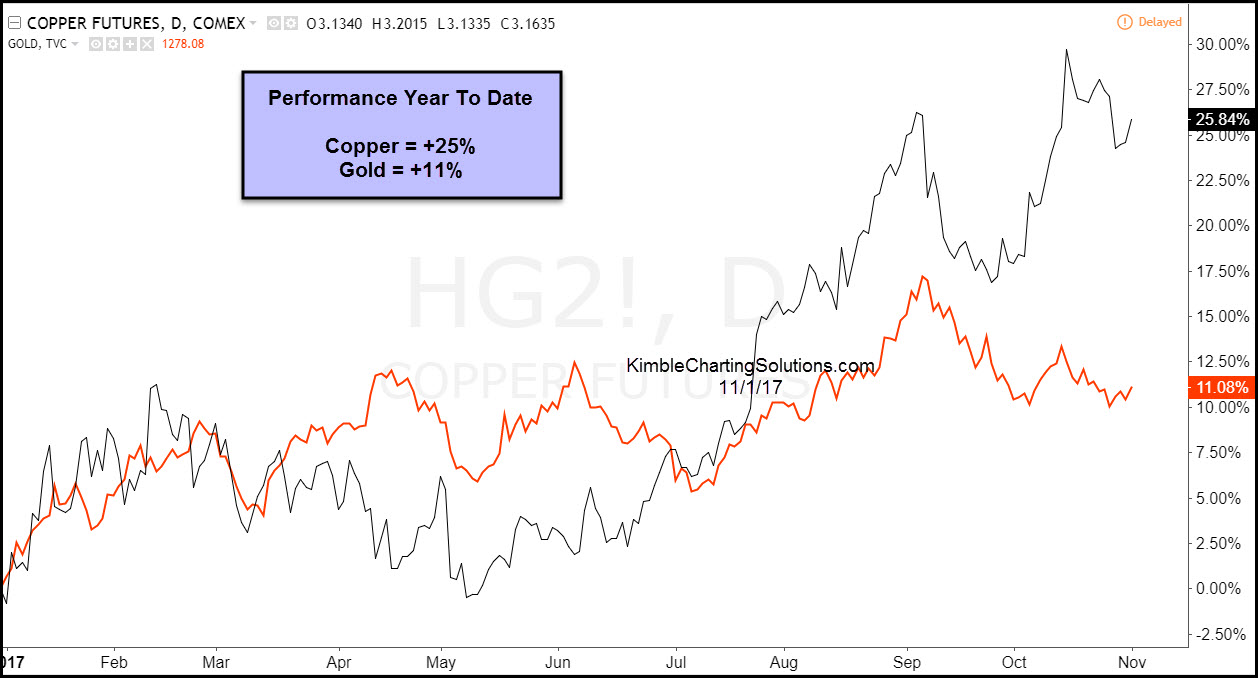
Doc Copper and Gold have both done well this year. Doc Copper has been the stronger of the two, reflected in the chart below-


CLICK ON CHART TO ENLARGE


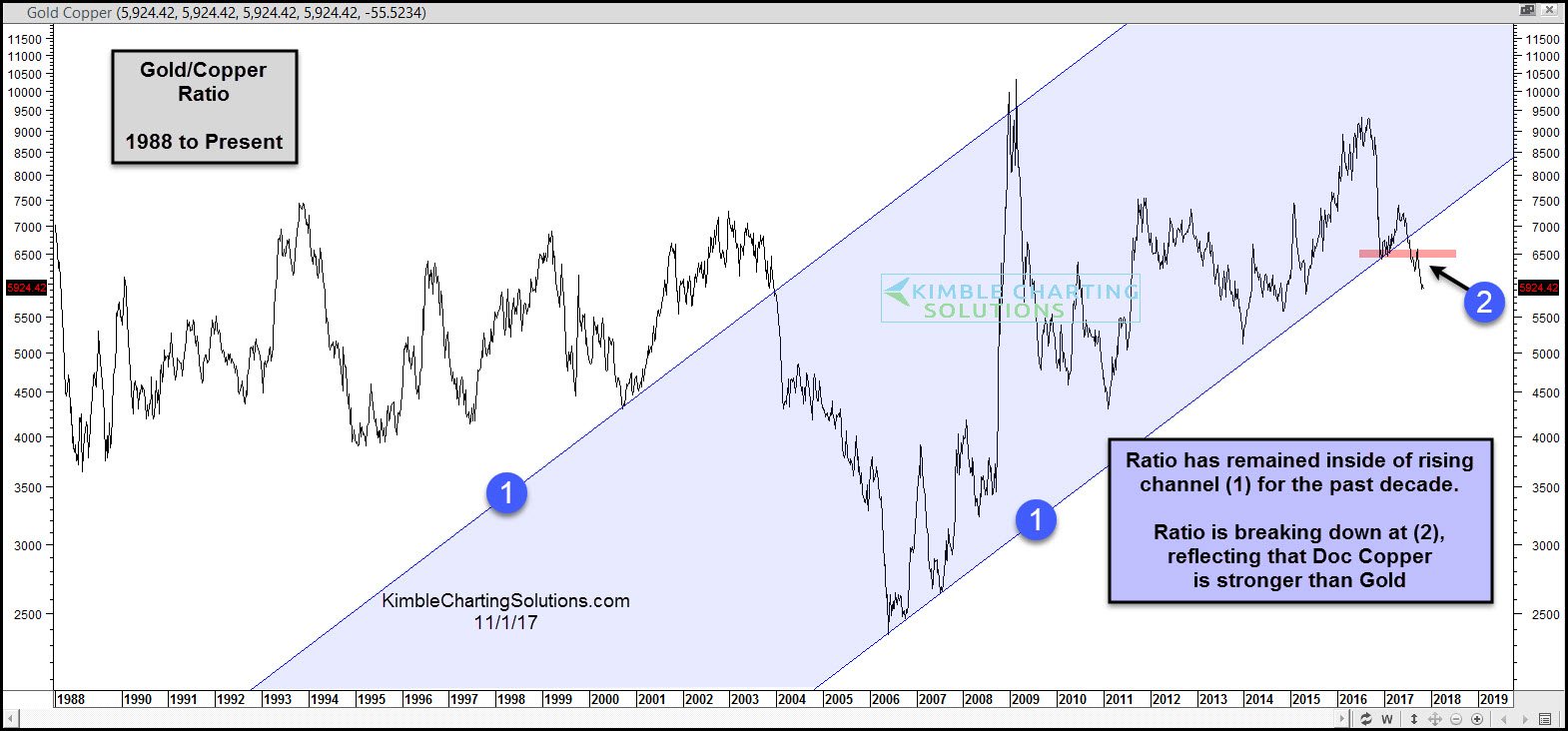
The strength in Doc Copper has the Copper/Gold ratio below doing something it hasn’t done in a long time!


CLICK ON CHART TO ENLARGE


The Doc Copper/Gold ratio has remained inside of rising channel (1) for the past decade. The ratio of late is now breaking below 10-year rising support at (2).


When attempting to decide on what metals to own, this break of 10-year rising support could be sending a very important message to the metals market and could be sending an important macro message as well.


Why you see chart pattern analysis with brief commentary:   There is a ton of news and opinions around markets and assets that make the decision-making process more difficult than it needs to be.   I believe the Power of the chart Pattern provides all you need to see what is taking place in an asset and determine the action to take.  This approach has worked well for me and our clients and I encourage you to test it for yourself.


Receive my free research posted on the blog daily here 


Or,  send an email if you would like to see sample research and take me up on a trial of my premium or weekly research where I provide actionable alerts on breakouts and reversals in broad market indices, sectors, commodities, the miners and select individual stocks 


Email services@kimblechartingsolutions.com  


Call us Toll free 877-721-7217 international 714-941-9381 


Website: KIMBLECHARTINGSOLUTIONS.COM 


Saturday, September 2, 2017

Palladium Suddenly Spikes To 16-Year Highs

Amid hope for reinvigorated auto production (after Hurricane Harvey"s destruction) and yesterday"s escalation in US-Russia tensions (Russia being the world"s largest producer), spot Palladium is spiking today, hitting its highest since record highs in January 2001.


While the entire gamut of industrial and precious metals have been rising recently (the latter on the back of Chinese demand hype), Palladium prices exploded today out of nowhere (biggest jump in 7 months).


Pushing the precious metal to its highest in 16 years...


There appear to be a few catalysts for the recent trend and today"s spike...


1. China"s commodity panic-buying trend


There just appears to be blind panic-buying momentum from China in any and every industrial metal and along with gold prices surging amid North Korea and debt ceiling drama, we suspect Palladium is catching a bid on the back of that.


2. Renewed hopes for growth in the auto sector


As Bloomberg notes, approximately 67 percent of palladium produced is used in catalytic converters, which convert up to 90 percent of the harmful gases in automobile exhaust to less noxious substances. Global auto sales, up 4 percent for the year, are driven by a global increase in SUV sales, the ongoing shift from diesel to gasoline engines in Europe (diesel engines alternatively use platinum), and tightening emission legislation.


Sales of autos fueled by petroleum have been particularly strong in China and India. According to Jeffrey Christian, managing partner of CPM Group, car sales in China have been “borrowed” from future years through the offering of rebates and tax cuts. In the first half of the year, auto sales in China rose 4.3 percent, to 13.4 million units, from a year earlier.


US Auto sales just collapsed though...


ZH: And the recent devastation caused by Hurricane Harvey is prompting companies like Ford to discuss increasing production once again.


3. Tighter supply due to Russian sanctions


Russia is the world"s largest supplier...


Source


Bloomberg notes that on Aug. 2, Congress passed a bill approving new sanctions on Russia in response to its interference in the 2016 U.S. presidential election, as well as its human rights violations, annexation of Crimea, and military operations in eastern Ukraine. The measure substantially reduces the president’s power to waive or ease certain sanctions without congressional approval.


The bill lists 12 types of sanctions that can be imposed on people and entities that, for example, conduct “significant” transactions with Russian defense and intelligence agencies and invest or facilitate the investment of $10 million or more in the privatization of any state-owned asset that unfairly benefits government officials or their associates.


So far, Russia has been able to maintain stable palladium supplies in the face of international political issues. Yet since 2014, a bloc of nations -- including Switzerland, Japan, Australia and Canada, as well as the European Union -- has imposed sanctions against Russia.


Norilsk Nickel, a public joint stock company, is the world’s leading producer of palladium and nickel. Its key shareholders are two powerful Russian oligarchs: Vladimir Potanin’s Interros and Oleg Deripaska’s Rusal. Each reportedly owns more than 25 percent of shares. Interros Group is one of the largest private investment companies in Russia. Deripaska has close ties to President Vladimir Putin and a connection to the American political consultant Paul Manafort, whom Deripaska employed from at least 2005 to 2009.


Norilsk Nickel reported that its palladium production fell 2 percent in the first half of the year from a year earlier, to almost 1.3 million metric tons. CPM’s Christian indicated that Norilsk’s stockpiling in the first quarter likely contributed to the tight market in May and June.


Although markets are fairly balanced, showing a small surplus, Norilsk said palladium consumption is expected to reach an all-time high of 10.8 million ounces, and is forecasting a deficit this year of more than 1 million ounces.


ZH: And additionally yesterday saw an escalation in tensions between US and Russia as the state department ordered the San Francisco consulate closed... prompting angry responses from Moscow - and perhaps retaliation.


*  *  *


We suspect the latter two are the most critical factors for today"s spike.

Wednesday, August 16, 2017

Doc Copper breaking out again, gains are piling up!

wrists breaking out rope ties chris kimble post


Ole Doc Copper has struggled since 2011, as it created a series of lower highs. Over the past 90-days, Doc Copper has experienced some impressive upside action.


Below looks at Doc Copper Futures over the past 4-years-


Copper futures weekly


CLICK ON CHART TO ENLARGE


Doc Copper created a series of lower highs below line (1) over the past few years. Earlier this year it hit falling resistance again and backed off. Over the past 6-weeks, Copper has witnessed some bullish price action it hasn’t in the past few years, which is breaking above falling highs.


A few weeks ago Copper broke above falling resistance (1) and highs earlier this year at (2). The rally of late now has it testing 2015 highs at (3). A breakout above (3) would send a bullish breakout message to Copper, with the next key horizontal resistance coming into play at the $3.25 level, which was 2014 highs.


How are members playing Doc Copper strength? Buy owning Freeport McMoran (FCX). A position was taken in FCX, by PremiumMetals and Sectors members 90- days ago.


performance comparison FCX, copper, spy chris kimble post


CLICK ON CHART TO ENLARGE


Doc Copper weakness over the past few years seemed to have little impact on the broad market. Will Doc Copper’s strength over the past few months and breaking above multi-year falling resistance, have a positive impact on the broad market and suggest that some economic strength is around the corner? In our humble opinion it is too early to tell. The Power of the Pattern did share that an opportunity was in play to make some decent Pocket Change 90-days ago and so far that message has not changed. as gains continue to pile up.


from Kimble Charting Solutions.  We strive to produce concise, timely and actionable chart pattern analysis to save people time, improve your decision-making and results


Send us an email if you would like to see sample reports or a trial period to test drive our Premium or Weekly Research


Website: KIMBLECHARTINGSOLUTIONS.COM


Questions: Email services@kimblechartingsolutions.com or call us toll free 877-721-7217 international 714-941-9381

Friday, July 14, 2017

Gold & Silver; 16-year bull market support test in play, says Joe Friday

Gold & Silver; 16-year bull market support test in play, says Joe Friday kimble charting solutions


Below compares the performance of Gold, Silver and the S&P 500 since July of 2001. Why compare the performance of the three starting in 2001? This is when Gold & Silver created a series of higher lows, starting a new bull market that lasted the following decade. From 2001 until 2011, Gold & Silver both outperformed the S&P 500 by more than 500% each! 


chart comparing Gold silver and S&P 500 kimble charting solutions


CLICK ON CHART TO ENLARGE


No doubt it paid to own Gold & Silver over the S&P 500 from 2001 to 2011. As we all know at this time, the performance between the three has done the exact opposite over the past 6-years, as it has paid to own the S&P and avoid Gold & Silver.  Is in now time to consider that Gold & Silver could be ending the 6-year bear market in metals?


Below looks at only Gold & Silver since the late 1990’s and why the price point in Gold & Silver are testing what could be historically important levels.


monthly chart of gold and silver, kimble charting solutions


CLICK ON CHART TO ENLARGE


The above chart reflects that Gold & Silver on a monthly basis are both testing 16-year rising support at this time. Despite Gold & Silver being lower over the past 6-years, this reflects that both are in long-term rising trends, where support is being tested.


Joe Friday Just The Facts; Support is Support until broken and both are testing long-term support at this time. What both do at this support test should send very important long-term messages about the metals space and will lead to wonderful opportunities.


If you would like to receive Power of the Pattern charts in the metals sector, you can receive them by being a Premiumor Metals member.


This information is coming to you from Kimble Charting Solutions.  We strive to produce concise, timely and actionable chart pattern analysis to save people time, improve your decion-making and results


Send us an email if you would like to see sample reports or a trial period to test drive our Premium or Weekly Research


Website: KIMBLECHARTINGSOLUTIONS.COM


Questions: Email services@kimblechartingsolutions.com or call us toll free 877-721-7217 international 714-941-9381

Sunday, June 11, 2017

Palladium Pandemonium - Short Squeeze Sends Precious Metal Spreads Parabolic

Authored by Kevin Muir via The Macro Tourist blog,


I know just enough about the palladium market to get myself into some serious trouble - which means, I don’t know much. But this morning, the popular trader Kid Dynamite tweeted about a surprising development in the palladium futures market.


https://www.thefringenews.com/wp-content/uploads/2017/06/themacrotourist.comKidJun0917-7bcd862d612454508c5cd6c5abcbfdb3819682bb.png


Usually, metals’ futures markets trade in contangos. The future price is higher than the spot price to account for the opportunity cost of holding (or financing) the long position in the underlying metal.


https://www.thefringenews.com/wp-content/uploads/2017/06/themacrotourist.comGCCurveJun0917-920adceb89e083811e85ebf736817e5737299e95.png


There is also a cost of storage which needs to be incorporated into this calculation. Arbitrageurs keep the prices in line, and whenever the futures price rises too much, they sell the future, buy the spot, finance the position and arrange for storage. On expiry, they deliver into the futures contract, earning their profit. If the future prices are too cheap, then either arbitrageurs unwind, or might even borrow the metal short to sell in the spot market, and cover by taking delivery for their futures long position. Also natural long buyers who are willing to wait, could buy the forward contract, content to own their metal at a discount to spot later. Assuming there is a properly functioning metals market, the futures price should not deviate too far from the cost of carry.


Which is why today’s action in the palladium market is so interesting. Buyers are willing to pay a large premium for the contracts that expire earlier (which is the exact opposite of what should occur).


Have a look at the prices for the different palladium contracts.


https://www.thefringenews.com/wp-content/uploads/2017/06/themacrotourist.comPACTJun0917-cfc17cdf8627853f8627c49f0dffc2067940fb00.png


The volumes are small at the front end of the curve, so I can already hear the complaints - that’s not a real market, someone just got squeezed on delivery.


Yet, if there was simply a problem with the June delivery, then we would see the June contract trading at a big premium, and the rest of the curve would be in contango. Instead, the whole curve has inverted.


Here is the chart of the September 2017 versus December 2017 palladium spread.


https://www.thefringenews.com/wp-content/uploads/2017/06/themacrotourist.comPAUZJun0917-f32b8a6cbffa9e883b8b34e0824f1fa8d5c9ebab.png


This is a real spread market that you can trade. So right now, you can enter into a contract to sell palladium in September, receive it back in December, and pocket $24 extra dollars for your work. It’s not just a June delivery problem, the whole curve is inverted.


https://www.thefringenews.com/wp-content/uploads/2017/06/themacrotourist.comPACurveJun0917-ffeefe1b1243bdcc426f4c133b5f9ebb9dfc237f.png


So what’s going on? Well, let’s take a peek of the spot price of palladium.


https://www.thefringenews.com/wp-content/uploads/2017/06/themacrotourist.comSpotJun0917-7137e44a8ed806fba169183cac36fb030afb74ca.png


It’s up on a stick and breaking out to new highs. Not only that, it’s doing this as the rest of the precious metals are sucking wind.


I realize palladium is more of an industrial metal than a pure precious metal, but not only is it breaking to new highs for this move, but it is actually pushing up against the highs that were hit during the great precious metals bull market of 2011.


https://www.thefringenews.com/wp-content/uploads/2017/06/themacrotourist.comPalladiumLTJun0917-f910591cedf819ee8a3f7c7c1e27b7cbce14a311.png


One of my trading buddies, the always insightful Ari Pine trades a ton of precious metals, and has been encouraging me to watch the palladium/platinum spread for some time now.


https://www.thefringenews.com/wp-content/uploads/2017/06/themacrotourist.comSpreadJun0917-264d22324a56e6e9a4819fd5e73b063de03c31cc.png


I wish I had listened. Ari was spot on correct that something was happening in the palladium market that deserved our attention (for Ari’s views on gold, click here for his interview on the great Futures Radio Show Podcast).


Palladium has been gaining versus platinum for the past year. Why do we care about this spread? Well, palladium and platinum’s main use is in the fabrication of catalytic converters for automobiles.


And maybe this offers a clue as to why palladium is soaring. I grabbed this palladium FAQ off the web that explains the two metals’ use in cars.


https://www.thefringenews.com/wp-content/uploads/2017/06/themacrotourist.comUsesJun0917-6209979aaa0a207c20afa6e57323e96a93b5746f.png


Palladium is mainly used in gasoline engines, while platinum plays a larger role in diesel cars. The Volkswagen emissions scandal effectively killed diesel’s future in passenger vehicles, so maybe this palladium outperformance can be explained by the dramatic switch from diesel to gasoline.


Combine this extra demand with the fact that palladium is a small market that was already suffering from challenging global supply, you had the recipe for a squeeze.


This slide is from North American Palladium’s website presentation from 2015 (it’s tough to find up to date information about palladium):


https://www.thefringenews.com/wp-content/uploads/2017/06/themacrotourist.comSupplyJun0917-1e05f8aae9973befc1314d0313929b7da5792391.png


When I was discussing palladium with Ari this morning, he wryly commented, “now that we have noticed the big curve inversion, the move is probably over.” That’s part of the reason I enjoy talking with him. Ari is probably even more cynical than me.


But I told him that this palladium move was a high standard deviation event. And I reminded him of one of my favourite lines. You know the problem with fading a 4 standard deviation move? It’s almost always right, but not before it becomes a 6 or 7 standard deviation move…


*  *  *


P.S.: For those gold bugs out there, some day I envision this same inversion occurring in the gold futures market, and this palladium episode should be filed away in the playbook for what to expect.

Tuesday, June 6, 2017

Gold- 6-year bear market ending here?

start button for kimble charting solutions gold ratio post


Is a new bull market in metals about to “Get Started?” Lets look at one indicator that is attempting to send a bullish signal, for the first time in 6-years.


Below looks at the Gold Futures/US Dollar ratio, since 1999 on a weekly basis-


Gold US dollar ratio kimble charting solutions


CLICK ON CHART TO ENLARGE


The Gold/King Dollar ratio broke above resistance in 2001 and a strong breakout took place. For a decade, Gold was much stronger than the US$ at (1). Gold, Silver and miners did very well in this time frame. Once the ratio broke rising support in 2011, the ratio turned lower. This is where the bear market in Gold, Silver and miners started.


Currently the ratio is attempting to do something it hasn’t in the past 6-years, which is a breakout at (2). A break above resistance is the first for the ratio since the highs back in 2011. If the ratio can keep moving higher and clear the highs of last summer, it would send the first longer-term bullish message to the metals space in years.


We would be honored to have you and a Premium or Metals member, if research in the Gold, Silver and Miners is of interest to you.


Website: KIMBLECHARTINGSOLUTIONS.COM


Blog:  KIMBLECHARTINGSOLUTIONS.COM/BLOG


Questions: Email services@kimblechartingsolutions.com or call us toll free 877-721-7217 international 714-941-9381

Monday, April 10, 2017

Mea Culpa, Report 9 April, 2017

Dear Readers,


I owe you an apology. I made a mistake. I am writing this letter in the first person, because I made the mistake.


Let me explain what happened. I wrote software to calculate the gold basis and cobasis (and of course silver too). The app does not just calculate the near contract. It calculates the basis for many contracts out in the distance, so I can see the whole picture. I developed a model for the fundamental price, based on the basis. My software calculates this, too (spoiler alert: the reported fundamental prices were high).


I have long since debugged it. It works reliably. So reliably, that every day I pored over the results, but I no longer checked the inputs and intermediate steps of the calculation. Now, in retrospect, I realize that I should have.


The root cause is simple. For as far back as I have ever seen, the symbol for a future has been a two-letter code for the commodity + a one letter for the month and one digit for the year. For example, gold is GC. December is Z. And 2017 is 7. So the December gold contract is “GC Z7”. Silver is SI, so December silver is “SI Z7”.


I did not expect my realtime quote provider to change year codes for contracts in 2018 and beyond. No longer is it one digit for year—8 in this case. Now it requires two digits. So the December 2018 gold contract is “GC Z18”. Even now that I have looked, I do not find any announcement of this change. I am not even sure it is an official COMEX change, or just a quirk of one quote provider.


This error was compounded because my software was not programmed to notify me of a problem. In software, the only thing worse than a failure in a system that is used in production is a silent failure that goes unnoticed, and hence goes uncorrected. This failure was unnoticed.


Before I get to the impact, I want to discuss how we will make sure this does not happen again.


My team and I have been working hard on a new website, and the centerpiece will be our ongoing data science work in the precious metals markets. We will publish about 45 graphs, with daily updates. Obviously, this is driven by a much more sophisticated software system than my humble application.


The new software is developed by one of the best coders in the world (not me, I’m rusty after not coding full-time in almost 15 years). Rudy Mathieu worked for my last company, a software company called DiamondWare.


Rudy has built a hardened, enterprise-grade software system (now undergoing extensive testing), and when it encounters an error, it does not fail silently. It is constantly checking the status of all key components, and has a dashboard so we can monitor how the software and the server running it are doing. It emails us if anything goes wrong. It will instantly detect problems, such as a change in the year code or even the Spanish Inquisition, which nobody expects (sorry, just a bit of humor).


For years, I have been publishing a unique view into the markets. Our new site takes it a thousand times further. I expect that it will become an essential tool for anyone who uses or trades gold. We need to ensure it is as reliable as clockwork.


I promise to make it so.


Back to the question: what was the net effect? My software was not able to calculate a basis for gold or silver contracts maturing in 2018 or beyond. However, my fundamental price model relies on them. Its accuracy began to suffer starting around last August. This error continued to grow in magnitude. As of last week’s Report, the fundamental price of gold was overstated by about $175, and silver’s fundamental by $2.30.


The correct fundamental prices as of Friday March 31 were about $1,260 and $16.70.


Interestingly—and this is important—the gold-silver ratio fundamental was robust to this error. The value stated in last week’s report, 75.75, was almost perfect. It was off from the revised estimated fundamentals by 0.2. I say revised and estimated, because I went back over the time period where I have incomplete data and derived what I need. The result is good enough for horeshoes and hand grenades, as we say in America (but it has higher uncertainty).


There is a bigger lesson here. Monetary Metals focuses on the ratio (which we trade in our fund), because it is less error-prone, more accurate, and less risky than trading either metal against the dollar.


OK… The bottom line is that on March 31, the corrected gold fundamental was above the market price, though not nearly so far above as I had reported it. It was about 1.4% over the market price (I reported 15.6% last week).


As an aside, my friend Pater Tenebrarum at Acting Man blog wrote about the disparity between the fundamental drivers that he monitors, and the fundamentals I reported. He is right in thinking that demand for physical is not going ballistic yet.


Though as you will see in the graphs below, the fundamental price has indeed been rising since mid to late December (as I have been correctly reporting), from a low of around $1,115 to $1261 at the end of March.


The correct silver fundamental price is below the market price. My commentary actually stands up pretty well, in light of the correct data. Even while I erroneously reported a silver fundamental running up to about $19, I have not been enthusiastic about silver. I haven’t “trusted” it enough to encourage a big silver trade, nor called for a major price move. I think there were two reasons.


One, obviously, the nearer-term contracts which I monitor are accurate. They did not show the kind of moves I would expect to see if the market for physical metal was getting so tight. The error only occurred for contracts in 2018. Two, the fundamental gold-silver ratio was correctly calling for a higher market ratio.


Below, I include graphs of the fundamental prices for both metals. The correct values will be overlaid with the ones I have been calculating. So you can see where it went off the rails, and by how far it deviated.


There is one last thing, which I am reluctant to discuss now, before we are ready to launch. Yet it is germane.


Monetary Metals has licensed market data from Thomson Reuters. When the new charts go live, they will be based solely on this data. This data is of better quality than the data from the realtime quote provider I have been using. And we have developed some very sophisticated algorithms that allows us to extract the maximum signal with the least noise, far superior to what my little app does with the data from my current provider.


The new basis and fundamental prices will not line up perfectly with the old data series. One reason is that the bid-ask spread is tighter. By the nature of the math to calculate the basis, tighter spread means a higher basis and higher cobasis.


That said, I am confident of two things. One, the new data is more accurate. And two, the old data set has served well in showing the big picture (notwithstanding the error I corrected this week).


We will look at the only true picture of supply and demand in the gold and silver markets. But first, the price and ratio charts.


The Prices of Gold and Silver


Next, this is a graph of the gold price measured in silver, otherwise known as the gold to silver ratio. Last week, we asked if the downward-moving gold-silver ratio had hit a line of support. It seems it did, as it moved up sharply on Friday.


The Ratio of the Gold Price to the Silver Price


For each metal, we will look at a graph of the basis and cobasis overlaid with the price of the dollar in terms of the respective metal. It will make it easier to provide brief commentary. The dollar will be represented in green, the basis in blue and cobasis in red.


Here is the gold graph.


The Gold Basis and Cobasis and the Dollar Price


Not much change in the scarcity of gold (i.e. the red line, the cobasis) while the price moved up slightly. Our calculated fundamental price is up $30, to about $1,290.


Let’s take a look at two graphs. Both show enough time to see where the error began to creep in, and where it ends. They are May 3, 2016 through March 31, 2017.


The first is the continuous gold basis, with the erroneous line overlaid with the corrected. As you can see, the erroneous basis was lower (indicating, falsely, lower abundance) and the erroneous cobasis was higher (indicated higher scarcity).


The Reported and Corrected Gold Basis and Cobasis


The second is the market price of gold, overlaid with the erroneous and corrected fundamental prices.


The Reported and Corrected Gold Fundamental Prices


The erroneous one takes off for the stars. The corrected value is much closer to the market price, though a bit above.


Now let’s look at silver.


The Silver Basis and Cobasis and the Dollar Price


We switched from the May to the July contract, as the May contract is in the process of being rolled (where traders must close positions in May and if they want to keep their positions, open a July or farther-out contract).


There is a small decrease in the basis and increase in cobasis, along with a falling price this week. And our fundamental price is up 14 cents, to just under $16.85. Yes, alas, that is more than a buck under the market.


Here are the same extra two graphs for silver.


The Reported and Corrected Silver Basis and Cobasis


The Reported and Corrected Silver Fundamental Prices


You can see here that there are two salient features. One, the fundamental has been rising for about a month longer than gold, though from a much more volatile bottom ($12.39). Two, the fundamental is way below the market price.


© 2017 Monetary Metals

Tuesday, March 28, 2017

Silver bear market could end here!


Below looks at the performance of Silver, Gold and the S&P 500 year to date. Metals and miners are off to a good start in 2017. Even though the stock market has received a good deal of attention this year, metals have done even better. Is the performance in 2017 the start of something even bigger for Silver & Gold?


silver gold spx comparison


CLICK ON CHART TO ENLARGE


It’s been a long time since buy and holders have experienced a bull market in Silver. How long has it been? Silver has created a series of lower highs since 2011. The trend for Silver remains down and now it is being presented with a chance to break this important down trend.


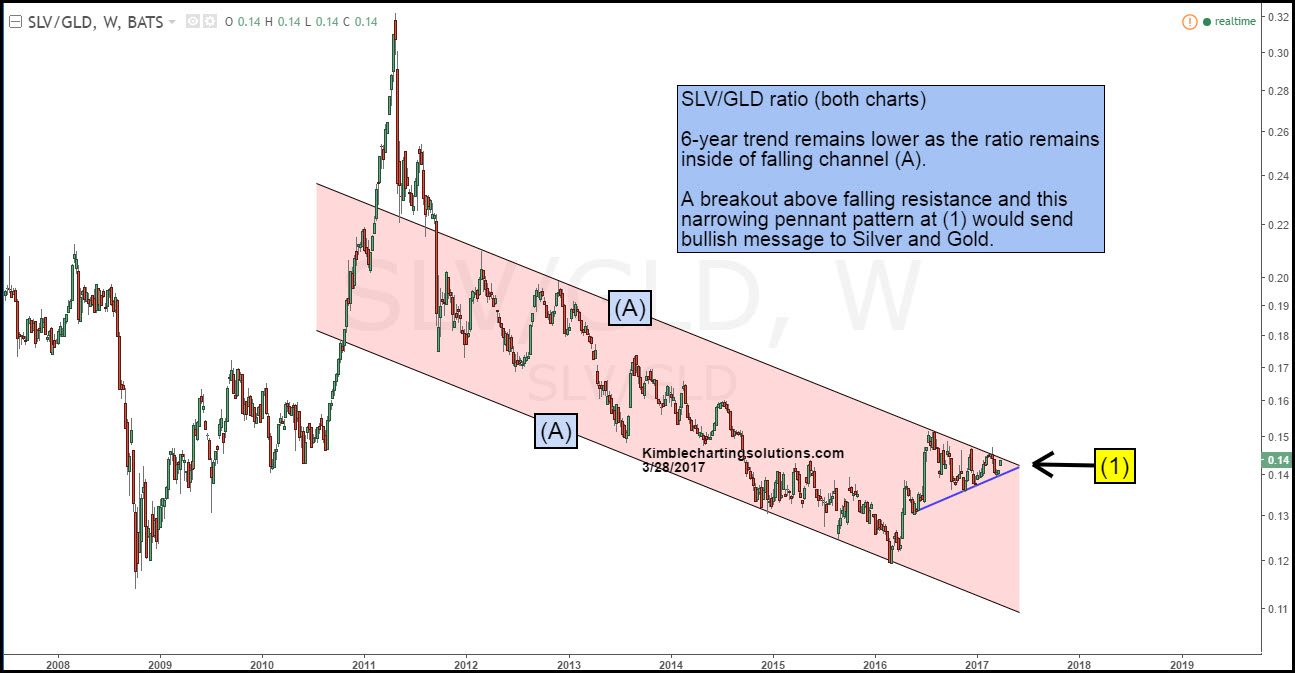
Below looks at the Silver/Gold ratio over the past 10-years. Last summer the ratio hit the top of falling channel (A) and failed to breakout. When this ratio failed to breakout, Gold, Silver and Miners turned weak.


silver gold ratio


CLICK ON CHART TO ENLARGE


Over the past 9-months, the ratio has created a series of lower high and higher lows, creating a narrowing pennant pattern, that is nearing completion at (1). The end of this pennant pattern is taking place, with the top of the pattern being the top of the 6-year falling channel.


If the bear market is to end for Silver, keep a very close eye on what takes place at (1). Premium & Metals members have played miners to the long side since 12/27/16. Even though Gold & Silver have done well, miners have done even better.


GDX is nearing falling resistance, similar to the ratio above. Members are pulling up stops on our miners positions, as the ratio above is testing one of the most important resistance/breakout tests in years. If the Silver/Gold ratio would do something it has failed to do for 6-years (breakout), it would send a bullish message to Silver, Gold and Miners.


Blog:  KIMBLECHARTINGSOLUTIONS.COM/BLOG


Get our daily research posts delivered to your inbox here


Website: KIMBLECHARTINGSOLUTIONS.COM


Questions: Email services@kimblechartingsolutions.com or call us toll free 877-721-7217 international 714-941-9381

Thursday, March 9, 2017

Precious Metals Pounded Into European Close - Break Below Key Technical Levels

Precious metals are being pounded once again this morning as we head into the European close.


Gold has broken below the 50-day moving average and the key "maginot" line of $1200 - lowest since January. Silver, similarly, has broken below its key technical levels and is testing the $17 level.


For now they are findiong some support at these key levels...


As USDJPY fades


Notably Gold is once again outperforming Silver (back above 70x) with 68x seemingly support for this ratio...


Monday, February 27, 2017

Curious Gold-Silver Ratio That Did Not Fall, Report 26 Feb, 2017

This holiday-shortened week (Monday was President’s Day in the US), the price of the dollar fell. In gold, it fell almost half a milligram to 24.75mg, and prices in silver it dropped 30mg, to 1.7 grams of the white monetary metal. Flipped upside down, gold went up 23 notes from the Federal Reserve, and silver appears to go up by 41 cents.


Below, we will show the only true picture of the gold and silver supply and demand fundamentals. But first, the price and ratio charts.


The Prices of Gold and Silver


Next, this is a graph of the gold price measured in silver, otherwise known as the gold to silver ratio. It moved sideways again this week, which would normally be odd for a time when the prices of the metals are rising.


The Ratio of the Gold Price to the Silver Price


For each metal, we will look at a graph of the basis and cobasis overlaid with the price of the dollar in terms of the respective metal. It will make it easier to provide brief commentary. The dollar will be represented in green, the basis in blue and cobasis in red.


Here is the gold graph.


The Gold Basis and Cobasis and the Dollar Price


For a very long time, we would post graphs that looked almost the same. Oh, the specifics of month, price, and basis would be different. But they had a certain sameness. The price of the dollar (i.e. inverse of the price of gold, in dollar terms) would move along with the cobasis (i.e. scarcity of gold). So as the dollar would rise (i.e. the price of gold would fall), the scarcity would rise. And vice versa. This means changes in price were due to changes in behavior by speculators.


And now we have a clear picture of … the opposite. The dollar has been falling since mid-December. And for that same time, the cobasis (scarcity of gold) has been rising.


Yes, gold has been getting scarcer as it becomes pricier.


How could this be possible? Doesn’t the law of supply and demand work for gold? You know, the standard “X” graph from Econ. 101?


Gold has several unique properties. One is that it is not purchased for consumption, but for monetary reserves or jewelry (which in most of the world is monetary reserves). Contrast that to copper which is purchased by plumbing manufacturers to make pipe. It’s a competitive market, and if the price of copper plumbing goes up too much then home builders will switch to plastic. Demand drops as price rises. Also, the marginal copper mine will increase production. Supply rises as price rises. It is self-correcting.


Gold, not being bought to consume, does not have a limit to demand as price rises. If anything a rising price (i.e. a falling currency) signals to people that holding gold is a good thing. They were wise to get out of their falling paper currency, and should consider buying more gold.


Also, virtually all of the gold ever mined in human history is still in human hands. All of this gold is potential supply, at the right price and under the right conditions. Even if gold mining worked like copper mining, and miners could just produce more, changes in mine production at the margin are not material to the overall gold supply. By official estimates, the total inventory of gold would take over 70 years to be produced at current mine production rates (and we believe this is a low estimate).


Readers may object that this question is a bit unfair, as any commodity can experience rising tightness and that will accompany its rising price for a while until the market can correct itself. That is true, but what we are looking at in gold is not that at all. When the market corrects itself—which we think is very likely, we do not see Armageddon just yet—it will not be because gold miners have cranked up their outputs, nor because gold users have substituted another metal. There is no substitute for monetary reservation, particularly as paper currencies are in the terminal stages of failure.


Our calculated fundamental price is now up to almost $1,400.


Now let’s look at silver.


The Silver Basis and Cobasis and the Dollar Price


The trend of falling dollar (i.e. rising price of silver) and rising cobasis (scarcity) is here in silver, too, but it’s weaker.


Silver does not quite have the same stocks to flows ratio as gold, but it has far and away a higher ratio than copper or any ordinary commodity. That is why silver is the other monetary metal.


The fundamental price of silver is now up to about $18.70. While this is over the market price of the metal, it’s not nearly so much above as gold.


This is why we calculate a fundamental on the gold-silver ratio over 74.


© 2017 Monetary Metals

Saturday, February 25, 2017

POWERFUL GOLD & SILVER COILED SPRINGS: Important Charts You Have To See

SRSrocco


By the SRSrocco Report,


According to the fundamentals, gold and silver are severely compressed coiled springs looking for an opportunity to release their tremendous power.  Yes, it is true, the precious metals still hold a great deal of power.  Which is why their prices are constantly controlled by market intervention.


Of course, the market intervention of gold and silver didn"t start recently.  Oh no, this has been going on for quite some time.  Even though the Central Banks and Gadflies on the financial networks have been able to BAMBOOZLE the public into believing gold is a "Barbarous relic", fundamentals and the laws of nature can"t be broken forever... as serious consequences normally follow.


When I read comments from supposedly intelligent people who believe gold is nothing more than a "13th century Middle Ages relic", and "that digital currency is the new future", what in the hell happened to IQ levels recently???


There seems to be this notion put forth by many in the Mainstream and Alternative media that "TECHNOLOGY" is going to save us all and be the new religion of the future.  While I have nothing against technology per say, it will not be the solution to our extremely serious energy predicament we are about to face head on.


For example, there are several voices out in the Alternative media suggesting that "Alien technology" will be finally released into the world, thus allowing our ADVANCED EMPIRE to continue indefinitely.  This of course would be a great benefit for Americans as it would allow them to continue filling their homes and rental storage units with all sorts crappy consumer products.


According to the supposed history of Alien encounters on the earth, they have been toying with humans for quite some time.  So, the idea that they will allow us to use some of their technology to save a species that shows such a high degree of IGNORANCE, STUPIDITY, CRUELTY & GREED, doesn"t pass the smell test to me.


Hold on.. I can take that a step further,  How many EMPIRES have come and gone in the past??  Okay, we had the Egyptian, Persian, Roman and Mayan Empires to name a few.  You would think if Aliens were going to start saving humans from being the POOR UNWORTHY SLOBS they have been for thousands of years, they would have done so already.  Wouldn"t they??


But, maybe we finally passed the test for our species, and now the Aliens think we deserve a break.... just like a freshly opened bottle of Coke.  Yes, that"s it.  We have passed the test of being WISE, PRUDENT, CARING and GENEROUS with one another, the plant and animals... and let"s not forget the environment.


On the other hand, logic suggests we are about to hit another SENECA CLIFF just like all the other prior empires that dried up and blew away.... and quite quickly, I may add.  So, even though there may be more intelligent life forms roaming the galaxy, it doesn"t seem quite likely they are going to waste much time on a species that has totally run AMUCK.


Which means, we little people here on earth are going to have to take it upon ourselves to continue on-wards when the GREATEST FINANCIAL PONZI SCHEME finally pops.  And pop it will.


The Gold & Silver Coiled Springs... Storing Tremendous Power


Over the years, monetary power shifted away from the precious metals and over to the FIAT MONETARY REGIME (a debt-based worthless paper currency system).  This stared long ago, but if we have to put a date on it, it would be 1969.  I will get into the particulars in an upcoming article.  However, the notion (again) that gold is a "13th century Barbarous relic" fails to consider that the world ran on a Gold-Backed U.S. Dollar system up until 1971.  This wasn"t that long ago.


Moreover, we still used silver in our coinage up until 1965.  While some silver coins, such as the Kennedy Half Dollar, were still minted for the general public up until 1969, silver was removed from U.S. coinage in 1965.


The real reason that silver was finally removed from U.S. coinage in 1965, was that it was too valuable to be used as money.... LOL.  I know that sounds silly, but that is the truth.  Now, when I say "money", I mean what it has degraded to over the past 50 years.


There just wasn"t enough silver to go around to meet the insatiable demand coming from the expanding industrial and jewelry sectors.  To use silver in coinage as well as supply future industrial and jewelry demand... there just wasn"t enough of the shiny metal.


This is exactly what President Lyndon Johnson stated during his comments after signing the 1965 Coinage Act:


Now, all of you know these changes are necessary for a very simple reason--silver is a scarce material. Our uses of silver are growing as our population and our economy grows. The hard fact is that silver consumption is now more than double new silver production each year. So, in the face of this worldwide shortage of silver, and our rapidly growing need for coins, the only really prudent course was to reduce our dependence upon silver for making our coins.


Well, there you have it.  While the grand conspiracy that silver was removed from currency to give more power to the elite may hold some truth, the REAL REASON was much more simple.  There just wasn"t enough silver to go around.


Furthermore, I really don"t believe the elite are really as smart and clever as some make them out to be.  Again, if we go back in history and look at all the EMPIRES that have come and gone, you would think that the elite would have had a better plan than allow everything to go to hell in a hand-basket... time after time.


We must remember, back in day when the world was using silver as money, life was a lot simpler.  There were no cell phones, or I-pads.  There were no electronics or solar panels that required silver.  Rather, we basically spent most of our time walking around dressed in glorified burlap sack clothing, growing food or producing simple consumer goods, while enjoying a bath once a week.  Gosh, how times have changed.


Regardless, the days of the Fiat Monetary Regime are numbered.  There"s just too much debt and derivatives over-hanging the system to allow us to continue for much longer.  Thus, in order to keep the Fiat Monetary Regime alive, the value of REAL MONEY, such as gold or silver, has to be kept in the DARK.


If we look at the following two charts, we can plainly see that gold and silver are both standing at the doorway of a major inflection point:


Gold Long Term chart


Silver Long Term Chart


Normally, I don"t pay much attention to "Technical Analysis", but in this case, we are on the verge of a very critical technical breakout.  Of course, this is more important for Hedge Funds, Institutions and large traders to follow, but in both charts, the gold and silver price remained above the 50 MA (50 month Moving Average) for a decade.


However, when QE3 was announced at the end of 2012, Central Bank liquidity made its way into stocks, bonds and real estate.  The precious metals were left out to dry.


If we recall from the quote above when Lyndon Johnson stated that silver was a scarce material over 50 years ago, it"s even more scarce today.  The same with gold.  When the gold and silver prices were knocking on the DOOR to reach new highs in 2012, this just could not stand.


Which is precisely why both gold and silver"s 50 MA level (RED LINE) and have fallen below and stayed there for the past four years.  However, both precious metals are once again tapping up against that 50 MA.  They first tapped up against the 50 MA in 2016... for good reason.


When the Dow Jones Index was scaring the living hell out of the markets by rapidly falling in the beginning of 2016, investors were getting a HINT of PRECIOUS METALS RELIGION.  Thus, investors flocked into gold and silver (gold and blue colored lines) in a big way, pushing their prices up as the Dow Jones Index fell nearly 1,000 points during five trading days in the beginning of February 2016:


Dow Jones Chart


This isn"t rocket science.  FEAR provides an excellent motivation for bringing people back to their senses.  However, this was just for a short while as the Fed and Central Banks ramped up their stock and bond purchases.  God only knows just how insane this amount must be.


Thus, calm was brought back into the markets allowing investors to go back to being TOTALLY INSANE once again.  Unfortunately, duct tape, baling wire and hot air cannot keep a market from succumbing to the fundamental laws of real economics.


The Dow Jones Index is so inflated, it"s overvalued by at least 60%.... for starters:


Dow Jones Correction


According to the economic contraction cycle that occurs about every six years, the Dow Jones Index is severely overdue for a good "ole fashion beating.  If we assume that a normal correction for the Dow Jones would be for it to fall to about 8,000 points, the index is overvalued by at least 60%.   And that is just for starters.


As I have mentioned in previous articles, where we are heading is nothing like anything we have experienced before.  Well sure, we could go back and look at the remains of the Egyptian, Persian, Roman and Mayan Empires for clues, but this would not be a good topic to bring up at the next family gathering or office party.


We must remember, most Americans are way too busy spending money they don"t have on crap that they really don"t need, to be bothered with the TRUTH that we are going to go head over the SENECA CLIFF, and there isn"t anything to stop it.


For all those who are new to the alternative media, the SENECA CLIFF came from the work of an ancient Roman philosopher, named Lucius Seneca.  According to Lucius Seneca (published on Ugo Bardi"s blog):


increases are of sluggish growth, but the way to ruin is rapid." Lucius Anneaus Seneca, Letters to Lucilius, n. 91


Seneca Cliff


Like it or not, we will most certainly experience the ramifications of the SENECA CLIFF in the future.  Unfortunately, technology will not save us from this fate.  Rather, the more technology we use to try to solve our dire energy predicament, the worse the cliff dive will be.  I discussed this in my article, CONTINENTAL RESOURCES: Example Of What Is Horribly Wrong With The U.S. Shale Oil Industry.


While I am being a broken record on this subject matter, I continue to receive new subscribers every day on the site.  Furthermore, the more individuals look at this data and information, the more LIGHT BULBS go off.  It takes time for this stuff to sink in.  Heck, it has taken me years to come to this realization.


Lastly, the value of gold and silver are going to skyrocket in the future.  However, I have no idea how bad things are going to be when the PHAT DEBT LADY finally sings.  But, at least physical precious metals will offer much better options in the future rather than 99% of the STOCK, BOND and REAL ESTATE liabilities out there which are masquerading as assets.


Lastly, if you haven"t checked out our new PRECIOUS METALS INVESTING section or our new LOWEST COST PRECIOUS METALS STORAGE page, I highly recommend you do.


Check back for new articles and updates at the SRSrocco Report.