Showing posts with label Dennis Gartman. Show all posts

Monday, December 25, 2017

Northeast Forecast To Get Big Winter Blast

Three days ago, we asked: Is A Major Winter Blast Coming To The East Coast This Christmas? Despite all the chatter from global warming alarmists this year, there is a chance, some in the Northeast could experience a white Christmas.


Ed Vallee, a private weather forecaster based in Connecticut, reports merging storms will spread snow, rain, and mixed conditions from the central Appalachians to New England. The system will start on Sunday night and continue into Monday. Snow totals are forecasted to bring 2-8″ for parts of the Northeast (shown below). 


Vallee discusses the risks associated with the storm, along with more details into the timing of this system.


AccuWeather Senior Meteorologist Brett Anderson, confirms Vallee’s forecast and said, there will be “enough snow to shovel and plow is likely from western and northern Pennsylvania and southern Ontario to Maine, New Brunswick, and Nova Scotia.”


Here are the highways that could be heavily impacted by the storm include Interstate 70, I-76, I-78, I-80, I-81, I-84, I-86, I-87, I-88, I-89, I-90, I-91, I-93, I-95, and I-390. AccuWeather’s team expects delays at airports in Pittsburgh, New York City, and Boston.


Also, the National Weather Service has issued a deluge of winter weather advisories and warnings for the Northeast (as of 12-24).


The National Oceanic and Atmospheric Administration (NOAA) provides an animated Gif depicting the trajectory of the system with the different types of precipitation probabilities.


Accuweather sheds more color on the storm:


From just north and east of Philadelphia to New York City, Providence, Rhode Island, and New Bedford, Massachusetts, just enough snow may fall to cover the ground, just in time for a White Christmas.


Farther south and west from Atlantic City, New Jersey to Baltimore and Salisbury, Maryland, and Washington, D.C., little or no snow is likely. Little or no rain may fall as well due to a gap in the storm.


Winter weather for the Northeast comes at no surprise considering the La Niña reading on the Oceanic Niño Index (ONI). La Niña conditions formed last month, indicating the Northern Hemisphere could be due for an abundance of winter weather (See: She’s Back! La Niña Is Here For The Second Consecutive Year).


BAMWX.com notes, the pattern is about to change in a huge way and it may begin on Christmas eve! Accumulating snow is on the table between Dec 24th-Jan 5th in a big way.


Obviously, if the winter blast does erupt, it is a perfect excuse for lagging spending, despite consumer sentiment at lofty levels.


Let’s just hope, the weather models above are as bad as Dennis Gartman’s market forecasts.


Wednesday, December 20, 2017

Exodus Starts: Millennials Ditch City Life

The urban revival of America’s core inner cities has been a decades-long failed experiment, as deindustrialization coupled with failed liberal policies have created a growing problem of inequality and violent crime. Middle-class advancement was once localized in the core of America’s cities, but that is not so much the case today, as those areas are labeled a “barbell economy,” divided between highly-paid professionals and low-skill service workers.


Brookings Institution notes as early as the 1970s, middle-class income in the inner cities started to shrink more than anywhere else. Today, in most US inner cities, the cores are more unequal than their surrounding suburbs, noted geographer Daniel Herz.


As the failed American inner city experiment nears the latter stages before a collapsing point, a new report from Time could be the final nail in the coffin for some American inner cities, as the article suggests “cities have already reached ‘Peak Millennial’ as young people begin to leave.” 


According to the latest Census data, after years of growth, the population of millennials in Boston and Los Angeles have declined since 2015, as a mass exodus from city life starts to take shape. Other cities such as Chicago, New York, and Washington, D.C., are experiencing similar issues but not as severe while growth rates of millennials plateau.


Dowell Myers, professor of demography at the University of Southern California, called the peak of the millennial population in major U.S. cities back in 2015, with the largest birth group of the cohort turning 27 this year. To note, Myers could be a far better forecaster than Dennis Gartman, but we’ll leave that for another conversation.


Myers said at the critical age of 27 and above, that is the time when the millennial generation will participate in, what we call, ‘millennial flight’ to the suburbs. Such a trend could be the final nail in the coffin for some American inner cities, who were expecting the millennial generation to lead the charge in the revival process, as what we’ve learned from Myers– that may not be the case.


The Times explains how Myers coined the term— ‘peak millennial’. Interesting, the plateauing of millennial populations are occurring in East Coast cities, while the West Coast is still drawing in young people.


To see which cities have reached “peak millennial” — a term Myers coined —we analyzed a decade of Census data through 2016. We found that while tech hubs like San Francisco and Seattle are still drawing young people, large East Coast cities, like New York and D.C., are fast approaching peak millennial, with plateauing populations of those born between 1980 and 1996.


And then there are cities like Boston, which already appear to have reached their peak. Boston lost roughly 7,000 millennials in 2016, after a record high of 259,000 the previous year.


In the explanation of millennial flight from America’s inner cities, Jim Rooney, president of the Greater Boston Chamber of Commerce said, “they’re doing what every generation does — they get married, start a family and think about having a backyard and looking at school systems” in the suburbs.


While that is definitely true, and what we’ve mentioned above, millennials tend to live in core inner cities, where inequality and violent crime are sometimes out of control. Also, many millennials are becoming priced out of real estate in these areas, as wage stagnation is drowning many millennials into more and more debt, on top of their already ballooning balance sheet of liabilities. Think student loans….


In Boston, the millennial peak was confirmed in 2014 through 2015, as it appears it’s all downside from here. Rooney’s findings conclude millennials in the region are being priced out of homes with the median home in Boston around $561,000, according to Zillow.


In Chicago, the millennial plateau occurred in 2014 through 2015, hitting a high of 814,000 millennials in 2015 and falling by a few hundred in 2016. Jack Lavin, president of the area’s Chamber of Commerce said millennials are moving to the suburbs to start a family— ditching urban areas. Nevertheless, the article does not mention— the out of control homicides adding to the fear of city life.


In Los Angeles, the millennial peak was confirmed in 2015, which saw a decline of about 2,500 millennials in 2016. “It’s hard for millennials to achieve a middle-class lifestyle that they think they deserve”, said Myers. With that being said, millennials are moving out.


Bottomline: The ruling elite and their inner-city playground planners who were expecting the millennial generation to revive their decades-long failed experiment are about to come to harsh terms with the reality of a millennial exodus.


Tuesday, November 14, 2017

Mysterious Bitcoin Dip-Buyer Identified

Amid the cataclymsic collapse of Bitcoin late on Friday night, the crypto currency suddenly saw a large buyer step in as prices plummeted below $6000. We now have an idea who that buyer of last resort was...


As a result of a giant publicity effort from its proponents, BCH saw mass investment as it heads towards a potentially contentious hard fork set for just after 7 p.m. GMT today. The failure of SegWit2x, coupled with endorsement from the soon-to-be-defunct Bitcoin Classic team meant BCH became the major ‘competitor’ to Bitcoin over the weekend.


But, as Reuters reports, former Fortress macro hedge fund manager Mike Novogratz - who we most recently profiled here - told Reuters Global 2018 Investment Outlook Summit in New York that he bought $15 to $20 million worth of Bitcoin over the weekend in that recent pullback.


The billionaire says his crypto fund "Galaxy Investment Partners" owns Bitcoin, Ethereum, and many other companies, and coins.


“The institutionalization of this space is coming. It’s coming pretty quick,” he said.


Novogratz said he expects major financial firms will soon start to offer bitcoin or similar products as an investment option, one that could be easily purchased over the phone.


“When it’s that easy, the price of bitcoin or ethereum is going to go much higher. And that is a lot closer than people think,”


His biggest regret this year has been not buying more cryptocurrencies when prices fell, because he knew that they would keep going up. He sees bitcoin, for instance, hitting $10,000 by March.


Novogratz previously said that, while bitcoin is a bubble, the mania is justified, because it is a technological advancement that promises to fundamentally alter our lives.


"I can hear the herd coming" Novogratz said.


And bubble or not, Novogratz concluded eloquently on the extreme nature of cryptocurrencies" potential...


“Remember, bubbles happen around things that fundamentally change the way we live,” he said.


“The railroad bubble. Railroads really fundamentally changed the way we lived. The internet bubble changed the way we live. When I look forward five, 10 years, the possibilities really get your animal spirits going.”


Bitcoin is set to become "the biggest bubble of our time," he added, and could reach $10,000 very soon due to fast-building interest.


But, we also note that Bank of Japan Governor Kuroda made some fascinating comments earlier that appeared to suggest selling yen and buying bitcoin:


Haruhiko Kuroda says he doesn’t “see any serious problem arriving from cryptocurrencies at the moment.”


“We are carefully watching the development,” he says at an event of the Schweizerisches Institut für Auslandforschung on Monday in Zurich.


Additionally, Bloomberg reported that Kurodas warned "Japan"s high debt-to-GDP ratio is not sustainable."


And as the chart below shows, the buying binge overnight really struck as Japan opened...


This move comes on the heels of American venture capital investor Tim Draper"s comments (founder of the Silicon Valley VC firm Draper Fisher Jurvetson) that fiat currencies will no longer be in use in five year"s time as they are to be replaced by cryptocurrencies.


At the WebSummit conference in Lisbon, Portugal, he told Forbes the fiat system will eventually disappear as people look toward coins like bitcoin or ethereum. He says its because fiat currencies are bound by country borders.


“In five years, if you try to use fiat currency they will laugh at you. Bitcoin and other cryptocurrencies will be so relevant … there will be no reason to have the fiat currencies,” he said.


An unabashed promoter of cryptocurrencies, Draper said he fell in love with bitcoin not long after it was introduced in 2009. He bought 30,000 coins in 2014 (at about $600 each); they are now valued at over $214 million.


“This is the greatest technology since the internet,’’ said the investor. “This is a sociological transformation, it’s a movement.’’


He also said that bitcoin will divide the financial services industry, at least initially.


“There will be a few who embrace it and jump out front and say, ‘This is important’ and then there are going to be those who jump back and say, ‘I’m going to cling to the past, and I’m going to hold onto everything I’ve got.’ And you know who wins then,” Draper said. “It’s always progress, it’s always technology.’’


Talking at the conference, he said investors should thoroughly study who’s running the ICOs and whether their business plans seem legitimate.


Draper has rejected the possibility of the cryptocurrency market imploding like the dotcom boom in the late ‘90s, saying “people are always going to say there’s a problem, and that usually means there’s a lot more upside.”


Finally we leave you with Dennis Gartman"s comments tonight on bitcoin:


"this is a market for criminals and millennials."


Sunday, November 12, 2017

She"s Back! La Niña Is Here For The Second Consecutive Year

For the second consecutive time in two years, La Niña (translated from Spanish as “little girl”) is back and she means business. New data from Climate.gov indicates La Niña conditions have formed just in time for winter weather in the Northern Hemisphere.


On Thursday, the Climate Prediction Center confirmed La Niña after analyzing October ocean temperatures cooling along the equatorial eastern and central Pacific Ocean. La Niña is often declared when sea surface temperatures in the region (just stated) decline by 0.5 degrees Celsius.


John Morales‏, Chief Meteorologist WTVJ NBC-6 Miami, shows the progression of cool water over the equatorial Pacific Ocean responsible for La Niña formation.


The cooler waters have an influence on atmospheric conditions by decreasing evaporation in the tropics, which is a major driver of global weather.


According to the Weather Channel,


A typical La Niña winter in the U.S. brings cold and snow to the Northwest and unusually dry conditions to most of the southern tier of the U.S., according to the prediction center.


The Southeast and Mid-Atlantic also tend to see warmer-than-average temperatures during a La Niña winter. New England and the Upper Midwest into New York tend to see colder-than-average temperatures.


Climate Prediction Center /NCEP/NWS Full Report: La Niña conditions are predicted to continue (~65-75% chance) at least through the Northern Hemisphere winter 2017-18.


During October, weak La Niña conditions emerged as reflected by below-average sea surface temperatures (SSTs) across most of the central and eastern equatorial Pacific Ocean [Fig. 1]. The weekly Niño indices were variable during the month, with values near -0.5° C during the past week in the Niño-3.4 and Niño-3 regions [Fig. 2]. Sub-surface temperatures remained below average during October [Fig. 3], reflecting the anomalously shallow depth of the thermocline across the central and eastern Pacific [Fig. 4]. Also, convection was suppressed near the International Date Line and slightly enhanced over parts of the Maritime Continent and the Philippines [Fig. 5]. Over the equatorial Pacific Ocean, low-level trade winds were mainly near average, but the upper-level winds were strongly anomalously westerly and the Southern Oscillation Index was positive. Overall, the ocean and atmosphere system reflects the onset of La Niña conditions.


For the remainder of the Northern Hemisphere fall and winter 2017-18, a weak La Niña is favored in the model averages of the IRI/CPC plume [Fig. 6] and also in the North American Multi-Model Ensemble (NMME) [Fig. 7]. The consensus of forecasters is for the event to continue through approximately February-April 2018. In summary, La Niña conditions are predicted to continue (~65-75% chance) at least through the Northern Hemisphere winter (click CPC/IRI consensus forecast for the chance of each outcome for each 3-month period).


La Niña is likely to affect temperature and precipitation across the United States during the upcoming months (the 3-month seasonal temperature and precipitation outlooks will be updated on Thursday November 16th). The outlooks generally favor above-average temperatures and below-median precipitation across the southern tier of the United States, and below-average temperatures and above-median precipitation across the northern tier of the United States.


La Niña weather phenomenon easily explained:


Ben Noll, Meteorologist, National Institute of Water & Atmospheric Research of New Zealand, compares the equatorial sea-surface temperatures in 2016 and 2017. His findings indicate 2017 waters “not as large farther west” when compared with 2016. Basically he validates NOAA’s “weaker La Niña” claim...


NOAA’s winter weather outlook indicates normal participation for the mid-tier of the United States. The southern-tier is forecasted to see much drier conditions. Meanwhile, the Great Lakes region and Northwest of the United States appear to have much wetter conditions.


Temperature outlooks for this winter include at-least 2/3 of the United States well above average. Below average to normal in regions, such as the Great Lakes region and Northwest.


Bottomline: What do weather forecasters and Dennis Gartman both have in common?... Well you guessed it– terrible forecasting...


Thursday, October 19, 2017

What Dennis Gartman Remembers Most From "Black Monday"

Excerpted from the latest Gartman Letter, and presented without commentary (but with some highlighting).


ON THIS HORRIBLE ANNIVERSARY AND WHAT WE REMEMBER MOST:


Everyone seems to be writing about what they remember about the Crash of ’87 and we remember it well… very… and breaking with our common use of the “royal we” in our commentary and using the personal pronouns instead, from this point onward…what I remember is the sheer irrationality of the day in question; the utter and sheer panic by those who had in the past never panicked and the effect it had upon me.


On the Friday before the “Crash” I was in Raleigh, North Carolina with close friends from my days at the CBOT of several years earlier: Brian O’Doherty, who played football for our beloved NC State University and who traded in the bond pit… and Carl Boraiko… one the best floor traders in T-notes, Bonds and the NOB spread I’ve had the privilege of knowing… and several others. We were there to go to the NC State v. lemson game on Saturday and  were playing golf at the Duke University Golf Course on Friday when one of us noticed that the Dow was “Down a hundred!!” that afternoon as we checked our phone pagers that were suddenly paging us all, for there were not Iphones then. The Dow had never been down 100 point before… ever! It was shocking, to say the very least. As a former floor trader and having been writing TGL for three years at the time, and having warned previously about the dangers of “portfolio insurance” I was fearful… very… about what might happen on Monday’s opening as a result.


Going into Monday’s opening, I’d written myself a note to buy KC Value Line Futures and to sell S&P futures in equal dollar sums, knowing/believing that the real selling by the portfolio insurers would be in the S&P futures. Normally I traded only 5-10 “lots” when trading net open positions, however I chose that morning to buy 50 Value Line futures and to sell about 50 of the S&P futures because the “risk” on the spread was obviously less than the risk on outright positions… usually.


The violence of the opening caught everyone wholly off guard and the position moved against me by several thousands of dollars initially but was moving back in my favor quickly by 9:30 a.m. as the NYSE was about to open. However, I got a frenzied phone call from my clearing firm at the time wanting 100% margin on both sides of the trade by 10:00 to be wired to them or they were going to sell me out… immediately! They did not want regular futures spread margins; nor did they want full futures margin on each side; they wanted full 100% payment for the face value of both sides of the trade… in effect about $5 million or so, which of course I did not have. I was sold out… at 10:01 when I phoned to say I could not meet their demand. I lost several thousands of dollars that day… a meaningful sum of money then..


A few hours later as the panic truly began in earnest and as the selling in the S&P futures reached a frenzy, the trade was “worth” several hundred thousand dollars… or would have been worth several hundred thousand dollars… in my favor for what I had expected to happen was in fact happening. The spread between the S&P futures and the Value Line moved violently in the latter’s favor. By Tuesday morning’s panic opening it would have nearly doubled again, but it made no difference to me. I was out!


In retrospect, the clearing firm in question was doing what it needed to do to make certain that its own solvency was assured and in retrospect this was rational.


What did I learn? I learned that markets can indeed be irrational; I learned that one has no choice but to expect the irrational and to prepare for it. I learned that amidst panic anything… absolutely ANYTHING… is possible and I learned to be prepared. Oh, and I learned that I never, ever, EVER want to go through that sort of day again… ever!

Monday, September 25, 2017

Who Made Dennis Gartman "The Commodities King?"

Content originally published at iBankCoin.com


Who"s in charge of doling out such titles anyway? Is there a chance, perhaps, someone in the media could title me "The Blogging Emperor" -- enabling me to make wide sweeping proclamations about the future of online media?
 
The craven vultures from CNBC are out with a fresh story this evening, discussing "The Commodity King"s" stance on gold and how it"s heading "demonstrably" higher.


"A year from now, gold will be demonstrably higher than it is right now," The Gartman Letter"s founder told "Futures Now" in a recent interview. "I would certainly think we could see $1400 [an ounce] in dollar terms."
 
"This is a correction but let"s understand the last rally that we had took off from $1200 to $1370. The fact that we"ve fallen back below $1300 I think is relatively inconsequential," he added.
 
"I am not a gold bug. I don"t believe the world is going to come to an end. I don"t think you own gold because you think governments are going to be collapsing around the world," he said.
 
His reason to own gold: Central banks and easy money.
 
"The monetary authorities are all still remaining expansionary," noted Gartman, given that easy central bank policy tends to undermine major currencies like the dollar and euro. "In that instance, the one currency that will probably do the best of all is gold."
 
He doesn"t believe the Federal Reserve"s intention to start reducing its $4.5 trillion balance sheet in October will be a headwind for gold. The unwinding of the Fed"s crisis-era policy "is going to take five or six years. This is not something that will occur overnight," he said.


I"m so glad that I sold the last of my gold position on Friday. There isn"t any reason to be on the same side of a Dennis Gartman trade, not now, not ever. This whole Commodity King business is awfully tiresome. It reminds me of boiler room tactics, where some brokers would declare themselves to be child prodigies in investing -- born geniuses, sent to a phone bank inside of a third rate firm to save the average investor from the dreadful underperformance of white shoe firms.


Even still, a 7% move from current levels isn"t exactly something to beat off to. The idea that gold is set to trade "demonstrably" higher because the Fed is set to tighten their balance sheet by $4.5 trillion over 5 years is nonsensical, inane, and tragically stupid.

Wednesday, August 30, 2017

As Harvey Moves Inland, A New Hurricane Is Forming Over The Atlantic

Update: According to the NHS, Atlantic Tropical Storm Irma has formed, and could be a Hurricane by Friday. With top winds of 50 miles (80 kilometers) per hour, Irma formed 420 miles west of Cabo Verde moving west at 13 mph, the U.S. National Hurricane Center in an 11 a.m. N.Y. time advisory.


According to Jeff Masters, co-founder of Weather Underground, computer forecast models disagree on its ultimate track but a U.S. strike later in September cannot be ruled out.


Irma is the ninth named storm of the Atlantic hurricane season, which also produced Harvey that devastated southeastern Texas, including Houston, and disrupted energy facilities and supplies and destroyed crops. Irma could become a Category 1 hurricane on the five-step Saffir-Simpson scale by Friday and gradually get stronger through Monday.


If its current track holds, Irma would still be bearing down from the east on the Leeward and Windward Islands in the Caribbean Sea Monday


* * *


The National Hurricane Center (NHC) will be initiating advisories at 11 AM AST, as the new area of low pressure in the eastern Atlantic Ocean will develop into Tropical Storm Irma. Tropical Storm Irma will become the 9th storm of the 2017 Atlantic hurricane season as it moves towards the Gulf of Mexico region.


Per Weather Channel,


In the near-term, future Irma will bring locally heavy rain and gusty winds to the Cabo Verde Islands through Wednesday.


South Florida Weather Management District (SFWMD) reports various pathways for Irma.


National Weather Service (NHS) reports Global Tropics Hazards and Benefits Outlook for the next 1-2 weeks. First week, Irma is labeled as a ‘tropical cyclone formation’  heading towards Caribbean Sea and the Gulf of Mexico. Second week, passing inland and over Central America.


"There is the potential to ramp up to a powerful hurricane in the coming days," according to AccuWeather Hurricane Expert Dan Kottlowski.


Irma will take about a week for the system to make its trek westward across the Atlantic Ocean. Meteorologists will likely be tracking this storm through the middle of September.


"All interests in the eastern Caribbean will need to monitor the progress of this evolving tropical cyclone, especially next week," Kottlowski said.


"It is way too soon to say with certainty where and if this system will impact the U.S."


Meanwhile, Texas and now southwestern Louisiana are still dealing with Tropical Storm Harvey. The weather disturbance has caused a great deal of destruction and cannot afford another storm such as Irma.


Conclusion


Luckily, Irma’s models via the major weather agencies provided above show current trajectories missing the devastated region. We all know in weather forecasting just like stock market forecasting models tend to be wrong – just ask Dennis Gartman.

Monday, August 21, 2017

10 Inconvenient Truths About Investing & The Markets

Authored by Lance Roberts via RealInvestmentAdvice.com,


This morning, as I was catching up on my reading, I stumbled onto this gem from Business Insider of an interview with the founder of Robinhood, a mobile app to let individuals trade stocks with no commissions.


“It’s [Robinhood Gold] serving a need that we saw in a part of our core user base, which includes people using Robinhood for the first time as well as those who have been with us since the beginning. A really large percentage of those users have become more mature investors. The No. 1 thing they kept asking for was the ability to use a margin feature.


With margin debt levels at already record high levels, the demand by individuals to leverage themselves into the financial markets has always, without exception, ended extremely poorly. Since the vast majority of users of the Robinhood app have never seen a bear market, the real lessons of trading have yet to be learned. 


It also brings me to today’s post.


One of the first rules that any successful long-term trader or investor will tell you is to keep a written record of your activities. This provides the basis for you to learn what you are doing right, but more importantly what you are doing wrong. The secret to investment success is actually quite simple and can be summed up as follows:


“Do more of what works and less of what doesn’t.” – Dennis Gartman


As I was reviewing some old trading notebooks this past weekend, a folder sheet of paper fell out of one of my 2011 binders. It was a printout of the “20-Truths Of Investing And The Markets” by Ivan Hoff of Ivan Hoff Capital.


I wanted to share my 10-favorites with you by adding some illustrations as well.


1. Stock prices run in cycles. Periods of re-pricing are usually quick and powerful.


Read: Soros – A Rudimentary Theory Of Bubbles


2. Stocks are very highly correlated during drastic sell offs and during the initial stage of the recovery. In general, correlation is high during bear markets.


Read: I Bought It For The Dividend


3. Try to trade in the direction of the trend. It is not only the path of least resistance, but also provides the best profit opportunities. Have a simple method to define the direction of the trend.


Read: Managing A Trend Change


4. Being wrong is not a choice. Staying wrong is.


Read: You Can’t Time The Market?


5. The overall market conditions will never be perfect and when they seem so it is probably a good idea to decrease exposure and take profits. With that in mind, you don’t have to be in the market all the time. When you don’t see good setups, it just makes sense to watch from the sidelines.


Read: 7-Myths Of Investing


6. If you understand the incentives of the major market participants, you will be able to predict their likely behavior. Technical analysis is a lot about understanding incentives and recognizing intentions.


Read: 7-Trading Rules You Won’t Follow


7. Your first loss will often be your best loss. No one is right all the time and you don’t have to be. There are market participants that are immensely profitable by being right only 30% of the time. It is good to have conviction in your investment thesis, but discipline should always trump conviction.


Read: The Psychology Of Loss


8. Optimism and pessimism in the stock market are contagious. Investor psychology often loses its logic and become emotional. The news media and the most recent price action play a particularly important role in developing moods of mass optimism or pessimism.


Read: 5-Universal Laws Of Human (Investment) Stupidity


9. Rising P/E is an indicator of rising expectations and confidence in the future of the stock. The P/E ratio reflects the enthusiastic optimism, or the gloomy pessimism of investors.


Read: Valuation Measures And Forward Returns


10. It doesn’t matter how smart you are, how ingenious your idea is or how cheap your stock is – if the market does not agree with you, you will not get paid. Period.


Read: The Big Lie Of Market Indexes


These are just reminders to keep you grounded in the reality of how money, and investing, REALLY work over the long-term. While it is easy to get lost in the excitement of the moment, the brutal return to reality has always been a costly lesson to re-learn.

Tuesday, July 4, 2017

Gartman: "The Time Has Come To Be Short Of Oil Once Again"

When we pointed out yesterday that "world-renowned commodity guru" Dennis Gartman remained bearish of oil, we quoted him as saying that "it has been our intention all along to await the opportunity to sell crude oil short on protracted rally and we are getting that rally as we write. We can be patient a while longer." His patience lasted less than 24 hours, because one day later - as oil is on the cusp of extending its bullish run for a near record 9th consecutive day - Gartman this morning that "the time then has come to be short of crude oil once again."


The section of note:


CRUDE OIL PRICES CONTINUE TO ADVANCE and have now risen for 8 or 9 days in a row, depending upon when one has marked the close. Going by the CME’s official closes, yesterday was the 8th day in row higher and the “bounce” from the lows made two weeks ago amidst what was then panic liquidation has now taken the market to an almost equally over-bought, hyper-extended level to the upside.


We have maintained that the “bounce” would take crude back to The Box marking the 50-62% retracement in nearby WTI crude to somewhere between $47.00-$48.15 and for all intents that was satisfied yesterday when the high of $47.07. Note then the chart of nearby August WTI and note The Box.


The time then has come to be short of crude oil once again, and we are certain that we shall be at least as equally scoffed at for selling crude today as we were two weeks ago for urging everyone, everywhere not to be short. This recent increase has, of course, re-ignited the interest of drillers to drill and the contango is still wide enough to encourage drilling and hedging as the one year forward is very nearly $50/barrel.


It is probably just a coincidence that earlier this morning WTI was in the red and has since crept up back into positive territory.


Friday, June 23, 2017

Gartman: 'Oil Heading Egregiously Lower'; Saudi Oil Reserves Will Be 'Worthless'

Content originally published at iBankCoin.com


Normally, I don"t hone in on a particular talking head, unless of course said talking head is especially egregious. Enter Dennis Gartman, the self-proclaimed "Commodity King."


In the clip below, Dennis ceded to the possibility that oil might bounce a little here -- perhaps as much as $5 -- a mere charitable donation to the fuckheads surviving off oil barrel sales. But over the long run, Gartman proclaimed "oil us heading egregiously lower."


Several years ago, I recall Dennis saying oil was heading down to a nickel -- because MUH fusion energy would replace oil. What in the actual fuck is he talking about?


Now that oil is weak again, this guy is entirely detaching from reality, pretending his car doesn"t run on oil, or his planes, or the fact that oil is used to produce a sundry of goods sold in the grocery store, particularly plastics. Now oil is heading "egregiously lower" and there"s nothing you little trollops could do about it. See, we won the war, said Gartman. The Saudi oil reserves will be "worthless" and our frackers have succeeded in becoming the "swing producer."


In summary, oil will be worthless soon. The hundreds of billions of debt associated with oil is nothing, discarded as a pittance, and the dissolution of oil is a "white swan" to the overall economy.


See it for yourselves.


Largest East Coast Pipeline Reveals Demand For Gasoline Is Crashing

There"s a reason this week"s EIA survey showing gasoline and oil supplies declining has failed to stop RBOB prices from collapsing to 7-month lows: The start of the summer has done nothing to revive sluggish demand. That"s because despite what the EIA survey said, little has been done to reduce record fuel inventories.


The squeeze has gotten so bad, Northeast Colonial Pipeline Co., the operator of the biggest US fuel pipeline system, said that demand to transport gasoline to the country"s populous northeast is the weakest in six years, the latest symptom of a global oil market grappling with oversupply. It’s notable that this peak has arrived despite the advent of the summer driving season, which has seen gasoline demand pull back from last year"s record highs, according to Reuters.


Because of the oversupply in the northeast, “line space”… the cost of renting “space” on the pipeline to assure one’s ability to get supplies of gasoline when necessary… has gone negative, according to Reuters. What can be more exemplary of excess inventories and of reduced demand for gasoline than this?


Refiners are in part to blame for the problem - they have continued to pump motor fuel at record levels for the second year in a row, worsening the oversupply problem, for fear of losing access to pipeline capacity. 


More broadly, attempts by large producers to reduce global supplies have failed to meaningfully raise the price of oil.  And with good reason: Traders have been skeptical of an agreement between OPEC and non-OPEC producers, including Russia, to extend last year"s supply cut, and already they"re concerns are being validated: Iraq has said it plans to increase production later this year despite the agreement.


The existence of negative capacity is a reversal of the typical dynamic, where refiners are forced to supplement their deliveries with tanker shipments or imports.


"The only reason [the pipelines] wouldn"t be full is clearly that inventory levels are high enough that there is no incentive to move product to New York," said Sandy Fielder, director of oil and products research, Morningstar in Austin, Texas.


"The situation is quite unusual," he said.


Even when high inventories make it unprofitable to do so, refiners typically keep pumping full volumes just to ensure they keep their rights to the line space, said Fielden.


But it appears as if refiners have finally reached the point where the financial pain outweighs the necessity of keepig their lease on some pipeline space - after all, Colonial has capacity to spare right now.


"It"s purely economic - why ship into a negative arb(itrage) for that long," one trader said.


Colonial connects Gulf Coast refineries with markets across the southern and eastern United States through more than 5,500 miles (8,850 km) of pipelines, delivering gasoline, diesel, jet fuel and other refined products. Colonial indicated it did not expect demand to exceed capacity for the next five-day cycle through the line, and informed shippers it would therefore not follow the typical process for rationing space.


Oil traders who insist on staying long can hold out hope that production shutdowns related to Tropical Storm Cindy could lift the price of oil for a short period. It"s also worth noting that  Dennis Gartman, who recently said oil wouldn"t rise above $44 a barrel again in his lifetime, just turned bullish folllowing a wave of downgrades from energy analyst. That could be good news...or maybe not.


While the cause of the supply is obvious, whatever has caused demand to fall off is less clear. Barclays has suggested that President Donald Trump"s immigrant crackdown has made millions of illegal immigrants living in the US afraid to get behind the wheel for fear of being detained and deported. If this is true, that means Trump is to thank for gasoline prices falling to their lowest levels since February, despite the start of the summer driving season?

Monday, March 27, 2017

Having Missed Friday's Move, Gartman Is Looking To "Reestablish Net Short Positions"

On Friday morning, ahead of Congressional and market rollercoaster resulting from the Republicans" failure to repeal Obamacare, we reported that Dennis Gartman had "moved to the sidelines" and covered his recent short:


Regarding positioning… and please do remember that the only money we manage is our own retirement fund and although it is only a few small millions it is still our money and we do indeed value it!... we came into yesterday’s session modestly net short of equities. However considering that the passage or non-passage of the health care legislation was a veritable coin toss circumstance we moved to cover those short derivatives positions early in the day and took to the sidelines. We remain there this morning. In our retirement account are long of several monthly dividend paying closed end short term bond funds; we are long of gold in EUR and Yen denominated terms and at the very close of trading yesterday we took small “punts” on the long side of crude oil.


Fast forward to Monday morning, when Gartman had this to say about the overnight action:


STOCK PRICES, AS MEASURED BY OUR INT’L INDEX, ARE UNCHANGED or actually be perfectly precise our Index has lost 1 point since we marked it here on Friday; however, as everyone should know by now, the stock index futures here in the US are sharply lower following the “collapse” of the health care legislation in the US House of Representatives on Friday.


To be sure, he laments having covered his short:


We had been net short of equities coming into Friday morning, but given the purely binary bet that one was making relative to the US health care legislation we thought it best to “go flat” and so we did. In retrospect, obviously, we should have remained net short, but that we thought was a coin-toss “bet” and we’d prefer not making bets such as that.


Yet unlike others, he is not looking for an excuse to BTFD. Instead he is hoping to find a spot where to "reestablish modest net short positions... but not today."


Now, obviously we have to find a point at which to reestablish modest net short positions and we shall; but not likely today. Today we shall watch how things develop; we are but mice in the fields with elephants at the moment and ‘tis best to stay away from stampeding elephants when at all possible. However, we do know this: we have lagged behind a simple net long position in US and or global equity investment, but as prices weaken not only shall we catch up with those positions, but soon this week we’ll begin to out-perform… perhaps materially.


Best of luck to Dennis: at the rate the S&P is covering its opening losses, he should be able "find a point" where the S&P turns green, and "reestablish shorts" on very short notice.

Saturday, December 17, 2016

Gartman's 2016 Year in Review

From Slope of Hope: I realize that the year isn"t quite over, but it"s late enough in 2016 to put together a retrospective of ZeroHedge"s favorite "commodity king", Mr. Dennis Gartman. This is the man, of course, frequently featured on CNBC, even though his daughter Courtney left the network earlier this year.


Although Gartman mostly makes market commentary, he also declared quite plainly in late August that Trump had "no chance" of winning the presidential race.


I did a couple of posts about the man, such as The Gartman Grid, which offers insight into how to interpret the often curious ponderings of DG, as well as a fanciful take at a new Broadway production Gartman The Musical.  
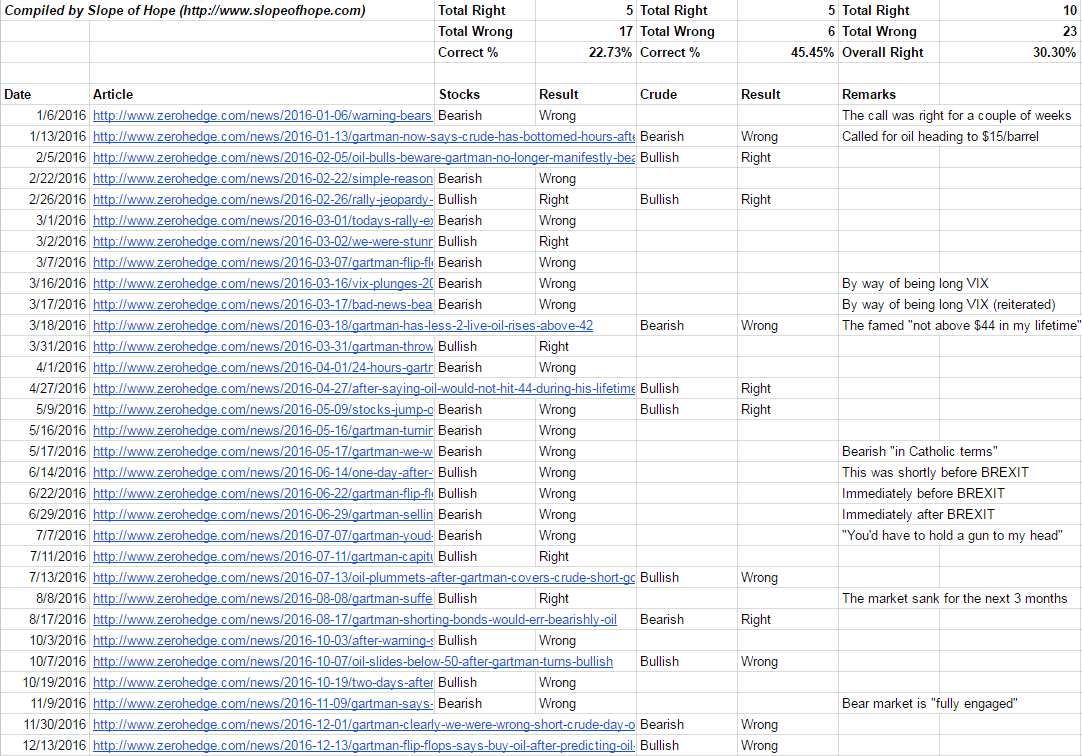

A more serious (and time-consuming) undertaking was to go through all of the Gartman-specific posts on ZH that called out concrete buy or sell recommendations from Gartman. Now "concrete" is a little tough with a man who peppers his speech with words like "gently" and "slightly" and "very very lightly", but I"ve tried my best. I can understand his reticence to make the bold declarations that he used to (e.g. "I have never been so bullish of oil") given the tomato-throwing that often ensues when he"s wrong.


Nevertheless, I have broken down all his equity buy/sell and crude oil buy/sell ideas. According to my analysis, he"s been right about 30% of the time overall, with equities (22.73% correct) being weaker than oil (45.45% correct). Well, they do call him the commodity king, right?


1216-gartman


You can access this analysis by clicking the image above or click here to see the Google Doc itself. I look forward to keeping up with the man"s declarations in 2017 and perhaps doing another analysis next December.


Tuesday, November 8, 2016

One Day After Biggest Rally Since March, Gartman Covers Shorts

Just hours after the biggest one-day surge in the S&P since March, Dennis Gartman has decided to follow the momentum, and after being bearish and short, he "covered in a great portion of our short  derivatives position and we added to our long position."


From his latest letter:


STOCK PRICES HAVE SOARED IN THE PAST TWENTY FOUR HOURS as the news spread around the world from late Sunday afternoon regarding the now famous “letter” from the FBI’s Director, Mr. Comey, to the members of the US Congress that there was nothing in the several tens of thousands of new e-mails that the Bureau had warned about two weeks ago that would lead to the possible indictment of Ms. Clinton. When that news “hit” Sunday afternoon, stock index futures soared; the Asian markets flew to the upside and when the European and North American markets finally did open they followed suit.


Our international Index has risen 138 points, or 1.4%, and this is one of the five strongest “up” sessions in the history of our Index which goes back for nearly thirty years. Indeed, this was one of those rare “unanimous” days where all ten of the markets comprising our Index have risen, taking stocks around the world up 4.9% for the year-to-date. The CNN Fear & Greed Index, which had fallen to 12 at its low on Friday, has risen to 33 as of last night’s close and having fallen below 15 and having turned around is now signaling a run to the upside once again… barring a surprising victory by Mr. 


Trump in today’s  Presidential voting.


If Ms. Clinton wins and if the Senate and the House remain in Republican hands all will be fine. Mannerly gridlock is the best of all governments; it is what the Founding Fathers of this country wanted. They did not wish for one-sided governance; they wanted balance and compromise. They wanted laws enacted slowly after deliberation, and that is what it appears we shall have if the latest polls prove prescient.


In our retirement fund here at TGL yesterday we did what we said we would do given the severity of the rally: We covered in a great portion of our short derivatives position and we added to our long position in the shares of a foreign steel producer immediately upon the opening of trading on the NYSE. We did more of the same mid-morning and by the day’s end finished effectively market neutral. We shall be buying in more of our short derivatives position in the course of the next few days, and almost certainly we’ll be adding to our long position in steel. Finally, we have done nothing to our long position in gold,  predicated in EURs, but we may soon be adding too to that position.


Good luck to all.