Showing posts with label Central America. Show all posts

Thursday, November 30, 2017

US Coast Guard Operates Secret Floating Prisons In Pacific Ocean

Last week, Seth Wessler wrote a story for the New York Times, in which he described “terror on the high seas”: an expansion of the maritime war on drugs, the U.S. Coast Guard is operating a fleet of secret floating prisions in the Pacific Ocean. Coined “floating Guantanamos”, Coast Guard cutters have been deployed as far as 3,000 miles miles away from the nearest U.S. port, to international waters from Central America to South America in a bid to bust drug smugglers.


Wessler writes about a number of men who were detained by the U.S. Coast Guard and imprisoned on the cutters for weeks or months at a time. The practice of capturing smugglers and turning them back to their governments changed in 2012, when the Defense’s Southern Command, tasked with leading the war on drugs in the Americas, launched a multinational military campaign called Operation Martillo, or “hammer.” Post 2012, Coast Guard cutters cruise around the Pacific picking up smugglers who will then be admitted to U.S. courts.


According to Wessler, the U.S. Coast Guard never intended to operate floating prisions, but thanks to U.S. marintime law, drug smuggling in international waters is considered a crime against the U.S (even if there is no proof), making the possibility of floating prisions legal. Once detained, conditions for the smugglers are quite rough, often kept on US vessels for weeks or months on end– chained to anything, usually on the ships’ decks exposed to the bare elements.


The Coast Guard has a humanitarian public image, celebrated in local newspapers for rescuing pleasure boaters off Montauk or hurricane survivors in Florida. But as the lone branch of the military that serves as a law-enforcement agency, the 227-year-old service has also long been in the business of interdicting contraband, from Chinese opium smugglers to Prohibition rumrunners. For centuries, Coast Guard operations waited to arrest smugglers once they crossed into U.S. territorial waters. Then, in the 1970s, as marijuana trafficking ballooned on the route from Colombia into the Caribbean before arriving in the United States, Justice Department officials argued to Congress that current U.S. law constrained law enforcement’s ability to punish drug smugglers caught on the high seas. While the Coast Guard, then a branch of the Department of Transportation, could chase smugglers into the Caribbean, Justice Department lawyers could rarely hold smugglers caught in the legal gray zone of international waters criminally liable in U.S. courts.


Congress responded by passing a set of laws, including the 1986 Maritime Drug Law Enforcement Act, that defined drug smuggling in international waters as a crime against the United States, even when there was no proof that the drugs, often carried on foreign boats, were bound for the United States. The Coast Guard was conscripted as the agency empowered to seek out suspected smugglers and bring them to American courts.


In the 1990s and through the 2000s, maritime detentions averaged around 200 a year. Then in 2012, the Department of Defense’s Southern Command, tasked with leading the war on drugs in the Americas, launched a multinational military campaign called Operation Martillo, or “hammer.” The goal was to shut down smuggling routes in the waters between South and Central America, stopping large shipments of cocaine carried on speedboats thousands of miles from the United States, long before they could be broken down and carried over land into Mexico and then into the United States. In 2016, under the Southern Command’s strategy, the Coast Guard, with intermittent help from the U.S. Navy and international partners, detained 585 suspected drug smugglers, mostly in international waters. That year, 80 percent of these men were taken to the United States to face criminal charges, up from a third of detainees in 2012. In the 12 months that ended in September 2017, the Coast Guard captured more than 700 suspects and chained them aboard American ships.


Wessler details the extent of his investigation below, which provides an eye-opening view of the extent of America’s secret extraterritorial war on drugs,


Over the last year, I’ve interviewed seven former Coast Guard detainees, some of whom are still in American federal prison, and received detailed letters, some with pencil renderings of the detention ships, from a dozen others. Most of these men remain confounded by their capture by the Americans, dubious that U.S. officials had the authority to arrest them and to lock them in prison. But it is the memory of their surreal imprisonment at sea that these men say most torments them. Together with thousands of pages of court records and interviews with current and former Coast Guard officers, these detainees paint a grim picture of the conditions of their extended capture on ships deployed in the extraterritorial war on drugs.”  


PBS NewsHour interviews Seth Wessler, where he speaks about the 700 suspected drug smugglers imprisoned on Coast Guard cutters between September 2016 through 2017.


Monday, October 16, 2017

The Legacy Of Reagan's Civilian 'PsyOps'

Authored by Robert Parry via ConsortiumNews.com,


When the Reagan administration launched peacetime “psyops” in the mid-1980s, it pulled in civilian agencies to help spread these still-ongoing techniques of deception and manipulation...


Declassified records from the Reagan presidential library show how the U.S. government enlisted civilian agencies in psychological operations designed to exploit information as a way to manipulate the behavior of targeted foreign audiences and, at least indirectly, American citizens.


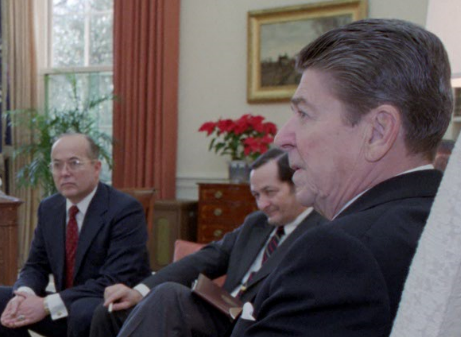
Walter Raymond Jr., a CIA propaganda and disinformation specialist who oversaw President Reagan’s “psyops” and “perception management” projects at the National Security Council. Raymond is partially obscured by President Reagan. Raymond is seated next to National Security Adviser John Poindexter. (Photo credit: Reagan presidential library)


A just-declassified sign-in sheet for a meeting of an inter-agency “psyops” committee on Oct. 24, 1986, shows representatives from the Agency for International Development (USAID), the State Department, and the U.S. Information Agency (USIA) joining officials from the Central Intelligence Agency and the Defense Department.


Some of the names of officials from the CIA and Pentagon remain classified more than three decades later. But the significance of the document is that it reveals how agencies that were traditionally assigned to global development (USAID) or international information (USIA) were incorporated into the U.S. government’s strategies for peacetime psyops, a military technique for breaking the will of a wartime enemy by spreading lies, confusion and terror.


Essentially, psyops play on the cultural weaknesses of a target population so they could be more easily controlled or defeated, but the Reagan administration was taking the concept outside the traditional bounds of warfare and applying psyops to any time when the U.S. government could claim some threat to America.


This disclosure – bolstered by other documents released earlier this year by archivists at the Reagan library in Simi Valley, California – is relevant to today’s frenzy over alleged “fake news” and accusations of “Russian disinformation” by reminding everyone that the U.S. government was active in those same areas.


The U.S. government’s use of disinformation and propaganda is, of course, nothing new. For instance, during the 1950s and 1960s, the USIA regularly published articles in friendly newspapers and magazines that appeared under fake names such as Guy Sims Fitch.


However, in the 1970s, the bloody Vietnam War and the Pentagon Papers’ revelations about U.S. government deceptions to justify that war created a crisis for American propagandists, their loss of credibility with the American people. Some of the traditional sources of U.S. disinformation, such as the CIA, also fell into profound disrepute.


This so-called “Vietnam Syndrome” – a skeptical citizenry dubious toward U.S. government claims about foreign conflicts – undermined President Reagan’s efforts to sell his plans for intervention in the civil wars then underway in Central America, Africa and elsewhere.


Reagan depicted Central America as a “Soviet beachhead,” but many Americans saw haughty Central American oligarchs and their brutal security forces slaughtering priests, nuns, labor activists, students, peasants and indigenous populations.


Reagan and his advisers realized that they had to turn those perceptions around if they hoped to get sustained funding for the militaries of El Salvador, Guatemala and Honduras as well as for the Nicaraguan Contra rebels, the CIA-organized paramilitary force marauding around leftist-ruled Nicaragua.


Perception Management


So, it became a high priority to reshape public perceptions inside those targeted countries but even more importantly among the American people. That challenge led the Reagan administration to revitalize and reorganize methods for distributing propaganda and funding friendly foreign operatives, such as creation of the National Endowment for Democracy under neoconservative president Carl Gershman in 1983.


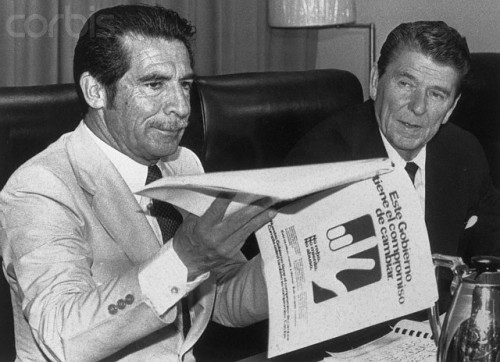
President Ronald Reagan meeting with Guatemalan dictator Efrain Rios Montt, who later faced accusations of genocide against Indian populations in the central highlands.


Another entity in this process was the Psychological Operations Committee formed in 1986 under Reagan’s National Security Council. In the years since, the U.S. administrations, both Republican and Democratic, have applied many of these same psyops principles, cherry-picking or manufacturing evidence to undermine adversaries and to solidify U.S. public support for Washington’s policies.


This reality – about the U.S. government creating its own faux reality to manipulate the American people and international audiences – should compel journalists in the West to treat all claims from Washington with a large grain of salt.


However, instead, we have seen a pattern of leading news outlets simply amplifying whatever U.S. agencies assert about foreign adversaries while denouncing skeptics as purveyors of “fake news” or enemy “propaganda.” In effect, the success of the U.S. psyops strategy can be measured by how Western mainstream media has stepped forward as the enforcement mechanism to ensure conformity to the U.S. government’s various information themes and narratives.


For instance, any questioning of the U.S. government’s narratives on, say, the current Syrian conflict, or the Ukraine coup of 2014, or Russian “hacking” of the 2016 U.S. election, or Iran’s status as “the leading sponsor of terrorism” is treated by the major Western news outlets as evidence that you are a “useful fool” at best, if not a willful enemy “propagandist” with loyalty to a foreign power, i.e., a traitor.


Leading mainstream media outlets and establishment-approved Web sites are now teaming up with Google, Facebook and other technology companies to develop algorithms to bury or remove content from the Internet that doesn’t march in lockstep with what is deemed to be true, which often simply follows what U.S. government agencies say is true.


Yet, the documentary evidence is now clear that the U.S. government undertook a well-defined strategy of waging psyops around the world with regular blowback of this propaganda and disinformation onto the American people via Western news agencies covering events in the affected countries.


During more recent administrations, euphemisms have been used to cloak the more pejorative phrase, “psychological operations” – such as “public diplomacy,” “strategic communications,” “perception management,” and “smart power.” But the serious push to expand this propaganda capability of the U.S. government can be traced back to the Reagan presidency.


The Puppet Master


Over the years, I’ve obtained scores of documents related to the psyops and related programs via “mandatory declassification reviews” of files belonging to Walter Raymond Jr., a senior CIA covert operations specialist who was transferred to Reagan’s National Security Council staff in 1982 to rebuild capacities for psyops, propaganda and disinformation.


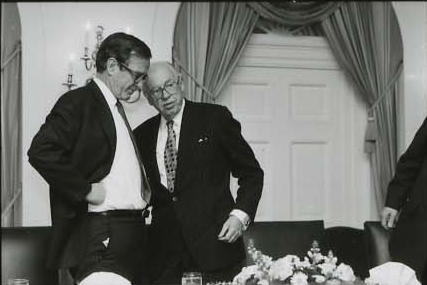
Then-Vice President George H.W. Bush with CIA Director William Casey at the White House on Feb. 11, 1981. (Photo credit: Reagan Library)


Raymond, who has been compared to a character from a John LeCarré novel slipping easily into the woodwork, spent his years inside Reagan’s White House as a shadowy puppet master who tried his best to avoid public attention or – it seems – even having his picture taken.


From the tens of thousands of photographs from meetings at Reagan’s White House, I found only a couple showing Raymond – and he is seated in groups, partially concealed by other officials.


But Raymond appears to have grasped his true importance. In his NSC files, I found a doodle of an organizational chart that had Raymond at the top holding what looks like the crossed handles used by puppeteers to control the puppets below them. The drawing fits the reality of Raymond as the behind-the-curtains operative who was controlling the various inter-agency task forces that were responsible for implementing psyops and other propaganda strategies.


In Raymond’s files, I found an influential November 1983 paper, written by Col. Alfred R. Paddock Jr. and entitled “Military Psychological Operations and US Strategy,” which stated: “the planned use of communications to influence attitudes or behavior should, if properly used, precede, accompany, and follow all applications of force. Put another way, psychological operations is the one weapons system which has an important role to play in peacetime, throughout the spectrum of conflict, and during the aftermath of conflict.”


Paddock continued, “Military psychological operations are an important part of the ‘PSYOP Totality,’ both in peace and war. … We need a program of psychological operations as an integral part of our national security policies and programs. … The continuity of a standing interagency board or committee to provide the necessary coordinating mechanism for development of a coherent, worldwide psychological operations strategy is badly needed.”


One declassified “top secret” document in Raymond’s file – dated Feb. 4, 1985, from Secretary of Defense Caspar Weinberger – urged the fuller implementation of President Reagan’s National Security Decision Directive 130, which was signed on March 6, 1984, and which authorized peacetime psyops by expanding psyops beyond its traditional boundaries of active military operations into peacetime situations in which the U.S. government could claim some threat to national interests.


“This approval can provide the impetus to the rebuilding of a necessary strategic capability, focus attention on psychological operations as a national – not solely military – instrument, and ensure that psychological operations are fully coordinated with public diplomacy and other international information activities,” Weinberger’s document said.


An Inter-Agency Committee


This broader commitment to psyops led to the creation of a Psychological Operations Committee (POC) that was to be chaired by a representative of Reagan’s National Security Council with a vice chairman from the Pentagon and with representatives from CIA, the State Department and USIA.


CIA seal in lobby of the spy agency’s headquarters. (U.S. government photo)


“This group will be responsible for planning, coordinating and implementing psychological operations activities in support of United States policies and interests relative to national security,” according to a “secret” addendum to a memo, dated March 25, 1986, from Col. Paddock, the psyops advocate who had become the U.S. Army’s Director for Psychological Operations.


“The committee will provide the focal point for interagency coordination of detailed contingency planning for the management of national information assets during war, and for the transition from peace to war,” the addendum added.


“The POC shall seek to ensure that in wartime or during crises (which may be defined as periods of acute tension involving a threat to the lives of American citizens or the imminence of war between the U.S. and other nations), U.S. international information elements are ready to initiate special procedures to ensure policy consistency, timely response and rapid feedback from the intended audience.”


In other words, the U.S. government could engage in psyops virtually anytime because there are always “periods of acute tension involving a threat to the lives of American citizens.”


The Psychological Operations Committee took formal shape with a “secret” memo from Reagan’s National Security Advisor John Poindexter on July 31, 1986. Its first meeting was called on Sept. 2, 1986, with an agenda that focused on Central America and “How can other POC agencies support and complement DOD programs in El Salvador, Guatemala, Honduras, Costa Rica and Panama.” The POC was also tasked with “Developing National PSYOPS Guidelines” for “formulating and implementing a national PSYOPS program.” (Underlining in original)


Raymond was named a co-chair of the POC along with CIA officer Vincent Cannistraro, who was then Deputy Director for Intelligence Programs on the NSC staff, according to a “secret” memo from Deputy Under Secretary of Defense Craig Alderman Jr.


The memo also noted that future POC meetings would be briefed on psyops projects for the Philippines and Nicaragua, with the latter project codenamed “Niagara Falls.” The memo also references a “Project Touchstone,” but it is unclear where that psyops program was targeted.


Another “secret” memo dated Oct. 1, 1986, co-authored by Raymond, reported on the POC’s first meeting on Sept. 10, 1986, and noted that “The POC will, at each meeting, focus on an area of operations (e.g., Central America, Afghanistan, Philippines).”


The POC’s second meeting on Oct. 24, 1986 – for which the sign-in sheet was just released – concentrated on the Philippines, according to a Nov. 4, 1986 memo also co-authored by Raymond.


But the Reagan administration’s primary attention continued to go back to Central America, including “Project Niagara Falls,” the psyops program aimed at Nicaragua. A “secret” Pentagon memo from Deputy Under Secretary Alderman on Nov. 20, 1986, outlined the work of the 4th Psychological Operations Group on this psyops plan “to help bring about democratization of Nicaragua,” by which the Reagan administration meant a “regime change.” The precise details of “Project Niagara Falls” were not disclosed in the declassified documents but the choice of codename suggested a cascade of psyops.


Key Operatives


Other documents from Raymond’s NSC file shed light on who other key operatives in the psyops and propaganda programs were. For instance, in undated notes on efforts to influence the Socialist International, including securing support for U.S. foreign policies from Socialist and Social Democratic parties in Europe, Raymond cited the efforts of “Ledeen, Gershman,” a reference to neoconservative operative Michael Ledeen and Carl Gershman, another neocon who has served as president of the U.S.-government-funded National Endowment for Democracy (NED), from 1983 to the present. (Underlining in original.)


Carl Gershman, president of the National Endowment for Democracy.


Although NED is technically independent of the U.S. government, it receives the bulk of its funding (now about $100 million a year) from Congress. Documents from the Reagan archives also make clear that NED was organized as a way to replace some of the CIA’s political and propaganda covert operations, which had fallen into disrepute in the 1970s. Earlier released documents from Raymond’s file show CIA Director William Casey pushing for NED’s creation and Raymond, Casey’s handpicked man on the NSC, giving frequent advice and direction to Gershman. [See Consortiumnews.com’s “CIA’s Hidden Hand in ‘Democracy’ Groups.”]


While the initials USAID conjure up images of well-meaning Americans helping to drill wells, teach school and set up health clinics in impoverished nations, USAID also has kept its hand in financing friendly journalists around the globe.


In 2015, USAID issued a fact sheet summarizing its work financing “journalism education, media business development, capacity building for supportive institutions, and strengthening legal-regulatory environments for free media.” USAID estimated its budget for “media strengthening programs in over 30 countries” at $40 million annually, including aiding “independent media organizations and bloggers in over a dozen countries,”


In Ukraine before the 2014 coup, USAID offered training in “mobile phone and website security,” which sounds a bit like an operation to thwart the local government’s intelligence gathering, an ironic position for the U.S. with its surveillance obsession, including prosecuting whistleblowers based on evidence that they talked to journalists.


USAID, working with billionaire George Soros’s Open Society, also funded the Organized Crime and Corruption Reporting Project (OCCRP), which engages in “investigative journalism” that usually goes after governments that have fallen into disfavor with the United States and then are singled out for accusations of corruption.


The USAID-funded OCCRP also collaborates with Bellingcat, an online investigative website founded by blogger Eliot Higgins, who is now a senior non-resident fellow of the Atlantic Council, a pro-NATO think tank that receives funding from the U.S. and allied governments.


Higgins has spread misinformation on the Internet, including discredited claims implicating the Syrian government in the sarin attack in 2013 and directing an Australian TV news crew to what looked to be the wrong location for a video of a BUK anti-aircraft battery as it supposedly made its getaway to Russia after the shoot-down of Malaysia Airlines Flight 17 in July 2014.


Despite his dubious record of accuracy, Higgins has gained mainstream acclaim, in part, because his “findings” always match up with the propaganda theme that the U.S. government and its Western allies are peddling. Though most genuinely independent bloggers are ignored by the mainstream media, Higgins has found his work touted by both The New York Times and The Washington Post, and Google has included Bellingcat on its First Draft coalition, which will determine which news will be deemed real and which fake.


In other words, the U.S. government has a robust strategy for deploying direct and indirect agents of influence who are now influencing how the titans of the Internet will structure their algorithms to play up favored information and disappear disfavored information.


A Heritage of Lies


During the first Cold War, the CIA and the U.S. Information Agency refined the art of “information warfare,” including pioneering some of its current features like having ostensibly “independent” entities and cut-outs present U.S. propaganda to a cynical public that would reject much of what it hears from government but may trust “citizen journalists” and “bloggers.”


A screen shot of U.S. Assistant Secretary of State for European Affairs Victoria Nuland speaking to U.S. and Ukrainian business leaders on Dec. 13, 2013, at an event sponsored by Chevron, with its logo to Nuland’s left.


USIA, which was founded in 1953 and gained new life in the 1980s under its Reagan-appointed director Charles Wick, was abolished in 1999, but its propaganda functions were largely folded into the new office of Under Secretary of State for Public Diplomacy and Public Affairs, which became a new fount of disinformation.


For instance, in 2014, President Obama’s Under Secretary for Public Diplomacy Richard Stengel engaged in a series of falsehoods and misrepresentations regarding Russia’s RT network. In one instance, he claimed that the RT had made the “ludicrous assertion” that the U.S. had invested $5 billion in the regime change project in Ukraine. But that was an obvious reference to a public speech by U.S. Assistant Secretary of State for European Affairs Victoria Nuland on Dec. 13, 2013, in which she said “we have invested more than $5 billion” to help Ukraine to achieve its “European aspirations.”


Nuland also was a leading proponent of the Ukraine coup, personally cheering on the anti-government rioters. In an intercepted phone call with U.S. Ambassador to Ukraine Geoffrey Pyatt, Nuland discussed how “to glue” or “midwife this thing” and who the new leaders would be. She picked Arseniy Yatsenyuk – “Yats is the guy” – who ended up as Prime Minister after elected President Viktor Yanukovych was overthrown.


Despite all the evidence of a U.S.-backed coup, The New York Times simply ignored the evidence, including the Nuland-Pyatt phone call, to announce that there never was a coup. The Times’ obeisance to the State Department’s false narrative is a good example of how the legacy of Walter Raymond, who died in 2003, extends to the present.


Over several decades, even as the White House changed hands from Republicans to Democrats, the momentum created by Raymond continued to push the peacetime psyops strategy forward.


In more recent years, the wording of the program may have changed to more pleasing euphemisms. But the idea is the same: how you can use psyops, propaganda and disinformation to sell U.S. government policies abroad and at home.

Friday, October 6, 2017

Hurricane Nate Heads For Gulf Coast: Goldman Projects Dramatic Refining Slowdown

Confirming an earlier projection by Accuweather that showed Hurricane Nate will likely make landfall as a cateogry one storm somewhere between Louisiana and the Florida panhandle on Sunday, the NHC has issued a hurricane warning - the highest-priority of the agency"s alert levels - for a broad swath of the Southern US stretching from Grand Isle Louisiana to the Florida-Alabama border.


As we noted earlier, unlike with Hurricane Irma, most of the models for Hurricane Nate consistently see the storm moving directly north through the Gulf before turning to northeast to follow the eastern U.S. shorline. 


Here are more details about storm-related warnings from the NHC:


SUMMARY OF WATCHES AND WARNINGS IN EFFECT:


A Hurricane Warning is in effect for...
* Grand Isle Louisiana to the Alabama/Florida border


A Storm Surge Warning is in effect for...
* Morgan City Louisiana to the Alabama/Florida border
* Northern and western shores of Lake Pontchartrain


A Tropical Storm Warning is in effect for...
* Punta Herrero to Rio Lagartos Mexico
* Pinar del Rio
* Metropolitan New Orleans
* Lake Pontchartrain and Lake Maurepas
* West of Grand Isle to Morgan City Louisiana


A Hurricane Watch is in effect for...
* Punta Herrero to Rio Lagartos Mexico
* Metropolitan New Orleans
* Lake Pontchartrain and Lake Maurepas
* East of the Alabama/Florida border to the Okaloosa/Walton County
Line
* West of Grand Isle to Morgan City Louisiana


A Storm Surge Watch is in effect for...
* East of the Alabama/Florida border to Indian Pass Florida


A Tropical Storm Watch is in effect for...
* East of the Okaloosa/Walton County Line to Indian Pass Florida
* West of Morgan City to Intracoastal City Louisiana
* Isle of Youth


Like they did with Hurricane Harvey, energy traders will be hyper focused this weekend on how the massive network of Gulf drilling platforms might be impacted by the storm.


As Goldman Sachs explains, a new storm, Nate, is heading for the US Gulf Coast and is expected to land as a category 1 hurricane in Louisiana on Sunday.


While the overall impact on the US oil sector is likely to be more modest than for Harvey (category 4 at landfall), it may have a similar supply impact given the path threatens more US Gulf Coast platforms. The demand impact is likely to be much smaller than Harvey given the lower intensity of the storm, the smaller amount of downstream capacity at risk and finally the smaller population impacted. On the refining side, 2.4 mb/d of refining capacity is at risk (13% of US capacity).


We expect the storm to likely (1) have little or only a slightly bullish aggregate impact on the global oil market in October given the expected similarly modest supply and demand losses, (2) support US and global refining margins, with distillate likely to be most sustainably impacted given the already low inventory levels, and finally (3) reduce US crude export flows, initially weighing on the WTI-Brent spread.


The resiliency of the US oil infrastructure during Harvey and the lesser intensity of the storm suggest however that these impacts should remain overall modest with flooding along the Mississippi River the likely greater threat.


Of course, as Accuweather warned earlier, warm temperatures in the Gulf of Mexico could bolster the storm as it moves northeast from Central America toward the southwestern US.

Thursday, August 31, 2017

What Happened To Making America Great Again?

Authored by Curt Mills via The National Interest,


With Steve Bannon out of the White House, regrets are abounding in some corners of the right over how President Trump staffed his administration.


As a candidate Donald Trump excoriated his party’s reigning orthodoxies. As president, however, he is running a fairly conventional administration in his first seven months, at least in the policy realm. What happened to making America great again?


The truth is that the new movement had troubling signs from the beginning. “People who went all-in for Trump were engaged in total wishful thinking,” complains one former Trump campaign policy adviser. According to him, “I think that in his gut Trump isn’t wedded to the establishment. But the idea that Trump’s sort-of vague intuition about this stuff would translate into any serious effort to cultivate the kind-of ideological team that could really catalyze a shift . . . there’s just no evidence of that. I didn’t see it on the campaign. And I don’t think—from what I know of how they’ve done hires—I don’t think ideology is a factor.”


Prominent backers of the New York mogul who were there with him from the early days—Newt Gingrich, Rudy Giuliani, Chris Christie and even former campaign manager Corey Lewandowski—did not get senior roles in the administration. At the Cabinet level, only Jeff Sessions and perhaps Michael Flynn seemed dyed-in-the-wool ideological national-populists. Instead, his White House was staffed with business titans and generals with whom he had limited previous association—Rex Tillerson, Jim Mattis, Steven Mnuchin, Gary Cohn and Wilbur Ross. He seemed to largely eschew bomb-throwers or the politicians who most robustly voiced support for Trumpism the ideology, such as Duncan Hunter or Kris Kobach. As early as January, one Washington conservative political professional (who refused to vote for Trump) boasted to me that he was both thrilled and stunned with the cabinet selections.


Roger Stone Jr., the controversial political consultant who sometimes has the ear of the president, has been saying in the press for months that Steve Bannon and his ilk made a mistake by not using more of their “political capital” on staffing choices, leaving them isolated when their mercurial boss had a change of mood.


Flash forward to this month and the editor of the magazine charged with defending Trumpism—trade protectionism, noninterventionism in foreign affairs, and skepticism of immigration and globalization—has renounced the president. Julius Krein of American Affairs is now on the warpath. “Bannon’s vision,” he says, “of nationalist populism is completely idiotic.” He blames the president for messing this up: “The core problem is at the top. It was always going to be such a weird administration . . . It had to be very nimble, and unite all these different strands. And, when that’s missing at the top. It obviously doesn’t work.” Krein singles out Mattis and Ross as excellent choices, but says that their influence is constrained by a wholly undisciplined president.


Are Neocons Better at Playing the D.C. Game?


In the first days following Trump’s election, establishment, even neoconservative, personnel were considered for roles. Nikki Haley, now UN ambassador, has been reported to have been offered the job of secretary of state before Rex Tillerson. In April in New York, she denied the offer, but confirmed the consideration. “The original call that I received to go to Trump Tower was to discuss Secretary of State,” Haley said. “No, he did not offer it.” Haley is firmly associated with the neoconservatives Trump has claimed to loathe, and during the primary she attacked Trump and endorsed his rival, Marco Rubio.


One reason the likes of Haley rose to the top is that many realists shunned Trump. “There is also the problem that few credentialed realists were eager to work with [Trump],” Scott McConnell, founding editor of The American Conservative, told me. “None were willing to play the game of looking for entry points—as the neocons did early on, with at least some success. . . . [Trump] seemed to have made most initial choices based on whom he might have seen on TV, and relied heavily, and probably overly, on the military, where top people were willing to work with him. He never really had connections to either nationalists/populists or realists—though neither group is that well entrenched in the D.C. think tank world.”


Haley likely came right up to the line of the only hard-and-fast rule of Trump world: no prior explicit and total renunciations of the man himself.


“I do think if you’re on the record saying nasty things about Trump, or the Trump family, that stuff can really hurt you,” the former campaign aide told me, in line with a longstanding rumor about Trump’s hiring.


Elliot Abrams, the former Reagan official nixed as the State Department’s number-two man, was one victim of this policy. Abrams declined comment to the National Interest for this story. And Haley’s position clashes and own personal ambition have had very real policy implications already. Widely thought to be a future presidential candidate, Haley has often stepped out ahead of the State Department with far-more hawkish language in her statements and public appearances as ambassador.


John Bolton is another example. Though Trump is an outspoken Iraq War critic, he considered the George W. Bush administration’s colorful cheerleader for secretary of state, national security adviser and deputy secretary of state. Bolton also declined comment for this story. Krein protested to me that Bolton is misunderstood, and actually would have been a great choice. McConnell ferociously disagrees: “The problem with Bolton is simple. If you liked George W. Bush’s foreign policy, especially the Iraq War and the idea of regime change carried out by the American military on a multi-country, pan-regional scale, and you want get that kind of policy going again, the search is over: he’s definitely the guy,” he wrote in December.


Could Things Have Been Different?


McConnell, a prominent ally of the Pat Buchanan movement that many contend augered the age of Trumpism, has argued that with Bannon gone, there effectively is no White House agenda, only a day-to-day quest for survival. And with Bannon’s exodus, along with former National Security Adviser Michael Flynn, and Reince Priebus and Sean Spicer (establishment professionals who nonetheless helped sell Trump to the party elite), it’s worth asking what sort of questions were asked of job applicants on the campaign and during the transition and afterward, if any.


One political professional who has advised Republican campaigns, including during 2016, finds the hiring of H. R. McMaster as national security adviser particularly curious, remarking “I don’t know how they could of” asked him any serious ideological questions, “given what they got.”


“When H.R. McMaster at his first staff meeting tells the collected staff that he does not agree with the use of the term ‘radical Islamic terrorism,’ one would have thought would have come up in the job interview.”


That sentiment—and the sense of absolute obliteration of the Bannon wing in the administration—was seemingly confirmed by the resignation letter of Sebastian Gorka on Friday.


“Regrettably, outside of yourself,” he wrote to the president. “The individuals who most embodied and represented the policies that will ‘Make America Great Again,’ have been internally countered, systematically removed, or undermined in recent months. This was made patently obvious as I read the text of your speech on Afghanistan. . . . The fact that those who drafted and approved the speech removed any mention of Radical Islam or radical Islamic terrorism proves that a crucial element of your presidential campaign has been lost.”


The former campaign aide says he spoke with Stephen Miller, now White House senior advisor, and nothing of the sort came up, at least during the hiring phase.


“I did have one conversation on ideology,” the former aide tells me.


“After I was hired and everything, I got a call from Steve Miller. . . . Steve calls me and tells me: ‘The biggest contrast we want to draw is ‘Globalist Hillary’ versus ‘Nationalist Trump.’”


If anyone has the profile in the West Wing to directly ideologically succeed Bannon, it is Miller. But should he have such ambition, he might argue for a more scrupulous, even rigid system for hiring, lest the administration lets more globalists in around the president.


“I was a little surprised by that” conversation, the former aide tells me.


“And I probably discerned around that time that it probably wasn’t going to be a good ideological fit. But, again, it wasn’t like he and I talked about this or he asked for my views or anything. He just sort of said this is what we’re doing. . . . He had every reason to know that I wasn’t a Trumpian ideologue. . . . But it never really came up directly.”


A Silver Lining For Trumpists?


If there is a counterview, it’s that the so-called establishment forces now around the president—particularly the troika of Tillerson, Mattis and Chief of Staff John Kelly—aren’t really moderates, at all.


Mattis has been labeled by some as a stealth agitator for regime change in Iran, and an opponent of the nuclear deal, having developed a uniformly negative impression of that country’s government from his days in Iraq, where units under his command warred with the Shia militias.


Tillerson, of course, has been called a Russophile by critics—like his boss, too chummy with Vladimir Putin. And his efforts to pull the State Department away from global democratization efforts have been roundly criticized in the establishment.


Least commented on has been General John Kelly, now chief of staff. He’s a confirmed hardliner from his days heading up U.S. Southern Command—a portfolio of Central and South America. Not just anyone with that kind of knowledge of the situation and professional background would sign up to be the Homeland Security chief for a president who vowed to deport millions of people and build a wall on the Southern border, but Kelly readily did.


And who knows? Bannon might not be permanently out of the fold, if he even is at all. Trump is known to take late-night calls from a wide-range of actors, including from chums like Stone. Bannon has also argued that he is going to war “for” the president outside of the White House. His battlecry is clear, but whether he will win that war remains unclear.

Wednesday, August 30, 2017

As Harvey Moves Inland, A New Hurricane Is Forming Over The Atlantic

Update: According to the NHS, Atlantic Tropical Storm Irma has formed, and could be a Hurricane by Friday. With top winds of 50 miles (80 kilometers) per hour, Irma formed 420 miles west of Cabo Verde moving west at 13 mph, the U.S. National Hurricane Center in an 11 a.m. N.Y. time advisory.


According to Jeff Masters, co-founder of Weather Underground, computer forecast models disagree on its ultimate track but a U.S. strike later in September cannot be ruled out.


Irma is the ninth named storm of the Atlantic hurricane season, which also produced Harvey that devastated southeastern Texas, including Houston, and disrupted energy facilities and supplies and destroyed crops. Irma could become a Category 1 hurricane on the five-step Saffir-Simpson scale by Friday and gradually get stronger through Monday.


If its current track holds, Irma would still be bearing down from the east on the Leeward and Windward Islands in the Caribbean Sea Monday


* * *


The National Hurricane Center (NHC) will be initiating advisories at 11 AM AST, as the new area of low pressure in the eastern Atlantic Ocean will develop into Tropical Storm Irma. Tropical Storm Irma will become the 9th storm of the 2017 Atlantic hurricane season as it moves towards the Gulf of Mexico region.


Per Weather Channel,


In the near-term, future Irma will bring locally heavy rain and gusty winds to the Cabo Verde Islands through Wednesday.


South Florida Weather Management District (SFWMD) reports various pathways for Irma.


National Weather Service (NHS) reports Global Tropics Hazards and Benefits Outlook for the next 1-2 weeks. First week, Irma is labeled as a ‘tropical cyclone formation’  heading towards Caribbean Sea and the Gulf of Mexico. Second week, passing inland and over Central America.


"There is the potential to ramp up to a powerful hurricane in the coming days," according to AccuWeather Hurricane Expert Dan Kottlowski.


Irma will take about a week for the system to make its trek westward across the Atlantic Ocean. Meteorologists will likely be tracking this storm through the middle of September.


"All interests in the eastern Caribbean will need to monitor the progress of this evolving tropical cyclone, especially next week," Kottlowski said.


"It is way too soon to say with certainty where and if this system will impact the U.S."


Meanwhile, Texas and now southwestern Louisiana are still dealing with Tropical Storm Harvey. The weather disturbance has caused a great deal of destruction and cannot afford another storm such as Irma.


Conclusion


Luckily, Irma’s models via the major weather agencies provided above show current trajectories missing the devastated region. We all know in weather forecasting just like stock market forecasting models tend to be wrong – just ask Dennis Gartman.

Thursday, August 10, 2017

Venezuela: Dictatorship, Collapse, And Consequence

Authored by Brandon Smith via Alt-Market.com,


If you want to outline the numerous failures of ideological and economic socialism, just name any socialist nation and you are sure to uncover an endless supply of examples. In fact, many countries where socialism is not total but making considerable inroads often suffer from severe decline — the U.S. being one of them. Whatever socialism touches it destroys, because forced interdependency does not work. It is a broken concept with no large scale successes (this includes China, which suffers from considerable poverty and a totalitarian government despite it being the most successful garbage economy out of a host of other garbage economies). Yet, proponents of socialism keep trying again and again claiming that "this time is different."


So ample have been socialism"s failures in the past several years that socialists have resorted to a classic blame game in order to maintain the delusion. You see, when you bring up nations at the very end of the socialist cycle on the verge of extinction — nations like Venezuela, all you are going to hear is the argument that it was "the evil western capitalists that sabotaged the experiment."


This is a fascinating journey into cognitive dissonance. Because in order to believe this nonsense, you have to first ignore the cold hard reality that socialist policies and politics have permeated every aspect of most western nations to the point that they can no longer be called free market societies. The fact is, IF sabotage of Venezuela can be proven as the cause of its economic ills rather than the inherent pitfalls of socialism, it would merely be a group of socialist nations sabotaging another socialist nation. "Capitalism" plays no part in this mess whatsoever.


In fact, it has been international banks like Goldman Sachs that continue to fund failed socialist projects like Venezuela through bond investmentIf anything, the banks have been artificially keeping the government afloat when it should be allowed to fail so that it can be replaced.


Venezuela is perhaps the easiest of modern examples of socialist collapse, and maybe it is lazy to pull the Venezuela card when discussing these issues, but consider for a moment that the country is important exactly because it is a cautionary tale. Venezuela as a disaster state is at the end of the path ALL other socialist nations are traveling down. Venezuela is the future, and the future is bleak.


Here is the problem: Human beings need some structure to function as a group, this is true. But, human beings also need participation in a structure to be voluntary, otherwise, they are unlikely to find meaning or happiness within that structure. Without productive and inventive individuals striving to improve a structure, the structure will eventually stagnate or implode. Without individuals to support it, the system is nothing; it does not exist.


Socialists tend to suffer from severe mental blockage when contemplating the idea of "voluntarism." They just can"t seem to grasp it. I believe this stems from a core assumption — the assumption that other people need to be forced to do "necessary" things, otherwise they will not do them. So, for example, socialists and big government champions will consistently argue that infrastructure like roads and fire fighting and police and schools could not exist without taxation; taxation being the stealing of other people"s money to pay for services that are supposedly vital to everyone. However, all of these services and more can and have been built and maintained in the past through free markets as well as through voluntary efforts. Force and taxation was not required back then, but for some reason it is required today.


What changed? Nothing. We have only strayed so far down the path of interdependency and government interference that most people can"t imagine life without it.


Another argument I hear often from pro-socialism types is the argument that interconnectivity is its own rationale. That is, they argue that the community requires dependency, because if you are independent then you are not supporting others and are thus harming the system. "We all have to live together within a society and if you are not helping us then you are hurting us," they state.


See how that works? You MUST participate, because if you don"t you are harming everyone else. It is not a victimless crime to walk away or to build a competing structure like those "selfish" libertarians claim. You are a part of the machine and if you stop serving your function then the whole machine may break and then we all suffer. Therefore, the application of force and coercion becomes morally acceptable because the "needs of the many outweigh the needs of the few."


This is the horrifying perpetual circle that is collectivism; we all stand together or we all fall together, toe the line or else!


Well, as we have seen many times this ideology is not very practical or successful. If human beings were bugs with a central hive mind then maybe socialism would have some merit. But thankfully, most of us are not bugs and we do not thrive in environments that treat us like drones. We might tolerate them for a while, but we certainly do not thrive in them. Frankly, such systems should be allowed to collapse because they are a hindrance to mankind, not a beacon of progress.


When examining Venezuela, we see the classic big government collapse in motion.


First comes economic strife as the inability of the system to provide "equality" becomes apparent. All high minded socialist and communist (same difference) structures end up with an oligarchy. As long as big government is present, the power mongers will flourish.


Beyond the massive gap that inevitably develops between the power elite and everyone else, socialism is actually highly effective at creating wealth equality; in that it makes all other people equally poor. In Venezuela, the government has hiked the minimum wage three times this year, and surprise surprise, this has done nothing to alleviate the problem. Try explaining this to the leftists in the U.S. demanding a mandatory $15/hr minimum wage and they will dismiss the comparison outright. Explain to them how, just like in Venezuela, hiking minimum wage requirements results in more poverty rather than less, and they"ll start talking about what is socially "correct" rather than what is mathematically evident.


At bottom, wage increases and social welfare measures are meaningless in the face of severe currency devaluation.  Venezuela has seen its currency value disintegrate by 93% in the past two years.  So terrible are the conditions now that starvation is becoming normalized.  In Venezuela, they call it the "Maduro Diet".


The next phase of the socialist breakdown is usually dictatorship. When the fantasy of pure equality dies and people are left with very little to show for their faith in the system, they start to become disillusioned and angry. Some citizens will decide to try the peaceful method and walk away from the broken structure so that they can build their own. Ultimately though, this is nothing more than a stopgap.


The Venezuelan government has been cracking down on alternative markets (often called "black markets") for years in order to force the population to remain as cogs within the socialist system. You see, in a socialist framework, people are property to be used for promotion of the system. They are not allowed to leave while the system is in dire straights, because the simple act of leaving stands as a damning indictment of the system itself. Leaving the system or peacefully competing with the system is treated as an act of war on the system.


The mode of dictatorship eventually meets with political opposition. People are only tolerant of tyranny for so long, and they will act. But, being generally moral, the average person will first seek out non-violent strategies to counter overt oppression. Again, this is nothing more than a stopgap. Venezuela has followed the same battle plan multiple dictatorships have followed in the past; namely the imprisonment of political opponents and activists.


This is usually a signal that the subject nation is on the verge of full spectrum collapse or civil war. Within months of any political cleansing, most totalitarian governments either start a war with another country to unify the public through fear, or, they destabilize into civil unrest. It is clear that Venezuela is going to fracture completely in the near term.


In previous articles I have warned about this process within Venezuela in terms of the consequences that will erupt throughout South and Central America. With a breakdown in Venezuela, Donald Trump"s border wall will be looking like a rather fantastic idea as millions rush from the ground zero turmoil that will be created when the region melts into factional war and refugees flee.


My first suspicion though is that no such border controls will exist and we will be caught completely unprepared.


My second suspicion is that this turmoil will provide some attractive opportunities to the establishment elites within the U.S. Remember how Europeans were goaded into accepting millions of immigrants from the Middle East in the name of "atoning" for the war crimes of the West? Parts of Europe are now slowly but surely crumbling under the stress of a completely incompatible culture overrunning the existing value structure. Remember how critics of the policy were told that "we created the mess in the Middle East and now had to pay for it?"


Expect the same exact rhetoric if and when the crisis in Venezuela spills over its borders and disrupts the southern hemisphere. American policies such as sanctions will be blamed. Socialists will chide the American public that they should feel guilty and leave the border open as penance for creating the mess in the first place. And, being that there are still no legitimate border controls, many of these refugees will enter the U.S. unimpeded.


At that point, we will perhaps see the next phase of collapse within the American socialist experiment as we are seeing the dismal results of socialist experiments in Europe overwhelmed by too many immigrants with no intention of assimilation. To make a "new world order", as establishment globalists sometimes refer to it, the old world order has to be destroyed. Socialism is in itself a very effective weapon for undermining the coherent structure of nations and cultures, leaving disaster and ashes in its wake.


With the slate wiped clean, as it were, international financiers and other elitists always seem to be in the right place and time to build the next system; a system even more centralized and more oppressive than the one before.


What we see in Venezuela is a potential nexus for greater calamity in the western hemisphere. And, what we also see is a microcosm of the socialist cancer in action. It is not some self-contained rarity, it is the common and predictable outcome of a society based on collectivist servitude and false promises of equality.

Sunday, June 25, 2017

EXPOSED: CIA drug connection shows how they support USD and manipulate foreign markets

(GLOBALINTELHUB.COM) – 6/26/2017 — Drugs have been a part of human society forever – however far back you go, humans have used drugs in one form or another; medicine, recreation, spirituality (Shamans of simple tribes often ate psychedelics).  In the world today there is an interesting schism between the puritan “America” and “Europe” about this issue – in Europe they consider drug addiction a health issue, and in places like Switzerland you can literally get strong narcotics like heroin from the Government.  In America it’s the opposite, there is an  exploding prison population for small non-violent offenses.  But as with many things in America there are lots of ironies and hypocrisies, America also has the highest per capita rate of users of legal pharmaceuticals ‘drugs’ – and is one of the only countries in the world where drug companies are allowed to advertise on TV (In Europe you won’t see commercials for Prozac, Viagra, or other questionably useful drugs).


As the CIA represents the main head of the octopus that controls America’s society on behalf of their Illuminati owners, it is only fitting that the CIA has its hand in the international drug trade.  It is also an interesting side note that since its early days the CIA has been interested in drugs for the use of interrogation, mind control, crowd control, and other purposes.  In fact there have been suggestions based on circumstantial evidence that the entire ‘hippie’ movement came straight out of a CIA drug lab vis a vis Tim Leary and other affiliated icons.


The inspiration of this article is the book and legend of Gary Webb, the book is Dark Alliance – a must read for any trader or investor.  Here’s a real blueprint how groups like the CIA manipulate markets.  While the story of Dark Alliance which was originally published in a small California regional newspaper the San Jose Mercury News.  The book is a great example of how to properly research a topic where its difficult to find information (in this case, because most of the CIA involvement was ‘secret’ and thus information was classified or destroyed, mostly).  In trading, information is also difficult to find – analysts can learn a great deal from reading this book and understanding how one investigative journalist broke open the biggest secret the CIA had in its closet of deep secrets:  The CIA was managing the international drug trade.  The book concludes with the impeccable logic of the agency and how they could be involved in such dastardly deeds.  When the topic was officially investigated it was discovered that the CIA had a secret legal agreement with the Department of Justice (DOJ) stating that through the CIAs business of spying, it was not their obligation to report illegal activities they witnessed to the DOJ (such as drug trafficking) as it may compromise their intelligence gathering.  And lo and behold, most of the CIAs international assets happened to be major drug kingpins like Manuel Noriega.  So based on this understanding, no employee of the CIA ever directly brought drugs into the USA, and likely never touched the operation directly.  It was CIAs job to provide logistic support, planes, pilots, operational instructions, airfields, needed gear, and most importantly – protection from prosecution in USA due to ‘national security.’  And there were side benefits to this operation.  They got to redirect funds from Central and South American cocaine to the fledgling contra revolution in Nicaragua which the US Congress didn’t want to continue funding.  They got to destroy the black community in South Central Los Angeles with the crack explosion (not only by health, but by using it as a tool to pass draconian laws).  They also could easily use the information on the drug trade to go after their enemies in Central America.  It seemed to be a win-win-win for USA.  And according to this secret agreement with DOJ it was all legal!


Before continuing, let’s un-muddy the waters about key points on this issue.  An investigation found that no CIA employee was found bringing illicit narcotics into USA.  That’s probably true.  In “Dark Alliance” there is no suggestion that the CIA itself was bringing drugs into the country.  The drug kingpins such as Norwin Meneses, Danilo Blandon, and others – were simply protected as ‘assets’ – the CIA not only looked the other way, they stopped other US Government investigators from uncovering anything substantial.  Several instances where the drug operations were discovered by DEA, FBI, and others – turned into a situation where they were instructed to cease the investigation and if they did not, the individual was targeted.


So how is all this connected to the markets?  The CIA is a fairly large organization, 20,000 employees working in the US and in practically every country in the world.  Their operations are vast, just to name a few not commonly known but public CIA operations, they are active angel and seed investors in Silicon Valley and have even created a budding DC based VC community that develops technology with primarily intelligence and military applications (such as face recognition).  The most absurd example of a CIA project was when they hired psychologist BF Skinner to train pigeons to aid in missile guidance systems:


One of the most seemingly preposterous military programs of all time occurred during WWII, when famed behavioral psychologist B.F. Skinner was enlisted by the government to try and train pigeons for use in a missile guidance system. At the time, Skinner was known as one of the major practitioners of operant conditioning, a system that used reward and punishment as a means of controlling behavior. With these ideas in mind, Skinner placed a series of specially trained pigeons inside missiles. A camera on the front of the missile recorded its flight path, which was then projected on a screen for the pigeon to see. The birds were trained to recognize the missile’s intended target, and they would peck at the screen if it was drifting off course. This information was fed to the weapon’s flight controls, which would then be changed to reflect the new coordinates. Skinner was originally given $25,000 to get the project up and running, and he actually managed to make some minor progress with it. But government officials were never quite able to get past the obvious absurdity of the program, and it was eventually shut down.   .. and another one “Acoustic Kitty”


Most people wouldn’t think of the common house cat as being a potential master of espionage, but the CIA sure did. In the 1960s, American intelligence is said to have spent over $20 million on “Acoustic Kitty,” a top-secret project that used cats as recording devices. The project took a group of specially trained cats and surgically implanted microphones, antennae and batteries into their tails, and then set them loose near the Russian embassy. The idea was that an unassuming cat would be able to stride right up to groups of communist officials and listen in on their conversation, which it could then beam back to agents with its sophisticated radio equipment. The plan was eventually put into action, but the first cat sent into the field was supposedly run over by a taxi before it could make a recording, and operation ‘Acoustic Kitty” was abandoned shortly thereafter.


Why did we use this ridiculous example?  Because it is a known project, that the CIA was using Pigeons to guide missiles – it’s not so hard to believe they provided drug traffickers with the logistic and legal support needed to bring Cocaine into USA (and many other activities).  For more absurd CIA programs see this article.


But the primary role of the CIA, is that of intelligence gathering and analysis which puts them right in the middle of the information war – and the battlefield is the financial markets.  As we explain in our book Splitting Pennies Understanding Forex – the only thing that backs the US Dollar are bombs.  Basically, the US Military, and in this case the CIA primarily, protects the US Dollar globally.  If you look at any foreign CIA operation it’s all about one thing: money.  Cuba became an enemy only after the communist government nationalized US owned businesses there (effectively, seized).  You can literally overlay a global map of CIA activity which is negatively correlated with Coca Cola and McDonald’s sales (which are all denominated in US Dollars).  And by the way, that is the connection to the CIA and FX – wherever there’s a foreign market, there is the CIA.  They fight for market domination of the US Dollar (and the US corporations and culture that comes with it) no different than a major US corporation competes for market share.  But their ‘client’ is one single entity: The US Government (and US Citizens, but rich ones).  They are protecting capitalism at the front lines – fighting communism while making a few dollars along the way – what could be more American than that?  They use the same playbook as they’ve developed internally for most of their operations – thus, by understanding the Contra-Cocaine operation one can understand any operation.  They aren’t really so different.


Here’s a document that shows how the CIA has been supporting the US Dollar, regarding Gold markets (bear in mind, this document is dated 1970, one year before Nixon created the free floating FX regime we use today, which means the US Dollar was pegged to Gold).  CIA support of US Dollar and USD interests is implied; that’s at the core of what they do – it is their doctrine.  Intelligence gathering, is the tactical level and Communism, and other threats to the USD global hegemony are strategies.  And relatively speaking, they do a good job.  The USD has never been used so widely around the world, the US stock market has enjoyed a bull run never seen before in history.  All the crap in the news and investigations into their drug operations are really an irrelevant side issue – what the CIA was created for, they succeed.


Probably, let’s hope this is not the case, probably – there wasn’t a CIA plot to bring Cocaine into America and turn it into crack and flood the black community.  These were all convenient circumstances to achieve what they wanted operationally – fund a covert war and at the same time make a little money and use the issue to ruin their local enemies.  Central America has few natural resources to speak of without sophisticated mining and/or manufacturing operations to tap them; in other words, there isn’t any ‘oil’ to exploit, as in the middle east.  The one thing that is easy to grow and is more valuable than any other naturally growing substance, is Coca (when refined into Cocaine).  And as explained in the book, before it was realized that it could be turned into crack – Cocaine was the habit of the Elite themselves, due to price and the fact that you could literally continue working while you were high on the powder (such as Wall St. traders during the trading session).  So while it seems extreme, and the crack epidemic of Los Angeles is clearly a huge social problem – it isn’t really surprising that the CIA was involved in such profitable business.  Similar circumstantial evidence suggests that a similar operation was run in Afghanistan, a land where the Poppy plant grows wild.  George H.W. Bush’s CIA nickname was George “Poppy” Bush.  Like “Grandpappy” right?  In the book Gary Webb claims that Pablo Escobar had a photo of “Poppy” standing in front of a huge pile of cash and cocaine, but the photograph never surfaced and he was killed shortly after making this statement about the photograph (it may be another funny coincidence).


In conclusion – this book is a must read for any trader or investor: Dark Alliance.  Also it’s a must read for any lawyer – as this is a unique situation where you have a hidden hand protecting defendants in Federal cases with ‘national security’ – silencing witnesses (with gag orders) and other mechanisms not common in district courts.


To get a full picture of how the financial world REALLY works, check out Splitting Pennies.

Wednesday, June 21, 2017

Leading The Multipolar Revolution: How Russia And China Are Creating A New World Order

Authored by Federico Pieraccini via The Stratgeic Culture Foundation,


The last thirty days have shown another kind of world that is engaging in cooperation, dialogue and diplomatic efforts to resolve important issues. The meeting of the members of the Belt and Road Initiative laid the foundations for a physical and electronic connectivity among Eurasian countries, making it the backbone of sustainable and renewable trade development based on mutual cooperation. A few weeks later, the Shanghai Cooperation Organization meeting in Astana outlined the necessary conditions for the success of the Chinese project, such as securing large areas of the Eurasian block and improving dialogue and trust among member states. The following AIIB (Asian Infrastructure Investment Bank) meeting in ROK will layout the economical necessities to finance and sustain the BRI projects.


The Shanghai Cooperation Organization (SCO) and the Chinese Belt and Road Initiative (BRI) have many common features, and in many ways seem complementary. The SCO is an organization that focuses heavily on economic, political and security issues in the region, while the BRI is a collection of infrastructure projects that incorporates three-fifths of the globe and is driven by Beijing"s economic might. In this context, the Eurasian block continues to develop the following initiatives to support both the BRI and SCO mega-projects. The Collective Security Treaty Organization (CTSO) is a Moscow-based organization focusing mainly on the fight against terrorism, while the Asian Infrastructure Investment Bank (AIIB) is a Beijing-based investment bank that is responsible for generating important funding for Beijing’s long-term initiatives along its maritime routes (ports and canals) and overland routes (road, bridges, railways, pipelines, industries, airports). The synergies between these initiatives find yet another point of convergence in the Eurasian Economic Union (EEU). Together, the SCO, BRI, CTSO, AIIB, and EEU provide a compelling indication of the direction in which humanity is headed, which is to say towards integration, cooperation and peaceful development through diplomacy.


On the other side we have the «old world order» made up of the IMF, the World Bank, the European Union, the UN, NATO, the WTO, with Washington being the ringmaster at the center of this vision of a world order. It is therefore not surprising that Washington should look askance at these Eurasian initiatives that threaten to deny its central and commanding role in the global order in favor of a greater say by Moscow, Beijing, New Delhi and even Tehran.


One of the most significant and noteworthy events in the last month, or even in recent years, has been the admission into the SCO of India and Pakistan, two nuclear powers with a history of tension and conflict between them. These two countries are critical to the peaceful and fruitful integration of Eurasia. The slow, two-year process of India and Pakistan’s admission into the SCO benefited greatly from China and Russia’s mediation, culminating in the historical agreement signed by Modi, Sharif, Putin and Xi. This is not to mention Afghanistan’s Ghani being at the same table with Modi and Sharif, representing one of the most infamous locations where Eurasian powers have clashed with each other, acting as an obstacle to the integration and development of the region. The main goal of the new SCO organization is a peaceful mediation between New Delhi and Islamabad, and certainly to reach a wider agreement that can include Afghanistan. Kabul is a good example of how the SCO can offer the ideal framework for achieving a definitive peace settlement. This reflects the sentiment that was expressed during the meeting that took place a few weeks ago in Moscow between Pakistan, India, China, Russia and Afghanistan over the complicated situation in the country. Clearly there are conflicting interests, and it is only through the mediation of Beijing and Moscow that it will be possible to reach a wider agreement and end the 16-year-old conflict.


Afghanistan is a good example of how the SCO intends to support the BRI. In this sense, it is important to note that Moscow and Beijing have decided to engage in a partnership that looks more like an alliance with long-term projects planned deep into 2030. The extent to which Russia and China are committed to common initiatives and projects can be seen in the BRI, SCO, AIIB and CTSO.


Security and Development


Beijing is fully aware that it is impossible to defeat terrorism without laying the foundation for economic growth in underdeveloped countries in Africa, Middle East, Central Asia and South Asia. Terrorist organizations are generally better able to recruit from populations suffering from low income and poor schooling. The SCO is required to manage and control its members’ most unstable areas (Central Asian republics, Afghanistan, India-Pakistan border, Beijing-New Delhi relations) and mediate between parties. The BRI and SCO go hand in hand, one being unable to operate without the other, as Xi and Putin have reiterated.


The SCO and BRI are both capable of meeting the challenges of economic growth through development and progress. Just looking at the BRI"s major projects helps one understand the level and extent of integration that has been agreed. The Eurasian Land Bridge begins in Western China and ends in Western Russia. The China-Mongolia-Russia economic corridor begins in Northern China and arrives in Eastern Russia. Central Asia will be connected to Western Asia, which practically means China linking with Turkey. The China-Indochina corridor runs from Southern China to Singapore; and the Bangladesh-China-India-Myanmar corridor starts in Southern China and arrives in India. The nearly completed China-Pakistan corridor starts in south-western China and reaches Pakistan. Finally, the maritime route running from the Chinese coast through to Singapore will reach the Mediterranean in Greece or, in the future, Venice.


What is evident is that countries like India, Singapore, Turkey and Myanmar, just to name a few, do not wish to miss the opportunity to join this initiative that promises to revolutionize trade and globalization as we know it. Today’s main economic problems, as well as the problem posed by terrorism, stems from the lack of economic growth brought on by a globalization that enriches the elites at the expense of ordinary people. The BRI aims to reinvent globalization, avoiding the protectionist drift that many countries today adopt in response to an aggressive and failed approach to globalization. Beijing intends to bring about a radical change to its industries by restructuring its production and boosting its investment in technology, generating more internal consumption, and becoming a country that offers services and not only manufacturing. For this process to be successful, it will be fundamental to reorganize the regional supply chain by transferring production to more competitive countries that will play important roles in sectors such as agriculture, energy, logistics and industrial projects. Southeast Asia in particular seems to offer ideal destinations for transferring Chinese industries.


In this process of transforming a good part of the globe, some countries currently outside of the SCO organization are nevertheless fully part of the integration schemes and will play a decisive role in the future. In particular, Iran, Turkey and Egypt are the main focus when one looks at their geographical position. The importance of these three countries vis-a-vis the SCO arises mainly from the need of the organization to pursue its work of political expansion and, in the future, to counter militarily the problem of terrorism and its spread. Naturally, countries like Iran and Egypt already devote a large part of their resources towards counteracting the terrorist phenomenon in the Middle East and North Africa. Their entry into the SCO would be seen by many protagonists of the BRI, especially China, as providing the opportunity to expand their projects in areas in North Africa and the Middle East that are currently tumultuous.


This should not come as a surprise, since even countries like Jordan and Israel have been taken into account by Beijing for important infrastructure projects related to the transport of desalinated water to regions with a high rate of drought. With Israel, the Chinese partnership is stronger than ever, counting on various factors such as technological development and the expansion of several Israeli ports to connect more Chinese maritime routes with destinations in the Mediterranean like Piraeus in Greece and probably Venice in Italy. Turkey"s entry into the SCO is mainly aimed at gathering the region"s major oil and gas suppliers and consumers under a single umbrella guaranteed by the SCO. These operations take time and a degree of cooperation that is hard to maintain, although the resolution of the situation in Syria, in addition to the crisis in the Gulf between Qatar and Saudi Arabia, could accelerate synergies and easily facilitate them.


The entry of Iran, Egypt and Turkey into the SCO is inevitable, receiving the strong encouragement of China and Russia, especially as regards the future connection between BRI and other infrastructure projects that are part of the EEU. The advantages are quite obvious to everyone, bringing about greater integration and infrastructure links, the increase of trade between nations, and general cooperation in mutual development. Products can travel from one country to another based on conditions determined bilaterally, something that often favors bigger nations rather than smaller ones. The intention of ??China"s Globalization 2.0, coupled with a Eurasian revival of the EEU, is to change the future of humanity by shifting the global pole of globalization and development towards the east. The BRI is immense and mind boggling in its scope, given that it embraces realities ranging from Panama (focused on the extended channel and the Nicaragua project for a new channel) to Australia, passing through Europe, the Middle East, Asia and the Persian Gulf.


Naturally, in this delicate balance, Europe is called on to play a decisive role in the future. The United States, with its «America First» policy, has already burned bridges with the Chinese BRI revolution, and indeed hopes to throw a spanner in China’s works. European countries including England, France, Germany and Italy have already begun to sign onto various Chinese proposals. It looks as if America’s allies are no longer listening to their former boss. The European Central Bank has for the first time diversified $500m into Yuan currency, and London, together with Rome, Berlin and Paris, was present in Beijing for the launch of the BRI. France, Germany and England sent high-level representations and delegations, Italy directly the Prime Minister. For Europe, the largest exporter to China and the second-largest regional block importing from China, it is inevitable that it will be an integral part of the BRI, looking to reach Iran, Turkey and Egypt for energy supplies and diversifying sources, all within the framework of the BRI.


In this process of Eurasian integration, there are some key countries to keep in mind, but the first steps have already been made with almost indissoluble ties having been made between Moscow and Beijing, as well as the monumental inclusion of Pakistan and India at the same table. With an understanding between India, Russia and China, as well as a lack of hostility to the project in Iran, Israel, Germany, England, Turkey and Egypt, it will be possible to speed up this global change, bringing it to the African countries, Gulf monarchies, South Asian countries, and even South and Central America. Even Washington"s historic allies like Israel, Saudi Arabia and the EU vacillate in the face of such an opportunity to broaden their horizons with significant gains. As far as their alliance with the United States, in this world rapidly heading towards a multipolar world order, not even Riyadh, Tel Aviv or London can afford the luxury of ignoring the project that perhaps more than any other will revolutionize the future of humanity in the near future. Not being a part of it is simply not an option.


The United States has two diametrically opposed options before it. It can operate alongside the BRI project, trying to fashion its own sphere of influence, albeit smaller than the countries residing within the Eurasian continent; but of course for Washington, simply being part of a grand project may not be enough, since it is used to getting its own way and subordinating the interests of other countries to its own. If the US decides to try and sabotage the BRI with their normal tools like terrorism, it is very likely that the countries historically aligned with Washington in these affairs (such as Pakistan and Saudi Arabia) will be subjected to Chinese economic pressure and encouraged to instead participate in a more positive manner.


Cooperation against Threats


The main question is the extent to which Chinese economic persuasion will succeed in overcoming US military threats. In this respect the SCO will be a decisive factor as it expands its influence beyond the Eurasian bloc into Africa and the Middle East. To date, the SCO cannot be considered a military bloc opposed to NATO. Everything will depend on the pressures that the United States will bring to bear on participating countries. Therefore, it is likely that the SCO will evolve to include a strong military aspect in order to counter American destabilization efforts.


It is difficult to predict whether the US will be neutral or belligerent. But considering recent history, American hostility is likely to force Moscow and Beijing into an asymmetric response that will hit Washington where it hurts most, namely its economic interests. Aiming at the dollar, and in particular the petrodollar, seems to be the best bet for advancing the BRI, threatening a massive de-dollarization that would end in disaster for Washington. This is the nuclear option that Beijing and Moscow are looking into, with more than a desire to accelerate this economic shift.


The future of humanity seems to be changing in exciting and unprecedented ways. The full integration of the Eurasian bloc will eventually end up changing the course of history, allowing nations that are currently weak and poor to withstand colonial pressures and broaden their cooperation and dialogue. Peace as a method for developing synergies and prosperity seems to be the new paradigm, contrasting with war and destruction as has been the case in the last decades.