Showing posts with label Marxian economics. Show all posts

Sunday, November 12, 2017

How Economics Failed The Economy

Authored by Umair Haque via Eudaimonia blog,


When, in the 1930s, the great economist Simon Kuznets created GDP, he deliberately left two industries out of this then novel, revolutionary idea of a “national income”: finance and advertising.


Don’t worry, this essay isn’t going to be a jeremiad against them, that would be too easy, and too shallow, but that is where the story of how modern economics failed the economy? - ?and how to understand how to undo it? - ?should begin.


Kuznets’ logic was simple, and it was not mere opinion, but analytical fact: finance and advertising don’t create new value, they only allocate, or distribute existing value? - ?in the same way that a loan to buy a television isn’t the television, or an ad for healthcare isn’t healthcare. They are only means to goods, not goods themselves.


Now we come to two tragedies of history.


What happened next is that Congress laughed, as Congresses do, ignored Kuznets, and included advertising and finance anywaysfor political reasons? - ?after all, bigger, to the politicians’ mind, has always been better, and therefore, a bigger national income must have been better. Right? Let’s think about it.


Today, something very curious has taken place.


If we do what Kuznets originally suggested, and subtract finance and advertising from GDP, what does that picture? - a picture of the economy as it actually is? - ?reveal? Well, since the lion’s share of growth, more than 50% every year, comes from finance and advertising? - whether via Facebook or Google or Wall St and hedge funds and so on? - ?we would immediately see that the economic “growth” that the US has chased so desperately, so furiously, never actually existed at all.


Growth itself has only been an illusion, a trick of numbers, generated by including what should have been left out in the first place. If we subtracted allocative industries from GDP, we’d see that economic growth is in fact below population growth, and has been for a very long time now, probably since the 1980s -  and in that way, the US economy has been stagnant, which is (surprise) what everyday life feels like.


Feels like. Economic indicators do not anymore tell us a realistic, worthwhile, and accurate story about the truth of the economy, and they never did?—?only, for a while, the trick convinced us that reality wasn’t. Today, that trick is over, and economies “grow”, but people’s lives, their well-being, incomes, and wealth, do not, and that, of course, is why extremism is sweeping the globe. Perhaps now you begin to see why the two have grown divorced from one another: economics failed the economy.


Now let us go one step, then two steps, further. Finance and advertising are no longer merely allocative industries today. They are now extractive industries. That is, they internalize value from society, and shift costs onto society, all the while, creating no value themselves. The story is easiest to understand via Facebook’s example: it makes its users sadder, lonelier, and unhappier, and also corrodes democracy in spectacular and catastrophic ways. There is not a single upside of any kind that is discernible? - ?and yet, all the above is counted as a benefit, not a cost, in national income, so the economy can thus grow, even while a society of miserable people are being manipulated by foreign actors into destroying their own democracy. Pretty neat, huh?


It was because finance and advertising were counted as creative, productive, when they were only allocative, distributive that they soon became extractive. After all, if we had said from the beginning that these industries do not count, perhaps they would not have needed to maximize profits (or for VCs to pour money into them, and so on) endlessly to count more. But we didn’t. And so soon, they had no choice but to become extractive: chasing more and more profits, to juice up the illusion of growth, and soon enough, these industries began to eat the economy whole, because of course, as Kuznets observed, they allocate everything else in the economy, and therefore, they control it. Thus, the truly creative, productive, life-giving parts of the economy shrank in relative, and even in absolute terms, as they were taken apart, strip-mined, and consumed in order to feed the predatory parts of the economy, which do not expand human potential. The economy did eat itself, just as Marx had supposed? - ?only the reason was not something inherent in it, but a choice, a mistake, a tragedy.


Again, that is just a story? - ?so let us extract the key principle, which is the main mistake, the way in which economics failed the economy. Economics? - ?let me be careful here, and say American economics? - ?made the grave mistake of supposing that whatever could be traded should be traded, and then counted as a benefit, always, to the economy. But that is patently foolish. You and I can buy guns, and while guns might help a few people hunt for food, mostly, they only help people kill. One only has to take a cursory glance at America’s off-the-charts murder rates and killing sprees. And so the net cost of guns is life itself. What can be traded isn’t always what should be traded, and even less so should what should be traded be counted only and always as a pure benefit to the economy.


I have said that the US is, ironically, the new Soviet Union, its precise mirror image. Here you see what I mean in the purest and truest way. In the Soviet Union, trade of any kind was strictly forbidden, because it was seen to always be a bad, a liability, and therefore, only the government should allocate goods. American economics made precisely the mirror image of the same mistake: trade was alwaysassumed to always be a good, in nearly every possible circumstance and case (except those against which moral crusades were launched, like sex and drugs), and was and is always counted as a benefit, even when it shouldn’t be, just as in my tiny examples of finance and advertising (and therefore, only markets can allocate resources to society’s benefit).


Do you see how both are precise mirror images of one another? Here we have two forms of exactly the same kind of extremism: one assumes that trade is always bad, the other, that it is always good, but both assume, and assume similarly totalist positions. And in that way, economics went Soviet, and so now the West is trapped in an ideological bubble, just like the Soviet Union, caught fast like a helpless fly in a web of dead theories that fail utterly to explain its own decline and stagnation, and so mystified pundits and theorists prattle on, but nothing much seems to change, or even to be understood any better than it was last year, or the year before that, even though each year the toll of those very failures mounts and mounts.


Yet the truth is simply this. Reality, like life, is messier, subtler, more complicated than saying a thing is all good or all bad. To say that a thing is always good or bad is to commit the same error: to suppose that there is no room for negotiation, for investigation, for innovation, for this difficult project that we call society to need to be, to evolve, or to grow, at all. Society can only really exist when the boundaries of what is good and bad must constantly be renegotiated, rediscovered, reimagined, and understood anew. In precisely that way, the good in society grows, and the bad, perhaps, if not shrinks, then at least doesn’t grow along with the good. And that is how prosperity truly happens.


The good is only, to the limited extent that we can see it, for human are always blind, whether life is flourishing, growing, and developing, or not. Yet life expectancy is falling, people don’t expect the next generation to do better, there are regular mass killings, and so forth, in America. Life is not flourishing, growing, or developing in a single way that I or even you can readily identify or name. And yet, the economy appears to be growing, because purely allocative and distributive enterprises like Uber, Facebook, credit rating agencies, endless nameless hedge funds, shady personal info brokers, and so on, which fail to contribute positively to human life in any discernible way whatsoever, are all counted as beneficial. Do you see the absurdity of it?


And so. It’s not a coincidence that the good has failed to grow, nor is it an act of the gods. It was a choice. A simple cause-effect relationship, of a society tricking itself into desperately pretending it was growing, versus truly growing. Remember not subtracting finance and advertising from GDP, to create the illusion of growth? Had America not done that, then perhaps it might have had to work hard to find ways to genuinely, authentically, meaningfully grow, instead of taken the easy way out, only to end up stagnating today, and unable to really even figure out why yet.


And yet, perhaps, you and I can learn from that very mistake. In the societies, economics, corporations, cities, towns that we build tomorrow, we must learn to consider the good in more sophisticated, subtle, and most important of all, more authentic ways than we did yesterday. Economics failed the economy by telling us that everything that could be traded should be traded, since trade is always beneficial to humankind, even though even a child can see that people are fleeced and hoodwinked into buying every kind of foolish device, from guns to immortality potions, every day since time itself began. They are really buying the same thing: a salve for the desperation of lives that have gone nowhere.


If we really wish to help them, the answer is not simply assuming the problem away, as both the Soviet Union and then America, ironically, following in the footsteps of its mortal enemy, did, by saying any kind of human activity is all bad, or all good - for then we have done nothing more than pretended to solve a problem, which is the most foolish blindness of all. Problems that we have pretended to solve will only have the freest license of all to grow, just as advertising and finance, by being imagined to be productive when they were only allocative, soon turned extractive, being given free rein when they should have been if not reined in, then at least set to pasture. To genuinely stretch, become, develop, and grow is the same for economies as it is for lives as it is for societies, too: doing the difficult work of reckoning imperfectly with the good, and the bad, that dwell together, somehow, in each and every human heart.


Wednesday, October 18, 2017

Is Bitcoin A Tower Of Monetary Babel?

Authored by Antonius Aquinas,


The promoters of crypto currencies have gushingly touted them as the mechanism by which the present central banking cabal and the system of nation states which derive much of their power from will be brought down and replaced by digital money. 


Despite their meteoric rise as speculative “assets,” there are fundamental economic reasons why they will never act as a general medium of exchange despite the wild enthusiasm for them by the crypto-currency cultists.


Money – a general medium of exchange – is the most marketable (exchangeable) commodity in an economy.  As a good, money is not sought after for its direct use – to satisfy individual wants – but to satisfy wants indirectly through exchange for other goods.  Over time, one good becomes money since it possesses qualities superior to all other goods as a money.  When gold became demanded not for its “use value,” but for its “exchange value,” it became a general medium of exchange – money.


As a consumer good, gold possessed a value or a “price” prior to it becoming a money, as the eminent monetary theorist Murray Rothbard explains:


...embedded in the demand for money is knowledge of the money-prices of the immediate past; in contrast to directly-used consumers’ or producers’ goods, money must have pre-existing prices on which to ground a demand.


But the only way this can happen is by beginning with a useful commodity under barter, and then adding demand for a medium to the previous demand for direct use (e.g., for ornaments in the case of gold.)*


Thus, Bitcoin’s “price” is not in terms of its original commodity price, but its price is in terms of dollars, Euros, yuan, etc.  In the dollar’s case, it was at one time linked to gold, but has since been severed from it while Bitcoin has had no such relationship.


Once money is established, then prices are expressed in terms of it and thus economic calculation can rationally take place and the division of labor and specialization can be expanded.  Rothbard continues:


The establishment of money conveys another great benefit.  Since all exchanges are made in money, all the exchange-ratios are expressed in money, and so people can now compare the market worth of each good to that of every other good.**


Once gold became money, the price of goods became expressed in gold not in other elements – nickel, zinc, lead, etc.  With the proliferation of crypto currencies, there will be a myriad of different price ratios for each good.  There will be a Bitcoin price for a car, an Ethereum price for a car, a Dogecoin price of a car, and so on.  This is the antithesis of the purpose of money – one unit of account that reflect prices for all commodities as Rothbard shows:


Because gold is a general medium it is most marketable, it can be stored to serve as a medium in the future as well as the present, and all prices are expressed in its terms.


Because gold is a commodity medium for all exchanges, it can serve as a unit of account for present, and expected future, prices.  It is important to realize that money cannot be an abstract unit of account or claim, except insofar as it serves as a medium of exchange.***  [my emphasis]


Crypto currencies, therefore, directly violate one of the main principles of monetary theory.  The vast array of digital money, all with unique price ratios (to say the least of their volatility), would make economic calculation and rational planning next to impossible.  In this sense, the current world of fiat dollars would be preferable to a Tower of Monetary Babel that digital currencies would create.


Central banks and governments do not fear crypto currency challengers to their monetary hegemony.  They, of course, jealously monitor the crypto market worried that any gains accrued may not be subject to tax.  Central banksters do fear gold for it remains, despite being demonetized, the last check on profligate central bank monetary expansion.  And, because countries who wisely understand gold’s importance and seek to get out from under the yoke of King Dollar (most notably China and Russia), continue to voraciously accumulate the yellow metal.


The return of true prosperity will only come about when gold is once again at the center of the monetary order and fiat currencies such as the dollar, Euro, and now Bitcoin are forgettable memories of a misguided and corrupt age.

Tuesday, July 25, 2017

"Shrinkflation" - How Food Companies Implement Massive Price Hikes Without You Ever Noticing

Do you ever get the sense that your favorite steak at that Quick Service Restaurant of your choice keeps getting thinner and thinner all while your check size at the end of the night continues getting larger and larger.  Well, it is.  How else are publicly traded chains going to continue to deliver margin growth to wall street in the midst of rising labor costs, rising commodity costs and shrinking customer traffic?


As a new study in the U.K. just revealed, shrinking portion sizes among food manufacturers is actually way more common than you might think and you probably never even noticed it.  In fact, according to data from the Office for National Statistics, over 2,500 consumer products in the U.K. shrunk in size over the past five years despite being sold for the same price.


But it"s not just food manufacturers that are shrinking portions while maintaining price as many consumers goods items from chocolate to coffee to toilet paper are all experiencing the same trends.  Known in grocery circles as "liar packs", shrinking portion sizes became an attractive alternative to simply raising prices back during the great recession when consumers became particularly sensitive to price.  Of course, the net effect is exactly the same but it"s much more difficult to notice that fine print on the bottom corner of the packaging than it is the price tag at check out.  Per The Telegraph:


Mark Jones, a food and drink solicitor at Gordons law firm, said: “Shrinkflation was borne out of the recession and has gathered staggering pace since 2009. The ONS’s report confirms this. Against the back drop of a weak economy, commodity prices have been rising over the last five years.


"The recession made people very price sensitive and you can see the evidence of that by looking at the impressive growth of discount retailers in the last five years, no retail sector has grown faster.


“Suppliers and retailers do not want to raise the ‘on the shelf’ price, but both have had to adapt to increasing commodity prices.


"Shrinking the size of the products being sold, whether that is toilet paper, chocolate or cleaning products, is just another way of pushing through a price increase, but in a more subtle way. How many of us noticed Andrex reduce the number of sheets on a toilet roll from 240 to 221?”


And here is the breakdown by month over the past 5 years:


But it"s not just British consumers getting duped by "shrinkflation" as all the same games are played in the U.S. markets as well.  For example, who is actually going to notice that 10 sheets of paper are missing from the Bounty rolls on the right versus those on the left?  Yet, assuming that both packages are sold at the same price this small reduction in size equates to a substantial 9% price hike on a per sheet basis.


Meanwhile, these containers are completely identical aside from some tiny print in the bottom right hand corner.


Conclusion: Caveat emptor...there is a whole army of Harvard MBAs working in consumer goods companies all around the world whose sole mission in life is to get you to pay more for less without ever noticing.

Friday, June 30, 2017

How Often Do Customers Pay Different Prices For The Same Thing?

Via Priceonomics.com,


The theory of supply and demand teaches us that consumers will pay the same prices for the same goods in a competitive market.


In reality, however, markets are rarely perfect and prices fluctuate wildly, with people often paying different prices for a variety of reasons. This is especially true in "business to business" markets where pricing can be especially opaque.


One of our customers, Plate IQ, has a massive database detailing just how much restaurants pay for their ingredients. Just how often were restaurants paying different amounts for the same item? We wanted to understand just how common this form of price variation is, so we combined invoice data from thousands of restaurants to create a dataset of millions of individual items purchased over a 90-day period.


We analyzed instances where the same supplier sold the same item to different restaurants for different prices on the same day. There are several reasons that might explain some of this variance – vendors often change their pricing for restaurants based on overall purchase volume, restaurant location, or for a variety of contractual reasons. 


Nonetheless, we saw daily price variation for nearly two thirds of items in our dataset. While vendor prices typically varied by less than 25% for an individual item, these price discrepancies can add up quickly. 


***


We first wanted to see just how common supplier price variation is in the restaurant industry. We counted how many days in a 90-day period an item was sold by the same supplier to different restaurants in the same area for prices that differed by more than $0.50. 


We were only interested in times where a vendor sold an item at different prices on the same day, since prices for many food items fluctuate seasonally, even weekly, depending on a host of supply factors.


Data source: Plate IQ


More often than not, vendors were charging different prices for the same item on a given day. Only 36% of items in our dataset were always sold at the same price, so nearly two thirds of ingredients showed some same-day price variation in the 90-day period.


When vendors charge restaurants different prices for the same item on the same day, how large is the price difference? For all items that showed at least some price variation, we calculated the maximum same-day price difference observed over a 90-day period. The distribution of variation sizes is shown below.


Data source: Plate IQ


Roughly one third of items shifted in price by less than 10% of their average price. The remaining two thirds showed more dramatic price variations, with vendor prices varying up to 50% for the same item between different restaurants on the same day.


We next looked at which items vendors were most likely to sell for different prices on the same day. We divided the number of days on which we saw price variation by the total number of days that item was sold, and expressed the result as a percentage. The 25 items for which vendors’ prices shifted most dramatically in one day are ranked below.


Data source: Plate IQ


The products with the most variable prices were diverse, encompassing produce, dairy, meats, and dry goods. For the products above, vendors charged prices that varied on 87% or more of the days on which they were sold.


The items we ranked above represent a range of categories. Does that mean that price variation is roughly as common in one category as in the next? To find out, we looked at the percent of products in each category that varied in price at least some of the time. Categories are ranked accordingly below.


Data source: Plate IQ


Restaurants are most likely to encounter variation in vendor pricing when purchasing alcohol - nearly 60% of the items in this category showed some price variation. Similarly, in the produce and non-alcoholic beverage categories, vendors charged different prices for more than 50% of the items sold at least some of the time.


Even in the categories where price variation was least prevalent - kitchen supplies and prepared foods – 20% to 25% of products had shifting prices.


Next, we wanted to find the items for which vendors charged the most variable prices to different restaurants. We first filtered our dataset to items with prices that varied on at least 10 days. Then, we took the maximum same-day price variation for each product and expressed it as a percent of the average price. The 25 items with the greatest price variation are ranked below.


Data source: Plate IQ


Prices for these top 25 products swung up to 52% in a single day between different restaurants purchasing the exact same product from a given vendor. At the top of this ranking, for example, the cost of a chicken cutlet shifted by nearly a dollar within a single day. And some unlucky restaurateurs have paid up to $41.73 for Domino Dark Brown Sugar - ranked 8th on our list - while their neighbors paid just $28.73 from the same supplier.


We also wanted to summarize price fluctuation magnitude by category. We calculated the average price variation (as a percent of mean price) over all items within each category, and ranked the categories by this figure.


Data source: Plate IQ


Our analysis of the frequency of price variation above showed that kitchen supplies are among the items least likely to be sold for different prices. But this table shows that when prices do swing, they swing by a lot; the average kitchen supply varied in price by nearly 14%.


Seafood, prepared foods, and alcohol had the lowest average price variation, and perhaps thankfully so: because seafood and alcohol were among the top 3 most expensive categories overall, upward pricing shifts in these categories could have the greatest impact on restaurants’ margins.


Finally, we wondered if there was a straightforward explanation for all these price shifts. Could it be that restaurants are being quoted different prices from the same vendor simply because they’re buying different quantities of that item, and receiving volume discounts? To find out, we assessed whether an item’s price was positively, negatively, or not correlated with quantity purchased. We summarize the percent of items that fell into each category below.


Data source: Plate IQ


For about 50% of items, there was no relationship between price and volume purchased of that item. In other words, the price might have shifted, but not in a way that was correlated with purchase volume. Of the items that did show a relationship between price and quantity, we more often saw that high-volume purchases were priced lower - a trend that reflects bulk discounting. That said, 15% of the time the restaurant getting the best price was actually buying a lower quantity!


So does this mean volume discounting does not exist in the restaurant industry? Not exactly. More commonly, vendors will give a discount to restaurants based on the total amount purchased from a vendor for all items on the bill versus the amount of a single item.


***


So when are restaurateurs most likely to encounter different prices for the same item on the same day from the same vendor?


Most items show some price variation, typically on the order of a few dollars per unit (or within 20% of the average cost). Alcoholic and non-alcoholic beverages and produce items are most likely to swing in price, but kitchen supplies, produce, and dairy prices swing the most when they do vary in a given day.

Saturday, April 22, 2017

Our State-Corporate Plantation Economy

Authored by Charles Hugh-Smith via OfTwoMinds blog,


We"ve been persuaded that the state-cartel Plantation Economy is "capitalist," but it isn"t. It"s a rentier skimming machine.


I have often discussed the manner in which the U.S. economy is a Plantation Economy, meaning it has a built-in financial hierarchy with corporations at the top dominating a vast populace of debt-serfs/ wage slaves with little functional freedom to escape the system"s neofeudal bonds.


Since I spent some of my youth in a classic Plantation town (and worked on the plantation as a laborer in summer), the concept of a Plantation Economy is not an abstraction to me, but a living analogy of the way our economy works.


Wal-Mart and the Plantation Economy (August 24, 2010)


Colonizing the Plantation of the Mind (August 25, 2010)


We Need a Social Economy, Not a Hyper-Financialized Plantation Economy (November 12, 2015)


Loving Our Servitude in America"s Plantation Economy (February 10, 2017)


The Plantation Economy is extremely hierarchical. Corporations and the state are both extremely hierarchical.


In the Plantation Economy, the Company has access to nearly unlimited credit. Small businesses serving the employees and the employees have enough credit to live on but not enough to buy productive assets. As a result, the Corporation can always buy up any productive assets, expanding its monopoly.


The state also has an essentially unlimited line of credit which it can use to fund its favored cartels and state fiefdoms.


In the Plantation Economy, the Company suppresses any innovation that threatens its monopoly and the state enforces whatever means the Corporation deploys: buying up patents and small companies, predatory pricing to bankrupt competitors, etc.


The Plantation Economy is a mono-culture of large corporations and their partner in rentier skimming, the state. Our economy is a state-cartel finance-debt system; it"s only capitalist on the margins, that is, in the fringes that aren"t profitable enough for corporations to control.


The core feature of this Plantation Economy is the privileges of accumulating capital are all in the hands of the state-cartel elites. The foundation of classical capitalism is the accumulation of capital, which in our era is not just cash, factories, mines, etc.--financial and industrial capital--but knowledge capital: intellectual property, knowledge of processes, creation and control of content, research and development, control of information streams (that is, maintaining information asymmetry) and so on.


Those with unlimited access to low-cost credit can buy up or control all productive capital, including the labor of knowledge-based workers.


When an economy is optimized for global corporations, the only possible result of this arrangement is a Plantation Economy. Our economy is optimized for corporations: they have access to unlimited low-cost credit, their capital can be shifted around the globe at a moment"s notice (i.e. it is mobile), they have the tax advantages of incorporation and complex tax codes, they can declare bankruptcy without any limitations and wipe out their debts, they can engage in fraud, corruption and embezzlement and face no consequence other than a modest fine, they can suppress competition and their size enables dominance of the labor market.


Imagine if all these immense advantages were granted solely to worker-owned collectives and co-ops, and corporations were de-optimized, that is, they no longer had access to credit, their employees and managers could be jailed for systemic fraud and embezzlement, they paid high fees for merely existing and they were denied the ability to buy political influence as easily as an employee buys a loaf of bread.


The problem with a Plantation Economy is that it inevitably stagnates and collapses. Suppressing competition and innovation corrodes productivity, and as productivity and social mobility both fade, so does wealth creation.


The state-cartel Plantation eventually eats all its own seed corn via the vast expansion of credit. What appears to be "wealth" in the state-cartel Plantation is illusory asset bubbles fueled by state-engineered credit expansion.


Beneath this brittle veneer of great "wealth," the real economy is stagnating. These charts reflect this reality:


Productivity: stagnant:


New business growth: stagnant:


New credit-money issued to finance, monopolies and cartels: through the roof:


And the only possible output of the state-cartel Plantation Economy: runaway wealth and income inequality. There is no other possible output of our system.


We"ve been persuaded that the state-cartel Plantation Economy is "capitalist," but it isn"t. It"s a rentier skimming machine. Capitalism enables the accumulation of capital by anyone in a transparent market, and the capitalist state enforces a level playing field.


There"s the get-to-work horn, people. Time to labor for the rentier skimming machine and its enforcer, the state, to pay your taxes, student loans, mortgages, and all your other neofeudal "obligations" to the state-cartel elites.


For more on the inevitable collapse of Plantation economies, please see my book Why Our Status Quo Failed and Is Beyond Reform ($3.95 Kindle, $8.95 print, $5.95 audiobook.

Wednesday, January 18, 2017

In A Free Market, No Profit Is "Excessive"

Authored by Ludwig von Mises via The Mises Institute,


Profits are never normal. They appear only where there is a maladjustment, a divergence between actual production and production as it should be in order to utilize the available material and mental resources for the best possible satisfaction of the wishes of the public. They are the prize of those who remove this maladjustment; they disappear as soon as the maladjustment is entirely removed. In the imaginary construction of an evenly rotating economy there are no profits. There the sum of the prices of the complementary factors of production, due allowance being made for time preference, coincides with the price of the product.


The greater the preceding maladjustments, the greater the profit earned by their removal. Maladjustments may sometimes be called excessive. But it is inappropriate to apply the epithet “excessive” to profits.


People arrive at the idea of excessive profits by confronting the profit earned with the capital employed in the enterprise and measuring the profit as a percentage of the capital. This method is suggested by the customary procedure applied in partnerships and corporations for the assignment of quotas of the total profit to the individual partners and shareholders. These men have contributed to a different extent to the realization of the project and share in the profits and losses according to the extent of their contribution.


But it is not the capital employed that creates profits and losses. Capital does not “beget profit” as Marx thought. The capital goods as such are dead things that in themselves do not accomplish anything. If they are utilized according to a good idea, profit results. If they are utilized according to a mistaken idea, no profit or losses result. It is the entrepreneurial decision that creates either profit or loss. It is mental acts, the mind of the entrepreneur, from which profits ultimately originate. Profit is a product of the mind, of success in anticipating the future state of the market. It is a spiritual and intellectual phenomenon.


The absurdity of condemning any profits as excessive can easily be shown. An enterprise with a capital of the amount c produced a definite quantity of p which it sold at prices that brought a surplus of proceeds over costs of s and consequently a profit of n per cent. If the entrepreneur had been less capable, he would have needed a capital of 2c for the production of the same quantity of p. For the sake of argument we may even neglect the fact that this would have necessarily increased costs of production as it would have doubled the interest on the capital employed, and we may assume that s would have remained unchanged. But at any rate s would have been confronted with 2c instead of c and thus the profit would have been only n/2 per cent of the capital employed. The “excessive” profit would have been reduced to a “fair” level. Why? Because the entrepreneur was less efficient and because his lack of efficiency deprived his fellow-men of all the advantages they could have got if an amount c of capital goods had been left available for the production of other merchandise.


In branding profits as excessive and penalizing the efficient entrepreneurs by discriminatory taxation, people are injuring themselves. Taxing profits is tantamount to taxing success in best serving the public. The only goal of all production activities is to employ the factors of production in such a way that they render the highest possible output. The smaller the input required for the production of an article becomes, the more of the scarce factors of production is left for the production of other articles. But the better an entrepreneur succeeds in this regard, the more is he vilified and the more is he soaked by taxation. Increasing costs per unit of output, that is, waste, is praised as a virtue.


The most amazing manifestation of this complete failure to grasp the task of production and the nature and functions of profit and loss is shown in the popular superstition that profit is an addendum to the costs of production, the height of which depends uniquely on the discretion of the seller. It is this belief that guides governments in controlling prices. It is the same belief that has prompted many governments to make arrangements with their contractors according to which the price to be paid for an article delivered is to equal costs of production expended by the seller increased by a definite percentage. The effect was that the purveyor got a surplus the higher, the less he succeeded in avoiding superfluous costs. Contracts of this type enhanced considerably the sums the United States had to expend in the two world wars. But the bureaucrats, first of all the professors of economics who served in the various war agencies, boasted of their clever handling of the matter.


All people, entrepreneurs as well as non-entrepreneurs, look askance upon any profits earned by other people. Envy is a common weakness of men. People are loath to acknowledge the fact that they themselves could have earned profits if they had displayed the same foresight and judgment the successful businessman did. Their resentment is the more violent the more they are subconsciously aware of this fact.


There would not be any profits but for the eagerness of the public to acquire the merchandise offered for sale by the successful entrepreneur. But the same people who scramble for these articles vilify the businessman and call his profit ill got.


The semantic expression of this enviousness is the distinction between earned and unearned income. It permeates the textbooks, the language of the laws and administrative procedure. Thus, for instance, the official Form 201 for the New York state income tax return calls “earnings” only the compensation received by employees and, by implication, all other income, also that resulting from the exercise of a profession, unearned income. Such is the terminology of a state whose governor is a Republican and whose state assembly has a Republican majority.


Public opinion condones profits only as far as they do not exceed the salary paid to an employee. All surplus is rejected as unfair. The objective of taxation is, under the ability-to-pay principle, to confiscate this surplus.


Now one of the main functions of profits is to shift the control of capital to those who know how to employ it in the best possible way for the satisfaction of the public. The more profits a man earns, the greater his wealth consequently becomes, the more influential does he become in the conduct of business affairs. Profit and loss are the instruments by means of which the consumers pass the direction of production activities into the hands of those who are best fit to serve them. Whatever is undertaken to curtail or to confiscate profits impairs this function. The result of such measures is to loosen the grip the consumers hold over the course of production. The economic machine becomes, from the point of view of the people, less efficient and less responsive.


The jealousy of the common man looks upon the profits of the entrepreneurs as if they were totally used for consumption. A part of them is, of course, consumed. But only those entrepreneurs attain wealth and influence in the realm of business who consume merely a fraction of their proceeds and plough back the much greater part into their enterprises. What makes small business develop into big business is not spending, but saving and capital accumulation.

Saturday, December 17, 2016

Gartman's 2016 Year in Review

From Slope of Hope: I realize that the year isn"t quite over, but it"s late enough in 2016 to put together a retrospective of ZeroHedge"s favorite "commodity king", Mr. Dennis Gartman. This is the man, of course, frequently featured on CNBC, even though his daughter Courtney left the network earlier this year.


Although Gartman mostly makes market commentary, he also declared quite plainly in late August that Trump had "no chance" of winning the presidential race.


I did a couple of posts about the man, such as The Gartman Grid, which offers insight into how to interpret the often curious ponderings of DG, as well as a fanciful take at a new Broadway production Gartman The Musical.  
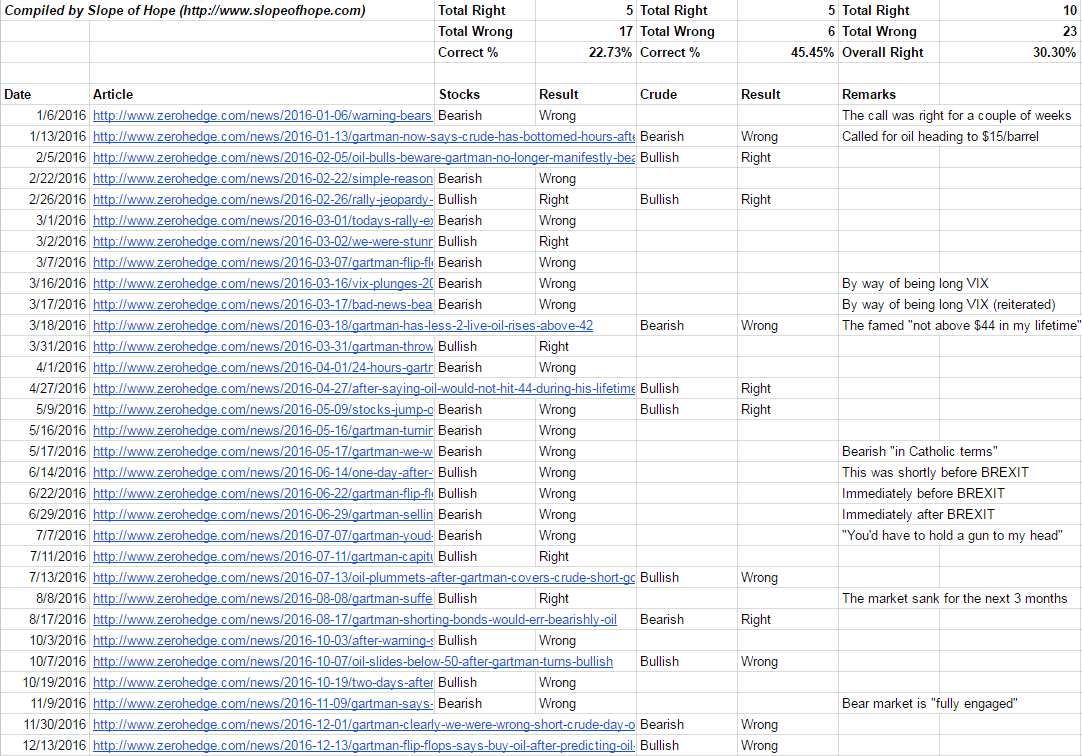

A more serious (and time-consuming) undertaking was to go through all of the Gartman-specific posts on ZH that called out concrete buy or sell recommendations from Gartman. Now "concrete" is a little tough with a man who peppers his speech with words like "gently" and "slightly" and "very very lightly", but I"ve tried my best. I can understand his reticence to make the bold declarations that he used to (e.g. "I have never been so bullish of oil") given the tomato-throwing that often ensues when he"s wrong.


Nevertheless, I have broken down all his equity buy/sell and crude oil buy/sell ideas. According to my analysis, he"s been right about 30% of the time overall, with equities (22.73% correct) being weaker than oil (45.45% correct). Well, they do call him the commodity king, right?


1216-gartman


You can access this analysis by clicking the image above or click here to see the Google Doc itself. I look forward to keeping up with the man"s declarations in 2017 and perhaps doing another analysis next December.


Monday, November 7, 2016

The Real Value of Precious Metals


Informed readers understand that the mainstream media, owned by a handful of gigantic corporations, is constantly bombarding us with propaganda, mythology, and disinformation. Some of this brainwashing is easily noted because it is very recent and/or plainly absurd. However, most of us will have absorbed large quantities of this mythology unknowingly, simply because we have been bombarded with this brainwashing (literally) every day of our lives.


One important aspect of this brainwashing is the mythology surrounding the concepts of price and value. For most people, these words are synonymous, even though they refer to two, distinct concepts. Price is the simpler of the two concepts. It merely refers to what a particular vendor or service-provider charges for their good/service.


Value is an entirely distinct concept. Value is the metric we use to compute what something is actually worth. At this point, most readers will begin to glean the difference between these two concepts. Just because a merchant charges $50 as the price for a particular good does not mean that this good has a value of $50. As consumers, we understand that it is not uncommon for merchants to over-charge for their goods, meaning that the price exceeds the value.


Conversely (although much less common) we also encounter situations where the price of a particular good is less than its actual value. Perhaps the merchant is distressed, i.e. going out of business, or is simply having a “sale” on their merchandise. In such situations where value exceeds price, we classify such transactions as “a bargain” – we obtained more purchasing power than we expected from the fiat currency in our wallets.


Now that we have clearly distinguished the concepts of price and value we can address the brainwashing. How and why have the bankers (and their media mouthpieces) managed to get most people to equate price with value, most of the time? The “how” is the easier dimension to address. In perfectly functioning free-and-open markets (something which has never existed in the real world) price does equal value.


In perfect markets, no merchant can over-charge for their products because in “perfect markets” consumers have perfect information. If one merchant charges excessively for his/her products, consumers with perfect information simply move on to a shop which prices its products fairly (i.e. price = value). Similarly, in perfect markets where merchants also have perfect information, they would never under-price their products, so once again price = value. (Note that in our “perfect markets” we assume that merchants never seek to undercut each other by discounting their goods.)


Here we see the origins of the mythology. In theory, price could/should/does equal value. The bankers and their media sycophants simply pretend that we have perfect markets – even though such markets could never exist in the real world – and thus is born the myth that price = value.


Why do the bankers consider it so important to brainwash us with this mythology? Here we have multiple motives at work. At the top of the list is market manipulation. Informed readers know that the bankers manipulate most of our markets most of the time. Indeed, the Big Banks have already been caught and/or convicted of conspiring to serially manipulate many of our most-important markets – with gold and silver markets being two of the most-obvious examples.


However, in a world where the Sheep have been brainwashed to believe that price = value, the concept of price manipulation cannot even exist. If price supposedly equals value, then no matter how high or low the price, manipulation cannot exist. Where price is assumed to equal value, any price is deemed to be a correct/legitimate price. Thus we see one, prime motive for this branch of brainwashing: to cover up the serial price/market manipulations of the One Bank.


Arguably, there is an even bigger motive for indoctrinating us with the mythology that price = value. It is found in the worthless, fiat currencies we carry in our wallets. Why is it vitally important to the One Bank that the Sheep accept the mythology that price = value with respect to our paper fiat currencies?


Very simply, if the Sheep automatically assume that price = value then those Sheep will never ponder the question “what is the actual value of this fiat currency?” The Sheep never ask this question, because they assume they already know the answer: the value of the currency is the same as its price (i.e. exchange rate). It is only in a world where the Sheep understand that price and value are separate concepts where the bankers would have to worry about those Sheep even beginning to ponder the worthlessness of these fiat currencies.


Putting this all together, we now see why price/value brainwashing has been a top priority of the One Bank, for more than a century. It is only through reinforcing this delusion that the One Bank can continue to perpetrate its serial manipulation of our markets. If we properly understood the concept of value, we would automatically see through the manipulation of most markets, because we would notice the discrepancy between price and value.


If we properly understood the concept of value, we would long ago have rejected the fraudulent fiat currencies foisted upon us by our corrupt central banks because we would immediately comprehend that these fiat currencies have no value. In a world which clearly understood the distinction between price and value, the One Bank could not continue to exist.


The constant, massive crimes it commits in manipulating our markets would become transparent. The fraud that the central banks and Big Banks perpetrate in conning us into using their worthless paper currencies would become transparent. Of all the lies which have been drilled into our minds, the mythology that price = value may be the single, most-important myth to the banking crime syndicate.


Now that we have established that there is no inherent connection between price and value, and now that we have established how/why we have been programmed with this brainwashing, we can finally address the title to this piece. What is the real value of precious metals?


It is a very simple question, yet thanks to the One Bank, it is now almost impossible to answer that question. For more than a hundred years; we have absorbed the mythology that price = value. For more than a hundred years; our markets have been constantly manipulated – perverting the relative price levels of virtually all the goods and services in our economies to historic extremes.


A century ago; answering the question “what is the value of precious metals?” would have still been an elementary proposition, because the differential between price and value had not yet been skewed to absurd extremes. For example, little more than a century ago the gold/silver price ratio was still at a rational level – approximately 20:1.


We know that number was relatively legitimate because the gold/silver price ratio is the most-established, most well-known price relationship in the history of our species: 15:1. The legitimacy of this price ratio is beyond any possible argument for two reasons. To begin with, the gold/silver price ratio (15:1) is an almost perfect match for the gold/silver supply ratio (17:1), the relative occurrence of the two elements in the Earth’s crust.


The second reason why we can be absolutely certain of the legitimacy of the historic gold/silver price ratio is that it endured for more than 4,000 years – until the One Bank began its malevolent campaign to destroy that price ratio as a first step in demonetizing silver. What is the mythology constantly fed to us by the bankers to explain/justify the ultra-fraudulent, modern gold/silver price ratio (currently around 70:1)?


Silver is no longer a monetary metal. It is now an “industrial metal.”


Pure brainwashing. In most of the world (outside the Corrupt West), silver is universally regarded as money: a store of value that most of the world’s population still uses to store (and protect) their wealth. The fact that silver also has a plethora of very important industrial applications cannot make silver less valuable. It can only make it more valuable.


The bankers’ propaganda is perverse. The fact that silver is now an “industrial metal” (while still also being money) makes silver more precious than ever, thus the historic price ratio should have shrunk to less than 15:1 rather than exploded upward to the current, ultra-fraudulent levels we have seen for an entire century.


Unfortunately, being able to price gold in relation to silver (and vice versa) helps us very little – in a world where all other prices for goods/services have also been perverted to extreme differentials versus their actual value. Given this reality, where do we even begin in attempting to determine the value of gold and silver in relation to other goods?


There is no simple way to answer this. The value of any good is supposed to be determined in accordance with its supply/demand fundamentals. However, the One Bank has severed the connection between price and fundamentals in most of our markets. In this pseudo-reality, not only does price have no connection to value, but we have been deprived of all objective reference points in determining value as a function of supply and demand.


What is the real value of precious metals? Today, this is a question which can only be answered in negative terms: the real value of gold and silver has no connection at all to the paper prices for gold and silver, and no connection at all to the paper prices for other goods.


The reaction of most readers to this elementary conclusion will be “so what?” What must be understood is that rejecting the bankers’ paper prices for all goods and all services as being fraudulent and irrelevant is an important step in changing this paradigm of fraud. It is only once we recognize that we can never estimate value of terms of the bankers’ paper prices (and the paper itself) that we reach an epiphany. We determine the real value of precious metals and the real value of all goods and services in relation to each other.


What is the real value of an ounce of gold? What is the real value of a house? What is the real value of a tennis ball? We cannot answer that question in terms of “dollars”, because our dollars have no value.


How many tennis balls can we obtain for an ounce of silver? How many ounces of gold must we spend to buy a house? Pricing hard assets in terms of other hard assets. It is only once humanity begins to ask (and answer) such questions again that we can return to a world of sanity, where price and value are at least similar, if not synonymous. It is only in such a sane world where accurate estimates of value once again become feasible.


What is the value of any good or service? We can never answer any such question as a function of dollars. We can only answer such questions as a function of real money, i.e. gold and silver.


What is the real value of precious metals today? We cannot possibly produce a rational answer to that question, in an irrational world which prices everything in terms of scraps of worthless paper. We can never estimate value as a function of something that has no value.


It is only when we completely reject the concept of “dollars” as being nothing but more banker fraud and we begin to price items of value in terms of other items of value that humanity can re-learn the concept of value – and then begin to attach rational prices to the goods and services produced by our societies.


Please email with any questions about this article or precious metals HERE