Showing posts with label Salient. Show all posts

Saturday, December 23, 2017

If Libs Were Smart They Would Push For Mueller Firing Himself Now

Authored by Tom Luongo,


The desperation of U.S. liberals to find some truth in the claims that Donald Trump’s campaign staff colluded with Russian state actors is approaching infinity. 


FBI Deputy Director Andrew McCabe’s testimony to the House Intelligence Committee all but confirms that the only ‘proof’ the FBI and Special Counsel Robert Mueller have of collusion is the discredited “Trump Dossier.”


This dossier was compiled by Christopher Steele and sold to the Clinton Campaign as opposition research by Fusion GPS.  McCabe stonewalled the HIC on this matter but couldn’t point to anything in the dossier that the FBI verified to be true other than publicly-known knowledge of Carter Page visiting Moscow in 2016.


And the last time I checked (as least for now) visiting Moscow is not a crime.


Neither is what Michael Flynn did a crime either, but let’s not bring facts in to dash the hope of the terminally insane.


McCabe has to stonewall on this issue otherwise he and the rest of the FBI are guilty of acting on behalf of Hillary Clinton to assist in spying on her political opponent.  Because that’s where all of this leads if people would take their ideological blinders off for five seconds and look at what we actually know as opposed to what we ‘just know to be true.’


Everyone involved in this sordid affair should be tried for espionage and treason.


Those prominent liberals running around protesting the mere thought of Donald Trump shutting down the Mueller investigation to ‘protect the sanctity of our elections’ are a bunch of simpering morons.


And I’m sick to death of the blatant and rank hypocrisy when it comes to election fraud in this country.


For this reason alone, the Mueller investigation should be shut down.


The Stupid Show


Look, anyone taking the rumor seriously that Donald Trump was close to shutting Mueller’s investigation down should have their head examined.  This was a blatant plant by the Washington  Post (and the CIA, let’s get real) to create exactly the kind of response from the Wil Wheatons of our world.


These people are simply ab-reacting noradrenaline junkies living in their amygdalas 24/7 while the world moves on without them.


If this isn’t the picture of someone in serious need of psychotherapy then …


In the same week we also get this little ditty by Newsweek. You don’t think these things aren’t coordinated to evoke this kind of response in ‘soy-boy’ Wheaton?


Painter, who worked under former president George W. Bush, appeared on MSNBC to discuss the widely criticized Fox News segment that suggested the FBI’s investigation into the Trump campaign could be considered a coup.


“The commander in chief is Donald Trump,” Painter said. “There is a risk of him using that power to destroy our democracy, whether you call it a coup or anything else. It’s not from the critics of Donald Trump that the danger is posed, it’s the fact that the man who is commander in chief of our military is engaged in obstruction of justice.”


The salient point here is why would Trump shut down Mueller?


Mueller has nothing on him. The longer this goes on the worse it looks for everyone involved and Trump comes out looking like the victim of a political witch-hunt.


Trump knows and has known from the beginning that there was nothing to investigate.


The only question has been whether Mueller could invent something through nigh-onto-illegal pressuring of people like Flynn, caught in the usual FBI web of procedural dishonesty, to turn on Trump and perjure themselves to avoid a prison sentence.


Trump v. Mueller


In fact, the more I think about the sequence of events, the more I think the meeting between Trump and Mueller the evening before Mueller was appointed as Special Counsel involved Trump telling Mueller, “Good luck finding anything, Bob, I’ll hang you by your own rope when this is all over.”


If I were in Trump’s position I would have done exactly that. I would have goaded Mueller into this, knowing full well that Uranium One was out there. This would have lit a fire under Mueller to cast a wide net, turn over every rock looking for any kind of dirt. Doing so would expose the whole rotten mess and Mueller looks like a guy running around investigating himself in the end.


Remember, Trump is the one that brought up Uranium One in the first place on the campaign trail.


In response, Hillary, as she always does, then accused Trump of that which she was actually guilty of – colluding with the Russians and using her position for personal gain.


The people who want to believe in Russia-Gate are missing this in their zeal to rid the world of Trump to validate their own failing world-view.


The longer this investigation goes on the more it will uncover the truth about what happened. In my mind, all the Mueller is doing now is compiling the actual case to exonerate himself over Uranium One and throw the rest of the FBI under the bus.


Given what we already know, I’d say Bob’s done a good job of this and it’s time for him to step aside and let this play out.



Monday, July 31, 2017

Bitcoin, Gold and Silver Report 30 July 2017

That’s it. It’s the final straw. One of the alternative investing newsletters had a headline that screamed, “Bitcoin Is About to Soar, But You Must Act by August 1 to Get In”. It was missing only the call to action “call 1-800-BIT-COIN now! That number again is 800 B.I.T..C.O.I.N.”


Is it about to go up? Maybe. We don’t know. And everyone should by now be skeptical of all “rocket to take off on XYZ date” claims. Between them, surely these newsletters have predicted thousands of the past zero blastoffs of gold and silver since 2011.


We have discussed bitcoin in the past, to argue that it is not money (a video here, and articles here and here). Bitcoin is not money because it is not a good. It’s just a number in a database. Money is a kind of good (genus). The most marketable kind (differentia).


Money must be a good because we are physical beings in a physical world and final payment—which is not demanded all the time, or even often—must be a physical thing that you can hold and touch in your physical hands. Bitcoin is not a physical good, so it represents, not final payment, but intermediate payment. It is not final until you trade the bitcoin for a real good. In the language of economics, a real good has utility apart from one’s hope to exchange it for something else. Bitcoin has no utility apart from this hope of its value in exchange, its price.


There is not one price but always two prices: bid and offer. When one has a thing and relies on someone else to buy it (or accept it in exchange), it is the bid price which is relevant. The offer price may be close above the bid, or it may be much higher. Typically sellers are reluctant to sell below their cost, but that has nothing to do with buyers. Buyers make a bid based on how they value it (or not).


This fact right here is sufficient to debunk the labor theory of value. Suppose producing a painting takes you 50 hours of labor plus $100 in materials. That does not matter. If your name is Banksy, people might be happy to pay tens of thousands of dollars for the painting. If your name is Keith Weiner, not so much (Keith is not known for having any skill at painting, though he can take some mean photographs).


For all commodities, for all real goods, for all tangible products, there is always a bid. Even a junk car is worth something to the scrap dealer. Even sand is worth something to the landscape contractor.


If a commodity is useful for something, it will have a robust bid. The price may be low or high, but the bid will be set by those who have a productive purpose in mind. If you can buy something, add a little bit of value from labor (e.g. cleaning it up) and sell it for $1,000 then you are willing to pay up to, say, $900.


Take copper. Copper can be used for wiring and plumbing (and many other things). If you manufacture plumbing, and you know that with a dollar worth of labor you can turn copper into a pipe that sells for $3.75, what are you willing to pay for the copper? Perhaps you would go up to $2.50 (it’s now about $2.85). If the price of copper drops, this new buyer will come into the market (for now, plumbing is made of plastic).


In this light, we now get to the 64 billion dollar question. What is the bid on bitcoin? What is it useful for, and who would buy it for that purpose?


Right now, bitcoin is a lot of fun. Its price is being driven up by frenzied speculators. With each new price level, proponents become bolder and more aggressive. Bitcoin will replace the dollar, bitcoin will go up to $1,000,000, the dollar is failing, get yours before August 1, etc. Many of these arguments were popular when the price of gold was rising relentlessly up through 2011.


But what’s the ultimate bid? Where is the floor, where it cannot go below because it’s just too profitable to buy it, transform it into a higher-value good to sell at a profit? Where is the floor where individuals will buy more and more because they want bitcoin in their living room, or in the tank of the car, or in their refrigerator, or in their basement?


It doesn’t exist, does it?


This is not a prediction for tomorrow morning. Indeed timing these things is impossible. However, there will come a point when the speculators turn. Perhaps their collective thumbs will move the planchette on the price-chart Ouija board to paint an ugly chart pattern (much uglier than head-and-shoulders). Whatever its initial cause, what will happen is clear in light of the above discussion.


The price of bitcoin could drop to any level. Incidentally, bitcoin could be used in exchange as it is now, whether its price is $0.01 or $1,000,000.


People often say that bitcoin is like gold, or even say it is “digital gold”. They are just trying to cash in on gold’s good name. The problem of the bid is another key difference between bitcoin and gold. Gold is an extremely useful commodity. Bitcoin is not any kind of commodity at all. It does not have a real bid at all, only the ever-changing bid of the fickle speculator.


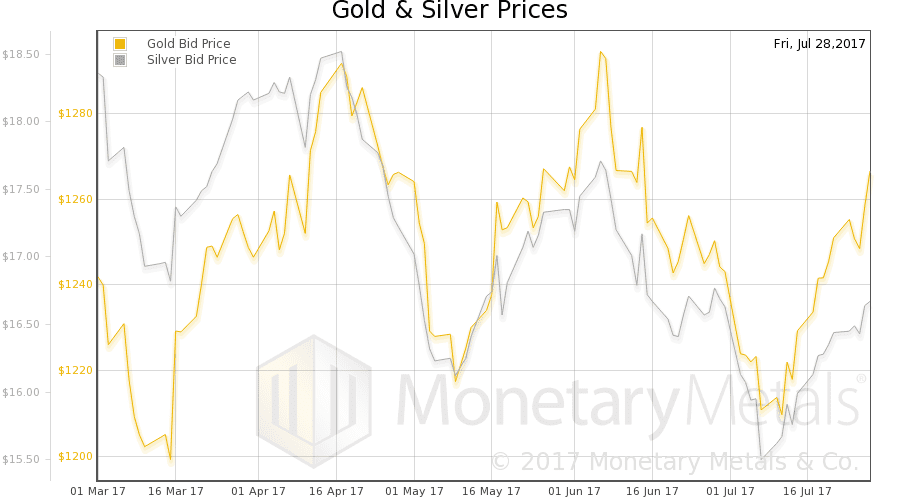
The prices of the metals rose some more this week, with gold +$13 and silver +$0.24. However, that leads to the question: is it speculators getting ahead of the fundamentals, or is it real?


Three weeks ago, with the price of gold $56 lower and the price of silver $1.15 lower than today, we asked if that was capitulation. We cited some circumstantial evidence (plus a rising scarcity of both metals as measured by the cobasis). We did not call for a moonshot, but a “normal trading bounce within the range.”


Today it is time to ask if the bounce is down, and if now is the time for a normal correction. And if it’s the same answer for both metals.


We will show graphs of the true measure of the fundamentals. But first charts of their prices and the gold-silver ratio.


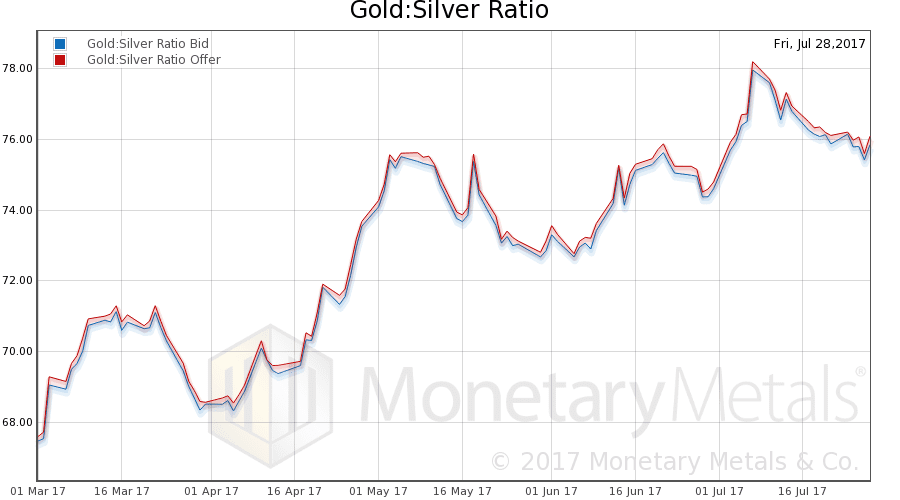
Next, this is a graph of the gold price measured in silver, otherwise known as the gold to silver ratio. The ratio moved down slightly this week. We find it interesting that the ratio did not fall farther.


In this graph, we show both bid and offer prices for the gold-silver ratio. If you were to sell gold on the bid and buy silver at the ask, that is the lower bid price. Conversely, if you sold silver on the bid and bought gold at the offer, that is the higher offer price.


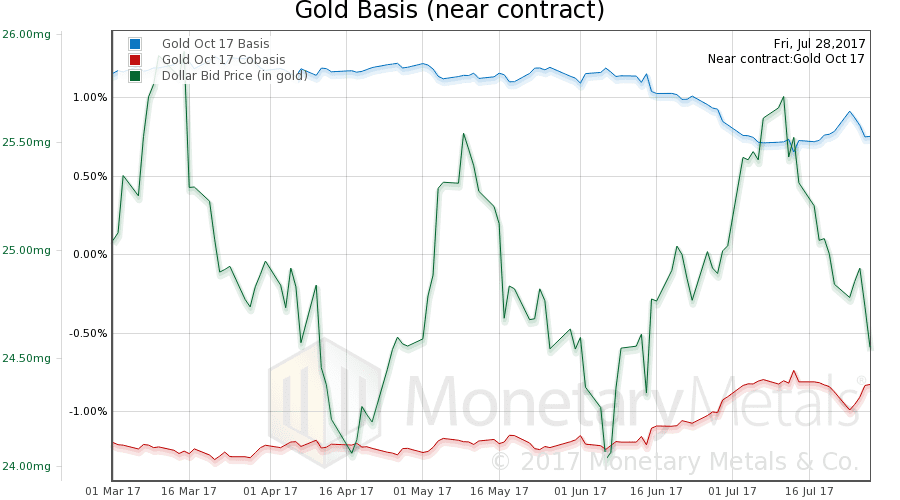
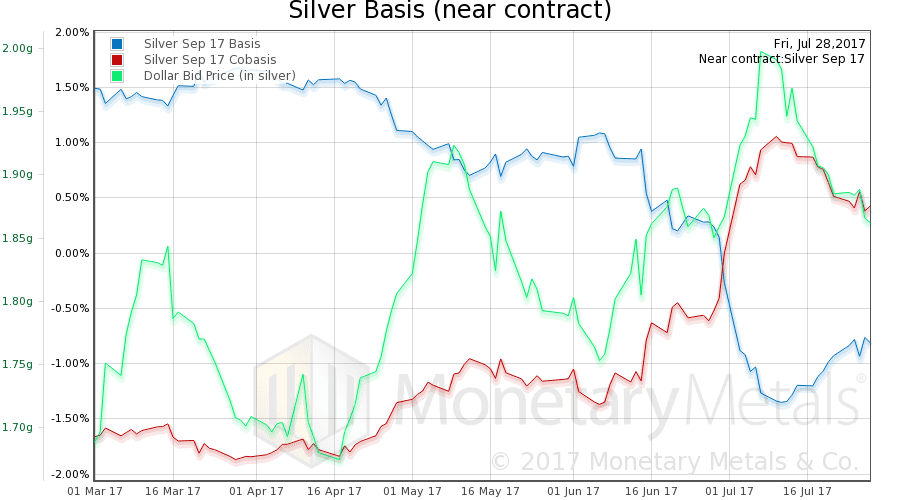
For each metal, we will look at a graph of the basis and cobasis overlaid with the price of the dollar in terms of the respective metal. It will make it easier to provide brief commentary. The dollar will be represented in green, the basis in blue and cobasis in red.


Here is the gold graph.


The dollar fell again this week (the mirror image of the rising price of gold). As the dollar fell, the cobasis increased—gold became more scarce.


Rising price + rising scarcity = rising fundamental price (fundamental price chart here).


Now let’s look at silver.


In silver, unlike in gold, as the dollar has dropped (i.e. the price of silver measured in dollars has risen), the metal has become more abundant.


Our calculated silver fundamental fell about 50 cents this week, or about 75 cents in the past few weeks. So while the price of gold may continue to rise to perhaps over $1,300 the price of silver could be a bit weaker. We calculate a fundamental gold-silver ratio of about 79 (chart here).


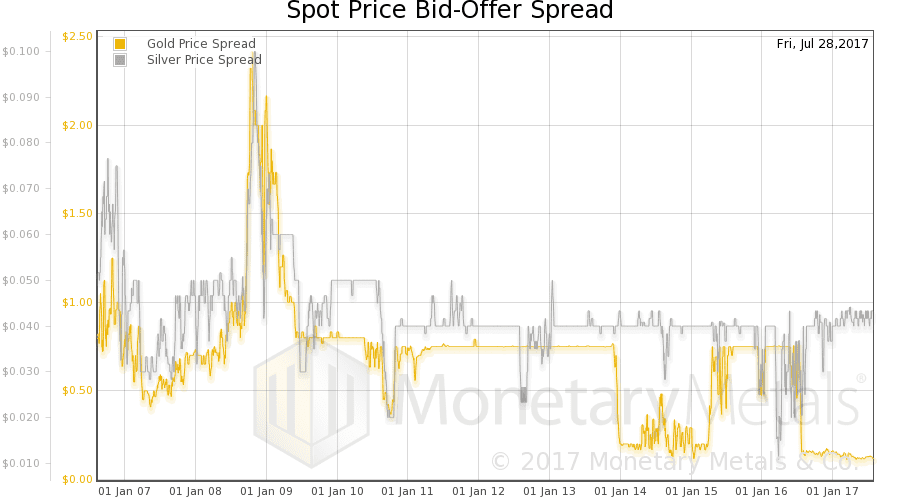
Coming back to the bid-ask spread, we thought we would publish another chart off our website. This one shows the bid-ask spread of spot gold and spot silver.


There are two salient features. First, note that the spread is really tight in both metals (though while the spread in gold dropped in mid-2016, in silver it increased). It is currently around 12 cents in gold. An ounce of gold is over $1,200 and the difference between bid and ask is $0.12 or 0.01 percent! In silver, it is around 4.2 cents, or 0.25 percent. Gold is more liquid, much more liquid.


Second, when the financial system buckled and nearly collapsed in 2008, the spreads widened to $2.40 and $0.10 in gold and silver, or 0.33 percent and 1.05% respectively. Compared to real estate in a normal market, both metals are extremely tight. Compared to illiquid assets during the peak of the crisis, it’s incredible. We recall a story of a guy who bought a famous painting by old master during the top in 2007. He paid, as we now recall, around $13 million. During the crisis, he was forced to sell it. He got $100,000. We assume the offer price on such a painting would still be $10 million or more. But $100,000 was the bid.


© 2017 Monetary Metals

Monday, April 10, 2017

Mea Culpa, Report 9 April, 2017

Dear Readers,


I owe you an apology. I made a mistake. I am writing this letter in the first person, because I made the mistake.


Let me explain what happened. I wrote software to calculate the gold basis and cobasis (and of course silver too). The app does not just calculate the near contract. It calculates the basis for many contracts out in the distance, so I can see the whole picture. I developed a model for the fundamental price, based on the basis. My software calculates this, too (spoiler alert: the reported fundamental prices were high).


I have long since debugged it. It works reliably. So reliably, that every day I pored over the results, but I no longer checked the inputs and intermediate steps of the calculation. Now, in retrospect, I realize that I should have.


The root cause is simple. For as far back as I have ever seen, the symbol for a future has been a two-letter code for the commodity + a one letter for the month and one digit for the year. For example, gold is GC. December is Z. And 2017 is 7. So the December gold contract is “GC Z7”. Silver is SI, so December silver is “SI Z7”.


I did not expect my realtime quote provider to change year codes for contracts in 2018 and beyond. No longer is it one digit for year—8 in this case. Now it requires two digits. So the December 2018 gold contract is “GC Z18”. Even now that I have looked, I do not find any announcement of this change. I am not even sure it is an official COMEX change, or just a quirk of one quote provider.


This error was compounded because my software was not programmed to notify me of a problem. In software, the only thing worse than a failure in a system that is used in production is a silent failure that goes unnoticed, and hence goes uncorrected. This failure was unnoticed.


Before I get to the impact, I want to discuss how we will make sure this does not happen again.


My team and I have been working hard on a new website, and the centerpiece will be our ongoing data science work in the precious metals markets. We will publish about 45 graphs, with daily updates. Obviously, this is driven by a much more sophisticated software system than my humble application.


The new software is developed by one of the best coders in the world (not me, I’m rusty after not coding full-time in almost 15 years). Rudy Mathieu worked for my last company, a software company called DiamondWare.


Rudy has built a hardened, enterprise-grade software system (now undergoing extensive testing), and when it encounters an error, it does not fail silently. It is constantly checking the status of all key components, and has a dashboard so we can monitor how the software and the server running it are doing. It emails us if anything goes wrong. It will instantly detect problems, such as a change in the year code or even the Spanish Inquisition, which nobody expects (sorry, just a bit of humor).


For years, I have been publishing a unique view into the markets. Our new site takes it a thousand times further. I expect that it will become an essential tool for anyone who uses or trades gold. We need to ensure it is as reliable as clockwork.


I promise to make it so.


Back to the question: what was the net effect? My software was not able to calculate a basis for gold or silver contracts maturing in 2018 or beyond. However, my fundamental price model relies on them. Its accuracy began to suffer starting around last August. This error continued to grow in magnitude. As of last week’s Report, the fundamental price of gold was overstated by about $175, and silver’s fundamental by $2.30.


The correct fundamental prices as of Friday March 31 were about $1,260 and $16.70.


Interestingly—and this is important—the gold-silver ratio fundamental was robust to this error. The value stated in last week’s report, 75.75, was almost perfect. It was off from the revised estimated fundamentals by 0.2. I say revised and estimated, because I went back over the time period where I have incomplete data and derived what I need. The result is good enough for horeshoes and hand grenades, as we say in America (but it has higher uncertainty).


There is a bigger lesson here. Monetary Metals focuses on the ratio (which we trade in our fund), because it is less error-prone, more accurate, and less risky than trading either metal against the dollar.


OK… The bottom line is that on March 31, the corrected gold fundamental was above the market price, though not nearly so far above as I had reported it. It was about 1.4% over the market price (I reported 15.6% last week).


As an aside, my friend Pater Tenebrarum at Acting Man blog wrote about the disparity between the fundamental drivers that he monitors, and the fundamentals I reported. He is right in thinking that demand for physical is not going ballistic yet.


Though as you will see in the graphs below, the fundamental price has indeed been rising since mid to late December (as I have been correctly reporting), from a low of around $1,115 to $1261 at the end of March.


The correct silver fundamental price is below the market price. My commentary actually stands up pretty well, in light of the correct data. Even while I erroneously reported a silver fundamental running up to about $19, I have not been enthusiastic about silver. I haven’t “trusted” it enough to encourage a big silver trade, nor called for a major price move. I think there were two reasons.


One, obviously, the nearer-term contracts which I monitor are accurate. They did not show the kind of moves I would expect to see if the market for physical metal was getting so tight. The error only occurred for contracts in 2018. Two, the fundamental gold-silver ratio was correctly calling for a higher market ratio.


Below, I include graphs of the fundamental prices for both metals. The correct values will be overlaid with the ones I have been calculating. So you can see where it went off the rails, and by how far it deviated.


There is one last thing, which I am reluctant to discuss now, before we are ready to launch. Yet it is germane.


Monetary Metals has licensed market data from Thomson Reuters. When the new charts go live, they will be based solely on this data. This data is of better quality than the data from the realtime quote provider I have been using. And we have developed some very sophisticated algorithms that allows us to extract the maximum signal with the least noise, far superior to what my little app does with the data from my current provider.


The new basis and fundamental prices will not line up perfectly with the old data series. One reason is that the bid-ask spread is tighter. By the nature of the math to calculate the basis, tighter spread means a higher basis and higher cobasis.


That said, I am confident of two things. One, the new data is more accurate. And two, the old data set has served well in showing the big picture (notwithstanding the error I corrected this week).


We will look at the only true picture of supply and demand in the gold and silver markets. But first, the price and ratio charts.


The Prices of Gold and Silver


Next, this is a graph of the gold price measured in silver, otherwise known as the gold to silver ratio. Last week, we asked if the downward-moving gold-silver ratio had hit a line of support. It seems it did, as it moved up sharply on Friday.


The Ratio of the Gold Price to the Silver Price


For each metal, we will look at a graph of the basis and cobasis overlaid with the price of the dollar in terms of the respective metal. It will make it easier to provide brief commentary. The dollar will be represented in green, the basis in blue and cobasis in red.


Here is the gold graph.


The Gold Basis and Cobasis and the Dollar Price


Not much change in the scarcity of gold (i.e. the red line, the cobasis) while the price moved up slightly. Our calculated fundamental price is up $30, to about $1,290.


Let’s take a look at two graphs. Both show enough time to see where the error began to creep in, and where it ends. They are May 3, 2016 through March 31, 2017.


The first is the continuous gold basis, with the erroneous line overlaid with the corrected. As you can see, the erroneous basis was lower (indicating, falsely, lower abundance) and the erroneous cobasis was higher (indicated higher scarcity).


The Reported and Corrected Gold Basis and Cobasis


The second is the market price of gold, overlaid with the erroneous and corrected fundamental prices.


The Reported and Corrected Gold Fundamental Prices


The erroneous one takes off for the stars. The corrected value is much closer to the market price, though a bit above.


Now let’s look at silver.


The Silver Basis and Cobasis and the Dollar Price


We switched from the May to the July contract, as the May contract is in the process of being rolled (where traders must close positions in May and if they want to keep their positions, open a July or farther-out contract).


There is a small decrease in the basis and increase in cobasis, along with a falling price this week. And our fundamental price is up 14 cents, to just under $16.85. Yes, alas, that is more than a buck under the market.


Here are the same extra two graphs for silver.


The Reported and Corrected Silver Basis and Cobasis


The Reported and Corrected Silver Fundamental Prices


You can see here that there are two salient features. One, the fundamental has been rising for about a month longer than gold, though from a much more volatile bottom ($12.39). Two, the fundamental is way below the market price.


© 2017 Monetary Metals

Saturday, March 25, 2017

The Useful And The Useless

Authored by Robert Gore via Straight Line Logic blog,


The battle lines are forming.


You’re standing on the prow of an ocean liner cutting through the icy waters of the North Atlantic. A huge iceberg looms dead ahead. You’ve seen it for some time, but now it’s too close, and the liner too big and fast, to avoid the collision. You quietly make your way to the lifeboats, knowing they’re the only chance for saving yourself and your loved ones. Below decks, an orchestra plays a waltz and oblivious revelers dance.


Most people don’t foresee the world’s inevitable collision with the iceberg of unsustainable fantasy. When it happens, they’ll respond predictably, with panic and cowardice. Those who’ve seen it coming and moved to the lifeboats will experience their own roiling emotions, attenuated by recognition of the logic behind the disaster. While the forewarned have dreaded impact, many will also welcome it, in the way one welcomes an unpleasant medical procedure: let’s get it over with. The motive is not malice, but conviction born of experience that actions have consequences and there’s no escaping them. After seemingly inexplicable and interminable delay, consequences shall arrive, amplified by the tawdry stratagems that promoted delay.


It will come as a surprise to many, but governments cannot suspend reality. Their arsenal, when things break down, comes down to their arsenal: the capacity to coerce. Violence or its threat enables governments to exact compliance. Proponents of government power invariably see themselves exercising it. Once the ship hits the iceberg, it will be obvious that governments’ guns are not wands, freeing citizens from the necessity of producing as much or more than they consume. They cannot compel innovators to innovate or producers to produce. While coercive power comes from one end of a gun, none of the powers that produce progress (and the gun) magically materialize at the other end.


It is said that America is a society divided. True enough, but the important question is: along what lines? Crisis and social breakdown will provide clarification: it’s governments and their beneficiaries versus producers. In other words, those who don’t do useful things versus those who do.


Huge shifts in social mood and direction are presaged. President Trump’s election presages the coming division. Among the analyses of the election, few noted an obvious dividing line. Trump’s supporters by and large do useful things, or are angry because they’re prevented from doing useful things. They build, engineer, manufacture, plant, grow, operate, maintain, repair, transport, and sell the things we find useful or essential. When we ram the iceberg, their skills, brains, and adaptability will be sorely needed.


Politicians and bureaucrats and the millions dependent on them for their fake jobs, income, food, shelter, transportation, and medical care will find little demand for their skills, such as they are. The useful may well conclude that keeping them alive is more trouble than it’s worth. There will be those who are too young, old, or infirm to produce, but whom the useful will support out of friendship or kinship. However, it would be surprising if they felt anything but contempt for the faceless hordes demanding that someone, anyone, take care of them.


Take away the undeserved from the undeserving and you get a tantrum. Steal the earned from those who earned it and you get righteous rage. One’s a firecracker, the other a volcano. The game has been to impress upon the useful a moral obligation to support the useless, but the volcano’s about to blow, burying that obscene morality in lava and ash. Given the staggering levels of accumulated debt and promises, the useful know their talents, skills, hard work, productivity and futures have been mortgaged for the useless. This is the salient and intractable social division. No reconciliation is possible between the useful and those who believe themselves entitled to their enslavement. The Trump fissure will become a yawning chasm when the Good Ship Profligate Government collides with the iceberg.


Centralization serves the needs of government and its dependents. Honest production and exchange require little government, perhaps none at all. Those who believe current arrangements should persist have to believe that the useful who support those arrangements will provide more and more while receiving less and less. The implicit premise has to be that when it all finally breaks down, the useful can be brutally subjugated—but kept producing—while receiving nothing more than their subsistence. Slavery cannot support the police state necessary to impose it, much less a modern economy. Those who believe any outcomes other than destruction and death are possible are delusional. If those are the outcomes they anticipate and desire, they’re homicidally and suicidally psychopathic.


Governments will have their surveillance apparatuses, police, militaries, prisons, torture chambers, concentration camps, killing fields, and the like. The useful will have their minds. Totalitarian accounting is daunting. All that money going out for suppression, so little coming in from a populace whose best and brightest have been imprisoned or murdered, or who produce the minimum necessary to survive. The day comes when the policeman, soldiers, and guards can’t be paid with anything of value and all hell breaks loose. Or, less colloquially, centralization gives way to decentralization.


To what depths governments will descend and how long they will survive as agents of repression is unknowable, but their dissolution is foreordained. They cannot commandeer the resources necessary to sustain the current level of tyranny. The useful will vote with their feet and if that’s not possible, bullets will be their ballots. They will establish enclaves and protect themselves from the tantrums, chaos, and depredations of the useless. (Useful in such a context may require nothing more than a willingness to work hard.) The useless depend on the useful, who of course don’t need them at all. The useful will eventually triumph, if the species survives (not a sure thing). Tragically, the butcher’s bill is likely to be exorbitant.

Monday, March 6, 2017

"The European 'Story' Is Broken"

Via Ben Hunt of Salient Partners" Epsilon Theory blog,


George Soros has a great line, one that I’ve stolen many times: “I’m not predicting. I’m observing.” We really don’t have a crystal ball, and it really is a dumb idea to pretend that we do. But what’s not dumb is to keep your eyes and ears open, observing both what the world is telling you (playing the cards) and what other market participants are telling you (playing the players), and reacting accordingly. That’s the heart of tactical investing.


What I’m observing today is that the European *story* is broken. I’m not saying that real world European companies are broken or that real world European economies are broken. In both cases, a few are but most aren’t. What I’m saying is that the buy-Europe!™ story that has been pitched by the sell-side ad nauseam for the past six months is broken and that these stocks are defenseless against the steady stream of anti-Europe political news we are going to endure for the next eight weeks.


Here’s the S&P 500 Index (“SPX”) in black, German DAX Index (“DAX”) in green, and Stoxx 600 Index in red over the past six months:


Source: Bloomberg, as of 02/26/17. For illustrative purposes only. Past performance is not indicative of how the index will perform in the future. The index reflects the reinvestment of dividends and income and does not reflect deductions for fees, expenses or taxes. The indices are unmanaged and are not available for direct investment.


Yes, the DAX has outperformed the SPX over the past six months. Why? Because every sell-side strategist and his cousin has been pounding the table that Europe is recovering and Europe is cheap and why worry about all those elections, anyway, because even if Le Pen wins it’ll just be like Brexit and everything will be fine.


The truth is I don’t know whether or not Le Pen will win in France this May. I don’t have a crystal ball. But what I do know is that nothing is happening between now and those elections that makes it less than a 50/50 coin toss whether Le Pen wins. There’s going to be a steady stream of negative press about all of the candidates from now until then, the difference being that core Le Pen supporters, like core Trump supporters, don’t care about the negative press. There is no story that could make these stocks go UP, but there will be plenty of stories that can make these stocks go DOWN.


And yes, I know that for “patient, long-term investors” and all the Warren Buffett wannabes out there, what happens over the next eight weeks doesn’t matter a bit, and if European stocks go down it just means that they’re even more “on sale”. But what I also know is that whenever I read a sell-side note talking about why something is a buy *today* for “patient, long-term investors”, that’s typically a signal to start shorting whatever they’re pitching. What I also know is that it’s a lot easier to be Warren Buffett when you’ve got $100 BILLION in more-or-less permanent capital from your insurance float. Good for him. Ain’t my situation. I’m guessing it isn’t yours, either.


But the risk here isn’t just a temporary blip on the European horizon. Here’s a picture of 2-yr French bond yields to 2-yr German bond yields (yellow), 2-yr Italian bond yields to Germany (red), and 2-yr Spanish bond yields to Germany (green) over the past six months. If you lived through the summer of 2011, this chart should give you a shiver.


Source: Bloomberg, as of 02/26/17. For illustrative purposes only. Past performance does not guarantee future results.


This is telling you that bond markets are starting to get really nervous about Europe and the stability of the Euro system, and the time frame of their nervousness is over the next two years. Could all this blow over if we get a market-friendly political result in May? Absolutely. And if that happens, maybe I’ll buy Europe THEN. 


But until then, I’ll listen to what the bond market is telling me over whatever Goldman Sachs and Morgan Stanley and the rest of our sell-side friends is pitching me. I’m not predicting. I’m observing.

Friday, October 28, 2016

Volcker the Vulture Points to U.S. ‘Debt Problem’


Paul Volcker has coasted through his life being revered by most pundits. However, previous commentaries have not been so kind in evaluating this infamous central banker. Volcker recently penned a piece for the New York Times titled “Ignoring the Debt Problem”. In writing this piece; Volcker has demonstrated at the
least that he is severely irony-impaired. At worst, Volcker has shown the world that he is a shameless hypocrite. As an aside, he is also apparently incapable of performing simple arithmetic.


Insults, invective and pandering have been poor substitutes for serious debate about the direction in which this country is going — or should be going. And a sound and sustainable fiscal structure is a key ingredient of any viable economic policy


Yes, this country can handle the nearly $600 billion federal deficit estimated for 2016. But the deficit has grown sharply this year, and will keep the national debt at about 75 percent of the gross domestic product, a ratio not seen since 1950, after the budget ballooned during World War II.


The picture Volcker paints is relatively clear. The infantile politicians of the U.S.’s Two-Party Dictatorship spend their time engaging in pointless grandstanding and/or juvenile mud-slinging at their supposed opponents rather than focusing on prudent fiscal management of the nation. Meanwhile, the United States is developing a severe debt problem. Unfortunately, Volcker’s self-serving description of the state of the U.S. economy and the (lack of) fiscal responsibility of the U.S. government bears little resemblance to the real world.


The U.S. national debt is about 75% of GDP? What year was that, Paul?


Anyone capable of Googling the U.S. “debt clock” will already know that the current, U.S. national mega-debt totals $19.7 trillion – and is rising rapidly. U.S. GDP for 2015 was reported at just under $18 trillion. Even if we back up the U.S. debt clock to the beginning of this year, we see that the U.S. debt-to-GDP ratio is well over 100%, and has been at that level for many years.


However, for those living in the real world, even a debt-to-GDP ratio for the U.S. of slightly more than 100% is a ridiculous understatement. U.S. GDP is systematically padded with more than $2 trillion/year of imaginary economic activity, thus real U.S. GDP is at an annual level somewhere below $16 trillion.


Then we have the U.S. “national debt”. The only U.S. statistical measurements which have been more heavily and systematically falsified than this number are U.S. inflation and job-creation mythology. To begin with, several $trillions of this debt have been fraudulently altered into “liabilities” instead of official debt, in order to pretend that the U.S.’s national debt is much lower than it is in reality.


This budget-fraud has been accomplished primarily via the U.S. government ransacking what it calls its government “trust funds”. Normally, a trust fund is a sacrosanct pool of wealth, with a legal firewall which prevents any encroachment on those funds. With the U.S. government, it treats its so-called trust funds the same way that a child treats his/her piggy-bank: it raids the funds any/every time it’s looking for some spending money.


This accounting fraud is illegal. If the U.S.’s suit-stuffers in Congress ever attempted such accounting chicanery in the real world, they would be immediately prosecuted for fraud. Beyond this, the U.S. government is carrying somewhere in the vicinity of $200 TRILLION in unfunded liabilities. In the real world, corporations are also required to account for their liabilities on their balance sheets. In the fantasy-world of the U.S. government, this $200 trillion is completely ignored in calculating its fiscal status.


The real U.S. debt-to-GDP ratio is somewhere around 150% (even without the $200 trillion in unfunded liabilities), making the United States one of the Western world’s worst deadbeat debtors. The U.S. is well past merely having a “debt problem”, it is hopelessly insolvent. However, let’s put aside the phony numbers on U.S. GDP and the fraudulent numbers on U.S. debt. The real, salient point here as Paul Volcker accuses American politicians of ignoring the U.S.’s obvious insolvency is that Volcker himself was the original architect of that insolvency.


Volcker continues spewing fiction:


Our current debt may be manageable at a time of unprecedentedly low interest rates. But if we let our debt grow, and interest rates normalize, the interest burden alone would choke our budget and squeeze out other essential spending. There would be no room for the infrastructure programs and the defense rebuilding that today have wide support.


Manageable? What Volcker conveniently leaves out of his fairy-tale is that there is no one buying any of the fraud-bonds of Western governments except other Western governments – a daisy-chain of debt. It’s only through conjuring near-infinite quantities of (worthless) funny-money to buy each other’s bonds that these deadbeat regimes are paying the lowest interest rates in history at a time of mass insolvency. See what sort of interest rate your banker offers you, when you’re so broke you have to borrow money to pay the interest on your debts.


If Western interest rates were normalized today, virtually every Western government would be bankrupt within a year. Here it must be understood that “normal” interest rates for regimes which are carrying the highest debts in history mean interest rates which are above average, not far, far, far below average.


To suggest that essential spending would be “squeezed out” by normalized interest rates is absurd understatement. Normal interest rates would mean at least a quintupling of U.S. interest payments, to more than $1 trillion per year (and rising). As for infrastructure, there is hardly any (non-military) infrastructure being built in the West today – even with our fraudulent interest rates. Only the Western war machines remain fully funded.


Laughably, Volcker is celebrated as the central banker who supposedly vanquished inflation. Anyone comparing consumer prices in the 1980’s with consumer prices today knows that Volcker never accomplished anything more than a brief pause in the inflation rate -- inflation created by central bank money-printing from people such as himself.


The Volcker policy which briefly blunted inflation was the most-draconian interest rate policy ever seen in the modern history of the global economy. Volcker drove up the U.S. benchmark interest rate as high as 20%, with interest rates around the world driven to similar levels. While Volcker was driving up interest rates to several multiples of the norm, he was simultaneously doing something else: driving up interest payments on sovereign debts, all over the world.


Paul Volcker is the Father of Global Insolvency. This one economic criminal did more to drown the world in debt than every other central banker he preceded. During the “Reagan era” (i.e. the Volcker era), the U.S. national debt tripled – in a mere eight years. However, this is only the tip of the iceberg in terms of Volcker’s economic crimes against humanity.


Retrospectively, Volcker now claims personal credit for being the single figure most responsible for assassinating the gold standard. Among the virtues of the gold standard is that it made it impossible for central banks to engage in the sort of reckless money-printing which is now standard across the Western world. It also made it impossible for governments to run large operating deficits, since the gold standard enforces a balance of payments.


It is these attributes of the gold standard which caused gold-hater, John Keynes, to derisively christen the gold standard “the Golden Handcuffs”. According to Keynes, the two greatest virtues of the gold standard are supposedly its two greatest flaws. We thus have the following chronology. Paul Volcker drowned the world in debt as a response to Paul Volcker drowning the world in inflation – the near-instantaneous consequence of Paul Volcker abolishing the gold standard.


Volcker the Vulture now sheds crocodile tears over U.S. indebtedness. Totally absent from his Revisionist fiction is that no one is more responsible for the current fiscal status of the U.S. economy than Volcker himself.


Seeing Paul Volcker “warn” the U.S. government about debt is much like seeing his successor, Alan Greenspan warning people about asset bubbles. Both of these former central bankers are shameless hypocrites, warning us about sins for which they were the worst perpetrators. The global economy was solvent before Paul Volcker. It has never been the same since.


Please email with any questions about this article or precious metals HERE