Showing posts with label Journalism. Show all posts

Sunday, December 3, 2017

ABC "Clarification" Upgraded To "Serious Error" - Reporter Brian Ross Suspended

Having suffered a massive backlash from their attempt to downplay a fraudulent story with a "clarification," ABC News has upgraded their contrition to a "serious error" and suspended the veteran reporter Brian Ross who wrote the story.


As a reminder, citing a single anonymous source, Ross told viewers during an ABC special report on Friday morning that Flynn was prepared to testify that Donald Trump, as a candidate for president, told him to contact Russians.


The left erupted in excitement...


But then, during Friday"s edition of "World News Tonight," Ross corrected his report, telling viewers that the source who had provided the initial information for his story later told him that it was as president-elect, not as a candidate, that Trump asked Flynn to contact Russians.


The rest of the world then erupted over such an egregious error that confirmed every emotions-over-intelligence "fake media" shot that Trump has ever sent.


The initial "clarification" has been upgraded to a "serious error" as ABC attempts to put this fire out.


ABC News statement:


We deeply regret and apologize for the serious error we made yesterday.


The reporting conveyed by Brian Ross during the special report had not been fully vetted through our editorial standards process.


As a result of our continued reporting over the next several hours ultimately we determined the information was wrong and we corrected the mistake on air and online.


It is vital we get the story right and retain the trust we have built with our audience –- these are our core principles.


We fell far short of that yesterday.


Effective immediately, Brian Ross will be suspended for four weeks without pay.


While it might be nice for Ross to have a month off over the Christmas holidays, many are asking for refunds in their brokerage accounts from the market"s reaction to his "serious error."


Tuesday, October 17, 2017

Car-Bomb Kills "One-Woman WikiLeaks" Who Led The Panama Papers Revelations

Meet Daphne Caruana Galizia, the journalist who led the Panama Papers investigation into corruption in Malta.


A blogger whose posts often attracted more readers than the combined circulation of the country’s newspapers, Caruana Galizia was recently described by Politico as a “one-woman WikiLeaks”.


To John Dalli, a former European commissioner whom she helped bring down in a tobacco lobbying scandal, Galizia is “a terrorist.”


To opposition MPs, she’s a political force of nature, one who fortunately has her guns aimed at the other side of the aisle.


“She single-handedly brought the government to the verge of collapse,” says one MP. “The lady has balls,” says another.


Galizia’s mantra was simple: blog relentlessly about the “cronyism that is accepted as something normal here. I can’t bear to see people like that rewarded.”


Her blogs were a thorn in the side of both the establishment and underworld figures that hold sway in Europe’s smallest member state.


Well, sadly, all that is over now, as Galizia was killed today when her car, a Peugeot 108, was destroyed by a powerful explosive device which blew the car into several pieces and threw the debris into a nearby field.


As The Guardian reports, her most recent revelations pointed the finger at Malta’s prime minister, Joseph Muscat, and two of his closest aides, connecting offshore companies linked to the three men with the sale of Maltese passports and payments from the government of Azerbaijan.


No group or individual has come forward to claim responsibility for the attack.


Malta’s president, Marie-Louise Coleiro Preca, called for calm.


“In these moments, when the country is shocked by such a vicious attack, I call on everyone to measure their words, to not pass judgment and to show solidarity,” she said.


“Everyone knows Ms Caruana Galizia was a harsh critic of mine,” Muscat at a hastily convened press conference, “both politically and personally, but nobody can justify this barbaric act in any way”.


The Nationalist party leader, Adrian Delia – himself the subject of negative stories by Caruana Galizia – claimed the killing was linked to her reporting.


“A political murder took place today,” Delia said in a statement.


“What happened today is not an ordinary killing. It is a consequence of the total collapse of the rule of law which has been going on for the past four years.”


Responding to news of the attack, the German MEP Sven Giegold, a leading figure in the parliament’s Panama Papers inquiry, said he was “shocked and saddened”.


“It is too early to know the cause of the explosion but we expect to see a thorough investigation,” said Giegold.


“Such incidents bring to mind Putin’s Russia, not the European Union. There can be absolutely no tolerance for violence against the press and violations of the freedom of expression in the European Union.


It doews make one wonder just what is happening in Europe, as Greece"s former finance minister tweeted...


Interesintgly, Muscat announced in parliament that FBI officers were on their way to Malta to assist with the investigation, following his request for outside help from the US government.


Caruana Galizia was 53 and leaves a husband and three sons.

Tuesday, September 12, 2017

The Government Begins Censorship Of Media Through Disingenuous Means


censorship2


The death of free speech is imminent.  Anyone with access to a computer and the internet can see that the United States mainstream media is nothing more than a propaganda machine designed to brainwash the masses into a lemming-like agreement with the government.


And now, it’s oh-so-ironic that the same government that tells the media what to report on in order brainwash the public is seeking to quiet those who disagree and label them as “propaganda.”  Some may call it fake news, others just want a different opinion rather than the left-leaning media hysteria we are accustomed to.  But now, media outlet RT (Russia Today), founded in Russia will have to register with the United States as “foreign media;” which will forever give it the inaccurate title of “propaganda.”


This doesn’t apply to merely the Russian version of the news outlet, but the American-run and operated site as well. According to The Hill, in a report on Monday, RT did not name the company that the Department of Justice (DOJ) has compelled to file paperwork under the Foreign Agents Registration Act, but blasted the edict as overreaching.


“The war the US establishment wages with our journalists is dedicated to all the starry-eyed idealists who still believe in freedom of speech. Those who invented it, have buried it,” Margarita Simonyan, RT’s editor-in-chief, said about the registration.


Media organizations have been exempted from the law, which is wide-ranging in its disclosure requirements and generally applies to political consultants and those working in lobbying or public relations. It would be a felony if RT is found to have willfully failed to register as a foreign agent, however. The registration would not stop the organization from operating, but requires regularly submitted paperwork that lists its sources of foreign government-tied revenue and the contacts it makes in the United States, and it would require any reporting to be labeled as being influenced or financed by the Russian government. –The Hill


RT has also contracted with Julian Assange, who runs WikiLeaks and is suspected of leaking internal emails from the Democratic National Committee, so the fact that they are being singled out with attempts to silence their reporting is not a big surprise to anyone with functioning neurons.


RT must be a threat to the political elites and the establishment, or they would be left alone while outlets like CNN brainwash and lie for profit to prop up the wealthy and powerful politicians they will stop at nothing to protect.


Click here to subscribe: Join over one million monthly readers and receive breaking news, strategies, ideas and commentary.

Gas Masks, Filters, Body Suits, Anti Radiation Pills

Please Spread The Word And Share This Post


Author: Mac Slavo
Views: Read by 257 people
Date: September 12th, 2017
Website: www.SHTFplan.com


Copyright Information: Copyright SHTFplan and Mac Slavo. This content may be freely reproduced in full or in part in digital form with full attribution to the author and a link to www.shtfplan.com. Please contact us for permission to reproduce this content in other media formats.


Thursday, August 3, 2017

Seymour Hersh: "RussiaGate Is A CIA-Planted Lie, Revenge Against Trump"

During the latter portion of a phone-call by investigative journalist, Seymour Hersh, Hersh has now presented “a narrative [from his investigation] of how that whole fucking thing began,” including who actually is behind the ‘RussiaGate’ lies, and why they are spreading these lies.

In a youtube video upload-dated August 1st, he reveals from his inside FBI and Washington DC Police Department sources — now, long before the Justice Department’s Special Counsel Robert Mueller will be presenting his official ‘findings’ to the nation — that the charges that Russia had anything to do with the leaks from the DNC and Hillary Clinton’s campaign to Wikileaks, that those charges spread by the press, were a CIA-planted lie, and that what Wikileaks had gotten was only leaks (including at least from the murdered DNC-staffer Seth Rich), and were not from any outsider (including ’the Russians’), but that Rich didn’t get killed for that, but was instead shot in the back during a brutal robbery, which occurred in the high-crime DC neighborhood where he lived. Here is the video... 

... and here is the transcript :


About the kid, I’ll tell you what I know. What I know comes off an FBI report. Don’t ask me how. You can figure it out, I’ve been around a long time. The kid, just, I don’t think he was murdered, I, I don’t think he was murdered because of what he knew. The kids a nice boy, 27, he was not IT expert, but he learned stuff. He was a data programmer, but he learned stuff. And so he’s living on one street, someone, in my eyes,- he’s living in a ruff neighborhood and in the exact where he’d been living, as I’m sure you know, there have been about 8 or 9 or 10 violent, uh not robberies, most of them with somebody brandishing a gun and it’s the kids hands, I’m telling you look, I’m sure you know what, his hands are marked up, the cops concluded he fought off the people, tried to run they shot him twice in the back with a 22 small caliper. And then, they, the kids that did it ran, they got scared, they didn’t take his wallet.


Ok. So what the cops do is this: And this is where nobody knows, what I’m telling you, and maybe you know something about it. When you have a death like that DC cops, if you’re dead, you don’t just generally go yep I know (unintelligible) you have to get in to the kids apartment and see what you can find. If he’s dead you don’t need a warrant but most cops get a warrant because they don’t know if they’ve guys has, has a, a roommate. You need a warrant. So they get a warrant. I’m just telling you, there is such a thing. They go in the house and they can’t do much with this computer. It’s (unintelligible) the cops don’t know much about it. So the DC cops they have a cyber unit in DC and they’re more sophisticated. They come and look at it. The idea is maybe he’s a series of exchanges with somebody who says I’m going to kill you motherfucker over a girl or… and they can’t get in. The cyber guys do a little better but they can’t make sense of it so they call the, they call the FBI cyber unit, the DC unit.


The Washington field office is a hot shit unit. The guy running the Washington field office he’s like, he’s like, you know, he’s like a three star at an army base he’s already looking for four, you know what I mean? He’s gonna go in a top job. There’s a cyber unit there that’s excellent, given. What you get in a warrant is, the public information you get in a warrant doesn’t include, uh, it does not include the affidavit underlying what, why you are you going in, what the reasons are that.. That’s almost never available, um, I, I can tell you that the existence of a warrant is a public document 99% of the time. So, um, on the same warrant, they call in the feds. The feds get through, and this is what they find. This is according to the FBI report. What they find is he makes cont- first of all this is what you have to know, you have to know some basic facts, one of the basic factors, in that there’s no DNC or Podesta emails that exist beyond May 22nd. May 21st, May 22nd is the last email from either one of those groups. And so what the reports says is that sometime in late spring, we’re talking June you know summers in June 21st, late spring would be after, I presume, I don’t know, I’d just say late spring, early summer and he makes contact with Wikileaks. That’s in his computer and he makes contact.


Now, I have to be careful because I, I’ve know, I, met Julian 10 or 12 years (ago?) I stay the fuck away from people like that, you know. He’s invited me, and when I’m in London I always get a message “Come see me at the Ecuadorian” but I say fuck no I’m not going there I’ve got enough trouble without getting photographed. And he’s under total surveillance by everybody but anyways. So, they found what he’d done. He had submitted a series of documents, of emails. Some juicy emails from the DNC, and you know, by the way all this shit about the DNC, um, you know, whether it was hacked or wasn’t hacked, whatever happened, the democrats themselves wrote this shit, you know what I mean? All I know is that he (Seth) offered a sample, an extensive sample, you know I’m sure dozens of email and said “I want money”. Then later Wikileaks did get the password, he had a Dropbox, a protected Dropbox, which isn’t hard to do, I mean you don’t have to be a wizard IT, you know, he was certainly not a dumb kid. They got access to the Dropbox. He also, and this is also in the FBI report, he also let people know, with whom he was dealing, and I don’t know how he dealt, I’ll tell you about Wikileaks in a second. I don’t know how he dealt with the Wikileaks and the mechanism but he also, the word was passed according to the NSA report, “I’ve also shared this box with a couple of friends so if anything happens to me it’s not going to solve your problem”. Ok. I don’t know what that means.


I don’t know whether you- Anyways, Wikileaks got access, and before he was killed- I can tell you right now Brennan is an asshole. Uh, I’ve known all these people for years. Clapper is sort of a better guy but not rocket scientist, the NSA guy’s a fucking moron, and they don’t- you know the trouble with all of those guys is that the only way they’re going to make it to a board or two and get hired by (?) and get some fat cat contracts is if Hillary stayed in. With Trump they’re gone, they’re done, they’re going to live on their pension, they’re not going to make it. And I gotta tell you guys, they don’t want to live on their pension, they want to be on boards.


I have somebody on the inside, you know I’ve been around a long time, and I write a lot of stuff. I have somebody on the inside who will go and read a file for me. This person is unbelievably accurate and careful, he’s a very high-level guy and he’ll do a favor. You’re just going to have to trust me. I have what they call in my business a long-form journalism, I have a narrative of how that whole fucking thing began, it’s a Brennan operation, it was an American disinformation and fucking the fucking President, at one point when they, they even started telling the press, they were back briefing the press, the head of the NSA was going and telling the press, fucking cock-sucker Rogers, was telling the press that we even know who in the GRU, the Russian Military Intelligence Service, who leaked it. I mean all bullshit. They were telling the studp- I worked at the New York Times for fucking years, and the trouble with the fucking New York Times is they have smart guys, but they’re totally beholden on sources. If the president or the head of the (???) to actually believe it. I was actually hired at the time to write, to go after the war in Vietnam War in 72 because they were just locked in. So that’s what the Times did. These guys run the fucking Times, and Trump’s not wrong. But I mean I wish he would calm down and had a better a better press secretary, I mean you don’t have to be so. Trump’s not wrong to think they all fucking lie about him.


The media-coverage of this matter is focusing on allegations that Seth Rich was murdered in order to silence him. All such media-coverage ignores much of what Hersh said on the phone (where Hersh makes clear that Rich was, indeed, murdered in a regular robbery), and therefore should be viewed as an example of what the Washington Post and others in the mainstream press call ‘fake news’, but which actually applies to themselves, on both the left and right, above all. 

The purpose of those distorting ‘news’ stories might be a desire, on the part of both the Democratic Party aristocrats and the Republican Party aristocrats, to distract the public’s attention away from the far deeper understanding that drives the “narrative” that Hersh, in that clip, is describing: rot by the U.S. aristocracy, which controls both of America’s political Parties, to deceive the American public. The objective is to protect the aristocracy. That’s not publishable; it is American samizdat. Corruption rules America. The public do not. This fact is what Hersh is describing in his “narrative.”

Tuesday, July 25, 2017

Snopes.com Implodes, Resorts To GoFundMe

Via StockBoardAsset.com,


Snopes.com is a liberal blog from 1994.  The website claims to be the internet’s oldest and most popular fact-checking site. Last year, Snopes Co-Founder was accused of embezzling company money, and spending it on prostitutes.


Now you can find the blog begging for $500k in funding via GoFundMe. So, far the campaign has raised $18,000 in 3 hours via 710 people...


Another victim of the fake news campaign backfiring on the left.


* * *


Some additional "color" from iBankCoin:


A key member of Facebook’s ministry of truth, Snopes, has hit a major snag which may force them out of business. Apparently too cheap or stupid to run a contract for their primary source of income past an attorney, the ‘arbiters of truth’ appear to be in major financial trouble after claiming a vendor is holding ad revenues hostage, and have set up a gofundme page which has raised $130,000 of it’s $500,000 goal within hours.


We had previously contracted with an outside vendor to provide certain services for Snopes.com. That contractual relationship ended earlier this year, but the vendor will not acknowledge the change in contractual status and continues to essentially hold the Snopes.com web site hostage.


Unfortunately, we have been cut off from our historic source of advertising income. –savesnopes.com


That outside vendor was none other than San Diego based Proper Media, which bought out Snopes co-founder Barbara Mikkelson’s share in the company for $3.6 million following a nasty divorce.


According to the San Diego Union Tribune:


Established in 2003, Bardav, Inc. was the joint venture of Snopes creator David Mikkelson and his then-wife Barbara Mikkelson, who each owned one share and 50 percent of the company. The couple divorced in 2015. In July of 2016, Barbara sold her stake to Proper Media’s five equity holders for $3.6 million.


Prior to the sale, Bardav had contracted Proper Media for web development and advertising services on Snopes.com, with the companies agreeing to split revenue earned from advertisements.


In May, Proper Media filed suit against Bardav and Mikkelson with the San Diego Superior Court of California over ownership of the site, alleging that Mikkelson attempted to gain control over the business and block Proper Media from its share of profits. Snopes counter sued, arguing that Proper Media has not paid Snopes its share of advertising revenue since March. Motions by both the plaintiffs and defendants are scheduled to be heard on Aug. 4.


Who could have imagined that the biased ‘fact-checking’ website run by militantly liberal rabid anti-Trumpers and co-founded by a cheating, whore mongering, cat-abandoning, embezzling degenerate would sign a sloppy contract?


The arrangement with Proper Media follows revelations that David Mikkelson secret PayPal account to allegedly funnel advertising revenue from Snopes into his personal accounts so that he could travel around the world banging whores behind his wife’s back – according to court documents obtained by Wesearcher / Gotnews.


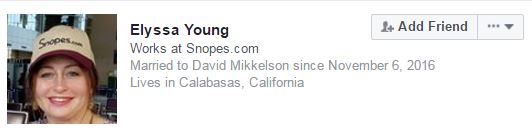
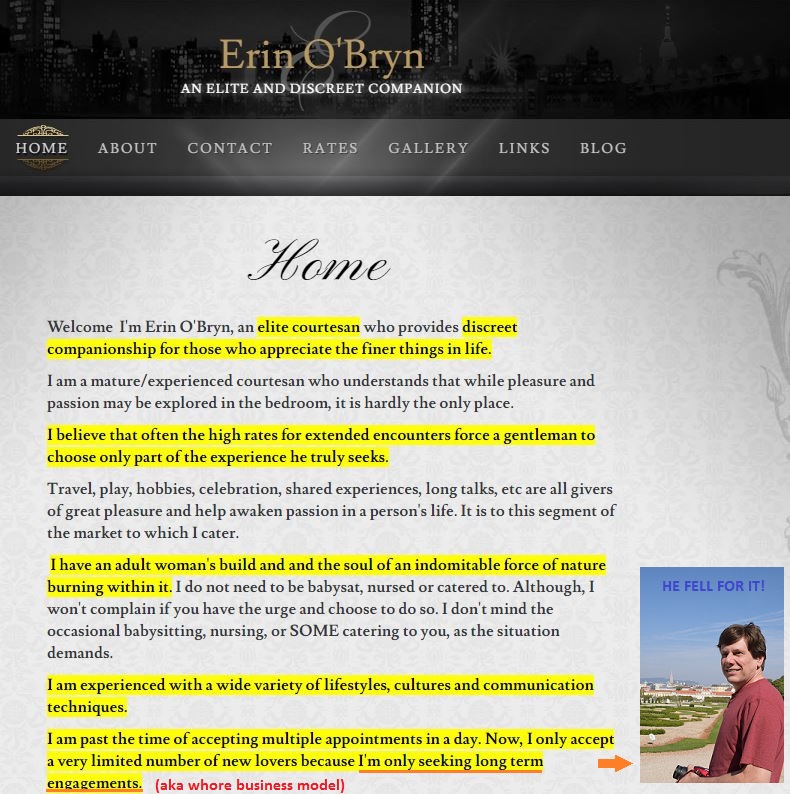
As iBankCoin reported in December, while engaging in debauchery behind his wife’s back, Mikkelson wrote off just about everything as a business expense, embezzling a reported $98,000. The Snopes co-founder has since settled down and married a [NSFW] part time porn actress, Snopes.com administrator (spicy!), and sex worker. As in, she has a website devoted to being a whore.  Apparently she’s a pretty good one despite being “past her time as an adult model.”


In the same divorce papers, David Mikkelson fired back, claiming his ex-wife Barbara took millions from their joint account and bought property in Las Vegas.


No word on whatever happened to the cat…


Monday, July 17, 2017

Carl Bernstein: "Cold Civil War" Has Taken Over Media; "Fact-Based Debate Is Becoming Impossible"

To say that the U.S. media has a developed a bit of a credibility issue of late would be an understatement.  Mass hysteria over Trump"s victory in November has clearly resulted in a staggering deterioration in reporting standards as dropping the latest "bombshell" and inflicting the latest wound on the Trump administration has been prioritized over truthful, fact-based reporting.  All of which, as we"ve noted frequently of late, has resulted in a number of embarrassing corrections from several major media outlets who have been forced to admit their reporting was just outright "fake news."


And, in case you missed it, Carl Bernstein, who is best known for his investigative reporting for the Washington Post that shed light on the Watergate scandal, appeared on CNN, of all places, this weekend to discuss the media"s credibility issue which he argued has largely developed in the "cable news era" as media outlets have become increasingly politicized in their race for ratings.


Among other things, Bernstein said that media outlets in this country are engaged in a "cold civil war" and that, as a result, "fact-based debate is becoming impossible."


"The difference between Watergate and now is that we are in the midst of a cold civil war in this country.  A political and cultural civil war and all of our reporting is taking place in the context of that cold civil war.  And nothing quite like existed at the time of Watergate."


"And part of the cold civil war itself is the configuration of media with Fox News, with CNN, being perceived by different sets of viewers as representing different truths.  When, in fact, Fox has changed American politics as perhaps no institution has since its invention in 1996."


"But also cable news itself is a different form than we had at the time of Watergate.  We didn"t see reporters on television discussing their stories.  We do go farther on the air now by having reporters from the Washington Post, the New York Times, CNN expand on their stories on the air.  Viewers are getting more interpreted information." 


"It is a different media universe and it is a cauldron taking place in this hot house of political debate in which a fact-based debate is becoming impossible in this culture and that"s part of the difficulty here.  We"re just lobbing accusations back and forth...in which a fact-based environment is almost impossible to maintain as long as the principals are willing to engage in the kind of rhetoric and lying that we have seen in this exchange of late."


Saturday, July 8, 2017

Rachel Maddow Caught In Latest Fake News Scandal; Proof Her "Forged NSA Document" Segment Was A Hoax

She thought she had it.  The smoking gun that would prove someone in Trump"s campaign colluded with the Russians to steal the 2016 election.  But, when a forged NSA document sent to Rachel Maddow turned out to be just more bad information from more anonymous sources, it left the crusading MSNBC host feeling a bit "triggered."  As such, she opened her show last night with the following segment:


“Somebody, for some reason, appears to be shopping a fairly convincing fake NSA document that purports to directly implicate somebody from the Trump campaign in working with the Russians in their attack in the election."


“This is news, because: why is someone shopping a forged document of this kind to news organizations covering the Trump-Russia affair?


Not surprisingly, Maddow uses the discovery to imply that someone within the Trump administration is intentionally planting fake information in an attempt to discredit her show.  She goes on to imply that similar efforts may have caused the recent firing of 3 "journalists" at CNN who simply couldn"t be bothered with verifying the anonymous tip they received.


Here are more details of Maddow"s show from the Daily Caller:


On June 7, an unidentified person sent documents to an online tip line for Maddow’s show, she said.


That was two days after The Intercept published legitimate NSA documents that were stolen by Reality Winner, a contractor for the agency.


And that"s where Maddow"s faux-outrage breaks down


You see, if it"s clear that Maddow received her forgery after the intercept published their documents then there"s really no "there" there.  Pretty much anyone with an internet connection could have simply taken the Reality Winner documents from The Intercept website and used them create a forgery to send to Maddow. 


Of course, Maddow knew that her whole story was bullshit unless she could convince her viewers that the forgery she received was created before The Intercept published it for the world to see.  If she could prove that, then she could insist the forged document must have come from someone on the "inside."


So, she decided to get "technical" and take a look at the "metadata" on the document she received.  As it turns out, the "creation date" on the document she received was roughly 3.5 hours before The Intercept published their Reality Winner story.  See, it"s all laid out right here on this lovely timeline graphic.  Checkmate, Mr. Trump!


Except, not.  Ironically, by stretching the truth in an attempt to prove that her story was in any way relevant, Maddow unwittingly proved exactly the opposite. 


As The Intercept has subsequently pointed out, the "creation date" on the document received by Maddow (see the timeline above) perfectly matches, to the exact second, the "creation date" on The Intercept"s Reality Winner document. 


Why?  Because that is the exact time in which The Intercept created their document and published it to their cloud server. 


All of which simply proves that Maddow"s source didn"t have a sneak peak at the Reality Winner documents...they actually used The Intercept document as their source for creating their forgery. 


Now, we could be wrong here...but, if the Trump administration wanted to dupe Rachel Maddow we suspect they could have gotten their hands on clean copies of the Reality Winner docs without having to lift them from The Intercept"s website.


So, what seems more likely to have happened here is that Maddow"s staff could easily tell the "NSA document" was a forgery from the start and simply ignored it at first. Afterall, she received the document on June 7th and is just now deciding to talk about it a month later?  Unlikely. 


But, when 3 journalists from CNN lost their jobs for publishing fake news, Maddow saw an opportunity to launch a whole new narrative attacking the Trump administration by alleging that they"re planting fake intelligence reports with the media.  Never let a good crisis go to waste...as they say.


Edward Snowden summarized the situation the best in a series of tweets:


Maddow"s lawyerly defense of why her implication was wrong is disappointing. Such caution should come prior to raising alarm on national TV.


When the media"s credibility is under attack, rushing stories out before checking facts and contacting the subject is hard to comprehend.


That said, journalism is hard and mistakes happen. When they do, as in this Maddow case, apologies should be frank and unequivocal.


When we start getting economical with facts, we lose. This important story was mangled by needlessly injected an unsupportable conspiracy.


Each time the media gets a prominent story wrong right now, I wince. More than egg on a famous face, it risks a generation"s trust in news.


If our most famous journalists are so proud they can"t admit to what is now an obvious error, how can they hope to hold the public trust?


Most folks can"t read three different papers every day. If we don"t set the highest standard, many give up and say the truth is unknowable.


That is the twilight of an age.


Still, we do feel badly for the liberal "journalists" of the world...all the embarrassing fake news stories of late means that they may have to actually start doing their jobs rather than just blindly running stories from "anonymous sources."

Thursday, July 6, 2017

Did CNN's Chris Cuomo Break The Law When He Sent This Now-Deleted Tweet?

Earlier this morning CNN host Chris Cuomo tweeted out, then promptly deleted, a message asking whether he should reveal the name of the Reddit user who made the now infamous Trump-CNN wrestling video.  He went on to imply that the whole purpose of outing the video"s creator would be to humiliate him for other posts he shared anonymously on a Reddit thread.


"Should CNN reveal name of Reddit user who made trump wrestling video? Had a lot of bigoted and hateful material on page and website."


Cuomo"s tweet seemed to mimic a similar threat made by CNN"s Andrew Kaczynski that was released earlier this morning (which we covered here).


CNN


Unfortunately for Cuomo, Kaczynski and all of CNN for that matter, it seems they probably should have brushed up on their knowledge of extortion laws before making their thinly-veiled threats.  As Ted Cruz subsequently pointed out, Georgia law (the home of CNN"s headquarters) strictly defines "theft by exortion" to include "dissemination of any information tending to subject any person to hatred, contempt, or ridicule or to impair his credit or business repute."


Of course, Cuomo produces his show in New York so those backward Georgia laws don"t apply to him.  That said, Julian Assange conveniently points out that New York also has it"s own rather unfavorable views of things like "coercion" and "extortion."


Of course, this isn"t the first time Cuomo has openly displayed his ignorance of the law.  As you may recall, he warned CNN viewers back in October that it was "illegal" for ordinary citizens to take a look at John Podesta"s emails as posted on WikiLeaks...


"Remember, it’s illegal to possess these stolen documents. It’s different for the media. So everything you learn about this you are learning from us."


All of which makes Project Veritas" latest CNN video, which features a producer saying that he "just can"t stand" Cuomo, all that much more entertaining.


"...[I] just can"t stand that guy [Cuomo] when he talks, we"re like shut up."


Thursday, June 29, 2017

Rebellion At The NYTimes: Newsroom To Walk Out After "Decrying Direction Of Paper"

Exhausted and demoralized after repeated buyouts and cutbacks in the newsroom, it seems the downtrodden journalists at the New York Times have finally had enough: In a pair of letters delivered to executive editor Dean Baquet and managing editor Joseph Kahn, the News Guild of New York said the New York Times editorial staff will leave the newsroom on Thursday as a demonstration of solidarity as management threatens jobs, according to MarketWatch.


Unlike the employee rebellion at the Wall Street Journal last year, when staffers confronted management about unequal pay practices and a paucity of female reporters and editors in leadership roles, the uproar at the times is centered around the repeated paycuts and cutbacks, which have left the newsroom feeling “demoralized.” One letter was sent by the organization"s copy editors, who are facing dramatic staffing cuts, while the second letter was sent by reporters in an expression of solidarity with the editing staff. Both detailed frustrations with the repeated rounds of buyouts, and the lack of transparency surrounding management’s decisionmaking.


“In the copy editors’ letter to Baquet and Kahn, they say they feel betrayed and disrespected in the newsroom, and ask that management reconsider staffing cuts that are expected as the paper plans to restructure.


“Cutting us down to 50 to 55 editors from more than 100, and expecting the same level of quality in the report, is dumbfoundingly unrealistic,” the letter reads. “You often speak about the importance of engaging readers, of valuing, investing and giving a voice to readers. Dean and Joe: We are your readers, and you have turned your backs on us.”


“Editors — and yes, that especially means copy editors — save reporters and the Times every day from countless errors, large and small,” they say in the letter. “Requiring them to dance for their supper sends a clear message to them, and to us, that the respect we have shown the Times will not be reciprocated.”


The editorial staff is accusing Times management of being too opaque in its efforts to restructure the news operation, which includes consolidating two separate groups of editors into one group and asking copy editors to resubmit applications for roles in the newsroom.


Indeed, morale is so low at the NYT that its reporters and editors said they actually feel more respected by readers than by management. The letters referenced an internal report in which the copy editors were compared to dogs urinating on fire hydrants.


That’s quite the claim  - considering President Donald Trump’s relentless bashing of the “failing” news organization has turned public sentiment squarely against it.


“And that is why it feels like such a profound waste that morale is low throughout the newsroom, and that many of us, from editors to reporters to photo editors to support staff, are angry, embittered and scared of losing our jobs,” the letter reads.


The rebellion comes at a time when advertising revenues for print – formerly a powerhouse of the media industry that has been precipitously eroded by the rise of free news on the internet – continue to shrink, and gains in digital advertising are failing to make up the difference.


In the first quarter, print ads declined by 18% while digital ad revenue increased by nearly 19% and accounted for more than 38% of the company’s total ad revenue. Still, the paper’s stock remains buoyant; shares have risen more than 35% year-to-date, compared with a 9% gain in the S&P 500.

Monday, June 5, 2017

CNN Caught Staging Fake News? Network Trots Out Anti-ISIS Muslims To Express Outrage After London Attacks

Content originally generated at iBankCoin.com


As one of the more inept tentacles of the deep state, CNN was just caught staging Fake News in the aftermath of the ISIS claimed London attacks which claimed 7 lives and injured 48.


While ISIS supporters are celebrating the attacks, MSM propagandists are hard at work pushing the "religion of peace" narrative - trotting out hijabbed women and a child to hold signs expressing Muslim outrage at the terrorist attacks.


This wasn"t an "organic" protest against terrorism. These Muslims didn"t just take it upon themselves to print glossy signs and show up. Instead, CNN staged their outrage.


Check it out...


AP used the #FakeNews pictures:


Thursday, May 25, 2017

Montana Republican "Body-Slams" Guardian Reporter Over Healthcare Question

Montana Republican congressional candidate Greg Gianforte reportedly "body slammed" Guardian reporter Ben Jacobs during an interview after being pressed for his opinion on the CBO healthcare score. Gianforte is the Republican candidate in Thursday"s special election for Montana"s open U.S. House seat.


"I"m sick and tired of you guys! The last time you came in here you did the same thing. Get the hell out of here! Get the hell out of here!


Jacobs told MSNBC"s Chris Hayes that he was trying to ask Gianforte about the Congressional Budget Office"s financial analysis of the Republican health care plan when "the next thing I know, I"m being body-slammed."


"He"s on top of me. My glasses are broken," Jacobs said. "It"s the strangest thing that"s happened in my entire life reporting."


Jacobs said he fell on his elbow and was waiting to be X-rayed.


The Guardian has released the audio of the event...


NBC News reports that , in a statement, Shane Scanlon, a spokesman for Gianforte"s campaign, alleged that Jacobs crashed an interview Gianforte was giving another reporter "and began asking badgering questions," adding that "Jacobs was asked to leave."


"Greg then attempted to grab the phone that was pushed in his face," Scanlon said.


"Jacobs grabbed Greg"s wrist, and spun away from Greg, pushing them both to the ground.


"It"s unfortunate that this aggressive behavior from a liberal journalist created this scene at our campaign volunteer BBQ," he said.


The Gallatin County Sheriff"s Office and and representatives of the state Republican Party didn"t immediately respond to NBC News" requests for comment.


The question is - was the video more like this...


Or this...


But on a more serious note, it appears the constant tensions between a liberal media and not-liberal politicians is reaching a tipping point.

Friday, April 28, 2017

US, UK Both Drop In Latest 'World Press Freedom Index' Rankings

Authored by Mike Krieger via Liberty Blitzkrieg blog,


Reporters without Borders just published its annual World Press Freedom Index rankings, and the results for both the U.S. and UK are not impressive. Both countries declined two spots from last year, with the UK at 41, and the greatest and most free nation on earth, America, down to 43.


Here’s The Guardian reporting on the UK’s decline:


Journalists in the UK are less free to hold power to account than those working in South Africa, Chile or Lithuania, according to an index of press freedom around the world.


Laws permitting generalised surveillance, as well as a proposal for a new espionage act that could criminalise journalists and whistleblowers as spies, were cited by Reporters Without Borders as it knocked the UK down two places from last year, to 40th out of 180 countries in its World Press Freedom Index.


In the past five years, the UK has slipped 12 places down the index. Rebecca Vincent, RSF’s UK bureau director, said this year’s ranking would have been worse were it not for a general decline in press freedom around the world, making journalists in Britain comparatively better off than those in countries such as Turkey and Syria.


RSF, which campaigns for free speech, warned of a general erosion of media freedom in English-speaking, democratic countries. The US, long considered a bastion of freedom of speech thanks to the first amendment of its constitution, also dropped two places, to 43rd. Canada fell four places, to 22nd, and New Zealand slipped eight places, to 13th.


Among the concerns raised by RSF was the passage of the UK’s “menacing” Investigatory Powers Act last November, which met only token resistance within parliament, despite giving UK intelligence agencies and police the most sweeping surveillance powers in the western world.


RSF said the act was a possible “death sentence” for investigative journalism in Britain, owing to its lack of protections for whistleblowers, journalists and their sources, and that it set a damaging precedent for other countries to follow.


Moving along, what about the shining city on a hill? Land of the free, home of the brave, the world’s indispensable nation!


Here’s what Reporters without Borders had to say about the U.S. as it dropped two spots to 43.


US press freedom, enshrined in the First Amendment to the 1787 constitution, has encountered several major obstacles over the past few years, most recently with the election of President Donald Trump. He has declared the press an “enemy of the American people” in a series of verbal attacks toward journalists, while attempting to block White House access to multiple media outlets in retaliation for critical reporting. Despite the bleak outlook under Trump, it bears repeating that his predecessor left behind a flimsy legacy for press freedom and access to information. Journalists continue to be arrested for covering various protests around the country, with several currently facing criminal charges. The Obama administration waged a war on whistleblowers who leaked information about its activities, leading to the prosecution of more leakers than any previous administration combined. To this day, American journalists are still not protected by a federal “shield law” guaranteeing their right to protect their sources and other confidential work-related information. And over the past few years, there has been an increase in prolonged searches of journalists and their devices at the US border, with some foreign journalists being prevented from any travel to the US after they covered sensitive topics such as Colombia’s FARC or Kurdistan.


If you think that’s bad, imagine where the U.S. will end up if the DOJ actually goes forward with charges against Julian Assange?


I discussed that troubling scenario in last week’s post, The American Empire Under Donald Trump Has Become Increasingly Desperate, Dangerous & Insecure.


Things are not headed in the right direction.

Tuesday, April 11, 2017

Populism In Our Time - "The Status Quo Is The Fundamental Problem"

Authored by Paul Brodsky via Macro-Allocation.com,


“Be even more suspicious…of all those who employ the term we or us without your permission. This is another form of surreptitious conscription, designed to suggest that we are all agreed on our interests and identity.”
- Christopher Hitchens


Merriam-Webster defines populist as “a believer in the rights, wisdom and virtues of the common people”, and when the word is capitalized: “a member of a U.S. political party formed in 1891 primarily to represent agrarian interests and to advocate the free coinage of silver and government control of monopolies”. The first definition seems to be the very point of representative government; the latter what happens when representative government is no longer representative.


The use of the word “populist” among professional politicos implies an off-the-run candidate or leader with ill-intent - an irreverent voice deigning to challenge established institutions by speaking directly to the deplorable rabble, bypassing the narrative perpetuated by vast political and media infrastructures. Those inclined towards transitive logic might infer that governments and the Fourth Estate propose, but are not structured and do not work, to serve the rights, wisdom and virtues of commoners.


We won’t get idealistic about democracy or the gaping separation between political rhetoric and execution. In non-revolutionary times (about 99.9% on a timeline) governments serve the privileged. It is what they do. Political leaders throw bones to commoners, providing bread, circuses and welfare - distractions eminently better than brioches chucked at them by Marie Antoinette, but decidedly worse than most people’s conception that their government abides by the principle of equal access for all.


Liberal democracies are like major medical insurance policies. They will, in the end, protect freedom and most liberties, but they do not provide preventative health care. (Indeed, as their promotion of systemic debt shows, they are not above distributing the fiscal equivalent of cigarettes to their citizens.)


We would argue that the manner in which resources are distributed (i.e., where an economy falls on a spectrum ranging from heavy government subsidies to entirely free commercial markets), is the most critical determinant of economic sustainability and social tranquility; an influence even greater than religious and cultural identities. Fitting government into popular needs and expectations is an ongoing balancing act, requiring authorities to continually synchronize public needs, capabilities and expectations.


Brexit, Trump (Le Pen, Frexit?), etc. are manifest samples of popular will seeking more equitable resource distribution. What is the difference between Les Misérables in 1832 and Ms. Clinton’ Deplorables today? About 4,000 miles and a hundred or so years.


The best “the people” (and investors) can hope for from governments today is that regime changes will be swift, orderly, and will keep the principles that sustain patriotism intact, even if those principles do not comport with reality. Reality ultimately resides in popular will, not in the narrative wealth-funded institutions foster. Diverse societies with a plurality of political ideals, social mores and economic goals are great. We should all watch out when they coalesce around a general sense of helplessness.


Fake News


Fake news is the deliberate spread of misinformation through traditional news or social media with the intent to mislead for financial or political gain. We are shocked (shocked!) it has become a thing today:


  • In the first century, Octavia launched a campaign of misinformation against Mark Anthony.

  • Benjamin Franklin wrote fake news about murderous "scalping" Indians working with King George III in an effort to influence public opinion towards revolt.

  • In 1835, the New York Sun reported that astronomers confirmed bizarre life on the moon. The Sun’s subscription based increased despite admitting soon after that it was all a hoax.

  • The Nazi Party rose to power in Germany in 1933 and established the Reich Ministry of Public Enlightenment and Propaganda under Joseph Goebbels. All published fact and fiction were dubious, to say the least.

  • Also in 1933, The New York Times published false reports written by its Moscow bureau chief (who won a Pulitzer Prize them), denying Russia was purposely starving millions of its citizens.

  • For some unknown reason (facetious), modern examples of fake news episodes promoted by established media are difficult to come by…in established media.

  • Social media is where all the fake news is today (facetious again).

The old saw about not believing everything you read in the papers never threatened established media until there was an alternative news source. While old media’s journalistic standards for sourcing and editing are no doubt generally superior to new media’s, the advent of internet-based news is shining a harsh light on a fundamental problem that has always existed with the press, but no longer does: the tight, clubby control of the Fourth Estate over a narrow information channel.


The de-centralization component of the internet has thrown a grenade into that channel and the result has been information disintermediation, which we think is, on balance, a great thing. The market for information is now free, even freer than the market for stocks and bonds. The difference is regulation. The process through which the public can consume securities is highly scrutinized while the process through which the public can consume information is not (in the US, thanks to the first amendment).


There are two directions popular opinion can go today regarding fake news: 1) demand that public information be regulated, or 2) embrace the idea that all information may be false. We believe the public has already decided overwhelmingly that it wants access to all news – real or fake, no matter.


If global communications authorities really want to set standards for news distributors then they would have to prohibit news organizations from being for-profit companies with incentives to sensationalize. This would apply to the New York Times as well as everyone posting cats that look like Hitler on Face Book. Practically, there would be very little compliance and such so a scenario is a non-starter.


The difference between news and information, whether fact or fiction, is in the eye of the beholder, not the editorial judgment of the publisher. This is where it belongs. Consumers of information beware. If we are to be honest, fake news is information meant to manipulate us and it will be with us always, as it always has been.


Regulatory Populism


Securities regulators should follow the non-action of public communication regulators - drop all standards related to the distribution of market information so that market participants become aware that they do not (indeed, cannot) have equal information and that information is not distributed simultaneously to all.


As for timing, an investor who witnesses first-hand a terrorist event or natural disaster is at an advantage, should she choose to act on it. More common, unscheduled information typically arrives on our screens two to ten minutes before financial television stations broadcast it. As for information itself, investors that do not make the effort to know all public information, or do not hire people that make the effort, will always be at a disadvantage. This is as it should be if we want to investing to be fair and merit-based.


Regulators cannot enforce how people communicate amongst themselves, but they can try to enforce how those with non-public information act on it. Identifying an illegality can be challenging. What if an investor who was about to take a position comes to understand something will soon happen that would make him suffer losses were he to do so? How can regulators get in the minds of investors?


Our sense is that regulatory oversight mostly exists to provide a means of weeding out the most heinous abuses of the public trust. The public trust is an interesting concept on its own. Question: Why are investors supposed to always trust the markets? Answer: So they stay invested. Question: Why are investors always supposed to stay invested? Formal Answer: We have no idea. (Informal Answer: To benefit rentiers with money and those closest to the credit channel, and to attract global wealth.)


Thus, market regulation is more a tool to sustain the perception of fair markets so the public stays invested than a means of actually ensuring fair markets. In a normally functioning economy, which at this point has been fictionalized, the factors of production would actively decide whether to save or invest.


Financial Populism


Our series of reports last month on passive vs. active investing highlighted a trend towards financial populism that has taken hold recently in the form of exchange traded products. (Vanguard, for example, took in $2 billion each day to their ETFs in the first quarter – monster inflows at the expense of active managers with educations, experience, and sometimes dissenting market views and opinions.)


The greater trend towards financial populism has been in place for a long time. The establishment of defined benefit pensions and mutual funds created consensus opinion, which brought together how economic and market information is framed and consumed. Certain information – popular economic data series, asset valuation metrics and political narratives – would reliably migrate in and out of vogue like herds of sheep, but with the speed and dexterity of cattle.


The herding behavior of helpless animals is analogous to the survival instincts of contemporary investors who think they have learned that they cannot get richer than their neighbors by speculating in alpha-seeking strategies. They are enthusiastically embracing beta strategies that promise market returns - nothing more, nothing less.


The demographically-driven, credit-driven popularity of financial asset markets over the last generation, combined with loss protection provided by exogenous market forces (i.e., central bank “puts”), have given financial asset markets the patina of risk-free sanctuaries. They are anything but. The truly unintended consequence passive investors will discover (soon, we think) – is that beta investing is not saving. Investing in financial asset markets remains speculative…now more than ever.


In our view, equity and real estate markets will soon destroy vast amounts of perceived wealth, either in nominal (price) terms or in real (inflation-adjusted) terms, most likely the latter. The destructive cause will not be a sudden change in popular sentiment, because even that would not change how and where perceived wealth is warehoused. The cause will be the necessary dilution of currencies in which financial assets are denominated. (We would be happy to provide more on this.)


We agree with elites that see populism as dangerous, but for an entirely different reason. The status quo is the fundamental problem, not an institutional framework to which we can revert for protection. The very way contemporary societies think of resources and wealth is at issue. The way we will be richer than our neighbors will be by satisfying our liabilities with our assets in real terms; not a very popular notion.


As for our particular relationship with populism, we agree with Cyril Connelly of the New Statesman: “Better to write for yourself and have no public, than to write for the public and have no self."

Tuesday, January 17, 2017

New York Times Warns "Budget Cuts Are Coming", Will Invest $5 Million To Cover Trump

On Tuesday, the New York Times unveiled its "2020 report", a self-assessment by the newspaper of its ongoing operational progress, accompanied by a note by top editors Dean Baquet and Joe Kahn, which also presents the company"s outlook on the future. Unlike previous years, when The NYT was worried that it was falling behind its digital competition like other liberal websites including Vox, WaPo, and BuzzFeed, this time the evaluation was more chipper, suggesting the NYT feels relatively good about its prospects.


Based on the report, the NYT"s stated goal to double its digital revenue to $800 million by 2020 seems within reach, after $500 million in 2016, and an trend line shows that revenue from consumers has far outstripped ad dollars. Additionally, the Times now counts more than 1.5 million paying digital subscribers and more than 1m print subscribers.


“We are, in the simplest terms, a subscription-first business. We are not trying to maximize clicks and sell low-margin advertising against them. We are not trying to win a pageviews arms race,” the 2020 report said. “Our focus on subscribers stems from a challenge confronting us: the weakness in the markets for print advertising and traditional forms of digital-display advertising.”


And yet not all was good news, because in the report was a warning that budget cuts are coming, a notice which followed the newspaper"s announcement several weeks ago that it would rent out floors in its headquarters to other companies to beef up its cash flow. To wit:


Some of these initiatives stem directly from consultations with the 2020 group; others result from the realities of the media business in a period of rapid change. Nothing can disguise the fact that the continued shift from print to digital demands a somewhat smaller and more focused newsroom.


There will be budget cuts this year. We will lay out the specifics in the coming weeks and months. We cannot pretend to be immune from financial pressures but we view this moment as a necessary repositioning of The Times’s newsroom, not as a diminishment.


The jobs impacted will be mostly in the editing vertical:


We must move away from duplicative and often low-value line editing. It slows us down, costs too much, and discourages experiments in storytelling. Backfielders, department heads, News Desk editors and, yes, the masthead spend too much time line editing and copy editing, moving around words with little true impact on a story. Copy editors, meanwhile, spend too much time editing and re-editing stories that should be posted quickly.


Yet in an ironic twist, it appears that Trump will lead to even more investing in the US, because the NYT announced it would invest some $5 million to cover Trump.


We are deeply committed to protecting our investment in the original newsgathering and storytelling that make The Times so indispensable in our readers’ lives. Our journalists reported from the ground in more than 150 countries last year, often at great personal risk. Our commitment to expert journalism will not waver. Instead we will focus cuts on the multilayered editing and production systems, a legacy of our newspaper traditions that remains much bigger and more complex than at our competitors.


To that end, you should know the company is investing more than ever in accountability journalism. As we explain later in this document, the business side will provide us an additional $5 million so we can produce even more coverage of the incoming Trump administration.


It adds that "even in these difficult financial times for our industry, the entire company has a commitment to this story. It is not only our mission. It is vital to our business. Our dominance on this story of a changing America will ensure our position as the essential news organization for years to come." It is unclear what would happen to this investment if Trump were to call out the NYT out as the next source of "fake news."


The biggest change coming to the NYT however, is that it is becoming more visual.


..The majority of our report is fairly traditional, and we should broaden the ways we tell stories. The broader mobile landscape is increasingly a visual one — think of Snapchat, Instagram, YouTube — and we know that our mobile audience wants Times journalism to incorporate visuals even more fully into our work. This will make our report better, but it will require significant focus.


The goal: to gain even more subscribers. "by focusing on subscribers, The Times will also maintain a stronger advertising business than many other publications. Advertisers crave engagement: readers who linger on content and who return repeatedly. Thanks to the strength and innovation of our journalism — not just major investigative work and dispatches from around the world but also interactive graphics, virtual reality and Emmy-winning videos that redefine storytelling — The Times attracts an audience that advertisers want to reach."


And now, after all that good news, if only the "2020 Report" also had an explanation why the company is vacating 8 floors in its HQ to generate "significant rental revenue."

Saturday, January 14, 2017

Mainstream Media Meltdown: 'Journalists' Seek 'Safe Space' To Discuss "How To Cover Trump"

After the president-elect"s first press conference since the election this week, it appears the mainstream media is in need of a "safe space". As The Hill reports, so-called journalists from the Huffington Post, Slate, CNN, and Univision will gather days before Donald Trump’s inauguration to publicly discuss "how the news media can and should proceed to cover" the president-elect.


After this happened...


Source: Branco


Slate will host the event next Wednesday, called “Not the New Normal.” CNN’s Brian Stelter will moderate the panel at New York University. As The Hill details,


The focus of the discussion will include "how journalists and media companies at large can play a bigger role in making sure that fact prevails over fiction in the coming months and years," according to Slate. 


Slate’s editor in chief Julia Turner and Slate Group chairman Jacob Weisberg — who hosts “Trumpcast,” a podcast dedicated to covering the president-elect — will participate in the panel.


Joining them will be Borja Echevarría, Univision Digital’s vice president and editor in chief; Huffington Post editor in chief Lydia Polgreen and New Yorker editor David Remnick.


Most of the panelists were staunchly critical of Trump during the campaign and since Election Day.


Tickets will cost $30, with proceeds benefiting the Committee to Protect Journalists.


This is the first time Slate has hosted a panel to discuss how to cover an incoming president.

Thursday, January 5, 2017

Washington Post Is Richly Rewarded For False News About Russia Threat While Public Is Deceived

Authored by Glenn Greenwald, originally posted at The Intercept,


In the past six weeks, the Washington Post published two blockbuster stories about the Russian threat that went viral: one on how Russia is behind a massive explosion of “fake news,” the other on how it invaded the U.S. electric grid. Both articles were fundamentally false. Each now bears a humiliating editor’s note grudgingly acknowledging that the core claims of the story were fiction: The first note was posted a full two weeks later to the top of the original article; the other was buried the following day at the bottom.


The second story on the electric grid turned out to be far worse than I realized when I wrote about it on Saturday, when it became clear that there was no “penetration of the U.S. electricity grid” as the Post had claimed. In addition to the editor’s note, the Russia-hacked-our-electric-grid story now has a full-scale retraction in the form of a separate article admitting that “the incident is not linked to any Russian government effort to target or hack the utility” and there may not even have been malware at all on this laptop.


But while these debacles are embarrassing for the paper, they are also richly rewarding. That’s because journalists — including those at the Post — aggressively hype and promote the original, sensationalistic false stories, ensuring that they go viral, generating massive traffic for the Post (the paper’s executive editor, Marty Baron, recently boasted about how profitable the paper has become).


After spreading the falsehoods far and wide, raising fear levels and manipulating U.S. political discourse in the process (both Russia stories were widely hyped on cable news), journalists who spread the false claims subsequently note the retraction or corrections only in the most muted way possible, and often not at all. As a result, only a tiny fraction of people who were exposed to the original false story end up learning of the retractions.


Baron himself, editorial leader of the Post, is a perfect case study in this irresponsible tactic. It was Baron who went to Twitter on the evening of November 24 to announce the Post’s exposé of the enormous reach of Russia’s fake news operation, based on what he heralded as the findings of “independent researchers.” Baron’s tweet went all over the place; to date, it has been re-tweeted more than 3,000 times, including by many journalists with their own large followings:


But after that story faced a barrage of intense criticism — from Adrian Chen in the New Yorker (“propaganda about Russia propaganda”), Matt Taibbi in Rolling Stone (“shameful, disgusting”), my own article, and many others — including legal threats from the sites smeared as Russian propaganda outlets by the Post’s “independent researchers” — the Post finally added its lengthy editor’s note distancing itself from the anonymous group that provided the key claims of its story (“The Post … does not itself vouch for the validity of PropOrNot’s findings” and “since publication of the Post’s story, PropOrNot has removed some sites from its list”).


What did Baron tell his followers about this editor’s note that gutted the key claims of the story he hyped? Nothing. Not a word. To date, he has been publicly silent about these revisions. Having spread the original claims to tens of thousands of people, if not more, he took no steps to ensure that any of them heard about the major walk back on the article’s most significant, inflammatory claims. He did, however, ironically find the time to promote a different Post story about how terrible and damaging Fake News is:


 Whether the Post’s false stories here can be distinguished from what is commonly called “Fake News” is, at this point, a semantic dispute, particularly since “Fake News” has no cogent definition.  Defenders of Fake News as a distinct category typically emphasize intent in order to differentiate it from bad journalism. That’s really just a way of defining Fake News so as to make it definitionally impossible for mainstream media outlets like the Post ever to be guilty of it (much the way terrorism is defined to ensure that the U.S. government and its allies cannot, by definition, ever commit it).


But what was the Post’s motive in publishing two false stories about Russia that, very predictably, generated massive attention, traffic, and political impact? Was it ideological and political — namely, devotion to the D.C. agenda of elevating Russia into a grave threat to U.S. security? Was it to please its audience — knowing that its readers, in the wake of Trump’s victory, want to be fed stories about Russian treachery? Was it access and source servitude — proving it will serve as a loyal and uncritical repository for any propaganda intelligence officials want disseminated? Was it profit — to generate revenue through sensationalistic click-bait headlines with a reckless disregard to whether its stories are true? In an institution as large as the Post, with numerous reporters and editors participating in these stories, it’s impossible to identify any one motive as definitive.


Whatever the motives, the effects of these false stories are exactly the same as those of whatever one regards as Fake News. The false claims travel all over the internet, deceiving huge numbers into believing them. The propagators of the falsehoods receive ample profit from their false, viral “news.” And there is no accountability of the kind that would disincentivize a repeat of the behavior. (That the Post ultimately corrects its false story does not distinguish it from classic Fake News sites, which also sometimes do the same.)


And while it’s true that all media outlets make mistakes, and that even the most careful journalism sometimes errs, those facts do not remotely mitigate the Post’s behavior here. In these cases, they did not make good faith mistakes after engaging in careful journalism. With both stories, they were reckless (at best) from the start, and the glaring deficiencies in the reporting were immediately self-evident (which is why both stories were widely attacked upon publication).


As this excellent timeline by Kalev Leetaru documents, the Post did not even bother to contact the utility companies in question — the most elementary step of journalistic responsibility — until after the story was published. Intelligence officials insisting on anonymity — so as to ensure no accountability — whispered to them that this happened, and despite how significant the consequences would be, they rushed to print it with no verification at all. This is not a case of good journalism producing inaccurate reporting; it is the case of a media outlet publishing a story that it knew would produce massive benefits and consequences without the slightest due diligence or care.


The most ironic aspect of all this is that it is mainstream journalists — the very people who have become obsessed with the crusade against Fake News — who play the key role in enabling and fueling this dissemination of false stories. They do so not only by uncritically spreading them, but also by taking little or no steps to notify the public of their falsity.


The Post’s epic debacle this weekend regarding its electric grid fiction vividly illustrates this dynamic. As I noted on Saturday, many journalists reacted to this story the same way they do every story about Russia: They instantly click and re-tweet and share the story without the slightest critical scrutiny. That these claims are constantly based on the whispers of anonymous officials and accompanied by no evidence whatsoever gives those journalists no pause at all; any official claim that Russia and Putin are behind some global evil is instantly treated as Truth. That’s a significant reason papers like the Post are incentivized to recklessly publish stories of this kind. They know they will be praised and rewarded no matter the accuracy or reliability because their Cause — the agenda — is the right one.


On Friday night, immediately after the Post’s story was published, one of the most dramatic pronouncements came from the New York Times’s editorial writer Brent Staples, who said this:


Now that this story has collapsed and been fully retracted, what has Staples done to note that this tweet was false? Just like Baron, absolutely nothing. Actually, that’s not quite accurate, as he did do something: At some point after Friday night, he quietly deleted his tweet without comment. He has not uttered a word about the fact that the story he promoted has collapsed, and that what he told his 16,000-plus followers — along with the countless number of people who re-tweeted the dramatic claim of this prominent journalist — turned out to be totally false in every respect.


Even more instructive is the case of MSNBC’s Kyle Griffin, a prolific and skilled social media user who has seen his following explode this year with a constant stream of anti-Trump content. On Friday night, when the Post story was published, Griffin hyped it with a series of tweets designed to make the story seem as menacing and consequential as possible. That included hysterical statements from Vermont officials — who believed the Post’s false claim — that in retrospect are unbelievably embarrassing.


That tweet from Griffin — convincing people that Putin was endangering the health and safety of Vermonters — was re-tweeted more than 1,000 times. His other similar tweets — such as this one featuring Vermont Sen. Patrick Leahy’s warning that Putin was trying to “shut down [the grid] in the middle of winter” — were also widely spread.


But the next day, the crux of the story collapsed — the Post’s editor’s note acknowledged that “there is no indication” that “Russian hackers had penetrated the electricity grid” — and Griffin said nothing. Indeed, he said nothing further on any of this until yesterday — four days after his series of widely shared tweets — in which he simply re-tweeted a Post reporter noting an “update” that the story was false without providing any comment himself:


In contrast to Griffin’s original inflammatory tweets about the Russian menace, which were widely and enthusiastically spread, this after-the-fact correction has a paltry 289 re-tweets. Thus, a small fraction of those who were exposed to Griffin’s sensationalistic hyping of this story ended up learning that all of it was false.


I genuinely do not mean to single out these individual journalists for scorn. They are just illustrative of a very common dynamic: Any story that bolsters the prevailing D.C. orthodoxy on the Russia Threat, no matter how dubious, is spread far and wide. And then, as has happened so often, when the story turns out to be false or misleading, little or nothing is done to correct the deceitful effects. And, most amazingly of all, these are the same people constantly decrying the threat posed by Fake News.


A very common dynamic is driving all of this: media groupthink, greatly exacerbated (as I described on Saturday) by the incentive scheme of Twitter. As the grand media failure of 2002 demonstrated, American journalists are highly susceptible to fueling and leading the parade in demonizing a new Foreign Enemy rather than exerting restraint and skepticism in evaluating the true nature of that threat.


It is no coincidence that many of the most embarrassing journalistic debacles of this year involve the Russia Threat, and they all involve this same dynamic. Perhaps the worst one was the facially ridiculous, pre-election Slate story — which multiple outlets (including The Intercept) had been offered but passed on — alleging that Trump had created a secret server to communicate with a Russian bank; that story was so widely shared that even the Clinton campaign ended up hyping it — a tweet that, by itself, was re-tweeted almost 12,000 times.


But only a small percentage of those who heard of it ended up hearing of the major walk back and debunking from other outlets. The same is true of The Guardian story from last week on WikiLeaks and Putin that ended up going viral, only to have its retraction barely noticed because most of the journalists who spread the story did not bother to note it.


Beyond the journalistic tendency to echo anonymous officials on whatever Scary Foreign Threat they are hyping at the moment, there is an independent incentive scheme sustaining all of this. That Russia is a Grave Menace attacking the U.S. has — for obvious reasons — become a critical narrative for Democrats and other Trump opponents who dominate elite media circles on social media and elsewhere. They reward and herald anyone who bolsters that narrative, while viciously attacking anyone who questions it.


Indeed, in my 10-plus years of writing about politics on an endless number of polarizing issues — including the Snowden reporting — nothing remotely compares to the smear campaign that has been launched as a result of the work I’ve done questioning and challenging claims about Russian hacking and the threat posed by that country generally. This is being engineered not by random, fringe accounts, but by the most prominent Democratic pundits with the largest media followings.


I’ve been transformed, overnight, into an early adherent of alt-right ideology, an avid fan of Breitbart, an enthusiastic Trump supporter, and — needless to say  — a Kremlin operative. That’s literally the explicit script they’re now using, often with outright fabrications of what I say (see here for one particularly glaring example).


They, of course, know all of this is false. A primary focus of the last 10 years of my journalism has been a defense of the civil liberties of Muslims. I wrote an entire book on the racism and inequality inherent in the U.S. justice system. My legal career involved numerous representations of victims of racial discrimination. I was one of the first journalists to condemn the misleadingly “neutral” approach to reporting on Trump and to call for more explicit condemnations of his extremism and lies. I was one of the few to defend Jorge Ramos from widespread media attacks when he challenged Trump’s immigration extremism. Along with many others, I tried to warn Democrats that nominating a candidate as unpopular as Hillary Clinton risked a Trump victory. And as someone who is very publicly in a same-sex, inter-racial marriage — with someone just elected to public office as a socialist — I make for a very unlikely alt-right leader, to put that mildly.


The malice of this campaign is exceeded only by its blatant stupidity. Even having to dignify it with a defense is depressing, though once it becomes this widespread, one has little choice.


But this is the climate Democrats have successfully cultivated — where anyone dissenting or even expressing skepticism about their deeply self-serving Russia narrative is the target of coordinated and potent smears; where, as The Nation’s James Carden documented yesterday, skepticism is literally equated with treason. And the converse is equally true: Those who disseminate claims and stories that bolster this narrative — no matter how divorced from reason and evidence they are — receive an array of benefits and rewards.


That the story ends up being completely discredited matters little. The damage is done, and the benefits received. Fake News in the narrow sense of that term is certainly something worth worrying about. But whatever one wants to call this type of behavior from the Post, it is a much greater menace given how far the reach is of the institutions that engage in it.