Showing posts with label Business economics. Show all posts

Friday, November 24, 2017

Caught On Tape: Chaos, Multiple Fights Break Out Among "Black Friday Zombies"

It’s Black Friday, and in keeping with the Holiday weekend tradition, media commentator Mark Dice traveled to Wal-Marts and other stores to document the “zombie apocalypse” of half-awake consumers hell-bent on elbowing past their peers so they can be sure to get the best deals on electronics, books, video games, clothes and any number of other popular holiday gift items. Of course, as Dice points out, many of the same deals can also be found on a little website called Amazon.com without the hassle of pushing through crowds.


After last year’s disappointing sales totals, retail analysts expect holiday weekend spending to come roaring back this year: According to Fox Business, spending per capita is expected to climb 47% compared with last year’s holiday weekend, up from $505 to $743. An estimated 164 million people are planning to shop or are considering shopping during the Thanksgiving weekend, according to a survey by the National Retail Federation. In a rare, positive piece of news for America"s beleagured retailers, Americans had already spent $1.52 billion, which is a 17% increase from last year. The warm autumn means fashion sellers are looking to offload masses of unsold coats, boots and woollens.


But for everyone who isn’t participating in the retail madness, plenty of videos and images have already emerged on social media of brawls, fistfights and stampedes in the US and around the world as the traditional Black Friday hysteria sets in.


The Riverchase Galleria in Alabama, a group of shoppers shouted and pounded one another with their fists while an unlucky few were trampled.


Meanwhile, a midnight brawl broke out at one California mall as two shoppers brutally pummeled each other.


Of course, the carnage wasn’t limited to the US. One video circulating on Twitter depicted a mass of shoppers swarming a game store in Cape Town, South Africa.


...and a multiperson brawl erupted outside the Eastgate Shopping Center in Johannesburg.


At another American all, a scuffle broke out over...toilet paper?


One radical feminist protester hijacked Black Friday sales at a Kiev sweet shop by throwing items around topless. The protester identified with the Femen movement, which has staged many similar protests in Russian and Ukraine.
The shop - owned by Roshen - was named after former Ukrainian president Petro Poroshenko, whose family famously owned a chocolate empire, as the Daily Mail pointed out.


At a shop in Sao Paulo, Brazil"s biggest city, huge crowds can be seen struggling to get hold of huge Samsung TVs.


In another of the images, a worker climbed a stack of electronics and attempted to marshal the chaos by using a vuvuzela horn. But his efforts failed to stem the swarming crowds.


According to local media reports quoted by the Mail, at least 68% of the Brazilians bought something during Black Friday, a number that compared with the 61% of last year and shows a slow increase of the economy.


Even in Athens, where the shaky Greek economy has only recently returned to growth, shoppers lined up in search of deals. Photos taken show some happy customers carrying away TVs.


In the UK, where Black Friday isn’t as chaotic as it is in other parts of the world, shoppers are expected to spend nearly £8 billion this weekend. In New York City, Macy"s Herald Square finally opened its doors at 5pm on Thanksgiving Day for thousands of early Black Friday shoppers in search of amazing sales, door buster deals, and limited-time-offers. Macy"s CEO Jeffrey Gennnette has said that spending so far on Black Friday is already slightly better than it was last year.


But the day is still young, and as the hours pass, we imagine more outrageous stories of brawls, shootings and other shocking behavior will emerge on social media...


...and we"ll be here to chronicle all of it.


"It"s Global & It"s Viral" - DiMartino Booth Exposes The Fed"s Biggest Fear

Via Greg Hunter"s USA Watchdog blog,


Former Federal Reserve insider Danielle DiMartino Booth says the record high stock and bond prices make the Fed nervous because it’s fearful of popping this record high credit bubble. DiMartino Booth says,


“The Fed’s biggest fear is they know darn well this much credit has built up in the background, and the ramifications of the un-wind for what has happened since the great financial crisis is even greater than what happened in 2008 and 2009. 


It’s global and pretty viral.  So, the Fed has good reason to be fearful of what’s going to happen when the baby boomer generation and the pension funds in this country take a third body blow since 2000, and that’s why they are so very, very intimidated by the financial markets and so fearful of a correction.”


[ZH:As a reminder, The Fed is normalizing the balance sheet - and as Yellen said last night - "so far so good"...  


So far The Fed (since the end of September) has shrunk the balance sheet by 0.17%... or $7.3 Billion of a $4.5 trillion balance sheet]


 Why will the Fed not allow even a small correction in the markets? DiMartino Booth says,


“Look back to last year when Deutsche Bank took the markets to DEFCON 1.  Maybe you were paying attention and maybe you weren’t, but it certainly got the German government’s attention.  They said the checkbook is open, and we will do whatever we need to do because we can’t quantify what will happen when a major bank gets into a distressed situation. 


I think what central banks worldwide fear is that there has been such a magnificent re-blowing of the credit bubble since 2007 and 2008 that they can’t tell you where the contagion is going to be.


So, they have this great fear of a 2% or 3% or 10 % (correction) and do not know what the daisy chain is going to look like and where the contagion is going to land.  It could be the Chinese bond market.  It could be Italian insolvent banks or it might be Deutsche Bank, or whether it might be small or midsize U.S. commercial lenders.  They can’t tell you where the systemic risk lies, and that’s where their fear is.  This credit bubble is of their making.”


In short, the Fed does not know what is going to happen, and according to DiMartino Booth, nobody does. DiMartino Booth contends,


“I don’t think any of us know what the implications are for a $50 trillion debt build since the great financial crisis (of 2008).


It is impossible to say.  We have never dealt with anything of this magnitude.”


On Bitcoin’s rapid rise in value, DiMartino Booth warns,


“To me, Bitcoin is a reflection of panic. It’s a reflection of people trying to get money into a safe place knowing the major governments of the developed world have got their printing presses running 24/7. 


It is a reflection of anxiety in fiat currencies and the fact it’s not practical to go back to a gold standard.  What scares me about Bitcoin is the central bankers are studying it to figure out how the blockchain works...


They are going to be controlling our spending with blockchain technology that is being perfected in the crypto currency universe.”


On gold and silver, DiMartino Booth says,


“2017 is the record for quantitative easing (money printing) globally. We have never, not even in the darkest days of the financial crisis, central banks have never injected as much money as they have into the markets...


I am not a gold bug, but we do know that in times of corrections that there is no place to hide in traditional asset classes that you can get at your Merrill Lynch brokerage. 


Gold and silver in the precious metals complex are the only places to hide and get true diversification and safety.”


Full interview below:


Danielle DiMartino Booth has free information on her website DiMartinoBooth.com. She also offers a subscription service called “Money Strong.”  For a one month free subscription click here.


Wednesday, November 22, 2017

Geoblocking Prevalent For EU"s Online Shoppers

This week, the European Union agreed to end unjustified geoblocking after a late-night session.


This relates to geoblocking the online trading of goods and services. As Statista"s Niall McCarthy explains, the agreement means companies will not be able to prevent customers from visiting and doing business on their website due to being resident in another EU member state. The European Commission says the new rules will boost e-commerce for the benefit of consumers and businesses who take advantage of the growing European online market.


As of last year, 63 percent of websites in the EU do not let shoppers buy from another EU country.


Infographic: Geoblocking Prevalent For EU You will find more statistics at Statista


Broken down by sector, 86 percent of electrical household appliance retailers will not sell to a shopper buying in a different member state.


Among electronics and computer hardware retailers, the rate is 79 percent while in the computer game and software sector, it is 73 percent.


Wednesday, November 15, 2017

WTI/RBOB Slide On Surprise Build As US Crude Production Hits New Record High

WTI/RBOB extended yesterday"s IEA-driven losses after a big crude build reported overnight by API, and DOE did nothing to assuage that with a 1.85mm crude build (admittedly smaller than API"s projected 6.5mm, but notably different from the 2.4mm draw expected), Gasoline also surprised with a build and WTI/RBOB extended losses. Additionally US Crude production rose to a new record high.


Bloomberg Intelligence energy analyst Fernando Valle notes:


Weaker demand drove a negative print for crude and product stocks. Strong refinery runs and rising crude exports were not enough to offset rising U.S. crude production. This latest increase, combined with reduced demand for refined products should put a damper on the oil-price recovery.


API


  • Crude +6.513mm  (-2.4mm exp) - biggest build in 9 months

  • Cushing -1.803mm - biggest draw in 4 months

  • Gasoline +2.399mm (-1.5mm exp) - biggest build in 3 months

  • Distillates -2.527

DOE


  • Crude +1.854mm (-2.4mm exp)

  • Cushing -1.504mm

  • Gasoline +894k (-1.5mm exp)

  • Distillates -799k

DOE data confirmed API"s reported builds in crude and gasoline (and a big drawdown in Cushing stocks)


US Crude production reached a new record high the previous week - not what OPEC hoped for - and last week"s big surge in the rig count suggests this is not about to slowdown as iot rose 25k b/d to a new record high...


WTI was hovering right at $55 heading into the DOE data and broiefly broke below on the print. RBOB is notably weaker...


“All of a sudden it seems that positives are in short supply for market bulls,” PVM Oil Associates analyst Stephen Brennock wrote in emailed report. “Yesterday’s slide is being compounded this morning by a fresh dose of price angst” sparked by the API report


Thursday, October 12, 2017

Curve Flattens After Blistering 30Y Auction Stops Through, Highest Bid To Cover In Two Years

After yesterday"s stellar 10Y auction, today at 1pm the Treasury sold the last of three weekly auctions, by offering $12 billion in 30Y paper to eager buyers. And eager they were, with the high yield of 2.870% stopping through the When Issued 2.874% by 0.4 bps. This was the biggest strop through on a 30Y auction going back to October 2016.


It wasn"t just the stop out that was strong, but the Bid to Cover as well, which at 2.530 was the highest going all the way back to September 2015. The internals were similary impressive, with Indirects taking down 62.8%, up from 58.8% in September, and on top of the 6 month average of 62.4%. Directs ended up with 10.6%, the highest award since March, higher than the 6.1% average, while Dealers were left holding 26.6% of the auction, the lowest dealer takedown since March, suggesting once again that even a modest increase in yields and foreign duration seekers crawl out of the woorwork and buy any US paper they can find.


Overall, while not a strong as yesterday"s 10Y auction, there were blistering demand for today"s last weekly auction, which was observed earlier courtesy of the 5s30s which has been flattening all day, sending the yield curve to the flattest in years.


Wednesday, September 27, 2017

Why Political Correctness Fails (When What We Know "For Sure" Is Wrong)

Authored by Gail Tverberg via Our Finite World blog,


Most of us are familiar with the Politically Correct (PC) World View. William Deresiewicz describes the view, which he calls the “religion of success,” as follows:


There is a right way to think and a right way to talk, and also a right set of things to think and talk about. Secularism is taken for granted. Environmentalism is a sacred cause. Issues of identity - principally the holy trinity of race, gender, and sexuality - occupy the center of concern.


There are other beliefs that go with this religion of success:


  • Wind and solar will save us.

  • Electric cars will make transportation possible indefinitely.

  • Our world leaders are all powerful.

  • Science has all of the answers.

To me, this story is pretty much equivalent to the article, “Earth Is Flat and Infinite, According to Paid Experts,” by Chris Hume in Funny Times. While the story is popular, it is just plain silly.


In this post, I explain why many popular understandings are just plain wrong. I cover many controversial topics, including environmentalism, peer-reviewed literature, climate change models, and religion. I expect that the analysis will surprise almost everyone.


Myth 1: If there is a problem with the lack of any resource, including oil, it will manifest itself with high prices.


As we reach limits of oil or any finite resource, the problem we encounter is an allocation problem. 


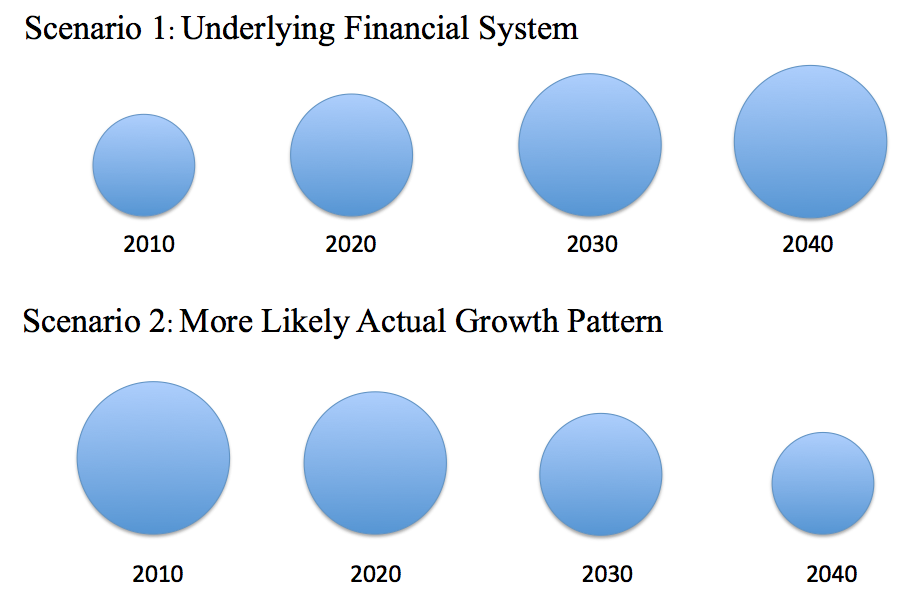
What happens if economy stops growing

Figure 1. Two views of future economic growth. Created by author.


As long as the quantity of resources we can extract from the ground keeps rising faster than population, there is no problem with limits. The tiny wedge that each person might get from these growing resources represents more of that resource, on average. Citizens can reasonably expect that future pension promises will be paid from the growing resources. They can also expect that, in the future, the shares of stock and the bonds that they own can be redeemed for actual goods and services.


If the quantity of resources starts to shrink, the problem we have is almost a “musical chairs” type of problem.


Figure 2. Circle of chairs arranged for game of musical chairs. Source


In each round of a musical chairs game, one chair is removed from the circle. The players in the game must walk around the outside of the circle. When the music stops, all of the players scramble for the remaining chairs. Someone gets left out.


The players in today’s economic system include


  • High paid (or elite) workers

  • Low paid (or non-elite) workers

  • Businesses

  • Governments

  • Owners of assets (such as stocks, bonds, land, buildings) who want to sell them and exchange them for today’s goods and services

If there is a shortage of a resource, the standard belief is that prices will rise and either more of the resource will be found, or substitution will take place. Substitution only works in some cases: it is hard to think of a substitute for fresh water. It is often possible to substitute one energy product for another. Overall, however, there is no substitute for energy. If we want to heat a substance to produce a chemical reaction, we need energy. If we want to move an object from place to place, we need energy. If we want to desalinate water to produce more fresh water, this also takes energy.


The world economy is a self-organized networked system. The networked system includes businesses, governments, and workers, plus many types of energy, including human energy. Workers play a double role because they are also consumers. The way goods and services are allocated is determined by “market forces.” In fact, the way these market forces act is determined by the laws of physics. These market forces determine which of the players will get squeezed out if there is not enough to go around.


Non-elite workers play a pivotal role in this system because their number is so large. These people are the chief customers for goods, such as homes, food, clothing, and transportation services. They also play a major role in paying taxes, and in receiving government services.


History says that if there are not enough resources to go around, we can expect increasing wage and wealth disparity. This happens because increased use of technology and more specialization are workarounds for many kinds of problems. As an economy increasingly relies on technology, the owners and managers of the technology start receiving higher wages, leaving less for the workers without special skills. The owners and managers also tend to receive income from other sources, such as interest, dividends, capital gains, and rents.


When there are not enough resources to go around, the temptation is to use technology to replace workers, because this reduces costs. Of course, a robot does not need to buy food or a car. Such an approach tends to push commodity prices down, rather than up. This happens because fewer workers are employed; in total they can afford fewer goods. A similar downward push on commodity prices occurs if wages of non-elite workers stagnate or fall.


If wages of non-elite workers are lower, governments find themselves in increasing difficulty because they cannot collect enough taxes for all of the services that they are asked to provide. History shows that governments often collapse in such situations. Major defaults on debt are another likely outcome (Figure 3). Pension holders are another category of recipients who are likely to be “left out” when the game of musical chairs stops.


Figure 3 – Created by Author.


The laws of physics strongly suggest that if we are reaching limits of this type, the economy will collapse. We know that this happened to many early economies. More recently, we have witnessed partial collapses, such as the Depression of the 1930s. The Depression occurred when the price of food dropped because mechanization eliminated a significant share of human hand-labor. While this change reduced the price of food, it also had an adverse impact on the buying-power of those whose jobs were eliminated.


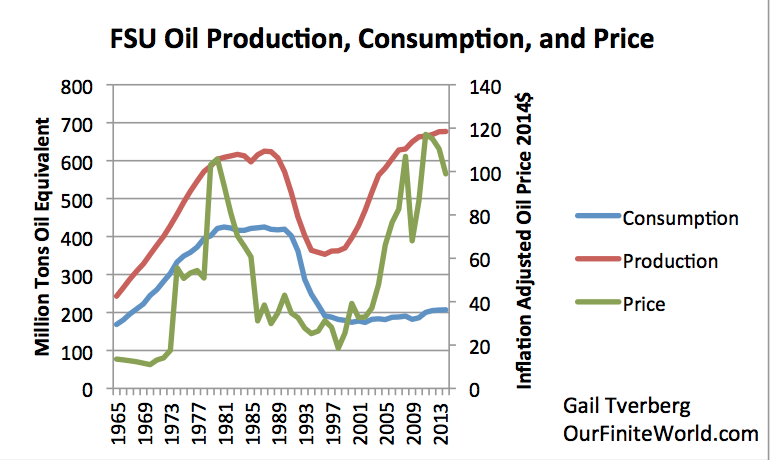
The collapse of the Soviet Union is another example of a partial collapse. This collapse occurred as a follow-on to the low oil prices of the 1980s. The Soviet Union was an oil exporter that was affected by low oil prices. It could continue to produce for a while, but eventually (1991) financial problems caught up with it, and the central government collapsed.


Figure 4. Oil consumption, production, and inflation-adjusted price, all from BP Statistical Review of World Energy, 2015.


Low prices are often a sign of lack of affordability. Today’s oil, coal, and natural gas prices tend to be too low for today’s producers. Low energy prices are deceptive because their initial impact on the economy seems to be favorable. The catch is that after a time, the shortfall in funds for reinvestment catches up, and production collapses. The resulting collapse of the economy may look like a financial collapse or a governmental collapse.


Oil prices have been low since late 2014. We do not know how long low prices can continue before collapse. The length of time since oil prices have collapsed is now three years; we should be concerned.


Myth 2. (Related to Myth 1) If we wait long enough, renewables will become affordable.


The fact that wage disparity grows as we approach limits means that prices can’t be expected to rise as we approach limits. Instead, prices tend to fall as an increasing number of would-be buyers are frozen out of the market. If in fact energy prices could rise much higher, there would be huge amounts of oil, coal and gas that could be extracted.


Figure 5. IEA Figure 1.4 from its World Energy Outlook 2015, showing how much oil can be produced at various price levels, according to IEA models.


There seems to be a maximum affordable price for any commodity. This maximum affordable price depends to a significant extent on the wages of non-elite workers. If the wages of non-elite workers fall (for example, because of mechanization or globalization), the maximum affordable price may even fall.


Myth 3. (Related to Myths 1 and 2) A glut of oil indicates that oil limits are far away. 


A glut of oil means that too many people around the world are being “frozen out” of buying goods and services that depend on oil, because of low wages or a lack of job. It is a physics problem, related to ice being formed when the temperature is too cold. We know that this kind of thing regularly happens in collapses and partial collapses. During the Depression of the 1930s, food was being destroyed for lack of buyers. It is not an indication that limits are far away; it is an indication that limits are close at hand. The system can no longer balance itself correctly.


Myth 4: Wind and solar can save us.


The amount of energy (other than direct food intake) that humans require is vastly higher than most people suppose. Other animals and plants can live on the food that they eat or the energy that they produce using sunlight and water. Humans deviated from this simple pattern long ago–over 1 million years ago.


Unfortunately, our bodies are now adapted to the use of supplemental energy in addition to food. The use of fire allowed humans to develop differently than other primates. Using fire to cook some of our food helped in many ways. It freed up time that would otherwise be spent chewing, providing time that could be used for tool making and other crafts. It allowed teeth, jaws and digestive systems to be smaller. The reduced energy needed for maintaining the digestive system allowed the brain to become bigger. It allowed humans to live in parts of the world where they are not physically adapted to living.


In fact, back at the time of hunter-gatherers, humans already seemed to need three times as much energy total as a correspondingly sized primate, if we count burned biomass in addition to direct food energy.


Figure 6 – Created by author.


“Watts per Capita” is a measure of the rate at which energy is consumed. Even back in hunter-gatherer days, humans behaved differently than similar-sized primates would be expected to behave. Without considering supplemental energy, an animal-like human is like an always-on 100-watt bulb. With the use of supplemental energy from burned biomass and other sources, even in hunter-gatherer times, the energy used was equivalent to that of an always-on 300-watt bulb.


How does the amount of energy produced by today’s wind turbines and solar panels compare to the energy used by hunter-gatherers? Let’s compare today’s wind and solar output to the 200 watts of supplemental energy needed to maintain our human existence back in hunter-gatherer times (difference between 300 watts per hour and 100 watts per hour). This assumes that if we were to go back to hunting and gathering, we could somehow collect food for everyone, to cover the first 100 watts per hour. All we would need to do is provide enough supplemental energy for cooking, heating, and other very basic needs, so we would not have to deforest the land.


Conveniently, BP gives the production of wind and solar in “terawatt hours.” If we take today’s world population of 7.5 billion, and multiply it by 24 hours a day, 365.25 days per year, and 200 watts, we come to needed energy of 13,149 terawatt hours per year. In 2016, the output of wind was 959.5 terawatt hours; the output of solar was 333.1 terawatt hours, or a total of 1,293 terawatt hours. Comparing the actual provided energy (1,293 tWh) to the required energy of 13,149 tWh, today’s wind and solar would provide only 9.8% of the supplemental energy needed to maintain a hunter-gatherer level of existence for today’s population. 


Of course, this is without considering how we would continue to create wind and solar electricity as hunter-gatherers, and how we would distribute such electricity. Needless to say, we would be nowhere near reproducing an agricultural level of existence for any large number of people, using only wind and solar. Even adding water power, the amount comes to only 40.4% of the added energy required for existence as hunter gatherers for today’s population.


Many people believe that wind and solar are ramping up rapidly. Starting from a base of zero, the annual percentage increases do appear to be large. But relative to the end point required to maintain any reasonable level of population, we are very far away. A recent lecture by Energy Professor Vaclav Smil is titled, “The Energy Revolution? More Like a Crawl.”


Myth 5. Evaluation methods such as “Energy Returned on Energy Invested” (EROI) and “Life Cycle Analyses (LCA)” indicate that wind and solar should be acceptable solutions. 


These approaches are concerned about how the energy used in creating a given device compares to the output of the device. The problem with these analyses is that, while we can measure “energy out” fairly well, we have a hard time determining total “energy in.” A large share of energy use comes from indirect sources, such as roads that are shared by many different users.


A particular problem occurs with intermittent resources, such as wind and solar. The EROI analyses available for wind and solar are based on analyses of these devices as stand-alone units (perhaps powering a desalination plant, on an intermittent basis). On this basis, they appear to be reasonably good choices as transition devices away from fossil fuels.


EROI analyses don’t handle the situation well when there is a need to add expensive infrastructure to compensate for the intermittency of wind and solar. This situation tends to happen when electricity is added to the grid in more than small quantities. One workaround for intermittency is adding batteries; another is overbuilding the intermittent devices, and using only the portion of intermittent electricity that comes at the time of day and time of year when it is needed. Another approach involves paying fossil fuel providers for maintaining extra capacity (needed both for rapid ramping and for the times of year when intermittent resources are inadequate).


Any of these workarounds is expensive and becomes more expensive, the larger the percentage of intermittent electricity that is added. Euan Mearns recently estimated that for a particular offshore wind farm, the cost would be six times as high, if battery backup sufficient to even out wind fluctuations in a single month were added. If the goal were to even out longer term fluctuations, the cost would no doubt be higher. It is difficult to model what workarounds would be needed for a truly 100% renewable system. The cost would no doubt be astronomical.


When an analysis such as EROI is prepared, there is a tendency to leave out any cost that varies with the application, because such a cost is difficult to estimate. My background is in actuarial work. In such a setting, the emphasis is always on completeness because after the fact, it will become very clear if the analyst left out any important insurance-related cost. In EROI and similar analyses, there is much less of a tieback to the real world, so an omission may never be noticed. In theory, EROIs are for multiple purposes, including ones where intermittency is not a problem. The EROI modeler is not expected to consider all cases.


Another way of viewing the issue is as a “quality” issue. EROI theory generally treats all types of energy as equivalent (including coal, oil, natural gas, intermittent electricity, and grid-quality electricity). From this perspective, there is no need to correct for differences in types of energy output. Thus, it makes perfect sense to publish EROI and LCA analyses that seem to indicate that wind and solar are great solutions, without any explanation regarding the likely high real-world cost associated with using them on the electric grid.


Myth 6. Peer reviewed articles give correct findings.


The real story is that peer reviewed articles need to be reviewed carefully by those who use them. There is a very significant chance that errors may have crept in. This can happen because of misinterpretation of prior peer reviewed articles, or because prior peer reviewed articles were based on “thinking of the day,” which was not quite correct, given what has been learned since the article was written. Or, as indicated by the example in Myth 5, the results of peer reviewed articles may be confusing to those who read them, in part because they are not written for any particular audience.


The way university research is divided up, researchers usually have a high level of specialized knowledge about one particular subject area. The real world situation with the world economy, as I mentioned in my discussion of Myth 1, is that the economy is a self-organized networked system. Everything affects everything else. The researcher, with his narrow background, doesn’t understand these interconnections. For example, energy researchers don’t generally understand economic feedback loops, so they tend to leave them out. Peer reviewers, who are looking for errors within the paper itself, are likely to miss important feedback loops as well.


To make matters worse, the publication process tends to favor results that suggest that there is no energy problem ahead. This bias can come through the peer review process. One author explained to me that he left out a certain point from a paper because he expected that some of his peer reviewers would come from the Green Community; he didn’t want to say anything that might offend such a reviewer.


This bias can also come directly from the publisher of academic books and articles. The publisher is in the business of selling books and journal articles; it does not want to upset potential buyers of its products. One publisher made it clear to me that its organization did not want any mention of problems that seem to be without a solution. The reader should be left with the impression that while there may be issues ahead, solutions are likely to be found.


In my opinion, any published research needs to be looked at very carefully. It is very difficult for an author to move much beyond the general level of understanding of his audience and of likely reviewers. There are financial incentives for authors to produce PC reports, and for publishers to publish them. In many cases, articles from blogs may be better resources than academic articles because blog authors are under less pressure to write PC reports.


Myth 7. Climate models give a good estimate of what we can expect in the future.


There is no doubt that climate is changing. But is all of the hysteria about climate change really the correct story?


Our economy, and in fact the Earth and all of its ecosystems, are self-organized networked systems. We are reaching limits in many areas at once, including energy, fresh water, the number of fish that can be extracted each year from oceans, and metal ore extraction. Physical limits are likely to lead to financial problems, as indicated in Figure 3. The climate change modelers have chosen to leave all of these issues out of their models, instead assuming that the economy can continue to grow as usual until 2100. Leaving out these other issues clearly can be expected to overstate the impact of climate change.


The International Energy Agency is very influential with respect to which energy issues are considered. Between 1998 and 2000, it did a major flip-flop in the importance of energy limits. The IEA’s 1998 World Energy Outlook devotes many pages to discussing the possibility of inadequate oil supplies in the future. In fact, near the beginning, the report says,


Our analysis of the current evidence suggests that world oil production from conventional sources could peak during the period 2010 to 2020.


The same report also mentions Climate Change considerations, but devotes many fewer pages to these concerns. The Kyoto Conference had taken place in 1997, and the topic was becoming more widely discussed.


In 1999, the IEA did not publish World Energy Outlook. When the IEA published the World Energy Outlook for 2000, the report suddenly focused only on Climate Change, with no mention of Peak Oil. The USGS World Petroleum Assessment 2000 had recently been published. It could be used to justify at least somewhat higher future oil production.


I will be the first to admit that the “Peak Oil” story is not really right. It is a halfway story, based on a partial understanding of the role physics plays in energy limits. Oil supply does not “run out.” Peak Oilers also did not understand that physics governs how markets work–whether prices rise or fall, or oscillate. If there is not enough to go around, some of the would-be buyers will be frozen out. But Climate Change, as our sole problem, or even as our major problem, is not the right story, either. It is another halfway story.


One point that both Peak Oilers and the IEA missed is that the world economy doesn’t really have the ability to cut back on the use of fossil fuels significantly, without the world economy collapsing. Thus, the IEA’s recommendations regarding moving away from fossil fuels cannot work. (Shifting energy use among countries is fairly easy, however, making individual country CO2 reductions appear more beneficial than they really are.) The IEA would be better off talking about non-fuel changes that might reduce CO2, such as eating vegetarian food, eliminating flooded rice paddies, and having smaller families. Of course, these are not really issues that the International Energy Association is concerned about.


The unfortunate truth is that on any difficult, interdisciplinary subject, we really don’t have a way of making a leap from lack of knowledge of a subject, to full knowledge of a subject, without a number of separate, partially wrong, steps. The IPCC climate studies and EROI analyses both fall in this category, as do Peak Oil reports.


The progress I have made on figuring out the energy limits story would not have been possible without the work of many other people, including those doing work on studying Peak Oil and those studying EROI. I have also received a lot of “tips” from readers of OurFiniteWorld.com regarding additional topics I should investigate. Even with all of this help, I am sure that my version of the truth is not quite right. We all keep learning as we go along.


There may indeed be details of this particular climate model that are not correct, although this is out of my area of expertise. For example, the historical temperatures used by researchers seem to need a lot of adjustment to be usable. Some people argue that the historical record has been adjusted to make the historical record fit the particular model used.


There is also the issue of truing up the indications to where we are now. I mentioned the problem earlier of EROI indications not having any real world tie; climate model indications are not quite as bad, but they also seem not to be well tied to what is actually happening.


Myth 8. We don’t need religion; our leaders are all knowing and all powerful.


We are fighting a battle against the laws of physics. Expecting our leaders to win in the battle against the laws of physics is expecting a huge amount. Some of the actions of our leaders seem extraordinarily stupid. For example, if falling interest rates have postponed peak oil, then proposing to raise interest rates, when we have not fixed the underlying oil depletion problem, seems very ill-advised.


Everything I have seen indicates that there is a literal Higher Power governing our world economy. It is the Laws of Physics that govern the world economy. The Laws of Physics affect the world economy in many ways. The economy is a dissipative structure. Energy inputs allow the economy to remain in an “out of equilibrium state” (that is, in a growing state), for a very long period.


Eventually the ability of any economy to grow must come to an end. The problem is that it requires increasing amounts of energy to fight the growing “entropy” (higher energy cost of extraction, need for growing debt, and rising pollution levels) of the system. The economy must come to an end, just as the lives of individual plants and animals (which are also dissipative structures) must come to an end.


People throughout the ages have been in awe of how this system that provides growth works. We get energy from the sun. This solar energy helps grow our food. It allows the physical growth of humans. It allows the growth of ecosystems and of economies. Humans, ecosystems, and economies seem permanent, but eventually they all must collapse. In physics terms, they are all dissipative structures.


Humans have been in awe of the self-organizing property permitted by flows of energy for as long as humans have had the ability to think abstract thoughts. These flows allow a newly created whole to be greater than the sum of their parts. For example, babies start from a small beginning and mature into adults. Musical notes go together to form recognizable melodies. Physical movements go together to form dances. Awe for this phenomenon seems to be one of the origins of religion.


Another reason for religions is a need for hierarchical structure within an economy. We know that animal groups very often have “pecking orders.” Adding a god provides a convenient way of adding a “top level” to the pecking order. Of course, if leaders can convince members of the group that they are all knowing and that science can provide all of the answers, then the top level provided by religion is not needed.


A third reason for religions is to help align the thoughts of members in a particular way. Most of us are aware of the power of magnetized materials.


Figure 7. Source.


To some extent, the same power exists when the belief systems of groups of people can be aligned in the same direction. For example, teachers find it much easier to teach large groups of students, if parents have emphasized the importance of school and the need for respect for teachers. A military leader can attack another country, if soldiers follow orders. A group of generally uncivilized people can learn the benefit of working with others, if proper instruction is given.


What has been astounding to me, as I have looked into the situation, is that the scientific evidence seems to point in the direction of a literal Higher Power governing our Universe. It is not clear whether this higher power is the Laws of Physics, or whether it is some outside “God” that created the Laws of Physics.


In the past, many researchers assumed that the Universe was a closed energy system, irreversibly headed toward a cold, dark end. Recent research indicates that the Universe is ever-expanding, and in fact, seems to be expanding at an accelerating rate. While individual dissipative structures are constantly encountering more and more entropy, the universe as a whole is perhaps expanding rapidly enough to “outrun” growing entropy. Thus, it can behave as an always-open system. This always-open energy system allows many types of objects to self-organize and grow, at least for a time. These objects behave as dissipative structures, each having a beginning and an end.


We really don’t know whether the Universe had a beginning. Some research suggests that it did not. Others believe it began with a Big Bang.


Within the Universe, the earth seems extremely unusual. In fact, it is not clear that there is any other planet that has exactly the right conditions for complex life. A recent American Scientist article discusses this issue. The book Rare Earth: Why Complex Life Is Uncommon in the Universe points out the huge number of coincidences that were necessary for complex life to form and flourish.


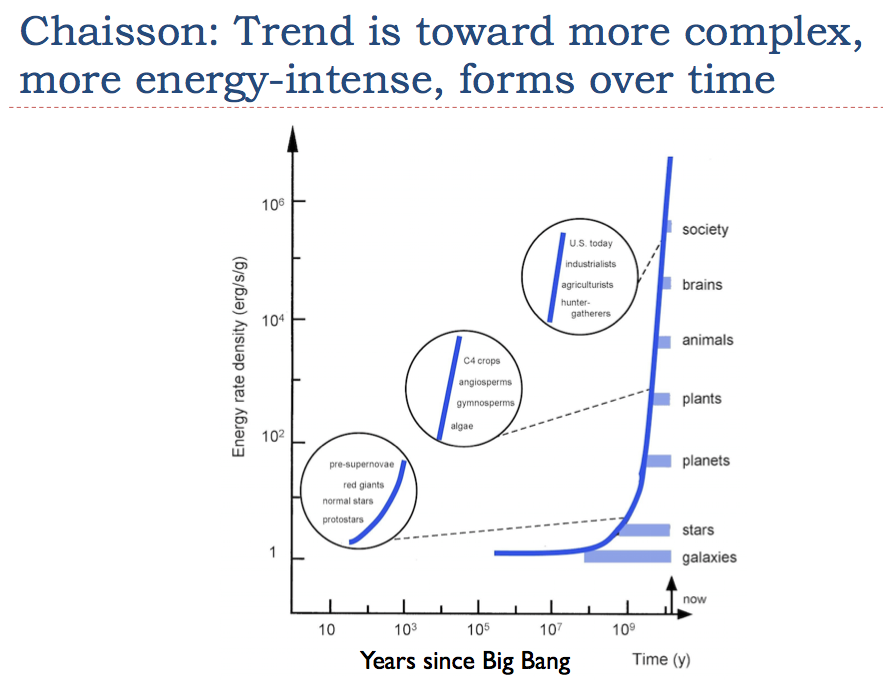
Within the Earth, and perhaps within the Universe as a whole, human economies are the most energy-dense form of structure found.


Figure 8. Image similar to ones shown in Eric Chaisson’s 2001 book, Cosmic Evolution: The Rise of Complexity in Nature.


Thus, in some sense, we humans and our economies may, in some sense, represent the current upper bound on development in the Universe.


We humans live on Earth. It is easy for us to think that our primary purpose in life is to care for and protect the Earth. Unfortunately, with our need for supplemental energy, this is not possible. Even at an early date, our need for resources exceeded what was sustainable. Joshua (in Joshua 17:14-18 relating to the period around 1400 BCE) instructs the tribes of Joseph to clear the trees from the hill country to have enough land for his tribe. This practice was clearly unsustainable; it would lead to erosion of the soil on hilltops. Even at that early date, high population and the need for resources to provide for this high population was conflicting with earth’s sustainability.


If our God is either the Laws of Physics, or some force giving rise to the Laws of Physics, then our God is really the God of the Universe. The limitations of the current Earth are no problem. God (or the Laws of Physics) could create a new Earth, or 1 million new Earths, if He chose to. Thus, from God’s point of view, it is not clear that there is any point to today’s environmentalism. There is a need not to poison ourselves, but “saving the earth” for other species after humans, or for a new set of humans who somehow will use much less energy, doesn’t make much sense. Humans can’t use much less energy; even if we could, our energy use would always be on an upward slope, headed to precisely where we are now.


There are many things that we can’t know for certain. Does this God want/expect us to worship him? Does this God plan an afterlife for some or all of the humans on Earth today? Obviously, if God (or the Laws of Physics) could create the Earth, God could also create other structures as well–possibly a “Heaven.” It is not clear to me that any one of today’s religions has a monopoly on insights regarding what is expected. A person might argue that we need not worry about religion at all, except for the fellowship it provides and the insights it offers regarding how early people coped with their difficulties.


Myth 9. The texts of religious groups around the world are literally true.


The texts of religious groups are true in the same sense that peer reviewed scientific literature is true. They represent, more or less, the best thinking of the day on a particular subject. This certainly does not mean that they are literally true.


We need to read religious texts in the context that they were written. In the earliest days, religious texts represented stories that people passed down from one generation to the next. These stories represented insights that these early people had gained. No one at that time was too concerned about authorship. If a story says, “God said,” it could also mean, “We think that this is something that God might have said.”


Literary styles were very different, back in an era before people pretended to have scientific knowledge. People created stories illustrating some aspect of a particular phenomenon. These stories were not supposed to fully describe what happened. This is why Genesis features two different creation stories.


The Bible makes liberal use of hyperbole and exaggeration. It is hard for people who are not familiar with the original language to understand how stories were intended to be interpreted. Is the concept of Hell added, primarily to provide a contrast to Heaven? In the Old Testament, the number of words in the ancient Hebrew language is much smaller than in today’s languages. This, by itself, makes direct translation difficult.


The earliest religious stories explained how God was perceived at that time. As people became more settled, their views changed. People were getting more “civilized.” Population densities were rising. The best beliefs in an early period may not have had relevance for a later period. This is why most religions have had reformers. Sometimes new writings are added. At other times, the way the writings are interpreted changes. This is why there seems to be a bizarre progression of stories from the Old Testament to the New Testament; new stories needed to be added to supplement and replace old ways of thinking.


Some of the things that early people discovered have not been understood by environmentalists. Genesis 1:28 says,


God blessed them and said to them, “Be fruitful and increase in number; fill the earth and subdue it. Rule over the fish in the sea and the birds in the sky and over every living creature that moves on the ground.”


The early people had figured out that humans were indeed different from other animals and plants. Their use of supplemental energy gave them power over other creatures. Their numbers could (and indeed, did) increase. Early authors were documenting how the world really worked. We later humans have been too blind to see the real situation. It is more pleasant for us to think that somehow we are just like other animals, except perhaps smarter and more in control. With our greater knowledge, we could somehow have avoided an increase in our numbers, if we had only planned better. The laws of physics say this cannot happen; our higher energy use dictates who will win the battle for resources.


The early religious stories were not too different from Peak Oil and Climate Change. They were sort of right. They gave partial insight. They were the best the authors could do at the time.


The ancient religious documents could not tell the whole story at once. New groups would gradually add more insights to the developing story, providing a better understanding of what was truly important for people living in a later period.


Conclusion


In practice, people need a religion or a religion-substitute. People need a basic set of beliefs with which to order their lives.


Our leaders today have proposed the Religion of Success, with its belief in Science, and the power of today’s leaders, as the new religion. This religion has appeal, because it denies the limits we are up against. Life will continue, as if we lived on a flat earth with unlimited resources. This story is pleasant, but unfortunately not true.


Donald Trump, with his version of conservatism, presents another religion. This religion seems to be focused on justifying the allocation of wealth away from the poor, toward the rich, through tax breaks for corporations and the wealthy. This is part of the process of “freezing out” the poor people of the world, when there are not enough resources to go around.


It is hard for me to support Trumpism, even though I recognize that in the animal world, the expected outcome when there are not enough resources to go around is “survival of the best-adapted.” If our concern is leaving energy resources in the ground for future generations, transferring buying power from the poor to the rich is a way of collapsing the economy quickly, while considerable resources remain in the ground. The fact that wealthy people are favored ensures that at least some people will survive.


China and Japan both have what are close to state religions, created by their leaders. School children learn stories regarding what is important, based on what state leaders tell them. In Japan, school children visit religious sites, and learn the proper religious observances. They also learn rules about what is expected of them–always be polite; respect those in charge; don’t eat food on the street; never leave any food wrappers on the ground. In many ways, these religions are probably not too different from today’s Religion of Success.


I personally am not in favor of religions that originate from political groups. I would prefer the “old fashioned” religions based on ancient documents from one or another of the world’s religions. We are clearly facing a difficult time ahead. Perhaps early people had insights regarding how to deal with troubled times. Admittedly, we don’t know for certain that heaven can be in our future. But when things look bleak, it is helpful to see the possibility of a reasonable outcome.


Furthermore, religious groups offer the possibility of finding a group of like-minded individuals to make friends with. We need all of the support we can get as we go through troubled times.

Friday, September 15, 2017

WTI Crude Fails At $50 Again As Rig Count Tumbles Most In 8 Months

As Texas slowly normalizes from Hurricane Harvey"s impact, production has rebounded but the rig count continues to tumble (down 7 to 749 this week). This is the biggest weekly drop in oil rigs since Jan 2017 and June 2016. WTI Crude futures have once again tested $50 (and failed) this morning.


This is the 5th week in a row with no increases in oil rig counts.


The massive collapse in US crude production last week - with most of Texas offline - has recovered somewhat with a 572k surge in production this week. However, it is clear that levels of production are well off pre-Harvey levels...


WTI retested $50 this morning, and failed, but RBOB gasoline is on the rise...“The dollar is once again weakening and that is adding some support to oil too”


However, some remain bulish - “The market is realizing that demand is a lot stronger than there was given credit for,” says Phil Flynn, senior market analyst at Price Futures Group. “The untold story hidden behind the glut has been the demand growth”

Tuesday, September 12, 2017

Ugly, Tailing 10Y Auction: Lowest Indirects Since 2016

If yesterday"s 3Y auction was ugly, today"s $20 billion 9-year-11 month reopening was just as abysmal.


With a high yield of 2.18%, this was not only a whopping 1.1bp tail to the 2.169% When Issued, it was the 6th consecutive "tail" in a row, with just 2 10Y auction stopping through so far in 2017 (January and March). That said, the yield was also the lowest since November, which may explain some of the weak bidside interest.


The internals were ugly, with a Bid to Cover of 2.28, fractionally above August"s 2.23, but well below the 6 month average. Just like yesterday, foreign bidders balked, and the Indirect award was a paltry 55.3%, down from 57.9% last month, and below the 63.4% average. This was the lowest Indirect award since November 2016. With Directs once again in line, at 6.0%, just below the 6.8% last month, it was the Dealers who had to step up and they do, taking 38.7% of the final allottment, the highest since November, and well above the 29.3 6 month average.


Finally, what likely prevented today"s auction from printing notably better, is that the recent record specials in repo, which last week hit a sub-fails rate of -3.75%, was completely gone as of this morning, and the 10Y traded at 0.00% in repo at 8am on Tuesday. And with no shorts to squeeze, the result was as expected.


Friday, September 8, 2017

Robert Murphy: 3 'Good' Things About "Price-Gouging"

As so often happens in the wake of a natural disaster, government officials in Texas are currently investigating claims of “price gouging,” which the office of the Attorney General reminds residents is illegal after the governor declares a disaster. This is a classic example of the ostensible contrast between greed and altruism, capitalism and charity.


Economists who favor the free market know the standard arguments for letting the price skyrocket to “clear the market” when there are supply shortages and demand spikes. These are important arguments, and indeed I will review them below.


At the same time, I think in our zeal to lecture the public on the efficient allocation of resources, we economists often forget to stress an important aspect of private morality when disaster strikes. Specifically, if certain individuals experience a genuine “windfall gain” simply because they happen to be holding goods that suddenly become very scarce, then these individuals can donate their windfall to support relief efforts. In this way, there is no question of them profiting from their neighbors’ suffering. Market prices are still able to perform their valuable function of communicating information about supplies and demands to everyone in the system, while the losses imposed by nature are more evenly distributed because of charitable assistance given from the lucky to the unlucky.


The Standard Arguments for Letting Prices Clear the Market


After a natural disaster, the supplies of certain items — such as bottled water, gasoline, flashlights, and canned goods — become much more rigid, while the demand for these items goes through the roof. Consequently, the “market-clearing price,” at which the quantity supplied equals the quantity demanded, also may rise quite significantly. (There were reports of a convenience store in Houston charging $99 for a case of bottled water and $20 for a gallon of gasoline.)


It’s obvious why most people would find this outcome horrendous, and that government officials would reassure the public that such behavior won’t be tolerated.


Even so, free market economists stress the social benefits of allowing the price to rise in this scenario. We can break these benefits into those emanating from the supply side and those emanating from the demand side. (For an excellent discussion, listen to David R. Henderson’s recent appearance on the Tom Woods Show.)


Benefit 1: Calling in More Supplies 


On the supply side, a much higher price acts as a loudspeaker telling the rest of the world: “Houston wants a lot more bottled water and gasoline!” Even though we might casually say that after a natural disaster, the supply of these items is fixed, strictly speaking that isn’t correct. Except in the most outrageous circumstances (such as an avalanche or radiation leak), outsiders can bring in additional amounts of these precious items.


It’s certainly true that morality comes into play here. For example, a convenience store owner who lives only an hour from Houston, and who has a big van, might decide to cancel his golf plans to instead make a few trips to either donate or sell “at cost” whatever supplies he has, in order to do his part in relieving suffering. Most Americans would probably say that was “the right thing to do” for somebody who found himself in that situation, when the news reported just how bad the flooding was.


But what about a convenience store owner who lives six hours from Houston? Is it acceptable for him to charge a bit more than “cost” or even “normal retail price” in order to recoup some of the sacrifice he would have to make — not just counting the gas in his vehicle but also the opportunity cost of missing work — if he were to make one or more round trips?


As we change the circumstances, Americans would begin to disagree about the exact moral obligations of various people who happened to have access to much-needed goods. But we can certainly agree that in practice more people would end up deciding to help move water, gasoline, flashlights, and other items into Houston, the more we allowed them to charge for these items once they unloaded them in the beleaguered city.


Also keep in mind that this “upward sloping supply curve” — meaning that as the price rises, there are more units of bottled water (say) in Houston — doesn’t just operate geographically, but it also operates temporally.


Benefit 2: Storing Up Goods for Emergency Use 


For example, suppose the manager of a grocery store hears on the news that a hurricane is approaching. If she believes the authorities will let her charge whatever the market will bear, then she might decide to stock the warehouse with extra cases of water, flashlights, batteries, generators, etc. She knows that if the storm turns out to be a nothingburger, she will have to run a big sale the following week, in order to clear out the excess inventory. (After all, she presumably already had the optimal amount of inventory before the impending hurricane made her bulk up the warehouse.)


However, so long as our hypothetical grocery store manager knows she will be legally allowed to charge (say) quadruple the normal price in the event of flooding, then she will probably err on the side of loading up the warehouse with more units, compared to her decisions if she knows that the authorities will punish her for “gouging” her customers.


Similar reasoning holds for gas station owners, who might have the ability to load up on unusually large amounts of inventory — perhaps by having extra trucks come in, and remain on their property — but would only be willing to incur this extra expense, if they thought there were a possibility the market price of gasoline would break (say) $10 and that the authorities would allow them to charge such prices.


As these examples illustrate, the amount of bottled water, gasoline, batteries, etc. “on hand” in Houston when the hurricane struck is itself influenced by the attitude of the authorities toward “price gouging.” Business owners and pure speculators didn’t ship in as much of these goods as they would have done, in an environment in which voluntary transactions were sacrosanct legally.


In his interview with Tom Woods, Henderson also made a very subtle point about high prices inducing owners to carry goods forward in time. I’ll illustrate his point with a hypothetical story: In the current legal environment, with prohibitions against “gouging,” a Houston store owner sitting on a few pallets of bottled water would probably just unload them all on Day 1 and leave town, because there would be nothing else for him to do. However, if the authorities and the public didn’t condemn owners for charging the true market price, such a person might reason, “Right now bottled water is selling for $10 per case in this neighborhood. But if the rain doesn’t stop and it takes longer than people expect for the streets to clear, it’s entirely possible that I could hold back 50 of my remaining cases in the back storeroom, and then sell them for $50 each in a few days. The prospect of getting an extra $2000 totally makes it worth my while to sleep here in the store for a few days, rather than leaving Houston.”


This type of analysis shows that we want high prices not simply to tell businesses in Arkansas that they should sell some of their bottled water in Houston, rather than unloading it all in Little Rock, but also to tell businesses in Houston that they should sell some of their bottled water on Day 5 after the hurricane rather than unloading it all on Day 1.


Benefit 3: Encouraging Conservation 


In the previous section we outlined the social benefits of high prices coming from the increased quantity supplied of the crucial items. On the flip side, letting prices rise will also encourage conservation among the end users, so that any given supply of items is “rationed” among people more uniformly.


Consider bottled water. Once the storm hits and a particular family knows they will be stuck in Houston for several days with flooded streets, the first inclination might be to run to the store and stock up on needed items. At the normal retail price, a mother might buy 10 cases of bottled water, not only for drinking but also in case they need to use it for (say) boiling pasta. After all, who knows how long the utilities might be knocked out? She reasons that she can store the cases in her pantry and draw the water down over the next two months, if it turns out that things go back to normal sooner rather than later. There’s no harm in stocking way up on water, just in case.


But of course, this is exactly what we don’t want people to do, in a situation where there are only (say) 3 cases of bottled water per stranded family in the city. We want the people who hit the stores before their neighbors to be very judicious in how much they buy, because they need to leave other units on the shelves for the next families who show up.


This is exactly what an “unconscionable” price will do. If the store is charging $20 for a case of water that normally retails for $4, our hypothetical mother won’t so casually load 10 cases into her SUV. After that sticker shock, suddenly boiling pasta with bottled water won’t seem as appealing. Maybe she’ll only buy 3 cases of water, and get some cans of tuna fish and protein bars instead.


When it comes to gasoline, there is a particular perversity of anti-gouging rules in the case of an impending storm. Imagine yourself as a military commander, who has thousands of vehicles you need to move away from the coast, and you only have a limited amount of fuel on your coastal base. However, there are plenty of refueling depots a few hours inland. What do you do?


The obvious solution is to only allow your troops to put enough fuel in their vehicles to make it to next refueling station. This spreads the available fuel around so that you can evacuate as many vehicles as possible.


Now back to the real world: In the path of an incoming storm, where thousands of people want to evacuate the coast, depending on refinery interruptions and other bottlenecks, it’s possible that some local stations will run out of gas if they don’t raise their prices significantly. The people who are lucky enough to get to the stations first will naturally fill the tank up, before getting on the interstate to get out of Dodge. Then the unlucky followers will see the gas station is empty, and may end up stalling on the interstate. The authorities then have a problem of dealing with stranded motorists who are stuck not because of flooding, but because they ran out of fuel during their escape.


In contrast, if the few relevant station owners charge $15 per gallon, then people who had (say) a half-tank in their car when the storm hit, will say, “That’s outrageous!” and get back on the highway, to see if prices are any better in another 50 miles. At a price of $15, only people who are about to run out of gas will buy any, and even they will only purchase enough to give them some breathing room. They too will probably take their chances and hope that gas is cheaper if they move away from the storm. Just as our hypothetical military commander, the decentralized price system allocates the scarce fuel among the vehicles to allow as many as possible to evacuate.


Is It Moral to Profit While Others Suffer?


Some people on social media heard these familiar economist arguments, but pushed back. “Yeah, we get your points about ‘efficiency,’” they said. “But let’s face it: During a disaster, plenty of heroes rise to the challenge, putting themselves in harm’s way in order to do what they can to help people in need. It is simply wrong for some convenience store owner who had just coincidentally gotten in a shipment of bottled water the day before, to effectively hit the lotto while his neighbors lose their house.”


I am sympathetic to this point, and I agree that typical libertarian economists often come across as coldhearted and seem detached from this everyday morality. (Indeed, this was the position I took in my concluding essay to the Independent Institute’s new book, Pope Francis and the Caring Society.)


Yet rather than prohibit owners from charging “what the market will bear,” I think a better way to avoid personally profiting from the tragedy of others is to suggest that they donate their genuine “windfalls” to relief efforts.


For example, consider a convenience store owner who happens to be sitting on 100 cases of bottled water that he normally sells for $4. (Assume he didn’t take any special measures to bulk up before the storm hit; this is the inventory he would have been holding in any case.) Because of the flooding, he realizes he could probably charge $14 and still sell out. So there is a potential $1,000 ( = $10 margin of “gouging” x 100 cases) in pure windfall profit he could make.


The conventional moralists would say no, he should keep his price at $4. But they have in mind that he would otherwise take that $1,000 and pocket it.


Suppose instead, however, that the owner charges the full $14, but then donates his $1,000 windfall to a local relief effort that is handing out free packets of food and dry clothes to families who were flooded out of their homes and have literally nothing (including wallets). Or to make the point even more clearly, suppose he donates the $1,000 windfall to a local organization that uses the money to buy bottled water and hand it out to desperate people?


Once we go down this path, we see that the insistence on charging only $4 for the cases of water really just means that our hypothetical store owner is concentrating his $1,000 worth of charity on the particular Houstonians who happen to walk into his store and pull out their credit card to make a big purchase. What are the odds that these people are the ones in Houston most in need of his implicit $1,000 charitable donation that day?


Conclusion


As economists in the Austrian tradition stress more than others, market prices act as signals that allow humans to communicate valuable information with each other.


Just as it would stymie relief efforts if rescue workers couldn’t use cell phones or walkie talkies in a disaster area, by the same token government officials hamper humanity’s ability to recover from a crisis when they prohibit market prices from letting producers and consumers talk to each other.

Thursday, September 7, 2017

WTI/RBOB Drop After Harvey Prompts US Crude Production Collapse, Biggest Inventory Build In 6 Months

Last night"s first glimpse of Harvey"s impact on energy confirmed a sizable crude build but only modest gasoline draw. WTI/RBOB prices slid into the DOE print and extended losses (after a quick kneejerk higher) following a bigger than expected crude build (+4.58mm vs +4mm exp). Gasoline and Distilates saw bigger draws than API reported but it was the collapse in Lower 48 crude production that stood out with most of Texas offline.


API


  • Crude +2.79mm (+4mm exp) - biggest build in 5 months

  • Cushing +669k (+1mm exp)

  • Gasoline -2.544mm (-5.2mm exp) - biggest draw in 6 weeks

  • Distillates -610k

DOE


  • Crude +4.58mm (+4mm exp) - biggest build in 5 months

  • Cushing +797k (+1mm exp)- biggest build in 5 months

  • Gasoline -3.20mm (-5.2mm exp)- biggest draw in 2 months

  • Distillates -1.396mm

The inventory changes reported by the API were much smaller than those forecast by analysts. As a reminder, Saxo Bank"s Ole Hanson notes that "inventory data later is a lot of moving parts which could be quite skewed away from what we’ve seen in recent weeks." Additionally, investors “are going to be skeptical of the data,” James Williams, an economist at energy researcher WTRG Economics, told Bloomberg. “It might be pretty flaky data this week and next, so I don’t expect to see a big market-mover”


Bloomberg"s Fernando Valle notes energy"s past week was all about Hurricane Harvey as refineries shuttered, choking output and hauling down inventories of gasoline and distillates.


Bigger than expected crude build and bigger gasoline and distillate draws than API reported...


Bloomberg"s Fernando Valle points out that the increase in crude inventories was largely expected after the devastating impacts of Hurricane Harvey on the Gulf Coast. The draw on refined product inventories was weaker than expected, as lost demand -- both locally and abroad -- offset lower-than-expected refinery utilization. Investors" focus will now shift to the restart of refineries and export ports.


As one might expect, Gulf Coast imports fell to a record low.


Bloomberg"s David Marino notes that exports tumbled with Texas ports closed.


Crude was the lowest since 2014, before the export limits were lifted. Gasoline fell by more than half to 319,000 barrels a day, the least in four years, and distillate shipments were the lowest since 2011. Look for those numbers to rebound as ports and pipelines reopen fully.


Production declined in the previous week, and with most of Texas ofline last week - Crude production in the Lower 48 collapsed...


This is the biggest week-on-week fall since August 2012, when Hurricane Isaac shut in more than 1.3 million barrels a day of Gulf of Mexico production.


WTI and RBOB have drifted lower after last night"s API data, heading into the DOE data. The kneejerk reaction to the crude build, gas draw and production crash was higher prices...


But that did not last long...


Brent “reached the May high and so far it’s been firmly rejected,” says Ole Hansen, head of commodity strategy at Saxo Bank. “It’s quite significant if we are getting a decent rejection here as it could indicate a short-term top in the market”


“It’s a market that is starting to struggle to move much higher, Brent crude up to $55 is probably as good as it gets at this stage”: Hansen

Tuesday, September 5, 2017

Debt Ceiling Turmoil: 4Wk Bills Price At Highest Yield Since Sept 2008 On Technical Default Fears

While traditionally few care about T-Bill auction results, which are usually a rather subdued affair, today was different: with today"s $20 billion in 4-Week Bills maturing on October 5, or smack in the middle of the interval when the US is expected to run out of cash absent a debt ceiling deal, there was palpable turmoil in the Bills market, as the yield on the just concluded auction demonstrated.


With the When Issued trading at 1.23%, the just priced auction printed at a high yield of 1.30%, what appears to be a record tail of7 bps, and the highest yield since September 2008. It is also an indication that for all the talk of a reduction in government shutdown/debt ceiling crisis odds, the market will have none of it, as the ongoing "king" in the October bills demonstrates.


The internals were mostly remarkable for the soaring yields, with other components coming roughly in line.:


  • High yield 1.300% vs prior six auction average 0.966%

  • Bid-to- cover 3.04 vs prior six auction average 3.07

  • Dealers awarded 58.5% vs previous six auction average 64.7%

  • Direct bidders awarded 16.9% vs prior six auction average 8.6%

  • Indirect bidders awarded 24.6% vs prior six auction average 26.6%

Putting the latest T-Bill "Kink" in perspective, the chart below shows just how high the Sept-Oct "hump" has blown out to following the auction.


Friday, September 1, 2017

Hurricane Harvey Looters Targeting Fuel Tanks As Google Searches For "How To Siphon Gas" Soar

Texas resident Joe Roan woke up to a rather unpleasant surprise yesterday morning as he discovered the remnants of a would-be thief attempting to steal gasoline from his Jeep Wrangler tank.  Unfortunately, as a local CBS affiliate pointed out last night, with refinery outages resulting in growing gasoline shortages, this is becoming a rather common occurrence for Texas residents.


Joe Roan didn’t witness the crime, but he found the evidence in his driveway.


“I came outside this morning and found this water hose was sticking out,” he said, holding the hose a thief left hanging out of his Jeep’s tank.


On the ground sat a gas tank.


“Instantly I knew someone was trying to steal my gas,” he said. “Maybe a car drove by when they were doing it and they ran? I don’t know.”


Roan said the thief didn’t even manage to get any fuel.


Meanwhile, Google searches for "how to siphon gas" have soared as criminals have been forced to hone their skills before taking to the streets.


Siphon


Of course, the rampant onset of gasoline thieves is the result of fuel shortages which are often exacerbated by the pure panic of people trying to keep their tanks topped off. As we"ve reported several times in recent days, long lines at gas stations have become a common sight from the Texas shores up to Dallas.


Meanwhile, one seasoned energy trader warned this is "only just beginning" as the hangover from Hurricane Harvey flows downstream to retail gas prices...


As Bloomberg notes, Harvey impact currently includes:


  • Colonial says it’ll commingle Rbob and conventional gasoline

  • Explorer Pipeline planning to start lines Saturday, Sunday

  • Logjam grows to 29 oil tankers as 11 ports remain closed

  • Total Port Arthur is said facing extended shutdown on power loss

  • Texas storm bucks N.Y. traders with wild gasoline expiry swings

  • NHC issues final advisory on Harvey; losing tropical character

Which has left retail gas prices at the pump at their highest in 2 years...


And, judging by their usual lagged response to RBOB, they are set to go dramatically higher in the next few weeks...


All of which has resulted in the predictable onslaught of price gouging, with the Dallas News reporting sightings of gas prices ranging from $2.99 a gallon to $8....


There were multiple reports of gas stations charging anywhere from $2.99 to $8 for a gallon of regular gas.


At the 76 gas station in Garland, the fuel-price display unit outside showed $8 for a gallon. The station was swamped with calls from angry customers after a photo was posted on social media, according to Robert Fernandez, who works there.


There have been numerous complaints about high gas prices, according to Kayleigh Lovvorn, spokeswoman for the office of Texas Attorney General.


“When evaluating whether a business is engaging in price gouging in the sale of fuel, we look to see if they are charging excessive or exorbitant prices,” Lovvorn said in an emailed statement. “We recognize that certain market conditions, such as decreased production and closed refineries, might cause market fluctuations.”


The attorney general’s office is looking into 984 complaints filed between August 25 and Thursday afternoon. On Thursday alone, its Consumer Protection Division received more than 500 complaints, “many of which involve allegations of high fuel prices in Dallas, including amounts ranging from $6 to $8 dollars per gallon.”


...which is still pretty cheap compared to what Best Buy is charging for water.


Water