Showing posts with label Best Buy. Show all posts

Saturday, November 25, 2017

America"s New "Trick" To Beat Black Friday Crowds: Wear Employee Uniforms

US shoppers’ lust for Black Friday bargains this year has reached absurd new levels, evidenced by a viral joke that morphed into a disturbing new trend to help shoppers beat Wal-Mart and other big box store crowds by disguising themselves as temporary holiday employees. It started when Twitter user @OverlyLiked announcing he would be selling his Walmart vest for $100.


“I’m selling this Walmart vest for $100,” he wrote. “Use it to skip the line during Black Friday. You can even walk in, grab what you want, and walk out."


Although the tweet was reportedly meant as a joke, earning @OverlyLiked more than 30,000 retweets and almost 80,000 likes, it wasn’t long before he was being inundated with real requests to buy his shirt.


“The popularity of the tweet really did not surprise me… What shocked me was the news coverage of that,” @OverlyLiked told RT, explaining that apart from the bidders, he was also sought out by numerous media outlets covering the story.


But @OverlyLiked’s disappointed would-be buyers didn’t need to wait long for other offers to materialize. It seems former and current Wal-Mart employees quickly caught on to the idea and began selling their own uniforms in earnest...


While others went out looking for them,


Meanwhile, Walmart has apparently caught on to the hustle, and has asked its employees to “question” anyone they see wearing one of their vests, but whom they do not recognize.


The American “Black Friday” tradition has intensified in recent years as big-box stores have sought to fend off the encroaching “Cyber Monday” when shoppers order all their items online - read Amazon - instead of trudging through massive crowds at Wal-Mart, Best Buy or any other retail mecca. Retailers typically open late Thursday evening, before the holiday has even ended, to offer massive bargains, prompting nationwide anarchy as dozens of stories and videos emerge of shoppers fighting one another for the cheapest deals on anything from blenders to widescreen TV’s to underwear. The insanity of Black Friday was perhaps encapsulated best by this meme that made the rounds a few years back:


Friday, November 24, 2017

"I Was Expecting Many More People": Black Friday Tumbles To 3rd Spot In Busiest Shopping Days Of The Year

It has been an odd year for retail: with an estimated 6,000 store closures, and 65,000 fewer retail jobs than at the start of the year, many have said shorting retail, and especially malls, is the next "big short" trade. Indeed, one look at the performance of the mall heavy CMBX 6 BBB- tranche confirms that the bottom has fallen out of the legacy "bricks and mortar" space.


And yet, despite what should be a furious race to the bottom for market share by all still solvent non-Amazon retailers, this has not happened in what appears to be a strange manifestation of rational pricing. In fact, according to Market Track, last year the discounts were 6% deeper than this year across 17 categories in Black Friday circulars, the WSJ reports, and notes that only three of 10 major retailers the firm measured had better prices this year.


This was obvious to potential buyers like Delaney Dauchy, 15, who was shopping with her mother at a mall in Thousand Oaks, Calif., and told the WSJ that the deals aren’t as good this year. She recalled a seven-for-$28 deal on underwear at Victoria’s Secret last year; this year, she said it was five-for-$28. The Dauchys said there were smaller crowds than past years and Black Friday deals have been going on all week. “I’m not sure it seems extra special,” Anne Dauchy, 47, said.


To be sure, there are still deals to be had: on Friday, retailers dangled the usual promotions, many of which were identical to last year, including 30% off at Coach and 50% off at the Gap. By Thanksgiving Day, shoppers were already taking advantage of the bargains. Kevin Krause, 27, was first in line waiting outside the Kohl’s store in Medford, Ore., Thanksgiving afternoon. The store opened its doors at 5 p.m., but by 3:15 there was already a line forming.


However, as the WSJ confirmed, lines at many other locations were far shorter - if present at all - compared to prior years, such as this Best Buy at the Fair Lakes Shopping Center in Fairfax Country, VA, where there was virtually no excitement opened this years, especially when compared to 2011.


Then (in 2011)...


... and now.


A similar comparison with Macy"s, which the WSJ compares between 2011 and now. The difference is self-explanatory.


Naturally, in light of the smaller bargains, the lack of shopper euphoria is understandable: yet what is surprising is why there aren"t bigger bargains? After all, neither the industry, nor the economy has turned on a dime. Speculating on the reason, the WSJ writes that "even as this year has proved one of the most challenging for retailers, analysts are predicting robust holiday sales, underpinned by rising wages, low unemployment and strong consumer confidence."


What rising wages? Aside from various "soft" surveys, and management expectations, wage growth remains abysmal, and real wage growth has been negative for three months!


What the WSJ probably means is that between near record low personal savings and a surge in credit card usage, Americans are spending like there"s no tomorrow... they are just not spending their own money.


Anyway, the always optimistic National Retail Federation expects sales to increase as much as 4%, to $682 billion in November and December, compared with the same period a year ago, which would make it the strongest season since 2014. The delusion about US households" spending power continued: "I’d be fully expecting people to be thinking about spending more, not be holding back as much as in the past,” said Andrew Duguay, a senior economist at Prevedere, a predictive analytics company.


Spending more of what?  Here is America"s savings rate: unfortunately people don"t have "more" to spend... 


And yet, maybe the NRF is on to something. In an interview with the WSJ earlier this week, Neiman Marcus Group CEO Karen Katz attributed a jump in the luxury retailer’s gross margin in the latest quarter to stronger full-priced sales. “We’ve gotten our inventory in perfect alignment with our sales,” Katz said.


That could change in the days leading up to Christmas. Shoppers have been trained to wait for deals—a practice made easier by online price comparisons. If they hold off on making purchases, retailers will likely slash prices more than planned as the season progresses.


To be sure, the lack of deals now may mean even greater discounts in the coming months:


In a Long Island, N.Y., Wal-Mart Thursday evening, Andre Valadas said it had been hard to snag one of the discounted Sharp TVs being sold at the store or at a Best Buy across the parking lot, but glanced at his phone often to text with friends nearby looking for a similar deal.


The 34-year-old software engineer expects prices to fall further. “I hope that if they don’t have deals right now they will have a them in a few weeks closer to Christmas,” Mr. Valadas said.


Retailers still have to contend with headwinds that include a shift in consumer spending away from apparel and accessories and toward dining, travel and entertainment, as well as the explosive growth in online sales.


The above is bad news for bricks and mortar retailers, who may have gotten a brief reprieve only to lose even more customers to online alternatives like Amazon.


And speaking of, Adobe Systems said online sales on Thanksgiving increased 17% as of 5 p.m. to $1.52 billion. It also expects online sales to increase 14% to $107.4 billion during the November-December period, compared with the previous year. Amazon said Thanksgiving was one of its biggest mobile shopping days, as orders placed through its app increased 50% over last year. Best selling items included Keurig coffee makers and its Echo speaker devices.


Indeed, no matter what happens to traditional retail, Amazon is likely to be winner. The online retailer, whose stock hit another all time high, is expecting a big Black Friday as more shoppers choose to skip the stores.


“If you go back to the creation of Black Friday, it was this amazing opportunity for customers to get great deals,” said Dorion Carroll, vice president of mobile shopping at Amazon, in an interview earlier this week. “So they would flock to the stores and all of that would be great, until it wasn’t. It got too crowded.”


In fact, it may come as a surprise to some, that Black Friday is no longer the busiest shopping day of the year. It ranks No. 3, behind the Saturday before Christmas and Cyber Monday, according to the consulting firm Customer Growth Partners.


Several dozen people still gathered in line early Friday morning to be the first inside a Target store in Houston when it opened at 6 a.m., though some said the crowds were notably smaller than years past. Once inside, shoppers like Freddy Cespedes, 42, owner of a small security company, found the best advertised stuff was already picked over the night before.


“I was expecting a lot more people,” said the Black Friday novice though he acknowledged he, like many people nowadays, primarily shops online.


Tuesday, October 24, 2017

A Frustrated David Einhorn Asks "Will The Market Cycle Never Turn?"

Just days after Third Point"s Dan Loeb took a victory lap in his latest letter to investors, boasting a 14.5% YTD performance, outperforming the S&P and virtually all of his peers, a decidedly more downcast letter was released today by Greenlight"s David Einhorn, who also had a good quarter, generating 6.2% in Q3, which brought his YTD return to 3.3% after a subpar first half. Yet despite the solid Q3 performance, Einhorn admits that "the market remains very challenging for value investing strategies, as growth stocks have continued to outperform value stocks. The persistence of this dynamic leads to questions regarding whether value investing is a viable strategy. The knee-jerk instinct is to respond that when a proven strategy is so exceedingly out of favor that its viability is questioned, the cycle must be about to turn around. Unfortunately, we lack such clarity. After years of running into the wind, we are left with no sense stronger than, “it will turn when it turns.”


Such an open-ended answer, however, is a problem for a fund which famously opened a basket of "internet shorts" several years prior, and which have continued to rip ever higher, detracting from Greenlight"s overall performance.


This, in turn, has prompted Einhorn to consider the unthinkable alternative: "Might the cycle never turn?" In other words, is the market now permanently broken.


Einhorn goes on to explain that his strategy "relies on the assumption that the equity value of a company equals the market’s best assessment of the current and future profits discounted at the company’s cost of capital. Our ability to outperform often comes from our skill in finding opportunities where the market has misestimated current or future profitability or miscalculated the cost of capital by over- or underestimating the risks."


It is here than an unexpectedly exasperated Einhorn emerges:


Given the performance of certain stocks, we wonder if the market has adopted an alternative paradigm for calculating equity value. What if equity value has nothing to do with current or future profits and instead is derived from a company’s ability to be disruptive, to provide social change, or to advance new beneficial technologies, even when doing so results in current and future economic loss? It’s clear that a number of companies provide products and services to customers that come with a subsidy from equity holders. And yet, on a mark-to-market basis, the equity holders are doing just fine.


Ah yes, the Fed-funded "deflation trade" which lowers prices for goods and services courtesy of ravenous investors who will throw money at any "growth" idea, without considerations for return or profit, because - well - more such investors will emerge tomorrow.  After all, in this day and age of ZIRP, what else will they do with their money.


Here Einhorn took aim at his favorite "bubble" shorts: Amazon, Tesla and Netflix. This is what he said:


When we consider the business performance of our three most well-known “bubble” shorts, we wonder if this alternative paradigm is in play. Last quarter, we noted Amazon.com’s (AMZN) earnings estimates had fallen over the prior few quarters. This quarter, AMZN revealed a much lower level of long-term structural profitability, causing consensus estimates for the next five years to drop by 40%, 22%, 18%, 14% and 8%, respectively. Ordinarily, stocks trading at nosebleed multiples fall sharply when such a dramatic reassessment happens. Instead, AMZN fell less than 1% during the quarter. Our view is that just because AMZN can disrupt somebody else’s profit stream, it doesn’t mean that AMZN earns that profit stream. For the moment, the market doesn’t agree. Perhaps, simply being disruptive is enough.


Tesla (TSLA) had an awful quarter both in its current results and future prospects. In response, its shares fell almost 6%. We believe it deserved much worse. So much went wrong for TSLA in the quarter that it is hard to only provide a brief summary. The main near-term problems are poor demand for its legacy vehicles and manufacturing challenges for the new Model 3. Notably, TSLA dramatically reduced its gross margin assumption for the September quarter and publicly blamed ramp-up costs for the new Model 3 sedan. More quietly, the company used the lower gross margin hurdle to offer incentives and to lower the cost of options on the Model S and Model X vehicles, and even offered significant markdowns on showroom models. Given the depth of the price cuts, we were surprised that demand for the Model S and Model X only improved modestly.


Meanwhile, it is becoming clear that scale manufacturing is actually a skill. While the CEO makes bold claims about TSLA’s superior prowess, continued production shortfalls, defects and product recalls disprove him. TSLA faces competition from established OEMs that have decades of scale manufacturing experience. Some of TSLA’s presumed market lead in areas like autonomous driving may more likely reflect TSLA’s willingness to put inadequately  tested and dangerous products on the road rather than a true technological advantage.


Finally, there is Netflix (NFLX), where the quarterly results beat expectations and the shares advanced 21%. Competition is heating up and media companies such as Disney will be removing their content from NFLX to compete directly (bulls used to believe that Disney would pull a Time Warner/AOL and pay-up for the highly promoted but profitless business). NFLX continues to accelerate its cash burn as it desperately tries to compensate for its inability to rely longer-term on licensed content. On the second quarter conference call, the CEO stated, “In some senses the negative free cash flow will be an indicator of enormous success.” To us, all it indicates is that NFLX is capable of dramatically changing the economics of stand-up comedy in favor of the comedians. Perhaps, there really is a new paradigm for valuing equities and the joke is on us. Time will tell.


Einhorn also highlights the biggest winners and losers in the quarter including CONSOL Energy (CNX), General Motors (GM) and Uniper (Germany: UN01) which were the largest contributors, while Caterpillar (CAT) short and Mylan (MYL) were detractors.


Some more details: Greenlight added long positions in Hewlett Packard Enterprise, Micron and Tempur Sealy; exited a short position on Best Buy and a long position on PVH. The fund"s largest disclosed long positions at quarter end were unchanged from the end of 2Q: AerCap, Bayer, Consol Energy, General Motors and gold. The parternships had an average exposure of 118% long and 73% short.


The full letter is below:


Thursday, September 21, 2017

Ban On Kaspersky Software Exposes The Hypocrisy Of US' Internet Agenda

Authored by Andrei Akulov via The Strategic Culture Foundation,


On September 18, the US Senate voted to ban the use of products from the Moscow-based cyber security firm Kaspersky Lab by the federal government, citing national security risk. The vote was included as an amendment to an annual defense policy spending bill approved by the Senate on the same day. The measure pushed forward by New Hampshire Democrat Jeanne Shaheen has strong support in the House of Representatives, which also must vote on a defense spending bill. The legislation bars the use of Kaspersky Lab software in government civilian and military agencies.


On September 13, a binding directive issued by Acting Secretary of Homeland Security Elaine Duke, ordered federal agencies to remove Kaspersky Lab products from government computers over concerns the Russia-based cybersecurity software company might be vulnerable to Russian government influence. All federal departments and agencies were given 30 days to identify any Kaspersky products in use on their networks. The departments have another 60 days to begin removal of the software. The statement says, «The department is concerned about the ties between certain Kaspersky officials and Russian intelligence and other government agencies, and requirements under Russian law that allow Russian intelligence agencies to request or compel assistance from Kaspersky and to intercept communications transiting Russian networks». The Russian law does not mention American networks, nevertheless it is used as a pretext to explain the concern.


Similar bans against US government use of Kaspersky products have been suggested before. In 2015, Bloomberg News reported that the company has «close ties to Russian spies».


According to US News, scrutiny of the company mounted in 2017, fueled by U.S. intelligence assessments and high-profile federal investigations of Russian interference in the 2016 election. This summer, the General Service Administration, which oversees purchasing by the federal government, removed Kaspersky from its list of approved vendors. In June, a proposal prohibiting the US military from using the company"s products was reportedly included in the Senate"s draft of the Department of Defense"s budget rules. US intelligence leaders said earlier this year that Kaspersky Lab was already generally not allowed on military networks.


Kaspersky Lab has been producing widely lauded anti-virus software for 20 years. Today, it boasts 400 million customers around the world. Suspected of being involved in cyber espionage, the leading antivirus programs producer concluded that it was «caught in the middle of a geopolitical fight» and is being «treated unfairly even though the company has never helped, nor will help, any government in the world with its cyberespionage or offensive cyber efforts». Eugene Kaspersky, co-founder and CEO of Kaspersky Lab, has repeatedly denounced the allegations against his company as false and lacking credible or public evidence. He accepted the invitation to testify before the US House of Representatives Committee on Science, Space, and Technology. The testimony is scheduled on Sept. 27. Too late! Even if he proves that his company is innocent, the ban will be in force. It has been introduced without giving him a chance to speak on the issue and dissipate the fears.


Kaspersky highlighted that more than 85% of its revenue comes from outside Russia. The US measure will inevitably damage the company’s image and undermine the competitive position of the Russian company internationally. Best Buy has already said it will no longer sell software made by the Russian company.


All the decisions have been taken without giving the company a chance to openly address or mitigate the concerns. There has been no thorough investigation of its activities on US soil. No credible evidence has been presented to support the accusations. It all smacks of unfair competition. The Kaspersky Lab software is quite popular in the United States, and the company’s competitors will no doubt look to capitalize on this opportunity.


The move is part of anti-Russian hysteria that hit the United States. Kaspersky Lab has come under a politically-charged attack simply because it is Russian. Can anybody imagine Russia’s authorities saying that Apple and Microsoft were working hand in glove with the CIA and, therefore, their products were considered a security threat and should be banned?


A few months ago the authorities of New Hampshire, the state Jeanne Shaheen is from, were seriously considering a ban on Russian vodka imports and sales! Meanwhile, the US energy exporters use the Countering America"s Adversaries Through Sanctions Act to vie for the European energy market.


On August 14, President Trump signed a memorandum that directs US Trade Representative Robert Lighthizer to determine whether an investigation is needed into alleged unfair Chinese trade practices. The move represents the first step in a process that could allow the president to impose tariffs on Chinese imports or other punishing trade actions. The struggle for «fair trade practices» takes place against flagrant violations of international competition rules by the United States as illustrated by the unfair treatment of Kaspersky Lab.


At the same time, the US takes no measures against Microsoft, which is abusing its dominance in the PC operating system market, creating obstacles for independent software security vendors by distributing its own Defender anti-virus software with the ubiquitous Windows operating system.


The message has been sent. Hypocrisy at the core of US internet agenda is becoming untenable. It cannot continue to advocate for an open web, while at the same time using the tactics of unfair competition. The narrative that United States is the defender of free Internet appears to be dead.

Friday, September 1, 2017

Hurricane Harvey Looters Targeting Fuel Tanks As Google Searches For "How To Siphon Gas" Soar

Texas resident Joe Roan woke up to a rather unpleasant surprise yesterday morning as he discovered the remnants of a would-be thief attempting to steal gasoline from his Jeep Wrangler tank.  Unfortunately, as a local CBS affiliate pointed out last night, with refinery outages resulting in growing gasoline shortages, this is becoming a rather common occurrence for Texas residents.


Joe Roan didn’t witness the crime, but he found the evidence in his driveway.


“I came outside this morning and found this water hose was sticking out,” he said, holding the hose a thief left hanging out of his Jeep’s tank.


On the ground sat a gas tank.


“Instantly I knew someone was trying to steal my gas,” he said. “Maybe a car drove by when they were doing it and they ran? I don’t know.”


Roan said the thief didn’t even manage to get any fuel.


Meanwhile, Google searches for "how to siphon gas" have soared as criminals have been forced to hone their skills before taking to the streets.


Siphon


Of course, the rampant onset of gasoline thieves is the result of fuel shortages which are often exacerbated by the pure panic of people trying to keep their tanks topped off. As we"ve reported several times in recent days, long lines at gas stations have become a common sight from the Texas shores up to Dallas.


Meanwhile, one seasoned energy trader warned this is "only just beginning" as the hangover from Hurricane Harvey flows downstream to retail gas prices...


As Bloomberg notes, Harvey impact currently includes:


  • Colonial says it’ll commingle Rbob and conventional gasoline

  • Explorer Pipeline planning to start lines Saturday, Sunday

  • Logjam grows to 29 oil tankers as 11 ports remain closed

  • Total Port Arthur is said facing extended shutdown on power loss

  • Texas storm bucks N.Y. traders with wild gasoline expiry swings

  • NHC issues final advisory on Harvey; losing tropical character

Which has left retail gas prices at the pump at their highest in 2 years...


And, judging by their usual lagged response to RBOB, they are set to go dramatically higher in the next few weeks...


All of which has resulted in the predictable onslaught of price gouging, with the Dallas News reporting sightings of gas prices ranging from $2.99 a gallon to $8....


There were multiple reports of gas stations charging anywhere from $2.99 to $8 for a gallon of regular gas.


At the 76 gas station in Garland, the fuel-price display unit outside showed $8 for a gallon. The station was swamped with calls from angry customers after a photo was posted on social media, according to Robert Fernandez, who works there.


There have been numerous complaints about high gas prices, according to Kayleigh Lovvorn, spokeswoman for the office of Texas Attorney General.


“When evaluating whether a business is engaging in price gouging in the sale of fuel, we look to see if they are charging excessive or exorbitant prices,” Lovvorn said in an emailed statement. “We recognize that certain market conditions, such as decreased production and closed refineries, might cause market fluctuations.”


The attorney general’s office is looking into 984 complaints filed between August 25 and Thursday afternoon. On Thursday alone, its Consumer Protection Division received more than 500 complaints, “many of which involve allegations of high fuel prices in Dallas, including amounts ranging from $6 to $8 dollars per gallon.”


...which is still pretty cheap compared to what Best Buy is charging for water.


Water

Thursday, August 3, 2017

Gingrich To GOP: Pass Tax Cuts In 2017 Or Prepare For Speaker Pelosi

Former House Speaker Newt Gingrich and former Best Buy CEO Brad Anderson penned an op-ed in the USA Today warning Republicans that they have about 4 months left to pass tax cuts or suffer the inevitable consequences of massive losses in the 2018 mid-terms that will return control of Congress to Nancy Pelosi.


The specter of House Speaker Nancy Pelosi is looming.


Following Republicans’ failure to fix the country’s health care system, polls show Americans are increasingly flirting with Democratic governance in Congress next year. This means Republicans must change their game plan. The next six months must not be the same as the last six months.


To regain their legislative momentum and keep their majority, Republicans must clearly demonstrate they are fighting for the country’s hardworking taxpayers. This means passing a major tax cut by Thanksgiving — and making it retroactive to the start of this year.


By 2018, the tax cuts will have spurred economic growth and wage increases, giving Republicans substantial momentum and a popular record of success to tout during their campaigns.


Gingrich


Of course, just like with the failed Obamacare repeal and replace effort, the infighting among various factions of the Republican party will inevitably make quick progress on a tax bill very difficult, if not impossible.


The first step for Republicans writing the tax cut legislation is to reject the notion that it needs to be revenue neutral. Instead, Republicans should argue that the tax cuts should be deficit neutral — meaning they wouldn’t add to the deficit because of the economic growth they"d produce.


We know that deficit neutrality might ruffle the feathers of some fiscal hawks. For them, we have only one question: Which will be more expensive, having House Speaker Nancy Pelosi attempt to implement a Democratic agenda, or passing a deficit-neutral Republican tax cut ensuring that voters will view Republicans as the party of middle-class prosperity in November 2018?


We also know that there are some in Congress who want to pursue comprehensive tax reform that also addresses deductions, loopholes and other less publicized taxes. We think these are valid goals. However, the tax code is complex, and Republicans don’t have time to pursue such massive and controversial reform.


Tax cuts by November beat comprehensive reform next spring because changes will take time to take effect and for voters to feel the impact. A Republican majority can always come back to tax reform in 2019.


Serious tax cuts will bring Americans more — and better — job opportunities, with higher take-home pay. That’s why we think this is the key to keeping the Republican majority in 2018.


In short, Republican lawmakers must come together over tax cuts for hardworking taxpayers before hardworking taxpayers come together against Republican lawmakers.


In conclusion, if Gingrich is right that the fate of the Republican Congress is truly dependent upon passing tax legislation by November, we suggest people get accustomed to seeing a lot more of this bright smiling face after next year"s election cycle.


Pelosi

Wednesday, February 15, 2017

Dow Hits 20,600 After Trump Hints At "Massive Tax Plan"

Trump did it again: one week after he promised to unveil "phenomenal" tax cuts, moments ago in his meeting with retail CEOs, who are meeting with the president to get him to kill the border adjustment tax idea, he pulled another OPEC, using the precise word the algos were looking for, and this time said that "tax reform is one of the best opportunities to really impact our economy," Trump said. "So we"re doing a massive tax plan that"s coming along really well."


He also said that there will be a “much, much simpler tax code” that will lower rates for everybody in every bracket. He added that “other than H & R Block, people are going to love it.”


Of course, people would love to know when it is coming, to which Trump had no explicit answer, instead saying the "tax plan will be submitted in not so distant future”


Trump then said that “there’s a lot of confidence in our economy right now,” citing both the jobs report and the level of the stock market.


Speaking to the retail CEOs, Trump added the retail industry is important to country in supporting millions of jobs, which however did not explain if the BAT will be cut - if so, then the level of corporate tax cuts would be far less, as there would be no partial revenue offset needed to balance the roughly $2 trillion in revenue losses over the next decade from cutting the tax rate from 35% to 20%.


Retailers are among the biggest opponents of border adjustability, arguing that it would result in higher prices for consumers. A number of Republican senators also have concerns about the proposal, putting its future in jeopardy.


The White House has given mixed signals on whether the president supports the border adjustment tax. Trump called it "too complicated" in an interview with The Wall Street Journal, but the White House later said that taxing imports could be one way to pay for a wall on the U.S.-Mexico border. Gary Cohn, head of Trump"s National Economic Council, told CNBC earlier this month that border adjustability is "one of the options that"s on the table."


Trump during Wednesday"s meeting also spoke about his plans to cut regulations. "We"re cutting regulations in just about every industry," he told executives from companies including Target; J.C. Penney; Best Buy; Gap; AutoZone; Walgreen Boots; Tractor Supply; Jo-Ann Fabric and Craft Stores.  The retail executives are slated to meet with House Ways and Means Committee Chairman Kevin Brady (R-Texas) and Senate Finance Committee Chairman Orrin Hatch (R-Utah) later on Wednesday.


As for stocks, one the headline scanning algos saw "massive" tax plan statement and the following headline...


  • TRUMP: WE WILL LOWER TAX RATES FOR PERSONAL, BUSINESS

... they quickly pushed stocks to new all time high - breaking above 20,600!!


Thursday, February 9, 2017

The Silent Terror Of The FBI - Could The Fourth Reich Happen Here?

Submitted by John Whitehead via The Rutherford Institute,


“After five years of Hitler’s dictatorship, the Nazi police had won the FBI’s seal of approval.” - Historian Robert Gellately


“Adolf Hitler is alive and well in the United States, and he is fast rising to power.” - Paul Craig Roberts, former Assistant Secretary of the Treasury, on the danger posed by the FBI to our civil liberties


Lately, there’s been a lot of rhetoric comparing Donald Trump to Adolf Hitler. The concern is that a Nazi-type regime may be rising in America.


That process, however, began a long time ago.


In fact, following the second World War, the U.S. government recruited Hitler’s employees, adopted his protocols, embraced his mindset about law and order, implemented his tactics in incremental steps, and began to lay the foundations for the rise of the Fourth Reich.


Sounds far-fetched? Read on. It’s all documented.


As historian Robert Gellately recounts, the Nazi police state was initially so admired for its efficiency and order by the world powers of the day that J. Edgar Hoover, then-head of the FBI, actually sent one of his right-hand men, Edmund Patrick Coffey, to Berlin in January 1938 at the invitation of Germany’s secret police—the Gestapo.


The FBI was so impressed with the Nazi regime that, according to the New York Times, in the decades after World War II, the FBI, along with other government agencies, aggressively recruited at least a thousand Nazis, including some of Hitler’s highest henchmen.


All told, thousands of Nazi collaborators—including the head of a Nazi concentration camp, among others—were given secret visas and brought to America by way of Project Paperclip. Subsequently, they were hired on as spies and informants, and then camouflaged to ensure that their true identities and ties to Hitler’s holocaust machine would remain unknown. All the while, thousands of Jewish refugees were refused entry visas to the U.S. on the grounds that it could threaten national security.


Adding further insult to injury, American taxpayers have been paying to keep these ex-Nazis on the U.S. government’s payroll ever since. And in true Gestapo fashion, anyone who has dared to blow the whistle on the FBI’s illicit Nazi ties has found himself spied upon, intimidated, harassed and labeled a threat to national security.


As if the government’s covert, taxpayer-funded employment of Nazis after World War II wasn’t bad enough, U.S. government agencies—the FBI, CIA and the military—have fully embraced many of the Nazi’s well-honed policing tactics, and have used them repeatedly against American citizens.


Indeed, with every passing day, the United States government borrows yet another leaf from Nazi Germany’s playbook: Secret police. Secret courts. Secret government agencies. Surveillance. Censorship. Intimidation. Harassment. Torture. Brutality. Widespread corruption. Entrapment. Indoctrination. Indefinite detention.


These are not tactics used by constitutional republics, where the rule of law and the rights of the citizenry reign supreme. Rather, they are the hallmarks of authoritarian regimes, where the only law that counts comes in the form of heavy-handed, unilateral dictates from a supreme ruler who uses a secret police to control the populace.


That danger is now posed by the FBI, whose laundry list of crimes against the American people includes surveillance, disinformation, blackmail, entrapment, intimidation tactics, harassment and indoctrination, governmental overreach, abuse, misconduct, trespassing, enabling criminal activity, and damaging private property, and that’s just based on what we know.


Whether the FBI is planting undercover agents in churches, synagogues and mosques; issuing fake emergency letters to gain access to Americans’ phone records; using intimidation tactics to silence Americans who are critical of the government; recruiting high school students to spy on and report fellow students who show signs of being future terrorists; or persuading impressionable individuals to plot acts of terror and then entrapping them, the overall impression of the nation’s secret police force is that of a well-dressed thug, flexing its muscles and doing the boss’ dirty work of ensuring compliance, keeping tabs on potential dissidents, and punishing those who dare to challenge the status quo.


Whatever minimal restrictions initially kept the FBI’s surveillance activities within the bounds of the law have all but disappeared post-9/11. Since then, the FBI has been transformed into a mammoth federal policing and surveillance agency that largely operates as a power unto itself, beyond the reach of established laws, court rulings and legislative mandates.


Consider the FBI’s far-reaching powers to surveil, detain, interrogate, investigate, prosecute, punish, police and generally act as a law unto themselves—much like their Nazi cousins, the Gestapo—and then try to convince yourself that the United States is still a constitutional republic.


Just like the Gestapo, the FBI has vast resources, vast investigatory powers, and vast discretion to determine who is an enemy of the state.


Today, the FBI employs more than 35,000 individuals and operates more than 56 field offices in major cities across the U.S., as well as 400 resident agencies in smaller towns, and more than 50 international offices. In addition to their “data campus,” which houses more than 96 million sets of fingerprints from across the United States and elsewhere, the FBI has also built a vast repository of “profiles of tens of thousands of Americans and legal residents who are not accused of any crime. What they have done is appear to be acting suspiciously to a town sheriff, a traffic cop or even a neighbor.” The FBI’s burgeoning databases on Americans are not only being added to and used by local police agencies, but are also being made available to employers for real-time background checks.


All of this is made possible by the agency’s nearly unlimited resources (its minimum budget alone in fiscal year 2015 was $8.3 billion), the government’s vast arsenal of technology, the interconnectedness of government intelligence agencies, and information sharing through fusion centers—data collecting intelligence agencies spread throughout the country that constantly monitor communications (including those of American citizens), everything from internet activity and web searches to text messages, phone calls and emails.


Much like the Gestapo spied on mail and phone calls, FBI agents have carte blanche access to the citizenry’s most personal information.


Working through the U.S. Post Office, the FBI has access to every piece of mail that passes through the postal system: more than 160 billion pieces are scanned and recorded annually. Moreover, the agency’s National Security Letters, one of the many illicit powers authorized by the USA Patriot Act, allows the FBI to secretly demand that banks, phone companies, and other businesses provide them with customer information and not disclose those demands to the customer. An internal audit of the agency found that the FBI practice of issuing tens of thousands of NSLs every year for sensitive information such as phone and financial records, often in non-emergency cases, is riddled with widespread constitutional violations.


Much like the Gestapo’s sophisticated surveillance programs, the FBI’s spying capabilities can delve into Americans’ most intimate details (and allow local police to do so, as well).


In addition to technology (which is shared with police agencies) that allows them to listen in on phone calls, read emails and text messages, and monitor web activities, the FBI’s surveillance boasts an invasive collection of spy tools ranging from Stingray devices that can track the location of cell phones to Triggerfish devices which allow agents to eavesdrop on phone calls.  In one case, the FBI actually managed to remotely reprogram a “suspect’s” wireless internet card so that it would send “real-time cell-site location data to Verizon, which forwarded the data to the FBI.” Law enforcement agencies are also using social media tracking software to monitor Facebook, Twitter and Instagram posts. Moreover, secret FBI rules also allow agents to spy on journalists without significant judicial oversight.


Much like the Gestapo’s ability to profile based on race and religion, and its assumption of guilt by association, the FBI’s approach to pre-crime allows it to profile Americans based on a broad range of characteristics including race and religion.


The agency’s biometric database has grown to massive proportions, the largest in the world, encompassing everything from fingerprints, palm, face and iris scans to DNA, and is being increasingly shared between federal, state and local law enforcement agencies in an effort to target potential criminals long before they ever commit a crime. This is what’s known as pre-crime. Yet it’s not just your actions that will get you in trouble. In many cases, it’s also who you know—even minimally—and where your sympathies lie that could land you on a government watch list. Moreover, as the Intercept reports, despite anti-profiling prohibitions, the bureau “claims considerable latitude to use race, ethnicity, nationality, and religion in deciding which people and communities to investigate.”


Much like the Gestapo’s power to render anyone an enemy of the state, the FBI has the power to label anyone a domestic terrorist.


As part of the government’s so-called ongoing war on terror, the nation’s de facto secret police force has begun using the terms “anti-government,” “extremist” and “terrorist” interchangeably. Moreover, the government continues to add to its growing list of characteristics that can be used to identify an individual (especially anyone who disagrees with the government) as a potential domestic terrorist. For instance, you might be a domestic terrorist in the eyes of the FBI (and its network of snitches) if you:


  • express libertarian philosophies (statements, bumper stickers)

  • exhibit Second Amendment-oriented views (NRA or gun club membership)

  • read survivalist literature, including apocalyptic fictional books

  • show signs of self-sufficiency (stockpiling food, ammo, hand tools, medical supplies)

  • fear an economic collapse

  • buy gold and barter items

  • subscribe to religious views concerning the book of Revelation

  • voice fears about Big Brother or big government

  • expound about constitutional rights and civil liberties

  • believe in a New World Order conspiracy

Much like the Gestapo infiltrated communities in order to spy on the German citizenry, the FBI routinely infiltrates political and religious groups, as well as businesses.


As Cora Currier writes for the Intercept: “Using loopholes it has kept secret for years, the FBI can in certain circumstances bypass its own rules in order to send undercover agents or informants into political and religious organizations, as well as schools, clubs, and businesses...” The FBI has even been paying Geek Squad technicians at Best Buy to spy on customers’ computers without a warrant.


Just as the Gestapo united and militarized Germany’s police forces into a national police force, America’s police forces have largely been federalized and turned into a national police force.


In addition to government programs that provide the nation’s police forces with military equipment and training, the FBI also operates a National Academy that trains thousands of police chiefs every year and indoctrinates them into an agency mindset that advocates the use of surveillance technology and information sharing between local, state, federal, and international agencies.


Just as the Gestapo’s secret files on political leaders were used to intimidate and coerce, the FBI’s files on anyone suspected of “anti-government” sentiment have been similarly abused.


As countless documents make clear, the FBI has no qualms about using its extensive powers in order to blackmail politicians, spy on celebrities and high-ranking government officials, and intimidate and attempt to discredit dissidents of all stripes. For example, not only did the FBI follow Martin Luther King Jr. and bug his phones and hotel rooms, but agents also sent him anonymous letters urging him to commit suicide and pressured a Massachusetts college into dropping King as its commencement speaker.


Just as the Gestapo carried out entrapment operations, the FBI has become a master in the art of entrapment.


In the wake of the 9/11 terrorist attacks the FBI has not only targeted vulnerable individuals but has also lured or blackmailed them into fake terror plots while actually equipping them with the organization, money, weapons and motivation to carry out the plots—entrapment—and then jailing or deporting them for their so-called terrorist plotting. This is what the FBI characterizes as “forward leaning—preventative—prosecutions.” In addition to creating certain crimes in order to then “solve” them, the FBI also gives certain informants permission to break the law, “including everything from buying and selling illegal drugs to bribing government officials and plotting robberies,” in exchange for their cooperation on other fronts. USA Today estimates that agents have authorized criminals to engage in as many as 15 crimes a day. Some of these informants are getting paid astronomical sums: one particularly unsavory fellow, later arrested for attempting to run over a police officer, was actually paid $85,000 for his help laying the trap for an entrapment scheme.


When and if a true history of the FBI is ever written, it will not only track the rise of the American police state but it will also chart the decline of freedom in America, in much the same way that the empowerment of Germany’s secret police tracked with the rise of the Nazi regime.


How did the Gestapo become the terror of the Third Reich?


It did so by creating a sophisticated surveillance and law enforcement system that relied for its success on the cooperation of the military, the police, the intelligence community, neighborhood watchdogs, government workers for the post office and railroads, ordinary civil servants, and a nation of snitches inclined to report “rumors, deviant behavior, or even just loose talk.”


In other words, ordinary citizens working with government agents helped create the monster that became Nazi Germany. Writing for the New York Times, Barry Ewen paints a particularly chilling portrait of how an entire nation becomes complicit in its own downfall by looking the other way:


In what may be his most provocative statement, [author Eric A.] Johnson says that ‘‘most Germans may not even have realized until very late in the war, if ever, that they were living in a vile dictatorship.’’ This is not to say that they were unaware of the Holocaust; Johnson demonstrates that millions of Germans must have known at least some of the truth. But, he concludes, ‘‘a tacit Faustian bargain was struck between the regime and the citizenry.’’ The government looked the other way when petty crimes were being committed. Ordinary Germans looked the other way when Jews were being rounded up and murdered; they abetted one of the greatest crimes of the 20th century not through active collaboration but through passivity, denial and indifference.


Much like the German people, “we the people” have become passive, polarized, gullible, easily manipulated, and lacking in critical thinking skills.  Distracted by entertainment spectacles, politics and screen devices, we too are complicit, silent partners in creating a police state similar to the terror practiced by former regimes.


Can the Fourth Reich happen here?


As I point out in my book Battlefield America: The War on the American People, it’s already happening right under our noses.

Friday, February 3, 2017

Two Wars Are About To Break Out Over Border Adjustment Tax

When it comes to the future of the US economy, capital markets, the strength of the dollar, and tax policy in general, few proposals are likely to have as much of an impact as the border adjustment tax, or BAT, which as we profiled before, could have a significant impact on the value of the dollar, pushing it as much as 15% higher, and leading to dramatic changes in global trade patterns. As a reminder, House speaker Paul Ryan is the primary advocate of the BAT, arguing this effective $1.2 trillion tax on imports is the only way Congress can pay for Trump"s proposed massive tax cuts.


Since the BAT stands to greatly benefit exporters, who would pay no taxes on exports, thereby dramatically boosting their bottom line, it is obvious why export-focused US businesses are heavily for the proposal. Among them are the "American Made Coalition," a coalition of more than 25 American businesses. Two corporate titans playing a leading role in the push for BAT are GE, which has hosted coalition partners at its D.C. offices recently, as well as Boeing, which also has much at stake in this fight. Other industries include manufacturing, high tech, software, medical device production, agriculture, energy production, biopharmaceuticals and information services.


Furthermore, in addition to Paul Ryan and the House GOP leadership, Steve Bannon has also opined in favor of the border tax and, in recent days. Trump himself has dismissed the cornerstone of the House GOP plan as "too complicated" and has been touting a 35% levy on imports as an alternative. Yet his spokesman appeared to put the tax back in play last week by proposing a 20% tax on goods from Mexico and "other countries we have a trade deficit with" to pay for a border wall. So far, Trump"s position on BAT is "fluid."


Meanwhile, as AP reports, a powerful lobbying force has emerged on the other side of the argument, and assures a war in the coming months as the fate of the border tax adjustment is determined in Congress.


Meet the "Americans for Affordable Products", a coalition of more than 100 retailers including Wal-Mart and Target as well as key trade associations, aimed at fighting a Republican proposal on how imports get taxed, a measure they believe would harm their businesses.


The National Retail Federation, along with the American International Automobile Dealers Association, the National Grocers Association and others are joining forces to form Americans for Affordable Products, which will run a campaign to educate consumers and show lawmakers that the so-called Border Adjusted Tax plan would lead to higher prices of as much as 20 percent on everyday items including clothing, food and even gas. The diversified group, which also includes such companies as Nike, Best Buy, luxury conglomerate LVMH and Dollar General, is trying to make their opposition heard even while Congress and the president try to sort out exactly what adjustments to put forth.


"There"s a rush to get this done in Congress. We want to make sure our voices are heard," said David French, chief lobbyist for the National Retail Federation, which has been dispatching members to meet with different levels of the new administration as well as lawmakers. Details of the consumer campaign are still being worked out, according to a spokeswoman at the retail trade group.


Since nearly all retail items bought by U.S. shoppers are either wholly or partly produced overseas, as companies have sought the cheapest way to make goods, the risk of an inflationary shock as prices are ultimately passed through to consumers is all too real. And with online competition and shoppers trained to find the best deals, U.S. retailers haven"t had the power to raise prices on many goods for several years.


"I"m losing sleep. I am scared out of my mind," said Rick Woldenberg, CEO of Learning Resources, which has signed on to the coalition. It is a family-owned company based in Vernon Hills, Illinois that makes educational toys and employs 150 people in the U.S.  He estimates that under the GOP plan his federal tax rate would soar to 165 percent from 39.6 percent, he would have to raise prices by 10 percent to 15 percent to stay viable, and would have to lay off employees.


Retail industry leaders have gone so far as to "describe it as an existential threat," said Stephen Lamar, executive vice president at the American Apparel & Footwear Association, another member of the  coalition. "When they crunch the numbers, it really affects things like solvency and profits."


Lamar said companies would likely have to pass along higher prices to shoppers, who wouldn"t tolerate it. Companies say they also would have to try to squeeze suppliers for more savings and fear they might even have to lay off workers or close stores. He also said a shirt label saying "Made in China," doesn"t tell the whole story. Seventy percent of the value of the garment supports U.S jobs in areas like design and logistics, he said.


More improtantly, other groups also oppose the border-adjusted tax, including Americans for Prosperity, a conservative organization backed by billionaires Charles and David Koch, who typically donate generously to Republican campaigns. And with such wealthy backers, it is only logical that this particular war will be waged where it counts: in Congress, and it is there that a problem for the Border Tax emerges.


While both sides of the fight have gamed it out the same way: they think Ryan and the House Ways and Means chair Kevin Brady can probably squeeze the plan through the House, the Senate is a different ball game. As Axios notes, even if Trump loudly supports border adjustability — and that"s a big if — he"ll have a tough time convincing Senators who fear him far less than House members do. And senators from states home to big box retailers, those with the most to lose should the law pass, have compelling reasons to oppose border adjustability.


GOP Senators being targeted by opponents of border adjustability:


  • Arkansas Senators Tom Cotton and John Boozman (Walmart)

  • Georgia Senator Johnny Isakson (Home Depot)

  • North Carolina Senators Richard Burr and Thom Tillis (Lowe"s)

GOP Senators who have already said they don"t like border adjustability:


  • Senator David Perdue of Georgia is a former CEO of Dollar General who has a deep understanding of the effects of border adjustment on retail. He said on CNBC: "In my view, it"s regressive. It just hammers low-income and middle-income consumers, and it really doesn"t foster growth."

  • Senator Mike Lee of Utah told Koch network donors: "This ends up becoming a VAT-like substance and I think it would end up having a lot of the negative characteristics of both a VAT and a tariff ... I really don"t like it."

  • Senator John Cornyn of Texas is known to be concerned about border adjustment"s effect on gasoline prices. Last week he tweeted: "Many unanswered questions about proposed "border adjustment" tax."

Since tax reform will likely be done through reconciliation, which requires a majority vote, Republicans can only afford to lose two senators on border adjustability.


Ultimately, the biggest question for both sides of this fight is whether Trump will weigh in forcefully on behalf of border adjustment. Trump"s chief strategist Steve Bannon is on board and believes it"s an American nationalist tax, however Trump has expressed less interest in the past. And the House GOP — supported by an outside coalition — is wisely making their pitch in nationalist terms. Axios cites a source, who favors border adjustment, as saying: "It is safe to say that the retail giants and the Koch brothers have jumped out to a head-start in this debate, but the political environment is tailor-made for the manufacturers and a strong "American jobs" message."


* * *


Finally, if the BAT does ultimately pass, leading to major changes for US trade and tax policy, its adverse impact on the rest of the world would be far greater. In a new note by Deutsche Bank"s George Saravelos and Robin Winkler, the economists have calculated the amount of trade with the U.S. that countries stand to lose if they face a 20% penalty at the border. Mexico is the obvious biggest loser, but Canada and Asian manufacturing economies including Vietnam, Malaysia and Thailand would also be in line for a big hit. In fact, anyone who exports to the US would see a major hit to their GDP almost immediately.


For those who are unfamiliar with the basis, Bloomberg explains that a border tax essentially places a levy on imported goods with the aim of narrowing the trade deficit and making the exports of domestic producers more competitive. The extent to which a country"s trade with the U.S. would be impacted is partly determined by how elastic demand for their products in the U.S. is. If the elasticity is higher, they suffer more. In other words, if Taiwanese-made electrical machinery sold in the U.S. suddenly becomes, say, 10 percent more expensive -- after suppliers absorb some of the tax themselves -- and potential buyers can find a domestic substitute easily, then price becomes the defining factor. Bad luck for the Taiwanese, in this example.


While the program would help the U.S. cut its trade deficit and on its own terms would likely be successful, it may not play well with trading partners.


For one, U.K. Prime Minister Theresa May should take an interest, as without a special deal the U.K. stands to suffer a serious reversal, according to Winkler and Saravelos. As demand for the U.K."s exports to the U.S. is highly elastic, a border tax could turn a surplus of around $1 billion into a deficit of around $19 billion, almost a fifth of gross trade between the two countries.


And, as DB explained back in December, what would all this do to the dollar? Push it up, through increased demand for U.S. products and reduced American demand for goods from the rest of the world, although not immediately and not in a predictable way, the report argues.  Even if a rise in the U.S. currency were to offset some of the competitive advantages that domestic exporters were to gain through the tax, the policy would still “severely undermine bilateral trade relations,” Winkler and Saravelos write.


In short, BAT would lead to a trade war due to a deterioration in terms of trade, even if Trump never actually launched a trade war.


As DB concludes, "while currency adjustment would be gradual and incomplete, even a fraction of the theoretically implied 25% adjustment would be material for the dollar and would leave ample scope for border tax adjustments to severely undermine bilateral trade relations. Mexico, Canada and Asia would be most severely hit by US border taxes while commodity exporters, Latam, and most of Europe would be less affected. The magnitudes of the damage would be enormous in our view."


* * *


To summarize: two wars are about to, or have already broken out, over the Border Adjustment Tax: one is domestic, and involves exporter (GE and Boeing) vs importer (WalMart and Koch Brothers) alliances and trade groups; this war will shift into the Senate, where Republicans can afford to lose at most 2 Senators, yet where as many as 6 are on the fence already (with 3 voicing a negative opinion toward BAT). The second war is one which would break out after the BAT is passed, and it would hammer - at least in the first few years - America"s biggest trading partners. And since the impact of the latter would be to force prices of the vast majority of retail goods sold in the US to soar, leading to a big jump in core inflation, eventually leading to a surge in the US Dollar - even if one ignores the diffuse effects and pervasive on global trade - the BAT would have an immediate impact on Fed policy, interest rates, and ultimately, prices of risk assets.

Saturday, January 28, 2017

Retail Sector - Doomed as Doomed Can Be

From the Slope of Hope: Being an equity bear has been brutal for, oh, nearly eight years now. With the S&P up about 250% since bottoming in March 2009, equities have been, on the whole, raging higher, with some sectors in particular benefiting tremendously from the Trumpgasm. One area, though, seems to be recognizing a bitterly cold chill of reality, and that is retail.


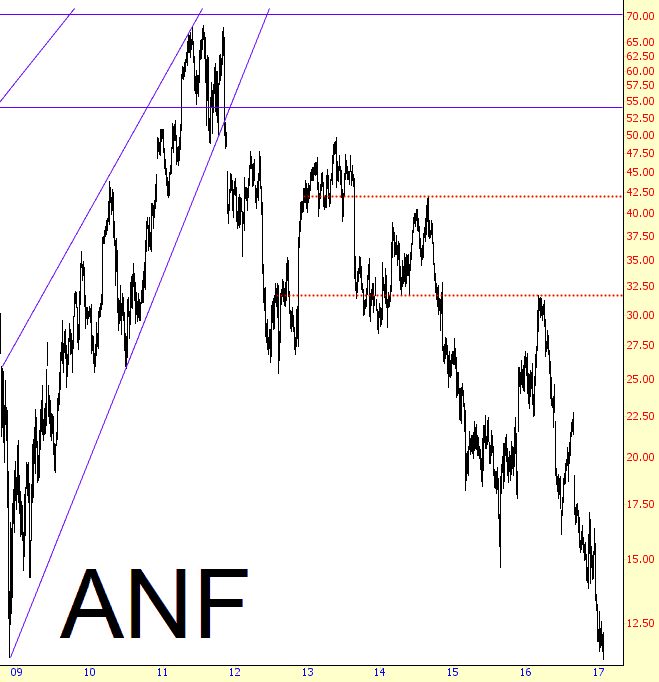
Not everything retail is weak, of course, Amazon has had an astonishing run (and we"ll see if it holds together when they report next week), and some stocks such as Autozone (AZO) and O"Reilly Auto Parts (ORLY) have cranked out multi-hundred percent gains for years now. But many retail companies, particularly those having to do with clothing, have been getting whacked. Take, for instance, Abercrombie & Fitch, which I"ve picked on endlessly: it is actually lower than it was at the greatest depths of the financial crisis. For how many stocks could you make that statement?


0128-ANF


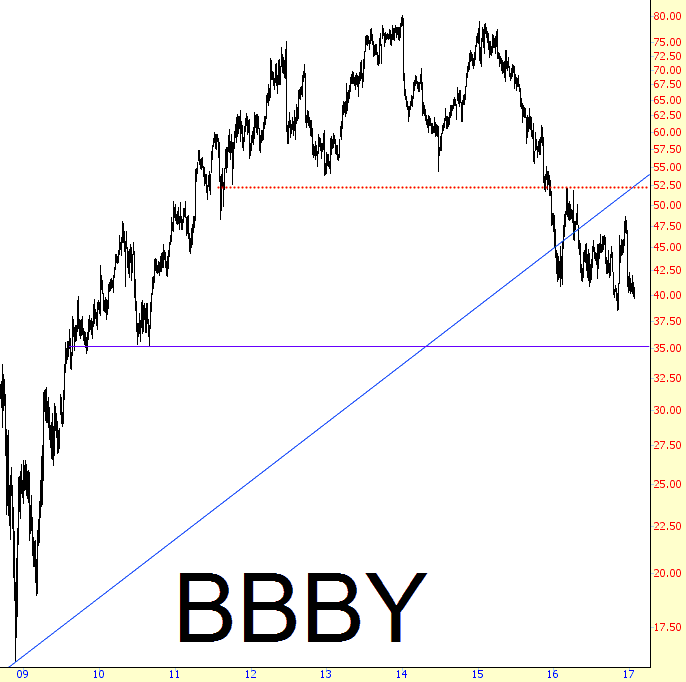
Bed Bath & Beyond has a quite well-formed head and shoulders pattern (whose neckline is shown with a red horizontal below) that suggests much lower prices to come.


0128-BBBBY


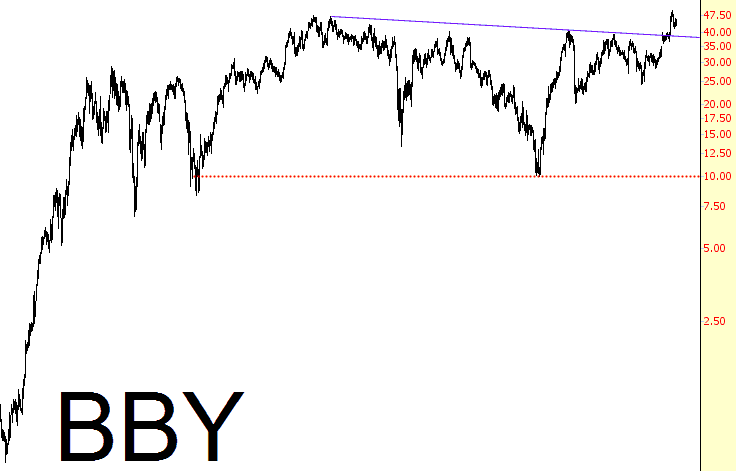
Be careful not to confuse this with a very similar symbol, however - Best Buy - which, competition from Amazon be damned, is defying gravity and broke above resistance this year.


0128-BBBY


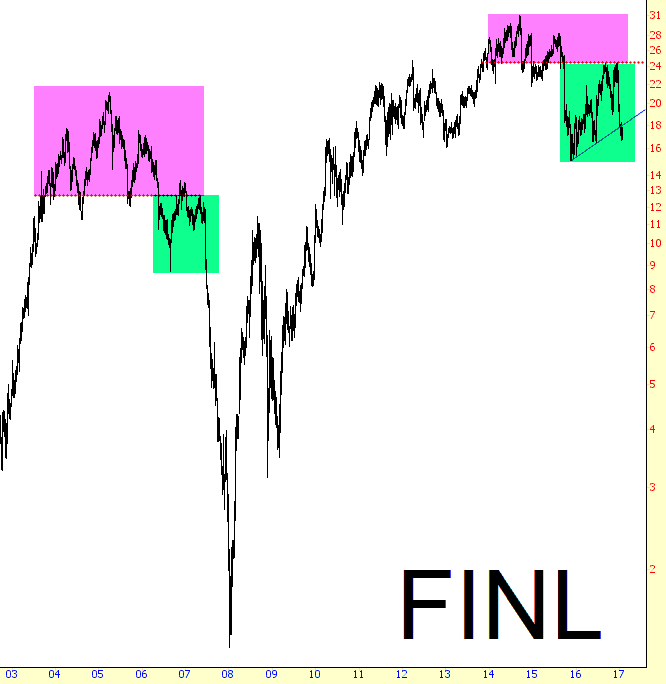
Let"s get back to the bearish charts, though: Shoe retailer Finish Line has been trending lower for months, and the analog is going beautifully:


0128-FINL


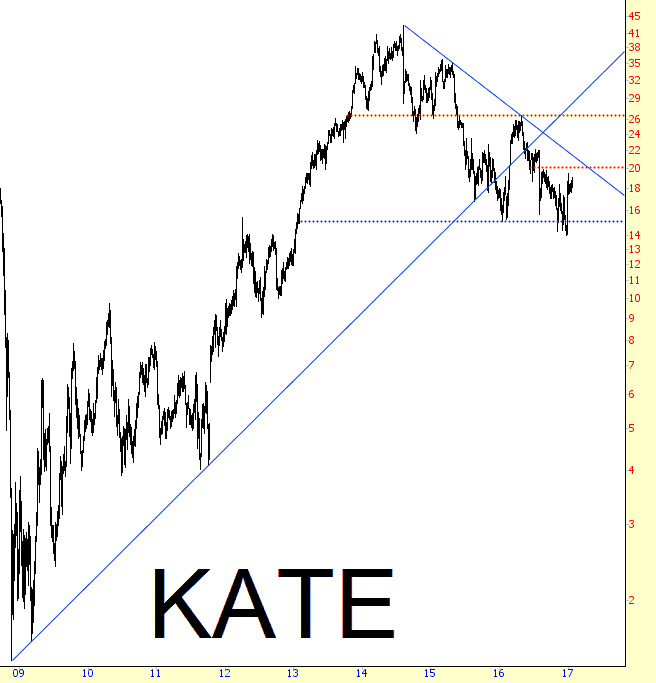
Another storefront at your local luxury mall is Kate Spade. It found strength off and on recently due to buyout chatter (they are desperately trying to sell themselves), but the pattern is bearish, and just so you are clear, just because a company is for sale doesn"t mean there will be any buyers. Just ask Twitter.


0128-KATE


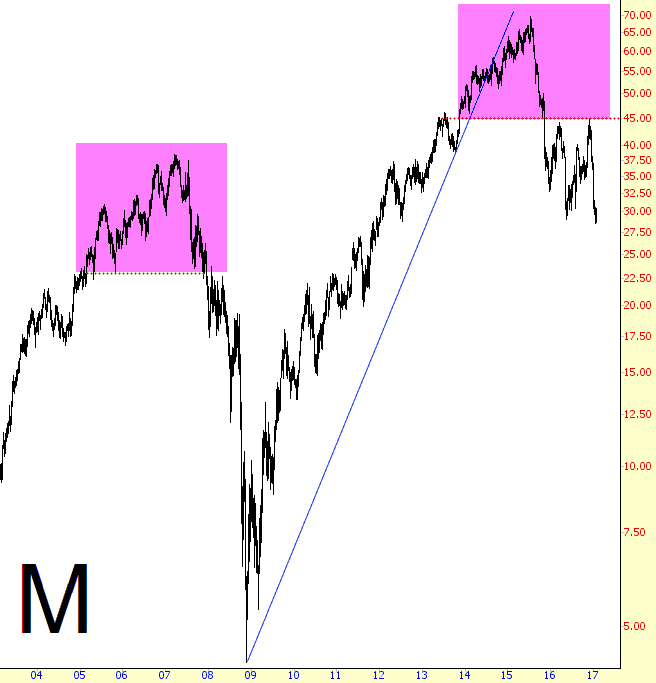
Speaking of analogs, take a look at Macy"s. Even though the stock has lost over half its value, if history is any guide, there are doomed as doomed can be (this is more impressive if you say it in an Ed Grimley voice).


0128-M


Hold on there........it"s another analog......and from another company I pick on a lot: Pier One, purveyor of scented candles, throw pillows, and monkeys carved from coconuts. This is another fine example of how just because a stock has already suffered a momentous collapse (about 65% so far) doesn"t mean it isn"t just going to keep collapsing. Firm support exists at $0.00.


0128-PIR


Overpriced seller of kitchenware, Williams Sonoma, is setting itself up for a big fall. It has found support for years in the mid 40s, but don"t count on that surviving the year intact.


0128-WSM


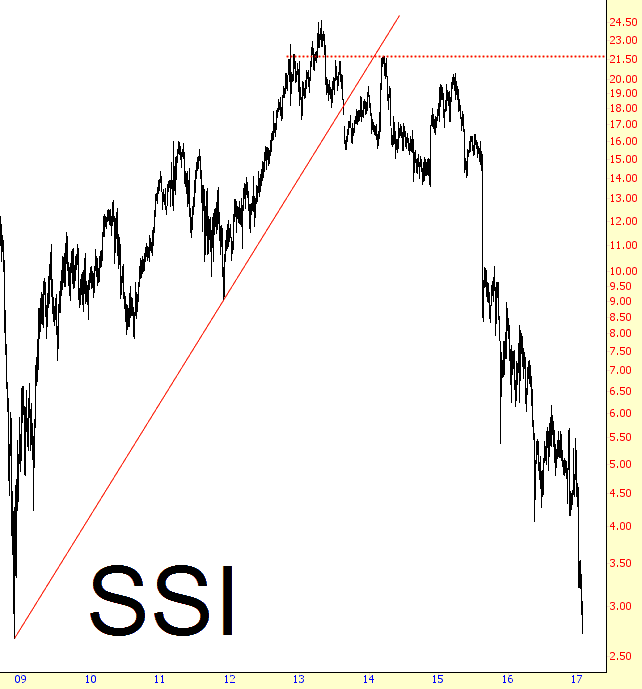
I will say, however, that some retailers are so far gone, the opportunity has already passed by. Stage Stores is a good example of a ship that"s already sailed.


0128-SSI


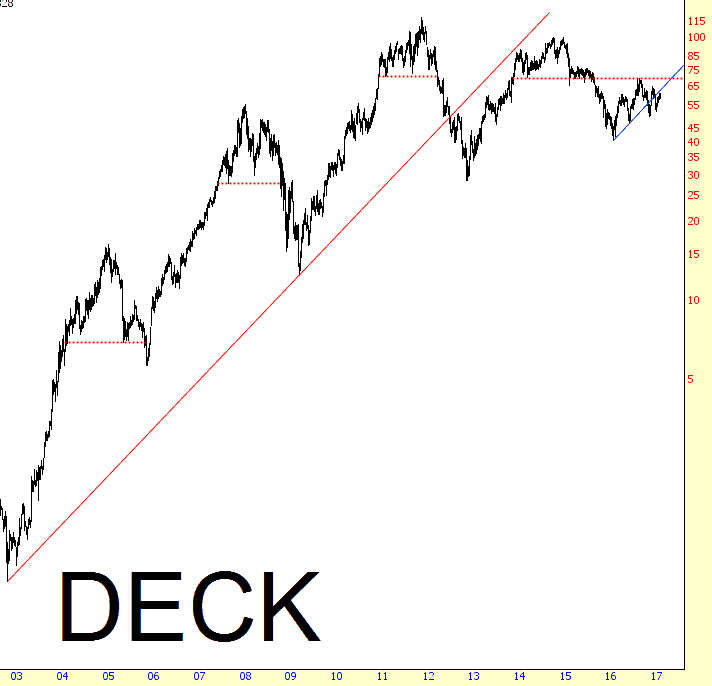
On the other hand, Deckers Outdoor (makers of the UGG shoe line, among others) has plenty of juice left to squeeze.


0128-DECK


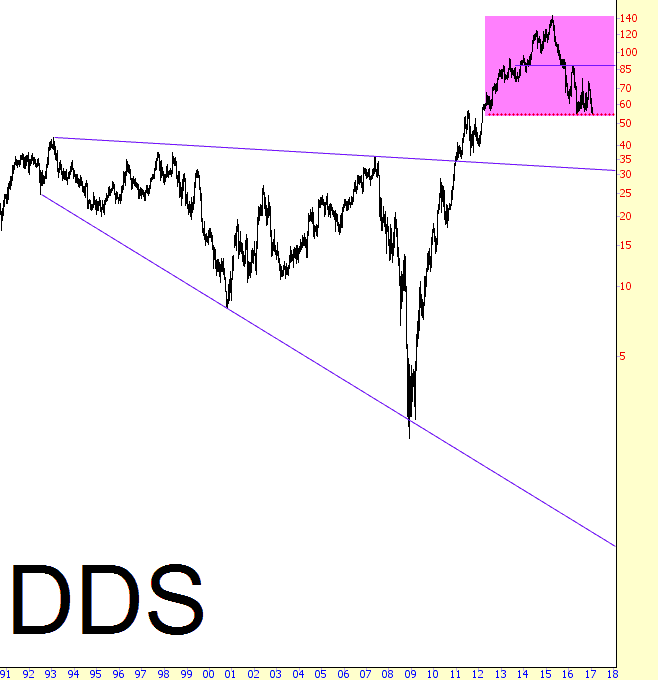
Dillard"s is another stock which has lost about 60% of its value already but doesn"t look anywhere close to being done falling.


0128-DDS


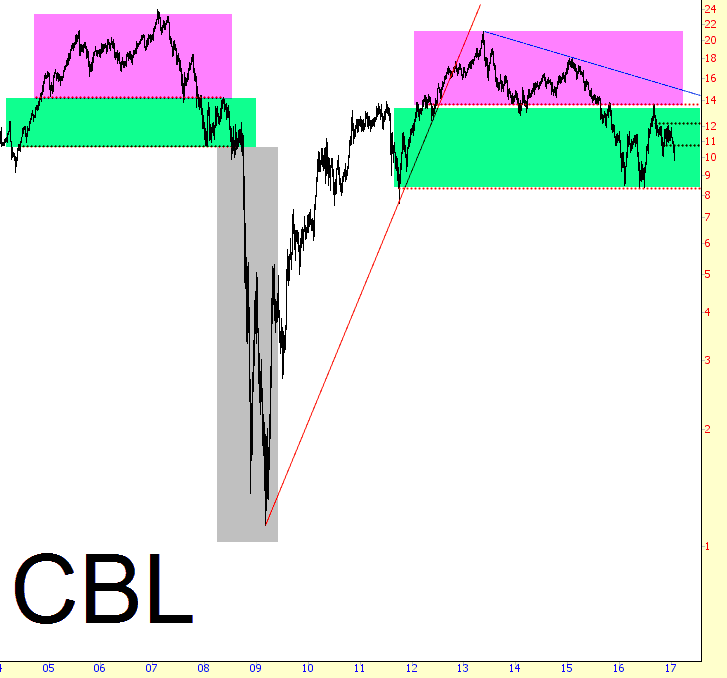
What got me thinking about all this was my best-performing short position, CBL Associates. I wasn"t sure what they did, but it turns out they are a big player in retail real estate - - hence their stock is also in a terrific analog and appears to be screwed and tattooed.


0128-CBL


If anyone is looking for rumblings to signal the kind of break in 2006/2007 that preceded the financial crisis, look no further than the charts above.