Showing posts with label International Energy Agency. Show all posts

Tuesday, December 19, 2017

OPEC vs IEA: Who"s Right On Oil Prices?

Authored by Nick Cunningham via OilPrice.com,


Last week, the International Energy Agency made a lot of OPEC brows furrow when it warned that 2018 may not be a very happy new year for the cartel.


U.S. shale supply, the IEA said in its December Oil Market Report, is set to grow more than OPEC has estimated and this could be the undoing of the production cut that boosted prices this year.


OPEC, for its part, has insisted that U.S. shale production won’t grow as much as the IEA says, baffling some observers who now wonder who they should believe. But let’s put it another way: If the coach of a football team tells you that his team will win the cup because they’re the best, but the football association has estimated that the team is not the best one in the league, who would you believe?


OPEC has a history of underestimating U.S. shale. This underestimation led to the glut that sank prices in 2014. Now it stands to reason that the cartel is more cautious in its estimates of U.S shale oil developments, but this caution does not necessarily have to be reflected in comments. Let’s not forget that comments from OPEC officials—whether or not grounded in facts—have had a direct and immediate effect on prices from events such as the shutdown of the Forties pipeline network last week.


So, it would make sense to lean more towards what the IEA says, and it says that non-OPEC supply next year will probably rise by 1.6 million bpd—a 200,000 bpd upward revision on the previous OMR. U.S. shale production alone will, according to IEA’s latest estimate, grow by 870,000 bpd in 2018. Meanwhile, demand will rise by 1.3 million barrels daily next year, hinting at another glut in the making. 


Now, OPEC’s last forecast is that non-OPEC supply next year will rise by just 990,000 bpd next year to 58.81 million bpd, although the group does caution that any non-OPEC supply growth forecast involves considerable uncertainties regarding U.S. shale production growth. For the U.S. specifically, OPEC forecasts a 1.05-million-barrel daily supply growth next year, which will be partially offset by declines in producers such as Russia, China, and Mexico, among others.


That’s quite a discrepancy between IEA and OPEC figures, but it’s not the only one. The two more notably disagree on when the glut will be over. IEA is skeptical about it disappearing before the end of next year, while OPEC is upbeat, believing the market will return to balance in the second half of 2018 as demand growth accelerates. 


Sometimes OPEC’s forecasts sound like developments that the cartel can will into existence, and this market rebalancing forecast is one of these cases. It’s true that some OPEC members have been very diligent in their compliance to the lower production quotas. Others not so much, so those from the first group have actually cut more than they agreed to in order to compensate for the non-compliant ones.


Can the overachievers continue doing this to ensure the forecast materializes? They can, but they can’t do anything about U.S. shale, and it’s uncertain whether Russia will stay in the agreement after the end of June: Moscow has indicated it would rather quit as soon as politely possible. OPEC also has another problem that’s been there since the original deal, but recently has been garnering more attention. With oil prices higher, how long until one or more OPEC members decide to drop the deal and cash in on the price increase?


Tuesday, November 14, 2017

Ruble, Real Tumble As Oil Slumps On Weaker IEA Outlook

WTI Crude is tumbling this morning, breaking down below $56 following a monthly report Tuesday from the International Energy Agency that said 2017 price gains along with milder-than-normal winter weather are slowing demand growth. This drop is weighing on oil-producers with the Ruble and Real dropping most...


The IEA reduced its demand estimate for next year by 200,000 barrels a day to 98.9 million a day, according to projections in its report. Forecasts for demand growth next year also fell by 100,000 barrels a day to 1.3 million a day.


“The market balance in 2018 does not look as tight as some would like, and there is not in fact a new normal” that would buoy prices above $60, said the Paris-based agency.


“If you put two and two together, it shows that we are going to be a little bit oversupplied in 1Q,” Michael Loewen, a commodities strategist at Scotiabank in Toronto, said by telephone referring to the IEA report. “Traders in the market are focusing on that right now. We rallied too far, too quick.”


This oil move has pushed the Ruble down to 3-month lows...back over 60 Ruble per USD...


Wednesday, September 27, 2017

Why Political Correctness Fails (When What We Know "For Sure" Is Wrong)

Authored by Gail Tverberg via Our Finite World blog,


Most of us are familiar with the Politically Correct (PC) World View. William Deresiewicz describes the view, which he calls the “religion of success,” as follows:


There is a right way to think and a right way to talk, and also a right set of things to think and talk about. Secularism is taken for granted. Environmentalism is a sacred cause. Issues of identity - principally the holy trinity of race, gender, and sexuality - occupy the center of concern.


There are other beliefs that go with this religion of success:


  • Wind and solar will save us.

  • Electric cars will make transportation possible indefinitely.

  • Our world leaders are all powerful.

  • Science has all of the answers.

To me, this story is pretty much equivalent to the article, “Earth Is Flat and Infinite, According to Paid Experts,” by Chris Hume in Funny Times. While the story is popular, it is just plain silly.


In this post, I explain why many popular understandings are just plain wrong. I cover many controversial topics, including environmentalism, peer-reviewed literature, climate change models, and religion. I expect that the analysis will surprise almost everyone.


Myth 1: If there is a problem with the lack of any resource, including oil, it will manifest itself with high prices.


As we reach limits of oil or any finite resource, the problem we encounter is an allocation problem. 


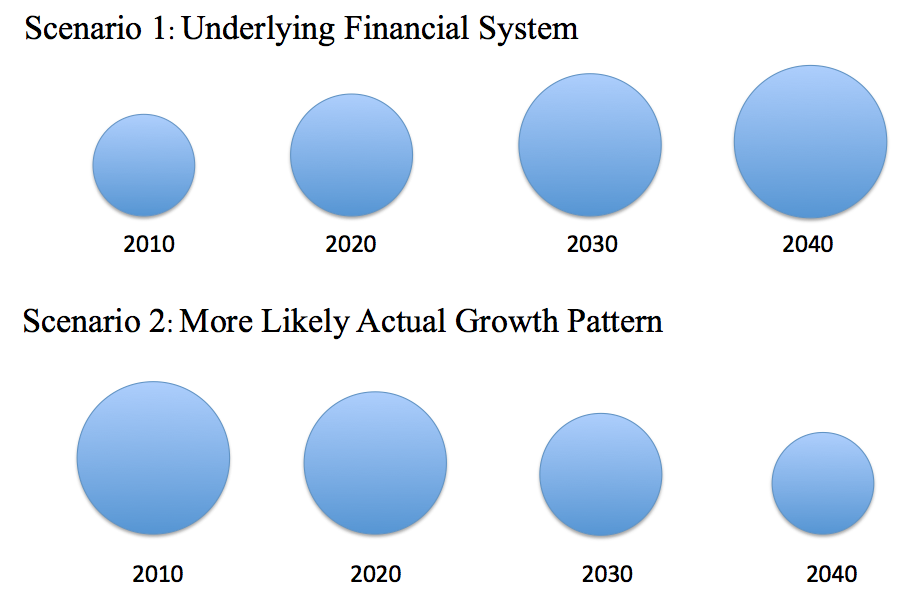
What happens if economy stops growing

Figure 1. Two views of future economic growth. Created by author.


As long as the quantity of resources we can extract from the ground keeps rising faster than population, there is no problem with limits. The tiny wedge that each person might get from these growing resources represents more of that resource, on average. Citizens can reasonably expect that future pension promises will be paid from the growing resources. They can also expect that, in the future, the shares of stock and the bonds that they own can be redeemed for actual goods and services.


If the quantity of resources starts to shrink, the problem we have is almost a “musical chairs” type of problem.


Figure 2. Circle of chairs arranged for game of musical chairs. Source


In each round of a musical chairs game, one chair is removed from the circle. The players in the game must walk around the outside of the circle. When the music stops, all of the players scramble for the remaining chairs. Someone gets left out.


The players in today’s economic system include


  • High paid (or elite) workers

  • Low paid (or non-elite) workers

  • Businesses

  • Governments

  • Owners of assets (such as stocks, bonds, land, buildings) who want to sell them and exchange them for today’s goods and services

If there is a shortage of a resource, the standard belief is that prices will rise and either more of the resource will be found, or substitution will take place. Substitution only works in some cases: it is hard to think of a substitute for fresh water. It is often possible to substitute one energy product for another. Overall, however, there is no substitute for energy. If we want to heat a substance to produce a chemical reaction, we need energy. If we want to move an object from place to place, we need energy. If we want to desalinate water to produce more fresh water, this also takes energy.


The world economy is a self-organized networked system. The networked system includes businesses, governments, and workers, plus many types of energy, including human energy. Workers play a double role because they are also consumers. The way goods and services are allocated is determined by “market forces.” In fact, the way these market forces act is determined by the laws of physics. These market forces determine which of the players will get squeezed out if there is not enough to go around.


Non-elite workers play a pivotal role in this system because their number is so large. These people are the chief customers for goods, such as homes, food, clothing, and transportation services. They also play a major role in paying taxes, and in receiving government services.


History says that if there are not enough resources to go around, we can expect increasing wage and wealth disparity. This happens because increased use of technology and more specialization are workarounds for many kinds of problems. As an economy increasingly relies on technology, the owners and managers of the technology start receiving higher wages, leaving less for the workers without special skills. The owners and managers also tend to receive income from other sources, such as interest, dividends, capital gains, and rents.


When there are not enough resources to go around, the temptation is to use technology to replace workers, because this reduces costs. Of course, a robot does not need to buy food or a car. Such an approach tends to push commodity prices down, rather than up. This happens because fewer workers are employed; in total they can afford fewer goods. A similar downward push on commodity prices occurs if wages of non-elite workers stagnate or fall.


If wages of non-elite workers are lower, governments find themselves in increasing difficulty because they cannot collect enough taxes for all of the services that they are asked to provide. History shows that governments often collapse in such situations. Major defaults on debt are another likely outcome (Figure 3). Pension holders are another category of recipients who are likely to be “left out” when the game of musical chairs stops.


Figure 3 – Created by Author.


The laws of physics strongly suggest that if we are reaching limits of this type, the economy will collapse. We know that this happened to many early economies. More recently, we have witnessed partial collapses, such as the Depression of the 1930s. The Depression occurred when the price of food dropped because mechanization eliminated a significant share of human hand-labor. While this change reduced the price of food, it also had an adverse impact on the buying-power of those whose jobs were eliminated.


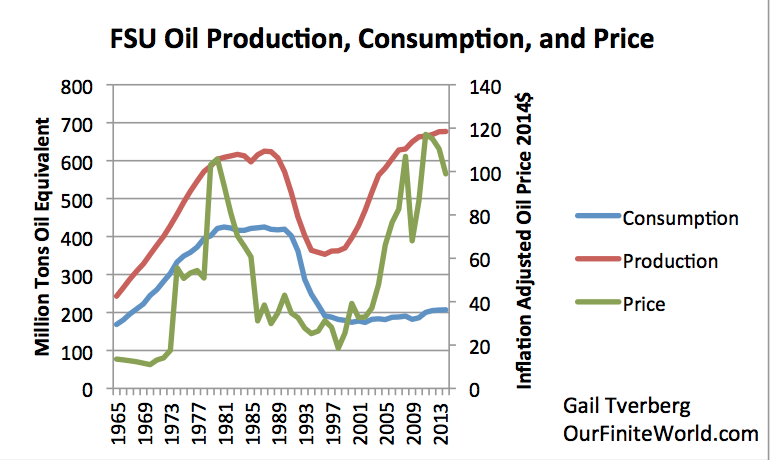
The collapse of the Soviet Union is another example of a partial collapse. This collapse occurred as a follow-on to the low oil prices of the 1980s. The Soviet Union was an oil exporter that was affected by low oil prices. It could continue to produce for a while, but eventually (1991) financial problems caught up with it, and the central government collapsed.


Figure 4. Oil consumption, production, and inflation-adjusted price, all from BP Statistical Review of World Energy, 2015.


Low prices are often a sign of lack of affordability. Today’s oil, coal, and natural gas prices tend to be too low for today’s producers. Low energy prices are deceptive because their initial impact on the economy seems to be favorable. The catch is that after a time, the shortfall in funds for reinvestment catches up, and production collapses. The resulting collapse of the economy may look like a financial collapse or a governmental collapse.


Oil prices have been low since late 2014. We do not know how long low prices can continue before collapse. The length of time since oil prices have collapsed is now three years; we should be concerned.


Myth 2. (Related to Myth 1) If we wait long enough, renewables will become affordable.


The fact that wage disparity grows as we approach limits means that prices can’t be expected to rise as we approach limits. Instead, prices tend to fall as an increasing number of would-be buyers are frozen out of the market. If in fact energy prices could rise much higher, there would be huge amounts of oil, coal and gas that could be extracted.


Figure 5. IEA Figure 1.4 from its World Energy Outlook 2015, showing how much oil can be produced at various price levels, according to IEA models.


There seems to be a maximum affordable price for any commodity. This maximum affordable price depends to a significant extent on the wages of non-elite workers. If the wages of non-elite workers fall (for example, because of mechanization or globalization), the maximum affordable price may even fall.


Myth 3. (Related to Myths 1 and 2) A glut of oil indicates that oil limits are far away. 


A glut of oil means that too many people around the world are being “frozen out” of buying goods and services that depend on oil, because of low wages or a lack of job. It is a physics problem, related to ice being formed when the temperature is too cold. We know that this kind of thing regularly happens in collapses and partial collapses. During the Depression of the 1930s, food was being destroyed for lack of buyers. It is not an indication that limits are far away; it is an indication that limits are close at hand. The system can no longer balance itself correctly.


Myth 4: Wind and solar can save us.


The amount of energy (other than direct food intake) that humans require is vastly higher than most people suppose. Other animals and plants can live on the food that they eat or the energy that they produce using sunlight and water. Humans deviated from this simple pattern long ago–over 1 million years ago.


Unfortunately, our bodies are now adapted to the use of supplemental energy in addition to food. The use of fire allowed humans to develop differently than other primates. Using fire to cook some of our food helped in many ways. It freed up time that would otherwise be spent chewing, providing time that could be used for tool making and other crafts. It allowed teeth, jaws and digestive systems to be smaller. The reduced energy needed for maintaining the digestive system allowed the brain to become bigger. It allowed humans to live in parts of the world where they are not physically adapted to living.


In fact, back at the time of hunter-gatherers, humans already seemed to need three times as much energy total as a correspondingly sized primate, if we count burned biomass in addition to direct food energy.


Figure 6 – Created by author.


“Watts per Capita” is a measure of the rate at which energy is consumed. Even back in hunter-gatherer days, humans behaved differently than similar-sized primates would be expected to behave. Without considering supplemental energy, an animal-like human is like an always-on 100-watt bulb. With the use of supplemental energy from burned biomass and other sources, even in hunter-gatherer times, the energy used was equivalent to that of an always-on 300-watt bulb.


How does the amount of energy produced by today’s wind turbines and solar panels compare to the energy used by hunter-gatherers? Let’s compare today’s wind and solar output to the 200 watts of supplemental energy needed to maintain our human existence back in hunter-gatherer times (difference between 300 watts per hour and 100 watts per hour). This assumes that if we were to go back to hunting and gathering, we could somehow collect food for everyone, to cover the first 100 watts per hour. All we would need to do is provide enough supplemental energy for cooking, heating, and other very basic needs, so we would not have to deforest the land.


Conveniently, BP gives the production of wind and solar in “terawatt hours.” If we take today’s world population of 7.5 billion, and multiply it by 24 hours a day, 365.25 days per year, and 200 watts, we come to needed energy of 13,149 terawatt hours per year. In 2016, the output of wind was 959.5 terawatt hours; the output of solar was 333.1 terawatt hours, or a total of 1,293 terawatt hours. Comparing the actual provided energy (1,293 tWh) to the required energy of 13,149 tWh, today’s wind and solar would provide only 9.8% of the supplemental energy needed to maintain a hunter-gatherer level of existence for today’s population. 


Of course, this is without considering how we would continue to create wind and solar electricity as hunter-gatherers, and how we would distribute such electricity. Needless to say, we would be nowhere near reproducing an agricultural level of existence for any large number of people, using only wind and solar. Even adding water power, the amount comes to only 40.4% of the added energy required for existence as hunter gatherers for today’s population.


Many people believe that wind and solar are ramping up rapidly. Starting from a base of zero, the annual percentage increases do appear to be large. But relative to the end point required to maintain any reasonable level of population, we are very far away. A recent lecture by Energy Professor Vaclav Smil is titled, “The Energy Revolution? More Like a Crawl.”


Myth 5. Evaluation methods such as “Energy Returned on Energy Invested” (EROI) and “Life Cycle Analyses (LCA)” indicate that wind and solar should be acceptable solutions. 


These approaches are concerned about how the energy used in creating a given device compares to the output of the device. The problem with these analyses is that, while we can measure “energy out” fairly well, we have a hard time determining total “energy in.” A large share of energy use comes from indirect sources, such as roads that are shared by many different users.


A particular problem occurs with intermittent resources, such as wind and solar. The EROI analyses available for wind and solar are based on analyses of these devices as stand-alone units (perhaps powering a desalination plant, on an intermittent basis). On this basis, they appear to be reasonably good choices as transition devices away from fossil fuels.


EROI analyses don’t handle the situation well when there is a need to add expensive infrastructure to compensate for the intermittency of wind and solar. This situation tends to happen when electricity is added to the grid in more than small quantities. One workaround for intermittency is adding batteries; another is overbuilding the intermittent devices, and using only the portion of intermittent electricity that comes at the time of day and time of year when it is needed. Another approach involves paying fossil fuel providers for maintaining extra capacity (needed both for rapid ramping and for the times of year when intermittent resources are inadequate).


Any of these workarounds is expensive and becomes more expensive, the larger the percentage of intermittent electricity that is added. Euan Mearns recently estimated that for a particular offshore wind farm, the cost would be six times as high, if battery backup sufficient to even out wind fluctuations in a single month were added. If the goal were to even out longer term fluctuations, the cost would no doubt be higher. It is difficult to model what workarounds would be needed for a truly 100% renewable system. The cost would no doubt be astronomical.


When an analysis such as EROI is prepared, there is a tendency to leave out any cost that varies with the application, because such a cost is difficult to estimate. My background is in actuarial work. In such a setting, the emphasis is always on completeness because after the fact, it will become very clear if the analyst left out any important insurance-related cost. In EROI and similar analyses, there is much less of a tieback to the real world, so an omission may never be noticed. In theory, EROIs are for multiple purposes, including ones where intermittency is not a problem. The EROI modeler is not expected to consider all cases.


Another way of viewing the issue is as a “quality” issue. EROI theory generally treats all types of energy as equivalent (including coal, oil, natural gas, intermittent electricity, and grid-quality electricity). From this perspective, there is no need to correct for differences in types of energy output. Thus, it makes perfect sense to publish EROI and LCA analyses that seem to indicate that wind and solar are great solutions, without any explanation regarding the likely high real-world cost associated with using them on the electric grid.


Myth 6. Peer reviewed articles give correct findings.


The real story is that peer reviewed articles need to be reviewed carefully by those who use them. There is a very significant chance that errors may have crept in. This can happen because of misinterpretation of prior peer reviewed articles, or because prior peer reviewed articles were based on “thinking of the day,” which was not quite correct, given what has been learned since the article was written. Or, as indicated by the example in Myth 5, the results of peer reviewed articles may be confusing to those who read them, in part because they are not written for any particular audience.


The way university research is divided up, researchers usually have a high level of specialized knowledge about one particular subject area. The real world situation with the world economy, as I mentioned in my discussion of Myth 1, is that the economy is a self-organized networked system. Everything affects everything else. The researcher, with his narrow background, doesn’t understand these interconnections. For example, energy researchers don’t generally understand economic feedback loops, so they tend to leave them out. Peer reviewers, who are looking for errors within the paper itself, are likely to miss important feedback loops as well.


To make matters worse, the publication process tends to favor results that suggest that there is no energy problem ahead. This bias can come through the peer review process. One author explained to me that he left out a certain point from a paper because he expected that some of his peer reviewers would come from the Green Community; he didn’t want to say anything that might offend such a reviewer.


This bias can also come directly from the publisher of academic books and articles. The publisher is in the business of selling books and journal articles; it does not want to upset potential buyers of its products. One publisher made it clear to me that its organization did not want any mention of problems that seem to be without a solution. The reader should be left with the impression that while there may be issues ahead, solutions are likely to be found.


In my opinion, any published research needs to be looked at very carefully. It is very difficult for an author to move much beyond the general level of understanding of his audience and of likely reviewers. There are financial incentives for authors to produce PC reports, and for publishers to publish them. In many cases, articles from blogs may be better resources than academic articles because blog authors are under less pressure to write PC reports.


Myth 7. Climate models give a good estimate of what we can expect in the future.


There is no doubt that climate is changing. But is all of the hysteria about climate change really the correct story?


Our economy, and in fact the Earth and all of its ecosystems, are self-organized networked systems. We are reaching limits in many areas at once, including energy, fresh water, the number of fish that can be extracted each year from oceans, and metal ore extraction. Physical limits are likely to lead to financial problems, as indicated in Figure 3. The climate change modelers have chosen to leave all of these issues out of their models, instead assuming that the economy can continue to grow as usual until 2100. Leaving out these other issues clearly can be expected to overstate the impact of climate change.


The International Energy Agency is very influential with respect to which energy issues are considered. Between 1998 and 2000, it did a major flip-flop in the importance of energy limits. The IEA’s 1998 World Energy Outlook devotes many pages to discussing the possibility of inadequate oil supplies in the future. In fact, near the beginning, the report says,


Our analysis of the current evidence suggests that world oil production from conventional sources could peak during the period 2010 to 2020.


The same report also mentions Climate Change considerations, but devotes many fewer pages to these concerns. The Kyoto Conference had taken place in 1997, and the topic was becoming more widely discussed.


In 1999, the IEA did not publish World Energy Outlook. When the IEA published the World Energy Outlook for 2000, the report suddenly focused only on Climate Change, with no mention of Peak Oil. The USGS World Petroleum Assessment 2000 had recently been published. It could be used to justify at least somewhat higher future oil production.


I will be the first to admit that the “Peak Oil” story is not really right. It is a halfway story, based on a partial understanding of the role physics plays in energy limits. Oil supply does not “run out.” Peak Oilers also did not understand that physics governs how markets work–whether prices rise or fall, or oscillate. If there is not enough to go around, some of the would-be buyers will be frozen out. But Climate Change, as our sole problem, or even as our major problem, is not the right story, either. It is another halfway story.


One point that both Peak Oilers and the IEA missed is that the world economy doesn’t really have the ability to cut back on the use of fossil fuels significantly, without the world economy collapsing. Thus, the IEA’s recommendations regarding moving away from fossil fuels cannot work. (Shifting energy use among countries is fairly easy, however, making individual country CO2 reductions appear more beneficial than they really are.) The IEA would be better off talking about non-fuel changes that might reduce CO2, such as eating vegetarian food, eliminating flooded rice paddies, and having smaller families. Of course, these are not really issues that the International Energy Association is concerned about.


The unfortunate truth is that on any difficult, interdisciplinary subject, we really don’t have a way of making a leap from lack of knowledge of a subject, to full knowledge of a subject, without a number of separate, partially wrong, steps. The IPCC climate studies and EROI analyses both fall in this category, as do Peak Oil reports.


The progress I have made on figuring out the energy limits story would not have been possible without the work of many other people, including those doing work on studying Peak Oil and those studying EROI. I have also received a lot of “tips” from readers of OurFiniteWorld.com regarding additional topics I should investigate. Even with all of this help, I am sure that my version of the truth is not quite right. We all keep learning as we go along.


There may indeed be details of this particular climate model that are not correct, although this is out of my area of expertise. For example, the historical temperatures used by researchers seem to need a lot of adjustment to be usable. Some people argue that the historical record has been adjusted to make the historical record fit the particular model used.


There is also the issue of truing up the indications to where we are now. I mentioned the problem earlier of EROI indications not having any real world tie; climate model indications are not quite as bad, but they also seem not to be well tied to what is actually happening.


Myth 8. We don’t need religion; our leaders are all knowing and all powerful.


We are fighting a battle against the laws of physics. Expecting our leaders to win in the battle against the laws of physics is expecting a huge amount. Some of the actions of our leaders seem extraordinarily stupid. For example, if falling interest rates have postponed peak oil, then proposing to raise interest rates, when we have not fixed the underlying oil depletion problem, seems very ill-advised.


Everything I have seen indicates that there is a literal Higher Power governing our world economy. It is the Laws of Physics that govern the world economy. The Laws of Physics affect the world economy in many ways. The economy is a dissipative structure. Energy inputs allow the economy to remain in an “out of equilibrium state” (that is, in a growing state), for a very long period.


Eventually the ability of any economy to grow must come to an end. The problem is that it requires increasing amounts of energy to fight the growing “entropy” (higher energy cost of extraction, need for growing debt, and rising pollution levels) of the system. The economy must come to an end, just as the lives of individual plants and animals (which are also dissipative structures) must come to an end.


People throughout the ages have been in awe of how this system that provides growth works. We get energy from the sun. This solar energy helps grow our food. It allows the physical growth of humans. It allows the growth of ecosystems and of economies. Humans, ecosystems, and economies seem permanent, but eventually they all must collapse. In physics terms, they are all dissipative structures.


Humans have been in awe of the self-organizing property permitted by flows of energy for as long as humans have had the ability to think abstract thoughts. These flows allow a newly created whole to be greater than the sum of their parts. For example, babies start from a small beginning and mature into adults. Musical notes go together to form recognizable melodies. Physical movements go together to form dances. Awe for this phenomenon seems to be one of the origins of religion.


Another reason for religions is a need for hierarchical structure within an economy. We know that animal groups very often have “pecking orders.” Adding a god provides a convenient way of adding a “top level” to the pecking order. Of course, if leaders can convince members of the group that they are all knowing and that science can provide all of the answers, then the top level provided by religion is not needed.


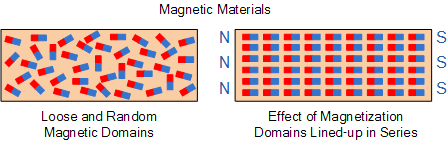
A third reason for religions is to help align the thoughts of members in a particular way. Most of us are aware of the power of magnetized materials.


Figure 7. Source.


To some extent, the same power exists when the belief systems of groups of people can be aligned in the same direction. For example, teachers find it much easier to teach large groups of students, if parents have emphasized the importance of school and the need for respect for teachers. A military leader can attack another country, if soldiers follow orders. A group of generally uncivilized people can learn the benefit of working with others, if proper instruction is given.


What has been astounding to me, as I have looked into the situation, is that the scientific evidence seems to point in the direction of a literal Higher Power governing our Universe. It is not clear whether this higher power is the Laws of Physics, or whether it is some outside “God” that created the Laws of Physics.


In the past, many researchers assumed that the Universe was a closed energy system, irreversibly headed toward a cold, dark end. Recent research indicates that the Universe is ever-expanding, and in fact, seems to be expanding at an accelerating rate. While individual dissipative structures are constantly encountering more and more entropy, the universe as a whole is perhaps expanding rapidly enough to “outrun” growing entropy. Thus, it can behave as an always-open system. This always-open energy system allows many types of objects to self-organize and grow, at least for a time. These objects behave as dissipative structures, each having a beginning and an end.


We really don’t know whether the Universe had a beginning. Some research suggests that it did not. Others believe it began with a Big Bang.


Within the Universe, the earth seems extremely unusual. In fact, it is not clear that there is any other planet that has exactly the right conditions for complex life. A recent American Scientist article discusses this issue. The book Rare Earth: Why Complex Life Is Uncommon in the Universe points out the huge number of coincidences that were necessary for complex life to form and flourish.


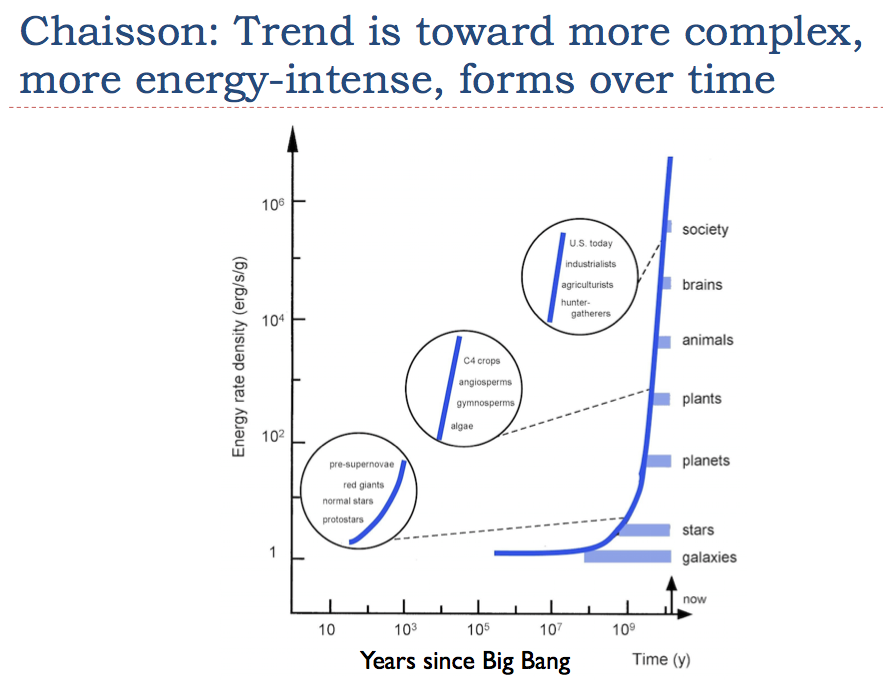
Within the Earth, and perhaps within the Universe as a whole, human economies are the most energy-dense form of structure found.


Figure 8. Image similar to ones shown in Eric Chaisson’s 2001 book, Cosmic Evolution: The Rise of Complexity in Nature.


Thus, in some sense, we humans and our economies may, in some sense, represent the current upper bound on development in the Universe.


We humans live on Earth. It is easy for us to think that our primary purpose in life is to care for and protect the Earth. Unfortunately, with our need for supplemental energy, this is not possible. Even at an early date, our need for resources exceeded what was sustainable. Joshua (in Joshua 17:14-18 relating to the period around 1400 BCE) instructs the tribes of Joseph to clear the trees from the hill country to have enough land for his tribe. This practice was clearly unsustainable; it would lead to erosion of the soil on hilltops. Even at that early date, high population and the need for resources to provide for this high population was conflicting with earth’s sustainability.


If our God is either the Laws of Physics, or some force giving rise to the Laws of Physics, then our God is really the God of the Universe. The limitations of the current Earth are no problem. God (or the Laws of Physics) could create a new Earth, or 1 million new Earths, if He chose to. Thus, from God’s point of view, it is not clear that there is any point to today’s environmentalism. There is a need not to poison ourselves, but “saving the earth” for other species after humans, or for a new set of humans who somehow will use much less energy, doesn’t make much sense. Humans can’t use much less energy; even if we could, our energy use would always be on an upward slope, headed to precisely where we are now.


There are many things that we can’t know for certain. Does this God want/expect us to worship him? Does this God plan an afterlife for some or all of the humans on Earth today? Obviously, if God (or the Laws of Physics) could create the Earth, God could also create other structures as well–possibly a “Heaven.” It is not clear to me that any one of today’s religions has a monopoly on insights regarding what is expected. A person might argue that we need not worry about religion at all, except for the fellowship it provides and the insights it offers regarding how early people coped with their difficulties.


Myth 9. The texts of religious groups around the world are literally true.


The texts of religious groups are true in the same sense that peer reviewed scientific literature is true. They represent, more or less, the best thinking of the day on a particular subject. This certainly does not mean that they are literally true.


We need to read religious texts in the context that they were written. In the earliest days, religious texts represented stories that people passed down from one generation to the next. These stories represented insights that these early people had gained. No one at that time was too concerned about authorship. If a story says, “God said,” it could also mean, “We think that this is something that God might have said.”


Literary styles were very different, back in an era before people pretended to have scientific knowledge. People created stories illustrating some aspect of a particular phenomenon. These stories were not supposed to fully describe what happened. This is why Genesis features two different creation stories.


The Bible makes liberal use of hyperbole and exaggeration. It is hard for people who are not familiar with the original language to understand how stories were intended to be interpreted. Is the concept of Hell added, primarily to provide a contrast to Heaven? In the Old Testament, the number of words in the ancient Hebrew language is much smaller than in today’s languages. This, by itself, makes direct translation difficult.


The earliest religious stories explained how God was perceived at that time. As people became more settled, their views changed. People were getting more “civilized.” Population densities were rising. The best beliefs in an early period may not have had relevance for a later period. This is why most religions have had reformers. Sometimes new writings are added. At other times, the way the writings are interpreted changes. This is why there seems to be a bizarre progression of stories from the Old Testament to the New Testament; new stories needed to be added to supplement and replace old ways of thinking.


Some of the things that early people discovered have not been understood by environmentalists. Genesis 1:28 says,


God blessed them and said to them, “Be fruitful and increase in number; fill the earth and subdue it. Rule over the fish in the sea and the birds in the sky and over every living creature that moves on the ground.”


The early people had figured out that humans were indeed different from other animals and plants. Their use of supplemental energy gave them power over other creatures. Their numbers could (and indeed, did) increase. Early authors were documenting how the world really worked. We later humans have been too blind to see the real situation. It is more pleasant for us to think that somehow we are just like other animals, except perhaps smarter and more in control. With our greater knowledge, we could somehow have avoided an increase in our numbers, if we had only planned better. The laws of physics say this cannot happen; our higher energy use dictates who will win the battle for resources.


The early religious stories were not too different from Peak Oil and Climate Change. They were sort of right. They gave partial insight. They were the best the authors could do at the time.


The ancient religious documents could not tell the whole story at once. New groups would gradually add more insights to the developing story, providing a better understanding of what was truly important for people living in a later period.


Conclusion


In practice, people need a religion or a religion-substitute. People need a basic set of beliefs with which to order their lives.


Our leaders today have proposed the Religion of Success, with its belief in Science, and the power of today’s leaders, as the new religion. This religion has appeal, because it denies the limits we are up against. Life will continue, as if we lived on a flat earth with unlimited resources. This story is pleasant, but unfortunately not true.


Donald Trump, with his version of conservatism, presents another religion. This religion seems to be focused on justifying the allocation of wealth away from the poor, toward the rich, through tax breaks for corporations and the wealthy. This is part of the process of “freezing out” the poor people of the world, when there are not enough resources to go around.


It is hard for me to support Trumpism, even though I recognize that in the animal world, the expected outcome when there are not enough resources to go around is “survival of the best-adapted.” If our concern is leaving energy resources in the ground for future generations, transferring buying power from the poor to the rich is a way of collapsing the economy quickly, while considerable resources remain in the ground. The fact that wealthy people are favored ensures that at least some people will survive.


China and Japan both have what are close to state religions, created by their leaders. School children learn stories regarding what is important, based on what state leaders tell them. In Japan, school children visit religious sites, and learn the proper religious observances. They also learn rules about what is expected of them–always be polite; respect those in charge; don’t eat food on the street; never leave any food wrappers on the ground. In many ways, these religions are probably not too different from today’s Religion of Success.


I personally am not in favor of religions that originate from political groups. I would prefer the “old fashioned” religions based on ancient documents from one or another of the world’s religions. We are clearly facing a difficult time ahead. Perhaps early people had insights regarding how to deal with troubled times. Admittedly, we don’t know for certain that heaven can be in our future. But when things look bleak, it is helpful to see the possibility of a reasonable outcome.


Furthermore, religious groups offer the possibility of finding a group of like-minded individuals to make friends with. We need all of the support we can get as we go through troubled times.

Sunday, August 27, 2017

What's Next For Oil: Interview With Former DOE Chief Of Staff

In this week"s MacroVoices podcast, Erik Townsend and Joe McMonigle, former chief of staff at the US Department of Energy, discuss the state of the global energy market, and OPEC’s rapidly diminishing ability to control oil prices. McMonigle believes investors will be hearing more jawboning from the Saudis, OPEC"s de-facto leader, over the next two weeks as they try to marshal support for extending the cartel"s production-cut agreement past a March 2018 deadline.


Of course, anyone who’s been paying attention knows the cuts have done little to alleviate supply imbalances that have weighed on oil prices for years. In a report published by the International Energy Agency earlier this month, the organization notes that non-compliance among OPEC members, and non-members who also agreed to the cuts those non-members who also agreed to cut oil production, increased again in July. According to the IEA data, non-compliance among the cartel’s members rose to 25 percent in July, the highest level since the agreement was signed in January. Meanwhile, noncompliance for non-members rose to 33%.


Given that oil prices have fallen since OPEC members and non-members first agreed on the cuts last November, the Saudi"s might have difficulty convincing their peers that the cuts are having an impact, other than allowing US shale producers to flourish.


OPEC will meet Nov. 30 in Vienna.


Erik: Joining me now as this week’s featured interview guest is former US Department of Energy Chief of Staff Joe McMonigle, who now heads up the energy research team at Hedgeye. Joe, I think everybody understands that the key question in today’s oil market is whether the rebalancing that OPEC production cuts were supposed to achieve is really happening or if the supply glut is actually still continuing. So let’s start with your high-level view first. Is OPEC effectively managing supply or are they really just managing market sentiment?


Joe: I think, to date, they have been managing sentiment and, of course, engaging in verbal intervention in the market. Yes, they did do this production cut deal a year ago—well, actually last November. They’re eight months into that deal now, and it’s really had not that much of an impact on the market. I think, originally, when the deal was announced, I think oil bulls really liked the idea and prices were boosted as a result. But many people, a lot of very savvy oil analysts and forecasters at banks, predicted big inventory draws in the spring that just never materialized. And, of course, the return of higher prices has incurred shale to rise—which, of course, we can get into later because It’s sort of a different phenomenon. But, just to really judge the effectiveness of the production cut deal, last Friday oil ended at—or settled at—47 and some change. It was actually a penny lower than it was a year ago.


So, just to judge—obviously, prices in the last couple days have fluctuated a little bit—but, really, if you’re looking at where prices were a year ago versus where they are today, I don’t think you can really say that the production cut deal has had a lot of influence or has been very effective. And I think as a result the markets started out really impressed, and I think they’ve been pretty disappointed as we’re into month eight now, almost nine months of the deal.”


In the coming works, McMonigle said he expects "two competing narratives" to emerge in the oil market. The first, advanced by the Saudis, will be news of large export cuts, particularly to the US. The other will be the story of rising shale production.


Erik: OPEC has another meeting coming up on November 30th. And, as we all know, they’re in the habit of using the periods leading up to these meetings to jawbone the market with their various propaganda announcements. So, there’s been talk about the production cuts maybe being extended, or even increased, at this meeting. There’ve also been rumors about maybe taking exempt countries that didn’t participate in the cuts and making them not exempt next time around.


So, what do you see actually happening on November 30th? And how do you think the propaganda campaign is going to play out between now and then?


Joe: I think you’re totally right; jawboning is really part of the OPEC playbook. And I think you’re going to see it in the next two weeks now—even before August is over—I think two competing narratives. One, you’re going to start seeing from the Saudis announcements or leaks about big cuts in crude exports, particularly to the US. And they sort of signaled that they were going to do that in July. I certainly expect them to have done it. Of course, a lot of it has to do with lower demand from China as well. But they will show some big cuts, I think, in crude exports. And then juxtapose that with, I think, what you’re going to see from the US—which we’ve seen really, I think, throughout the summer—and that’s really rising US production—and a lot of other forecasts from banks and other oil analysts about rising US production. And I think Barclay’s came out with a forecast report earlier this week or late last week that had oil going to ten-and- a-half million barrels a day by the end of 2018.


So, I think you’re going to start seeing more of that, and I think that’s really making it difficult for OPEC to regain the narrative about the production cut deal. And I think they badly want to try to get that back. In terms of the next meeting, already, yesterday, you had the Kuwait oil minister say that they’re going to make a decision to consider whether to extend the production cut deal or to basically end it. Unfortunately, neither of those scenarios is really what the market wants to hear. I think the market wants to hear that there’s going to be deeper cuts, and that’s really not been on the table. I think there was some potential anticipation of that, potentially at the last OPEC meeting. We thought there really Wasn’t a chance of that happening. We wrote a note for clients that basically said—“longer not deeper” was the title of our note.


I think at the very least you’re looking at another extension. Even though it’s extended into the end of first quarter 2018, I think they will probably want to signal at that November meeting that they will extend. I think that’s at a minimum. However, I would not preclude, potentially, more drastic action at that meeting. But I think it’s too early to tell. I think we have to really see where the market is in late October and early November.


And I think the main reason for that is really the Aramco IPO coming up. And I think it’s just—we’re going to talk about that later I think—but I think that’s really, it’s a central focus of the Saudi Arabian government, of their economic reforms, so they have a lot riding on it. And, therefore, I think there’s the potential that there could be some unilateral Saudi action of deeper cuts.


So that’s something I now put in the realm of possibility as I look at the different options coming up at the November 30th meeting.”


While inventories data released in recent weeks have shown large drawdowns in the US, McMonigle said any declines have been more than offset by climbing shale production.


"Erik: I want to come back to the Aramco IPO in a few minutes, but let’s start with touching on the official US data that comes from your former employer, the Department of Energy.


It used to be pretty easy to read these reports, but lately we’re kind of getting conflicting data. There were quite a few much bigger than expected drawdowns in crude oil inventory in recent weeks, although this week it appears to be much more in line with inventory, around a 3 million barrel drawdown, which is for this time of year pretty normal.


Those big drawdowns would have been very bullish. But then we also see that there’s been steadily increasing domestic production in these Wednesday reports. That would be a bearish sign. But then on Fridays we get the rig count, which looks like it’s finally starting to level off a little bit. So that would tend to go the other way.


When you net all these things together, what do you see in the data? Are we looking at a bona fide rebalancing of the market that’s actually occurring? Or is there still a production glut?


Joe: I guess I side on the production glut side. I think—certainly there’s been some drawdowns, and I think that’s positive news. It’s hard—it’s impossible to say it’s not positive news, although I think most observers thought the drawdowns would occur sooner and they’d be even greater than they are. But a sustained several weeks now of drawdowns, I think has been positive. As you point out, the signals, however, about rising US production to really record levels, and the resiliency of US shale, I think is really a big counterweight to these inventory draws.


Now we’re also entering a phase here where the end of summer, the high demand season, is going to be switching over. And there’s going to be refinery maintenance, and—so I think a lot of the contributing factors, in terms of gasoline and other product inventories, are probably going to start stalling out. And so I think you’re going to see the market struggle here in the fall, even with further draws.


And, of course, crude exports from the US, which now are allowed as a result of lifting the crude export ban in 2016—I think, first of all, no one really thought, until prices really recovered to big levels, that there would be significant exports. But, again, the market has really been surprised, I think, about very strong crude exports. And of course that’s affecting the drawdown numbers as well.


So I think it’s a much more complicated data array to consider now, as we go into the fall. And I think—definitely you put your finger on it—the US production number, I think, is the big complicating factor in what would otherwise be very bullish news."


The former DoE chief also had this interesting detour into the petrodollar system:


Erik: A lot of people think the reason that the US dollar has remained the world"s reserve currency, 45 years after the Bretton Woods system collapsed in 1971, is the so-called petrodollar system in which Middle East oil producers price their oil in US dollars regardless of who it"s being sold to. And many of those nations also reinvest their profits in US Treasury Bonds.  But recently we"re seeing pressure from Russia and China to stop transacting in dollars. Iran, in particular, seems to have come to favor Euros over dollars for its oil exports. So do you think the petrodollar system—or even the US dollar"s hegemony as the global reserve currency—is at risk in the longer term in light of these developments? And what do these changes mean for the price of oil as you look ahead?  


Joe: First of all, I don"t profess to be an expert on currencies and its impact on oil prices. But certainly, historically, there"s been an inverse relationship between the dollar and oil prices. I do think the supply glut has kind of interfered a bit with that relationship. And it hasn"t necessarily worked as clockwork as it has in the past. I"m not sure the moves by China and Russia are really going to have that much of an impact, or any impact at all. So I do think the dollar really remains the preferred currency, not just in oil but in commodities in general. 


I will tell you an interesting story from my time at DOE. When oil prices really surged to $100 levels, the Saudis—and in particular Minister Al-Naimi, at the time the oil minister of Saudi Arabia—really talked out loud about potentially changing the currency for oil prices from dollars to Euros, just so that they could lower those skyrocketing prices they felt were impacting demand and having a greater impact on markets than it probably should. So, certainly I think market participants are looking more at currencies right now. But I don"t really put much stock in the moves—or the noise, I guess I would characterize it—from Russia and China.


This is just a modest selection of of the items discussed on the interview which also includes:


  • Is the oil supply glut rebalancing?

  • Is OPEC just jawboning the market?

  • Import data impacting oil inventories

  • Outlook for U.S. oil production

  • Update on Venezuelan geopolitics

  • What can go wrong with Iran?

  • Is the Petrodollar system at risk?

  • Is the Saudi Aramco IPO going to happen?

  • Is the term structure signaling bullish prices

Listen to the rest of the interview below:


Friday, July 14, 2017

Rig Count Rises To April 2015 Highs As Analysts Warn "Oil Market Rebalancing Hasn't Even Started Yet"

After falling for the first time this year two weeks ago, Baker Hughes reports US oil rig count rose once again (up 2 to 765) for the 24th week in the last 25, to the highest since April 2015.


"The so-called re-balancing is likely to happen later than earlier," Michael Poulsen, an analyst at Global Risk Management Ltd, said on Friday.


It does appear we have reached an inflection point in the rig count numbers (if the historical relationship with crude holds)...


While EIA cut its 2018 production outlook, this week saw the effect of field maintenance in Alaska and Tropical Storm Cindy in the Gulf of Mexico fall away and production surged once again this week - to new cycle highs...


And the lagged rig count trend suggests crude production has further to rise yet...


Crude prices have been active today with macro headlines hurting and machines helping ramp any dip... the rig count create iunstant selling which was instantly bid back upo,,,


And while US crude production just jumped to cycle highs (and shale production we believe reached a record high), OilPrice.com"s Nick Cunningham notes the oil market rebalancing hasn"t even started yet...


Global oil production surged in June “as producers opened the taps,” according to a new report from the International Energy Agency (IEA). OPEC was a major culprit, with Libya and Nigeria doing their best to scuttle the production cuts made by other members.


But it wasn’t just those two countries, who are exempted from the agreed upon reductions. OPEC’s de facto leader, Saudi Arabia, also boosted output by an estimated 120,000 bpd in June, from a month earlier. That put Saudi production above 10 million barrels per day (mb/d) for the first time in 2017. Those gains, combined with the 80,000 bpd increase from Libya and a 60,000 bpd jump from Nigeria, plus some smaller contributions from Equatorial Guinea, put OPEC’s June production 340,000 bpd higher than in May. It also took the cartel’s compliance rate down to just 78 percent from 95 percent in May, the worst monthly figure for the group since its deal came into force at the start of the year.


Even worse, the production figures from Libya and Nigeria are much higher at this point than their June average. Over the past few months, the two countries have added 700,000 bpd in new supply, offsetting nearly half of the 1.8 mb/d in the combined OPEC/non-OPEC cuts. And more barrels could be on the way. Libya’s output is now above 1 mb/d, a four-year high, and Nigeria could see production “soar towards full capacity of roughly 1.8 mb/d during August,” the IEA says, up from 1.59 mb/d in June.


The IEA noted that the production cut deal is averaged over the entire compliance period through March 2018, so one month’s worth of data might not mean much. But it does not bode well. If the higher level of production continues, or if the compliance rate slips further, it would throw most projections about rebalancing out the window. “It will be a very difficult six months for the oil industry,” Fatih Birol, the IEA’s executive director, said at a conference in Istanbul. “It will be riding on the storm.”


Still, OPEC woes also mean that U.S. shale is suffering too. Prices collapsed in June, and there are many more causes for concern about the health of the shale industry than previously. The IEA said that “[f]inancial data suggests that while output might be gushing, profits are not,” with even executives from the industry saying that oil needs to be north of $50 per barrel for shale growth to be sustainable. U.S. shale might still grow in the near-term, but “the recent exuberance is being reined in,” the Paris-based energy agency concluded.


For now, though, non-OPEC supply is depressing the oil market. Global oil production is up 1.2 mb/d from a year ago, and “non-OPEC [is] firmly back in growth mode,” the IEA said in its report. Next year, things don’t get much better. Non-OPEC countries – led by the U.S., Canada and Brazil – will add 1.4 mb/d of new supply, enough to meet the entire growth in global demand. As such, any gains in output from OPEC would merely return the market to a surplus. That raises a very big question about what OPEC plans on doing after March 2018 when its deal expires. For now, it has no “exit strategy.”


The silver-lining for oil prices is that demand was much more robust in the second quarter compared to the first, leaping from 1 mb/d to 1.5 mb/d. The IEA revised up its overall 2017 demand growth figure to 1.4 mb/d, an increase of 0.1 mb/d compared to last month.


Putting supply and demand together, the IEA predicts that global inventories should have drained at a rate of 0.7 mb/d in the second quarter, although incoming data suggests the drawdowns might not have actually occurred at such a pace.


Ultimately, the message from the IEA was much more pessimistic than in previous months. In May, the agency said that the “rebalancing is essentially here and, in the short term at least, is accelerating.” But that bullish sentiment has all but vanished. “[W]e need to wait a little longer to confirm if the process of re-balancing has actually started in 2Q17 and if the waning confidence shown by investors is justified or not,” the IEA wrote this week.

This Nation Just Became The World's Newest Energy Superpower

Authored by Dave Forest via OilPrice.com,


Lots of news this week on energy companies from one particular spot on Earth.


India.


In Lebanon — where reports suggest Indian state oil firm ONGC will bid for offshore blocks. In Canada — where Indian officials are said to be negotiating coking coal supplies. And even in Venezuela, where the cash-strapped government is seeking to sell ONGC a 9 percent stake in the key San Cristobal oil field.


And a new study released this week suggests it’s not coincidence we’re hearing so much about Indian companies on the energy stage.


In fact, India has quietly become one of the world’s biggest energy investors.


That revelation came from the International Energy Agency (IEA) — which released a report yesterday on energy investment trends for 2016. Showing that India’s investment in energy projects surged during the past year.


All told, India’s spending on electricity, oil and gas, coal and renewables jumped by 7 percent in 2016, as compared to the previous year. Reaching nearly $100 billion.


As the chart below shows, that rise was enough to vault India into third place globally for energy investment. Edging out oil giant Russia. India moved into third place globally for energy spending in 2016.


(Click to enlarge)


Of course, India’s energy spending is still a long way off second-place U.S. and top investor China. But the rapid rise of energy investment here shows this is an up-and-coming spot for project funding in oil and gas, and beyond.


IEA attributed India’s ascent to new government policies helping to modernize and expand the economy. Further evidence the country is “getting its act together” in becoming a true natural resource superpower.


That’s an important point of note for project developers globally. Especially given Indian firms seem to have appetite for places further out on the risk spectrum — evidenced by this week’s action in places like Lebanon and Venezuela.


As a final point of interest, the IEA study also showed that — for the first time ever — electricity passed oil and gas as the top energy sector for investment in 2016. Coming as capital spending in the global petroleum space plunged 38 percent between 2014 and 2016.


The group says however, that petro-spending should jump in 2017. Watch for Indian companies to be a big part of those deals and new projects.

Sunday, July 2, 2017

The Looming Energy Shock

There will be an extremely painful oil supply shortfall sometime between 2018 and 2020. It will be highly disruptive to our over-leveraged global financial system, given how saddled it is with record debts and unfunded IOUs.


Due to a massive reduction in capital spending in the global oil business over 2014-2016 and continuing into 2017, the world will soon find less oil coming out of the ground beginning somewhere between 2018-2020.


Because oil is the lifeblood of today"s economy, if there’s less oil to go around, price shocks are inevitable. It"s very likely we"ll see prices climb back over $100 per barrel. Possibly well over.


The only way to avoid such a supply driven price-shock is if the world economy collapses first, dragging demand downwards.


Not exactly a great "solution" to hope for.


Pick Your Poison


This is why our view is that either


  1. the world economy outgrows available oil somewhere in the 2018 – 2020 timeframe, or

  2. the world economy collapses first, thus pushing off an oil price shock by a few years (or longer, given the severity of the collapse)

If (1) happens, the resulting oil price spike will kneecap a world economy already weighted down by the highest levels of debt ever recorded, currently totaling some 327% of GDP:


(Source)


Remember, in 2008, oil spiked to $147 a barrel. The rest is history -- a massive credit crisis ensued.  While there was a mountain of dodgy debt centered around subprime loans in the US, what brought Greece to its knees wasn’t US housing debt, but its own unsustainable pile of debt coupled to a 100% dependence on imported oil --  which, figuratively and literally, broke the bank.


If (2) happens, then the price of oil declines, if not collapses. Demand withers away, the oil business cuts back on its exploration/extraction investments even further, so that much later, when the global economy is trying to recover, it then runs into an even more severe supply shortfall. It becomes extremely hard to get sustained GDP growth back online.


If you really want to understand why I hold these views, you need to fully understand and digest this next chart. It shows the amazingly tightly-coupled linear relationship between economic growth and energy consumption:


(Source)


This chart above says, if you want an extra incremental unit of economic growth you"re going to need to have an extra incremental unit of energy.  More growth means more energy consumed.


And today, oil is still THE most important source of energy. It"s the dominant energy source for transportation, by far.  A global economy, after all, is nothing more than things being made and then moved, often very far distances. Despite what you might read about developments in alternative and other forms of energy, our dependency on oil is still massive.


Plunging Investment


Resulting from the start of oil"s price decline in 2014, the world saw a historic plunge in oil investments (exploration, development, CAPEX, etc) as companies the world over retracted, delayed or outright canceled oil projects:


(Source)


In the chart above, note the two successive drops in oil investment from 2014-2015 and then again into 2016.  So far 2017 is shaping up for another successive decline, which will mark the only three-year decline in investment in oil"s entire history.  So what"s happening here is actually quite unusual.


This isn’t just a slump. It’s an historic slump.


We don’t yet know by how much oil investment will decline in 2017, but it’s probably pretty close to the rates seen in the prior two years.


Next, take note of the dotted blue arrow in the chart.  See how far oil investment climbed during the years from 2009-2014?  Not quite a doubling, but not far off from one either.  Remember those years, I’ll return to them in a moment.


The key question to ask about the 2009-2014 period is: How much new oil was discovered for all that spending?


Turns out: Not a lot.


Practically No Discoveries


There is one hard and fast rule in the oil business: Before you can pump it, you have to find it.


The growing problem here is that oil discoveries were horrible in 2016, really bad in 2015, and terrible in 2014. That recent three year stretch is the worst in the data series:


(Source)


Again: you have to find it before you can pump it. And around the world, oil companies are just not finding as much as they used to.  


Remember that blue dotted line on the oil investment chart above?  Here’s its counterpart, showing discoveries over the same time frame -- it’s just a straight slump downwards:


Global oil discoveries fell to a record low in 2016 as companies continued to cut spending and conventional oil projects sanctioned were at the lowest level in more than 70 years, according to the International Energy Agency, which warned that both trends could continue this year.


Oil discoveries declined to 2.4 billion barrels in 2016, compared with an average of 9 billion barrels per year over the past 15 years. Meanwhile, the volume of conventional resources sanctioned for development last year fell to 4.7 billion barrels, 30% lower than the previous year as the number of projects that received a final investment decision dropped to the lowest level since the 1940s.


(Source)


Now it"s clear why the oil companies pulled back their investment dollars so rapidly when prices slumped:  They were spending more and finding less throughout the 2009-2014 period, so they were already feeling the pain of diminishing returns. When the price of oil cracked below $100 a barrel, they wasted no time reining in their investment dollars.


Should we be concerned about this record lowest level of oil project funding in 70 years?  Why, yes, we should.  Everyone should:


"Our analysis shows we are entering a period of greater oil price volatility (partly) as a result of three years in a row of global oil investments in decline: in 2015, 2016 and most likely 2017," IEA director general Fatih Birol said, speaking at an energy conference in Tokyo.


"This is the first time in the history of oil that investments are declining three years in a row," he said, adding that this would cause "difficulties" in global oil markets in a few years.


(Source)


To give you a visual of the process, here’s a chart to help you understand why it takes years between making an initial find and maximum production:


(Source)


This bears repeating: Oil is the most important substance for our economy, we’re burning more of it on a yearly basis than ever before, and we just found the lowest amount since the world economy was several times smaller than it is now. And all this is happening while we"re reducing our efforts to find more at an unprecedented rate.


There’s no way to speed up the process of oil discovery and extraction meaningfully, no matter how much money and manpower you throw at it.  It simply requires many years to go from a positive test bore to a fully functioning extraction and distribution/transportation program operating at maximum. 


In Part 2: Preparing For The Coming Shock we provide the evidence that shows why by 2019, or 2020, oil prices will have forced a new crisis upon the world.


More economic growth requires more energy. Always has and it always will. Oil is the most important form of energy of them all. But everyone assumes -- especially today when it appears as if we"re "awash" in it given the current supply glut -- that we will always have access to as much as we need.


That"s not going to be the case soon. And you are one of the few to understand why.


You get to use that awareness to make conscious decisions about your own life right here and right now. You can position yourself for safety, as well as to take advantage of what are likely to be once-in-a-lifetime investment opportunities.


But you also need to prepare for those in your life, like most other people today, who lack the ability, insight, or capability to join you at this early stage.


Click here to read the report (free executive summary, enrollment required for full access)

Tuesday, June 20, 2017

WTI Plunges To 7-Month Lows - Enters Bear Market As HY Bonds Crater

WTI Crude has entered a bear market (down over 20% from its highs) amid concerns OPEC-led output cuts won’t succeed in rebalancing the market (and not helped by the fact that Libya is pumping the most crude in 4 years).


For the first time since Nov 2016, WTI front-month traded with a $42 handle...


Here are eight factors that are behind the current fall in oil prices according to Arab News:


1. High exports from OPEC: Despite the reduction in production from oil producers, the level of exports is still high as many tanker-tracking data showed. Morgan Stanley in a report on June 8 said that tanker-tracking data showed that waterborne exports increased strongly in May across the world, up by 2.2 million bpd from April and 3.3 million bpd from May 2016.


2. High global oil inventories: Saudi Energy Minister Khalid Al-Falih told Arab News’ sister publication Asharq Al-Awsat in an interview on June 19 that oil inventories globally are down following the deal. The Organization for Economic Co-operation and Development’s (OECD) oil stocks went down by 65 million barrels from their peak in July 2016. However, Al-Falih acknowledged that US stocks are falling less than expected. As for the market, the fall in inventories is too slow to trigger a price response. The International Energy Agency (IEA) estimates that oil stocks in the OECD are still at 292 million barrels above their five-year average. Energy researcher Bernstein estimates that US stocks must go down by 4 million barrels every week for it to go back to normal levels.


3. Concerns on gasoline demand: The outlook for US gasoline consumption this summer is a concern. Gasoline stocks rose 2.1 million barrels and gasoline inventories currently sit at 242.4 million barrels, or 9 percent, above the five-year average of 223 million barrels, according to the US Energy Information Administration (EIA) data.


4. Increase in the number of rigs: The number of US oil rigs is continuing to rise. Drillers added more oil rigs for a 22nd straight week, marking the biggest streak in at least three decades, according to weekly data from Baker Hughes released on June 16.


5. Worries about supply in 2018: The IEA said in its report on June 14 that supply from non-OPEC producers next year may offset cuts from OPEC and its allies. Oil demand is set to grow by 1.4 million bpd in 2018 but supplies outside OPEC will grow even faster, by almost 1.5 million bpd.


6. Oil prices in contango: Brent and West Texas Intermediate (WTI) crudes, down almost 15 percent since late May, are both trading in contango, with forward prices higher all the way into the next decade. Contango is a structure that normally denotes weak demand for spot cargoes as it means oil prices in the future are higher than today’s, thus it makes producers store crude for future sale.


7. Return of oil output from Libya, Nigeria: Libyan oil production this week is up by 200,000 to 300,000 bpd from early May. Nigeria is also pushing for an additional output of 200,000 bpd this month. The market is concerned that this will add to oversupply, but Al-Falih said on June 19 that the increase is within agreed limits set by the original deal last year.


8. Speculation: Al-Falih blamed volatility in oil prices on speculative trading as many are trading on headlines and on forecasts of supply growth from resources “that may not happen.”


HY Bonds are getting hit led by a spike in HY Energy risk...


“People are getting a little fatigued waiting for the production cuts to have effect,” Michael Lynch, president of Strategic Energy & Economic Research in Winchester, Mass., says by phone.


“Between the U.S. shale activity and Libya and Nigeria seeing their production go up some, that’s making people very nervous about the near-term prospects”


Tonight"s API inventory data may provide further impetus for this move.

Thursday, April 20, 2017

Why The Relationship Between OPEC And Hedge Funds Is On The Verge Of Falling Apart

Following years of acrimony between OPEC and the hedge fund community, which the cartel dismissed simply as "speculators", things suddenly changed in 2016 when the two groups got so close, there were outright reports of collusion between the two on various occasions. We documented this last month in "Why OPEC Is Colluding With Hedge Funds." However, as Reuters" energy analyst John Kemp pointed out on twitter this morning, that relationship may be ending as hedge funds start to lose confidence in OPEC.


Taking us to the beginning, Kemp notes that OPEC and some of the most important hedge funds active in commodities reached an understanding on oil market rebalancing during informal briefings held in the second half of 2016. OPEC committed to implement credible production cuts and reduce global crude stocks while hedge funds responded by establishing bullish long positions in both flat prices and calendar spreads.


OPEC effectively underwrote the fund managers’ bullish positions by providing the oil market with detail about output levels and public messaging about high levels of compliance. In return, the funds delivered an early payoff for OPEC through higher oil prices and a shift from contango to backwardation that should have helped drain excess crude stocks.


The Reuters analyst then notes that the understanding was initially successful between December 2016 and February 2017, with reports of strong compliance from OPEC, spot prices rising $10 per barrel and calendar spreads moving from contango to flat or, albeit briefly, backwardation.


But the understanding started to unravel with the calendar spreads collapsing after Feb. 21 and flat prices dropping from March 8.


The sharp reversal in both spreads and flat prices inflicted substantial losses on many bullish hedge funds in February and March. The correction came amid growing doubts about whether OPEC was really cutting oil supplies to the market by as much as anticipated.


Traders noted that global stocks of crude and refined products showed little sign of drawing down during the first three months of 2017, and in fact continued to hit record highs. Meanwhile, Bullish fund managers pushed the time horizon for expected stock draw downs back to the second half of the year.


OPEC has come under pressure to reconfirm the faith of hedge fund bulls with an early commitment to extend current output cuts beyond June.


And, as reported earlier today, Saudi and other senior OPEC ministers have been edging towards an extension commitment in recent days. But there are lingering doubts about whether OPEC can deliver real market tightening during the second half of 2017.


Meanwhile, calendar spreads have been falling along the curve with weakness extending from the prompt June-July (M7-N7) spread all the way through to December-January (Z7-F8)


Adding to the confusion, U.S. crude imports from OPEC members Saudi Arabia, Iraq and Venezuela have remained steady or increased since the start of the year, according to the U.S. Energy Information Administration.


At the same time, reported global crude and products inventories have remained stubbornly high, according to data compiled by the International Energy Agency.


To be sure, it is possible that global crude stocks "could" be falling already as previously invisible stocks are repositioned and become more visible to the market. There is some evidence that unreported crude stocks held by producer countries, in floating storage, and in tank farms in the Caribbean and South Africa are being drawn towards the major refining centres. As crude is drawn towards the United States, Rotterdam and Singapore, it is captured in published statistics.


But reported stocks need to start falling soon if hedge fund managers’ confidence in rebalancing is to be maintained.


Which is why the daily jawboning by OPEC in the form of its recurring messaging about high levels of compliance has lost much of its effectiveness and is no longer enough to justify a bullish position in crude.


As a result, reported stock changes now matter more for oil prices and calendar spreads than compliance assessments by OPEC’s secondary sources.


Kemp"s conclusion: "OPEC’s credibility is on the line: stocks need to show a significant draw during the second and third quarters or many hedge funds are likely to give up on the bullish narrative prevailing since late 2016."


For now, $50 has proven to be a decisive support for WTI although with every passing week that commercial stocks don"t show a material reduction, the tentative agreement between OPEC and hedge funds is one step closer to falling apart, and not even an "extension" of the production cut will be able to push prices higher.


* * *


Finally, here is a presentation put together by Kemp which lays out some of the key variables (link)