Showing posts with label Geothermal. Show all posts

Friday, December 8, 2017

Bloomberg Has Identified Buffett"s Successor At Berkshire Hathaway (It Thinks)

There are some well-kept secrets in the financial world. For example, there’s the identity of the person or people who designed Bitcoin under the pseudonym, Satoshi Nakamoto. Then there’s the identity of the parties responsible for the frequent dumping of billions of dollars of gold futures contracts on to the market without regard for maximising price. Another one is Warren Buffett’s successor as Chief Executive Officer Berkshire Hathaway.


Besides his advancing years, he’s 87, there are other signs that curtain is coming down on the era of the world’s most successful investor. As we noted in August in “The Value Of Lunch With Warren Buffett Plunges 22%”.


The winning bidder in legendary investor Warren Buffett’s annual charity auction haspledged $2.68 million for the privilege of eating lunch with the billionaire investor…While the sum is far greater than the $25,000 paid in 2000 - the first year Buffett held the fundraiser - it’s about $800,000 shy of the record sum of $3,456,789 paid in 2012 and 2016.


By his own admission, Buffett has also found it increasingly challenging to find “value” in keeping with his investment style which he modelled on an earlier doyen of value investing, Benjamin Graham. That’s not Buffett’s fault, it merely reflects the longevity of the latest iteration of central bank bubbles.


Speaking to the usual throngs of shareholders as Berkshire’s AGM in May 2017, Buffett admitted that.


“If I die tonight, I think the stock would go up tomorrow.”


He wasn’t joking, the world’s greatest capital allocator was merely acknowledging that the market would likely price the parts of his very disparate conglomerate higher than the whole. “It would be a good Wall Street story”, he was reported to have said.


Bloomberg Businessweek has published an article on Buffett and Berkshire Hathaway arguing that the pressure to break up the company will mount after he steps down. Buffett’s successor will be critical if that is to be prevented…and Bloomberg thinks it knows his identity. For the time being, while Buffett remains in situ, nothing is going to change.


The glue is Buffett, who’s argued persuasively for decades that this hodgepodge makes sense. His market-beating returns have helped: $100 invested in Berkshire in 1964, when he began aggressively buying shares to take control, would be worth more than $2 million today.


Nothing of the sort is likely to happen while Buffett is there. He’s still the controlling shareholder, Berkshire is his life’s work, and he doesn’t want it torn apart by investment bankers or activist investors. To slow that process, Buffett assembled a board that backs his approach, and after his death he’ll leave his remaining shares to charities run by family and friends who know his wishes. But the pressure to dismantle his creation will mount—eventually.


The bulwark against that impulse will be Buffett’s successor as chief executive officer, whose identity is one of the business world’s best-kept secrets. In all his years of giving interviews and taking questions at the company’s marathon annual meeting, Buffett has acknowledged that the board has picked his replacement, but he’s never disclosed the name.


In a cheeky dig at Buffet’s ego, the Businessweek article suggests that by naming his successor, it might take the spotlight away from the man himself, “who loves the attention”. While we think there’s some truth to that, we also agree that Berkshire’s board is keen to give itself room to maneuver. Prior to his resignation from Berkshire, it was widely accepted that David Sokol, known as his “Mr Fix-It and major influence on acquisition targets, would succeed Buffett.


 Arguing that “These days, however, most arrows are pointing toward one man”, Bloomberg begins making its case by re-capping what Buffett has said about the qualifications for his job.  


Buffett, at least, has talked about the qualifications for the position. In a 2015 letter to shareholders, he said the board wants his successor to be drawn from the company’s ranks and “relatively young, so he or she can have a long run in the job.” He suggested future Berkshire CEOs should hold the post for more than a decade and that they should be “rational, calm, and decisive.” And, he noted, they should have upstanding character, be unmotivated by ego or a big paycheck, and be “all-in” at Berkshire.


As the article points out, Buffett neglected to mention stockpicking skills, although the next CEO will be able to call on the two former hedge fund managers hired by Buffett, Todd Combs and Ted Weschler. The two manage about $20 billion of Berkshire’s stock portfolio, but are unlikely to have the skills or the desire to oversee Berkshire string of operating businesses. The role of Chairman is expected to be given to eldest son, Howard Buffet who’s job will be to “guard the company’s culture—and force out any future CEO who messes with it”.


Bloomberg thinks that a major clue to the identity was dropped by Buffett’s partner, Charlie Munger.


Munger called two executives—Ajit Jain and Greg Abel—examples of the company’s “world-leading” managers who are in some ways better than their boss. While Buffett later denied that any executives were in a “horse race” to succeed him, the logical inference from Munger’s letter was that the board had already settled on one of these two—and probably wasn’t as seriously considering other internal candidates such as BNSF Executive Chairman Matt Rose or Tony Nicely, the CEO of Geico. Abel declined to comment, and Jain and Buffett didn’t respond to requests for comment.


Jain and Abel each fit many aspects of Buffett’s carefully tailored job description. They’re deeply committed to Berkshire’s culture, which prizes efficiency and long-term thinking. Neither has outward character flaws that would immediately be disqualifying. And each has built large businesses for Buffett.


Jain runs the insurance business, which remains the core of Berkshire, while Abel runs the energy/utility businesses. It’s tough to make a judgement between the two, but Bloomberg thinks that, in the end, Abel’s youth will sway it.


Jain runs the company’s namesake reinsurance operation, which for decades has provided Berkshire with billions of premium dollars for investments and acquisitions. Buffett has repeatedly said that Jain has probably made more money for shareholders than he has. In 2011 he said the board would make Jain CEO if he wanted the job.


Abel has steadily expanded a utility holding company in Iowa into a colossus in the energy industry. It runs several power companies throughout North America and the U.K., interstate natural gas pipelines, and giant wind and solar farms. It’s a big part of Berkshire that stands to get only bigger, Buffett said in May, adding that it’s “hard to imagine a better-run operation.”


A key distinction between the two executives is age: Jain is 66, Abel is 55. Buffett is proof that the CEO can do well by shareholders long past typical retirement age. Even so, Jain has been facing some health challenges that could eventually make working more difficult, according to people who’ve recently spent time with him. Analysts and some longtime investors don’t think he wants the job. He’s also spent his career in insurance, a business less essential to Berkshire than it once was.


Bloomberg notes that others are increasingly sharing the same view about Greg Abel, including Berkshire investors and analysts. If Abel is the man for the job, he will have to contend with Berkshire’s need to allocate around $400 billion of capital over the next decade, a larger sum than Buffett deployed during the last half century. The article argues that Abel is far from a bad allocator.


That’s a skill Abel has spent years honing. An accountant by training, he joined the business he now runs in 1992 when it was a small geothermal power producer in California. Its head at the time was Sokol, who spotted talent in the young executive and promoted him to bigger roles. In 2000, as investors chased the latest dot-com stocks, Berkshire bought a majority stake in the business.


Being part of Buffett’s empire created an opportunity. Abel’s company, then called MidAmerican Energy Holdings, was able to retain its earnings, a rarity in the utility industry, where the norm is to pay generous dividends..For a time, he ran a utility in the U.K. People who’ve worked for him say he’s steeped in the details of his operations. He often visits his far-flung utilities in person. “He’s made big bets,” says Jeff Matthews, an investor who’s written three books about Berkshire. “He’s as smart as they come.”


Ironically, if Abel is promoted to fill Buffet’s considerable boots, one scenario which would make his job considerably easier would be a market crash. Finding value would be much easier in deploying the company’s $100 billion cash mountain.


Sunday, October 29, 2017

How Many Barrels Of Oil Are Needed To Mine One Bitcoin?

What would you guess? Five…twenty five…fifty?


James Stafford, editor of Oilprice.com not only does the math, but explains the energy-driven geographic arbitrage currently driving bitcoin mining


The bitcoin boom is well and truly underway, and investors are constantly looking for new ways to gain an advantage in this space The best way to do this, it seems, is by cutting the energy costs of mining this precious commodity. The bitcoin mining industry consumes 22.5 TWh of energy annually, which amounts to 13,239,916 barrels of oil equivalent.


With 12.5 bitcoins being mined every 10 minutes, that means the average energy cost of one bitcoin would equate to 20 barrels of oil equivalent.


While it’s all about where you sit on the cost curve, Stafford provides us with some context on gross energy consumption.


To put this in perspective, the total energy consumption of the world’s Bitcoin mining activities is more than 40 times greater than that required to power the entire Visa network.


And it’s very profitable...


Mining bitcoin has the potential to be a wildly lucrative business, with a single Bitcoin now valued at more than 100 barrels of oil.


That kind of price makes it one of the most valuable commodities on the planet and, just like oil, this commodity is increasingly valuable to mine if the energy costs can be kept down. Bitcoin transactions are secured by computer miners, who are competing for rewards in the form of coins from the network.


The more computation power they use, the better their chances. The drill rig is a computer, and hydraulic fracturing is done with the tip of your fingers.


...if you’ve got bucket loads of cheap electricity.


It’s a phenomenally energy-intensive process. Cheap electricity is exactly what made China the Bitcoin mining king. The yearly cost of the energy necessary to mine Bitcoin determines its economics. But to get in on that you risk reputation because you’re either siphoning off surplus energy from somewhere else, or you’re partnering with the government. No matter how you look at it, it’s a very gray area. No one wants dirty coal fueling such a sophisticated endeavor, for example.


As we discussed recently, subsidized electricity and hyperinflation has led to rapid growth in Bitcoin mining in Venezuela, albeit from a low base.


When it comes to scale, however, the new Bitcoin mining hub - with a different type of energy advantage - is Iceland. James Stafford calls it the “New Ground (Below) Zero”, he continues.


That’s why HIVE Blockchain Technologies Ltd. - a gold-miner-turned-bitcoin-miner - has set up in Iceland. As one of the first public companies that lets you participate in the build-up and infrastructure of crypto mining, HIVE is taking advantage of Bitcoin’s favorite element: Ice. It’s freezing in Iceland, so the relative energy cost of mining there is lower. Mining hardware requires enormous power and creates tons of heat, and natural temperature is key: Iceland saves on cooling costs, making it one of the most potentially profitable places to mine Bitcoin.


He cites other examples of crypto companies moving to Iceland.


Giant ether mining start-up, BitFury Group, is there. BitFury, out of the Netherlands, generated over $90 million in revenue this year, and predicts it will be generating $585 million in revenue by 2021. While its flagship data center is in the Republic of Georgia, it’s also now tapping into the cool temperatures of Iceland. Emmanuel Abiodun, founder of Cloud Hashing, a company which owns a computing facility in Iceland, chose Iceland because of its cheap and plentiful geothermal and hydroelectric energy, and the “free Arctic air” that is piped in to cool the machines. Iceland is also ground zero for Hong-Kong-based Genesis Mining Ltd, which is building the largest ether mining facility in the world in Iceland. And HIVE has recently acquired a new data center from Genesis for $9 million and a 30 percent equity stake in HIVE, according to Bloomberg, which says HIVE shares have “Bitcoin investors buzzing”. Right next door to this landmark bitcoin facility in Reykajanes, Iceland, HIVE has just acquired a second data center from Genesis.


Stafford states that “The cold countries are now the home of what is being dubbed ‘geothermal gold’.” Talking of which.


HIVE’s backers include mining mavericks Frank Giustra and Frank Holmes. Giustra built up Goldcorp (NYSE:GG) in 2000 and today it trades at a market cap of nearly $11 billion, and is one of the largest gold-mining companies in the world. He was also behind Silver Wheaton, which is now Wheaton Precious Metals Corp. (NYSE:WPM), the biggest silver and gold streaming company in the world. Giustra’s 20-oscar-winning entertainment behemoth, Lion’s Gate, also took in $2.4 billion in revenue in 2015. And these are just a few of his multi-billion-dollar hits. Holmes is the CEO of San Antonio-based US Global Investors, which has $2.6 billion in assets under management and is one of the definitive top precious metals funds. Both have backed HIVE, and Holmes is now its chairman. Both still love gold because gold will always be gold, but they’re not old-fashioned. Bitcoin is huge, and they won’t be left out of the wave.


A two-pronged strategy of gold and crypto, we’re not going to argue with that.


Tuesday, October 24, 2017

The "Safest Home In America" Is Back On The Market

A simmering nuclear crisis, series of devastating natural disasters and a resurgence of drug-fueled crime are inspiring more Americans than ever before to buy up “doomsday prepper” gear – everything from gas masks to fallout shelters – a trend that we’ve observed time and time again.


While most Americans will need to settle for a small backyard bunker stocked with canned goods and water filters because of cost constraints, anybody looking for something slightly more stylish need look no further: A home in the Atlanta suburbs that has been described by architects as “the safest home in America” just hit the market – and it can be yours for the bargain price of $15 million.


The home, known as Rice House, is located inside a gated community in Alpharetta, Georgia, about 30 minutes northeast of central Atlanta.


The cream-colored, colonnaded facade of the Rice House, situated on 3.5 acres just outside Atlanta, hides far more than a private theater, bowling alley, and infinity swimming pool.


The master and guest bedrooms have ballistic doors that can withstand fire from an AK-47 assault rifle. The car vault is large enough to hold 30 vehicles and has an entrance designed to be concealed by a waterfall. Secret doors lead to a 15,000-square-foot bunker  in which an embattled owner could conceivably hole up for years, with off-grid power and water drawn from three artesian wells drilled 1,000 feet into the ground. The house had its own security architect who spent two decades designing secure buildings for the DOJ.


Listing materials boast that it is “one of, if not the, safest home in America.”


“This is a home where you could put a $20 million painting on the wall and sleep comfortably at night,” said listing broker Paul Wegener, of Atlanta Fine Homes Sotheby’s International Realty. “The same goes for your family.”


The unnamed entrepreneur who owns Rice House spent six years and some $30 million to build the 36,000-square-foot fortress – a project that Bloomberg claims was “mostly for kicks.”


“He said to me, ‘If anyone wants to get me, they can find me at Chick-fil-A,’” the real-estate agent tasked with selling the home said. “It was something of an intellectual exercise to create an impenetrable home, a personal Batcave that the owner could peel his Bugatti Veyron out of.”


The home was just relisted for $14.7 million, a drop from the original $17.5 million. The estate also needs to be finished, a project that cost an additional $3 million to $5 million. The owner planned the Rice House as a family legacy, but decided to sell when he learned his son didn’t want to live there. The main house has been completely built, with eight bedrooms, 14 bathrooms, three kitchens, a private museum, a wine cellar, an indoor shooting range, and commercial-grade elevators.


“The mandate was the best of everything,” Wegener said. To construct the foundation, workers dug down to bedrock and then bored down into it. The walls are made from extra-strength concrete reinforced with rebar. The car vault originally was designed with 18 columns, but the owner pushed back until engineers figured out a way to use custom-made bridge beams, so no pillars would be needed to support the ceiling. The Rice House is highly energy-efficient, with geothermal heating and cooling and a solar energy system.


Though it’s not included in the listing—to maintain that hush-hush feel—the Rice House is in Country Club of the South, a location popular among athletes and other famous individuals. Retired Atlanta Braves pitcher Tom Glavine, Usher, Whitney Houston, and NBA Hall of Famer Allen Iverson have all lived there. The neighborhood has 19 tennis courts, an 18-hole, golf course designed by Jack Nicklaus, basketball courts, a concert venue—and, of course, 24-hour security.


Sunday, September 17, 2017

North Korea's Nuclear Tests Could Trigger "Supervolcano" Eruption

After North Korea’s latest nuclear test, scientists are worried that more underground explosions in the isolated country’s rocky north could set the stage for a deadly volcanic eruption not unlike the one that NASA fears could be brewing in the Yellowstone caldera.


Following the North’s sixth nuclear test, which produced a blast that, by some estimates, was as powerful as 300 kilo hertz, Chinese authorities have stepped up radiation monitoring and even closed part of their border with North Korea as fallout fears have intensified.


And now, as Newsweek reports, China has limited access to a nature reserve on its border with North Korea after a mysterious series of seismic shakes at the rogue nation"s nuclear test site were detected less than 10 minutes after it conducted its latest test, which also triggered a sizable tremor. The severity of the tremors prompted Beijing to close the site over fears that underground detonations by the North Koreans at a facility near Punggye-ri could lead to rockslides, or worse, trigger an eruption of the active "super volcano" Mount Paektu, according to Disclose.tv.


According to Disclose.tv, the magma and sulfur booms during a supervolcano eruption could kill millions of people in the surrounding area, and potentially endangering all of humanity.


The volcano, which is sacred to North Korea, is located right on its border with China. China’s closure is in effect for a 70-mile-radius around the detonation site. A blast from a super volcano could be catastrophic, with ash traveling thousands of miles, potentially causing hundreds of thousands of deaths


"For the safety and convenience of travelers, we have temporarily closed the southern tourist zone of Changbai Mountain," read the message from Chinese authorities, translated by UPI. "Officials are thoroughly investigating the safety of the tourist area." The area will remain closed to the public until "the potential risks disappear," it said.


But besides radioactive risks, scientists are worried that North Korea’s nuclear tests could disturb could disturb mountains in the Changbai range, along with the still-active Mt. Paektu, triggering the first eruption since 1903.


A new article in scientific journal Nature’s Scientific Reports states that “an underground nuclear explosion test near an active volcano constitutes a direct threat."


Scientists wrote that it could “disturb the magma chamber of a volcano, thus accelerating the volcanic activity,” scientists argue.


“This is an interesting mystery at this point,” Göran Ekström, a seismologist at Columbia University in New York City, told Nature.


The US Geological Survey estimated the second burst of seismic energy, only eight and a half minutes after the detonation, had a magnitude of 4.1; the detonation itself registered at 6.3. While satellite images do show signs of structural collapse, the movement of rock more closely resembles a landslide.


North Korea is hardly alone in facing a potentially deadly eruption. Recently, NASA scientists have spoken out about the threat of super volcanoes and the risky methods that could be used to prevent a devastating eruption.


Lying beneath the tranquil and beautiful settings of Yellowstone National Park in the US is an enormous magma chamber called a caldera. It’s responsible for the geysers and hot springs for which the area is known, but for scientists at NASA, it’s also one of the greatest natural threats to human civilization as we know it.


Following an article published by BBC about super volcanoes last month, a group of NASA researchers got in touch with the media to share a report previously unseen outside the space agency about the threat Yellowstone poses, and what they hypothesize could possibly be done about it. As one researcher described it, the threat from super volcanos is much higher than the risk from asteroids


“I was a member of the NASA Advisory Council on Planetary Defense which studied ways for NASA to defend the planet from asteroids and comets,” explains Brian Wilcox of Nasa’s Jet Propulsion Laboratory (JPL) at the California Institute of Technology.  


“I came to the conclusion during that study that the supervolcano threat is substantially greater than the asteroid or comet threat.”


So, the agency has devised a plan that could ameliorate the volcano threat. The plan, which has yet to be authorized or implemented, would drill up to 10km down into the super volcano and pump down water at high pressure. The circulating water would return at a temperature of around 350C (662F). Thus, slowly day by day, extracting heat from the volcano. And while such a project would come at an estimated cost of around $3.46 billion, it comes with an enticing catch which could convince politicians (taxpayers) to make the investment.


“Yellowstone currently leaks around 6GW in heat,” Wilcox says. “Through drilling in this way, it could be used to create a geothermal plant, which generates electric power at extremely competitive prices of around $0.10/kWh. You would have to give the geothermal companies incentives to drill somewhat deeper and use hotter water than they usually would, but you would pay back your initial investment, and get electricity which can power the surrounding area for a period of potentially tens of thousands of years. And the long-term benefit is that you prevent a future supervolcano eruption which would devastate humanity.”


Of course, drilling into a super volcano comes with its own risks – in fact, it could inadvertently cause the eruption scientists are trying to prevent.


Talk about a volcanic irony…

Sunday, September 3, 2017

"Don't Mess With Yellowstone Supervolcano" Geologists Warn NASA

Two weeks ago, we reported that Brian Wilcox, a former member of the NASA Advisory Council on Planetary Defense, had shared a report on what the Space Agency considered one of the greatest natural threats to human civilization: the Yellowstone "supervolcano."


Following an article published by BBC about super volcanoes last month, a group of NASA researchers got in touch with the media to share a report previously unseen outside the space agency about the threat Yellowstone poses, and what they hypothesize could possibly be done about it. 


“I was a member of the NASA Advisory Council on Planetary Defense which studied ways for NASA to defend the planet from asteroids and comets,” explains Brian Wilcox of Nasa’s Jet Propulsion Laboratory (JPL) at the California Institute of Technology. 


“I came to the conclusion during that study that the supervolcano threat is substantially greater than the asteroid or comet threat.”


Yellowstone currently leaks about 60 to 70% of its heat into the atmosphere through stream water which seeps into the magma chamber through cracks, while the rest of the heat builds up as magma and dissolves into volatile gasses. The heat and pressure will reach the threshold, meaning an explosion is inevitable. When NASA scientists considered the fact that a super volcano’s eruption would plunge the earth into a volcanic winter, destroying most sources of food, starvation would then become a real possibility.  Food reserves would only last about 74 days, according to the UN, after an eruption of a super volcano, like that under Yellowstone.  And they have devised a risky plan that could end up blowing up in their faces.  Literally.


Wilcox hypothesized that if enough heat was removed, and the temperature of the super volcano dropped, it would never erupt. But he wants to see a 35% decrease in temperature, and how to achieve that, is incredibly risky. One possibility is to simply increase the amount of water in the supervolcano. As it turns to steam. the water would release the heat into the atmosphere, making global warming alarmists tremble.


“Building a big aqueduct uphill into a mountainous region would be both costly and difficult, and people don’t want their water spent that way,” Wilcox says. “People are desperate for water all over the world and so a major infrastructure project, where the only way the water is used is to cool down a supervolcano, would be very controversial.”


So, NASA came up with an alternative plan: the smartest people on earth believe the most viable solution could be to drill up to 10km down into the super volcano and pump down water at high pressure. The circulating water would return at a temperature of around 350C (662F), thus slowly day by day extracting heat from the volcano. And while such a project would come at an estimated cost of around $3.46 billion, it comes with an enticing catch which could convince politicians (taxpayers) to make the investment.


“Yellowstone currently leaks around 6GW in heat,” Wilcox says. “Through drilling in this way, it could be used to create a geothermal plant, which generates electric power at extremely competitive prices of around $0.10/kWh. You would have to give the geothermal companies incentives to drill somewhat deeper and use hotter water than they usually would, but you would pay back your initial investment, and get electricity which can power the surrounding area for a period of potentially tens of thousands of years. And the long-term benefit is that you prevent a future supervolcano eruption which would devastate humanity.”


To be sure, NASA itself admitted that drilling into a super volcano comes with its own risks, like the eruption that scientists are desperate to prevent. Triggering an eruption by drilling would be disastrous.


“The most important thing with this is to do no harm,” Wilcox says. “If you drill into the top of the magma chamber and try and cool it from there, this would be very risky. This could make the cap over the magma chamber more brittle and prone to fracture. And you might trigger the release of harmful volatile gases in the magma at the top of the chamber which would otherwise not be released.”


Now, it is others" turn to slam the NASA plan: according to a geologist at Yellowstone national park, the proposal could have dire consequences, including killing countless animals.


According to the Star, Dr Jefferson Hungerford, who works at Yellowstone, has warned NASA scientists to stay away from the volcano. He said that: “messing with a mass that sits underneath our dynamic Yellowstone would potentially be harmful to life around us.


“It would potentially be a dangerous thing to play around with.” And he questioned whether the drilling could even work, saying “we’re not there scientifically”.


More importantly, Dr Hungerford said there is no need for anything to be done proactively at Yellowstone, adding: “We won’t see [an eruption]. Very likely we will never see it.


Perhaps he is correct: the Earth has 20 known supervolcanoes, which if they erupt, would trigger planet-changing effects. Major eruptions are incredibly rare, with the last one approximately 26,500 years ago in New Zealand. But if a similar event occurred today, it would cause a nuclear winter with humans wiped out in just a few months from starvation.


For now, what some of the smartest people in the world disagreeing on what to do next, the increasingly more precarious status quo is the most likely outcome.

Sunday, August 20, 2017

NASA Unveils Plan To Stop World-Ending Supervolcano Eruption...There's Just One Catch

A NASA plan to stop the Yellowstone supervolcano from erupting, could actually cause it to blow... triggering a nuclear winter that would wipe out humanity.


As we have detailed recently, government officials have been closely monitoring the activity in the Yellowstone caldera.


However, as SHTFplan.com"s Mac Slavo details, scientists at NASA have now come up with an incredibly risky plan to save the United States from the super volcano.


A NASA scientist has spoken out about the true threat of super volcanoes and the risky methods that could be used to prevent a devastating eruption. Lying beneath the tranquil and beautiful settings of Yellowstone National Park in the US lies an enormous magma chamber, called a caldera. It’s responsible for the geysers and hot springs that define the area, but for scientists at NASA, it’s also one of the greatest natural threats to human civilization as we know it.


Brian Wilcox, a former member of the NASA Advisory Council on Planetary Defense, shared a report on the natural hazard that hadn’t been seen outside of the agency until now. Following an article published by BBC about super volcanoes last month, a group of NASA researchers got in touch with the media to share a report previously unseen outside the space agency about the threat Yellowstone poses, and what they hypothesize could possibly be done about it.


“I was a member of the NASA Advisory Council on Planetary Defense which studied ways for NASA to defend the planet from asteroids and comets,” explains Brian Wilcox of Nasa’s Jet Propulsion Laboratory (JPL) at the California Institute of Technology.  


“I came to the conclusion during that study that the supervolcano threat is substantially greater than the asteroid or comet threat.”


Yellowstone currently leaks about 60 to 70 percent of its heat into the atmosphere through stream water which seeps into the magma chamber through cracks, while the rest of the heat builds up as magma and dissolves into volatile gasses. The heat and pressure will reach the threshold, meaning an explosion is inevitable. When NASA scientists considered the fact that a super volcano’s eruption would plunge the earth into a volcanic winter, destroying most sources of food, starvation would then become a real possibility.  Food reserves would only last about 74 days, according to the UN, after an eruption of a super volcano, like that under Yellowstone.  And they have devised a risky plan that could end up blowing up in their faces.  Literally.


Wilcox hypothesized that if enough heat was removed, and the temperature of the super volcano dropped, it would never erupt. But he wants to see a 35% decrease in temperature, and how to achieve that, is incredibly risky. One possibility is to simply increase the amount of water in the supervolcano. As it turns to steam. the water would release the heat into the atmosphere, making global warming alarmists tremble.


“Building a big aqueduct uphill into a mountainous region would be both costly and difficult, and people don’t want their water spent that way,” Wilcox says. “People are desperate for water all over the world and so a major infrastructure project, where the only way the water is used is to cool down a supervolcano, would be very controversial.”


So, NASA came up with an alternative plan. They believe the most viable solution could be to drill up to 10km down into the super volcano and pump down water at high pressure. The circulating water would return at a temperature of around 350C (662F), thus slowly day by day extracting heat from the volcano. And while such a project would come at an estimated cost of around $3.46 billion, it comes with an enticing catch which could convince politicians (taxpayers) to make the investment.


“Yellowstone currently leaks around 6GW in heat,” Wilcox says. “Through drilling in this way, it could be used to create a geothermal plant, which generates electric power at extremely competitive prices of around $0.10/kWh. You would have to give the geothermal companies incentives to drill somewhat deeper and use hotter water than they usually would, but you would pay back your initial investment, and get electricity which can power the surrounding area for a period of potentially tens of thousands of years. And the long-term benefit is that you prevent a future supervolcano eruption which would devastate humanity.”


Of course, drilling into a super volcano comes with its own risks, like the eruption that scientists are desperate to prevent. Triggering an eruption by drilling would be disastrous.


“The most important thing with this is to do no harm,” Wilcox says.


“If you drill into the top of the magma chamber and try and cool it from there, this would be very risky. This could make the cap over the magma chamber more brittle and prone to fracture. And you might trigger the release of harmful volatile gases in the magma at the top of the chamber which would otherwise not be released.”


The cooling of Yellowstone in this manner would also take tens of thousands of years, but it is a plan that scientists at NASA are considering for every super volcano on earth.


“When people first considered the idea of defending the Earth from an asteroid impact, they reacted in a similar way to the supervolcano threat,” Wilcox says.


“People thought, ‘As puny as we are, how can humans possibly prevent an asteroid from hitting the Earth.’ Well, it turns out if you engineer something which pushes very slightly for a very long time, you can make the asteroid miss the Earth. So the problem turns out to be easier than people think. In both cases it requires the scientific community to invest brain power and you have to start early. But Yellowstone explodes roughly every 600,000 years, and it is about 600,000 years since it last exploded, which should cause us to sit up and take notice.


So what would happen?

Wednesday, July 26, 2017

Visualizing What Energy Sources Power The World?

There are many types of maps out there, but one of the most telling ones is a simple satellite image of the Earth at night. As "s Jeff Desjardins writes, on these powerful images, the darkness is a blank canvas for the bright city lights that represent the vast extent of human geography. The bright spots help us understand the distribution of population, as well as what areas of the world are generally wealthier and more urban. Meanwhile, the big dark spots – such as over the wilderness in northern Canada, the Amazon basin, or in Niger – show areas that are not densely populated or more rural.


Here’s one image based on this principle. It comes from NASA, and is a composite made from 400 separate satellite images from 2012:


Satellite composite image of Earth


Source: Visual Capitalist


How Are These Lights Powered?


But what if we could differentiate, by “shutting off” lights that are powered by certain electricity sources?


Today’s visualizations come from a nifty interactive website put together by GoCompare.com, and they breakdown the world’s electricity by source: fossil fuels, renewables, or nuclear fission.


Fossil Fuels


To start, here are the places on Earth that are powered by fossil fuels.


(Click image to see larger version)
Fossil Fuels only


Source: Visual Capitalist


Globally, fossil fuels represent about two-thirds of electricity usage. It’s also worth noting that fossil fuels also make up the majority of non-electrical sources needed for things like automobiles, aircraft, and ships, which are not shown on the map.


For further interest, we have previously shown the evolution over time of total U.S. energy usage, as well as a detailed breakdown of current U.S. usage – both which are still dominated by fossil fuels such as oil, natural gas, and coal.


Nuclear Only


Here are the places on Earth powered by nuclear fission.


(Click image to see larger version)
Nuclear only


Source: Visual Capitalist


Nuclear makes up about 10% of all global electricity usage – and France is the world’s most reliant country, getting about 74% of its power mix from nuclear. Also noteworthy is Japan, which has switched its major electrical source from nuclear to fossil fuels since the Fukushima incident in 2011.


Nuclear is a major source of energy in the rest of Europe as well.


Belgium (51%), Sweden (43%), Hungary (51%), Slovakia (55%), Czech Republic (35%), Slovenia (33%), Ukraine (43%), and Finland (33%) all draw significant amounts of their electricity from nuclear reactors.


Renewables


Last, but not least, are renewables.


(Click image to see larger version)
Renewables only


Source: Visual Capitalist


It’s important to remember here that hydroelectricity is the largest renewable energy source by far, and that countries like Canada and Brazil rely on hydro extensively.


Outside of hydro, Italy is a leader in solar generation (6% of all electricity). Meanwhile, just eight countries host over 80% of all installed wind power: France, Canada, United Kingdom, Spain, India, Germany, USA, and China.


Finally, it’s worth noting that there are four smaller countries that get all, or nearly all, of their electricity from renewable sources. Those include Iceland (72% hydro, 28% geothermal), Albania (100% hydro), Paraguay (100% hydro), and Norway (97% hydro, 2% fossil fuels, and 1% other).

Wednesday, June 7, 2017

More Solar Jobs Is A Curse, Not A Blessing

Authored by Paul Driessen via The Mises Institute,


Citing U.S. Department of Energy data, the New York Times recently reported that the solar industry employs far more Americans than wind or coal: 374,000 in solar versus 100,000 in wind and 160,000 in coal mining and coal-fired power generation. Only the natural gas sector employs more people: 398,000 workers in gas production, electricity generation, home heating and petrochemicals.


This is supposed to be a good thing, according to the Times. It shows how important solar power has become in taking people out of unemployment lines and giving them productive jobs, the paper suggests.


Indeed, the article notes, California had the highest rate of solar power jobs per capita in 2016, thanks to its “robust renewable energy standards and installation incentives” (ie, mandates and subsidies).


In reality, it’s not a good thing at all, and certainly not a positive trend. In fact, as Climate Depot and the Washington Examiner point out — citing an American Enterprise Institute study — the job numbers actually underscore how wasteful, inefficient and unproductive solar power actually is.


That is glaringly obvious when you look at the amounts of energy produced per sector. (This tally does not include electricity generated by nuclear, hydroelectric and geothermal power plants.)


  • 398,000 natural gas workers = 33.8% of all electricity generated in the United States in 2016

  • 160,000 coal employees = 30.4 % of total electricity

  • 100,000 wind employees = 5.6% of total electricity

  • 374,000 solar workers = 0.9% of total electricity

It’s even more glaring when you look at the amount of electricity generated per worker. Coal generated an incredible 7,745 megawatt-hours of electricity per worker; natural gas 3,812 MWH per worker; wind a measly 836 MWH for every employee; and solar an abysmal 98 MWH per worker.


In other words, producing the same amount of electricity requires one coal worker, two natural gas workers — 12 wind industry employees or 79 solar workers.


Even worse, whereas coal and gas electricity is cheap, affordable, and available virtually 100% of the time — wind and solar are expensive, intermittent, unreliable, and available only 15–30% of the time, on an annual basis. Wind and solar electricity is there when it’s there, not necessarily when you need it.


In truth, about the only thing solar and wind companies do well is collect billions of dollars in subsidies from taxpayers and billions of dollars in much higher electricity rates from consumers. And when you look at the overall picture, solar and wind power generation is far worse than this.


Land. Wind and solar require vastly more acreage. Modern coal or gas-fired power plants use roughly 300 acres to generate 600 megawatts nearly 100% of the time. The 600-MW Fowler Ridge wind farm in Indiana covers 50,000 acres and generates electricity about 20% of the year. Nevada’s Nellis Air Force Base solar panels generate a trivial 14 MW 22% of the time from 140 acres; getting 600 MW 22% of the time from such panels would require 6,000 acres.


Backup power. Because wind and solar power generation is random and intermittent, it must be backed up by reliable coal or gas power plants that actually do 80% of the work. So we must build both renewable systems and fossil fuel systems.


Transmission lines. Coal, gas and nuclear plants can be located just a few miles from cities. Wind and solar facilities are often 100–200 miles from cities, and thus require ultra-long transmission lines.


Raw materials. All those wind turbines, solar panels, backup power plants and transmission lines require huge amounts of concrete, steel, copper, fiberglass, rare earth metals and other resources. Ores must be dug out of the ground, processed into usable raw materials, and turned into finished components.


If we relied just on coal and gas power, we wouldn’t need all the land and raw materials (and energy to process them) required for hundreds of wind turbines and thousands of solar panels.


Environmental and human rights impacts. The United States has essentially banned mining for rare earth and other metals, so we import them from other countries. Rare earth metals for wind turbines and solar panels come from the Baotou region of China/Mongolia, where environmental and worker health and safety standards and conditions are horrendous — leaving sick workers and ecological degradation.


High electricity costs. Even with all the hidden taxpayer subsidies, electricity from wind and solar is typically twice as expensive as from conventional sources. That affects family and business budgets. Energy-intensive hospitals and factories face soaring energy cost increases that result in layoffs and plant closures. Studies in Britain, Germany and Spain found that every wind and solar job created resulted in two to four jobs lost in other sectors of the economy that must buy expensive wind or solar electricity.


Wildlife and habitats. Solar panels blanket vast acreage, preventing plants from growing under them and reducing wildlife habitats and populations. Wind turbines are notorious for killing eagles, hawks, other birds and bats — though the actual death tolls are hidden by wind companies and government agencies, which also exempt Big Wind companies from endangered species and other wildlife protection laws.


Climate change. Once we factor in the redundant energy systems, long transmission lines, raw materials required to build all of them, and energy required for mining, processing, manufacturing, transportation, construction and maintenance, wind and solar bring no reductions in carbon dioxide or other greenhouse gas emissions. Therefore, even if these gases now drive climate change (which they don’t), wind and solar bring no climate benefits. They are all pain, for no gain.


Even with all of this special treatment, Suniva just became the latest solar company to file for bankruptcy. And now it says it and other U.S. solar companies will totally disappear unless the government immediately imposes tariffs on all solar cells and modules imported from anywhere outside the USA.


Wind and solar are simply a bad deal for consumers, workers and the environment.

Sunday, May 7, 2017

Why We Should Be Concerned About Low Oil Prices

Authored by Gail Tverberg via Our Finite World blog,


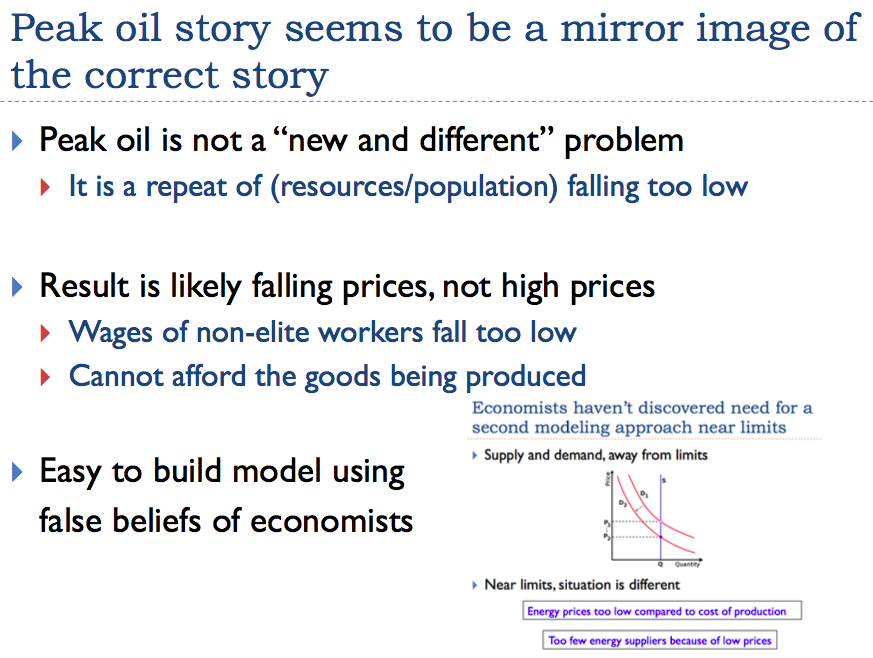
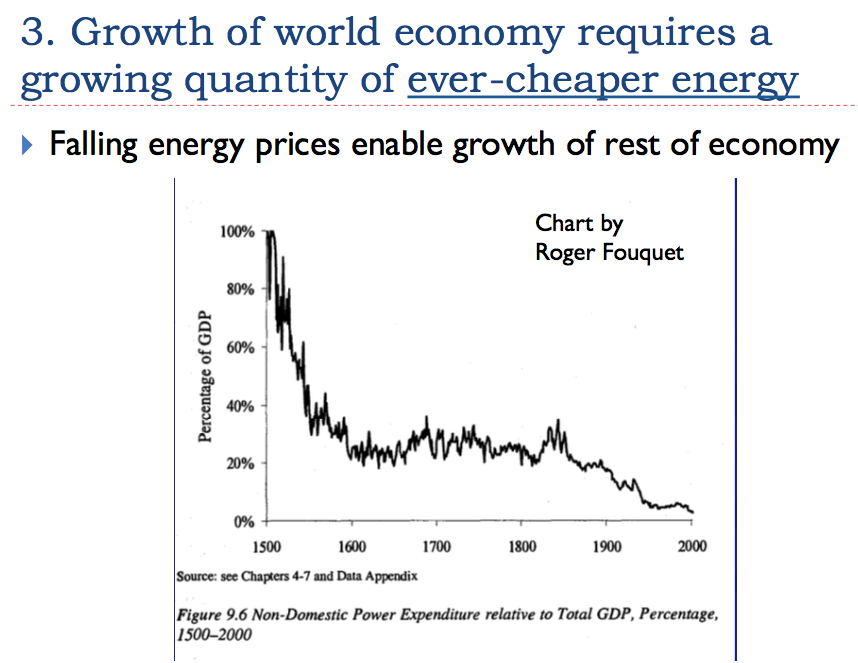
Most people assume that oil prices, and for that matter other energy prices, will rise as we reach limits. This isn’t really the way the system works; oil prices can be expected to fall too low, as we reach limits. Thus, we should not be surprised if the OPEC/Russia agreement to limit oil extraction falls apart, and oil prices fall further. This is the way the “end” is reached, not through high prices.


I recently tried to explain how the energy-economy system works, including the strange way prices fall, rather than rise, as we reach limits, at a recent workshop in Brussels called “New Narratives of Energy and Sustainability.” The talk was part of an “Inspirational Workshop Series” sponsored by the Joint Research Centre of the European Commission.

My talk was titled, “Elephants in the Room Regarding Energy and the Economy.” (PDF) In this post, I show my slides and give a bit of commentary.


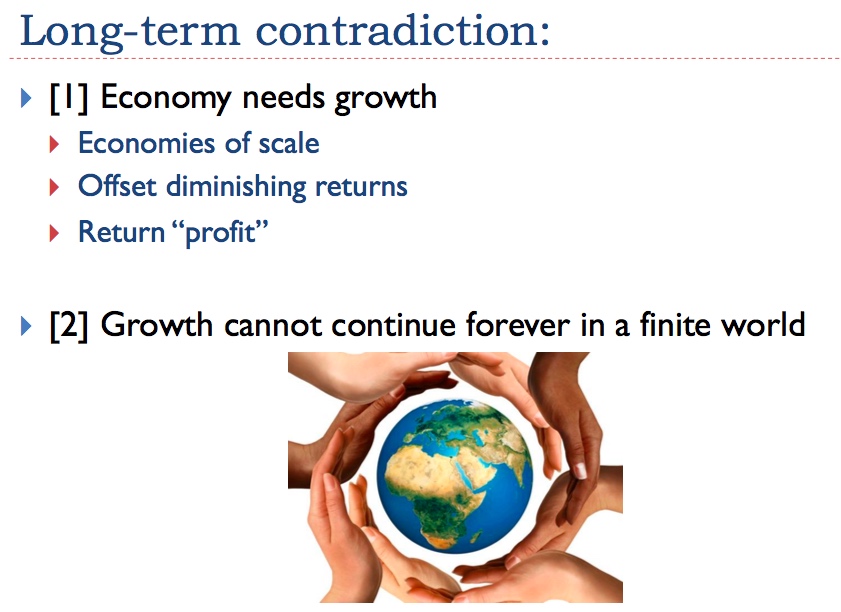
The question, of course, is how this growth comes to an end.


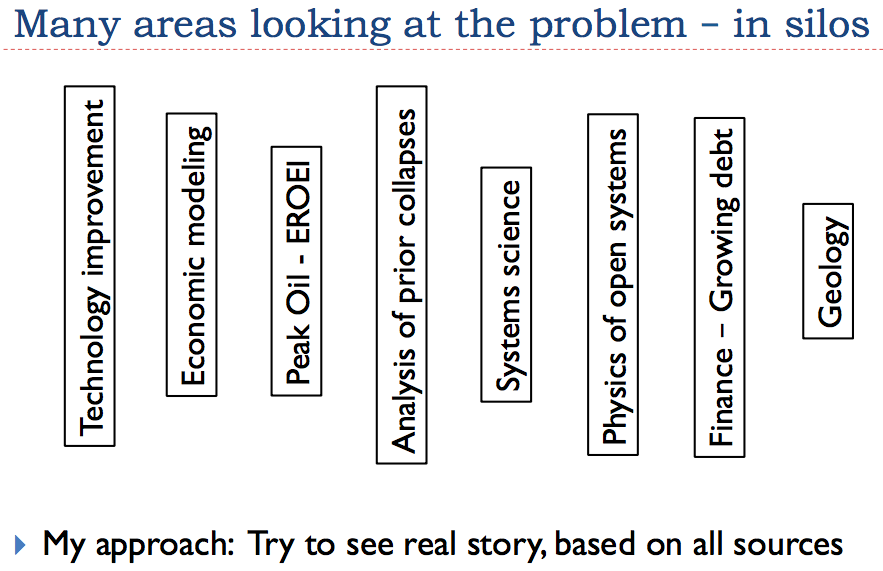
I have been aided in my approach by the internet and by the insights of many commenters to my blog posts.


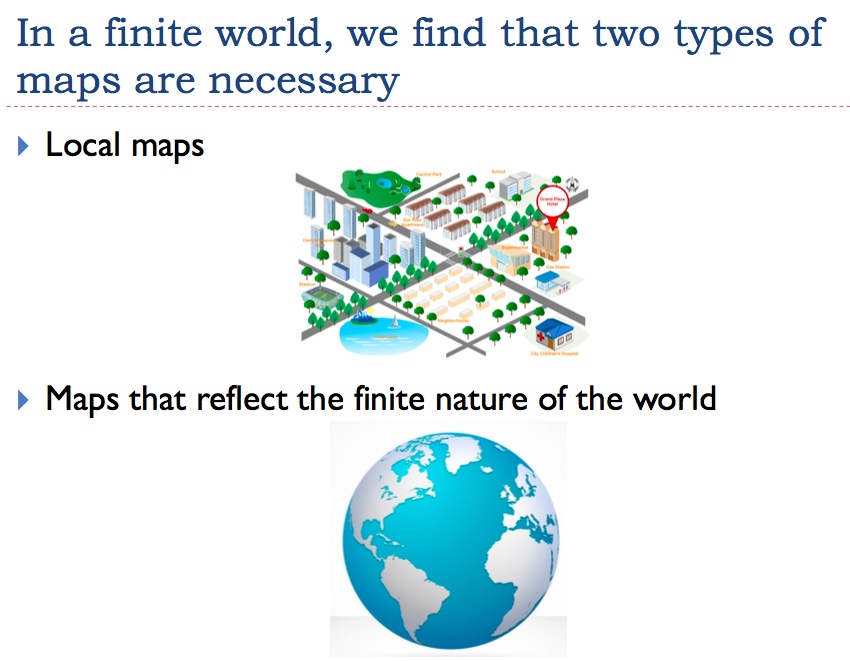
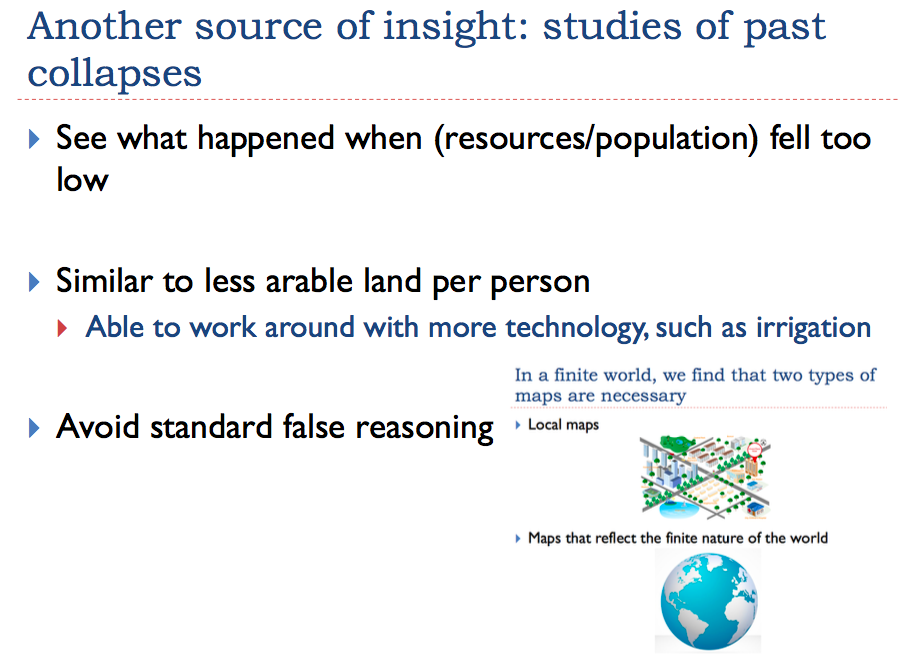
We all recognize that our way of visualizing distances must change, when we are dealing with a finite world.


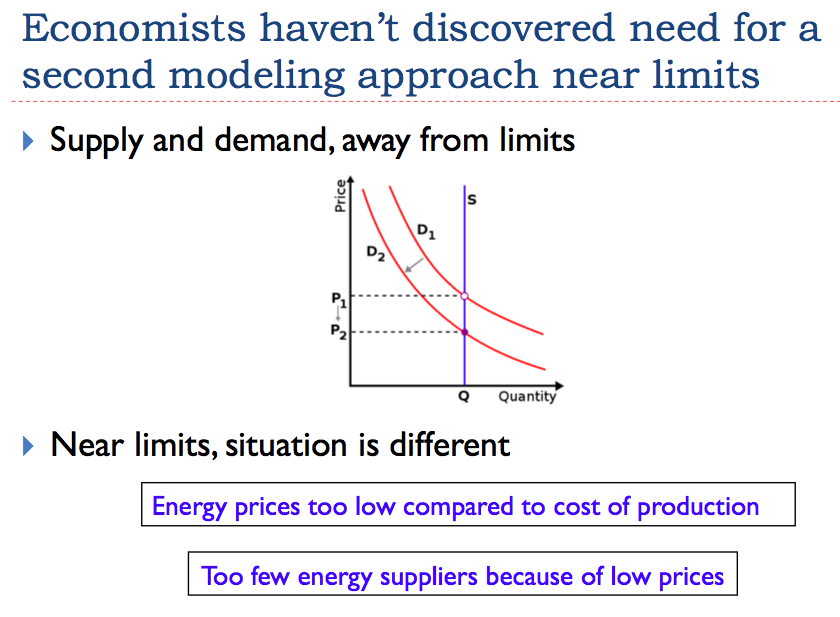
I should note that not all economists have missed the fact that the pricing situation changes, as limits are reached. Aude Illig and Ian Schindler have recently published a paper that concludes, “We find that price feedback cycles which lead to increased production during the growth phase of oil extraction go into reverse in the contraction phase of oil extraction, speeding decline.”


The comments shown in red on Slide 6 (above) reflect a variety of discussions over the last several years. Oil prices in the $50 per barrel range are way too low for producers. They may be high enough to get “oil out of the ground,” but they are not high enough to encourage necessary reinvestment, and they are not high enough to provide the tax revenue that oil exporters depend on.


Most people don’t stop to think about the symmetric nature of the problem. They also don’t realize that the adverse impacts of low oil prices don’t necessarily appear immediately. They can temporarily be hidden by more debt.


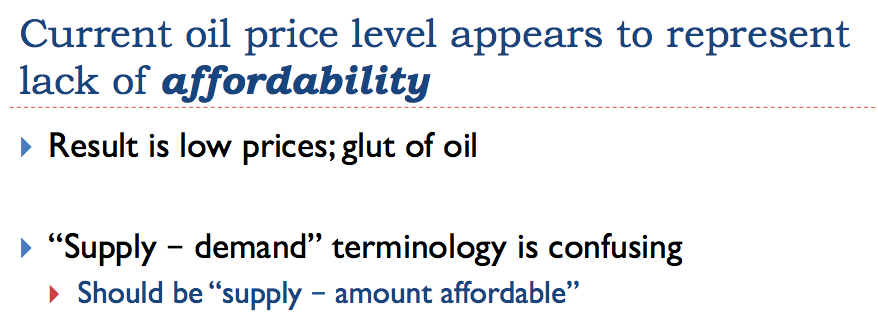
There would be no problem if wages were to rise as oil prices rise. Or if there were an easily substitutable source of cheap energy. The problem becomes an affordability problem.


The economists’ choice of the word “demand” is confusing. A person cannot simply demand to buy a car, or demand to go on a vacation trip. The person needs some way to pay for these things.


If researchers don’t examine the situation closely, they miss the nuances.


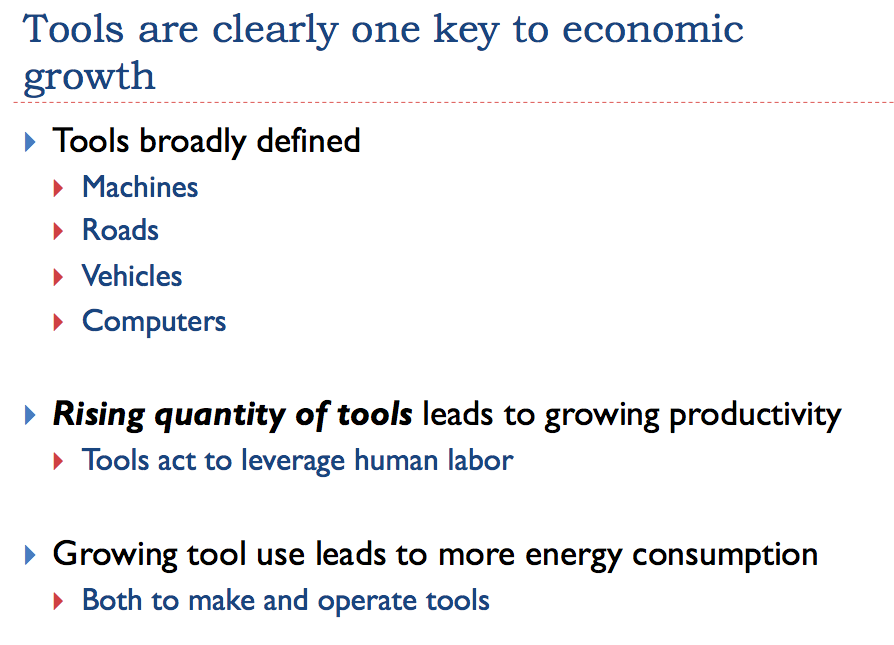
Many people think that the increasing use of tools can save us, because of the possibility of increased productivity.


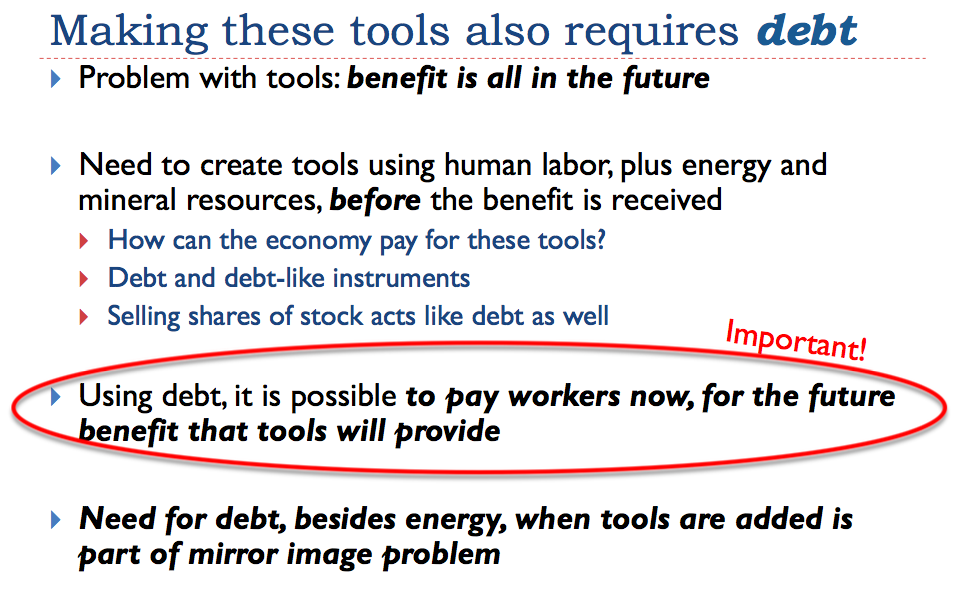
Using more tools leads to the need for an increasing amount of debt.


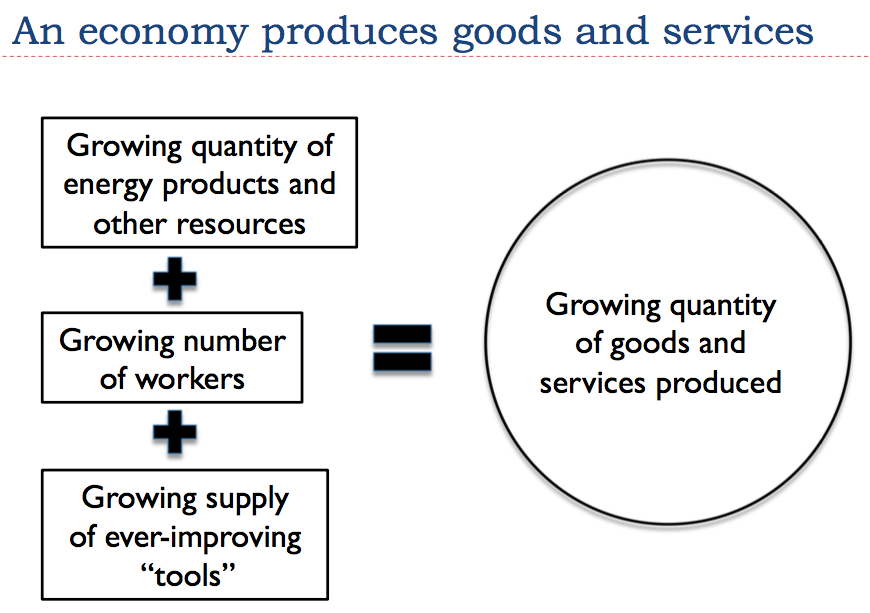
Read this chart from left to right. If we combine increasing quantities of resources, workers, and tools, the output is a growing quantity of goods and services.


Read this chart from right to left. How do we divide up the goods and services produced, among those who produced the products? If we can only use previously produced goods to pay workers and other contributors to the system, we will never have enough. But with the benefit of debt, we can promise some participants “future goods and services,” and thus have enough goods and services to pay everyone.


If we decrease the amount of debt, we have a big problem. Instead of the debt adding to the amount of goods and services produced, the shrinkage acts to decrease the amount of goods and services available for distribution as pay. This is why moving from deficit spending to a balanced budget, or a budget that reduces debt, is so painful.


When I say (resources/population), I mean resources per capita. Falling resources per capita makes it harder to earn an adequate living. Think of farmers trying to subsist on ever-smaller farms. It would become increasingly difficult for them to earn a living, unless there were to be a big improvement in technology.


Or think of a miner who is extracting ore that is gradually dropping from 5% metal, to 2% metal, to 1% metal content, and so on, because the best quality ore is extracted first. The miner needs to work an increasing number of hours to produce the ore needed for 100 kilograms of the metal. The economy is becoming in some sense “worse off,” because the worker is becoming “inefficient” through no fault of his own. The resources needed to provide benefits simply are less available, due to diminishing returns. This problem is sometimes reported as “falling productivity per worker.”


Falling productivity per worker tends to lower wages. And lower wages put downward pressure on commodity prices, because of affordability problems.


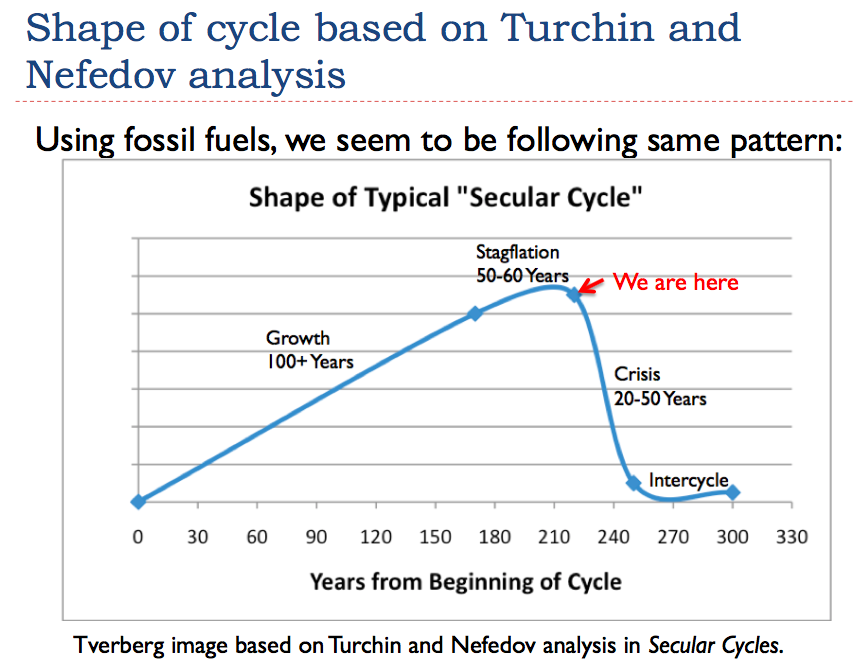
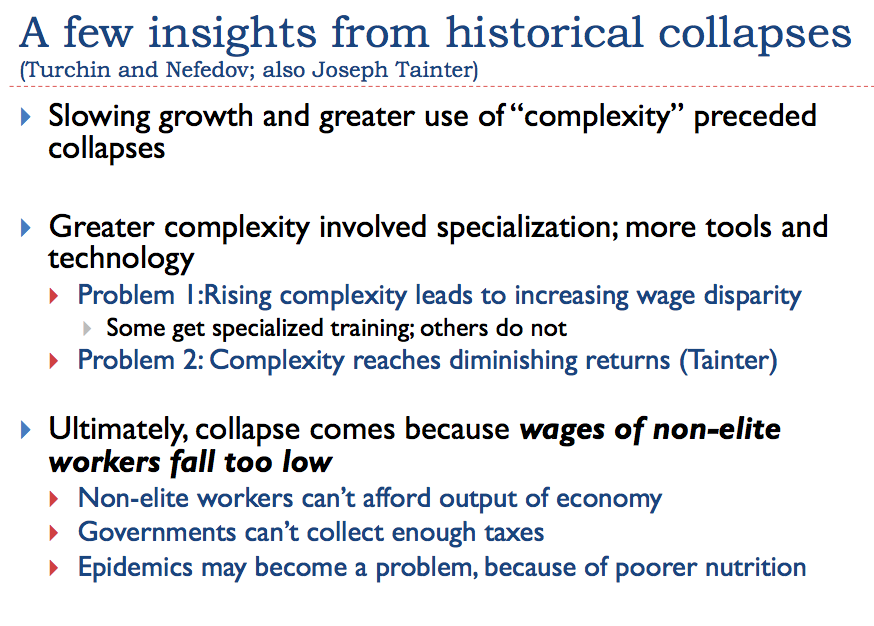
The problems that prior civilizations reached before collapse sound in many ways like the problems we are seeing today. We are seeing increased specialization, and falling relative wages of non-elite workers.


We seem to have already gone through a long period of stagflation since the 1970s. The symptoms we are seeing today look as if we are approaching a steep downslope. If we are approaching a crisis stage, it may be much shorter than the 20 to 50 years observed historically. Earlier civilizations (from which these timeframes were observed), did not have electricity or the extensive international trade system we have today.


The period since 1998 seems especially flat for wages for US wage earners, in inflation-adjusted terms. This is the period since energy prices started rising, and since globalization started playing a greater role.


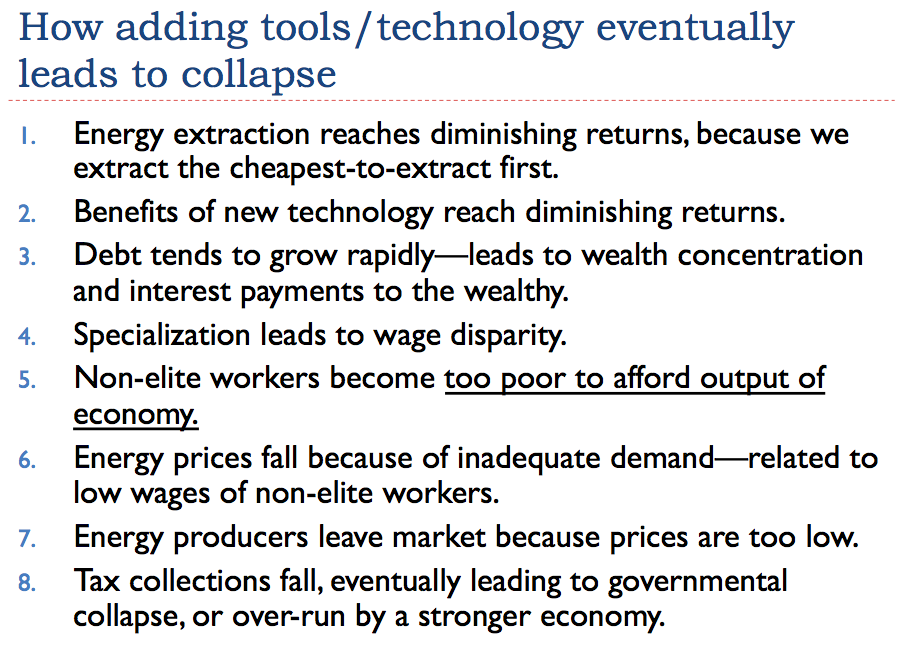
This is a list I made, showing that what looks to be beneficial–adding tools and technology–eventually leads to our downfall. The big problem that occurs is that non-elite workers become too poor to afford the output of the economy. Adding robots to replace workers looks efficient, but leaves many unemployed. Unemployment is even worse than low pay.


We can think of the economy as being a self-organized network of businesses, consumers, and governments. New products are gradually added, and ones that are no longer needed are eliminated. Government regulations change in response to changing business conditions. Debt is especially important for economic growth, because it makes goods affordable for customers, and it enables the use of “tools.” Prices are created almost magically by this networked system, through the interaction between supply and demand (reflecting affordability, among other things).


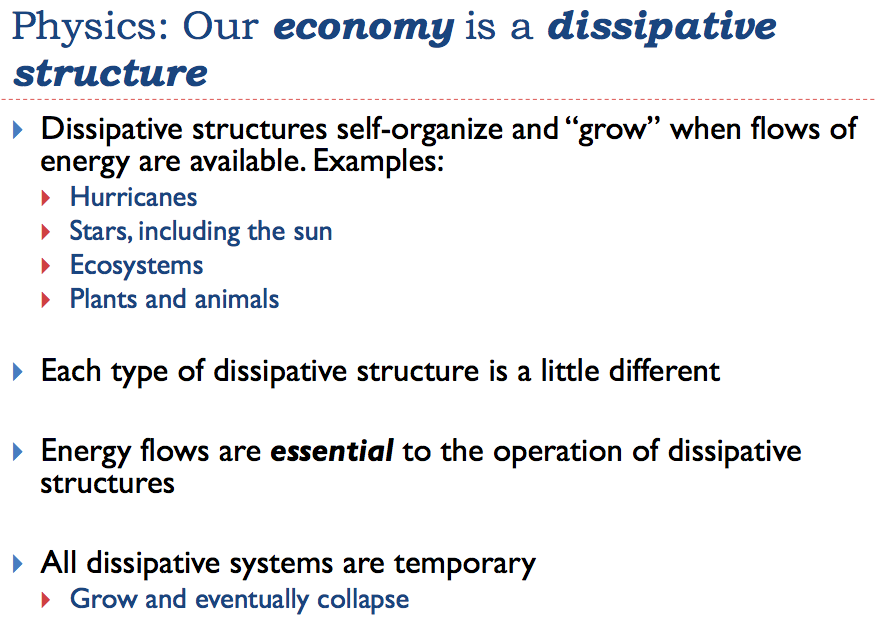
It is only in recent years that physicists have become increasingly aware of the fact that many types of structures form in the presence of flows of energy. We have known for a long time that plants and animals can grow when conditions are right. The networked economy illustrated above is one of the types of things that can grow and flourish in the presence of energy flows.


This is my view of how an economy, as a dissipative structure, works. “Tools and technology” are at the center. If a person doesn’t think too much about the issues involved, it is easy to assume that tools and technology will allow the economy to grow forever.


There is a potential for problems, both with respect to inputs and waste outputs. Early modelers missed many of these “issues.” M. King Hubbert created a model in which the quantity of energy supply and technology are the only issues of importance. He thus missed the impact of the Waste Output problems at the right. The Waste Outputs lead to falling prices as limited supply nears, and thus lead to a much steeper drop in production than Hubbert’s symmetric model would suggest.


Peak oilers recognized one important point: our use of oil products would at some point have to come to an end. But they did not understand how complex the situation is. Low prices, rather than high, would be the problem. We would see gluts rather than shortages, as we approach limits. Much of the oil that seems to be technologically extractable will really be left in the ground, because of low prices and other problems.


Here, I am getting back to the topic I was originally asked to talk about. What else, besides low energy prices and too much debt, are likely to be problems as we reach limits?


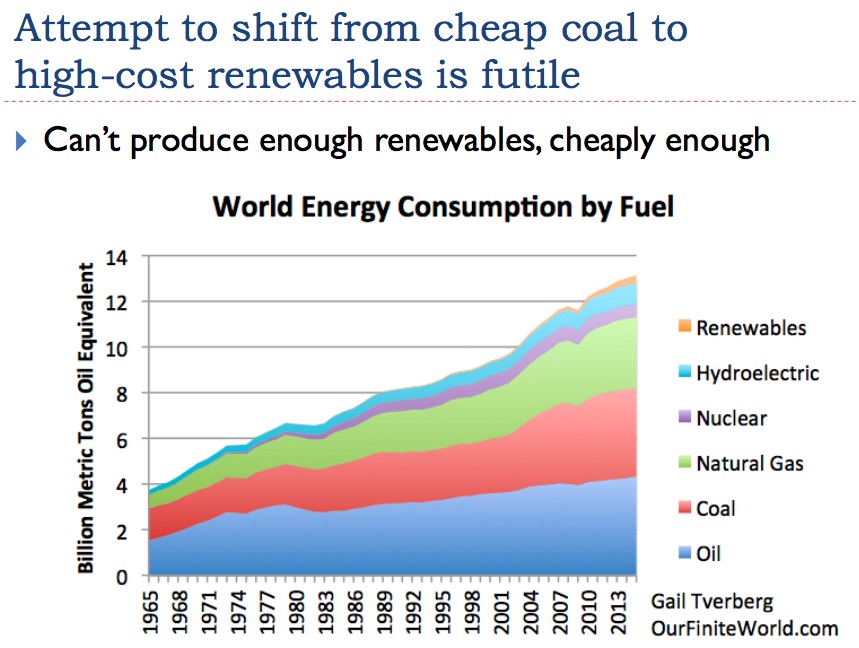
The easy way of modeling the use of wind turbines and solar turbines is to assume that the electricity produced by these devices is equivalent to electricity produced by fossil fuels, or by hydroelectric. Unfortunately, this is not the case.


Trying to integrate solar panels into an electric grid adds a whole new level of complexity to the electrical system. I have only illustrated some of the issues that arise in the slide above.


The fact that the price system doesn’t work for any fuel is a major impediment to adding more than a very small percentage of intermittent renewables to the electric grid. Intermittent renewables can only be used on the electric grid if they have a 24/7/365 backup supply that can be ramped up and down as needed. Unfortunately, the pricing system does not provide nearly high enough rates for this service. We are now seeing how this works out in practice. South Australia lost its last two coal-fired electricity power plants due to inadequate wholesale electricity prices when it added wind and solar. Now it is experiencing problems with both high electricity prices and too-frequent outages.


Another problem is that new [long distance] transmission makes buying from neighbors optimal, over at the left of Slide 28. This is a new version of the tragedy of the commons. Once long distance lines are available, and a neighbor has a fairly inexpensive supply of electricity, the temptation is to simply buy the neighbor’s electricity, rather than build local electricity generating capacity. The greater demand, without additional supply, then raises electricity prices for all, including the neighbor who originally had the less expensive electricity generation.


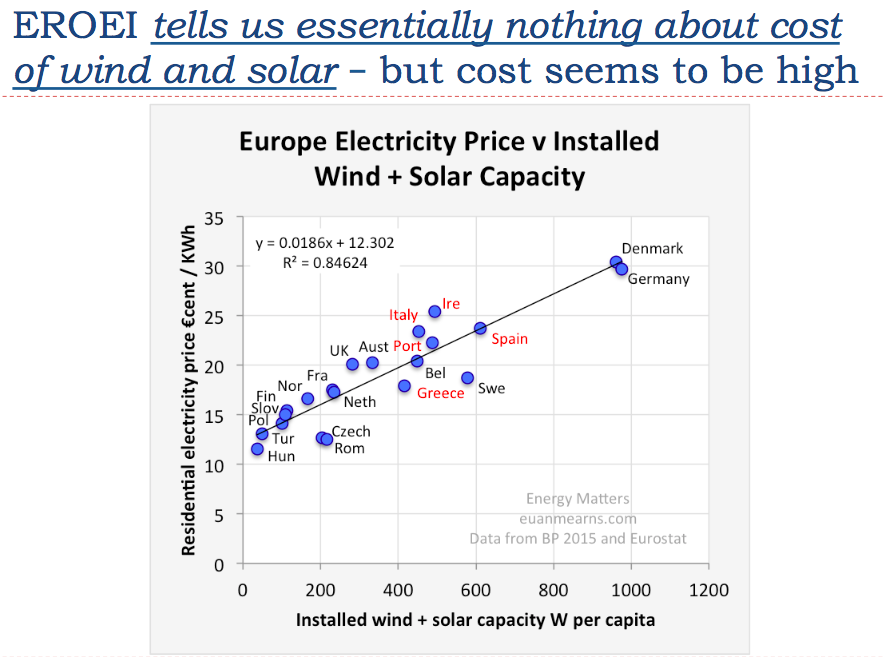
It is easy to assume that EROEI (Energy Returned on Energy Invested) or some other popular metric tells us something useful about the cost of integrating intermittent renewables into the electric grid, but this really isn’t the case.


We are now beginning to see what happens in “real life,” as intermittent renewables are added. For example, we can now see the problems South Australia is having with high electricity prices and too many outages as well as the high electricity prices in Germany and Denmark.


Wind and solar are not very helpful as stand-alone devices. Yet this is the way they are modeled. Some researchers have included installation costs, but this still misses the many problems that these devices cause for the electrical system, especially as the share of electricity production by these devices rises.


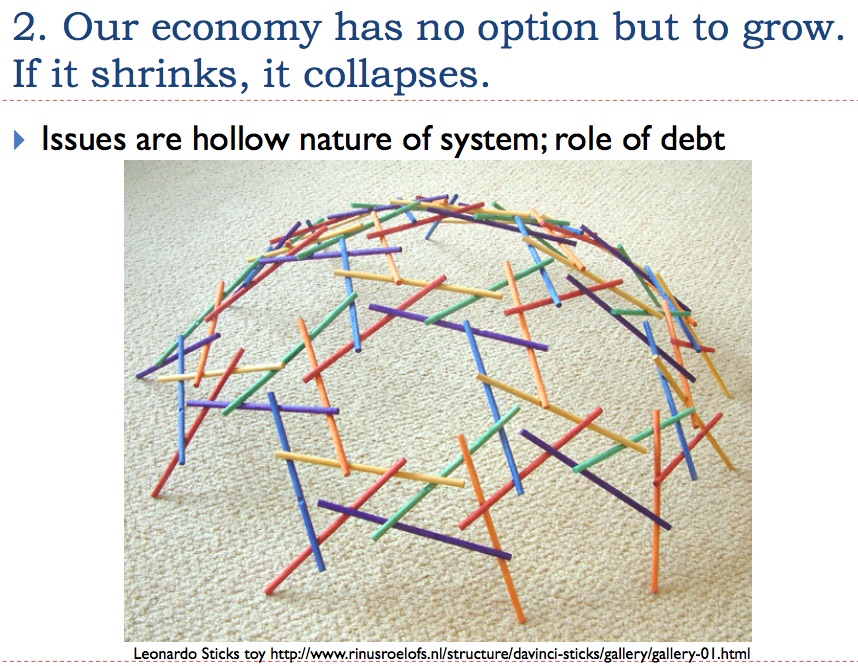
A networked system works differently than a system that is “user controlled.” It builds itself, and it can collapse, if conditions aren’t right. I have shown the economy as hollow, because there is no way of going backward.


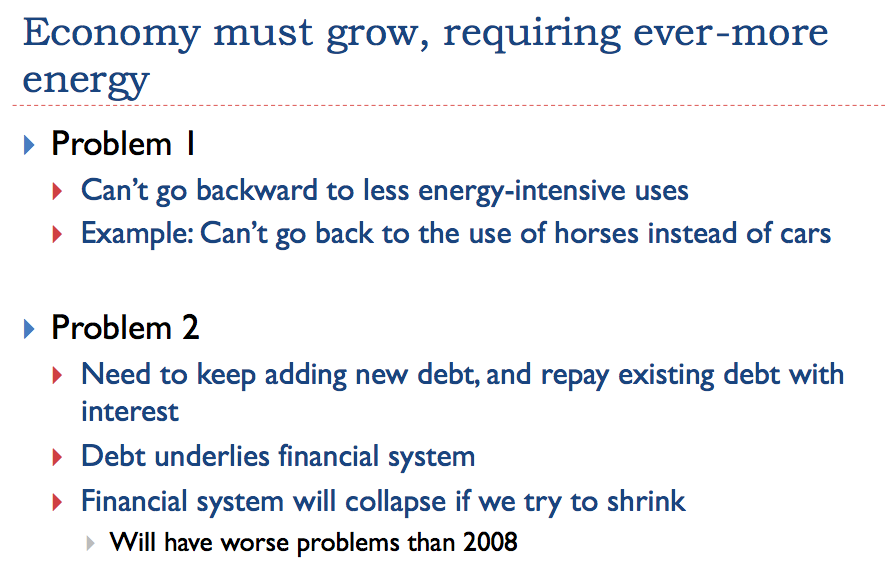
Many people miss the point that the economy must keep growing. In fact, I pointed this out in Slide 2 and gave an additional reason why it must keep growing on Slide 16. As the economy grows, we tend to need more energy. Growing efficiency can only slightly offset this. Thus, as a practical matter, energy per capita needs to stay at least level for an economy to grow.


If energy prices rise, this will tend to squeeze out discretionary spending on other goods and services. If we cannot obtain energy products sufficiently cheaply, the system of economic growth will stop.


The fact that energy prices can, and do, fall below the cost of production is something that has been missed by many modelers. Prices can go down, even when the cost of production plus taxes needed by governments rises!


Wind and solar are part of the category at the top called “renewables.” This category also includes energy from wood and from geothermal. Many people do not realize how small this category is. Hydroelectric is also considered a renewable, but it is not growing in supply in the United States or Europe.


It takes energy to have an intergovernmental organization, such as the European Union. In fact, it takes energy to operate any kind of government. When there is not enough surplus energy to go around, citizens decide that the benefits of belonging to such organizations are less than the costs involved. That is the reason for the Brexit vote, and the reason the question is coming up elsewhere.


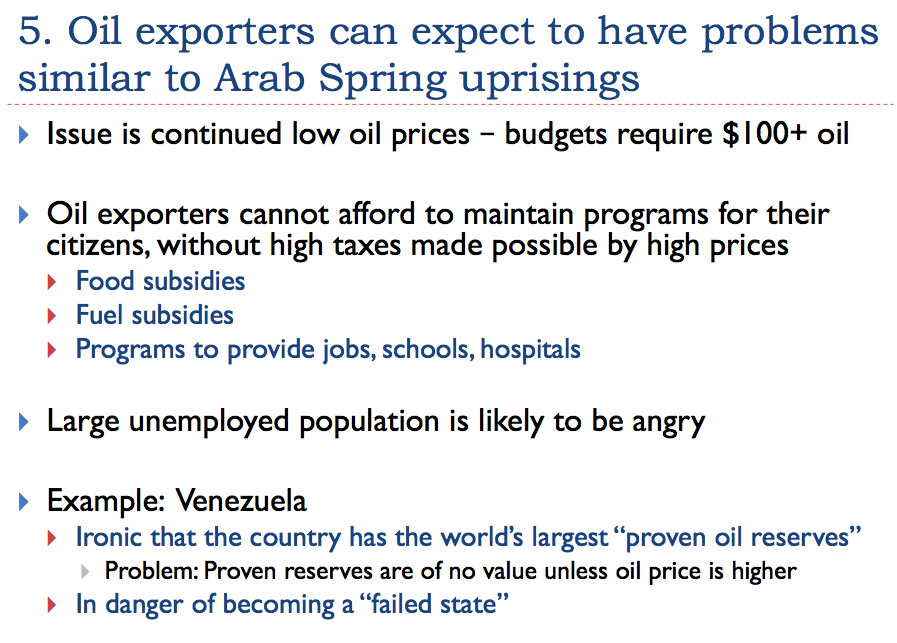
The amount of taxes oil-producing countries can collect depends on how high the price of oil is. If the price isn’t high enough, oil-exporting countries generally have to cut back their budgets. Even Saudi Arabia is having difficulty with low oil prices. It has needed to borrow in order to maintain its programs.


Oil prices have been too low for producers since at least mid-2014. It is possible to hide a problem with low prices with increasing debt for a few years, but not indefinitely. The longer the low-price scenario continues, the more likely a collapse in production is. Also, the tendency of international organizations of government to collapse (Slide 38) takes a few years to manifest itself, as does the tendency for civil unrest within oil exporters (Slide 39).


It is easy to miss the point that modeling a piece of the system doesn’t necessarily tell a person very much about the system as a whole.


Once an incorrect understanding of our energy problem becomes firmly entrenched, it becomes very difficult for leaders to understand the real problem.