Showing posts with label Guam. Show all posts

Monday, February 19, 2018

Volcanic Activity And Earthquakes In The Ring Of Fire Spark Fears Of ‘The BIG ONE’


The Ring of Fire appears to be awakening in the past few weeks.  As deaths, injuries, and evacuations occur around the volatile area, new fears have arisen that the “big one” could occur any day now.


Many have warned that the Ring of Fire’s activity could produce a large enough earthquake to completely destroy the entire California coast. So far, nothing of the sort has happened, but new and violent volcanic activity is forcing the fear back to the forefront of people’s minds.


According to The Sun, scientists are now sounding the alarm as well.  Scientists have warned that the frequent seismic activity, which has already claimed lives, could mean a huge quake is on the way.  A new study out of California says that the cluster of tremors around the planet’s so-called Ring of Fire (the horseshoe-shaped geological disaster zone) could indicate the “big one” is due to hit, TheDaily Mail Online reports.


The research, published in the journal Science Advances, involved analysis of 101 major earthquakes around the Pacific Ring of Fire between 1990 and 2016. Thorne Lay, a professor of Earth and planetary sciences at UC Santa Cruz, said, “Based on the clustering of earthquakes in space and time, the area that has just slipped is actually more likely to have another failure.” He added that despite the stress on the fault being lowered to below failure level, “the surrounding areas have been pushed towards failure in many cases, giving rise to aftershocks and the possibility of an adjacent large rupture sooner rather than later.”


“Taiwan, Guam, and Japan are far apart relative to the static stress interactions, but one could examine the seismic shaking from an earlier event in the region of a later event to see if small earthquakes were triggered as the seismic waves went by which could have led to a cascade of failures culminating in a larger event,” said Lay.  “Until that type of analysis is done, causal connection between the events is very speculative. Earthquakes are happening frequently in the Ring of Fire, and some apparent space-time clustering could arise from purely random (non-interacting) activity.”


More than 180 people were injured and 17 people killed when a 6.4 magnitude quake struck Taiwan’s east coast on February 6.


On Tuesday a series of tremors reaching magnitudes as high as 5.7 shook the US island territory of Guam.


Since February 11, three earthquakes have hit Japan, the largest measured at 4.8 on the Richter scale and was 103 kilometers from Hachijo.


But scientists have reassured the public, saying such activity is normal for the Ring of Fire and dismissed speculation of a “domino effect” triggering a bigger quake.The Sun


While some scientists look to discover the possibility of an unexpected “big one,” many others are urging the public to remain calm and not be concerned.


Toshiyasu Nagao, head of Tokyo-based Tokai UNiversity’s Earthquake Prediction Research Centre, told Japan Times, “The Pacific Rim is in a period of activity. In terms of volcanic history, however, the current activity is still regarded as normal.”

Sunday, December 17, 2017

Debunking The Myths About An Attack On North Korea

Submitted by The Saker,


First, the bragging dummies


Trump and Haley are still at it.  They want to force China to take action against the DPRK by threatening to take North Korea “into their hands” if China refuses to comply.  Haley said, “But to be clear, China can do more, (…) and we’re putting as much pressure on them as we can. The last time they completely cut off the oil, North Korea came to the table. And so we’ve told China they’ve got to do more. If they don’t do more, we’re going to take it into our own hands and then we’ll start to deal with secondary sanctions.”


First, let’s reset this scene in a kindergarten and replay it.


Kid A has a fight with Kid B.  Kid A threatens to beat up Kid B.  Kid B then tells Kid A to go screw himself.  Kid A does nothing, but issues more threats.  Kid B keeps laughing.  And then Kid A comes up with a brilliant plan: he threatens Kid C (who is much much bigger than Kid B and much much stronger too!) by telling him "if you don’t make Kid B comply with my demands, I will take the issue in my own hands!".  The entire schoolyard erupts in hysterical laughter.


Question: how would you the gauge the intelligence of Kid A? Anyway...


This would all be really funny if this was a comedy show.  But what this all is in reality is a slow but steady progression towards war.  What makes this even worse is the media’s obsession with the range of North Korean missiles and whether they can reach Guam or even the USA.  With all due respect for the imperial “only we matter” (and nevermind the "gooks"), there are ways “we”, i.e. the American people can suffer terrible consequences from a war in the Korean Peninsula which have nothing to do with missile strikes on Guam or the USA.


Image via The Saker


The lucrative target: Japan


This summer I mentioned one of the most overlooked potential consequences of a war with the DPRK and I want to revisit this issue again.  First, the relevant excerpt from the past article:


While I personally believe that Kim Jong-un is not insane and that the main objective of the North Korean leadership is to avoid a war at all costs, what if I am wrong?  What if those who say that the North Korean leaders are totally insane are right? Or, which I think is much more likely, what if Kim Jong-un and the North Korean leaders came to the conclusion that they have nothing to lose, that the Americans are going to kill them all, along with their families and friends?  What could they, in theory, do if truly desperate?  Well, let me tell you: forget about Guam; think Tokyo!  Indeed, while the DPRK could devastate Seoul with old fashioned artillery systems, DPRK missiles are probably capable of striking Tokyo or the Keihanshin region encompassing Kyoto, Osaka and Kobe including the key industries of the Hanshin Industrial Region.  The Greater Tokyo area (Kanto region) and the Keihanshin region are very densely populated (37 and 20 million people respectively) and contain an immense number of industries, many of which would produce an ecological disaster of immense proportions if hit by missiles.  Not only that, but a strike on the key economic and financial nodes of Japan would probably result in a 9-11 kind of international economic collapse.  So if the North Koreans wanted to really, really hurt the Americans what they could do is strike Seoul, and key cities in Japan resulting in a huge political crisis for the entire planet.  During the Cold War we used to study the consequences of a Soviet strike against Japan and the conclusion was always the same: Japan cannot afford a war of any kind.  The Japanese landmass is too small, too densely populated, to rich in lucrative targets and a war would lay waste to the entire country. This is still true today, only more so.  And just imagine the reaction in South Korea and Japan if some crazy US strike on the DPRK results in Seoul and Tokyo being hit by missiles!  The South Koreans have already made their position unambiguously clear, by the way. As for the Japanese, they are officially placing their hopes in missiles (as if technology could mitigate the consequences of insanity!).  So yeah, the DPRK is plenty dangerous and pushing them into their last resort is totally irresponsible indeed, nukes or no nukes.


Yet, for some reason, the western media rarely mentions Japan or the possible global economic consequences on a strike against Japan.  Very few people know for sure whether the North Koreans truly have developed a usable nuclear weapon (warhead and missile) or whether the North Korean ballistic missile truly can reach Guam or the USA.  But I don’t think that there is any doubt whatsoever that North Korean missile can easily cover the roughly 1000km (600 miles) to reach the heart of Japan.  In fact, the DPRK has already lobbed missiles over Japan in the past.  Some red blooded US Americans will, no doubt, explain to use that the US THAAD system can, and will, protect South Korea and Japan from such missile strikes.  Others, however, will disagree.  We won’t know until we find out, but judging by the absolutely dismal performance of the vaunted US Patriot system in the Gulf War,  I sure would not place my trust in any US made ABM system.  Last, but not least, the North Koreans could place a nuclear device (not even a real nuclear warhead) on a regular commercial ship or even a submarine, bring it to the coast of Japan and detonate it.  The subsequent panic and chaos might end up costing even more lives and money than the explosion itself.


Then there is Seoul, of course.  US analyst Anthony Cordesman put is very simply “A battle near the DMZ, directed at a target like Seoul, could rapidly escalate to the point at which it threatened the ROK’s entire economyeven if no major invasion took place."


[Sidebar: Cordesman being Cordesman, he proceeds to hallucinate about the effects of a DPRK invasion of the ROK and comes up with sentences such as “Problems drive any assessment of the outcome of a major DPRK invasion of the ROK, even if one only focuses on DPRK- ROK forces. The DPRK has far larger ground forces, but the outcome of what would today be an air – land battle driven heavily by the overall mobility of DPRK land forces and their ability to concentrate along given lines of advance relative to the attrition technically superior ROK land and air forces could inflict is impossible to calculate with any confidence, as is the actual mix of forces both sides could deploy in a given area and scenario“.  Yup, the man is seriously discussing AirLand battle concepts in the context of a DPRK invasion of the South!  He might as well be discussing the use of Follow-on-Forces Attack concept in the context of a Martian invasion of earth (or an equally likely Russian invasion of the Baltic statelets!).  It is funny and pathetic how a country with a totally offensive national strategy, military doctrine and force posture still feels the need to hallucinate some defensive scenarios to deal with the cognitive dissonance resulting from clearly being the bad guy.]


Why does Cordesman say that?  Because according to a South Korean specialist “DPRK artillery pieces of calibers 170mm and 240mm “could fire 10,000 rounds per minute to Seoul and its environs.”   During the war in Bosnia the western press spoke of “massive Serbian artillery strikes on Sarajevo” when the actual rate of fire was about 1 artillery shell per minute.  It just makes me wonder what they would call 10,000 rounds per minute.


The bottom line is this: you cannot expect your enemy to act in a way which suits you; in fact you should very much assume that he is going to do what you do not expect and what is the worst possible for you.  And, in this context, the DPRK has many more options than shooting an ICBM at Guam or the USA.  The nutcases in the Administration might not want to mention it, but an attack on the DPRK risks bringing down both the South Korean and the Japanese economies with immediate and global consequences: considering that rather shaky and vulnerable nature of the international financial and economic system, I very much doubt that a major crisis in Asia would not result in the collapse of the US economy (which is fragile anyway).


We should also consider the political consequences of a war on the Korean Peninsula, especially if, as is most likely, South Korea and Japan suffer catastrophic damage.  This situation could well result in such an explosion of anti-US feelings that the US would have to pack and leave from the region entirely.


How do you think the PRC feels about such a prospect?  Exactly.  And might this not explain why the Chinese are more than happy to let the USA deal with the North Korean problem knowing full well that one way or another the USA will lose without the Chinese having to fire a single shot?


The terrain


Next I want to re-visit a threat which is discussed much more often: North Korean artillery and special forces.  But first, I ask you to take a close look at the following three maps of North Korea:


These full-size maps can be downloaded from here.


What I want you to see is that the terrain in North Korea is what the military call “mixed terrain”.  The topography of North Korea article in Wikipedia actually explains this very well:


The terrain consists mostly of hills and mountains separated by deep, narrow valleys. The coastal plains are wide in the west and discontinuous in the east.  Early European visitors to Korea remarked that the country resembled “a sea in a heavy gale” because of the many successive mountain ranges that crisscross the peninsula. Some 80 percent of North Korea’s land area is composed of mountains and uplands, with all of the peninsula’s mountains with elevations of 2,000 metres (6,600 ft) or more located in North Korea. The great majority of the population lives in the plains and lowlands.


Being from Switzerland I know this kind of terrain very well (it’s what you would see in the Alpine foothills called “Oberland” or “Préalpes”) and I want to add the following: dense vegetation, forests, rivers and creek with steep banks and rapid currents.  Small villages and *a lot* of deep, underground tunnels. There are also flat areas in North Korea, of course, but, unlike Switzerland, they are composed mostly of rice fields and marshes.  In military terms this all translates into one simple and absolutely terrifying word: infantry.


Why should the word infantry scare so much? Because infantry means on foot (or horses) with very little airpower (AA and MANPADS), satellites (can’t see much), armor (can’t move around), gunships, submarines or cruise missiles can do.  Because infantry means “no lucrative targets” but small, dispersed and very well hidden forces.  Company and even platoon-level warfare.  Because infantry in mixed terrains means the kind of warfare the US Americans fear most.


The adversary


And with that in mind, let’s repeat that besides its huge regular armed forces (about a million soldiers plus another 5 million plus in paramilitary organizations) the DPRK also has 200,000 special forces.   Let’s assume that the Western propaganda is, for once, saying the truth and that the regular armed forces are poorly equipped, poorly trained, poorly commanded and even hungry and demotivated (I am not at all sure that this is a fair assumption, but bear with me).  But spreading that amount of soldiers all over the combat area would still represent a huge headache, even for “the best and most powerful armed forces in history” especially if you add 200,000 well-trained and highly motivated special forces to the mix (I hope that we can all agree that assuming that special forces are also demotivated would be rather irresponsible).  How would you go about finding out who is who and where the biggest threat comes from? And consider this: it would extremely naive to expect the North Korean special forces to show up in some clearly marked DPRK uniforms.  I bet you that a lot of them will show up in South Korean uniforms, and others in civilians clothes.  Can you imagine the chaos of trying to fight them?


You might say that the North Koreans have 1950"s era weapons.  So what?  That is exactly what you need to fight the kind of warfare we are talking about: infantry in mixed terrains.  Even WWII gear would do just fine.  Now is time to bring in the North Korean artillery.  We are talking about 8,600 artillery guns, and over 4,800 multiple rocket launchers (source).  Anthony Cordesman estimates that there are 20,000 pieces in the “surrounding areas” of Seoul.  That way is more than the US has worldwide (5,312 according to the 2017 “Military Balance”, including mortars).  And keep in mind that we are not talking about batteries nicely arranged in a flat desert, but thousands of simple but very effective artillery pieces spread all over the “mixed terrain” filled with millions of roaming men in arms, including 200,000 special forces.  And a lot of that artillery can reach Seoul, plenty enough to create a mass panic and exodus.


Think total, abject and bloody chaos


So when you think of a war against North Korea, don’t think “Hunt for Red October” or “Top Gun”.  Think total, abject and bloody chaos.  Think instant full-scale FUBAR.  And that is just for the first couple of days, then things will get worse, much worse.  Why?


Because by that time I expect the North Korean Navy and Air Force to have been completely wiped-off, waves after waves of cruise missiles will have hit an X number of facilities (with no way whatsoever to evaluate the impact of these strikes, but nevermind that) and the US military commanders will be looking at the President with no follow-up plan to offer.  As for the North Koreans, by then they will just be settling in for some serious warfare, infantry-style.


There is a better than average that a good part of the DPRK elites will be dead.   What is sure is that the command and control of the General Staff Department over many of its forces will be if not lost, then severely compromised.  But everybody will know that they have been attacked and by whom.  You don’t need much command and control when you are in a defensive posture in the kind of terrain were movement is hard to begin with.  In fact, this is the kind of warfare where “high command” usually means a captain or a major, not some faraway general.


You might ask about logistics?  What logistics I ask you? The ammo is stored nearby in ammo dumps, food you can always get yourself and, besides, its your home turf, the civilians will help.


Again, no maneuver warfare, no advanced communications, no heavy logistical train – we are talking about a kind of war which is much closer to WWII or even WWI than Desert Storm.


[Sidebar: as somebody who did a lot of interesting stuff with the Swiss military, let me add this: this kind of terrain is a battlefield were a single company can stop and hold an entire regiment; this is the kind of terrain where trying to accurately triangulate the position of an enemy radio is extremely hard; this is the kind of terrain where only horses and donkeys can carry heavy gear over narrow, zig-zagging, steep paths;  entire hospitals can be hidden underground with their entrance hidden by a barn or a shed; artillery guns are dug in underground and fire when a thick reinforced concrete hatch is moved to the side, then they hide; counter-battery radar hardly works due to bouncing signals; radio signals have a short range due to vegetation and terrain; weapon caches and even company size forces camps can only be detected by literally stepping on them; underground bunkers have numerous exits; air-assault operations are hindered by the very high risk of anti-aircraft gunfire or shoulder-fired missiles which can be hidden and come from any direction.  I could go on and on but I will just say this: if you want to defeat your adversary in such a terrain there is only one technique which works: you do what the Russians did in the mountains in southern Chechnia during the second Chechen war – you send in your special forces, small units on foot, and you fight the enemy on his own turf.  That is an extremely brutal, dangerous and difficult kind of warfare which I really don’t see the Americans doing.  The South Koreans, yes, maybe. But here is where the number game also kicks in: in Chechnia the Russians Spetsnaz operated in a relatively small combat zone and they had the numbers.  Now look at a map of North Korea and the number of North Korean special forces and tell me – do the South Koreans have the manpower for that kind of offensive operations?  One more thing: the typical US American reaction to such arguments would be “so what, we will just nuke them!".  Wrong.  Nuke them you can, but nukes are not very effective in that kind of terrain, finding a target is hard to begin with, enemy forces will be mostly hidden underground and, finally, you are going to use nukes to deal with company or platoon size units?!  Won’t work.]


If you think that I am trying to scare you, you are absolutely correct. I am.  You ought to be scared.  And notice that I did not even mention nukes.  No, not nuclear warheads in missiles.  Basic nuclear devices driven around in common army trucks.  Driven down near the DMZ in peacetime amongst thousands of other army trucks and then buried somewhere, ready to explode at the right time.  Can you imagine what the effect of a “no-warning” “where did it come from?” nuke might be on advancing US or South Korean forces?  Can you imagine how urgent the question “are there any more?” will become?  And, again, for that the North Koreans don’t even need a real nuclear weapon.  A primitive nuclear device will be plenty.


I can already hear the die-hard “rah-rah-rah we are number 1!” flag-wavers dismissing it all saying “ha! and you don’t think that the CIA already knows all that?”.  Maybe they do and maybe they don’t – but the problem is that the CIA, and the rest of the US intelligence community, has been so hopelessly politicized that it can do nothing against perceived political imperatives.  And, frankly, when I see that the US is trying to scare the North Koreans with B-1B and F-22s I wonder if anybody at the Pentagon, or at Langely, is still in touch with reality.  Besides, there is intelligence and then there is actionable intelligence. And in this case knowing what the Koreans could do does not at all mean know what to do about it.


Speaking of chaos – do you know what the Chinese specifically said about it?


Can you guess?


That they will “not allow chaos and war on the peninsula."


Enter the Chinese


Let’s talk about the Chinese now.  They made their position very clear: “If North Korea launches an attack that threatens the United States then China should stay neutral, but if the United States attacks first and tries to overthrow North Korea’s government China will stop them."  Since there is no chance at all of a unprovoked North Korean attack on the South or the USA, especially with this threat by the Chinese to remain neutral if the DPRK attacks first, let’s focus on the 2nd part of the warning.


What could the Chinese do if the US decides to attack North Korea?  There basic options depend on the nature of the attack:


  1. If the US limits itself to a combination of missile and airstrikes and the DPRK retaliates (or not), then the Chinese can simply provide technical, economic and humanitarian aid to the DPRK and denounce the US on a political level.

  2. If the USA follow up with a land invasion of some kind or if the DPRK decides to retaliate in a manner which would force the USA into a land invasion of some kind, then the Chinese could not only offer directly military aid, including military personnel, but they could also wait for the chaos to get total in Korea before opening a 2nd front against US forces (including, possibly, Taiwan).

That second scenario would create a dangerous situation for China, of course, but it would be even far more dangerous for US forces in Asia who would find themselves stretched very thin over a very large area with no good means to force either adversary to yield or stop.  Finally, just as China cannot allow the USA to crush North Korea, Russia cannot allow the USA to crush China.  Does that dynamic sound familiar?  It should as it is similar to what we have been observing in the Middle-East recently:


  1. Russia->Iran->Hezbollah->Syria

  2. Russia->China->DPRK

This is a very flexible and effective force posture where the smallest element is at the forefront of the line-up and the most powerful one most removed and at the back because it forces the other side to primarily focus on that frontline adversary while maximizing the risks of any possibly success because that success is likely to draw in the next, bigger and more powerful adversary.


Conclusion: preparing for genocide


The US has exactly a zero chance of disarming or, even less so, regime changing the DPRK by only missile and airstrikes.  To seriously and meaningfully take the DPRK “in their hands” the US leaders would need to approve of a land invasion.  However, even if that is not the plan, if the DPRK decides to use its immense, if relatively antiquated, firepower to strike at Seoul, the US will have no choice to move in ground forces across the DMZ.  If that happens about 500,000 ROK troops backed by 30,000 US military personnel will face about 1 million North Korea soldiers backed by 5 million paramilitaries and 200,000 special forces on a mix terrain battlefield which will require an infantry-heavy almost WWII kind of military operations.  By definition, if the USA attacks the DPRK to try to destroy its nuclear program such an attack will begin by missile and air strikes on DPRK facilities meaning that the USA will immediately strike at the most valuable targets (from the point of view of the North Koreans of course).  This means that following such an attack the US will have little or no dissuasive capabilities left and that means that following such an attack the DPRK will have no incentive left to show any kind of restraint.  In sharp contrast, even if the DPRK decides to begin with an artillery barrage across the DMZ, including the Seoul metropolitan area, they will still have the ability to further escalate by either attacking Japan or by setting off a nuclear device.  Should that happen there is an extremely high probability that the USA will either have to “declare victory and leave” (a time-honored US military tradition) or begin using numerous tactical nuclear strikes.  Tactical nuclear strikes, by the way, have a very limited effectiveness on prepared defensive position in mixed terrain, especially narrow valleys.  Besides, targets for such strikes are hard to find.  At the end of the day, the last and only option left to the USA is what they always eventually resort to would be to directly and deliberately engage in the mass murder of civilians to “break the enemy’s will to fight” and destroy the “regime support infrastructure” of the enemy’s forces (another time-honored US military tradition stretching back to the Indian wars and which was used during the Korean war and, more recently, in Yugoslavia).  Here I want to quote an article by Darien Cavanaugh in War is Boring:


On a per-capita basis, the Korean War was one of the deadliest wars in modern history, especially for the civilian population of North Korea. The scale of the devastation shocked and disgusted the American military personnel who witnessed it, including some who had fought in the most horrific battles of World War II (…).  These are staggering numbers, and the death rate during the Korean War was comparable to what occurred in the hardest hit countries of World War II. (…)  In fact, by the end of the war, the United States and its allies had dropped more bombs on the Korean Peninsula, the overwhelming majority of them on North Korea, than they had in the entire Pacific Theater of World War II.


“The physical destruction and loss of life on both sides was almost beyond comprehension, but the North suffered the greater damage, due to American saturation bombing and the scorched-earth policy of the retreating U.N. forces,” historian Charles K. Armstrong wrote in an essay for the Asia-Pacific Journal.  “The U.S. Air Force estimated that North Korea’s destruction was proportionately greater than that of Japan in the Second World War, where the U.S. had turned 64 major cities to rubble and used the atomic bomb to destroy two others. American planes dropped 635,000 tons of bombs on Korea—that is, essentially on North Korea—including 32,557 tons of napalm, compared to 503,000 tons of bombs dropped in the entire Pacific theatre of World War II.”  As Armstrong explains, this resulted in almost unparalleled devastation.  “The number of Korean dead, injured or missing by war’s end approached three million, ten percent of the overall population. The majority of those killed were in the North, which had half of the population of the South; although the DPRK does not have official figures, possibly twelve to fifteen percent of the population was killed in the war, a figure close to or surpassing the proportion of Soviet citizens killed in World War II.”


Twelve to fifteen percent of the entire population was murdered by US forces in Korea during the last war (compare these figures to the so-called ‘genocide’ of Srebrenica!).  That is what Nikki Haley and the psychopaths in Washington DC are really threatening to do when they speak of taking the situation “in their own hands” or, even better, when Trump threatens to “totally destroy” North Korea.  What Trump and his generals forget is that we are not in the 1950"s but in 2017 and that while the Korean War and a negligible economic impact on the rest of the planet, a war the middle of Far East Asia today would have huge economic consequences.  Furthermore, in the 1950"s the total US control over the mass media, at least in the so-called “free world” made it relatively easy to hide out the murderous rampage by US-lead forces, something completely impossible nowadays.  The modern reality is that irrespective of the actual military outcome on the ground, any US attack on the DPRK would result is such a massive loss of face for the USA that it would probably mark the end of the US presence in Asia and a massive international financial shock probably resulting in a crash of the currently already fragile US economy.  In contrast, China would come out as the big winner and the uncontested Asian superpower.


All the threats coming out of US politicians are nothing more than delusional hot air.  A country which has not won a single meaningful war since the war in the Pacific and whose Army is gradually being filled with semi-literate, gender-fluid and often conviction or unemployment avoiding soldiers is in no condition whatsoever to threaten a country with the wide choice of retaliatory options North Korea has.  The current barrage of US threats to engage in yet another genocidal war are both illegal under international law and politically counter-productive.  The fact is that the USA is unlikely to be able to politically survive a war against the DPRK and that it now has no other option than to either sit down and seriously negotiate with the North Koreans or accept that the DPRK has become an official nuclear power.


Sunday, December 10, 2017

These 8 Places Around The World Are Actively Preparing For Nuclear War

Authored by Daisy Luther via The Organic Prepper blog,


Everywhere, it seems like officials are actively preparing for the possibility of nuclear war.


Tensions are high in practically every corner of the world but somehow, despite the proliferation of imminent threats, many people are still blithely unaware of the hell that could be unleashed.


Due to tensions between the US and North Korea, the world is frantically preparing for the possibility of a nuclear attack. The US, China, Russia, North Korea, and South Korea have all shown force with bombers and destroyers, and it seems that it will only be a matter of time before one incident sparks a cascading explosion.


The governments of these 8 places are making preparations, but they’ll be to little avail if people don’t participate and just expect to be rescued.


1) South Korea


In South Korea, their government has urged citizens to get prepared for war, and prepping is becoming mainstream for North Korea’s nearest neighbor and sworn enemy.


The government of South Korea is making every effort to turn its citizens into a country of survivalists. With the ever-increasing threats from the North, South Korean preppers are becoming mainstream, instead of a quirky fringe element…


The South Korean President isn’t taking this lying down. In case North Korea undertakes provocations against us or our ally, we have the power to destroy (the North) beyond recovery.” This threat most likely will not please the Dear Leader of North Korea, so it’s probably safe to predict even greater hostilities on the horizon.


The South Korean Ministry of Public Administration and Security has issued guidelines for a variety of attacks to their citizens due to the ever-increasing risk of an attack by North Korea…


…An article published in the South Korean Times states, “The number of doomsday pessimists is rapidly growing here, as is shown from the number of relevant YouTube videos and their views.”


The article goes on to describe a video by a popular female comedian that teaches watchers how to create a bug-out bag. But that’s not all. South Korean preppers are becoming mainstream. (source)


2) China


A Chinese newspaper from an area that shares a border with North Korea published a series of articles advising people how to prepare for a strike.


Bloomberg summarized the advice:


The Jilin Daily — the government newspaper of Jilin province on North Korea’s northeastern border — published articles on page 5 explaining how nuclear weapons work and the damage they cause. The paper used cartoons to offer advice on what residents can do about radiation exposure and provided instructions on how to respond during an attack.


One article listed essential items for emergency kits, including fire extinguishers and breathing masks. Another warned that air raids could mean nuclear, chemical and biological attacks, and used the 1945 atomic bombing of Hiroshima as an example.


The cartoon images illustrated how residents should clean their bodies, boots, and coats after being exposed to radiation. They suggested taking iodine tablets if there is radiation nearby. (source)

3) Japan


Millions of people in Japan have taken part in (or soon will) nuclear attack evacuation drills, and the Prime Minister is urging local authorities to designate the best sturdy, underground sites to be used as potential shelters.


…Tokyo isn’t the first city to conduct these types of large-scale drills: Towns facing the Korean Peninsula have conducted similar drills in recent months. 


The national and city governments are to carry out a series of exercises between January and March to prepare for a potential attack on Tokyo, the Sankei Shimbun newspaper reported, the first time that a major Japanese city will have carried out responses to a simulated attack.


Towns facing the Korean Peninsula have in recent months conducted similar drills, with residents instructed to seek shelter in response to sirens warning of an imminent missile strike.


Prime Minister Shinzo Abe has called on local governments throughout the country to identify underground facilities or buildings that are sufficiently sturdy to withstand a missile attack and to designate those facilities as shelters. source()


But it isn’t just Asia that is preparing for the possibility of a nuclear strike.


4) Australia


Australia recently received a warning from North Korea, calling the country a “vassal” of the United States.


A spokesman for the North Korean Foreign Ministry told the country’s state-run Korean Central News Agency (KCNA) [said] that Australia’s support for the United States in opposing North Korea was a “suicidal act.”


“Australia will be unable to avoid a disaster if it keeps toeing the US line of military, economic and diplomatic pressure upon the DPRK despite its repeated warnings,” the Foreign Ministry spokesman was quoted as saying.


“It should be prudent in speech and conduct with its own principle, instead of blindly following the US’ policy of aggression, and realize that working to develop friendly relations with other countries is the best way to its security.” (source)

The minister for defense personnel, Dan Tehan, said that they “will not be cowed” by North Korea’s threats.

5) Hawaii


Hawaii recently tested their nuclear sirens that have not been used since the 1980s. The island is the closest American state to Hawaii, which makes it geographically vulnerable.


But here’s the bummer about the siren test. They were going for 20 whole minutes and hardly anyone even noticed them.


It’s hoped that the 385 sirens dotted around Hawaii will give residents and tourists a 20-minute warning if North Korean nuclear missiles are inbound.


But the sirens, which have been silent since the Cold War, were barely heard in the busy tourist areas of Waikiki, where most people obliviously went about their day.


…Disturbed by the underwhelming results of the tests, officials are now investigating whether the sirens were operating as they are supposed to. (source)


One of my dearest friends lives in Hawaii and has attended the nuclear preparedness meetings that have been held on Maui. According to her, hardly anyone shows up. No one is interested.


With that in mind, one must wonder if the issue with the lack of response to the nuke siren is one of decibels or one of cognitive dissonance.


6) Guam


As a US territory and the closest to North Korea, Guam could find itself in the crosshairs. Officials have issued guidelines to all its residents to prepare them for the possibility of a nuclear strike. (Here’s a link to the fact sheet.)


There’s some excellent advice, such as:


  • “Make a list of potential concrete shelters near your home, workplace or school.”

  • “Do not look at the flash or fireball — It can blind you.”

  • “Lie flat on the ground and cover your head. If the explosion is some distance away, it could take 30 seconds or more for the blast wave to hit.”

  • “When possible, take a shower with lots of soap and water…do not scrub or scratch the skin.”

  • “Do not use conditioner in your hair because it will bind radioactive material to your hair.”


7) The US Mainland


Here on the mainland, California is making preparations, but one notable factor is that residents should not expect help from the government any time soon should such a catastrophe occur. (This, of course, is something that preppers have known for a long time and is clearly evidenced in the slow response to Puerto Rico.)


It also warns of the difficulties government authorities would likely encounter in dealing with the aftermath of a blast. The public will need to evacuate, the report says, but with “limited understanding of radiation risks, they will experience high anxiety and may be non-compliant…”


“…The consequences of a nuclear attack in Southern California would be catastrophic,” the report says. “Nonetheless, government entities and first responders are expected to remain operational to preserve human life, maintain order, and aid in the recovery process.”


The report, which is largely directed at local, state, and federal agencies and first responders located in the Los Angeles region, notes that the federal government will likely be of limited help immediately after a nuclear blast.


“[T]here will be no significant federal assistance at the scene for 24-72 hours following the attack,” the bulletin says. (source)


The Pentagon is planning missile defense bases along the coast.


Congressman Mike Rogers, who sits on the House Armed Services Committee and chairs the Strategic Forces Subcommittee which oversees missile defence, said the Missile Defense Agency (MDA) was aiming to install extra defences at West Coast sites.


“It’s just a matter of the location, and the MDA making a recommendation as to which site meets their criteria,” the Alabama Congressman and Republican said.


When asked about the plan, MDA Deputy Director Rear Admiral Jon Hill said in a statement: “The Missile Defense Agency has received no tasking to site the Terminal High Altitude Air Defense System on the West Coast.”


The MDA is a unit of the US Defense Department. Congressman Rogers did not reveal the exact locations the agency is considering but said several sites are “competing” for the missile defense installations. source()


The goal, of course, is to shoot down the missiles before they can land in the United States and cause untold damage and death tolls. It may not be that easy though. Alarmingly, several experts have raised concerns about our ability to shoot down nukes before they hit.


8) Russia


Russia has been preparing for nuclear possibilities for quite a while now. Last year, it was reported that Russia was building fallout shelters all over the country and that 40 million citizens participated in a defense drill shortly before the US election, when tensions were running high over Syria.


But it didn’t end with the election because now Russia is up to its eyeballs trying to defuse the US/North Korea situation. Russian president Vladimir Putin recently received a letter from Kim Jong Un that stated they could launch an attack on the US “at any day” and could reach the mainland.


As well, Russia has voiced concerns about the animosity with NATO and recently drilled for the possibilities of nuclear or biological attacks. Russia has alleged that the US and Europe are developing nuclear weapons use procedures at their borders.


Preparing for a scenario in which Russia was attacked by “weapons of mass destruction by a hypothetical enemy,” soldiers were deployed in hazmat suits and gas masks.


Units specializing in chemical weapons were deployed in the Krasnodar and Stavropol regions, while at least 100 personnel in the neighboring Rostov region launched a parallel decontamination drill on Monday. It followed similar exercises held by Russian overseas troops in nearby Armenia over the weekend.


Also deployed were mobile laboratories and radioactive- and chemical-tracing reconnaissance vehicles capable of quarantining, assessing and potentially eliminating a chemical or nuclear threat. 


In recent weeks, Russia’s nuclear-capable forces practiced missile launches and flyovers in apparent offensive measures for a conflict scenario. (source)


Here is what would happen if a 10 kiloton nuclear strike occurred.


As I have written numerous times, if you aren’t at Ground Zero, a nuclear strike is very survivable. It isn’t one of those situations like The Road, where the whole world is a nuclear wasteland and people start eating each other to survive.


(This is an excerpt from my article, How to Prepare for a Nuclear Attack.)


Contrary to popular belief, a nuke won’t kill everyone within hundreds of miles. If you aren’t in the immediate blast radius, a nuclear strike is absolutely survivable.


The one-mile radius around the blast will be virtually unsurvivable. Within two miles, people will suffer 3rd-degree burns from the intense wave of heat.


If you are within two miles of the blast, the winds will be coming at about 600 miles per hour. This will take down buildings and cause a tremendous amount of pressure. Some experts recommend that you keep your mouth open to try and reduce the pressure on your eardrums. Looking at the blast could cause permanent blindness.


According to the DHS (source), 10 kilotons is the approximate size of nuclear weapon we could expect.


  • Nearly everyone within a half-mile radius of the point of impact would die and most of the buildings would be demolished. This would be considered Ground Zero.

  • The area within the next half mile would suffer extensive damage, fires, and serious injuries.

  • Areas within three miles could see minor injuries to people and slight damage to their homes.

  • The fallout would kill even more people. According to the DHS:

  • Within 10 to 20 miles of the explosion, radioactive exposure would cause nausea and vomiting within hours and death without medical treatment.

  • But for those near enough to the blast, experiencing more than 800R of radiation, not seeking shelter immediately would cause deaths with or without medical treatment, the study found.

  • People would not be able to evacuate this area as fallout would arrive within just 10 minutes.

People upwind of the strike and outside the 20-mile radius would be unlikely to suffer any effects. People downwind would need to take shelter. Deaths from cancer that is related to the fallout could occur for many years after.


With all of these governments spending oodles of money trying to prepare their citizens for the unthinkable, it would be extremely wise to get ready, just in case.


You’ll need to plan to hunker down for 14-21 days. That means you’ll need food, a way to cook it, water, sanitation supplies, and other essentials to last for that amount of time. You should invest in a potassium iodide supplement to stave off the possibility of thyroid cancer. (Learn how to use them in this article with a printable version.)


*  *  *


In times like this, it’s more essential than ever to keep well-informed. (Sign up here for my daily emails and follow my website, Preppers Daily News.) Most importantly, go to this article to learn in-depth what you should do to prepare for the possibility of a nuclear attack. If the missiles are in the air, it’s far too late.


Wednesday, December 6, 2017

US Deploys B1-B Bombers To Korean Peninsula For Drills

The US will deploy B-1B Lancer bombers over Korean Peninsula for joint aerial drills with U.S. and South Korean fighters, Yonhap News reports, citing military authorities.


The B-1B squadron will fly from the Anderson Air Force Base in Guam today, and will be deployed to participate in the United States Air Force"s "Vigilant Ace"  which as we reported over the weekend is the “largest-ever” joint US aerial drill to be held together with South Korea. The squadron of tactical bombers will practice bombing runs under the cover of South Korean warplanes.


As Yonhap adds, "as a strategic weapon, the B-1B is participating in this training, with the intensity of the pressure felt by North Korea seemingly near its peak. B-1B flew over the Korean peninsula on February 2, ahead of US President Donald Trump"s visit."


In September, B-1Bs and F-15C Eagle fighters traveled the farthest north of the demilitarized zone any U.S. fighter or bomber aircraft have flown off North Korea’s coast this century. This promoted North Korea to say it was within its rights to shoot down U.S. warplanes flying in international airspace.


Monday, December 4, 2017

Pentagon To Deploy THAAD Anti-Missile Systems On West Coast To Protect Against North Korean ICBM Attack

Days after North Korea launched its most advanced ICBM which reportedly can hit a target anywhere in the United States with its 8,000+ mile range, Pyongyang said the U.S. is "begging" for a nuclear war by planning the "largest-ever" joint aerial drill with South Korea, according to Bloomberg. “Should the Korean peninsula and the world be embroiled in the crucible of nuclear war because of the reckless nuclear war mania of the U.S., the U.S. will have to accept full responsibility for it,” North Korea’s state-run KCNA said Saturday, citing a statement by the Ministry of Foreign Affairs.


As we previously reported, the statement came after Yonhap News reported that six U.S. Raptor stealth fighters planes arrived in South Korea on Saturday for a joint air drill named "Vigilant Ace 18" scheduled for Dec. 4 to 8. The F-22s flew into South Korea together in a show of force. The stealth fighters, however, were just a small part of the upcoming show of force: according to local media, some 230 aircraft and up to 16,000 soldiers and airmen are taking part in the drill, which is one of the biggest ever of its kind.


Meanwhile, in addition to Lindsey Graham"s warning that US civilians in South Korea should evacuate ahead of "military conflict", in response to North Korea"s recently enhanced capabilities, the United States is beefing up security on the West Coast.


Last week the New York Times reported that Hawaii was bringing back its Cold War-era early missile warning system designed to warn residents of an impending nuclear attack.


The Attack Warning Tone, described as a “wailing tone,” will be heard for about 50 seconds on the first business day of every month, beginning on Dec. 1. It will sound after the regular monthly test of the sirens that warn residents of hurricanes or tsunamis, the Emergency Management Agency said.


Now, according to Congressmen Mike Rogers who sits on the House Armed Services Committee along with Democrat Adam Smith, we learn that the Pentagon is also exploring locations on the West Coast for anti-missile hardware. Rogers and Smith said the Pentagon is looking to distribute the THAAD anti-missile system made by Lockheed Martin Corp at west coast sites.


“It’s just a matter of the location, and the MDA making a recommendation as to which site meets their criteria for location, but also the environmental impact,” the Alabama Congressman and Republican told Reuters during an interview on the sidelines of the annual Reagan National Defense Forum in southern California, although the Congressmen said the number of sites that may ultimately be deployed had yet to be determined.


As Zero Hedge reported in September, the THAAD ground-based regional missile defense system has a 100% success rate in test interceptions according to the U.S. Missile Defense Agency as of May 2017, hitting 13 out of 13 targets (unlike the new SM-3 Block IIA missile developed jointly by the US and Japan failed its first test in June). 


Reuters elaborates:


THAAD is a ground-based regional missile defense system designed to shoot down short-, medium- and intermediate-range ballistic missiles and takes only a matter of weeks to install. In addition to the two THAAD systems deployed in South Korea and Guam in the Pacific, the U.S. has seven other THAAD systems. While some of the existing missiles are based in Fort Bliss, Texas, the system is highly mobile and current locations are not disclosed.


A Lockheed Martin representative declined to comment on specific THAAD deployments, but added that the company “is ready to support the Missile Defense Agency and the United States government in their ballistic missile defense efforts.” He added that testing and deployment of assets is a government decision.


The United States also tested the THAAD system in July, shooting down a simulated, incoming intermediate-range ICBM.


The addition to boost West Coast defense, THAAD locations will significantly beef up the existing ground-based Midcourse Defense System (GMD) located in Alaska and California, along with the ship-mounted Aegis system deplyed on U.S. Navy vessels. The THAAD system has a much higher success rate than the GMD. The Missile Defense Agency also told Congress in June that it planned to deliver 52 more THAAD interceptors to the U.S. Army between October, 2017 and September 2018, bringing total deliveries to 210 since May 2011, Reuters reports.


There is a bit of conflicting information on the plan, however, as Missile Defense Agency deputy director, Rear Admiral Jon Hill, stated "The Missile Defense Agency has received no tasking to site the Terminal High Altitude Air Defense System on the West Coast," directly contradicting reps Mike Rogers and (R-AL) and Adam Smith (D-WA).


As reported in September, South Korea has already installed the THAAD system in the province of Gyeongsangbuk, which hundreds of residents took to the streets to protest in a major clash with police. 


Perhaps the South Koreans (and certainly China) are not especially excited by the U.S. military buildup, but now that the neighbor to the north has the ability to sling an ICBM over 8,000 miles, they may reconsider.


America"s Military-Industrial Addiction

Authored by JP Sottile via ConsortiumNews.com,


Polls show that Americans are tired of endless wars in faraway lands, but many cheer President Trump’s showering money on the Pentagon and its contractors, a paradox that President Eisenhower foresaw...


The Military-Industrial Complex has loomed over America ever since President Dwight D. Eisenhower warned of its growing influence during his prescient farewell address on Jan. 17, 1961. The Vietnam War followed shortly thereafter, and its bloody consequences cemented the image of the Military-Industrial Complex (MIC) as a faceless cadre of profit-seeking warmongers who’ve wrested control of the foreign policy. That was certainly borne out by the war’s utter senselessness … and by tales of profiteering by well-connected contractors like Brown & Root.


Over five decades, four major wars and a dozen-odd interventions later, we often talk about the Military-Industrial Complex as if we’re referring to a nefarious, flag-draped Death Star floating just beyond the reach of helpless Americans who’d generally prefer that war was not, as the great Gen. Smedley Darlington Butler aptly put it, little more than a money-making “racket.”


The feeling of powerlessness that the MIC engenders in “average Americans” makes a lot of sense if you just follow the money coming out of Capitol Hill. The Project on Government Oversight (POGO) tabulated all “defense-related spending” for both 2017 and 2018, and it hit nearly $1.1 trillion for each of the two years. The “defense-related” part is important because the annual National Defense Authorization Act, a.k.a. the defense budget, doesn’t fully account for all the various forms of national security spending that gets peppered around a half-dozen agencies.


It’s a phenomenon that noted Pentagon watchdog William Hartung has tracked for years. He recently dissected it into “no less than 10 categories of national security spending.” Amazingly only one of those is the actual Pentagon budget. The others include spending on wars, on homeland security, on military aid, on intelligence, on nukes, on recruitment, on veterans, on interest payments and on “other defense” — which includes “a number of flows of defense-related funding that go to agencies other than the Pentagon.”


Perhaps most amazingly, Hartung noted in TomDisptach that the inflation-adjusted “base” defense budgets of the last couple years is “higher than at the height of President Ronald Reagan’s massive buildup of the 1980s and is now nearing the post-World War II funding peak.” And that’s just the “base” budget, meaning the roughly $600 billion “defense-only” portion of the overall package. Like POGO, Hartung puts an annual price tag of nearly $1.1 trillion on the whole enchilada of military-related spending.


The MIC’s ‘Swamp Creatures’


To secure their share of this grandiloquent banquet, the defense industry’s lobbyists stampede Capitol Hill like well-heeled wildebeest, each jockeying for a plum position at the trough. This year, a robust collection of 208 defense companies spent $93,937,493 to deploy 728 “reported” lobbyists (apparently some go unreported) to feed this year’s trumped-up, $700 billion defense-only budget, according to OpenSecrets.org. Last year they spent $128,845,198 to secure their profitable pieces of the government pie.


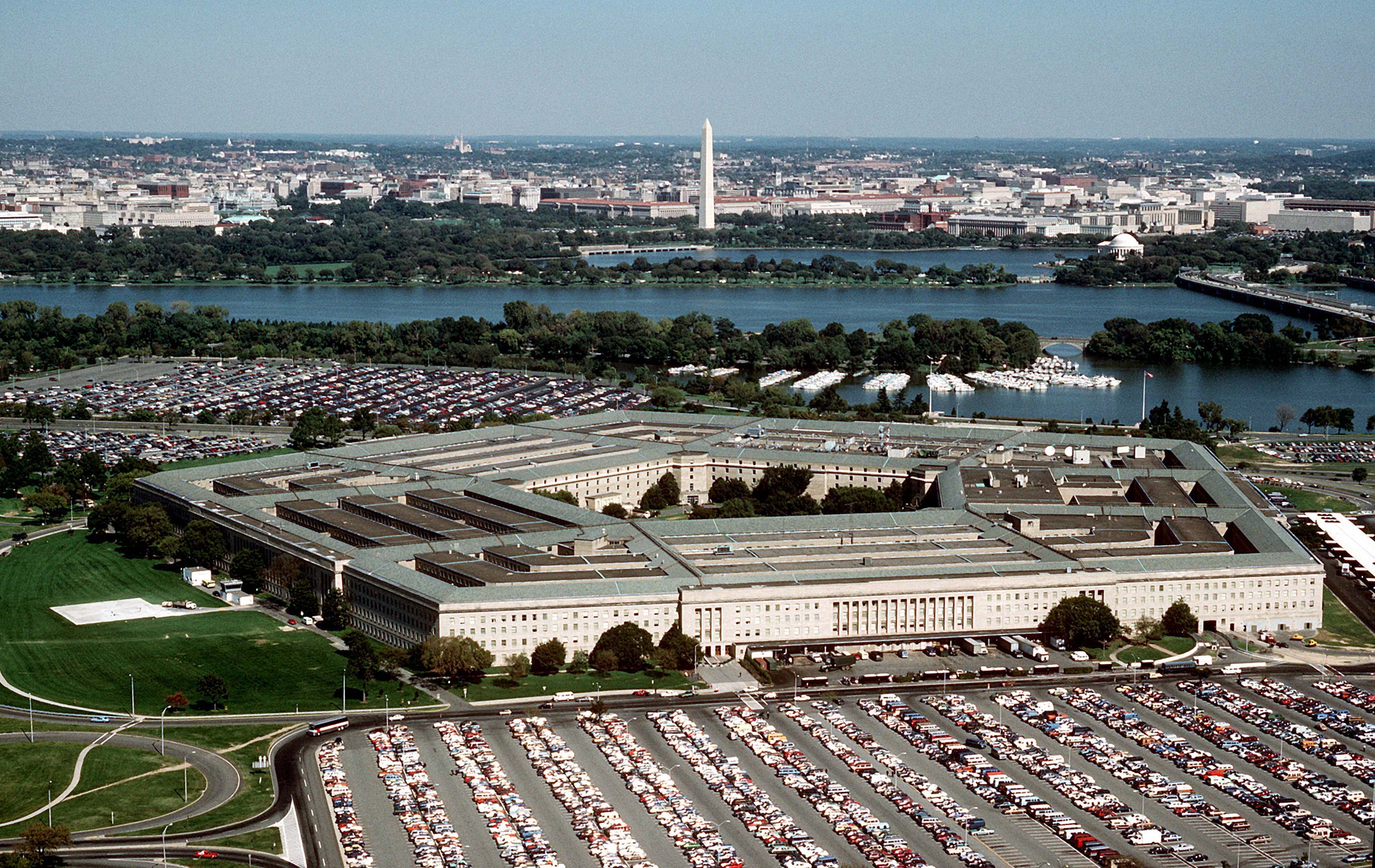
The Pentagon, headquarters of the U.S. Defense Department, as viewed with the Potomac River and Washington, D.C., in the background. (Defense Department photo)


And this reliable yearly harvest, along with the revolving doors connecting defense contractors with Capitol Hill, K Street and the Pentagon, is why so many critics blame the masters of war behind the MIC for turning war into a cash machine.


But the cash machine is not confined to the Beltway. There are ATM branches around the country. Much in the way it lavishes Congress with lobbying largesse, the defense industry works hand-in-glove with the Pentagon to spread the appropriations around the nation. This “spread the wealth” strategy may be equally as important as the “inside the Beltway” lobbying that garners so much of our attention and disdain.


Just go to U.S. Department of Defense’s contract announcement webpage on any weekday to get a good sense of the “contracts valued at $7 million or more” that are “announced each business day at 5 p.m.” A recent survey of these “awards” found the usual suspects like Raytheon, Lockheed Martin and General Dynamics. The MIC was well-represented. But many millions of dollars were also “won” by companies most Americans have never heard of … like this sampling from one day at the end of October:


  • Longbow LLC, Orlando Florida, got $183,474,414 for radar electronic units with the stipulation that work will be performed in Orlando, Florida.

  • Gradkell Systems Inc., Huntsville, Alabama, got $75,000,000 for systems operations and maintenance at Fort Belvoir, Virginia

  • Dawson Federal Inc., San Antonio, Texas; and A&H-Ambica JV LLC, Livonia, Michigan; and Frontier Services Inc., Kansas City, Missouri, will share a $45,000,000 for repair and alternations for land ports of entry in North Dakota and Minnesota.

  • TRAX International Corp., Las Vegas, Nevada, got a $9,203,652 contract modification for non-personal test support services that will be performed in Yuma, Arizona, and Fort Greely, Alaska,

  • Railroad Construction Co. Inc., Paterson, New Jersey, got a $9,344,963 contract modification for base operations support services to be performed in Colts Neck, New Jersey.

  • Belleville Shoe Co., Belleville, Illinois, got $63,973,889 for hot-weather combat boots that will be made in Illinois.

  • American Apparel Inc., Selma, Alabama, got $48,411,186 for combat utility uniforms that will be made in Alabama.

  • National Industries for the Blind, Alexandria, Virginia, got a $12,884,595 contract modification to make and advanced combat helmet pad suspension system. The “locations of performance” are Virginia, Pennsylvania and North Carolina.

Sharing the Largesse


Clearly, the DoD is large enough, and smart enough, to award contracts to companies throughout the 50 states. Yes, it is a function of the sheer size or, more forebodingly, the utter “pervasiveness” of the military in American life. But it is also a strategy. And it’s a tactic readily apparent in a contract recently awarded to Raytheon.


On Oct. 31, 2017, they got a $29,455,672 contract modification for missions systems equipment; computing environment hardware; and software research, test and development. The modification stipulates that the work will spread around the country to “Portsmouth, Rhode Island (46 percent); Tewksbury, Massachusetts (36 percent); Marlboro, Massachusetts (6 percent); Port Hueneme, California (5 percent); San Diego, California (4 percent); and Bath, Maine (3 percent).”


Frankly, it’s a brilliant move that began in the Cold War. The more Congressional districts that got defense dollars, the more votes the defense budget was likely to receive on Capitol Hill. Over time, it evolved into its own underlying rationale for the budget.


As veteran journalist William Greider wrote in the Aug. 16, 1984 issue of Rolling Stone, “The entire political system, including liberals as well as conservatives, is held hostage by the politics of defense spending. Even the most well intentioned are captive to it. And this is a fundamental reason why the Pentagon budget is irrationally bloated and why America is mobilizing for war in a time of peace.”


The peace-time mobilization Greider referred to was the Reagan build-up that, as William Hartung noted, is currently being surpassed by America’s “War on Terror” binge. Then, as now … the US was at peace at home, meddling around the world and running up a huge bill in the process. And then, as now … the spending seems unstoppable.


And as an unnamed “arms-control lobbyist” told Grieder, “It’s a fact of life. I don’t see how you can ask members of Congress to vote against their own districts. If I were a member of Congress, I might vote that way, too.”


Essentially, members of Congress act as secondary lobbyists for the defense industry by making sure their constituents have a vested interest in seeing the defense budget is both robust and untouchable. But they are not alone. Because the states also reap what the Pentagon sows … and, in the wake of the massive post-9/11 splurge, they’ve begun quantifying the impact of defense spending on their economies. It helps them make their specific case for keeping the spigot open.


Enter the National Conference of State Legislatures (NCSL), which notes, or touts, that the Department of Defense (DoD) “operates more than 420 military installations in the 50 states, the District of Columbia, Guam and Puerto Rico.” Additionally, the NCSL is understandably impressed by a DoD analysis that found the department’s “$408 billion on payroll and contracts in Fiscal Year 2015” translated into “approximately 2.3 percent of U.S. gross domestic product (GDP).”


And they’ve become a clearinghouse for state governments’ economic impact studies of defense spending. Here’s a sampling of recent data compiled on the NSCL website:


  • In 2015, for example, military installations in North Carolinasupported 578,000 jobs, $34 billion in personal income and $66 billion in gross state product. This amounts to roughly 10 percent of the state’s overall economy.

  • In 2014, Coloradolawmakers appropriated $300,000 in state funds to examine the comprehensive value of military activities across the state’s seven major installations. The state Department of Military and Veterans Affairs released its study in May 2015, reporting a total economic impact of $27 billion.

  • Kentuckyhas also taken steps to measure military activity, releasing its fifth study in June 2016. The military spent approximately $12 billion in Kentucky during 2014-15. With 38,700 active duty and civilian employees, military employment exceeds the next largest state employer by more than 21,000 jobs.

  • In Michigan, for example, defense spending in Fiscal Year 2014 supported 105,000 jobs, added more than $9 billion in gross state product and created nearly $10 billion in personal income. A 2016 study sponsored by the Michigan Defense Center presents a statewide strategy to preserve Army and Air National Guard facilities following a future Base Realignment and Closure (BRAC) round as well as to attract new missions. 

Electoral Impact


But that’s not all. According to the DoD study cited above, the biggest recipients of DoD dollars are (in order): Virginia, California, Texas, Maryland and Florida. And among the top 18 host states for military bases, electorally important states like California, Florida and Texas lead the nation.


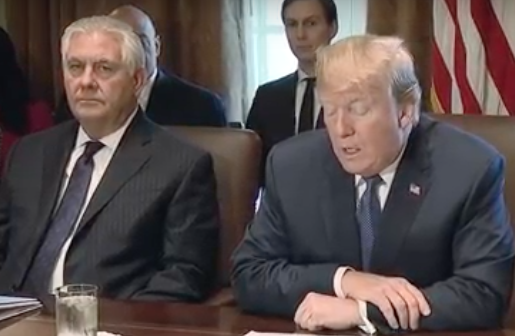
President Trump speaking at a Cabinet meeting on Nov. 1, 2017, with Secretary of State Rex Tillerson to Trump’s right and son-in-law Jared Kushner seated in the background. (Screen shot from whitehouse.gov)


And that’s the real rub … this has an electoral impact. Because the constituency for defense spending isn’t just the 1 percent percent of Americans who actively serve in the military or 7 percent of Americans who’ve served sometime in their lives, but it is also the millions of Americans who directly or indirectly make a living off of the “defense-related” largesse that passes through the Pentagon like grass through a goose.


It’s a dirty little secret that Donald Trump exploited throughout the 2016 presidential campaign. Somehow, he was able to criticize wasting money on foreign wars and the neoconservative interventionism of the Bushes, the neoliberal interventionism of Hillary Clinton, and, at the same time, moan endlessly about the “depleted” military despite “years of record-high spending.” He went on to promise a massive increase in the defense budget, a massive increase in naval construction and a huge nuclear arsenal.


And, much to the approval of many Americans, he’s delivered. A Morning Consult/Politico poll showed increased defense spending was the most popular among a variety of spending priorities presented to voters … even as voters express trepidation about the coming of another war. A pair of NBC News/Survey Monkey polls found that 76 percent of Americans are “worried” the United States “will become engaged in a major war in the next four years” and only 25 percent want America to become “more active” in world affairs.


More to the point, only 20 percent of Americans wanted to increase the troop level in Afghanistan after Trump’s stay-the-course speech in August, but Gallup’s three decade-long tracking poll found that the belief the U.S. spends “too little” on defense is at its highest point (37 percent) since it spiked after 9/11 (41 percent). The previous highpoint was 51 percent in 1981 when Ronald Reagan was elected in no small part on the promise of a major build-up.


So, if Americans generally don’t support wars or engagement in the world, why do they seem to reflexively support massive military budgets?


Frankly, look no further than Trump’s mantra of “jobs, jobs, jobs.” He says it when he lords over the sale of weapon systems to foreign powers or he visits a naval shipyard or goes to one of his post-election rallies to proclaim to “We’re building up our military like never before.” Frankly, he’s giving the people what they want. Although they may be war-weary, they’ve not tired of the dispersal system that Greider wrote about during Reagan’s big spree.


Ultimately, it means that the dreaded Military-Industrial Complex isn’t just a shadowy cabal manipulating policies against the will of the American people. Nor is the “racket” exclusive to an elite group of Deep State swamp things. Instead, the military and the vast economic network it feeds presents a far more “complex” issue that involves millions of self-interested Americans in much the way Eisenhower predicted, but few are willing to truly forsake.


Monday, November 6, 2017

Pentagon Says Securing North Korean Nuclear Sites Would Require "Ground Invasion"

With President Donald Trump arriving in Japan today to kick off a 10-day Asia tour, the Washington Post is reporting that the only way to locate and secure all of North Korea’s nuclear weapons sites “with complete certainty” would be a ground invasion, and in the event of conflict, Pyongyang could use biological and chemical weapons, the Pentagon told lawmakers in a newly released assessment of what war on the Korean Peninsula might look like.


The Pentagon, in a letter to lawmakers, said that a full discussion of U.S. capabilities to “counter North Korea’s ability to respond with a nuclear weapon and to eliminate North Korea’s nuclear weapons located in deeply buried, underground facilities” is best suited for a classified briefing.


The letter also said that Pentagon leaders “assess that North Korea may consider the use of biological weapons” and that the country “has a long-standing chemical weapons program with the capability to produce nerve, blister, blood and choking agents."


The Pentagon repeated that a detailed discussion of how the United States would respond to the threat could not be discussed in public.


The letter noted that Seoul, the South Korean capital, is a densely populated area with 25 million residents. 


The Pentagon’s candid assessment appears to validate claims made by former White House Chief Strategist Steve Bannon, who famously said in an interview with the American Prospect before he was forced out of his White House job that there are no “good” military options for toppling the Kim regime. A ground invasion, he said, would lead to millions of casualties in the South Korean capital of Seoul from conventional weapons fire.


It’s release also coincides with the president’s push to rally the North’s neighbors in the region to do more to punish the restive Kim regime, which conducted a test of a hydrogen bomb - also its sixth nuclear test overall - in early September.


The North has been notably quiet since Sept. 15, when it launched a medium-range missile over the northern Japanese island of Hokkaido. Aside from the usual condemnations of military drills involving US and South Korean, and threats that the North is seriously considering testing a hydrogen bomb over the Pacific. Some have speculated that a partial collapse at the North’s Pyunggye-ri nuclear testing facility has been partly responsible for the delays.


The letter to lawmakers was written by Rear Adm. Michael J. Dumont, the vice director of the Pentagon’s Joint Staff, in response to a request for information from two House members about “expected casualty assessments in a conflict with North Korea,” including for civilians and U.S. and allied forces in South Korea, Japan and Guam.


In the letter, Dumont explains how a ground invasion would unfold.


Any operation to pursue North Korean nuclear weapons would likely be spearheaded by U.S. Special Operations troops. Last year, President Barack Obama and then-Defense Secretary Ashton B. Carter gave U.S. Special Operations Command a new, leading role coordinating the Pentagon’s effort to counter weapons of mass destruction. SOCOM did not receive any new legal authorities for the mission but gained influence in how the military responds to such threats.


Elite U.S. forces have long trained to respond in the case of a so-called “loose nuke” in the hands of terrorists. But senior officials said SOCOM is increasingly focused on North Korea.


Given the difficulty and tremendous potential for casualities that would accompany a ground invasion, Dumont affirmed that the military supports the present strategy of pursuing a diplomatic solution to the simmering standoff between the North and the US.


Dumont said the military backs the current U.S. strategy on North Korea, which is led by Secretary of State Rex Tillerson and focuses on ratcheting up economic and diplomatic pressure as the primary effort to get North Korean leader Kim Jong Un to stop developing nuclear weapons. Tillerson, Defense Secretary Jim Mattis and the Joint Chiefs of Staff chairman, Gen. Joseph F. Dunford Jr., have emphasized that during trips to Seoul this year.


In contrast, President Trump, who goes unmentioned in the Pentagon letter, has taunted Kim as “Rocket Man” and expressed frustration with diplomatic efforts, hinting that he is considering preemptive military force.


“I told Rex Tillerson, our wonderful Secretary of State, that he is wasting his time trying to negotiate with Little Rocket Man,” Trump tweeted on Oct. 1, adding, “Save your energy Rex, we’ll do what has to be done!"


On Oct. 7, Trump added in additional tweets that North Korea had “made fools” of U.S. negotiators. “Sorry, but only one thing will work!” he said. 


Defense Secretary James Mattis and the Pentagon has often pointed to the massive risk that North Korean weaponry pose to South Koreans living In Seoul. But the military has never before publicly revealed so much about its plans for a hunt for North Korea’s underground weapons.


Air Force Col. Patrick Ryder, a Pentagon spokesman, said that Dumont and other Pentagon officials had no additional comment about the letter.


A senior US military official in South Korea told WaPo that while the 28,500 US troops in South Korea maintain a high degree of readiness, he “has to believe” that North Korea does not want a war, given all of the nations aligned against it.


“If you open the history books, this is not the first time that we’ve been in a heavy provocation cycle,” the official said. On the side of South Korea and the United States, he said, “there is no action taken without extreme consideration of not putting this in a position where a fight is going to happen."


Dumont’s letter also notes that “we have not seen any change in the offensive posture of North Korea’s forces."


A statement by 16 lawmakers, released simultaneously with the Pentagon letter, urged Trump to stop making “provocative statements” that impede diplomatic efforts and risk the lives of U.S. troops.


One lawmaker cited estimates that a ground invasion of the North would leave 300,000 people dead in the first couple of days.


The Pentagon’s “assessment underscores what we’ve known all along: There are no good military options for North Korea,” said the statement, organized by Lieu and Gallego and signed by 14 other members of Congress who are veterans, all but one of them Democrats. In a telephone interview, Lieu said that the intent of asking the Pentagon for information was to spell out the cataclysmic consequences of war with North Korea and the aftermath.


“It’s important for people to understand what a war with a nuclear power would look like,” said Lieu, citing estimates of 300,000 dead in the first few days alone. More than 100,000 Americans are potentially at risk.


Lieu, who spent part of his time in the Air Force on Guam preparing for military action against North Korea, called the letter a confirmation that a conflict would result in a “bloody, protracted ground war.” The Joint Chiefs, he believes, are “trying to send a message to the American public,” he said.


“This is grim,” Lieu said. “We need to understand what war means. And it hasn’t been articulated very well. I think they’re trying to articulate some of that."


The question now is: Will this report undermine Trump’s efforts to push the US’s allies in the Pacific to do more to peacefully pressure the Kim regime to abandon its nuclear weapons program. China and Russia have for months been pushing a plan that would see the North freeze its nuclear program in exchange for the US withdrawing its THAAD missile defense systems from South Korea.


The Kim regime has repeatedly said it will never give up its nuclear weapons, which it believes are essential for the survival of the regime.