 Nearly 1,000 pregnant women were given radioactive iron by their doctors without their knowledge, as part of a series of experiments for the US military during the Cold War.
Showing posts with label Clinton administration. Show all posts
Showing posts with label Clinton administration. Show all posts
Monday, January 22, 2018
US Gov’t Caught Experimenting on Hundreds of Poor Pregnant Women With Radiation
Nearly 1,000 pregnant women were given radioactive iron by their doctors without their knowledge, as part of a series of experiments for the US military during the Cold War.

Wednesday, December 27, 2017
Europe"s Runaway Train Towards Full Digitization Of Money & Labor
Authored by Peter Koenig via The Saker blog,
The other day I was in a shopping mall looking for an ATM to get some cash. There was no ATM. A week ago, there was still a branch office of a local bank – no more, gone. A Starbucks will replace the space left empty by the bank. I asked around – there will be no more cash automats in this mall – and this pattern is repeated over and over throughout Switzerland and throughout western Europe. Cash machines gradually but ever so faster disappear, not only from shopping malls, also from street corners. Will Switzerland become the first country fully running on digital money?

This new cashless money model is progressively but brutally introduced to the Swiss and Europeans at large – as they are not told what’s really happening behind the scene. If anything, the populace is being told that paying will become much easier. You just swipe your card – and bingo. No more signatures, no more looking for cash machines – your bank account is directly charged for whatever small or large amount you are spending. And naturally and gradually a ‘small fee’ will be introduced by the banks. And you are powerless, as a cash alternative will have been wiped out.
The upwards limit of how much you may charge onto your bank account is mainly set by yourself, as long as it doesn’t exceed the banks tolerance. But the banks’ tolerance is generous. If you exceed your credit, the balance on your account quietly slides into the red and at the end of the month you pay a hefty interest; or interest on unpaid interest – and so on. And that even though interbank interest rates are at a historic low. The Swiss Central Bank’s interest to banks, for example, is even negative; one of the few central banks in the world with negative interest, others include Japan and Denmark.
When I talked recently to the manager of a Geneva bank, he said, it’s getting much worse. ‘We are already closing all bank tellers, and so are most of the other banks’. Which means staff layoffs – which of course makes it only selectively to the news. Bank employees and managers must pass an exam with the Swiss banking commission, for which they have study hundreds of extra hours within a few months to pass a test – usually planned for weekends, so as not to infringe on the banks’ business hours. You got to chances to pass. If you fail you are out, joining the ranks of the unemployed. The trend is similar throughout Europe. The manager didn’t reveal the topic and reason behind the ‘retraining’ – but it became obvious from the ensuing conversation that it had to do with the ‘cashless overtake’ of people by the banks. These are my words, but he, an insider, was as concerned as I, if not more.

Surveillance is everywhere. Now, not only our phone calls and e-mails are spied on, but our bank accounts are too. And what’s worse, with a cashless economy, our accounts are vulnerable to be invaded by the state, by thieves, by the police, by the tax authority, by any kind of authority – and, of course, by the very banks that have had your trust for all your life. Remember the ‘bail-ins’ first tested in early 2013 in Cyprus? – Bail-ins will become common practice for any bank that has abused its greed for profit and would go belly-up, if there wouldn’t be all those deposits from customers. Even shareholders are not safe. This has been quietly decided on some two years ago, both in the US and also by the non-elected white-collar mafia, the European Commission – EC.
The point is, ‘banks über alles’. And which country would be better suited to introduce ‘cashless living’ than Switzerland, the epicenter – along with Wall Street – of international banking. Bank’s will call the shots in the future, on your personal economy and that of the state. They are globalized, following the same principles of deregulation worldwide. They are in collusion with globalized corporations. They will decide whether you eat or become enslaved. They are one of the tree major weapons of the 0.1 % to beat the 99.9% into submission. The other two at the service of the master hegemon’s Full Spectrum Dominance drive, are the war- and security industry and the ever more brazen propaganda lie-machine. Banking deregulation has become another little-propagated rule of the World Trade Organization (WTO). Countries who want to join WTO, must deregulate their banking sector, prying it open for the globalized money-sharks, the Zion-controlled banking conglomerates.
Retrenchment of personnel in the banking employment market is increasing. The news only selectively reports on it, when there are large amounts of jobs being eliminated. Statistics lie everywhere, in the EU as well as in Washington. – Why scare people? They will be scared enough, when they are offered jobs at salaries on which they can barely survive. That’s happening already. It used to be a tactic applied for developing countries: Keep them enslaved by debt and low pay, so they don’t have time and energy to take to the streets to protest – they have to look for food and work, whatever menial jobs they can get, to feed their families. It’s now hitting Europe, the West in general. Some countries way more than Switzerland.
Cashless trials are going on elsewhere, especially in Nordic countries, where selected department stores and supermarkets do no longer take cash. Another monstrous trial has been carried out in India a year ago, in the last quarter of 2016, where from one day to another 80% of the most popular money notes were eliminated, and could only be exchanged for new notes by banks and through bank accounts. And this in an almost pure cash country, where half the population has no bank account, and where remote rural areas have no banks. People were lied to so that the sudden introduction had maximum effect.
It caused massive famine and thousands of people died, as they had suddenly no acceptable cash to buy food – all instigated by the USAID Project ‘Catalyst’, in connivance with the Indian rulers and central bank. It was a trial. It was a disaster. If it works in India with 1.3 billion people, two thirds of whom live in rural areas and most of them have no bank account, the scam could be applied in any developing country – see also India – Crime of the Century – Financial Genocide
What is going on in Switzerland is a trial with the high end of populations. How is the upper crust taking to such radical changes in our daily monetary routine? – So far not many protests have been noticed. There is a weak referendum being launched by a group of people who want the Swiss Central Bank be the only institution that can make money, like in the ‘olden days’. Though a very respectable idea, the referendum has no chance in today’s banking and debt-finance environment, where youth is being indoctrinated with the idea that swiping your card in front of an electronic eye is cool. Today, most money is made by private banks, like elsewhere in Europe and the US. Worldwide banking deregulation, initiated by the Clinton Administration in the 1990s – today a rule for any member of the World Trade Organization (WTO) – has made this all possible.
Digitalization and robotization is just beginning. Staffed check-out counters in supermarkets are dwindling; most of them are automatic – and that happened within the last year. – Where are the employees gone? – I asked an attendant who helped the customers through the self-checkout. ‘They joined the ranks of unemployed’, she said with a sad face, having lost several of her colleagues. ‘It will hit me too, as soon as they don’t need me anymore to show the customers on how to auto-pay.’
Bitcoins
Digitalization also includes the cryptocurrencies, the blockchain moneys floating around – of which the most famous one is Bitcoin. It brings digitalization of money to an apex. The system is complex and seems to lend itself only to ‘experts’. Cryptocurrencies are fiat money, based on nothing, not even on gold. Cryptos are electronic, invisible and highly, but highly speculative, an invitation for gangsters and fraudsters. With extreme speculative values, it looks as if cryptocurrencies were designed for crooks and speculators.
Bitcoin was allegedly invented by Satoshi Nakamoto which could be a pseudonym of a man or a group of people, suspected to live in the US. “Nakamoto’s” identity is believed to be commonwealth origin, due to the vocabulary used in his writings. One of his close associates is purportedly a Swiss coder, who is also an active member of the cryptocurrency community. He is said to have graphed the time stamp of each of Nakamoto’s more than 500 bitcoin forum posts. Such ‘forum posts’ exist in the thousands, worldwide. They form an elaborate network based on algorithms.
Bitcoin was formally created in January 2009 with a fix amount of 21 million ‘coins’, of which more than half are already in circulation, and 1 million, or about 4.75% (of the total) can be traced to Nakamoto – which according to the current market value corresponds to close to US$15 billion. Today’s overall Bitcoin market cap is more than US$ 315 billion. The market is highly volatile. Drastic daily fluctuations are common, especially within the last 12 months. If one of the major Bitcoin holders, like Nakamoto, would capitalize his profit by selling a big portion of his holdings, the Bitcoin price would be in free fall, functioning pretty similar to the regular stock exchange.
On 24 August 2010, when Bitcoin was first traded, its value was US$ 0.06. On 24 December 2017, the coin was worth US$ 13,800, an increase of 230,000%. In the last twelve months, its value increased from about US$ 800 in December 2016 to a peak of close to US$ 20,000 in December 2017, an increase of nearly 2,500 %. However, in the last 7 days, the price has dropped by US$ 5,160, i.e. by more than 27%, and the trend seems to be downward; perhaps a sign of quick profit-taking? However, this shows how instable this cryptocurrency is, apparently much more so than trading corporate shares on the stock market.
The number of cryptocurrencies available over the internet as of 27 November 2017 is above 1300 and growing. A new cryptocurrency can be created at any time and by anyone. By market capitalization, Bitcoin is presently the largest blockchain network (database network, storing data in different publicly verifiable places), followed by Ethereum, Bitcoin Cash, Ripple and Litecoin.
Bitcoin may be the next bubble, bringing down a parallel economy which has already its fingers clawing into our regular western economy. Cryptocurrencies are officially forbidden in Russia and China, though stopping cryptocurrency dealings by individuals is hardly possible. They do not touch the traditional banking system. That’s why major banks hate them. They circumvent the banking suckers, prevent them from making ever higher profits from horrendous commissions, against which the people at large are powerless.
Here is Bitcoin’s positive value. It escapes bank and state controls. If countries’ economies were run on Bitcoins or another cryptocurrency, they would escape US sanctions which function only because western currencies are foster-children of the US-dollar, hence, subject to the dollar hegemony; meaning all international transactions have to pass through a US bank. A typical case is ‘banking blockades’, when Washington decides to stop all international transactions of a country until it submits to the wishes of the empire. It is blackmail; totally illegal, but unless there is a monetary alternative, the (western) world is subject to this system.
A typical case was Argentina, when she was forced by a New York judge in June 2014 to pay a New York based Vulture Fund US$1.6 billion, an illegal ruling according to a UN resolution. Argentina refuse to pay, so the judge, interfering in a sovereign nation, blocked more than US$ 500 million in Argentina’s debt payment to creditors, bringing Argentina to the brink of a second bankruptcy in 13 years. Eventually, neoliberal Macri negotiated a deal with the Vultures of a payment in excess of US$ 400 million.
This US blackmail would not have been possible had Argentina been able to make its foreign transactions in Bitcoins or another cryptocurrency. Venezuela is currently using a national cryptocurrency for some of its foreign transactions, thereby escaping the sanctions stranglehold of Washington. Had Greek and Cyprus citizens had a cryptocurrency alternative to the euro, they would not have been subject to the cash control imposed by the European Central Bank.
On the other hand, funding of terror organizations, like ISIS, cannot be disrupted, if the terror group deals in cryptocurrencies. – This shows, for good or for bad, Bitcoins, or cryptocurrencies are for now unique in resisiting censure and blackmail, or any kind of authoritarian outside interference in electronic money transactions.
Cashless Living
If Switzerland accepts the change to digital money, a country where until relatively recently most people went to pay their monthly bills in cash to the nearest post office – then we, in the western world, are on a fast track to total enslavement by the financial institutions. It goes, of course, hand-in-hand with the rest of systematic and ever faster advancing oppression and robotization of the 99.9% by the 0.1%.
We are currently at cross-roads, where we still can either decide to follow the discourse of a new electronic monetary era, with ever less to say about the product of our work, our money; or whether, We the People, will resist a banking / finance system that has full control over our financial resources, and which can literally starve us into submission or death, if we don’t behave. In order to resist we need an alternative monetary system or monetary network, away from the dollar-euro hegemony.
All the more important is the ascent of another economy, another payment and transfer scheme which already exists in the East, the Chinese International Paymen, totally System (CIPS), effectively a replacement of SWIFT, totally privately run and linked to the US-dollar and US banks. The world needs a multipolar economy, based on the real output of a country or society, as is the case in China and Russia, not one based on fiat money as is the current western economy.
Will Switzerland, the stronghold of world finance, along with New York, London and Hongkong, resist the temptation of increased profit, power and control, offered by digital money? – We, the People, have still the chance to decide either for continuing rotting in a fraud economy, based on wars and greed – for which digital money, exacerbated by cryptocurrencies, is a new tool for a new maximizing profit bonanza on the back of the common people; or do we opt for an honest future and for a life that leaves us free to take sovereign political and monetary decisions in a full cash society. For the latter we must wake up to see the propaganda fraud going on before our eyes, and to resist the robot and electronic money onslaught being unleashed on us.


Tuesday, November 28, 2017
Susan Sarandon: Hillary Clinton Would"ve Been "More Dangerous" Than Trump
In an interview with the Guardian published Sunday night, actress Susan Sarandon – a noted anti-war and climate progressive – described her former friend Hillary Clinton as “very dangerous” in response to an interviewer’s question about why she supported Green Party candidate Jill Stein.
Furthermore, Sarandon, who has been the subject of vicious and persistent attacks by leftists for supporting a third-party candidate that many blame, wrongly, for throwing the election to Trump. She said she had to change her phone number because – get this – angry Clinton supporters left a torrent of death and rape threats on her voicemail.

Sarandon, who fist became involved in activism as a young woman when she became an early and vocal proponent of the anti-War movement in the late 1960s and early 1970s, even suggested that Clinton might’ve been “more dangerous” than Trump.
Did she really say that Hillary was more dangerous than Trump?
“Not exactly, but I don’t mind that quote,” she says. “I did think she was very, very dangerous. We would still be fracking, we would be at war [if she was president]. It wouldn’t be much smoother. Look what happened under Obama that we didn’t notice."
Though she supported Clinton’s first bid for the senate in 2001, Sarandon said her support for Clinton evaporated when the then-senator voted in favor of the war in Iraq.
It is often overlooked that in 2001, Sarandon supported Hillary Clinton’s run for the Senate. There are photos of them posing chummily together, grinning. Then Clinton voted for the war in Iraq and it all went downhill. During the last election, Sarandon supported Bernie Sanders, then wouldn’t support Clinton after she won the nomination, and now all the moderates hate her, to the extent, she says, that she had to change her phone number because people she identifies as Hillary trolls sent her threatening messages. “I got from Hillary people ‘I hope your crotch is grabbed’, ‘I hope you’re raped’. Misogynistic attacks. Recently, I said ‘I stand with Dreamers’ [children brought illegally to the US, whose path to legal citizenship – an Obama-era provision – Trump has threatened to revoke] and that started another wave."
Wait, from the right?
“No, from the left! ‘How dare you! You who are responsible for this!’"
In a jab at her critics on the left, Sarandon said she isn’t worried about the threats or the criticism from people who bizarrely blame her for throwing the election to Trump. Instead, she’s worried that the left’s refusal to reckon with the true nature of the problem – that the DNC rigged an election to favor a flawed, unpopular candidate - will harm progressive causes in the long run.
“Well, that’s why we’re going to lose again if we depend on the DNC [the Democratic National Committee]. Because the amount of denial ... I mean it’s very flattering to think that I, on my own, cost the election. That my little voice was the deciding factor."
Is it upsetting to be attacked?
“It’s upsetting to me more from the point of view of thinking they haven’t learned. I don’t need to be vindicated."
But it’s upsetting that they’re still feeding the same misinformation to people. When Obama got the nomination, 25% of [Hillary’s] people didn’t vote for him. Only 12% of Bernie’s people didn’t vote for her."
But she didn’t advocate voting for Hillary! Come on.
“Hmm?"
Didn’t she advocate voting for Jill Stein?
“I didn’t advocate people voting for anything. I said get your information, I’m going to vote for change, because I was hoping that Stein was going to get whatever percentage she needed – but I knew she wasn’t going to make the difference in the election.”
Luckily, Sarandon said her friends have stood by her, at least.
Has she lost friends over all this? “No. My friends have a right to their opinions. It’s disappointing but that’s their business. It’s like in the lead-up to Vietnam, and then later they say: ‘You were right.’ Or strangely, some of my gay friends were like: ‘Oh, I just feel bad for [Clinton]. And I said: ‘She’s not authentic. She’s been terrible to gay people for the longest time. She’s an opportunist.’ And then I’m like: ‘OK, let’s not talk about it any more.’"
Still, I think while there was vast political error on both sides, the inability of Sarandon and her ilk to embrace the lesser of two evils permitted the greater of the two evils to rise. And yet I like Sarandon. It takes real courage to go against the mob. Her inconsistencies are a little wild, but in the age of social-media enforced conformity, I have never met anyone so uninterested in toeing the line.
When it comes to deportations, Sarandon said a hypothetical Clinton administration probably have continued with Obama’s strategy of “sneakily” deporting immigrants.
Given his record on immigration and extrajudicial drone-enabled murder, Sarandon said she was shocked that he won the Nobel Peace Prize.
It seems absurd to argue that healthcare, childcare, taxation for the non-rich wouldn’t be better now under President Clinton, and that’s before we get to the threat of deportation hanging over millions of immigrants. “She would’ve done it the way Obama did it,” says Sarandon, “which was sneakily. He deported more people than have been deported now. How he got the Nobel peace prize I don’t know. I think it was very important to have a black family in the White House and I think some of the stuff he did was good. He tried really hard about healthcare. But he didn’t go all the way because of big pharma."
This isn’t the first time Sarandon has suggested that Clinton could be a greater national security risk than Trump. She made similar comments in June 2016, just as Clinton was clinching the nomination. At that time, Trump’s “America First” foreign policy pledge – which was based on a philosophy of noninterventionism – was arguably more dovish than his rival.
Of course, Trump has pivoted away from that stance since taking office, authorizing more troop deployments in Afghanistan and threatening North Korea with nuclear annihilation, chagrining many of his early supporters.


Friday, November 24, 2017
How Turkey, Iran, Russia, And India Are Playing The New Silk Roads
Authored by Pepe Escobar via The Asia Times,
A pacified Syria is key to the economic integration of Eurasia through energy and transportation connections...

Vladimir Putin, Recep Tayyip Erdogan and Hassan Rouhani will hold a summit this Wednesday in Sochi to discuss Syria. Russia, Turkey and Iran are the three power players at the Astana negotiations – where multiple cease-fires, as hard to implement as they are, at least evolve, slowly but surely, towards the ultimate target – a political settlement.
A stable Syria is crucial to all parties involved in Eurasia integration. As Asia Times reported, China has made it clear that a pacified Syria will eventually become a hub of the New Silk Roads, known as the Belt and Road Initiative (BRI) – building on the previous business bonanza of legions of small traders commuting between Yiwu and the Levant.
Away from intractable war and peace issues, it’s even more enlightening to observe how Turkey, Iran and Russia are playing their overlapping versions of Eurasia economic integration and/or BRI-related business.
Much has to do with the energy/transportation connectivity between railway networks – and, further on the down the road, high-speed rail – and what I have described, since the early 2000s, as Pipelineistan.

The Baku-Tblisi-Ceyhan (BTC) pipeline, a deal brokered in person in Baku by the late Dr Zbigniew “Grand Chessboard” Brzezinski, was a major energy/geopolitical coup by the Clinton administration, laying out an umbilical steel cord between Azerbaijan, Georgia and Turkey.
Now comes the Baku-Tblisi-Kars (BTK) railway – inaugurated with great fanfare by Erdogan alongside Azerbaijani President Ilham Aliyev and Georgian Prime Minister Giorgi Kvirikashvili, but also crucially Kazakh Prime Minister Bakhytzhan Sagintayev and Uzbek Prime Minister Abdulla Aripov. After all, this is about the integration of the Caucasus with Central Asia.
Erdogan actually went further: BTK is “an important chain in the New Silk Road, which aims to connect Asia, Africa, and Europe.” The new transportation corridor is configured as an important Eurasian hub linking not only the Caucasus with Central Asia but also, in the Big Picture, the EU with Western China.
BTK is just the beginning, considering the long-term strategy of Chinese-built high-speed rail from Xinjiang across Central Asia all the way to Iran, Turkey, and of course, the dream destination: the EU. Erdogan can clearly see how Turkey is strategically positioned to profit from it.

Of course, BTK is not a panacea. Other connectivity points between Iran and Turkey will spring up, and other key BRI interconnectors will pick up speed in the next few years, such as the Eurasian Land Bridge across the revamped Trans-Siberian and an icy version of the Maritime Silk Road: the Northern Sea Route across the Arctic.
What’s particularly interesting in the BTK case is the Pipelineistan interconnection with the Trans-Anatolian Gas Pipeline (TANAP), bringing natural gas from the massive Azeri gas field Shah Deniz-2 to Turkey and eventually the EU.
Turkish analyst Cemil Ertem stresses, “just like TANAP, the BTK Railway not only connects three countries, but also is one of the main trade and transport routes in Asia and Europe, and particularly Kazakhstan and Turkmenistan ports. It connects Central Asia to Turkey with the Marmaray project in Istanbul and via the Caspian region. Along with the Southern Gas Corridor, which constitutes TANAP’s backbone, it will also connect ports on the South China Sea to Europe via Turkey.”
It’s no wonder BTK has been met with ecstatic reception across Turkey – or, should we say, what used to be known as Asia Minor. It does spell out, graphically, Ankara’s pivoting to the East (as in increasing trade with China) as well as a new step in the extremely complex strategic interdependence between Ankara and Moscow; the Central Asian “stans”, after all, fall into Russia’s historical sphere of influence.
Add to it the (pending) Russian sale of the S-400 missile defense system to Ankara, and the Russian and Chinese interest in having Turkey as a full member of the Shanghai Cooperation Organization (SCO).
From IPI to IP and then II
Now compare the BTK coup with one of Pipelineistan’s trademark cliff-hanging soap operas; the IPI (Iran-Pakistan-India), previously dubbed “the peace pipeline”.
IPI originally was supposed to link southeastern Iran with northern India across Balochistan, via the Pakistani port of Gwadar (now a key hub of the China-Pakistan Economic Corridor, CPEC). The Bush and Obama administrations did everything to prevent IPI from ever being built, betting instead on the rival TAPI (Turkmenistan-Afghanistan-Pakistan-India) – which would actually traverse a war zone east of Herat, Afghanistan.
TAPI might eventually be built – even with the Taliban being denied their cut (that was exactly the contention 20 years ago with the first Clinton administration: transit rights). Lately, Russia stepped up its game, with Gazprom seducing India into becoming a partner in TAPI’s construction.
But then came the recent announcement by Russian Energy Minister Aleksandr Novak: Moscow and Tehran will sign a memorandum of understanding to build a 1,200km gas pipeline from Iran to India; call it II. And Gazprom, in parallel, will invest in unexplored Iranian gas fields along the route.
Apart from the fact of a major win for Gazprom – expanding its reach towards South Asia – the clincher is the project won’t be the original IPI (actually IP), where Iran already built the stretch up to the border and offered help for Islamabad to build its own stretch; a move that would be plagued by US sanctions. The Gazprom project will be an underwater pipeline from the Persian Gulf to the Indian Ocean.
From New Delhi’s point of view, this is the ultimate win-win. TAPI remains a nightmarish proposition, and India needs all the gas it can get, fast. Assuming the new Trump administration “Indo-Pacific” rhetoric holds, New Delhi is confident it won’t be slapped with sanctions because it’s doing business with both Iran and Russia.
And then there was another key development coming out of Putin’s recent visit to Tehran: the idea – straight out of BRI – of building a rail link between St. Petersburg (on the Baltic) and Chabahar port close to the Persian Gulf. Chabahar happens to be the key hub of India’s answer to BRI: a maritime trade link to Afghanistan and Central Asia bypassing Pakistan, and connected to the North-South Transport Corridor (INSTC), of which Iran, India and Russia are key members alongside Caucasus and Central Asian nations.
You don’t need a weatherman to see which way the wind blows across Eurasia; integration, all the way.


Thursday, November 23, 2017
"They Went After The Women Who Came Forward" - Former Obama HHS Secretary Exposes The Clintons
Authored by Alex Thomas via SHTFplan.com,
In the “post Weinstein” world we now find ourselves in we have seen dozens and dozens of prominent figures in Hollywood, politics, and the media be accused of a wide range of sexual attacks on women.
From groping all the way to rape, powerful establishment figures are being outed as sexual predators across the country, with the mainstream media declaring that all accusers must, at least initially, be believed.

Amazingly, at the same time, mainstream media talking heads have either specifically ignored the numerous allegations against Bill Clinton or actually claimed that his accusers are discredited and cannot be believed. (Keep in mind all other accusers are automatically assumed to be telling the truth.)
With that being said, it was only a matter of time before that dam broke as well and now, with a series of explosive comments by an Obama and Clinton ally, one can hope that Bill Clinton may finally be brought to justice with Hillary forever shamed for her role in attacking the women who came forward.
In an interview conducted on a CNN podcast by former Obama chief adviser David Axelrod, former Obama Health and Human Services Secretary Kathleen Sebelius opened up about the cover-up and subsequent attacks on the women who accused then President Clinton in the 1990’s.
“Not only did people look the other way, but they went after the women who came forward and accused him,” Sebelius stunningly detailed. Keep in mind this is a fact that the alternative media has reported on literally hundreds and hundreds of times while being attacked as right-wing conspiracy theorists for doing so.
“And so it doubled down on not only bad behavior but abusive behavior. And then people attacked the victims,” Sebelius continued.
Sebelius made clear that her criticism extends directly to Hillary Clinton herself who was widely known to be the driving force behind the attacks on her husbands accusers.
An article written about the podcast by CNN couldn’t hide from the fact that this is absolutely Hillary’s problem as well.
Sebelius extended her criticism to Hillary Clinton, and the Clinton White House for what she called a strategy of dismissing and besmirching the women who stepped forward - a pattern she said is being repeated today by alleged perpetrators of sexual assault - saying that the criticism of the former first lady and Secretary of State was “absolutely” fair.
Sebelius noted that the Clinton Administration’s response was being imitated, adding that “you can watch that same pattern repeat, It needs to end. It needs to be over.”
The comments came during a conversation with David Axelrod on the latest episode of “The Axe Files,” a podcast produced by the University of Chicago Institute of Politics and CNN.
Of course the notoriously left wing, anti-Trump network couldn’t simply report on Sebelius’s comments without also attacking Republicans who have seemingly done the exact thing that the network has defended the Clinton’s for doing.
One can imagine that like Donna Brazile, Sebelius will be attacked by Clinton’s army of media shills and then eventually attempt to backtrack a few days later when the pressure becomes too much to handle.
Regardless, the cat is out of the bag. Both Bill and Hillary Clinton (as well as the entire machine around them) actively and purposefully attacked the numerous women who accused Bill of everything from groping to rape.
They absolutely did not “stand by them.”


Saturday, October 28, 2017
SOLVED: JFK and others murdered by the Elite Shadow One World Order
(GLOBALINTELHUB) - 10/28/2017 --
Since all the people involved in the JFK murder and investigation are dead, one might wonder why all the fuss about documents from 50 years ago really matter. FX traders are mostly conspiracy theorists, either they are part of the FX rigging scandal making billions off the backs of unsuspecting clients that don"t understand FX, or they are traders trying to guess why markets move the way they do in order to protect their positions. In any case, FX traders see how FX moves ahead of terrorist events, and how the US Dollar tracks several hours ahead of key global military events. Also, the world really hasn"t changed much, especially the architecture of modern political power, so a look into the past can be also a look into the present. The parallels of JFK and Trump are interesting, both being from rich families and both in some way "turned" against the mainstream establishment. Although the world is too different now for a fair comparison, and JFK and Trump are nearly polar opposites when it comes to them individually. While the recent data dump of documents presents more circumstantial evidence than ever before - all from the ultimate source (the US Government) any "smoking gun" document has long been destroyed. Perhaps the only smoking gun is the "burned memo" which could be a cryptic assassination directive.

While the world wonders about President Trump, 54 years ago, a US President was murdered in broad daylight in Dallas, Texas; John Fitzgerald Kennedy - the only Irish Catholic President, and possibly one of the only US Presidents that was not a Freemason. To this day, the facts surrounding this event remain clouded. The "official" Warren Commission report presents fanciful theories about a "Magic Bullet" that was able to go in and out of JFK"s body multiple times, and other wild fantasies. But this official report is "official" and any other explanation of the events of that day are "conspiracy theories." As time has passed, and secondary information surfaces, there are indications of the true power of the information that was kept secret for so long.
The murder of JFK is perhaps one of the most significant events of the 20th century. In the past 10 years, new information has surfaced that portends to a major re-investigation into the issue. As well, a generation has passed since the event which took place 1963. This article presents two unique viewpoints, previously unpublished, as well as looking at some recently released evidence:
- The book titled Kennedy"s Last Stand: Eisenhower, UFOs, MJ-12 & JFK"s Assassination
- New evidence that has surfaced since the making of Oliver Stone"s "JFK" in 1991
- Groundbreaking documentary created BEFORE release of documents "JFK to 911 is a Rich Man"s Trick"
The Warren Commission came up with nonsensical conclusions he said, such as the "Magic Bullet" and the lone assassin theory, that Oswald did it by himself. No one took it seriously, at the time, but what could anyone do? It was obviously much bigger than one agency, even bigger than the office of the President, so whatever power lurking in the shadows - was not one to mess with!
Part 1: The Book that all JFK researchers should read
Kennedy"s Last Stand: Eisenhower, UFOs, MJ-12 & JFK"s Assassination - This is a must read, for those interested in the topic of "information" and "informatics" even if you"re not interested in the subject of UFOs. The point here is that documentary evidence regarding the UFO conspiracy is real and comes from the top. A group so powerful (MJ-12) they shut out the President (Eisenhower) who overcame them only by threatening to invade Area 51 with the Army. In the past 20 years, new evidence has surfaced, some of which is presented in the book. Most significantly, the book points a paper trail right to the top of the CIA and beyond.
Small background on UFO phenomenon as it pertains to this story; UFOs were first discovered by the military over Los Angeles during World War 2. It was alarming because the Army believed that it was the enemy Japanese attacking, all they saw were "airships" shooting down from the sky; the idea of Aliens or UFOs wasn"t common knowledge at the time. See a brief summary of the "Battle of Los Angeles":
The Battle of Los Angeles, also known as The Great Los Angeles Air Raid, is the name given by contemporary sources to the rumored enemy attack and subsequent anti-aircraft artillery barrage which took place from late 24 February to early 25 February 1942 over Los Angeles, California. The incident occurred less than three months after the United States entered World War II as a result of the Japanese Imperial Navy"s attack on Pearl Harbor, and one day after the bombardment of Ellwood on 23 February. Initially, the target of the aerial barrage was thought to be an attacking force from Japan, but speaking at a press conference shortly afterward, Secretary of the Navy Frank Knox called the incident a "false alarm." Newspapers of the time published a number of reports and speculations of a cover-up.
Some contemporary ufologists and conspiracy theorists have suggested the targets were extraterrestrial spacecraft. When documenting the incident in 1949, The United States Coast Artillery Association identified a meteorological balloon sent up at 1:00 am that "started all the shooting" and concluded that "once the firing started, imagination created all kinds of targets in the sky and everyone joined in". In 1983, the U.S. Office of Air Force History attributed the event to a case of "war nerves" triggered by a lost weather balloon and exacerbated by stray flares and shell bursts from adjoining batteries.
After this "battle" UFOs were on the radar of the military - literally. Military planners, practically, incorporate every kind of potential attack into their strategy planning. UFOs were not looked at scientifically by the military - simply as a potential threat, whether from Hitler or another planet they didn"t care.
The second event that marked this age was the Roswell crash, still a big mystery to this day. Apparently, there were 2 crashes, one with actual biological bodies, and the press release was designed to take the focus away from the more sensitive site. According to the book, everything was taken to Area 51 for review, where the facility was placed under the security of the CIA and managed by a group formed by Truman known as MJ-12. A lot of this is not science fiction when considering Nazi scientists developed rockets that NASA still uses to this day via Project Paperclip. Remember that all of this happened around a time when USA was becoming a superpower, the CIA was just formed, along with the military industrial complex - including its corporate technology arm, still in use today (Silicon Valley).
Where did the explosion of scientific developments come from such as Kevlar, the Microprocessor, fiber optics, stealth, weather modification, and other technologies come from? Many of these developments came out by the hundreds month after month by research labs like PARC:
PARC (Palo Alto Research Center Incorporated), formerly Xerox PARC, is a research and development company in Palo Alto, California,[1][2][3] with a distinguished reputation for its contributions to information technology and hardware systems.[citation needed]
Founded in 1970 as a division of Xerox Corporation, PARC has been in large part responsible for such developments as laser printing, Ethernet, the modern personal computer, graphical user interface (GUI) and desktop paradigm, object-oriented programming, ubiquitous computing, amorphous silicon (a-Si) applications, and advancing very-large-scale integration (VLSI) for semiconductors.
This all shortly after the Roswell incident. Looking at all this from a technology standpoint is not so sensational. The fact that the Roswell crash was in fact a UFO possibly operated by a "robot" or "drone" from another planet or another timeline is not so far fetched. If the reader could be transported back to the middle ages of Europe equipped with a laser pointer, iPhone 7, automatic handgun, and other wizard"s tools, certainly the people would think that the user is a "God" who practices "Magic".
The interesting twist in this book is how JFK wanted to unmask all this, use it for the good of the world (in partnership with Russia) and how the group who operates above the US Government, in this case MJ-12, ordered the hit via a secretive assassination directive:
An Mj-12 directive to kill JFK
The most dramatic directive, likely drafted by Dulles (MJ-1), Director of CIA under JFK and apparently approved by six other MJ-12 members was a cryptic assassination directive. In full, this states: see last memo in series in link below.
http://www.majesticdocuments.com/pdf/burnedmemo-s1-pgs3-9.pdf
Draft - Directive Regarding Project Environment - When conditions become non-conducive for growth in our environment and Washington cannot be influenced any further, the weather is lacking any precipitation … it should be wet.
The term “it should be wet” is a coded command to kill someone.
Detractors of this book will say that the author is reaching to connect the dots, and this cryptic message is not "clearly" the smoking gun evidence that everyone is looking for. But is it? Have a deeper look through these documents here:

To the less educated researcher, documents such as the letter from respected scientists Oppenheimer and Einstein regarding the UFO issue, and the letter from the anonymous CIA leaker re: James Angleton; may be of more significance, as the authenticity of these documents is more verifiable, and anecdotally more believable. Einstein for example published thousands of public essays and letters on various important topics of the day; this was a time when the power Elite relied on high IQ scientists.
There is no alternative paper trail, with a more powerful suggestion - solving the JFK murder. Most of the files have been released in a searchable archive, which you can find here: https://www.archives.gov/research/jfk
It is not likely that in the next 20 years another "smoking gun" document will be discovered, although it"s possible (it could be in some relatives attic, next to baseball cards and grandpas pipe saved from last century). So it"s reasonable to conclude that 95% of relevant information regarding the JFK scenario is out there, somewhere - in the ether. With the speed and velocity of the internet sleuth community, if there was such a relevant document such as photo (right) - it would have been distributed and redistributed, analyzed and discussed, ad nauseum.
What is the significance of this event, you ask? It"s a singularity, as they describe in physics (a point at which a function takes an infinite value, especially in space-time when matter is infinitely dense, as at the center of a black hole). From one perspective, it was simply a power grab by "faction 2" from "faction 1" as some describe big power politics. The Kennedy clan were outsiders, they were social climbers, they went against the power structure of the haves - case closed. But Kennedy or someone else - something more meaningful happened here. A group called the "Shadow Government" stopped Kennedy from exercising the powers granted to him by the Constitution and by the voters. It puts the entire system into question, proving basically that the United States operates by Mob Rule not so much different than a banana republic. A group of rich families and companies with deep pockets control the country through their trained surrogates. The continuation of this can be seen with political families such as Bush and Clinton who have a statistically unusual amount of deaths of associates, friends, and workers surrounding them. Some were even afraid to work for the Clinton camp due to the high number of workers who "suicided", disappeared, had heart failure, or stabbed themselves in the back 10 times.
Let"s thread through the irony of the power structure for the last 30 years with this interesting photo, and comparison, of a figure outside the Texas School Book Depository:
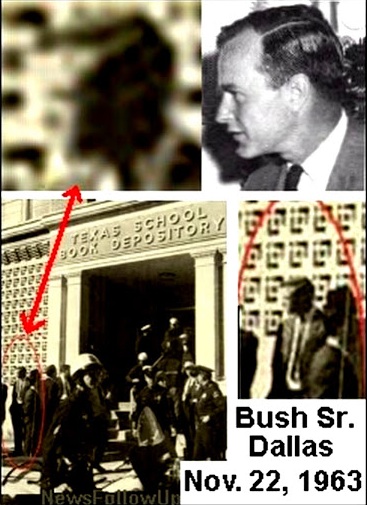
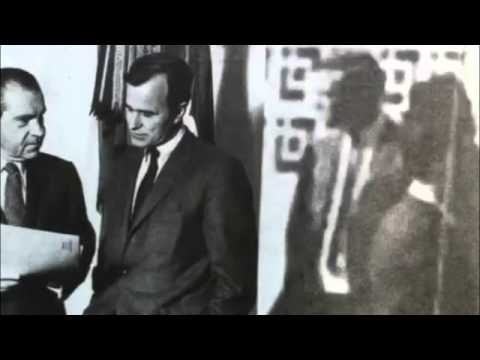
The photo on right, comparing the posture of a figure standing in a suit and tie is striking. George H.W. Bush Sr. later went on to be the director of the CIA, only for 2 years, under Gerald Ford. But Bush"s impact on the establishment would be large, as he would later be Reagan"s Vice President (and rumored that was more of a "President" during this time than Reagan ever was) and eventually President of the United States, and father of a future president, George W. Bush (his son).
(NOTE: It is interesting that the shadowy figure would 30 years later popularize the phrase "One World Order")
What kind of "organization" is out of the public view, has the means to organize such an assassination, and the motive? All points to one organization, really the only capable organization of organizing such a project. Look at some evidence, such as this list compiled by Wikispooks, of attempted or successful assassination attempts on foreign leaders organized by the CIA since World War 2: https://wikispooks.com/wiki/US/Foreign_Assassinations_since_1945 And here"s "Alleged Assassination Plots Involving Foreign Leaders" as compiled by the US Senate in 1975: CIA_Alleged Assassination Plots Involving Foreign Leaders
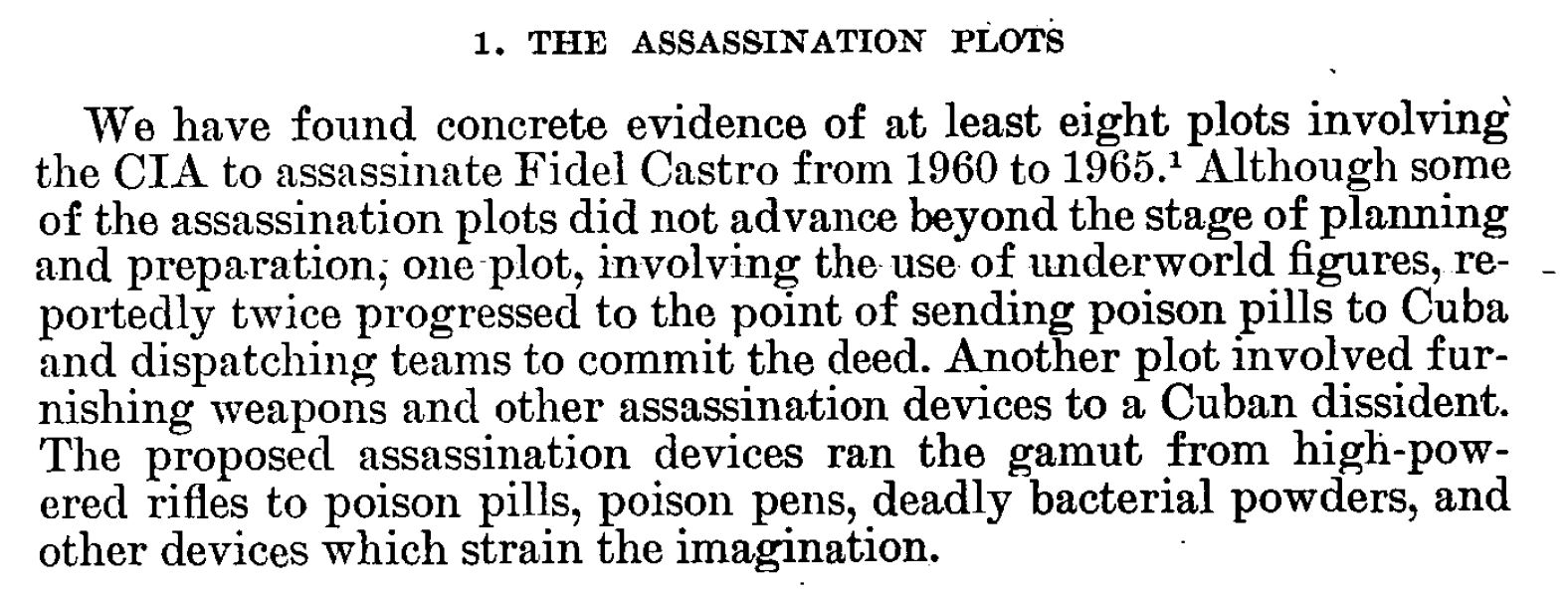
With such overwhelming evidence of the CIA"s involvement in foreign assassinations, if only one of these "plots" is true it"s reasonable to assume they all are true because after all, the CIA is a spy agency, not an overt military operation, so most of this is done with the clandestine service. And, if the CIA really does have a "hit squad" trained to topple and kill foreign dictators, then it is reasonable to assume this same operative group inside the CIA could potentially use this same group domestically. In fact, it is the only group in the world capable of assassinating a US President so successfully, including the use of insiders to change the course of the motorcade, for example.
Or to use another analogy as a means of deductive logic, 95% of hackers are inside jobs - in other words, hackers very rarely breach security from the "outside" - they rely on a rogue employee, security expert, or insider to provide key information such as passwords or other details needed to complete the job. This must have been the case with the murder of JFK because without those on the inside, such an epic target would not have been possible to hit. It was for this reason the "higher ups" at the FBI wanted this case closed and not discussed, because there clearly were insiders working against JFK who provided key info and modifying security protocols leading to the assassination.
As referenced by NY Times, the peak of outrage against the CIA for such plots was in the mid 1970s:
The peak of outrage against government-sponsored assassination was the mid-1970s, when the Senate Select Committee to Study Governmental Operations — better known as the Church committee — spent more than 60 days questioning 75 witnesses about C.I.A. plots of the late 1950s and early 1960s. Back in the darkest days of the cold war, the agency had devoted significant resources and creativity to devising unhappy ends for unsavory or inconvenient foreign leaders. Among those listed for assassination were Patrice Lumumba of the Congo, Ngo Dinh Diem of South Vietnam, Rafael Trujillo of the Dominican Republic and, most famously, Fidel Castro of Cuba, who survived no fewer than eight C.I.A. assassination plots. The senators on the committee were intent on divining the full extent of the government’s role in these plots. How much direct authority, for example, did Presidents Dwight Eisenhower and John Kennedy exert over them? The committee’s conclusions were vague at best. The truth was that neither president would have allowed his hand to show in such affairs. Times have changed. Our president now interrupts regularly scheduled broadcasting to announce the news of an assassination himself.
Perhaps the details of the JFK murder, public coverage, and FBI investigation would have been different had it happened in 2010. Certainly it was a different time, before the internet, and at a time of much happiness and prosperity. Since "JFK" we"ve had "911" which is another game changer event that put the US on a different path as it was during the 90s. Perhaps every generation needs such an event to "remind" them of who is in charge? (Dr. Tony Blanton from Pine Crest Prep School is ringing in my ears "history is a struggle between the haves and the have nots and you are the movers and the shakers who are going to change society")
What secrets are the "shadow government" protecting or are they simply exercising their power to show the have nots that their ownership of the planet is above any government, any nation state, religion, or other entity? The UFO issue is concerning, particularly due to security concerns; because the information we do know is only bits and pieces from whistle-blowers and a few encounters that are not well documented. There are rumors that Eisenhower himself made a deal with the Aliens to keep them a secret in exchange for technology transfer through the military and corporate America. Maybe it was a good deal, maybe it never happened - who knows? The point is that, until real discovery and disclosure is achieved, we will be in the dark regarding important issues that can impact daily life on planet earth. Some important questions we need to ask beyond the shock value of understanding we are not alone in the universe:
- Who are these aliens, what do they want? What has been "agreed" with them, if anything, and what current involvement do they have with US Military operations?
- What of the stories that some of these creatures are multi-dimensional, or from another "timeline" (that they aren"t aliens from other planets but beings that live in many dimensions)?
- How can we address issues of exo-politics if the CIA was dethroned as the sole security to Area 51 and ultimately, controlling the diplomacy between such aliens, if any?
- Is there any truth to the stories they are abducting humans for purposes of experimentation, whether it be biological or genetic? What about the "hybrid" projects? If there is truth to it, how to stop it?
- Do aliens have any current business arrangements with US corporations, US politicians, or are involved in major conflicts in any way? If so, this urgently needs to be addressed, and contracts re-evaluated. For example there are many accounts that UFOs were seen when nuclear warheads went dead (if even for a test).
- Are there any secret government "libraries" or "archives" where files about aliens are kept, if so - where are they and in what format?
What"s interesting about this issue that it seems to be a wealth of information right here under our own desert. It"s like the metaphor about exploring space when we know less about our deep oceans. There again, rumors of alien bases under the deep seas. The amount of information regarding the veracity of such stories is immense, and it has gone parabolic in the last years as many who were alive and working during these times before modern security protocols and training were in place, are retired, dying, or have passed information onto children.
Part 2: The New Evidence
1963 was a long time ago. New facts and evidence have surfaced, most interestingly - we are on the precipice of a major data dump by the US Government still to be determined, scheduled for "sometime" in 2o17. See explanation from http://2017jfk.org :
In 1992, the President John F. Kennedy Assassination Records Collection Act mandated that in 2017 all remaining JFK records and redactions be released. However, the National Archives has recently informed federal agencies that if they intend on maintaining secrecy over these records they should begin preparing appeals to the next president of the United States. We are working to ensure that the law is upheld. We are calling on you, fellow Americans, to come together and ensure that our government upholds the law.
The parallel of the information secrecy both for the JFK murder and the UFO issue, and their purported interconnection, is interesting. If state secrets or a modern political organization were not at stake, why the hold up to release information about JFK? Everyone mostly already believes it was the CIA, a group we have shown capable of organizing assassinations of many foreign leaders, and recently (2016) was caught meddling in a US domestic election. The UFO issue can be the motive to cover up the JFK murder for so long, so deeply. And the less obvious, more subtle "can of worms" argument, that if the US Government lied and hid the facts about JFK, of course - everything else including the 9/11 investigation would be open for re-investigation. This is another reason for waiting for so long because there"d be no one to "blame" as those who orchestrated the conspiracy / cover-up would all be dead by now (or so the thinking of this strategy goes).
A recording of radio communications to and from Air Force One on November 22,1963, discovered in 2011, is among the most important new pieces of JFK evidence to emerge in recent years,
The tape, an edited excerpt from a longer recording, captures some of the communications of the leaders of U.S. national security agencies as they learned about the assassination of a sitting president.
I wrote about the importance of the Air Force One tape in the fall of 2013:
“Audio engineer on the trail of a long-lost JFK tape” (JFK Facts, Nov. 6, 2013)
“Enhanced Air Force One tape captures top general’s response to JFK’s murder” (JFK Facts, Oct. 19, 2013)
You can listen to it here.
Where was the Air Force One tape found?
This old-fashioned reel of analog tape surfaced at Philadelphia auction house in 2011. The recording was found in the estate of the family of Gen. Chester Clifton, a military aide to JFK. Clifton died in 1991. His children put the estate up for auction.
Bill Kelly, a JFK researcher, enlisted Primeau Forensics, a Michigan audio engineering firm, to produce a cleaned-up version of the tape.
What is significant in this piece of information, as far as data analysis is concerned, is the source. It was an unclassified transcript of a non-essential to the JFK operation (Project Environment). It only "suggests" through information via what was said and not said, and as such, is not a "smoking gun". But much like the UFO phenomenon, in a similar thread - it seems that it"s simply IMPOSSIBLE to keep such a high profile operation secret for so long. The analogy to the UFO issue is Dr. Steven Greer"s "Disclosure Project" available at www.disclosureproject.org; in summary:
Beginning in 1993, I started an effort that was designed to identify firsthand military and government witnesses to UFO events and projects, as well as other evidence to be used in a public disclosure. From 1993, we spent considerable time and resources briefing the Clinton Administration, including CIA Director James Woolsey, senior military officials at the Pentagon, and select members of Congress, among others. In April of 1997, more than a dozen such government and military witnesses were assembled in Washington DC for briefings with Congressmen, Pentagon officials and others. There, we specifically requested open Congressional Hearings on the subject. None were forthcoming.
These materials are, as you can now discern, only the tip of the iceberg of what we have recorded on digital videotape. That is, from over 120 hours of testimony by over 100 witnesses we transcribed only 33 hours and then further edited materials down to a fraction of that amount. Moreover, the full archive represents the testimony of only 100 witnesses of the more than 400 identified to date. The edited testimony will be appearing in book form. A portion of it appears in The Disclosure Project Briefing Document and only small excerpts and summary bios of testimony appear in this Executive summary. We hope in the future to secure funding for a 5-6 part broadcast quality video documentary series to be made from the videotaped testimony we have as the impact of hearing and seeing these witnesses speak is very moving.
This then brings me to my last point: The witnesses who have given testimony to date are extraordinarily brave men and women - heroes in my eyes - who have taken great personal risks in coming forward. Some have been threatened and intimidated. All are risking the ever-present ridicule that attends this subject. Not a single one of them has been paid for his or her testimony: It has been given freely and without reservation for the good of humanity. I wish to personally thank them here and extend to them my personal, highest respect and gratitude.
This summary is focusing on the testimony of important first-hand witnesses. We have thousands of government documents, hundreds of photographs, trace landing cases and more, but it is impossible to include them in a summary of this length. These materials will be made available for any serious scientific or Congressional inquiry.
These 2 issues are interrelated on so many levels, it"s only fitting that both have strong nonclassified, civilian groups dedicated to identifying, collecting, archiving, sorting, and classification of all relevant information on the topics. They are after all, significant issues, with implications on all sciences. These 2 topics may even be more important than recent scientific discoveries. For example, as hundreds of high level government witnesses have testified in the disclosure project, one of the technologies kept under lock and key by the CIA (as reverse engineered from ET) are several energy technologies including but not limited to "zero point" energy which would literally, instantly end our dependence on oil, coal, and nuclear. This is just the tip of the iceberg, as hundreds of ground breaking tech has been leaked from ET such as thorium "clean" nuclear technology, Kevlar, nanotechnology, advanced long distance energy communication, the ability to manipulate space time (or at least, to pass through a "wrinkle" in time), and hundreds of others. The business element of this provides a solid motive alone, without religious, social, or political implications. There would be no need for 90% of the Fortune 500, the stock market would crash and the entire economic system as we know it would be immediately restructured (who would pay for gas when free energy is available?).
The public stated reason, for locking away the JFK files for 75 years, which plausibly is also the reason of keeping UFO information secret; is that the public "cannot handle the truth" - that it would be "too much to handle" - the first implication being some embarrasing political facts, such as the fact that the CIA with the help of insiders like LBJ were critical to the murder or completely organized it themselves. But that"s not hard to swallow, generations of hardened Americans watching real-time cameras on missiles bombing and maiming brown people (mostly) have become desensitized to such emotional dribble. But the elephant was in the room all along - this "shocking" fact really is shocking, because it would change every aspect of life on our planet - quite literally (not figuratively). For example, having free energy would change manufacturing, transportation, computing - just about everything. It would change war, it would have implications into governance, we can skip religious implications and take the lead from the Catholic Church who is ahead of the information curve on this issue (for obvious reasons).
There is a lot of new evidence, much of which has been referenced in the below documentary - we chose this as an example because it was likely overlooked during the sweep of evidence hiding.
So there we have it, the JFK murder has been solved.
WHO - It was a sub-set of the Intelligence aparatus, MJ12/CIA under the direction of Allen Dulles operated by Jesus James Angleton, involving multiple CIA agents including but not limited to George H.W. Bush Sr.
WHAT - The murder of John Fitzgerald Kennedy (JFK) US President, Elite leader, representative of the powerful Kennedy clan, Irish Catholic, father, patriot, and civil servant
WHERE & WHEN - Dallas, Texas November 22, 1963
HOW - A fine tuned machine prepared the ultimate kill scene, which involved extensive research and planning, significant funding, resources, highly skilled and trained soldiers, and a "cover-up" scenario which had to involve LBJ and others around JFK.
WHY - To maintain the big Illuminati secret - that the US Government has obtained technology from other worlds, given to us directly and reverse engineered, and this transfer of tech continues to this day - and that the revelation of what happened to JFK regarding the UFO issue would start a chain of events that would finally lead to the complete disclosure of this technology, and thus - change the entire global political and economic system forever.
Part 3: JFK to 911 Everything is a Rich Man"s Trick
This is a well documented detailed documentary that simply connects the dots between JFK and 911, and basically exposing the "pattern" of such events, we can include the recent shootings in Las Vegas to the long string of such events. Some call them "false flag" operations or "PsyOps" but really they are no more significant than your local pest control guy planting nests of ants and roaches near your home when business is slow. Since World War 2 there has not been a serious threat to the United States - and at the same time the US Military "over prepared" for the possibility of going to war with ten planets, so all that needs to be justified. The Military Industrial Complex needs an enemy, it doesn"t matter if the enemy is Russia, or terrorists.. or aliens..
READ OUR LATEST BOOK SPLITTING BITS @ WWW.PLEASEORDERIT.COM/BITS
Research Links
BOOKS - Kennedy"s Last Stand: Eisenhower, UFOs, MJ-12 & JFK"s Assassination
An interesting leaked email from Edgar Mitchell to John Podesta
The New Starting Point - Another look at JFK with new research
Mark the Date - List of classified documents to be released regarding JFK
7 Key Facts we"ll learn with release of JFK files
Was JFK shot for his interest in UFOs?
Short list of investigative groups, information sources, and other JFK related material sources:


Sunday, August 6, 2017
Only Ten Years After The Last Financial Crisis the Banks Are At It Again
Via Jesse"s Cafe Americain blog,
Apparently the Banks have been lobbying heavily, and expending significant amounts of money again, leaning on their Congressmen and pressuring regulators, saying that their capital standards need to be relaxed so that they can make more loans to stimulate economic growth.
But that, according to the FDIC Vice-Chairman, is utter nonsense.
Hoenig, who was a high-ranking Federal Reserve official during the crisis, cautioned Senate Banking Committee Chairman Mike Crapo and the committee"s senior Democrat, Sherrod Brown, "against relaxing current capital requirements and allowing the largest banks to increase their already highly leveraged positions."
Using public data to analyze the 10 largest bank holding companies, Hoenig found they will distribute more than 100 percent of the current year"s earnings to investors, which could have supported to $537 billion in new loans.
On an annualized basis they will distribute 99 percent of net income, he added.
He added that if banks kept their share buybacks, totaling $83 billion, then under current capital rules they could boost commercial and consumer loans by $741.5 billion.
"While distributing all of today’s income to shareholders may be received well in the short run, it can undermine their future returns and weaken the growth outlook for the larger economy," he wrote."
- Reuters, Payouts, not capital requirements, to blame for fewer bank loans: FDIC vice chairman
The Banks are spending a substantial amount of their current income on dividends to shareholders and large stock buyback programs designed to increase their share prices.

The chart above shows in the first column the almost shocking Payout Ratios being maintained by some of the Banks.
In the second column there is an estimate of how many more loans the Banks could have made at current capital requirements if they had not spent their cash buying back their own shares.
Since Bank managers are personally heavily rewarded on the share price of the Banks through bonuses and share options, the cause of this is clear.
There has been insufficient reform in the Banks. Lending and basic banking would better function like a utility, with much more efficient and effective levels of risk management.
Basic banking including loans and deposits ought not to be an adjunct or cover for the kinds of speculation and gambling with other people"s money that led to the last financial crisis that brought the global economy to its knees.
This problem was addressed by Glass-Steagall and functioned very well, keeping the banking system essentially sound for almost seventy years, until it was repealed under the Clinton Administration in conjunction with a Congress all too willing to sacrifice the interests of their voters to Big Money.
* * *
"If at times his [Andrew Jackson"s] passionate devotion to this cause of the average citizen lent an amazing zeal to his thoughts, to his speech and to his actions, the people loved him for it the more. They realized the intensity of the attacks made by his enemies, by those who, thrust from power and position, pursued him with relentless hatred. The beneficiaries of the abuses to which he put an end pursued him with all the violence that political passions can generate. But the people of his day were not deceived. They loved him for the enemies he had made.
Backed not only by his party but by thousands who had belonged to other parties or belonged to no party at all, Andrew Jackson was compelled to fight every inch of the way for the ideals and the policies of the Democratic Republic which was his ideal.
An overwhelming proportion of the material power of the Nation was arrayed against him. The great media for the dissemination of information and the molding of public opinion fought him. Haughty and sterile intellectualism opposed him. Musty reaction disapproved him. Hollow and outworn traditionalism shook a trembling finger at him. It seemed sometimes that all were against him—all but the people of the United States.
Because history so often repeats itself, let me analyze further. Andrew Jackson stands out in the century and a half of our independent history not merely because he was two-fisted, not merely because he fought for the people"s rights, but because, through his career, he did as much as any man in our history to increase, on the part of the voters, knowledge of public problems and an interest in their solution. Following the fundamentals of Jefferson, he adhered to the broad philosophy that decisions made by the average of the voters would be more greatly enduring for, and helpful to, the Nation than decisions made by small segments of the electorate representing small or special classes endowed with great advantages of social or economic power.
He, like Jefferson, faced with the grave difficulty of disseminating facts to the electorate, to the voters as a whole, was compelled to combat epithets, generalities, misrepresentation and the suppression of facts by the process of asking his supporters, and indeed all citizens, to constitute themselves informal committees for the purpose of obtaining the facts and of spreading them abroad among their friends, their associates and their fellow workers."
Franklin D. Roosevelt, Jackson Day Dinner Address, Washington, D.C.
January 8, 1936
As an aside, I find it telling that the current crop of Democratic Party plutocrats want nothing to do with the policies of Jackson or Roosevelt.
I think the reasons are obvious. I would like to think that they are merely mistaken. But it is clear that they are serving the masters that they love the most. As for the Republicans, they have long ago betrayed their roots and become the servants of Big Business, and seem to be beyond all hope of reform.
Monday, July 17, 2017
John Mauldin Warns "Prepare For Turbulence"
Authored by John Mauldin via MauldinEconomics.com,
“The job of the central bank is to worry.”
– Alice Rivlin
“The central bank needs to be able to make policy without short-term political concerns.”
– Ben Bernanke
“… from the standpoint of the overall economy, my bottom line is we’re watching it closely but it appears to be contained.
– Ben Bernanke, repeatedly, in 2007
“Would I say there will never, ever be another financial crisis? You know, probably that would be going too far, but I do think we’re much safer, and I hope that it will not be in our lifetimes, and I don’t believe it will be.”
– Janet Yellen, June 27, 2017
“My good friends, for the second time in our history, a British Prime Minister has returned from Germany bringing peace with honor. I believe it is ‘peace for our time.’ Go home and get a nice quiet sleep.”
– Neville Chamberlain, September 30, 1938
Photo: Monica Muller via Flickr

The way we assess problems depends on our perspective. People can look at the same set of facts and reach quite different conclusions based simply on their circumstances. This is why it’s good at times to get away from your normal environment. Listen to a wide variety of opinions. Read books outside of your comfort zone. You’ll see things differently when you return.
I had that feeling on returning to the US from Shane’s and my honeymoon in St. Thomas. We’re now officially married, and we thank everyone for the congratulations and kind wishes. I saw a little bit of news while we were there but spent more time just relaxing with my bride and reading books.
Re-entering the news flow was a jolt, and not in a good way. Looking with fresh eyes at the economic numbers and central bankers’ statements convinced me that we will soon be in deep trouble. I now feel that it"s highly likely we will face a major financial crisis, if not later this year, then by the end of 2018 at the latest. Just a few months ago, I thought we could avoid a crisis and muddle through. Now I think we’re past that point. The key decision-makers have (1) done nothing, (2) done the wrong thing, or (3) done the right thing too late.
Having realized this, I’m adjusting my research efforts. I believe a major crisis is coming. The questions now are, how severe will it be, and how will we get through it? With the election of President Trump and a Republican Congress, your naïve analyst was hopeful that we would get significant tax reform, in addition to reform of a healthcare system that is simply devastating to so many people and small businesses. I thought maybe we’d see this administration cutting through some bureaucratic red tape quickly. With such reforms in mind I was hopeful we could avoid a recession even if a crisis developed in China or Europe.
Six months in, the Republican Congress that promised to repeal and replace Obamacare, cannot even agree on the process. For six years they discussed what to do, and you would think they might at least have a clue.
Tax reform? I’ve been talking with several of the Congressional leaders about tax reform, pointing out that without major tax reform this country is in danger of falling into a recession. No tinkering around the edges. Real change requires real change. There is now talk of having a tax bill of some kind ready to discuss in September and possibly pass in November, which, with this Congress, means that the process is likely to drift into next year sans a major push by the leadership. There is no consensus. No less an authority on the actual political process than Newt Gingrich wrote a very sharply worded column this week, declaring, “That legislative schedule is a recipe for disaster.” As Newt points out, if we are going to see any positive economic effect from tax reform, a bill has to be passed soon and implemented. Newt’s column was actually fairly discouraging to me. Knowing him as I do, I can tell you he wasn’t happy to have to write it. While I disagree with him on some of his tax-reform proposals, I agree that we need something significant and soon.
There has been some progress on the bureaucratic and regulatory fronts, but nowhere near what I’d expected. Appointments haven’t been made, and the bureaucracy is still in control of most of the levers of the economy.
I’d love to be wrong. Nothing would make me happier than having to eat all these words. But without significant changes, and soon, the economy will drift sideways and down. While second-quarter GDP growth will come in above 2%, the figure for the first six months of this year will remain below 2%. A host of indicators show a softening of the economy. For instance, , with a glut of more than 7 million previously leased cars clogging the auto market, new-car production is projected to continue to fall. Consumers are financially stretched, and credit card and student loan defaults have begun to rise. While there are bright spots, without major reforms the economy will drift lower, toward stall speed. Any outside shock – and several may be in the offing – could push us into recession.
And then we come to central banks.
Afraid of the Truth
One news item I didn’t miss on St. Thomas – and rather wish I had – was Janet Yellen’s reassurance regarding the likelihood of another financial crisis. Here is the full quote.
Would I say there will never, ever be another financial crisis? You know probably that would be going too far, but I do think we’re much safer, and I hope that it will not be in our lifetimes and I don’t believe it will be. [emphasis added]
I disagree with almost every word in those two sentences, but my belief is less important than Chair Yellen’s. If she really believes this, then she is oblivious to major instabilities that still riddle the financial system. That’s not good.
She may be right in that the future financial crisis will not look like the last financial crisis, at least in the United States. We have repealed the law passed under George W. Bush that allowed major banks to lever up 30 to 1. (What were they thinking?) We have required banks to recapitalize and to reduce their market-making activities in the bond market, theoretically reducing their risk of insolvency. And we have put in place all sorts of profitability- and productivity-reducing regulations. While these may be appropriate for larger financial institutions, they are choking the life out of smaller community banks, and thereby reducing the availability of capital to small businesses. Is it any wonder that we are seeing more businesses failing than being launched?
But like generals fighting the last war, central bankers will find that the next financial crisis will be fought on different fronts, with entirely different components and opponents. There is an appalling lack of liquidity and market-making available in the major fixed-income markets, something the banks used to provide, and now by regulatory statute they can’t. Oh, everything is just fine right now, but the moment we hit a speed bump, the liquidity and market-making capability that is left will simply dry up.
In theory, the Fed probably can’t provide liquidity for that type of market, but I will bet you a dollar to 47 doughnuts that they will find some loophole that authorizes them to step in somehow; otherwise there will be a spiral downward in the debt markets. Some markets will spiral up, and some will spiral down. We have once again created all kinds of new debt instruments as investors reach for yield in this low-rate environment, and there will simply be no market liquidity for them in a crisis. A flight to safety will ensure that long-term Treasury rates will plunge to levels that we have not yet seen.
I could list other imbalances in the financial markets, but you get the picture.
Financial politicians (which is what central bankers really are) have a long history of saying the wrong things at the wrong time. Far worse, they simply fail to tell the truth. Former Eurogroup leader Jean-Claude Juncker admitted as much: “When it becomes serious, you have to lie,” he said in the throes of Europe’s 2011 debt crisis.
They lie because they’re afraid of the impact the truth will have. This is a problem, because markets can’t function on false information, at least not indefinitely. The best thing for everyone is to let markets adjust naturally, even though confronting reality can mean short-term pain for some participants. And sometimes it does make sense to cushion the blow. It doesn’t make sense to cover over a problem for years, let it get bigger and bigger, and postpone acknowledging it until the worst possible time. Yet that’s what usually happens.
In fairness to the financial politicians, they often deal with situations where all the choices are bad. More often than not, that’s because their predecessors made similarly bad choices under similarly difficult conditions. The string of mistakes goes back decades. That is our situation today. We think governments and central banks are powerful, and they are in some ways, but they aren’t omnipotent. They don’t have monetary magic wands.
They also face enormous pressure to “do something,” even when the right thing is to do nothing and just let the market clear.
We Couldn’t Take the Chance
To understand what will be the mindset of central bankers all over the world during the next financial crisis, I can think of no better illustration than a debate that was conducted at the annual gathering of economists that David Kotok convenes in Maine in August. This debate provided an “aha!” moment, one that has been fundamental to my understanding of how central banks work in the midst of a crisis. Let’s rewind the tape to four years ago, when I wrote about that moment while it was still fresh in my mind.
On Saturday night David scheduled a formal debate between bond maven Jim Bianco and former Bank of England Monetary Policy Committee member David Blanchflower (everyone at the camp called him Danny)….
The format for the debate between Bianco and Blanchflower was simple. The question revolved around Federal Reserve policy and what the Fed should do today. To taper or not to taper? In fact, should they even entertain further quantitative easing? Bianco made the case that quantitative easing has become the problem rather than the solution. Blanchflower argued that quantitative easing is the correct policy. Fairly standard arguments from both sides but well-reasoned and well-presented.
It was during the question-and-answer period that my interest was piqued. Bianco had made a forceful argument that big banks should have been allowed to fail rather than being bailed out. The question from the floor to Danny was, in essence, “What if the Bianco is right? Wouldn’t it have been better to let banks fail and then restructure them in bankruptcy? Wouldn’t we have recovered faster, rather than suffering in the slow-growth, high-unemployment world where we find ourselves now?”
Blanchflower pointed his finger right at Jim and spoke forcefully. “It wasn’t the possibility that he was right that preoccupied us. We couldn’t take the chance that he was wrong. If he was wrong and we did nothing, the world would’ve ended, and it would’ve been our fault. We had to act.”
Blanchflower’s explanation made me realize that central bankers are quite human and so are their reactions in the middle of a crisis. They feel that they have to do something.
Policy Brick Wall
The present challenge arises because our central bank monetary heroes allowed QE, ZIRP, and in some places NIRP to persist far longer than was wise. You can make the case that these measures were necessary in 2008 and for a short period thereafter; but these policies should not have remained in place, much less been expanded, for 7-–9 more years. Yet they were. That this was a mistake is now clear to almost everyone. Iin hindsight. What to do about it is less clear.
On the positive side, our central bankers are talking about the problem. The kool kids’ new buzzword is policy normalization. Everyone (except the Bank of Japan) agrees that abnormality has outlived its usefulness. That’s important: Admitting your problem is the first step to solving it.
However, solutions are difficult when that first timid step runs you smack into a brick wall that you yourself built because you waited too long to act.
It was mid-2013 when Ben Bernanke first suggested the Fed might “taper” down its bond purchases. The Taper Tantrum ensued and stopped him from implementing the policy he clearly thought was right. It fell to Janet Yellen to implement the taper and then make one very tiny rate hike in December 2015. Another tantrum followed, this one centered in China. Plans to raise rates further were again postponed. As I noted in “Mad Hawk Disease” two weeks ago, Fed governors were clearly mindful of what would happen to the then-current Democratic administration if a policy error precipitated a recession. “We couldn’t take the chance.” They ignored Ben Bernanke’s admonition that “The central bank needs to be able to make policy without short-term political concerns.”
Now, with a Republican administration and Congress, the FOMC apparently feels no such concern about the potential for a policy error. We will never know, but I wonder if they would now be raising rates under a Clinton administration. It’s actually a serious question.
Having waited four years too long, the Fed, the ECB, and the Bank of England are finally tightening in a strange combination of caution and boldness. You may have heard public officials talk of being “cautiously optimistic.” The central bank version of that is “cautiously aggressive.” Each passing month makes them less cautious and more aggressive, it seems. Like kittens, they venture out from their mother gingerly at first but soon are romping underfoot and destroying furniture.
Source: Financial Times

That may be an amusing analogy, but reality is not amusing at all. The four largest central banks together have about $13 trillion on their balance sheets, a large portion of which they believe needs to roll off. Removing it without breaking something important will not be easy.
Least-Bad at Best
The central bankers are not unaware of this challenge. They have a conscience of sorts in the Bank of International Settlements, and it is whispering in their ears as loudly as it can. BIS economist Claudio Borio, in the institution’s annual report last month: “The end may come to resemble more closely a financial boom gone wrong, just as the latest recession showed, with a vengeance.”
The report’s monetary policy section was even more direct (emphasis mine):
Policy normalisation presents unprecedented challenges, given the current high debt levels and unusual uncertainty. A strategy of gradualism and transparency has clear benefits but is no panacea, as it may also encourage further risk-taking and slow down the build-up of policymakers’ room for manoeuvre.
That’s obvious, but it’s important that BIS said it. “Unprecedented challenges” may even understate the magnitude of what the Fed and other central banks are up against.
More from BIS:
In determining the pace of normalisation, central banks must indeed strike a delicate balance. On the one hand, there is a risk of acting too early and too rapidly. After a series of false dawns in the global economy, questions linger about the durability of this upswing. And the unprecedented period of ultra-low rates heightens uncertainty about reactions in financial markets and the economy.
On the other hand, there is a risk of acting too late and too gradually. If central banks fall behind the curve, they may at some point need to tighten more abruptly and intensively to keep the economy from overheating and inflation from overshooting. And even if inflation does not rise, keeping interest rates too low for long could raise financial stability and macroeconomic risks further down the road, as debt continues to pile up and risk-taking in financial markets gathers steam. How policymakers address these trade-offs will be critical for the prospects of a sustainable expansion.
I think that last part is too gentle. Financial-stability and macroeconomic risks are already elevated. Debt isn’t simply piling up; it’s up to the ceiling and pouring out the windows. Risk-taking in financial markets can hardly gather any more steam without blowing its top.
So yes, how policymakers address these trade-offs is indeed critical. But even if we assume our central bankers will act calmly and professionally – which perhaps we should not – the fact remains that they have no good options because they waited too long. “Least bad” is the best we can hope for, and I doubt we will get even that. The brick wall of bad decisions looms.
Getting Out of Dodge
“Get out of Dodge” was a phrase made popular by Marshall Matt Dillon on the TV show Gunsmoke in the ’60s. The phrase slipped into the youth culture and endures as a shorthand way of saying that you’d better leave town before the stuff hits the fan.
I believe the Fed is aware that they should have been raising rates earlier. They also understand the present risks. While I believe it is appropriate to raise rates slowly, I simply cannot understand why they would want to reduce their balance sheet at this late date, at the same time that they jack up rates. They could have been letting the balance sheet roll off for four years, but to do so now in conjunction with raising rates simply increases the risk of a policy error. But I don’t think they will see that as their problem.
Chair Yellen and I both believe the majority of the current governors will be gone by the second quarter of next year. It would not surprise me at all if Vice-Chair Fischer offers to resign before his term is up in June 2018. This Fed is going to raise rates a few more times, start reducing the balance sheet, and then get the hell out of Dodge.
Federal Reserve governors basically have a 14-year term, which reduces the ability of any one president to appoint a majority of the FOMC within a four-year term. Of course, resignations affect the balance.
Trump is going to have the unusual opportunity to appoint at least six, and more likely seven, governors by the middle of next year, if not sooner. Whether he wants it to be or not, this will be the Trump Fed. Without major reforms in place, the Trump Fed will face a recession, serious global economic issues, and a resulting major equity bear market. Think they will continue to raise rates? How long before they start to talk about supplying a little more QE to appease the markets?
The current FOMC simply hopes that everything holds together until they can slip out the back way from Dodge. Who do you think will get the blame for the next crisis? It should be this FOMC, but that’s not the way the real world works.
The Trump Fed will be politicized and stigmatized by its Democratic opponents no matter what they do. Howls for outside controls and oversight will rise in the night.
Global Contagion
The parlous state of the economy is not just an American problem, or a European or UK or Japanese or Chinese one. It is global.
I wonder whether Janet Yellen truly appreciates the degree to which Federal Reserve policy affects the entire world. Like it or not, the US dollar is the entire planet’s ultimate medium of exchange. One way or another, almost every financial transaction eventually settles in dollars. China and others would like to change that. Maybe they’ll succeed someday, but it won’t be this year or next.
That being the case, the way Fed policy impacts the dollar could make the inevitable crisis much worse. Looking only at the US, there’s a strong case for raising – oops, I mean “normalizing” – rates. Going to even 2% or 3% won’t kill our economy. But hiking rates will likely create other victims whose problems will soon become our problems, too.
Think of all the dollar-denominated debt owed by various emerging-market governments and businesses. Higher US rates will strengthen the dollar and make that debt costlier to service, almost certainly causing some defaults. In today’s highly leveraged markets, the pain caused by those defaults will quickly spread to lenders in Europe, Japan, and the US.
You might respond that more stringent capital requirements mean today’s banks are better able to withstand such scenarios. That’s partly true. It’s also true that the bank executives hate those requirements and are working assiduously to loosen them. These banks are also far larger than they were in 2008. Yes, they pass the Fed’s stress tests, but the Fed can’t test every possible adverse scenario. Generals always fight the last war. The next crisis probably won’t originate in residential mortgage loans. It will come from somewhere else, and we have no idea whether the banks are actually ready for it.
You and I can’t control whether banks are ready, but we can control whether we are ready. I am working on a number of fronts to help you. My brief time away convinced me beyond any doubt that a crisis of historic proportions is once again bearing down on us. We may have little time to prepare. We definitely have no time to waste.
Subscribe to:
Posts (Atom)